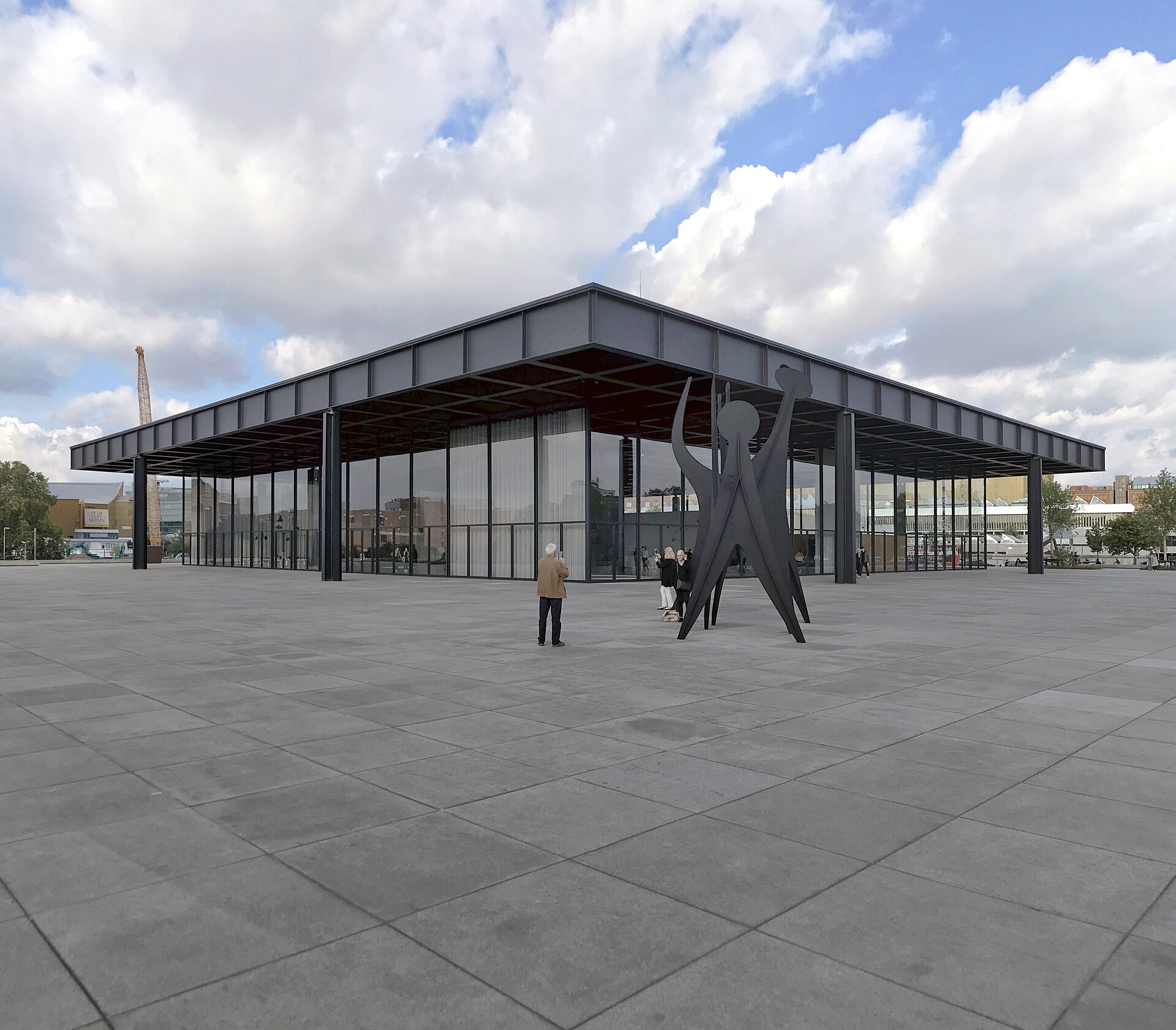
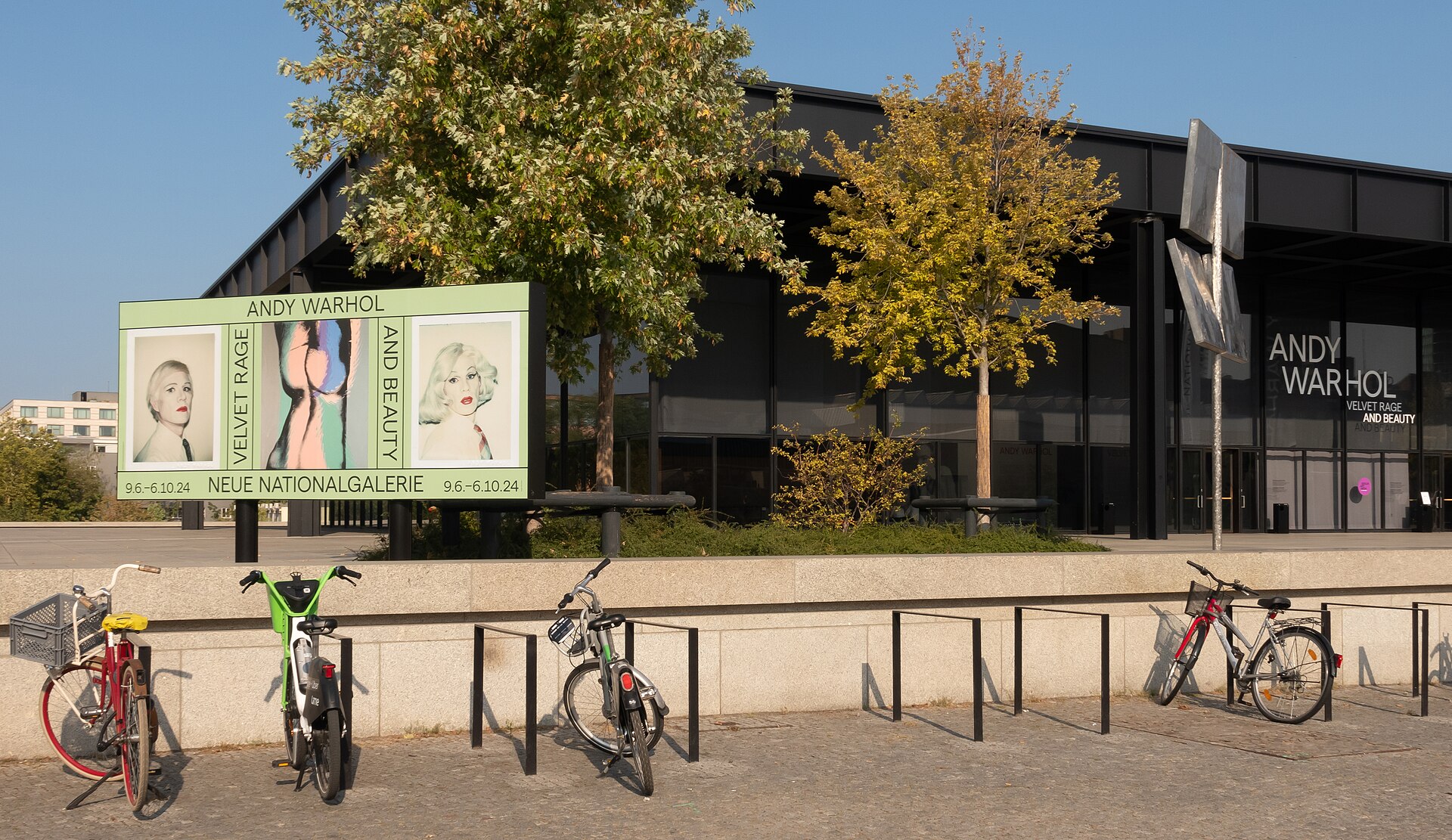
The building seen from the plaza after its 2015-to-2021 restoration, with a large abstract sculpture standing in front of the entrance. Vetted by eye before use.
Photograph by Gunnar Klack · CC BY-SA 4.0Neue Nationalgalerie
Museum · Founded 1968
Open, admission and hours confirmed 21 August 2026 · 8 sources
On this page 16 sections
ContentsClose
The Nationalgalerie's twentieth-century holdings: Cubism, German Expressionism, Bauhaus-era abstraction and Surrealism, with Picasso, Kandinsky, Miro and Barnett Newman among the names the museum's own material and Wikipedia's account both put forward. The building itself is the limiting factor on how much of it a visitor ever sees: the single upper hall is reserved for temporary shows and the permanent collection lives on a below-ground level built for practicality rather than drama, so the museum rotates its own holdings rather than displaying them in full. An expansion building, berlin modern, is under construction on the Kulturforum beside the Neue Nationalgalerie to a design by Herzog and de Meuron, intended to relieve exactly this space constraint.
| Kind | Museum |
|---|---|
| Founded | 1968 |
| City and country |  Berlin, Germany Berlin, Germany |
| Address | Potsdamer Strasse 50, 10785 Berlin, Germany |
| Website | smb.museum/en/museums-institutions/neue-nationalgalerie/home |
| Status | Open, confirmed |
| Record last verified |
Visiting
- Hours
- MondayClosed
- Tuesday, Wednesday, Friday to Sunday10:00 to 18:00
- Thursday10:00 to 20:00late opening
- Closed
- Monday.
- Admission
- Museum ticket, all exhibitionsEUR 2010 EUR concession
- Collection onlyEUR 147 EUR concession
- Ruin and Rush (special exhibition)EUR 105 EUR concession
- Kulturforum, all exhibitions across the siteEUR 2211 EUR concession
- Annual pass, Staatliche Museen zu BerlinEUR 25from 25 EUR, the cheapest annual pass
- Under 18Freefree with ID at the entrance
Free entry: Children and young people up to age 18 always enter free on presentation of ID. First Thursday of every month, 4pm to 8pm, free admission via the Art4All program- Tickets
- smb.museum/en/museums-institutions/neue-natio... The museum's own ticket page.
- Do I need to book?
- Not stated as required on the fetched visitor page.
- Address
- Potsdamer Strasse 50, 10785 Berlin, Germany MapU-Bahn / S-Bahn Potsdamer Platz
On foot Barrier-free entrance on the left side of the building on Reichpietschufer - Website
- smb.museum/en/museums-institutions/neue-nationalgalerie/home
- Telephone
- +49 30 266424242
Before you go how long, access, photography, bags, eating, shop
- How long to allow
- One large upper hall for special exhibitions and a below-ground level for the permanent collection; an hour to ninety minutes covers both, longer if the current Ruin and Rush exhibition is included.
- Access
- The museum states it is wheelchair accessible, with barrier-free access on the left side of the building on Reichpietschufer.
- Photography
- Not stated on the fetched pages; not published here.
- Bags
- Not stated on the fetched pages; not published here.
- Eating
- Cafe on site, per the museum's Gastronomy and Bookstore page (not fetched in detail for this research pass)
- Shop
- Museum bookstore on site
Prices and hours change. We take them from the institution's own pages and print the day we read them, and you can check the current position at the source we used. Confirm before you travel.
What is inside
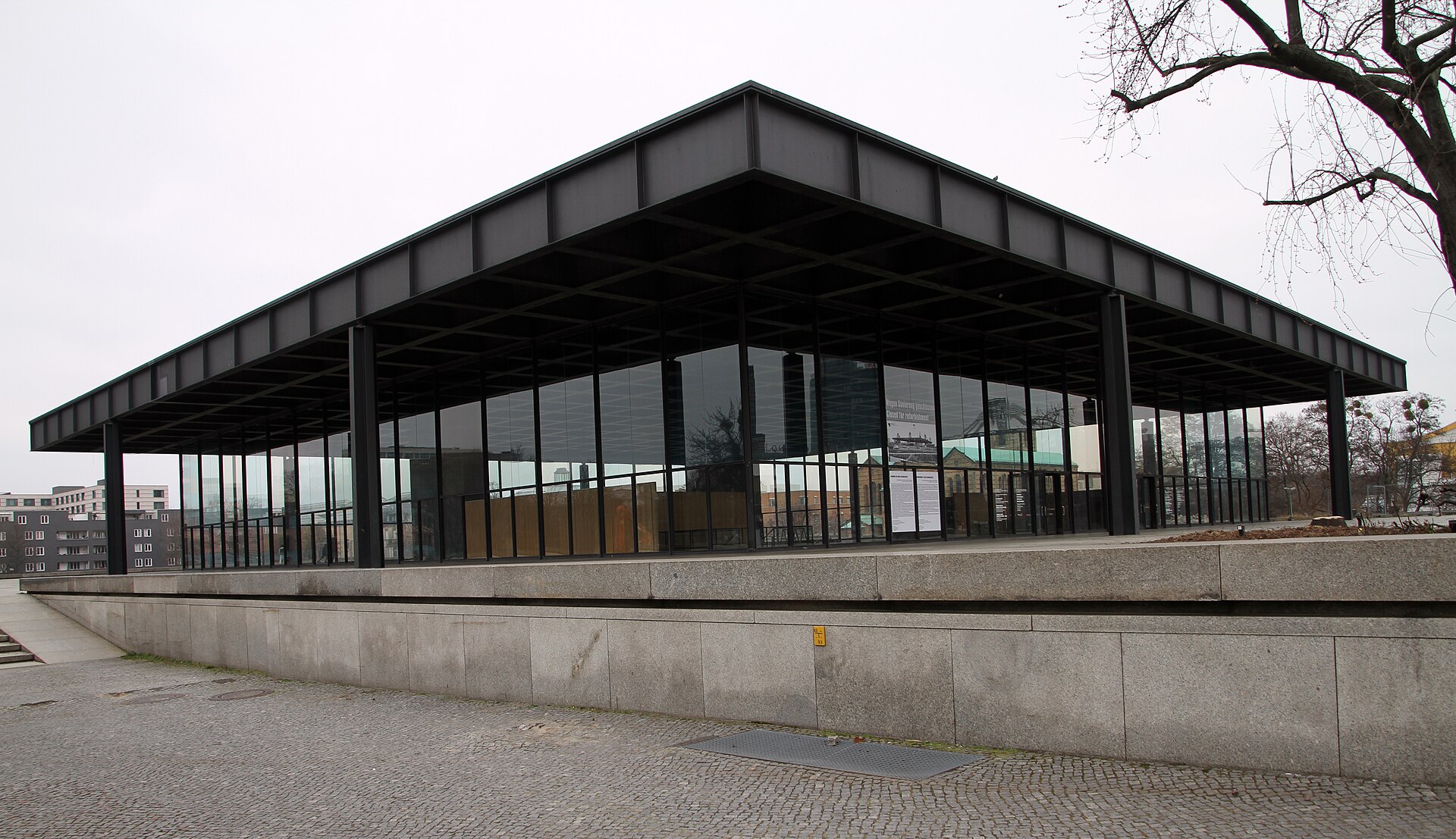
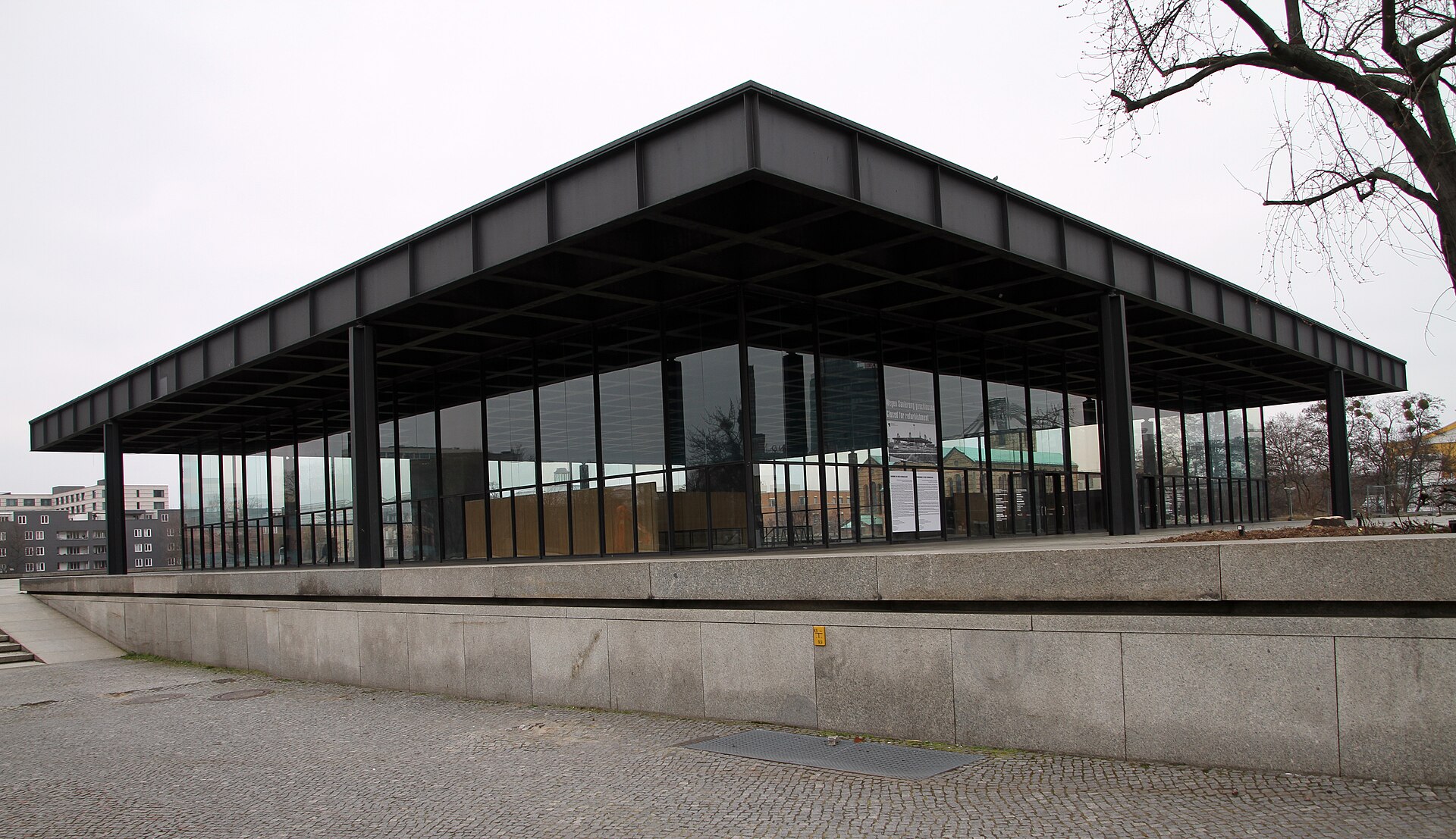
Photograph by Gerd Eichmann · CC BY-SA 4.0 The upper hall
A single column-free glass pavilion of about 2,683 square metres, raised on three flights of steps and carried by eight cruciform steel columns under an 18-metre cantilevered roof, with an 8.4-metre ceiling on a 3.6-metre structural grid; the granite floor and glazed walls that Mies van der Rohe designed to dissolve the boundary between the art and the city outside. Used for temporary exhibitions rather than a fixed hang, currently Ruin and Rush: Berlin 1910 to 1930.
The lower level
Roughly 10,000 square metres sitting three-quarters underground beneath the plaza, holding the permanent collection galleries, library, offices, shop and cafe; the part of the building that does the ordinary museum work the glass pavilion above was never designed to do.
The sculpture terrace
The plaza and steps around the glass pavilion carry large-scale outdoor sculpture, among them Henry Moore's Three Way Piece No. 2: The Archer of 1964 to 1965, Alexander Calder's Tetes et Queue of 1965, and Richard Serra's Berlin Block for Charlie Chaplin of 1978, all shown in the open rather than inside the building.
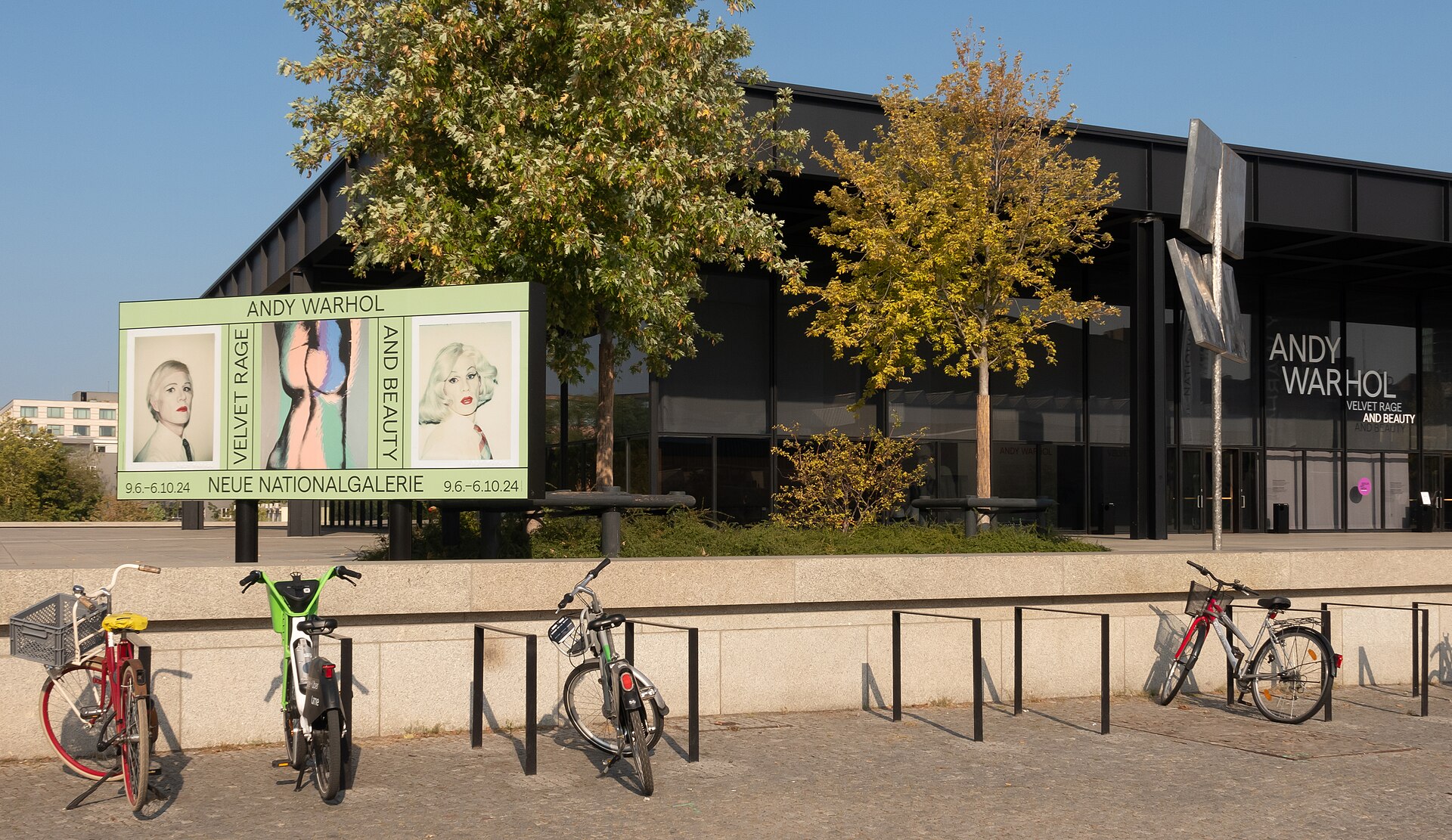
Photograph by Michielverbeek · CC BY 4.0 Ruin and Rush: Berlin 1910 to 1930
A current showcase, 25 April 2026 to 3 January 2027, of about 35 works from the Neue Nationalgalerie's own Classical Modern holdings, organised in three sections, Metropolitan Dynamism, Social Hardship and The New Woman, with paintings by Otto Dix, Hannah Hoech and Ernst Ludwig Kirchner alongside film clips from Metropolis and Berlin: Symphony of a Great City.
What to see first
The building itself
Ludwig Mies van der Rohe, 1965 to 1968Mies's last major built work, and on the museum's own account a design he developed from earlier unbuilt projects for a column-free glass pavilion; he attended the September 1965 cornerstone laying and the hydraulic raising of the steel roof two years later, and died within months of the building's 15 September 1968 opening.4
The 2015 to 2021 restoration
David Chipperfield ArchitectsA five-year closure that took the budget from an estimated 101 million EUR to an actual cost of about 140 million EUR by April 2021; the architects worked from archival material held at MoMA New York and the Library of Congress, and original elements including handrails and shelving were removed, restored and reinstalled in their original positions rather than replaced. Mies himself had refused earlier renovation proposals in his lifetime, on record as fearing they would ruin the building's proportions.5
The Archer
Henry Moore, 1964 to 1965 (Three Way Piece No. 2: The Archer)One of the large-scale outdoor sculptures the museum keeps permanently on the terrace rather than inside the glass hall, part of the building's original conception of art as something encountered in the open plaza as much as under the roof.5
Tetes et Queue
Alexander Calder, 1965A standing sculpture on the terrace from the same year the roof was raised, and the artist whose work reopened the building's special-exhibition programme in August 2021 after the Chipperfield restoration.5
Berlin Block for Charlie Chaplin
Richard Serra, 1978A later addition to the terrace sculptures, extending the outdoor programme from Mies's own era into the late twentieth century.5
Ruin and Rush: the Weimar-era collection on show now
Otto Dix, Hannah Hoech, Ernst Ludwig Kirchner and othersAbout 35 works from the museum's own Classical Modern holdings, on show 25 April 2026 to 3 January 2027, built around Berlin's contradictions between 1910 and 1930: excess and poverty, emancipation and extremism, with a section on queer identity and the New Woman as well as the city's built environment and traffic.8
The wider Classical Modern holdings
Picasso, Kandinsky, Barnett Newman, Miro and othersThe museum's core strength on Wikipedia's account of the collection, spanning Cubism, Expressionism, Bauhaus and Surrealism; the building's limited hanging space means only a rotating fraction of the full collection is ever on view at once.5
Exhibitions on now
- On now30 Apr to 25 Oct 2026Confirmed · check before you travel
Past exhibitions here
A name that meant a fresh start
The museum's own account of its name is direct: Neue Nationalgalerie, the New National Gallery, signalled a deliberate break from the old and the start of a new chapter, the cultural rebirth of West Berlin after the war. It opened on 15 September 1968 as part of the Kulturforum, the cultural district Hans Scharoun planned at what was then the edge of West Berlin, hard against the wall dividing the city. The building was Ludwig Mies van der Rohe's last major completed work. He attended the cornerstone laying in September 1965 and watched the enormous steel roof raised hydraulically into place two years later; he died within months of the building's opening, so the Neue Nationalgalerie is, among other things, the last building its own architect saw finished.
A hall built to define space rather than confine it
Mies had been developing the idea behind this building for years before Berlin commissioned it, through earlier unbuilt projects for a column-free pavilion meant to hold very large works and let them function as elements of the space itself rather than objects hung against a wall. What was built is a single glass hall of about 2,683 square metres, raised on three flights of steps, carried on eight cruciform steel columns, with an 18-metre cantilever between the glazed facade and the columns and an 8.4-metre ceiling on a 3.6-metre grid. It is, by any account, one of the purest statements of Mies's late architectural language anywhere. It is also, by the same accounts, a genuinely difficult room to hang art in: the granite floor and glass walls flood the hall with natural light that creates hazy, shifting shadow, and smaller works have needed freestanding or hanging partitions to be shown at all, which works against the openness the design was built to achieve. The bulk of the actual museum, the permanent collection, the library, offices, shop and cafe, sits on a second level built three-quarters underground beneath the plaza, out of sight and doing the practical work the glass hall above was never meant to do.
A restoration that worked like archaeology
The building closed in early 2015 for what became a five-year renovation led by David Chipperfield Architects, and it reopened on 21 August 2021 with an Alexander Calder exhibition. The Bundesamt fuer Bauwesen estimated the cost at 101 million EUR in January 2015; by completion in April 2021 the actual figure had reached about 140 million EUR. The method was closer to conservation archaeology than ordinary refurbishment: the architects worked from archival material held at the Museum of Modern Art in New York and the Library of Congress to establish the building's original condition, and original elements, handrails and shelving among them, were removed, restored and reinstalled in their previous positions rather than replaced with new fabric. The steel roof structure and the glass facade both underwent comprehensive restoration, including the replacement of 56 upper facade panes with new safety glass. Deferred modernisation was addressed at the same time: air conditioning, lighting, security, accessibility and the electrical and art-handling infrastructure a 1968 building was never built with. Mies himself had refused proposals to alter the building during his own lifetime, reportedly on the grounds that doing so would ruin its proportions; the 2015-to-2021 project is the first renovation the building has had since, and it was designed explicitly to restore rather than to update his original intentions.
Sculpture that never goes indoors
The plaza and terrace around the glass hall carry large outdoor sculpture as a matter of permanent policy rather than temporary display: Henry Moore's Three Way Piece No. 2, The Archer, of 1964 to 1965; Alexander Calder's Tetes et Queue of 1965, from the same year the roof itself went up; and, extending the collection into the later twentieth century, Richard Serra's Berlin Block for Charlie Chaplin of 1978. None of the three requires a ticket to see, which is consistent with Mies's own stated ambition for the building, art encountered in the same continuous space as the city around it rather than sealed off from it.
A collection the building cannot hold
The Nationalgalerie's twentieth-century collection, Cubism, Expressionism, Bauhaus and Surrealism, with Picasso, Kandinsky, Miro and Barnett Newman among the names most associated with it, is larger than the building was ever designed to show in full. The single upper hall goes to temporary exhibitions, currently Ruin and Rush: Berlin 1910 to 1930, a showcase of about 35 works from the museum's own Weimar-era holdings, organised around the city's contradictions of excess and poverty, emancipation and extremism, with paintings by Otto Dix, Hannah Hoech and Ernst Ludwig Kirchner and film footage from Metropolis and Berlin: Symphony of a Great City. The permanent collection rotates below ground rather than hanging in full, and a dedicated expansion building for twentieth-century art, berlin modern, is now under construction on the Kulturforum beside this museum to a design by Herzog and de Meuron, intended to give the collection room the Mies building was never meant to provide.
How to actually use it
Twenty euros covers every exhibition in the building, fourteen for the collection alone, and the 22 EUR Kulturforum ticket extends the same admission to the Gemaeldegalerie, the Kupferstichkabinett and the Kunstgewerbemuseum on the same site, worth buying if more than one stop is planned. Under-18s are free with ID at any time. The museum is open Tuesday to Sunday, 10:00 to 18:00, with a late Thursday closing at 20:00, and closed Monday; the current Brancusi exhibition extends Friday and Saturday evening hours to 20:00 on specific dates, which is worth checking against the museum's own calendar before a late visit. Most visitors clear the building, upper hall and lower galleries together, in an hour to ninety minutes; the sculpture terrace outside costs nothing extra and can be seen without a ticket at all.
What visitors say
The museum publishes no visitor prose and no platform rating on its own pages, so this rests on the institution's own material and on published architectural assessment. The building itself, rather than any single work inside it, is what the Neue Nationalgalerie is chiefly known for: Mies van der Rohe's last major work, a glass pavilion raised on eight columns under an 18-metre cantilever, treated internationally as a canonical statement of his late style. The building's own limitations are equally well documented: its single vast upper hall was never a practical exhibition space for a broad collection, which is why the permanent holdings live below ground and only a rotating fraction is ever on view, and the 2015-to-2021 restoration ran 39 million EUR over its original estimate.
What is praised, what is criticised
- Praised: the upper hall itself as architecture, a column-free glass pavilion under an 18-metre cantilevered roof, treated as a landmark of twentieth-century museum design in its own right
- Praised: the fidelity of the 2015 to 2021 restoration, which worked from archival material at MoMA New York and the Library of Congress and reinstalled original elements such as handrails and shelving in their original positions rather than replacing them
- Praised: the outdoor sculpture terrace, which keeps major works by Henry Moore, Alexander Calder and Richard Serra on permanent public view around the building rather than behind a ticket barrier
- Criticised: the granite floor and glazed walls that make the hall so admired architecturally also, on a documented architectural-history account, reflect natural light in ways that create hazy shadow and have made curatorial work in the space notoriously complicated
- Criticised: the lower, below-ground level that holds the actual permanent collection has been described in the same account as comparatively pedestrian and poorly lit next to the celebrated hall above it, an imbalance built into the original design rather than a later failure
- Criticised: the restoration cost overran its own estimate by about 39 million EUR, from 101 million to about 140 million EUR by completion in April 2021
Questions about Neue Nationalgalerie
Where is Neue Nationalgalerie?
Potsdamer Strasse 50, 10785 Berlin, Germany.
How much does it cost to visit?
Museum ticket, all exhibitions: EUR 20; Collection only: EUR 14; Ruin and Rush (special exhibition): EUR 10; Kulturforum, all exhibitions across the site: EUR 22; Annual pass, Staatliche Museen zu Berlin: EUR 25. As confirmed 21 August 2026.
When is it open?
Monday closed; Tuesday, Wednesday, Friday to Sunday 10:00-18:00; Thursday 10:00-20:00. Closed: Monday. As confirmed 21 August 2026.
How do you get there?
U-Bahn / S-Bahn: Potsdamer Platz; On foot: Barrier-free entrance on the left side of the building on Reichpietschufer.
What should you see first?
The building itself (Ludwig Mies van der Rohe, 1965 to 1968); The 2015 to 2021 restoration (David Chipperfield Architects); The Archer (Henry Moore, 1964 to 1965 (Three Way Piece No. 2: The Archer)); Tetes et Queue (Alexander Calder, 1965); Berlin Block for Charlie Chaplin (Richard Serra, 1978); Ruin and Rush: the Weimar-era collection on show now (Otto Dix, Hannah Hoech, Ernst Ludwig Kirchner and others).
What we could not confirm
- Whether the Chipperfield restoration involved a full physical dismantling of the steel superstructure down to its frame, as popularly described in general accounts of the project, or a more selective removal and restoration of individual elements (handrails, shelving, facade panes) as the sources this desk could fetch directly describe. The two framings are not necessarily contradictory but this page follows only what was directly sourced rather than the more dramatic popular version.
- The exact dates of the David Chipperfield renovation: the museum's own profile page and most secondary sources give 2015 to 2021 (closure from early 2015, reopening August 2021), while the Wikipedia page on David Chipperfield himself lists the project as 2012 to 2020. Both are on record; this page uses 2015 to 2021 as the better-supported range.
- The primary text of Phyllis Lambert's Mies in America (2001) and the archived Galinsky.com profile, both cited by Wikipedia for the critical assessment of the hall's lighting and Mies's resistance to renovation, could not be fetched directly during this research pass (web.archive.org is not reachable by this desk's tools). The characterisation in reception.reviews should be checked against the primary text.
- Whether a free-licence photograph exists of the below-ground permanent-collection level or the interior of the upper hall during a hang. Only exterior views could be verified and vetted by eye during this research pass.
Images
Sources
- 1Staatliche Museen zu Berlin, Neue Nationalgalerie, Plan Your Visit: opening hours (Tuesday to Sunday 10:00 to 18:00, Thursday to 20:00, closed Monday), the address (Potsdamer Strasse 50, 10785 Berlin), barrier-free access on Reichpietschufer, and transit via Potsdamer Platz. Read from the raw HTML on 7 August 2026. smb.museum/en/museums-institutions/neue-nationalgalerie/plan-your-visit/
- 2Staatliche Museen zu Berlin, Neue Nationalgalerie, Prices & Tickets: the 20.00/10.00 EUR museum ticket, 14.00/7.00 EUR collection ticket, the Brancusi and Ruin and Rush exhibition prices, the 22.00/11.00 EUR Kulturforum ticket, the annual pass from 25 EUR, and free entry to age 18. Read from the raw HTML on 7 August 2026. smb.museum/en/museums-institutions/neue-nationalgalerie/plan-your-visit/prices-tickets/
- 3Staatliche Museen zu Berlin, Neue Nationalgalerie, Contact: the visitor services phone number +49 30 266424242 (Monday to Friday, 9am to 4pm) and the Genthiner Strasse 38 visitor-services address. Read from the raw HTML on 7 August 2026. smb.museum/en/museums-institutions/neue-nationalgalerie/plan-your-visit/contact/
- 4Staatliche Museen zu Berlin, Neue Nationalgalerie, About Us / Profile: Mies van der Rohe's design as his final major project, the September 1965 cornerstone laying, the hydraulic raising of the steel roof, the 15 September 1968 opening and Mies's death shortly afterward, the building's role in the Kulturforum designed by Hans Scharoun, the 2015-to-2021 refurbishment, and the collection's twentieth-century scope with an expansion building under construction. Read from the raw HTML on 7 August 2026. smb.museum/en/museums-institutions/neue-nationalgalerie/about-us/profile/
- 5Wikipedia, 'Neue Nationalgalerie': the upper hall's dimensions (2,683 sq m, 18 m cantilever, eight cruciform columns, 8.4 m ceiling on a 3.6 m grid), the below-ground level (about 10,000 sq m), the 2015-to-2021 David Chipperfield Architects restoration (101 million EUR estimate rising to about 140 million EUR by completion, archival research at MoMA New York and the Library of Congress, original elements removed/restored/reinstalled, August 2021 reopening with an Alexander Calder show), the critical assessment of the granite floor's light and the lower level's comparatively poor lighting (citing Phyllis Lambert, Mies in America, 2001, and a Galinsky.com profile by Simon Glynn), and the terrace sculptures by Henry Moore, Alexander Calder and Richard Serra. en.wikipedia.org/wiki/Neue_Nationalgalerie
- 6Wikipedia (German), 'Neue Nationalgalerie': the renovation cost estimate of 101 million EUR in January 2015 against an actual cost of about 140 million EUR by April 2021, the five-year closure from early 2015, and the replacement of 56 upper facade panes with safety glass manufactured in China. de.wikipedia.org/wiki/Neue_Nationalgalerie
- 7Wikipedia, 'David Chipperfield': lists the Neue Nationalgalerie renovation as a completed project dated 2012 to 2020, a different date range from the museum's own 2015-to-2021 account, noted here as an open question rather than silently resolved. en.wikipedia.org/wiki/David_Chipperfield
- 8Staatliche Museen zu Berlin, exhibition page, 'Ruin and Rush: Berlin 1910-1930': the 25 April 2026 to 3 January 2027 run, about 35 works from the Neue Nationalgalerie's own Classical Modern collection, the three curatorial sections (Metropolitan Dynamism, Social Hardship, The New Woman), named artists Otto Dix, Hannah Hoech and Ernst Ludwig Kirchner, and film clips from Metropolis (1927) and Berlin: Symphony of a Great City (1927). Read from the raw HTML on 7 August 2026. smb.museum/en/exhibitions/detail/ruin-and-rush/