Kathe Kollwitz
 German · 1867-1945
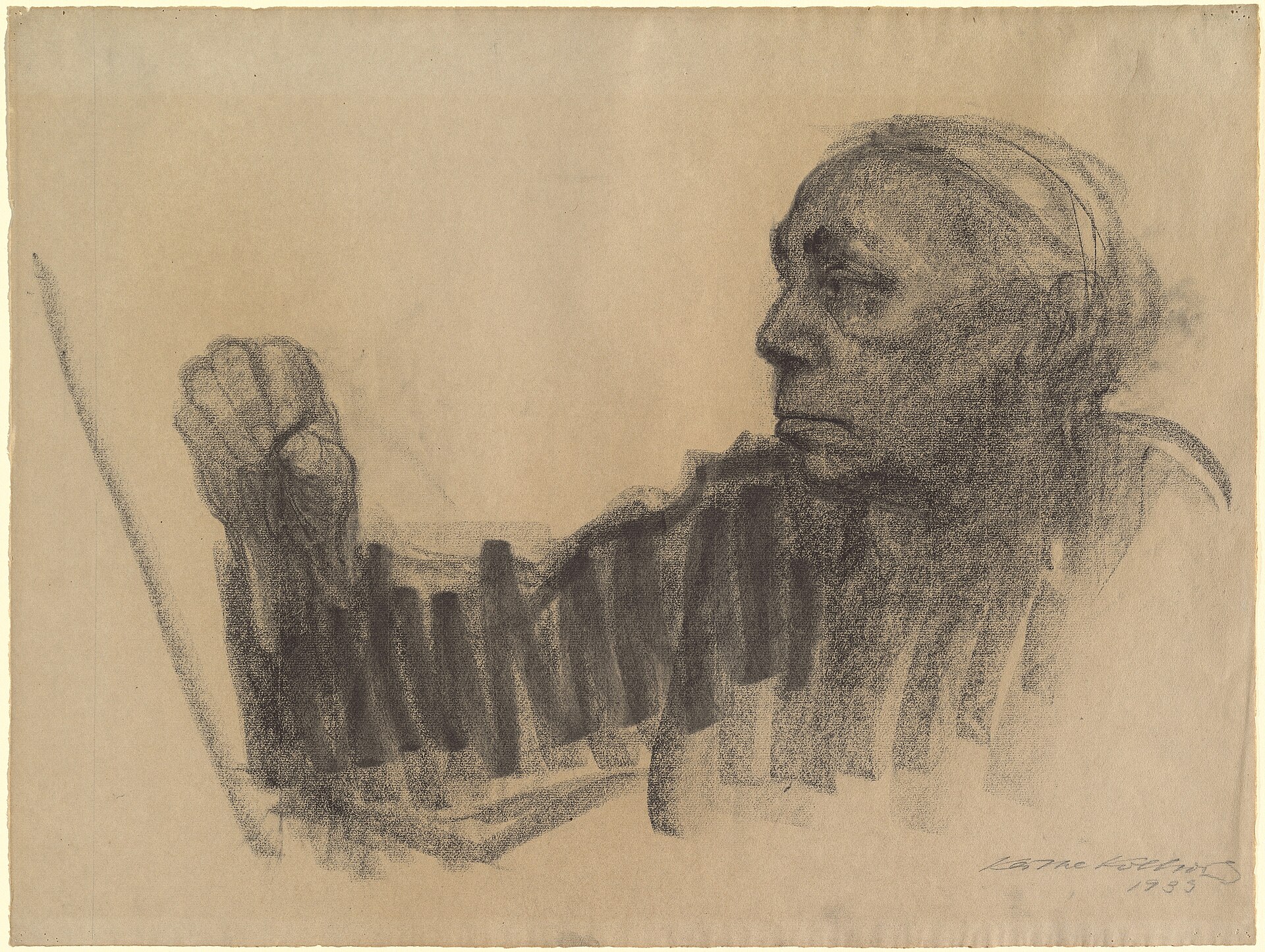
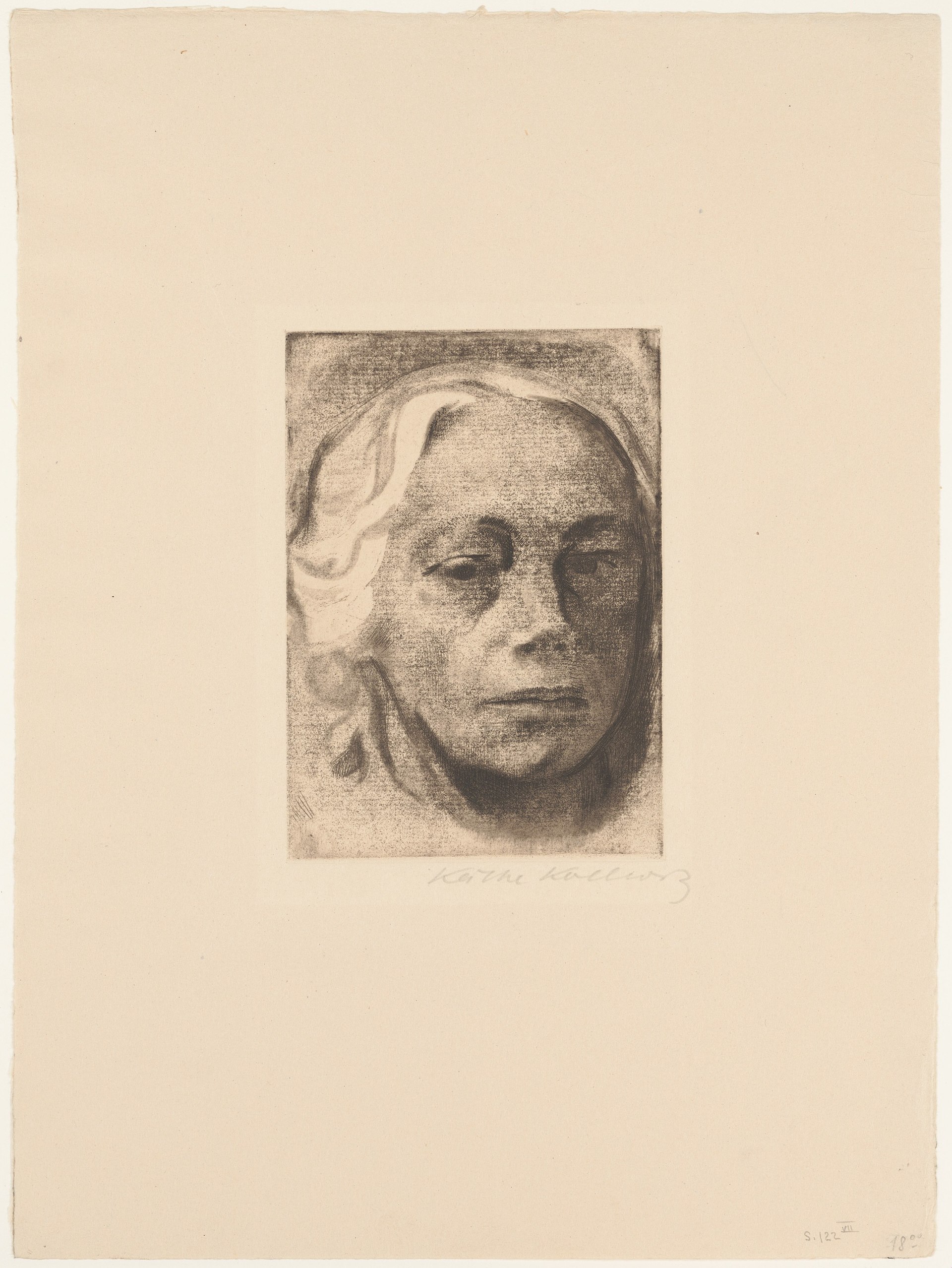
Self-Portrait, Left Profile, Drawing (Selbstbildnis im Profil nach links, zeichnend), charcoal on brown laid Ingres paper, 1933, the year before the Academy pressure that led to her forced resignation in 1933-34. Signed and dated by the artist. From the Lessing J. Rosenwald Collection.
National Gallery of Art, Washington, D.C.| Full name | Kathe Schmidt Kollwitz |
|---|---|
| Worked as | Printmaker, Sculptor |
| Born | 8 July 1867 · Konigsberg, East Prussia (now Kaliningrad, Russia) |
| Died | 22 April 1945 · Moritzburg, near Dresden, Germany |
| Nationality | German |
| Movement | Realism, independent of the Expressionist movements around her |
| Sources | 15 cited |
| Last verified |
About this page Last verified · 15 sources cited
On this page 12 sections
ContentsClose
Kathe Kollwitz spent five decades making etchings, lithographs, woodcuts and sculpture almost entirely about people who were hungry, working, grieving or dead, and she did it from inside a household that supplied the models. Her husband Karl ran a medical practice for the poor of Berlin's Prenzlauer Berg district from two rooms of their own apartment, and the women who sat in his waiting room sat again for her. She produced 275 individual prints across her career and was, in 1919, the first woman elected a full member of the Prussian Academy of Arts. The Nazi regime forced her resignation in 1933 and later listed at least some of her work as degenerate while simultaneously stealing two of her images for its own propaganda, an contradiction her own museums still describe as unresolved.
The single fact that separates her from every other artist working the theme of a mother and a dead child is that she used her own son Peter as the model for one, in 1903, when he was seven years old. He was killed in Flanders eleven years later, at eighteen, and she spent the rest of her working life making the image again in other forms: a print cycle, and finally a pair of stone figures that still kneel over his grave in Belgium.
Images
Chronology
- 1867
Born Kathe Schmidt on 8 July in Konigsberg, East Prussia.2
- 1885-1886
Studies under Karl Stauffer-Bern at a women's art school in Berlin; introduced to Max Klinger's prints.2
- 1888-1889
Studies under Ludwig Herterich at the Munich Academy's women's art school.2
- 1891
Marries Karl Kollwitz, a doctor, and moves to Prenzlauer Berg, Berlin.23
- 1893-1897
Makes her first major print cycle, A Weavers' Revolt, after Gerhart Hauptmann's play Die Weber.1
- 1902-1908
Makes the seven-plate cycle Peasants' War, commissioned in 1904 by the Association for Historic Art and published with the dealer Emil Richter in 1908.14
- 1903
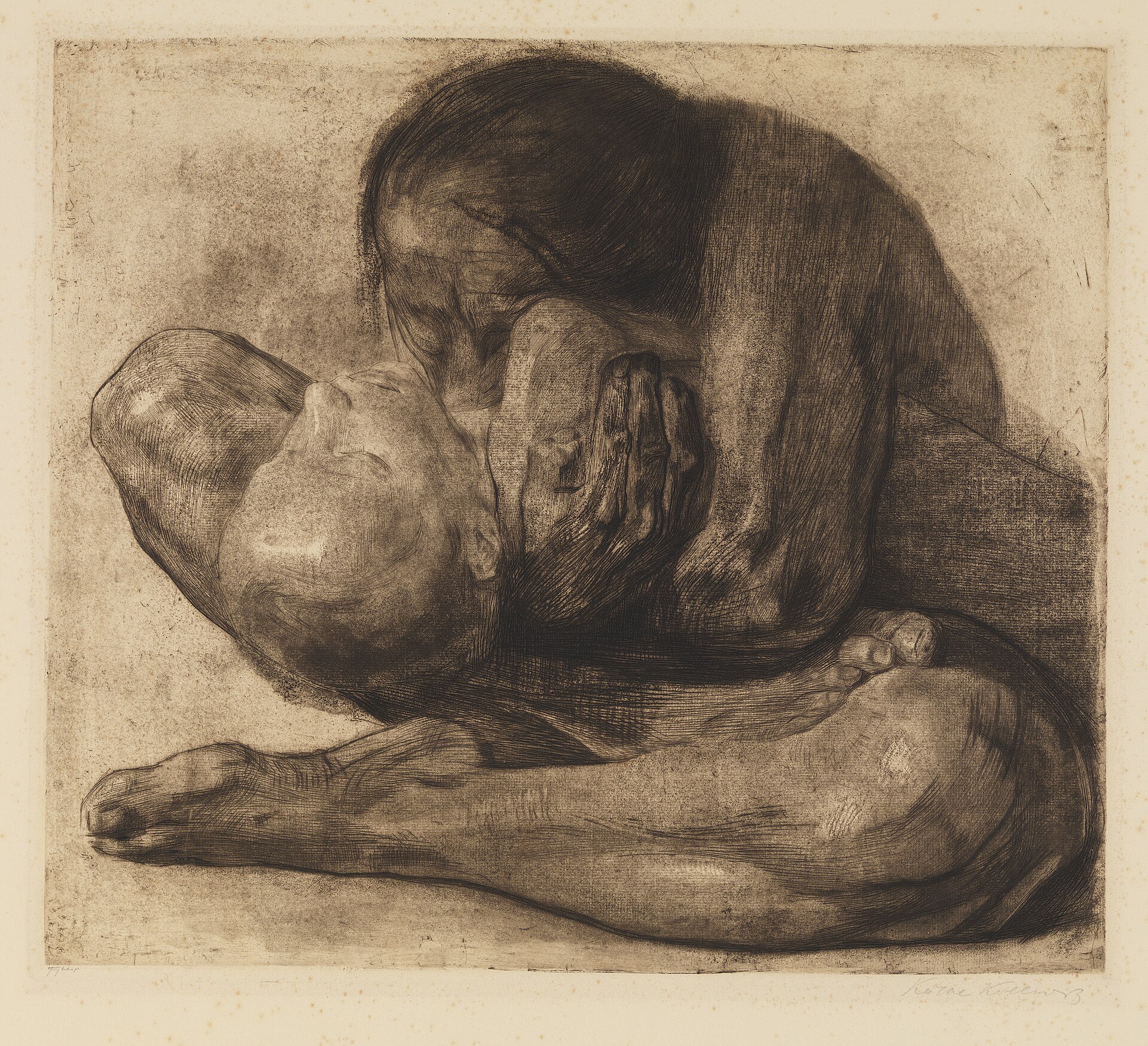
Etches Frau mit totem Kind (Woman with Dead Child), using herself and her seven-year-old son Peter as models.10
- 1914
Son Peter killed near Diksmuide, Flanders, on 22 October, aged 18; Kollwitz conceives the War print cycle the same year.8
- 1918-1923
Executes the seven woodcuts of War (Krieg); exhibits the completed cycle in 1924 at Berlin's International Antiwar Museum.1
- 1919
Elected, 24 January, the first woman full member of the Prussian Academy of Arts and given the title of professor.29
- 1919-1920
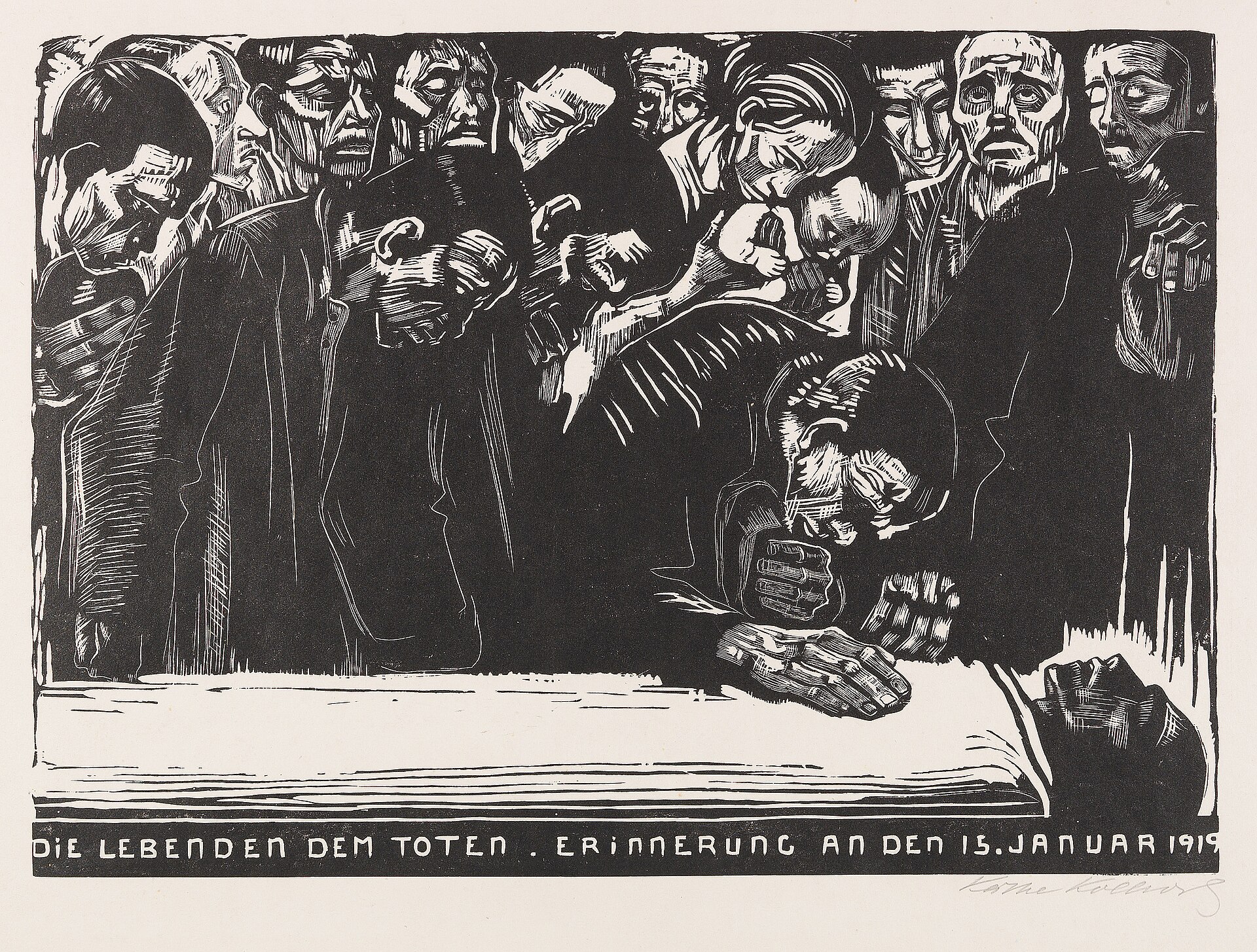
Makes In Memoriam Karl Liebknecht, working through rejected etching and lithograph states before completing it as a woodcut.1
- 1926
The three-sheet woodcut cycle Proletariat is issued by the dealer Emil Richter.1
- 1927-1932
Completes the sculpture Grieving Parents and has it erected at Roggevelde military cemetery, Belgium, overlooking Peter's grave.8
- 1928
Takes over leadership of the Prussian Academy's master studio for graphic arts.2
- 1933
Forced to resign from the Prussian Academy of Arts under the new Nazi government; barred from exhibiting.29
- 1936
Visited by the Gestapo in July and threatened with arrest and deportation to a concentration camp.9
- 1937
Works appear in the Entartete Kunst exhibition in Munich; receives over 150 tribute telegrams on her 70th birthday.119
- 1937-1938
Models the sculpture Mutter mit totem Sohn (Mother with her Dead Son), later enlarged for the Neue Wache.9
- 1938
Her work is removed from the Berlin venue of the touring Entartete Kunst show; her sculpture Turm der Mutter is separately seized and denounced as degenerate.11
- 1940
Husband Karl Kollwitz dies.9
- 1942
Grandson Peter, named for her dead son, is killed on the Eastern Front, aged 21.9
- 1943
Evacuated from Berlin; her home and studio of more than fifty years on Weissenburger Strasse are destroyed in an Allied bombing raid.29
- 1945
Dies on 22 April in Moritzburg, near Dresden, sixteen days before the end of the war in Europe.29
- 1954-1956
German war graves in Belgium are consolidated; Peter's grave and the Grieving Parents sculptures are moved to Vladslo.12
- 1955
August Klipstein publishes the first catalogue raisonne of the prints, through Kornfeld in Bern.5
- 1993
Harald Haacke's four-times-enlarged version of Mutter mit totem Sohn is installed in the Neue Wache, Berlin, as the national memorial to victims of war and tyranny.9
- 2002
Alexandra von dem Knesebeck's two-volume catalogue raisonne of the prints, published by Kornfeld, supersedes Klipstein's 1955 catalogue.5
- 2016
Annette Seeler publishes a catalogue raisonne of the sculpture.5
- 2022
Auction record set at Galerie Kornfeld, Bern: the lithograph Pieta (1903) makes CHF 1.3 million, exceeding the prior record of just under CHF 900,000.7
The market
Kollwitz's market is overwhelmingly a print market. Her auction record was set at Galerie Kornfeld in Bern in 2022, when the house's own chronology records a new result of CHF 1.3 million for the lithograph Pieta of 1903, against a prior record of just under CHF 900,000 the year before; third-party databases separately report the same sale converted to 1,141,438 US dollars, a figure that appears to include buyer's premium, though the source read for this page does not itself distinguish hammer from premium for the CHF figure. Her reputation and market in the United States were unusually well established before the Second World War for a German artist of her generation, and were built and sustained afterward chiefly through one gallery, Otto Kallir and Hildegard Bachert's Galerie St. Etienne in New York.
| Date | Sale | Work | Result | Note |
|---|---|---|---|---|
| 2022 | Galerie Kornfeld, Bern | Pieta | Hammer CHF 1.3 million (stated by the auction house as the new record result; not explicitly identified as hammer-only or premium-inclusive in the source read) With premium Not stated in the source read CHF | Kollwitz's auction record as of the sources consulted; market databases separately quote the same sale as USD 1,141,438, a converted, fee-basis figure that this page does not treat as equivalent to the CHF figure without confirmation. |
| 2021 | Not specified in the source read | Not specified in the source read | Hammer Just under CHF 900,000 With premium Not stated in the source read CHF | The previous Kollwitz auction record, per Galerie Kornfeld's own chronology, exceeded by the 2022 Pieta sale. |
Hammer is the price at which the bidding stopped; with premium adds the fee the house charges the buyer on top. Hammer price and buyer's premium in the glossary.
Where to see the work
| Institution | City | Holdings | Note |
|---|---|---|---|
| Kathe-Kollwitz-Museum | Berlin | Prints, drawings and sculpture including the In Memoriam Karl Liebknecht material | Dedicated single-artist museum. |
| Kathe Kollwitz Museum | Cologne | Prints and drawings from the family's own holdings | Founded with the artist's granddaughter, Dr. Jutta Bohnke-Kollwitz, as first director. |
| Statens Museum for Kunst | Copenhagen | Impressions from A Weavers' Revolt and Frau mit totem Kind | Accession numbers in the KKS series. |
| Metropolitan Museum of Art | New York | Self-portrait prints, open-access CC0 photography | |
| National Gallery of Art | Washington, D.C. | Self-portrait drawings and prints, including the 1933 charcoal self-portrait reproduced on this page | Largely from the Rosenwald Collection. |
| British Museum | London | Impressions from A Weavers' Revolt | |
| Neue Wache | Berlin | Harald Haacke's 1993 enlargement of Mutter mit totem Sohn | Installed as the national memorial to victims of war and tyranny; not an art museum. |
The essay
Chapter 1A doctor's waiting room, not an academy
Kathe Schmidt trained as a painter at the women's art schools open to her in the 1880s, since the Prussian academies themselves did not yet admit women: under Karl Stauffer-Bern in Berlin in 1885-86...
Kathe Schmidt trained as a painter at the women's art schools open to her in the 1880s, since the Prussian academies themselves did not yet admit women: under Karl Stauffer-Bern in Berlin in 1885-86, then under Ludwig Herterich at the Munich Academy's women's school in 1888-89. Stauffer-Bern, a friend of Max Klinger, showed her Klinger's 1883 print cycle Ein Leben, and it was Klinger's 1891 treatise Malerei und Zeichnung, arguing for the graphic arts as a medium equal to painting, that pushed her away from the easel for good. She kept drawing and etching, largely self-taught in the technical side of printmaking, for the rest of her career.
In 1891 she married Karl Kollwitz, a doctor, and moved into an apartment on Weissenburger Strasse in Prenzlauer Berg, then a district sliding from upper-middle-class into working-class. Two of its rooms were his surgery; she had to borrow a neighbour's living room as a studio until the household could afford more space. Karl saw up to forty patients a day and made house calls besides, treating people who could not otherwise afford a doctor, and the working-class women in his waiting room became the models Kathe could not otherwise have reached. She later wrote of him: "I know of no other person who can love so much, so wholeheartedly." He co-founded the Social Democratic Doctors' Association and argued in print for medicine that treated patients as more than an economic transaction, a position that made both Kollwitzes locally famous in Prenzlauer Berg well before Kathe was famous anywhere else.
Chapter 2The revolt she watched from the stalls
Gerhart Hauptmann's 1892 play Die Weber, a dramatisation of the 1844 Silesian weavers' uprising, gave Kollwitz her first major subject.
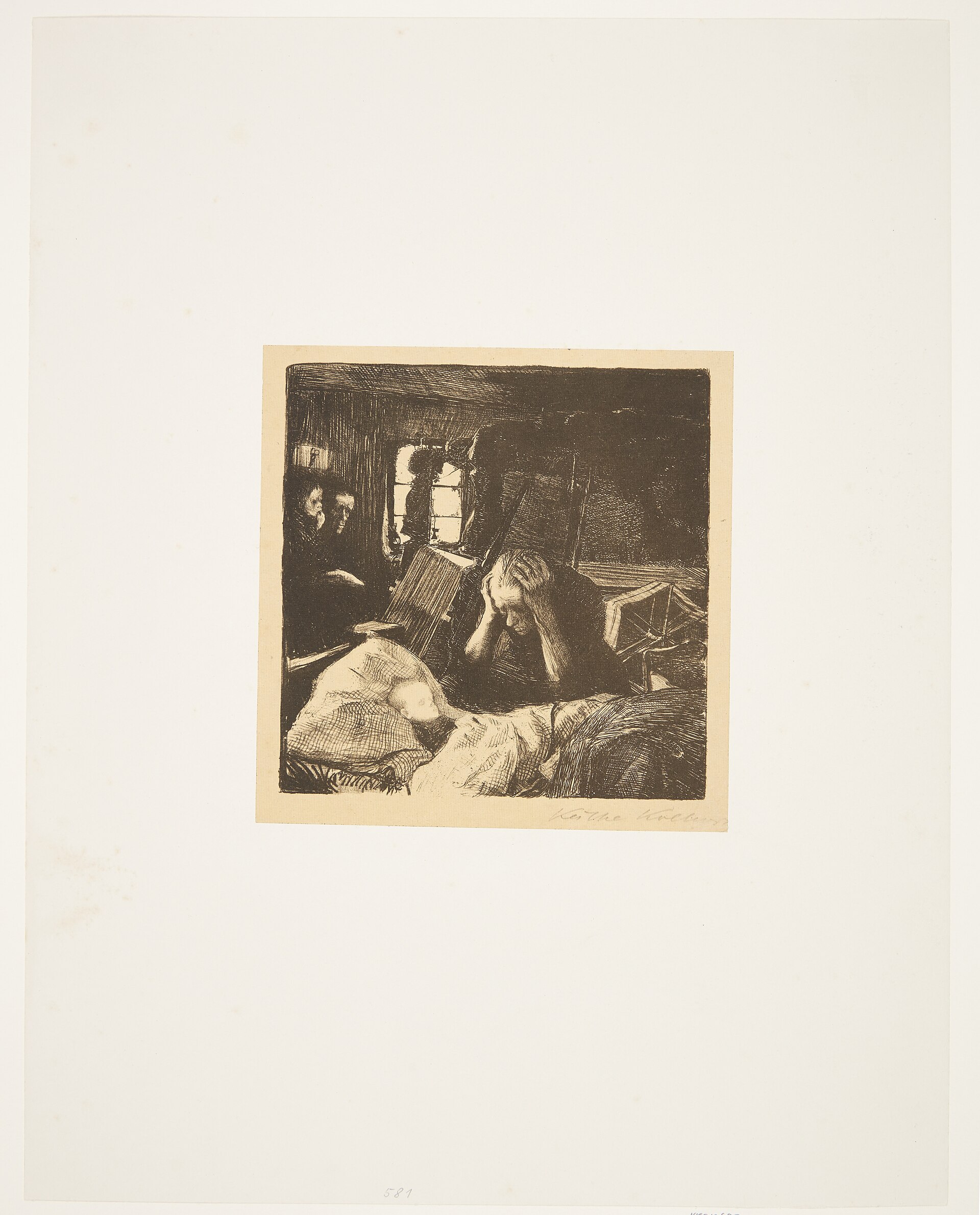
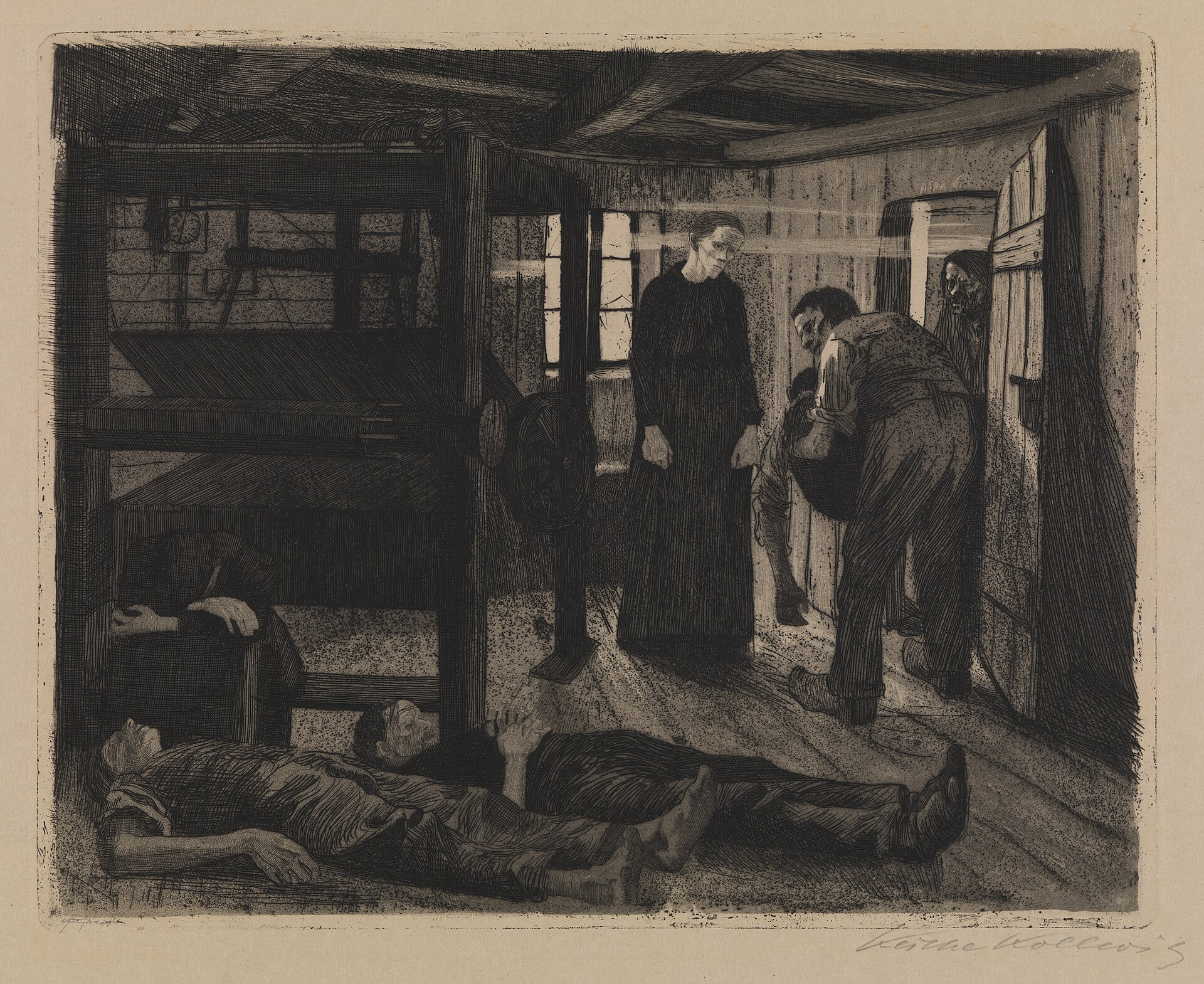
Gerhart Hauptmann's 1892 play Die Weber, a dramatisation of the 1844 Silesian weavers' uprising, gave Kollwitz her first major subject. She began A Weavers' Revolt (Ein Weberaufstand) in 1893 and finished it in 1897: six sheets moving from want, through a death in the household, a secret meeting, a march on the mill owners, the storming of the gate, to the dead laid out afterwards. It was the first print cycle to establish the pattern she would use for the rest of her career, working and reworking a subject across different plates and techniques before settling on a final state, and it made her reputation: the completed cycle was shown at the Grosse Berliner Kunstausstellung in 1898 and would have won the exhibition's gold medal had Kaiser Wilhelm II not personally vetoed the prize for a work he considered to glorify social unrest.
Chapter 3Her best work, by her own judgment
Peasants' War (Bauernkrieg), the seven-plate cycle she worked on from 1902 to 1908, is her most ambitious print series and the one she herself rated highest.
Peasants' War (Bauernkrieg), the seven-plate cycle she worked on from 1902 to 1908, is her most ambitious print series and the one she herself rated highest. It is drawn from Wilhelm Zimmermann's history of the German Peasants' War of 1524-25 and follows the same arc as the weavers' cycle: provocation, rebellion, and defeat. She showed an early proof of the third sheet, Charge, depicting the historical figure Black Anna igniting the revolt, at the Berlin Secession's sixth exhibition in 1902, where it drew a favorable response; she then submitted it to the Verein fur historische Kunst (Association for Historic Art) in 1904, which awarded her the commission to complete the remaining six plates, published together with the Dresden dealer Emil Richter in 1908. Writing to the art historian Max Lehrs, an early champion of her technical skill, about Charge, she said plainly: "I consider this . . . print to be my best work and I am rather happy about it."
The surviving preparatory material, now largely in the Getty Research Institute's Dr. Richard A. Simms Collection, shows how hard each image was to reach. The opening plate, The Ploughmen, took five years and passed through a rejected lithograph and a rejected etching before she eliminated a standing female figure from the composition entirely to concentrate on the labourers' physical torment. The third plate, Sharpening the Scythe, went through several states titled Inspiration in which a male figure guides the peasant woman's hand to the weapon before Kollwitz rejected that image and gave the woman sole possession of the blade. She had originally planned to close the cycle with Battlefield, a woman searching a field of corpses for her son by lantern light, but added a seventh plate, The Prisoners, to show the revolt's actual defeat.
Chapter 4The child who posed as his own future
In 1903, the same decade as the Peasants' War plates, Kollwitz made the etching Frau mit totem Kind (Woman with Dead Child): a mother crouched around a dead child's body, her mouth pressed to its...
In 1903, the same decade as the Peasants' War plates, Kollwitz made the etching Frau mit totem Kind (Woman with Dead Child): a mother crouched around a dead child's body, her mouth pressed to its chest as if trying to draw it back inside her. She used herself and her younger son Peter, then seven years old, as the models. Peter would be killed in Flanders in October 1914, eleven years after he sat for an image of his own death as a child in his mother's arms. No source read for this page states that Kollwitz or her family ever commented directly on that coincidence, and this page does not claim she foresaw anything; it records only that the documented model for the 1903 print and the son killed in 1914 are the same person, a fact any reader of the two events side by side would otherwise have to reconstruct alone.
An impression of the print, held by the Statens Museum for Kunst in Copenhagen, is catalogued there simply as Frau mit totem Kind; market and auction listings sometimes use the title Pieta for a Kollwitz lithograph of the same year and broadly the same subject, and the sources read for this page do not establish whether the two are the same composition in two techniques or two distinct images (see Open questions).
Chapter 522 October 1914
Peter Kollwitz, Kathe and Karl's younger son, volunteered for the German army within weeks of the outbreak of war in 1914 and was killed near Diksmuide in West Flanders on 22 October, during the...
Peter Kollwitz, Kathe and Karl's younger son, volunteered for the German army within weeks of the outbreak of war in 1914 and was killed near Diksmuide in West Flanders on 22 October, during the First Battle of the Yser. He was eighteen. Kollwitz wrote afterward that she never recovered from it, and the loss reoriented the rest of her working life toward the subject of parents and the dead.
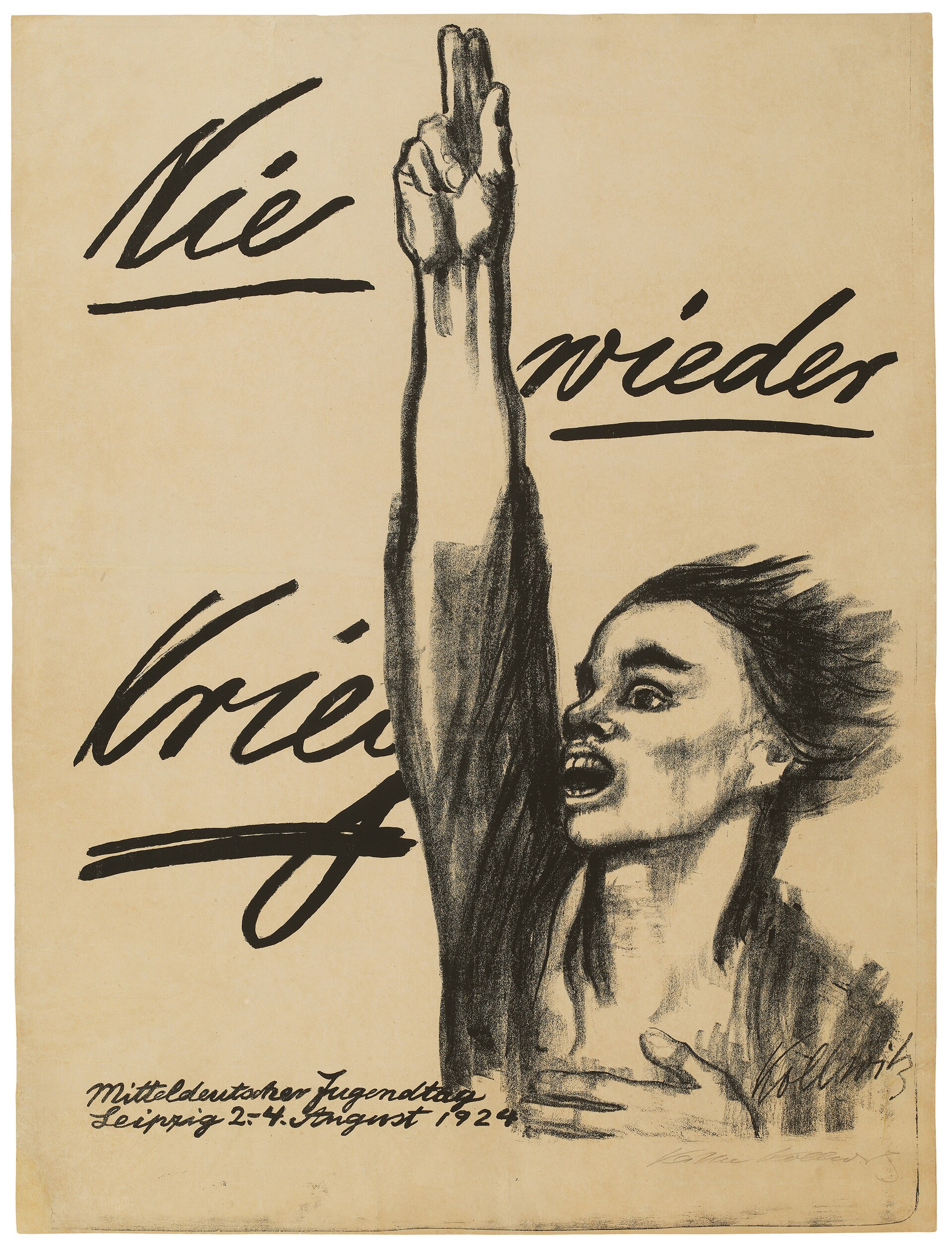
She conceived a print cycle on the war in 1914, the year of Peter's death, but did not execute it until 1918-1923: seven woodcuts under the title Krieg (War), addressing not combat itself but what it did to the people left behind, mothers, fathers, wives, widows, including a plate titled Die Eltern (The Parents) showing two figures collapsed together in grief. She exhibited the completed cycle in 1924 at the newly founded International Antiwar Museum in Berlin. Separately, working in stone rather than print, she spent 1927 to 1932 completing a pair of grieving-parent figures as a war memorial and had them erected at the Roggevelde military cemetery, positioned so the father's gaze fell on the grave marker bearing Peter's name. When Germany consolidated its Belgian war cemeteries into four concentration sites in the 1950s, Peter's remains and the two statues were moved together to the larger cemetery at Vladslo, where they still stand.
Chapter 6A farewell she said she had the right to draw
On the morning of Karl Liebknecht's funeral in January 1919, after the Spartacist Uprising's failure and his murder by right-wing paramilitaries, Kollwitz visited the Liebknecht household to offer...
On the morning of Karl Liebknecht's funeral in January 1919, after the Spartacist Uprising's failure and his murder by right-wing paramilitaries, Kollwitz visited the Liebknecht household to offer her condolences and was asked by the family to draw him lying in his coffin. She was not a Communist and never joined any political party in her life, unlike her own father, an active Social Democrat, but she made the drawings and then spent the better part of a year trying to find the right technique for a memorial print, later writing: "The immense impression made by the hundred thousand mourners at his grave inspired me to a work. It was begun and discarded as an etching, I made an attempt to do it anew, and rejected it, as a lithograph. And now finally as a woodcut it has found its end." The finished sheet, In Memoriam Karl Liebknecht (Gedenkblatt fur Karl Liebknecht), exists in six states catalogued by Alexandra von dem Knesebeck as state 159; a signed and dedicated impression of the sixth state's first variant, one of only nine impressions of that particular state, has been documented in the German print trade, giving a concrete sense of how finely the market distinguishes one Kollwitz state from the next.
Chapter 7First woman, then no woman
On 24 January 1919, with the Weimar Republic only weeks old, Kollwitz was elected the first woman ever admitted to full membership of the Prussian Academy of Arts, more than a century after its...
On 24 January 1919, with the Weimar Republic only weeks old, Kollwitz was elected the first woman ever admitted to full membership of the Prussian Academy of Arts, more than a century after its founding, and was given the title of professor; she asked that the appointment not initially carry teaching duties, though she took over the Academy's master studio for graphic arts in 1928. Ernst Barlach, Lovis Corinth, Georg Kolbe and Wilhelm Lehmbruck were admitted in the same intake.
The Nazi seizure of power ended it. In 1933 she was forced to resign from the Academy, and her work was withdrawn from museums and barred from exhibition. In July 1936 the Gestapo visited the Kollwitz household directly and threatened Kathe and Karl with arrest and deportation to a concentration camp; both later biographers and her own museum credit her international reputation with having kept the threat from being carried out. She continued working under the ban, largely in lithography.
Chapter 8Degenerate, then useful
The regime's relationship to Kollwitz's work does not resolve into a single story, and this page gives both halves of it rather than picking one.
The regime's relationship to Kollwitz's work does not resolve into a single story, and this page gives both halves of it rather than picking one. Evidence indicates her prints appeared in the notorious Entartete Kunst (Degenerate Art) exhibition when it opened in Munich in 1937, among the Kollwitz works swept into that campaign, but they were removed from the display by the time it travelled on to Berlin in 1938. That same year, her 1937-38 sculpture Turm der Mutter (Tower of Mothers) was seized from a local exhibition and denounced as degenerate art in its own right. On her seventieth birthday in 1937 she nonetheless received more than one hundred and fifty telegrams of tribute from artists and admirers around the world, a measure of the reputation the regime could not fully suppress even while formally banning her.
At the same time, Nazi propagandists appropriated her imagery for their own purposes without her consent: her print cycle Hunger was reprinted with the false claim that it depicted victims of Communism, and her print Bread! was reproduced with her name replaced by a fabricated signature, "St. Frank." Scholars at the National Museum of Women in the Arts describe the reason for this reversal, condemnation followed by ideological theft, as still unresolved: her work's stripped-down, universal quality apparently made it as useful to Nazi messaging as its working-class and pacifist origins had made it suspect. Separately, when the Levy family of Cologne, for whom she had begun carving a gravestone in 1936, were driven from Germany after Kristallnacht in November 1938, she wrote to them expressing what she called pain and shame at what had been done.
Chapter 9A second Peter, and the end
Her son Hans and his wife named their own son, born 1921, Peter after his dead uncle.
Her son Hans and his wife named their own son, born 1921, Peter after his dead uncle. That second Peter was killed on the Eastern Front in 1942, at twenty-one, a second loss of a grandson bearing the name and something of the fate of the son she had lost in the first war. Karl Kollwitz had died in 1940. In the late fall of 1943 the Kollwitzes' Berlin apartment on Weissenburger Strasse, home and surgery and studio for more than fifty years, was destroyed in an Allied bombing raid, and with it an unknown quantity of drawings, working proofs and papers; Kollwitz had already been evacuated from Berlin and eventually settled in Moritzburg, near Dresden. She died there on 22 April 1945, at seventy-seven, sixteen days before the war in Europe ended. She was cremated and given an honorary grave, an Ehrengrab, in Berlin's Friedrichsfelde cemetery.
Chapter 10What the plate remembers that the sale doesn't
Kollwitz reworked her images obsessively, and the print trade's own record of that habit is a genuine authenticity resource: a specialist dealer in her work reports that August Klipstein's catalogue...
Kollwitz reworked her images obsessively, and the print trade's own record of that habit is a genuine authenticity resource: a specialist dealer in her work reports that August Klipstein's catalogue distinguishes fifteen separate states for the 1925 woodcut Hunger alone, and the Liebknecht memorial's own documented state-and-impression-count (state VI a of VI c, nine impressions) is typical rather than exceptional. Two publishers issued her plates during and after her lifetime: Emil Richter Verlag in Dresden, who also financed print catalogues of her work in 1913 and 1927, and his successor Alexander von der Becke and Son, whose printings from the original matrices continued into the late 1960s, decades after her death, to satisfy ongoing demand. Posthumous impressions carry either a facsimile signature stamp or the von der Becke blindstamp rather than her own hand, and the trade's value hierarchy runs, in descending order, a lifetime impression she personally signed, an unsigned lifetime impression, and a posthumous restrike from the same plate; a specialist dealer notes there is often little qualitative difference between them beyond gradual wear on the matrix itself. No documented case of an outright forged or falsely attributed Kollwitz print was found in the sources read for this page; the corpus's real authenticity questions are about state, printing and edition rather than fakes.
The standard reference works have themselves gone through states. August Klipstein, working with Alexander von der Becke, published the first catalogue raisonne of the prints through Kornfeld's Bern gallery in 1955. Alexandra von dem Knesebeck's two-volume Werkverzeichnis der Graphik, also published by Kornfeld, superseded it in 2002 with seven hundred and twenty pages and roughly four hundred illustrations; Annette Seeler published a separate catalogue raisonne of the sculpture in 2016. No single closed authentication board for Kollwitz is documented in the sources read; expertise is concentrated at Kornfeld in Bern, publisher of both graphic catalogues, and at the two Kollwitz museums in Berlin and Cologne, the Cologne museum having been founded with the artist's own granddaughter, Dr. Jutta Bohnke-Kollwitz, as its first director.
Chapter 11A grief made four times life size
Kollwitz's small bronze Mutter mit totem Sohn (Mother with her Dead Son), modelled in 1937-38 on the same Pieta-derived composition she had first explored in 1903, stands barely thirty centimetres...
Kollwitz's small bronze Mutter mit totem Sohn (Mother with her Dead Son), modelled in 1937-38 on the same Pieta-derived composition she had first explored in 1903, stands barely thirty centimetres tall in its original form. In 1993 the sculptor Harald Haacke enlarged it roughly four times and the Federal Republic installed the enlargement as the central figure of the Neue Wache on Unter den Linden in Berlin, rededicated as the Central Memorial of the Federal Republic of Germany to the Victims of War and Tyranny. The choice provoked open argument at the time: critics asked how a specifically Christian image of a mother cradling her adult son's body could stand as the national memorial for all victims of war and tyranny, including the Jewish victims of the Holocaust, a group the Pieta's own iconography does not represent. The debate has not been resolved by removing the sculpture; it remains in place, and the objection remains on the historical record alongside it.
Chapter 12Believers she never joined
Kollwitz grew up in a household already outside the religious and political mainstream: her maternal grandfather, Julius Rupp, founded Prussia's first Free Religious Community, a congregation...
Kollwitz grew up in a household already outside the religious and political mainstream: her maternal grandfather, Julius Rupp, founded Prussia's first Free Religious Community, a congregation operating outside state-approved Lutheranism, and her father was an active Social Democrat. She herself never joined the Social Democratic Party or any other political party, a fact she stated explicitly when defending her right, as an artist rather than as a partisan, to memorialise the murdered Communist leader Karl Liebknecht. Her closest documented affiliations were personal and intellectual rather than institutional: an early-1900s relationship with the Viennese Jewish bookseller and publisher Hugo Heller, who was among the founders of the Wednesday Society where Sigmund Freud lectured and who asked her to marry him after his wife's death in 1909, unsuccessfully; and later, a market and reputation built substantially by Jewish dealers and collectors, among them Otto Kallir, who founded New York's Galerie St. Etienne in 1939, his business partner Hildegard Bachert, who made Kollwitz the gallery's mainstay and later assisted both the Knesebeck and Seeler catalogues, and the Sears, Roebuck executive Lessing Rosenwald, whose gift collection at the National Gallery of Art in Washington includes her 1933 self-portrait drawing reproduced on this page. Her own account of her beliefs, so far as the sources read for this page establish it, is documented conduct rather than a stated creed: a lifelong refusal of party membership, a socialist household of origin, sustained friendships across religious lines, and a body of work in which grief and labour, not doctrine, supply whatever the pictures ask the viewer to believe.
Chapter 13The market for grief
Kollwitz's market is a print market; she largely abandoned painting before her career properly began, and her sculpture is scarce and mostly institutional.
Kollwitz's market is a print market; she largely abandoned painting before her career properly began, and her sculpture is scarce and mostly institutional. Her record price was set at Galerie Kornfeld in Bern in 2022, when the auction house's own published chronology records a new result of CHF 1.3 million for the rare lithograph Pieta of 1903, exceeding the previous Kollwitz record of just under CHF 900,000 set the year before. Market databases separately report the same sale as realising 1,141,438 US dollars, a converted, fee-basis figure; the source read for this page does not itself specify whether the CHF 1.3 million is the hammer price or a total inclusive of buyer's premium, and this page does not guess (see Open questions). Her pre-war reputation in the United States, unusually for a German artist of her generation, was already established before refugee collectors began arriving with further examples of her work in the late 1930s, and it was built and sustained for decades afterward specifically through Galerie St. Etienne in New York.
What is documented
Technique
The surviving work
- What is accepted
- 275 individual etchings, lithographs and woodcuts, per the Getty Research Institute's account of the graphic oeuvre; sculpture is catalogued separately.
- What is contested
- No de-attribution controversy comparable to an old-master corpus was found in the sources read for this page. The corpus has instead been refined by cataloguing rather than reduced by removal: Klipstein's 1955 catalogue was reorganised and expanded, not overturned, by Knesebeck's 2002 catalogue.
- Who rules on attribution
- No single closed authentication board is documented in the sources read. Expertise is concentrated at Galerie Kornfeld in Bern, publisher of both print catalogues, and at the Kathe-Kollwitz-Museum in Berlin and the Kathe Kollwitz Museum in Cologne, the latter founded with the artist's granddaughter Dr. Jutta Bohnke-Kollwitz as its first director.
Catalogue raisonne
- August Klipstein (with Alexander von der Becke), catalogue raisonne of the prints, Kornfeld, Bern, 1955. The first full catalogue of the graphic work; superseded but not repudiated by Knesebeck 2002.5
- Alexandra von dem Knesebeck, Kathe Kollwitz: Catalogue Raisonne of her Prints / Werkverzeichnis der Graphik, 2 vols plus CD, Kornfeld, Bern, 2002. 720 pages, roughly 400 illustrations; current standard reference for the prints, covering 1890-1913 and 1914-1941.5
- Annette Seeler, catalogue raisonne of the sculpture, 2016. Standard reference for the sculpture, a much smaller body of work than the prints.5
Questions about Kathe Kollwitz
Who was Kathe Kollwitz?
Printmaker; Sculptor. 1867-1945.
When did Kathe Kollwitz live?
Born 8 July 1867, Konigsberg, East Prussia (now Kaliningrad, Russia); died 22 April 1945, Moritzburg, near Dresden, Germany.
Where can you see work by Kathe Kollwitz?
Kathe-Kollwitz-Museum (Berlin); Kathe Kollwitz Museum (Cologne); Statens Museum for Kunst (Copenhagen); Metropolitan Museum of Art (New York); National Gallery of Art (Washington, D.C.); British Museum (London).
What does the market for Kathe Kollwitz look like?
Kollwitz's market is overwhelmingly a print market. Her auction record was set at Galerie Kornfeld in Bern in 2022, when the house's own chronology records a new result of CHF 1.3 million for the lithograph Pieta of 1903, against a prior record of just under CHF 900,000 the year before; third-party databases separately report the same sale converted to 1,141,438 US dollars, a figure that appears to include buyer's premium, though the source read for this page does not itself distinguish hammer from premium for the CHF figure.
What is still unresolved about Kathe Kollwitz?
Whether the lithograph Pieta (1903), which set the 2022 Kornfeld auction record, is the same composition as the 1903 etching Frau mit totem Kind in a different technique, or a distinct print entirely. The sources read for this page do not resolve it.
Open questions
- Whether the lithograph Pieta (1903), which set the 2022 Kornfeld auction record, is the same composition as the 1903 etching Frau mit totem Kind in a different technique, or a distinct print entirely. The sources read for this page do not resolve it.
- Whether Galerie Kornfeld's published CHF 1.3 million result for that sale is a hammer price or a premium-inclusive total; the auction house's own chronology does not specify, and the USD 1,141,438 figure quoted by market databases appears to be a converted, fee-basis figure rather than a like-for-like hammer comparison.
- The full itinerary and dates of Kollwitz's inclusion in and removal from the Entartete Kunst exhibition: the source read establishes that her work appeared in Munich in 1937 and was gone from the Berlin venue by 1938, but does not give a complete city-by-city record of the touring show.
- No documented case of a forged or falsely attributed Kollwitz print was found in the sources consulted; the corpus's real authenticity questions concern print states, printings and posthumous editions rather than forgery, and this page does not assume forgery is a live issue absent evidence.
Sources
- 1Getty Research Institute, "Kathe Kollwitz: Prints, Process, Politics" (exhibition wall text, drawn from the Dr. Richard A. Simms Collection of Prints and Drawings by Kathe Kollwitz), published online 2019. getty.edu/research/...
- 2Kathe-Kollwitz-Museum Berlin, "Biography". kaethe-kollwitz.berlin/en/...
- 3Kathe-Kollwitz-Museum Berlin, "Karl Kollwitz - physician and social politician". kaethe-kollwitz.berlin/en/...
- 4Kathe Kollwitz Museum Koln, "The Peasants' War Cycle" (collection page). kollwitz.de/collection/...
- 5Kallir Research Institute, "Kathe Kollwitz" (artist overview). kallirresearch.org/artists/...
- 6Jewish Currents, "The Jewish Connections of Kathe Kollwitz". jewishcurrents.org/jewish-connections-kathe-kollwitz
- 7Galerie Kornfeld Auktionen Bern, "Chronology". kornfeld.ch/g326.html
- 8Australian War Memorial, collection record C156097, "Die Eltern (The Parents)". awm.gov.au/collection/...
- 9Wikipedia, "Kathe Kollwitz". en.wikipedia.org/wiki/...
- 10Wikipedia, "Woman with Dead Child". en.wikipedia.org/wiki/...
- 11National Museum of Women in the Arts, "The Art of Contradiction: Nazi Reception of Kathe Kollwitz" (Broad Strokes Blog). nmwa.org/blog/...
- 12Wikipedia, "Vladslo German war cemetery". en.wikipedia.org/wiki/...
- 13Brier Hill Gallery, "Editions, States, and Restrikes" (print dealer trade note, used for publisher and posthumous-printing information; a commercial rather than scholarly source, flagged as such). brierhillgallery.com/brier-hill-blog/...
- 14Wikimedia Commons file description and cataloguing metadata (sourced to Ketterer Kunst) for "Kathe Kollwitz Gedenkblatt fur Karl Liebknecht 1920.jpg". commons.wikimedia.org/wiki/...
- 15National Gallery of Art, "Self-Portrait, Left Profile, Drawing (Selbstbildnis im Profil nach links, zeichnend)", object record, accession 1943.3.5217, Rosenwald Collection. nga.gov/artworks/...

Last verified