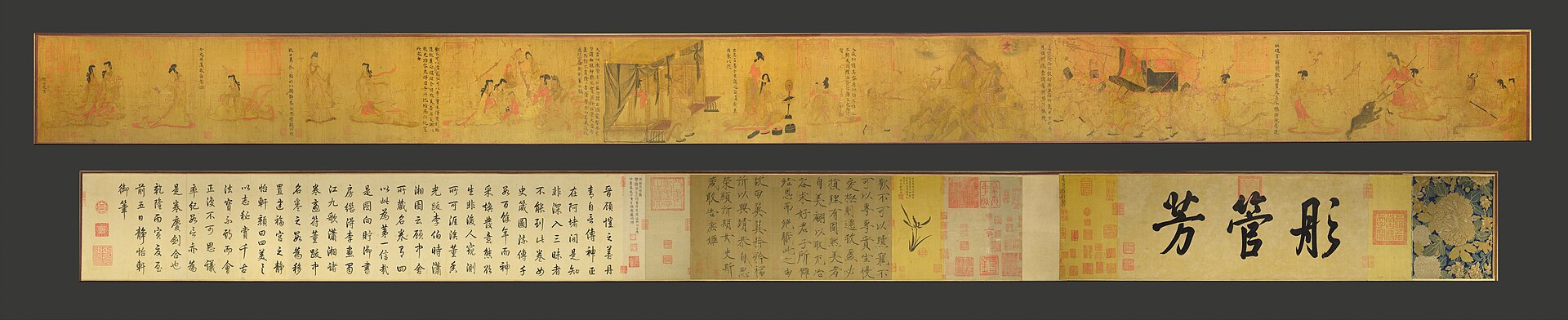
Admonitions of the Instructress to the Court Ladies
5th-8th century AD · Handscroll
British Museum, London, Room 91a
Chinese (Eastern Jin dynasty) · c. 345-c. 406
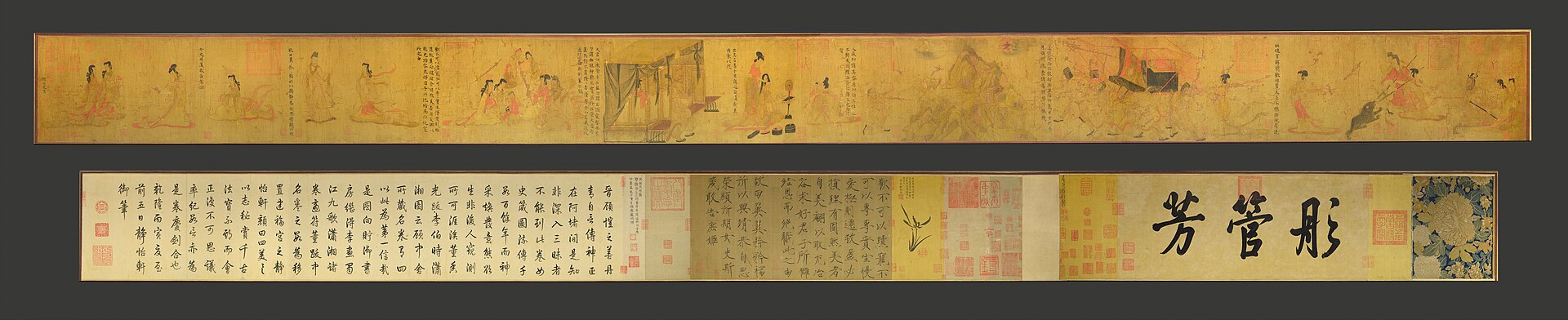
Admonitions of the Instructress to the Court Ladies (full scroll) The British Museum scroll, museum number 1903,0408,0.1, attributed to Gu Kaizhi, in its full mounted extent. Sourced via the Google Art Project; licence verified public domain via the Wikimedia Commons API. No verified portrait. No securely identified likeness of this maker is known under a free licence. We do not publish a face we cannot verify.
British Museum, London, via Google Arts and Culture| Full name | Gu Kaizhi (courtesy name Changkang) |
|---|---|
| Worked as | Painter |
| Born | c. 345 · Wuxi, Jiangsu province, Eastern Jin |
| Died | c. 406 · Not documented in the sources consulted |
| Nationality | Chinese (Eastern Jin dynasty) |
| Movement | Six Dynasties painting (Eastern Jin court) |
| In this archive | 1 artwork |
| Sources | 15 cited |
| Last verified | 17 September 2026 |
About this page 1 artwork in the archive · Last verified 17 September 2026 · 15 sources cited
Gu Kaizhi opens the written history of Chinese painting and is credited with its founding masterpiece, and no painting in his own hand is known to survive. Every picture that carries his name today, including the Admonitions of the Instructress to the Court Ladies at the British Museum, is a later copy of a lost original, made by an unknown hand at an unknown distance in time from whatever Gu Kaizhi actually painted. That is not a gap in this record. It is the subject of it.
The single fact most readers do not know going in: the British Museum's own catalogue does not call its scroll a work of the fourth century. It dates the physical object to the fifth to seventh century, a hundred to three hundred years after Gu Kaizhi died, and most specialists read it as a Tang-dynasty tracing copy rather than anything earlier. Scholars disagree by centuries about how far removed the surviving object is from an original that itself cannot be dated with confidence. What is not in dispute is that the object has its own full history independent of Gu Kaizhi: Song, Ming and Qing owners who left seals and colophons on it, a removal from the Qing imperial collection during the international occupation of Beijing in 1900, a sale in London in 1903, and a British remounting a decade later that Chinese conservators and scholars have since named as a documented conservation error.
Because no autograph painting exists to examine, the strongest evidence for who Gu Kaizhi actually was is textual, not visual: a body of anecdote preserved within a generation of his death by Liu Yiqing in the Shishuo Xinyu, compiled around 430, and a further body of anecdote and theory preserved four centuries later by the critic Zhang Yanyuan in the Lidai Minghua Ji, completed in 847. This record treats that distinction, between the historical man the texts describe and the reconstructed painter whose hand no one has securely seen, as the central fact of the page rather than a footnote to it.

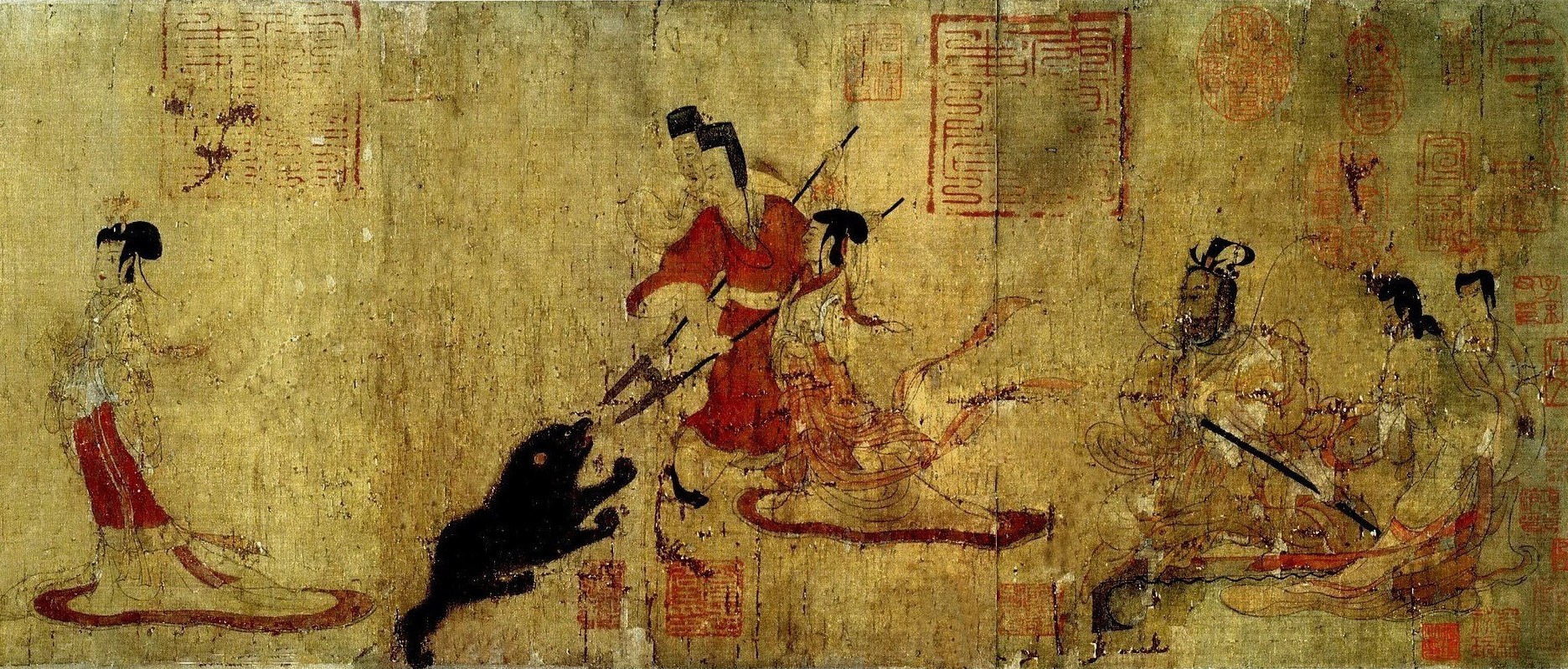
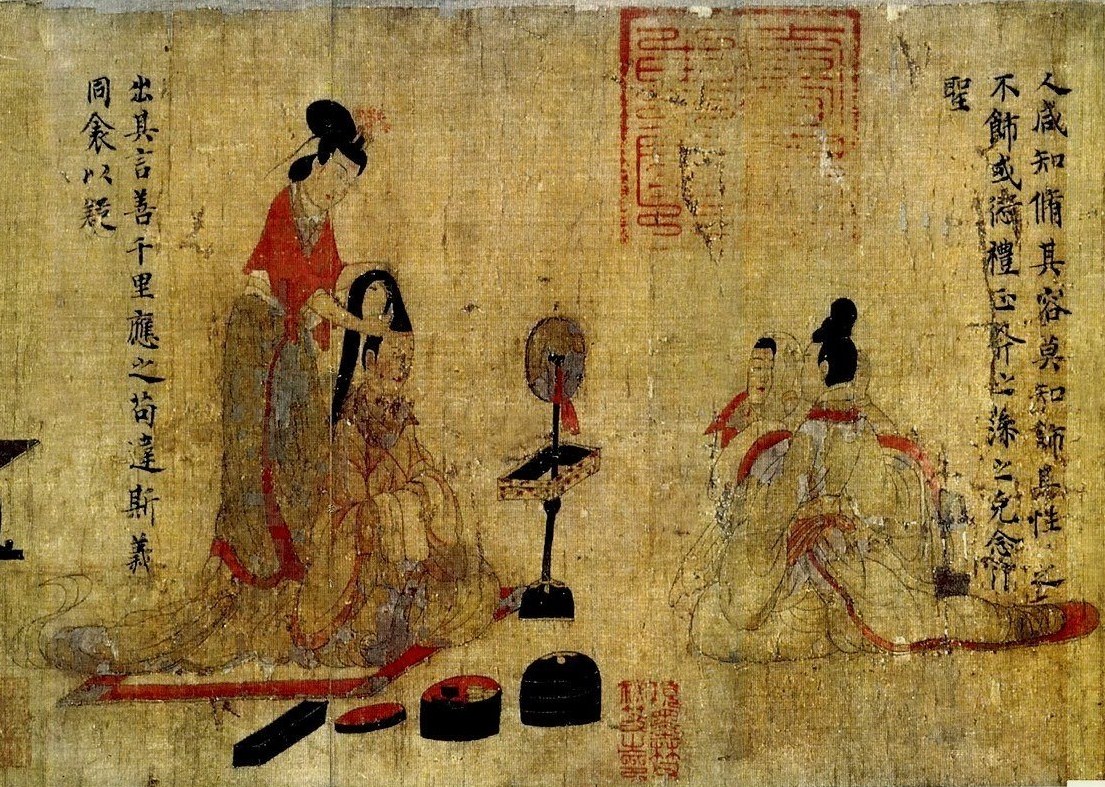

Born in Wuxi, Jiangsu province, Eastern Jin dynasty; some sources give c. 344.6
By tradition paints the Vimalakirti mural at the Waguan Temple in Jiankang, modern Nanjing, said to have drawn large donations that funded the temple's construction.68
Serves as Assistant to the Minister of Defence at the Eastern Jin court, after entering service around age nineteen as an aide to the general Huan Wen.6
Dies. No painting securely in his own hand is known to have survived him.6
The critic Zhang Yanyuan completes the Lidai Minghua Ji, the earliest connected history of Chinese painting and the primary surviving source for Gu Kaizhi's theoretical writing and reputation, more than four centuries after his death.8
Earliest secure sighting of the scroll later catalogued as the Admonitions Scroll: the connoisseur Mi Fu records it in the possession of the court eunuch Liu Youfang.9
The scroll is catalogued as a work of Gu Kaizhi in the Xuanhe Huapu, the painting catalogue of Emperor Huizong's Song imperial collection.9
The Qianlong Emperor acquires the scroll from the Tianjin merchant An Qi, remounts it and begins adding his seals, an orchid painting and a colophon over the following decades.91
The scroll is removed from the Qing imperial collection, kept at the Summer Palace, during the international occupation of Beijing that followed the Boxer Rebellion.12
The British Museum purchases the scroll from Captain Clarence Johnson for 25 pounds sterling; Keeper Sidney Colvin records the silk as already worn and rotted.12
The British Museum's own restorer Stanley Littlejohn, working with the Japanese printmaker Urushibara Mokuchu, cuts the scroll into sections and remounts it flat in a Japanese byobu format; this is distinct from the 100 woodblock facsimiles of the scroll Urushibara and the block-cutter Sugizaki Hideaki had separately produced for the museum from 1912.1315
A joint British Museum conservation study redisplays the scroll in a new case; Chinese scholars including Tao Yuzhi and Yang Xin publicly criticise the 1910s remounting as damaging to the object.345
No market exists for this maker in any ordinary sense, and none has ever existed. The Admonitions Scroll has never been sold at public auction; it passed from private possession into British Museum ownership by a single purchase from Captain Clarence Johnson in 1903 and has not changed hands since. The Nymph of the Luo River and Wise and Benevolent Women copies illustrated on this page are institutionally held in Beijing, Shenyang and Washington and are likewise not on the market. No painting securely in Gu Kaizhi's own hand has ever existed to trade, since none survives. The nearest figure this record can state is the 1903 purchase price of 25 pounds sterling paid to Johnson, a private sale rather than an auction result, made at a time the museum's own keeper had already recorded the silk as worn and rotted; it is not recorded here as a market result because it was not one.
| Institution | City | Holdings | Note |
|---|---|---|---|
| British Museum | London | The Admonitions Scroll, museum number 1903,0408,0.1 (attributed to Gu Kaizhi; the museum's own catalogue dates the physical object to the 5th-7th century). | Not on display outside a fixed six-week annual window (2026 schedule: 13 July to 24 August); kept in darkness the rest of the year and shown only by appointment through the Asia department. |
| Palace Museum | Beijing | A complete 12-scene Southern Song paper copy of the Admonitions Scroll composition, plus a Song-Ming copy of Nymph of the Luo River and the sole surviving 13th-century Song copy of Wise and Benevolent Women. | A different physical object from the British Museum scroll in every case; not to be confused with it. |
| Liaoning Provincial Museum | Shenyang | A Southern Song copy of Nymph of the Luo River, reported to have left the Qing collection with the last emperor Puyi. | A different composition from the Admonitions Scroll. |
| National Museum of Asian Art (Freer Gallery of Art), Smithsonian Institution | Washington, DC | A Southern Song copy of Nymph of the Luo River. | A different composition from the Admonitions Scroll. |
Three compositions carry Gu Kaizhi's name in the surviving record: the Admonitions of the Instructress to the Court Ladies (nine of an original twelve painted scenes, British Museum), the Nymph of...
Three compositions carry Gu Kaizhi's name in the surviving record: the Admonitions of the Instructress to the Court Ladies (nine of an original twelve painted scenes, British Museum), the Nymph of the Luo River (known only through five later Song-to-Ming copies) and Wise and Benevolent Women (known through a single thirteenth-century Song copy). Not one of the three is catalogued by its holding museum as an autograph work. Each is a copy, and in most cases a copy of a copy, separated from any original Gu Kaizhi composition by an unknown number of intervening transmissions.
This is the ordinary condition of very early Chinese painting, not a defect specific to Gu Kaizhi. Silk and paper do not survive many centuries of handling, rolling and unrolling without replacement or recopying, and the paintings that mattered most were copied precisely because they mattered, which is also why the copies survive and the originals generally do not. The effect for a modern reader is that every specific claim about Gu Kaizhi's technique, palette or exact compositional choices is a claim about a copy, filtered through a copyist's hand and a copyist's period conventions, argued back toward an original nobody now alive has seen.
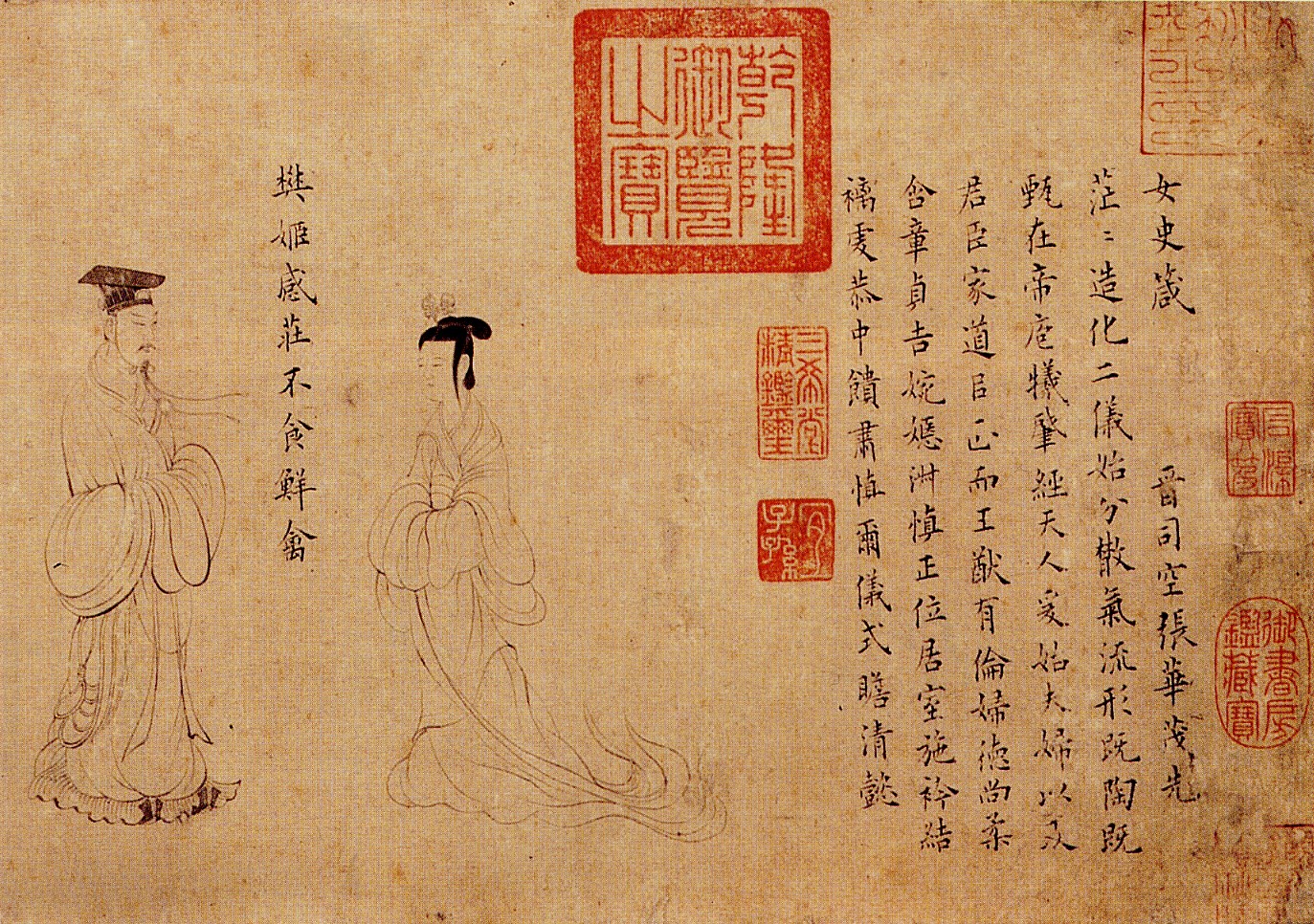
The paintings illustrate the Nushi zhen (Admonitions of the Instructress to the Court Ladies), an eighty-line didactic text composed around AD 292 by the Jin-dynasty official Zhang Hua (232-300).
The paintings illustrate the Nushi zhen (Admonitions of the Instructress to the Court Ladies), an eighty-line didactic text composed around AD 292 by the Jin-dynasty official Zhang Hua (232-300). By tradition Zhang wrote it to rebuke the empress consort Jia Nanfeng, whose conduct scandalised the Western Jin court, and to set out more broadly the conduct expected of the women of the imperial household. Each surviving scene is paired with a block of calligraphy quoting the specific lines of Zhang Hua's text it illustrates, a structure the British Museum's own catalogue preserves scene by scene.
The lessons are concrete rather than generic. The scene beside Lady Ban Jieyu's declining to share the emperor's palanquin illustrates a specific historical act of foresight, refusing an honour precisely because accepting it could later look like undue influence. The passage beside the next scene states plainly that nothing exalted escapes decline, sun past noon and moon past full, an argument against complacency in high favour rather than a scene of court leisure. The text beside the toilette scene draws an explicit contrast between women who know how to adorn their faces and the far smaller number who know how to adorn their character, naming the second as the harder and more necessary discipline. Later passages warn that an unguarded word travels a thousand miles and can cost trust even from a bedfellow, that favour built on charm alone is favour that will end, and that self-restraint and quiet duty, not display, are what the text calls the path to lasting honour. The closing scene ends the pairing with the Instructress's own voice addressing the ladies of the harem directly.
This is an ordinary, stated didactic function, not a hidden one. Every scene traces to a specific passage of a named text, and the museum's own transcription and translation of the accompanying calligraphy is the primary evidence for it. No concealed or hidden programme is argued for the object in any source consulted for this record; the moral content is the entire content, and the text panels say so themselves.
The British Museum's own online catalogue dates the surviving scroll to the fifth to seventh century AD, declining to commit further.
The British Museum's own online catalogue dates the surviving scroll to the fifth to seventh century AD, declining to commit further. That range already places the object a century or more after Gu Kaizhi's death around 406. Among named specialists who have argued a more specific date in print, the positions diverge sharply and none has settled the question.
Shane McCausland, who organised the British Museum's 2001 colloquium on the scroll and edited the resulting volume, reads the scroll as a Tang-dynasty tracing copy, on the basis of pictorial and textual features he argues diverge from what is independently known of Jin-period painting. Kohara Hironobu has argued that the calligraphy accompanying the scenes was not written until after 1075, in a hand deliberately archaised to look older than it is, which would separate the date of the text from the date of the painting and push at least part of the object later still. Wen Fong has read the same calligraphy differently, finding it consistent with the hand of the monk-calligrapher Zhiyong, active in the late sixth to early seventh century, an argument for an earlier date than Kohara's. Chen Pao-chen has argued in print for treating the painting as carrying genuine early, pre-Tang pictorial content rather than a straightforward later tracing. Yang Xin has proposed a different origin altogether: that the painting was a work commissioned at the Northern Wei court of Emperor Xiaowen, around 471 to 499, rather than a copy of a Gu Kaizhi original at all. This record located no second named scholar endorsing Yang Xin's Northern Wei theory, and flags that as unresolved.
None of these five positions is settled and this record does not arbitrate between them. What is documented, not argued, is that specialists working from the same physical evidence, the same calligraphy and the same pictorial style, read it to conclusions that differ by two centuries or more, and that an attribution to Gu Kaizhi himself is, at best, an attribution to a lost original transmitted through an unknown number of intervening copies before this one was made.
Gu Kaizhi is comparatively well documented as a historical figure, even though he is poorly documented as a painter whose actual pictures can be examined.
Gu Kaizhi is comparatively well documented as a historical figure, even though he is poorly documented as a painter whose actual pictures can be examined. He was born around 345 in Wuxi, in what is now Jiangsu province; his father Gu Yuezhi served in the Eastern Jin imperial secretariat. Gu Kaizhi entered service around age nineteen as an aide to the powerful general Huan Wen, later holding a sequence of minor court posts, including Assistant to the Minister of Defence in 366 and, later still, Gentleman in Waiting to the Emperor.
Contemporaries and near-contemporaries praised him for combining painting, literary talent and a celebrated eccentricity, a reputation later summarised in the epithet sanjue, the three perfections, a label also applied to a small number of other early figures. Sources differ on his birth year by a year or so, some giving 344 rather than 345; this record follows the dating used on the Wikimedia Commons record for the two detail plates reproduced below, which is consistent with the range given across the secondary literature.
The strongest surviving evidence for Gu Kaizhi as a working painter, rather than as a name attached to later copies, is textual, and it comes in two layers set at very different distances from his...
The strongest surviving evidence for Gu Kaizhi as a working painter, rather than as a name attached to later copies, is textual, and it comes in two layers set at very different distances from his life. The nearer layer is the anecdotal tradition Liu Yiqing preserved in the Shishuo Xinyu (A New Account of Tales of the World), compiled around 430, within a generation of Gu Kaizhi's death. The farther layer is the anecdotal and critical tradition preserved by the Tang-dynasty critic Zhang Yanyuan in his Lidai Minghua Ji (Record of Famous Painters of Successive Dynasties), completed in 847, more than four centuries after Gu Kaizhi's death. Zhang Yanyuan's compilation is the earliest surviving connected history of Chinese painting and the principal source for Gu Kaizhi's own theoretical writing, quoted at second hand; neither layer can be checked against a picture that still exists.
By the later, Tang-dynasty tradition, around 363 to 365 Gu Kaizhi painted a mural of the bodhisattva-layman Vimalakirti at the Waguan Temple in Jiankang, the Eastern Jin capital and modern Nanjing, and the mural is said to have drawn such large donations from viewers that it funded the temple's construction. The nearer, fifth-century tradition preserved in the Shishuo Xinyu holds that in figure painting Gu Kaizhi rated the rendering of dress and physical likeness below the eyes, which he considered to carry the sitter's spirit, in the anecdote that he would leave a portrait's eyes undotted for years, reluctant to complete the single stroke he judged decisive. The later, Tang-dynasty tradition separately describes his brushwork in figure drawing as an unbroken, even line, likened to the thread spun by a spring silkworm, a description later critics used to characterise the whole early Chinese figure-painting tradition he is credited with founding.
Zhang Yanyuan also preserves an anecdote about the warlord Huan Xuan opening a chest of Gu Kaizhi's sealed paintings without his knowledge; on discovering the theft, Gu is said to have remarked that his finest works possessed a spirit-power of their own and had simply transformed themselves and vanished. The story is read, in the tradition that preserves it, as evidence of how highly his painting was already regarded in his own lifetime or shortly after. None of this can be checked against a surviving picture. It is evidence of reputation, preserved in text, not evidence of technique that can be verified against an object.
Gu Kaizhi is credited with three theoretical texts, including Hua Yuntaishan Ji (On Painting Yuntai Mountain) and a treatise on famous painters of the Wei and Jin dynasties.
Gu Kaizhi is credited with three theoretical texts, including Hua Yuntaishan Ji (On Painting Yuntai Mountain) and a treatise on famous painters of the Wei and Jin dynasties. None survives as an independent manuscript. What survives is quotation: Zhang Yanyuan preserved fragments of Gu Kaizhi's own critical writing inside the Lidai Minghua Ji, meaning that Gu Kaizhi's theoretical voice, like his painted hand, reaches the present only through a later compiler's transcription and selection, made centuries after the fact and subject to whatever Zhang Yanyuan chose to keep, condense or paraphrase.
This record treats the theory attributed to Gu Kaizhi as documented in the sense that it appears, attributed to him by name, in a citable ninth-century compilation, and as unverifiable in the stronger sense that no autograph text exists to check the compiler's transcription against. Both things are true at once and neither should be dropped in favour of the other.
The Admonitions Scroll is not the only composition to carry Gu Kaizhi's name.
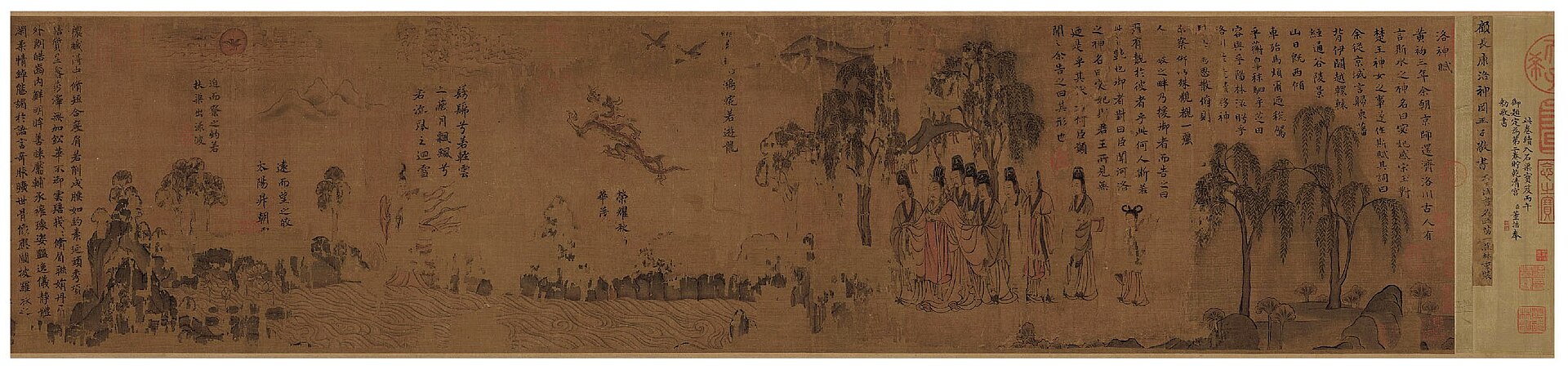
The Admonitions Scroll is not the only composition to carry Gu Kaizhi's name. The Nymph of the Luo River illustrates a different text entirely, Cao Zhi's rhapsody on the goddess of the Luo River, and survives only in later copies, none earlier than the Southern Song. Two of the best-known copies are illustrated on this page: one held by the Liaoning Provincial Museum in Shenyang, reported to have left the Qing collection with the last emperor Puyi when he fled north, and one held by the National Museum of Asian Art (the former Freer Gallery of Art) of the Smithsonian Institution in Washington. A further copy is held by the Palace Museum in Beijing. A separate composition, Wise and Benevolent Women, survives in a single thirteenth-century Song copy, also at the Palace Museum.
Every one of these objects is a different painting on a different subject from the Admonitions Scroll, and none should be confused with it or treated as an alternative version of the same work. What they share with the Admonitions Scroll is the underlying evidentiary problem: a name attached by later cataloguers and connoisseurs to a composition whose relationship to any specific original by Gu Kaizhi cannot be established from the surviving physical evidence alone.
The earliest secure sighting of the Admonitions Scroll is in the painter-connoisseur Mi Fu's Hua Shi (History of Painting), written around 1103, which places it with the court eunuch Liu Youfang.
The earliest secure sighting of the Admonitions Scroll is in the painter-connoisseur Mi Fu's Hua Shi (History of Painting), written around 1103, which places it with the court eunuch Liu Youfang. By 1120 it is catalogued as a work of Gu Kaizhi in the Xuanhe Huapu, the painting catalogue of Emperor Huizong's imperial collection, meaning it had entered Song imperial hands by then. When Kaifeng fell to the Jurchen Jin in 1127 and Huizong's collection scattered, the scroll's custody becomes uncertain again; a seal associated with the Jin Emperor Zhangzong appears on one section, but scholars are not confident it was applied at the time rather than added later from another source.
The chain resumes with named Ming-dynasty owners: the official Wang Ao, the minister Yan Song (whose confiscated property reverted to the Ming court after his disgrace in 1562), the official Gu Congyi, and finally the collector Xiang Yuanbian, who left roughly fifty of his own seals on the object and a colophon, the heaviest documented intervention by any single owner before the Qing. After Xiang Yuanbian's death in 1590, no owner is documented for roughly a century and a half, until the scroll surfaces in the early eighteenth century in the collection of the Tianjin salt merchant An Qi, from whom the Qianlong Emperor acquired it in 1746.
The Qianlong Emperor did not simply own the scroll; he physically remade it.
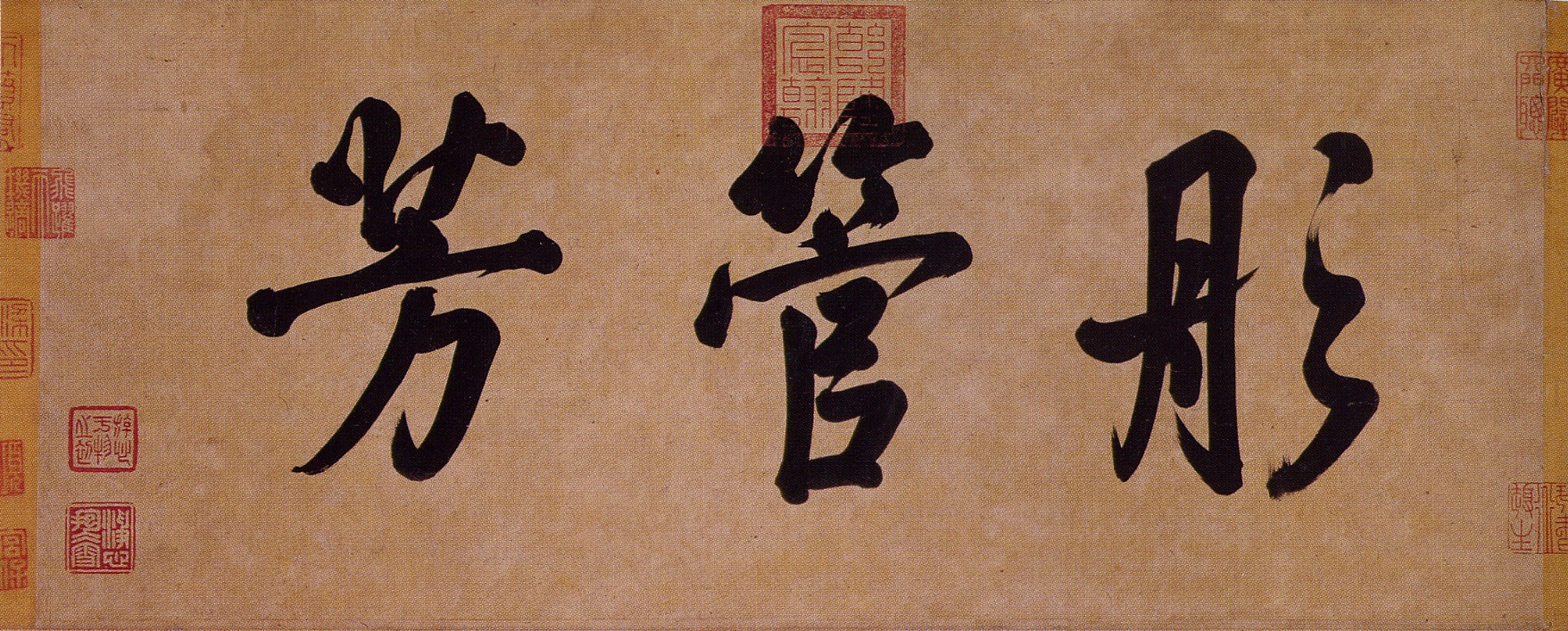
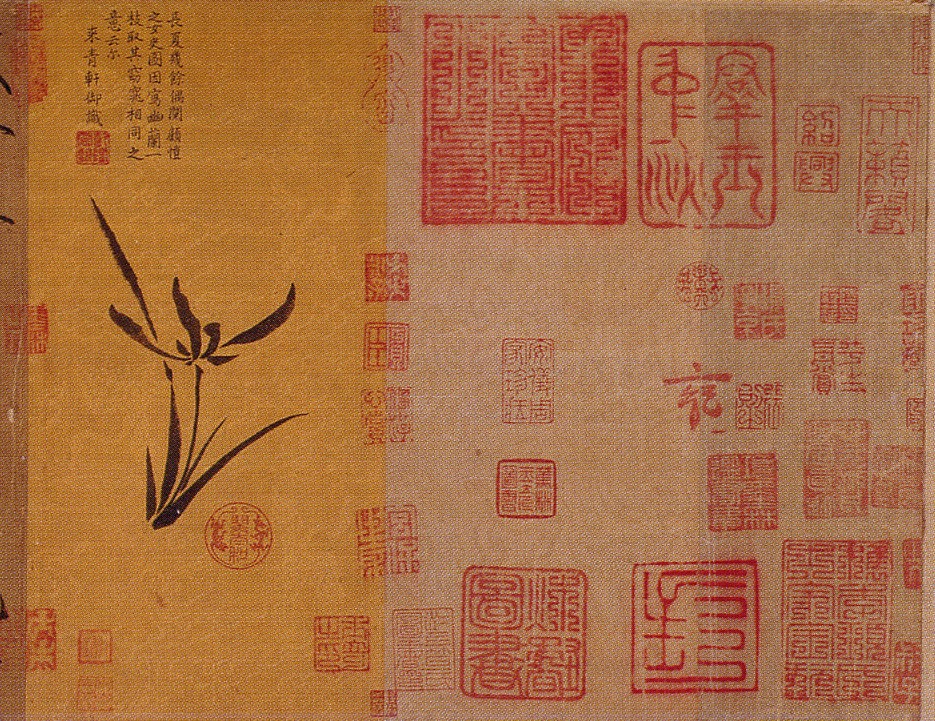
The Qianlong Emperor did not simply own the scroll; he physically remade it. In and after 1746 he had it remounted, added a title inscription in his own hand, painted an orchid onto the mount, and over his sixty-year reign impressed thirty-seven personal seals onto it, an act of ownership so dense it amounts to a form of authorship in its own right. He commissioned the court painter Zou Yigui to add a closing composition, Pine, Bamboo, Rock and Spring, as the final section of the mounted scroll, and kept the object, alongside three others he grouped as the Four Beauties, in his private Pavilion of Tranquil Ease.
This is worth stating plainly because casual Western commentary on the object sometimes treats the Qianlong material as clutter obscuring an earlier, purer painting. Qianlong's seals and colophon are primary evidence in their own right, of imperial taste, of the object's status at the summit of the Qing collection, and of exactly the kind of intensive, physically transformative engagement with a scroll that a Chinese collector considered a mark of honour rather than damage.
By the 1890s the scroll was kept, under Empress Dowager Cixi's de facto rule, at the Summer Palace complex west of Beijing.
By the 1890s the scroll was kept, under Empress Dowager Cixi's de facto rule, at the Summer Palace complex west of Beijing. When the Boxer Rebellion broke out and the international legations in Beijing came under siege, an Eight-Nation Alliance force occupied the city from mid-August 1900, and the Summer Palace was burned and systematically looted by soldiers of the occupying powers between mid-August and October of that year, an action distinct from, though following on from, the earlier 1860 burning of the same palace complex during the Second Opium War.
Captain Clarence Arnold Keatinge Johnson (1870-1937), a British Indian cavalry officer of the First Bengal Lancers stationed in the area, acquired the scroll during this period. His family later told the British Museum that he received it as a personal reward from a Chinese noblewoman whose household he had escorted to safety. No document corroborates this account, and it should be read as an undocumented family tradition rather than an established fact. What is documented is the setting: an occupied capital, a burning and looted palace, and a foreign officer leaving China in possession of one of the most treasured objects in the recently displaced Qing imperial collection. Whatever the specific transaction, Johnson's acquisition took place inside, and cannot be meaningfully separated from, the wider looting of the Summer Palace by the forces of the occupying alliance.
Johnson returned to Britain and in 1902 brought the scroll to the British Museum seeking only to have the jade toggle fitted to its wrapper appraised, apparently unaware of the painting's...
Johnson returned to Britain and in 1902 brought the scroll to the British Museum seeking only to have the jade toggle fitted to its wrapper appraised, apparently unaware of the painting's significance. Sidney Colvin, Keeper of the Department of Prints and Drawings, and his assistant Laurence Binyon recognised the object's importance. The Trustees purchased it from Johnson in 1903 for 25 pounds sterling, a figure this record could not find corrected or superseded in any source consulted and treats as confirmed.
Colvin's own contemporary condition note is blunt: the silk was, he wrote, much worn and rotted, and bore many traces of ancient repair. Twenty-five pounds in 1903 was roughly a domestic servant's or junior clerk's annual wage of the period, paid for what is now one of the most closely studied paintings in the British Museum's collection.
In 1914-15, the British Museum had the scroll dismantled from its Chinese roller-scroll format and remounted flat, using a Japanese byobu, or folding-screen, technique, carried out by the museum's...
In 1914-15, the British Museum had the scroll dismantled from its Chinese roller-scroll format and remounted flat, using a Japanese byobu, or folding-screen, technique, carried out by the museum's own restorer Stanley Littlejohn working with the Japanese printmaker Urushibara Mokuchu. This was a separate, later project from the 100 woodblock colour facsimiles of the scroll the museum had commissioned from Urushibara and the block-cutter Sugizaki Hideaki starting in 1912; that earlier commission produced copies of the painting, not the physical remounting of the original object. The painting sections were separated onto one mount and the accompanying colophons onto another, and Zou Yigui's closing painting was detached and mounted as an independent album leaf, cutting the scroll into what conservators now describe as three physically separated sections.
The intention, by the standards of the time, was conservation. The consequence, judged by the standard a Chinese scroll-mounter would apply, was closer to the opposite. Traditional Chinese handscroll mounting is itself an intensive, periodically renewed craft, built around a rolled format; flattening a silk scroll onto rigid panels in the Japanese album manner is a different physical treatment for a different kind of object, exposing the painting to flat, evenly distributed light and handling the rolled format was never built to receive. Named Chinese specialists have said so in public and in print. Tao Yuzhi, a researcher in the painting and calligraphy department of the Shanghai Museum, has stated that splitting an ancient Chinese silk painting into sections and mounting it on panels amounts to destroying the cultural relic, and that the practice could not happen at the Shanghai Museum, the Palace Museum in Beijing or the National Palace Museum in Taipei. Yang Xin, former deputy director of the Palace Museum in Beijing and the same scholar who has separately proposed the Northern Wei commission theory discussed above, has said the British Museum reworked the object according to a Western logic, treating it as if it belonged on a wall like an oil painting rather than as a scroll meant to be unrolled.
The British Museum's own conservation staff have reached a compatible conclusion by a different route. When the museum convened international specialists for a joint study beginning in 2013, in-house conservators including Qiu Jinxian, the museum's first Chinese-trained senior conservator of East Asian painting, judged the silk too fragile by then to remount as a rolled scroll at all, and refined the flat, panel-mounted presentation the 1910s remounting had already imposed rather than attempting to reverse it. The resulting case, unveiled in June 2014, is a purpose-built steel structure roughly four metres long, using passive humidity buffering and a strict annual light budget, with the scroll now shown for a fixed six-week window each year and kept in total darkness the rest of the time.
No catalogue raisonne and no authentication board exists for Gu Kaizhi.
No catalogue raisonne and no authentication board exists for Gu Kaizhi. Attribution is argued in print, object by object, by named specialists: McCausland, Kohara Hironobu and Wen Fong on the Admonitions Scroll's date, Chen Pao-chen and Yang Xin on its origin, with the museums that hold the three attributed compositions cataloguing them as attributed to, or after, Gu Kaizhi rather than as autograph works. There is no committee whose ruling would settle the question, and none of the specialists cited in this record claims that their own position is final.
As of this research pass, the British Museum's own collection record lists the Admonitions Scroll as not on display, consistent with a display schedule confined to a fixed six-week window each year; the museum's published 2026 schedule set that window for 13 July to 24 August. Outside it, the object is kept in darkness and study access is by appointment through the museum's Asia department. The scroll also sits inside a live, unresolved argument over Chinese cultural property removed from the country during roughly a century of foreign military intervention; in August 2023 the Chinese state-run Global Times published a formal editorial call for the British Museum to return relics acquired through what it characterised as improper channels, and in May 2025 the museum's director Nicholas Cullinan publicly ruled out permanent deaccessioning as museum policy, proposing loan and partnership arrangements instead. No response naming the Admonitions Scroll specifically was located in the sources consulted for this record.
Painter. c. 345-c. 406.
Born c. 345, Wuxi, Jiangsu province, Eastern Jin; died c. 406, Not documented in the sources consulted.
British Museum (London); Palace Museum (Beijing); Liaoning Provincial Museum (Shenyang); National Museum of Asian Art (Freer Gallery of Art), Smithsonian Institution (Washington, DC).
No market exists for this maker in any ordinary sense, and none has ever existed. The Admonitions Scroll has never been sold at public auction; it passed from private possession into British Museum ownership by a single purchase from Captain Clarence Johnson in 1903 and has not changed hands since.
What did Gu Kaizhi actually paint. No painting in his own hand is known to survive, so every specific claim about his style rests on later copies whose distance from any original is itself disputed.
Last verified 17 September 2026
One artwork and its story every Tuesday, with the picture: who owned it, what it made, and what closes soon in the exhibition calendar. No promotion, and nothing we cannot cite.
We send one email to confirm the address and keep nothing else. Every letter carries a one-click unsubscribe. How we handle your data.
_Southern_Song_Copy._Freer_Gallery_of_Art._Washington..jpg)
_Southern_Song_Copy._Liaoning_Provincial_museum.jpg)