Elisabetta Sirani
 Italian (Bolognese) · 1638-1665
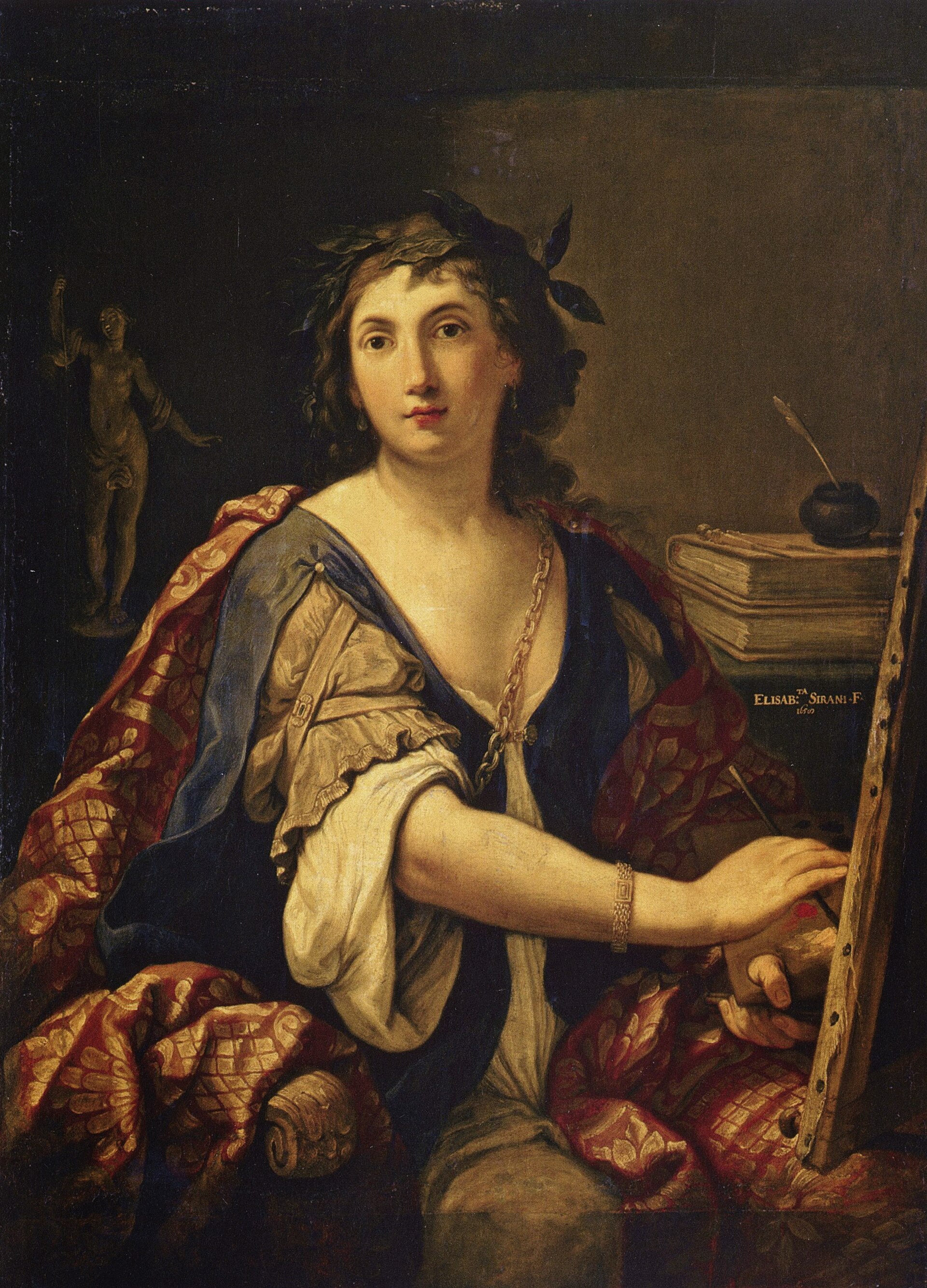
Self-Portrait as an Allegory of Painting, signed ELISAB.TA SIRANI F. 1658, Pushkin State Museum of Fine Arts, Moscow; painted for the notary Cavazza (Modesti). The sitter is called the artist by the museum and by Modesti, who titles it a self-portrait; it is an allegory, so it is a stylised likeness, and she wears a laurel wreath, a gold chain and a statuette stands behind her. The other likenesses are drawings and a lost painting known from an engraving, and the later printed portraits derive from that lost painting.
Pushkin State Museum of Fine Arts, Moscow (public domain; Commons PD-old)| Worked as | Painter, Etcher, Draughtswoman, Teacher |
|---|---|
| Born | 8 January 1638 · Bologna, Papal States |
| Died | 28 August 1665 · Bologna, Papal States (buried in San Domenico, in the... |
| Nationality | Italian (Bolognese) |
| Movement | Bolognese Baroque, in the tradition of Guido Reni and the Carracci |
| Sources | 15 cited |
| Last verified |
About this page Last verified · 15 sources cited
On this page 13 sections
ContentsClose
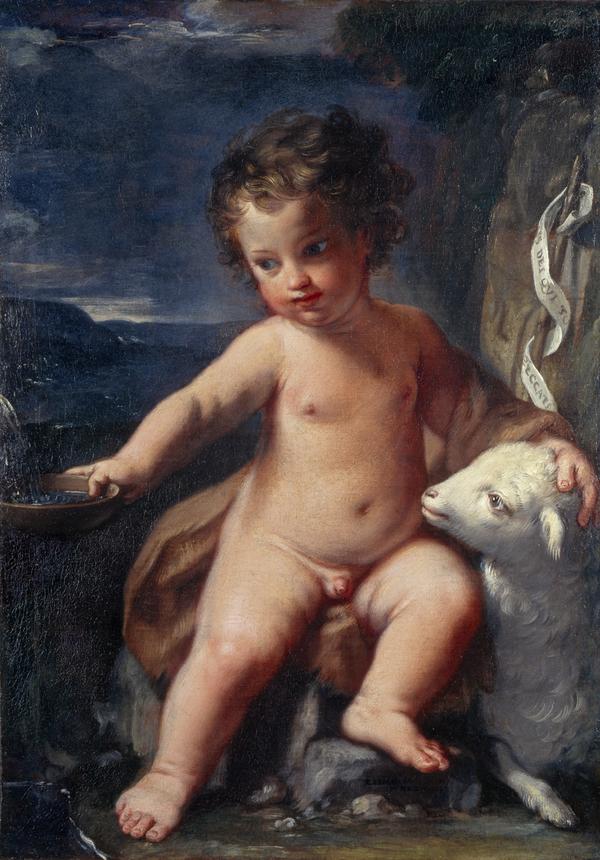
Elisabetta Sirani kept a ledger. From 1655 until the summer of 1665 she wrote down, picture by picture, what she had painted, what it showed and who it was for, and her biographer Carlo Cesare Malvasia printed the list in 1678. That one document is why she is among the best-documented women painters of Bologna (Modesti calls her the most documented, successful and collected Bolognese woman artist), and the reason this page starts with her paperwork and not with her legend. The ledger names about 110 clients (Modesti), runs to nearly 200 paintings by the count of Babette Bohn, and has been checked against the surviving signed pictures, which match it every time a dated canvas can be tied to an entry.
She was 27 when she died on 28 August 1665, after severe stomach pains, and the National Museum of Women in the Arts says her father suspected a jealous maid. The record is less tidy and more interesting. Malvasia reports that the stomach was found perforated when the body was opened, though the physicians who first said poison later came round to a natural death. A maid was jailed and exiled according to Malvasia, accused by a father who withdrew the charge according to Modesti, and acquitted according to the museum blog of the National Museum of Women in the Arts. Those three outcomes sit in print side by side, and this page keeps them side by side.
The thing a reader probably doesn't know is how little of her work belongs to her name alone. From about 1662 her father's hands were crippled by gout and she ran the workshop: two sisters painted, a studio hand made prints after her pictures, and she trained a school of women. Her pictures are signed, often by stitching ELISABETTA SIRANI FECIT into a cushion braid or a cuff, because, Modesti says, detractors doubted a woman could have painted such works and believed her father helped. Some of her own works have since been given to him, and some pictures once called her self-portraits are now doubted or given to others.
Images
Chronology
- 1638
Born in Bologna on Friday 8 January, the eldest child of the painter and art dealer Giovanni Andrea Sirani and Margherita Masini della Mano.12
- 1642
Guido Reni dies, when she is four, which is why Bohn rejects the idea that he taught her.41
- 1655
First entry in her Nota delle pitture, among them an altarpiece for the Marchese Spada, given by the Marchese to a congregation in Parma, and a Virgin and Child with Saints for Trasasso, still in its likely original place.34
- 1657
On 28 February the prior of the Certosa, Daniele Granchio, commissions the Baptism of Christ; a fee of 1,000 lire was promised. The same year she dedicates an etched Madonna of the Passion to Count Ettore Ghisilieri.42
- 1658
Signs the five-by-four-metre Baptism for San Girolamo della Certosa, the Judith Triumphant for the banker Andrea Cattalani and the Self-Portrait as an Allegory of Painting for the notary Cavazza.234
- 1659
Paints the Timoclea, now at Capodimonte, as a pair for Cattalani.23
- 1662
Her father is crippled by gout and she runs the studio; on 19 August Ferdinando Cospi writes to Prince Leopoldo de' Medici that she is considered a maestra and keeps her large family.124
- 1664
Her largest year, 30 works in the ledger; the Portia Wounding her Thigh is signed for the silk merchant Simone Tassi.15
- 1665
Writes her last ledger entry in the summer, naming the 'grand Personages' who passed through Bologna that spring to see her paintings and watch her work.1
- 1665
Dies on 28 August after severe stomach pains; rumours of poison lead to the trial of a servant; she is buried beside Guido Reni in San Domenico after a civic funeral.1312
- 1678
Malvasia prints her Nota and his life of her in Felsina pittrice, volume 2.31
- 1854
Andrea Bianchini publishes legal proofs on the poisoning of Sirani at Bologna; Mazzoni Toselli follows in 1868 and Baldi in 1958, according to Bohn's note.4
- 1976
The Los Angeles County Museum of Art's Women Artists 1550-1950 shows the Portia and brings her into the modern canon.513
- 2004
First major retrospective, 'Elisabetta Sirani, pittrice eroina', in Bologna (4 December 2004 to 27 February 2005), with Modesti's first monograph.15
- 2008
Portia Wounding her Thigh is offered at Sotheby's with an estimate of USD 300,000-500,000 and goes to a Bologna foundation.5815
- 2025
Massimo Pulini publishes Il diario di Elisabetta Sirani, reproducing the manuscript diary and adding unpublished works.141
- 2026
The National Gallery of Victoria acquires The Madonna and Child with a swallow through the Eva Mandel Bequest (2026.47), its first painting by her.1
The market
Her market is thin and the public record is partial; these are selected results. The highest found is USD 505,000 for the Portia Wounding her Thigh in January 2008, per the aggregator Art.Salon, against a Sotheby's estimate of USD 300,000 to 500,000 shown on its own page. Others tabulated: a pair of octagonal allegories at USD 158,500 in 2012, a signed 1665 Young Saint John at USD 50,000 in 2014, a Saint John the Baptist at GBP 52,500 in 2016, a Venus and Cupid at USD 137,500 in 2018 and a signed Mater Dolorosa at GBP 8,820 in 2023. Art.Salon's history list also carries further rows, among them a Beauty Fending Off Time at GBP 85,000, a Holy Family at GBP 5,000, a lady as Pandora or Artemisia at USD 22,500 and a Maria mit dem Kind at 43,750 in an unclear currency; their price-to-title layout couldn't be reliably matched, so they are not tabulated. The one verified premium statement is Bonhams': its GBP 52,500 is 'inc. premium'. The other rows come from an aggregator that doesn't say whether its figures include the buyer's premium, so the hammer and premium columns are given as not stated.
Two pictures have earlier sales on record. Sotheby's provenance for the Venus and Cupid, as reproduced by Art.Salon, gives its sale at Bukowski, Stockholm, on 29 May 2007 (lot 434) as SEK 1,725,000, stated there as $250,000; the 2018 result is USD 137,500, and the two figures are not on a comparable basis, since premium and conversion are not stated for either. The Young Saint John was bought by its 2014 consignor at Sotheby's New York on 15 January 1993 (lot 41); no 1993 price was found. At the low end, a signed devotional Mater Dolorosa made GBP 8,820 at Christie's in 2023.
Insurance, probate and customs values were not found. No tax-dation, export-licence, theft or restitution case involving her work was found.
| Date | Sale | Work | Result | Note |
|---|---|---|---|---|
| January 2008 | Sotheby's New York (sale N08404, lot 44) | Portia Wounding her Thigh, signed ELISAB.A SIRANI F. 1664, oil on canvas, 101 x 138 cm | Hammer not stated With premium USD 505,000 (premium treatment not stated by the aggregator) USD | Estimate USD 300,000-500,000. Said by Art.Salon to be the highest result for her. Buyer per the Commons description: the Collezioni d'Arte e di Storia della Fondazione della Cassa di Risparmio, Bologna. Underbidder not found. |
| 26 January 2012 | Sotheby's New York (lot 51) | An Allegory of Fame and An Allegory of Virtue, a pair of octagonal canvases | Hammer not stated With premium USD 158,500 (premium treatment not stated) USD | Estimate USD 150,000-200,000. |
| 5 June 2014 | Sotheby's New York (lot 35) | Young Saint John the Baptist, signed 1665, oil on canvas laid on panel, 69.9 x 48.3 cm | Hammer not stated With premium USD 50,000 (premium treatment not stated) USD | Estimate USD 40,000-60,000. Bought by the consignor at Sotheby's New York, 15 January 1993, lot 41. Sotheby's note on a ledger entry for an Infant Saint John for Senator Pietramellara in 1660. |
| 8 December 2016 | Bonhams London, New Bond Street (lot 52) | Saint John the Baptist | Hammer not stated With premium GBP 52,500 inc. premium GBP | Result as printed on the Bonhams page. Bonhams compares it with the 1665 Young Saint John and a 1664 Delilah offered at Hotel Drouot, Paris, 4 November 2011. |
| 2 February 2018 | Sotheby's New York (lot 195) | Venus and Cupid, signed on the quiver ELISA SIRANI F.1664, oil on canvas, 105 x 82 cm | Hammer not stated With premium USD 137,500 (premium treatment not stated) USD | Estimate USD 100,000-150,000. Provenance in the note: commissioned by Count Annibale Ranuzzi; by descent to Count Girolamo Ranuzzi (1788 inventory); Bukowski, Stockholm, 29 May 2007, lot 434, SEK 1,725,000; Adam Williams, New York. |
| 8 December 2023 | Christie's London (lot 158) | The Mater Dolorosa, signed and indistinctly dated 166[2?], oil on canvas, 74.9 x 63 cm | Hammer not stated With premium GBP 8,820 (premium treatment not stated) GBP | Estimate GBP 8,000-12,000. |
Hammer is the price at which the bidding stopped; with premium adds the fee the house charges the buyer on top. Hammer price and buyer's premium in the glossary.
Where to see the work
| Institution | City | Holdings | Note |
|---|---|---|---|
| Pushkin State Museum of Fine Arts | Moscow | Self-Portrait as an Allegory of Painting, signed and dated 1658. | Painted for the notary Cavazza; the museum's current display status wasn't checked. |
| Collezioni d'Arte e di Storia, Fondazione Cassa di Risparmio in Bologna | Bologna | Portia Wounding her Thigh (1664) and Anna Maria Ranuzzi Marsigli as Charity (1665). | The Portia was bought at Sotheby's in 2008 according to the Commons description. |
| San Girolamo della Certosa | Bologna | Baptism of Christ (1658), about five by four metres, still in the church for which it was commissioned. | Bohn describes it flanking Agostino Carracci's Last Communion of Saint Jerome, now in the Pinacoteca Nazionale, and a canvas by her father. |
| Pinacoteca Nazionale | Bologna | The Penitent Magdalen (1660), the Saint Bruno on copper (1657) and a copper portrait of her that Bohn gives to Barbara Sirani. | Several works are in the deposits, per Bohn, who thanks the museum for access. |
| Museo Nazionale di Capodimonte | Naples | Timoclea (1659), 228 x 174.5 cm. | Painted as a pair with the Judith Triumphant for Andrea Cattalani. |
| Burghley House | Stamford, Lincolnshire | Judith Triumphant (1658). | Painted for Cattalani. |
| Museo Civico d'Arte | Modena | Galatea (1664) in its original carved frame. | Made for Ferdinando Cospi. |
| National Museum of Women in the Arts | Washington, D.C. | Virgin and Child (1663). | Gift of Wallace and Wilhelmina Holladay. |
| National Gallery of Victoria | Melbourne | The Madonna and Child with a swallow (2026.47) and works on paper. | Modesti's essay says three works on paper in English and four in its Italian text; the NGV itself should be asked. |
| Ashmolean Museum | Oxford | Self-Portrait as a Lady, a full-length drawing (inv. 953, per Bohn). | Part of the Gaburri collection before it left Italy. |
| Walker Art Gallery, National Museums Liverpool | Liverpool | Self-portrait drawing, red chalk, about 1664 (WAG1995.345, per Bohn). | Formerly Gaburri and Rogers. |
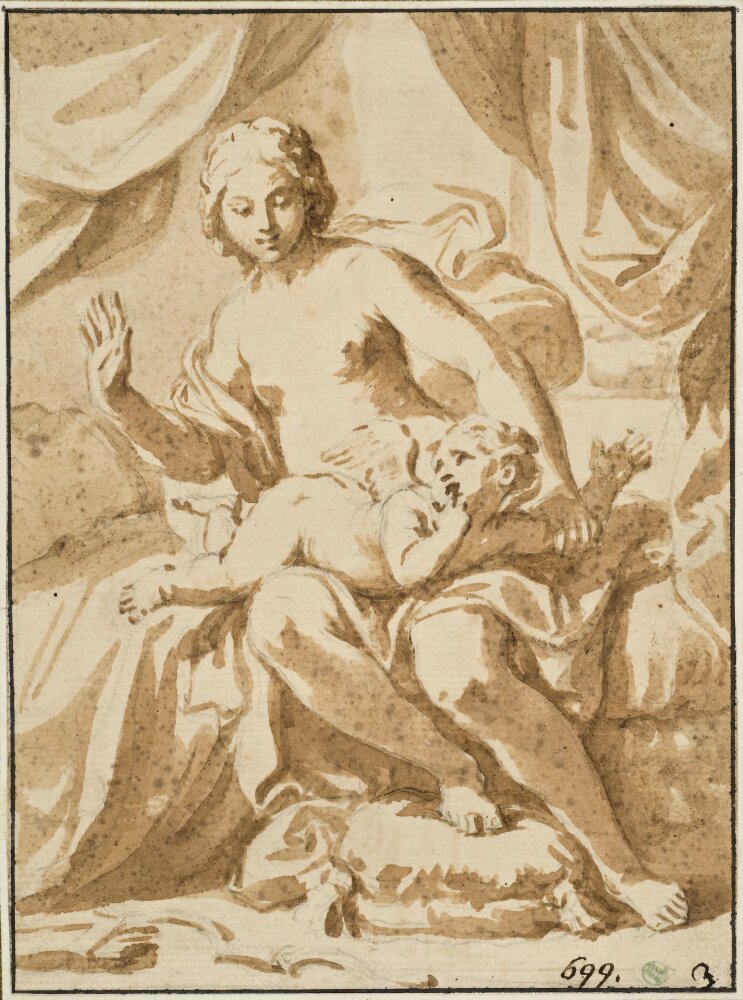
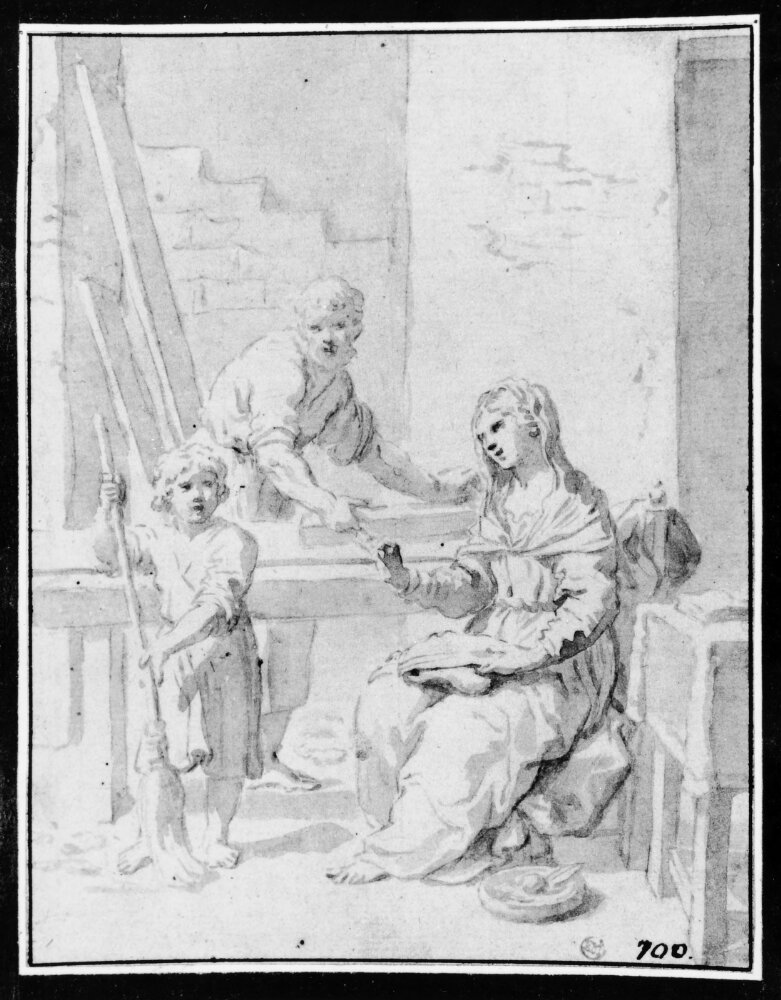
| Nationalmuseum | Stockholm | Drawings including a Venus Punishing Amor and a Holy Family with Mary sewing. | Both are catalogued on Commons as drawings (NMH 842-1863 and 843-1863). |
Forgeries and misattributions
- Misidentified self-portraits
- No forgery was found. Bohn lists pictures wrongly called Sirani's self-portraits: a Self-Portrait as La Pittura formerly at the Heim Gallery, London, that she says doesn't resemble the artist and may not be hers; a picture in the Uffizi that is a replica of a self-portrait by the Bolognese painter Lucia Casalini Torelli; and a picture in the National Museum of Women in the Arts, Washington, which she thinks is by Giovanni Andrea Sirani and doesn't show Elisabetta. Comparison with her securely identified features (arched eyebrows, long nose, elaborate hair) and with early collection records; Bohn knew the Heim picture only from a photograph.4
- A copper portrait in the Pinacoteca Nazionale
- Oil on copper, 15.5 x 12.5 cm, inv. 368, acquired 1896, long catalogued as a work by Elisabetta of her own likeness. Bohn says it has little stylistic similarity to her other works and matches Malvasia's description of the portrait of Elisabetta that her sister Barbara painted after her death in 1665. Style and the match with Malvasia and with Picinardi's poem; Ann Sutherland Harris first suggested Barbara in 1976.43
- Saint Bruno on copper, 1657
- Signed and dated and listed in her own 1657 entries, yet catalogued in the Pinacoteca Nazionale as by Giovanni Andrea. The signature and the ledger entry (Bohn).4
- Her works mistaken for Reni's, and her students' for hers
- Bohn says her fame produced confusion with the works of her students, most of whom are largely unknown in extant works. The Reni connection was also overstated by writers who called him her teacher. Documentary: Reni's death in 1642 when she was four; the ledger and signed pictures.4
The essay
Chapter 1A ten-year career kept in her own ledger
The 'Nota delle pitture fatte da me Elisabetta Sirani' is a list in her own voice, covering 1655 to 1665 and published in Malvasia's Felsina pittrice of 1678 (the 1841 edition has it at volume 2...
The 'Nota delle pitture fatte da me Elisabetta Sirani' is a list in her own voice, covering 1655 to 1665 and published in Malvasia's Felsina pittrice of 1678 (the 1841 edition has it at volume 2, pages 393 to 400). Each entry gives the subject, the composition, often the size, and the person it was made for. Modesti calls it the essential primary source for the oeuvre and counts 110 clients in it. The entries read like a studio book and not like a catalogue: for a Madonna of 1664 she writes that it is composed much like the one she did for a Florentine gentleman but with a different idea, because there the Child caresses his mother and here he shows her a swallow, for the archpriest of Piumazzo. That is the NGV picture acquired in 2026.
The ledger can be tested, and it passes. Bohn notes that every dated painting that can be connected to a picture on the list confirms the accuracy of Sirani's chronology. Modesti adds that 1664, with 30 works, was her largest year. No source read gives a verified entry count: Bohn reports that the list covers nearly 200 paintings, Modesti says about 200 canvases of which 130 survive, and the Gale encyclopedia says some 170 works including drawings and etchings. In 2025 Massimo Pulini published Il diario di Elisabetta Sirani (NFC Edizioni, Rimini, 288 pages), which according to a Finestre sull'Arte introduction reproduces the manuscript version of the diary for the first time and adds previously unpublished works. The contents of that book were not seen for this page.
The ledger is also an act of self-defence. Modesti reads the signatures and the ledger together as her answer to detractors who thought her father painted the pictures. Bohn reports that Sirani signed some 66 per cent of her extant paintings, an unusually high rate, and her last ledger entry, written the summer she died, lists the 'grand Personages' who passed through Bologna that spring to see her paintings and watch her work.
Chapter 2The workshop: a father's gout, two sisters and one working hand
Giovanni Andrea Sirani (1610-1670) was a painter, an art dealer, an appraiser and a teacher, and had been Guido Reni's closest assistant.
Giovanni Andrea Sirani (1610-1670) was a painter, an art dealer, an appraiser and a teacher, and had been Guido Reni's closest assistant. The household ran as a studio with a reception room. Modesti reports that the paintings were mostly paid for in kind, in jewellery and gold, which the family displayed in a glass case in the reception room for 'the common benefit of the household' (Malvasia's phrase, as Modesti quotes it). Her father's library, with Plutarch, the Old Testament and Ripa's Iconologia, was her reading room.
By about 1662 his hands were ruined by gout and Elisabetta was the head of the studio. Malvasia, who knew the household closely, says the old man could no longer use his right hand and gripped the brush in the left, whose fingers were hardly better, as one would hold a sword or a stick. A letter from the Bolognese agent Ferdinando Cospi to Prince Leopoldo de' Medici of 19 August 1662 says she is considered a maestra and keeps her large family by her work. In the same period Cospi sent two of her drawings to Leopoldo and remarked, as Bohn reports a letter she cites, that her father's hands had been deformed for so long there was no reason to suspect he had helped her.
Who else worked in the room is partly known. Her sisters Barbara and Anna Maria both became professional painters, according to Modesti's account. A studio assistant, Lorenzo Loli, executed prints after her paintings and finished drawings (Modesti). The ledger for 1660 names a Lorenzo Tinti, copper engraver and former pupil of her father, then in the service of Modena; Bohn credits a Lorenzo Tinti with the standard engraved portrait of her, and whether the two are the same man wasn't checked. Modesti notes that the Sirani family carpenter, Angelo Riva, carved the gilded frame of the Galatea. The division between her hand and the studio's is not published in a form that could be checked, and no source read says how many of the ledger's pictures were finished by others.
The credit has sometimes flowed the wrong way. Bohn reports a small Saint Bruno on copper of 1657 in the Pinacoteca Nazionale, Bologna, labelled as a work of Giovanni Andrea even though it carries Elisabetta's signature and date and is in her own list for that year.
Chapter 3Not Reni's pupil
Many accounts call her Guido Reni's heir or pupil.
Many accounts call her Guido Reni's heir or pupil. Bohn reports that Reni died in 1642, when Elisabetta was four, and that Bolognese biographers qualified the connection as early as the eighteenth century while others went on blurring it. Her father had been his assistant, and she learnt his idiom through her father, his drawings and his pictures. Bohn notes that a modern plaque on her house in Via Urbana still calls her an emulator of Reni, and she lies in the tomb with him, a placement that fed the notion of two painters united in death.
What she took from him is argued, and the two standard descriptions differ in emphasis. Ann Sutherland Harris and Linda Nochlin, quoted in the Gale encyclopedia, say she mastered his technique but with more sculptural drapery, a darker tonal range and less bland faces. Modesti says she began in Reni's idealising classical style and then developed an expressive manner of her own, mixing Reni and Raphael with Caravaggio's tenebrism and Guercino's colour. Both agree she moved off his model.
Her training came from the family house: Modesti says it included history, music, literature, art theory and philosophy, and that her father also taught her etching, which she had mastered by 18. She couldn't attend his nude life-drawing class for the male apprentices, which Modesti counts among the limits of her training. Malvasia, for his part, claims the credit for the whole career: he writes that he insisted on her father letting her take up the brush and kept encouraging her. Modesti treats this as the claim of a friend and patron-agent, and no second witness to it was found.
Chapter 4A school run by a woman
Bologna had a tradition of women artists unusual for Italy; Modesti counts 68 documented women painters in the early modern city, the single largest school of women artists in Italy.
Bologna had a tradition of women artists unusual for Italy; Modesti counts 68 documented women painters in the early modern city, the single largest school of women artists in Italy. Sirani added something specific: a studio where girls were taught to draw and paint by a woman and not by a husband, brother or father, which Modesti calls a matrilineal pedagogic model. She took her two younger sisters, the noblewoman Ginevra Cantofoli and perhaps Lucrezia Scarfaglia. Malvasia, writing in 1678, says numerous women and girls follow the example of this most worthy painter, and names eleven.
The record here is thin and slightly contradictory. Bohn says she trained about a dozen women, and notes that Cantofoli (1618-72) was a generation older than Sirani, so the word student needs a footnote. Scarfaglia and Cantofoli each left a self-portrait showing the painter at an easel, a format Bohn traces to Sirani's own Self-Portrait Painting the Portrait of her Father. Veronica Fontana (1619-90), another Bolognese woman who worked for Malvasia, may have cut the wood engraving of Sirani in the Felsina pittrice. Extant works by her students are rare, which is the commonest way for a woman's pupils to disappear.
Modesti calls her example pioneering and gives the numbers above. A bigger claim, that hers was the first school for women in Europe outside a convent, is repeated in popular summaries, but none of the scholarly sources read says it, so it isn't made here.
Chapter 5Women of courage, and a Portia at an overdoor
Her favourite subjects, Modesti says, were women: sacred, mythological and allegorical.
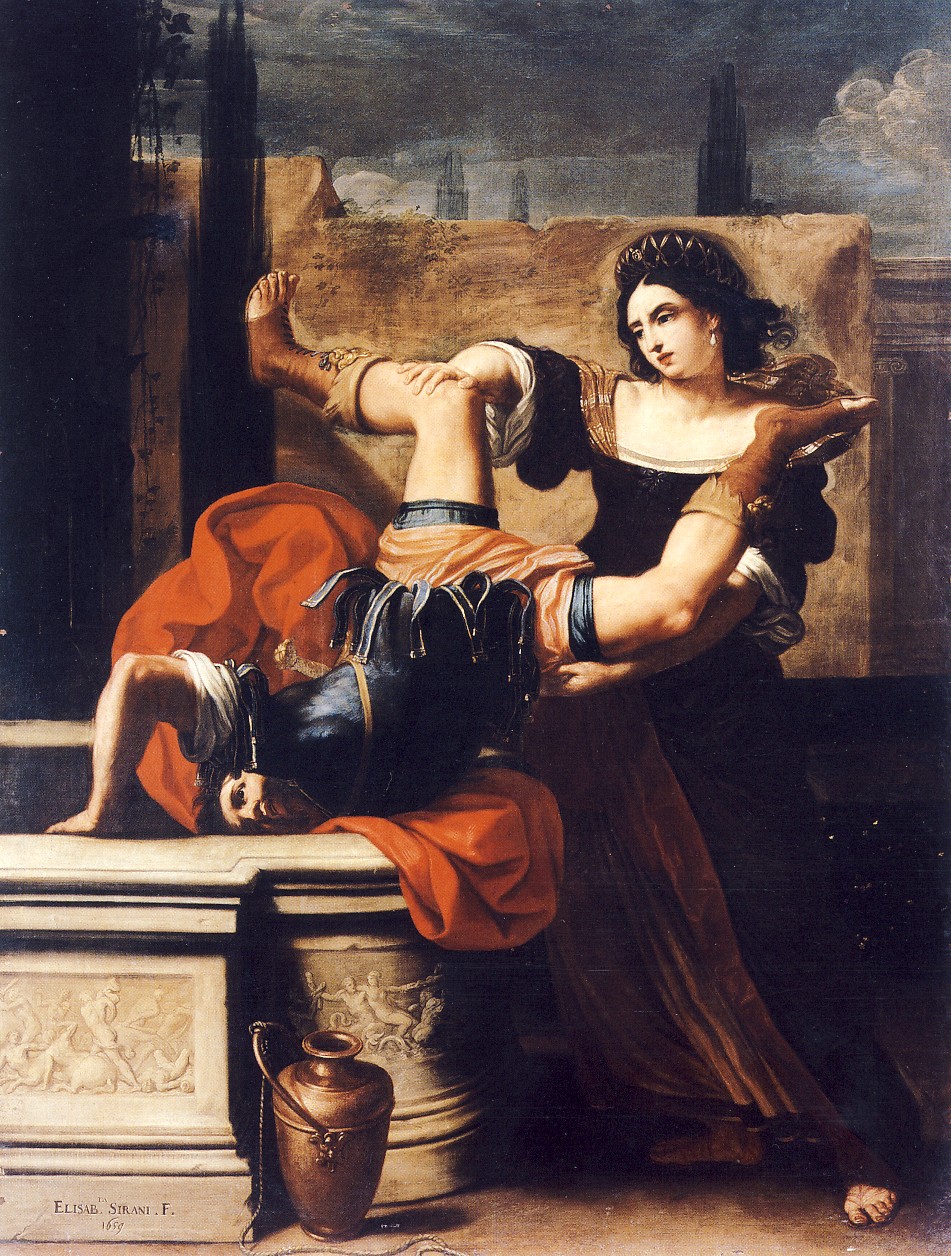
Her favourite subjects, Modesti says, were women: sacred, mythological and allegorical. She painted the biblical Judith, Timoclea who pushed her rapist into a well and Portia, the wife of Brutus as independent agents, and she painted the anti-heroines Delilah, Cleopatra and Circe with their virtues rather than their vices. Few women painters of her time attempted history painting; Bohn calls her the first Bolognese woman to specialise in it and reports at least 145 religious pictures, some fifty subjects from ancient history, myth and allegory and only about fifteen portraits.
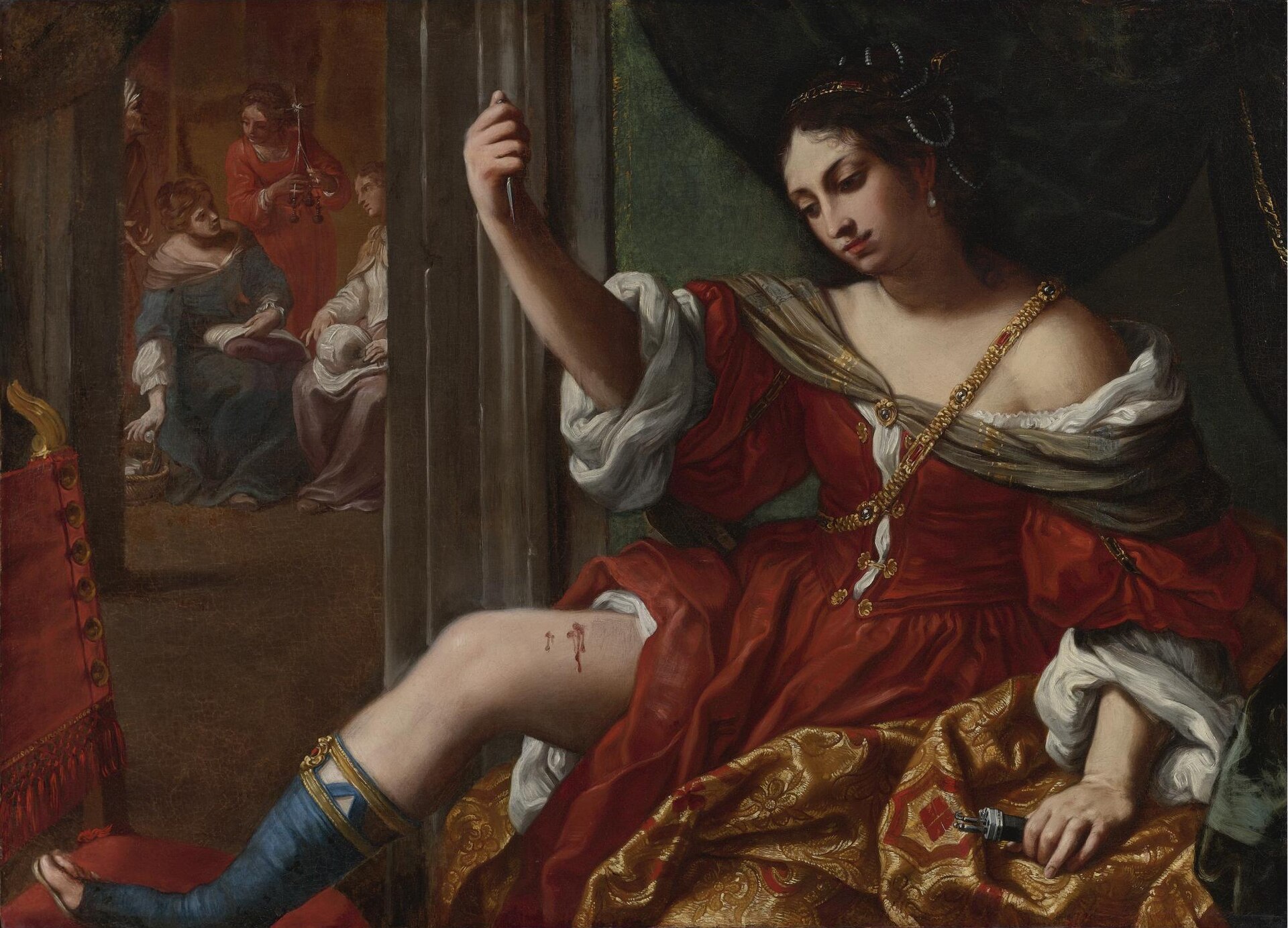
The documented part is simple. Her father's library supplied the sources, with Plutarch, the Old Testament and Ripa, according to Modesti, and her ledger describes each subject. For Simone Tassi, a silk merchant who owned five of her pictures, she wrote in 1664 of a Portia wounding herself in the thigh, 'when she desired to know of the plot that worried her husband' (Sotheby's looser rendering of the Italian, which has the conspiracy her husband was hatching), an overdoor with maidens at work in a room beyond. Plutarch's version has Portia cut her thigh with a nail knife to prove she could bear her husband's secrets. The Sotheby's catalogue note, which is the auction house's reading, says the unusual horizontal composition was dictated by the picture's position over a door, and that the choice of subject was probably Sirani's own because Tassi's collection was otherwise orthodox.
What the picture means to later readers is argued, not documented. The Gale encyclopedia calls the picture unique in showing a woman's courage and heroism, a point of view seldom seen in the art of its time, and says Harris and Nochlin rate it and the Penitent Magdalen as equal to Reni's best; the picture was in their 1976 exhibition Women Artists 1550-1950. Sotheby's calls it the unique treatment of the theme in Italian seicento painting. Bohn and Phillippy are cited in the Sotheby's literature list for readings of the painting. The Sotheby's note itself says such feminist readings are in part theoretical. The ledger is silent on any intention beyond the subject, and no letter in which she explains it was found.
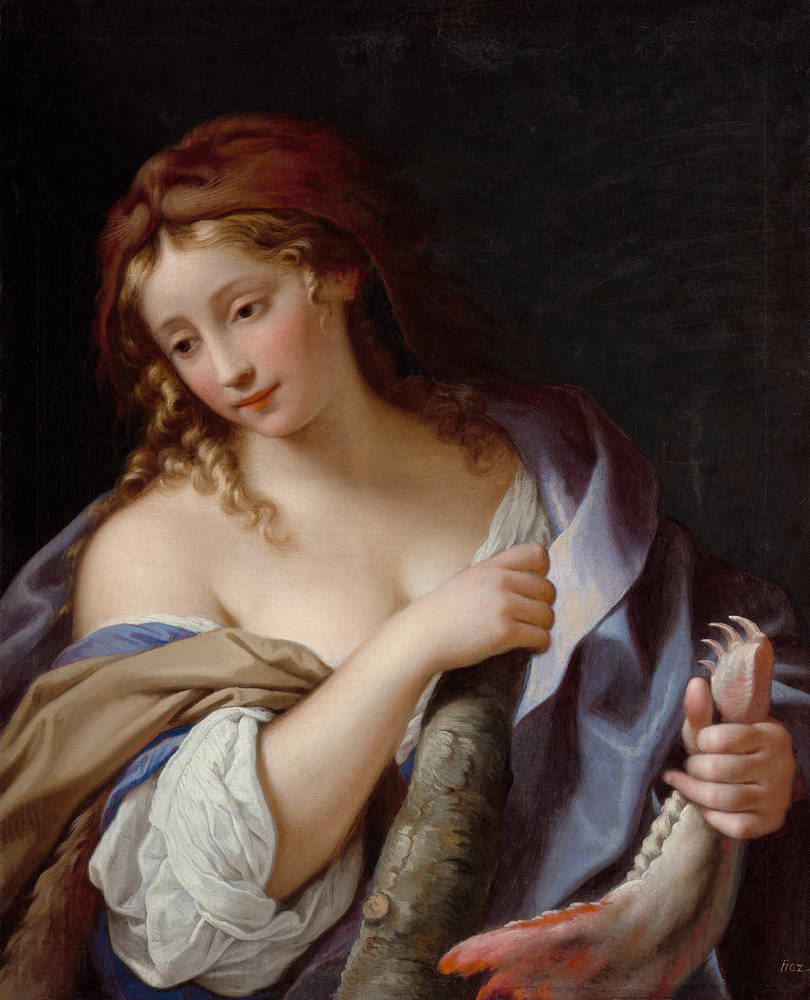
There is no hidden programme in the Madonnas. Modesti reads them as Counter-Reformation devotional pictures of the kind Cardinal Gabriele Paleotti's Bologna wanted, small quadretti da letto for private prayer, with the Child offering a swallow, a rose, a pear or a rosary to his mother. She argues that the swallow announces spring and, like the goldfinch, points to the Passion and Resurrection, and that the Virgin wears a Bolognese peasant's linen headcloth so local women could see themselves in her. That is Modesti's reading of a pictorial convention, not a statement by the painter.
Chapter 6Signing, self-portrait and the painter as a subject
A signed picture is a claim. Modesti notes that most of her extant paintings and some drawings are signed and dated, with variations on ELISABETTA SIRANI FECIT, and that she wove the name into the...
A signed picture is a claim. Modesti notes that most of her extant paintings and some drawings are signed and dated, with variations on ELISABETTA SIRANI FECIT, and that she wove the name into the picture itself: on cushion braids, cuffs and necklines. In the NGV Madonna the contracted signature E.A SI and the start of the date sit on the tie of the Virgin's cloak. In the Portia, the signature is on the base of the chair back.
She also sold her face. The Self-Portrait as an Allegory of Painting of 1658, now in the Pushkin Museum, Moscow, is signed ELISAB.TA SIRANI F. 1658 and was painted, Modesti says, for Signor Cavazza, notary of the bishopric; the ledger's entry for the year is a half-figure of Painting for Cavazza. Modesti says she sometimes used her own portrait in her images of heroic women and that collectors wanted self-portraits by women. In the great Baptism for the Certosa of 1658, the ledger says one of the two saintly women flanking the scene is her own portrait, the one looking toward Heaven. Bohn argues that this veiled figure is a self-fashioning as a Bolognese holy woman and links it with Caterina Vigri; that is an argued reading and the ledger says only that it is a portrait.
The most famous self-portrait for two centuries is lost. Bohn describes Sirani Painting the Portrait of her Father, once in the Ercolani collection in Bologna, known today from written descriptions, a preparatory drawing and an engraving of 1833. The first printed portrait, Tinti's engraving of about 1665, substituted the Virgin for the father's likeness and changed her from portraitist to history painter. Bohn records at least three self-portrait drawings: a full-length Self-Portrait as a Lady in the Ashmolean Museum, Oxford, which she calls unusual for its pretensions to high social status; one in the Walker Art Gallery, Liverpool, in red chalk, of about 1664; and one of about 1660 in a private collection in Geneva, which prepared the lost painting.
Chapter 7How she painted
Modesti's 2026 account of the NGV Madonna is the fullest technical statement found.
Modesti's 2026 account of the NGV Madonna is the fullest technical statement found. Sirani worked directly on the canvas alla prima without underdrawing, often laying the paint wet into wet in the neo-Venetian manner, and built texture with impasto. The picture shows a pentimento to the right of the Virgin's face where the head was first set closer to the Child and the swallow. She nonetheless made many compositional studies on paper first, and finished drawings after her own paintings, sometimes as models for prints.
The drawings are a separate signature. Malvasia describes her way of drawing as the method of a great master, seldom used even by her father: she dipped a small brush in ink wash and had the invention drawn, shaded and highlighted all at once, in a few broad strokes. He says she did this the evening the news came that the agreement over the Certosa Baptism had been reached, producing a compositional drawing on half a sheet of royal paper that he was given and that went into the collection of Valerio Polazzi. She also drew in charcoal, red chalk and graphite.
Speed was part of the reputation and part of the evidence. In a passage he says he wrote to answer the whisper that her father did the work, Malvasia describes taking Monsignor Albergati and a party of knights to watch her paint: at his request she lifted the Madonna from the easel, set a small canvas in its place and, in less than an hour by his account, blocked in and nearly finished a woman's head. That is his account, and he was a partisan witness. Supports are mostly canvas; she also painted small devotional works on copper, such as the Holy Family of 1662 in a private collection in Milan and the Saint Bruno, and a Young Saint John the Baptist is on canvas laid on panel (Sotheby's). Her etchings, which Modesti counts as roughly 12 or 15, carry inscriptions such as Siranus In[venit] where she etched her father's design.
Chapter 8Clients, money and what a picture cost
Her clients ranged from artisans and merchants to bankers, professors, ecclesiastics, senators and nobility, and Modesti lists the Medici, the Duchess of Bavaria and the King of Poland among her...
Her clients ranged from artisans and merchants to bankers, professors, ecclesiastics, senators and nobility, and Modesti lists the Medici, the Duchess of Bavaria and the King of Poland among her admirers abroad. Marchese Ferdinando Cospi and Count Annibale Ranuzzi acted as her agents, and Malvasia as her promoter. The banker Andrea Cattalani commissioned at least five works, among them the Judith Triumphant of 1658, now at Burghley House, and the Timoclea of 1659, now at Capodimonte, as a pair. Tassi, the silk merchant, bought at least five; the Portia is the one with a documented valuation, not a price paid.
Three numbers survive from her own lifetime or just after. Bohn reports, citing a monastery record that she says can no longer be found, a fee of 1,000 lire promised for the Baptism on 28 February 1657. Sotheby's, quoting Morselli's published inventories, says the Portia was valued at about 500 lire in Tassi's 1675 inventory, second in value only to a Madonna and Child with Saints by Ludovico Carracci among his 66 paintings. The ledger itself, as read, records subject and patron and not prices. No source read gives a contemporary wage or house price in Bologna to put these lire against, and a modern equivalent is not offered.
After her death the pictures circulated among collectors. Sotheby's notes that the Tassi collection passed on to Ludovico Foschi in 1675, who held it until 1696, and that by then the picture was catalogued with no attribution, size or value. The ledger also shows tradesmen: a jeweller, Giovanni Battista 'Cremonese' in the ledger and Giovanni Battista Amati from Cremona in Modesti's caption, for whom she painted a Magdalen with a companion Saint Jerome, and a family fishmonger, Giuseppe Comelli, who perhaps owned the Holy Family on copper of 1662 (Modesti).
Chapter 928 August 1665: the death and what the sources say
The fullest early account is Malvasia's, printed 13 years after her death.
The fullest early account is Malvasia's, printed 13 years after her death. He writes that the maid was jailed and did not deny putting a powder in her mistress's soup, that another woman who came into the house for domestic services had seen her do it, and that the maid herself ate what was left in the dish and became very ill. The maid always said it was only sugar and cinnamon, as she was in the habit of adding. He suggests that she may herself have been deceived into believing the mixture would make her mistress love her. Giuliano Laureti, he reports, always said she could not be put to the torture, and she was sent into exile regardless, a light penalty if guilty and a grave one if innocent. Malvasia adds that he can only accept the trial as poorly conducted, and he calls false the rumours that a powerful hand was behind the death because she had refused an offered post (servizio), and a second story about a caricature she was said to have drawn at a knight's command.
On the body he is just as specific. If it was poison, he writes, it was a coarse one, a caustic; when the corpse was opened, according to someone who saw it (Malvasia says he couldn't bring himself to look), the stomach was found perforated, though the physicians who first said poison later came round to a natural death. He adds that such a thing can arise inside a body of its own accord, in a vivacious woman, and he hints at a possible hidden cause: a wish for a husband that her father had refused. This is Malvasia's speculation, offered without evidence, and it is reported here as that.
Modern writers fix the outcome differently. Modesti (2026) writes that the autopsies showed a natural death, most likely peritonitis from a perforated gastric ulcer, that her father accused the domestic Lucia Tolomelli and brought her to trial, and that he later retracted. The NMWA museum blog says the servant was tried and acquitted and that the autopsy found numerous lacerations in the stomach, presumably perforated ulcers. The Gale encyclopedia, following Harris and Nochlin, says the maid was exiled after a hasty trial conducted unfairly according to Malvasia, and that she admitted putting a packet she believed was sugar and cinnamon into the soup. Bohn reports the poisoning as a popular belief, with a maid allegedly competing with her mistress for a young man, and calls the whole romance a fabrication of the kind Vasari wrote about Properzia de' Rossi. These accounts don't fit together: the maid was exiled (Malvasia, Gale), was acquitted (NMWA) or was accused and the charge retracted (Modesti). This page doesn't pick one.
The primary legal papers exist and have not been read for this page. Bohn's footnote points to Andrea Bianchini's Prove legali sull'avvelenamento della celebre pittrice bolognese Elisabetta Sirani (Bologna 1854), to Ottavio Mazzoni Toselli's Racconti storici estratti dall'archivio criminale di Bologna (Bologna 1868, vol. 2, pp. 475-599) and to Giovanni Baldi's La farmacia nella breve mortale malattia della pittrice bolognese Elisabetta Sirani (Pisa 1958). The 2004 Genoa book Il veleno, l'arte by Buscaroli Fabbri and Rondoni, listed in the Sotheby's literature, is a true-and-theatrical history of the case. The name Lucia Tolomelli is in Modesti's essay; it doesn't appear in the Malvasia text as scanned.
Chapter 10The funeral, the tomb and an afterlife of portraits
Bologna gave her a civic funeral in San Domenico.
Bologna gave her a civic funeral in San Domenico. The NMWA blog describes formal orations, poetry and music and an enormous catafalque bearing a life-size sculpture of her; Modesti says the elders of Bologna gave her this funeral and the citizens, women above all, came in crowds. The funeral oration, Il Pennello Lagrimato by Giovanni Luigi Picinardi, was printed in 1665 and called her the glory of womankind, the gem of Italy and the sun of Europe; Malvasia republished it. She was buried in the Chapel of the Rosary beside Reni, in the arca of the Guidetti family (so spelled in the scan) where Senator Saulo Guidetti had earlier had Reni's body put, as Malvasia writes, and Picinardi added an epitaph pairing the two.
Her family went on painting her. Malvasia prints verses for Barbara's posthumous portrait of Elisabetta and for a Virgin that Anna Maria painted after her sister's death. Bohn reports a small copper portrait in the Pinacoteca Nazionale (inv. 368, acquired 1896) as probably Barbara's, not Elisabetta's own work, and Tinti's engraving became the model for later images, down to the wood engraving in the 1678 life.
Early in his life of her, Malvasia, her friend and now her mourner, says he regrets ever having urged her father to let her paint, and says he would pay with his blood to be spared having to write the account.
Chapter 11Reputation: heroine, pallid imitator, subject
Modesti traces the arc in the NGV essay.
Modesti traces the arc in the NGV essay. She appears in the literature constantly until the nineteenth century, when the Bolognese school fell from favour and she was dismissed as a pale imitator of Guido Reni. She resurfaced in two local exhibitions, of Italian portraiture in 1911 and Emilian painting in 1959. The first monographic retrospective, 'Elisabetta Sirani, pittrice eroina 1638-1665', was in Bologna in 2004-05 with Modesti's first monograph, and five monographic exhibitions followed between 2018 and 2023. Group shows since the 1970s, from Harris and Nochlin's Women Artists 1550-1950 in 1976 to By Her Hand in Detroit, have put her in the canon of women artists.
The highest result found is for the Portia, which Sotheby's offered in 2008 with an estimate of USD 300,000-500,000 and which then went to a Bologna foundation. The NGV acquisition of 2026 is the first painting by her to enter that collection and, to Modesti's knowledge, the only one in any Australian collection.
What is documented
Technique
The surviving work
- What is accepted
- No single accepted figure is published in a form that could be checked. Counts in print: nearly 200 paintings in her own list (Bohn 2004); about 200 canvases with 130 surviving (Modesti 2020); over 200 paintings, circa 12 prints and hundreds of drawings (Modesti 2026). Modesti's 2023 book carries a list of known paintings at pages 135-138, which was not seen.
- What is contested
- Attributions have moved both ways. A Saint Bruno on copper carries her signature and was catalogued as her father's; and works once published as her self-portraits are now given to others (see forgeries). Modesti's two print counts (15 and about 12) and the 170 to 200 range for the oeuvre are unreconciled. Pulini's 2025 diary adds previously unpublished works whose acceptance couldn't be tested.
- Who rules on attribution
- No authentication board, committee or catalogue raisonne with that title was found. The working references are her own ledger, Modesti's 2023 checklist and Pulini's 2025 diary; auction houses cite Modesti (2004) as their literature.
Catalogue raisonne
- Adelina Modesti, Elisabetta Sirani. Una virtuosa del Seicento bolognese, Bologna, Editrice Compositori, 2004. First monograph; cited in the Sotheby's literature for the Portia (pp. 248-250) and for a Young Saint John (pp. 60-61). Not a catalogue raisonne in title.156
- Jadranka Bentini and Vera Fortunati (eds), Elisabetta Sirani, 'pittrice eroina' 1638-1665, exhibition catalogue, Bologna, Editrice Compositori, 2004. Catalogue of the Bologna retrospective of 4 December 2004 to 27 February 2005; the Portia is no. 67.15
- Adelina Modesti, Elisabetta Sirani, London, Lund Humphries, and Los Angeles, Getty Publications, 2023. Contains her bibliography, exhibition list and a list of known paintings (pp. 135-138). The current published checklist; not seen.1
- Massimo Pulini, Il diario di Elisabetta Sirani. Una monografia in forma di album, Rimini, NFC Edizioni, 2025. Reproduces the manuscript diary and adds unpublished works; the NGV essay cites it entry by entry (no. 131 for the NGV Madonna, with a related Hamburg drawing as 131A). Not seen.114
- A. Manaresi, Elisabetta Sirani, Bologna 1898; F. Frisoni, 'La vera Sirani', Paragone no. 335, 1978. Earlier studies listed in the Sotheby's literature for the Portia; not seen.5
Questions about Elisabetta Sirani
Who was Elisabetta Sirani?
Painter; Etcher; Draughtswoman; Teacher; Workshop head. 1638-1665.
When did Elisabetta Sirani live?
Born 8 January 1638, Bologna, Papal States; died 28 August 1665, Bologna, Papal States (buried in San Domenico, in the Chapel of the Rosary beside Guido Reni).
How are fakes and misattributions of Elisabetta Sirani detected?
Misidentified self-portraits. No forgery was found. Bohn lists pictures wrongly called Sirani's self-portraits: a Self-Portrait as La Pittura formerly at the Heim Gallery, London, that she says doesn't resemble the artist and may not be hers; a picture in the Uffizi that is a replica of a self-portrait by the Bolognese painter Lucia Casalini Torelli; and a picture in the National Museum of Women in the Arts, Washington, which she thinks is by Giovanni Andrea Sirani and doesn't show Elisabetta.
Where can you see work by Elisabetta Sirani?
Pushkin State Museum of Fine Arts (Moscow); Collezioni d'Arte e di Storia, Fondazione Cassa di Risparmio in Bologna (Bologna); San Girolamo della Certosa (Bologna); Pinacoteca Nazionale (Bologna); Museo Nazionale di Capodimonte (Naples); Burghley House (Stamford, Lincolnshire).
What does the market for Elisabetta Sirani look like?
Her market is thin and the public record is partial; these are selected results. The highest found is USD 505,000 for the Portia Wounding her Thigh in January 2008, per the aggregator Art.Salon, against a Sotheby's estimate of USD 300,000 to 500,000 shown on its own page.
What is still unresolved about Elisabetta Sirani?
How many entries does the Nota delle pitture contain, and how many survive? Bohn says nearly 200, Modesti says about 200 canvases with 130 extant, the Gale encyclopedia says 170.
Open questions
- How many entries does the Nota delle pitture contain, and how many survive? Bohn says nearly 200, Modesti says about 200 canvases with 130 extant, the Gale encyclopedia says 170. The OCR of the 1678 text was read but the entries were not counted; the checklist in Modesti (2023, pp. 135-138) was not seen.
- What happened to the maid? Malvasia says exile, the NMWA blog says acquittal and Modesti says her father withdrew the accusation. The legal papers cited by Bohn (Bianchini 1854, Mazzoni Toselli 1868, Baldi 1958) were not read, nor the Bologna criminal archive they draw on.
- What did the autopsies show? Modesti says they showed a natural death, most likely a perforated gastric ulcer; the NMWA blog says numerous lacerations in the stomach, presumably perforated ulcers; the Gale entry says holes in the stomach that may have been ulcers; Malvasia reports a perforated stomach and a first physicians' poison verdict later withdrawn. No post-mortem record was found.
- How much of the surviving oeuvre was finished by the workshop? Her sisters, Loli and male apprentices are documented, but no technical or documentary study was found separating her hand from the studio's on individual pictures.
- How many prints did she make: about 12 (Modesti 2026) or 15 (Modesti 2020)?
- Do the Portia's modern readings reflect her intention? Sotheby's thinks the subject was her own choice, others read it as a statement about women's courage. The ledger gives only the subject.
- Which of Pulini's previously unpublished works (2025) have other specialists accepted?
Sources
- 1Adelina Modesti, 'A Most Famous Painter', NGV Magazine issue 58, May-June 2026 (essay on The Madonna and Child with a swallow, NGV 2026.47). Modesti is the author of the 2004, 2014 and 2023 books on Sirani. Primary quotations from the work diary appear in her notes. ngv.vic.gov.au/essay/...
- 2Adelina Modesti, 'Elisabetta Sirani of Bologna (1638-1665)', guest post on Art Herstory, 2 November 2020 (drawn from her article in Imagines, 2, August 2018, pp. 84-96). artherstory.net/elisabetta-sirani
- 3Carlo Cesare Malvasia, Felsina pittrice: vite de' pittori bolognesi, Bologna 1678, vol. 2, life of Giovanni Andrea Sirani and Elisabetta Sirani, including her 'Nota delle pitture' and the account of her death. Read in the Internet Archive scan and its OCR text (item felsinapittricev02malv_0); the 1841 Zanotti edition puts the Nota at vol. 2, pp. 393-400. Seventeenth-century Italian; the OCR is imperfect and every rendering into English on this page is the page author's own. archive.org/details/...
- 4Babette Bohn, 'Female self-portraiture in early modern Bologna', Renaissance Studies, vol. 18, no. 2, June 2004, pp. 239-286 (read in full, JSTOR copy). jstor.org/stable/...
- 5Sotheby's, Important Old Master Paintings including European Works of Art, sale N08404, lot 44, Elisabetta Sirani, Portia Wounding her Thigh: estimate, provenance, literature and catalogue note (result not shown on the page). sothebys.com/en/...
- 6Sotheby's, Old Master Paintings, sale N09161, 5 June 2014, lot 35, Elisabetta Sirani, Young Saint John the Baptist: estimate USD 40,000-60,000, provenance, catalogue note (result not shown on the page). sothebys.com/en/...
- 7Bonhams, Old Master Paintings, London, New Bond Street, 8 December 2016, lot 52, Elisabetta Sirani, Saint John the Baptist: 'Sold for GBP 52,500 inc. premium'. bonhams.com/auction/...
- 8Art.Salon, lot record for Sirani, An Allegory of Fame and An Allegory of Virtue, Sotheby's New York, 26 January 2012, lot 51 ( price aggregator; the Sotheby's page was not opened; also gives the Portia 2008 result). art.salon/artwork/...
- 9Art.Salon, lot record for Sirani, Venus and Cupid, Sotheby's New York, 2 February 2018, lot 195, reproducing Sotheby's provenance ( price aggregator). art.salon/artwork/...
- 10Art.Salon, lot record for Sirani, Young Saint John the Baptist, Sotheby's New York, 5 June 2014, lot 35 ( price aggregator). art.salon/artwork/...
- 11Art.Salon, lot record for Sirani, The Mater Dolorosa, Christie's London, 8 December 2023, lot 158 ( price aggregator). art.salon/artwork/...
- 12Nancy G. Heller, 'Artist Spotlight: Elisabetta Sirani', Broad Strokes blog, National Museum of Women in the Arts, 23 December 2009 (museum blog, secondary). nmwa.org/blog/...
- 13'Sirani, Elizabetta (1638-1665)', in Women in World History: A Biographical Encyclopedia (Gale), by Barbara Morgan, citing Harrap's Illustrated Dictionary of Art and Artists (1990) and Harris and Nochlin, Women Artists 1550-1950 (1976). encyclopedia.com/women/...
- 14Marta Santacatterina, 'Elisabetta Sirani, a successful painter in 17th-century Bologna. Told by those who studied her', Finestre sull'Arte, 27 May 2025 (introduction to an interview with Massimo Pulini; the interview itself is behind a paywall and was not read). finestresullarte.info/en/...
- 15Wikimedia Commons file description for 'Elisabetta Sirani - Portia wounding her thigh.jpg', object-history field (a transcription of the Sotheby's provenance plus the 2008 purchase by the Bologna foundation; ). commons.wikimedia.org/wiki/...

Last verified