Elisabeth Vigee Le Brun
 French · 1755-1842
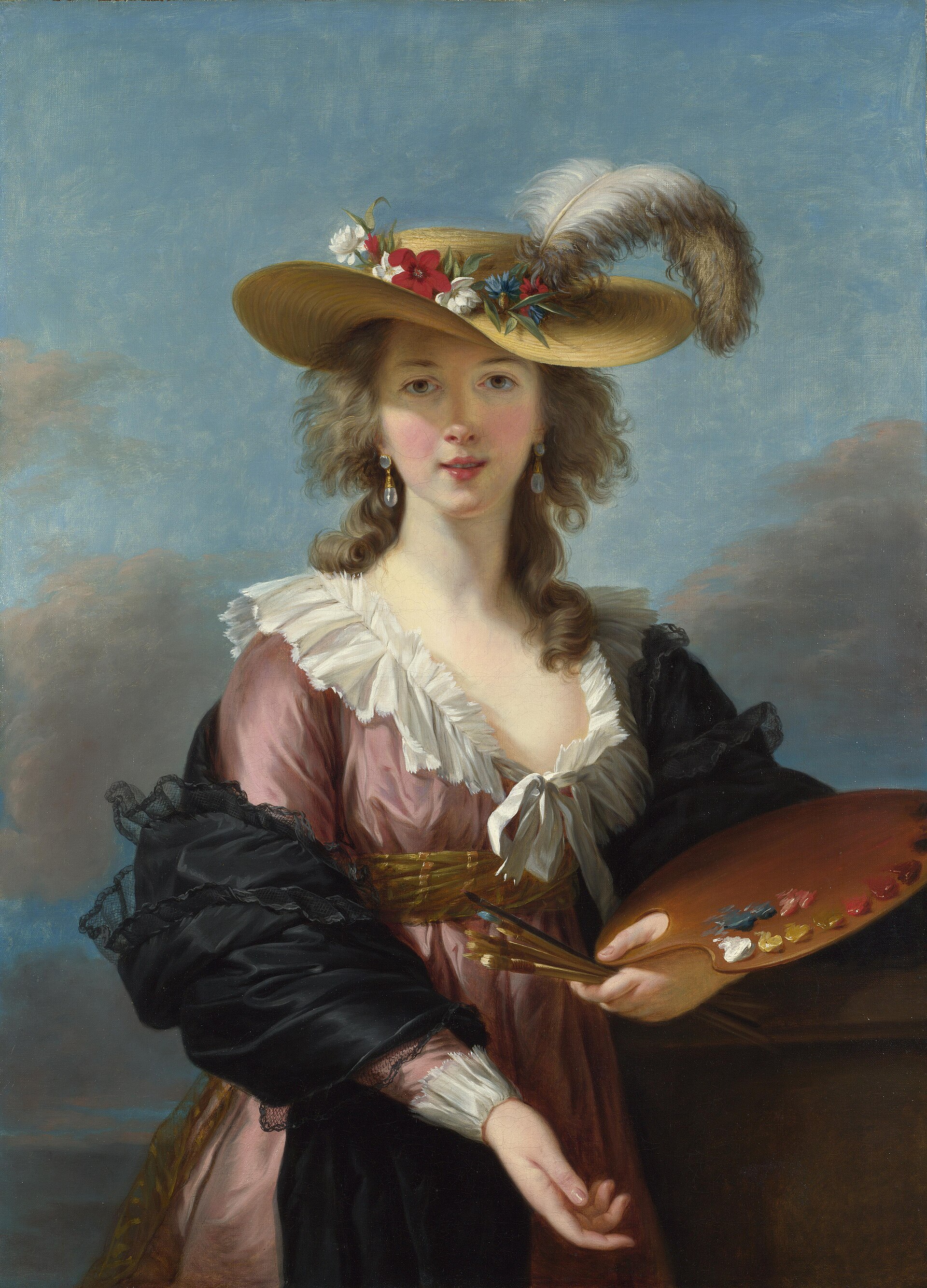
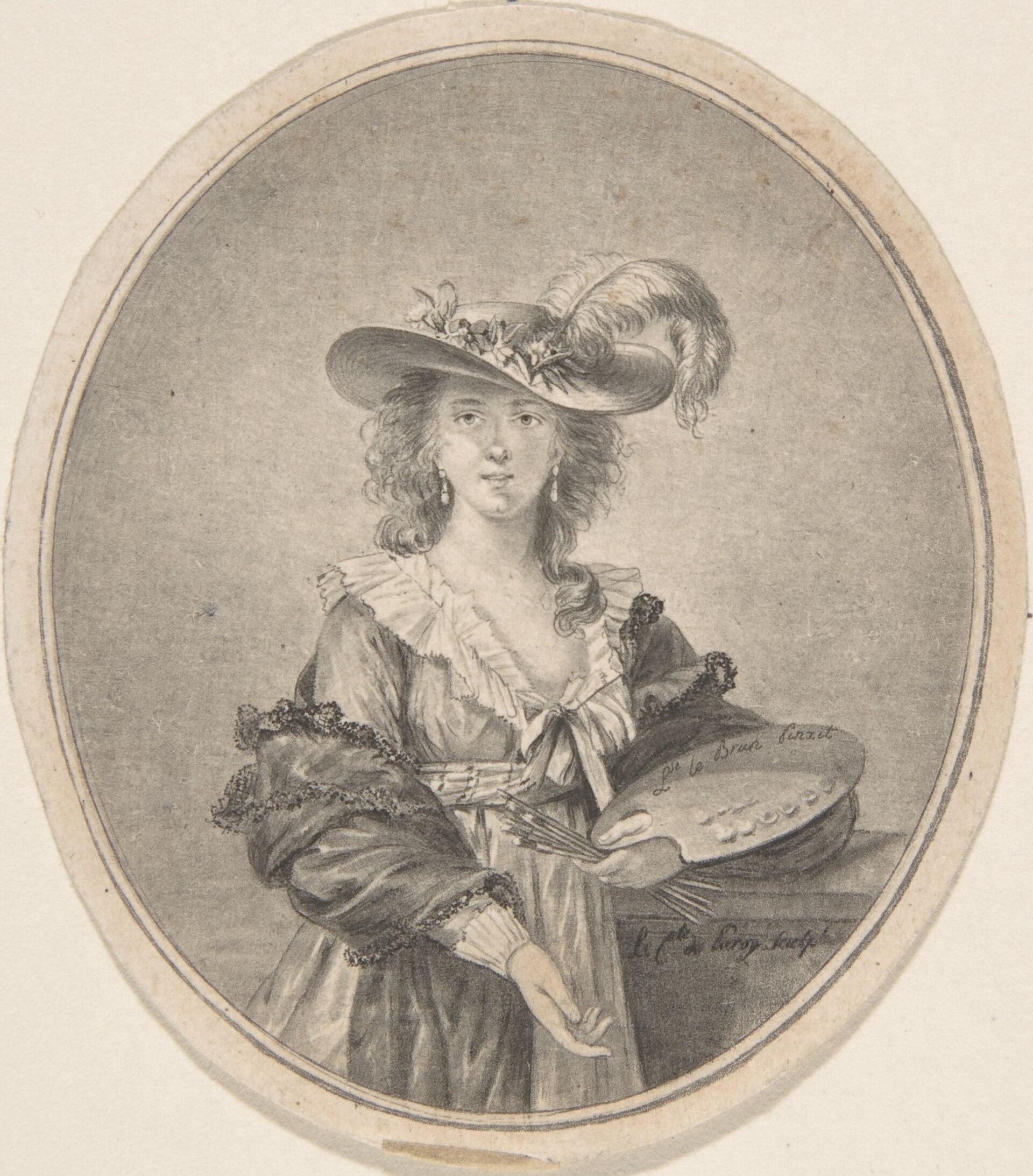
Self-Portrait in a Straw Hat, a signed copy she painted in Brussels in 1782 of a popular original still in the Rothschild collection; both were shown at the 1783 Salon. The pose deliberately corrects Rubens's so-called Chapeau de Paille, whose sitter wears no straw hat at all. Bought by the National Gallery in 1897 for 600 pounds.
The National Gallery, London| Full name | Marie Elisabeth Louise Vigee Le Brun |
|---|---|
| Worked as | Painter, Portraitist, Memoirist |
| Born | 1755-04-16 · Paris, France |
| Died | 1842-03-30 · Paris, France |
| Nationality | French |
| Movement | Late Rococo court portraiture, moving toward Neoclassicism |
| Sources | 14 cited |
| Last verified |
About this page Last verified · 14 sources cited
On this page 13 sections
ContentsClose
Elisabeth Vigee Le Brun was the official portraitist of Marie Antoinette, one of only four women who could hold a seat in the French Royal Academy of Painting and Sculpture at any one time, and the author of a three-volume memoir that is itself a primary source for everything else on this page. She built a self-supporting practice as a teenager, was admitted to the Academy over the objection that her own husband's trade as an art dealer disqualified her, fled France at midnight in October 1789 and spent twelve years painting her way across Italy, Austria and Russia before the emigre list was cleared and she came home.
What the standard account tends to compress is the scale and the argument of it. She left behind a production usually put at several hundred portraits and roughly two hundred landscapes, no completed catalogue raisonne, at least one live dispute over which of two versions of a picture is the original, and a set of self-portraits that are not diary entries but a calculated, decades-long campaign to define what a working woman painter was allowed to look like.
Images
Chronology
- 1755
Born in Paris on 16 April, daughter of the pastelist Louis Vigee and Jeanne Maissin.2
- 1767
Her father Louis Vigee dies; she is twelve.2
- 1774
Joins the Academie de Saint-Luc, two years before it is suppressed.2
- 1776
Marries the painter and picture dealer Jean-Baptiste-Pierre Le Brun.2
- 1778
Paints her first major portrait of Marie Antoinette and becomes her regular portraitist.213
- 1780
Paints Peace Bringing Back Abundance, later her Academy reception piece.6
- 1782
Paints the original and a signed copy of Self-Portrait in a Straw Hat while in Brussels.1
- 1783
Admitted to the Academie Royale de Peinture et de Sculpture on 31 May alongside Adelaide Labille-Guiard, filling two of the four seats reserved for women, after Marie Antoinette's intervention overcame the objection that her husband was a dealer.267
- 1783
Exhibits Marie Antoinette en chemise at the Salon; the portrait is withdrawn amid controversy over its informality.10
- 1786
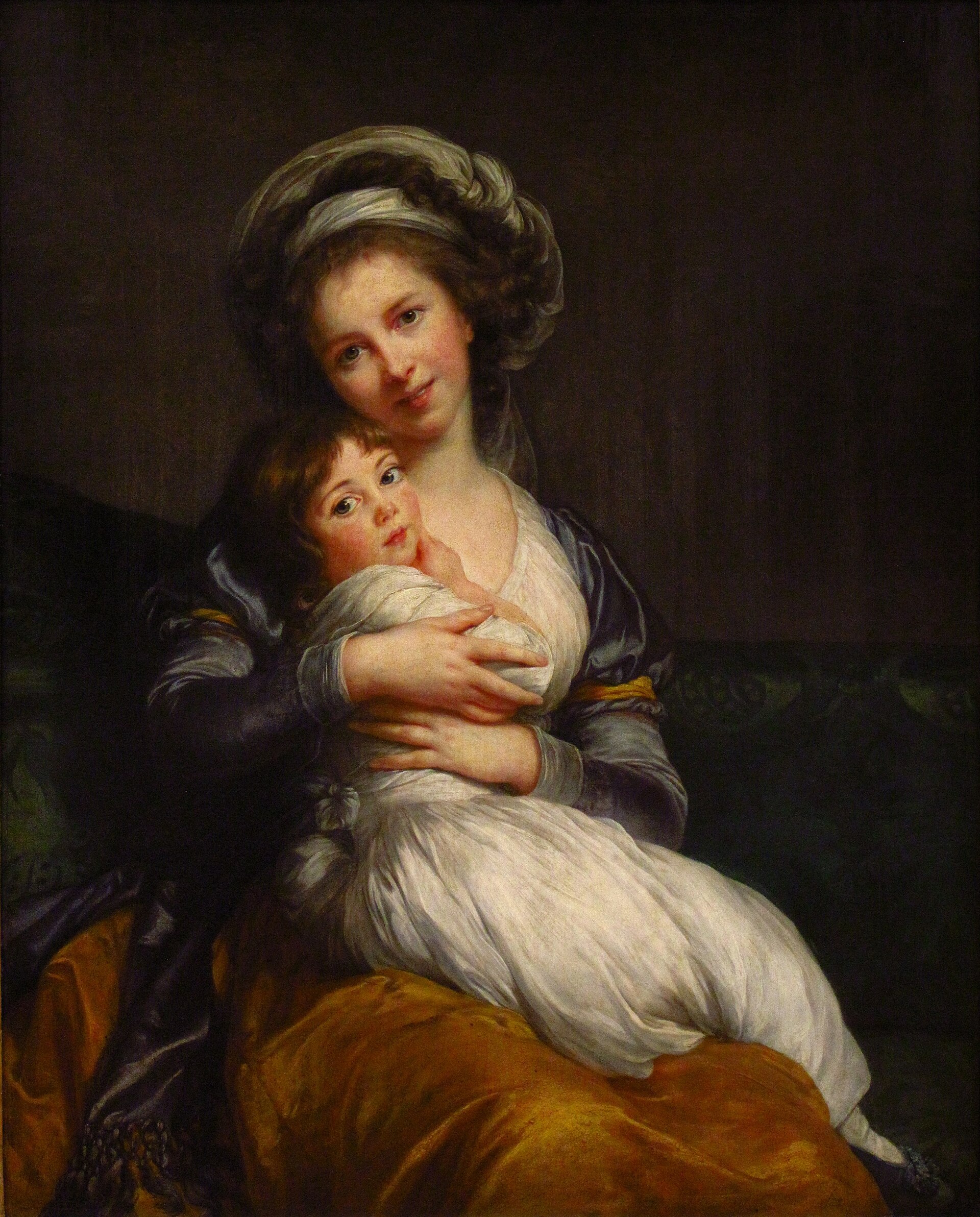
Paints Self-Portrait with Her Daughter, Julie, known as Maternal Tenderness.5
- 1787
Shows Maternal Tenderness at the Salon; contemporary press, including Memoires secrets, objects to her open-mouthed smile.58
- 1787
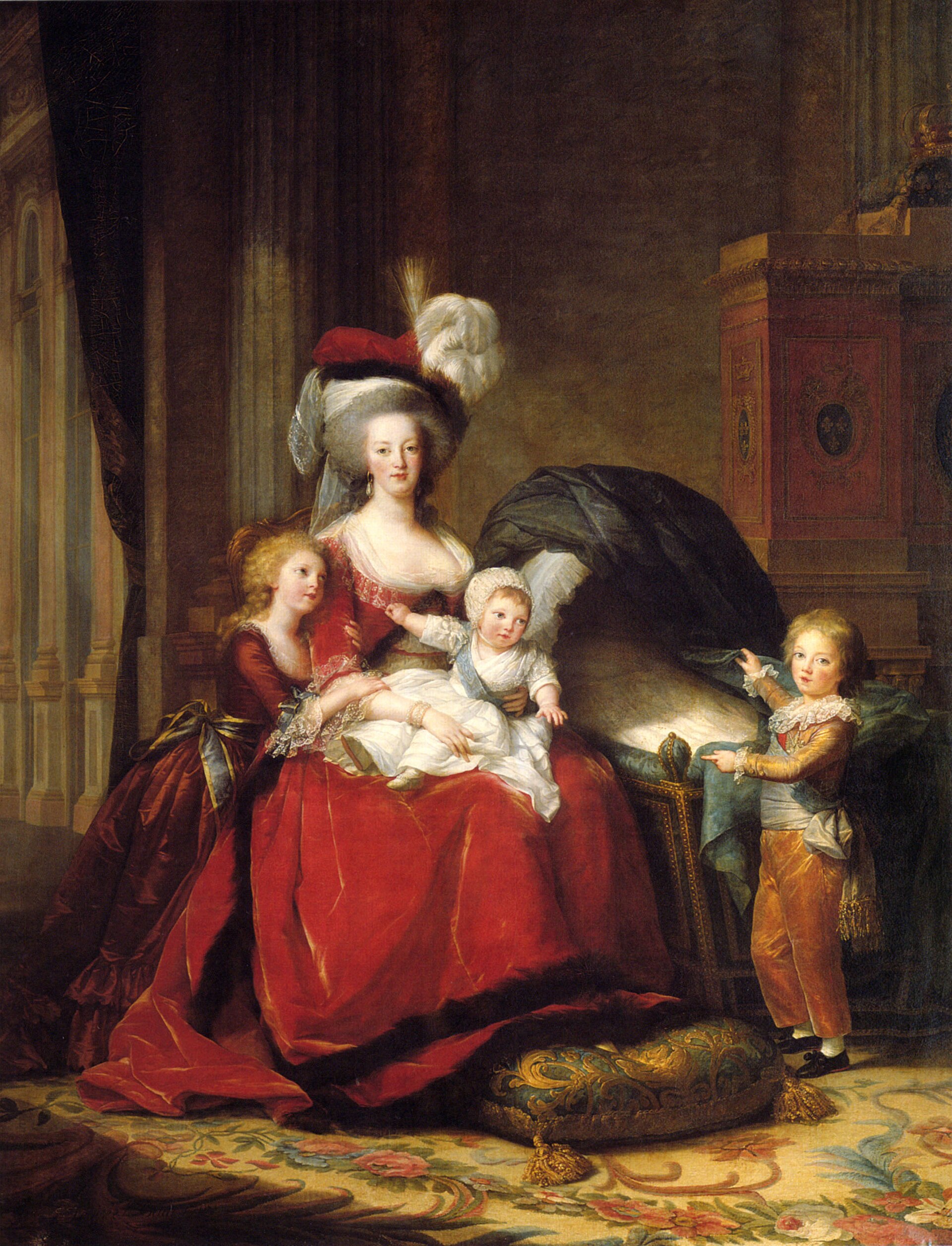
Paints Marie Antoinette and Her Children, her largest royal commission, now at Versailles.2
- 1788
Paints the Tipu Sultan embassy portraits, including Portrait of Muhammad Dervish Khan; all three ambassadors are later executed on returning to Mysore after their mission fails.4
- 1789
Flees Paris at midnight on 5 October for Italy, beginning twelve years away.3
- 1789-1792
Works in Turin, Parma, Rome, Naples, Venice and Milan; elected to academies in Rome, Bologna, Parma and Florence.32
- 1792-1795
Three years in Vienna, painting Austrian and emigre nobility.2
- 1795-1801
More than six years in Russia, painting Catherine the Great's family and the exiled Polish king.2
- 1800
Struck from the French state's emigre list.2
- 1802
- 1803-1805
Makes periodic visits to England before resettling permanently in France.2
- 1835-1837
Publishes the Souvenirs in three volumes, written with her nieces Caroline Riviere and Eugenie Tripier Le Franc.3
- 1842
The market
Her prices lagged her historical reputation for most of the twentieth century and then moved sharply after 2016, as her market was reassessed alongside the Grand Palais and Metropolitan Museum retrospective. Press coverage of her largest sales is not always careful to separate the hammer price from the buyer's premium, and this record does not paper over that where the sources themselves do not.
| Date | Sale | Work | Result | Note |
|---|---|---|---|---|
| 30 January 2019 | Sotheby's | Portrait of Muhammad Dervish Khan, Full-Length, Holding His Sword in a Landscape (1788) | Hammer USD 7,185,900 (the figure most consistently reported as the hammer price) With premium Reported total sale price USD 7.18 to 7.2 million; press coverage does not consistently distinguish hammer from buyer's premium for this lot USD | Sold in the New York Old Masters sale, described at the time as an auction record for a pre-modern female artist and more than four times the artist's previous record. |
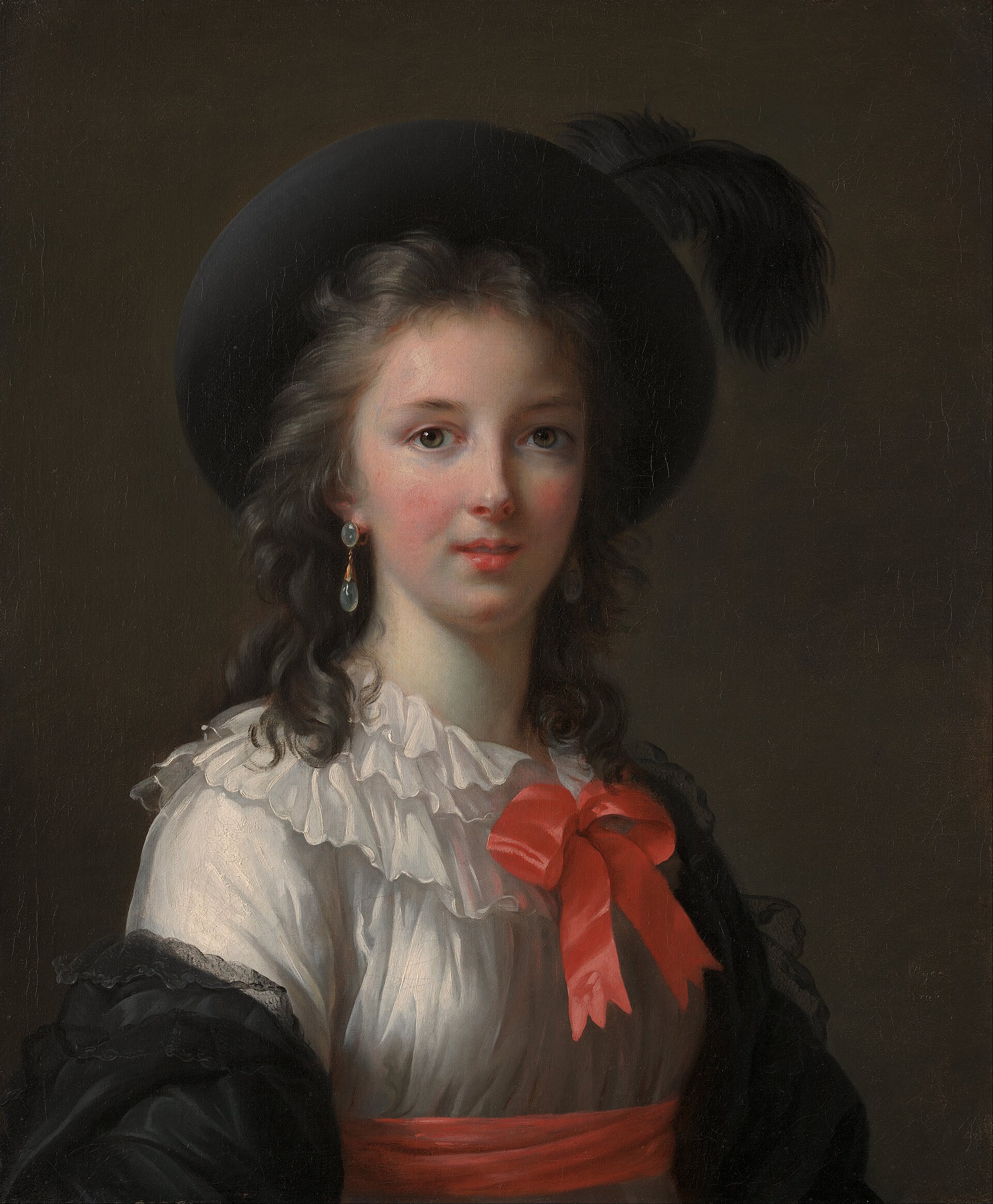
| 2017-10 | Christie's | Portrait of the artist, bust-length (self-portrait) | Hammer Not separated from premium in the sources consulted With premium Reported at approximately USD 1.5 million total USD | The artist's auction record immediately before the 2019 Sotheby's sale. |
| 2016-04 | Christie's | Portrait of Princess Golitsyna | Hammer Not separated from premium in the sources consulted With premium Reported at USD 1,205,000 total USD | Described at the time as an auction record for an academicienne, a female member of the Academie Royale specifically, rather than for women artists in general. |
Hammer is the price at which the bidding stopped; with premium adds the fee the house charges the buyer on top. Hammer price and buyer's premium in the glossary.
Where to see the work
| Institution | City | Holdings | Note |
|---|---|---|---|
| Musee du Louvre | Paris | Self-Portrait with Her Daughter, Julie (Maternal Tenderness, 1786, INV 3069) and other works | The core Paris holding of her self-portraiture. |
| Palace of Versailles | Versailles | Marie Antoinette and Her Children (1787) and other court commissions | Her largest surviving royal commission. |
| National Gallery | London | Self-Portrait in a Straw Hat (NG1653, acquired 1897) | Her most widely reproduced self-portrait. |
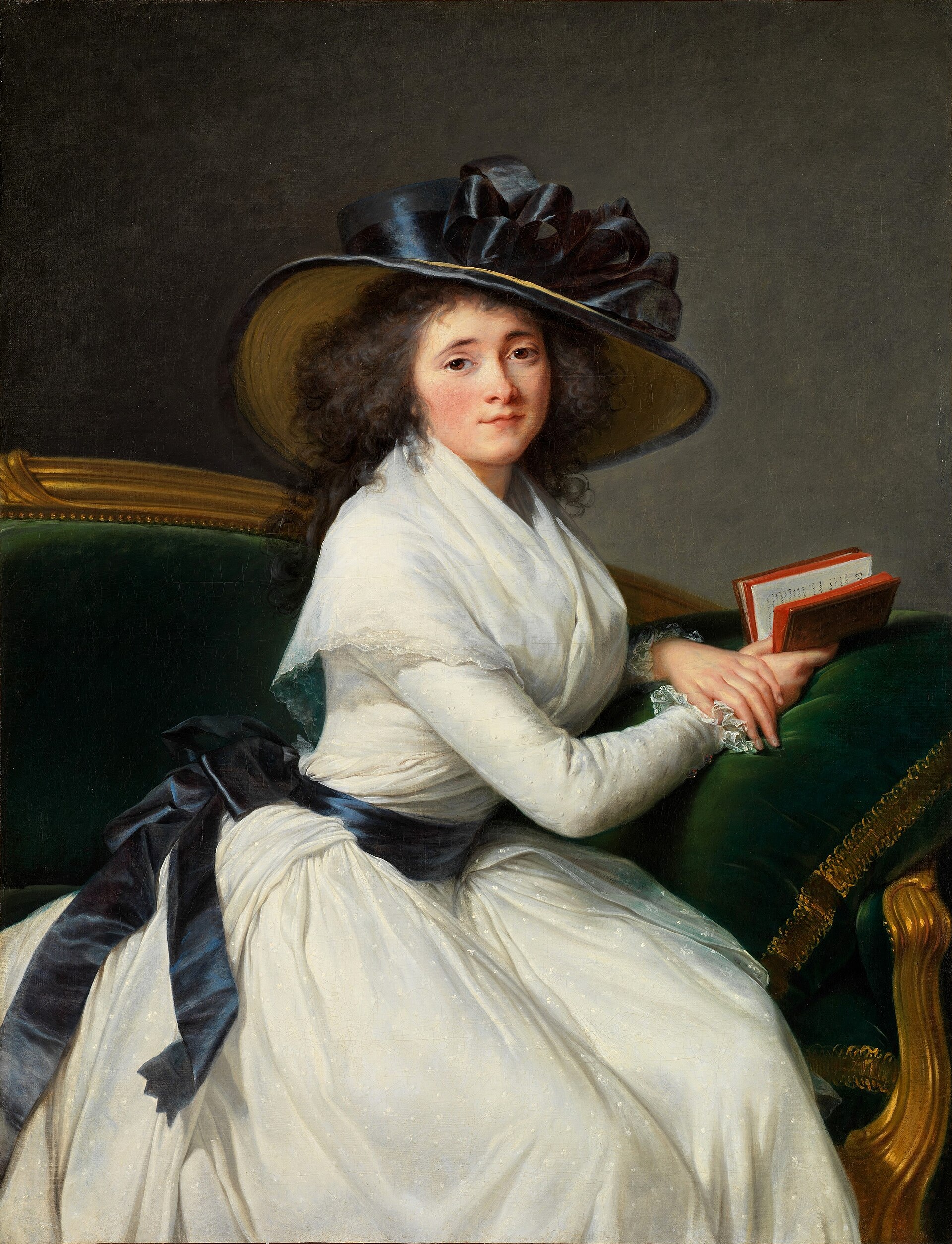
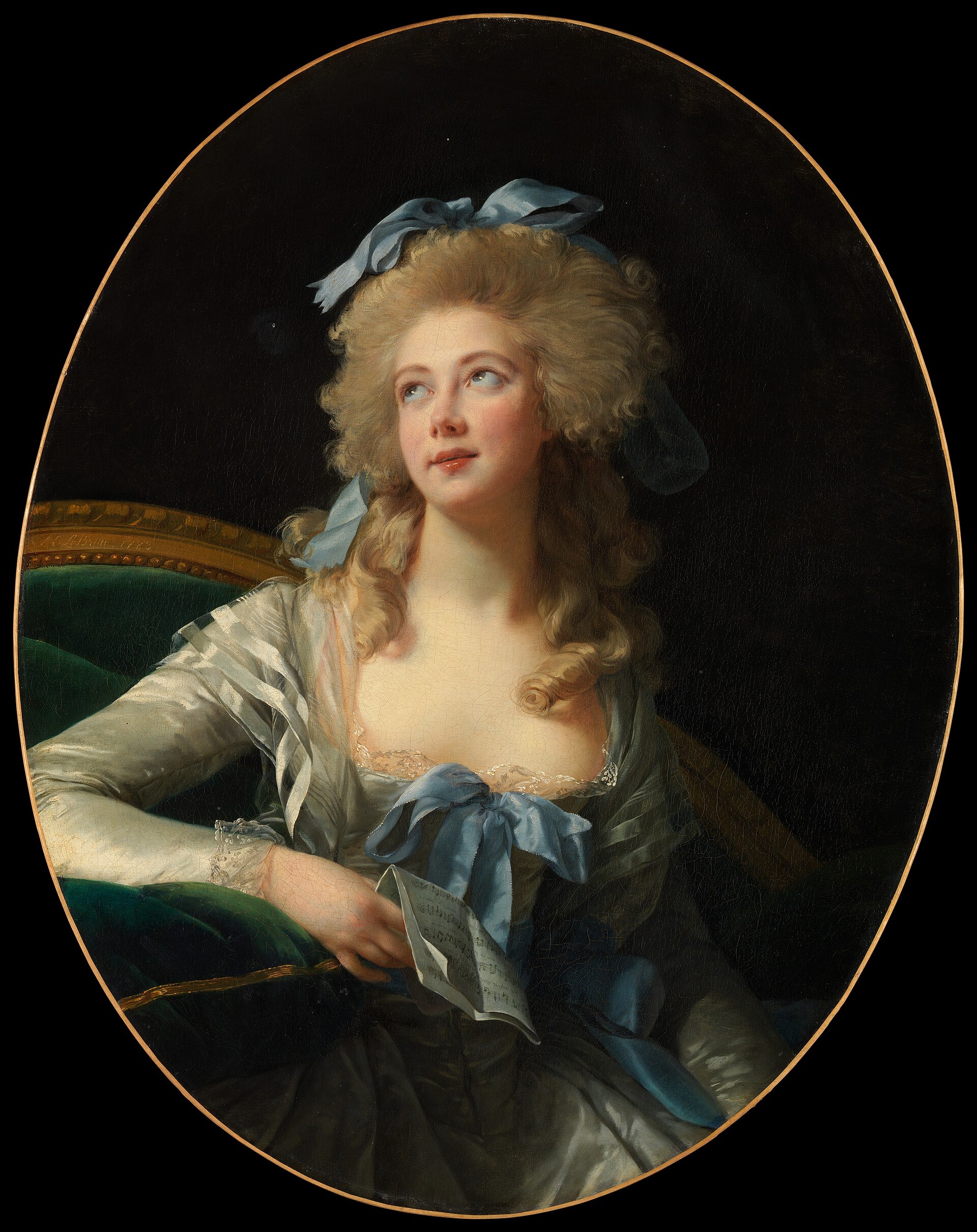
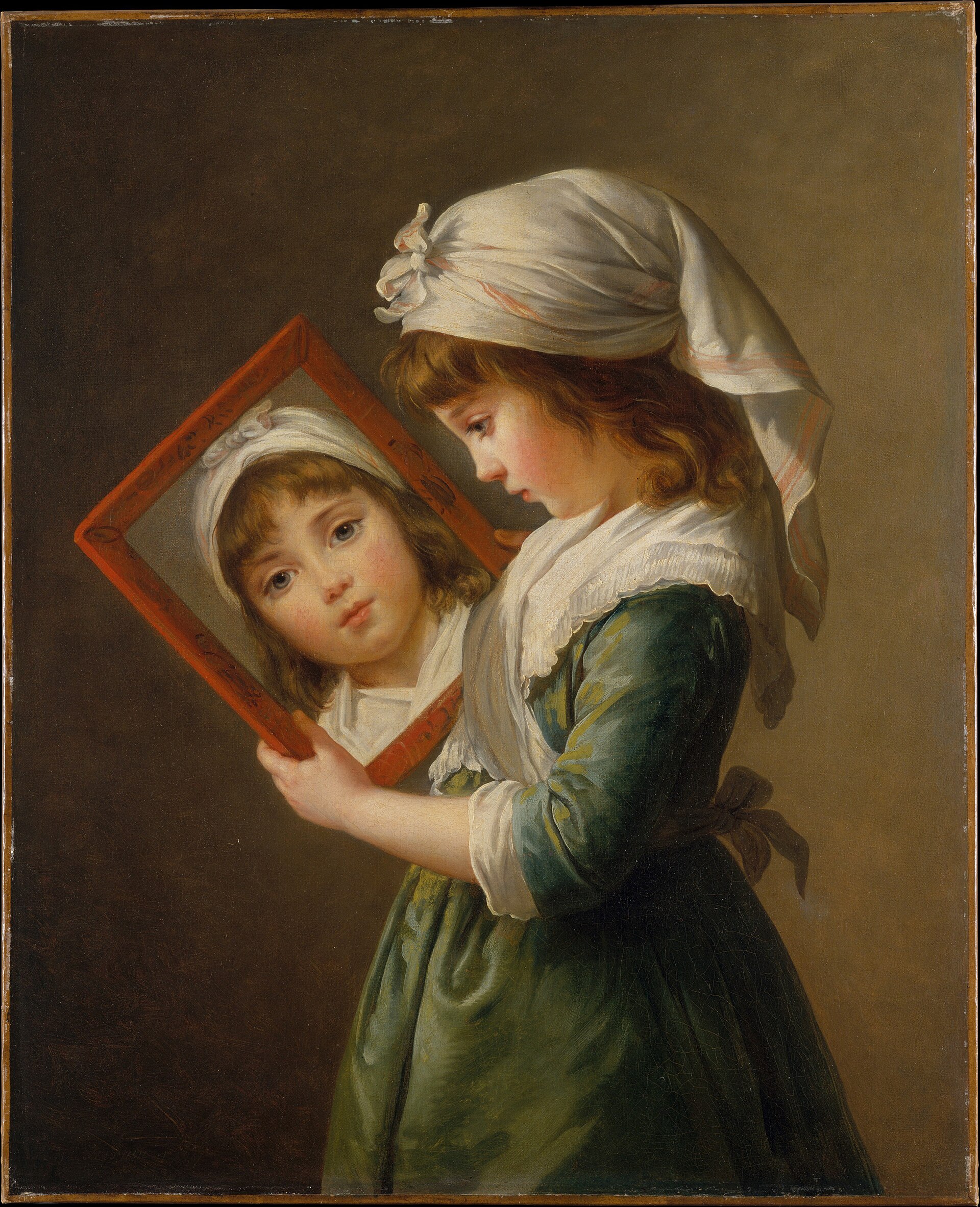
| Metropolitan Museum of Art | New York | Comtesse de la Chatre, Madame Grand, Julie Le Brun Looking in a Mirror and other portraits | The largest concentrated Vigee Le Brun holding in the United States. |
| Kimbell Art Museum | Fort Worth | Self-Portrait, c. 1781 | Acquired by Kay Kimbell in 1949; the museum organised Baillio's 1982 exhibition. |
| The State Hermitage Museum | Saint Petersburg | Portraits from her Russian exile years, 1795-1801 | Painted while she was a working emigre in Catherine the Great's court circle, not a later acquisition of exile-period work from elsewhere. |
Forgeries and misattributions
- Portrait of Etienne Vigee (the artist's brother), Saint Louis Art Museum
- The museum's canvas is a signed picture long treated as an autograph portrait of her brother. Laurent Hugues, a curator with the French national museums service, has identified it as a later signed copy rather than the original. Connoisseurship-based reattribution by a named specialist; the claimed original is said to be in a private Paris collection. No further technical evidence was found in the sources consulted.12
The essay
Chapter 1A corpus larger than the record of it
Popular accounts put her output at around 660 portraits and roughly 200 landscapes, a total near 900 works, but that figure traces to general reference sources rather than to a completed scholarly...
Popular accounts put her output at around 660 portraits and roughly 200 landscapes, a total near 900 works, but that figure traces to general reference sources rather than to a completed scholarly count, and it should be read as a working estimate, not a final tally. No catalogue raisonne of her work has been published. Joseph Baillio, who organised a Kimbell Art Museum exhibition on her in 1982, has been preparing one for decades; as of the major 2015-2016 retrospective he co-organised with Katharine Baetjer and Paul Lang for the Grand Palais, the Metropolitan Museum and the National Gallery of Canada, it remained unpublished.
That retrospective is itself a measure of how thin the intervening scholarship was: a reviewer noted that after Baillio's 1982 catalogue, Vigee Le Brun had been the subject of relatively few scholarly studies for over thirty years. The New York venue alone showed 80 works, about a third of them from private collections and many exhibited publicly for the first time. It was the first international retrospective ever given to her.
Chapter 2Trained by her father, supporting the family without him
She was trained first in pastel by her own father, Louis Vigee, a pastelist and a member of the rival Academie de Saint-Luc.
She was trained first in pastel by her own father, Louis Vigee, a pastelist and a member of the rival Academie de Saint-Luc. He died when she was twelve, and she continued her training under Gabriel Briard and others before joining the Academie de Saint-Luc herself in 1774, two years before Louis XV suppressed it. By her teens she was already earning enough from portrait commissions to help support her widowed mother and younger brother, a fact usually offered as a charming anecdote about precocity rather than what it actually was: a teenage girl running a commercial studio because the household needed the income.
In 1776 she married Jean-Baptiste-Pierre Le Brun, a painter turned picture dealer. The marriage gave her a dealer's eye for the market and a dealer's connections. It also very nearly cost her the one credential that mattered most.
Chapter 3Four seats, and the objection that nearly worked
The Academie Royale de Peinture et de Sculpture capped the number of women who could hold membership at any one time at four.
The Academie Royale de Peinture et de Sculpture capped the number of women who could hold membership at any one time at four. When Vigee Le Brun's name came forward in 1783, alongside Adelaide Labille-Guiard, the initial objection was not that she was a woman as such but that her husband was a picture dealer, a trade the Academy treated as a conflict of interest against the very market its own members' work moved through. Louis XVI overrode the objection after Marie Antoinette intervened, and on 31 May 1783 both women were admitted on the same day, filling two of the four seats reserved for their sex.
Her reception piece was Peace Bringing Back Abundance, an allegorical composition of 1780 read at the time as a comment on Louis XVI's role in ending France's involvement in the American war. Reception was mixed: she was accused of plagiarism by some critics and praised by others, including the American painter John Trumbull, who singled out the quality of the coloring. The Academy seat did not survive the Revolution; the category of female academician was abolished with the institution itself in 1793.
Chapter 4The queen's painter, and the portrait the court could not accept
She painted Marie Antoinette roughly thirty times over about six years, work that came with regular access to the queen's private apartments and a first commission, in 1778, that reportedly paid...
She painted Marie Antoinette roughly thirty times over about six years, work that came with regular access to the queen's private apartments and a first commission, in 1778, that reportedly paid three times what the court's previous portraitist had been getting. In 1783 she exhibited a portrait of the queen wearing a simple gathered muslin gown and a straw hat, informal to the point of resembling contemporary underclothes, made from imported cotton rather than French silk at a moment when supporting the domestic silk trade was itself a political statement. The picture caused enough outrage that it was pulled from the Salon and replaced before the exhibition closed.
The irony is that the gown she was mocked for outlived the scandal by decades. The chemise a la reine became a genuine fashion movement, worn across aristocratic Europe within a year and still recognisable in the sheer Neoclassical silhouettes of the early nineteenth century. A queen's portraitist had, without quite intending to, helped design the wardrobe of the generation that would depose her.
Chapter 5What a portrait cost, and what that meant
Her own memoir, the Souvenirs, is the primary source for her fees, and it needs to be read as what it is: an account written in her eighties, decades after the events, by a woman with every reason to...
Her own memoir, the Souvenirs, is the primary source for her fees, and it needs to be read as what it is: an account written in her eighties, decades after the events, by a woman with every reason to remember her career in the best light. With that caveat, the figures given are still useful as period comparanda. The first royal commission of 1778 is reported at six thousand livres, against an ordinary household servant's annual wage of around fifty livres and the price of a good carriage at roughly two thousand. Whatever the precision of the number, the order of magnitude is not in doubt: within a few years of her Academy admission she was among the highest-paid portraitists working in France, of either sex.
Chapter 6The self-portrait as an argument, not a diary entry
Her most reproduced image, the Self-Portrait in a Straw Hat, is a signed copy she made in Brussels in 1782 of an original still in the Rothschild collection; both versions were shown at the 1783...
Her most reproduced image, the Self-Portrait in a Straw Hat, is a signed copy she made in Brussels in 1782 of an original still in the Rothschild collection; both versions were shown at the 1783 Salon, and the National Gallery in London bought this copy in 1897 for 600 pounds. The pose is not an observed moment. It deliberately quotes Rubens's so-called Chapeau de Paille, a portrait of Susanna Lunden that in fact shows no straw hat at all, a mistranslation of the Flemish for felt that had stuck to the painting's popular title. Vigee Le Brun put herself in a genuine straw hat, holding her own palette and brushes, and looking directly out at the viewer with an openness Rubens's sitter does not have. It reads as a calculated claim of kinship with one of the acknowledged masters of the previous century, corrected on a point of fact and made by a working woman with her tools visibly in hand rather than a wealthy man's wife on display.
She returned to the same project with more risk four years later. Self-Portrait with Her Daughter, Julie, known as Maternal Tenderness, shown at the Salon of 1787 and now in the Louvre, shows her smiling with her teeth visible while she embraces her daughter. Open-mouthed smiling was not a convention of elite portraiture; the historian Colin Jones has traced the shift to improvements in dentistry that made good teeth worth displaying as a mark of status, but in 1787 it read to some viewers as closer to a tavern scene than a court likeness. The gossip sheet Memoires secrets condemned it as an affectation that artists, connoisseurs and people of taste had united in disapproving of, with no precedent among the ancients. Between the chemise portrait and this one, a pattern is visible: she kept testing how far an informal, physically present mode of representation, unpowdered, undraped in the old sense, smiling with an open mouth, could go before the court version of taste pushed back, and she kept pushing again.
Chapter 7Twelve years without a country
She left Paris at midnight on 5 October 1789, as the crowd that would march on Versailles the same day was already forming, and did not return for twelve years.
She left Paris at midnight on 5 October 1789, as the crowd that would march on Versailles the same day was already forming, and did not return for twelve years. The itinerary reads like a European tour of courts rather than a flight: Turin, Parma, Rome and Naples, where she was elected to local academies, then Venice and Milan, three years in Vienna painting Austrian and emigre nobility, then more than six years in Russia, where she painted members of Catherine the Great's family and the deposed king of Poland. She was formally struck from the French state's list of emigres in 1800, which cleared the legal path home, and returned to Paris on 18 January 1802.
The exile is also the clearest evidence that her market was never only French. In 1788, the year before she left, she had painted three ambassadors sent to Louis XVI's court by Tipu Sultan of Mysore, seeking a military alliance against the British in India. The mission failed, and on their return to Mysore all three ambassadors were executed. One portrait from that commission, of the ambassador Muhammad Dervish Khan, survived through her husband's later liquidation of his dealer's stock and resurfaced at auction more than two centuries later, a direct physical link between a Rococo Parisian studio and a diplomatic failure on the other side of the world.
Chapter 8The dealer husband, and what became of the stock
Jean-Baptiste-Pierre Le Brun's profession is usually mentioned only as the technicality that nearly blocked her Academy seat, but it shaped the object history of her work more directly than that.
Jean-Baptiste-Pierre Le Brun's profession is usually mentioned only as the technicality that nearly blocked her Academy seat, but it shaped the object history of her work more directly than that. As a working picture dealer he held and traded canvases, including his wife's, and after his death his estate was liquidated and its stock dispersed onto the market rather than kept together as a single studio holding. That dispersal is a documented reason her paintings now sit in scattered private and institutional hands rather than in one traceable estate archive, and it is part of why a catalogue raisonne compiled two centuries later still has real work to do.
She herself lived another three decades past the Revolution, resettling permanently in France by 1805 after visits to England, and spent part of her final years, in her eighties, dictating and revising the Souvenirs with the help of her nieces Caroline Riviere and Eugenie Tripier Le Franc. She died on 30 March 1842 in Paris, in her eighty-seventh year.
Chapter 9One picture, two claimed originals
Attribution problems on her material are not confined to popular-account round numbers.
Attribution problems on her material are not confined to popular-account round numbers. The portrait of her brother, Etienne Vigee, held by the Saint Louis Art Museum, has been identified by Laurent Hugues, a curator with the French national museums service, as a later signed copy rather than the original, which he places in a private Paris collection. This is precisely the kind of version-versus-copy question a finished catalogue raisonne exists to settle, and on this picture it has not yet been settled in public. Until it is, both the Saint Louis canvas and the claimed Paris original are best described exactly that way: two candidates, one documented dissent, no resolution.
Chapter 10What the market pays now
For most of the twentieth century her prices lagged her reputation.
For most of the twentieth century her prices lagged her reputation. That changed decisively on 30 January 2019, when Sotheby's New York sold the 1788 Portrait of Muhammad Dervish Khan for a price reported across the trade press as 7.18 to 7.2 million dollars, more than four times the previous auction record for her work, a 1.5 million dollar sale of a bust-length self-portrait at Christie's New York in October 2017. Coverage of the 2019 sale is not consistent about separating the hammer price from the buyer's premium, an ordinary failure of auction reporting and one this record flags rather than silently resolves; the closest figure to a stated hammer is 7,185,900 dollars. The sale was described at the time as a record for any pre-modern female artist at auction. A few years earlier, in April 2016, Christie's had sold her portrait of Princess Golitsyna for 1,205,000 dollars, itself then described as a record for an academicienne, a member of the Academy specifically, rather than for women artists generally. Both figures now read as staging posts rather than ceilings.
What is documented
Technique
The surviving work
- What is accepted
- No completed catalogue raisonne has been published. The figure most often repeated in general reference sources is around 660 portraits and roughly 200 landscapes, a total near 900 works; this is a working estimate rather than a scholarly tally credited to a named authority in the sources consulted, and should be replaced with Baillio's catalogue raisonne once it appears.
- What is contested
- At least one attributed work has a live, named dispute rather than a settled count: the Saint Louis Art Museum's portrait of her brother Etienne Vigee has been identified by Laurent Hugues, a curator with the French national museums service, as a later signed copy, with the original said to be in a private Paris collection. No public resolution was found in the sources consulted.
- Who rules on attribution
- Joseph Baillio is treated across the sources consulted as the leading modern specialist and the compiler of a catalogue raisonne still in preparation. No board or institution currently rules on attribution in his place; individual questions, such as the Saint Louis Etienne Vigee portrait, are argued case by case in museum files and exhibition catalogues rather than by a standing authority.
Catalogue raisonne
- Joseph Baillio, Katharine Baetjer and Paul Lang, Vigee Le Brun (exhibition catalogue, Grand Palais, Paris; Metropolitan Museum of Art, New York; National Gallery of Canada, Ottawa, 2015-2016) The current scholarly benchmark, not a completed catalogue raisonne. The New York venue alone showed 80 works, about a third from private collections, many never previously exhibited.11
- Joseph Baillio, Elisabeth-Louise Vigee Le Brun, 1755-1842 (exhibition catalogue, Kimbell Art Museum, Fort Worth, 1982) Cited by later reviewers as the last major scholarly catalogue on her before the 2015-2016 retrospective, over thirty years later.11
Questions about Elisabeth Vigee Le Brun
Who was Elisabeth Vigee Le Brun?
Painter; Portraitist; Memoirist. 1755-1842.
When did Elisabeth Vigee Le Brun live?
Born 1755-04-16, Paris, France; died 1842-03-30, Paris, France.
How are fakes and misattributions of Elisabeth Vigee Le Brun detected?
Portrait of Etienne Vigee (the artist's brother), Saint Louis Art Museum. The museum's canvas is a signed picture long treated as an autograph portrait of her brother. Laurent Hugues, a curator with the French national museums service, has identified it as a later signed copy rather than the original.
Where can you see work by Elisabeth Vigee Le Brun?
Musee du Louvre (Paris); Palace of Versailles (Versailles); National Gallery (London); Metropolitan Museum of Art (New York); Kimbell Art Museum (Fort Worth); The State Hermitage Museum (Saint Petersburg).
What does the market for Elisabeth Vigee Le Brun look like?
Her prices lagged her historical reputation for most of the twentieth century and then moved sharply after 2016, as her market was reassessed alongside the Grand Palais and Metropolitan Museum retrospective. Press coverage of her largest sales is not always careful to separate the hammer price from the buyer's premium, and this record does not paper over that where the sources themselves do not.
What is still unresolved about Elisabeth Vigee Le Brun?
When, or whether, Joseph Baillio's catalogue raisonne will be published; without it, the true accepted total for her corpus cannot be stated with confidence.
Open questions
- When, or whether, Joseph Baillio's catalogue raisonne will be published; without it, the true accepted total for her corpus cannot be stated with confidence.
- Which canvas is the authentic Portrait of Etienne Vigee: the Saint Louis Art Museum's signed picture or the version Laurent Hugues places in a private Paris collection.
- What happened to the bulk of Jean-Baptiste-Pierre Le Brun's dealer stock at his estate liquidation, and how much of his wife's own work passed through it untracked.
- Whether a documented, itemised inventory of her studio contents at her own death in 1842 survives; none was located in the sources consulted.
Sources
- 1National Gallery, London, catalogue entry: Elisabeth Louise Vigee Le Brun, Self Portrait in a Straw Hat, NG1653. nationalgallery.org.uk/paintings/...
- 2Chateau de Versailles, 'Elisabeth Louise Vigee Le Brun', official biography. en.chateauversailles.fr/discover/...
- 3Wikipedia, 'Elisabeth Vigee Le Brun'. en.wikipedia.org/wiki/...
- 4Wikipedia, 'Portrait of Muhammad Dervish Khan'. en.wikipedia.org/wiki/...
- 5Wikipedia, 'Self-Portrait with Julie (Maternal Tenderness)'. en.wikipedia.org/wiki/...
- 6Wikipedia, 'Peace Bringing Back Abundance'. en.wikipedia.org/wiki/...
- 7Wikipedia, 'List of members of the Academie royale de peinture et de sculpture'. en.wikipedia.org/wiki/...
- 8Artnet News, 'Art Bites: How Elisabeth Vigee Le Brun Scandalized French Society With a Smile'. news.artnet.com/art-world/...
- 9Artnet News, 'A Painting by Elisabeth-Louise Vigee Le Brun Sold for $7.2 Million at Sotheby's, a New Record for a Female Artist From Before the Modern Era'. news.artnet.com/market/...
- 10Fashion History Timeline (Fashion Institute of Technology), '1783 - Elisabeth Louise Vigee Le Brun, Marie Antoinette in a Chemise Dress'. fashionhistory.fitnyc.edu/1783-vigee-le-brun-antoinette-c...
- 11Kathleen Brosnan, review of 'Vigee Le Brun: Woman Artist in Revolutionary France', Nineteenth-Century Art Worldwide, Autumn 2016. 19thc-artworldwide.org/autumn16/...
- 12Freeman Art, expert authentication and attribution note on Elisabeth-Louise Vigee Le Brun, citing Laurent Hugues on the Saint Louis Art Museum's Portrait of Etienne Vigee. freemanart.ca/Le-Brun.htm
- 13TheArtStory, 'Vigee Le Brun Paintings, Bio, Ideas'. theartstory.org/artist/...
- 18Anka Muhlstein, "A Most Successful Woman," The New York Review of Books, 24 March 2016. States the 1778 Marie Antoinette commission paid six thousand livres, three times Gautier-Dagoty's fee, against a household servant's annual wage of about fifty livres and a carriage at about two thousand livres. nybooks.com/articles/...
Last verified