Angelica Kauffman
 1741-1807
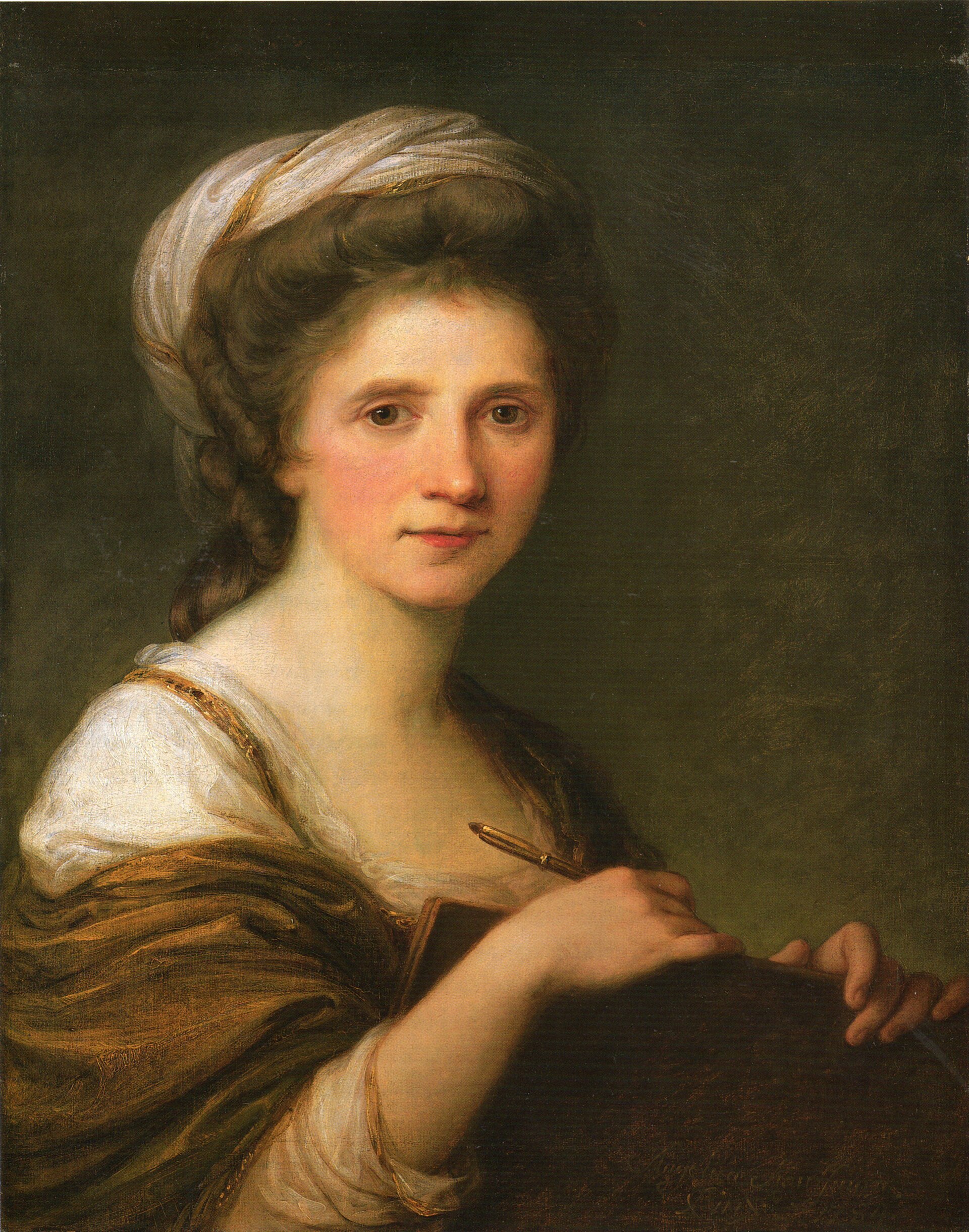
Self-portrait of 1784, Neue Pinakothek, Munich, which Commons records as painted when she was 42, in a turban wound around her hair. The identification as a self-portrait rests on the museum collection record as carried in Commons categories and Wikidata, and is not disputed in the sources consulted; the inscription lower right was not independently read.
Bayerische Staatsgemaeldesammlungen, Neue Pinakothek, Munich, via Wikimedia Commons (public domain)| Full name | Maria Anna Angelika Kauffmann |
|---|---|
| Worked as | Painter, History painter, Portraitist, Etcher |
| Born | 1741-10-30 · Chur, Graubunden, Switzerland |
| Died | 1807-11-05 · Rome |
| Nationality | Swiss-born, of a Vorarlberg (Austrian) family |
| Movement | Neoclassicism, with a Rococo and Sensibility strand |
| Sources | 19 cited |
| Last verified |
About this page Last verified · 19 sources cited
On this page 13 sections
ContentsClose
Angelica Kauffman was one of the two women among the twenty-two founding members of the Royal Academy in 1768, a history painter who left a large fortune, and the author of a private ledger of her own pictures and fees that was found in the Academy's library and first translated in 1924. She painted Winckelmann in Rome in 1764, worked in London from 1766 to 1781, painted four ceiling pictures for the Academy's own rooms, and from 1782 held a salon beside the Spanish Steps that Goethe and Herder attended. Her funeral in 1807 was described as the grandest since Raphael's.
What the standard account leaves out is how little anyone can count. The research project that is writing her catalogue raisonne estimates about 1000 oil paintings on its home page while its own biography puts her whole oeuvre at over 800 works, a Swiss broadcaster in 2024 quoted Baumgartel at about 800 paintings, and the project's director told that broadcaster that most of the 'Kauffmanns' that surface each week are imitations or forgeries. Her name has attached itself to ceilings, painted furniture and porcelain for two centuries, and the research project now says she did not paint on wood, ivory or porcelain and that many wall and ceiling decorations credited to her are not hers. Nobody has yet published the catalogue that would settle it.
Images
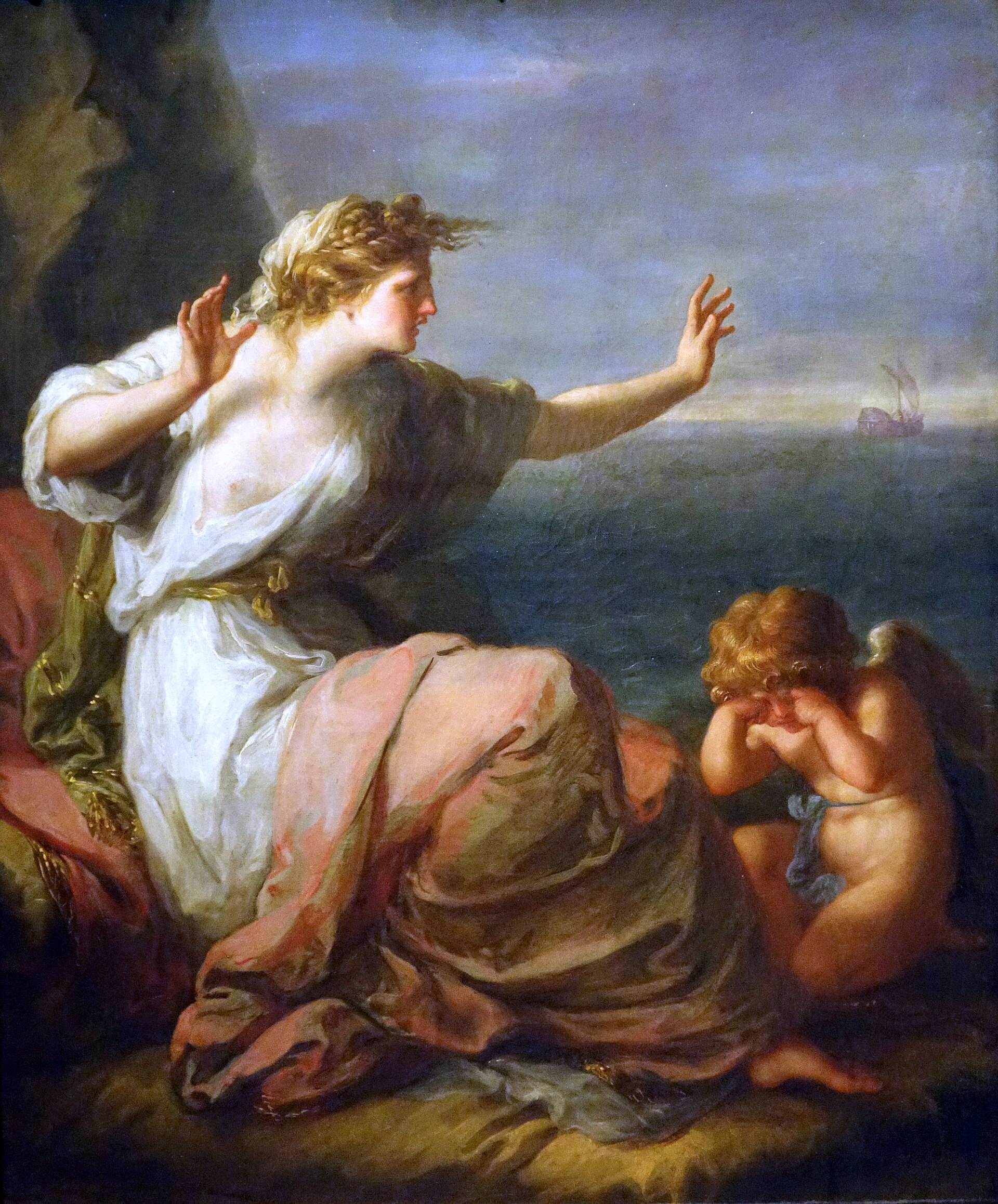
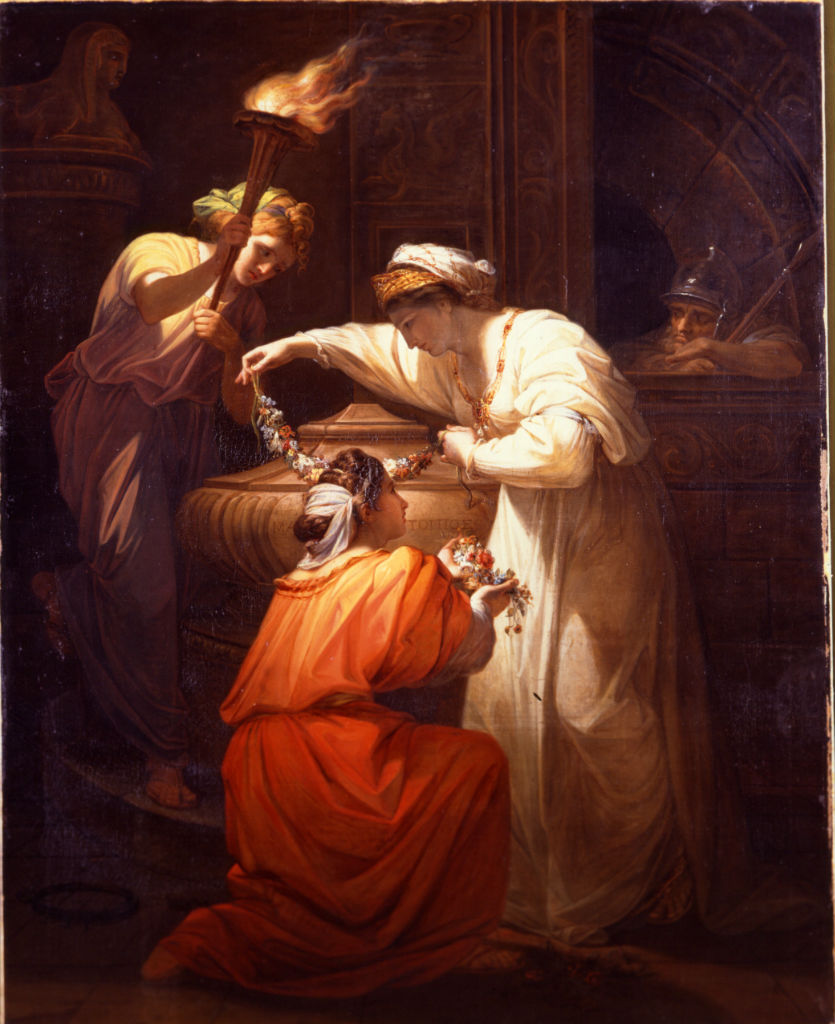
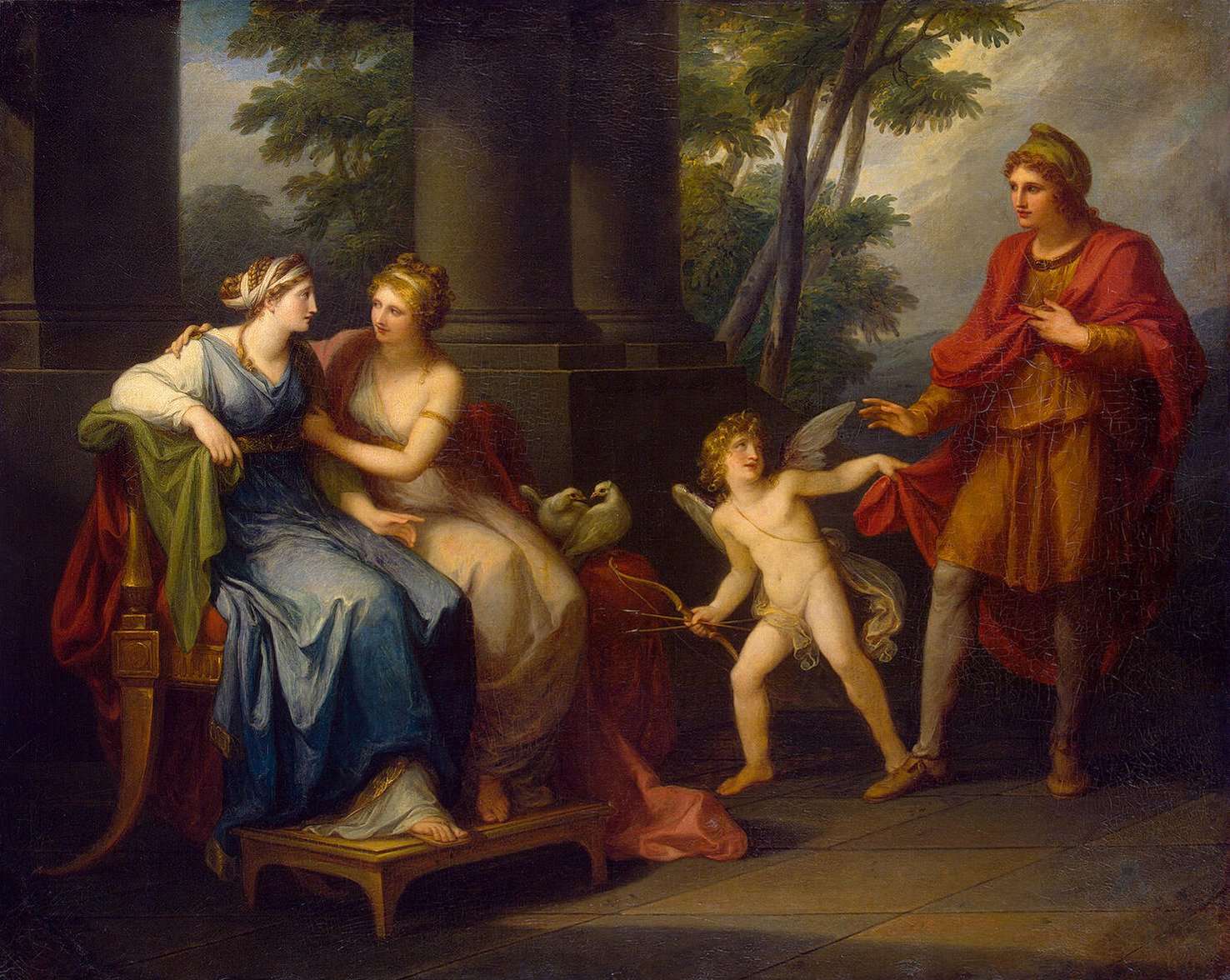
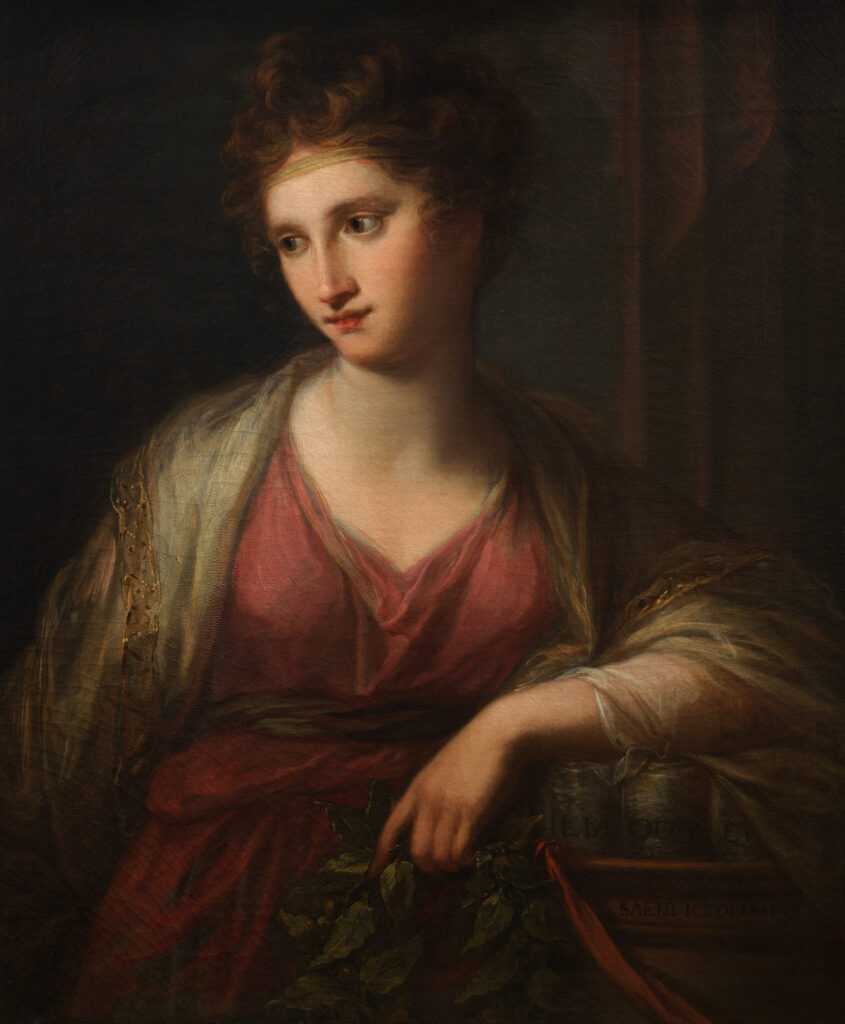
Chronology
- 1741
Born in Chur, in what is now Graubunden, Switzerland, on 30 October according to Wikipedia; the Research Project and a Swiss broadcaster give the year and place.156
- 1757
Her mother dies in Milan; she decides to make painting her sole career and, aged fifteen, paints frescoes of the apostles in the church at Schwarzenberg while her father paints the ceiling.3
- 1764
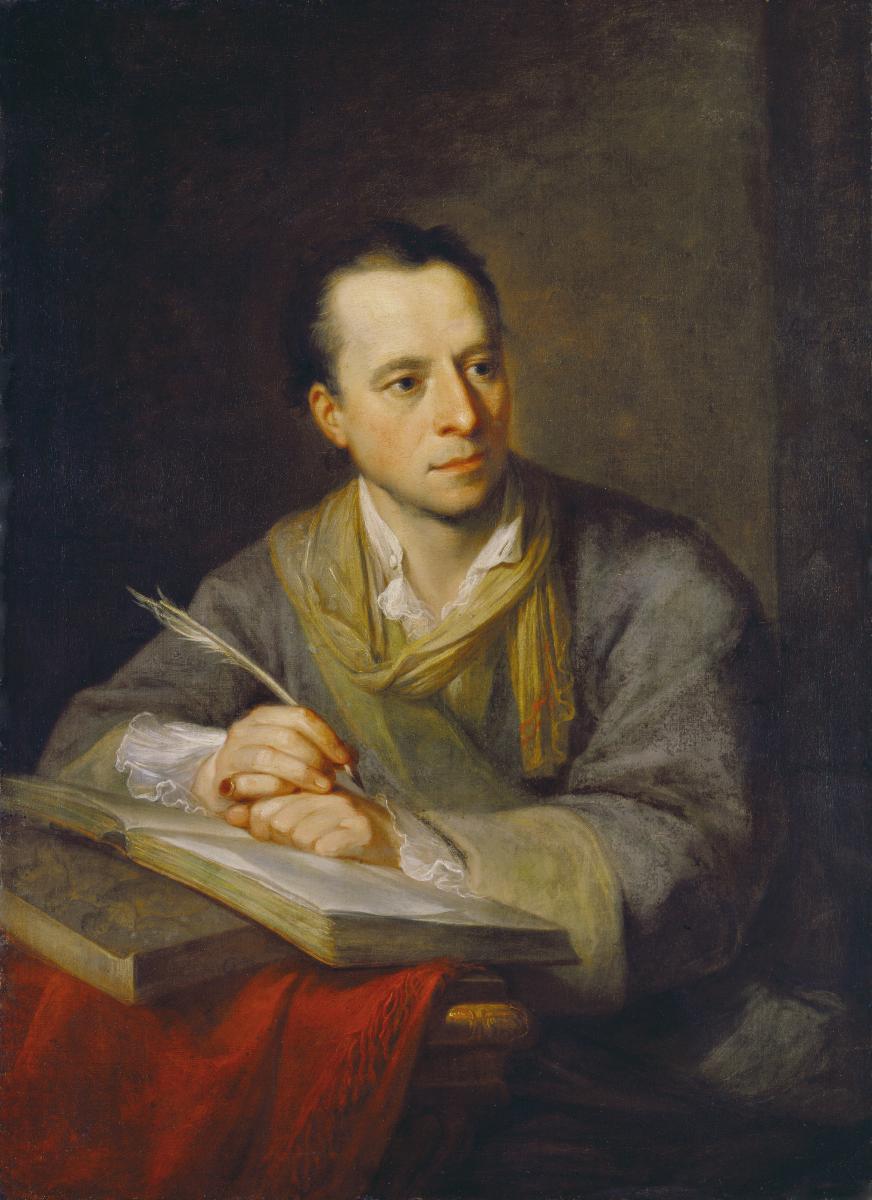
Paints Johann Joachim Winckelmann in Rome, her breakthrough as a portraitist; the picture is now in the Kunsthaus Zurich.3
- 1766
Moves to London, where she lives until 1781, and soon has portrait commissions from the royal family and nobility.3
- 1767
Marries a man posing as Count Frederick de Horn; he is an impostor and a deed of separation is dated 10 February 1768 on the 1924 account from Rossi.13
- 1768
Becomes one of the 22 founding members of the Royal Academy, with Mary Moser one of only two women; the Research Project says they remained the only women Academicians for the next 200 years, a round figure.3
- 1769
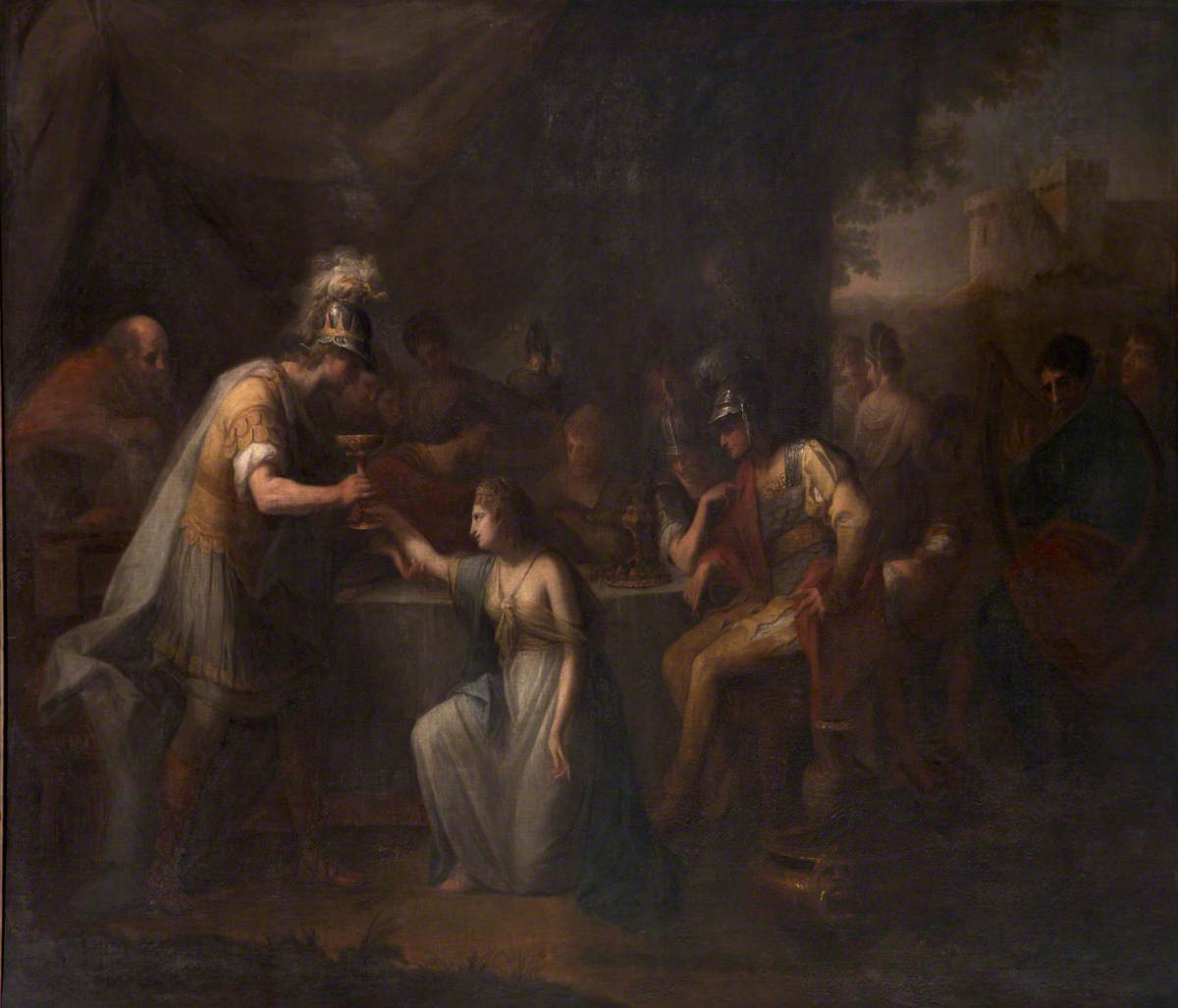
Exhibits four classical subjects at the first Royal Academy exhibition, including the Interview of Hector and Andromache.1
- 1771
Visits Ireland for the summer on invitation and receives commissions from the country's leading collectors.3
- 1778-1780
Paints four ceiling pictures for the Royal Academy at Somerset House, paid 100 pounds on the Somerset House account.119
- 1781
Marries Antonio Zucchi under a contract of 10 July that guarantees her free disposal of her income; leaves London in October; her father dies during the stopover in Venice (1782 per Wikipedia; the Research Project gives no year).31
- 1782
Opens a studio beside the Spanish Steps in Rome and builds an international clientele.3
- 1787
The Research Project dates Goethe's coming to Rome to this year; the two become close friends and she paints him (the portrait is dated 1787 in Wikipedia's list). Anna Amalia and Herder follow, and she paints them too.3
- 1791
Finishes the altar picture for the Holy House of Loreto, ordered by command of Pius VI and paid 250 zecchini on 5 June.1
- 1798
French troops occupy Rome; her studio is spared but devaluation damages her finances.3
- 1805
Completes her last large portrait commission, for Crown Prince Ludwig of Bavaria, now in the Neue Pinakothek in Munich.3
- 1807
Dies in Rome on 5 November; buried at Sant'Andrea delle Fratte after a funeral modelled on Raphael's, with a bust placed in the Pantheon.31
- 1924
Manners and Williamson publish the English translation of her own memorandum of paintings, found in the Royal Academy library, with a list of works by owner and of chief auction sales.1
- 1990
The Angelika Kauffmann Research Project is initiated under the direction of Bettina Baumgartel to produce a critical catalogue raisonne.2
- 1998
Retrospective in Dusseldorf, Munich and Chur; the conservator Inken Holubec presents the first interim results of her technical examinations.14
- 2024
Royal Academy exhibition, 1 March to 30 June, co-curated with Baumgartel after its 2020 opening in Dusseldorf.12
- 2026
The National Gallery in London receives Achilles discovered among the Daughters of Lycomedes, the first Kauffman in its current collection, on 2 July.11
The market
Her prices have a floor from continuous demand. The dealer Simon C. Dickinson, who sells her work, wrote in 2024 that her peaks and troughs have been less pronounced than for some other women old masters and that two of his five sold twenty years ago or more. His top five are five results between 453,000 pounds and 1,110,000 dollars, all including premium. An art-price aggregator records a higher realised price for a pair of 1780 portraits in 2013, 1,106,500 pounds. The dealer's list leaves out the 2013 sale, so the record depends on whose list is read; hammer prices are not given for these lots, and the figures are not currency-adjusted here.
Her own pictures sold in the 1880s and 1920s at prices that look small against her fees: the Coutts daughters were 300 guineas in 1791 and 273 pounds in 1922. A lesser picture, a Penelope at Christie's in May 2023, made 170,000 dollars hammer.
| Date | Sale | Work | Result | Note |
|---|---|---|---|---|
| 14 October 2021 | Christie's New York | Cornelia, Mother of the Gracchi (1788), 110 x 152 cm | Hammer Not stated in the sources consulted With premium USD 1,110,000 including premium USD | Estimate USD 200,000-300,000 per an aggregator. Dealer source gives lot 63, the aggregator lot 62; unresolved. |
| 8 July 2021 | Christie's London | Countess of Derby with her infant son and her half-sister playing the harp, 1770s, lot 14 | Hammer Not stated With premium GBP 562,500 including premium GBP | From a dealer's list of her top prices. |
| 30 January 2019 | Sotheby's New York | Portrait of three children, almost certainly Lady Georgiana Spencer, Lady Henrietta Spencer and George, Viscount Althorp (late 1760s), lot 52 | Hammer Not stated With premium USD 915,000 including premium (dealer source); Sotheby's slideshow says 'sold for' that sum USD | Estimate USD 600,000-800,000. Provenance in the catalogue: Colonel Norman Colville; Christie's, 13 June 2001, lot 3; Richard Green, London, 2001. |
| 4 December 2013 | Sotheby's London | Pair: Mary May with her three daughters and Joseph May with their three sons (1780), lot 46 | Hammer Not stated With premium GBP 1,106,500 'price realised' per an aggregator GBP | Estimate GBP 1,000,000-1,500,000. Aggregator gives earlier sale: Christie's, 15 May 1886, lots 87 and 88, 165 and 60 guineas. Aggregator, not a house record. |
| 25 November 2004 | Sotheby's London | Portrait of the Hon. Anne Seymour Damer as Ceres (1766), lot 41 | Hammer Not stated With premium GBP 453,000 including premium GBP | From a dealer's list. |
| 12 June 2003 | Sotheby's London | Portrait of Philip Tisdal with his wife and family (1771), lot 8 | Hammer Not stated With premium GBP 509,600 including premium GBP | From a dealer's list. |
| 24 May 2023 | Christie's New York (Safra collection sale) | Penelope, subject given as the wife of Odysseus | Hammer USD 170,000 With premium USD 214,000 with fees USD | The only recent lot found with both figures; sold without reserve in a single-owner sale. |
| 1922 | Christie's London | Three daughters of Thomas Coutts (1791), lot 41 | Hammer Not stated; GBP 273 is the sale figure Manners and Williamson give With premium Not stated GBP | Listed in Manners and Williamson as mentioned in her Italian list; the memorandum gives 300 guineas in 1791. Her price in the 1920s was lower in nominal terms than her fee. |
Hammer is the price at which the bidding stopped; with premium adds the fee the house charges the buyer on top. Hammer price and buyer's premium in the glossary.
Where to see the work
| Institution | City | Holdings | Note |
|---|---|---|---|
| Royal Academy of Arts | London | Four ceiling pictures for Somerset House (1778-80), including Design (126 x 148.5 cm) | Usually in the Front Hall; two were lent to Tate Britain in 2024. |
| National Gallery | London | Achilles discovered among the Daughters of Lycomedes, 1787-8 (NG6710), displayed in Room 37 from 2 July 2026 | Gift of the Barrett Collection; the first Kauffman in its current collection. |
| Petworth House (National Trust) | Petworth, England | Diomed and Cressida (1788), recently conserved | A display on the conservation was reported in June 2024. |
| Kunsthaus Zurich | Zurich | Portrait of Johann Joachim Winckelmann (1764) | The picture that opened Rome to her. |
| Neue Pinakothek | Munich | Self-portrait (1784); portrait of Crown Prince Ludwig of Bavaria (last large commission, completed 1805 per the Research Project) | The last large commission. |
| Angelika Kauffmann Museum | Schwarzenberg, Vorarlberg | Changing annual exhibitions | Opened 2007 in her father's home region. |
Forgeries and misattributions
- The weekly 'new Kauffmann'
- Baumgartel told Swiss television in March 2024 that practically every week another 'Kauffmann' appears and that 90 per cent of them are imitations or forgeries, while genuine pictures once thought lost still turn up in private collections. The Research Project says there are innumerable copies, imitations and forgeries, and that over 600 prints (home page) or over 1000 engravings (biography) were made after her. No technical protocol is described in the sources consulted. The project asks for lost works and offers discretion; its own methods are connoisseurship, documents such as the 1924-published memorandum and technical examination by Holubec.623
- Decorative ceilings, mantles and painted furniture
- Manners and Williamson in 1924 wrote that any ceiling in her manner was attributed to her and that painted furniture in her style was said to be by her own hand, while accepting a group of rooms (Luton Hoo, Syon House, 20 Portman Square and others). The Research Project now says many such attributions in English houses are wrong and that she did not paint on wood, ivory or porcelain. Attribution by 'similarity of line and design' in 1924; the later position is stated without a case-by-case list in the sources consulted.12
- Misattribution: the Bishop of Derry
- The half-length of the Bishop of Derry with a bust of Maecenas, at Downhill, had been ascribed to Vigee Le Brun in the family catalogue and in a book on her; Manners and Williamson gave it back to Kauffman. A memorandum entry of June 1790 describes the very composition and the sitter's own letter refers to it.1
- Under-attribution: a pair sold as Circle of Benjamin West
- The art historian Bendor Grosvenor reported in 2011 that a pair of portraits offered by Sotheby's in New York as Circle of Benjamin West had failed at a first estimate of 30,000-50,000 dollars and then made 28,125 dollars including premium; he wrote that in his opinion they were by Kauffman in her Italian period. Connoisseurship by one writer; no reattribution by the Research Project was found.18
The essay
Chapter 1The number nobody agrees on
There is no accepted count of her paintings, and the main source of figures contradicts itself.
There is no accepted count of her paintings, and the main source of figures contradicts itself. The Angelika Kauffmann Research Project, run since 1990 by Bettina Baumgartel, says on its home page that she left an estimated 1000 oil paintings on canvas or copper, 13 frescoes, some 450 drawings and 39 etchings. The biography page of the same project speaks of an oeuvre of over 800 works in all, which cannot be a like-for-like total beside 1000 oils and 450 drawings, and says she produced 41 autograph etchings between 1762 and 1779. A Swiss television report of March 2024, quoting Baumgartel, gave about 800 paintings, about 400 drawings and 40 etchings.
The same pages disagree on prints after her. The home page says more than 600 were made; the biography says over 1000 engravings based on her originals survive. These are the project's own estimates, not a tally of catalogued objects, and the catalogue itself is still in preparation. Its stated scope is more than two thousand works by and after her, in public and private collections in Europe, Russia and the United States. Until it appears the honest figure is a range, and the reader should treat any single number in a museum label or auction essay as a quotation from one of these estimates.
Chapter 2The ledger she kept
The best document for her mature career is her own.
The best document for her mature career is her own. After she left England in October 1781 she kept a handwritten memorandum, in Italian, of the pictures she painted: the subject, the size, the sitter or buyer, the price and how it was paid. Lady Victoria Manners and Dr G. C. Williamson found it in the library of the Royal Academy and published a translation by Signora Vitelleschi in their 1924 book, which they say was written because of the discovery. It runs from Venice in December 1781 to her death, a span the editors give as twenty-five years.
It is not complete. The editors note that the manuscript itself says certain portraits were left out, and that they know of at least one picture dated 1800 that it does not mention. Where it does record a picture, it can overturn an attribution: the half-length of the Bishop of Derry with a bust of Maecenas, painted in Rome in June 1790, had been catalogued by the family and in a book on Vigee Le Brun as hers, until the description and a letter from the sitter matched Kauffman's entry. The sources consulted give no shelfmark for the manuscript and no edition of it since 1924, so the 1924 translation, with its editors' stated difficulty deciphering her hand, is what every later writer is working from.
Chapter 3What her pictures cost
The memorandum gives a working price list, in the currency each client paid.
The memorandum gives a working price list, in the currency each client paid. A pair of small rounds for a London buyer, Mr Bowles, was fifty guineas in 1782; another pair of ovals sixty. A head and shoulders portrait without hands for a Roman prelate, Monsignor Gaetani, was twenty-four zecchini in September 1783, which she records as the price settled on for portraits of that size. A larger half-length with hands for Count Brown was eighty zecchini. For the Duc de Chartres she took forty louis d'or. The Bishop of Derry's portrait in 1790 was paid through the Roman banker Torlonia as 258 Roman crowns, which she says was the value of 120 zecchini.
The large pictures sit far above that. She records 460 Venetian zecchini for the Death of Leonardo da Vinci, bought by the Grand Duke of Russia. Thomas Coutts paid 300 guineas for the life-size group of his three daughters, settled through the banker Thomas Jenkins in April 1791. The altar picture for the Holy House of Loreto, ordered by command of Pius VI through his Secretary of State, was 250 zecchini, paid on 5 June 1791. The only conversion in the memorandum is her own: 258 Roman crowns for 120 zecchini. This record gives no modern equivalents: the methods differ by an order of magnitude and no single one was found in a source.
The one institutional fee found is recorded elsewhere. A Somerset House account ledger quoted in the Journal of the Royal Institute of British Architects in 1892, reproduced by Manners and Williamson, lists 100 pounds to Angelica Kauffman for four pictures in the ceiling of the lecture room, against 125 pounds to Benjamin West for five and 30 guineas to Sir Joshua Reynolds for one. The Academy's own records name the room differently from the ledger, a naming muddle the 1924 authors left standing.
Chapter 4Training, and two marriages
She was the daughter and pupil of the painter Johann Joseph Kauffmann, who moved the family between Chur, Morbegno, Como, Milan and the Bregenz Forest.
She was the daughter and pupil of the painter Johann Joseph Kauffmann, who moved the family between Chur, Morbegno, Como, Milan and the Bregenz Forest. Her mother Cleophea Lutz died in Milan in 1757, after which she decided to make painting her sole career; in the same year, aged fifteen, she painted frescoes of the apostles on the side walls of the church at Schwarzenberg while her father painted the ceiling. Her second Italian journey, from about 1758 or 1759 to 1766, was given over to study in the Este, Sampieri, Medici and Borghese collections and to painting copies for British travellers, which built the English clientele that took her to London.
Her first marriage is the episode every biography retells and the sources disagree about its detail. The Research Project says only that she was tricked into it by an impostor at the start of her London years. Manners and Williamson, relaying the 1810 biography by De Rossi, name the man as Brandt, who arrived in London in 1767 posing as the Swedish Count Frederick de Horn, had in fact been the real count's valet or natural son depending on the version, and extracted a sum of money before a deed of separation of 10 February 1768. Those details come from a single secondary tradition and should be read as such. Her second marriage, to the Venetian painter Antonio Zucchi in July 1781, was made under a contract that guaranteed her free disposal of her own income.
Chapter 5The Academy, and how she sat in it
She appears as 'Kauffmann, Miss Anna Angelica Catherine, R.A.' in its early catalogues; her first exhibits in 1769 were four classical subjects, among them the Interview of Hector and Andromache.
She appears as 'Kauffmann, Miss Anna Angelica Catherine, R.A.' in its early catalogues; her first exhibits in 1769 were four classical subjects, among them the Interview of Hector and Andromache. A trade writer for a London dealer says she exhibited every year from 1769 to 1782 and was barred, as a woman, from the Academy's life drawing. That last point comes from a gallery's blog and is not independently sourced, but the institutional pattern behind it is not in doubt: Johan Zoffany's group portrait of the Academicians of 1771-72 shows her and Mary Moser only as portraits on the wall.
The four oval ceiling pictures she painted in 1778-80 for the Academy's rooms at Somerset House, Invention, Composition, Design and Colour in the Research Project's wording, were moved to Burlington House and now hang in its entrance hall. In 1924 Manners and Williamson corrected the Dictionary of National Biography, which had given her the Council Chamber ceiling there; that ceiling is by Benjamin West. Their book lists her subjects as Genius, Design, Composition and Painting, and the ledger places the pictures in the lecture room. Design shows a woman copying the Belvedere Torso, a cast of which the Academy owned for its students. Two of the four were to be shown in the 2024 exhibition and the other two lent to Tate Britain.
Chapter 6How she painted
She painted in oil on canvas and on copper, and early in pastel.
She painted in oil on canvas and on copper, and early in pastel. The Research Project says she did not paint on wood, ivory or porcelain. Conservation work on Diomed and Cressida of 1788, a picture commissioned by John Boydell for his Shakespeare Gallery and now at Petworth, found by infrared reflectography an underdrawing, most probably in charcoal, laid out on a grid, which the National Trust reads as evidence that she scaled up a smaller sketch. The report of the National Trust display calls it the first time it had been seen.
Her method also leaves a pattern across pictures. Baumgartel has found two bust portraits painted as preparatory studies for the family portrait of Princess Catherine Bariatinskaya and the Polish Chancellor Jerome Andrzej Tamoyski, and argues that Kauffman reused such studies and compositions across commissions. The conservator Inken Maria Holubec, who has worked with the project since 1997, has specialised in the grounds, primers and binders of the paintings, and has published on her works on copper and on her materials and painting process. No pigment table or dendrochronological type series for the corpus was found in the sources consulted, and the technique entries below should be read with that gap in mind.
Chapter 7Prints, fashion and the borrowed name
She became famous partly through the engravers.
She became famous partly through the engravers. William Wynne Ryland and Francesco Bartolozzi translated her small mythological and sentimental pictures into red and brown stipple prints that sold widely and served, the Research Project says, as design templates for young artists, so that a fashion a la Kauffman spread across Europe. Ryland himself absconded in 1783 on a charge of forgery and was later executed, according to Manners and Williamson, who draw on Mrs Frankau's research into his case.
Her reputation then drifted away from the pictures and onto the style. In 1924 the authors wrote that any ceiling decoration in her manner was attributed to her, that painted furniture in her style was said to be by her own hand, and that her scenes were reproduced at Sevres and Meissen. The Art Newspaper, previewing the 2024 Royal Academy show, put it that after Neoclassicism fell out of fashion, reproductions of her work on furniture and other decorative objects meant it was no longer seen as serious art but as prettified and domestic.
Chapter 8Ceilings, commodes and the claims about them
Here two positions exist and they should not be averaged.
Here two positions exist and they should not be averaged. Manners and Williamson in 1924 accepted a body of decorative work: ceilings at Luton Hoo and 106 Piccadilly, rooms at 20 Portman Square and Queen Anne's Gate, decoration at Syon House and a gaming room at Clytha Park. They admitted that in most instances the decorative work could be told from that of contemporaries only by the general similarity of line and design to her other work, and they regretted that the Victoria and Albert Museum held no authentic painted piece to serve as a guide. The only payment they could find for her decorative work was the Somerset House account.
The Research Project, almost a century later, says that many wall, ceiling and mantle decorations in English historic houses are erroneously attributed to her and that she did not paint on wood, ivory or porcelain. Baumgartel adds in 2024 that virtually every week another 'Kauffmann' appears and that 90 per cent of them are imitations or forgeries, while genuine works long thought lost still surface in private collections. The two positions are not reconciled in any source consulted. Neither is a verdict on a particular house: each decoration needs its own file.
Chapter 9What she believed and what she read
The documented material is modest and mostly Catholic and humanist in the ordinary eighteenth-century way.
The documented material is modest and mostly Catholic and humanist in the ordinary eighteenth-century way. A priest is said to have steered her away from an operatic career in her youth, a story given by Wikipedia and a dealer's essay; the Research Project says she was deeply religious and gave generously to her father's village. Her will, abstracted in 1924 from a German art journal, asks for 100 masses on the day of her burial and after, at a stated fee each, and leaves her English and French books to the nephew of Zucchi and her German and Italian books to a Kauffmann cousin. That is an inventory of language, not of a library; no list of titles was found.
Her own description of the altar picture for Loreto, in the memorandum, states that the child Virgin waters a lily, 'the which flower is the symbol of purity', and that a ray of sunlight falls on her. It is the clearest sentence she left about what an image meant. In Rome from 1763 she studied classicist theory and, the Research Project says, pursued Winckelmann's maxim of noble simplicity and quiet grandeur; her portrait of him in 1764 opened doors. From the 1780s she painted large Roman-republic subjects with women at their centre, Cornelia and her children as her treasures among them, which the Research Project reads as new heroines for the Enlightenment, and the Academy curator Annette Wickham says she had an interest in finding active stories about women. These are readings by named scholars, not statements from the painter. No lodge membership, correspondence of that kind or hidden programme turned up in the sources consulted, and nothing in the record suggests one.
Chapter 10The estate
Her will says that all she possessed had been won by her work.
Her will says that all she possessed had been won by her work. Her London capital of 3350 pounds sterling at 3.5 per cent went to three Kauffmann cousins, 1000 pounds sterling to her cousin Rosa Bonomi, and 17,790 florins (the abstract prints 17,790-37) held in her homeland to cousins around Schwarzenberg and Morbegno. Her cousin Johann Kauffmann received the studio contents: her books, her engravings, her own pictures, the lay figures and costumes, her drawings and her portrait by Reynolds, with the order that the paintings finished or unfinished in her studio be sold and the proceeds shared. The will adds that of her designs and drawings the worst were to be burnt.
The sale of that studio, the fate of the 'worst' drawings and the whereabouts of the Reynolds portrait are not traced in the sources consulted. Her funeral at Sant'Andrea delle Fratte, which Wikipedia says Canova directed on the model of Raphael's and the Research Project calls the grandest since Raphael's, was followed by a procession; her last pictures were carried in the procession, and a bust by her cousin Johann Peter Kaufmann was placed in the Pantheon beside Raphael's. French occupation in 1798 spared her studio but, the Research Project says, damaged her finances through devaluation.
Chapter 11What it has fetched
The market is a story of an artist who never fell far.
The market is a story of an artist who never fell far. A gallery that sells her work lists her top public sales as Cornelia, Mother of the Gracchi at Christie's New York on 14 October 2021 for 1,110,000 dollars including premium, a group of the Countess of Derby at Christie's London on 8 July 2021 for 562,500 pounds, the Spencer children at Sotheby's New York on 30 January 2019 for 915,000 dollars, and two earlier British portraits at 453,000 and 509,600 pounds. An art-price aggregator lists a pair of 1780 portraits of Mary and Joseph May with their children at Sotheby's London on 4 December 2013 for 1,106,500 pounds, which the aggregator says is higher than the 2021 Cornelia as a realised price. Each source gives different slices; hammer prices are not given for these lots, and the Christie's Safra sale of 24 May 2023 is the only recent lot found with both figures.
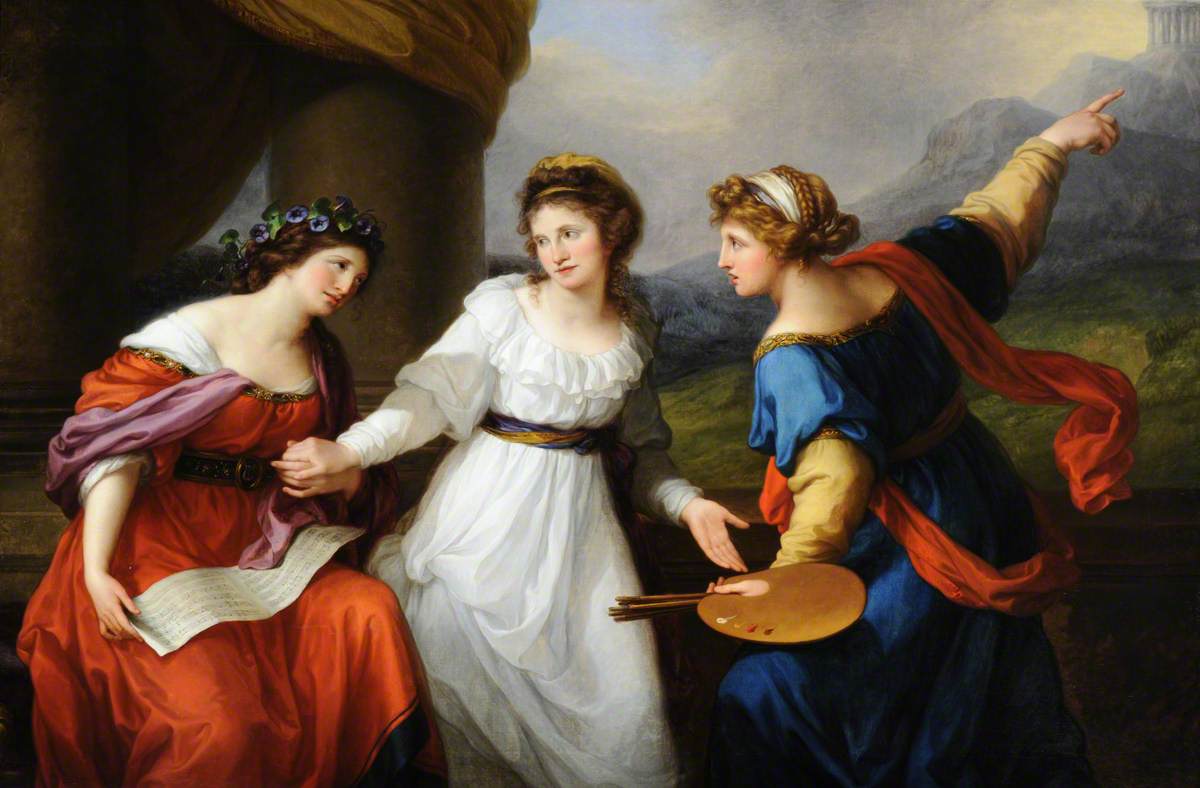
Set against her own fees, the prices of the early twentieth century look low. The Coutts daughters picture cost 300 guineas in 1791 and was sold at Christie's in 1922 for 273 pounds, according to Manners and Williamson, whose list also records a version of the 'Angelica divided between Painting and Music', signed Rome 1794, at 650 pounds in 1906. The May pair, which the aggregator says fetched 165 and 60 guineas at Christie's in 1886, made 1,106,500 pounds in 2013 on the same listing.
Chapter 12What is happening to her now
The Royal Academy's Angelica Kauffman exhibition ran from 1 March to 30 June 2024, co-curated by Annette Wickham and Bettina Baumgartel, with about thirty works, after opening at the Kunstpalast in...
The Royal Academy's Angelica Kauffman exhibition ran from 1 March to 30 June 2024, co-curated by Annette Wickham and Bettina Baumgartel, with about thirty works, after opening at the Kunstpalast in Dusseldorf in January 2020. In July 2026 the National Gallery in London accepted from the Dallas collectors Richard and Luba Barrett a gift of Achilles discovered among the Daughters of Lycomedes, a large and fully worked preparatory picture of 1787-8 for a painting commissioned by Catherine the Great that is now in St Petersburg. It is the first Kauffman to enter the National Gallery's current collection; the one bequeathed in 1835 passed to what is now Tate Britain and is believed to have been destroyed at Plymouth in 1941. The Research Project is asking the public for four lost pictures known only from prints, and for portraits of Klopstock and others known only from written sources.
What is documented
Technique
The surviving work
- What is accepted
- No authority publishes an accepted count. The Research Project (Bettina Baumgartel, since 1990) estimates about 1000 oils on canvas or copper, 13 frescoes, some 450 drawings and 39 etchings on its home page; its biography speaks of over 800 works in all; a Swiss television report in March 2024 quoting Baumgartel gave about 800 paintings, about 400 drawings and 40 etchings. The unpublished catalogue is to contain more than 2000 works by and after her.
- What is contested
- Decorative work is the main contested ground. Manners and Williamson in 1924 listed ceilings, chimney-pieces and painted rooms at Luton Hoo, 106 Piccadilly, Portman Square, Syon House and Clytha Park as hers, admitting they could separate her hand from contemporaries only by similarity of line and design. The Research Project now says many such decorations are erroneously attributed and that she did not paint on wood, ivory or porcelain. Baumgartel told Swiss television that 90 per cent of the Kauffmanns that appear each week are imitations or forgeries.
- Who rules on attribution
- No authentication board found. Baumgartel and the Research Project are the de facto authority: Swiss television describes her as often called in as an expert, and the project solicits lost works and guarantees discretion. The unpublished catalogue means no formal ruling can be cited.
Catalogue raisonne
- Victoria Manners and G. C. Williamson, Angelica Kauffmann, R.A.: Her Life and Her Works (London and New York, 1924). The last printed catalogue. Lists pictures by owner, includes the translated memorandum, a list of chief auction sales to 1924, the Academy exhibition list and an abstract of her will. Several attributions in it have since been questioned, especially decorative work.1
- Angelika Kauffmann Research Project (AKRP), Kritisches Werkverzeichnis / Catalogue Raisonne, ed. Bettina Baumgartel (in preparation). Paintings, drawings and prints, planned in several volumes and more than 2000 works by and after her. Not yet published in the sources consulted; the project asks for lost works such as Lady Elizabeth Grey imploring Edward IV, known only from Ryland's engraving of 1780.24
Questions about Angelica Kauffman
Who was Angelica Kauffman?
Painter; History painter; Portraitist; Etcher; Founding Royal Academician. 1741-1807.
When did Angelica Kauffman live?
Born 1741-10-30, Chur, Graubunden, Switzerland; died 1807-11-05, Rome.
How are fakes and misattributions of Angelica Kauffman detected?
The weekly 'new Kauffmann'. Baumgartel told Swiss television in March 2024 that practically every week another 'Kauffmann' appears and that 90 per cent of them are imitations or forgeries, while genuine pictures once thought lost still turn up in private collections. The Research Project says there are innumerable copies, imitations and forgeries, and that over 600 prints (home page) or over 1000 engravings (biography) were made after her.
Where can you see work by Angelica Kauffman?
Royal Academy of Arts (London); National Gallery (London); Petworth House (National Trust) (Petworth, England); Kunsthaus Zurich (Zurich); Neue Pinakothek (Munich); Angelika Kauffmann Museum (Schwarzenberg, Vorarlberg).
What does the market for Angelica Kauffman look like?
Her prices have a floor from continuous demand. The dealer Simon C. Dickinson, who sells her work, wrote in 2024 that her peaks and troughs have been less pronounced than for some other women old masters and that two of his five sold twenty years ago or more.
What is still unresolved about Angelica Kauffman?
How many paintings she made: the Research Project's own pages give 'over 800' works in all and an estimated 1000 oils, and the catalogue that would decide is unpublished.
Open questions
- How many paintings she made: the Research Project's own pages give 'over 800' works in all and an estimated 1000 oils, and the catalogue that would decide is unpublished.
- Where her handwritten memorandum of paintings now sits in the Royal Academy library, whether it has been re-edited since the 1924 translation, and which pictures the manuscript omits.
- Which of the decorative commissions in English houses, long catalogued as hers, are hers at all; the Research Project's list of what it rejects was not found.
- Whether she had pupils or assistants in her studio, and what the division of hands was on large commissions; none were identified in the sources consulted, and the Zucchi role in her decorative work is not documented there.
- What became of the studio contents, the drawings the will ordered burnt and the Reynolds portrait after 1807.
- Whether the Cornelia sale of 2021 or the Mary May pair of 2013 is her auction record, and what the hammer was in each case.
Sources
- 1Victoria Manners and G. C. Williamson, Angelica Kauffmann, R.A.: Her Life and Her Works (Bodley Head, London / Brentano's, New York, 1924), full text at the Internet Archive. Contains the translated memorandum, a list of works by owner, the auction list and the will. Read in full text from the scan. archive.org/details/...
- 2Bettina Baumgartel, 'Angelica Kauffman (1741-1807)', home page of the Angelika Kauffmann Research Project (AKRP). angelika-kauffmann.de/en/...
- 3Bettina Baumgartel, 'Biography', Angelika Kauffmann Research Project. angelika-kauffmann.de/en/...
- 4Bettina Baumgartel, 'Lost works', Angelika Kauffmann Research Project. angelika-kauffmann.de/en/...
- 5Angelika Kauffmann Research Project, 'Recycling in the working process of Angelica Kauffman', 17 July 2021. angelika-kauffmann.de
- 6SRF (Swiss broadcaster), 'Wie die Kuenstlerin Angelika Kauffmann Europas Elite bezauberte', Tagesschau, 4 March 2024. Quotes Baumgartel. srf.ch/kultur/...
- 7Simon C. Dickinson Ltd, 'Angelica Kauffman: Her art and her market', 23 February 2024. Trade source: a dealer that sells her work; prices stated as including premium. simondickinson.com/blog/...
- 8The Art Newspaper, 'Mid-season Old Masters auctions in New York fetch nearly $13m', 26 May 2023. theartnewspaper.com/2023/...
- 9Sotheby's, Master Paintings Evening Sale, New York, 30 January 2019, lot 52, catalogue entry with provenance and estimate. sothebys.com/en/...
- 10Sotheby's, '7 New Auction Records for Women Artists of the Premodern Era' (slideshow stating the lot sold for USD 915,000). sothebys.com/en/...
- 11National Gallery, London, press release 'National Gallery acquires a picture by Angelica Kauffmann', 2 July 2026. nationalgallery.org.uk/about-us/...
- 12Chloe Ashby, 'Royal Academy of Arts's forgotten founding member Angelica Kauffman gets solo show', The Art Newspaper, 1 March 2024. theartnewspaper.com/2024/...
- 13Richard Ginger, 'Angelica Kauffman painting conserved at Petworth House', Antique Collecting, 14 June 2024, reporting the National Trust display. antique-collecting.co.uk
- 14Angelika Kauffmann Research Project, 'Inken Maria Holubec' (conservator profile and publication list). angelika-kauffmann.de/en/...
- 15Wikipedia, 'Angelica Kauffman'. en.wikipedia.org/wiki/...
- 16Art.Salon, auction listing: Kauffmann, Portrait of Mary May with her three daughters and Joseph May with their three sons, Sotheby's London, 4 December 2013, lot 46. Aggregator; replace with Sotheby's results page. art.salon/artwork/...
- 17Art.Salon, auction listing: Kauffman, Cornelia, Mother of the Gracchi, Christie's New York, 14 October 2021. Aggregator; replace with Christie's lot essay. art.salon/artwork/...
- 18Bendor Grosvenor, 'Angelica Kauffman slips through the net in NY?', Art History News, 11 June 2011. A single writer's opinion. arthistorynews.com/articles/...
- 19Royal Academy of Arts, Object of the Month January 2011: Angelica Kauffman, Design, reproduced on Enfilade. enfilade18thc.com/2011/...
Last verified