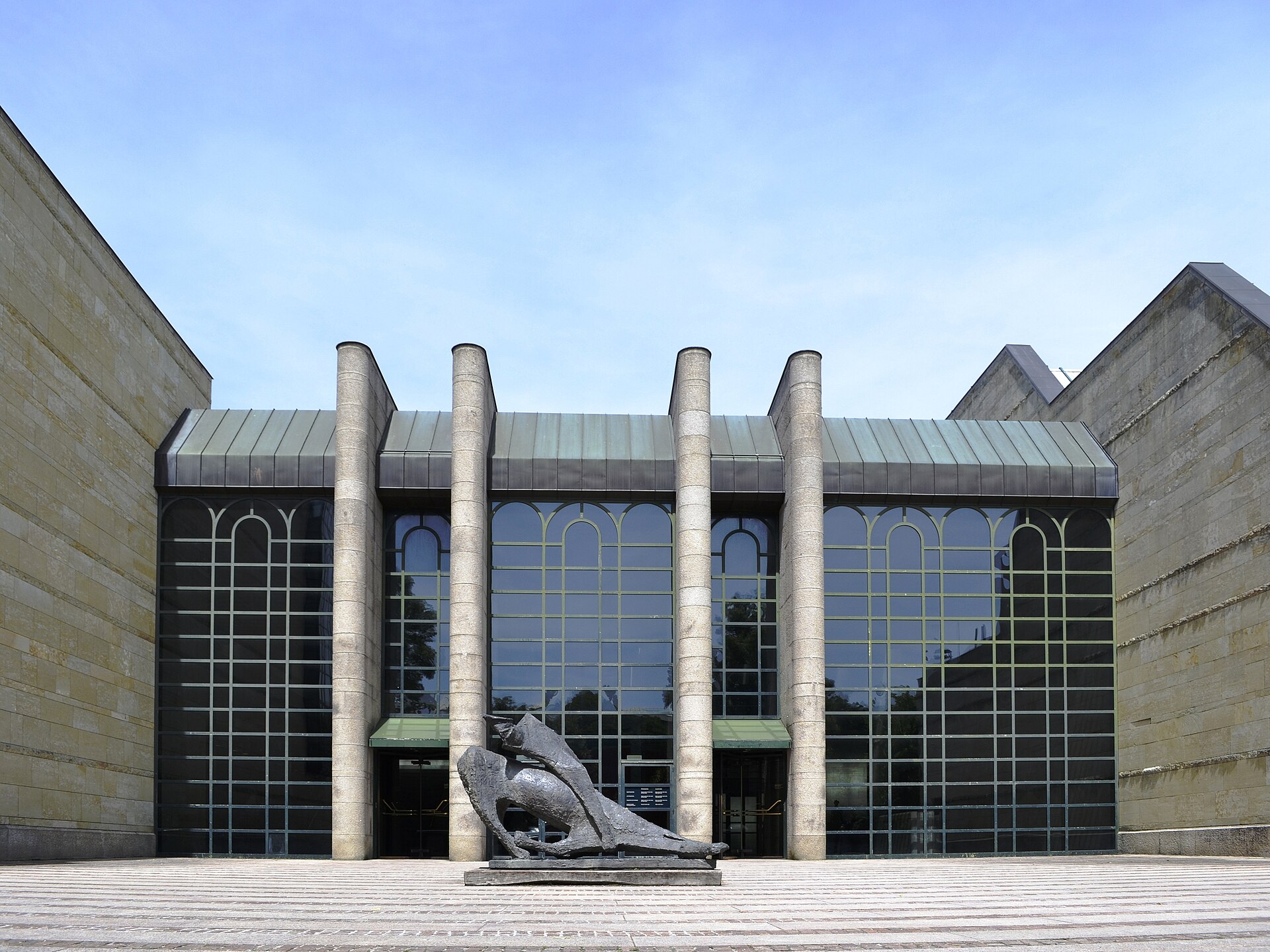
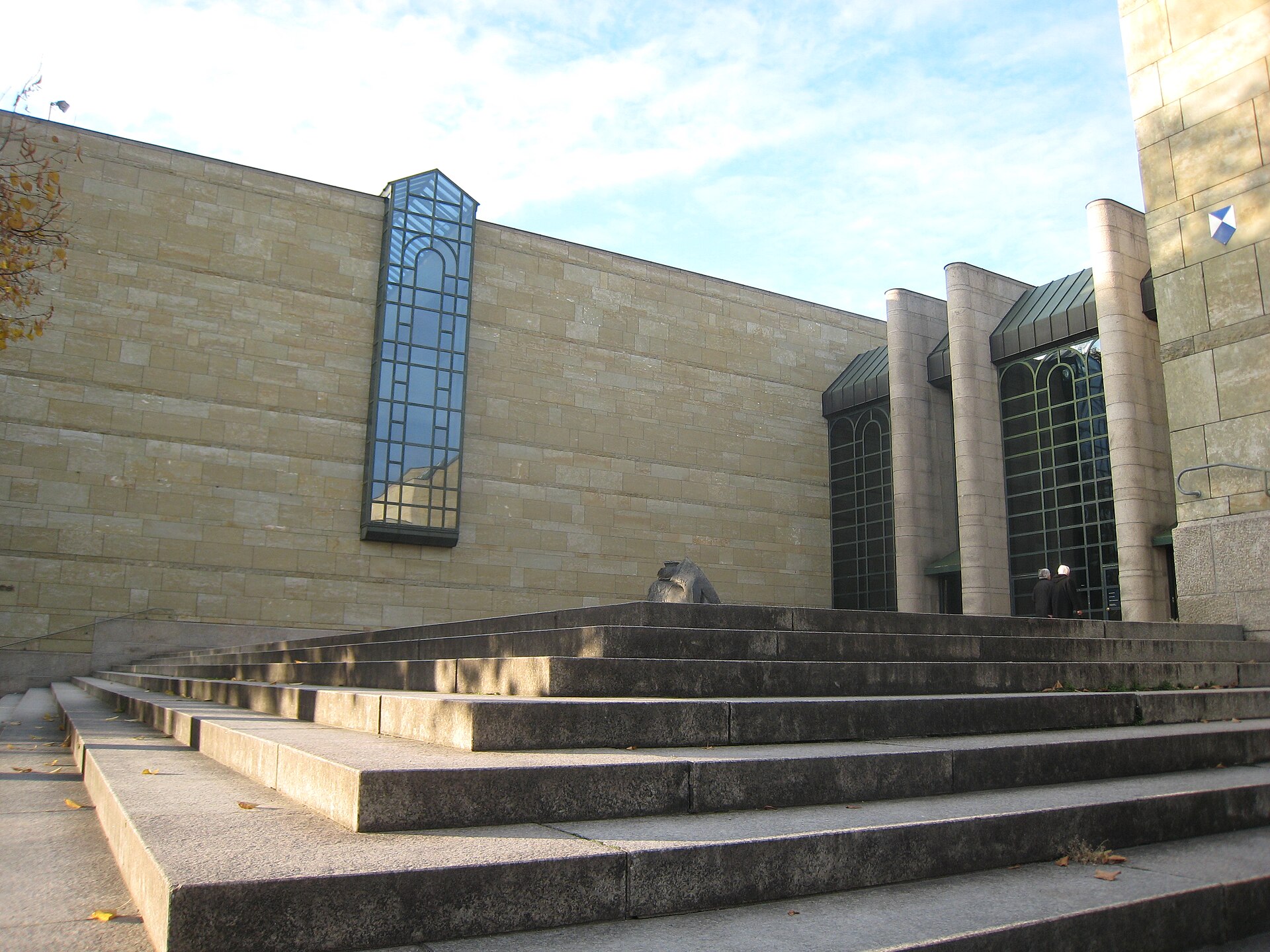
Alexander von Branca's postmodern entrance facade, stone-clad columns carrying a green-patinated canopy over the glazed entrance bays, with a bronze sculpture on the plaza in front. Vetted by eye before use.
Photograph by High Contrast · CC BY 3.0 deClosed to visitors - not permanently
Neue Pinakothek is currently closed. Not open and not permanently closed. The museum's own page states plainly: 'The Neue Pinakothek is undergoing major renovation. Therefore, the museum is currently closed.' Closed since 1 January 2019. Selected 19th-century works are shown meanwhile on the ground floor of the Alte Pinakothek and at the Sammlung Schack.
Expected to reopen: The museum's own visit page states the reopening 'is planned for 2029' without a more precise date. A 2026-read Wikipedia account gives a fuller timeline: the closure was originally projected to end by 2025, but the museum's director corrected that in early 2022, stating the building would be structurally finished around the end of 2027/2028 with reopening in the second half of 2029 - a target that has therefore already moved once, from 2025. · a target, not yet confirmed
Closure confirmed from the institution's own page. We re-check this page on a schedule and will update it, from the institution's own announcement, the moment it reopens.
On this page 14 sections
ContentsClose
More than 3,000 European paintings of the 18th and 19th centuries, on the account read for this page, with the collection's own stated centre of gravity in French Impressionism and Post-Impressionism, German Romanticism, and turn-of-the-century Symbolism. Ludwig I founded it as a deliberate counterpart to the Alte Pinakothek across the street: Old Masters on one side, the art of his own day on the other, a pairing that gave Europe what the museum's own material calls its first museum built specifically to exhibit contemporary painting. None of it is currently on view in the building built to hold it; what can be seen is a curated selection split between the Alte Pinakothek's ground floor and the Sammlung Schack.
| Kind | Museum |
|---|---|
| Founded | 1853 |
| City and country |  Munich, Germany Munich, Germany |
| Address | Barer Strasse 29, 80799 Muenchen, Germany |
| Website | pinakothek.de/en/neue-pinakothek |
| Status | Closed temporarily, confirmed |
| Record last verified |
Visiting
- Hours (pre-closure)
- All daysClosed to visitors since 1 January 2019 for renovation. No visiting hours currently apply to the Neue Pinakothek building itself.
- Closed
- Every day, until a stated 2029 reopening.
- Admission (pre-closure)
- Alte Pinakothek, adult (includes the ground-floor 19th-century display standing in for the Neue Pinakothek)EUR 96 EUR reduced; 1 EUR on Sundays
- Sammlung Schack, adultEUR 43 EUR reduced; 1 EUR on Sundays
- Under 18FreeBavarian state museums standard free-entry policy; not separately restated on the Neue Pinakothek's own closed page
Free entry: 1 EUR on Sundays at both the Alte Pinakothek and the Sammlung Schack, the two venues currently showing the Neue Pinakothek's displaced collection- Do I need to book?
- Not applicable while the museum is closed.
- Address
- Barer Strasse 29, 80799 Muenchen, Germany MapTram Pinakotheken stop, on the Kunstareal
On foot Directly across Theresienstrasse / Barer Strasse from the Alte Pinakothek - Website
- pinakothek.de/en/neue-pinakothek
- Telephone
- +49 89 23805 284
- [email protected]
Before you go how long, access, photography, bags, eating, shop
- How long to allow
- Not applicable while closed. The displaced 19th-century highlights can be seen instead on the ground floor of the Alte Pinakothek and at the Sammlung Schack, each on its own separate ticket.
- Access
- Not published for the closed Neue Pinakothek in the sources read for this record.
- Photography
- Not published in the sources read for this record.
- Bags
- Not published in the sources read for this record.
- Eating
- Not applicable while the museum building is closed.
- Shop
- Not applicable while the museum building is closed.
The museum is closed (see above). These are the figures published before the closure, kept here for a visitor planning ahead rather than presented as bookable today, and you can check the current position at the source we used. We will re-confirm them once it reopens.
What is inside
The 19th-century collection, normally housed here
Before the January 2019 closure, and again on the stated 2029 reopening, this museum holds more than 3,000 European paintings spanning the 18th and 19th centuries, on the account read for this page, with particular strength in French Impressionism, Post-Impressionism and German Romanticism, the exact range Ludwig I intended when he founded the collection to put contemporary painting in dialogue with the Old Masters across the street.
The Impressionist and Post-Impressionist rooms
Home, in ordinary times, to Van Gogh's Sunflowers of 1888 and his The Weaver, Manet's Le Dejeuner (Luncheon in the Studio) of 1868, Monet's The Bridge at Argenteuil and Water Lilies of about 1915, Gauguin's Te tamari no atua and Cezanne's The Railway Cutting; all currently unavailable in this building and, where shown at all, on view instead at the Alte Pinakothek.
The Symbolist and turn-of-the-century rooms
Gustav Klimt's portrait of Margaret Stonborough-Wittgenstein of 1905 is the collection's best-known Symbolist holding, part of the same displaced 19th-century display now split between the Alte Pinakothek and the Sammlung Schack.
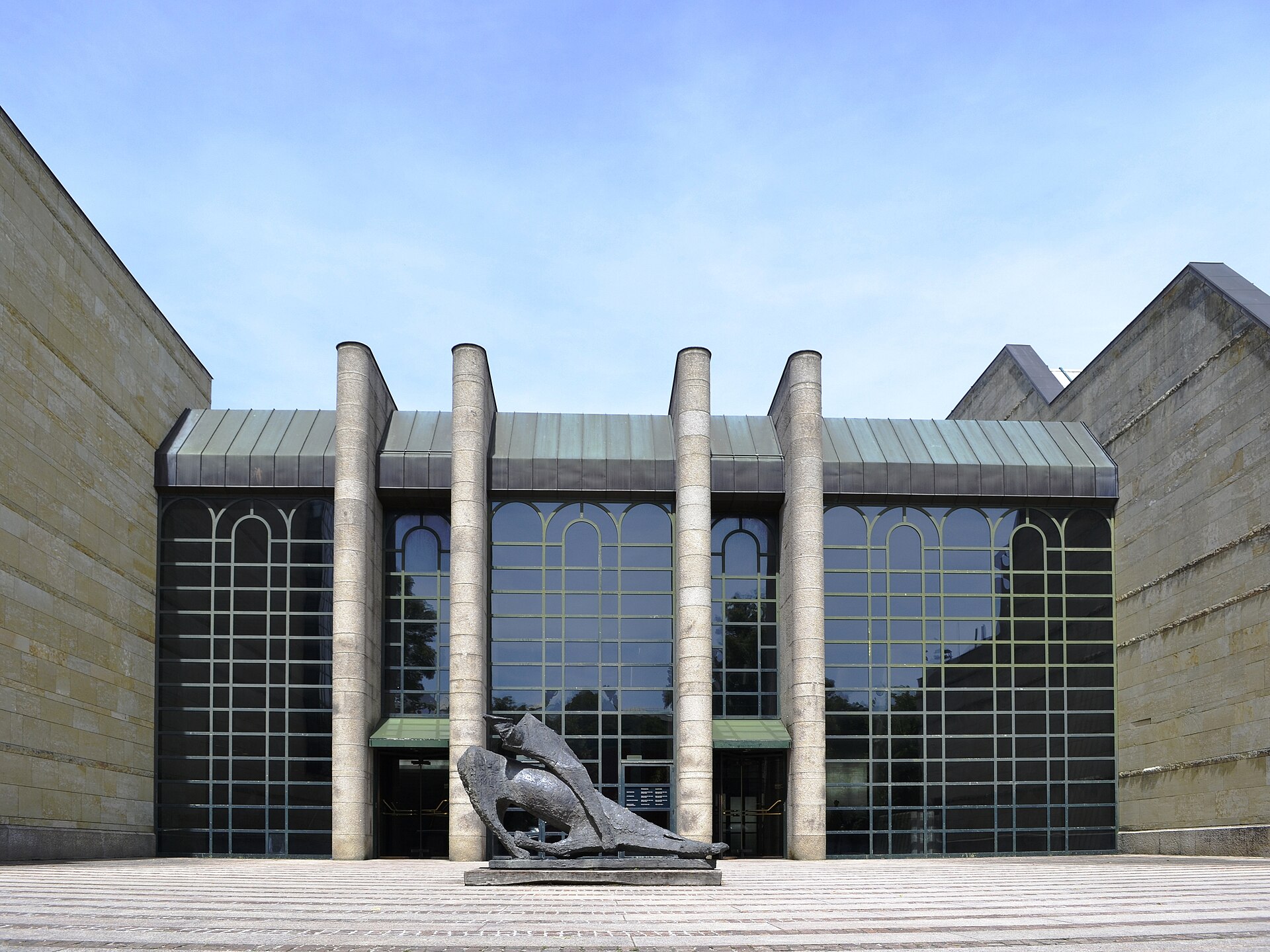
Photograph by High Contrast · CC BY 3.0 de The building itself, by Alexander von Branca, 1975 to 1981
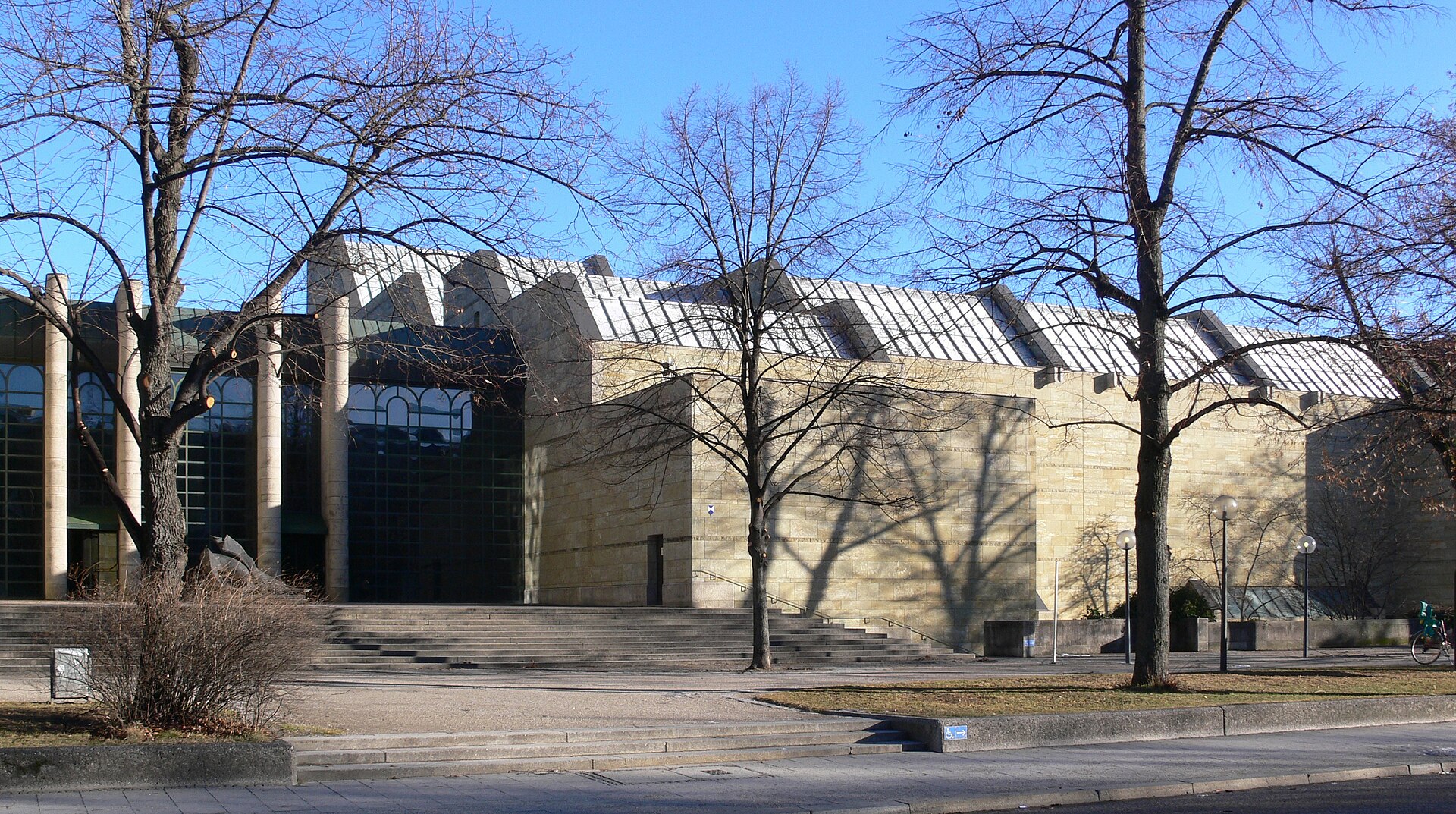
A postmodern replacement for Friedrich Gaertner and August Voit's 1853-to-1859 original, which the Allied bombing of Munich destroyed and which was demolished rather than rebuilt, unlike the neighbouring Alte Pinakothek, which Hans Doellgast reconstructed from its own ruins. Von Branca's building combines a reinforced-concrete structure with a natural-stone facade, deliberately built to read as solid masonry it structurally is not, an approach Wikipedia's German-language account frames as a considered historical reference rather than a flaw, and includes ornamental water spouts the same account describes as functionally useless by design, a comment on the separation of function and appearance.
What to see first
Sunflowers
Vincent van Gogh, 1888The single picture most identified with this collection internationally, currently inaccessible in its home building and, where shown at all during the closure, on view as part of the Alte Pinakothek's ground-floor display of Neue Pinakothek highlights.4
Le Dejeuner (Luncheon in the Studio)
Edouard Manet, 1868Named among the museum's own highlighted holdings, and one of the pictures that makes the case for Ludwig I's original ambition: contemporary French painting shown in direct dialogue with the Old Masters across the street.1
Margaret Stonborough-Wittgenstein
Gustav Klimt, 1905The collection's best-known Symbolist portrait, of the philosopher Ludwig Wittgenstein's sister, and a work whose current display location during the closure this desk could not confirm from a fetched source.1
Water Lilies
Claude Monet, about 1915Part of the museum's own account of its Impressionist strength, alongside Monet's The Bridge at Argenteuil, and among the pictures a visitor cannot currently see in the building built to hold them.1
Te tamari no atua (The Birth of Christ)
Paul Gauguin, 1896Named on Wikipedia's account of the collection's Post-Impressionist holdings, part of the same 19th-century survey now split across two other buildings during the closure.4
The Railway Cutting
Paul CezanneNamed among the museum's Post-Impressionist holdings on the account read for this page; no more precise date was found in the sources fetched.4
Works by Caspar David Friedrich
Caspar David FriedrichNamed as part of the collection's German Romanticism strength on the museum's own account, the earlier chronological end of a collection whose stated range runs from the 18th century into the early 20th.1
A museum built for living painters, not old ones
Ludwig I began the collection that became the Neue Pinakothek as crown prince, as early as 1809, and formally established the museum in 1853; the original building, designed by Friedrich Gaertner and August Voit, was completed in 1859. The museum's own account calls it the first museum in Europe built specifically to exhibit contemporary painting, and its purpose was explicit: a direct counterpart to the Alte Pinakothek across the street, so that the art of Ludwig's own century could be seen in the same district as, and in implicit conversation with, the Old Masters. That founding idea, contemporary art shown deliberately beside historical art rather than in a separate institution, is still the collection's organising logic, even though nothing of the 1859 building survives to house it.
Bombed, then erased rather than rebuilt
Allied bombing destroyed the original Neue Pinakothek during the Second World War, the same war that damaged its neighbour the Alte Pinakothek. The two buildings' postwar fates diverged completely. The Alte Pinakothek was rebuilt from its own ruins by the architect Hans Doellgast, a reconstruction that deliberately left visible scars of the damage rather than disguising them. The Neue Pinakothek was not given the same treatment: its ruins were demolished outright, and Gaertner and Voit's design was not reconstructed in any form. The site stood without a purpose-built museum for decades before Alexander von Branca's replacement building opened in 1981. Whatever a visitor sees on Barer Strasse today, in other words, is not a repaired nineteenth-century building; it is a completely different building on the same address, and the original design is gone rather than merely damaged.
A postmodern building that argues with itself on purpose
Von Branca's building, built between 1975 and 1981, is reinforced concrete faced in natural stone, deliberately built to read as solid masonry construction it is not. A German-language architectural account of the building frames this directly: the divergence between the modern structural material and the traditional-looking facade is read as a considered historical reference rather than a deception, a device with precedent across architectural history rather than a novelty specific to this building. The same account singles out the building's ornamental water spouts as functionally useless by design, offered as a comment on the separation of function and aesthetics rather than as a construction defect. Whether a visitor finds this convincing or affected is a matter of taste the sources read here do not resolve; what they do establish is that the building's oddities are treated as intentional rather than accidental in the one serious account this desk could source.
Closed since January 2019, and a date that has already moved once
The Neue Pinakothek shut completely on 1 January 2019 for what its own current visitor page still describes only as major renovation, without detailing the underlying structural, technical or safety issues. What can be reconstructed from elsewhere is that the building's complex roof construction has complicated the works, and that a temporary weather-protection roof was installed in autumn 2023 specifically to keep water out of the site during construction. The reopening date has itself already moved: an original target of 2025 was corrected by the museum's own director, Barbara Thiel-Lintner, in early 2022, to structural completion around the end of 2027 or 2028 and a public reopening in the second half of 2029. The museum's current visitor page states only that reopening is planned for 2029, without repeating the fuller, already-revised timeline. On the evidence of one slip already on the record, this page treats the 2029 date as a real but unconfirmed target rather than a settled fact.
Where the pictures actually are right now
The museum's own material is specific about where a visitor can still see part of the collection. Selected nineteenth-century highlights are shown on the ground floor of the Alte Pinakothek, and a further selection is shown at the Sammlung Schack, a complete standing museum in its own right rather than a mere overflow gallery: about 150 paintings across three floors, the collection Count Adolf Friedrich von Schack assembled of German-speaking nineteenth-century artists including Franz von Lenbach, Arnold Boecklin and Anselm Feuerbach. Both venues charge their own separate admission, 9.00 EUR regular and 6.00 EUR reduced at the Alte Pinakothek, 4.00 EUR regular and 3.00 EUR reduced at the Sammlung Schack, with a 1.00 EUR Sunday rate at both.
What is actually unavailable, and what to do instead
Van Gogh's Sunflowers of 1888 and his The Weaver, Manet's Le Dejeuner of 1868, Monet's Water Lilies and The Bridge at Argenteuil, Gauguin's Te tamari no atua, Cezanne's The Railway Cutting and Klimt's portrait of Margaret Stonborough-Wittgenstein are the collection's best-known holdings, and none of them can currently be seen in the building the museum's own name still points to. A visitor planning a Munich trip around this collection needs to check the Alte Pinakothek's current ground-floor display and the Sammlung Schack directly, since which specific pictures are on view at either address can change, and this page's own fetched sources did not include a current, itemised checklist for either substitute venue. Until 2029, at the earliest on the museum's own account, the Neue Pinakothek itself is a building with a name and an address and nothing inside it a ticket can reach.
What visitors say
The museum publishes no visitor prose and no platform rating, and cannot currently be visited at all, so this rests on the institution's own material and on a documented, independently sourced timeline slip. The Neue Pinakothek's identity is unusually tied to its building's own history: the second Munich museum on this site to bear the name, after the 1853 original was bombed and then demolished rather than rebuilt, unlike its neighbour the Alte Pinakothek. Its 1975-to-1981 postmodern replacement by Alexander von Branca is treated by the one architectural account this desk could fetch as a considered, historically referential design rather than a straightforwardly admired or disliked one. What is not in dispute is the length of the current closure: shut since January 2019, originally expected back by 2025, now stated as 2029, a four-year slip on the museum's own account of its own history.
What is praised, what is criticised
- Praised: the museum's own transparency about where the collection has gone: rather than a blank closed notice, the institution's page names the two specific venues, the Alte Pinakothek's ground floor and the Sammlung Schack, where 19th-century highlights can still be seen
- Praised: Alexander von Branca's building is treated, in the one architectural account this desk could source, as a deliberate and historically literate design rather than an accident, its stone-faced concrete and non-functional water spouts read as considered commentary rather than error
- Praised: the Sammlung Schack, one of the two substitute venues, is itself a complete standing collection in its own right, about 150 paintings across three floors assembled by Count Adolf Friedrich von Schack, rather than a bare overflow space
- Criticised: the closure has already run more than seven years by this research date, and the reopening estimate has itself already slipped once, from an originally stated 2025 to the current 2029, on the account this desk could source; open_status.reopening.firm is set to false for exactly this reason
- Criticised: the original 1853-to-1859 building was demolished rather than restored after wartime bombing, unlike the neighbouring Alte Pinakothek, which was rebuilt from its own ruins by Hans Doellgast - a choice that means nothing of Friedrich Gaertner and August Voit's original design survives on this site today
- Criticised: no cost figure for the current renovation could be found in any source this desk could fetch, which is itself a gap worth recording on a page whose house standard is to publish the cost of a public project whenever one is stated
Questions about Neue Pinakothek
Where is Neue Pinakothek?
Barer Strasse 29, 80799 Muenchen, Germany.
How much does it cost to visit?
Alte Pinakothek, adult (includes the ground-floor 19th-century display standing in for the Neue Pinakothek): EUR 9; Sammlung Schack, adult: EUR 4; Under 18: free. As confirmed 21 August 2026.
When is it open?
All days closed. Closed: Every day, until a stated 2029 reopening. As confirmed 21 August 2026.
How do you get there?
Tram: Pinakotheken stop, on the Kunstareal; On foot: Directly across Theresienstrasse / Barer Strasse from the Alte Pinakothek.
What should you see first?
Sunflowers (Vincent van Gogh, 1888); Le Dejeuner (Luncheon in the Studio) (Edouard Manet, 1868); Margaret Stonborough-Wittgenstein (Gustav Klimt, 1905); Water Lilies (Claude Monet, about 1915); Te tamari no atua (The Birth of Christ) (Paul Gauguin, 1896); The Railway Cutting (Paul Cezanne).
What we could not confirm
- Which specific paintings are currently on view at the Alte Pinakothek's ground floor and at the Sammlung Schack at any given time; the museum's own fetched pages describe the arrangement in general terms (an exhibition covering '19th-century masterworks') without a current, dated checklist this desk could verify.
- The specific structural, safety or technical reasons for the 2019 closure beyond 'the complex roof construction complicates the renovation.' No fetched source gave a fuller engineering account or a total project cost in EUR.
- Whether the reopening estimate has moved again since the early-2022 correction reported by Wikipedia (German). This page's sources were all read on 7 August 2026 and should be re-confirmed as 2029 approaches.
- Whether any free-licence photograph exists of the Neue Pinakothek's interior, before the 2019 closure. None was located and vetted during this research pass; only exterior views of the Branca building are used here.
- The Bavarian State Building Authority (Staatliches Bauamt Muenchen 1), which is executing the renovation, states on its own project site (sanierung-neue-pinakothek.de/faq/) that reopening is 'voraussichtlich 2030' (expected 2030) - a year later than the museum's own 'planned for 2029'. Recorded here as a cross-source discrepancy rather than acted on; the museum's own page remains the source of record for open_status.reopening pending a ruling from Leon/Ruth on which body's estimate should govern.
Images
Sources
- 1Pinakothek der Moderne / Bayerische Staatsgemaeldesammlungen, 'Neue Pinakothek' page: Ludwig I's 1853 founding and his aim to put contemporary art in dialogue with the Old Masters, the original Gaertner and Voit building's WWII destruction and demolition, Hans Doellgast's contrasting reconstruction of the Alte Pinakothek, the Alexander von Branca replacement opening 1981, the current closure notice, the two substitute display locations (Alte Pinakothek ground floor, Sammlung Schack), and named highlights including van Gogh's Sunflowers, Manet's Le Dejeuner, Klimt's Margaret Stonborough-Wittgenstein, Monet's Water Lilies, Cezanne and Gauguin. Read from the raw HTML on 7 August 2026. pinakothek.de/en/neue-pinakothek
- 2Pinakothek der Moderne / Bayerische Staatsgemaeldesammlungen, 'Visit' page: the statement that reopening 'is planned for 2029', hours and admission for the Alte Pinakothek (9.00/6.00 EUR, 1.00 EUR Sunday), Pinakothek der Moderne, Sammlung Schack (4.00/3.00 EUR, 1.00 EUR Sunday) and Museum Brandhorst, the general information phone (+49 89 23805 284) and email ([email protected]), and the Alte Pinakothek ticket-office phone (+49 89 23805 216). Read from the raw HTML on 7 August 2026. pinakothek.de/en/visit
- 3Pinakothek der Moderne / Bayerische Staatsgemaeldesammlungen, 'Sammlung Schack' page: about 150 paintings across three floors, the collection assembled by Count Adolf Friedrich von Schack of German-speaking artists including Franz von Lenbach, Arnold Boecklin and Anselm Feuerbach. Read from the raw HTML on 7 August 2026. pinakothek.de/en/sammlung-schack
- 4Wikipedia, 'Neue Pinakothek': Ludwig I's collecting from 1809 as crown prince, the 1853 establishment and 1859 completion of the original building, the 1975-to-1981 Alexander von Branca postmodern replacement (reinforced concrete with a stone facade), the January 2019 closure, the reopening timeline revision (originally projected 2025, revised to structural completion around end of 2027/2028 and reopening in the second half of 2029), the collection's 3,000-plus paintings, and named highlights including van Gogh's Sunflowers and The Weaver, Manet's Luncheon in the Studio, Monet's The Bridge at Argenteuil, Gauguin's Te tamari no atua, Cezanne's The Railway Cutting and Klimt's Margaret Stonborough-Wittgenstein. en.wikipedia.org/wiki/Neue_Pinakothek
- 5Wikipedia (German), 'Neue Pinakothek': the 1 January 2019 closure, director Barbara Thiel-Lintner's early-2022 correction of the reopening timeline (structural completion end of 2027/2028, reopening 2029), the complex roof construction complicating the renovation, the temporary weather-protection roof installed autumn 2023, and the critical account of von Branca's building (the divergence between its concrete structure and stone facade read as a considered historical reference, and its ornamental, functionally useless water spouts read as intentional commentary on the separation of function and aesthetics). de.wikipedia.org/wiki/Neue_Pinakothek
- 6Wikidata, Neue Pinakothek (Q170152): street address Barer Strasse 29, postal code 80799, Munich, coordinates 48.14989, 11.57111, used as the only and cross-checked against the museum's own pages for everything else. wikidata.org/wiki/Q170152
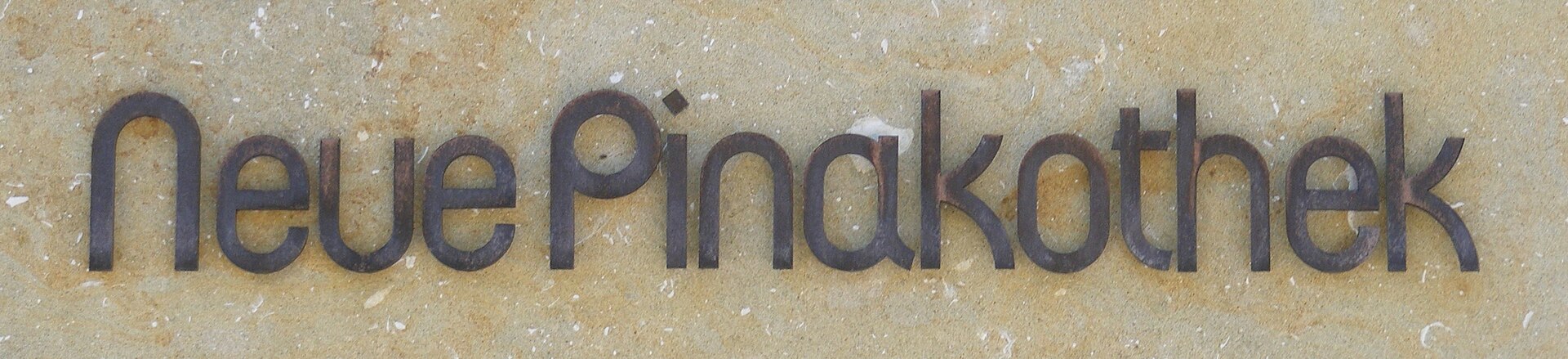
- 7Wikimedia Commons, File:Schriftzug Neue Pinakothek.JPG and File:Neue Pinakothek, entrance.jpg: the source of two of this page's plates, each downloaded as a thumbnail and looked at before use to confirm the building shown is the Neue Pinakothek specifically. commons.wikimedia.org/wiki/File:Neue_Pinakothek,_entrance.jpg
