Amedeo Modigliani
 Italian · 1884-1920
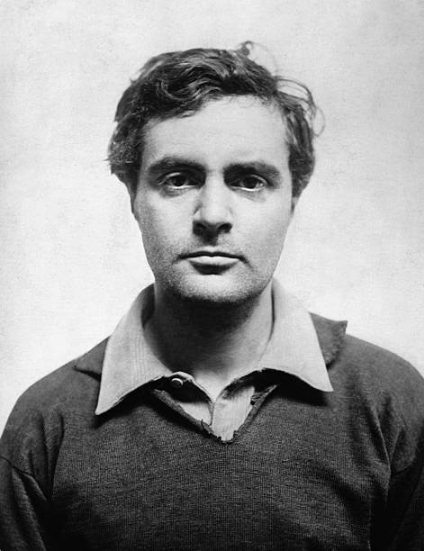
Modigliani photographed in Nice in 1918, in a picture taken to replace identification papers he had lost. The photographer is not credited on the Commons file page; the image is sourced there from a Getty Images record.
Public domain (PD-France, PD-US-expired)| Full name | Amedeo Clemente Modigliani |
|---|---|
| Worked as | Painter, Sculptor, Draughtsman |
| Born | 12 July 1884 · Livorno, Kingdom of Italy |
| Died | 24 January 1920 · Paris, France |
| Nationality | Italian |
| Movement | School of Paris (Ecole de Paris) |
| Sources | 21 cited |
| Last verified |
About this page Last verified · 21 sources cited
On this page 13 sections
ContentsClose
Modigliani died at thirty-five owning almost nothing, leaving no studio inventory, no gallerist charged with his legacy, and an infant daughter who would not see her father's reputation settled in her own lifetime. Everything that makes him hard to research follows from that one fact. There is no single accepted list of what he painted: the standard reference for over fifty years counted 337 works and was compiled by a critic who saw the paintings himself and admitted the list was incomplete, and a rival catalogue of 421 paintings, almost thirty years in the making, was only published in April 2026. There is no single body with settled authority to say what is genuine, and the man who for years claimed exactly that authority, as head of an institute in Rome bearing Modigliani's name, has twice been convicted in French and Italian courts of authenticating and producing fakes.
The single thing most readers do not know is how deliberately he pursued the reputation for tragedy that now overshadows the work: a genuinely gifted draughtsman and sculptor who trained formally in Florence and Venice, who counted Constantin Brancusi as a friend and influence, and who introduced himself in a Paris still working through the aftermath of the Dreyfus Affair by declaring his own Jewish identity rather than concealing it. He is also, unusually among painters of his rank, one of the most heavily forged artists of the past century, with two separate criminal cases and a still-disputed insurance claim in the hundreds of millions of dollars sitting behind the two paintings that have made him a nine-figure name at auction.
This page treats the corpus problem, the forgeries and the money as the main story, because they are the parts a specialist or a bidder actually needs and cannot find gathered in one place. The tragic biography is real and is recorded here too, but it is not the hardest thing to find out about this artist. The hardest thing is knowing, for any given picture, whether it belongs to him at all.
Images
Chronology
- 1884
Born 12 July in Livorno to a Sephardic Jewish family whose finances had collapsed around the time of his birth.1
- 1898-1900
Studies under Guglielmo Micheli in Livorno while recovering from childhood tuberculosis.1
- 1902
Enrolls at the Accademia di Belle Arti, Florence.1
- 1903-1904
Studies at the Accademia in Venice.1
- 1906
Arrives in Paris in January; enrolls at the Academie Colarossi and settles in Montmartre.1
- 1907
Physician and collector Paul Alexandre begins buying his drawings; the Alexandre cache stays largely unpublished until 1993.15
- 1909
Comes to know Constantin Brancusi in Montparnasse and takes up direct stone carving at a studio in the Cite Falguiere.17
- 1911-1912
Exhibits carved limestone heads, drawing on Cycladic, Egyptian and African sources studied at the Trocadero ethnographic museum; shown at the 1912 Salon d'Automne as "Heads, a Decorative Ensemble."1517
- 1914-1915
Largely abandons sculpture as stone dust aggravates his tubercular lungs; returns to painting full time.17
- 1915
Paul Guillaume begins promoting his work in Paris.1
- 1916
Leopold Zborowski becomes his principal dealer and informal patron, paying a daily rate and supplying models and materials.1
- 1917
Meets Jeanne Hebuterne; in December, his only lifetime solo exhibition, at the Galerie Berthe Weill, is closed by Paris police on grounds of indecency after nudes are displayed in the street window.19
- 1918
Travels with Zborowski's support to Nice and Cagnes-sur-Mer for his health; daughter Jeanne born in November.1
- 1920
Dies in Paris on 24 January of tubercular meningitis, aged thirty-five; Jeanne Hebuterne, eight months pregnant, dies by suicide two days later, on 26 January.1
- 1930
Jeanne Hebuterne's remains are moved to lie beside Modigliani's in Pere Lachaise Cemetery.1
- 1932
Leopold Zborowski dies; his widow is forced to sell his entire Modigliani holdings to settle his debts.1
- 1958-1970
Ambrogio Ceroni publishes his catalogue of 337 paintings, examined in person, later treated by the trade as the de facto standard.3
- 1984
The Livorno hoax: three fake stone heads dredged from the Fosso Reale canal are authenticated by leading Italian critics, then exposed as the work of local art students and a dock worker, Angelo Froglia.91011
- 1993
Paul Alexandre's family publishes his long-hidden collection of Modigliani drawings.15
- 2008
Christian Parisot, head of the Rome Modigliani Institute, is convicted in Paris of authenticating forged Jeanne Hebuterne drawings.12
- 2010
Christie's Paris sells a Modigliani limestone head, Tete, for a premium-inclusive 43,185,000 euros against a 4 to 6 million euro estimate.8
- 2012-2013
Parisot is placed under house arrest in a second Italian investigation; fifty-nine further works are seized.13
- 2014
Sotheby's New York sells a Modigliani limestone head, Tete (1911-12), for a premium-inclusive 70,725,000 dollars, hammer 63,000,000 dollars; the auction record for a Modigliani sculpture.421
- 2015
Nu couche (1917-18) sells at Christie's New York for a premium-inclusive 170,405,000 dollars.45
- 2017
A Genoa exhibition is closed early after Italian police seize twenty-one paintings; twenty are later judged forgeries.314
- 2018
Nu couche (sur le cote gauche) sells at Sotheby's New York, hammer 139 million dollars, 157,159,000 dollars with premium.67
- 2020
Dealer Joseph Guttman sues his insurers for over 107 million dollars over the paintings seized in Genoa; the case remains unresolved in the sources consulted.1420
- 2026
Marc Restellini publishes a catalogue raisonne of 421 oil paintings, plus three addenda, after a twenty-nine-year project.2
The market
Modigliani's reclining nudes of 1917-1918 have produced two of the small number of paintings ever to clear a hundred million dollars at auction, three years apart, at rival houses. His sculpture market has moved on an even more dramatic scale relative to its own starting estimates: the actual auction record for a Modigliani sculpture is a 2014 Tete at Sotheby's New York, not the more frequently cited 2010 Christie's Paris Tete, which was a different and smaller work. The scale of the money is also, on the documented account of the scholar building the newest catalogue raisonne, a direct driver of the forgery problem discussed elsewhere on this page: a genuine attribution and a rejection are now separated by tens of millions of dollars on a single canvas.
| Date | Sale | Work | Result | Note |
|---|---|---|---|---|
| 9 November 2015 | Christie's | Nu couche (1917-18) | Hammer Not published in the sources consulted With premium 170,405,000 USD | Second-highest price for any work of art at auction at the time; seven anonymous telephone bidders; bought by the Chinese collector Liu Yiqian. |
| 14 May 2018 | Sotheby's | Nu couche (sur le cote gauche) (1917) | Hammer 139,000,000 With premium 157,159,000 USD | Estimate 150,000,000 dollars. Seller John Magnier had bought the same painting at Christie's in 2003 for 26,900,000 dollars. |
| 4 November 2014 | Sotheby's | Tete (limestone head, 1911-12) | Hammer 63,000,000 With premium 70,725,000 USD | The actual auction record for a Modigliani sculpture, exceeding the better-known 2010 Christie's Paris result below. Unpublished estimate reported only as in excess of 45,000,000 dollars. Guaranteed by Sotheby's; sold to an anonymous telephone bidder. |
| 14 June 2010 | Christie's | Tete (limestone head, c. 1909-1914) | Hammer Not published in the sources consulted With premium 43,185,000 EUR | Estimate 4,000,000 to 6,000,000 euros. Consigned from the estate of the collector Gaston Levy; bought by an anonymous telephone bidder. A different, smaller Tete than the higher-priced 2014 Sotheby's example above. |
Hammer is the price at which the bidding stopped; with premium adds the fee the house charges the buyer on top. Hammer price and buyer's premium in the glossary.
Where to see the work
| Institution | City | Holdings | Note |
|---|---|---|---|
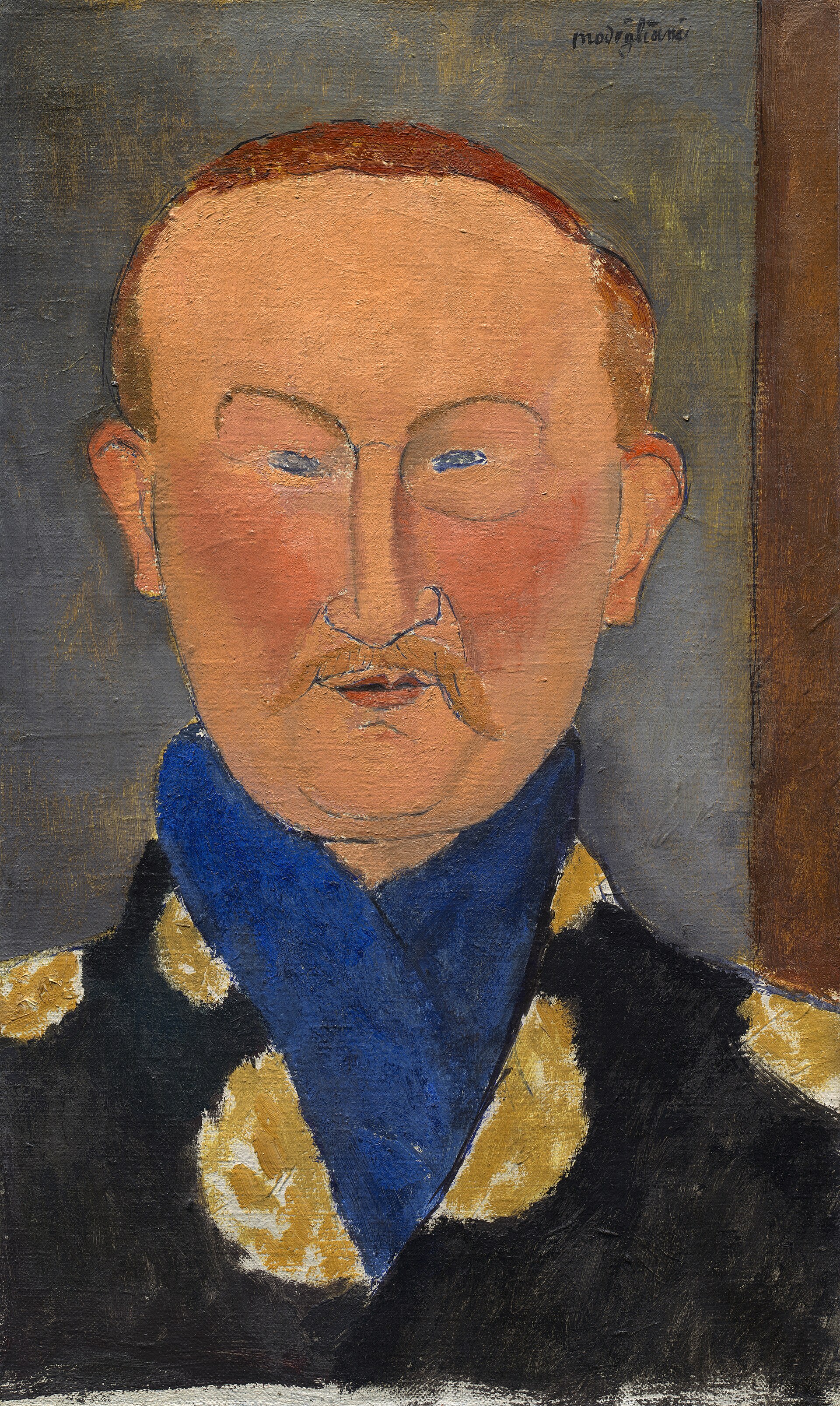
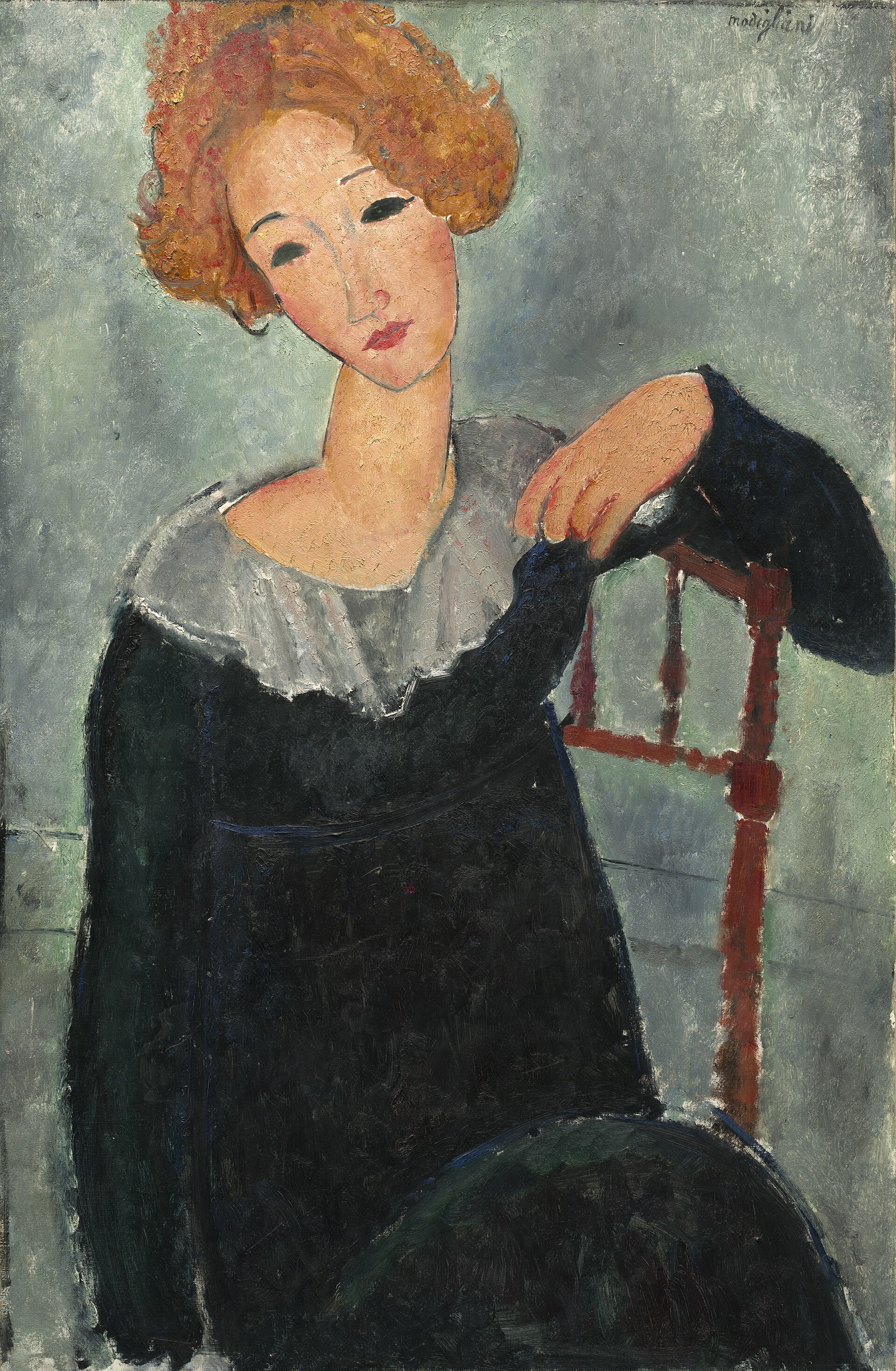
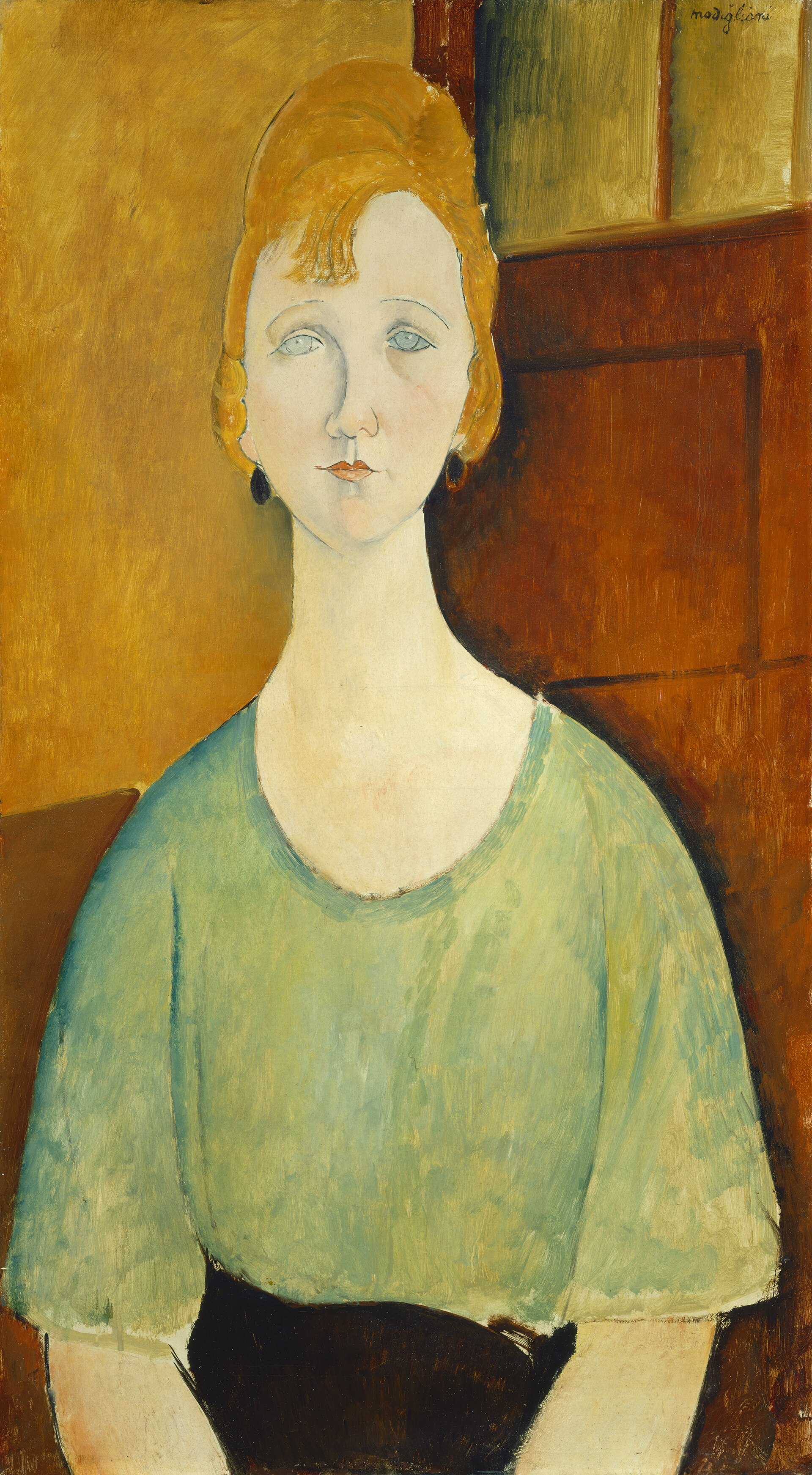
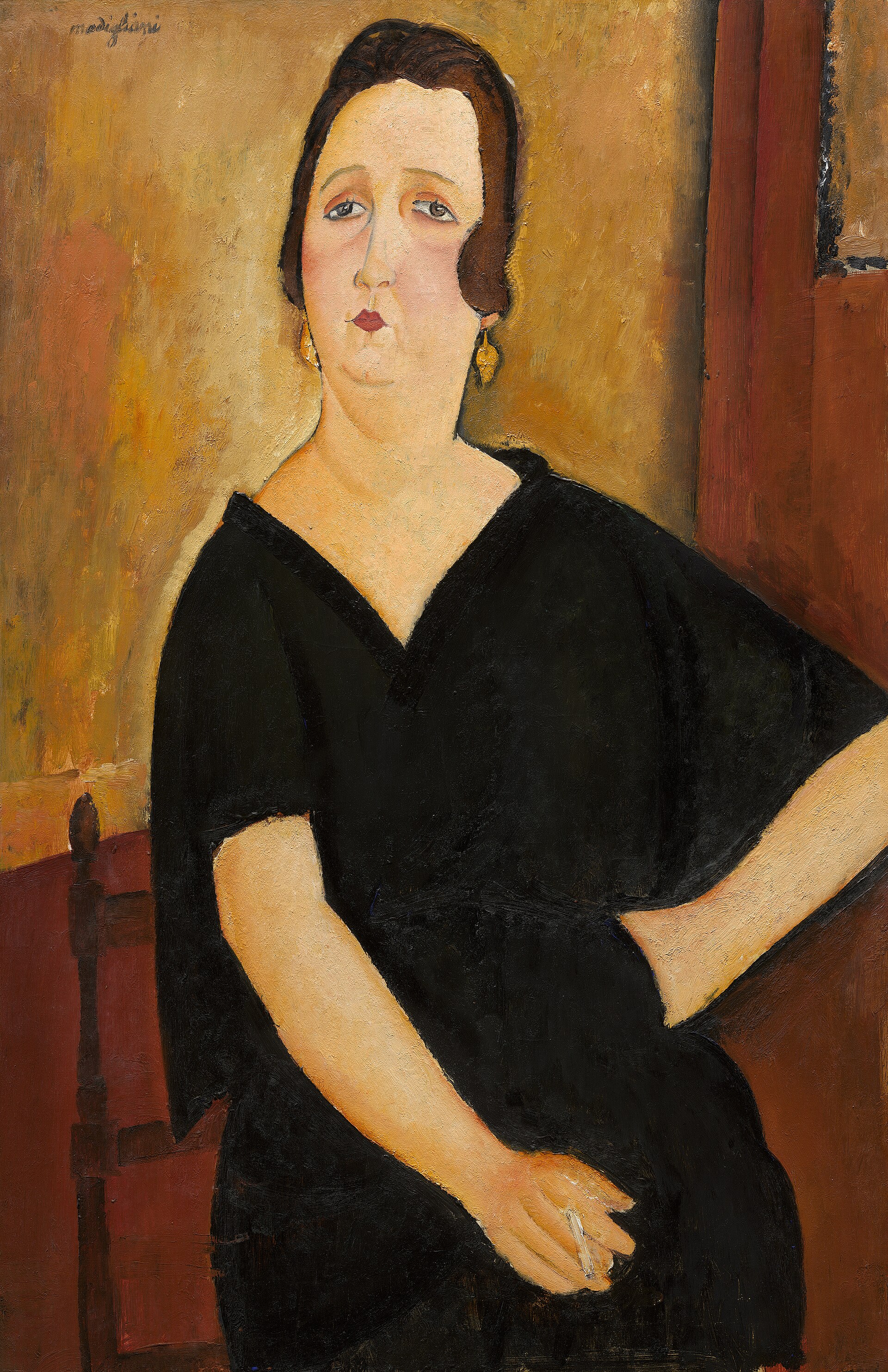
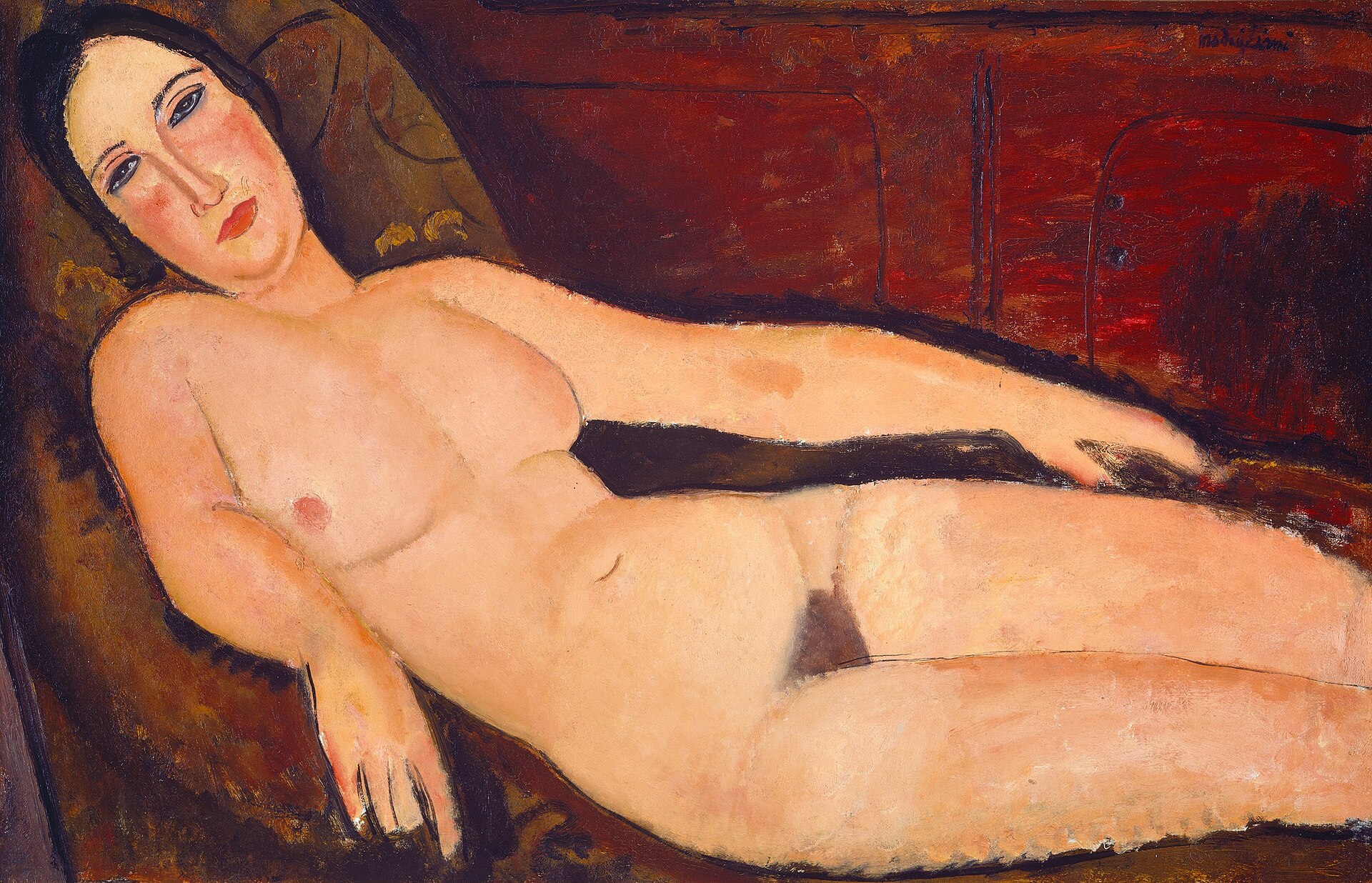
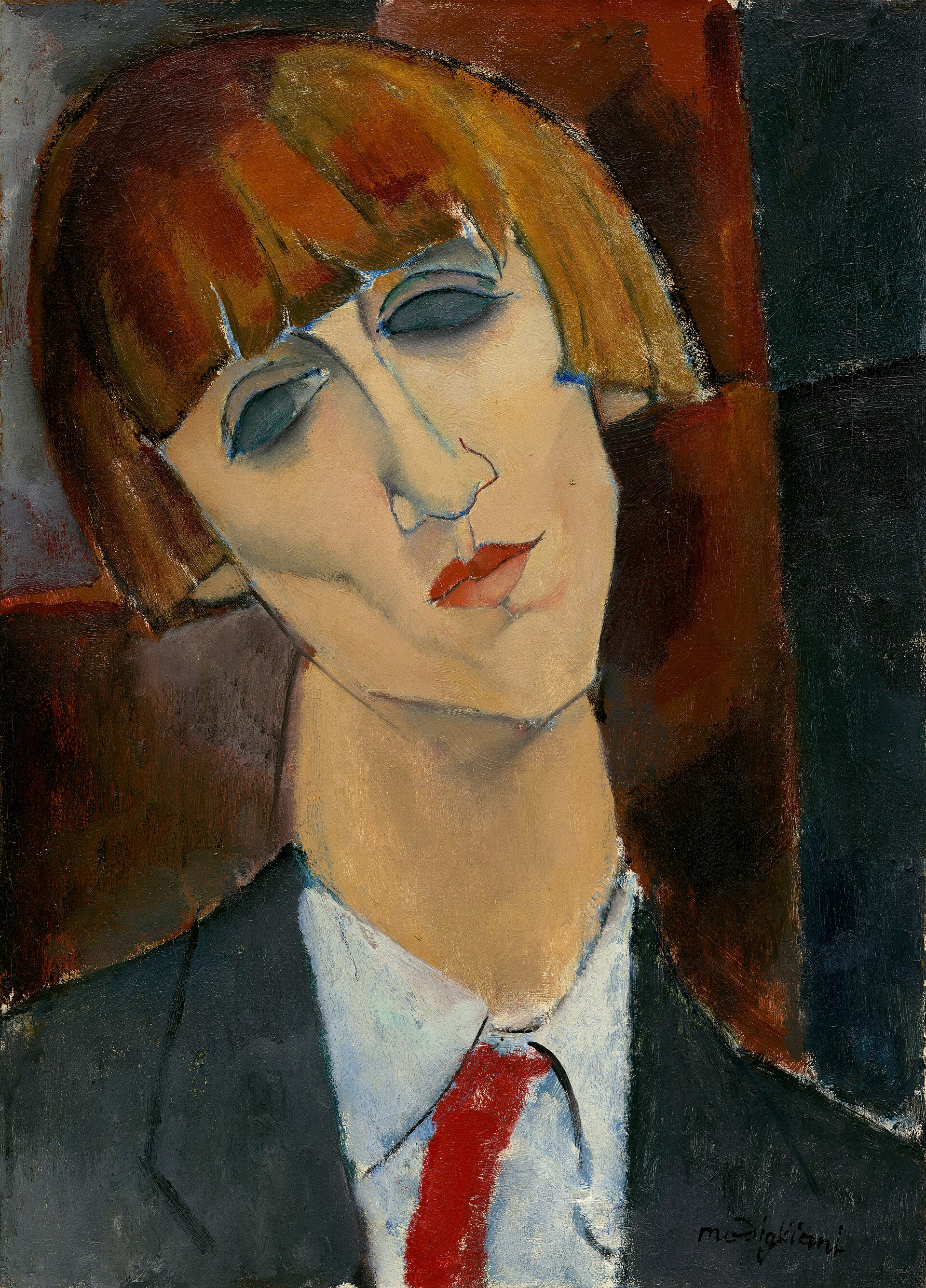
| National Gallery of Art | Washington, DC | A substantial group of paintings from the Chester Dale Collection, including Leon Bakst (1917), Woman with Red Hair (1917), Girl in a Green Blouse (1917), Madame Amedee (Woman with Cigarette) (1918), Nude on a Divan (1918) and Madame Kisling (c. 1917). | The single largest concentration of illustrated works used on this page. |
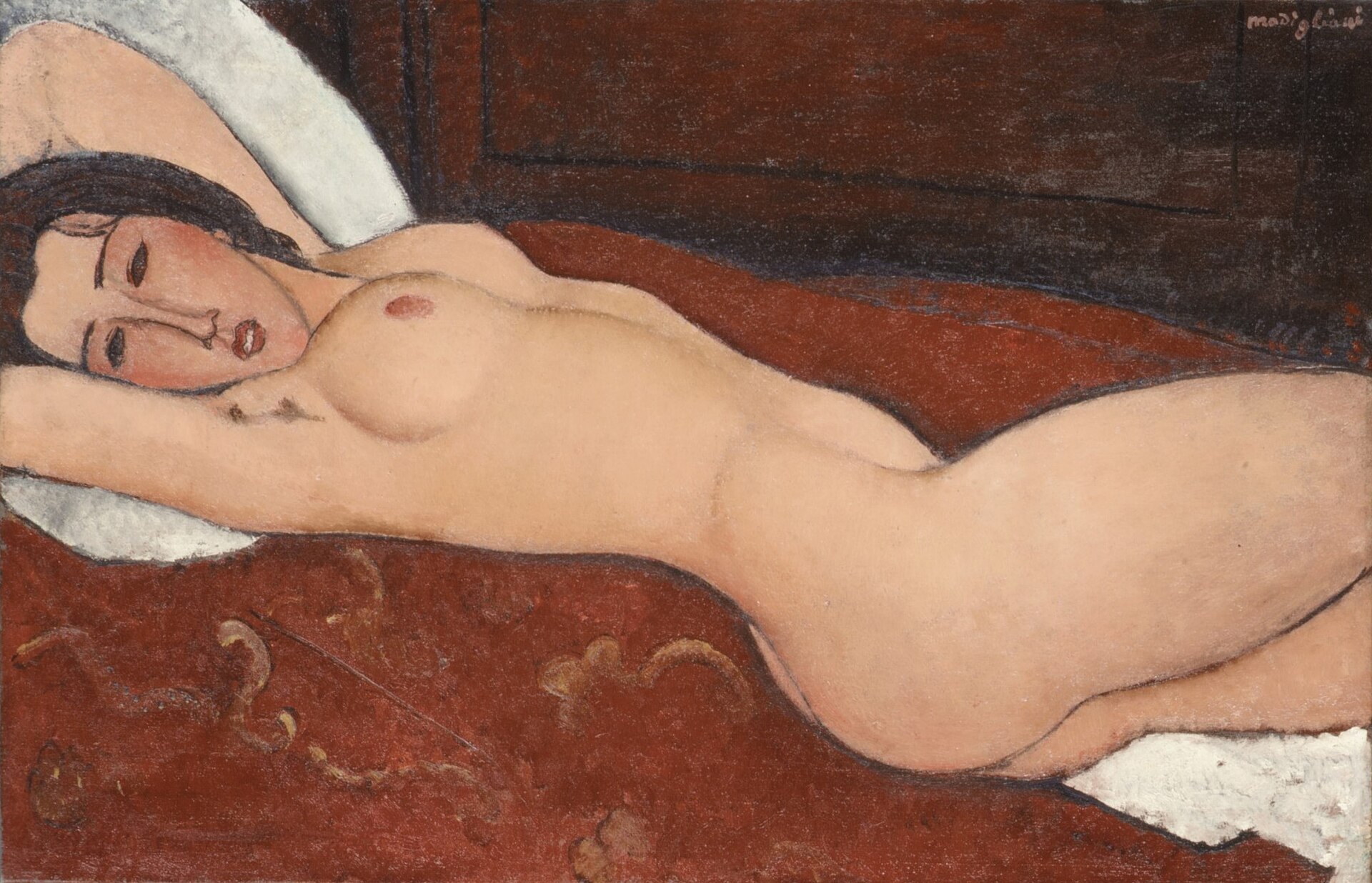
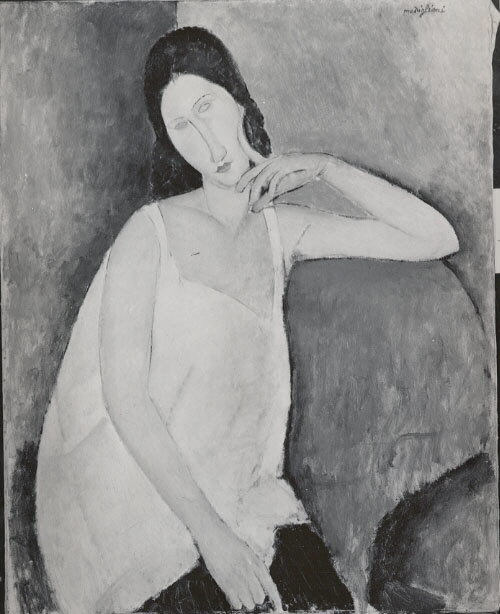
| Metropolitan Museum of Art | New York | Includes Reclining Nude (1917) and a 1919 portrait of Jeanne Hebuterne, among other paintings and drawings. | The Reclining Nude here is a distinct painting from the two record-priced reclining nudes sold at Christie's in 2015 and Sotheby's in 2018; see the gallery caption for the distinction. |
| Musee de l'Orangerie | Paris | Holds works from the Jean Walter and Paul Guillaume collection, assembled in part by Modigliani's own early dealer. | Consult the museum's current catalogue for the precise list on view; not independently verified for this page. |
Forgeries and misattributions
- The Livorno hoax, 1984
- Three carved stone heads dredged from Livorno's Fosso Reale canal during centenary celebrations of Modigliani's birth were authenticated by a roster of leading Italian and international critics, including Giulio Carlo Argan and Cesare Brandi. Three local art students confessed on national television to carving one head with a Black and Decker power drill; a dock worker and artist, Angelo Froglia, separately revealed he had carved the other two as a deliberate exercise exposing how easily expert authority could be manufactured. Modern road-paving tar residue, anachronistic to Modigliani's era, was found on one head.91011
- Christian Parisot and the Modigliani Institute, 2008-2013
- Parisot, president of the Rome-based Modigliani Institute, claimed authenticating authority derived from the artist's daughter and issued certificates for material later shown to be fake, including seventy-seven forged Jeanne Hebuterne drawings and, in a second case, further works valued at over 6.65 million euros. A Paris court convicted Parisot in 2008, upheld on appeal in 2010; a further Italian investigation led to his house arrest in December 2012 and the seizure of fifty-nine additional works.1213
- Genoa, 2017
- A Palazzo Ducale exhibition of Modigliani's work, seen by roughly 100,000 visitors, was found to include twenty forged paintings out of twenty-one seized by Italian police. Raised by the collector and critic Carlo Pepi, the same figure who had correctly identified the 1984 Livorno heads as fakes at the time; confirmed by subsequent expert review. The resulting insurance dispute, over a claim exceeding 107 million dollars, remained unresolved in the most recent source consulted.314
The essay
Chapter 1A corpus still being written
On 14 April 2026 the art historian Marc Restellini published, through his own Institut Restellini and distributed by Yale University Press, a six-volume catalogue raisonne of Modigliani's oil...
On 14 April 2026 the art historian Marc Restellini published, through his own Institut Restellini and distributed by Yale University Press, a six-volume catalogue raisonne of Modigliani's oil paintings that had been almost thirty years in preparation. It accepts 421 paintings, plus three addenda, roughly a hundred of them newly authenticated during the project and about half already sitting in museum collections without a settled catalogue number. Fifteen paintings previously attributed to Modigliani were left out, either because the evidence did not hold up or because the works themselves could no longer be located for examination. Restellini's method was forensic rather than purely connoisseurial: every candidate work was checked against a documented benchmark corpus, built from the paintings that passed directly through two of Modigliani's own contemporary collectors, Paul Alexandre and Jonas Netter, using spectrometry, carbon-14 dating, infrared reflectography and x-radiography alongside archival and stylistic comparison.
Until that publication, the working reference for the trade was a much shorter and much older list. The Italian critic Ambrogio Ceroni published his catalogue in installments between 1958 and his death in 1970, and it counted 337 paintings, every one of which Ceroni had examined in person. Ceroni never claimed the list was exhaustive, and specialists have argued for decades that his methodology, seeing every work with his own eyes rather than working from documentation, necessarily excluded genuine paintings he simply never had the chance to look at. Auction houses and museums nonetheless treated the Ceroni number as a practical ceiling for over half a century: a painting not in Ceroni was, in commercial terms, treated close to a painting that could not be sold, whatever its actual merits.
Restellini has been explicit that this situation has real financial stakes attached to it, and that the stakes cut both ways: a painting moving from unrecognized to recognized status can gain enormously in value, and a painting recognized under one catalogue but omitted from a newer one stands to lose just as much. He has said publicly that he received death threats over decisions to exclude specific paintings from his research, and that resolving the 2017 Genoa forgery case, discussed below, would remove one source of that pressure. Whether the trade adopts the 2026 catalogue as the new working standard, keeps deferring to Ceroni out of institutional habit, or ends up working with both lists side by side is not yet settled as this page is written.
Chapter 2From Livorno to the Cite Falguiere
Modigliani was born in the port city of Livorno on 12 July 1884 to a Sephardic Jewish family whose fortunes had collapsed around the time of his birth.
Modigliani was born in the port city of Livorno on 12 July 1884 to a Sephardic Jewish family whose fortunes had collapsed around the time of his birth. He was a sickly child: pleurisy around age eleven, typhoid fever in his early teens, and tuberculosis at sixteen, the disease that would eventually kill him. Much of his early education happened from a sickbed, reading Dante and, according to his own family's account, Spinoza, a distant relation on his mother's side that is asserted in family tradition and widely disputed by historians rather than documented in any surviving record.
His formal training was more conventional than the later myth of the untrained bohemian suggests. He studied under Guglielmo Micheli in Livorno from 1898 to 1900, enrolled at the Accademia di Belle Arti in Florence in 1902, and moved to the Accademia at Venice for the 1903-1904 academic year, absorbing the Renaissance and classical collections of both cities directly. He arrived in Paris in January 1906 and enrolled at the Academie Colarossi, settling first in Montmartre and later in the Montparnasse quarter that would define the rest of his working life. Among the earliest people to take his work seriously was the physician and collector Paul Alexandre, who began buying and encouraging him from 1907; Alexandre's own cache of roughly 450 drawings by Modigliani stayed almost entirely unknown to scholarship until his descendants published it in 1993, decades after both men were dead.
Chapter 3The stone heads
Modigliani had already taken up sculpture in Livorno as a teenager, but it became his primary occupation in Paris from around 1909, the same period in which he came to know Constantin Brancusi in...
Modigliani had already taken up sculpture in Livorno as a teenager, but it became his primary occupation in Paris from around 1909, the same period in which he came to know Constantin Brancusi in Montparnasse. Brancusi's example mattered on two levels: his sculptural forms, and his insistence on carving stone directly rather than modelling in clay for a caster to translate into marble later. Modigliani adopted the same discipline, working straight into blocks of limestone, and sometimes sandstone, much of it scavenged from Paris construction sites rather than bought, at a studio in the Cite Falguiere, a small cul-de-sac in Montparnasse.
The heads he produced draw openly on sources well outside the European academic tradition he had been trained in: Cycladic figures, Egyptian sculpture, and the African and other non-Western carvings he studied at the Musee d'Ethnographie du Trocadero, Paris's first anthropological museum. Roughly twenty to twenty-five of these carved limestone heads survive, an elongated, ovoid, mask-like series he exhibited in 1911 and again at the 1912 Salon d'Automne under the title Heads, a Decorative Ensemble. Whether this deliberate reach beyond European precedent was simply an aesthetic choice or something closer to a personal argument about identity is a question this page returns to below, because at least one specialist has made a documented case that the two were connected.
He stopped carving almost entirely by 1914 or 1915, and the reason was physical rather than artistic: stone dust is punishing for tubercular lungs, and the heavy, repetitive labour of direct carving was simply unsustainable for a man whose disease had been active since adolescence. The elongated necks, ovoid heads and blank, often pupil-less eyes he had worked out in stone did not disappear with the sculpture, however. They migrated directly into the paintings that followed, which is why his mature portraits look, in a specific and diagnosable way, like paintings made by a sculptor.
Chapter 4"I am Modigliani, the Jew"
Livorno had no Jewish ghetto and, by his own later account, no significant antisemitism that Modigliani encountered growing up.
Livorno had no Jewish ghetto and, by his own later account, no significant antisemitism that Modigliani encountered growing up. Paris in 1906 was a different environment: a city still working through the long aftermath of the Dreyfus Affair, absorbing a wave of foreign and Jewish immigration it did not always welcome, and giving a public platform to writers such as Edouard Drumont, whose pseudo-scientific racial theories about facial features were used to construct and justify hierarchies against Jews. Modigliani, who spoke fluent French and did not look conventionally Jewish to Parisian eyes, could have passed through this environment unremarked. Multiple accounts instead record him doing the opposite: introducing himself to new acquaintances by stating plainly, in one commonly cited English rendering, "My name is Modigliani. I am a Jew."
Mason Klein, curator of the Jewish Museum's 2017 exhibition Modigliani Unmasked, has argued, drawing on the large cache of early drawings from the Paul Alexandre collection, that the mask-like uniformity of Modigliani's mature portraits was not simply a formal mannerism borrowed from African and Cycladic sculpture. Klein's argument is that Modigliani was using the depersonalizing device deliberately, to question the fixity of identity and racial classification at exactly the moment Parisian pseudo-science was trying to fix Jewish and other faces into legible types. This is a documented, citable scholarly argument, advanced by a named curator working from primary drawings, not a resemblance-based guess; it is also, as Klein himself frames it, one reading among others, and this page presents it as argued rather than as settled fact about what Modigliani himself intended.
Chapter 5Zborowski, Guillaume, and the price of a good day
Modigliani was represented, in the loose sense the word carried in his circle, by two dealers in succession.
Modigliani was represented, in the loose sense the word carried in his circle, by two dealers in succession. Paul Guillaume began promoting his work from late 1915. From 1916 the Polish poet and dealer Leopold Zborowski became his principal support: Zborowski supplied models, materials and the use of his own apartment, and paid Modigliani a daily rate reported at fifteen to twenty francs, in effect a wage rather than a conventional dealer's commission arrangement.
Zborowski organized what became Modigliani's only solo exhibition in his lifetime, at the Galerie Berthe Weill on the rue Taitbout in December 1917. Weill hung several of the reclining nudes, painted through 1916 and 1917, in the gallery's street-facing window. The paintings showed pubic hair, a detail that broke with the sanitized convention of the academic nude and that the Paris police, acting on obscenity grounds, treated as sufficient cause to intervene: they ordered the paintings removed, and when Weill refused to take the offending canvas out of the window, they closed the show and took her into custody rather than the picture. It reopened afterward, evidently once the more provocative canvases had been withdrawn from public view, but nothing sold, and it remains the only exhibition of his work Modigliani saw mounted while he was alive.
Chapter 6Death, and two days later
By 1918 Modigliani's health had declined enough that Zborowski arranged for him, along with Jeanne Hebuterne, the painter he had been living with since late 1917, to spend time in the warmer climate...
By 1918 Modigliani's health had declined enough that Zborowski arranged for him, along with Jeanne Hebuterne, the painter he had been living with since late 1917, to spend time in the warmer climate around Nice and Cagnes-sur-Mer. Their daughter, also named Jeanne, was born there in November 1918. The family returned to Paris in 1919. The popular image of Modigliani as a dissolute, hashish-smoking, absinthe-drinking pauper is a real part of the record of his last Paris years, documented by people who knew him, but this page treats it as one strand of a man whose underlying and controlling condition was tuberculosis, contracted at sixteen and active, in one form or another, for most of his adult life; the substance use is documented, and so is the disease it was, at least in part, being used to mask.
He died in Paris on 24 January 1920, aged thirty-five, of tubercular meningitis. Jeanne Hebuterne was twenty-one years old and eight months pregnant with their second child. Two days later, on 26 January, she threw herself from a fifth-floor window at her parents' home, killing herself and the unborn child she was carrying. Modigliani was buried in Pere Lachaise Cemetery; Hebuterne was buried separately at first, and her family agreed to have her remains moved to lie beside his only in 1930, a decade later. Their shared headstone carries two lines, one for each of them: struck down by death at the moment of glory, and devoted companion to the extreme sacrifice.
Chapter 7Livorno, 1984: the drill and the canal
In July 1984, to mark the centenary of Modigliani's birth, Livorno's museum of modern art organized a dredging of the Fosso Reale, the town's old canal system, acting on a local rumor that the young...
In July 1984, to mark the centenary of Modigliani's birth, Livorno's museum of modern art organized a dredging of the Fosso Reale, the town's old canal system, acting on a local rumor that the young Modigliani had thrown away sculptures he was dissatisfied with before leaving for Paris around 1909. The dredging, led by the museum figures Vera and Dario Durbe, recovered three carved stone heads in the style of Modigliani's known sculpture. The Durbes declared them genuine immediately, and a roster of major Italian and international critics agreed with them in print, among them Giulio Carlo Argan, Cesare Brandi, Enzo Carli, Carlo Ludovico Ragghianti and Jean Leymarie, several of the most respected names in twentieth-century Italian art criticism. One collector and later Modigliani specialist, Carlo Pepi, said publicly and immediately that all three heads were fakes, made by different hands, and was ignored.
Weeks later, shortly before the museum's planned public unveiling, three Livorno art students, Pietro Luridiana, Pierfrancesco Ferrucci and Michele Ghelarducci, told the magazine Panorama that they had made one of the heads themselves as a joke, using an ordinary Black and Decker power drill and a chisel, and had dumped it in the canal never expecting it to be taken seriously; they later repeated the demonstration on national television to an audience reported at ten million. Separately, a twenty-nine-year-old Livorno dock worker and artist, Angelo Froglia, came forward to say he had carved the other two heads himself, not as a prank but as a deliberate piece of conceptual art intended to expose how easily media attention and expert authority could manufacture a consensus; he documented the process and released it as a short film, Peitho e Apate, named for the Greek personifications of persuasion and deceit. One detail that should have caught the fakes on physical evidence alone: tar residue from modern road-paving material was later found on one of the heads, a substance that did not exist in Modigliani's lifetime.
The affair humiliated the critics who had endorsed the find and damaged the reputations of some of the most senior figures in Italian art history of the period. Two of the fake heads remain on permanent public display in Livorno today, kept not as Modiglianis but as artifacts of the hoax itself, a monument to how the attribution actually failed.
Chapter 8Christian Parisot and the Modigliani Institute
Christian Parisot headed the Rome-based Modigliani Institute and asserted, citing rights he said were given to him by the artist's daughter Jeanne Modigliani, an official capacity to authenticate the...
Christian Parisot headed the Rome-based Modigliani Institute and asserted, citing rights he said were given to him by the artist's daughter Jeanne Modigliani, an official capacity to authenticate the artist's work under French law. That claimed authority did not survive contact with the courts. In April 2008 a Paris court convicted Parisot of fraud for producing and authenticating a set of forged drawings and watercolors attributed to Jeanne Hebuterne, seventy-seven of them, first shown at an exhibition Parisot organized in Segovia, Spain in 2002 and exposed after a great-nephew of Hebuterne's challenged their authenticity; the court sentenced him to two years, sixteen months of it suspended, and fined him 8,000 euros. An appeals court upheld the conviction in 2010 and increased the fine to 50,000 euros.
The case did not end there. Following a further investigation that traced back to a 2010 seizure of allegedly fake material at an exhibition in Palestrina, Italian authorities placed Parisot and the Italian dealer Matteo Bignapiano under house arrest in December 2012, seizing fifty-nine further works said to be falsely attributed to Modigliani, and accusing Parisot of issuing certificates of authenticity for counterfeit material valued at more than 6.65 million euros. An institute that had presented itself as the legitimate custodian of Modigliani's legacy turned out, on the documented court record, to have been one of the more significant sources of fake Modiglianis entering the market.
Chapter 9Genoa, 2017
In the summer of 2017 the Palazzo Ducale in Genoa staged a large Modigliani exhibition that drew roughly 100,000 visitors before it closed three days early.
In the summer of 2017 the Palazzo Ducale in Genoa staged a large Modigliani exhibition that drew roughly 100,000 visitors before it closed three days early. The closure came after the collector and critic Carlo Pepi, the same skeptic who had correctly called the 1984 Livorno heads fake from the outset, raised the alarm over a group of the exhibited paintings. Italian police seized twenty-one works from the show, and expert review subsequently concluded that twenty of them were forgeries, roughly a third of everything on display.
Investigators named several people connected to the exhibition as suspects, including Massimo Vitta Zelman, president of the exhibition organizer Mondo Mostre Skira, the show's curator Rudy Chiappini, and the Hungarian-born American dealer Joseph Guttman, reported in March 2019 to have loaned eleven of the disputed works. By September 2020 the dispute had moved into insurance litigation: Guttman, now said to have loaned a dozen paintings in total to the Genoa show, sued a group of European insurers, led by the German firms Kuhn and Bulow and Ergo Versicherungs, for more than 107 million dollars under a nail-to-nail policy covering the works while on loan. The insurers moved to have the case heard in Europe under German law rather than in New York, and a scheduled hearing was pushed back to January 2021. No verdict on the underlying claim, or on the criminal investigation, appears in the sources consulted for this page.
Chapter 10What the market pays
Modigliani is one of a small number of artists whose work has cleared the hundred-million-dollar threshold at auction, and both of the paintings that did it are reclining nudes from the same...
Modigliani is one of a small number of artists whose work has cleared the hundred-million-dollar threshold at auction, and both of the paintings that did it are reclining nudes from the same productive stretch of 1917 to 1918, sold three years apart at rival houses. Nu couche (1917-18) sold at Christie's New York on 9 November 2015 for a premium-inclusive total of 170,405,000 dollars, the second-highest price for any work of art at auction at the time; bidding opened at 75 million dollars, reached the presale estimate of 100 million within fifteen seconds, and was fought over by seven anonymous telephone bidders before the Chinese collector Liu Yiqian won it. The hammer figure alone, separate from the buyer's premium, was not found published in the sources consulted for this page. Nu couche (sur le cote gauche) (1917) sold at Sotheby's New York on 14 May 2018 against an estimate of 150 million dollars, hammering at 139 million and totalling 157,159,000 dollars with premium; the seller, the businessman John Magnier, had bought the same painting at Christie's in 2003 for 26.9 million dollars, a return of close to six times in fifteen years that is itself useful evidence of how fast this particular market has moved.
The sculpture market operates on a smaller but still striking scale, and the actual auction record for a Modigliani sculpture is not the best-known of the two Cite Falguiere-period Tete sales but the less-cited one. A limestone head, Tete (1911-12), sold at Sotheby's New York on 4 November 2014 for a premium-inclusive 70,725,000 dollars, hammering at 63 million against an unpublished presale estimate reported only as in excess of 45 million dollars; the work was guaranteed by Sotheby's and went to an anonymous telephone bidder. A second, smaller limestone head also titled Tete had sold for less three and a half years earlier, at Christie's Paris on 14 June 2010, for a premium-inclusive 43,185,000 euros, against a presale estimate of only 4 to 6 million euros, roughly ten times the high estimate; the consignor was the estate of the collector Gaston Levy, and the buyer there was also an anonymous telephone bidder. Restellini has connected these figures directly to the forgery problem: the financial stakes attached to a genuine attribution, and to a rejection, are now high enough on their own to explain why the fights over his catalogue turned as bitter as they did.
Chapter 11Where the studio went
Modigliani left no will, no studio inventory and no dealer with a formal, lasting mandate to manage what remained after his death.
Modigliani left no will, no studio inventory and no dealer with a formal, lasting mandate to manage what remained after his death. His daughter Jeanne was fourteen months old when her parents died within two days of each other; she was taken to Italy and raised by her paternal grandparents and an aunt in Livorno, and it was not until she was an adult, publishing a 1958 study of her father, that anyone connected to the family took an active role in how his work was documented. Zborowski, the dealer who had effectively been paying Modigliani's living costs since 1916, continued to hold and sell from his own accumulated stock of the work after 1920, but his business failed in 1931, he died suddenly of a heart attack in March 1932, and his widow was forced to sell his entire collection to cover the debts; it is now completely dispersed among later owners.
The paintings and drawings that eventually gave later scholarship its firmest ground were not the ones that passed through the open market at all. Paul Alexandre's cache of roughly 450 drawings, bought directly from Modigliani between 1907 and the First World War, stayed within the Alexandre family and almost entirely unpublished until 1993. Alexandre's holdings, together with the paintings assembled by the early collector Jonas Netter, became the documented benchmark corpus that Marc Restellini's team used decades later to test every other candidate painting scientifically. The two collectors who actually knew Modigliani and bought from him directly turned out, a century on, to matter more to the settled record than anything that happened to the work after it left their hands.
What is documented
Technique
The surviving work
- What is accepted
- 421 oil paintings, plus three addenda, per Marc Restellini's catalogue raisonne published 14 April 2026 through the Institut Restellini and Yale University Press, the product of a twenty-nine-year project including scientific testing of every candidate work.
- What is contested
- For over half a century the working figure was 337, the count in Ambrogio Ceroni's catalogue, published in installments 1958-1970, which included only paintings Ceroni had personally examined. Restellini's 2026 catalogue newly authenticates roughly a hundred paintings beyond Ceroni's list, about half of them already in museum collections, and removes fifteen works previously attributed to Modigliani for lack of definitive evidence or because they could not be located for testing.
- Who rules on attribution
- No single body currently holds uncontested authority. The Institut Restellini has financed its research partly through authentication fees and describes its findings as forensic fact rather than expert opinion, but the trade had not, as of this catalogue's April 2026 publication, stated whether it would treat the new list as superseding Ceroni. The Rome-based Modigliani Institute, which once claimed authenticating rights derived from the artist's daughter, lost most of its credibility after its president, Christian Parisot, was convicted twice, in 2008 and again in the early 2010s, of authenticating and producing forged Modigliani-attributed material.
Catalogue raisonne
- Ambrogio Ceroni, catalogue of Modigliani's paintings, published in installments 1958-1970. 337 works, each examined by Ceroni in person; long treated by auction houses and museums as the de facto standard despite Ceroni's own acknowledgment of gaps.3
- Marc Restellini, catalogue raisonne of the oil paintings (Institut Restellini, distributed by Yale University Press, 2026), six volumes. 421 paintings plus three addenda; each work tested by spectrometry, carbon-14, infrared and x-ray imaging and cross-referenced against a documented benchmark corpus. Not yet confirmed by auction houses as superseding Ceroni as of publication.2
Questions about Amedeo Modigliani
Who was Amedeo Modigliani?
Painter; Sculptor; Draughtsman. 1884-1920.
When did Amedeo Modigliani live?
Born 12 July 1884, Livorno, Kingdom of Italy; died 24 January 1920, Paris, France.
How are fakes and misattributions of Amedeo Modigliani detected?
The Livorno hoax, 1984. Three carved stone heads dredged from Livorno's Fosso Reale canal during centenary celebrations of Modigliani's birth were authenticated by a roster of leading Italian and international critics, including Giulio Carlo Argan and Cesare Brandi.
Where can you see work by Amedeo Modigliani?
National Gallery of Art (Washington, DC); Metropolitan Museum of Art (New York); Musee de l'Orangerie (Paris).
What does the market for Amedeo Modigliani look like?
Modigliani's reclining nudes of 1917-1918 have produced two of the small number of paintings ever to clear a hundred million dollars at auction, three years apart, at rival houses. His sculpture market has moved on an even more dramatic scale relative to its own starting estimates: the actual auction record for a Modigliani sculpture is a 2014 Tete at Sotheby's New York, not the more frequently cited 2010 Christie's Paris Tete, which was a different and smaller work.
What is still unresolved about Amedeo Modigliani?
What was the hammer price alone, before buyer's premium, for Nu couche (1917-18) at Christie's on 9 November 2015? Reporting agrees on the 170,405,000 dollar final price but the hammer figure was not found published in the sources consulted for this page.
Open questions
- What was the hammer price alone, before buyer's premium, for Nu couche (1917-18) at Christie's on 9 November 2015? Reporting agrees on the 170,405,000 dollar final price but the hammer figure was not found published in the sources consulted for this page.
- Will auction houses, insurers and museums adopt Marc Restellini's 421-painting catalogue raisonne, published April 2026, as superseding Ambrogio Ceroni's 337-painting list, or will the two continue to be cited side by side? Too recent a publication to answer as of this record.
- What is the final legal and ownership outcome of the paintings seized in the 2017 Genoa exhibition, and of Joseph Guttman's insurance claim? Unresolved as of the most recent source consulted, dated September 2020.
- Where did the bulk of Modigliani's unsold studio work go after 1920? Leopold Zborowski's own holdings were dispersed at his death in 1932, but a complete account of the wider unsold studio contents has not been assembled in the sources consulted here.
- Is the Modigliani family's own tradition connecting his mother's line to the philosopher Baruch Spinoza accurate? Multiple sources note it as a claimed distant relation, asserted by the family and widely disputed by historians, with no documentary record found.
Sources
- 1Wikipedia, 'Amedeo Modigliani'. Meryle Secrest or Jeffrey Meyers) where a claim is load-bearing. en.wikipedia.org/wiki/...
- 2Anna Brady, 'Marc Restellini's atom bomb of a Modigliani catalogue raisonne is finally published', The Art Newspaper, 14 April 2026. theartnewspaper.com/2026/...
- 3Lorena Munoz-Alonso, 'Why Is Modigliani Catnip for Forgers? The Fakes (and Feuds) Behind One of the Art Market's Most Dangerous Artists', Artnet News, 7 August 2017. news.artnet.com/art-world/...
- 4Brian Boucher, 'A $170-Million Modigliani Nude Breaks Records at Christie's $491 Million Artist's Muse Sale', Artnet News, 9 November 2015. news.artnet.com/market/...
- 5Wikipedia, 'Nu couche'. en.wikipedia.org/wiki/...
- 6The Value, 'Sotheby's New York 2018 May Impressionist and Modern Art Evening Sale: Amedeo Modigliani, Nu couche, result'. en.thevalue.com/articles/...
- 7'At $157.2 Million, Modigliani's Greatest Nude Is Also the Most Expensive Painting Ever Sold at Sotheby's', Sotheby's. sothebys.com/en/...
- 8Wikipedia, 'Tete (sculpture)'. en.wikipedia.org/wiki/...
- 9'Amedeo Modigliani: The Memorable 1984 Hoax', modigliani1909.com. modigliani1909.com/Amedeo-Modigliani-The-1984-Hoax.html
- 10'The Great Modigliani Head Hoax: Art, Myth, and a Power Drill', Paintvine. paintvine.co.nz/blogs/...
- 11Wikipedia, 'Angelo Froglia'. en.wikipedia.org/wiki/...
- 12'Modigliani expert Christian Parisot sentenced for forgery', The Art Newspaper, 1 May 2008. theartnewspaper.com/2008/...
- 13'Christian Parisot Arrested: Modigliani Institute President Involved In Forgery Investigation', HuffPost, 14 January 2013. huffpost.com/entry/...
- 14'Insurers fight $107m claim for Modigliani paintings seized by Italian police', The Art Newspaper, 24 September 2020. theartnewspaper.com/2020/...
- 15Meredith Mendelsohn, 'What's behind Modigliani's Trademark Portrait Style?', Artsy Editorial, 29 August 2017, drawing on curator Mason Klein's research for the Jewish Museum exhibition 'Modigliani Unmasked'. artsy.net/article/...
- 16Ilana Sichel, 'My Name Is Modigliani. I am a Jew.', Jewish Telegraphic Agency, 4 December 2017. jta.org/jewniverse/...
- 17'Amedeo Modigliani: Sculptor, were it not for lung disease', Hektoen International, 28 August 2025. hekint.org/2025/...
- 18Wikipedia, 'Jeanne Modigliani'. en.wikipedia.org/wiki/...
- 19'Discover the painting that scandalised Paris in 1917', Google Arts and Culture, in partnership with The Courtauld. artsandculture.google.com/story/...
- 20Naomi Rea, 'Italian Police May Have Solved the Mystery of Who Was Behind an Exhibition of Fake Modigliani Paintings in Genoa', Artnet News, 14 March 2019. news.artnet.com/art-world/...
- 21Judd Tully, 'Sotheby's Evening Sale: The Chariot of Fire', Blouin ArtInfo, 5 November 2014, republished by Beaumont Nathan Fine Art. beaumontnathan.com/2014/...
Last verified