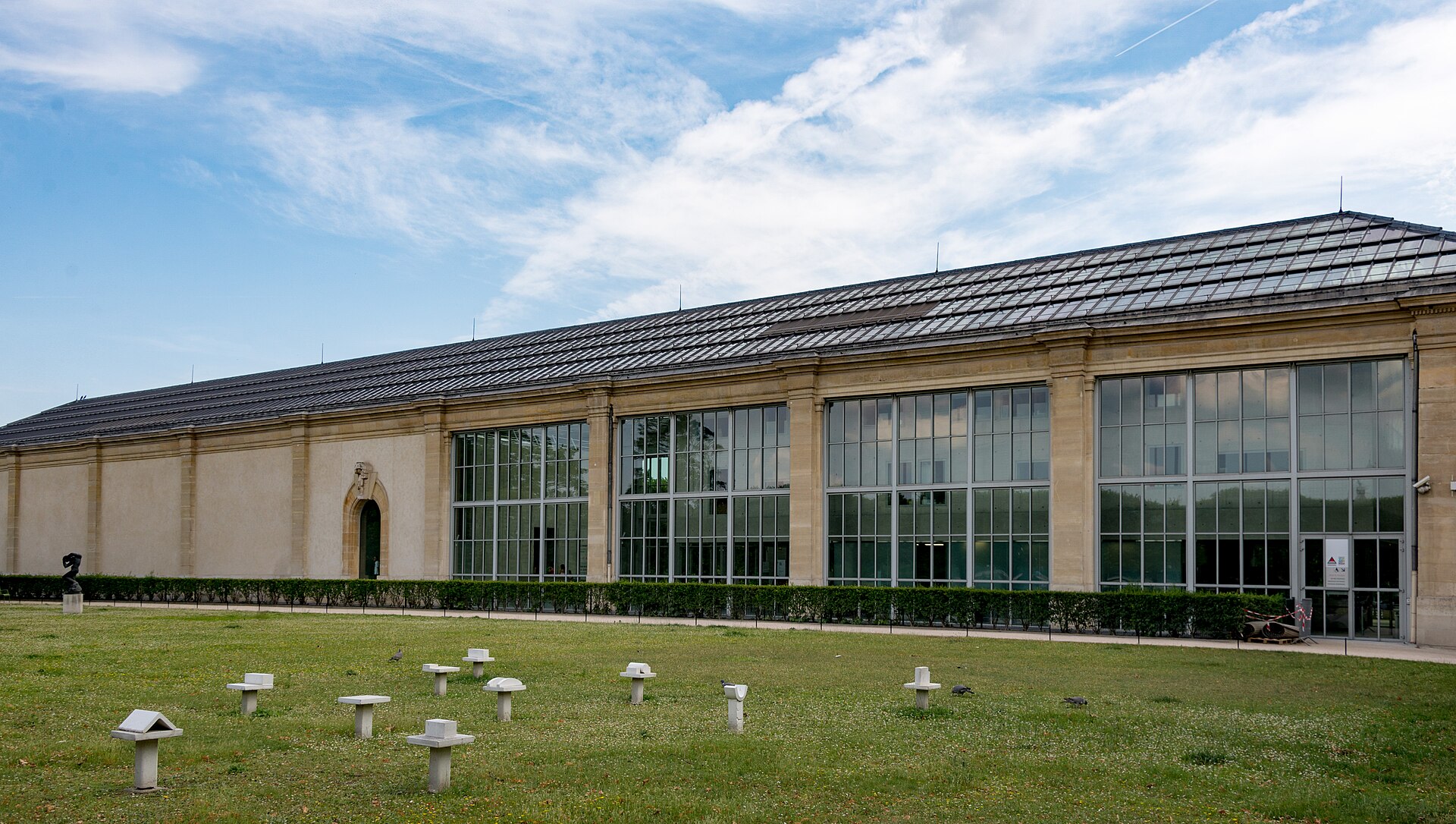
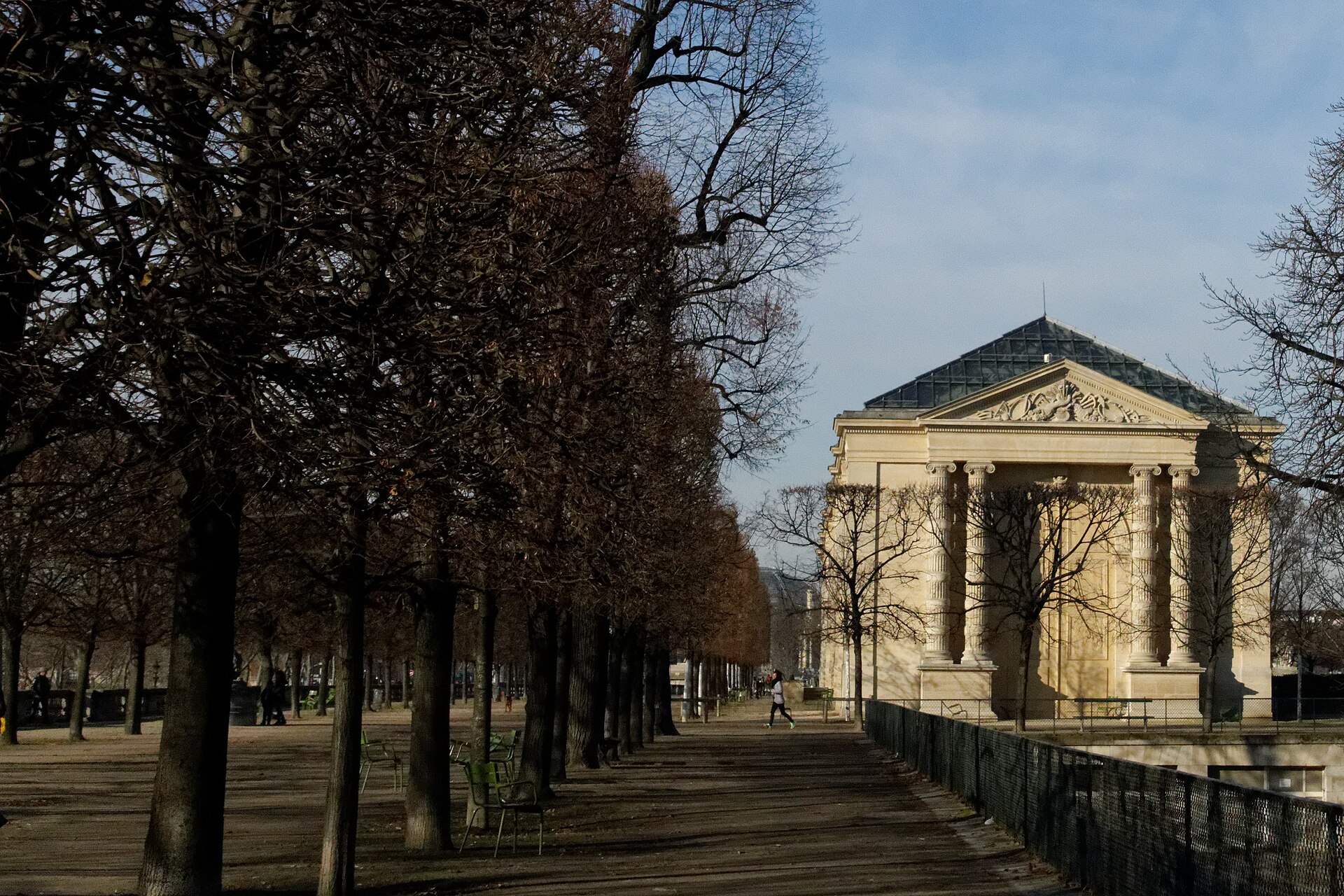
The Musee de l'Orangerie's long south facade, glazed toward the Seine as built in 1852 for the Tuileries orange trees.
xiquinhosilva · Photograph by xiquinhosilva from Cacau · CC BY 2.0Musee de l'Orangerie
Museum · Musée de l'Orangerie · Founded 1852
Open, admission and hours confirmed 19 August 2026 · 17 sources
On this page 15 sections
ContentsClose
The Orangerie is really two collections sharing one building, and neither substitutes for the other. Monet's Water Lilies are a single site-specific work that cannot travel and exists nowhere else in this form: the eight panels were built for these two rooms, to Monet's own specification, and every renovation since 1927 has been judged by whether it protects or damages that intention. The Walter-Guillaume collection underneath it is a conventional assembled collection built by two private owners across four decades, and it carries the version-tracking problems any dealer-formed collection does: the museum's own catalogue records at least seven versions of Renoir's Jeunes filles au piano and six versions of Soutine's Le Petit Patissier without settling how this museum's copies relate to the others still in circulation. What ties the two halves together is Paul Guillaume himself, whose eye assembled the paintings on the lower level and whose own African and Oceanian holdings, now dispersed to other institutions including the Musee du quai Branly - Jacques Chirac, occasionally return to the Orangerie on loan.
| Local name | Musée de l'Orangerie |
|---|---|
| Kind | Museum |
| Founded | Built 1852 as an orangery for the Tuileries; opened to the public as the Musee Claude Monet on 17 May 1927; became an independent national museum in the 1978-84 renovation |
| City and country |  Paris, France Paris, France |
| Address | Jardin des Tuileries, Place de la Concorde (Seine side), 75001 Paris, France |
| Website | musee-orangerie.fr |
| Status | Open, confirmed |
| Record last verified |
Visiting
- Hours
- Monday09:00 to 18:00Last admission 17:15, galleries clear at 17:45
- TuesdayClosed
- Wednesday09:00 to 18:00Last admission 17:15, galleries clear at 17:45
- Thursday09:00 to 18:00Last admission 17:15, galleries clear at 17:45
- Friday09:00 to 18:00Extended to 21:00 during exhibition periods (last admission 20:15, hall cleared by 20:45), with a reduced rate after 18:00
- Saturday09:00 to 18:00Last admission 17:15, galleries clear at 17:45
- Sunday09:00 to 18:00Last admission 17:15, galleries clear at 17:45
- Closed
- Every Tuesday. 1 May. Morning of 14 July. 25 December.
- Admission
- General admission, onlineEUR 12.50Timed entry
- General admission, at the museumEUR 11
- Discounted admission, at the museumEUR 8.50Concession categories are listed separately by the museum
- Friday night, onlineEUR 10Nocturne opening to 9pm every Friday during exhibition periods; this rate applies after 6pm
- Friday night, at the museumEUR 8.50Same nocturne rate bought on site
- Enfant et Cie, onlineEUR 10Reduced rate for up to two EU-resident adults accompanying a child under 18
- Enfant et Cie, at the museumEUR 8.50
- Combined ticket, Musee d'Orsay and Musee de l'OrangerieEUR 20Sold at the museum only, not online
- Under 18FreeFree
- 18-25, EU citizen or long-term EU residentFreeFree with proof of identity and residence
- Disabled visitor plus one companionFreeFree on presentation of a disability card
Free entry: First Sunday of every month, for all visitors; online time-slot booking is required- Tickets
- musee-orangerie.fr/en/visit-orangerie The museum's own ticket page.
- Do I need to book?
- Not compulsory but recommended: an online timed ticket carries priority admission within a half-hour window; walk-up tickets are sold subject to capacity
- Address
- Jardin des Tuileries, Place de la Concorde (Seine side), 75001 Paris, France MapMetro Lines 1, 8 and 12, Concorde station
Bus Lines 42, 45, 72, 73, 84 and 94, Concorde stop
Velib (bike share) Stations at Cambon-Rivoli, Alger-Rivoli, Assemblee Nationale and Musee d'Orsay; cycle parking is prohibited inside the Tuileries Garden itself and racks are provided at Place de la Concorde instead - Website
- musee-orangerie.fr
- Telephone
- +33 1 44 77 80 07
- [email protected]
Before you go how long, access, photography, bags, eating, shop
- How long to allow
- The building is small by Paris museum standards. Visitor reviews describe one to two hours for the permanent collection, longer with a temporary exhibition; the museum's own listing on Tripadvisor estimates under an hour, which several reviewers call optimistic once the queue is included
- Access
- Free admission for disabled visitors and one companion on presentation of a disability or priority card. The museum publishes separate pages on transport and parking, orientation, and equipment for deaf and hard-of-hearing visitors, and lends wheelchairs, folding seats and canes at the entrance
- Photography
- Not stated as a formal policy on the museum's own visit page. Visitor reviews describe extensive personal photography inside the Water Lilies rooms, including of the paintings themselves, and complain specifically about other visitors posing for photos rather than about a ban on cameras
- Bags
- A cloakroom is available at the entrance. A visitor review from June 2026 describes a bag check at entry
- Eating
- The Cafe-Librairie inside the museum, and the Kiosque de l'Orangerie, a separate snack kiosk in the Tuileries Garden immediately outside
- Shop
- A bookshop sharing space with the cafe, selling exhibition catalogues and souvenirs
Prices and hours change. We take them from the institution's own pages and print the day we read them, and you can check the current position at the source we used. Confirm before you travel.
What is inside
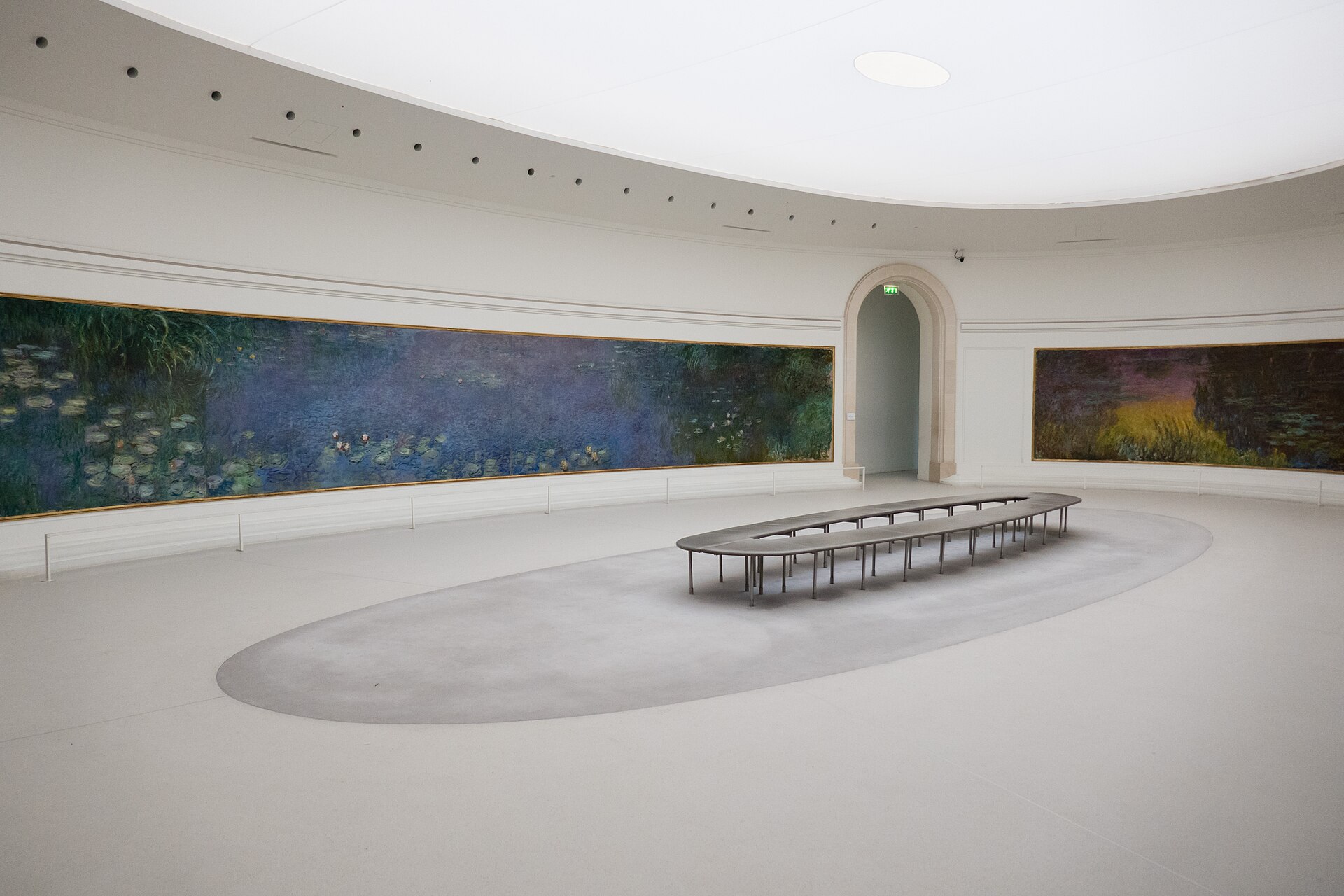
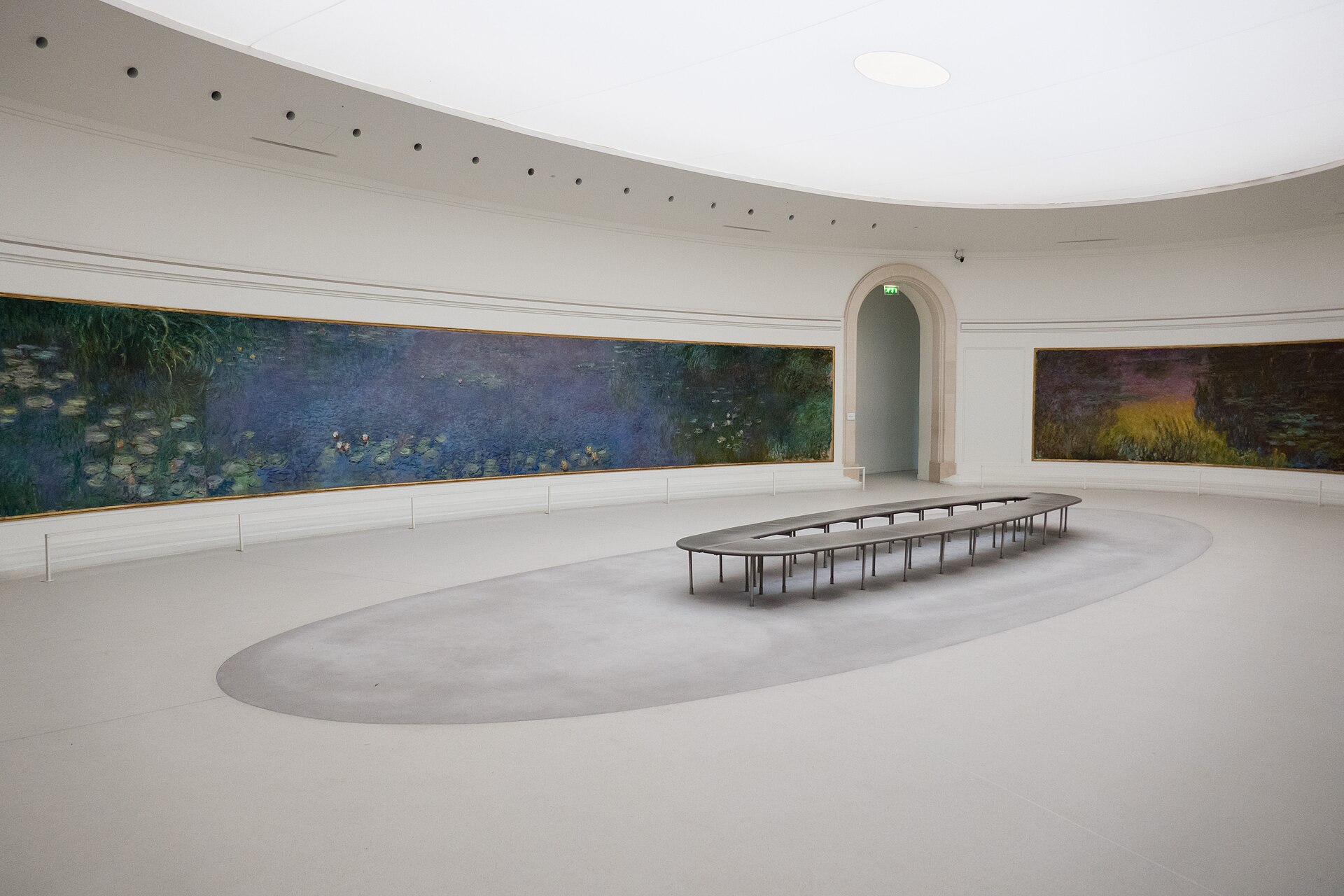
Photograph by Brady Brenot · CC BY-SA 4.0 The Water Lilies rooms
Two adjoining oval rooms on the upper level holding Monet's eight great Nympheas panels, each 2 metres high, laid end to end for a combined length of about 91 metres. The rooms are oriented east-west along the axis running from the Arc de Triomphe to the Louvre, so the sunrise-toned panels face east and the sunset-toned ones face west; a ceiling oculus lights the paintings with the sky's own changing light rather than fixed gallery lighting.
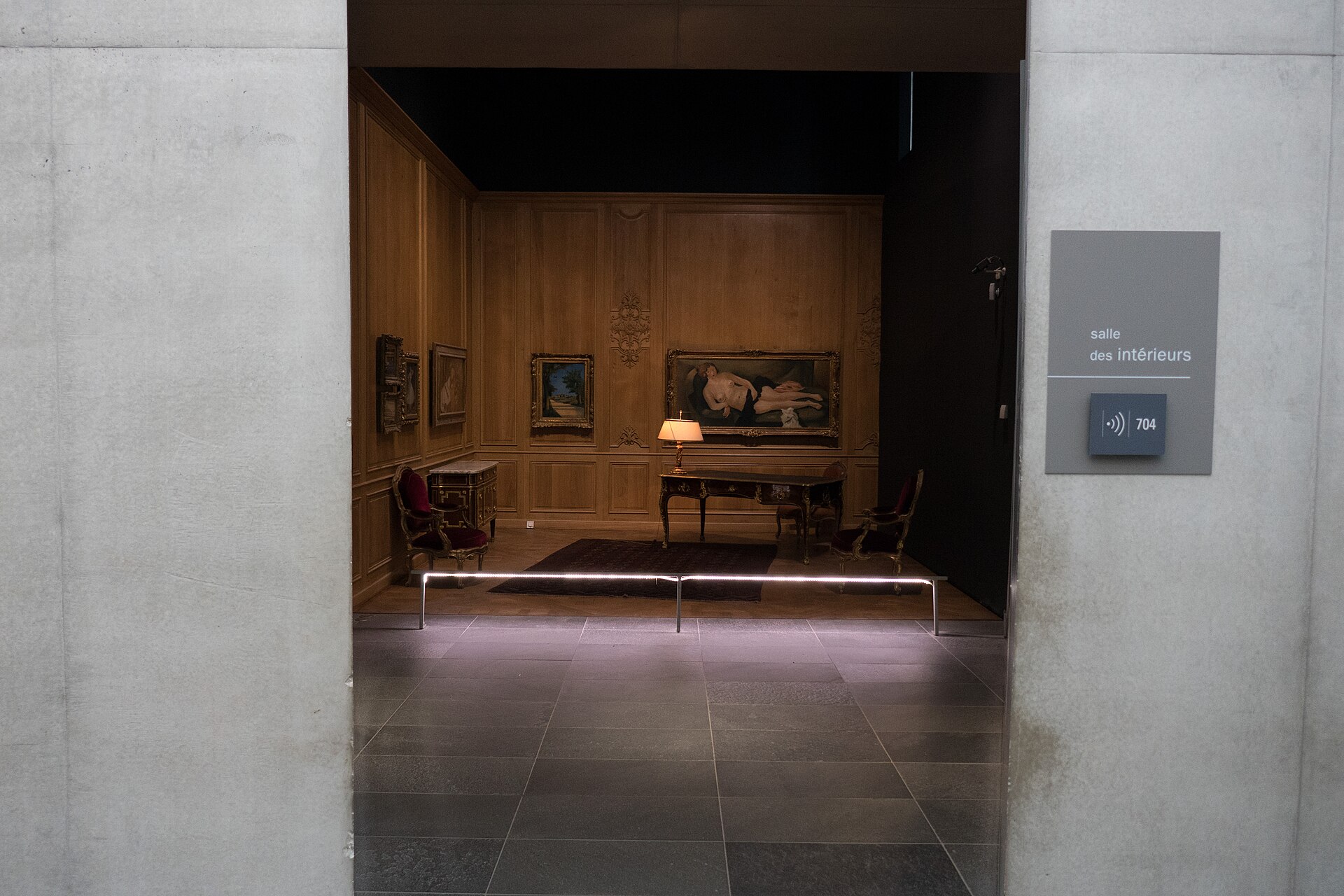
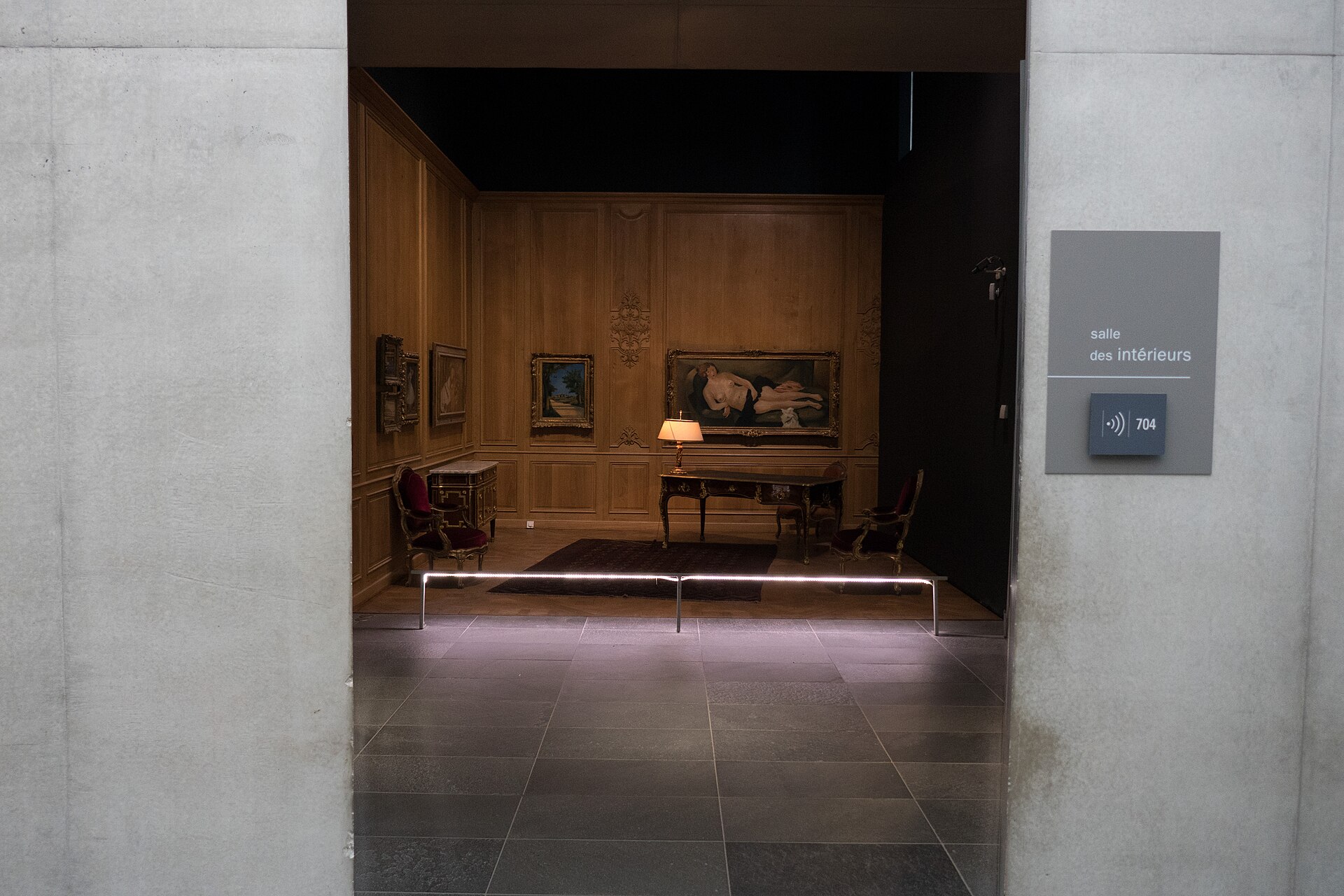
Photograph by Brady Brenot · CC BY-SA 4.0 Walter-Guillaume collection galleries, level -2
The basement galleries dug out in the 2000-2006 renovation hold the 148 paintings of the Jean Walter and Paul Guillaume collection: 25 Renoir, 15 Cezanne, a single Gauguin, a single non-Water-Lilies Monet and a single Sisley from the Impressionist side, and for the twentieth century 12 Picasso, 10 Matisse, 5 Modigliani, 7 Marie Laurencin, 9 Henri Rousseau, 31 Derain, 10 Utrillo, 22 Soutine and 1 Van Dongen. One room, the Salle des interieurs, reconstructs a panelled domestic interior of the kind Domenica Walter furnished her own apartment with.
Close-up gallery
A rotating small gallery added in the September 2020 rehang, given over three times a year to a tightly focused look at one theme, artist or group of works from the permanent collection rather than the full survey hang used elsewhere in the building.
Contemporary Counterpoint gallery
A second gallery from the same 2020 rehang, used for a changing programme of contemporary art shown in deliberate dialogue with the Water Lilies rather than as a separate exhibition; Contemporary Counterpoint was the name of the programme itself as well as the room, running to 24 August 2026 at the time of writing.
Temporary exhibition galleries
Four rooms at the west end of the building, next to Place de la Concorde, created in 1930 when the museum was attached to the Louvre and used ever since for the special exhibitions the Orangerie is known for: an Impressionist cycle in 1930-33, Peintres de la realite in 1934, Rubens et son temps in 1936, and in 2025-26 a monographic show on Henri Rousseau co-produced with the Barnes Foundation in Philadelphia.
What to see first
The Nympheas (Water Lilies) cycle, Claude Monet
Claude MonetMonet's own installation, designed with architect Camille Lefevre down to the spacing between panels and the unguided route a visitor takes through the two rooms; a monument to the 1918 Armistice that the artist kept reworking and destroying pieces of until his death in 1926, so that Georges Clemenceau had to see the rooms opened to Monet's specification without him.4
Jeunes filles au piano, Pierre-Auguste Renoir
Pierre-Auguste RenoirPainted around 1892, one of at least seven known versions of the same composition that Renoir made, of which this is the one that passed through Paul Guillaume's collection in 1928; the museum's own catalogue entry does not resolve which of the other versions in other collections it is closest to.6
Dans le parc de Chateau Noir, Paul Cezanne
Paul CezanneOne of fifteen Cezannes in the Walter-Guillaume collection, painted around 1898-1900 near the estate outside Aix-en-Provence where Cezanne kept a studio in his last years, and one of the works Paul Guillaume chose to build the collection's Impressionist core around.7
Paul Guillaume, Novo Pilota, Amedeo Modigliani
Amedeo ModiglianiA 1915 portrait of the dealer who would go on to assemble the whole collection this museum shows, painted at the home of Modigliani's mistress Beatrice Hastings; Modigliani casts the 23-year-old Guillaume as a ship's new helmsman, a tribute from the artist to the man effectively patronising him at the time.8
Le Petit Patissier, Chaim Soutine
Chaim SoutineThe painting that made Soutine's career: Paul Guillaume bought an earlier version in 1923 and is on record describing it in his own review, and when Albert Barnes saw it in Guillaume's gallery he bought it on the spot, turning Soutine from an unknown into a sought-after painter overnight. Soutine painted six versions of the subject; the Orangerie's, bought later, is one Guillaume chose in memory of the first.9
La Carriole du Pere Junier, Henri Rousseau
Henri Rousseau (Le Douanier)A 1908 group portrait Rousseau painted to settle a debt to a friendly market gardener, worked up from a photograph but deliberately distorted in scale: Rousseau enlarged one dog and shrank another against a critic's objection, telling him flatly that the painting demanded it.10
Les Trois Soeurs, Henri Matisse
Henri MatisseA 1917 triptych-related portrait bought by Paul Guillaume at a public sale, almost certainly because two related canvases of the same three sisters had already gone through his hands to Albert Barnes' collection in Philadelphia. As of this research the museum's own object record lists it as not currently on view.5
Exhibitions on now
Past exhibitions here
- Closed25 Mar to 24 Aug 2026Confirmed · check before you travel
An orangery before it was a museum
The building is older than its collection by seventy years. Napoleon III ordered it built in 1852 as a winter shelter for the orange trees that lined the Tuileries Palace garden, which until then had wintered in the Louvre's Grande Galerie. The architect Auguste Bourgeois finished it in four months: a structure built like a greenhouse, glazed on its south face toward the Seine to catch the sun and almost blind on the north face toward rue de Rivoli to keep out the wind. Louis Visconti, the architect then remodelling the Louvre itself, designed the two entrance porticoes at either end, framed in columns and topped with sculpted pediments of cornucopias and corn ears in keeping with the building's original job.
The Empire that built it did not survive it by much. After the fall of the Empire in 1870 and the fire that gutted the Tuileries Palace in 1871, the Orangerie passed to the French state, which went on using it to store the orange trees and, in between, for horticultural shows, concerts, banquets, contests and dog shows until 1922. Nothing about the building's first seventy years suggested it would end up holding some of the best-known paintings in France.
Clemenceau's gift and Monet's own design
Monet had been circling the idea since at least 1897, and told the critic Gustave Geffroy in 1909 that he wanted the water lily theme carried along the walls of a room. It took the loss of his son and the outbreak of war to push him into it: in 1914, at 74, he wrote that he was undertaking a great project, and spent the war years painting alternately outdoors and in a new studio he had built with skylights for the purpose. His friendship with Georges Clemenceau, renewed after 1908 when Clemenceau bought a property near Giverny, became decisive. The day after the Armistice, on 12 November 1918, Monet wrote to Clemenceau offering two decorative panels to the state as a monument to victory, and it was Clemenceau who pushed him to enlarge the gift into the full decorative series.
The formal agreement followed in September 1920, and a contract for 19 panels was signed on 12 April 1922, but Monet kept doubting himself, reworking panels and destroying some outright even as Clemenceau wrote that he had reached the limit of what brush and mind could achieve. Monet kept the paintings until he died in December 1926. It fell to Clemenceau to see the rooms opened to Monet's own design: eight panels, each two metres high and spanning ninety-one metres in total, arranged with the architect Camille Lefevre in two oval rooms shaped like the mathematical symbol for infinity, oriented east-west along the historical axis that runs from the Arc de Triomphe to the Louvre so that the panels toned for sunrise face east and those toned for sunset face west. A ceiling oculus, not fixed lighting, was the point: the paintings were built to change with the actual weather outside. The rooms opened as the Musee Claude Monet on 17 May 1927, four months after the artist's death.
Decades of indifference, then a Sixtine Chapel of Impressionism
The gift that Clemenceau fought to secure did not land the way either man hoped. By 1927 Impressionism looked like yesterday's revolution next to Fauvism, Cubism, Futurism, Dada and Surrealism, and the public stayed away from the Water Lilies rooms for decades. The museum itself sometimes built temporary partition walls across the rooms to hang unrelated temporary exhibitions, hiding Monet's panels behind them. The 1944 bombing of Paris damaged the roof of the second room and one of the compositions, while the rest survived by accident rather than design.
The revival, when it came, came from outside France. In 1952 the painter Andre Masson published a piece comparing the Orangerie's rooms to the Sistine Chapel of Impressionism, and in 1955 the Museum of Modern Art in New York bought and displayed one of Monet's late water lily paintings, at a moment when American critics were starting to trace a line from Monet's late work to the New York School painters then working in an all-over style with no single focal point: Pollock, Rothko, Newman, Still. Clement Greenberg was the critic most associated with drawing out that lineage. The Orangerie's own account of the paintings' afterlife names the Rothko Chapel in Houston, Barnett Newman's Stations of the Cross at the National Gallery in Washington, and Cy Twombly's Battle of Lepanto at the Brandhorst Museum in Munich as the clearest descendants of what Monet built here.
Two husbands, one collection, and the Orangerie's second life
Paul Guillaume was still in his twenties when he started dealing art in 1914. By his death in 1934 he had assembled several hundred paintings running from Impressionism to the Parisian avant-garde, alongside African and Oceanian pieces, and had grown rich and well known on both sides of the Atlantic while planning to open his own museum. His widow, Domenica, remarried the architect and industrialist Jean Walter, and between them reduced and reshaped the collection while continuing to buy. When the French state bought it in two stages, 1959 and 1963, subject to Domenica's lifetime usufruct, she asked that it carry both her husbands' names, and it was agreed the collection would go to the Orangerie.
The building that resulted from that decision is not the one Clemenceau opened. The architect Olivier Lahalle's 1960-65 renovation tore out the original temporary-exhibition galleries and inserted two full-length floors, one above the other, reached by a monumental staircase with a banister designed by Raymond Subes that replaced the original vestibule leading to the Water Lilies. The collection went on public view in 1966, opened by the culture minister Andre Malraux; Domenica kept the paintings in her own possession until she died in 1977. A third renovation, 1978-84, consolidated the building and gave the collection its permanent name and rooms, and cut the Orangerie loose administratively from the Louvre and the Jeu de Paume, whose own Impressionist holdings were by then earmarked for the future Musee d'Orsay. What is on the walls today is 148 paintings spanning the 1860s to the 1930s: 25 Renoir, 15 Cezanne, a single Gauguin, a single Monet outside the Water Lilies, a single Sisley, and for the twentieth century 12 Picasso, 10 Matisse, 5 Modigliani, 7 Marie Laurencin, 9 Henri Rousseau, 31 Derain, 10 Utrillo, 22 Soutine and 1 Van Dongen.
Undoing the 1960s renovation, and a building sized for the wrong crowd
The next rebuild undid the one before it. Between 2000 and 2006, under the architect Olivier Brochet and the then-director Pierre Georgel, the two superimposed floors that Lahalle had inserted came out again, and the natural light that Monet had insisted on returned to the Water Lilies rooms for the first time since the 1960s. New basement galleries were dug to the north of the building to hold the Walter-Guillaume collection, along with a temporary exhibition space, an auditorium, an education room and a bookshop; the work was delayed by the discovery of the remains of the Fosses Jaunes, a defensive ditch built in 1566 to protect the Tuileries Palace. The rebuilt museum reopened on 17 May 2006, and since May 2010 has shared a single public authority with the Musee d'Orsay. A further rehang in September 2020 added the close-up and Contemporary Counterpoint galleries and brought in a loan of African and Oceanian sculpture from the Musee du quai Branly - Jacques Chirac, objects that had themselves passed through Paul Guillaume's hands before they went to Domenica's second collecting interest.
The most recent renovation had nothing to do with the art and everything to do with the crowd. The museum closed until 2 March 2025 to rebuild its entrance, expand the lobby, add a second exit and a vacuum system aimed at the dust that blows in from the Tuileries Garden's own seventeenth-century gravel paths, a problem the museum had already priced at 15 million euros to fix at the source in 2013 and judged too expensive to carry out. The building the 2006 renovation planned around 600,000 visitors a year; by the time of the 2024-25 works, the museum's own director put the real figure at roughly 1.2 million. A structure designed to change with the light Monet asked for now has to be redesigned around a queue Monet never had to plan for.
What visitors say
Visitors consistently single out the two oval Water Lilies rooms as the reason to come, describing the changing daylight and the way the panels wrap around a seated viewer as unlike anything else on a standard Paris museum circuit, and several call the museum a calmer, smaller counterpart to the Louvre and the Musee d'Orsay nearby. Against that, the single most repeated complaint by far is noise and crowding inside those same two rooms: visitors photographing themselves rather than the paintings, groups talking over the museum's own posted request for quiet, and queues that persist even with a timed ticket. A cleaning complaint recurs too, tied to the Tuileries Garden's gravel paths tracking grit onto the gallery floor.
What is praised, what is criticised
- Praised: the design of the two oval Water Lilies rooms and the way the natural light changes the paintings through the day
- Praised: the collection's manageable size next to the Louvre and Orsay, and the temporary exhibitions built around individual Walter-Guillaume artists
- Praised: the audio guide
- Criticised: overcrowding and noise inside the Water Lilies rooms despite signs asking visitors to be quiet
- Criticised: visitors posing for photographs rather than looking at the paintings, blocking sightlines for others
- Criticised: long queues even with a reserved time slot
- Criticised: dust and sand tracked in from the Tuileries Garden's gravel walkways settling on the gallery floor, a problem the museum itself has cited as a reason for a 2013 renovation proposal it judged too costly to carry out
Ratings on other platforms
Tripadvisor: 4.6 from 17,729 ratings, read 19 August 2026
A platform average is a tertiary source: it moves, it is not audited, and we quote no visitor's words.
Questions about Musee de l'Orangerie
Where is Musee de l'Orangerie?
Jardin des Tuileries, Place de la Concorde (Seine side), 75001 Paris, France.
How much does it cost to visit?
General admission, online: EUR 12.5; General admission, at the museum: EUR 11; Discounted admission, at the museum: EUR 8.5; Friday night, online: EUR 10; Friday night, at the museum: EUR 8.5. As confirmed 19 August 2026.
When is it open?
Monday 09:00-18:00; Tuesday closed; Wednesday 09:00-18:00; Thursday 09:00-18:00; Friday 09:00-18:00; Saturday 09:00-18:00; Sunday 09:00-18:00. Closed: Every Tuesday. 1 May. As confirmed 19 August 2026.
How do you get there?
Metro: Lines 1, 8 and 12, Concorde station; Bus: Lines 42, 45, 72, 73, 84 and 94, Concorde stop; Velib (bike share): Stations at Cambon-Rivoli, Alger-Rivoli, Assemblee Nationale and Musee d'Orsay; cycle parking is prohibited inside the Tuileries Garden itself and racks are provided at Place de la Concorde instead.
What should you see first?
The Nympheas (Water Lilies) cycle, Claude Monet (Claude Monet); Jeunes filles au piano, Pierre-Auguste Renoir (Pierre-Auguste Renoir); Dans le parc de Chateau Noir, Paul Cezanne (Paul Cezanne); Paul Guillaume, Novo Pilota, Amedeo Modigliani (Amedeo Modigliani); Le Petit Patissier, Chaim Soutine (Chaim Soutine); La Carriole du Pere Junier, Henri Rousseau (Henri Rousseau (Le Douanier)).
What we could not confirm
- The museum's own catalogue entry for Renoir's Jeunes filles au piano states that at least six other versions of the composition exist but does not identify them or say how this version relates to the others; not resolved here.
- Henri Matisse's Les Trois Soeurs is listed on the museum's own object database as not currently on view, with no stated reason or return date at the time of this research.
- Whether the 2024-25 entrance and dust-control renovation has measurably reduced grit inside the galleries has not been reported on since the museum reopened in March 2025; the visitor complaints logged here predate a full assessment.
Images
Sources
- 1Wikidata, Q726781, Musee de l'Orangerie (identity, coordinates) wikidata.org/wiki/Special:EntityData/Q726781.json
- 2Musee de l'Orangerie, Visit page (hours, prices summary, address, transport, services, contact) musee-orangerie.fr/en/visit-orangerie
- 3Musee de l'Orangerie, Rates page (full admission price table) musee-orangerie.fr/en/articles/rates-257
- 4Musee de l'Orangerie, History of the Water Lilies cycle musee-orangerie.fr/en/node/33
- 5Musee de l'Orangerie, From the orangerie to the museum (building and institutional history) musee-orangerie.fr/en/node/24
- 6Musee de l'Orangerie, artwork record, Jeunes filles au piano, Auguste Renoir musee-orangerie.fr/en/artworks/jeunes-filles-au-piano-196508
- 7Musee de l'Orangerie, artwork record, Dans le parc de Chateau Noir, Paul Cezanne musee-orangerie.fr/en/artworks/dans-le-parc-de-chateau-noir-196032
- 8Musee de l'Orangerie, artwork record, Paul Guillaume Novo Pilota, Amedeo Modigliani musee-orangerie.fr/en/artworks/paul-guillaume-novo-pilota-196295
- 9Musee de l'Orangerie, artwork record, Le Petit Patissier, Chaim Soutine musee-orangerie.fr/en/artworks/le-petit-patissier-196563
- 10Musee de l'Orangerie, artwork record, La Carriole du Pere Junier, Henri Rousseau musee-orangerie.fr/en/artworks/la-carriole-du-pere-junier-196429
- 11Dale Berning Sawa, Musee de l'Orangerie enters latest stage of year-long renovation, The Art Newspaper, 19 February 2025 theartnewspaper.com/2025/02/19/musee-de-lorangerie-enters-latest-stage-of-year-long-renovation
- 12Tripadvisor, Musee de l'Orangerie attraction page (aggregate rating and review themes, read 19 August 2026) tripadvisor.com/Attraction_Review-g187147-d265635-Reviews-Musee_de_l_Orangerie-Paris_Ile_de_France.html
- 13Service-public.gouv.fr, Annuaire de l'administration, Musee de l'Orangerie des Tuileries (phone number) lannuaire.service-public.gouv.fr/gouvernement/11add9ce-d0e4-4570-b66e-7f3b1ac0f9cf
- 14Musee de l'Orangerie, Permanent collections, the Walter-Guillaume collection (artist counts and collection history) musee-orangerie.fr/en/collection/permanent-collections-walter-guillaume-collection
- 15Musee de l'Orangerie, artwork record, Les Trois Soeurs, Henri Matisse musee-orangerie.fr/en/artworks/les-trois-soeurs-196463
- 16Musee de l'Orangerie, homepage (live exhibition programme and today's hours, read 19 August 2026) musee-orangerie.fr/en
- 17Sortiraparis, Musee de l'Orangerie closes for a month (dated 7 January 2025; describes the 28 January-2 March 2025 closure only, checked 19 August 2026 to rule out a WebSearch summary that had wrongly extended this into a 2026 closure) sortiraparis.com/en/what-to-visit-in-paris/exhibit-museum/articles/323001-the-musee-de-l-orangerie-closes-its-doors-for-a-month