Tiffany Studios, New York
 American · active 1902-1932
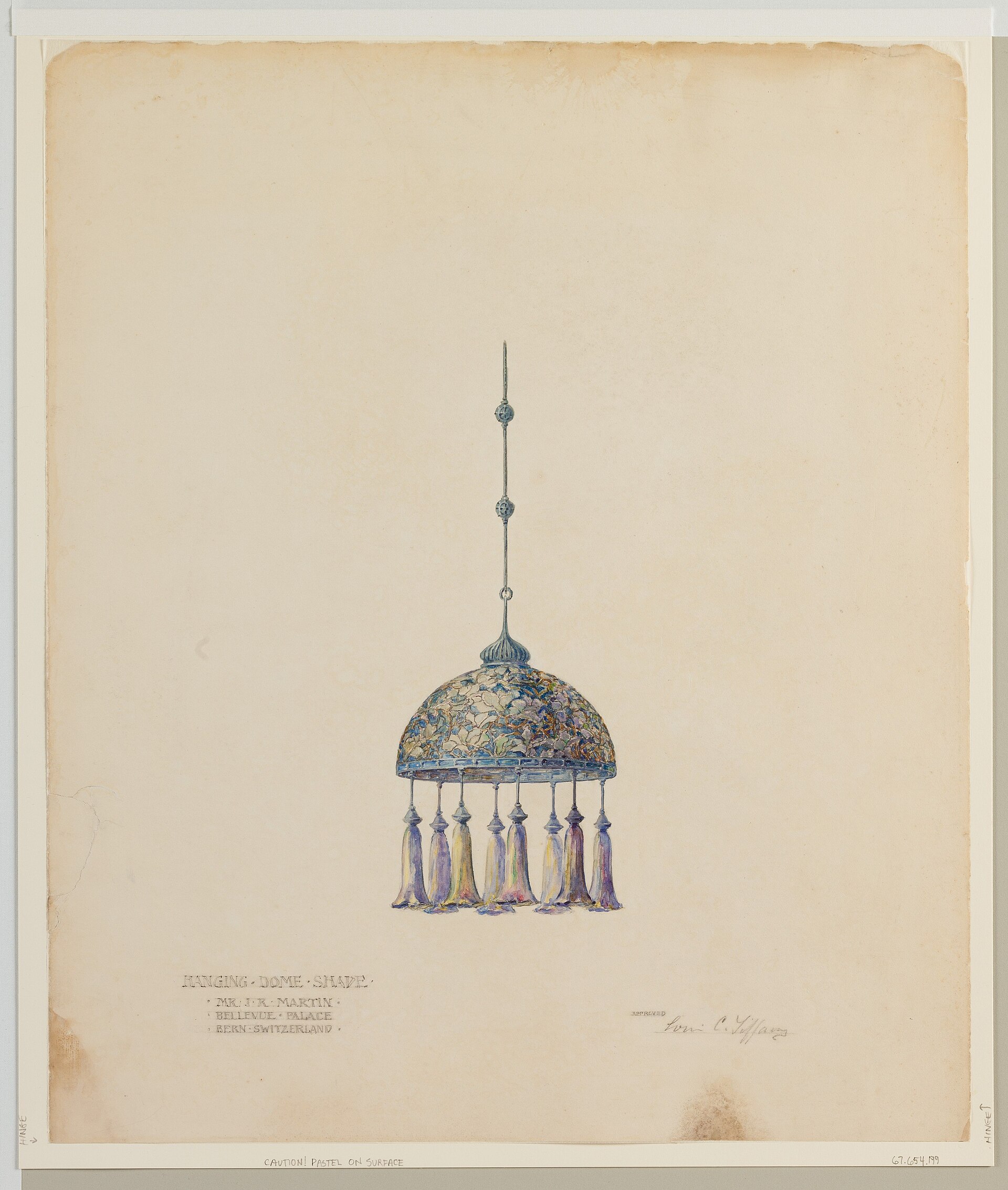
Approved by Louis C. Tiffany A Tiffany Studios presentation drawing for a hanging dome shade for Mr J. R. Martin at the Bellevue Palace, Bern, Switzerland, in watercolour and pastel. At the lower right the sheet carries the word APPROVED and Louis C. Tiffany's own signature. This is the documentary form of his actual role: he approved designs that other hands drew. The drawing is unsigned by its designer, which is the ordinary condition of the firm's paper. No verified portrait. No securely identified likeness of this maker is available under a free licence. We do not publish a face we cannot verify.
The Metropolitan Museum of Art, New York| Full name | Tiffany Studios, incorporated New York, 25 February 1902 |
|---|---|
| Worked as | Glasshouse, Leaded-glass window maker, Lampshade manufacturer, Mosaicist |
| Born | Incorporated 25 February 1902 · New York City. Showrooms and offices in Manhattan |
| Died | Filed for bankruptcy 16 April 1932. · New York City |
| Nationality | American |
| Movement | American Art Nouveau |
| Sources | 34 cited |
| Last verified | 17 September 2026 |
About this page Last verified 17 September 2026 · 34 sources cited
On this page 13 sections
ContentsClose
Tiffany Studios was a manufactory of several hundred people, and almost everything sold under its name was designed by somebody other than the man whose name it was. That sentence would have been unpublishable before 2005. In that year two researchers independently found several hundred private letters written by Clara Pierce Wolcott Driscoll, who ran the firm's Women's Glass Cutting Department from 1892 to 1909, to her mother and sisters in Ohio. The letters describe her inventing named lamp models on dated days. Because the firm's own business records were dispersed and largely destroyed after it closed, those family letters are the fullest first-person account of the studio's interior life that exists. More than thirty shade designs are now credited to Driscoll, and museums from Cleveland to Toledo to Bentonville have added a separate DESIGNER line to their catalogue entries.
What the letters do not establish is that Louis Comfort Tiffany designed nothing. He set the aesthetic, developed the glass, kept a design file of photographs to feed his designers, and signed off on the drawings; surviving presentation sheets carry the word APPROVED above his signature. The Charles Hosmer Morse Museum, which holds the largest Tiffany archive anywhere, states the counter-position plainly: the firm was built in the historic tradition of studios producing work under the name of an established artist, and one employee cannot tell the whole story. It also records that Tiffany publicly credited Will H. Low and Lydia Emmet by name in the firm's own 1893 World's Columbian Exposition pamphlet, which complicates the popular claim that he never credited anybody. Both positions are on this page, with the names of who holds them.
Two other things a reader needs before anything else. First, the mark dates the object: eleven successive corporate names were used between 1878 and 1938, and a base struck TIFFANY GLASS AND DECORATING CO. cannot have left the works after 1902. Second, this is not Tiffany and Company. The jeweller on Fifth Avenue was founded by Charles Lewis Tiffany, this firm was run by his son, and they were separate businesses with separate marks, separate premises and separate fates. The jeweller is still trading. This firm went bankrupt in 1932 and its building was pulled down.
Images
Chronology
- 1848
Louis Comfort Tiffany born in New York on 18 February, son of Charles Lewis Tiffany of Tiffany and Company.320
- 1875
Tiffany begins experimenting with glassmaking at Thill's Empire State Flint Glass Works in Brooklyn.20
- 1878
Louis C. Tiffany and Company formed on 18 June and opens its first glasshouse.120
- 1880-81
Three glass patents filed and granted as a group. US 237,418, Colored-Glass Window, filed 25 October 1880 and granted 8 February 1881, claims coloured panes carrying a reflective metallic film; US 237,416 and US 237,417 issue the same day.5
- 1881
Louis C. Tiffany and Company, Associated Artists registered 15 June with Candace Wheeler, Samuel Colman and Lockwood de Forest.13
- 1883
Associated Artists dissolved 28 April; Louis C. Tiffany and Company re-established the same day.1
- 1885
- 1887
The firm takes a lease on 5 March on 333-335 Fourth Avenue, an 1861 loft building. Doros dates the establishment of the Tiffany Glass Company to this move rather than to the 1885 incorporation.1920
- 1888
Clara Pierce Wolcott arrives in New York, enters the Metropolitan Museum Art School as the only woman studying architectural decoration, and is hired by Tiffany.1214
- 1892
Tiffany Glass Company reorganised 18 February as the Tiffany Glass and Decorating Company. Driscoll returns after her husband's death and takes charge of a six-woman Women's Glass Cutting Department.114
- 1893
Stourbridge Glass Company incorporated 7 April; the Corona works open and the glasshouse is destroyed by fire in the same year. Arthur J. Nash arrives from Stourbridge. The firm wins fifty-four medals at the World's Columbian Exposition in Chicago and credits Will H. Low and Lydia Emmet by name in its own exhibition Synopsis. Joseph Briggs joins the firm.2152029
- 1894
Favrile registered as a trademark on 13 November, number 25,512. The Favrile vase registry begins its letter-prefix numbering with A1.36
- 1897
Cecilia Waern, writing in The International Studio in September, puts the women's department at forty to fifty. Lillian A. Palmie is at the firm by this year.914
- 1898
The first commercially produced leaded lamps. A letter of 29 June describes Driscoll modelling a Butterfly shade in paper and linen to show Tiffany. Out-of-Door Memorials, the firm's monument catalogue, is copyrighted by the Tiffany Glass and Decorating Company.121324
- 1899
Frederick Wilson takes charge of the Ecclesiastical Department.10
- 1900
Allied Arts Company incorporated 2 April. At the Paris Exposition Universelle, where exhibitors were required to name the individuals responsible, prizes go to Driscoll for a Dragonfly lamp and to Arthur J. Nash for glass; Northrop's Magnolia window and the monumental Dandelion lamp are shown.11722
- 1901
Eastern Arts Company incorporated 23 July. The Dandelion lamp is shown again at the Pan-American Exposition in Buffalo.117
- 1902
Tiffany Studios incorporated 25 February. Charles Lewis Tiffany dies 18 February and Louis becomes the first design director of Tiffany and Company. Stourbridge Glass renamed Tiffany Furnaces 29 September; Tiffany Glass and Decorating and Allied Arts consolidated 18 November. Gouvy and Palmie date three enamel-department watercolours to this year.1925
- 1903
The glaziers' and glass cutters' union moves to close the women's department. The settlement caps the women at twenty-seven and confines them to lampshades and small luxury goods, and gives Driscoll's department the exclusive right to design every lampshade and fancy good the firm makes.1214
- 1905
Tiffany Studios moves to the former Knickerbocker Athletic Club at Madison Avenue and 45th Street, 347-355 Madison Avenue. Laurelton Hall completed, eighty-four rooms on 600 acres at a construction cost given as about two million dollars.1933
- 1909
Driscoll leaves the firm permanently on marrying Edward A. Booth. Eastern Arts Company consolidated 1 December.112
- 1913
Tiffany Studios publishes Character and Individuality in Decorations and Furnishings, illustrating its Madison Avenue showrooms, its furniture and rug floors and its wrought ironwork.30
- 1918
The Louis Comfort Tiffany Foundation begins running a residential art school at Laurelton Hall.33
- 1919
Tiffany retires from Tiffany Studios.20
- 1920
Tiffany Furnaces, Inc. reorganised 6 January as Louis C. Tiffany Furnaces.1
- 1924
Louis C. Tiffany Furnaces dissolved 2 April and becomes the A. Douglas Nash Company, which closes in 1929 or 1930.13
- c. 1930
The Corona works close.15
- 1932
Tiffany Studios files for bankruptcy on 16 April from 391 Madison Avenue; liabilities are reported at 481,595 dollars against assets of 315,907 dollars. The Louis C. Tiffany Studios Corporation is announced 20 June. Joseph Briggs begins shipping crates of Tiffany glass to Accrington.11629
- 1933
Louis Comfort Tiffany dies 17 January.20
- 1935
Egon and Hildegard Neustadt buy their first Tiffany lamp, a Daffodil, in a Greenwich Village second-hand shop for 12 dollars 50.816
- 1938
The Louis C. Tiffany Studios Corporation is liquidated by Lester Dutt and Associates of Washington and the studio contents auctioned ahead of demolition. Westminster Memorial Studios is formed by former employees at 148 West 23rd Street to finish outstanding stained-glass commissions.14
- 1946
The contents of Laurelton Hall are sold at Parke-Bernet Galleries, 24 to 28 September, with lesser objects through the Coleman Galleries and by private sale.33
- 1949
Laurelton Hall sold on 9 January for 10,000 dollars.33
- 1956-58
The Carnegie Institute in Pittsburgh mounts the first sympathetic public exhibition in 1956; the Museum of Contemporary Crafts in New York shows 300 objects in 1958, of which eight are lamps.16
- 1957
Laurelton Hall burns on 6 March. Hugh McKean and Jeannette Genius McKean buy the right to salvage what remains and ship it to Winter Park, Florida.33
- 1966
The first major sale of Tiffany glass, by Coates-Connelly, contains no lamps.16
- 1970
Egon Neustadt publishes The Lamps of Tiffany, which supplies the classification of shade types collectors still use. Reproductions begin to appear on the market as prices rise.167
- 1972
The eight Tiffany design watercolours later at the Rakow Research Library are water-damaged, most probably in the Corning flood when Hurricane Agnes struck.9
- 1997
Christie's New York sells a Lotus lamp, lot 200, on 12 December for 2,807,500 dollars including premium, a world record for a twentieth-century decorative arts object.1716
- 2004
The Rakow Research Library acquires the Arthur J. Nash and Leslie H. Nash collection at auction, including the coded glass formulas.10
- 2005
Nina Gray finds Driscoll letters at the Queens Historical Society; Martin Eidelberg is approached by a Driscoll descendant. The two meet by chance at Kent State University Library.1213
- 2006-07
A New Light on Tiffany: Clara Driscoll and the Tiffany Girls opens at the New-York Historical Society on 27 November 2006; the catalogue by Eidelberg, Gray and Hofer is published in 2007. The Metropolitan Museum shows Louis Comfort Tiffany and Laurelton Hall the same autumn.1233
- 2016
On 2 September, Winterthur's Scientific Research and Analysis Laboratory runs portable X-ray fluorescence on four marked Tiffany lamps at the Neustadt Collection and publishes the first documented compositional differences between genuine and fake solder and bases.8
- 2021
Rago sells a monumental Dandelion lamp of 1900, lot 273, on 13 May for 3,745,000 dollars including premium against an estimate of 50,000 to 75,000 dollars.1731
- 2024
Sotheby's New York sells the Danner Memorial Window on 18 November for 12,480,000 dollars including premium against 5 to 7 million, the auction record for any Tiffany Studios work.18
- 2025
Sotheby's sells the Fromer collection on 12 June for 6.3 million dollars, and on 11 December sells a Magnolia floor lamp attributed to Agnes Northrop for a reported 4.4 million dollars, the lamp record.3234
- 2025-26
Tiffany Lamps: Beyond the Shade runs at the Driehaus Museum in Chicago from 12 September 2025 to 19 April 2026.28
The market
Every published Tiffany result is a total including the buyer's premium, and no house consulted here separates the hammer. That single convention makes cross-market comparison unreliable and it is the first thing to fix in any file. Read every figure below as premium-inclusive unless stated otherwise.
The market is younger than the objects by seventy years. Lamps were being broken for their lead in the 1930s; a Daffodil cost 12 dollars 50 in 1935. A Wisteria made 14,000 dollars in the early 1970s, 150,000 to 200,000 dollars in the 1980s and 300,000 to 500,000 dollars in the 1990s. The lamp record has moved four times since 1997, from 2,807,500 to a reported 4.4 million dollars, and the ceiling is not a lamp at all: a window took 12,480,000 dollars in November 2024, more than double the best lamp.
Two structural points matter more than the headline numbers. Estimates in this field are unreliable at the top: the 2021 Dandelion carried a 50,000 to 75,000 dollar estimate and made fifty times the low figure. And of the five record-holding objects since 1997, four are now attributed to Clara Driscoll or her department and to Agnes Northrop. The most expensive things this firm ever made are, on current attribution, the work of women it did not name.
| Date | Sale | Work | Result | Note |
|---|---|---|---|---|
| 12 December 1997 | Christie's New York | Lotus lamp, lot 200 | Hammer Not published With premium USD 2,807,500 including premium USD | Estimate USD 2,500,000 to 3,500,000. Sold to an anonymous telephone bidder. A world auction record at the time for any twentieth-century decorative arts object. This model is the subject of a separate Iconotheca record and is not re-described here. |
| 13 December 2018 | Christie's New York | Pond Lily lamp, about 1903, lot 9 | Hammer Not published separately With premium USD 3,372,500 including premium USD | Estimate USD 1,800,000 to 2,500,000. Held the lamp record for two and a half years. |
| 13 May 2021 | Rago, Lambertville, New Jersey | Monumental Dandelion lamp, 1900, lot 273 | Hammer Not published separately With premium USD 3,745,000 including premium USD | Estimate USD 50,000 to 75,000 in one report and 50,000 to 70,000 in another. Eleven telephone bidders. 29 1/2 in. high; hand-blown Favrile globe shade on a hammered and patinated copper base worked as the life cycle of a dandelion, the globe contoured to read as wind currents, the blossoms of soldered brass strip and the seed puffs coated in silver or white metal. Commissioned for the Paris Exposition Universelle of 1900 and shown again at the Pan-American Exposition, Buffalo, 1901, then untraced for 125 years before surfacing in a Virginia estate held by the family since the 1950s. Design believed to be Driscoll's. Took the record for any Tiffany Studios work at the time. |
| 18 November 2024 | Sotheby's New York | The Danner Memorial Window, 1913 | Hammer Not published With premium USD 12,480,000 including premium USD | Modern Evening Auction. Estimate USD 5,000,000 to 7,000,000. Six and a half minutes of bidding between three parties; bought on the telephone through Cassandra Hatton. Commissioned in 1913 for the First Baptist Church, Canton, Ohio, as a memorial to John and Terressa Danner, founding members. From the collection of Alan Gerry. Design credited by Sotheby's to Agnes Northrop with Louis Comfort Tiffany. The auction record for any Tiffany Studios work, and the first time a major Tiffany work was placed in one of the house's marquee evening slots alongside Monet, Picasso and Carrington. |
| 12 June 2025 | Sotheby's New York | Masterpieces by Louis Comfort Tiffany, featuring the Ann and Robert Fromer Collection (whole sale) | Hammer Not published With premium USD 6,300,000 total including premium USD | Estimate USD 3,600,000 to 5,600,000. 96 per cent sold by lot, nearly 60 per cent of lots above the high estimate. Led by the Stillman Memorial Window at USD 2,390,000 against an estimate of 1.5 to 2.5 million. Windows, leaded lamps, Favrile glass, pottery and fancy goods. |
| 11 December 2025 | Sotheby's New York | Magnolia floor lamp, about 1910, lot 209 | Hammer Not published With premium USD 4,400,000 as reported USD | From Dreaming in Glass: Masterworks by Tiffany Studios, featuring works from The Schur Family Collection. Estimate USD 2,000,000 to 3,000,000. Design attributed to Agnes Northrop, described in one report as believed rather than settled. The current auction record for a Tiffany Studios leaded lamp. Sources report a single rounded figure and none separates hammer from premium. |
| 1970s | Trade, various | Wisteria table lamp | Hammer Not applicable With premium USD 14,000 in the early 1970s USD | Recorded as the benchmark at the start of the revival. The same model is given at 150,000 to 200,000 dollars in the 1980s and 300,000 to 500,000 dollars in the 1990s. These are trade ranges, not individual results, and are cited as a trajectory rather than as prices. |
| 1935 | Second-hand shop, Greenwich Village | Daffodil lamp, about 1905 | Hammer Not applicable With premium USD 12.50 purchase price USD | Bought by Egon and Hildegard Neustadt, their first Tiffany lamp. Winterthur values the same lamp today at 35,000 to 60,000 dollars. The figure is included because it establishes the base of the entire market: within three years of the bankruptcy the objects were worth less than the labour of carrying them. |
Hammer is the price at which the bidding stopped; with premium adds the fee the house charges the buyer on top. Hammer price and buyer's premium in the glossary.
Where to see the work
| Institution | City | Holdings | Note |
|---|---|---|---|
| The Charles Hosmer Morse Museum of American Art | Winter Park, Florida | The most comprehensive collection of Louis Comfort Tiffany's work anywhere, together with the largest archive: letters, photographs, business records and design material. Holds the 1893 Tiffany Chapel from the World's Columbian Exposition and the material salvaged from Laurelton Hall after the 1957 fire. | A 6,000-square-foot Laurelton Hall gallery opened in 2011. The museum's published position on attribution is more cautious than the popular account and should be read alongside it. |
| The Neustadt Collection of Tiffany Glass | Long Island City and Queens, New York | The archive of original Tiffany flat glass and pressed jewels, given by the organisation as nearly half a million pieces and in one published account as more than a quarter of a million, plus lamps and windows. A gallery at the Queens Museum since 1995. | The physical reference standard against which a questioned shade is compared, and the site of Winterthur's 2016 X-ray fluorescence study. |
| New-York Historical Society | New York | The Neustadt gift of 132 lamps and three windows, shown as a standing gallery of about a hundred lit lamps. Mounted A New Light on Tiffany in 2006-07 and holds material relating to it. | The single best place to see the range of shade models together and lit. |
| Rakow Research Library, Corning Museum of Glass | Corning, New York | Documents and drawings from Tiffany Studios, the Tiffany Glass and Decorating Company and Tiffany Furnaces; the Arthur J. Nash and Leslie H. Nash collection with the coded glass formulas, acquired at auction in 2004; the Jeffrey Rush Higgins collection on Frederick Wilson, 1885-1990; eight original design watercolours by Alice C. Gouvy and Lillian A. Palmie. | The most useful single stop for anyone working on the firm's process rather than its products. Publishes the corporate chronology used on this page. |
| The Metropolitan Museum of Art | New York | Design drawings, window cartoons and presentation sheets including approved lighting and ecclesiastical designs; the Laurelton Hall loggia; Autumn Landscape and the Garden Landscape triptych by Agnes Northrop, the latter unveiled in 2024. | The Garden Landscape attribution rests on a signed design drawing in the museum's own collection, which is the strongest evidence class available for a Tiffany designer. |
| Haworth Art Gallery | Accrington, Lancashire | Sixty-nine glass vases, seven mosaic samplers, seven watercolour designs on paper, fifty glass tiles, further glass products and five ceramic vases, sent from New York by Joseph Briggs between 1932 and 1933. | The largest collection of Tiffany glass in Europe and the direct product of the bankruptcy. First shown in the 1970s revival. |
| Cleveland Museum of Art | Cleveland, Ohio | Peacock (2018.281) and Woodbine (2018.283) table lamps catalogued with Clara Wolcott Driscoll named as designer, plus Tiffany Glass and Decorating Company glass. | Among the first museums to add a separate designer line after the 2007 publication. |
| Toledo Museum of Art | Toledo, Ohio | The Lotus Lamp, 2022.28A-J, catalogued with Driscoll as designer. | Subject of a separate Iconotheca record. Recorded as not on view. |
| Corning Museum of Glass | Corning, New York | Favrile glass and mosaics, including the Dragonflies and Water Flowers reading lamp of 1899 credited to Driscoll. Mounted the first major exhibition devoted to Tiffany's glass mosaics in 2017. | Mosaics are the least understood part of the output and the one where Frederick Wilson and Joseph Briggs matter most. |
| The Richard H. Driehaus Museum | Chicago, Illinois | Tiffany Lamps: Beyond the Shade, 12 September 2025 to 19 April 2026, drawing on the museum's collection and the Richard H. Driehaus collection now held by the Art Exhibition Lending Foundation. | Includes Favrile vases, enamels, ceramics and a leaded-glass fire screen as well as lighting. Current at the date of this page. |
| Crystal Bridges Museum of American Art | Bentonville, Arkansas | Wisteria table lamp catalogued to Driscoll. | The Wisteria is the best-documented Driscoll model: the letters describe her designing it. |
| Dayton Art Institute | Dayton, Ohio | Dragonfly lamp catalogued to Driscoll. | The Dragonfly is the one design for which Driscoll was publicly credited in her lifetime, at Paris in 1900. |
| Churches and public buildings, United States and beyond | 1,551 recorded sites | The bulk of the surviving output is architectural and in situ: windows, mosaics and memorials in churches, mausolea, banks and civic buildings. | The Tiffany Census indexes these by region, date, designer, category and rating with 2,930 item photographs and 687 signature photographs. It is the only tool of its kind and it is not an institution. |
Forgeries and misattributions
- The Winterthur pairs, examined 2 September 2016
- Four lamps from the Neustadt Collection, all bearing Tiffany Studios marks: two Grape library lamps and two Dragonfly shades, one genuine and one fake in each pair. The fakes are dated by Winterthur to 1975-2000 and their makers are unknown. Portable X-ray fluorescence spectrometry by Winterthur's Scientific Research and Analysis Laboratory. Genuine glass is lead-based with arsenic present in most colours; genuine solder is a lead and tin alloy containing arsenic; genuine bases are a copper, zinc and tin bronze. The fakes had glass with no lead, solder of zinc and tin without lead or arsenic, and bases of copper and tin bronze with the zinc absent. Winterthur describes this as the first documented identification of the characteristic differences in solder and bases, and the test is non-destructive.8
- Turner v. Ludtka, trading as Larry's Antiques, Buffalo, New York, filed in Federal Court 2014
- The collector Alfred A. Turner Jr. alleged that he had paid 100,000 dollars for two lamps that were not Tiffany: a Geranium for 40,000 dollars in September 2012 and a Spider for 60,000 dollars in October 2012. Turner's account is that Sotheby's declined to offer the Spider lamp for sale over concerns that it was counterfeit, and that a Tiffany appraiser then found both lamps fake. The outcome of the suit is not established in the sources reachable here.26
- The Pennington Gallery lamp, 2019
- A lamp sold as Tiffany for about 10,000 dollars became the subject of a refund dispute after examination. An expert concluded that the lamp was, in the phrase reported, without a shadow of a doubt not an authentic Tiffany lamp. Reported in local television coverage; the technical basis of the opinion is not published.26
- Anachronistic glass in a lamp presented as 1906
- A lamp offered as a period piece of 1906 was found to contain glass types not manufactured until the late 1980s and 1990s, together with a recently applied finish. Materials analysis and dating of the glass types against known manufacturing histories. This is the general principle behind every successful Tiffany detection: the object's materials date themselves regardless of what is struck into the metal, and a stamp can be added to any object at any time in its life, including a century after the fact to a genuine period base by another maker.268
The essay
Chapter 1A firm, not a hand
Every other maker page on this site describes a person who made objects one at a time.
Every other maker page on this site describes a person who made objects one at a time. This one describes a corporation that made catalogue models in editions, and the difference runs through every question a collector or a curator will want to ask. There is no autograph work. There is no signature in the sense a painting has one; there is a die-struck company mark. There is no oeuvre catalogue with a number for each object, because the firm never published one and its production ledgers no longer exist. The nearest thing is Alastair Duncan's Tiffany Lamps and Metalware, whose 2019 edition illustrates more than two thousand models and cross-references them to the firm's original model numbers and descriptions. That is a reference to designs, not to objects.
The practical consequence is that a Tiffany attribution has two halves that behave completely differently. The manufacturer is usually easy: the construction, the alloy, the glass and the mark either agree or they do not, and when they agree the object came out of Corona. The designer is usually hard, and until 2005 nobody even asked the question, because the answer had been printed on every label for a century and the answer was Louis Comfort Tiffany. That answer is now known to be wrong for a large and growing list of the firm's most famous products, and it is still printed.
So a page about Tiffany Studios has to be organised around evidence rather than around a life. What follows is arranged as a specialist would work through an object: the corporate name and what it dates, the marks and numbers and what they mean, the material, the people who actually designed and cut, the money, the fakes, and where the surviving paper is.
Chapter 2Eleven company names, and why the name dates the object
The Rakow Research Library at the Corning Museum of Glass publishes the corporate chronology with incorporation and dissolution dates taken from the Morse Museum, from Alice Cooney Frelinghuysen's...
The Rakow Research Library at the Corning Museum of Glass publishes the corporate chronology with incorporation and dissolution dates taken from the Morse Museum, from Alice Cooney Frelinghuysen's Laurelton Hall volume and from Mayer and Lane's article on the Associated Artists. It is the cleanest sequence available and it is worth setting out in full, because the trade routinely collapses it into the single phrase Tiffany Studios.
Louis C. Tiffany and Company ran from 18 June 1878 to 9 June 1881. Tiffany and Wheeler and Tiffany and de Forest ran alongside it and merged into it on the same day. Louis C. Tiffany and Company, Associated Artists, was registered 15 June 1881 and dissolved 28 April 1883. Louis C. Tiffany and Company was re-established that day and dissolved 1 December 1885, when the Tiffany Glass Company was incorporated. The Tiffany Glass Company was reorganised on 18 February 1892 as the Tiffany Glass and Decorating Company, which was consolidated out of existence on 18 November 1902. The Stourbridge Glass Company was incorporated 7 April 1893 and renamed Tiffany Furnaces on 29 September 1902; Tiffany Furnaces, Inc. was reorganised on 6 January 1920 as Louis C. Tiffany Furnaces, which was dissolved on 2 April 1924 and became the A. Douglas Nash Company, itself closed in 1929 or 1930. The Allied Arts Company ran from 2 April 1900 to 18 November 1902 and the Eastern Arts Company from 23 July 1901 to 1 December 1909. Tiffany Studios itself was incorporated 25 February 1902 and filed for bankruptcy on 16 April 1932. The Louis C. Tiffany Studios Corporation was announced on 20 June 1932 and its contents were liquidated through 1938.
The Morse Museum's own summary differs in two places and the differences matter. Morse gives Louis C. Tiffany and Company as 1878 to 1885 rather than 1878 to 1881, and gives the Tiffany Glass and Decorating Company as 1892 to 1902 where Corning gives 1892 to 1900 with a formal consolidation in 1902. Paul Doros's chronology introduces a third variant, dating the establishment of the Tiffany Glass Company to 1887, when the firm took a lease at 333-335 Fourth Avenue, rather than to the 1885 incorporation. None of these is a mistake; they are the difference between a legal date, an operating date and a date of occupancy. A cataloguer should say which one is being used.
What all of them agree on is the practical rule. A mark is a terminus. Tiffany Glass and Decorating Company lettering or the TGDCO monogram belongs to the 1890s; Tiffany Furnaces, Inc. to 1902-1920; Louis C. Tiffany Furnaces, Inc. to 1920-1928; Tiffany Studios to 1902-1932. Roughly nine in ten marked pieces read TIFFANY STUDIOS NEW YORK, which is why the other marks are worth knowing: they narrow a date by decades in a field where the objects themselves are almost never dated.
Chapter 3What a specialist actually reads
There are two number systems on a Tiffany lamp and they do different jobs.
There are two number systems on a Tiffany lamp and they do different jobs. The number struck into the metal ring at the lower edge of a leaded shade is a mould or design number and it identifies the pattern; the same number recurs on every shade made to that pattern, so mould 1507 is the sixteen-inch Dragonfly wherever it appears. The number struck into the underside of a bronze base is a stockroom inventory number from the firm's own stores system and it identifies a piece of stock, not a design and not a date. Reading a base number as a date is the commonest amateur error in the field.
The wording is fixed and the lettering is diagnostic. An authentic mark reads TIFFANY STUDIOS NEW YORK in capitals, struck into the metal rather than cast or engraved, the strike slightly uneven, with the patina inside the strike matching the patina around it. Mixed upper and lower case is a reproduction. On earlier shades the reading may be TIFFANY GLASS AND DECORATING CO. or the abbreviation TGCO. On a base the model or inventory number sits below the wording, generally four or five digits.
Blown Favrile glass carries a separate system that is genuinely a dating tool. Vases from 1892 and 1893 carry numbers with no letter. From 1894 a prefix letter was introduced, beginning with A1, and the alphabet was worked through in sequence; when the prefixes were exhausted the letter moved to the end, so the number after Z9999 is 1A. Robert Koch's reference work assigns a year to each letter: prefix A to 1894, prefix D to 1895, suffix A to 1906, and so on. Later pieces, particularly the pastels, use shape numbers instead, which repeat across every example of that shape, and late compound signatures give the shape number first and the serial number second, so a piece marked 1525 with 9008M is carrying both. Utilitarian pieces made in sets frequently carry only L.C.T. or L.C.T. Favrile and no number at all.
None of this decides anything on its own, and the reason is worth stating without euphemism. A stamp is the cheapest feature of a lamp to imitate and it can be added at any point in an object's life, including a century later to a genuine period base by another maker. Marks narrow the question. They do not answer it. What answers it is the construction, the alloy and the glass, and since 2016 there has been an instrumental test for all three.
Chapter 4Favrile: three patents, one trademark and a coded formula book
The material came before the firm. Between October 1880 and February 1881 Tiffany filed and was granted three glass patents in a single group.
The material came before the firm. Between October 1880 and February 1881 Tiffany filed and was granted three glass patents in a single group. US 237,418, Colored-Glass Window, was filed 25 October 1880 and granted 8 February 1881; its claim is for a window or mosaic of coloured panes in which some panes carry a reflective metallic coating, produced by depositing a film of a metal, a metal oxide or a metal compound on the surface by exposure to vapours or gases or by direct application, giving what the patent calls a highly iridescent surface of pleasing metallic lustre that changes with the angle of view. US 237,416 and US 237,417 were granted the same day. What the patents describe is lustre applied to the surface. What the firm became famous for is colour carried in the body of the glass, which is a different thing and took another decade to reach.
The commercial name arrived on 13 November 1894, when Favrile was registered as a trademark, number 25,512. The derivation is contested in the literature and neither side has produced a document. One account traces it to the Old English or archaic fabrile, meaning hand-wrought; another to a French form. Nobody consulted here cites Tiffany explaining it himself. The term covers blown and moulded art glass and was later extended by the firm to enamels and pottery, so Favrile on a label is a proprietary brand and not a technical description.
The technical work belonged to Arthur J. Nash, a glassworker from Stourbridge in England, who came to the Corona glasshouse at the end of 1892 or the beginning of 1893. Nash and Tiffany developed the method of blending colours in the molten state to get shading and texture within a single gather, and Nash kept the formulas in a code known to a handful of his workers. The Rakow Research Library acquired the Arthur J. Nash and Leslie H. Nash collection at auction in 2004; the formula books are among the very few pieces of the firm's technical paper to survive in an identifiable body.
For flat glass, which is what a window and a leaded shade are made of, the firm produced a vocabulary of sheet types that a specialist reads like a fabric. Streamer glass has hand-drawn strings of molten glass fused to the surface. Fracture glass has thin hand-blown shards pressed into the sheet. Drapery glass is folded while hot with hand-held rollers so that it reads as cloth in a figure window. Ring mottle and herringbone ripple are further named textures. The common principle is that the colour and the modelling are in the metal of the glass, so that form is defined without paint. That is the difference between Tiffany and the painted-glass tradition it displaced, and it is also why a fake gives itself away in the glass before it gives itself away anywhere else.
Chapter 5The letters, and exactly what they prove
Clara Pierce Wolcott was born in Tallmadge, Ohio, on 15 December 1861, trained at the Western Reserve School of Design for Women, came to New York in 1888 and entered the Metropolitan Museum Art...
Clara Pierce Wolcott was born in Tallmadge, Ohio, on 15 December 1861, trained at the Western Reserve School of Design for Women, came to New York in 1888 and entered the Metropolitan Museum Art School as the only woman studying architectural decoration. Tiffany hired her the same year. The firm barred engaged and married women, so her employment broke three times: she left on marrying Francis Driscoll in 1889, returned after his death in 1892, left again on an engagement and returned when the fiance vanished, and left permanently in 1909 on marrying Edward A. Booth. She died on 6 November 1944.
From 1892 she ran the Women's Glass Cutting Department, which began with six women and grew to thirty-five; Cecilia Waern, writing in The International Studio in September 1897, put it at forty to fifty. In 1903 the all-male glaziers' and glass cutters' union moved to have the department closed and threatened to strike. The settlement capped the women at twenty-seven and confined them to lampshades and small luxury goods, and in exchange Driscoll's department kept the right to design every lampshade and fancy good the firm produced. That clause is the load-bearing fact behind every departmental attribution made for a shade model of after 1903.
The correspondence surfaced in 2005. Nina Gray, an independent scholar and former New-York Historical Society curator, came across letters at the Queens Historical Society in Flushing while researching a book. Martin Eidelberg, professor emeritus at Rutgers, was approached by a Driscoll descendant after a lecture. The two met by chance at the Kent State University Library in Ohio, where the Kelso House Museum Collection holds more of the same correspondence, and compared notes. With Margaret K. Hofer of the New-York Historical Society they mounted A New Light on Tiffany: Clara Driscoll and the Tiffany Girls, which opened on 27 November 2006 and was published as a catalogue in 2007.
The letters are not a claim of authorship. They are design in progress, dated. A letter of 29 June 1898 describes Driscoll building a model in paper and linen to show Tiffany a Butterfly shade drawn from a memory of yellow butterflies over wild primroses in Ohio. Another has her designing a daffodil shade over a lunch hour. Across the correspondence she describes conceiving the Dragonfly in 1898, the Butterfly in 1898, the Cobweb before 1902, the Peony around 1900 to 1904, the Wisteria around 1901, the Arrowhead around 1904, and the Geranium and Daffodil on a form shared with the Arrowhead. More than thirty shade designs are now credited to her. The Rakow blog adds a detail from the letters that is easy to miss and hard to overstate: Driscoll records that Tiffany generally approved her ideas and rarely changed her designs.
Two boundaries should be marked. First, a letter naming a model is a different class of evidence from an inference that a shade of a given date must have come out of her department; a record that blurs the two is repeating the old error in the other direction. Second, the same 1903 settlement that gives departmental attributions their force also caps them: it tells you which department, not which woman.
Chapter 6The counter-position, and who holds it
The Driscoll story has been told often enough that it now has its own orthodoxy, and the institution with the largest Tiffany archive in the world declines to sign up to all of it.
The Driscoll story has been told often enough that it now has its own orthodoxy, and the institution with the largest Tiffany archive in the world declines to sign up to all of it. The Charles Hosmer Morse Museum of American Art in Winter Park, Florida, states on its own account of Tiffany Studios that neither the firm nor its predecessors were created to function as guilds in which individual artists are equally recognised, and that they were designed in the historic tradition of studios producing work under the name of an established artist. It calls the discovery of the Driscoll letters invaluable and then adds, in as many words, that one employee cannot tell the whole story.
The Morse also supplies the single most awkward fact for the strong version of the anonymity claim. In the Synopsis of the Exhibit of the Tiffany Glass and Decorating Company, published by the firm and freely distributed at the World's Columbian Exposition in 1893, Will H. Low and Lydia Emmet are cited by name beneath pictures of their designs. That is nine years earlier than the incorporation of Tiffany Studios and seven years before the Paris exposition of 1900 that is usually described as the one occasion on which the firm named an individual. The Morse names Frederick Wilson, Joseph Lauber, Edward P. Sperry, Agnes Fairchild Northrop, Alice Carmen Gouvy and Clara Driscoll as important designers at the firm and says that Tiffany publicly credited a number of these individuals for their work.
Set against that, the Journal of Antiques and Collectibles states the opposite emphasis: that Tiffany rarely spoke publicly of his designers and kept their contributions quiet. Both statements can be defended from the surviving material because the practice was inconsistent. The honest formulation is that the firm named individuals when it suited an exhibition catalogue and did not name them on the objects, on the price lists or in the advertising, which is where a later cataloguer would have looked.
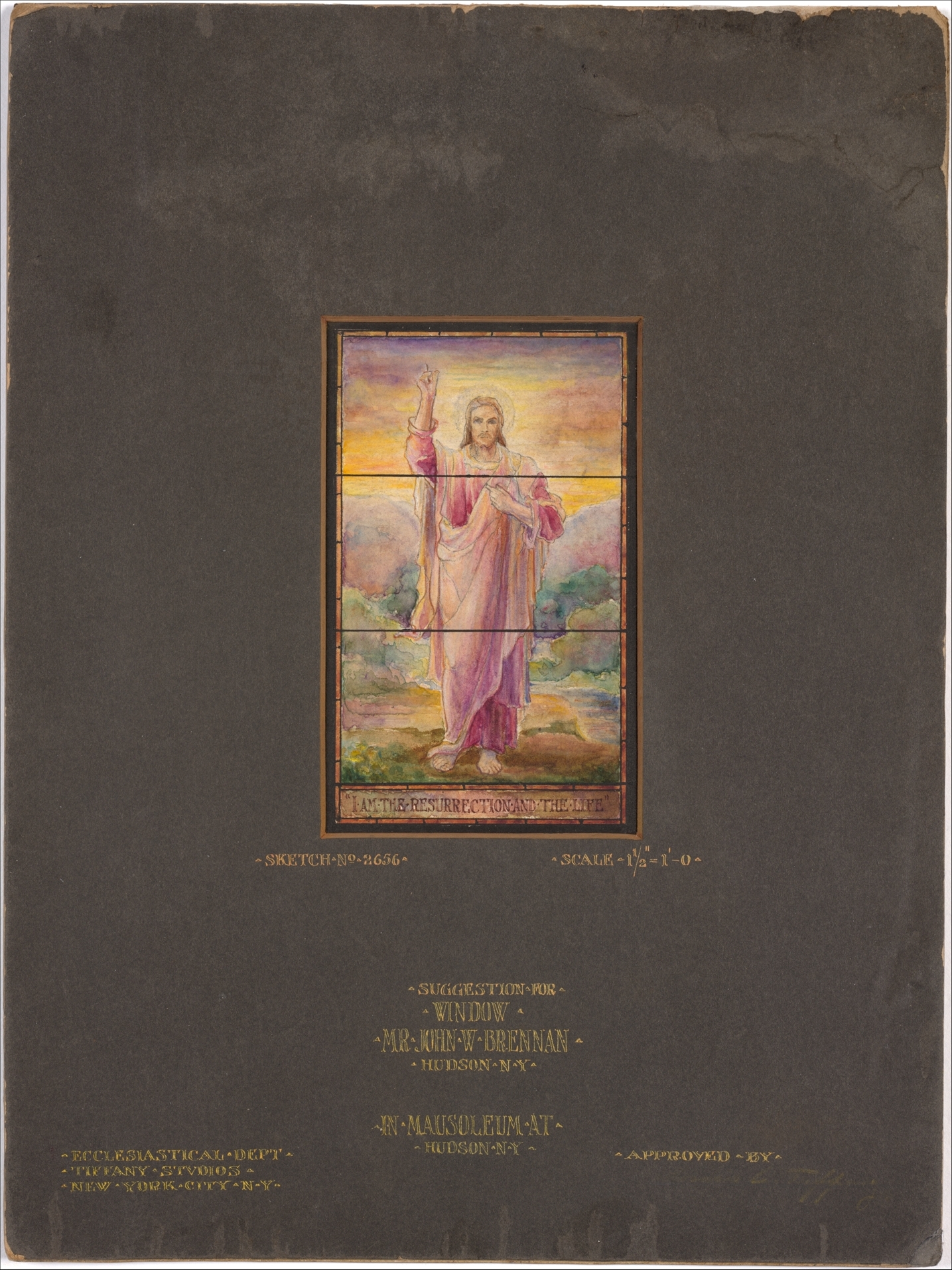
The Morse also records how the supervision actually worked, which is the part of the argument most often skipped. Tiffany maintained a design file of photographs, drawn from his own early work, from monuments that interested him and from his travels, and circulated it as source material to his designers. He visited the Corona glasshouse. He signed drawings. A presentation sheet from the Ecclesiastical Department in the Metropolitan Museum carries the printed words APPROVED BY above a signature, and a lighting drawing for the Bellevue Palace in Bern carries the word APPROVED and Louis C. Tiffany's own hand. That is a documented role, and it is neither authorship nor absence.
Chapter 7The other named hands
Driscoll is now famous and the rest of the studio is not, which distorts the picture in a second way.
Driscoll is now famous and the rest of the studio is not, which distorts the picture in a second way. The firm ran several design groups and the leaded shades were only one product of one of them.
Agnes Fairchild Northrop, born in Flushing on 20 April 1857 and dead at ninety-six on 14 September 1953, joined in the early 1880s and stayed close to fifty years, which is longer than anyone else discussed here. She briefly headed the Women's Glass Cutting Department before Driscoll took it over, and by the 1890s had her own studio and her own speciality: landscape and garden windows. Her Magnolia was shown at the Paris Exposition Universelle of 1900. Her Autumn Landscape is in the Metropolitan Museum, and the Metropolitan's Garden Landscape triptych, commissioned by Sarah B. Cochran for Linden Hall and unveiled in 2024, is attributed to her directly from a signed design drawing in the museum's own collection. That is the strongest class of evidence available in this field, and it is worth noting that it is a drawing, not a letter, and not a mark on the glass.
Frederick Wilson, 1858 to 1932, ran the Ecclesiastical Department from 1899. The figure windows and the great mosaic schemes are largely his, and the Rakow Research Library holds the Jeffrey Rush Higgins collection on Wilson, running 1885 to 1990 and containing commission letters, correspondence, church ephemera, scrapbooks and design drawings. That is one of the few places where the firm's client correspondence survives in quantity.
Joseph Briggs came from Accrington in Lancashire, emigrated at seventeen in 1891 and entered the firm in 1893. He rose to run the mosaic department and eventually became managing director, staying about forty years. Alice Carmen Gouvy, born in Cleveland around 1870-75 and a graduate of the Cleveland School of Art in 1894, and Lillian A. Palmie, born in Brooklyn around 1871-74 and at the firm by 1897, worked in the enamel and pottery department under Driscoll's direction; Palmie's twin sister Marion also worked for the firm. Julia Munson was Tiffany's first collaborator when he turned to jewellery, out of the enamels department. Will H. Low and Lydia Emmet were credited by name in 1893. Joseph Lauber, 1855 to 1948, and Edward P. Sperry, died 1925, are named by the Morse among the important designers.
Set that list beside the number of objects. The firm employed several hundred workers at Corona at its peak, and one account puts the artisan force above three hundred. Named designers account for a fraction of the labour. The people who selected the glass, cut it, foiled it, soldered it, cast the bronze and applied the patina are, with the exception of the women Driscoll happens to mention in letters home, anonymous and will stay that way.
Chapter 8What the firm actually sold
A modern reader arrives at Tiffany Studios through lamps, and lamps were a late and comparatively small part of the business.
A modern reader arrives at Tiffany Studios through lamps, and lamps were a late and comparatively small part of the business. The firm's first commercially produced leaded lamps date from about 1898 or 1899. By then it had been making windows for twenty years.
Its own 1913 publication, Character and Individuality in Decorations and Furnishings, is the clearest evidence of the range, because it was written to sell the whole service rather than one product. Its plates show a furniture showroom, a rug showroom hung with Persian and Chinese carpets, a stair hall lined with leaded windows and lit by floor lamps, a hall of desk sets and table lamps laid out like a department store, and a wrought-iron grapevine gate and arch executed by the firm. Tiffany Studios sold interior decoration entire: panelling, textiles, mantels, furniture, carpets, metalwork, lighting and glass, to one client, on one contract.
It also ran a memorial and monument business that is almost invisible in the modern literature. Out-of-Door Memorials: Mausoleums, Tombs, Headstones and All Forms of Mortuary Monuments, copyright 1898 by the Tiffany Glass and Decorating Company, is a full trade catalogue of carved stone: Celtic crosses, inscribed slabs, wheel-headed markers, mausolea. Another catalogue of the period advertises Tiffany favrile glass, Tiffany windows, Tiffany mosaics, Tiffany monuments and Tiffany granite in a single title. A firm that will sell you a granite headstone is not a studio in the artistic sense; it is a contractor with a design department.
The ecclesiastical work was the volume business and remains the largest surviving body of material. The Tiffany Census, an independent project begun in January 2015 and completed in its development phase by August 2016, records Tiffany glass in publicly viewable buildings, mainly churches, and currently lists 1,551 sites and 3,961 individual items, with 2,930 item photographs and 687 photographs of signatures. It is built from the firm's own published lists of 1886, 1893, 1897 and 1910 and from Alastair Duncan's Tiffany Windows of 1980, supplemented by newspaper archives. No source consulted here gives a defensible total for how many windows the firm made. The census counts what can still be found and stops there, which is the correct behaviour and the reason it is worth citing.
Chapter 9Corona, and the two Manhattan addresses
The firm had a factory and a shop front and they were nine miles apart, which is the physical fact behind the division of labour.The Corona complex stood at the corner of 43rd Avenue and 97th Place...
The firm had a factory and a shop front and they were nine miles apart, which is the physical fact behind the division of labour.
The Corona complex stood at the corner of 43rd Avenue and 97th Place in Queens and ran from 1893 to about 1930. It began as the Stourbridge Glass Company, later Tiffany Furnaces, making sheet and blown glass to formulas developed by its own chemists. A decorative enamel department and a pottery studio were added by 1900. A brick complex alongside, operating as the Allied Arts Company and then as Tiffany Studios, housed woodworking shops, the lampshade and chandelier departments, a foundry and a metal shop. Furniture, lighting, desk accessories, elevator doors and monumental sculpture came out of it as well as glass. Several hundred worked there at peak. Doros records that the glasshouse was destroyed by fire in 1893, the year it opened.
In Manhattan the Tiffany Glass Company took a lease on 5 March 1887 on 333-335 Fourth Avenue, an Italianate loft of about 1861 that had been advertised for storage and light manufacturing. The Tiffany Chapel was shown there after the 1893 Chicago exposition, and a 112-foot mosaic frieze for Chicago's Marquette Building, containing 200,000 pieces of glass and 10,000 pieces of pearl, was assembled there in 1895. In 1905 the firm moved to larger quarters at the former Knickerbocker Athletic Club at the south-east corner of Madison Avenue and 45th Street, addressed 347-355 Madison Avenue, and it is that building which appears as the frontispiece of the 1913 catalogue captioned simply Tiffany Studios, showrooms and general offices. The bankruptcy petition of 1932 gives the address as 391 Madison Avenue.
The Corona site is now a school. The Fourth Avenue building survived, took the Fifth Avenue Auction Rooms on its lower floors after 1905, housed the Schola Cantorum from 1919 to 1922 and was converted to co-operative apartments by 1981. It still stands as 333-335 Park Avenue South.
Chapter 10The division of labour, and where a name could have been recorded
A leaded shade began as a full-size coloured pattern on paper.
A leaded shade began as a full-size coloured pattern on paper. The pattern was cut into numbered templates. Glass was selected against the design from stock, cut to the templates, wrapped at the edge in thin copper foil and assembled over a wooden mould, then soldered on both faces and patinated. The metal ring at the lower rim, carrying the die-struck mark and the mould number, went on last.
Under the 1903 settlement, the women of Driscoll's department did the designing, the glass selection and the cutting, and the men assembled the lamps. The New-York Historical Society's gallery states the geographical version of the same split: the women worked in Manhattan and the men assembled in Queens. Men handled geometric shade designs; the floral work went to the women.
The point of setting this out is to be exact about where an attribution could have come from and did not. Four separate documents in the sequence carried numbers: the pattern, the template set, the mould and the finished shade rim. None of them carried a designer's name. The firm numbered its designs meticulously and its people not at all, and that was a decision rather than an oversight. It is also why the recovery of any name at all has had to come from outside the firm's paperwork, from a family correspondence, a signed presentation drawing, an exhibition pamphlet or a stamp on a watercolour from the enamel department.
Chapter 111932
The taste turned against the firm before the money did.
The taste turned against the firm before the money did. The aesthetic of the 1920s wanted plain surfaces and Tiffany would not change his designs to meet it; a contemporary judgement quoted in the trade literature is that he had been oversold and had become an old-fashioned cliche. Production at Corona declined through the 1920s and the works closed around 1930. Tiffany himself had retired from Tiffany Studios in 1919, the year before the Louis Comfort Tiffany Foundation was created.
Tiffany Studios filed its bankruptcy petition on 16 April 1932 from 391 Madison Avenue; the New York Times carried it the following day. Liabilities are reported at 481,595 dollars against assets of 315,907 dollars, a spread that is modest by the standards of 1932 and tells you the firm was illiquid rather than hollow. A successor entity, the Louis C. Tiffany Studios Corporation, was announced on 20 June 1932. Louis Comfort Tiffany died on 17 January 1933, aged eighty-four.
The dispersal took six more years. Sales continued from the West Twenty-Third Street premises until 1938, when the corporation was liquidated by Lester Dutt and Associates of Washington and the studio's contents were auctioned ahead of demolition. Former employees formed Westminster Memorial Studios at 148 West 23rd Street to finish the outstanding stained-glass commissions, which is how a number of windows installed after 1938 come to be Tiffany designs made by a firm of another name. The Roman Bronze Works, which had been a subcontractor to the firm, regained ownership of the foundry side; John Polachek later bought Roman Bronze Works and merged it into the General Bronze Corporation, which became the largest bronze fabricator in New York.
One private act of salvage in the same window matters more than any of this. Between 1932 and 1933, Joseph Briggs shipped more than three crates of Tiffany glass and decorative objects from New York to his home town of Accrington in Lancashire. The Haworth Art Gallery there holds the result: sixty-nine glass vases, seven mosaic samplers, seven watercolour designs on paper, fifty glass tiles, further glass products and five ceramic vases. Accrington opened its first Tiffany exhibition in the 1970s, when Art Nouveau came back into fashion, and the collection is on display today. It exists because the managing director of a bankrupt New York firm sent the stock home.
Chapter 12Where the paper went
The claim that Tiffany Studios' records were destroyed when the firm closed is repeated everywhere and is broadly right, but it is too blunt to be useful.
The claim that Tiffany Studios' records were destroyed when the firm closed is repeated everywhere and is broadly right, but it is too blunt to be useful. What was destroyed was the operational archive: the order books, the design ledgers, the payroll. What survives is scattered, and a researcher needs the map more than the obituary.
The Charles Hosmer Morse Museum of American Art in Winter Park holds what the Corning librarians call the richest body of Tiffany material anywhere, including letters, photographs, business records and other documentation, and describes its own archives as internationally recognised and a significant part of the collection's importance. It showed a selection as Stories from the Archives: Louis Comfort Tiffany and His Studios from 15 October 2019 to 13 February 2021, built around the progression from studio process to finished object.
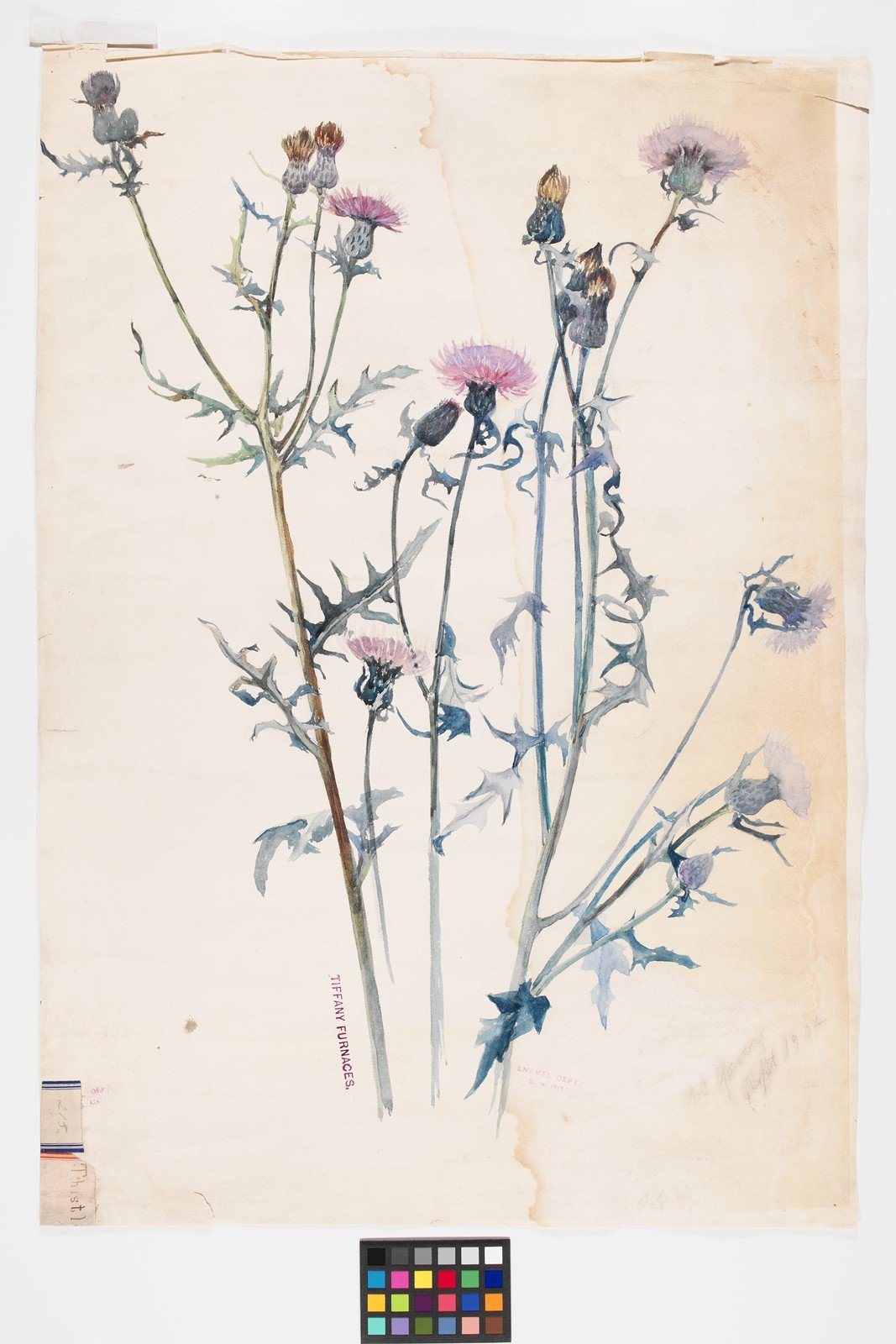
The Rakow Research Library at Corning holds documents and drawings from Tiffany Studios, the Tiffany Glass and Decorating Company and Tiffany Furnaces; the Arthur J. Nash and Leslie H. Nash collection acquired at auction in 2004, which includes the glass formulas; the Jeffrey Rush Higgins collection on Frederick Wilson; and eight original Tiffany design watercolours, of which five are signed by Alice C. Gouvy and two by Lillian A. Palmie. All eight carry the Tiffany Furnaces stamp, five carry the stamp of the Enamel Department of the Stourbridge Glass Company and three are dated 1902. They were water-damaged, most probably in the Corning flood of 1972 when Hurricane Agnes struck, and were conserved in 2007 by Michele Philips at the Westlake Conservators in Skaneateles, New York. Two of them, Thistle and Marsh Marigold, travelled with the New-York Historical Society's Driscoll exhibition.
The Driscoll correspondence itself sits in two places, the Queens Historical Society in Flushing and the Kelso House Museum Collection at Kent State University Library Special Collections in Ohio. The Neustadt Collection of Tiffany Glass in Long Island City holds the firm's flat glass, described by the organisation as nearly half a million pieces and in one published account as more than a quarter of a million, which functions as a physical reference archive rather than a paper one. The New-York Historical Society holds the Neustadt gift of lamps and windows. The Metropolitan Museum holds design drawings, cartoons and presentation sheets. And the firm's own printed catalogues, digitised from library copies, are now the most accessible surviving record of what it sold and what it charged.
Laurelton Hall, Tiffany's own house, is a separate loss with its own chronology. The eighty-four-room mansion on 600 acres was completed in 1905 at a construction cost given as around two million dollars. The Foundation ran a residential art school there from 1918. The contents went to Parke-Bernet Galleries on 24 to 28 September 1946, with lesser objects through the Coleman Galleries and by private sale, and the house itself was sold on 9 January 1949 for 10,000 dollars. It burned on 6 March 1957. Hugh McKean, who had been a student at Laurelton Hall in 1930, and Jeannette Genius McKean bought the right to salvage what was left and shipped it to Winter Park; the Morse Museum opened a 6,000-square-foot Laurelton Hall gallery in 2011. The Metropolitan Museum has the loggia.
Chapter 13Forgotten, then priced
The reputational collapse was total and it is documented in prices.
The reputational collapse was total and it is documented in prices. Within three years of the bankruptcy, dealers were breaking leaded shades for the lead. Egon Neustadt, a Queens orthodontist, bought his first Tiffany lamp with his wife Hildegard in 1935, a Daffodil from a second-hand shop in Greenwich Village, for 12 dollars 50; Winterthur estimates that lamp today at 35,000 to 60,000 dollars. Lamps went to the attic or the junk man.
Rehabilitation began with the reassessment of Art Nouveau in the 1940s. The Carnegie Institute in Pittsburgh mounted the first sympathetic public exhibition in 1956. The Museum of Contemporary Crafts in New York showed 300 objects in 1958, of which only eight were lamps, which is a precise measure of where lamps then stood in the hierarchy. The first major sale of Tiffany glass, by Coates-Connelly in 1966, contained no lamps at all.
The 1970s turned it. Neustadt published The Lamps of Tiffany in 1970, the book that gave the field its nomenclature; its nine sections classify shades by motif, floral or geometric, and by shape, and the categories in use today, including the globular shade with an irregular lower border and the shade with irregular upper and lower borders replacing the aperture with an openwork crown, are his and not the firm's. Tiffany Studios never classified its lamps that way. A Wisteria made 14,000 dollars in the early 1970s. By the 1980s a Wisteria was 150,000 to 200,000 dollars and by the 1990s 300,000 to 500,000. The John W. Mecom Jr. collection of 1995 was the largest important group to reach the market. In December 1997 a Lotus lamp at Christie's New York took the field into seven figures for the first time.
Two things follow from that arc. The first is that the modern Tiffany market is barely fifty years old, and everything in it was priced by people who could remember when the objects were worthless. The second is that the reproduction industry began in exactly the same decade as the price rise, for exactly that reason.
Chapter 14The market, with the hammer problem stated
Every headline figure in this field is a total including the buyer's premium, and no auction house consulted here publishes the hammer separately.
Every headline figure in this field is a total including the buyer's premium, and no auction house consulted here publishes the hammer separately. That is the house convention and it is not going to change, so a reader comparing a Tiffany result with a hammer-only figure from another market is comparing two different numbers. Where a figure below is premium-inclusive it says so; where the hammer is unpublished it says that too.
The lamp record has moved four times in twenty-eight years. On 12 December 1997 Christie's New York sold a Lotus lamp, lot 200, for 2,807,500 dollars including premium against an estimate of 2.5 to 3.5 million, a world record then for any twentieth-century decorative arts object. On 13 December 2018 Christie's sold a Pond Lily of about 1903, lot 9, for 3,372,500 dollars including premium against 1.8 to 2.5 million. On 13 May 2021 Rago in Lambertville, New Jersey, sold lot 273, a monumental Dandelion lamp, for 3,745,000 dollars including premium against an estimate of 50,000 to 75,000 dollars, with eleven telephone bidders competing. On 11 December 2025 Sotheby's New York sold lot 209 of Dreaming in Glass, a Magnolia floor lamp of about 1910 attributed to Agnes Northrop, for a reported 4.4 million dollars against 2 to 3 million.
The Rago Dandelion deserves more than a line, because it is the most instructive result in the field. The lamp is one of only two known monumental examples, 29 and a half inches high, a hand-blown Favrile globe on a hammered and patinated copper base worked as the life cycle of a dandelion, the globe carrying a contoured pattern read as wind currents. It was commissioned for the Paris Exposition Universelle of 1900 and shown again at the Pan-American Exposition in Buffalo in 1901, then disappeared for a hundred and twenty-five years before surfacing in a Virginia estate, in a family that had owned it since the 1950s and whose father was an antiquarian dealer. Rago estimated it at 50,000 to 75,000 dollars. It made fifty times the low estimate. Any reader tempted to think this market is efficiently priced should hold that estimate in mind.
Lamps are not the ceiling. On 18 November 2024 Sotheby's New York sold the Danner Memorial Window in its Modern Evening Auction for 12,480,000 dollars including premium against an estimate of 5 to 7 million, after a bidding contest of six and a half minutes between three bidders; the winning bid was placed by telephone through Cassandra Hatton, the house's global head of Science and Pop Culture. The window was commissioned in 1913 for the First Baptist Church in Canton, Ohio, as a memorial to John and Terressa Danner, founding members of the congregation, and came from the collection of Alan Gerry. Sotheby's credits the design to Agnes Northrop working with Louis Comfort Tiffany. It is the auction record for any Tiffany Studios work and it is more than double the record for a lamp.
Single-owner Tiffany sales are now a fixture. On 12 June 2025 Sotheby's Masterpieces by Louis Comfort Tiffany, featuring the Ann and Robert Fromer Collection made 6.3 million dollars against an estimate of 3.6 to 5.6 million, 96 per cent sold by lot and nearly 60 per cent of lots above the high estimate, led by the Stillman Memorial Window at 2,390,000 dollars against 1.5 to 2.5 million.
One pattern is worth naming because the trade has been slow to. Of the four record-holding lamps since 1997, the Dandelion, the Pond Lily and the Lotus are attributed to Driscoll or to her department and the Magnolia to Northrop, and the record-holding window is Northrop's. The most expensive objects this firm ever made are now, on current attribution, the work of women whose names were not published in their lifetimes.
Chapter 15The reproduction problem, and the instrumental test
Two different things are called fakes and they need separating before anything sensible can be said about either.The first is the open reproduction.
Two different things are called fakes and they need separating before anything sensible can be said about either.
The first is the open reproduction. Tiffany-style leaded lamps have been a mass-market product since the 1970s, made in the United States by firms such as Meyda Tiffany, founded in that decade by Meyer Cohen, and since in China, India and Vietnam, with glass water-jet cut to standardised patterns and hand-assembled. Many use genuine copper foil and genuine art glass. They are sold as what they are and nothing about them is deceptive. The trade has been producing high-quality reproductions for more than fifty-five years and is producing them now.
The second is the object built or doctored to be sold as period, and it converges on the first over time. An honest reproduction loses its receipt, acquires an owner who does not know what it is, then a dealer who suspects, then a stamp. Because a stamp can be added at any point in an object's life, marks cannot police the boundary.
Since 2016 there is an instrumental test, and it is the most important development in Tiffany authentication since the letters. On 2 September 2016, Winterthur's Scientific Research and Analysis Laboratory took a portable X-ray fluorescence spectrometer to the Neustadt Collection and examined four lamps that all carried Tiffany Studios marks: two Grape library lamps and two Dragonfly shades, one genuine and one fake in each pair. Genuine Tiffany glass reads as lead-based with arsenic present in most colours; the solder is a lead and tin alloy containing arsenic; the bases are a copper, zinc and tin bronze. The fakes, dated by Winterthur to between 1975 and 2000 and attributed to unknown makers, showed glass with no lead at all, solder of zinc and tin with neither lead nor arsenic, and bases of copper and tin bronze with the zinc missing. Winterthur describes this as the first documented identification of the characteristic differences in the solder and the bases. It is non-destructive, it takes minutes, and it does not care what is stamped on the object.
The litigated cases show why that matters. In a suit filed in Federal Court in 2014, the collector Alfred A. Turner Jr. alleged that Lawrence Ludtka, trading as Larry's Antiques in Buffalo, New York, had taken 100,000 dollars from him for two lamps that were not Tiffany: a Geranium bought for 40,000 dollars in September 2012 and a Spider bought for 60,000 dollars in October 2012. Turner's account is that Sotheby's declined to offer the Spider for sale on suspicion that it was counterfeit and that a Tiffany appraiser then found both lamps fake. In a separate 2019 dispute over a lamp sold by the Pennington Gallery, an expert concluded that the lamp was without a shadow of a doubt not authentic. A related detection point recurs in the trade reporting and is worth carrying: a lamp presented as 1906 was shown to contain glass types not manufactured until the late 1980s and 1990s, together with a recently applied finish. Materials date themselves whatever the paperwork says.
The rule that follows is unglamorous and correct. For any Tiffany lamp without an institutional or auction-house history, the burden sits with the object, and it is discharged by the glass, the solder and the alloy rather than by the stamp.
Chapter 16Tiffany Studios is not Tiffany and Company
This confusion is not a pedantic footnote; it produces wrong valuations, wrong catalogue entries and wrong insurance schedules, and it deserves to be stated once without hedging.Tiffany and Company...
This confusion is not a pedantic footnote; it produces wrong valuations, wrong catalogue entries and wrong insurance schedules, and it deserves to be stated once without hedging.
Tiffany and Company is a jewellery and silver house founded by Charles Lewis Tiffany, 1812 to 1902. Tiffany Studios and its predecessors were run by his son, Louis Comfort Tiffany, 1848 to 1933, and made glass, windows, mosaics, lighting, metalware, pottery, enamels and interior decoration. They were separate corporations with separate premises, separate marks and separate accounts. A mark reading TIFFANY AND CO. on a piece of silver has nothing to do with the firm described on this page, and a base reading TIFFANY STUDIOS NEW YORK has nothing to do with the jeweller.
What is true is that the two were entangled by family, by finance and by marketing, and the Morse Museum says so directly. Louis Tiffany's financial backers, principally his father, were called on repeatedly to keep his companies solvent. The family connection secured him prominence at international expositions, where his firms always exhibited alongside Tiffany and Company, and he used the name his father had built to sell his own wares. Charles Lewis Tiffany died on 18 February 1902 and Louis became the jeweller's first design director, or art director, in that year; the two titles are used interchangeably in the sources and one account places his appointment as chief jewellery design director in 1907. The two dates are not necessarily in conflict, since the roles are described differently, but no source consulted here reconciles them and neither should be quoted as settled.
His own remark, reported by the Morse Museum, is the best short account of how he ran the enterprise: go after the money there is in art, but the art will be there just the same. It is the sentence of a man who built a marketing machine and then let the art win, which is roughly what the balance sheet of April 1932 records.
What is documented
Technique
The surviving work
- What is accepted
- There is no accepted count and there cannot be one, because the firm made catalogue models in editions whose sizes were never published and its production records do not survive. Alastair Duncan's Tiffany Lamps and Metalware, 2019 edition, illustrates more than two thousand models and cross-references them to the firm's original model numbers and descriptions; its publisher describes it as the closest thing to a record of the firm's output, since Tiffany Studios never published a catalogue raisonne. For architectural glass, the independent Tiffany Census lists 1,551 sites and 3,961 items in publicly viewable buildings as of consultation. Both count designs or surviving installations, not objects made.
- What is contested
- Attribution of design, not of manufacture, is what is contested, and the movement has been almost entirely in one direction since 2007. More than thirty shade designs have moved from Louis Comfort Tiffany to Clara Driscoll on the evidence of her letters, and museums including Cleveland, Toledo, Crystal Bridges and the Dayton Art Institute now carry her as designer on their catalogue records. Agnes Northrop has taken the Magnolia floor lamp and the Danner Memorial Window, in the latter case on a signed design drawing. The unresolved class is much larger than the resolved one: every shade model of after 1903 fell within the exclusive design remit of Driscoll's department, which supports a departmental attribution but names no individual. The Morse Museum's published position is that the letters, while invaluable, are the account of one employee and cannot carry the whole history.
- Who rules on attribution
- No active authentication board and none recorded as having existed. Attribution of manufacture rests with auction-house specialist departments, with the Neustadt Collection in Long Island City, whose archive of original Tiffany flat glass functions as the physical reference standard, and since 2016 with instrumental analysis; Winterthur's portable X-ray fluorescence protocol on glass, solder and base alloy is the first published test that does not depend on connoisseurship or on the mark. Attribution of design rests with the scholarly literature and with individual museum curatorial files, which is why the same model can carry different designer lines at different institutions.
Catalogue raisonne
- Alastair Duncan, Tiffany Lamps and Metalware: An Illustrated Reference to Over 2000 Models, ACC Art Books, 2019 edition. The standard reference for models. Not a catalogue raisonne of objects: it indexes designs and the firm's own model numbers and descriptions, and the 2019 edition adds 245 pictures of pieces that have resurfaced on the market, together with reproductions from Tiffany sales brochures and advertisements. Tiffany Studios never published a catalogue raisonne and no complete one exists.27
- Alastair Duncan, Tiffany Windows, 1980, incorporating A Partial List of Tiffany Windows compiled from three of the firm's own publications covering work made before 1911. The foundation of every subsequent window census. Its title states the limitation: partial. The Tiffany Census is built on it.2123
- Egon Neustadt, The Lamps of Tiffany, 1970. Not a catalogue but the source of the nomenclature. Its nine sections classify shades by motif, floral or geometric, and by shape, including the globular shade with an irregular lower border and the shade with irregular upper and lower borders. The categories are Neustadt's, not the firm's; Tiffany Studios did not classify its lamps this way.16
- Martin Eidelberg, Nina Gray and Margaret K. Hofer, A New Light on Tiffany: Clara Driscoll and the Tiffany Girls, New-York Historical Society, 2007. The publication that moved the attributions. Built on the Driscoll correspondence found in 2005 and on design drawings; it documents Alice Gouvy and Lillian Palmie as well as Driscoll. It is an argument about authorship, not a corpus.912
- Robert Koch, Rebel in Glass and Louis C. Tiffany's Glass, Bronzes, Lamps. The earlier standard, and the source of the year-by-letter tables used to date blown Favrile registry numbers.623
Questions about Tiffany Studios, New York
Who was Tiffany Studios, New York?
Glasshouse; Leaded-glass window maker; Lampshade manufacturer; Mosaicist; Bronze foundry and metalware manufacturer; Interior decorating firm; Memorial and monument contractor; Enameller and potter. 1902-1932 under that name; the chain of Tiffany firms runs 1878-1938.
When did Tiffany Studios, New York live?
Born Incorporated 25 February 1902; consolidated with the Tiffany Glass and Decorating Company and the Allied Arts Company on 18 November 1902, New York City. Showrooms and offices in Manhattan; glasshouse, foundry, metal shop, woodworking shops and lamp and chandelier departments at Corona, Queens; died Filed for bankruptcy 16 April 1932. A successor, the Louis C. Tiffany Studios Corporation, was announced 20 June 1932 and its contents were liquidated through 1938. Louis Comfort Tiffany died 17 January 1933, New York City; the last address was 391 Madison Avenue.
How are fakes and misattributions of Tiffany Studios, New York detected?
The Winterthur pairs, examined 2 September 2016. Four lamps from the Neustadt Collection, all bearing Tiffany Studios marks: two Grape library lamps and two Dragonfly shades, one genuine and one fake in each pair. The fakes are dated by Winterthur to 1975-2000 and their makers are unknown.
Where can you see work by Tiffany Studios, New York?
The Charles Hosmer Morse Museum of American Art (Winter Park, Florida); The Neustadt Collection of Tiffany Glass (Long Island City and Queens, New York); New-York Historical Society (New York); Rakow Research Library, Corning Museum of Glass (Corning, New York); The Metropolitan Museum of Art (New York); Haworth Art Gallery (Accrington, Lancashire).
What does the market for Tiffany Studios, New York look like?
Every published Tiffany result is a total including the buyer's premium, and no house consulted here separates the hammer. That single convention makes cross-market comparison unreliable and it is the first thing to fix in any file.
What is still unresolved about Tiffany Studios, New York?
How many lamps and windows did the firm actually make? No source consulted gives a defensible figure, because the production records do not survive.
Open questions
- How many lamps and windows did the firm actually make? No source consulted gives a defensible figure, because the production records do not survive. Duncan counts more than two thousand models; the Tiffany Census counts 3,961 surviving items at 1,551 sites. Neither is a total.
- Which individual women of the Glass Cutting Department designed which post-1903 shade models? The 1903 settlement establishes that the department designed them all. The letters name Driscoll's own inventions. Everything between those two statements is unattributed.
- Did Tiffany Studios credit individuals more often than the standard account allows? The Morse Museum cites the firm's own 1893 Synopsis naming Will H. Low and Lydia Emmet, seven years before the Paris disclosure usually described as unique. The firm's other publications have not been systematically searched for further credits in the sources consulted here.
- What did Clara Driscoll earn? Payroll gives 1,820 dollars a year. A 1904 newspaper piece on women earning 10,000 dollars is cited for her in some accounts and for Julia Munson in others. The primary newspaper item has not been read here.
- Which corporate chronology is right for the Tiffany Glass and Decorating Company? Corning gives 1892 to 1900 with consolidation on 18 November 1902; the Morse Museum gives 1892 to 1902. A mark alone therefore cannot distinguish 1900 from 1902 without settling this.
- What became of the firm's order books and design ledgers? The standard statement is that the records were destroyed when the firm closed. No source consulted describes the act, the date or who authorised it, and the survival of the Nash formula books, the Wilson correspondence and the Morse business records shows the destruction was not complete.
- What were the hammer prices behind the published totals? No auction house consulted publishes hammer separately for any Tiffany result cited on this page, including the 1997 Lotus, the 2018 Pond Lily, the 2021 Dandelion, the 2024 Danner Window and the 2025 Magnolia.
- How many objects made after 1938 by Westminster Memorial Studios are catalogued as Tiffany Studios? Former employees finished the outstanding stained-glass commissions under a new name. Any window installed after 1938 to a Tiffany design belongs to a category nobody has counted.
- Is the Magnolia floor lamp attribution to Agnes Northrop settled? Sotheby's credits her; one trade report describes the attribution as believed rather than established. No signed drawing for the lamp is cited, unlike the Garden Landscape window.
- How large was the workforce, precisely and when? Accounts give over three hundred artisans at Corona and several hundred workers at peak, without a payroll figure or a date. The firm's employment records have not been located.
Sources
- 1Corning Museum of Glass, Rakow Research Library, Ask a Glass Question, 'What are the major dates of Louis Comfort Tiffany's Tiffany Studios?'. Source for the incorporation, reorganisation, consolidation and dissolution dates of every Tiffany firm from 1878 to 1938. The answer cites the Charles Hosmer Morse Museum of American Art, Frelinghuysen's Louis Comfort Tiffany and Laurelton Hall, and Mayer and Lane, 'Disassociating the Associated Artists'. libanswers.cmog.org/faq/...
- 2The Charles Hosmer Morse Museum of American Art, 'Louis Comfort Tiffany and Tiffany Studios'. Source for the museum's corporate dates, for the statement that Tiffany publicly credited a number of individuals and named Will H. Low and Lydia Emmet in the firm's 1893 Columbian Exposition Synopsis, for the list of important designers, for the design file of photographs, for the observation that one employee cannot tell the whole story, and for the Tiffany quotation. NOTE: WebFetch returned HTTP 403; the page was read in the in-app browser on 3 August 2026. morsemuseum.org/louis-comfort-tiffany/...
- 3Wikipedia, 'Louis Comfort Tiffany', for the succession of firm names, the Favrile trademark of 13 November 1894, the Corona furnaces, Arthur Nash of Stourbridge, Laurelton Hall, the 1932 bankruptcy and the 1902 appointment as first design director of Tiffany and Company. TERTIARY. Flagged for replacement with Frelinghuysen and with Duncan. en.wikipedia.org/wiki/...
- 4Wikipedia, 'Tiffany glass', for the sheet-glass types (streamer, fracture, drapery), the Corona address and dates of 1901 to 1932, the 1932 bankruptcy, and the passage of the foundry to the Roman Bronze Works and thence to the General Bronze Corporation. TERTIARY. en.wikipedia.org/wiki/...
- 5Google Patents, US 237,418 A, 'Colored-Glass Window', Louis C. Tiffany, New York. Filed 25 October 1880, granted 8 February 1881. Source for the claim text and for the two companion patents US 237,416 and US 237,417 granted the same day. patents.google.com/patent/...
- 6Philip Chasen Antiques, 'Tiffany Studios numbering explained', 7 August 2009. Source for the Favrile registry number system, the prefix letters from A1 in 1894, the switch to suffix letters after Z9999, the year-by-letter tables attributed to Robert Koch, shape numbers on later pastels and compound late signatures. DEALER SOURCE, used for the numbering conventions only. blog.chasenantiques.com/2009/...
- 7antiquetiffanylamps.com, 'Tiffany Lamp Facts: Signatures, Authentication and Lamp Types'. Source for the base and shade mark wording and placement, the 1900-1928 range for TIFFANY STUDIOS NEW YORK, the alternative marks TGDCO, Tiffany Furnaces Inc. and Louis C. Tiffany Furnaces Inc., the estimate that about 90 per cent of authentic pieces carry the Tiffany Studios mark, the mould-number-on-rim against inventory-number-on-base distinction, the mixed-case test, and the statement that marks are added to imitations both during and after production. DEALER SOURCE. antiquetiffanylamps.com/lamp-facts
- 8Winterthur Museum, Garden and Library, 'Treasures on Trial: The Art and Science of Detecting Fakes', Tiffany case study. Source for the 2 September 2016 portable X-ray fluorescence examination of four marked lamps at the Neustadt Collection, the compositional differences in glass, solder and base alloy between genuine and fake, the 1975-2000 dating of the fakes, and the Neustadt collecting history including the 12 dollar 50 Daffodil of 1935 and its present valuation. treasuresontrial.winterthur.org/evidence/...
- 9Corning Museum of Glass, Behind the Glass blog, Marvin Bolt, 'May Flowers at the Rakow Library: Design Drawings by the Tiffany Girls', 9 May 2012. Source for the eight Tiffany drawings, their titles, the signatures of Alice C. Gouvy and Lillian A. Palmie, the TIFFANY FURNACES and Enamel Dept. S.G.Co. stamps, the 1902 dates, the dimensions of Thistle and Chestnut Leaves, the 1972 Hurricane Agnes flood damage and the 2007 conservation by Michele Philips, the biographies of Gouvy and Palmie, and Driscoll's statement that Tiffany generally approved her ideas. NOTE: WebFetch returned HTTP 403; read in the in-app browser on 3 August 2026. blog.cmog.org/2012/...
- 10Corning Museum of Glass, Rakow Research Library, Ask a Glass Question, 'Does the Rakow Research Library have Tiffany Studios / Tiffany Glass and Decorating Company archives?'. Source for the statement that papers relating to Tiffany and his firms are scattered across many libraries and collectors, for the Rakow holdings, for the Arthur J. Nash and Leslie H. Nash collection acquired at auction in 2004, for the Jeffrey Rush Higgins collection on Frederick Wilson 1885-1990, and for Wilson taking charge of the ecclesiastical department in 1899. libanswers.cmog.org/faq/...
- 11The Charles Hosmer Morse Museum of American Art, 'Stories from the Archives: Louis Comfort Tiffany and His Studios', 15 October 2019 to 13 February 2021. Source for the museum's description of its archives as internationally recognised and for the exhibition's framing of studio process against finished work. Read in the in-app browser on 3 August 2026. morsemuseum.org/on-exhibit/...
- 12Wikipedia, 'Clara Driscoll (glass designer)', for her dates of 15 December 1861 to 6 November 1944, the marriage bar and the three interruptions to her employment, Nina Gray's discovery at the Queens Historical Society, the exhibition opening of 27 November 2006 and the 2007 catalogue, the more than thirty designs, and the disputed 10,000 dollar salary claim. TERTIARY. Flagged for replacement with Eidelberg, Gray and Hofer, A New Light on Tiffany (2007). en.wikipedia.org/wiki/...
- 13Incollect, 'The Women of Tiffany Studios' by Margaret K. Hofer, Nina Gray and Martin Eidelberg. Source for the hundreds of letters at the Queens Historical Society and Kent State University Library, the department reaching thirty-five women, and the dated list of models attributed to Driscoll from the letters: Dragonfly 1898, Butterfly 1898, Cobweb before 1902, Peony about 1900-04, Wisteria about 1901, Arrowhead about 1904, Geranium and Daffodil. incollect.com/articles/...
- 14Journal of Antiques and Collectibles, 'The Tiffany Girls: Under the Glass Ceiling'. Source for the department growing from six in 1892 to thirty-five, for Driscoll's tenure of about 1888 to 1909, for the naming of Northrop, Gouvy and Munson, for the statement that Tiffany rarely spoke publicly of his designers and kept their contributions quiet, and for the attachment of the 10,000 dollar salary to Julia Munson rather than to Driscoll. journalofantiques.com/digital-publications/...
- 15The Neustadt Collection of Tiffany Glass, 'Tiffany in Queens'. Source for the Corona complex at 43rd Avenue and 97th Place, its dates of 1893 to about 1930, the several hundred workers, the Stourbridge Glass Company and Tiffany Furnaces, the enamel department and pottery studio added by 1900, the Allied Arts and Tiffany Studios brick complex with woodworking shops, lampshade and chandelier departments, foundry and metal shop, and the 1920s decline. theneustadt.org/learn/...
- 16Incollect, 'The Taste for Tiffany Lamps'. Source for the collapse in taste in the 1920s and 1930s, the 481,000 dollar bankruptcy liabilities, the Carnegie Institute exhibition of 1956, the Museum of Contemporary Crafts show of 1958 with 300 objects and eight lamps, the Coates-Connelly sale of 1966 with no lamps, Neustadt's 1970 book and its nomenclature, the early 1970s Wisteria at 14,000 dollars, the 1980s and 1990s ranges, and the John W. Mecom Jr. collection of 1995. incollect.com/articles/...
- 17Philip Chasen Antiques, 'Rago Auctions breaks the world record price for a Tiffany Studios lamp, May 13, 2021', 17 May 2021. Source for the Dandelion at 3,745,000 dollars including buyer's premium as lot 273 against an estimate of 50,000 to 75,000 dollars, for the 1900 Paris and 1901 Buffalo exhibition history, for the Truman-administration diplomat who acquired it in the 1940s and the family that stored it, for the shade's three star cracks, and for the previous record of 3,372,500 dollars set at Christie's New York on 13 December 2018 for a Pond Lily. DEALER SOURCE; used because it states explicitly which figures include the premium. blog.chasenantiques.com/2021/...
- 18Antiques and The Arts Weekly, 'Tiffany Masterpiece Windows Achieves $12.48 Million, Shatters Tiffany Auction Record'. Source for the Danner Memorial Window sold at Sotheby's New York on 18 November 2024 in the Modern Evening Auction for 12,480,000 dollars, the 1913 commission for the First Baptist Church in Canton, Ohio, the Danner memorial dedication, the attribution to Louis Comfort Tiffany and Agnes Northrop, the six-and-a-half-minute contest between three bidders, and the winning telephone bid taken by Cassandra Hatton. antiquesandthearts.com/tiffany-masterpiece-windows-achiev...
- 19Daytonian in Manhattan, 'The Tiffany Studios Building, 333-335 Park Avenue South', October 2022. Source for the 1861 construction of the Fourth Avenue building, the lease taken on 5 March 1887, the 1892 reorganisation, the display of the Tiffany Chapel after the 1893 Chicago exposition, the 112-foot Marquette Building frieze of 1895 with 200,000 pieces of glass and 10,000 of pearl, the 1905 move to the former Knickerbocker Athletic Club at Madison Avenue and 45th Street, and the building's later uses. daytoninmanhattan.blogspot.com/2022/...
- 20Paul Doros, tiffanystudios.org, 'Tiffany Chronology', copyright 2021. Source for the 1875 experiments at Thill's Empire State Flint Glass Works, the 1887 Tiffany Glass Company at 333-335 Fourth Avenue, the fifty-four medals at the 1893 World's Columbian Exposition and the destruction of the glasshouse by fire that year, the 1902 incorporation at 333-341 Fourth Avenue, Tiffany's retirement from Tiffany Studios in 1919 and the creation of the Foundation, and his death on 17 January 1933. A privately published chronology, used where it supplements rather than contradicts the Corning dates. tiffanystudios.org/tiffany-chronology.html
- 21Cambridge 2000, 'Tiffany Census'. An independent census of Tiffany stained glass, mosaics and related items in publicly viewable buildings. Source for the totals of 1,551 sites, 3,961 items, 2,930 item photographs and 687 signature photographs, for the methodology drawing on Tiffany's own publications of 1886, 1893, 1897 and 1910 and on Alastair Duncan's Tiffany Windows of 1980, and for the project's start in January 2015. cambridge2000.com/tiffany
- 22Wikipedia, 'Agnes Northrop', for her dates of 20 April 1857 to 14 September 1953, her arrival in the early 1880s and tenure of close to fifty years, her brief headship of the Women's Glass Cutting Department before Driscoll, her landscape and garden speciality, the Magnolia window shown at Paris in 1900, Autumn Landscape at the Metropolitan Museum, and the Garden Landscape triptych for Sarah B. Cochran attributed to her from a signed design drawing. TERTIARY. en.wikipedia.org/wiki/...
- 23leadedlamps.com, 'About Tiffany Studios'. Source for the named departments (lamp shop, mosaic department, metalworking shop, glass cutting), for Henry Salzer in the mosaic department, for the 1901 photograph of Driscoll and Joseph Briggs in a workroom, and for the bibliography of Robert Koch (Rebel in Glass; Glass, Bronzes and Lamps) and Alastair Duncan (Tiffany Glassware with Norman Porter and Douglas Jackson; Tiffany Windows; Tiffany at Auction). TRADE SOURCE. leadedlamps.com/abouttiffanystudios.html
- 24antiquetiffanylamps.blogspot.com, 'A Brief Tiffany Studios History and Tiffany and Company: A Distinction', December 2013. Source for the first commercially produced leaded lamps dating from about 1898-99 in time for the 1900 Paris exposition, for the factory employing over 300 artisans producing lamps, vases, scent bottles, tiles, windows and desk furniture, and for Joseph Briggs continuing the work to complete outstanding commissions. DEALER SOURCE; the dates it gives for the end of the firm differ from the Corning chronology and the Corning dates are followed here. antiquetiffanylamps.blogspot.com/2013/...
- 25Lillian Nassau LLC, 'Tiffany Studios vs. Tiffany and Co.'. Cited for the dealer trade's own statement that the answers to whether Tiffany lamps were made by Tiffany and Company and whether Louis Comfort Tiffany designed jewellery for it are not as straightforward as one would like. The page defers its answers to a video and supplies no further detail; it is recorded here as evidence that the confusion is live in the trade rather than as a source of fact. DEALER SOURCE. lilliannassau.com/features/...
- 26Courthouse News Service, 'Collector Says Dealer Sold Phony Tiffany Lamps'. Source for the 2014 federal suit by Alfred A. Turner Jr. against Lawrence Ludtka trading as Larry's Antiques of Buffalo, New York, over a Geranium lamp bought for 40,000 dollars in September 2012 and a Spider lamp bought for 60,000 dollars in October 2012, Sotheby's refusal to offer the Spider, and the appraiser's finding that both were fake; also for the 2019 Pennington Gallery dispute and for the lamp presented as 1906 containing glass types not manufactured until the late 1980s and 1990s together with a recently applied finish. NOT FETCHED: WebFetch returned HTTP 403 and the in-app browser refused the domain. The content is reported here from search indexing of this page and of related coverage and should be confirmed against the docket. courthousenews.com/collector-says-dealer-sold-phony-tiffa...
- 27Alastair Duncan, Tiffany Lamps and Metalware: An Illustrated Reference to Over 2000 Models, ACC Art Books, 2019 edition, ISBN 9781788840309. Bibliographic entry taken from publisher and retailer listings, which state the figure of over 2,000 models, the cross-referencing to the firm's original model numbers and descriptions, the 245 additional pictures of pieces resurfacing on the market, and the inclusion of reproductions from Tiffany sales brochures and advertisements. NOT READ: the book itself has not been consulted here and the record should be checked against it. amazon.com/Tiffany-Lamps-Metalware-illustrated-reference/...
- 28Driehaus Museum, Chicago, 'Tiffany Lamps: Beyond the Shade', 12 September 2025 to 19 April 2026. Source for the exhibition dates and contents, drawing on the museum's collection and the Richard H. Driehaus collection now held by the Art Exhibition Lending Foundation. Note that a Preservation Chicago notice gives the closing date as 15 March 2026 while the museum's own page gives 19 April 2026; the museum's date is followed here. driehausmuseum.org/exhibition/...
- 29Great British Life, 'Joseph Briggs: the Accrington link to the world famous Tiffany glass'. Source for Briggs emigrating at seventeen in 1891, entering Tiffany Studios in 1893, rising to run the mosaics department and to become managing director over about forty years, and for the more than three crates shipped to Accrington between 1932 and 1933 comprising 69 glass vases, seven mosaic samplers, seven watercolour designs on paper, 50 glass tiles, further glass products and five ceramic vases now at the Haworth Art Gallery. NOT FETCHED DIRECTLY: reported from search indexing of this page and of the Hyndburn Borough Council collection page, and flagged for confirmation. greatbritishlife.co.uk/magazines/...
- 30Tiffany Studios, Character and Individuality in Decorations and Furnishings, New York 1913. The firm's own illustrated catalogue, digitised by the Internet Archive from a library copy. Source for the plates of the showrooms and general offices, the furniture showroom, the rug showroom, the stair hall and the wrought iron arch, and for the caption text carried on each plate. archive.org/details/...
- 31Antiques and The Arts Weekly, 'Rago Sets Tiffany Studios Auction Record With Dandelion Lamp At $3.7M'. Source for the lot description at 29 1/2 in. high, the hand-blown Favrile globe shade on a hammered and patinated copper base, the dandelion life-cycle imagery and the contour pattern read as wind currents, the oxidised and patinated copper of the base, the brass-strip blossoms and silver or white metal seed puffs, the eleven telephone bidders, the estimate of 50,000 to 70,000 dollars, the confirmation that the 3,745,000 dollar figure includes the buyer's premium, and the provenance from the 1900 Paris and 1901 Buffalo expositions through 125 untraced years to a Virginia estate held since the 1950s. antiquesandthearts.com/rago-sets-tiffany-studios-auction-...
- 32Sotheby's, 'Masterpieces by Louis Comfort Tiffany, Featuring The Ann and Robert Fromer Collection', New York, 12 June 2025. Source for the sale total of 6.3 million dollars against an estimate of 3.6 to 5.6 million, 96 per cent sold by lot, nearly 60 per cent of lots above the high estimate, and the Stillman Memorial Window at 2,390,000 dollars against 1.5 to 2.5 million. Figures reported from search indexing of the sale's digital catalogue and results pages; the public lot pages do not display results without a login. sothebys.com/en/...
- 33Wikipedia, 'Laurelton Hall', for the eighty-four rooms on 600 acres completed in 1905, the construction cost of about two million dollars, the Foundation's residential art school from 1918, the 1949 sale for 10,000 dollars, the 1957 fire, the McKean salvage and its removal to Winter Park, the Metropolitan Museum's 2006 exhibition and the Morse Museum's 6,000-square-foot Laurelton Hall gallery of 2011. TERTIARY. The 1946 Parke-Bernet dates of 24 to 28 September and the sale date of 9 January 1949 are reported from search indexing of the Morse Museum's Laurelton Hall page, which returned HTTP 403 to direct fetch and could not be loaded in the in-app browser. en.wikipedia.org/wiki/...
- 34Sotheby's, lot 209, 'An Important and Rare Magnolia Floor Lamp', from Dreaming in Glass: Masterworks by Tiffany Studios, featuring works from The Schur Family Collection, New York, 11 December 2025. Source for the estimate of 2 to 3 million dollars and the Northrop attribution; the realised figure of about 4.4 million dollars is reported in the trade press and the lot page does not display the result without a login. This sale is covered in detail in the separate Iconotheca record on the Tiffany Studios Lotus Lamp and is summarised here only for the record chain. sothebys.com/en/...
Last verified 17 September 2026