The Ru official kilns at Qingliangsi, Baofeng
 Chinese, Northern Song · active 1086-1125
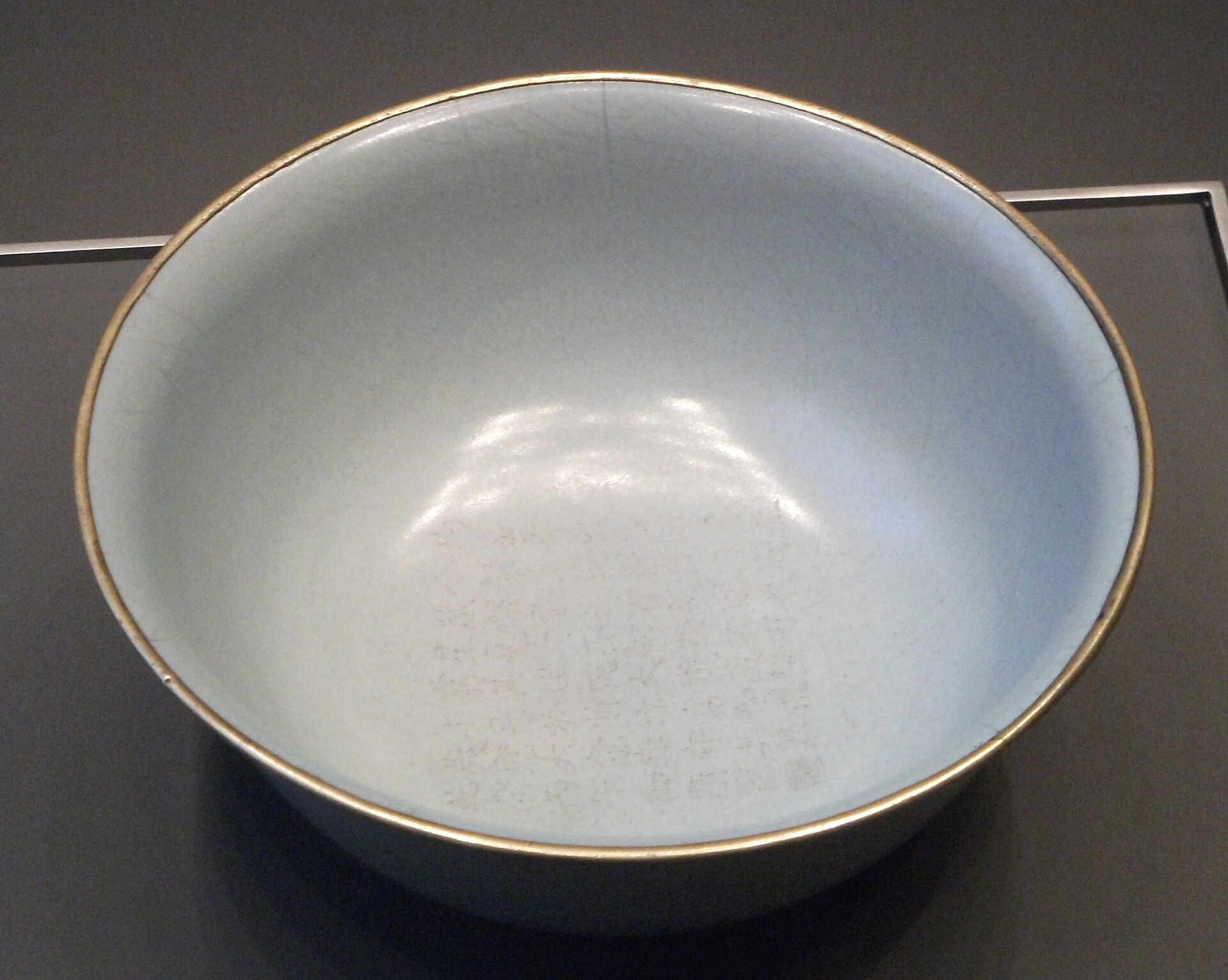
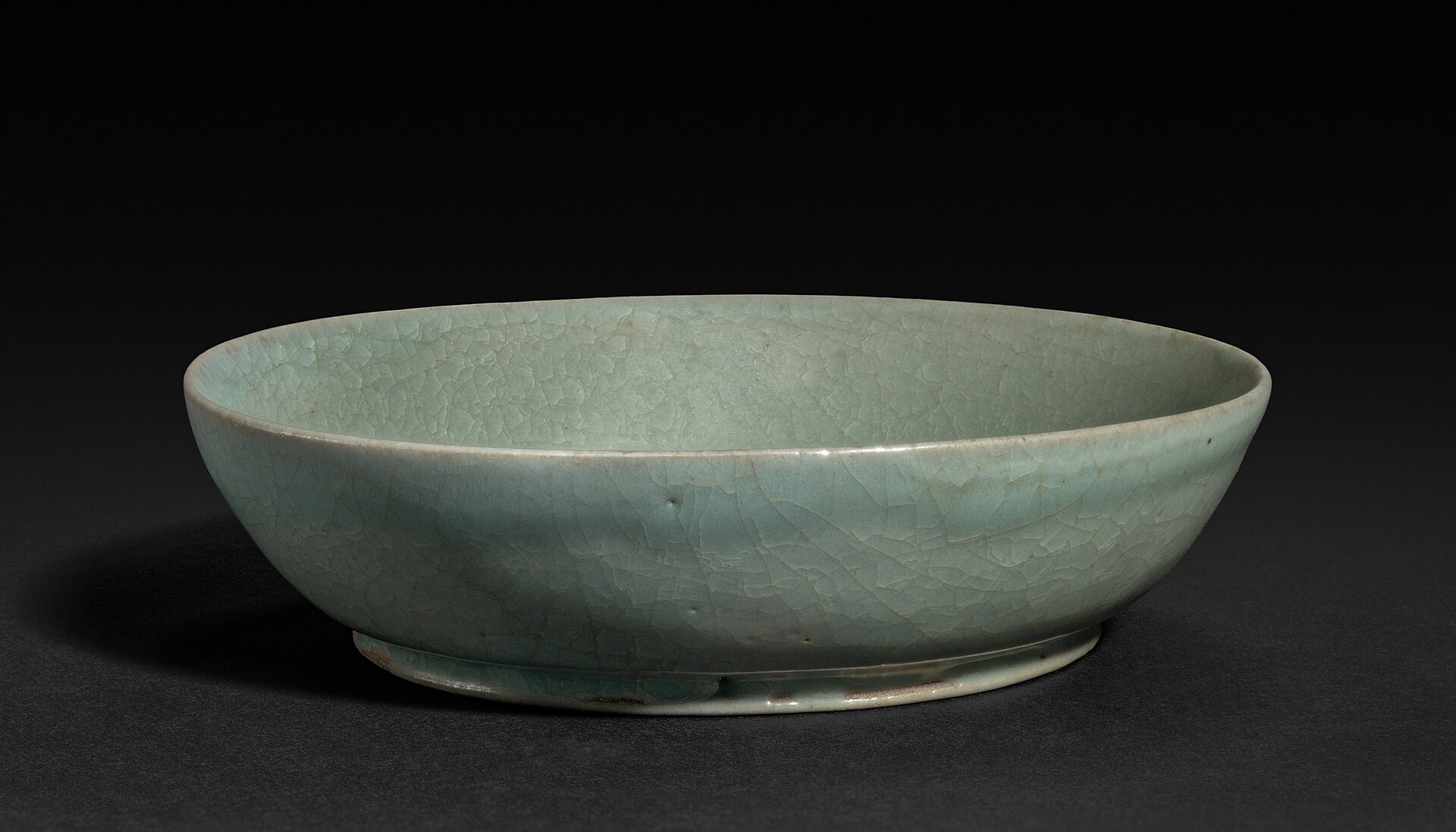
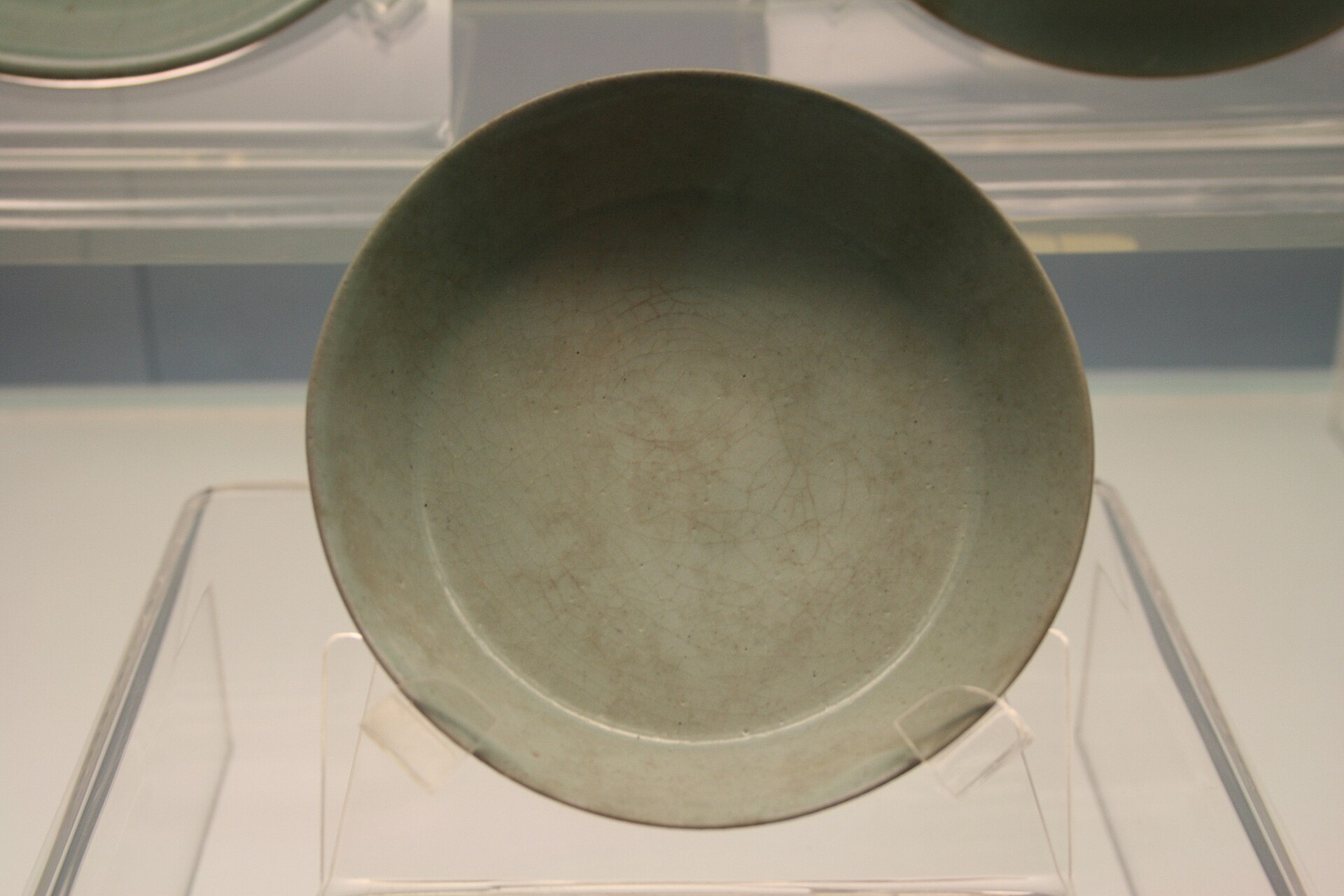
Ru bowl with metal rim and a poem in the well, Percival David Collection A Ru bowl with a metal rim, in Room 95 of the British Museum, with the incised inscription faintly visible in the well. The photograph's file page gives no accession number. Krahl's list has one Percival David bowl with a metal rim and a Qianlong inscription (no. 17, 17 cm, PDF.3); that match is my inference from the list and the photograph, not a museum statement. No verified portrait. No securely identified likeness of this maker is known under a free licence. We do not publish a face we cannot verify.
Sir Percival David Collection, British Museum; photograph Johnbod, CC BY-SA 4.0| Full name | Ru guanyao, the Northern Song official kilns at Qingliangsi, Baofeng county, Henan |
|---|---|
| Worked as | Court ceramic workshop, Celadon kiln |
| Nationality | Chinese, Northern Song |
| Movement | Northern Song court celadon (Ru ware) |
| Sources | 23 cited |
| Last verified |
About this page Last verified · 23 sources cited
On this page 13 sections
ContentsClose
The Ru official kilns made a bluish-green stoneware for the Northern Song court for about twenty years, perhaps forty, and then stopped when the Jurchen took the north in 1127. Nothing they made is signed and no potter is named. The Ru kilns are a place, an order from the court and a period. What survives is a list of about 87 to 89 vessels, most in four museums, and a mass of excavated sherds from Qingliangsi in Henan (1, 7, 10).
The reason the name carries what it carries is the list. For no other Song ware can the survivors be counted vessel by vessel, and the count has gone up chiefly by relabelling and not by digging: a bowl in Dresden catalogued as Korean was announced as the 88th piece in 2021, and a British Museum washer long held to be Korean was confirmed as Ru that October (12, 13). The 2017 sale of a 13 cm washer for HKD 294,287,500 with premium, HKD 260,000,000 at the hammer, was a sale of one of four heirloom pieces then in private hands (3, 4, 5, 6).
What a reader probably does not know is how much of the standard story rests on few and late sources. The commission, the agate and the sale of rejects are documented by texts of 1192 and after (10). The meaning usually read into the ware, an austere literati taste or a Chan ideal, is argued by named writers and not documented by anything from the kiln or the court (1, 7, 11).
Images
Chronology
- 1086-1106
Production period of Ru guanyao on the dating Krahl calls most likely, from Chen Wanli (1951). Rawson and Vainker, as reported by Wikipedia, give later or longer spans.120
- 1124
Xu Jing's account of his mission to Goryeo notes the likeness between Goryeo celadon and Ru, an independent date by which Ru existed.97
- 1127
The Jurchen take the northern part of the empire; the court loses access to the Ru kilns.1
- 1151
Zhang Jun presents the Gaozong emperor with a set of Ru vessels, recorded by Zhou Mi in Wulin jiushi.71
- 1192
Zhou Hui writes in Qingbo zazhi that only pieces the court rejected could be sold and that agate was used in the glaze.102
- 1388
- 1591
Gao Lian's Zun sheng ba jian is the first printed use of 'sesame seed' for the spur marks.1
- 1729
A Qing court inventory lists 31 Ru brush washers kept in lacquer boxes.27
- 1732
The Jiangxi tongzhi lists Ru-glaze copies ordered for the Yongzheng emperor at Jingdezhen.12
- 1786
Qianlong composes a poem on a Percival David bowl about how few bowls survive.10
- 1915
R. L. Hobson still writes that no authenticated Ru is known in Europe.2
- 1923
A fire in a Forbidden City storage hall damages porcelains; fifteen fire-damaged pieces are among the 87 now counted.1
- 1928
Percival David buys in New York a small washer he takes for Ru.1314
- 1935-1936
The London International Exhibition of Chinese Art shows ten Ru pieces lent by the Chinese government.1
- 1950-1987
Qingliangsi identified, matched by chemistry (1977), reported (1985) and first excavated (1987), by differing accounts.7121
- 1958-2009
Counts rise from 31 outside China (Gompertz 1958) to 65 (Wang 1987), 69 (1991) and 70 (Degawa 2009).1
- 1982
Sotheby's London sells the Le Cong Tang washer (15 June 1982, lot 252); it then enters the Chang Foundation, Taipei.111
- 2000
The Hongxi Museum, Taipei, sells ceramics during a property-market crisis; Cao Xingcheng buys a batch of Song porcelains including the washer.17
- 2000-2002
Sixth excavation uncovers the central firing area with a sherd layer 20 cm thick, over 98 per cent Ru.7
- 2012
Sotheby's Hong Kong sells the lobed Alfred Clark washer for about HKD 208 million with premium; Krahl counts 79.221
- 2014
Henan institute excavates a furnace and 'Ru-type' wares near the central firing area.1615
- 2015
Palace Museum Beijing publishes a list of 90 pieces.1
- 3 October 2017
Le Cong Tang washer hammers at HKD 260,000,000, HKD 294,287,500 with premium; Krahl's list counts 87.361
- February 2021
A Ru bowl in Dresden, catalogued as Korean, is announced as the 88th known piece.12
- October 2021
The British Museum announces that a Percival David washer long held Korean has been confirmed as Ru by hand-held XRF.1314
- November 2025
Sotheby's offers a unique Ru bowl in bo form (Hong Kong) and a kintsugi-repaired washer (London); results not available.1011
The market
Almost nothing is for sale. Krahl lists six vessels at auction since 1940 and Sotheby's 2025 note says fewer than ten; the main events are the 2012 lobed washer and the 2017 round washer. The 2017 piece fetched HKD 260,000,000 at the hammer and HKD 294,287,500 with premium (3, 6). 2012 was about HKD 208 million with premium, hammer not found (22). Smaller and repaired pieces were offered in 2025 at far lower estimates, but results were not available (10, 11). The price moves with glaze quality, shape, condition and provenance, in that order on the evidence of Krahl's own comments (1, 2).
| Date | Sale | Work | Result | Note |
|---|---|---|---|---|
| 4 April 2012 | Sotheby's Hong Kong | Lobed brush washer, Mrs Alfred Clark collection, sale HK0367 lot 101 | Hammer Not found With premium About HKD 208,000,000 (blog), HKD 207,860,000 (Wikipedia citing Sotheby's) HKD | Estimate HKD 60,000,000-80,000,000. Premium-inclusive. The figure has not been checked on a primary page. |
| 3 October 2017 | Sotheby's Hong Kong | Round brush washer 13 cm, Le Cong Tang, ex Chang Foundation, sale HK0747 lot 5 | Hammer HKD 260,000,000 (reported live in the room) With premium HKD 294,287,500 total with buyer's premium (HKD 34,287,500 derived by subtraction) HKD | About USD 37.7 million. Estimate upon request, briefed near HKD 100 million. Two bidders, 20 minutes. Buyer unnamed. |
Hammer is the price at which the bidding stopped; with premium adds the fee the house charges the buyer on top. Hammer price and buyer's premium in the glossary.
Recorded without a public price
- 22 November 2025 · Large Ru guanyao bowl, bo shape, 21.5 cm, Okada Museum of Art, lot 1013 · Sotheby's Hong Kong · Result not available (login-gated) Estimate HKD 20,000,000-40,000,000. Offered as a previously unrecorded form. Unconfirmed whether it sold.
- 5 November 2025 · Brush washer 11.6 cm with four spur marks, kintsugi-style restoration, lot 140 · Sotheby's London · Result not available (login-gated) Estimate GBP 200,000-300,000. Unconfirmed whether it sold.
Where to see the work
| Institution | City | Holdings | Note |
|---|---|---|---|
| National Palace Museum, Taipei | Taipei | 21 heirloom pieces on Krahl's list, including the narcissus basin without crackle that carries a poem by Qianlong. | The largest group. Check the museum for what is on view; the open-data record gives no gallery. |
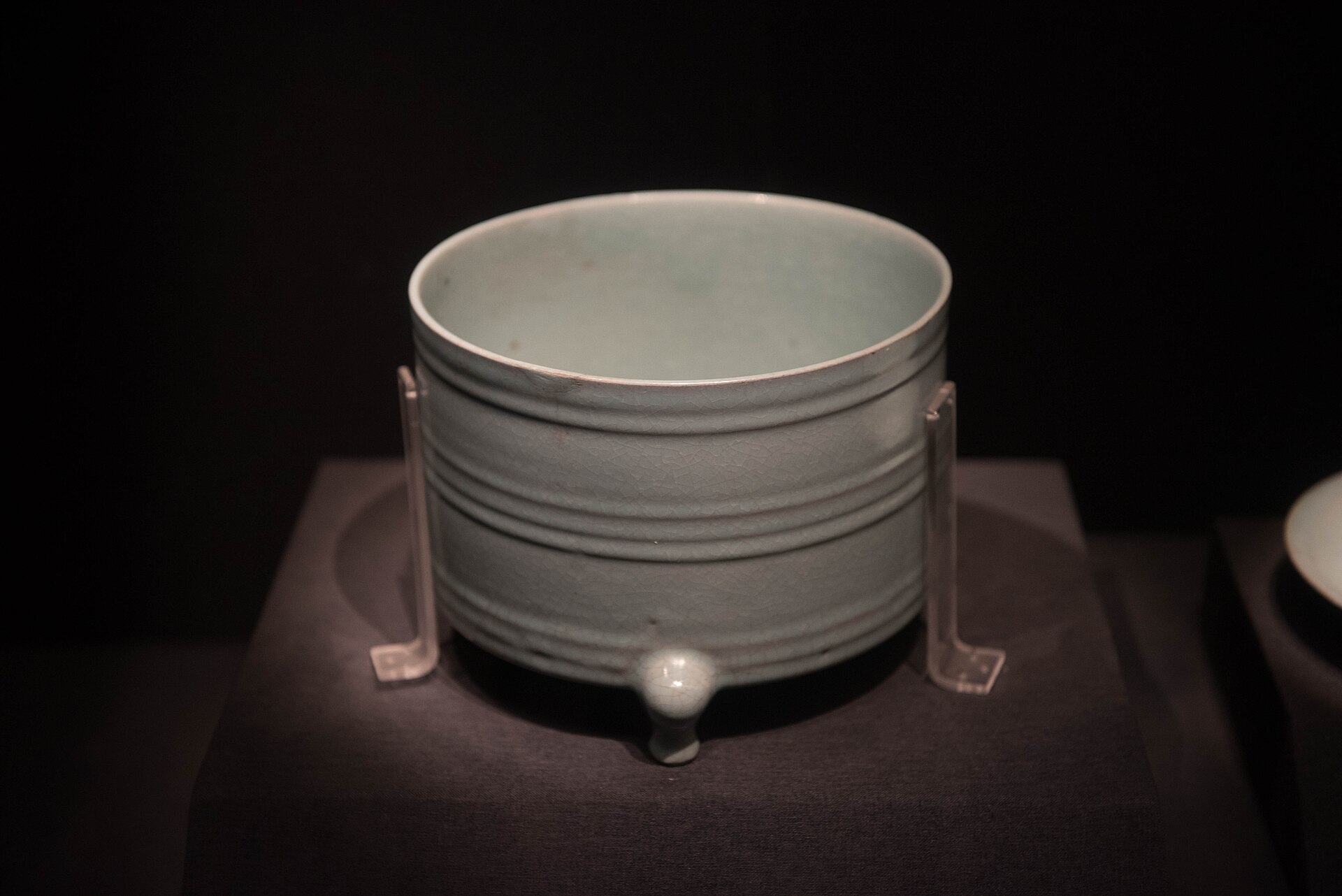
| Palace Museum (Forbidden City) | Beijing | 17 pieces on Krahl's list, many ex Qing court collection and several fire-damaged. Includes the three-footed vessel Commons labels a zun. | Published the 2015 list of 90 pieces; its staff first suggested in 2018 that the Dresden bowl was Ru. |
| British Museum, Sir Percival David Collection (Room 95) | London | 17 pieces on Krahl's list, among them the 2021 re-attributed washer. | The Art Newspaper reported the 2021 washer on display in the ceramics gallery; check current display. |
| Shanghai Museum | Shanghai | 9 pieces on Krahl's list, including washers and shallow dishes. | Also holds Yongzheng Ru-type copies from Jingdezhen. |
| Henan Museum | Zhengzhou | Song and Yuan gallery of Henan wares; Wikipedia says it holds a decorated Ru-kiln vase excavated at Qingliangsi in 1987 (tertiary, unconfirmed). | The museum of the province where the kilns stood; check the gallery for current display. |
| Cleveland Museum of Art | Cleveland | Brush washer 1957.40, 12.8 cm, attributed by the museum to Qingliangsi. | The museum releases its images as CC0. |
| Staatliche Kunstsammlungen Dresden | Dresden | The 88th piece, a 13 cm bowl labelled Korean until 2018-21. | Display status not confirmed. |
Forgeries and misattributions
- Genuine Ru labelled Korean: the Percival David washer, the Dresden bowl and a 2013 bowl stand
- A brush washer bought by Percival David in New York in 1928 was downgraded to Korean by the 1970s and sat in the British Museum as Korean for about fifty years. A Dresden bowl bought in 1927 was catalogued Korean until Palace Museum Beijing staff queried it in 2018. A bowl stand published and sold as Korean at Guardian Hong Kong in April 2013 was deducted by Krahl from the Beijing list. Krahl's eye, then confirmation: Cranfield Forensic Institute's hand-held XRF for the British Museum found rare elements consistent with Ru and not with Korean wares. Dresden was confirmed by Krahl. The Beijing staff tip and Krahl's connoisseurship drove the Dresden find.1121314
- Qing Jingdezhen copies, including one that fooled the Qianlong emperor
- Under Yongzheng the court sent Song pieces to Jingdezhen for copying. A Yongzheng copy carries a long Qianlong poem written as if for a Song original. Ru-type vessels of the period are in the Shanghai Museum. The sources opened give no diagnostic beyond the 1732 order, which specifies a copper-coloured paste and the copying of two Song glaze types, and Krahl's point that Ru was never copied so closely that later pieces blur the list. The Qing pieces are Jingdezhen porcelain, the Song pieces stoneware.12
- 'Ru-type ware' as a trap for the reader
- The term means Qing Jingdezhen imitation in the auction literature and a celadon excavated at Qingliangsi in 2014 in the archaeological papers. By reading the context: the excavation papers use it for wares found on the kiln site; sales catalogues use it for Qing copies.15161
- The Percival David 1107 test disc
- A disc with an inscription claiming to be the first test piece of 9 April 1107 was long cited for the start date. Wikipedia reports that it is now generally agreed to be a fake, probably of the twentieth century, and that it was long treated with suspicion. Reported only through a tertiary source; the British Museum entry was not opened.20
- Modern fakes offered to the trade
- Nicolas Chow of Sotheby's said Ru is the most forged ware and that he receives emails almost daily from people who think they own a piece. Not documented in a single case in the sources opened. The accepted count of heirloom pieces itself works as a filter: a new private Ru piece would be one of fewer than a handful.5
The essay
Chapter 1An imperial order, a village in Henan and a very short window
Ru guanyao is the official ware of the late Northern Song court, made at kilns in the Ruzhou area, in what is now Baofeng county in Henan (1).
Ru guanyao is the official ware of the late Northern Song court, made at kilns in the Ruzhou area, in what is now Baofeng county in Henan (1). Regina Krahl, the specialist whose list of survivors is the working reference, puts the production at about twenty years in the reigns of Zhezong and Huizong and calls the span 1086 to 1106 'still largely accepted' (1). The ware is unsigned and carries no reign mark. I found no potter, kiln master or supervising official named in any source I opened. What identifies a piece is its body, its glaze, its foot and the tiny spur scars on the base, checked against sherds from the kiln site.
The names matter because they drift. Sotheby's writes 'Ru guanyao' and Percival David, writing in the 1930s, wrote 'Ju ware', the same word in the older romanisation (1). Krahl's 'heirloom' means a piece that was handed down above ground and never buried, as against the large body of excavated fragments (1). And 'Ru-type ware' is now used for two unrelated things: the Jingdezhen copies of the Qing court, and a celadon excavated at Qingliangsi in 2014 and named 'Ru-type' by its excavators (15, 16). A label that says only 'Ru-type' tells you nothing until you know which.
Chapter 2A corpus small enough to count, and still not agreed
No other Song ware can be listed piece by piece, and Krahl says so: the number is under one hundred because Ru was always treated as a treasure, and because it was never copied closely enough for...
No other Song ware can be listed piece by piece, and Krahl says so: the number is under one hundred because Ru was always treated as a treasure, and because it was never copied closely enough for later imitations to blur the list (1). The count has moved like this. Gompertz listed 31 pieces outside China in 1958, besides ten the Chinese government sent to London in 1935-36. Wang Qingzheng published 65 in 1987 and 69 in 1991. Degawa Tetsuro listed 70 reliable pieces for the Osaka exhibition of 2009. Krahl counted 79 in 2012, and the Palace Museum, Beijing, printed a list of 90 in 2015 (1). Krahl then subtracted four pieces from that list, held back three of its brush washers whose heirloom status was unverified and added four that Beijing had missed, arriving at 87 (1). A cup recently found in Japan is held back too.
The Dresden bowl, announced in February 2021, was called the 88th (12). Krahl's article in Arts of Asia, Spring 2021, is cited by Sotheby's in 2025 for a count of 89 (10). The sources I opened do not say which piece is the 89th. Sotheby's gives the title of Krahl's article as 'Ruyao No. 88 resides in Dresden, Germany and another chance discovery', which implies a second find but does not name it (10, 11). The British Museum washer, publicly confirmed as Ru in October 2021 (13, 14), may be that piece, but nothing I opened says so and the Spring 2021 date of the article precedes that announcement.
The list is not a consensus. The National Palace Museum says six narcissus basins survive, five in Taipei and one in Osaka (8). Krahl's 2017 list also has six, but four are in Taipei, one in Osaka and one in the Jilin Province Museum, and she lists the Taipei basin of 15.9 cm separately as a plain 'basin' (1). The museum and the auction-house specialist classify the same shelf differently. Sun Xinmin, writing from the Henan institute, counted about 74 surviving pieces in 18 varieties at some date he does not give (7). Nobody has published a census that reconciles all of these.
Chapter 3Where the 87 are
On Krahl's 2017 list the National Palace Museum in Taipei holds 21 pieces, the Palace Museum in Beijing 17, the British Museum 17 (most of them the Percival David Collection) and the Shanghai Museum...
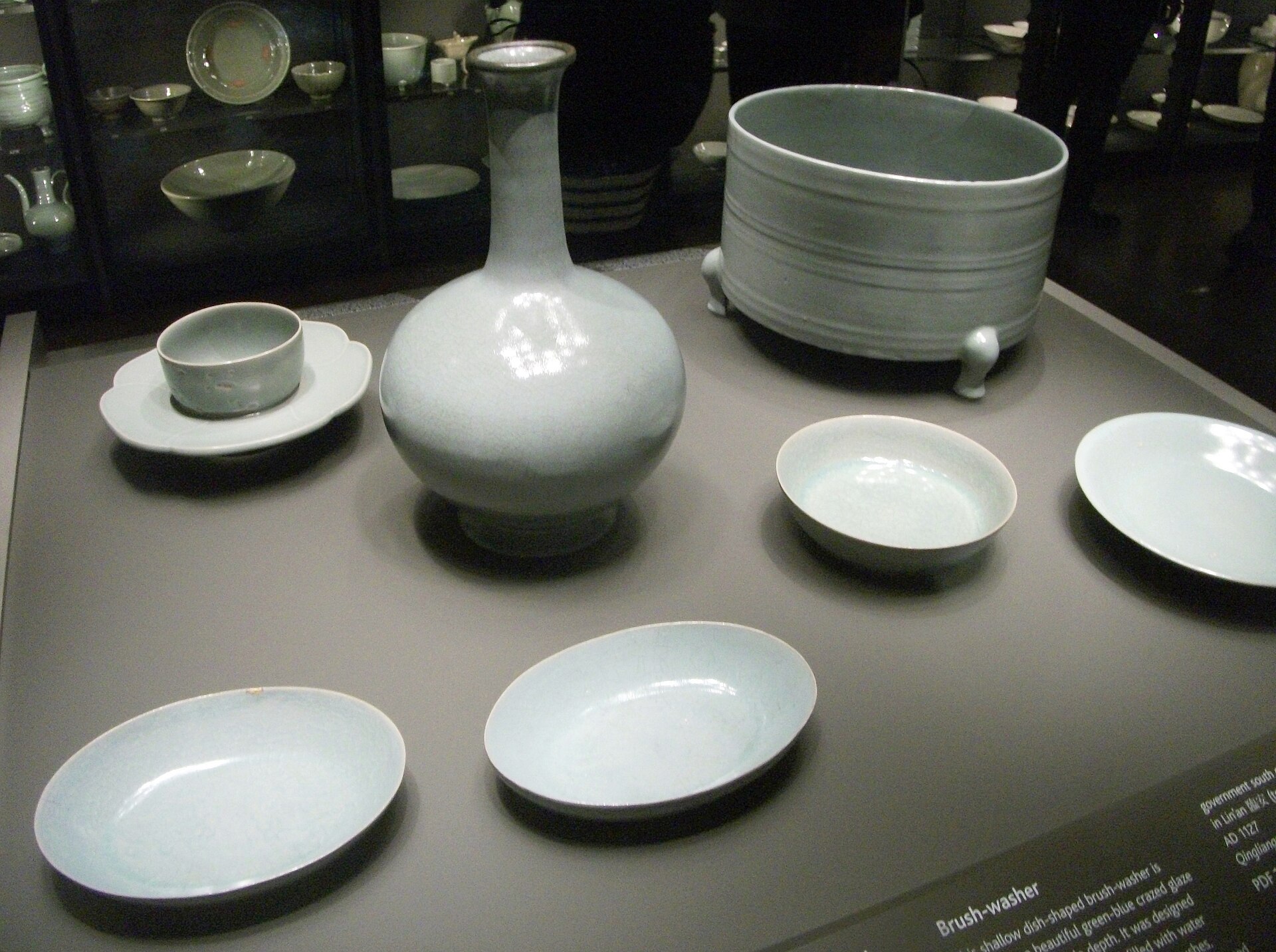
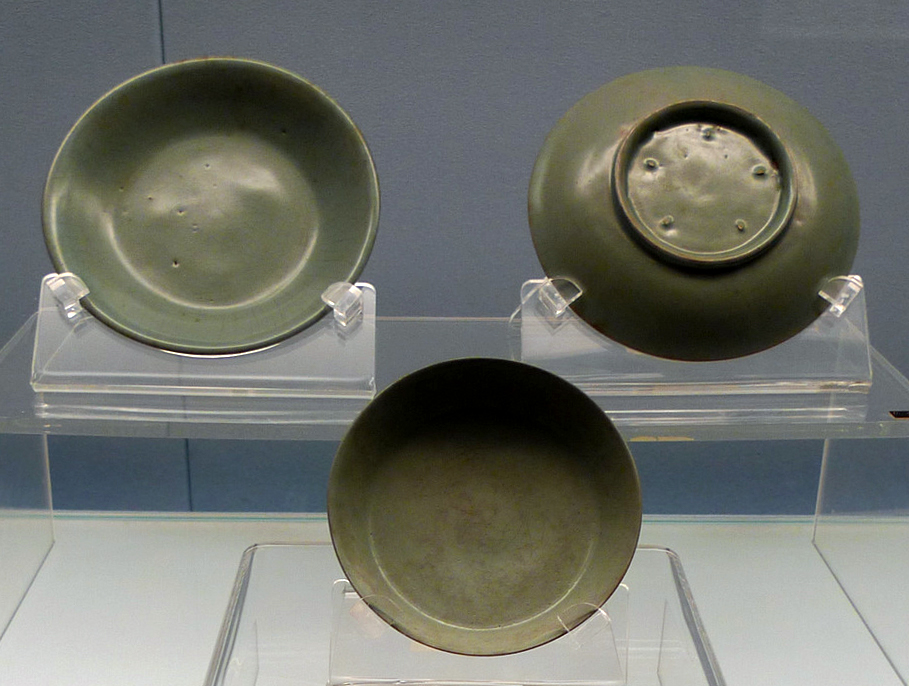
On Krahl's 2017 list the National Palace Museum in Taipei holds 21 pieces, the Palace Museum in Beijing 17, the British Museum 17 (most of them the Percival David Collection) and the Shanghai Museum 9. I recounted these from her itemised list and they agree with her entries (1). The National Museum of China and the Rohsska Museum in Gothenburg have two each. Single pieces are in Tianjin, Osaka, Hong Kong, Cleveland, Philadelphia, St Louis, the Victoria and Albert Museum, the Ashmolean, the Museum of Fine Arts in Boston, the Rietberg in Zurich, the Princessehof in Leeuwarden, Copenhagen, Tokyo, Cincinnati and Jilin (1).
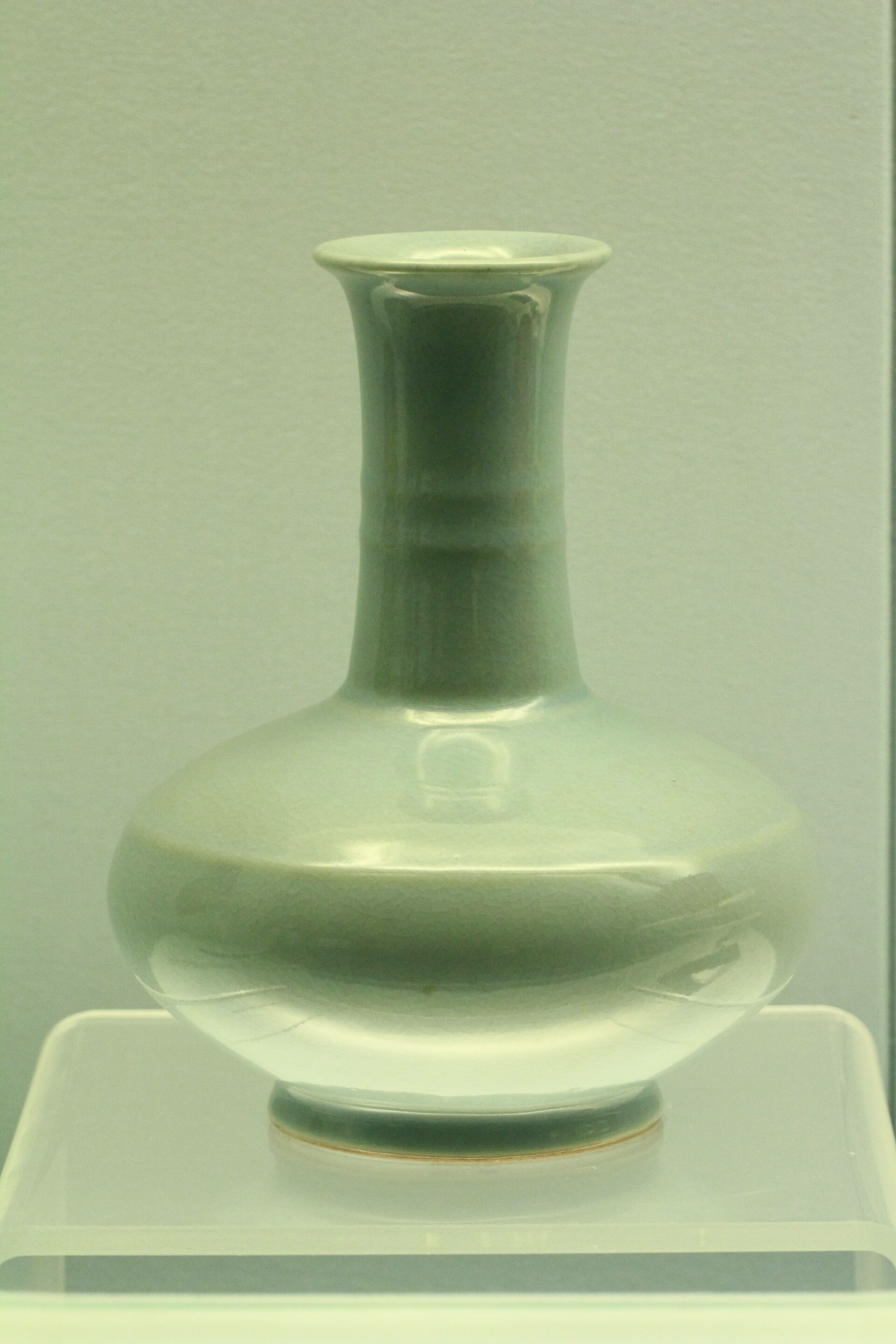
The shapes are narrow. Of the 87 the round brush washer is the commonest form at 33, and washers of all kinds total 38. There are 25 dishes in four types, six narcissus basins, five bottles, three incense burners, two plain basins, two bowls, four bowl stands, one warming bowl and one tripod stand. The 33 round washers range from 12.3 to 16.7 cm and no size predominates (1). The best glazes, Krahl observes, tend to sit on the smaller and simpler forms, and the larger and more complex shapes often came out less remarkable (1). Only the 2025 Okada bowl in the shape called bo is offered by its cataloguer as a previously unrecorded form (10).
In 2017 four heirloom pieces were in private hands: the lot itself, the lobed washer sold in 2012, a dish sold at Christie's New York in 2006 and a dish owned by a private holder identified in the list only as Au Bakling (1). The Art Newspaper and the BBC both said four (4, 5). Krahl's own prose on the same page says 'no more than three' remain in private hands, which can be reconciled only if the lot she was selling is not counted (1).
Chapter 4How the kilns were found, and who found them
The discovery has more than one account.
The discovery has more than one account. Sun Xinmin says the site was found in 1950 by Chen Wanli, confirmed in the first excavation of 1987 and that the main porcelain-firing area was found in 2000 in the sixth excavation (7). Krahl says a site thought to be the official manufactory was identified in 1986 and that kiln remains followed 'somewhat later' (1). A separate story credits the ceramics historian Ye Zhemin, who in 1977 found a sherd typical of Ru ware at Qingliangsi and took it to Guo Yanyi at the Shanghai Institute of Ceramics, whose analysis found its composition nearly identical to a Ru dish in the Palace Museum; the result was published in 1985 (21). That last account comes from Wikipedia and has not been checked against Ye's paper.
These are not strictly contradictory. A kiln site can be suspected in 1950, matched by chemistry in 1977, reported in 1985 and excavated from 1987. But the dates differ and the reader should know that the sources do. The excavation that mattered most is the one of 2000 to 2002: Sun reports places with a layer of porcelain sherds as thick as 20 cm, says more than 98 per cent of the sherds excavated were Ru ware and says the forms, glaze colours and spurs matched the heirloom pieces (7). Sotheby's 2025 note tells it differently again, as an accidental discovery of shards at the edge of the village in 1987 followed by systematic excavation in the early 2000s (11). A further excavation from March to September 2014 by the Henan Provincial Institute of Cultural Heritage and Archaeology opened a furnace built after the kiln's mature period and found celadon, named 'Ru-type' by the excavators, and unglazed biscuit bodies near the central firing area (16).
The practical result is that attribution moved from comparison among a few dozen known pieces to comparison with material of known findspot. The kiln also revealed what the heirlooms hide. Sotheby's and Sun both report that the potters tried complicated sculptural forms, openwork, moulded and incised decoration and incense burners with animal lids, none of which survives complete in the heirloom corpus (1, 7). Krahl reads the sherds as pieces kept back in the workshops because they were imperfect or unfinished, which is why she excludes them from her census (1). Sun also records that moulds for basins, washers and incense burners were excavated, which he takes as evidence of strict dimensional standards for palace vessels (7).
Chapter 5Twenty years or forty, and the end
The span is disputed in a narrow way. Krahl accepts 1086 to 1106 on the authority of Chen Wanli (1951) and says all scholars agree the period was extremely short, with some arguing a slightly longer...
The span is disputed in a narrow way. Krahl accepts 1086 to 1106 on the authority of Chen Wanli (1951) and says all scholars agree the period was extremely short, with some arguing a slightly longer one (1, 2). The British Museum, Jessica Rawson and Shelagh Vainker, as reported by Wikipedia, give longer ranges: Rawson 1107 to 1125, Vainker about forty years, the British Museum 'twenty or perhaps forty' (20). I have not opened those books. What every position shares is the end: the Jurchen took the northern part of the empire in 1127 and the court lost access to the kilns (1).
One piece of dating evidence is independent of that argument. Xu Jing, in his illustrated account of the Xuanhe mission to Goryeo of 1124, remarked on the likeness between Goryeo celadon and Ru, which gives a date by which Ru wares existed (9, 7). The museum treats this as showing exchange between the Ru kilns and kilns outside China (9).
A disc in the Percival David Collection once seemed to settle the start: it carried an inscription claiming to be the 'first test piece' of 9 April 1107. Wikipedia reports that it is now generally agreed to be a fake, probably of the twentieth century, and that it confused the dating for decades (20). I could not open the British Museum entry and so treat this as reported, not verified.
Chapter 6Why the court asked for green: graded
Documented in later texts. The commission is recorded.
Documented in later texts. The commission is recorded. Krahl writes that the court was unhappy with the white Ding wares because of their unglazed rims and ordered green wares from Ruzhou instead, 'the first direct commission of ceramics by an imperial court', which until then had relied on tribute wares (1). A Southern Song note by Ye Zhi in Tanzhai bi heng is said to give the same reason, that Dingzhou white ware had rough rims and was unusable, so Ruzhou was ordered to make green ware (19). I saw that quotation only in a tertiary article. The same Krahl note adds, with 'apparently', that nothing shows direct imperial involvement in the making (1).
Argued. Krahl argues that the taste for a modest, unspectacular ware came from a world view that prized modesty over display, citing the austere politician Wang Anshi (1021-1086) and the literati painters who sought artlessness, and that a glaze admired for a precise shade ('approaching the blue of the sky after rain') answered the same taste (1). Sun Xinmin ties the plain style to the 'School of Principle' of Cheng Hao and Zhu Xi and to Chan Buddhism (7). On Sun's own dates, Cheng Hao died in 1085, before production began, and Zhu Xi (1130-1200) was born after the Northern Song ended, so his school can have shaped the ware's later reputation more easily than its making. A 2025 Sotheby's note lists Neo-Confucianism, Daoism and Chan together, and a collector, Cao Xingcheng, says Song porcelain should be read through Zen (11, 17). None of these writers cites a Song document connecting a Ru order to a doctrine. The link between the ware and the thought of the age is an argument by several named people, and no more.
Legend. The tale that Huizong dreamed of blue sky after rain and wrote a couplet for the potters appears in popular accounts, which attribute it to a Ming text, the Xuande dingyi pu, and which say themselves that it has no solid historical support (18, 19). Krahl uses the phrase as a description of the colour, not as the emperor's order (1). The resemblance of the glaze to jade is Krahl's observation of the surface, not a recorded aim of the potters (2).
Chapter 7The glaze, the firing and what the labs say
The practice of firing fully glazed vessels on small spurs was not invented at Ru, Krahl writes, but the kilns perfected it, making the marks tiny and tidy and cutting them to three (2).
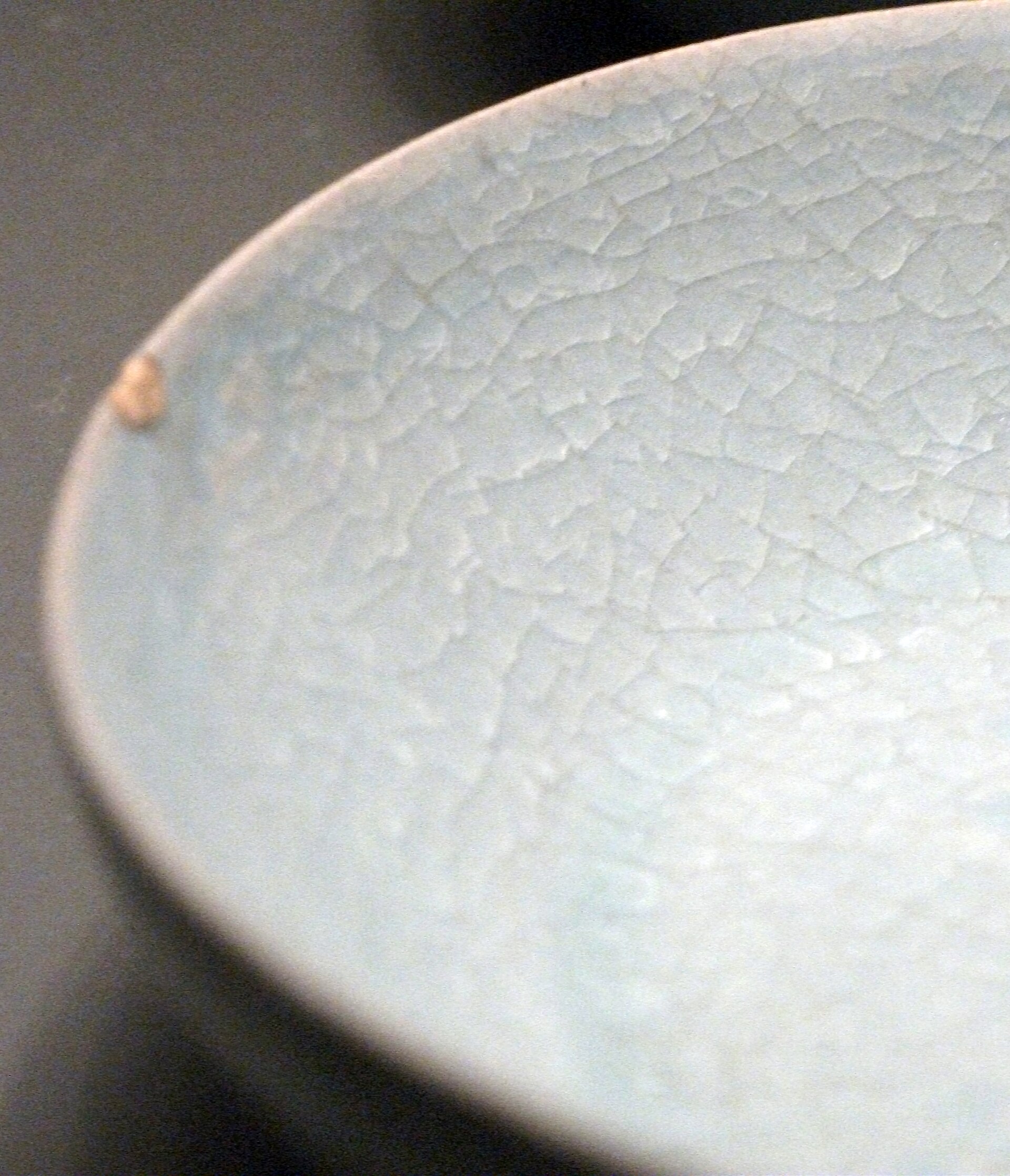
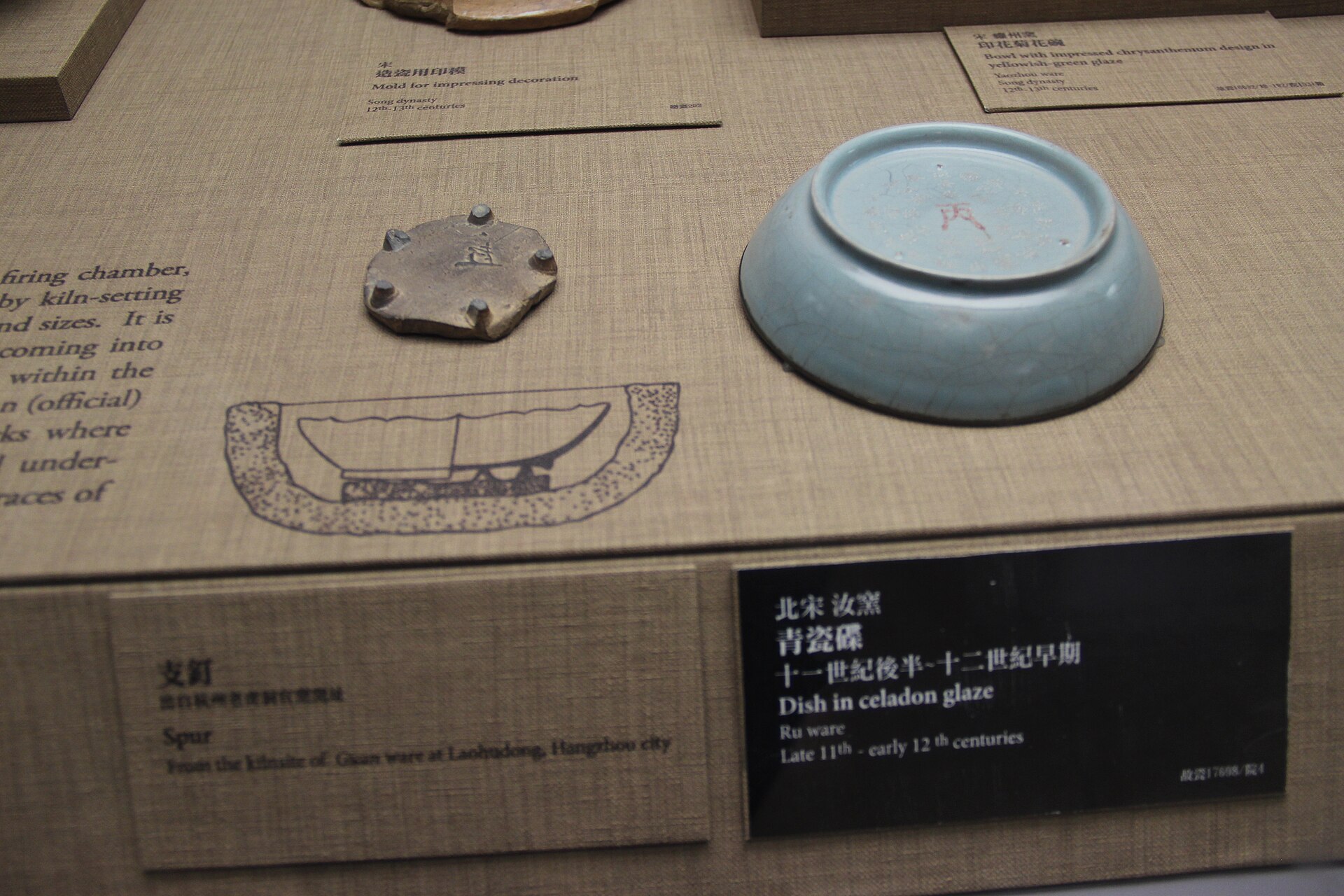
The practice of firing fully glazed vessels on small spurs was not invented at Ru, Krahl writes, but the kilns perfected it, making the marks tiny and tidy and cutting them to three (2). Ru kilns were small bun-shaped mantou kilns under 2 m long, vessels were fired upright in individual saggars, each piece was fired more than once and the method 'undoubtedly led to many failures' (1). Krahl notes that vessels of the same basic form may be fired on three or on five spurs (1). The National Palace Museum's narcissus basin has six (8). Crazing, a fault elsewhere, was first valued as an asset on Ru, Krahl says, although a good pattern needs 'a happy coincidence of circumstances and cannot be produced at will' (1).
The agate claim is documented as a text and not settled as chemistry. Zhou Hui, in Qingbo zazhi of 1192, says agate was used in the glaze (10). Two modern articles quote the Chinese with slightly different wording, one adding the word for powder, and I could not resolve that without a critical edition (18, 19). Agate was mined near the kiln site (2, 18). Rose Kerr and Nigel Wood, quoted by Krahl, judged that putting agate in the glaze gave 'no real technical advantage but did no harm either', and Krahl calls the statement 'still not fully explained' except as a mark of cachet (2).
Laboratory work has mostly addressed attribution. Cranfield Forensic Institute used hand-held X-ray fluorescence in 2021 to find levels of some rare elements in a Percival David washer's glaze that, it says, fit Ru and not Korean wares, backed by Krahl's stylistic study (13). Wu and Zhao of Zhengzhou University measured Ru-type bodies from the 2014 dig and put their firing temperature at 1150 to 1200 degrees Celsius against 950 for the unglazed bodies, both underfired (15). An EDXRF study of 21 samples found that the raw materials and glaze formula of the Ru-type sky green ware differ from those of Ru guan ware (16). Sun describes the heirloom body as light grey and somewhat underfired, with a fairly high absorbency rate and an especially high number of bubbles of different sizes (7). I did not find a lab-published copper content analysis of heirloom Ru and I have not claimed one.
Chapter 8What the Song texts say, and how few they are
The record is thin and late. Xu Jing's 1124 mention of Ru and Goryeo celadon is the earliest, and the only one from the period in the sources I opened (9).
The record is thin and late. Xu Jing's 1124 mention of Ru and Goryeo celadon is the earliest, and the only one from the period in the sources I opened (9). Zhou Mi, born 1232, records in Wulin jiushi that in 1151 Zhang Jun gave the Gaozong emperor a set of Ru vessels and that in 1179 a Ru vase stood on display at a gathering in the Jujing Garden (7). Zhou Hui, writing in 1192, said the pieces had become 'very difficult to obtain' and that only what the court rejected could be sold (2, 10). Cao Zhao's Ge gu yao lun of 1388 preferred uncrazed pieces, a judgement the National Palace Museum cites as the best illustration of its own uncrackled basin (8, 9). The expression 'sesame seed' for the spur marks first appears in print in 1591 in Gao Lian's Zun sheng ba jian (1).
Krahl makes the point that matters for reading all of this: Ru's fame in later centuries rested more on hearsay than on seen objects, with literary passages copying each other, and by the late Ming the ware was deemed 'unobtainable' (2). The 1151 gift raises an arithmetic puzzle as well as a historical one. Sun's translation itemises the gift as a pair of bottles, a washer, an incense burner, a spherical sachet, four small cups, two large cups, a pair of incense pots and two food canisters, which I count as 15 against his stated 16 (7). Krahl asks how any official could have amassed so many pieces when the court kept the best and only rejects were sold, and leaves the question open (1).
Chapter 9Gaozong, the Hangzhou copies and what the loss meant
Documented. After 1127 the Southern Song court at Hangzhou could not obtain Ru or Ding.
Documented. After 1127 the Southern Song court at Hangzhou could not obtain Ru or Ding. Gaozong set up official kilns inside the capital to make wares modelled on Ru (1). Sun quotes a record that at the Hangzhou Palace Maintenance Office kiln the clay was formed into moulds of extremely precise workmanship (7).
Argued. Krahl reads Ru as a standing reminder of lost territory and Zhang Jun's gift of 1151 as a statement of wealth and allegiance to the court (1, 2). Sotheby's goes further and says Ru 'evokes patriotic sentiments and nostalgic thoughts of glorious eras' (1). That is a statement about modern and later readers. I found no source for what the Southern Song court itself said about Ru, beyond the gift being recorded.
A trace of the same politics survives in the museums. Wikipedia, citing the Oriental Ceramic Society's newsletter, says the Taipei and Beijing collections have not shared an exhibition (20). I did not confirm that and it is the kind of claim that goes stale.
Chapter 10The Qing collection: 31 washers, the poems and the copies
An inventory of 1729 lists 31 Ru wares, all brush washers, kept in lacquer boxes, some with inscriptions that can be matched to pieces in Taipei today (2).
An inventory of 1729 lists 31 Ru wares, all brush washers, kept in lacquer boxes, some with inscriptions that can be matched to pieces in Taipei today (2). Sun's translation of the court workshop file names two eunuchs who delivered a lacquer box and 29 vessels, 'in fact 31' in his bracket, with pieces marked bing or inscribed Fenghua and Kunning (7). Krahl's 2017 list shows the same lettering on bases: jia, yi, bing and cai, and palace names such as fenghua (1).
The Yongzheng emperor sent originals from Beijing to Jingdezhen as models. The 1732 Jiangxi tongzhi lists 'Ru glaze' copies in two types, one uncrackled and one with fish-roe crackle, made from the colours of Song pieces (1, 2). Ming potters virtually never copied Ru, presumably because too few pieces were in circulation; Krahl names one exception, a Xuande-period blue-glazed narcissus basin made at the Jingdezhen imperial kilns (1).
Qianlong 'appropriated' the ware, in Krahl's word, by having his poems cut into 22 of the 87 pieces, though he did not always identify Ru correctly, and in one instance had a long poem cut into a Yongzheng copy that he took for a Song original (1). Another Sotheby's note counts at least 20 pieces and 18 different poems, of which only two actually mention Ru (2). Sun gives a different figure, 183 poems cut into 16 prized porcelains, of which 15 were Ru, which I cannot reconcile with Krahl (7).
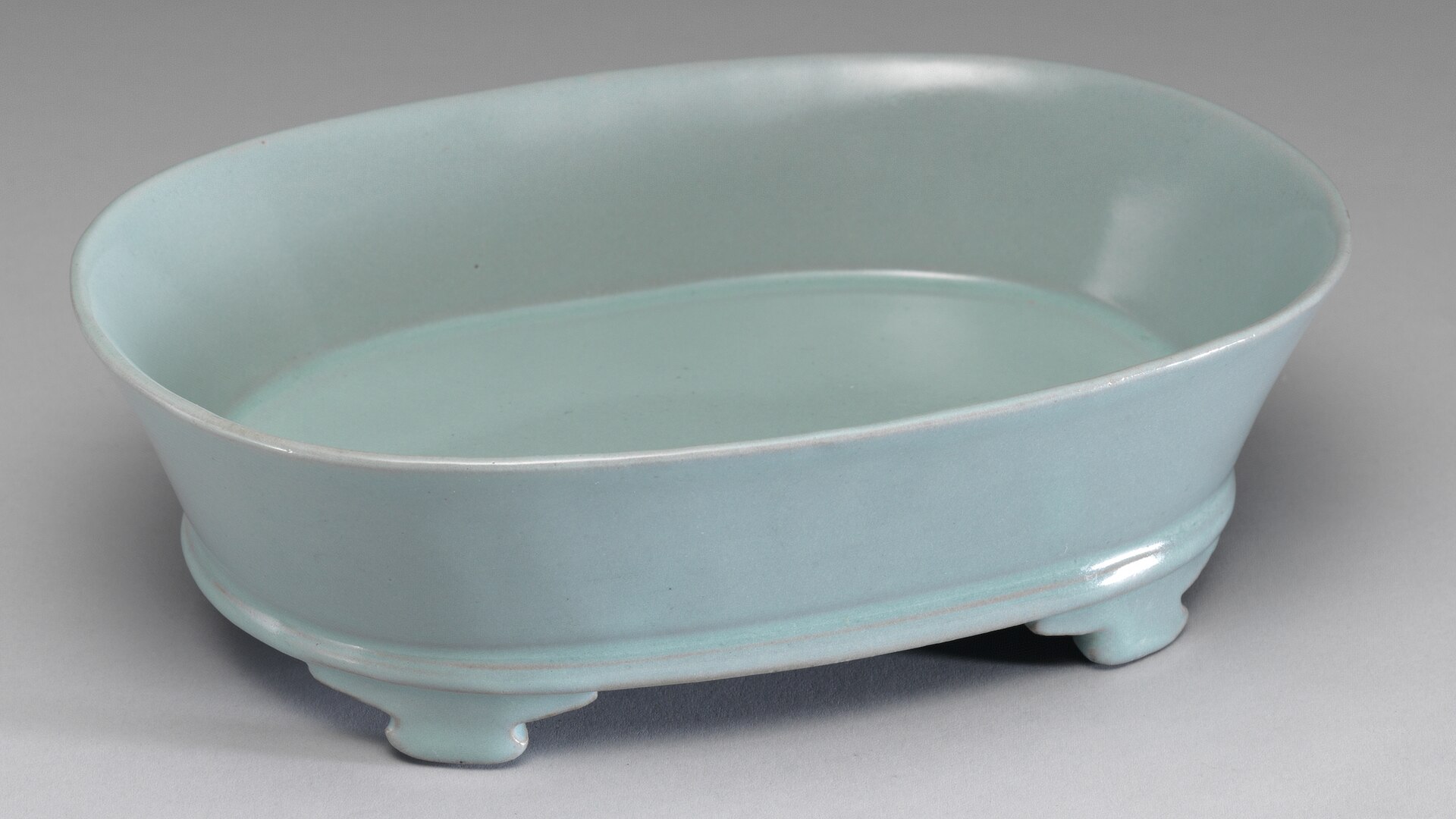
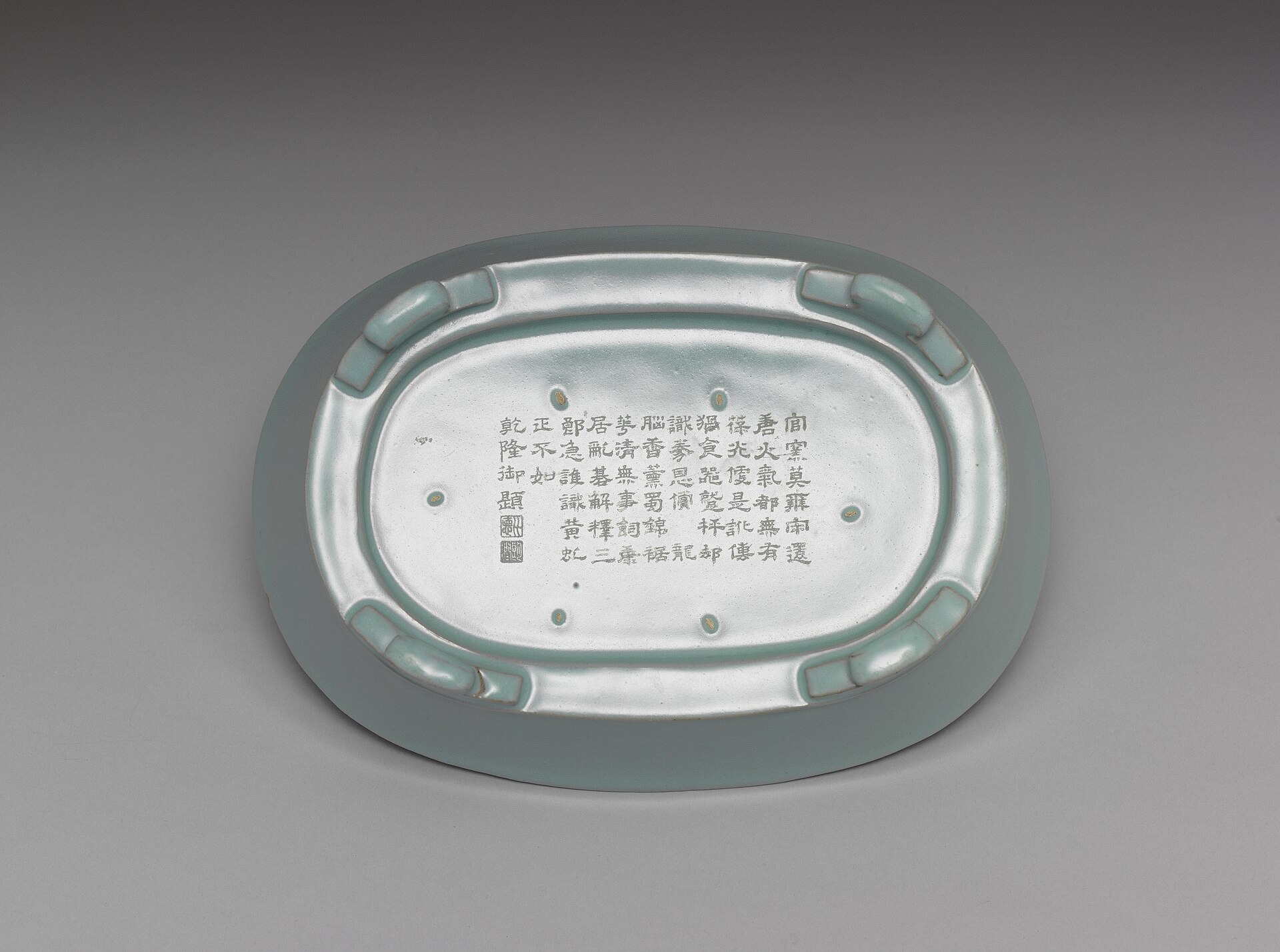
The Taipei narcissus basin shows what the poems prove. Its inscription, transcribed by the museum, opens with a line which in my reading says that among guan wares one cannot tell Song from Tang, and goes on to mention a mistaken report that it was a small dog's feeding vessel; two seals follow, reading Bi De and Lang Run (8). That is the emperor calling it guan and recording a story he rejects, and the museum gives no English translation. The museum adds that he had a wooden stand made with a drawer holding an album of his own copies of Song masters' letters and paintings (8). A poem of 1786 on a Percival David bowl wonders at how few bowls survive: 'bowls are as rare as stars in the morning' (10).
Chapter 11A fire, an exhibition and how Europe learned Ru
After the fall of the Qing, and before the Forbidden City opened as a museum, a fire in 1923 destroyed a storage hall in which old works of art were kept.
After the fall of the Qing, and before the Forbidden City opened as a museum, a fire in 1923 destroyed a storage hall in which old works of art were kept. Krahl calls it supposedly deliberate, set by eunuchs to hide thefts. Only some Ru wares and some Chenghua doucai porcelains were kept from the cleared remains, and fifteen fire-damaged pieces are among the 87 (1). The sources I opened do not trace how pieces left the palace for Western hands.
R. L. Hobson wrote in 1915 that no authenticated Ru was known in Europe (2). The International Exhibition of Chinese Art in London in 1935-36 changed that: the Chinese government lent ten examples and several Western collectors already owned pieces without being sure what they were (1). David's 'Commentary on Ju Ware' followed in the Transactions of the Oriental Ceramic Society for 1936-37 (1). David had bought a small washer in New York in 1928 believing it Ru, and the attribution was reversed by the 1970s (13, 14). Pieces from the Percival David and Eumorfopoulos collections were shown too (1). Alfred and Mrs Clark of Fulmer formed their collection mainly in the 1920s to 1940s and Mr Clark died in 1950 (2).
Chapter 12Wrong in both directions: Korean labels, Ru-type copies and the daily emails
Ru is a ware with a forgery problem, but the cases on record are mostly of the opposite kind: genuine pieces called something else.
Ru is a ware with a forgery problem, but the cases on record are mostly of the opposite kind: genuine pieces called something else. Percival David's washer was relabelled Korean by the 1970s and stayed so for about fifty years until Krahl and Cranfield's hand-held XRF put it back (13, 14). The Dresden bowl, bought in 1927 and long thought Korean, was queried by Palace Museum Beijing staff in 2018 and confirmed by Krahl (12). A bowl stand sold in Hong Kong in 2013 was sold as Korean and is one of the four items Krahl deducted from the Beijing list (1). Korean imitation of Ru began shortly after the ware was made, Wikipedia says, and Korean pieces were long mistaken for Chinese originals (20).
Copies in the proper sense come late. Qing imitation at Jingdezhen under Yongzheng was deliberate and documented, and the court was fooled by its own copy (1, 2). Nicolas Chow, Sotheby's head of Chinese art, told the BBC that Ru is 'most forged' and that he receives emails nearly every day from people who say they own a piece, while only four heirloom pieces exist in private hands (5). I found no published case in which a thermoluminescence date or a named laboratory broke a modern Ru forgery. That is a gap in what I could open and not a statement that none exists.
Chapter 13What it costs: three sales and a cohort that is mostly not for sale
Almost every Ru piece is in a museum, so the market is a handful of events.
Almost every Ru piece is in a museum, so the market is a handful of events. Krahl lists six vessels sold at auction since 1940: a bottle from the Eumorfopoulos sale in 1940, a narcissus basin from the Ataka collection in 1959 and 1970, a washer from the K. S. Lo collection in 1980, a dish from the Junkunc collection at Christie's New York in December 1992, a second Junkunc dish in 2006 and the lobed Clark washer in 2012 (1). Her 2017 list prints the Junkunc dish sale as Christie's Hong Kong, 3 December 1982, in one place, while her own note on the same page and Sotheby's 2025 note both give Christie's New York, 3 December 1992 (1, 11). The 2017 lot's own London sale of 15 June 1982 is not in her six, and the 2025 note adds it, which makes seven vessels and says 'fewer than ten' in all (10, 11).
Result one: the lobed Clark washer, Sotheby's Hong Kong, April 2012, estimate HKD 60,000,000 to 80,000,000. The premium-inclusive result was about HKD 208 million (22) and Wikipedia gives HKD 207,860,000 or USD 26.7 million (20). I did not find a hammer price.
Result two: the Le Cong Tang washer, 3 October 2017, lot 5, estimate on request and briefed at about HKD 100 million. Bidding opened at HKD 80 million and the hammer fell at HKD 260,000,000 after 20 minutes between one bidder in the room and one on the telephone (3). The premium-inclusive total was HKD 294,287,500 (6). The difference of HKD 34,287,500 is derived by subtraction. It displaced the Chenghua chicken cup (HKD 281.2 million with fees, 2014) as the dearest Chinese ceramic (4). The buyer was not named and the underbidder is not recorded in the sources I opened (5).
Result three: the 2025 sales show how far a Ru piece can fall from that peak. Sotheby's offered the Okada bowl of bo form, 21.5 cm, on 22 November 2025 at HKD 20,000,000 to 40,000,000 (10), and a London washer of 11.6 cm with four spur marks and a kintsugi-style repair, in a sale closing on 5 November, at GBP 200,000 to 300,000 (11). The London lot page does not print a year; I take it to be 2025 from the sale code in an earlier record. Both results sit behind Sotheby's login and I could not confirm either. The 2017 figure was set by a 13 cm washer in near perfect condition, one of only four in private hands, and Krahl's account of its glaze is the strongest in her note; nothing in the sources lets me say what it would make now.
Chapter 14Who rules on attribution now
No board, committee or foundation rules on Ru.
No board, committee or foundation rules on Ru. Attribution is made by curators and a few specialists. The census of record for the market is Regina Krahl's list for Sotheby's, which is itself built on the Palace Museum Beijing's 2015 catalogue and Degawa's 2009 Osaka list (1). The Palace Museum's staff flagged the Dresden bowl in 2018 and Krahl confirmed it (12). Where chemistry is needed the institutions have turned to Cranfield Forensic Institute, which used hand-held XRF for the British Museum (13). I found no evidence in the sources opened of a formal Chinese government or Palace Museum authentication of lots at auction.
What is documented
Technique
The surviving work
- What is accepted
- 87 heirloom pieces on Regina Krahl's 2017 list for Sotheby's (Hong Kong), raised to 88 by the Dresden bowl (February 2021) and to 89 in her Arts of Asia article of Spring 2021, as cited by Sotheby's in 2025. Excavated fragments are excluded from every count.
- What is contested
- The figure was 65 (Wang 1987), 69 (1991), 70 (Degawa 2009), 79 (Krahl 2012), 90 (Palace Museum Beijing 2015, before Krahl subtracted four and suspended four more) and about 74 on Sun Xinmin's undated tally. The National Palace Museum and Krahl classify the narcissus basins differently (five in Taipei against four).
- Who rules on attribution
- No active authority and no board. The de facto reference is Krahl's list; attribution rests on curators at Taipei, Beijing and the British Museum and on the kiln-site material, with outside labs called in for disputes.
Catalogue raisonne
- Regina Krahl, 'The worldwide patrimony of heirloom Ru official wares', in Sotheby's Hong Kong, 3 October 2017, lot 5 Itemised list of 87 pieces with institution, size and inscription, plus four held-back additions and one lost. The practical working census.1
- Palace Museum Beijing, Ru ci ya ji / Selection of Ru Ware (2015) Printed a list of 90 pieces, including several fire-damaged items not previously published; Krahl reworked it. Not opened by me, known through Krahl.1
- Degawa Tetsuro in Hokuso Joyo seiji, Museum of Oriental Ceramics, Osaka (2009) List of 70 reliable pieces, the base for Krahl's 2012 list. Known through Krahl.1
- Wang Qingzheng, Fan Dongqing and Zhou Lili, Ruyao de faxian / The Discovery of Ru Kiln (1987; revised 1991) First list in China, of 65 then 69 pieces, including some Wang himself doubted. Known through Krahl.1
Questions about The Ru official kilns at Qingliangsi, Baofeng
Who was The Ru official kilns at Qingliangsi, Baofeng?
Court ceramic workshop; Celadon kiln. active c. 1086-1125.
How are fakes and misattributions of The Ru official kilns at Qingliangsi, Baofeng detected?
Genuine Ru labelled Korean: the Percival David washer, the Dresden bowl and a 2013 bowl stand. A brush washer bought by Percival David in New York in 1928 was downgraded to Korean by the 1970s and sat in the British Museum as Korean for about fifty years. A Dresden bowl bought in 1927 was catalogued Korean until Palace Museum Beijing staff queried it in 2018.
Where can you see work by The Ru official kilns at Qingliangsi, Baofeng?
National Palace Museum, Taipei (Taipei); Palace Museum (Forbidden City) (Beijing); British Museum, Sir Percival David Collection (Room 95) (London); Shanghai Museum (Shanghai); Henan Museum (Zhengzhou); Cleveland Museum of Art (Cleveland).
What does the market for The Ru official kilns at Qingliangsi, Baofeng look like?
Almost nothing is for sale. Krahl lists six vessels at auction since 1940 and Sotheby's 2025 note says fewer than ten; the main events are the 2012 lobed washer and the 2017 round washer.
What is still unresolved about The Ru official kilns at Qingliangsi, Baofeng?
How many pieces are there? 87, 88, 89 and 90 all circulate, and the National Palace Museum and Regina Krahl classify the narcissus basins differently (five against four in Taipei).
Open questions
- How many pieces are there? 87, 88, 89 and 90 all circulate, and the National Palace Museum and Regina Krahl classify the narcissus basins differently (five against four in Taipei). Nobody has published a reconciled census, and the identity of the 89th piece is not given in the sources opened.
- Was the span 1086 to 1106, or 1107 to 1125, or forty years? Krahl, following Chen Wanli, holds the first; Rawson and Vainker, as reported by Wikipedia, give longer or later spans. The 1107 test disc that once seemed to settle it is reported as a fake.
- Is Qingliangsi the Northern Song 'official kilns of the capital'? The National Palace Museum says concrete proof of the exact site of those kilns has not been found and treats Ru as official only by the likeness of its shapes to Southern Song Guan; Krahl treats Qingliangsi as the official manufactory and says other sites such as Zhanggongxiang yield nothing that matches heirloom pieces.
- Was there ever an imperial order, as against a tribute system? Krahl calls Ru the first direct commission of ceramics by the court but says no sign of imperial involvement is known; Wikipedia, reporting Vainker, marks a disagreement over how normal that practice was.
- Does agate in the glaze do anything? The Song text says it was used, Kerr and Wood say it did no harm and no good, and the lab literature I opened tests only Ru-type bodies and glazes, not heirloom Ru.
- How could Zhang Jun give 16 pieces in 1151 when only rejects were sold, and how many did he give: Sun's translation itemises 15?
- Which pieces count as one auction appearance? Krahl's 2017 text lists six vessels, Sotheby's 2025 note adds the 1982 sale of the Le Cong Tang washer and says fewer than ten, and no one has published the full list with a result for each.
- How many poems did Qianlong inscribe on Ru: 22 pieces (Krahl), at least 20 pieces and 18 poems (Sotheby's 2012) or 183 poems on 16 porcelains (Sun)?
- What was the relation of the Ru kilns to the court on the ground? No potter, official or workshop head is named in any source opened, nor is the size of the labour force.
Sources
- 1Sotheby's, lot 5, A highly important and extremely rare Ru guanyao brush washer, Northern Song dynasty, Song: Important Chinese Ceramics from the Le Cong Tang Collection, Hong Kong, 3 October 2017 (sale HK0747). Includes Regina Krahl's catalogue note 'A Ru ice crackle brush washer' and her list 'The worldwide patrimony of heirloom Ru official wares' (87 pieces, with institution, size and inscription for each). Primary: the catalogue itself. Opened in full. sothebys.com/en/...
- 2Sotheby's, lot 101, An outstanding Ru guanyao lobed brush washer, Northern Song dynasty, Ru - From a Japanese Collection, Hong Kong, April 2012 (sale HK0367). Regina Krahl's catalogue notes on the Song texts, the Yongzheng and Qianlong evidence and the Alfred Clark provenance. The lot page does not show the result (login required). Primary. sothebys.com/en/...
- 3The Value, 'Setting Record for World's Most Expensive Ceramic, Ru-ware Brush Washer Fetches US$37.7m', Haley So, 3 October 2017. Live report from the saleroom: opening bid HK$80m, hammer HK$260m at 10.58 a.m., two bidders, 20 minutes. Journalism, the only source opened that states the hammer. en.thevalue.com/articles/...
- 4The Art Newspaper, 'Record breaking Chinese brush washer points to demand for Song ceramics in Hong Kong', Lisa Movius, 9 October 2017. HK$294.3m (US$37.7m) with fees, previous record HK$281.2m (Chenghua chicken cup, 2014), four heirloom pieces in private hands. theartnewspaper.com/2017/...
- 5BBC News, 'Chinese Ru-ware bowl sets $38m auction record in Hong Kong', 3 October 2017. Nicolas Chow of Sotheby's on the ware being the most forged and on four heirloom pieces in private hands. bbc.co.uk/news/...
- 6Just-Collecting (news), report on the 2017 Sotheby's Hong Kong Ru sale, giving the premium-inclusive total HK$294,287,500 (US$37,669,041). Journalism. news.justcollecting.com
- 7Sun Xinmin (Director, Henan Provincial Institute of Cultural Relics and Archaeology), 'Appreciating Ru Ware', in the National Palace Museum Taipei exhibition site 'Ambient Green Flow', archived 8 April 2015. Excavation chronology, 98 per cent sherd figure, the 1151 gift list, the 1729 inventory, Qianlong's poems. Opened in full via the Wayback Machine. web.archive.org/web/...
- 8National Palace Museum, Taipei, Open Data, 'Narcissus basin with bluish-green glaze, Ru ware', object no. 017851N, with the transcription of Qianlong's inscription, the six spur marks and the museum's count of narcissus basins. Primary. Opened in full. digitalarchive.npm.gov.tw/opendata/...
- 9National Palace Museum, Taipei, 'Precious as the Morning Star: 12th-14th Century Celadons in the Qing Court Collection', section 'Ru Wares and the Northern Song Official Kilns' (2016). The museum's statement that the exact site of the Northern Song 'official kilns of the capital' has not been proved, and its citation of Xu Jing (1124). Primary. theme.npm.edu.tw/exh104/...
- 10Sotheby's, lot 1013, A highly important and extremely rare large Ru guanyao bowl, Masterpieces of Asian Art from the Okada Museum of Art, Hong Kong (sale HK1632, closed 22 November 2025). Catalogue note quoting Zhou Hui (1192), Krahl's count of 89 (citing her article in Arts of Asia, Spring 2021) and Qianlong's 1786 poem on a Percival David bowl. Result not shown (login required). Primary. sothebys.com/en/...
- 11Sotheby's, lot 140, A rare Ru Guanyao brush washer, Northern Song Dynasty, Chinese Art, London (closed 5 November), estimate GBP 200,000-300,000, 11.6 cm, four spur marks, kintsugi-style restoration. Result not shown (login required). Primary. sothebys.com/buy/...
- 12The Art Newspaper, ''Rarest' royal Chinese porcelain bowl - at least 900 years old - discovered in Dresden state collection', Catherine Hickley, 11 February 2021. The 88th known piece, labelled Korean, flagged by Palace Museum Beijing staff in 2018 and confirmed by Krahl. theartnewspaper.com/2021/...
- 13Cranfield University press release, 'Cutting-edge forensic analysis identifies rare ceramic dish for the British Museum', October 2021. Cranfield Forensic Institute (Andrew Shortland) used hand-held XRF to confirm a Percival David brush washer, long held to be Korean, as Ru. Primary (institutional press release). cranfield.ac.uk/press/...
- 14The Art Newspaper, 'Very dishy: small bowl in British Museum revealed to be extremely rare Chinese imperial ceramic', Martin Bailey, 19 October 2021. Percival David bought the dish in New York in 1928; downgraded to Korean by the 1970s. theartnewspaper.com/2021/...
- 15Bo Wu and Weijuan Zhao (Zhengzhou University), 'Analysis of the chemical composition and phase structure of Ru-type ware bodies under the influence of firing temperature', Clay Minerals 56(2), June 2021, pp. 108-116, doi 10.1180/clm.2021.24. Abstract read; full text not accessed. Primary (abstract only). cambridge.org/core/...
- 16'Studying the Source of Raw Material and Glaze Formula of Sky Green Ru-type Ware and Ru Kuan Ware by EDXRF', Spectroscopy Online. Abstract and introduction read (4 unglazed bodies, 10 Ru-type and 7 Ru Kuan samples, 16 elements, 2014 excavation by the Henan Provincial Institute of Cultural Heritage and Archaeology). Authors and date not recorded in the copy opened. spectroscopyonline.com/view/...
- 17The Value, 'Exclusive Interview with Cao Xingcheng, the Master of Le Cong Tang', 18 August 2017. Source for the Hongxi Museum sale of 2000 and the owner's stated reason for consigning. Interview, journalism. en.thevalue.com/articles/...
- 18People's Daily (paper.people.com.cn), feature on Ru porcelain, 6 March 2016. Quotes Zhou Hui's Qingbo zazhi on agate and presents the Huizong dream story as legend. paper.people.com.cn/hqrw/...
- 19Netease feature on why Ru ware is blue, quoting Ye Zhi's Tanzhai bi heng (Southern Song) and attributing the 'sky after rain' couplet to the Ming Xuande dingyi pu. c.m.163.com/news/...
- 20Wikipedia, 'Ru ware'. Used only for the Vainker and Rawson dating positions, the Percival David test-disc doubt and the 2016 Beijing exhibition, each flagged where used. Replace with Vainker (1991), Rawson (ed. 2007) and the British Museum catalogue entry. en.wikipedia.org/wiki/...
- 21Wikipedia, 'Ye Zhemin'. Source for the 1977 sherd, the analysis by Guo Yanyi at the Shanghai Institute of Ceramics and the 1985 publication. Replace with Ye's own paper and Kerr and Wood, Science and Civilisation in China 5:12 (2004). en.wikipedia.org/w/...
- 22RoadToParnassus (blog), 'A Chinese Ru Brush-washer at Sotheby's', April 2012, update giving the 2012 result as HK$208 million with premium. roadtoparnassus.blogspot.com/2012/...
- 23Wikimedia Commons file page for Cleveland Museum of Art, Brush Washer, 1957.40, carrying the museum's own description, dimensions (12.8 cm) and CC0 status. Note the file gives the accession as 1957.4. commons.wikimedia.org/wiki/...

Last verified