Works on Paper: Watermarks, Foxing and Light
The sheet is evidence before the image is. Chain lines, watermarks and mould-mates date an impression, and a lux budget decides how often anyone is allowed to see it.
On this page 5 sections
ContentsClose
In short
- Laid paper records the mould's wires as close laid lines and widely spaced chain lines; wove replaced them with woven mesh from Baskerville's 1757 Virgil onward.
- A watermark dates the sheet, not the image, and Hinterding found legible watermarks in only about a third of more than 7,000 Rembrandt impressions.
- Nineteenth-century wood-pulp paper destroys itself through lignin and acid sizing, so a 1450 rag sheet can be chemically healthier than an 1880 one.
- At 50 lux a light-sensitive sheet still earns only about three months on show every five years, and the fading does not come back.
The sheet is a record of the mould that made it
Hand-made paper is formed by dipping a wire sieve into pulp and lifting it, and the wire pattern transfers into the sheet as a variation in thickness. Held to the light, laid paper shows two families of line: closely spaced laid lines, and the more widely spaced chain lines that run parallel to the shorter sides of the sheet. That pattern is the mould's fingerprint, and it is present in every sheet that mould ever made.
Within laid paper there is a distinction that matters for dating. In antique laid paper the wooden ribs supporting the wires drew water out unevenly, leaving darker strips along the chain lines when the sheet is viewed in transmitted light. Later moulds lifted the chain wires slightly clear of the ribs, producing an evener tone. The presence or absence of those shadows separates earlier from later hand moulds without any reference to the image on the sheet.
Wove paper replaced the parallel wires with a plain woven brass cloth, giving a surface with no ribbing at all. James Whatman the elder, 1702 to 1759, of Kent appears to have originated the technique, and its first appearance in a British publication was John Baskerville's 1757 edition of Virgil, printed on it because Baskerville wanted a smoother surface for his type. Benjamin Franklin encountered wove in England between 1757 and 1762, introduced it for currency printing in America from about 1764, and supported early domestic mills. After the paper machine established itself from 1807, wove became the world standard, and it is now around ninety-nine per cent of production.
One trap follows from mechanisation. A dandy roll, invented in 1826, presses a laid pattern into machine-made paper by displacing fibres, producing a sheet that shows laid and chain lines in transmitted light and in surface texture. Laid pattern alone therefore does not establish that a sheet is hand-made or old, and the evidence has to be read together with the paper's other characteristics.
Watermarks date the sheet, and mould-mates date the impression
A watermark is a design in wire sewn onto the mould, thinning the pulp where it sits. The technique originated at Fabriano in 1282, and by the early modern period the marks were a mill's identifier, often paired with a countermark elsewhere in the sheet.
The methodological point is narrow and important. A watermark dates the paper, not the design printed or drawn on it. Where it becomes powerful is in identifying mould-mates: impressions on sheets made from the same physical mould, which came from one batch and were therefore used within a bounded period. When several impressions of different plates share the same mark, the latest dated plate among them establishes a date at or after which that paper was in use.
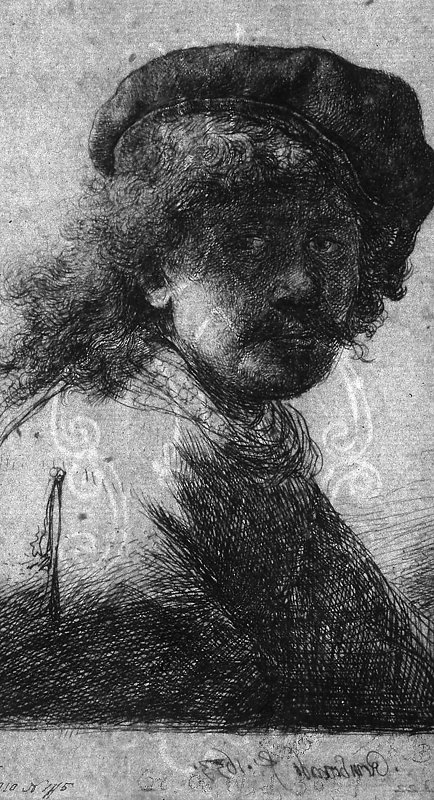
Rembrandt is the field's proving ground. Erik Hinterding examined more than 7,000 impressions and found watermarks in about a third of them, 2,369 sheets, which he classified into 680 different marks grouped in fifty-four general types with 294 variants and 512 subvariants including twins. That corpus turns paper into a dating instrument: it separates lifetime impressions from posthumous ones, brackets when Rembrandt returned to and reworked an old plate, and constrains the sequence of states.
The remaining two thirds, the sheets without a legible mark, are the current research frontier. Since 2012 the Watermark Identification in Rembrandt's Etchings project has been measuring the idiosyncratic spacing of chain lines recorded in beta-radiographs and matching those patterns as a substitute for a watermark, with the decision-tree method set out by C. Richard Johnson Jr. in the Journal of Historians of Netherlandish Art in 2020. The National Gallery of Victoria's programme on its 140 Rembrandt prints shows what the imaging involves in practice: beta-radiography using a plate that emits low-energy beta particles to record the sheet's internal structure through even heavy ink, alongside transmitted and raking light. Fifty-eight individual watermarks in eighteen design groups came out of that collection, including German arms of Wuerttemberg and Ravensburg and French Strasbourg bend and lily marks. One mark dated 1680 ties an impression to the posthumous Paris printings of Pierre Francois Basan, which is exactly the distinction a buyer of a Rembrandt etching most needs made.
Nineteenth-century paper is a slow fire, and older paper often is not
Collectors routinely assume that older paper is more fragile. For the period between roughly 1850 and 1980 the assumption inverts.
Paper made from wood pulp retains lignin, which was not removed in processing, and lignin breaks down under light and heat into acidic products. Traditional alum-rosin sizing introduced further acid into the sheet. The result is acid hydrolysis of the cellulose: the paper yellows, embrittles and eventually crumbles, a failure mode known in the library world as slow fire. William Barrow published research on the phenomenon in the 1930s, and the response took half a century to standardise, with ANSI/NISO Z39.48 arriving in 1984 and the international equivalent ISO 9706 in 1994.
Permanent paper is defined against those failures. It has a neutral or slightly basic pH, at or a little above 7, achieved with mild bases such as calcium or magnesium bicarbonate, and for a working life of at least a hundred years it needs an alkaline reserve of two per cent or more to neutralise acid generated later. Rag paper made from cotton rather than wood contains no lignin at all, which is why archival grades are still specified in rag.
The practical consequence for anyone assessing a portfolio is that the date on the sheet predicts its chemistry. A fifteenth-century engraving on rag paper may be chemically stable and mechanically sound. A late nineteenth-century lithograph on machine-made pulp paper may be brittle enough to crack along a fold, and mass deacidification exists precisely because institutions hold a great deal of material in that condition. Condition risk on paper follows manufacture, not age.
Foxing is not a diagnosis, and the treatments are not free
Foxing is the brown or rust-coloured spotting that appears on aged paper, and its cause is genuinely unresolved. Two hypotheses compete. The biotic explanation attributes the spots to fungal activity, with xerophilic genera such as Aspergillus, Cladosporium, Penicillium and Eurotium repeatedly identified in foxed areas, producing coloured metabolites and reaction products with cellulose degradation compounds. The abiotic explanation attributes it to localised oxidation of cellulose catalysed by metal particles, principally iron, with elevated iron concentrations measured in some foxed regions. High humidity is implicated in both routes, and the current position in the literature is that foxing is probably a combined effect rather than a single mechanism with a single cure.
The distribution of the problem supports the manufacturing argument made above. Foxing is rare in incunabula, books printed before 1501, which is attributed to better paper: as demand rose, later papermakers reduced water use and cleansed rag fibres less thoroughly, leaving more of whatever it is that foxing needs.
Treatment options include sodium borohydride, bleaches, hydrogen peroxide and laser methods, and every one of them carries a risk of unintended damage to the sheet. This is where foxing becomes a market issue rather than a conservation curiosity. A drawing whose foxing has been chemically reduced looks better and has been through an intervention that a condition report may describe only as 'cleaned' or 'washed and bleached', or may not describe at all. For reproduction purposes the spots can be removed digitally after scanning, which leaves the object untouched.
The buyer's question is therefore not whether a sheet is foxed. It is what has already been done to it, by whom, and with what.
Light is the one loss that cannot be treated
Every other risk to a work on paper can in principle be arrested. Light damage cannot be reversed, only prevented, and it accumulates from every hour of every display.
The numbers are settled enough to plan against. Conservation guidance sets a maximum of 50 lux, roughly 4.5 footcandles, for light-sensitive collections, which means works on paper, photographs and textiles. Less sensitive material, including oil paintings, wood and leather, is given 150 lux, and insensitive material such as metal, ceramic, stone and glass 300 lux. Ultraviolet content should ideally be between zero and 10 microwatts per lumen and must not exceed 75, and since UV-filtering films degrade they need replacing on something like a ten-year cycle.
The governing principle is reciprocity: damage is the product of illumination and time, so exposure is measured in lux hours. Fifty lux for 2,000 hours does the same work as 100,000 lux for one hour. That arithmetic is what converts a lighting level into an exhibition policy. The standard recommendation restricts light-sensitive material to three months on display every five years, and less sensitive material to three months every two years, with continuous display acceptable only for the insensitive categories.
Three months in five years is a severe constraint, and it explains institutional behaviour that outsiders often misread. Print rooms show works by appointment in drawers rather than on walls. Major drawings appear in one exhibition and then vanish for years. Loan refusals for a celebrated sheet are usually not political.
For a private collector the same arithmetic is a valuation input. A drawing's exhibition history is a record of consumed light, and heavy exhibition use is a permanent debit against the object. Framed sheets hanging in domestic daylight are being spent, quietly and continuously, and no restorer can put the colour back.
Questions
It dates the sheet, which sets an earliest bound for the image on it, and nothing more. Its real power comes from mould-mates, where several impressions on paper from the same mould are grouped and the latest dated plate among them fixes a date at or after which the batch was in use. That is how lifetime impressions are separated from posthumous ones.
No. Laid pattern has been produced on machine-made paper by dandy roll since 1826, and the roll displaces fibres so the pattern is visible in transmitted light as well as on the surface. The dating evidence lies in the finer characteristics, including whether antique-style rib shadows are present along the chain lines, and in the watermark and fibre analysis.
That is a conservation decision, not a cosmetic one. Every available route, from sodium borohydride to bleaches, peroxide and lasers, risks damaging the sheet, and the cause of foxing is not settled, so treatment is empirical. The disclosure question matters more commercially: prior chemical treatment should appear in the condition record, and frequently does not.
Because its light budget is spent. Standard practice caps light-sensitive works at 50 lux and restricts display to about three months in every five years, and exposure is cumulative and irreversible. A sheet that has been shown recently has no allowance left, regardless of the significance of the requesting exhibition.
Sources
- 1Wikipedia, 'Laid paper': laid lines and chain lines, antique versus modern laid and the rib shadows, dominance in Europe from the twelfth to eighteenth centuries, dandy roll imitation. Tertiary source; replace with a standard paper-history reference. en.wikipedia.org/wiki/...
- 2Wikipedia, 'Wove paper': James Whatman the elder (1702-1759), Baskerville's 1757 Virgil, Franklin's introduction to America and currency printing from about 1764, the paper machine of 1807, present share of production. Tertiary source. en.wikipedia.org/wiki/...
- 3Wikipedia, 'Watermark': origin at Fabriano in 1282, method of manufacture, dandy roll from 1826, use in dating documents and artworks. Tertiary source. en.wikipedia.org/wiki/...
- 4C. Richard Johnson Jr., 'Decision Trees for Watermark Identification in Rembrandt's Etchings', Journal of Historians of Netherlandish Art 12.2 (2020): Hinterding's 7,000-plus impressions, 2,369 watermarked sheets, 680 marks in fifty-four types, mould-mate dating, chain-line pattern matching. jhna.org/articles/...
- 5National Gallery of Victoria, 'Rembrandt's watermarked papers at the NGV': beta-radiography, transmitted and raking light, 140 prints, fifty-eight watermarks in eighteen design groups, the 1680 mark linked to Basan's posthumous printings. ngv.vic.gov.au/explore/...
- 6Wikipedia, 'Foxing': competing fungal and metallic hypotheses, humidity, rarity in incunabula and the decline in paper quality, treatment options and their risks. Tertiary source; replace with the AIC Book and Paper Group literature review. en.wikipedia.org/wiki/...
- 7Conservation Center for Art and Historic Artifacts, 'Light Exposure for Artifacts on Exhibition': 50 lux for sensitive collections, 150 and 300 lux tiers, UV limits of 0-10 and maximum 75 microwatts per lumen, the lux-hours formula, three months every five years. ccaha.org/resources/...
- 8Wikipedia, 'Acid-free paper': lignin and alum-rosin sizing, acid hydrolysis and slow fire, pH at or above 7, two per cent alkaline reserve, Barrow's 1930s research, ANSI/NISO Z39.48-1984 and ISO 9706 (1994), rag versus wood pulp. Tertiary source. en.wikipedia.org/wiki/...
More in Research and Method
The partThe First Link Is in the Maker's Own Hand
A maker's bill, workbook or memoir is the only provenance document that fixes date, cost and first owner at once.
The date on the object dates one layer of it
Seven dated objects in this archive show that a date belongs to one layer of the thing: the parchment, the copying, the printing, the compilation.
Every Record Here Ends in Questions It Could Not Answer
The 257 published records in this archive carry 1,795 open questions between them, a median of seven each, and not one record carries none.