The Auction Catalogue as a Historical Document
Printed sale catalogues were written to sell and became the spine of provenance research. Where the digitised runs are, why the annotated copy is the real record, and how to cite one.
On this page 6 sections
ContentsClose
In short
- Samuel Baker held his first sale under his own name on 11 March 1744 and James Christie his first on 5 December 1766, but the printed sale catalogue predates both, appearing as simple leaflets in the early seventeenth-century Netherlands.
- The annotated hand copy, carrying prices and buyers' names in manuscript, is a different and better document than the printed catalogue, and two annotated copies of one sale can disagree.
- More than 15,500 catalogues are free and full-text searchable through Heidelberg's German Sales, and over 22,000 more, many of them annotated, through the Wildenstein Plattner Institute.
- Christie's closed external access to its own archive in February 2021, which makes library-held and digitised runs the working record rather than a convenience.
The catalogue was written to sell, and it records only what selling required
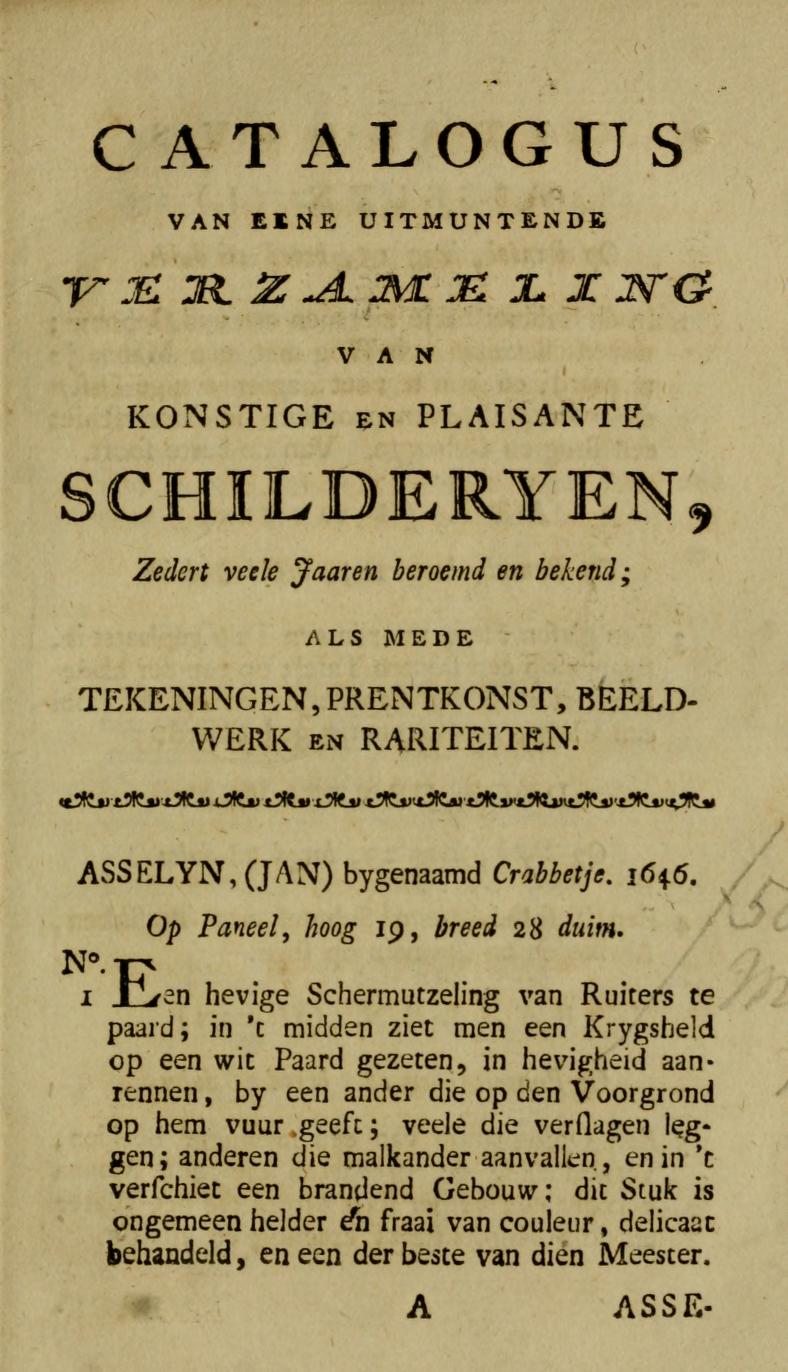
The earliest art sales catalogues appeared in the early seventeenth century as simple leaflets, and in the seventeenth-century Netherlands some dealers were already sending printed illustrated catalogues to potential clients. Over the following two centuries the leaflet grew into an extensive, illustrated, sometimes scholarly publication. The institutional landmarks come later than the format: Samuel Baker, a London bookseller, held his first auction under his own name on 11 March 1744 and built a reputation on advertising and on catalogues presented as authoritative; James Christie held his first sale on 5 December 1766, and the earliest catalogue his firm retains is from that December.
What the printed catalogue contains is determined entirely by what was needed to sell the lot. A lot number, a short description, usually an attribution, often a subject, sometimes a support and a measurement. What it does not contain is anything the seller had no commercial reason to supply. Condition is absent or euphemistic. Ownership history appears when a previous owner's name adds value and vanishes when it does not. The printed catalogue never states what a buyer actually paid, because it was printed before the sale.
The attributions are confident because confidence sells, and this is the single most common trap for a student. A picture called Rembrandt in an 1820 catalogue is not a scholarly opinion; it is a commercial position taken by a firm with a stake in the outcome, at a moment when the machinery for testing such positions barely existed. Read the attribution as a claim made by an interested party on a known date, which is genuinely useful information, and read the measurements, support and subject as the closest thing the document offers to fact.
The annotated copy is the document; the printed catalogue is the advertisement
The catalogues that matter to research are the marked ones. Dealers, agents, clerks and the auctioneers themselves wrote prices and buyers' names into their working copies during and after the sale. These are known in the German literature as Handexemplare, hand copies, and alongside the protocol catalogues they constitute the actual record of what happened in the room. Heidelberg University Library runs a dedicated project on hand and protocol copies of auction and inventory catalogues covering 1860 to 1950, precisely because the printed text alone answers almost none of the questions a provenance researcher has.
The Wildenstein Plattner Institute makes the same point at scale: many of the catalogues in its digitised holdings carry annotations from previous owners, including sale prices, the names of buyers and occasional sketches, and it notes explicitly that different institutions hold copies with different annotations. That last observation is the methodological heart of the matter. There is no single annotated copy of a sale. There are several, made independently, by people with different information and different purposes, and they can disagree.
Two consequences follow. First, locate as many copies of a sale as you can reach before drawing a conclusion, and quote which copy you are reading. Second, treat every annotation as an assertion by an unidentified annotator working to no standard. A figure in the margin may be the hammer price, a total including charges, a reserve, an estimate, or what the annotator thought the lot was worth. A name may be the buyer of record, a dealer bidding for a client, or a member of a ring. A lot that failed to sell may carry a number that looks exactly like a result. The annotation is evidence of something; establishing of what is the work.
What is digitised, where it lives, and what it costs
The free resources now cover a very large part of the field, and a student who pays for access before exhausting them is wasting money.
The Getty Provenance Index holds more than 2.3 million records drawn from archival inventories, auction catalogues and dealer stock books, including sales content from Belgium, Britain, the Netherlands, France, Germany and Scandinavia, and the Goupil and Knoedler stock books. More than 830,000 auction records have been digitally extracted, with links out to full PDFs hosted by Heidelberg University Library. The Getty Research Library also holds over 10,000 photocopied auction and private contract sale catalogues, weighted towards European sales between 1670 and 1870, and around 20,000 collectors files covering dealers, collectors and institutions from the late Middle Ages onward.
Heidelberg's German Sales offers more than 15,500 digitised catalogues in open access with full-text search, drawn mainly from German-speaking countries, out of holdings of over 20,000 auction and sales catalogues. Its programme has systematically covered catalogues published in Germany, Austria and Switzerland between 1901 and 1929, and has indexed and digitised over 3,200 catalogues published in those countries between 1930 and 1945, which is the material the restitution field depends on.
The Wildenstein Plattner Institute provides free access to more than 22,000 sales catalogues from the seventeenth century to 1945, processed with optical character recognition so that the text is searchable, with filters for date, place of sale, auction house, artist and collector. Its Digital Library now brings that together with catalogues raisonnes, artist monographs and 972 Wildenstein Galleries exhibition catalogues, exceeding 25,000 digitised publications in total.
Alongside these, the Getty Research Portal aggregates digitised art-historical texts with a filter for auction catalogues; the Metropolitan Museum's Watson Library had uploaded around 1,400 historic sales catalogues as of 2025; Gallica carries the French runs; and HathiTrust, Google Books, Open Library and the Frick's digital collections between them hold a great deal more. SCIPIO, a searchable subset of OCLC holdings, covers roughly 300,000 auction catalogues for locating a physical copy. The main subscription resource is Art Sales Catalogues Online, with over 32,000 full-text catalogues for 1600 to 1900 and more than 65,000 Lugt records, available on site at the British Library, the National Art Library and the Courtauld among others.
Lugt numbers are how the field agrees which sale it is discussing
Frits Lugt's Repertoire des catalogues de ventes publiques interessant l'art ou la curiosite, in four volumes, lists more than 100,000 art sales catalogues from 1600 to 1925 held in European and American libraries. Every sale in that range has a Lugt number, and that number is the shared reference by which two researchers confirm they are talking about the same event. Lugt gave his own collection of sale catalogues, with his library, to the Netherlands Institute for Art History in The Hague, which is why the RKD holdings are what they are.
The online edition through Brill carries over 65,000 Lugt records, but only the first three volumes, covering 1600 to 1900, have been digitised, and it sits behind a paywall. The printed volumes remain the reference for 1900 to 1925 and are in every serious art library.
Quote the Lugt number in your notes as a matter of routine. It costs one bracketed figure and it does something no link can do: it survives. A scan's URL will be retired in the next platform migration. The Lugt number will still identify the sale, and it will still let a reader in another country find whichever surviving copy is nearest to them.
The 2021 Christie's closure is the argument for working from libraries
In February 2021 Christie's closed public access to the archive at its King Street salesroom in London, following reductions to the team of archivists. Reporting at the time described it as the most comprehensive auction archive in the world, holding buyer records, sale prices and auctioneer's books going back to the firm's first sales in 1766, and both trade and academic users protested. The house said it would continue to maintain its records appropriately and would explore ways to expand access in future. Publicly searchable results on the Christie's website reach back to 1998.
Draw the general lesson rather than the particular grievance. The commercial record of the art market is a corporate asset. It is maintained at the owner's discretion, for the owner's purposes, and it can be closed, thinned or repriced without notice or consultation. The library record is not held on those terms. Heidelberg, the Getty, the Frick, the RKD, the Watson Library and the Wildenstein Plattner Institute are all in the business of keeping things and making them findable, and they publish what they hold and what they lack.
Build your evidence from institutional holdings, cite those holdings, and treat any auction house's own website as a convenience that may not be there when your reader goes looking.
A method for using a catalogue as evidence rather than as a price list
Identify the sale first, using Lugt for anything between 1600 and 1925, SCIPIO or a union catalogue to find physical copies, and the Getty Provenance Index to see whether the contents have been transcribed. Then find every accessible copy, prioritising annotated ones, and note which institution holds each.
Read the front matter before the lots. The conditions of sale tell you what the house was and was not undertaking. The viewing dates tell you how much opportunity buyers had to look. The wording of the consignment matters enormously: a named collection is a provenance statement, while 'the property of a gentleman' or 'the property of a lady' is a category invented to conceal one, often deployed for estates in difficulty or for dealers disguising trade stock as private property.
Then reconcile the lot text with the object. Measurements, support and subject are the load-bearing elements, and the honest test is whether the description could equally fit a second picture. A great deal of published provenance rests on entries that could apply to any of a dozen surviving canvases. Where it does, say so in your own note.
Record the currency, the date and whether a figure is a hammer price or a total including charges, and say which your source gives; a great many secondary accounts conflate them silently. Treat every buyer's name as an agent until proved otherwise, because dealers bid for clients and clients bid under other men's names. And keep sight of what the exercise is for. The purpose is not to find out what a picture fetched. It is to establish that a specific object stood in a specific room in a specific city on a specific day, in identifiable hands, which is the only kind of sentence a provenance is made of.
Questions
Usually, but not reliably. Annotations were made by dealers, agents, clerks and auctioneers for their own purposes and follow no standard, so a marginal figure may be hammer, a total including charges, a reserve or an estimate. State which institution's copy you are quoting and what the annotation literally reads, and let the reader see the ambiguity.
Give the auction house, city, sale title where the sale is named, the sale date and the lot number, and add the Lugt number for any sale between 1600 and 1925. If you used a digitised or annotated copy, name the holding institution as well, because annotated copies differ from one another. The identifiers will outlive the URL.
The Wildenstein Plattner Institute offers more than 22,000 sales catalogues free and searchable, many of them annotated with prices, buyers' names and occasional sketches. Heidelberg's German Sales adds over 15,500 open-access catalogues with full-text search, including a project dedicated to annotated hand and protocol copies covering 1860 to 1950.
Yes. Lugt lists more than 100,000 catalogues for 1600 to 1925 across European and American libraries, far more than has been digitised, and Brill's online edition covers only volumes one to three, ending in 1900. It is also the shared identifier by which two researchers confirm they mean the same sale, which no scan URL can be.
Sources
- 1Getty Research Institute Library, 'Auction and Sales Catalog Research Guide: Getty Provenance Index Resources Relating to Sales and Auctions' (2.3 million records; 10,000 photocopied catalogues 1670-1870; 20,000 collectors files). libguides.getty.edu/c.php
- 2Getty Research Institute Library, 'Auction and Sales Catalogs (Online Full-Text)' (Art Sales Catalogues Online: 32,000+ catalogues 1600-1900, 65,000+ Lugt records; Getty Research Portal; Wildenstein Plattner Institute 22,000+ catalogues). libguides.getty.edu/c.php
- 3Heidelberg University Library, 'German Sales: Source Material for Art Market and Provenance Research' (15,500+ digitised catalogues, open access, full-text searchable). digi.ub.uni-heidelberg.de/en/...
- 4Heidelberg University Library, 'Auction Catalogues, digitized' (holdings of over 20,000 auction and sales catalogues; digitisation of 1901-1929 and 1930-1945 runs). digi.ub.uni-heidelberg.de/en/...
- 5Heidelberg University Library, German Sales project page on hand and protocol copies of auction and inventory catalogues, 1860-1950. digi.ub.uni-heidelberg.de/en/...
- 6Wildenstein Plattner Institute, 'The WPI Sales Catalogues Database: A Valuable Resource for Art Historical Research' (annotations, prices, buyers' names, differing copies between institutions). wpi.art/2024/...
- 7Wildenstein Plattner Institute, 'Announcing the WPI Digital Library' (25,000+ digitised publications, including 972 Wildenstein Galleries exhibition catalogues). wpi.art/2025/...
- 8Sotheby's Institute of Art Library, 'Historic catalogues online' (free and subscription resources compared, including the Met's ~1,400 uploaded catalogues as of 2025). sia.libguides.com/salescatalogues/...
- 9Yale University Library, 'Auction catalogues: Collecting and Provenance Research' (Lugt as the standard work; SCIPIO's ~300,000 records; Getty Provenance Index coverage 1650-1945). guides.library.yale.edu/c.php
- 10Brill, 'Lugt's Repertoire Online' (100,000+ catalogues 1600-1925; only volumes covering 1600-1900 digitised). brill.com/display/...
- 11Artnet News, 'Christie's Has Closed Off Public Access to Its 255-Year-Old Auction Archive, a Major Resource for Scholars, Citing Budget Concerns' (February 2021). news.artnet.com/market/...
- 12The Art Newspaper, 'Christie's auction house closes access to historic archive due to staff cuts', 11 February 2021. theartnewspaper.com/2021/...
- 13Sotheby's, 'Our History' (Samuel Baker's first sale under his own name, 11 March 1744). sothebys.com/en/...
- 14History Today, 'The first Christie's auction' (5 December 1766). historytoday.com/archive/...
- 15Metropolitan Museum of Art, Watson Library digital collections: auction catalogs. metmuseum.org/art/...
More in Research and Method
The partThe First Link Is in the Maker's Own Hand
A maker's bill, workbook or memoir is the only provenance document that fixes date, cost and first owner at once.
The date on the object dates one layer of it
Seven dated objects in this archive show that a date belongs to one layer of the thing: the parchment, the copying, the printing, the compilation.
Every Record Here Ends in Questions It Could Not Answer
The 257 published records in this archive carry 1,795 open questions between them, a median of seven each, and not one record carries none.