Reading the Primary Sources of Art History
Vasari, Cennini and van Mander are evidence about their own moment before they are evidence about the past. A working method for using them, and the inventories that correct them.
On this page 5 sections
ContentsClose
In short
- Vasari's 1568 Giuntina is a different book from the 1550 Torrentiniana, and citing 'Vasari' without naming the edition is an incomplete citation.
- Gaetano Milanesi showed in 1862 that Andrea del Castagno was buried in August 1457 while Domenico Veneziano lived until May 1461, destroying Vasari's murder story after three centuries of repetition.
- The Cennini text in circulation descends from a Laurenziana manuscript of 1437 and later copies, and the first printed edition of 1821 was set from an eighteenth-century transcript rather than the manuscript itself.
- Notarial and probate inventories correct the artist-biography tradition because they were compiled for valuation and division of estates, not for reputation.
Vasari is a primary source for 1550 and 1568 before he is a source for 1350
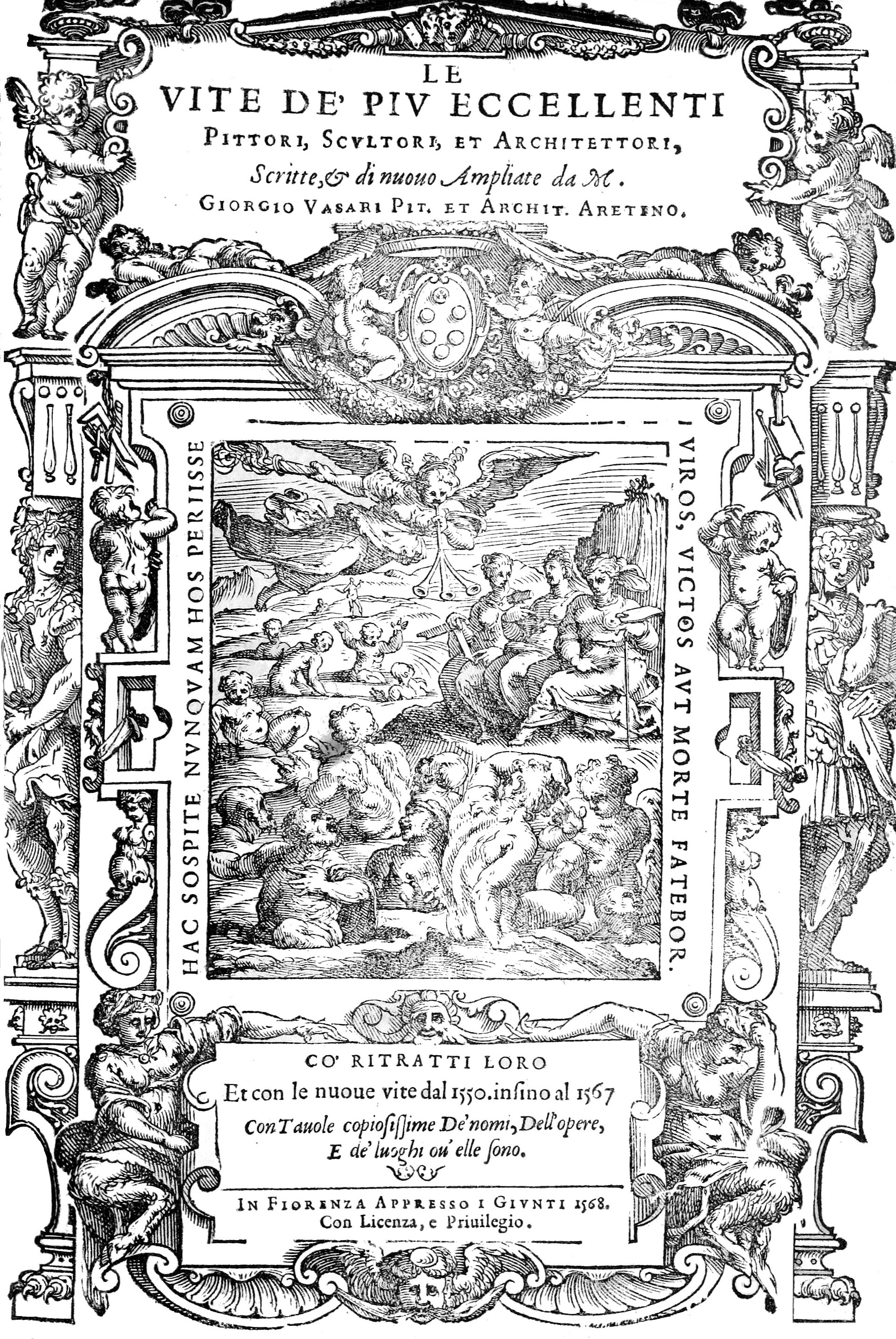
Giorgio Vasari's Lives exists in two editions and they are not the same book. The first, printed in Florence by the Flemish typographer Lorenzo Torrentino in 1550, is known as the Torrentiniana. The second, printed in Florence by the Giunti in 1568, is the Giuntina: three books, woodcut portraits of the artists, a much larger cast of living men, and a great deal of rewriting. A student who writes 'Vasari says' without saying which edition has not finished making the citation. Passages were added, cut and reworked between the two, and the changes are usually the interesting part.
The distance between Vasari and his subjects matters more than the distance between Vasari and us. Writing about Cimabue and Giotto, he is describing men two centuries dead, from a Florentine vantage point, for a Medicean patron, inside a scheme in which painting declines after antiquity, revives in Tuscany and culminates in Michelangelo. Every fourteenth-century Life is shaped by that arc before it is shaped by evidence. Writing about his own contemporaries he is often a first-hand witness with access to the workshops, and there he is very good indeed. The same book is therefore two different kinds of document depending on which page you open.
The worked example every student should know is the murder that never happened. Vasari relates that Andrea del Castagno, envious of Domenico Veneziano's secrets in oil painting, feigned friendship, waited for him in the street and killed him. The story ran for three hundred years and coloured Castagno's reputation throughout. In 1862 the archival scholar Gaetano Milanesi published evidence that Castagno was buried in August 1457 and that Domenico was alive until May 1461. The victim outlived his murderer by nearly four years.
Note the shape of the error. It is a structurally satisfying narrative, with envy punished and a technical secret as motive, for which Vasari had no document and no reason to look for one. The practical rule follows from that. Treat each statement as a claim with a provenance of its own: establish what Vasari could plausibly have seen, whom he could have asked, what work the claim does in his argument, and whether the nineteenth-century document-hunters found paper for it. Where they did, cite the document. Where they did not, write that Vasari alone reports it. Both of those are publishable sentences. 'Vasari records that', followed by silence, is not.
Cennini describes a workshop, and the text you quote is a reconstruction
Cennino Cennini's Il Libro dell'Arte is the closest surviving thing to a manual written from inside a late-medieval Italian painter's shop: pigments and their grinding, the preparation of panels and grounds, gilding, the handling of egg tempera, how to draw on tinted paper. Archival work places its composition most probably in Padua. It is the reason technical art historians can put names to what they see in a fourteenth-century panel, and it is corroborated again and again by examination of the objects themselves.
What students rarely register is that the text they quote is a critical construction. The oldest surviving witness is a manuscript in the Biblioteca Medicea Laurenziana in Florence dated 1437, decades after Cennini wrote, and linguistically it carries traces of the text's passage through Venice. A second important witness, Riccardiano 2190 in the Biblioteca Riccardiana, dates to the third quarter of the sixteenth century and preserves chapters the Laurenziana lacks. Two further copies of the Laurenziana survive, one in the Vatican Apostolic Library as Ottoboniano Latino 2874 and one in the Biblioteca Nazionale in Florence as Palatino 818.
The printing history compounds this. Giuseppe Tambroni's first printed edition of 1821 was set not from the 1437 manuscript but from a 1737 copy of it, and was attacked on precisely that ground. Antonio Benci's sharp review of Tambroni announced the Riccardiana manuscript, which became fundamental to reconstructing the text. Carlo and Gaetano Milanesi's edition of 1859 worked from the two Florentine manuscripts, interpolating them and setting the largely incomplete Vatican copy aside. Lara Broecke's English translation of 2015 prints an Italian transcription alongside the translation, which is the only responsible way for a non-specialist to use the text.
So when Cennini appears to say something surprising about a technique, the first question is which manuscript and which editor. A recipe attested only in a sixteenth-century copy is evidence about the sixteenth century until shown otherwise. Cite the edition and the chapter number, and where an argument turns on a single word, quote the Italian and let the reader judge.
Van Mander built a northern canon, and he built it to a programme
Karel van Mander's Schilder-boeck, published in Haarlem in 1603 and 1604, does for the north what Vasari did for Italy, partly by direct imitation. Its biographical section, Het Leven der Doorluchtighe Nederlandtsche en Hoogduytsche Schilders, supplies the earliest connected account of Netherlandish and German painters. For sixteenth-century figures it frequently rests on men van Mander knew or could interrogate, and that is where its authority sits.
Van Mander was a painter and a poet with a didactic purpose. The book opens with an instructional poem setting out the grounding of painting for aspiring youth, runs through the Lives, and closes with the interpretation of Ovid's Metamorphoses and the reading of figures. The Lives are selected and shaped to argue for what northern painting is and how a young painter should proceed. The Vasarian framework, including the assumption that art progresses, is imported wholesale, and it does not fit the material as neatly as van Mander needs it to.
The route in for English readers is Hessel Miedema's edition, published between 1994 and 1999, which sets a facsimile of the original beside a translation and several volumes of commentary, prefaced by van Mander's own life as given in the second edition of 1616 to 1618. The commentary is the reason to use it: it is a running record of which statements have documentary support and which do not, compiled by the leading specialist on the text. A scanned copy of the Schilder-boeck from the Getty Research Institute's holdings is freely available through the Internet Archive, which is enough to check a passage against the Dutch.
Inventories are the corrective, because nobody compiled them to praise anyone
The artist-biography tradition tells you what a literate professional in Florence or Haarlem wanted posterity to think. Inventories tell you what was in a room. They were drawn up for valuation, probate, dowry, insolvency, taxation and the division of estates, by clerks and notaries with no interest whatever in the history of art, and that indifference is what makes them useful.
The Getty Provenance Index holds more than 2.3 million records taken from archival inventories, auction catalogues and dealer stock books. Its archival inventories are legal records listing objects in European private collections between 1520 and 1880; its sales catalogue records document works offered for sale in Europe from 1650 to 1945; it also indexes payments to artists in Rome between 1576 and 1711, and files on more than 20,000 collectors, dealers and institutions. For seventeenth-century Amsterdam, the Montias Database at the Frick Art Research Library holds 1,280 inventories listing 51,071 individual works of art, dated between 1597 and 1681 and drawn from the Amsterdam city archive. Close to half were compiled by the Orphan Chamber ahead of auction; most of the remainder are notarial death or bankruptcy inventories. The database states plainly that it is not a complete record of Amsterdam inventories of the period, which is exactly the kind of statement to look for and to quote.
The single most instructive document of this kind is Rembrandt's. Having petitioned for cessio bonorum, the surrender of goods to be sold by the municipal authorities in settlement of his debts, he was inventoried by an official of the Desolate Boedelskamer, the Amsterdam chamber of insolvent estates. The official finished on 26 July 1656 after two days of walking room to room through the house on the Breestraat, recording 363 items or groups of items in succinct descriptions. The result is a topographic account of what a major painter actually owned, written by a clerk with no aesthetic agenda and every professional reason to be accurate about quantity.
Inventories have their own pathologies, and they are consistent enough to plan for. Attributions in them are trade shorthand: a picture called a Rembrandt in a 1660s Amsterdam inventory is a picture somebody at the door said was a Rembrandt. Valuations respond to size, subject and frame at least as much as to authorship. Rooms are listed in the order the clerk walked them, so the sequence is architectural rather than thematic and tells you about the house. And absence proves nothing at all, since an object out for repair, on loan or pledged against a debt does not appear. Use inventories to establish that a kind of picture stood in a kind of room in a given year, and be slow to identify a single line with a surviving canvas.
A checklist for reading a sixteenth-century account
Six checks, in order. Identify the edition or manuscript in front of you and count the steps between it and the author's hand. Establish what the author could have seen and whom he could have asked. Name the work the claim does in his argument. Look for an independent document, and for who found it and when. Find out what nineteenth-century archival scholarship did to the passage, since Milanesi, Gaye, Bottari and Frey went through most of this material with the registers open. Then read the modern critical editor's apparatus, which is the part nobody reads and the place where the doubts are recorded.
The free texts to work from are better than most students realise. Fondazione Memofonte publishes Vasari's writings as a searchable database covering both the 1550 and 1568 editions alongside the Ricordanze, the correspondence and the Ragionamenti, which makes it possible to check whether a phrase belongs to Vasari or to his translator. The Getty Research Portal aggregates digitised art-historical texts across its contributing institutions and is free. The Internet Archive carries scans of the Schilder-boeck and of the nineteenth-century editions of the Vite.
Finally, be explicit in your own prose about which kind of statement you are making. 'Vasari reports' does not mean 'documents show'. A footnote that says a claim rests on Vasari alone is worth more to the next reader than one that quietly launders him into fact, and it protects you when somebody goes and reads the burial register. The habit costs nothing except the sentence.
Questions
Cite the one you actually used and name it: the 1550 Torrentiniana or the 1568 Giuntina. Where an argument depends on a passage, check both, because Vasari added, cut and rewrote extensively between them. English translations differ in which edition they follow, so read the translator's preface before treating a passage as evidence for either year.
He is reliable as a record of what one trained painter held the correct procedures to be, and technical examination of panels corroborates him repeatedly. He is not a survey of practice across Italy, and the text's transmission through a manuscript of 1437 and a sixteenth-century copy means an individual passage should be checked against a critical edition before it carries weight.
The Getty Provenance Index publishes transcribed archival inventories of European private collections from 1520 to 1880, and the Montias Database at the Frick Art Research Library covers 1,280 Amsterdam inventories from 1597 to 1681, listing 51,071 works. Both are free to search. Neither is complete, and both say so.
Attribute it in the sentence, not only in the note, and then say whether any document supports it. If a nineteenth-century editor flagged the passage, name the editor and the year. A reader can then weigh the claim without repeating your research, which is the whole purpose of a footnote.
Sources
- 1Discover Arezzo, 'Lives of the most excellent painters, sculptors and architects' (on the 1550 Torrentiniana and 1568 Giuntina editions). Tertiary summary; replace with the printed editions or the Memofonte transcriptions where possible. discoverarezzo.com/en/...
- 2Virtual Uffizi, 'The invention of Domenico Veneziano's murder at the hands of Andrea del Castagno' (Milanesi's 1862 disproof, burial August 1457, Domenico alive May 1461). virtualuffizi.com/the-invention-of-domenico-veneziano%E2%...
- 3Italian Art Society, 'Florentine painter Andrea di Bartolo di Simone, known as Andrea del Castagno, died suddenly 19 August 1457'. italianartsociety.org/2017/...
- 4Fondazione Memofonte, 'Vasari scrittore' (searchable database of Vasari's writings, both editions of the Vite, Ricordanze and correspondence). memofonte.it/vasari-scrittore
- 5Treccani, 'Il Libro dell'arte di Cennino Cennini: la prima stampa e il dibattito sulla lingua' (Laurenziana 1437, Riccardiano 2190, Ottoboniano Latino 2874, Palatino 818, Tambroni 1821 from a 1737 copy, Benci's review, Milanesi 1859). treccani.it/magazine/...
- 6Studi di Memofonte 15/2015, Alessandro Ricotta on the manuscript tradition of the Libro dell'Arte. memofonte.it/home/...
- 7Archetype Publications, Lara Broecke, 'Cennino Cennini's Il Libro dell'Arte: A new English translation and commentary with Italian transcription' (2015). archetype.co.uk/our-titles/...
- 8Dictionary of Art Historians, entry for Karel van Mander (Schilder-boeck 1603-04; Miedema's edition and commentary, 1994-99). arthistorians.info/manderk
- 9Internet Archive, Karel van Mander, 'Het schilder-boeck', digitised from the Getty Research Institute copy. archive.org/details/...
- 10Getty Research Institute, 'What's Covered in the Provenance Index' (2.3 million records; archival inventories 1520-1880; sales catalogues 1650-1945; payments to artists in Rome 1576-1711). getty.edu/databases-tools-and-technologies/...
- 11Frick Art Research Library, 'The Montias Database of 17th Century Dutch Art Inventories' (1,280 inventories, 51,071 works, 1597-1681, Amsterdam city archive; explicit statement of incompleteness). research.frick.org/montias
- 12Gary Schwartz, '398 Rembrandt's Rembrandts' (the Desolate Boedelskamer inventory completed 26 July 1656 after two days, 363 items or groups of items). garyschwartzarthistorian.nl/398-rembrandts-rembrandts
- 13Rembrandt's Money, 'The Chamber of Abandoned and Insolvent Estates' (cessio bonorum and the role of the Desolate Boedelskamer). rembrandtsmoney.com/rm24013-the-chamber-of-abandoned-and-...
More in Research and Method
The partThe First Link Is in the Maker's Own Hand
A maker's bill, workbook or memoir is the only provenance document that fixes date, cost and first owner at once.
The date on the object dates one layer of it
Seven dated objects in this archive show that a date belongs to one layer of the thing: the parchment, the copying, the printing, the compilation.
Every Record Here Ends in Questions It Could Not Answer
The 257 published records in this archive carry 1,795 open questions between them, a median of seven each, and not one record carries none.