Bronze Casts: Lifetime, Posthumous, Surmoulage
Two casting methods, three kinds of cast and one French decree decide what a bronze is worth. The edition number and the cast date carry more price than the modelling.
On this page 5 sections
ContentsClose
In short
- Indirect lost wax reproduces a wax shell about 3 mm thick that the sculptor can rework; French sand casting takes the mould straight off a cut-up model and needs far more chasing.
- A surmoulage is moulded from a finished bronze, so it comes out smaller than its parent and softer in surface detail.
- French law caps an original edition at twelve: eight numbered 1/8 to 8/8 and four artist's proofs I/IV to IV/IV, with anything further marked as a reproduction.
- Guy Hain recast from genuine Rudier moulds and stamped them Alexis Rudier to imply lifetime casts; an expert estimated over 6,000 copies, only about a third traced.
Two ways to get bronze out of a model, and they leave different objects
Lost-wax casting comes in two forms. The direct method casts from a wax the sculptor made, and consumes it, so there is one object and no edition. The indirect method, which is what almost every edition bronze means, takes a mould from the original model, and a wax replica is built inside that mould.
In the indirect process the mould is coated with molten wax to a thickness of about three millimetres and the hollow wax is removed. That wax is chased with heated tools to remove seams, then sprued with a wax tree of channels for the metal to enter and for air to escape. It is dipped repeatedly in silica slurry and stucco until a ceramic shell about half an inch thick has been built, then fired so the wax runs out and the shell hardens, leaving a cavity. Molten bronze at around 1200 degrees is poured in, the shell is broken away, and the raw cast is filed and polished to remove sprue stubs and the pits left by air bubbles.
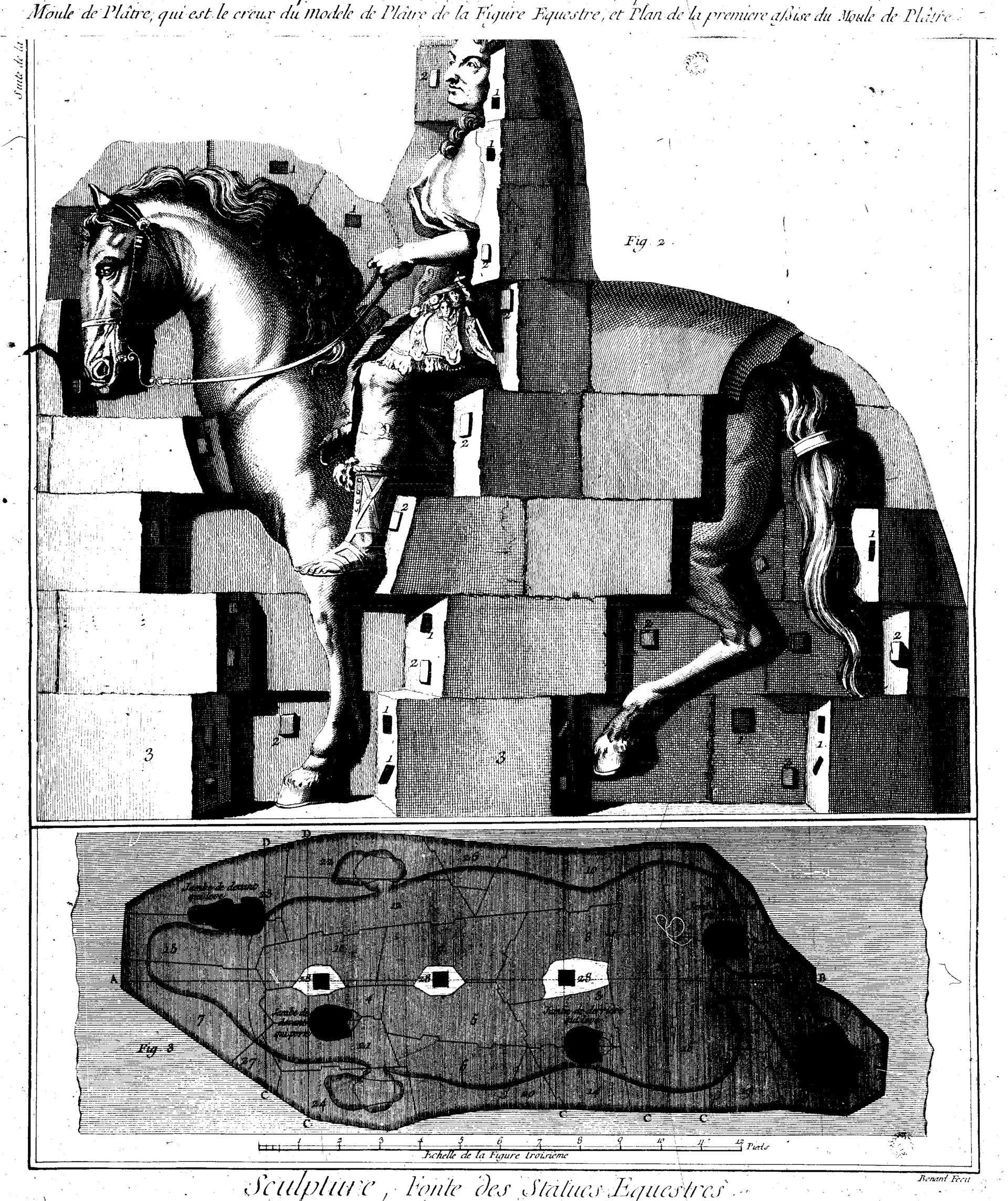
Sand casting, the French foundry tradition, works differently. As the Musee Rodin describes it, the model - which is generally cut into sections to make it mouldable - is packed round with sand to form the mould, the core is placed back inside, and the bronze is cast directly. There is no wax intermediate, so the sculptor gets no final opportunity to work over a wax before the metal is poured. Chasing after the cast matters more than in lost wax, because the sections have to be reassembled. The technique is capable of ambitious single pours: the museum notes that the large Thinker was cast in one go.
The practical difference shows on the object. Sand casting is cheaper for large work and holds less fine detail than investment casting; lost wax reproduces the surface more faithfully and permits a final human touch on the wax. A specialist inspecting a bronze is therefore looking at evidence of a process, and joins, chasing patterns and interior finish are part of what identifies which foundry practice produced it.
A cast is a generation, and each generation loses something measurable
The vocabulary of the trade compresses a physical fact. A lifetime cast is pulled from the artist's model while the artist is alive and, in the good cases, is finished and patinated under supervision. A posthumous cast is pulled from the same model afterwards. A surmoulage is something else entirely: a mould taken from an existing finished bronze, and a cast pulled from that.
The surmoulage carries two signatures of its own making. It is smaller than the bronze it was taken from, because molten metal shrinks as it cools and the loss compounds through the extra generation. The Daumier Register's account of surmoulage describes copies as slightly smaller than legal casts because of mould shrinkage in baking and the loss through drying, and notes that they can also be heavier. And it is softer: moulding from a finished, chased and patinated surface blurs the detail, so edges look melted and the crispness of the original tooling is gone.
Neither test is available without a reference. Softness is a comparative judgement, and shrinkage is only detectable against documented dimensions for the model at that size. This is why serious sculpture diligence begins with the catalogue raisonne measurements and the foundry records rather than with the object in the room.
Surface quality alone will not do the work. The same Daumier source records that Guy Hain, whose entire business was passing off recast bronzes, produced Daumier busts of remarkable quality that carried no numbers and no foundry cachet. Excellence of finish is evidence about a founder's skill. It is not evidence about a cast's generation.
French law wrote the edition, and the market inherited it
The number stamped on a bronze is a legal artefact, and its history is specific. In 1956 French law limited the casting of each of Rodin's works to twelve examples at each size. In 1968 France required the date of the cast to be inscribed on the sculpture, and numbering became compulsory from 1 January that year, with the further requirement that numbers cannot be hidden inside the base.
Decree 81-255 of 3 March 1981, known as the Marcus decree, addressed fraud in sales of works of art and collectables. Under Article R.122-3 of the Code de la Propriete Intellectuelle, an edition of a sculpture limited to twelve numbered casts, artist's copies included, counts as an original work of art. The 1981 numbering scheme divides those twelve: eight for the market, numbered 1/8 to 8/8, and four artist's copies in Roman numerals, I/IV to IV/IV, reserved for cultural institutions. Anything cast beyond the edition, and any facsimile, aftercast or reproduction, must be described as such, and the decree requires the word 'Reproduction' to be applied visibly and indelibly. Enlargements and reductions must differ from the original by roughly a third in size and are classified as works of art rather than original works of art.
For Rodin specifically, the authority runs through the state. Rodin left his estate to the French nation in 1916 with the right to continue casting, and by the decree of 5 September 1978 the Musee Rodin casts from the original plasters under the conditions set by law. The museum states that no more than twelve bronzes may be cast from an original work, that each new casting project requires historical and archival research and validation by two committees of French and foreign sculpture experts under a binding ethical charter, and that it takes one of the twelve for the national collections. It also states plainly that this activity has underwritten its finances, its collections and the renovation of its two sites for the past hundred years.
The consequence for a buyer is that 'original' in the French legal sense and 'made in the sculptor's lifetime' are different claims. A cast made in 2015 within an authorised edition of twelve is an original under Article R.122-3. It is not a lifetime cast, and no amount of legal correctness in the catalogue makes it one.
The market prices the cast date, and the reporting rarely says which price it means
Judd Tully's survey of the Rodin market quotes David Norman, formerly head of Impressionist art at Sotheby's, saying the market is very strong for the top lifetime casts, unquestionably so. The 1920s casts also perform, and the reason given is material rather than sentimental: the patinas were often applied by the same craftsmen who had worked with Rodin before his death, so the surface, which is what a viewer actually sees, has the same authorship as a lifetime example.
The reported results in that survey span two orders of magnitude for the same artist. L'eternel printemps, modelled 1884, made USD 20.4 million at Sotheby's New York in May 2016. Iris, messagere des dieux, modelled 1890-91 and cast 1902-05, made GBP 11.5 million, reported as about USD 16.7 million, at Sotheby's London in February 2016. Penseur, petit modele, cast between 1920 and 1930, made GBP 1,568,750 at Sotheby's London in the same month.
Two house cautions apply to those figures. The source does not distinguish hammer price from premium-inclusive total, and figures at this level reported in the press are normally totals including buyer's premium; the hammer prices were lower and are not stated. And the dollar equivalents given for sterling results are conversions at an unstated date, which makes them derived numbers rather than sale records. The currency of the sale is sterling in London and dollars in New York, and that is what should be quoted.
Degas shows the same structure with a harder edge, because there are no lifetime casts at all. The Little Dancer of Fourteen Years was made in 1881 in pigmented beeswax over a metal armature with rope and paintbrushes, dressed in real clothing and hair. The bronzes are entirely posthumous: his heirs authorised casting, the Hebrard foundry in Paris cast from 1920 until its bankruptcy in 1936, and Valsuani continued into the mid-1970s. Sixty-nine of the waxes survived the casting process, and at least twenty-eight bronzes of the Little Dancer are in public collections. A Hebrard cast sold at Sotheby's on 3 February 2009 for a reported GBP 13,257,250, again a figure that is almost certainly premium-inclusive. There is no evidence Degas authorised bronzes in his lifetime, which means the entire market in Degas sculpture prices a decision taken by other people after 1917.
Guy Hain proved that the mould's provenance is the object's provenance
The most instructive fraud in the sculpture market did not involve fake moulds. It involved real ones.
Guy Hain approached the Rudier foundry, one of the houses that had cast Rodin's bronzes in the early twentieth century, and persuaded its owners Georges and Bernard Rudier to recast known Rodin works from the original moulds. He also worked from plaster copies that were seventy-five to ninety years old. Because the moulds were genuine, the casts carried genuine surface detail, and the usual technical tests for an aftercast - softened modelling, dimensional shrinkage - did not catch them. He then applied the signature of the Alexis Rudier foundry, the mark associated with casts made in Rodin's lifetime and immediately after.
The scale was industrial. Police arrested him in January 1992 and seized around twenty metric tons of sculpture. He came to court on 17 January 1996 and was sentenced in June 1997 to four years, of which he served eighteen months. He resumed afterwards and was rearrested in 2002. The proceeds have been put at about FRF 130 million, roughly USD 18.2 million at the time. One expert estimate puts his output above 6,000 copies beyond those recovered, with only about a third traced. Christie's and Sotheby's both sold his work unknowingly, and he extended the operation to Barye, Camille Claudel, Maillol and others.
The lesson is precise and it generalises past Rodin. A cast's authenticity is not a property of its surface; it is a property of its history, meaning which mould, taken from which model, at whose instruction, on what date, with which mark applied. Hain's bronzes were physically excellent and documentarily false. Any diligence process that tests the metal and skips the paperwork will pass them.
Questions
Under French law, yes, provided it falls within the edition of twelve and was cast under the museum's authority, which derives from Rodin's 1916 bequest and the decree of 5 September 1978. The market nonetheless pays a large multiple for lifetime casts, so 'original' in the legal sense and 'lifetime' in the commercial sense have to be kept apart in any valuation.
Measure it against documented dimensions for that model at that size, since an aftercast is smaller than its parent because metal shrinks as it cools, and examine the crispness of edges and tooling, which moulding from a finished bronze softens. Absent foundry marks and numbers are a further indicator, though a skilled aftercast can be superb in quality, so finish alone proves nothing.
No. Under the French numbering scheme established in 1981 the four Roman-numbered proofs are part of the same edition of twelve and were designated for cultural institutions rather than for public sale. Any premium attached to them is a market convention, not a statement about the casting.
Because the headline figures published for major bronzes are normally premium-inclusive totals, while the hammer price, which is what the market actually bid, goes unreported. Where a result is quoted in one currency and converted into another, the conversion is derived and date-dependent, and the sale currency is the fact of record.
Sources
- 1Wikipedia, 'Lost-wax casting': direct and indirect methods, 3 mm wax shell, chasing, spruing, ceramic shell investment, burnout, pour at about 1200 C, metal chasing. Tertiary source; replace with foundry technical literature. en.wikipedia.org/wiki/...
- 2Wikipedia, 'Sand casting': green sand, cope and drag, cores, surface finish, and comparison with investment casting on detail and cost. Tertiary source. en.wikipedia.org/wiki/...
- 3Musee Rodin, 'Bronze sand casting': packing the mould in sand, replacing the core, casting directly, cutting the model, additional chasing, the Thinker cast in one pour. musee-rodin.fr/en/...
- 4Musee Rodin, 'Original bronze casts': limit of twelve bronzes per original work, validation by two committees of French and foreign experts, ethical charter, one cast retained for the national collections. musee-rodin.fr/en/...
- 5Iris and B. Gerald Cantor Foundation, 'Laws that Govern the Casting of Rodin's Work': 1916 bequest, 1956 limit of twelve, 1968 date inscription, 1981 numbering of 1/8-8/8 and I/IV-IV/IV. cantorfoundation.org/resources/...
- 6Gilles Perrault, 'The regulations governing bronze sculptures': decree 81-255 of 3 March 1981, Article R.122-3 CPI, compulsory numbering from 1 January 1968, the marking 'Reproduction', the one-third rule for enlargements and reductions. wp.gillesperrault.com/the-regulations-governing-bronze-sc...
- 7Daumier Register, 'Bronze surmoulage (copy)': how aftercasts are produced and detected, dimensional shrinkage, removal of foundry marks, and the quality of Guy Hain's Daumier busts. daumier.org/fileadmin/...
- 8Wikipedia, 'Guy Hain': the Rudier moulds, the Alexis Rudier signature, arrest January 1992 and seizure of about twenty tons, trial 17 January 1996, four-year sentence June 1997, rearrest 2002, estimate of over 6,000 copies. Tertiary source; replace with the French court record. en.wikipedia.org/wiki/...
- 9Judd Tully, 'Appraising Rodin': David Norman on lifetime casts, the 1920s patinas, and the Sotheby's results of May 2016 and February 2016. Prices as reported; the source does not distinguish hammer from premium-inclusive total. juddtully.net/articles/...
- 10Wikipedia, 'Little Dancer of Fourteen Years': 1881 pigmented beeswax over armature, Hebrard casting 1920-1936, Valsuani to the mid-1970s, sixty-nine surviving waxes, at least twenty-eight bronzes, Sotheby's sale of 3 February 2009 at a reported GBP 13,257,250. Tertiary source. en.wikipedia.org/wiki/...
More in Research and Method
The partThe First Link Is in the Maker's Own Hand
A maker's bill, workbook or memoir is the only provenance document that fixes date, cost and first owner at once.
The date on the object dates one layer of it
Seven dated objects in this archive show that a date belongs to one layer of the thing: the parchment, the copying, the printing, the compilation.
Every Record Here Ends in Questions It Could Not Answer
The 257 published records in this archive carry 1,795 open questions between them, a median of seven each, and not one record carries none.