Attributed To, Studio Of, Circle Of: What the Catalogue Actually Means
Each rung of the attribution ladder is defined in the houses' own published wording, and the authenticity warranty stops dead at the top one. The definitions do not fully agree.
On this page 6 sections
In short
- Christie's warranty covers only the uppercase Heading, and expressly does not apply to any qualified heading such as 'Attributed to'.
- Christie's and Sotheby's give five years; Bonhams gives one year from the sale to notify a forgery.
- The houses do not define the rungs identically: Christie's studio pictures are possibly supervised by the artist, Sotheby's are by an unknown hand who may or may not have been directed.
- A picture catalogued as Circle of Rembrandt at GBP 15,000 to 20,000 realised GBP 137,000 with premium and was later accepted as autograph.
The ladder is published, and the houses wrote it themselves
A catalogue heading is a graded statement of confidence, and each grade is defined in print in the conditions of sale that every bidder accepts. Christie's sets them out under the heading Important Notices and Explanation of Cataloguing Practice. The artist's name alone, unqualified, means in Christie's opinion a work by the artist. Below that sits a block the house labels Qualified Headings.
Within that block, 'Attributed to' means in Christie's qualified opinion probably a work by the artist in whole or in part. 'Studio of' or 'Workshop of' means a work executed in the studio or workshop of the artist, possibly under his supervision. 'Circle of' means a work of the period of the artist and showing his influence. 'Follower of' means a work executed in the artist's style but not necessarily by a pupil. 'Manner of' means a work executed in the artist's style but of a later date. 'After' means a copy, of any date, of a work of the artist.
A parallel ladder governs inscriptions and is read far less often. 'Signed', 'Dated' or 'Inscribed' means in the house's qualified opinion the work has been signed, dated or inscribed by the artist. 'With signature', 'With date' or 'With inscription' means the signature, date or inscription appears to be by a hand other than that of the artist. A single preposition separates a signed picture from a picture bearing somebody else's writing.
The definitions do not agree, and the differences are substantive
Sotheby's publishes its own glossary and it is not a paraphrase of Christie's. For Sotheby's, 'Attributed to' means in our opinion probably a work created at a time when the artist mentioned was active and there are serious grounds to believe that it is by the artist's hand, with less certainty as to authorship than the preceding category. That formulation carries a dating claim that Christie's wording does not.
The sharper divergence is at 'Studio of'. Christie's says a work executed in the studio, possibly under the artist's supervision. Sotheby's says a work by an unknown hand in the studio of the artist which may or may not have been executed under the artist's direction. Christie's phrasing leaves the master's involvement open as a possibility; Sotheby's begins by asserting an unknown hand. On 'Circle of', Sotheby's specifies a work by an artist as yet unidentified but of a distinct hand, closely associated with the named artist but not necessarily his pupil, where Christie's says only period and influence.
Bonhams sits between them and merges two rungs into one, defining 'Studio/Workshop of' as a work by an unknown hand in a studio of the artist which may or may not have been executed under the artist's direction. Sotheby's, for paintings, has no separate Workshop of heading at all, and folds 'Style of' into 'Manner of'. Reading a heading therefore requires knowing which house wrote it, because the same three words carry three slightly different claims across the three salerooms that sell most of this material.
The warranty stops at the top rung, and one house gives a fifth of the time
The commercial content of the ladder is not in the definitions. It is in the clause that says which of them the house will stand behind. Christie's authenticity warranty states that if, within five years of the date of the auction, the buyer gives notice that the lot is not authentic, Christie's will refund the purchase price. It then narrows the promise twice. It is given only for information shown in uppercase type in the first line of the catalogue description, which the conditions call the Heading, and it does not apply to any information other than in the Heading even if shown in uppercase type.
The second narrowing is decisive. The warranty does not apply to any Heading or part of a Heading which is qualified. Christie's spells out the example: use of the term 'Attributed to' means the lot is in Christie's opinion probably a work by the named artist, but no warranty is provided that the lot is the work of the named artist. Every rung below the unqualified name is sold with the house assuming no risk, liability or responsibility for the authenticity of authorship.
Sotheby's reaches the same destination by a different route. Its guarantee runs for a period of five years after the date of the auction and promises that a lot is not a counterfeit, defined as an imitation created to deceive as to authorship, origin, date, age, period, culture or source where the correct description is not reflected by the catalogue description, taking into account any glossary of terms. A picture correctly described as 'Circle of' is not a counterfeit, so the carve-out operates through the definition rather than through an express exclusion. Bonhams, by contrast, requires notice in writing in any event within one year after the sale. Five years and one year are not the same product.
The price falls where the claim stops being about a person
The commercially decisive break is between the first two rungs and everything under them. An unqualified name and 'Attributed to' are both claims about an individual. 'Studio of' is a claim about a place, and in Sotheby's wording an explicit claim about an unknown hand. That change of category, from a person to an institution, is where the price falls away, and it is why attribution disputes concentrate at exactly that boundary rather than spreading evenly down the ladder.
It is also why studio pictures are the most interesting lots in an old master sale. A workshop painting in which the master executed the head is in part by the master, and nobody can price that cleanly, so the market discounts the object toward the level of its weakest passage. The buyer who can identify which passages are strong is buying the discount rather than the picture.
The warranty structure reinforces the same cliff. Above the line, the house will refund. Below it, the house has told the bidder in advance that it accepts no responsibility for authorship. The gap in price between an unqualified heading and 'Attributed to' is therefore not only a gap in scholarly confidence. It is the difference between a lot sold with a five-year money-back promise and a lot sold without one.
The ladder moves in both directions, with figures attached
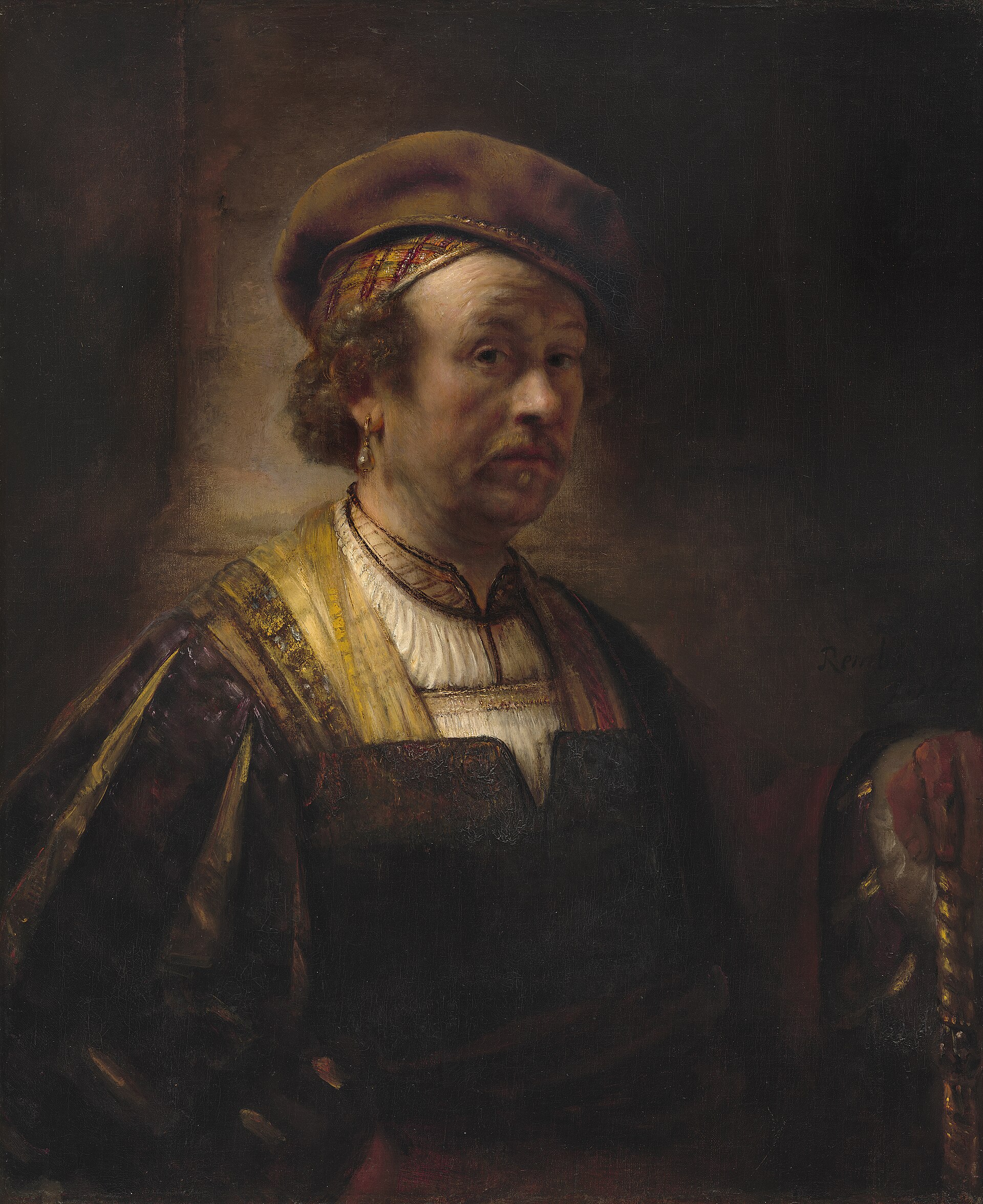
On 9 December 2016 Christie's London offered lot 122 in its Old Masters Day Sale as Circle of Rembrandt Harmensz. van Rijn, Portrait of a gentleman, half-length, in a black velvet cloak and white lace collar and cuffs, estimated at GBP 15,000 to 20,000. The price realised, which in Christie's reporting is the premium-inclusive figure, was GBP 137,000. The buyer was the dealer Jan Six, whose stated reason for looking harder was that the catalogue's own dating contradicted its own heading: at the age the entry proposed, Rembrandt did not yet have a circle. Ernst van de Wetering subsequently accepted the picture as autograph, and it was announced in May 2018 as Portrait of a Young Gentleman.
Movement downward is more common and much quieter. The Man with the Golden Helmet in the Gemaldegalerie in Berlin, inventory 811A, was acquired by Wilhelm von Bode in 1897 as a work by Rembrandt's own hand. The museum now records that in 1986, following thorough investigation using technological and art-historical methods, the attribution was withdrawn once and for all. It is given to Rembrandt's circle, Amsterdam, about 1650 to 1660, and the museum still does not know who painted it. Jan Kelch, announcing the finding, was careful about what had changed: it is not a fake, and it remains a great masterful work.
The asymmetry is worth holding on to when reading any old catalogue. A picture called autograph in 1908 and 'circle of' in 2008 has not altered. The consensus about it has, and only the upward moves generate a press release.
How to read a heading in practice
Read the heading against the essay. A department that believes an attribution argues for it at length and names the scholars who concur. A department that is hedging describes the picture, praises its quality, and says very little about who made it. Then read the heading against the estimate, which is the number the house has to defend in the room. A confident heading over a diffident estimate indicates the specialists are less certain than the wording.
The English courts have tested what a lower rung obliges a house to do. In Thwaytes v Sotheby's, decided by Mrs Justice Rose on 16 January 2015, a second version of Caravaggio's The Cardsharps had been sold by Sotheby's on 5 December 2006 for GBP 42,000 plus buyer's commission, catalogued as by a Follower of Caravaggio. It was bought on behalf of Sir Denis Mahon, who had it cleaned and in November 2007 announced it as an autograph replica by Caravaggio himself. The consignor sued. The court dismissed the claim, holding that Sotheby's were entitled to rely on the connoisseurship of their specialists, that they reasonably concluded the quality was not sufficiently high to indicate Caravaggio, and that they were under no obligation to carry out infrared analysis or to advise the seller to arrange it.
The judgment also records the market context that makes a low rung rational. About thirty versions of the composition other than the disputed picture were offered at auction between 1988 and 2012, over half of them through Christie's or Sotheby's, and during the trial week one copy sold at Bonhams for GBP 1,250 and another at Christie's as 'After Caravaggio' for GBP 10,000 against a GBP 2,000 to 3,000 estimate. A house cataloguing the thirty-first version conservatively is behaving normally, and the law has said so.
Questions
It is a defined commercial position rather than a verdict. Christie's means probably a work by the artist in whole or in part; Sotheby's adds that there are serious grounds to believe it is by the artist's hand. At both houses it is a qualified heading, so the authenticity warranty does not cover it.
The houses differ. Christie's says a work executed in the studio, possibly under his supervision. Sotheby's and Bonhams say a work by an unknown hand which may or may not have been executed under the artist's direction. Neither quantifies the master's involvement, which is why the term is contested so often.
Christie's gives five years from the date of the auction, and Sotheby's five years from the auction date under its counterfeit guarantee. Bonhams requires written notice within one year after the sale. The period is a term of business, not an industry standard, and should be checked in the actual conditions.
Yes, in either direction, and the warranties anticipate it. Christie's excludes cases where scholarship has developed since the auction leading to a change in generally accepted opinion, and Sotheby's rejects claims where the catalogue accorded with generally accepted scholarly opinion at the date of sale.
Sources
- 1Christie's, Conditions of Sale, New York, 19 October 2023, 'Important Notices and Explanation of Cataloguing Practice' and clause 2, Our Authenticity Warranty. christies.com/-/...
- 2Christie's, Conditions of Sale, Hong Kong, 8 February 2022, sections A1 and A3 on opinion and condition. images.liveauctioneers.com/houses/...
- 3Sotheby's, 'Guide for Buyers: Glossary and Important Notices', Glossary of Terms, Paintings. help.sothebys.com/en/...
- 4Sotheby's, Conditions of Business for Buyers, London, condition 15, Authenticity Guarantee. sothebys.com/en/...
- 5Bonhams, Old Master Paintings catalogue, sale C-28250, 9 June 2023, section 21 Pictures and clause 9 Forgeries. images1.bonhams.com/original
- 6Christie's, lot record for Circle of Rembrandt Harmensz. van Rijn, Portrait of a gentleman, Old Masters Day Sale, London, 9 December 2016, lot 122. christies.com/lot/...
- 7Staatliche Museen zu Berlin, museum-digital object record for The Man with the Golden Helmet, Gemaldegalerie inv. 811A, recording the 1986 withdrawal of the attribution. smb.museum-digital.de/object/...
- 8Thwaytes v Sotheby's [2015] EWHC 36 (Ch), Mrs Justice Rose, 16 January 2015, full judgment. caselaw.nationalarchives.gov.uk/ewhc/...
- 9National Gallery of Art, Washington, 'Notes to the User', giving a museum's parallel ladder of attribution qualifications. nga.gov/research/...
More in Research and Method
The partThe First Link Is in the Maker's Own Hand
A maker's bill, workbook or memoir is the only provenance document that fixes date, cost and first owner at once.
The date on the object dates one layer of it
Seven dated objects in this archive show that a date belongs to one layer of the thing: the parchment, the copying, the printing, the compilation.
Every Record Here Ends in Questions It Could Not Answer
The 257 published records in this archive carry 1,795 open questions between them, a median of seven each, and not one record carries none.