Antikythera Mechanism
Unidentified Hellenistic astronomer-engineer (workshop tradition disputed) · Disputed. Proposed dates for construction range from c. 205 BC to the early first century BC. The Hellenic Ministry of Culture and Sports gives a working range of c. 150-100 BC. This is a separate question from the date of the shipwreck that carried it, which independent archaeological evidence places at c. 70-60 BC.
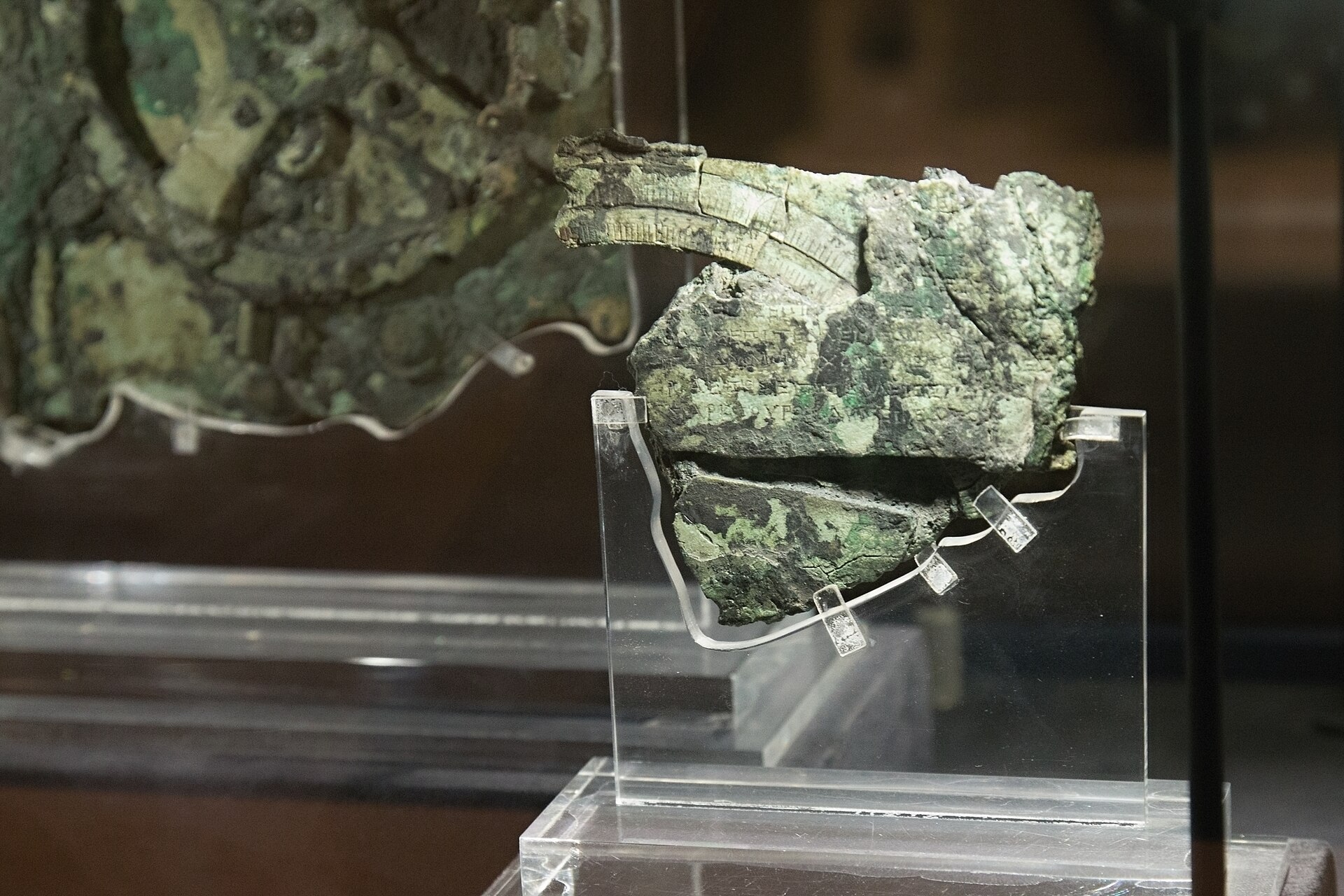
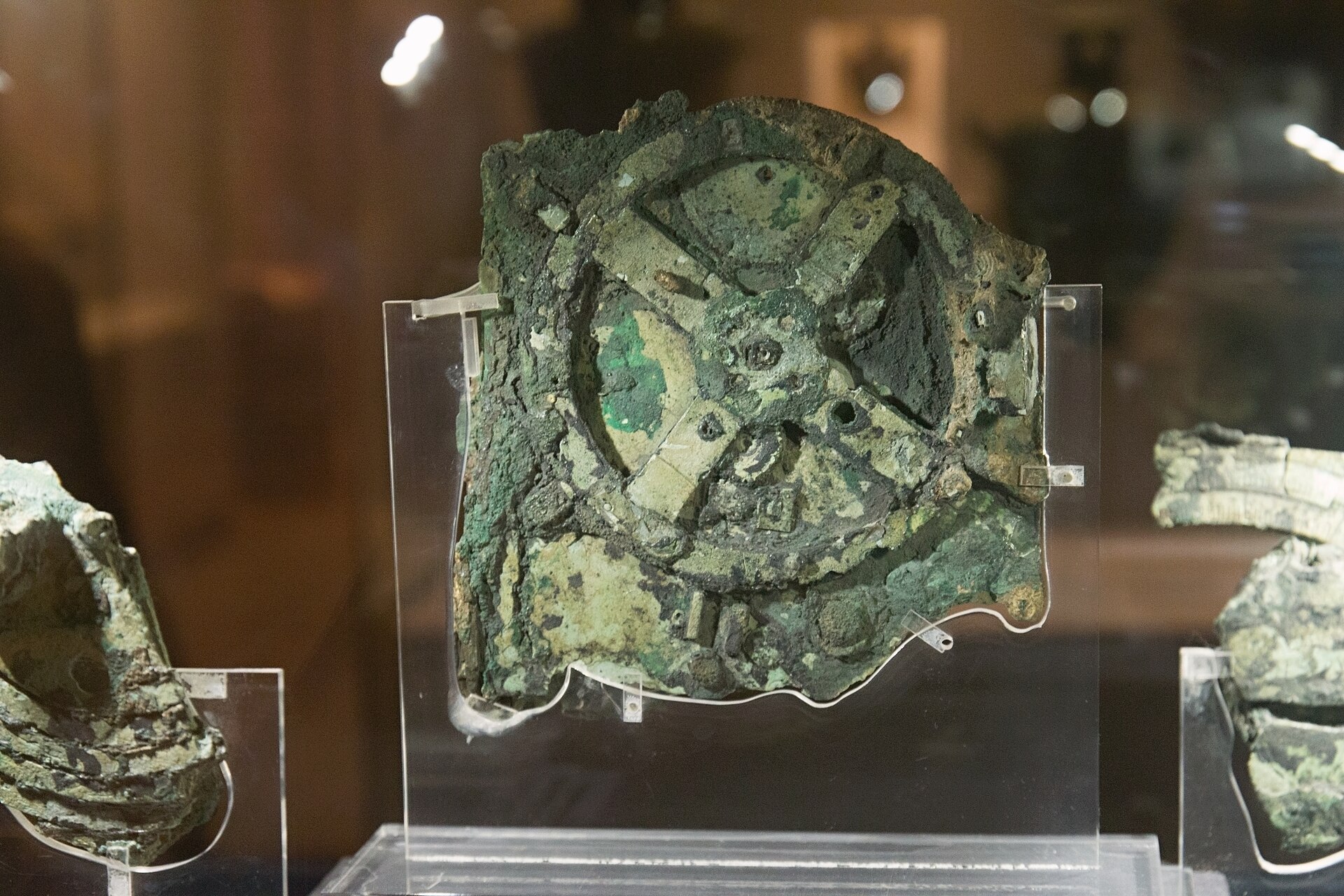
Fragments of the mechanism as displayed at the National Archaeological Museum of Athens. The dense gear structure of Fragment A, carrying 27 of the 30 surviving gears, is visible at the centre.
Photograph by Zde, via Wikimedia Commons · CC BY-SA 4.0| Artist | Unidentified Hellenistic astronomer-engineer (workshop tradition disputed) |
|---|---|
| Date | Disputed. Proposed dates for construction range from c. 205 BC to the early first century BC. The Hellenic Ministry of Culture and Sports gives a working range of c. 150-100 BC. This is a separate question from the date of the shipwreck that carried it, which independent archaeological evidence places at c. 70-60 BC. |
| Medium | Cast and hand-cut bronze (gear wheels, plates, dial faces, pointers and axles), originally mounted in a wooden case with bronze cover plaques front and back |
| Dimensions | 82 surviving fragments. The largest, Fragment A, has a maximum dimension of 17.7 cm and carries 27 of the mechanism's 30 surviving gears; Fragment B measures 11.8 cm and Fragment C 10.5 cm. The wooden case is estimated, from corrosion traces and fittings, at approximately 33 x 18 x 10 cm. No original weight is recorded, and the case does not survive intact. |
| Where it is now | National Archaeological Museum, Athens (NAMA), Collection of Bronzes, permanent Antikythera Shipwreck exhibitionlast confirmed |
| Inventory number | X 15087 (also rendered as inventory Chi 15087 in Greek-language museum documentation) |
| Attribution | DisputedNo maker is named on the instrument or in any surviving ancient text that can be matched to it with certainty. Full note |
| Object type | Clocks and instruments |
| Period | Hellenistic Greek |
| Cases | Disputed attribution |
| Inscriptions | Approximately 3,400 characters of ancient Greek text survive across the fragments: a lunisolar calendar with month names on the back-dial ring, a parapegma recording the seasonal risings and settings of stars, and inscriptions on the front and back cover plates that function as a user's instruction manual. Most of this text was illegible to the naked eye and was recovered only through computed tomography and surface imaging carried out in 2005. |
| Owners on record | 4 links3 documented, 1 disputed |
| Sources | 13 cited |
About this record Last verified · 13 sources cited · Change log
On this page 9 sections
ContentsClose
What survives is 82 corroded bronze fragments, salvaged by Symi sponge divers and the Hellenic Navy from a Roman-era shipwreck off the island of Antikythera in 1900-1901 and sitting largely unexamined in the National Archaeological Museum of Athens for half a century afterward. Inside the corrosion, radiography by Derek de Solla Price in the 1970s and computed tomography by the Antikythera Mechanism Research Project in 2005-2006 found a geared calculating machine: 30 surviving bronze gears driving dials that tracked the sun, the moon's true irregular motion, the 19-year lunisolar calendar cycle, eclipse prediction across the 223-month Saros cycle, and the four-year rhythm of the Panhellenic games. Nothing else of comparable mechanical sophistication survives from anywhere in the ancient world.
Who built it, and exactly where, remains argued rather than settled: the astronomical design has been traced to a Rhodian tradition associated with the astronomer Geminus and, through Cicero's testimony, the Stoic philosopher Posidonius, while the calendar inscribed on its dials has been read first as Corinthian-Syracusan and more recently, more persuasively, as Epirote. The two need not conflict, and this record states both positions and names who holds each rather than picking one. A 2021 reconstruction proposing a full planetary display on the mechanism's ruined front face is presented here as a contested hypothesis, not an established design.
What is not in dispute is custody. Unlike almost everything else catalogued in this publication, the mechanism has never been sold, exported or privately owned: it has been Greek state property, without interruption, since the day it came up from the sea.
Provenance
Each link is graded. Documented: a cited source supports it. Disputed: the identification is argued but not established. Unknown: no owner for that span, and the gap is not smoothed into a narrative. The grades in the glossary.
- c. 205-100 BC (disputed) - c. 70-60 BCUnknown maker and unknown subsequent owner(s)disputed
Manufacture date, place and maker are all disputed; see attribution and open_questions. Nothing is known about who owned or used the instrument between its construction and its loss with the ship, a gap of unknown length that the shipwreck date does not close.1389
- c. 70-60 BC - 1900None (lost with the wreck)documented
The ship carrying the mechanism, along with statuary, glassware, jewellery and a coin hoard, sank off the island of Antikythera. The wreck date rests on Rhodian and Koan amphorae and silver Pergamene tetradrachms minted 76-67 BC.12
- 1900 - 1901Kingdom of Greece, via the Hellenic Royal Navy salvage operationdocumented
Discovered by Symi sponge divers under Captain Dimitrios Kontos sheltering from a storm; diver Elias Stadiatis first reported the wreck. The Greek state organized a formal, Navy-supported salvage running through 1900-1901 at c. 45 metres depth. The mechanism fragment was recovered probably in July 1901.1212
- 1901 - presentNational Archaeological Museum, Athens (Greek state)documented
Transferred to NAMA immediately after salvage and never sold, exported, or privately owned. Recognized as a geared mechanism in 1902 (Valerios and Spyridon Stais); studied by Rehm and Svoronos in the following years; radiographed by Price and Karakalos, 1971-1973; CT- and PTM-imaged by the Antikythera Mechanism Research Project, 2005-2006; displayed with all 82 fragments together in a dedicated permanent gallery since 2013.135
Technical evidence
| Attribution note | No maker is named on the instrument or in any surviving ancient text that can be matched to it with certainty. Two separate questions are argued in the scholarship and are often run together: which astronomical tradition designed it, and which region's calendar it was built to serve. Alexander Jones and others argue the astronomy points to Rhodes, on the basis of parallels with the astronomer Geminus and Cicero's testimony that the Stoic philosopher Posidonius, a Rhodian, built a similar sphere. A 2008 Nature paper by Freeth, Jones and colleagues read the month names on the calendar ring as belonging to the Corinthian family of calendars, at the time associated with Syracuse and, through Syracuse, with the tradition of Archimedes. Paul Iversen's 2017 re-study of the same inscriptions concluded the calendar cannot be Syracusan and is more likely Epirote, from a Corinthian colony such as Ambracia. None of these proposals is settled, and none is mutually exclusive with the others; a Rhodian design tradition serving an Epirote or northwestern Greek calendar is not a contradiction. |
|---|---|
| Material | Bronze, cast and hand-finished, heavily mineralized and corroded after roughly two millennia in seawater.13 |
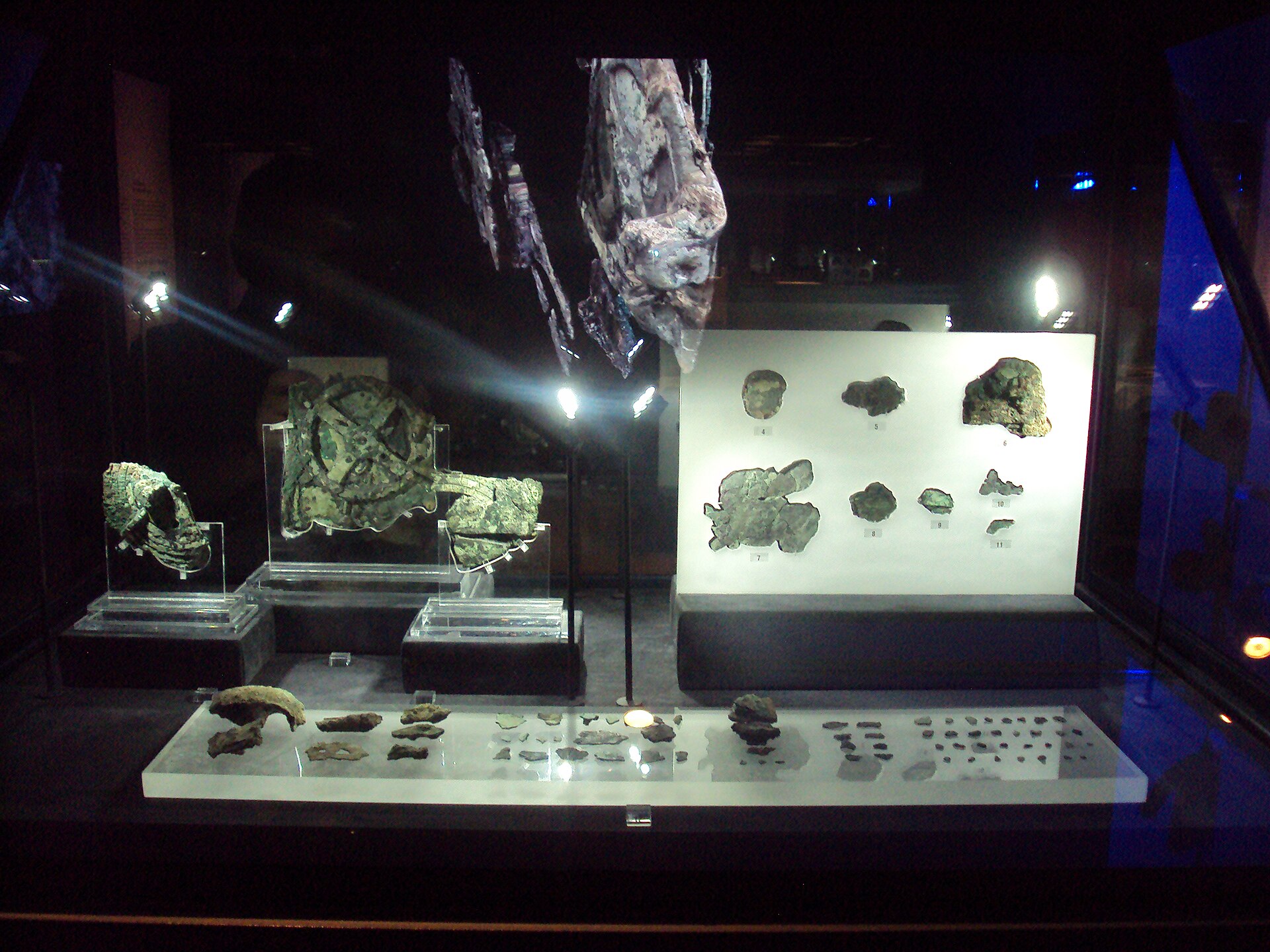
| Fragments | 82 surviving fragments, the largest seven designated A through G. Fragment A carries 27 of the mechanism's 30 surviving gears and has a maximum dimension of 17.7 cm; Fragment B measures 11.8 cm and Fragment C 10.5 cm.13 |
| Case | Original wooden case, not surviving intact, estimated from corrosion traces and fittings at approximately 33 x 18 x 10 cm, with bronze protective plaques inscribed front and back.3 |
| Gear train | 30 toothed bronze gears survive and are confirmed; reconstructions based on the surviving evidence propose a complete original train of roughly 30 to 37 gears, some positions conjectural.15 |
| Inscriptions | Approximately 3,400 characters of ancient Greek text across the fragments: calendar month names, a parapegma of star risings and settings, and front and back cover plates functioning as an instruction manual. Legible in detail only after 2005 imaging.5 |
| Front dial | Single display combining a 365-day Egyptian civil calendar ring, adjustable one day per four years, with a zodiac ring and separate pointers for the sun and moon; the moon pointer uses a pin-and-slot device to model the moon's variable orbital speed.5 |
| Back dials | Upper spiral dial: 19-year Metonic cycle over 5 turns (235 months), with a Callippic (76-year) subsidiary dial and a 4-year Panhellenic games subsidiary dial. Lower spiral dial: 223-month Saros eclipse-prediction cycle over 4 turns, with a 54-year Exeligmos subsidiary dial.56 |
| 2005-2006 imaging | Microfocus X-ray computed tomography by X-Tek Systems (the prototype scanner known as the Bladerunner, resolution better than 0.1 mm) and Polynomial Texture Mapping surface imaging by Hewlett-Packard, both commissioned by the Antikythera Mechanism Research Project.5 |
| Dating | Shipwreck context: c. 70-60 BC, from Rhodian and Koan amphorae and Pergamene silver tetradrachms minted 76-67 BC. Mechanism construction: disputed, proposed between c. 205 BC and the early first century BC; the Hellenic Ministry of Culture gives a working range of c. 150-100 BC. The two dates answer different questions and are not interchangeable.123 |
Images
The record in full
Chapter 1A corroded lump that turned out to be a machine
What survives is 82 fragments of bronze, the largest of them the size of a fist, all of it fused by two thousand years of seawater into a green-black mineral crust that at first glance looks like...
What survives is 82 fragments of bronze, the largest of them the size of a fist, all of it fused by two thousand years of seawater into a green-black mineral crust that at first glance looks like nothing at all. Inside that crust, cleaning and imaging have found 30 toothed bronze gears, the smallest with teeth under a millimetre high, meshed into a train that once turned pointers across at least seven dials on the front and back faces of a wooden case roughly the size of a large book, about 33 by 18 by 10 centimetres.
The gears are not decoration. They are calculation. Turn a hand crank on the side of the case, now lost, and a chain of gearing carried that single input into the differential motion of the sun, the moon and the Greek civil calendar, reproduced on dials that could be read off directly. It is, on the current evidence, the oldest surviving example of a geared calculating machine, and nothing of comparable mechanical sophistication is known to survive from anywhere in the world for more than a thousand years afterward.
Chapter 2The front face: sun, moon and the zodiac
The front dial, the most heavily damaged of the mechanism's faces, carried a single large display: a fixed outer ring marked with the 365 days of the Egyptian civil calendar, which could be rotated...
The front dial, the most heavily damaged of the mechanism's faces, carried a single large display: a fixed outer ring marked with the 365 days of the Egyptian civil calendar, which could be rotated by one day every four years to correct for the true solar year, and a zodiac ring behind it marked with the twelve signs. Two pointers, for the sun and the moon, moved around this display at their true, uneven astronomical rates.
The moon pointer is the mechanism's single most admired piece of engineering. Its gearing includes a pin-and-slot device, one gear riding on a slightly offset pivot from another, that mechanically reproduces the moon's variable speed across the sky, faster at perigee and slower at apogee, a first-order model of lunar anomaly consistent with the theory later associated with the astronomer Hipparchus. A small subsidiary dial, read through a window, showed the moon's phase.
Chapter 3The back face: two spirals and the calendar of the games
The back of the case carried two large spiral dials rather than circular ones, a design choice that let each cram far more calendar than a single circle could hold.
The back of the case carried two large spiral dials rather than circular ones, a design choice that let each cram far more calendar than a single circle could hold. The upper spiral tracked the 19-year Metonic cycle, the period after which the lunar and solar calendars realign, laid out over five turns of 235 months, with a smaller subsidiary dial for the 76-year Callippic cycle that refines it. A second small subsidiary dial on the same face tracked the four-year cycle of the Panhellenic athletic festivals: the Olympic Games at Olympia, the Pythian Games at Delphi, the Nemean and Isthmian Games, and the lesser-known Naa games at Dodona in Epirus, each named on the dial in its own festival year.
The lower spiral tracked the 223-month Saros cycle used to predict eclipses, in 4 turns, with glyphs at specific cells marking which months were liable to a lunar or solar eclipse and roughly what time of day or night it would fall, plus a further subsidiary dial for the 54-year Exeligmos cycle that corrects the Saros prediction for the extra third of a day it leaves out. This is a real, mechanized eclipse-prediction calendar built from cycles known to Babylonian and Greek astronomers; it is not, on the surviving evidence, a device that could forecast the exact visibility, magnitude or path of a given eclipse with the precision sometimes claimed for it in popular accounts, and this record does not repeat that claim.
Chapter 4An instruction manual in bronze
Both cover plates, front and back, were engraved with dense blocks of small Greek lettering, some of it under two millimetres tall.
Both cover plates, front and back, were engraved with dense blocks of small Greek lettering, some of it under two millimetres tall. Reading it required the 2005 imaging campaign described below; almost none of it was legible to the naked eye even under a magnifying glass, because the surface had corroded and split. What it turned out to say is, in effect, a user's manual: a description of what each dial shows, how the eclipse glyphs should be read, and, in fragmentary lines that survive on the front cover, hints that the same case also carried instructions for using it as an observation instrument, possibly with a sighting device for measuring the position of a star or the sun.
Separately, a parapegma text records the seasonal risings and settings of named stars and constellations against the calendar, the same function served by parapegmata carved onto stone in several Greek cities of the period. This is ordinary Hellenistic applied astronomy: parapegmata were used to fix agricultural and civic dates against the visible sky, not evidence of hidden or esoteric content. Nothing in the inscriptions ties the mechanism to divination, cult ritual or astrology in the sense of personal horoscopy; its documented purpose is calendrical and calculational.
Chapter 5A storm, a corpse that was not a corpse, and a year of diving
In the early spring of 1900, a boat of sponge divers from the island of Symi under Captain Dimitrios Kontos took shelter from a storm in the lee of the small island of Antikythera, between Crete and...
In the early spring of 1900, a boat of sponge divers from the island of Symi under Captain Dimitrios Kontos took shelter from a storm in the lee of the small island of Antikythera, between Crete and the Peloponnese. One of the divers, Elias Stadiatis, went down in the standard heavy diving dress of the period, canvas suit and copper helmet, and surfaced badly shaken, reporting a seabed littered with rotting corpses and horses. Kontos went down himself and came up holding the bronze arm of a statue: the wreck was ancient, and the corpses were marble and bronze figures lying where the ship had sunk.
The Greek government, alerted through the Ministry of Education, brought in the Hellenic Royal Navy to support a formal salvage operation that ran through 1900 and into 1901, working the wreck at a depth of around 45 metres, at the edge of what diving technology of the period could safely reach; at least one diver died and two more were paralysed by decompression sickness during the recovery. The salvage brought up dozens of marble statues, a large bronze youth now known as the Antikythera Ephebe, a bronze head identified as a Stoic philosopher, glassware, jewellery, a hoard of silver coins, and a small number of shapeless, badly corroded lumps of bronze that were catalogued without much interest alongside everything else. One of those lumps, retrieved probably in July 1901, was the mechanism.
Chapter 6Two dates, not one
It matters, and is easy to blur, that the wreck and the mechanism are dated by two different kinds of evidence and answer two different questions.
It matters, and is easy to blur, that the wreck and the mechanism are dated by two different kinds of evidence and answer two different questions. The wreck's date, when the ship went down, rests on the cargo: Rhodian and Koan amphorae, Hellenistic fine pottery, and a hoard of silver cistophoric tetradrachms, most struck at Pergamon and a few at Ephesus, the latest minted between 76 and 67 BC. Together this evidence places the sinking at roughly 70-60 BC, with some specialists narrowing it further toward 60 BC.
The mechanism's own construction date is a separate and unresolved question, argued from the astronomy and epigraphy of the object itself rather than from the cargo around it. Proposals in the current literature range as early as about 205 BC, based on a proposed calibration eclipse, to as late as the early first century BC, closer to the wreck date itself. The Hellenic Ministry of Culture and Sports currently gives a working range of c. 150-100 BC on its own materials. What is not in dispute is that the mechanism could have been, and on most proposed dates was, decades or generations old by the time it went down with the ship: an heirloom, an antique, or simply a durable working instrument, rather than something built for that voyage.
Chapter 7Decades in a drawer
The finds were shipped to the National Archaeological Museum in Athens, and for roughly two years the bronze lump that would turn out to be the mechanism sat uncatalogued with the rest.
The finds were shipped to the National Archaeological Museum in Athens, and for roughly two years the bronze lump that would turn out to be the mechanism sat uncatalogued with the rest. On 17 May 1902 the archaeologist Valerios Stais, examining the museum's holdings, noticed a gear wheel embedded in one of the fragments and reported it to his relative, the politician and antiquarian Spyridon Stais; the museum recognized, correctly, that this was some kind of geared device, and speculated, incorrectly, that it might be an astronomical clock of a later, Byzantine or even more recent date, since nothing that sophisticated was believed to exist in antiquity.
The German philologist Albert Rehm and the Greek numismatist and museum director Ioannis Svoronos studied the fragments in the following years and argued, against the initial skepticism, that the object was ancient and astronomical, but without the tools to see inside the corroded bronze neither could go much further than informed speculation about what the gearing actually did. The object then went through a long period of relative neglect, cited in survey literature as a curiosity but not seriously re-examined, for roughly the next half century.
Chapter 8Derek de Solla Price and the gears from the Greeks
The historian of science Derek J. de Solla Price began working on the mechanism in the early 1950s and published his first account of it, based on visual examination alone, in Scientific American in...
The historian of science Derek J. de Solla Price began working on the mechanism in the early 1950s and published his first account of it, based on visual examination alone, in Scientific American in June 1959, under the title 'An Ancient Greek Computer.' Price was already convinced the fragments represented a calendrical and astronomical calculating device far more capable than anything else known from antiquity, and his 1959 article is the point at which that claim entered the wider scientific literature rather than remaining a museum curiosity.
Price returned to the object with the Greek nuclear physicist Charalampos Karakalos, who between 1971 and 1973 produced gamma-ray and X-ray radiographs of all the fragments, the first images of the mechanism's interior. Working from those radiographs, Price published the monograph 'Gears from the Greeks: The Antikythera Mechanism, a Calendar Computer from ca. 80 BC' in 1974, in which he identified more than thirty gears, proposed a working reconstruction of the gear train, and set out the case that the device modelled the motions of the sun and moon against the calendar. Price's reconstruction was incomplete and, on some points, mistaken about which gears connected to which, corrections that the 2005-2006 imaging would later make possible, but his central claim, that this was a real calculating machine and not a curiosity, has held.
Chapter 9The Antikythera Mechanism Research Project, 2005-2006
The next major advance came from a formal collaboration formed around 2005: the Antikythera Mechanism Research Project, led by the astrophysicist Mike Edmunds of Cardiff University together with the...
The next major advance came from a formal collaboration formed around 2005: the Antikythera Mechanism Research Project, led by the astrophysicist Mike Edmunds of Cardiff University together with the mathematician and filmmaker Tony Freeth, working with the National Archaeological Museum in Athens and the National Hellenic Research Foundation. In the autumn of 2005 two teams brought new imaging technology to the fragments. X-Tek Systems of the United Kingdom, led by Roger Hadland, brought an eight-tonne prototype microfocus computed-tomography scanner, nicknamed the Bladerunner and originally built to detect hairline cracks in turbine blades, which produced three-dimensional X-ray images resolving detail below a tenth of a millimetre inside the corroded bronze. Separately, a Hewlett-Packard team led by Tom Malzbender used Polynomial Texture Mapping, a raking-light surface-imaging technique, to make the worn surface inscriptions readable for the first time.
The results, published in Nature in 2006 as 'Decoding the ancient Greek astronomical calculator known as the Antikythera Mechanism,' resolved the gear train to 30 confirmed gears and a coherent overall design, and recovered enough of the inscriptions to read the back-cover text as an operating manual and to identify the eclipse-prediction function of the lower back dial in detail for the first time. A follow-up paper in Nature in 2008, again involving Freeth and the papyrologist Alexander Jones, identified the small subsidiary dial on the back face as tracking the four-year cycle of the Panhellenic games, including the previously unattested appearance of the Naa games of Dodona, which turned out to matter for the separate question of where the mechanism's calendar came from.
Chapter 10Who built it, and for whom: the live argument
No name survives on the instrument, and no ancient text can be matched to it with certainty, so the question of who designed it and where is argued from indirect evidence, and the argument runs on...
No name survives on the instrument, and no ancient text can be matched to it with certainty, so the question of who designed it and where is argued from indirect evidence, and the argument runs on two separate tracks that are often collapsed into one.
The first track is the astronomical design tradition. Cicero, writing in the first century BC, records that the Stoic philosopher Posidonius of Rhodes, a contemporary of his own generation, had built a mechanical sphere that reproduced the daily motions of the sun, moon and five planets; Cicero separately records, at second hand, that the Syracusan Archimedes built two such spheres in the third century BC, one kept by the Roman general Marcellus after the fall of Syracuse in 212 BC and later placed in a temple in Rome, the other kept as a personal memento. Neither of the Archimedes spheres nor the Posidonius sphere survives, and neither is the Antikythera Mechanism: they are textual testimony that the tradition of building geared or otherwise mechanized astronomical models existed in the Hellenistic world before and around the mechanism's likely construction date, not evidence about this specific object. Alexander Jones, in his 2017 study 'A Portable Cosmos,' argues from close parallels between the mechanism's astronomical content and the surviving handbook of the Rhodian astronomer Geminus, writing around 70 BC, that the design tradition behind the mechanism is Rhodian; a reviewer for the Bryn Mawr Classical Review calls the case 'persuasive' rather than proven.
The second track is the calendar the mechanism was built to serve, which is a question about the inscribed month names on the back-dial ring rather than about the astronomy. The 2008 Freeth and Jones paper identified these names as belonging to the Corinthian family of Greek calendars, and, noting Corinth's historical link to its colony Syracuse, floated a possible connection to Sicily and, through it, to the Archimedes tradition. Paul Iversen's 2017 re-examination of the same inscriptions in Hesperia argued that the calendar cannot be Syracusan on internal grounds and is better explained as the calendar of a Corinthian colony in Epirus, in northwestern Greece, such as Ambracia, a reading that fits the appearance of the Epirote Naa games on the games dial.
These two tracks are not a contradiction that needs resolving into one city. A design in the Rhodian astronomical tradition, built for a client or a market in Epirus or built there under Rhodian-trained expertise, is entirely consistent with both bodies of evidence, and no publication in this research area claims the question is closed. This record states the disputed positions as disputed, names who holds them, and draws no conclusion of its own.
Chapter 11What is still not settled: the front gearing and Fragment D
Two problems remain genuinely open in the technical literature, as distinct from the origin debate above.The first is Fragment D, a small disc bearing an unusually fine 63-tooth gear, first noted by...
Two problems remain genuinely open in the technical literature, as distinct from the origin debate above.
The first is Fragment D, a small disc bearing an unusually fine 63-tooth gear, first noted by Svoronos and photographed in 1905-1906, then mislaid in the museum's holdings and rediscovered in 1973. Because almost nothing survives to show where Fragment D sat in the assembled mechanism, its function has been reassigned more than once: proposed in various reconstructions as part of a planetary indicator train, and more recently, in a 2021 technical paper by Voulgaris, Mouratidis and Vossinakis working from the AMRP's own tomography data, as part of a previously unrecognized 'draconic' gear train tracking the 18.6-year cycle of the moon's nodes, a fourth lunar cycle alongside the Metonic, Callippic and Saros trains already confirmed. Both readings remain live in the literature; this record treats Fragment D's function as unresolved rather than adopting either.
The second is the mechanism's front face, where damage is heaviest and the least physical evidence survives. In 2021 a team from University College London led by Tony Freeth published 'A Model of the Cosmos in the ancient Greek Antikythera Mechanism' in Scientific Reports, proposing a gear train for the front display that would have shown not just the sun and moon but the five planets known to antiquity, using a system of nested tubes and epicyclic gearing derived from period astronomical theory to fit the small number of tooth counts and inscriptions that do survive from that part of the mechanism. This is a proposed reconstruction built to be mechanically consistent with the fragmentary evidence, not a design recovered directly from surviving gears, since the gears that would have driven a planetary display, if they ever existed, have not survived. It supersedes earlier, simpler proposals by Freeth and Jones in 2012 and by Carman, Thorndike and Evans, and it is presented by its authors as the best current fit to the evidence, not as a proven original design, and this record treats it accordingly: a serious, published, contested hypothesis about a full planetary Cosmos display, not an established fact about what the mechanism did.
Chapter 12Property of the Greek state since the day it surfaced
Unlike almost every other object in this publication, the Antikythera Mechanism carries no market history at all.
Unlike almost every other object in this publication, the Antikythera Mechanism carries no market history at all. It has never been privately owned, never been sold, and never left Greek state custody since the moment it was landed from the sponge boat in 1901. There is no auction record to correct, no dealer, no export dispute and no restitution claim to weigh, because none of those events has ever happened to it. The chain here is short and it is fully documented: salvage under Greek naval supervision in 1900-1901, immediate transfer to the National Archaeological Museum, and continuous museum custody to the present.
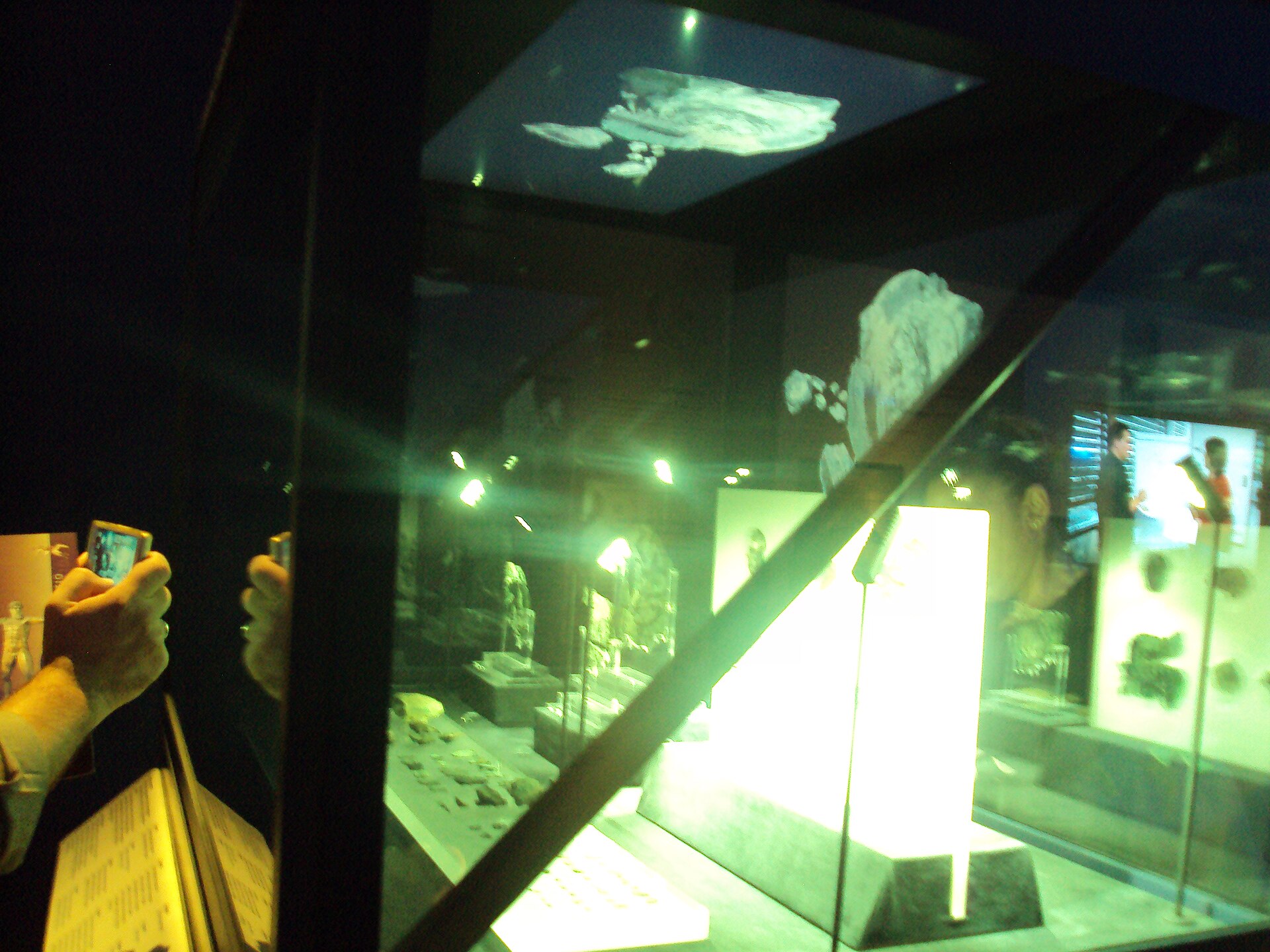
What has changed is how it is displayed. For most of the twentieth century the fragments were kept and studied largely as archival material rather than as a headline exhibit. Since 2013 all 82 surviving fragments have been brought together in a dedicated permanent gallery within the museum's Collection of Bronzes, alongside models and reconstructions built from the AMRP's published gear-train data, making the object legible to a general visitor in a way that the corroded fragments alone cannot be.
Chapter 13The search continues at the wreck site
The 1900-1901 salvage worked by hard-hat divers at the edge of safe depth, and by the time it ended the site was understood to be far from fully cleared.
The 1900-1901 salvage worked by hard-hat divers at the edge of safe depth, and by the time it ended the site was understood to be far from fully cleared. A first return, led by Jacques Cousteau in 1976, recovered further coins, including the Pergamene tetradrachms used to help date the wreck, and human bone. A sustained modern research program, Return to Antikythera, began in 2012 under the Hellenic Ministry of Culture and Sports with Brendan Foley of the Woods Hole Oceanographic Institution as a lead marine archaeologist, using technical mixed-gas diving and, from 2019, the Exosuit atmospheric diving system to reach and work the 45-55 metre site safely for extended periods.
Seasons in 2014, 2015, 2016, 2017, 2019 and from 2020 onward have recovered more than a hundred further artifacts: a bronze armrest possibly from a couch or throne, part of a bone flute, a board-game piece, luxury glassware and ceramics, further marble statuary including fragments identified with figures such as Hercules, and, in 2016, a human skeleton nicknamed Pamphilos, whose bones have been sampled for ancient DNA. Side-scan and photogrammetric survey work has suggested the debris field is larger than the single ship originally assumed, raising the possibility of a second, nearby wreck. No further mechanism fragments, and no second geared instrument, had been confirmed as of the most recent published expedition results; the search continues under the same government program.
Chapter 14Games, festivals and the calendar that mattered
It is worth being precise about what kind of object this is and is not.
It is worth being precise about what kind of object this is and is not. Nothing in the inscriptions or the gear train ties the mechanism to divination, personal horoscopy or a cult function, and no scholar working on it has argued that it did; this record treats that absence as a finding rather than a gap. What the front and back dials document instead is an entirely ordinary, and entirely documented, Hellenistic civic concern: keeping the lunisolar calendar, which drifts against the solar year without regular correction, in step with both agricultural time and the fixed religious calendar of Panhellenic worship.
The four-year games cycle tracked on the back dial was not a sports fixture list in the modern sense. The Olympic Games at Olympia and the Pythian Games at Delphi were religious festivals held in honour of Zeus and Apollo respectively, with the Nemean and Isthmian Games and the Naa at Dodona forming a wider circuit of sacred competition that structured civic and religious life across the Greek world on a shared four-year rhythm. A mechanism that could tell its owner, at a glance, which festival year the calendar was currently in was doing civic-religious timekeeping, not abstract science for its own sake. Separately, Alexander Jones and other historians of ancient astronomy have argued, on the basis of Cicero's account of Posidonius, that instruments of this kind circulated among Stoic philosophers partly as demonstration pieces, physical arguments for a providentially ordered, mechanically comprehensible cosmos consistent with Stoic physics; this is an argued interpretation of purpose, attributed here to the scholars who make it, not a claim about what any specific owner of this specific instrument believed.
The artist
Unidentified. No maker's name survives on the object or in any ancient text securely matched to it.
This dossier covers what can be established about the mechanism's technical and intellectual authorship rather than a named individual, since none survives. Two distinct questions are argued in the scholarship: which astronomical design tradition produced the gearing and theory embodied in the mechanism, and which region's civil calendar it was built to track. Both are live disputes, argued by named scholars from named evidence, not settled attributions, and this dossier presents them as such.
Related works
| Work | Relation | Where it is |
|---|---|---|
| The spheres of Archimedes and Posidonius Archimedes of Syracuse (attrib.); Posidonius of Rhodes (attrib.) | Textual testimony (Cicero, De re publica) for the wider Hellenistic tradition of mechanical astronomical spheres; neither survives and neither is this object Cicero reports Marcellus took one Archimedes sphere to Rome after the fall of Syracuse in 212 BC and kept the other himself; he separately reports a similar sphere built by Posidonius, his own contemporary. These are evidence of a tradition, not physical relatives of the Antikythera Mechanism. | Not extant |
| Byzantine sundial-calendar Unidentified | The next surviving geared astronomical instrument after this one, roughly seven centuries later A portable sundial combined with a geared lunisolar calendar, four fragments surviving, dated on stylistic grounds to the 5th-6th century AD and studied by J.V. Field and M.T. Wright in 1985. Far simpler than the Antikythera Mechanism, it is the nearest thing to a technological successor known to survive. | Science Museum, London |
| Tower of the Winds (Horologion of Andronikos of Kyrrhos) Andronikos of Kyrrhos | Contemporary Hellenistic public astronomical timekeeping monument, non-geared An octagonal marble structure of the 1st century BC combining sundials, a water clock and wind-direction indicators. It demonstrates the same period's public appetite for mechanized and semi-mechanized timekeeping, at monumental rather than portable scale. | Roman Agora, Athens |
| Antikythera Ephebe (Youth of Antikythera) Unidentified Greek sculptor, c. 340 BC | Recovered from the same shipwreck, a different object entirely; included here for context, not for resemblance A large bronze statue of a young man, brought up in the same 1900-1901 salvage. It establishes that the ship was carrying a mixed cargo of high-value Greek art toward likely buyers further west, the context the mechanism itself was found within. | National Archaeological Museum, Athens |
| Later geared astronomical instruments (medieval astrolabes and equatoria) Various, Islamic and European workshops | The tradition of geared or mechanically calculating astronomical instruments as it resumes after antiquity Geared astronomical calculation is not attested again with confidence until instruments such as a geared astrolabe attributed to Muhammad ibn Abi Bakr of Isfahan (1221-1222 AD), roughly thirteen centuries after the Antikythera Mechanism's likely construction. The gap itself, rather than any direct link, is the historically significant fact. | Various collections |
Open questions
- Where, and within which workshop or school, was the mechanism actually built? The astronomical design has been argued to Rhodes and the calendar to Epirus by way of a Corinthian colony; the two need not conflict, but neither is proven, and no third-party physical evidence (metallurgical sourcing of the bronze, for instance) has settled the question.
- What was the front dial's full display, and did it show the five planets? The 2021 UCL reconstruction proposes a planetary 'Cosmos' gear train consistent with the surviving fragmentary evidence, but the gears that would prove it, if they ever existed, have not survived, and earlier, simpler reconstructions remain in the literature.
- What was Fragment D for? Its 63-tooth gear has been proposed as part of a planetary train and, more recently, as part of a previously unidentified lunar-node ('draconic') gear train; the fragment's original position in the assembled mechanism is not established.
- What is the mechanism's precise construction date? Published proposals range across more than a century, from c. 205 BC to the early first century BC, and the shipwreck date does not resolve this because the object could have been decades old when it sank.
- Was the mechanism cargo, being shipped for sale or as a diplomatic gift alongside the statuary and luxury goods recovered from the same wreck, or was it a personal possession of someone travelling on the ship? Nothing in the published record distinguishes these possibilities.
- Do more fragments of this mechanism, or a second comparable instrument, remain at the wreck site? The Return to Antikythera project has recovered further artifacts in most seasons since 2012 and has suggested the debris field may include a second wreck, but no further mechanism components have been confirmed as of the most recently published results.
Questions about this object
What is Antikythera Mechanism?
Antikythera Mechanism is a clocks and instruments, dated disputed. Proposed dates for construction range from c. 205 BC to the early first century BC. The Hellenic Ministry of Culture and Sports gives a working range of c. 150-100 BC. This is a separate question from the date of the shipwreck that carried it, which independent archaeological evidence places at c. 70-60 BC.. Medium: Cast and hand-cut bronze (gear wheels, plates, dial faces, pointers and axles), originally mounted in a wooden case with bronze cover plaques front and back.
Who made Antikythera Mechanism, and is the attribution settled?
The attribution to Unidentified Hellenistic astronomer-engineer (workshop tradition disputed) is recorded here as disputed. No maker is named on the instrument or in any surviving ancient text that can be matched to it with certainty. Two separate questions are argued in the scholarship and are often run together: which astronomical tradition designed it, and which region's calendar it was built to serve. Alexander Jones and others argue the astronomy points to Rhodes, on the basis of parallels with the astronomer Geminus and Cicero's testimony that the Stoic philosopher Posidonius, a Rhodian, built a similar sphere. A 2008 Nature paper by Freeth, Jones and colleagues read the month names on the calendar ring as belonging to the Corinthian family of calendars, at the time associated with Syracuse and, through Syracuse, with the tradition of Archimedes. Paul Iversen's 2017 re-study of the same inscriptions concluded the calendar cannot be Syracusan and is more likely Epirote, from a Corinthian colony such as Ambracia. None of these proposals is settled, and none is mutually exclusive with the others; a Rhodian design tradition serving an Epirote or northwestern Greek calendar is not a contradiction.
Where is Antikythera Mechanism now?
National Archaeological Museum, Athens (NAMA), Collection of Bronzes, permanent Antikythera Shipwreck exhibition. Inventory number X 15087 (also rendered as inventory Chi 15087 in Greek-language museum documentation). Last confirmed 18 August 2026. In continuous, uninterrupted Greek state custody since its recovery from the sea in 1901. All 82 fragments have been displayed together in a dedicated gallery since 2013.
What is still unknown about Antikythera Mechanism?
Where, and within which workshop or school, was the mechanism actually built? The astronomical design has been argued to Rhodes and the calendar to Epirus by way of a Corinthian colony; the two need not conflict, but neither is proven, and no third-party physical evidence (metallurgical sourcing of the bronze, for instance) has settled the question.
Sources
- 1Wikipedia, 'Antikythera mechanism'. en.wikipedia.org/wiki/...
- 2Wikipedia, 'Antikythera wreck'. en.wikipedia.org/wiki/...
- 3Hellenic Ministry of Culture and Sports, official page on the Antikythera Mechanism, giving inventory number X 15087, working construction date c. 150-100 BC, and case dimensions. olympicgames.culture.gov.gr/en/...
- 4Woods Hole Oceanographic Institution, 'Return to Antikythera' project, History page, on the modern (2012-present) return expeditions to the wreck site led with the Hellenic Ministry of Culture and Sports and Brendan Foley. antikythera.whoi.edu/history
- 5Freeth, T., Bitsakis, Y., Moussas, X. et al., 'Decoding the ancient Greek astronomical calculator known as the Antikythera Mechanism', Nature 444, 587-591 (2006). nature.com/articles/...
- 6Freeth, T., Jones, A., Steele, J.M. and Bitsakis, Y., 'Calendars with Olympiad display and eclipse prediction on the Antikythera Mechanism', Nature 454, 614-617 (2008). nature.com/articles/...
- 7Freeth, T., Higgon, D., Dacanalis, A. et al., 'A Model of the Cosmos in the ancient Greek Antikythera Mechanism', Scientific Reports 11, 5821 (2021). nature.com/articles/...
- 8Iversen, P.A., 'The Calendar on the Antikythera Mechanism and the Corinthian Family of Calendars', Hesperia 86.1 (2017), pp. 129-203. jstor.org/stable/...
- 9Review of Alexander Jones, 'A Portable Cosmos: Revealing the Antikythera Mechanism, Scientific Wonder of the Ancient World' (Oxford University Press, 2017), Bryn Mawr Classical Review 2018.05.16. bmcr.brynmawr.edu/2018/...
- 10Price, D.J. de Solla, 'An Ancient Greek Computer', Scientific American 200.6 (June 1959), pp. 60-67. Consulted via full-text archive. hist.science.online.fr/antikythera/...
- 11Voulgaris, A., Mouratidis, C. and Vossinakis, A., 'The Draconic gearing of the Antikythera Mechanism: Assembling the Fragment D, its role and operation', arXiv:2104.06181 (2021). arxiv.org/abs/...
- 12Wikipedia, 'Antikythera Ephebe'. en.wikipedia.org/wiki/...
- 13Field, J.V. and Wright, M.T., 'Gears from the Byzantines: A portable sundial with calendrical gearing', Annals of Science 42.2 (1985), pp. 87-138. tandfonline.com/doi/...
Last verified · Published
Change log
18 August 2026 - Record created at the house standard: researched narrative, technical evidence, maker dossier, graded provenance chain, prices with hammer and premium separated, related works, open questions and sources.