The Antikythera Mechanism
Unknown Greek maker, working in a tradition associated with Rhodes, Corinth or Syracuse · c. 150-100 BC on the National Archaeological Museum's own gallery label. A date of 205 BC has been argued from the eclipse sequence on the back dial; other readings place it in the first century BC. The shipwreck that carried it is dated to the second quarter of the first century BC.

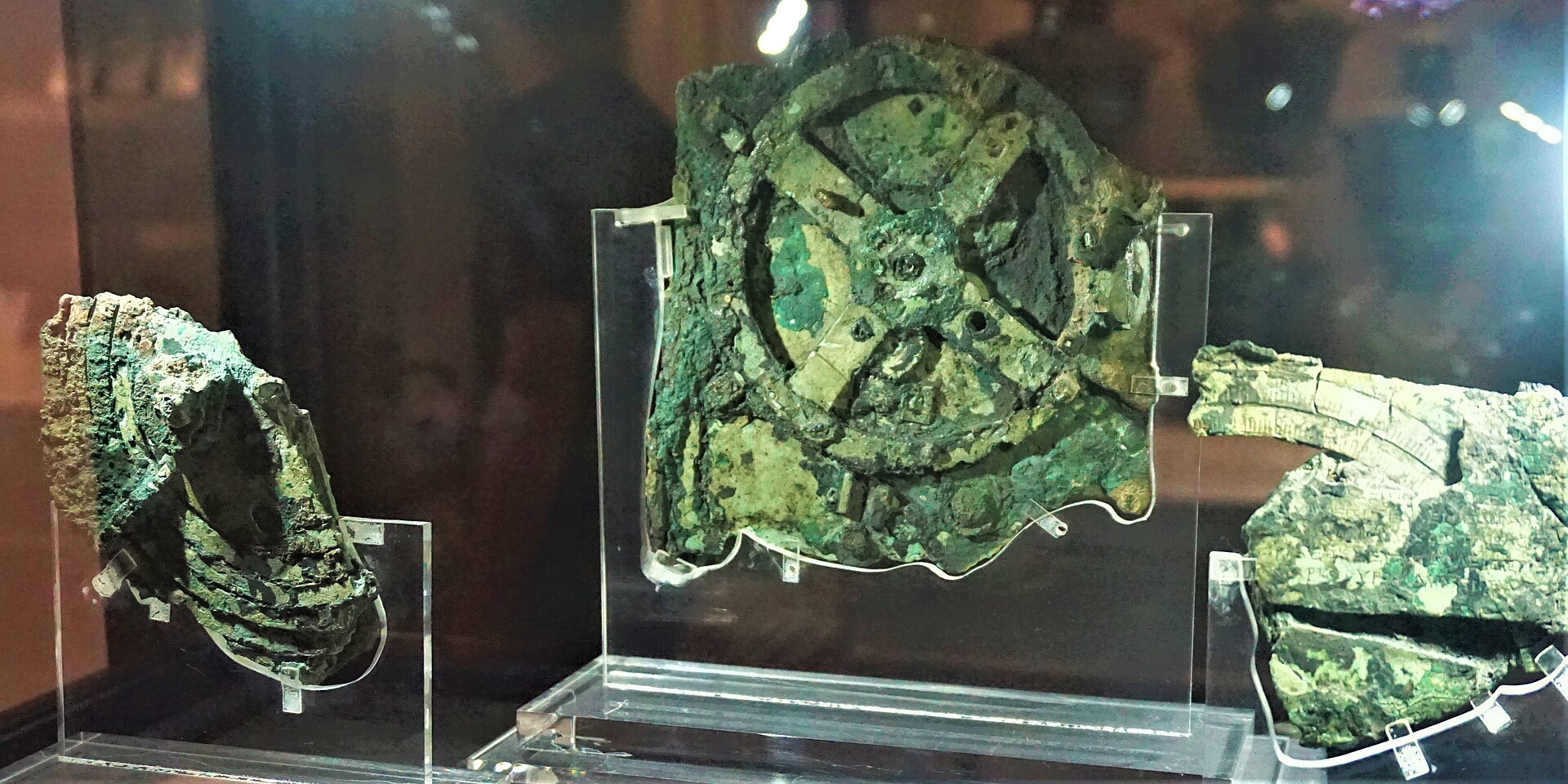
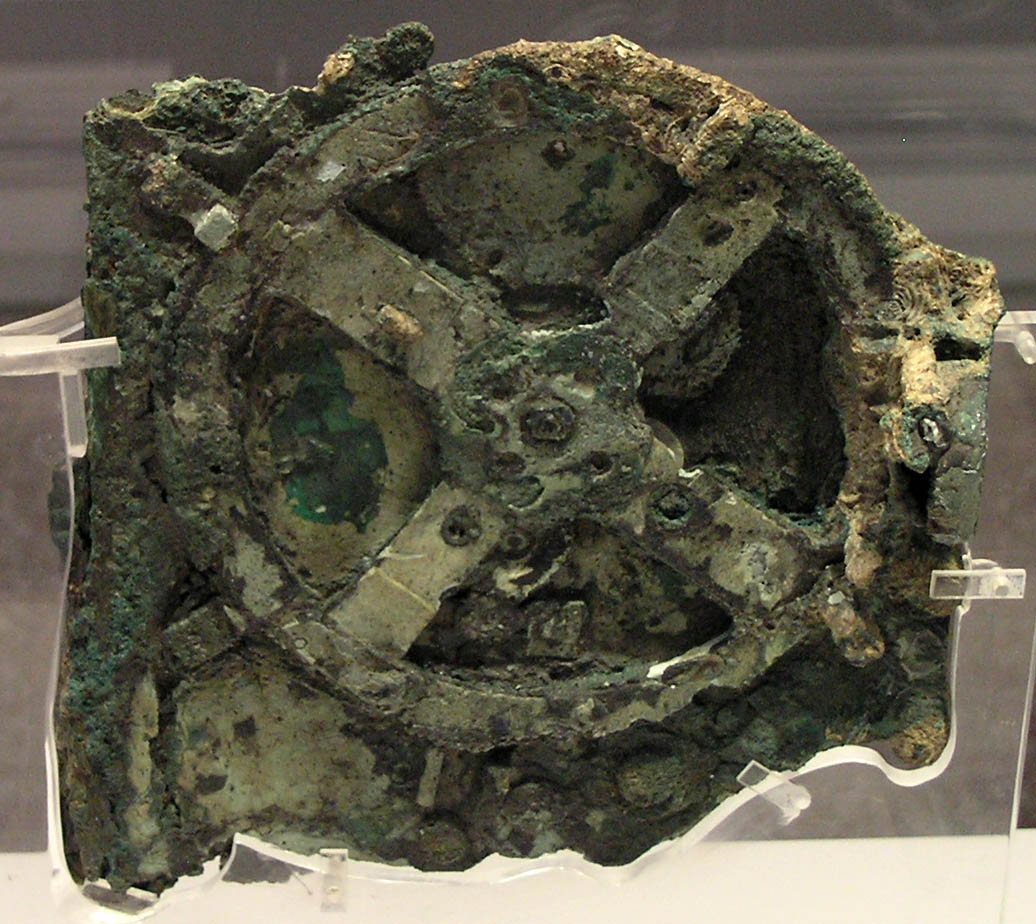
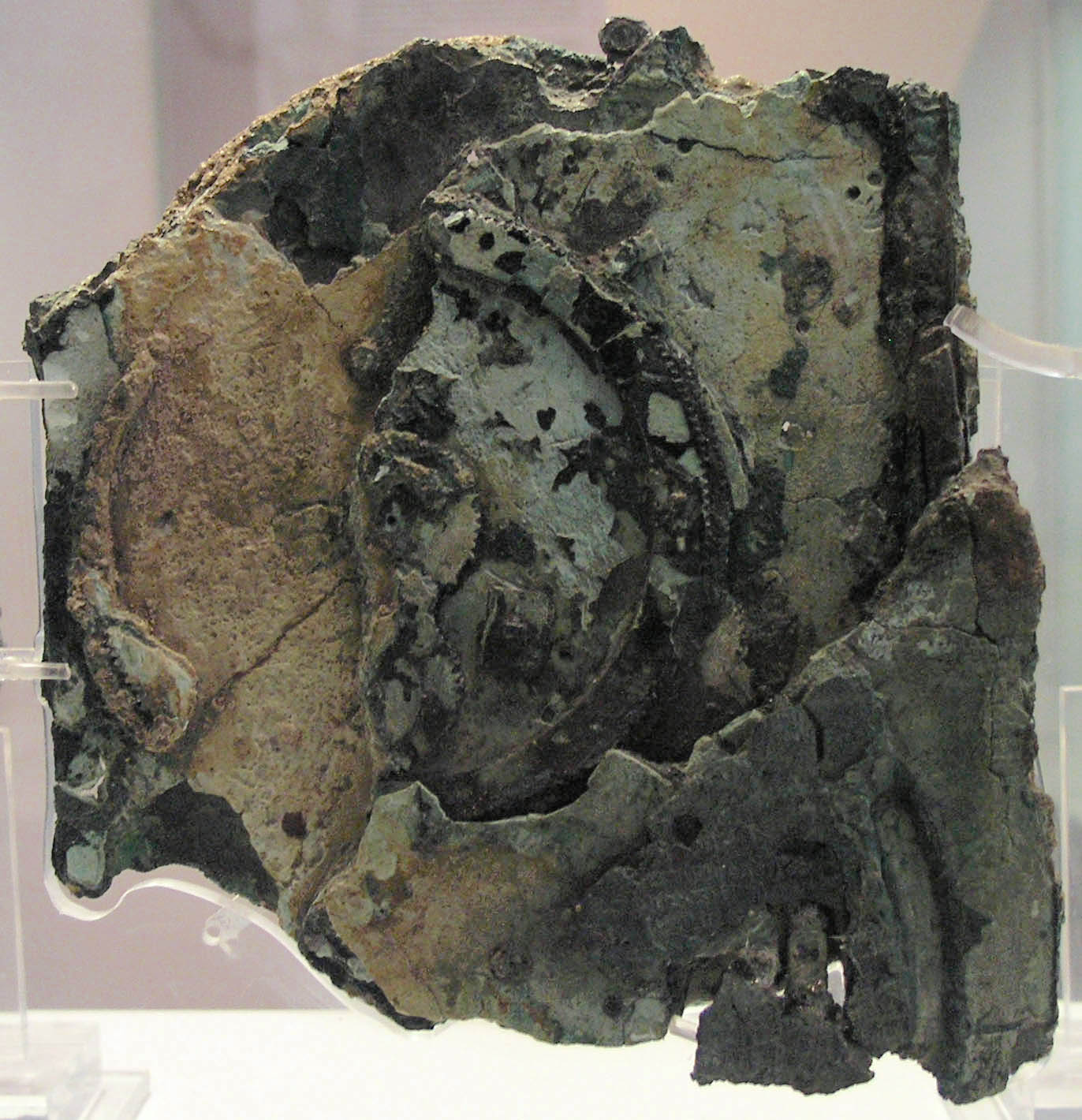
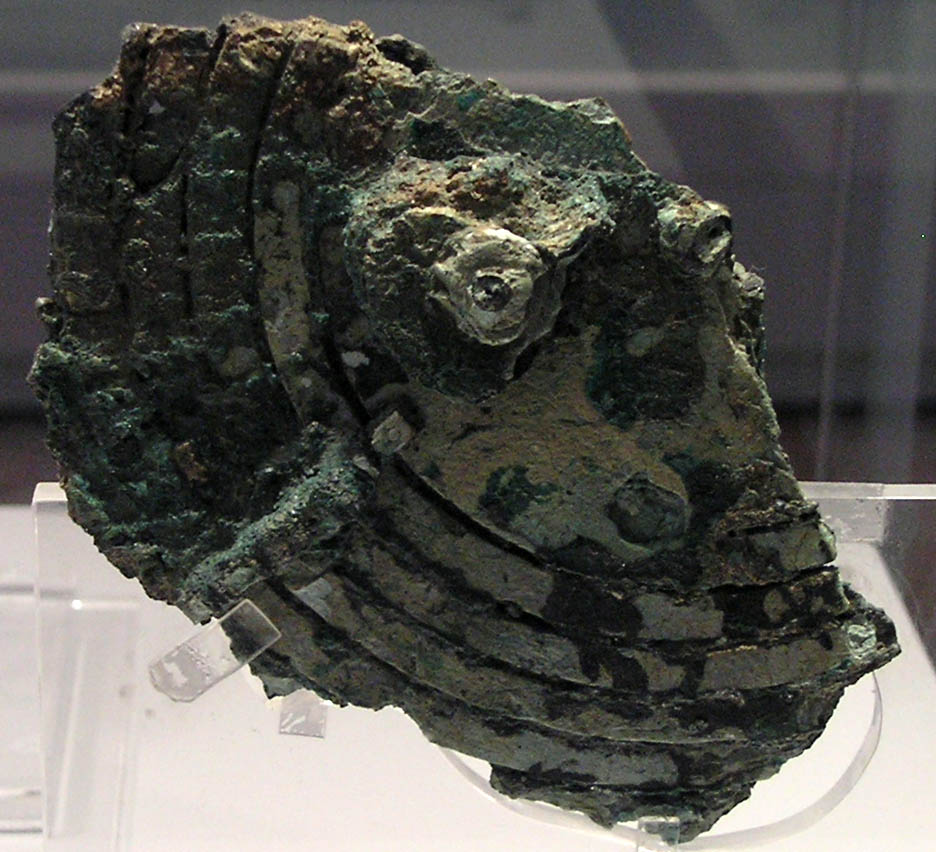
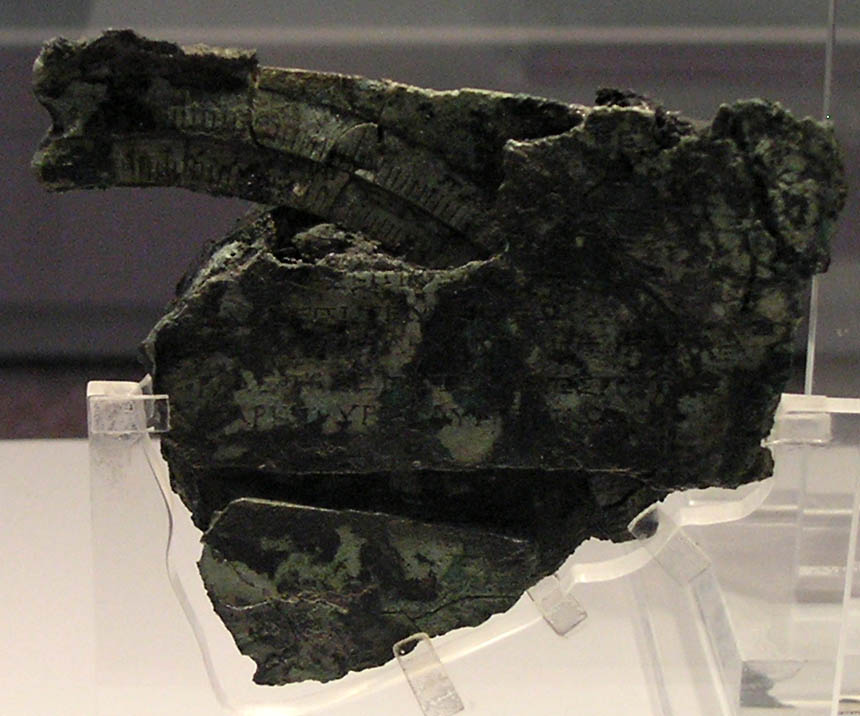
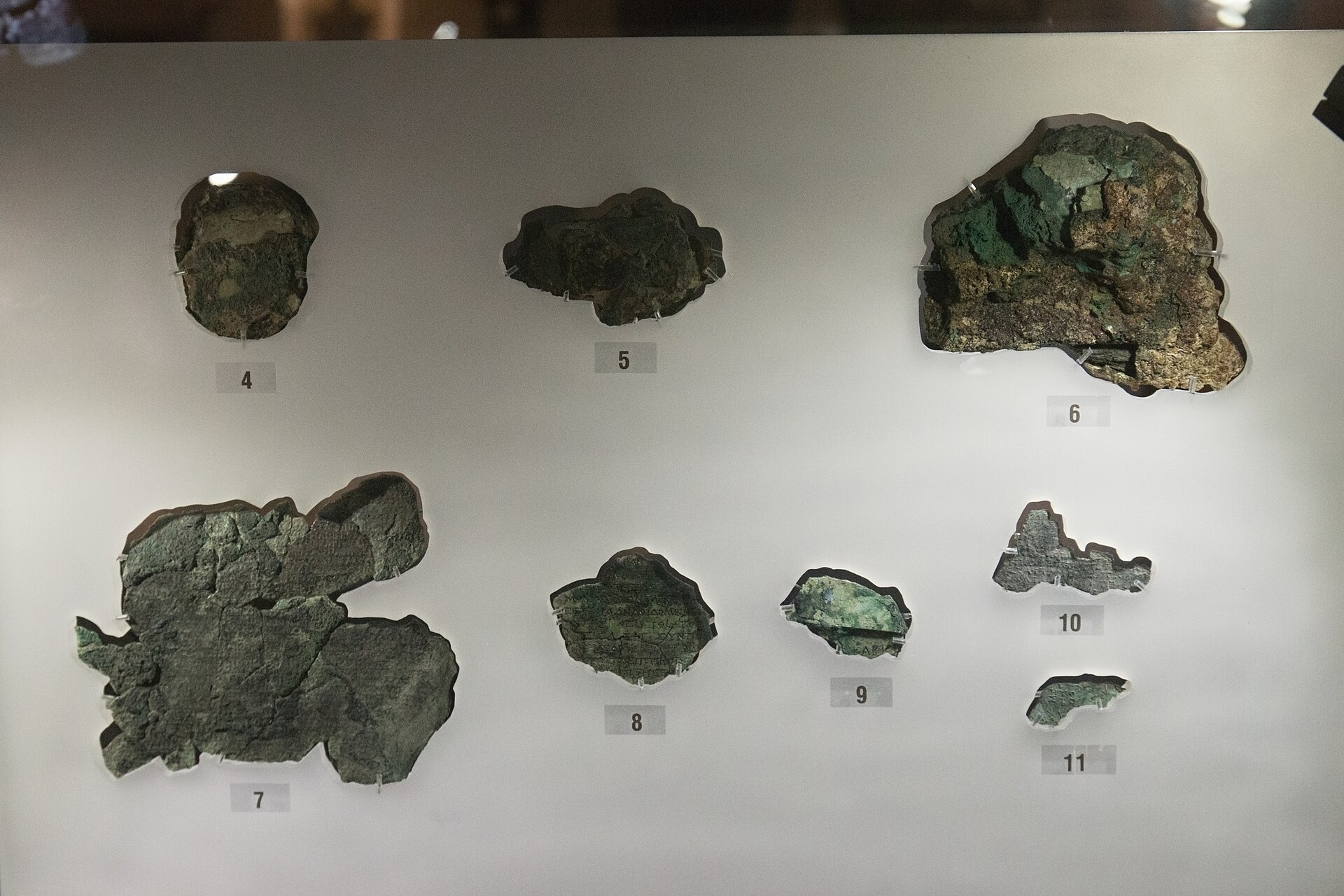
The object described in this record, photographed in its case in the National Archaeological Museum in Athens, where it is inventory 15087. Three of the surviving pieces stand on acrylic mounts: the largest, Fragment A, at the centre, with two smaller inscribed fragments flanking it. Nothing here turns and nothing here is reconstructed. This is corroded bronze recovered from the sea in 1900 and 1901, and it is the whole of what an argument seventy years long has had to work from.
Photograph by Peulle, CC BY-SA 4.0, via Wikimedia Commons| Artist | Unknown Greek maker, working in a tradition associated with Rhodes, Corinth or Syracuse |
|---|---|
| Date | c. 150-100 BC on the National Archaeological Museum's own gallery label. A date of 205 BC has been argued from the eclipse sequence on the back dial; other readings place it in the first century BC. The shipwreck that carried it is dated to the second quarter of the first century BC. |
| Medium | Bronze plates and gearing in a wooden case |
| Dimensions | The largest surviving gear is about 13 cm in diameter. The 82 fragments vary from plate-sized to chips of a few millimetres and no overall dimension for the complete object survives; reconstructed sizes are estimates and are not adopted here as measurements. |
| Where it is now | National Archaeological Museum, Athens; the mechanism is inventory 15087 on the museum's own gallery label for the Antikythera shipwrecklast confirmed 3 August 2026 |
| Attribution | UnknownNo maker is named on the object and none has ever been established. Full note |
| Object type | Clocks and instruments |
| Period | Hellenistic Greek, second or first century BC |
| Cases | Has a provenance gap |
| Inscriptions | Greek, on the surfaces of many plates including the front and back covers. The museum's own gallery text describes them as relating to astronomical and calendar calculations and to instructions for the use of the instrument, and epigraphists of the early twentieth century characterised them as something like an owner's manual. About 1,380 letters forming 156 complete words have been read on Fragment G alone from X-ray computed tomography, including the word STERIGMOS, stationary point, which Albert Rehm read in 1905 on a small piece later reassembled into that fragment. |
| Owners on record | 5 links4 documented, 1 unknown |
| Sources | 6 cited |
About this record Last verified 13 August 2026 · 6 sources cited · Change log
On this page 12 sections
ContentsClose
Eighty-two corroded bronze fragments, the largest surviving gear about thirteen centimetres across, recovered from a first-century BC shipwreck off the island of Antikythera by sponge divers from Symi in 1900 and 1901. It is a geared astronomical calculating instrument, and there is nothing else remotely like it from the ancient world; the next machine of comparable complexity is more than a thousand years later.
It was not recognised for two years. It came up as an encrusted lump among bronze and marble statues that were the reason anybody was diving, and on 17 May 1902 Valerios Stais saw a gear wheel in it. What it actually did was not established for another seventy years, and the reading of it is still being revised: the two decisive advances were both imaging campaigns rather than excavations, gamma-radiography by Charalampos Karakalos with Derek de Solla Price in 1971, and a purpose-built X-ray computed tomography and reflectance-imaging programme in 2005.
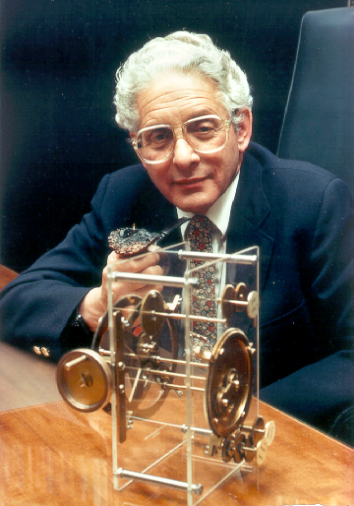
The object a reader has almost certainly seen is not this object. Reconstructions and working models of the mechanism are in museums and photographs all over the world. The thing itself is a shelf of green fragments, and no photograph of it exists under a licence this archive can publish.
Provenance
Each link is graded. Documented: a cited source supports it. Disputed: the identification is argued but not established. Unknown: no owner for that span, and the gap is not smoothed into a narrative. The grades in the glossary.
- - c. 70-60 BCUnknown; in transit aboard a ship carrying Greek goods westwardunknown
No maker, owner, commissioner or destination is documented. The cargo is generally read as Greek material travelling from Delos or from a city on the Asia Minor coast towards Italy, driven off course in bad weather and foundered. Whether the mechanism was cargo, a passenger's property or ship's equipment is not established. The wreck is dated by its cargo and coins to the second quarter of the first century BC; the instrument may already have been decades old when it was loaded.13
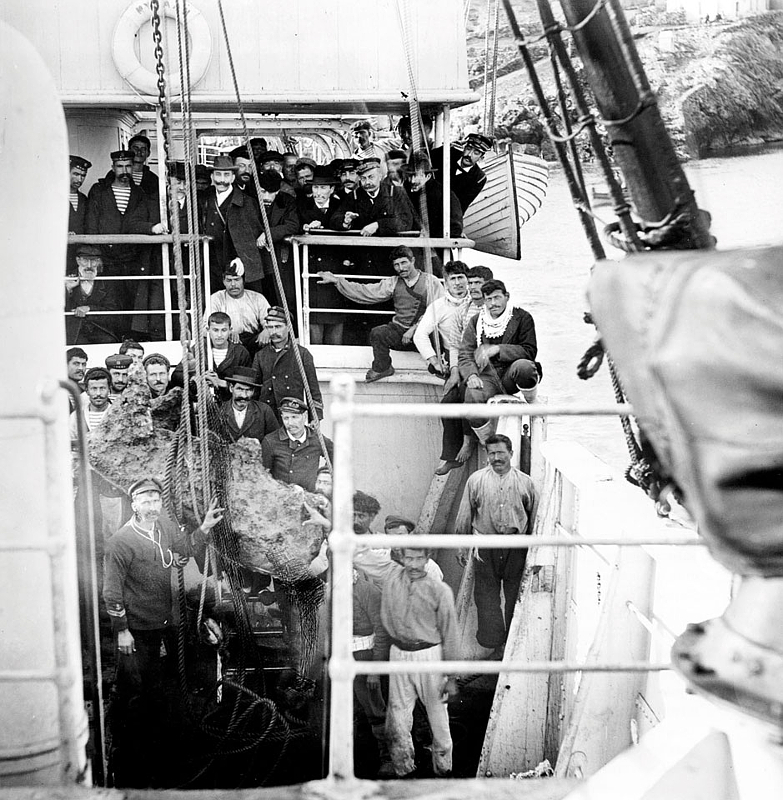
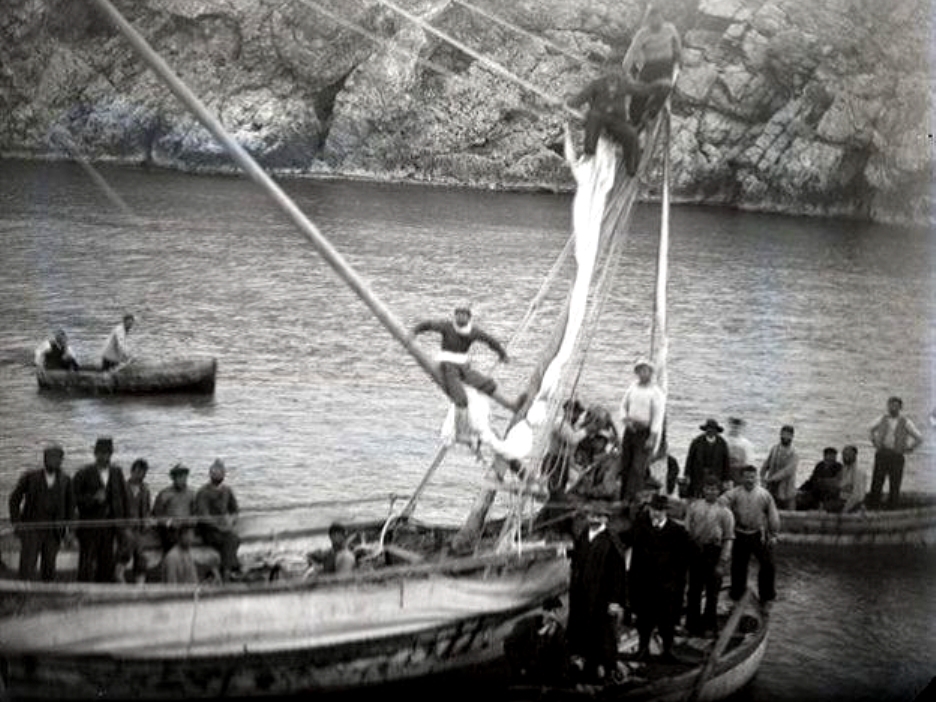
- 1900 - 1901Recovered by sponge divers from Symi under Captain Dimitrios Kontos, with the Hellenic Royal Navydocumented
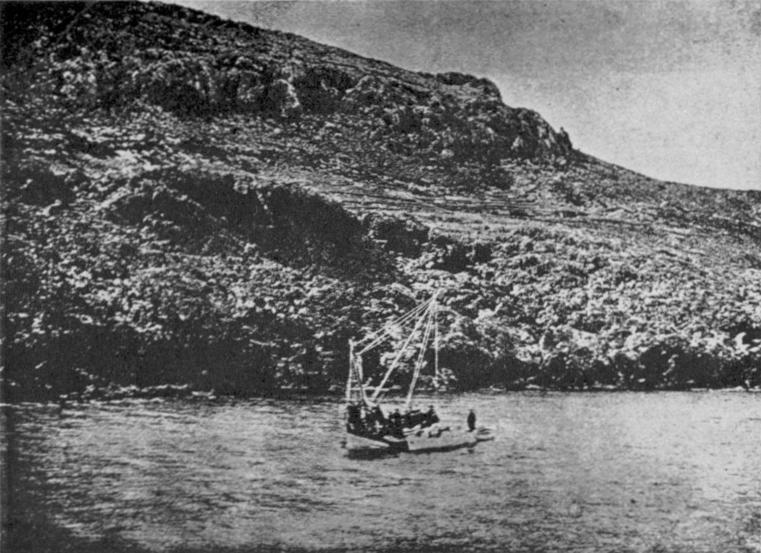
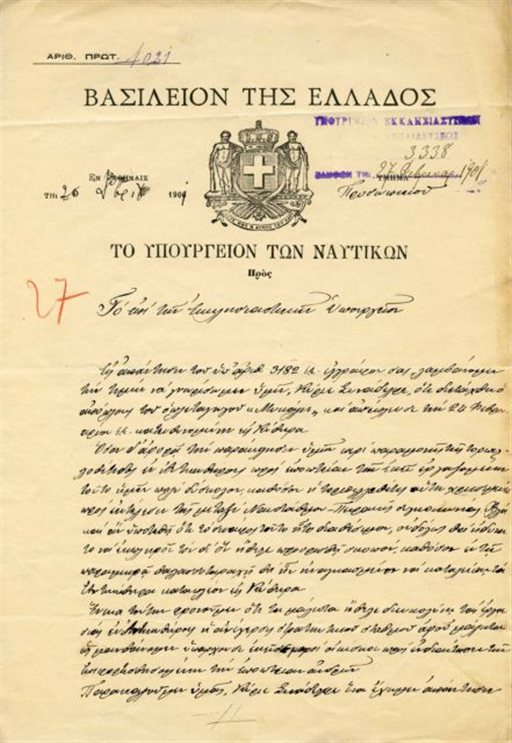
Located by chance about Easter 1900 by sponge-fishers from Symi returning from the north coast of Africa, who attempted to anchor near Potamos. Raising began at the end of 1900 and lasted many months, in standard diving dress at about 50 metres, a depth at the limit of the equipment. The first object recovered was the right arm of a bronze philosopher of the third century BC. A Greek Ministry of Naval Affairs document of 26 February 1901 records the despatch of the vessel Mykali to Kythera for the works. Divers were killed and paralysed during the salvage; the compensation paid to the crew is not established in the sources consulted.134
- 1901 - presentNational Archaeological Museum, Athensdocumented
The finds entered the Greek national collection directly from the salvage. The gearing was recognised on 17 May 1902 by Valerios Stais, two years after the discovery of the wreck; his cousin Spyridon Stais is named alongside him in some accounts. The mechanism is inventory 15087 on the museum's own gallery label, which lists the lyre as 15104 and parts of couches as 15098, 15099 and 15101. It has never been on the market, never been offered at auction, and is the subject of no restitution claim.123
- 1971 - 1974In the museum; imaged by Charalampos Karakalos with Derek J. de Solla Pricedocumented
X-ray and gamma-ray imaging of the fragments, the first look inside the corrosion, published by Price in 1974. Price had become interested in 1951 and published a popular account in 1959.3
- 2005 - presentIn the museum; the Antikythera Mechanism Research Projectdocumented
A collaboration of Cardiff University, the National Archaeological Museum, the University of Athens and the Aristotle University of Thessaloniki with X-Tek Systems and Hewlett-Packard. X-Tek built a 400 kV microfocus CT machine of about eight tonnes and moved it to Athens because the fragments could not travel; HP supplied a polynomial texture mapping dome. Published in Nature in 2006 and 2008, with the inscriptions published in 2016 and a front-dial model in 2021.3
Prices realised
The Antikythera mechanism has never been sold, offered, valued or insured on any published basis. It was recovered inside Greek territorial waters by Greek divers under Greek naval supervision and entered the national collection directly, so no dealer, no export licence and no restitution claim appears anywhere in its history. There is no hammer price, no premium, no estimate and no comparable. Any figure quoted for it is invention. The only cost recorded against it is human: divers were killed and paralysed raising the wreck, and the sums the Greek state paid the crew are not established in the sources consulted for this record.
Technical evidence
| Attribution note | No maker is named on the object and none has ever been established. The inscriptions are instructions and calendrical text, not a signature. The best evidence for localisation is internal: the month names on one of the dials are Corinthian, which points to Corinth or one of its colonies, Syracuse among them, rather than to Rhodes, which had been the standard guess on the strength of the Rhodian astronomical tradition and of Cicero's account of a planetary sphere. Attributions to Archimedes, to Hipparchus and to Posidonius all circulate. None rests on evidence from the object and none is adopted here. The National Archaeological Museum's own gallery label states the museum's position on the date and says nothing about a maker, which is the correct position. |
|---|---|
| Fragment count | Seven large fragments, A to G, and 75 minor pieces numbered 1 to 75; 82 in total. The National Archaeological Museum's own gallery label adds that it is not certain that the 75 small fragments belong to the mechanism.23 |
| Material and case | Bronze. The museum states that the mechanism was contained in a wooden-framed case, probably with a bronze plaque on its front and back.2 |
| Gearing | At least 30 gears on the museum's own statement; 37 are reported in the published reconstruction. The largest surviving gear is about 13 cm in diameter. Teeth are triangular and hand cut.23 |
| Displays | Scales, dials, axles and pointers. A front zodiac and calendar display; back spiral dials for the Metonic 19-year cycle and the Saros eclipse cycle of 223 lunar months, with Callippic and Exeligmos subsidiaries; a four-year games dial including the Olympiad identified in 2008.23 |
| Inscriptions | Greek, on many plates including the front and back covers, relating to astronomical and calendar calculations and to instructions for use. About 1,380 letters forming 156 complete words have been read on Fragment G from X-ray CT. Albert Rehm read the word STERIGMOS, stationary point, in 1905.23 |
| Month names | Corinthian, which points to Corinth or a Corinthian colony such as Syracuse rather than to Rhodes.3 |
| 1971 imaging | X-ray and gamma-ray images of the fragments made by Charalampos Karakalos with Derek J. de Solla Price; published by Price in 1974. The first internal view of the gearing.3 |
| 2005 imaging | A 400 kV microfocus X-ray computed tomography machine of around eight tonnes, built by X-Tek Systems and transported to Athens because the fragments could not travel, together with a Hewlett-Packard reflectance dome implementing polynomial texture mapping for surface relighting. Published in Nature in 2006 and 2008.3 |
| Date | About 150 to 100 BC on the museum's own gallery label. A date of 205 BC has been argued from the Saros eclipse sequence. The wreck is dated to the second quarter of the first century BC, which is a terminus for deposition and not for manufacture.123 |
| Find circumstances | About 25 metres from the east coast of Antikythera near the harbour of Potamos, at a depth of about 50 metres. Salvage began at the end of 1900 and lasted many months.1 |
Images
The record in full
Chapter 1The object is 82 fragments, and almost every picture of it is not it
Start here, because it is the single most common error made about this object.
Start here, because it is the single most common error made about this object. The Antikythera mechanism is a set of corroded bronze fragments in the National Archaeological Museum in Athens. The museum's own gallery label states the count precisely: seven large fragments, labelled A to G, and 75 minor pieces numbered 1 to 75, made of bronze, and it adds that it is not certain that all 75 small fragments belong to the mechanism at all. Seven and seventy-five is the eighty-two that is always quoted, and the museum's caveat about the seventy-five is almost never quoted with it.
What circulates instead are reconstructions. There are working models in Athens, in Thessaloniki, in Bozeman, in Sao Paulo, in Kassel; there are Lego versions, transparent acrylic versions, brass versions turned by a crank. They are photographed constantly and captioned as the Antikythera mechanism. They are hypotheses in metal, and several of them embody gear trains that later research has abandoned.
The distinction matters more here than for almost any object in this archive, because the reconstructions disagree with each other and with the fragments. A reader looking at a polished brass model with a hand crank is looking at an argument, not at evidence.
Chapter 2How it came up
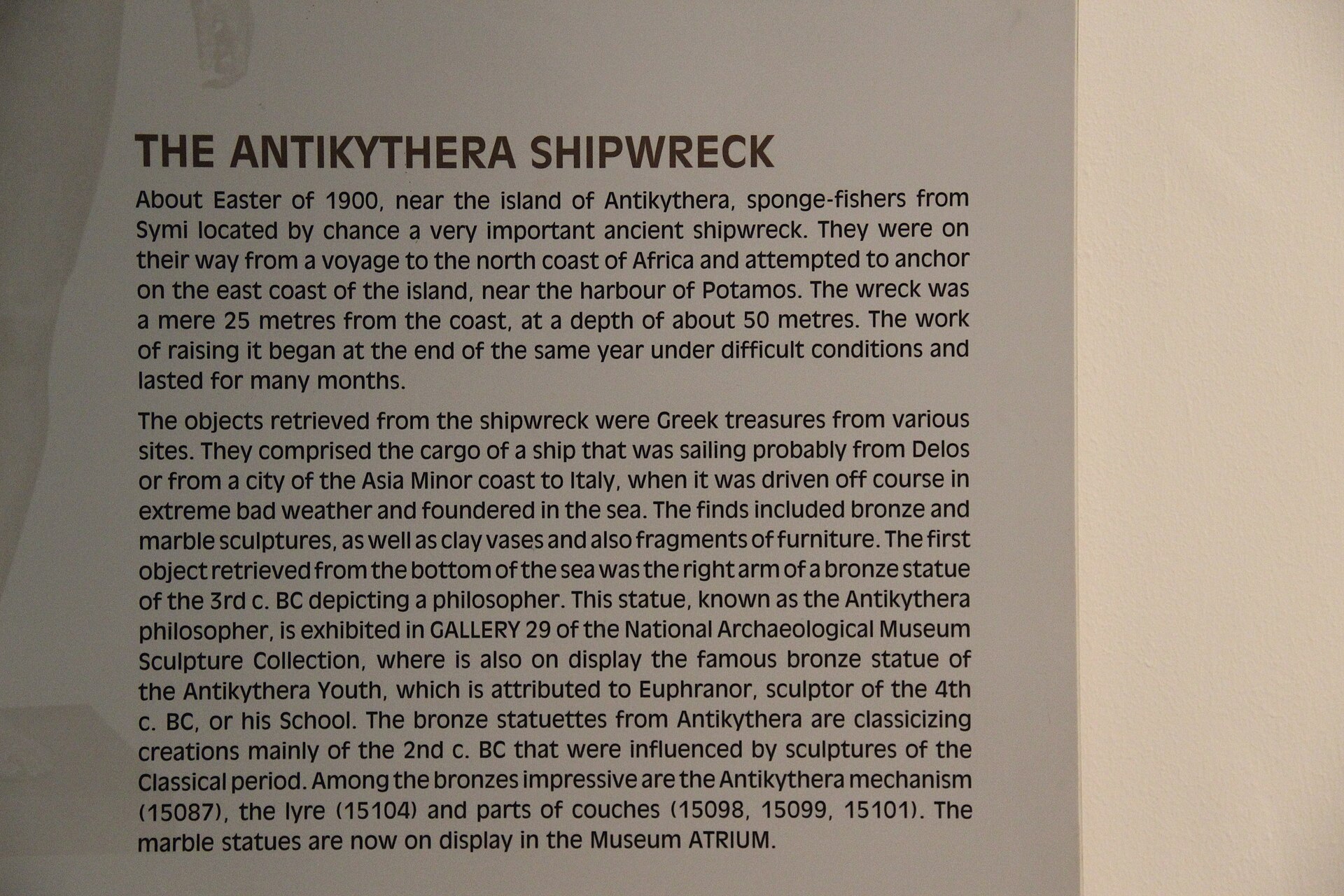
The National Archaeological Museum's own account, printed on the gallery wall beside the finds, is worth following because it is the holding institution's position rather than a retelling.
The National Archaeological Museum's own account, printed on the gallery wall beside the finds, is worth following because it is the holding institution's position rather than a retelling. About Easter of 1900, near the island of Antikythera, sponge-fishers from Symi located by chance a very important ancient shipwreck. They were on their way home from a voyage to the north coast of Africa and attempted to anchor on the east coast of the island, near the harbour of Potamos. The wreck lay a mere 25 metres from the coast, at a depth of about 50 metres. The work of raising it began at the end of the same year, under difficult conditions, and lasted for many months.
The captain was Dimitrios Kontos and the diver usually named as the first to see the site is Elias Stadiatis. The salvage was carried out by the sponge divers themselves, in standard diving dress, working at a depth that was at the outer limit of what that equipment allowed and well inside the range at which decompression illness kills. The Hellenic Royal Navy supplied a vessel and supervision; a Ministry of Naval Affairs document of 26 February 1901 concerning the despatch of the vessel Mykali to Kythera for the Antikythera works survives and is reproduced by the museum.
The first object retrieved from the bottom of the sea, according to the same gallery text, was the right arm of a bronze statue of the third century BC depicting a philosopher. Nobody was looking for a machine.
Chapter 317 May 1902
The mechanism came up with everything else and went into the museum as corroded bronze.
The mechanism came up with everything else and went into the museum as corroded bronze. It was recognised on 17 May 1902, when Valerios Stais, then at the National Archaeological Museum, saw a gear wheel in one of the lumps. His cousin Spyridon Stais is named alongside him in some accounts.
The two-year gap is the most instructive fact in the object's modern history. It was not found by an archaeologist, it was not recognised on the seabed, and it survived the salvage, the transport and two years of museum storage as an unremarkable mass of corrosion. The bronze statues from the same wreck were understood immediately, because a statue looks like a statue. The single most important object recovered from any ancient wreck sat unread because nobody had a category for it.
Chapter 4What it does, so far as the fragments will say
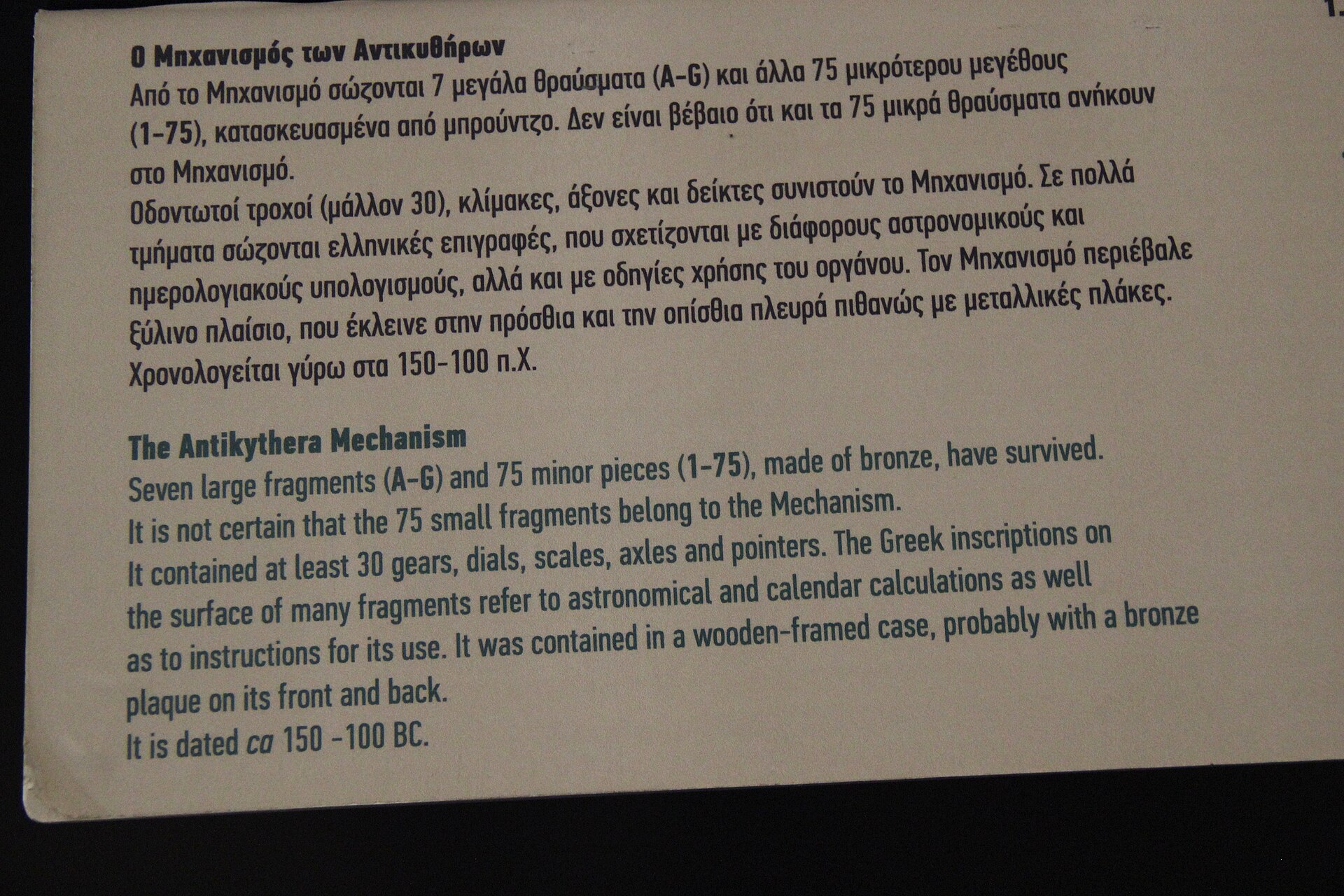
The museum's gallery text is the conservative statement and is worth taking as the baseline: the mechanism contained at least 30 gears, dials, scales, axles and pointers; the Greek inscriptions on...
The museum's gallery text is the conservative statement and is worth taking as the baseline: the mechanism contained at least 30 gears, dials, scales, axles and pointers; the Greek inscriptions on the surface of many fragments refer to astronomical and calendar calculations and to instructions for its use; and it was contained in a wooden-framed case, probably with bronze plates on its front and back.
Beyond that baseline, and on the strength of the imaging campaigns rather than of the naked eye, the readings that have gained acceptance are these. The front carried a zodiac and calendar display showing the positions of the sun and moon. The back carried two large spiral dials, one running on the 19-year Metonic cycle that reconciles lunar months with solar years, the other on the Saros eclipse cycle of 223 lunar months, with subsidiary dials for the Callippic and Exeligmos corrections. A dial giving the four-year cycle of the games, including the Olympiad, was identified in 2008. The month names on the Metonic dial are Corinthian.
The lunar display incorporates a pin-and-slot arrangement that reproduces the variable speed of the moon around its orbit, which is a mechanical solution to a problem in observational astronomy and is the detail that most persuaded specialists that this is an instrument built by somebody who understood the theory rather than a curiosity.
In 2024, University of Glasgow physicists Graham Woan and Joseph Bayley applied statistical methods developed for gravitational-wave detection to the calendar ring's surviving hole positions, most of which are damaged or missing outright. Their Markov Chain Monte Carlo analysis put the original hole count at 354 or 355 (68% credible interval 354.08 to 355.24), matching the 354-day lunar year rather than the 365-day solar year some earlier reconstructions assumed, with the holes spaced to an average radial precision of 0.028mm. Published in the Horological Journal in July 2024, it is a statistical inference from damaged physical evidence, not a new fragment, and it corroborates rather than overturns the reading above.
Chapter 5The gear that looks like a clock and is not one
It is worth being precise about the claim that this object is a computer or a clock, because both words are doing work they should not.It has no escapement and it keeps no time.
It is worth being precise about the claim that this object is a computer or a clock, because both words are doing work they should not.
It has no escapement and it keeps no time. It is turned by hand, and what it computes it computes as a function of how far the input has been turned. It models cycles, not hours. The proper description is a geared calculating instrument that mechanises astronomical cycles, and the ancient category it belongs to is the sphere or planetarium that Cicero describes rather than anything horological.
Its importance to the history of technology rests on the gearing itself: differential and epicyclic arrangements, triangular teeth cut by hand, a largest wheel of about 13 centimetres, and a level of miniaturisation that has no surviving parallel until medieval Islamic geared calendars and European clockwork. Whether it was a unique object or the survivor of a tradition of such instruments is unresolved and is one of the real open questions about it. The Fragment G inscription analysis has been read as showing that the maker built the instrument for other people to use, perhaps students, astronomers or wealthy individuals, and not only for himself, which is an argument for a tradition rather than a one-off.
Chapter 6Seventy years of reading it with the wrong tools
Albert Rehm, a German philologist, was the first to propose that the object was an astronomical calculator, and in 1905 he read the word sterigmos, stationary point, on a small piece later...
Albert Rehm, a German philologist, was the first to propose that the object was an astronomical calculator, and in 1905 he read the word sterigmos, stationary point, on a small piece later reassembled into Fragment G. Stationary points are where a planet appears to reverse direction, so the word is direct evidence for planetary modelling, read in 1905 and not built into any reconstruction for decades.
Derek J. de Solla Price, a historian of science at Yale, became interested in 1951 and published a popular account, An Ancient Greek Computer, in 1959. His decisive step was not textual. In 1971 he and the Greek nuclear physicist Charalampos Karakalos made X-ray and gamma-ray images of the fragments, and it was those images that first showed the gear counts inside the corrosion. Price published the results in 1974.
The pattern holds for every subsequent advance. What moves the reading forward is a new way of seeing inside the metal, not a new excavation, because the object has been complete, in the sense of being all that survives, since 1901.
Chapter 72005: an eight-tonne scanner brought to the museum
The campaign that produced the current reading was mounted in 2005 by a collaboration of Cardiff University, the National Archaeological Museum, the University of Athens and the Aristotle University...
The campaign that produced the current reading was mounted in 2005 by a collaboration of Cardiff University, the National Archaeological Museum, the University of Athens and the Aristotle University of Thessaloniki with two industrial partners.
X-Tek Systems built a 400 kilovolt microfocus computed tomography machine, weighing around eight tonnes, and moved it to Athens, because the fragments could not travel. Hewlett-Packard supplied a reflectance imaging dome implementing polynomial texture mapping, which lights a surface from many directions in turn and combines the images so that a surface can afterwards be relit at will, bringing up inscriptions that are invisible under any single fixed light.
The results were published in Nature in 2006 and again in 2008. The 2006 paper reported the gear train and functions; the 2008 paper reported the Olympiad dial and the Corinthian month names. The 2016 publication of the inscriptions and a 2021 model of the front dial by the University College London team continued the work. The imaging data have supported readings of 1,380 letters on Fragment G alone.
For a reader wanting to know how far the object has been made available: this is one of the best-documented objects in the ancient world in terms of published technical imaging, and among the worst-documented in terms of freely licensed photography of the fragments themselves.
Chapter 8How old it is, and why that is contested
Three positions are in circulation and each rests on a different kind of evidence.The National Archaeological Museum's own gallery label dates it to about 150 to 100 BC.
Three positions are in circulation and each rests on a different kind of evidence.
The National Archaeological Museum's own gallery label dates it to about 150 to 100 BC. That is the institutional position and it is the one this record leads with.
A date of 205 BC has been argued from the eclipse predictions on the Saros dial, on the reasoning that the sequence has a start point and that the start point can be calculated. If that is right, the instrument was made before Hipparchus did the work usually credited with making such modelling possible, which has consequences for the history of Greek astronomy well beyond this object.
The wreck itself is dated by its cargo and coins to the second quarter of the first century BC. A ship's date is a terminus for when the object went to the seabed, not for when it was made, and an instrument of this cost would plausibly have been decades old when it was loaded. The dating dispute is therefore not resolvable from the wreck, and this record does not resolve it.
Chapter 9The chain of custody, and what a wreck record actually establishes
As a provenance chain this is a short document and an unusually clean one, and it is worth setting out because it is the opposite of the usual antiquities problem.There is no collector, no dealer, no...
As a provenance chain this is a short document and an unusually clean one, and it is worth setting out because it is the opposite of the usual antiquities problem.
There is no collector, no dealer, no export licence and no restitution claim. The object was recovered inside Greek territorial waters by Greek divers, under the supervision of the Greek navy, and entered the Greek national collection immediately. It has never been on the market, has never been offered at auction, and there is no price of any kind in its history. The Ministry of Naval Affairs document of 26 February 1901 is a piece of the state's own paperwork for the operation.
What is not documented is everything before 1901. Who made it, who owned it, who was shipping it and where to are all unknown. The cargo is generally read as a shipment of Greek goods travelling west, probably from Delos or from a city on the Asia Minor coast, towards Italy, and the object was therefore probably in transit as property when it sank. Whether it was cargo, or a passenger's instrument, or ship's equipment, is not established.
The divers were, by most accounts, compensated by the Greek state for the finds. The terms and the sums are not established in the sources consulted here, and at least one diver died and others were paralysed in the course of the salvage. A record that lists the fragments and omits that has left out the price actually paid for them.
Chapter 10What is happening to it now
The fragments are on display in the bronze collection of the National Archaeological Museum in Athens, with the mechanism catalogued on the museum's own gallery label as inventory 15087, alongside...
The fragments are on display in the bronze collection of the National Archaeological Museum in Athens, with the mechanism catalogued on the museum's own gallery label as inventory 15087, alongside other bronzes from the same wreck: the lyre, 15104, and parts of couches, 15098, 15099 and 15101. The marble statues from the wreck are displayed separately in the museum atrium.
The wreck site itself has been worked again. Jacques Cousteau dived it in the 1950s and again in 1976, and a series of modern campaigns from 2012 has recovered further material including human skeletal remains, which is exceptional for an ancient wreck and opens the possibility of identifying the people aboard. No further piece of the mechanism has been recovered in any modern campaign, which is itself a finding: the 82 fragments are very probably all there is.
The reading of the object is not closed. Every major imaging campaign since 1971 has changed the reconstruction, and the 2021 model of the front dial is a proposal rather than a settlement.
The artist
Unknown; the Antikythera maker and the people who read the object
There is no artist page to write here and that is the finding. The object carries no signature, and the inscriptions on it are instructions and calendrical text rather than a name. Everything said about its maker is inference from the object itself: the month names on the Metonic dial are Corinthian, which points to Corinth or one of its colonies rather than to Rhodes, and the quality of the astronomy points to somebody working inside a serious theoretical tradition rather than to a clever mechanic.
What can be documented instead is the succession of people who made the object legible, because for this object the readers are the history. Valerios Stais saw the gear. Albert Rehm read the vocabulary of planetary theory in 1905. Derek de Solla Price and Charalampos Karakalos got inside the corrosion in 1971. The 2005 collaboration between Cardiff, the museum, two Greek universities, X-Tek and Hewlett-Packard produced the reading that stands today, and it will be revised again.
Exhibited
- 2012-2013The Antikythera Shipwreck: the Ship, the Treasures, the MechanismNational Archaeological Museum, Athens · The museum's special exhibition of the wreck material. The Ministry of Naval Affairs document of 1901 reproduced in this record was published in connection with it.
- presentPermanent display, bronze collectionNational Archaeological Museum, Athens · The mechanism is shown with the other bronzes from the wreck. The marble statues from the same cargo are displayed in the museum atrium, and the Antikythera philosopher and the Antikythera Youth are in Gallery 29.
Literature
- Derek J. de Solla Price, Gears from the Greeks: The Antikythera Mechanism, a Calendar Computer from ca. 80 BC, Transactions of the American Philosophical Society. The publication of the 1971 gamma-radiography carried out with Charalampos Karakalos. Superseded in its reconstruction and still the foundation of the modern literature. (1974)
- T. Freeth and others, 'Decoding the ancient Greek astronomical calculator known as the Antikythera Mechanism', Nature, 30 November 2006. The first publication of the 2005 imaging campaign. NOT READ IN FULL for this record: nature.com returned an authentication redirect to a plain fetch and the abstract was not retrieved.
- T. Freeth, A. Jones, J. M. Steele and Y. Bitsakis, 'Calendars with Olympiad display and eclipse prediction on the Antikythera Mechanism', Nature, 31 July 2008. Source in the secondary literature for the Olympiad dial and the Corinthian month names. NOT READ IN FULL for this record.
- T. Freeth and the UCL Antikythera Research Team, 'A Model of the Cosmos in the ancient Greek Antikythera Mechanism', Scientific Reports, March 2021. A proposed reconstruction of the front dial compatible with the currently known data. NOT READ IN FULL for this record; the fetch returned a redirect and a mis-served article.
Related works
| Work | Relation | Where it is |
|---|---|---|
| The Antikythera Youth (Ephebe), NAMA 13396 Attributed by the museum to Euphranor or his school | From the same cargo, recovered in the same salvage The famous bronze from the wreck. It was understood immediately on recovery, while the mechanism sat unrecognised for two years, because a statue looks like a statue. | National Archaeological Museum, Athens, Gallery 29 |
| The Antikythera Philosopher Unknown Greek | From the same cargo; the first object raised The museum's own gallery text records that the first object retrieved from the bottom of the sea was the right arm of a bronze statue of the third century BC depicting a philosopher. | National Archaeological Museum, Athens, Gallery 29 |
| The lyre, NAMA 15104, and the couch fittings 15098, 15099 and 15101 Unknown Greek | Bronzes from the same wreck, catalogued in sequence with the mechanism Their inventory numbers sit immediately around the mechanism's 15087 on the museum's own label, which is the clearest indication of how the wreck material was accessioned as a single group. | National Archaeological Museum, Athens |
| The reconstructions and working models Various, from Derek de Solla Price onwards | Not the object; hypotheses about it Every major imaging campaign since 1971 has changed the reconstruction, so models built to earlier readings embody gear trains that have since been abandoned. They are photographed far more often than the fragments and are routinely captioned as the mechanism itself. | Athens, Thessaloniki, Kassel, Sao Paulo, Bozeman and elsewhere |
| Cicero's account of a planetary sphere Attributed in antiquity to Archimedes and to Posidonius | The only textual evidence that instruments of this kind existed Cicero describes a geared sphere modelling the motions of sun, moon and planets. It is the reason the mechanism is not regarded as impossible, and it is also the reason attributions to Archimedes circulate. No evidence from the object supports any named attribution. | Textual |
Open questions
- Who made it, and where. No maker is named on the object. The Corinthian month names point to Corinth or a Corinthian colony such as Syracuse and away from Rhodes, which had been the standard guess; attributions to Archimedes, Hipparchus and Posidonius all circulate and none rests on evidence from the object.
- When it was made. The museum's own label gives about 150 to 100 BC; a date of 205 BC has been argued from the Saros eclipse sequence; the wreck itself dates only the deposition. The three cannot be reconciled from the material consulted.
- Whether all 82 fragments belong to it. The National Archaeological Museum's own gallery text states that it is not certain that the 75 small fragments belong to the mechanism, a caveat that is almost never repeated when the number 82 is quoted.
- Whether it was unique or the survivor of a tradition. The inscription analysis has been read as showing that the maker built it for other people to use, which argues for a tradition; no second instrument of the kind survives from antiquity.
- Who was on the ship, where it was going, and whether the mechanism was cargo, a passenger's property or ship's equipment. None of this is established.
- What the Greek state paid the sponge divers, and the full human cost of the salvage. Divers were killed and paralysed at about 50 metres in standard dress; the compensation terms are not established in the sources consulted.
- Why it went unrecognised for two years in the museum after recovery, and who handled it in that period. The recognition on 17 May 1902 is documented; the two years before it are not.
- Whether any further fragment survives at the wreck site. No modern campaign since 2012 has recovered another piece of the mechanism, which suggests the 82 are all there is, but the site has not been exhausted.
Questions about this object
What is The Antikythera Mechanism?
The Antikythera Mechanism is a clocks and instruments, dated c. 150-100 BC on the National Archaeological Museum's own gallery label. A date of 205 BC has been argued from the eclipse sequence on the back dial; other readings place it in the first century BC. The shipwreck that carried it is dated to the second quarter of the first century BC.. Medium: Bronze plates and gearing in a wooden case.
Who made The Antikythera Mechanism, and is the attribution settled?
The attribution to Unknown Greek maker, working in a tradition associated with Rhodes, Corinth or Syracuse is recorded here as unknown. No maker is named on the object and none has ever been established. The inscriptions are instructions and calendrical text, not a signature. The best evidence for localisation is internal: the month names on one of the dials are Corinthian, which points to Corinth or one of its colonies, Syracuse among them, rather than to Rhodes, which had been the standard guess on the strength of the Rhodian astronomical tradition and of Cicero's account of a planetary sphere. Attributions to Archimedes, to Hipparchus and to Posidonius all circulate. None rests on evidence from the object and none is adopted here. The National Archaeological Museum's own gallery label states the museum's position on the date and says nothing about a maker, which is the correct position.
Where is The Antikythera Mechanism now?
National Archaeological Museum, Athens; the mechanism is inventory 15087 on the museum's own gallery label for the Antikythera shipwreck. Last confirmed 3 August 2026. Recovered by Greek sponge divers under Hellenic Navy supervision in 1900 and 1901 and in the museum's possession since; the gearing was recognised on 17 May 1902.
What is still unknown about The Antikythera Mechanism?
Who made it, and where. No maker is named on the object. The Corinthian month names point to Corinth or a Corinthian colony such as Syracuse and away from Rhodes, which had been the standard guess; attributions to Archimedes, Hipparchus and Posidonius all circulate and none rests on evidence from the object.
Sources
- 1National Archaeological Museum, Athens, gallery label 'The Antikythera Shipwreck', read from the museum's own wall text photographed in the bronze gallery. PRIMARY institutional statement. Source for the Easter 1900 discovery by sponge-fishers from Symi returning from the north coast of Africa, the attempted anchorage near the harbour of Potamos, the wreck lying 25 metres from the coast at a depth of about 50 metres, the raising beginning at the end of 1900 and lasting many months, the cargo probably sailing from Delos or a city on the Asia Minor coast towards Italy, the first object recovered being the right arm of a bronze philosopher of the third century BC, and the inventory numbers of the wreck bronzes: the mechanism 15087, the lyre 15104, and couch parts 15098, 15099 and 15101. commons.wikimedia.org/wiki/...
- 2National Archaeological Museum, Athens, gallery label 'The Antikythera Mechanism', read from the museum's own wall text. PRIMARY institutional statement. Source for the seven large fragments A to G and 75 minor pieces 1 to 75, the museum's own caveat that it is not certain that the 75 small fragments belong to the mechanism, the at least 30 gears with dials, scales, axles and pointers, the Greek inscriptions relating to astronomical and calendar calculations and to instructions for use, the wooden-framed case probably with bronze plaques front and back, and the museum's date of about 150 to 100 BC. commons.wikimedia.org/wiki/...
- 3Wikipedia, 'Antikythera mechanism'. TERTIARY, flagged for replacement with the Nature papers and the Antikythera Mechanism Research Project publications, neither of which could be read in full for this record. Source for Captain Dimitrios Kontos and the Symi divers, the Hellenic Royal Navy expeditions of 1900 to 1901 at Point Glyphadia, the recovery of the mechanism probably in July 1901, the recognition of a gear wheel by Valerios Stais and his cousin Spyridon Stais on 17 May 1902, the 82 fragments after conservation, the largest gear of about 13 cm, Albert Rehm as the first to propose an astronomical calculator, Derek de Solla Price's interest from 1951 and the 1971 X-ray and gamma-ray imaging with Charalampos Karakalos published in 1974, the 2005 Cardiff-led computed tomography campaign, the 37 gears, the 2006 and 2008 Nature papers and the March 2021 University College London model. en.wikipedia.org/wiki/...
- 4Wikimedia Commons file page for the Greek Ministry of Naval Affairs document of 26 February 1901 concerning the despatch of the vessel Mykali to Kythera for the Antikythera wreck works, published by the National Archaeological Museum in connection with its 2012 exhibition of the wreck material. Licence verified as public domain from extmetadata.LicenseShortName. commons.wikimedia.org/wiki/...
- 5Wikimedia Commons API and file description pages, used to verify extmetadata.LicenseShortName per file for every plate proposed in this record and to read the full wikitext rather than the API summary. The 1900 to 1901 salvage photographs are tagged PD-old with the author unknown; the two gallery-label photographs are CC0 releases by Gary Lee Todd, Flickr-reviewed. commons.wikimedia.org/w/...
- 6An improved calendar ring hole-count for the Antikythera mechanism (Woan & Bayley, Horological Journal, July 2024) arxiv.org/abs/...
.jpg)
.jpg)

Last verified 13 August 2026 · Published 4 August 2026
Change log
2 August 2026 - Record deepened to the house standard: narrative sections, technical evidence, artist dossier, related works and open questions added; provenance chain and auction results replaced with the researched versions; sources rebuilt.
6 August 2026 - Re-verified: location and custody unchanged (National Archaeological Museum, Athens); the 2021-2025 University of Geneva-coordinated wreck excavation completed its fifth and final season in mid-2025 with hull timbers and further finds but no new mechanism fragment, consistent with this record; all previously cited source URLs re-resolved. Added one open question and one source: a 2025 preprint (not yet peer-reviewed) modelling gear-manufacturing tolerances and concluding the mechanism's gear train would jam within months of operation, a direct challenge to the working-calculator reading.
4 August 2026 - Withheld from publication. This archive lists an object only when a photograph OF THAT OBJECT can be reproduced under a free licence. No such photograph has been found for this one, so the record is held rather than published beside pictures of other things. It will be released if a free reproduction appears.
4 August 2026 - Record created at the house standard: researched narrative, technical evidence, maker dossier, graded provenance chain, prices with hammer and premium separated, related works, open questions and sources.
13 August 2026 - Re-verified: location and custody unchanged (National Archaeological Museum, Athens, inventory 15087); no new mechanism fragment recovered in any wreck campaign; the 2025 gear-jamming preprint noted in the 2026-08-06 changelog entry remains the current state of that dispute. Added one new, previously uncovered finding: Woan and Bayley's 2024 statistical re-analysis of the calendar ring hole count (Horological Journal), corroborating the lunar-year reading. Note for the desk: this record's last_verified field had drifted stale relative to its own changelog - a 2026-08-06 re-verification entry existed but never bumped last_verified, which is why this record still sorted as the oldest-verified. Worth checking whether other records have the same gap.