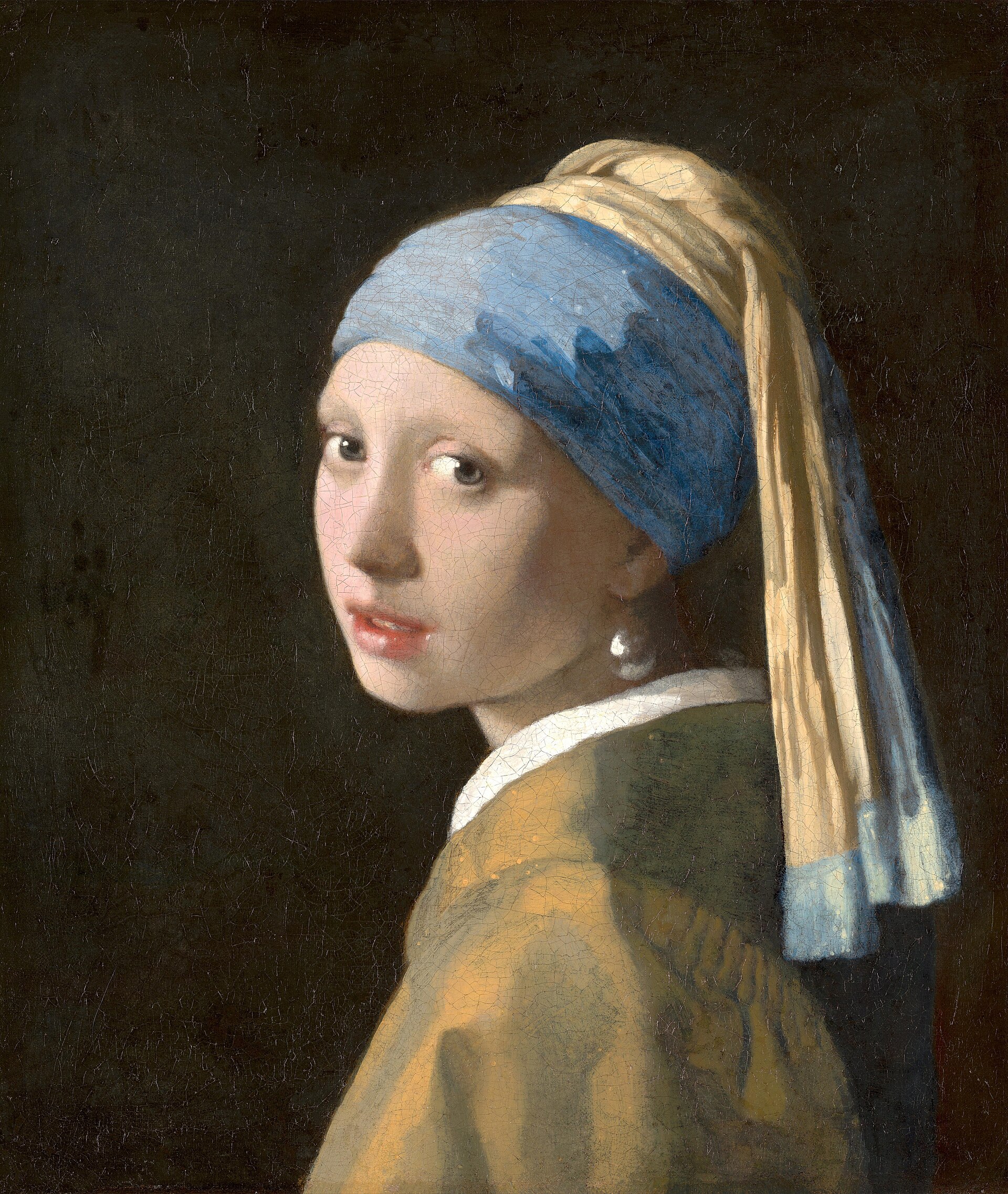
Girl with a Pearl Earring
c. 1665 · Oil on canvas
Mauritshuis
Mauritshuis ·  The Hague, Netherlands · 23 Apr to 23 Aug 2026
It closed on 23 August 2026. The page stays because an exhibition history is evidence: where a work was shown, and when, is part of its provenance and this archive cites it.
On now at Mauritshuis: Frans Hals and genre painting.
Sixteen photographs by Stephan Vanfleteren, fifteen of them new, hung one to a room among the paintings that prompted them. The museum warns on the page that several of them treat death directly.
Shown: Girl with a Pearl Earring, Johannes VermeerThe Mauritshuis has no temporary exhibition wing worth the name, and this show does not pretend otherwise. There is no separate gallery, no dedicated entrance and no additional ticket. Sixteen photographs by the Belgian photographer Stephan Vanfleteren have been placed one to a room across all sixteen rooms of the city palace, among the paintings that are always there. Some hang, some stand and some lie on the floor.
That decision is the whole argument of the show, and it is a riskier one than a separate hang would have been. A photograph in its own white room is judged against other photographs. A photograph screwed to the wall of a room that already contains a Vermeer, a Rembrandt or a Potter is judged against those, immediately and by every visitor who walks in, including the several hundred thousand a year who came for the Girl with a Pearl Earring and did not come for contemporary photography at all. The museum has put a living photographer in the least forgiving position available to it.
A pentimento is a correction: a change of mind the painter made on the canvas and painted over, an arm moved, a head turned, an animal altered, now recoverable with infrared and x-ray. The plural is the show's title. Vanfleteren takes the word past its technical meaning and applies it to the corrections people and societies make, or fail to make, over four centuries. The claim is that a seventeenth-century panel and a photograph made in 2026 are both records of somebody changing their mind under pressure.
The letters published alongside the show demonstrate this on a specific painting rather than asserting it in the abstract. Reading Paulus Potter's The Bull of 1647, the correspondents note that the animal appears to have been a cow before the painter made it a bull, that it seems assembled from the body parts of animals of different ages, that the direction of its gaze is anatomically impossible, and that the farmer's hand beside it is painted far too large. That is a catalogue of corrections and errors left visible in a picture routinely described as a masterpiece of observation from life, and it is a better argument for the show's thesis than any wall text.
The invitation came from Martine Gosselink, the museum's general director, who asked Vanfleteren to look at the whole collection through his own lens and then walked the rooms with him. Vanfleteren, born in Kortrijk in 1969, has spent two decades on raw black-and-white portraiture, documentary work and the photography of dead animals, and is not an obvious house choice for a museum whose reputation rests on Dutch and Flemish painting of the seventeenth century.
The pairing was worked out over two years and thirty letters, the first sent in February 2024 and the last in March 2026, published as a book rather than a catalogue. Fifteen of the sixteen photographs were made for these rooms. The sixteenth already existed: a photograph Vanfleteren made in 2022 for the museum's anniversary show FLASH BACK, responding to Rembrandt's Anatomy Lesson of Dr Nicolaes Tulp of 1632, and it is the one work in the show that had already been tested in this building.
The Mauritshuis prints a caution with the show: like the seventeenth-century masters, Vanfleteren does not avoid depicting death and mortality, and some images may be upsetting. A museum that puts this notice on a show hung inside its permanent collection is conceding something specific. A visitor cannot choose to skip this exhibition and still see the collection, because the exhibition is in every room of the collection. The subjects a reviewer counted include a dead dog, a bloodied figure of Christ, a scar, blankets belonging to migrants and the reproductive anatomy of cattle, and any of them may be met by somebody who bought a ticket to see a girl in a blue turban.
One photograph to each room of the Mauritshuis, sixteen in total, placed among the permanent hang rather than gathered in a gallery of their own. Fifteen were made for this show; each responds either to one specific painting in that room or to a theme the room as a whole carries.1
A photograph Vanfleteren made in 2022 for the museum's anniversary exhibition FLASH BACK, taken in response to Rembrandt's Anatomy Lesson of Dr Nicolaes Tulp of 1632. It is the only work in the show that predates the commission, and the only one already shown in this building.4
A white horse strung up, a naked man, a flower, a sea horizon, the blankets of transmigrants, black and white clouds, Homer, a self-portrait, the scrotum of a bull and the udder of a cow, a scar, a man in white briefs, an anti-paradise, the photographer's own dead dog Kosmos, a bloodied Christ figure, a naked woman, and a hand by itself.2
The painting the letters read most closely: an animal that appears to have been altered from a cow to a bull, apparently composed from parts of animals of different ages, with a gaze that could not physically occur and a farmer's hand painted conspicuously oversized. The corrections in it are the show's title made literal.2
Vermeer's painting stays on the wall for the run of the show and is one of the works the photographer and the director walked past and wrote to each other about. A visitor coming only for it meets the photographs on the way, which is the arrangement the museum chose deliberately.2
Full record in this archivePrices and timing change. We take them from the page we used and print the day we read it: the source we used. Confirm before you travel.
Coverage in the Dutch and Flemish press has been consistently favourable and has concentrated on one question above all others: whether a living photographer can be hung beside Rembrandt, Vermeer and Potter without looking diminished. The reviewers who have addressed it directly conclude that he can.
Searched for a published reservation about this show in the Dutch and Flemish press and trade press - de Volkskrant, NRC, Trouw, Het Parool, De Standaard and De Morgen were searched by name, alongside the photography and museum press including DIGIFOTO Pro, Focus Magazine, Museumtijdschrift, Mixed Grill and the Hague city press. Every piece located was either a preview written before the opening or an appreciation; as at 7 August 2026, with the show two weeks from closing, no reviewer had published a criticism of it that we could find.
Recorded as a gap rather than left blank: an absence of criticism is itself a fact about how a show was received, and it is only worth reading if we say where we looked.
One artwork and its story every Tuesday, with the picture: who owned it, what it made, and what closes soon in the exhibition calendar. No promotion, and nothing we cannot cite.
We send one email to confirm the address and keep nothing else. Every letter carries a one-click unsubscribe. How we handle your data.