Gustave Courbet. Realist and Rebel
Leopold Museum ·  Vienna, Austria · 19 Feb to 21 Jun 2026
This exhibition has closed
It closed on 21 June 2026. The page stays because an exhibition history is evidence: where a work was shown, and when, is part of its provenance and this archive cites it.
On now at Leopold Museum: PREMIERE! The Oesterreichische Nationalbank Collection, Herbert Boeckl - Hans Josephsohn: Figural Archetypes.
Around 130 exhibits, among them 90 paintings and 20 works on paper, in the first extensive monographic Courbet exhibition in Austria. The Origin of the World was among them. Closed 21 June 2026.
Images
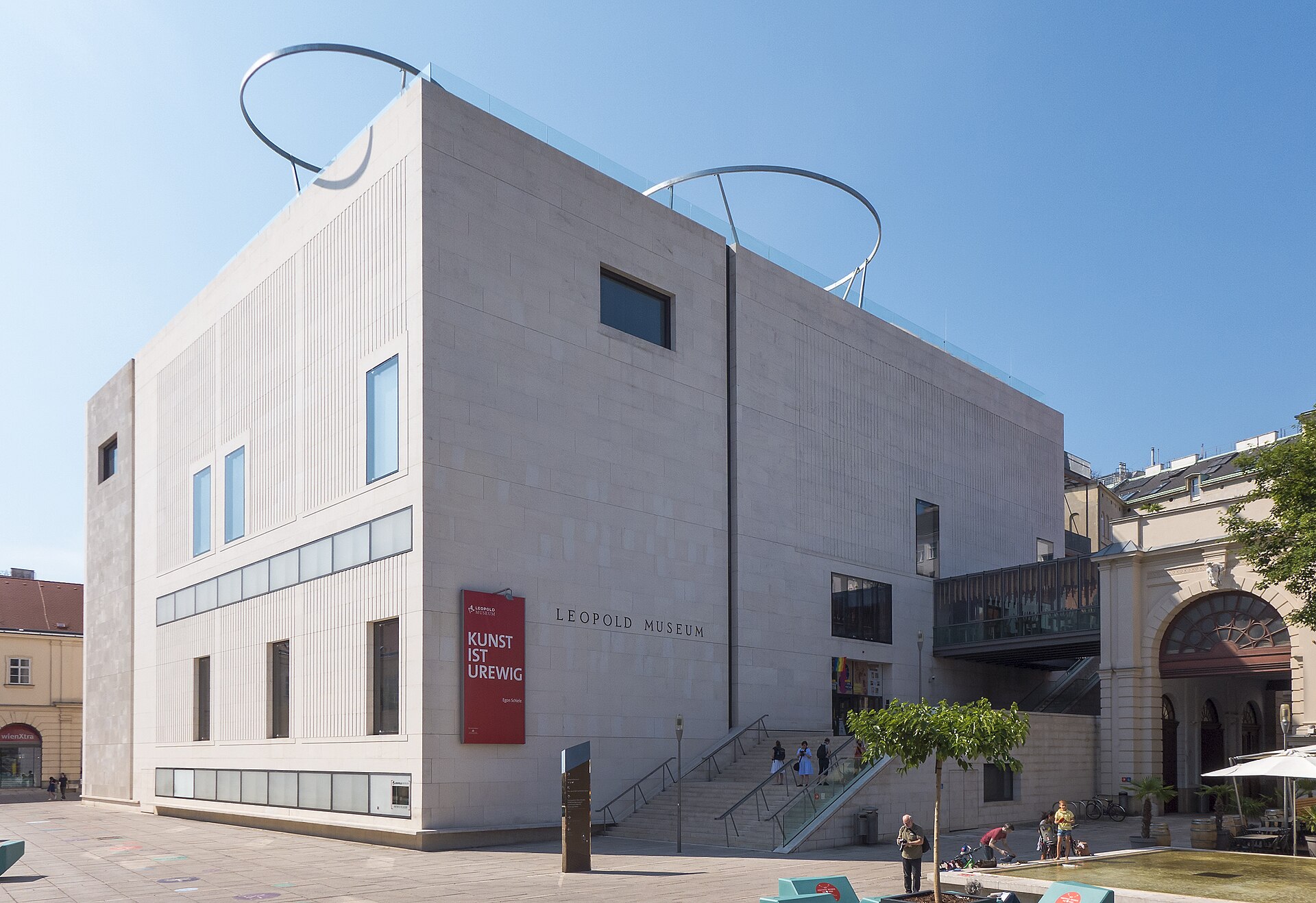 Shown: Leopold Museum - not the exhibition
The first time Austria did this
Courbet died in 1877 and this was the first extensive monographic exhibition of his work ever mounted in Austria. That is a striking gap for a painter of his standing in a city with the museum culture Vienna has, and the Leopold Museum's own material makes the point that the show finally answers a wish Courbet expressed roughly a hundred and fifty years ago to be seen properly in Vienna.
It was assembled by Hans-Peter Wipplinger, the museum's director, with Niklaus Manuel Gudel, and hung on Level -1. The museum counts around 130 exhibits, of which 90 are paintings and 20 are graphic works - the arithmetic leaves roughly twenty further items unaccounted for in that description, which the museum does not itemise. Lenders included the Musee d'Orsay, the Palais des Beaux-Arts de Lille and the Musee Fabre, alongside named private collectors including Karlheinz Essl, Christa Kamm and Werner Trenker.
What Courbet was actually doing, and why it was a scandal
Courbet was self-taught and from 1848 he began painting the unremarkable daily life of working people at the scale and with the seriousness that European painting reserved for history and myth. That is the whole provocation. It was not that the subjects were ugly; it was that they were given the dignity of a format that was supposed to be earned by kings, saints and battles. He called what he was after truthfulness, a new authenticity, and he was attacked for it in his lifetime.
The exhibition's clearest demonstration of this was After Dinner at Ornans of 1849 - a completely unspectacular everyday scene which was nonetheless the first of its kind to be given an official distinction at the Paris Salon. An establishment award for a picture of people sitting around after a meal is the moment the argument was won on the establishment's own ground, and it is a better piece of evidence than any manifesto.
The Meeting, better known as Bonjour Monsieur Courbet, of 1854, does the same job for his self-presentation: the painter meets his patron on the road and is shown as the patron's equal, not his employee. The show opened, appropriately, with self-portraits staging exactly that stance, including the Young Man Sitting study, a self-portrait at the easel of 1847.
The Origin of the World, and how rarely it leaves Paris
The Origin of the World of 1866 was among the central exhibits, and the fact worth carrying away is how unusual its presence was: it has been shown outside France only four times. A visitor in Vienna between February and June 2026 was seeing something that, on that count, leaves the Musee d'Orsay about once a generation.
It was hung as part of a group of sensuously charged nudes that also included The Sleepers of 1866. It is worth keeping the proportion straight, because the notoriety distorts it: painted nudes are only a small part of Courbet's output. The exhibition set them among landscapes of the country around his native Ornans, seascapes including The Wave of 1870 and The Waterspout of 1867, hunting scenes, paintings of grottos, and The Water Stream at La Breme of 1866.
Prison, exile, and the part of the story that is least secure
Courbet's politics were not decorative. He took part in the Paris Commune, was imprisoned, and spent his last years in exile in Switzerland, dying there in 1877. The exhibition included work made in imprisonment and in exile, which is the section most shows of this kind leave thin.
It is also the part of the material that scholarship is least sure about. Writing in Cosmopolis in April 2026, the exhibition's own contributor Pierre Chessex is reported as noting that the exile work of 1873 to 1877 has been largely overlooked for a long time, and that assessing it depends on reliable sources precisely because many of those works carry an attribution problem. That is a real caution and it belongs on the page: the late Swiss pictures are the corner of Courbet's output where what is by his hand and what is not is still being argued.
The show did not end in Vienna. It travelled on to the Museum Folkwang in Essen; the Leopold's own announcement states this without giving the German dates, and we have not found them confirmed, so we do not print a run we cannot source.
What is in the show
Self-portraits, the opening argument
Gustave CourbetEarly self-portraits staging Courbet's rebellious stance, including Young Man Sitting, a study and self-portrait at the easel of 1847, and The Man Mad with Fear of about 1844. The Meeting, or Bonjour Monsieur Courbet, of 1854, in which the painter and his patron meet as equals on the road.2
The everyday, given the dignity of history painting
Gustave CourbetAfter Dinner at Ornans of 1849, the first thoroughly unspectacular everyday scene to be awarded an official distinction at the Paris Salon, and The Man with a Pipe of about 1849. These carry the social-realist claim that made him notorious in his own lifetime.3
The nudes, including one that rarely travels
Gustave CourbetThe Origin of the World of 1866, described by the museum as among the central exhibits and shown outside France only four times, together with The Sleepers of 1866. Painted nudes are a small part of Courbet's output and the exhibition set them among landscape and seascape rather than isolating them.3
Ornans, the sea and the grottos
Gustave CourbetLandscapes of the country around his native Ornans, paintings of grottos and hunting scenes, and seascapes including The Wave of 1870 and The Waterspout of 1867, with The Water Stream at La Breme of 1866. This is the bulk of the ninety paintings and the part of his work least served by his political reputation.2
Imprisonment and Swiss exile
Gustave CourbetWork made during his imprisonment after the Paris Commune and in exile in Switzerland from 1873 until his death in 1877, plus drawings and graphic works. This is the least settled part of his corpus: many exile works carry an attribution problem and the period has long been under-examined.4
Who made it
- Curated by Hans-Peter Wipplinger, Director, Leopold Museum - curator of the exhibition
- Curated by Niklaus Manuel Gudel, Co-curator
- Organised by Leopold Museum
Tickets for this show
- Tickets
- RegularEUR 19museum admission, which covered this exhibition on Level -1
- Reduced, under 26, 65 and over, disabled, unemployedEUR 16
- Vienna City CardEUR 17
- Under 19EUR 2.50
- Under 7Freefree
- Culture Pass, ICOM, Circle of Patrons, Annual Pass, tourist guidesFreefree on production of the relevant identification
- Timed entry
- No timed entry; tickets were sold online and at the door. In the final four days, 18 to 21 June 2026, the museum extended closing to 9pm because of demand.
- Hours
- This exhibition closed on 21 June 2026 and cannot now be seen. The prices above are the museum's standing admission, read on the date below and recorded so the cost of visiting while it ran is on file. The museum opens daily 10am to 6pm, with Tuesday closing reintroduced from September.
Prices and timing change. We take them from the page we used and print the day we read it: the source we used. Confirm before you travel.
What critics said
Coverage in the German-language and Swiss press was uniformly admiring and treated the show as overdue rather than as debatable, concentrating on the fact that Austria had never mounted a Courbet retrospective before and on the rarity of The Origin of the World travelling at all.
What is praised, what is criticised
- Praised: that Austria finally has a full Courbet exhibition, repeatedly framed as answering a wish the painter himself expressed about a hundred and fifty years ago
- Praised: the presence of The Origin of the World, shown outside France only four times
- Praised: After Dinner at Ornans, singled out as the moment an entirely unspectacular everyday scene took an official prize at the Paris Salon
- Praised: the inclusion of the imprisonment and exile work, which comparable shows usually treat as an afterthought
No published criticism found
Searched for a published reservation about this exhibition across the Austrian, German and Swiss press and the art trade press - Der Standard, Die Presse, Kurier, the Frankfurter Allgemeine, the Neue Zurcher Zeitung, Cosmopolis, Meer and the Vienna Art Week coverage were searched by name. Everything located was admiring or descriptive. One aggregated search summary asserted that the show omitted Courbet's flower paintings; we went to the article it named and that claim is not in it, so we do not print it. As at 7 August 2026 we found no published criticism of the exhibition.
Recorded as a gap rather than left blank: an absence of criticism is itself a fact about how a show was received, and it is only worth reading if we say where we looked.
Sources
- 1Leopold Museum, exhibition page for Gustave Courbet. Realist and Rebel: the run dates, the named works on show, the thematic range from self-portraits and social realism through landscape, seascape, grottos and the nudes to the imprisonment and exile work, the sold-out catalogue, and the extended 9pm closing from 18 to 21 June 2026. leopoldmuseum.org/en/exhibitions/150/gustave-courbet
- 2Leopold Museum, press news release for GUSTAVE COURBET. REALIST AND REBEL: around 130 exhibits including 90 paintings and 20 graphic works, the curators Hans-Peter Wipplinger and Niklaus Manuel Gudel, the claim to be the first extensive monographic exhibition of the artist in Austria, Level -1, the named lenders including the Musee d'Orsay, the Palais des Beaux-Arts de Lille and the Musee Fabre, and the onward showing at the Museum Folkwang in Essen. leopoldmuseum.org/en/press/news/1443/GUSTAVE-COURBET-REALIST-AND-REBEL
- 3'Realist and rebel', Meer, 13 March 2026: the review, the framing of the show as answering Courbet's own wish for a Vienna retrospective, After Dinner at Ornans as the highlight and the first everyday scene distinguished at the Salon, The Meeting, and the statement that The Origin of the World has been shown outside France only four times. meer.com/en/105455-realist-and-rebel
- 4'Gustave Courbet: realist and rebel', Cosmopolis, 6 April 2026: the account of the exhibition and the note attributed to the contributor Pierre Chessex that the exile work of 1873 to 1877 has long been overlooked and must be assessed against reliable sources because many of those works carry an attribution problem; also the observation that painted nudes form only a small part of Courbet's output. cosmopolis.ch/gustave-courbet-realist-and-rebel/
- 5Leopold Museum, tickets and visitor information: the admission table including the reduced, under-19, Vienna City Card and free categories, and the daily 10am to 6pm opening. Read 7 August 2026. leopoldmuseum.org/en/visit/tickets