Coronation Stone of Moctezuma Xocoyotzin
Unrecorded Mexica sculptor, Tenochtitlan · c. 1503
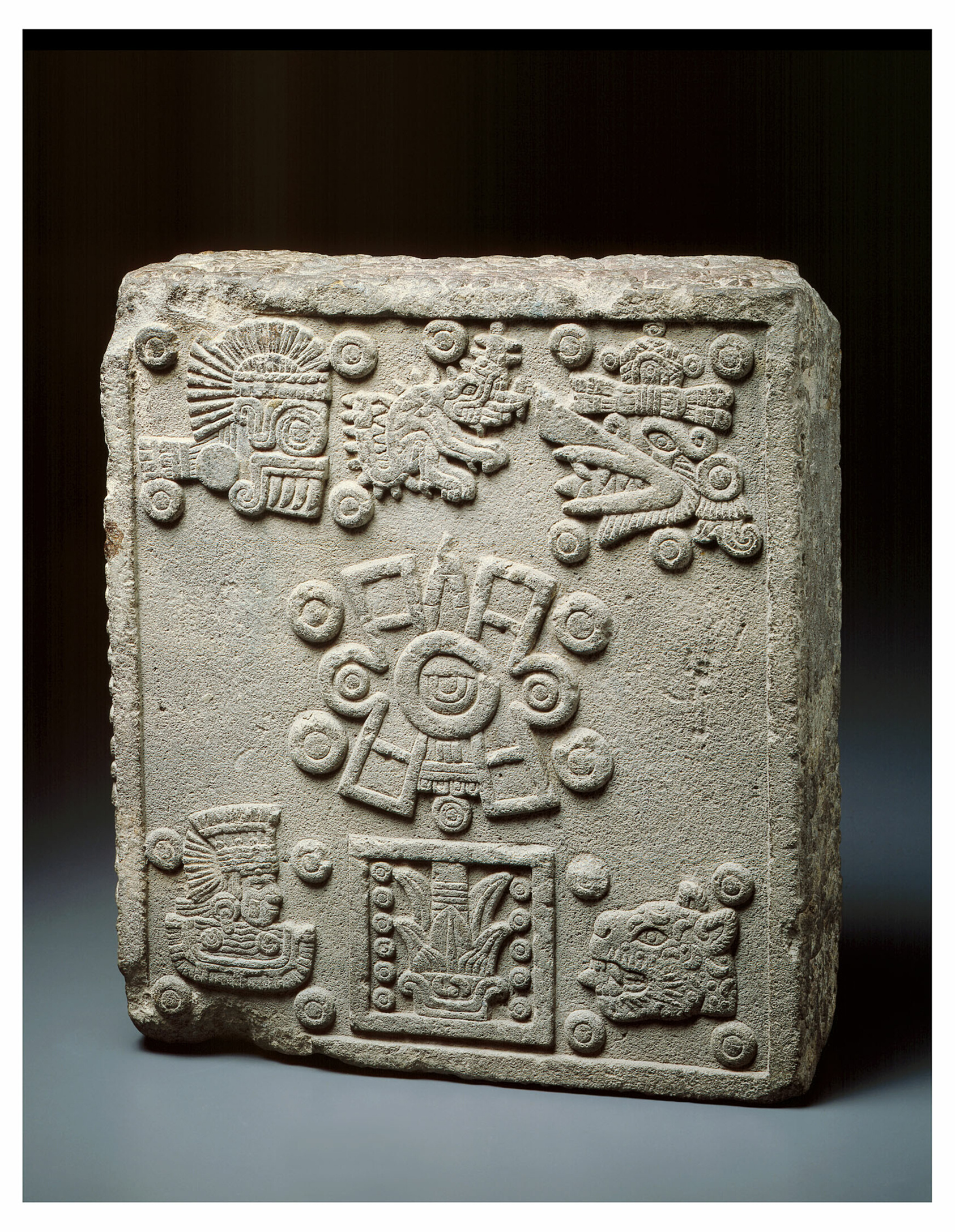
The record subject. Basalt, 67.4 by 57.8 by 22.9 cm, carved on the top and all four sides with an incised date beneath. The glyphs on this face fix the year 11 Reed and the day 1 Crocodile, read as 15 July 1503, the day Moctezuma the Younger was crowned.
| Artist | Unrecorded Mexica sculptor, Tenochtitlan |
|---|---|
| Date | c. 1503 |
| Medium | Basalt |
| Dimensions | 67.4 x 57.8 x 22.9 cm as catalogued by the Art Institute of Chicago. The 1983 exhibition catalogue gave the same block as 22.8 high x 67.3 long x 57.7 wide cm, and a 2023 article gives 55.9 x 66 x 22.9 cm |
| Where it is now | Art Institute of Chicago, Gallery 161last confirmed 18 September 2026 |
| Inventory number | 1990.21 |
| Attribution | AttributedNo maker is named and none can be. Full note |
| Object type | Antiquity |
| Period | Mexica (Aztec), Late Postclassic, early sixteenth century |
| Cases | Has a provenance gap |
| Inscriptions | Carved glyphs, not writing in the alphabetic sense. On the top face: the four terminated cosmic eras 4 Jaguar, 4 Wind, 4 Rain and 4 Water at the corners, 4 Movement at the centre, the day 1 Crocodile in a rare full-figured form, and the year 11 Reed in a square cartouche. All four sides carry the earth monster Tlaltecuhtli flanked by paired atl tlachinolli, the sacred war sign. On the underside, the date 1 Rabbit, incised in a style that differs from the relief carving of the other surfaces. |
| Owners on record | 5 links3 documented, 1 disputed, 1 unknown |
| Sources | 6 cited |
About this record Last verified 18 September 2026 · 6 sources cited · Change log
On this page 12 sections
ContentsClose
A basalt block a little over half a metre across, carved on every face, whose glyphs fix a single day: 15 July 1503, when Moctezuma the Younger took the Mexica throne. It sets that coronation inside the sequence of the five cosmic eras, so that a dynastic event is dated by the calendar of creation itself.
Nothing whatever is recorded of it before February 1971, when it surfaces in a Los Angeles dealer's gallery. The two earliest documents are an authentication written for the dealer and a slide a scholar shot on the dealer's premises. In 1972 it was bought by an Illinois industrialist and spent eighteen years in a clock museum in Rockford. The Art Institute of Chicago bought it in January 1990.
The 1983 catalogue that made it famous called it the Stone of the Five Suns, said its precise function was uncertain because no example of its type has ever been found in place, and never used the word coronation. The museum's title asserts what that catalogue would not, and in 2023 a specialist recorded in a footnote that Emily Umberger has questioned the monument's authenticity.
Provenance
Each link is graded. Documented: a cited source supports it. Disputed: the identification is argued but not established. Unknown: no owner for that span, and the gap is not smoothed into a narrative. The grades in the glossary.
- c. 1503 - unknownThe ritual centre of Tenochtitlandisputed
The Art Institute states the monument was originally located within the ritual precinct of Tenochtitlan, whose remains lie under central Mexico City. No findspot is documented. Nicholson wrote in 1983 that no precise provenance data are available but that it was probably discovered somewhere near the centre of Mexico City, and headed the entry: purportedly found in Mexico City.12
- unknown - 1971Unknownunknown
Nothing whatever is recorded. No excavation, owner, sale, export document, customs entry or photograph is known for this monument before February 1971. The gap covers the Spanish conquest, the entire colonial period, Mexican independence, the nineteenth-century discoveries of Aztec monoliths in the Zocalo, and the twentieth century up to 1971.12
- by 10 February 1971 - 1972Stendahl Art Galleries, Los Angelesdocumented
Documented by two objects rather than a transaction. An unpublished typewritten analytical study prepared by Hasso von Winning and sent to Stendahl Art Galleries on 10 February 1971, inscribed HvW Feb. 10, 1971 and to Stendahl 10-II-71, in the West Lake Society archive, Rhode Island; and a slide of the object at Stendahl Art Galleries photographed by H. B. Nicholson, identified as 5 Suns Stone, marked S for Stendahl, and time-stamped with the processing date code FEB71H7, in the H. B. Nicholson Slide Archive at California State University, Los Angeles. Copies of both are in the museum's curatorial file. Nicholson's 1983 catalogue records that the block entered a Los Angeles private collection in the winter of 1971.12
- 1972 - 1990Seth G. Atwood (1917-2010), the Time Museum, Rockford, Illinoisdocumented
Sold to Atwood on 14 November 1972. The museum's evidence is a letter from Patricia Atwood dated 18 December 1989, copy in the curatorial file. Atwood ran the Atwood Vacuum Machine Company and had founded the Time Museum at the Clock Tower Resort in Rockford in 1971. The stone was lent from there to the National Gallery of Art in 1983, where the lender is listed as The Time Museum, Rockford, Illinois. It was not part of the Sotheby's dispersal of the Time Museum's horological collection, having been sold nine years earlier.1256
- 1990 - presentArt Institute of Chicagodocumented
Sold to the Art Institute of Chicago on 9 January 1990, acquired through the Major Acquisitions Fund and accessioned 1990.21. No price has been published. On view in Gallery 161. Exhibited internationally at least six times since, including the Royal Academy in London, the Martin-Gropius-Bau in Berlin, the Bundeskunsthalle in Bonn and the British Museum.1
Prices realised
This monument has never been offered at auction. Both recorded sales, to Seth Atwood on 14 November 1972 and to the Art Institute of Chicago on 9 January 1990, were private, so no hammer price and no buyer's premium exist and no figure has been published for either. For scale in the same collection and the same decade: the horological collection of Atwood's Time Museum was dispersed by Sotheby's in four sales realising 57.9 million United States dollars in total, the first of which, in 1999, included the Henry Graves Patek Philippe at eleven million. This stone was in none of them, having been sold to the museum nine years before.
Technical evidence
| Attribution note | No maker is named and none can be. The monument is attributed to the sculptors of Tenochtitlan on style and on its glyphs, which the Art Institute of Chicago reads as fixing the date 15 July 1503, the coronation of the ninth Mexica ruler. The attribution that matters here is not of hand but of subject: the object was published in 1983 as the Stone of the Five Suns, an essentially religious monument whose precise function was unknown, and is catalogued today as a coronation stone. One scholar has privately questioned whether it is ancient at all. |
|---|---|
| Material | Basalt, carved in high relief on the top and all four sides, with an incised date on the underside.12 |
| Dimensions | Art Institute: 67.4 x 57.8 x 22.9 cm. Nicholson 1983: height 22.8, length 67.3, width 57.7 cm. Grigsby 2023: 55.9 x 66 x 22.9 cm. The three do not agree beyond the thickness.123 |
| Top face | Seven dates: 4 Jaguar, 4 Wind, 4 Rain and 4 Water at the corners as the termination dates of the four ended eras; 4 Movement at the centre for the present era; the day 1 Crocodile in a rare full-figured form; and the year 11 Reed in a square cartouche.12 |
| Sides | All four carry the earth monster Tlaltecuhtli, a crouching creature with a gaping mouth studded with knife teeth, flanked by two atl tlachinolli signs meaning sacred war.2 |
| Underside | The date 1 Rabbit, the calendrical name of the earth, which was created in that year. It is incised in a style that differs from the relief carving of the other surfaces.2 |
| Date derived | 11 Reed must equate to 1503 on the lateness of the carving. On the Caso correlation the day 1 Crocodile fell only once in that year, as the eighth day of Hueytecuilhuitl, equivalent to 15 July 1503. The Art Institute gives 15 July 1503; Grigsby's 2023 reading of the same glyph gives 25 July 1503.123 |
| Function | Unknown. Nicholson stated in 1983 that the precise function is uncertain since no examples of its type have been found in situ, and no later published determination was found.2 |
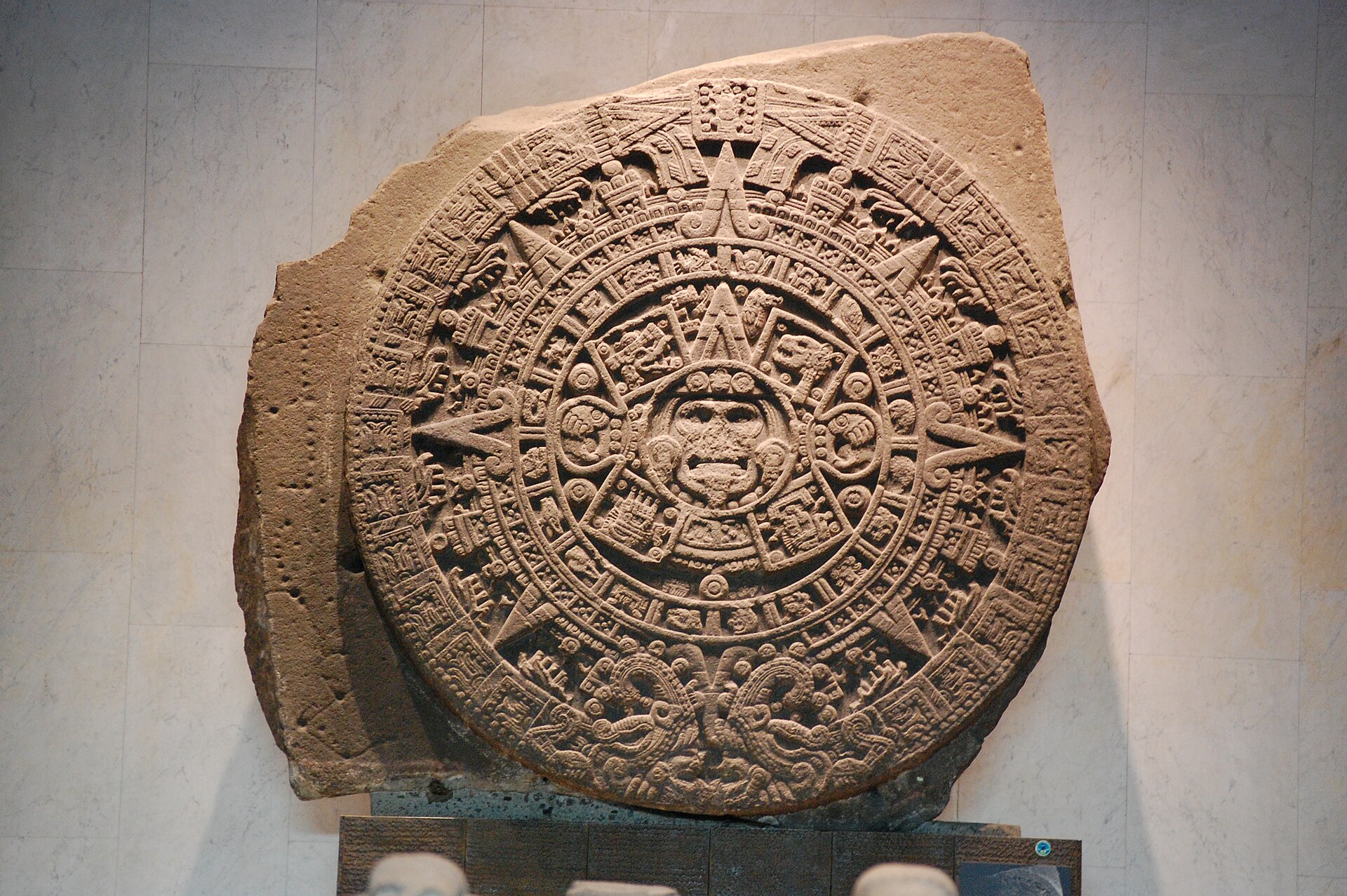
| Comparanda cited in 1983 | The Calendar Stone and the Stone of the Suns, both in the Museo Nacional de Antropologia, and a carved rectangular stone in the Yale Peabody Museum. Tlaltecuhtli images of the same type appear on the Bilimek pulque vessel, the Box of Hackmack and a Berlin cuauhxicalli.2 |
Images
The record in full
Chapter 1What the stone says
The top face carries seven dates. Five of them, each a profile figure with four dots, are the termination dates of the cosmic eras: 4 Jaguar at the lower right, 4 Wind at the upper right, 4 Rain at...
The top face carries seven dates. Five of them, each a profile figure with four dots, are the termination dates of the cosmic eras: 4 Jaguar at the lower right, 4 Wind at the upper right, 4 Rain at the upper left, 4 Water at the lower left, and 4 Movement at the centre. Four worlds have ended. The fifth, the one the carver was living in, was to end in earthquakes, and its sign sits in the middle of the composition.
Between 4 Wind and 4 Rain is the day 1 Crocodile, shown in a rare full-figured form. Between 4 Water and 4 Jaguar is the year 11 Reed inside a square cartouche. A year and a day within it. Because the carving is very late in style, 11 Reed has to be 1503, and on the standard correlation of the Mexica and Christian calendars the day 1 Crocodile fell only once in that year, as the eighth day of the feast Hueytecuilhuitl, equivalent to 15 July 1503.
The ethnohistorical sources record that Moctezuma the Younger, who ruled from 1503 to 1520, was crowned on the day 1 Crocodile in that year. So the two dates were most probably carved to bind the beginning of his reign to the sequence of cosmogonic ages, the last of which was the one in which his city rose to imperial power.
All four sides show Tlaltecuhtli, the earth in the form of a crouching monster with a gaping mouth studded with knife teeth, flanked by paired atl tlachinolli signs, the water-and-burning-field couplet that means sacred war. On the underside, in the usual place for an earth image, is the date 1 Rabbit, the calendrical name of the earth, which was created in that year.
Chapter 2The detail on the underside that nobody explains
One sentence in the 1983 catalogue entry deserves far more attention than it has had.
One sentence in the 1983 catalogue entry deserves far more attention than it has had. The 1 Rabbit glyph on the underside is incised in the stone in a style that differs from the relief carving of the other surfaces.
Every other carved surface is high relief, and the cataloguer singled out its boldness and vigour. The underside date is not: it is incised, and in a different manner. That could mean it was cut at a different moment, by a different hand, for a different purpose, or under a different convention for the hidden face of a monument. No published explanation was found for it.
It is recorded here because a difference of technique on one face of a block is exactly the kind of observation that gets dropped between a catalogue entry and a museum label, and because it is the only physical anomaly on the object that has been published by anyone.
Chapter 3The name it was famous under, and the name it has now
The object entered the literature in 1983, in the National Gallery of Art's exhibition Art of Ancient Mexico: Treasures of Tenochtitlan, catalogued by H.
The object entered the literature in 1983, in the National Gallery of Art's exhibition Art of Ancient Mexico: Treasures of Tenochtitlan, catalogued by H. B. Nicholson with Eloise Quinones Keber. There it is number 6, and it is called the Stone of the Five Suns.
Nicholson set out the whole coronation argument. He identified 11 Reed as 1503, derived 15 July from the Caso correlation, cited the sources for Moctezuma's crowning on 1 Crocodile, and concluded that the two dates were probably carved to commemorate that dynastic event. What he did not do was rename the object. His entry describes an essentially religious monument that includes dates with apparent historical and dynastic referents, and he wrote plainly that its precise function is uncertain since no examples of its type have been found in situ. The word coronation does not appear anywhere in that catalogue.
The Art Institute exhibited it in 1992 as the Coronation Stone of Moctezuma II, with the older name kept in brackets. By its 2009 guide it had become the Coronation Stone of Motecuhzoma II with Stone of the Five Suns in parentheses, and today the museum's own title carries no parenthesis at all. Over about twenty-five years a cautious inference about why two dates were carved has hardened into the object's name, and the caution has been edited out.
That is not a scandal and probably not even an error. It is how attributions travel, and it matters only because the original argument rested on a calendrical correlation and a chain of colonial sources rather than on anything found with the stone.
Chapter 4A named scholar has questioned whether it is ancient
In 2023 the archaeoastronomer Marc Grigsby published a study in Estudios de Cultura Nahuatl arguing that the Aztec Calendar Stone commemorates the same coronation, and used this monument as his...
In 2023 the archaeoastronomer Marc Grigsby published a study in Estudios de Cultura Nahuatl arguing that the Aztec Calendar Stone commemorates the same coronation, and used this monument as his comparison. His fourth footnote reads, in full and verbatim: While Emily Umberger has questioned the authenticity of the monument (personal communication 2019), the information contained in its ideographs supports the thesis presented here that it is a date-specific monument to Motecuhzoma II's coronation.
Emily Umberger is one of the principal authorities on Mexica sculpture and on Moctezuma's monuments in particular, and Grigsby cites her published work repeatedly elsewhere in the same article. He records her doubt and then sets it aside on iconographic grounds.
This record takes no position on whether the stone is ancient, and there is no basis in the published literature for asserting that it is not. What can be stated is the situation, which is unusual and which no museum label reflects: a leading specialist in the field has questioned the authenticity of a monument whose entire recorded history begins in a Los Angeles dealer's gallery in 1971, and the only trace of that doubt in print is a footnote reporting a private communication.
The context sharpens it. The Getty Research Institute, which now holds the Stendahl Galleries archive, says of the dealer through whose hands this stone passed that he and his partners in Mexico did a brisk trade in antiquities that were often looted, forged, or assembled from disparate fragments. That is the Getty's characterisation of the trade, not of this object. But a record that prints the coronation date to the day and does not print the authenticity question is not doing its job.
Chapter 5Nothing before February 1971
The Art Institute's provenance line is unusually granular, and what it documents is the absence rather than the chain.
The Art Institute's provenance line is unusually granular, and what it documents is the absence rather than the chain. The stone was with Stendahl Art Galleries in Los Angeles by 10 February 1971. The evidence for that date is not a bill of sale. It is an unpublished typewritten analytical study prepared by Hasso von Winning and sent to Stendahl on 10 February 1971, inscribed HvW Feb. 10, 1971 and to Stendahl 10-II-71, now in the West Lake Society archive in Rhode Island; and a slide of the object photographed on the dealer's premises by H. B. Nicholson, labelled 5 Suns Stone, marked S for Stendahl, and time-stamped with the processing code FEB71H7, now in the Nicholson slide archive at California State University, Los Angeles.
Read that again as a diligence document. The two earliest records of this monument's existence are an authentication commissioned by the dealer selling it and a photograph taken by a scholar standing in the dealer's gallery. Both men are named, both documents are archived, and neither says where the stone came from.
The 1983 catalogue is as candid as it could be: purportedly found in Mexico City; entered a Los Angeles private collection in the winter of 1971; no precise provenance data are available, but it was probably discovered somewhere near the centre of Mexico City. Probably, somewhere, near. That is the whole of what is known about where a two-hundred-kilogram carved monument of the Mexica state came from.
Chapter 6The authenticator worked for the dealer
Hasso von Winning was a serious Mesoamericanist, and the study he wrote in February 1971 is a real piece of scholarship.
Hasso von Winning was a serious Mesoamericanist, and the study he wrote in February 1971 is a real piece of scholarship. He was also writing it for the gallery that was selling the object.
That arrangement was normal in the pre-Hispanic trade of the period and it is worth naming rather than passing over. An authentication commissioned by a seller is evidence about an object, but it is evidence produced inside a commercial relationship, and it is the only expert opinion on this monument from before it entered a museum. The document itself is unpublished. This record has not read it; its existence, date and inscriptions are known only from the Art Institute's own citation of it.
The second earliest document has a similar shape. Nicholson photographed the stone at Stendahl's in 1971 and twelve years later wrote the catalogue entry that established what it is. He is the field's authority on it and he first saw it as stock.
Chapter 7Earl Stendahl and the invention of a market
Earl Stendahl founded his Los Angeles gallery in 1911 and spent years trying to sell European modernism to California without success.
Earl Stendahl founded his Los Angeles gallery in 1911 and spent years trying to sell European modernism to California without success. In the 1930s he turned to Mexican antiquities and found his market. According to Mary Miller, director of the Getty Research Institute, he could not sell modern art to California but struck gold with pre-Columbian art, which was figurative and somewhat primitive but not too much.
The closing of European shipping lanes in 1940 was the making of him. In Miller's account he sold a few pieces in 1939 and from 1940 it was gangbusters, because everyone was looking for something new and he had the inventory. He used his Hollywood connections to build what she calls the first mass market for pre-Columbian antiquities, and supplied the May Company with a steady flow of Mexican antiquities sold in department stores.
The consequence Miller draws is the one that matters to a provenance archive: the objects Stendahl chose became the canon, and they shape how pre-Hispanic art history is written to this day. The Stendahl Galleries archive, with its letters, photographs, appraisals and sales records, is now at the Getty, which has established a Pre-Hispanic Art Provenance Initiative to work through it. Whether it contains anything on this stone is unknown to this record.
Chapter 8Eighteen years in a clock museum
On 14 November 1972 the stone was sold to Seth G.
On 14 November 1972 the stone was sold to Seth G. Atwood, and it went to Rockford, Illinois. The Art Institute's evidence for that transaction is a letter from Patricia Atwood dated 18 December 1989, seventeen years after the fact and written while the museum was preparing to buy.
Atwood, born in Rockford in 1917 and dead there in 2010, ran the Atwood Vacuum Machine Company, a family manufacturing business with over two thousand employees and around fifty million dollars of annual sales in 1971; it was sold in 1985 with annual sales of a hundred and thirty-eight million. In 1971, the year before he bought this stone, he founded the Time Museum at the Clock Tower Resort in Rockford, which became one of the leading horological collections in the world with nearly fifteen hundred pieces.
So a Mexica coronation monument spent eighteen years in a museum of clocks, and was lent from there to the National Gallery of Art in 1983, where the lender is listed as The Time Museum, Rockford, Illinois. There is a logic to it that nobody seems to have written down: the Time Museum was about the measurement of time, and this object is a calendar. Whether that is why Atwood bought it is not recorded.
The Time Museum's own dispersal is a useful comparison for anyone valuing this object. Its horological collection was sold by Sotheby's in four sales; the first, in 1999, included the Henry Graves Patek Philippe at eleven million dollars, and the four together realised 57.9 million. This stone was not in any of them. It had left nine years earlier, sold directly to the Art Institute of Chicago on 9 January 1990.
Chapter 9What the museum paid, and what it has not said
The purchase was made from the Major Acquisitions Fund and completed on 9 January 1990.
The purchase was made from the Major Acquisitions Fund and completed on 9 January 1990. No price has been published. There was no auction, so there is no hammer and no buyer's premium; the only figure that could exist is the invoice between Seth Atwood and the museum.
This matters more than usual because the object had an exhibition history before the sale. It had been shown at the National Gallery of Art in Washington in 1983 and 1984, catalogued by the leading authority in the field and reproduced in a major publication. A private owner selling in 1990 was selling a monument that four years of scholarship and one national exhibition had already made famous. That is a value-creating sequence, and the number at the end of it is not public.
Chapter 10Thirty years on the road
Few objects in this archive have travelled as hard.
Few objects in this archive have travelled as hard. After the National Gallery in 1983 and 1984 it went round the United States in the Art Institute's own The Ancient Americas: Art from Sacred Landscapes, Chicago in 1992 and 1993, then Houston and then the Los Angeles County Museum of Art. In 2002 and 2003 it was catalogue number 226 in Aztecs at the Royal Academy of Arts in London, and travelled on to the Martin-Gropius-Bau in Berlin and the Bundeskunsthalle in Bonn. It was in The Aztec World at the Field Museum in Chicago in 2008 and 2009, and it was catalogue number 14 in Moctezuma: Aztec Ruler at the British Museum in 2009 and 2010.
Two international loan exhibitions devoted to Moctezuma and to the Aztec state, in London, Berlin and Bonn, both of which required export licences and insurance valuations and government indemnity, and neither of which appears to have produced any published statement about where the object came from. An exhibition history is not a provenance, and this is the clearest illustration of that in the archive: thirty years of scholarly and diplomatic scrutiny, and the earliest record is still a dealer's slide from February 1971.
Chapter 11The measurements do not agree
Three published sets of dimensions exist for one block of basalt.The Art Institute gives 67.4 by 57.8 by 22.9 centimetres.
Three published sets of dimensions exist for one block of basalt.
The Art Institute gives 67.4 by 57.8 by 22.9 centimetres. Nicholson in 1983 gave height 22.8, length 67.3, width 57.7, which is the same block with the axes named differently and rounding to a millimetre. Grigsby in 2023 gives 55.9 by 66 by 22.9, which is not.
The 22.9 constant across all three shows they are describing the same object. The discrepancy is in the other two axes, and this record does not resolve it. The museum's figures are the ones to use because it holds the stone and can measure it; the 2023 figures are recorded here so that a reader meeting them elsewhere knows they are in circulation and knows they conflict.
Chapter 12What is unresolved
The gap in this record is the record. A carved monument of the Mexica state, weighing a couple of hundred kilograms, cannot be casually mislaid; it was made in the ritual centre of Tenochtitlan...
The gap in this record is the record. A carved monument of the Mexica state, weighing a couple of hundred kilograms, cannot be casually mislaid; it was made in the ritual centre of Tenochtitlan, which lies under the middle of Mexico City, and it reappears in California in 1971 with no owner, no findspot, no excavation, no export document and no photograph before the dealer's own.
The Art Institute has not published provenance research on it beyond the granular 1971 to 1990 line already quoted, which is itself better documentation than most museums provide and which makes the emptiness before it the more conspicuous. No claim by Mexico or by its National Institute of Anthropology and History has been found in the sources consulted here, and the official text of the 1972 Mexican federal law on monuments could not be retrieved to characterise what regime would apply, so this record does not characterise it.
The stone is on view in Chicago, in Gallery 161. It is the object through which a great many people first meet the Mexica calendar, and the date it carries is precise to the day. Everything about the fifteenth of July 1503 is known. Everything between then and the tenth of February 1971 is not.
The artist
The sculptors of Tenochtitlan
No Mexica sculptor is named in any source. What the record preserves instead is a state workshop tradition working in basalt in the imperial capital in the decades before 1519, producing monuments that are simultaneously religious objects, calendars and dynastic propaganda, and whose conventions are consistent enough that a stone can be dated by the lateness of its style alone. The dossier below is about that tradition and about how its output is read, because that is the only maker this object has.
Exhibited
- 1983-1984Art of Ancient Mexico: Treasures of Tenochtitlan, catalogue no. 6 as Stone of the Five Suns, lent by The Time Museum, Rockford, IllinoisNational Gallery of Art in association with Dumbarton Oaks, Washington, 28 September 1983 to 8 January 1984
- 1992-1993The Ancient Americas: Art from Sacred Landscapes, catalogue no. 3, as Coronation Stone of Moctezuma II (Stone of the Five Suns)Art Institute of Chicago, 10 October 1992 to 3 January 1993; Museum of Fine Arts, Houston, 4 February to 18 April 1993; Los Angeles County Museum of Art, 6 June to 15 August 1993
- 2002-2004Aztecs, catalogue no. 226Royal Academy of Arts, London, 16 November 2002 to 11 April 2003; Martin-Gropius-Bau, Berlin, 16 May to 10 August 2003; Kunst- und Ausstellungshalle der Bundesrepublik Deutschland, Bonn, 12 September 2003 to 11 January 2004
- 2008-2009The Aztec World (not in catalogue)The Field Museum, Chicago, 28 October 2008 to 19 April 2009
- 2009-2010Moctezuma: Aztec Ruler, catalogue no. 14British Museum, London, 24 September 2009 to 24 January 2010
Literature
- H. B. Nicholson with Eloise Quinones Keber, Art of Ancient Mexico: Treasures of Tenochtitlan, exh. cat., National Gallery of Art, pp. 41-42, catalogue no. 6, as Stone of the Five Suns. (1983)
- Richard Townsend, ed., The Ancient Americas: Art from Sacred Landscapes, exh. cat., Art Institute of Chicago, pp. 57-59, 375, cat. 3, fig. 13a-c. (1992)
- James N. Wood, The Art Institute of Chicago: The Essential Guide, p. 15, as Coronation Stone of Motecuhzoma II. (1993)
- Eduardo Matos Moctezuma and Felipe Solis Olguin, Aztecs, exh. cat., Royal Academy of Arts, London, pp. 455-456, cat. 226. (2003)
- Eduardo Matos Moctezuma and Felipe Solis Olguin, The Aztec Calendar and other Solar Monuments, INAH, pp. 125-126, 155. (2005)
- James Cuno, The Essential Guide, 3rd ed., Art Institute of Chicago, p. 24; and Richard R. Townsend, The Aztecs, 3rd ed., Thames and Hudson, pp. 29-30. (2009)
- Marc Grigsby, in Estudios de Cultura Nahuatl, on the Aztec Calendar Stone as a coronation monument, with the Chicago stone as comparison and the authenticity question in footnote 4. (2023)
Related works
| Work | Relation | Where it is |
|---|---|---|
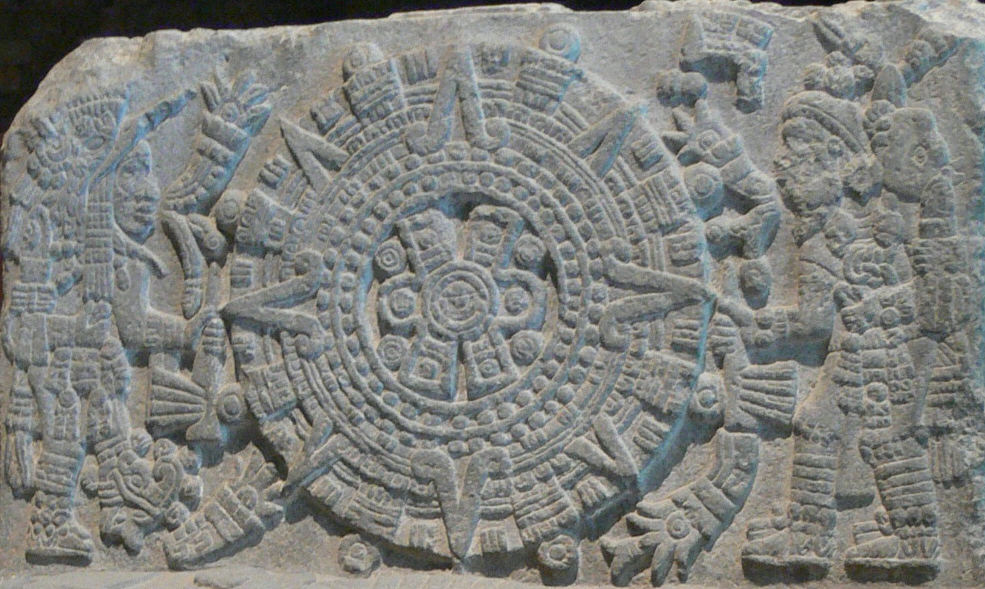
| Aztec Calendar Stone (Piedra del Sol) Unrecorded Mexica sculptor | Nicholson's closest stylistic parallel for the era-dates; argued in 2023 to commemorate the same coronation Found in the main plaza of Mexico City in 1790 and published by Antonio de Leon y Gama in 1792. A documented discovery, which is exactly what the Chicago stone lacks. | Museo Nacional de Antropologia, Mexico City |
| Stone of the Suns Unrecorded Mexica sculptor | Cited by Nicholson as carrying stylistically similar era-dates One of the three monuments he named as comparanda for the five dates. | Museo Nacional de Antropologia, Mexico City |
| Carved rectangular stone Unrecorded Mexica sculptor | The third comparandum Nicholson named for the era-dates Cited in the 1983 entry after Beyer 1921. | Yale Peabody Museum |
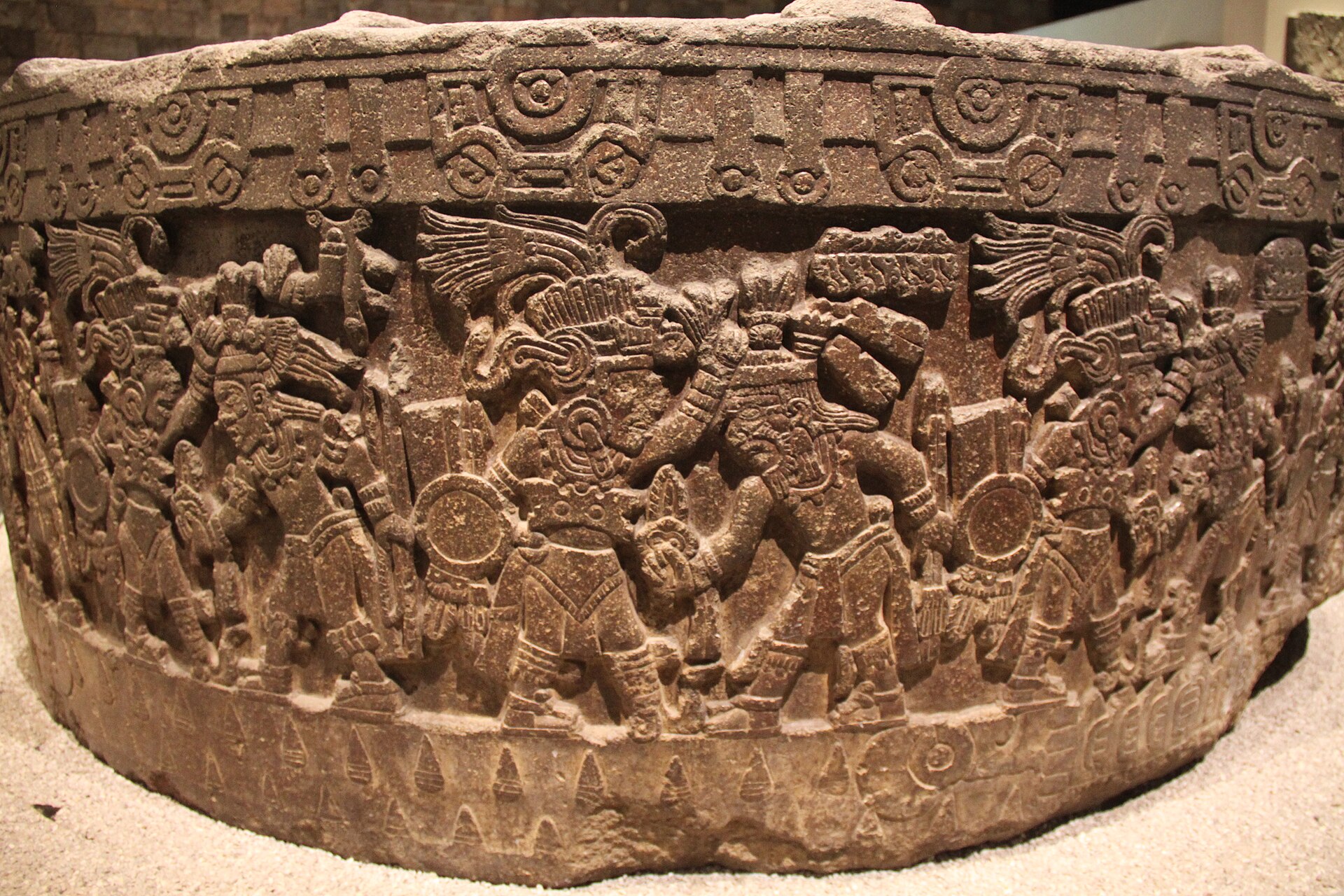
| Teocalli of the Sacred War Unrecorded Mexica sculptor | The other monument binding a ruler to the cosmic eras, and carrying the same sacred-war sign Widely read as a monument of Moctezuma II. | Museo Nacional de Antropologia, Mexico City |
| Stone of Tizoc Unrecorded Mexica sculptor | A royal monument of an earlier reign, with a known findspot Included as the control: a Mexica ruler's monument that was excavated in Mexico City and never left. | Museo Nacional de Antropologia, Mexico City |
| Box of Hackmack and the Bilimek pulque vessel Unrecorded Mexica sculptors | Carry Tlaltecuhtli images of the same crouching type as the Chicago stone's underside and sides Cited together with a Berlin cuauhxicalli in the 1983 entry as the closest iconographic parallels. | Museum fur Volkerkunde, Hamburg; Weltmuseum Wien |
Open questions
- Is the monument ancient? Emily Umberger has questioned its authenticity in a personal communication of 2019, recorded in a published footnote by Marc Grigsby, who sets the doubt aside on iconographic grounds. No scientific examination of the stone has been published.
- Where did it come from, and when did it leave Mexico? Nothing at all is recorded before 10 February 1971. Nicholson wrote only that it was purportedly found in Mexico City and probably discovered somewhere near the centre of the city.
- Who sold it to Stendahl Art Galleries, and when? The two earliest documents are an authentication commissioned by the dealer and a slide taken on the dealer's premises, and neither names a source.
- What does Hasso von Winning's unpublished February 1971 study actually say? It is the earliest expert opinion on the object, it was written for the seller, and it has never been published. This record has not read it.
- Does the Stendahl Galleries archive at the Getty contain anything on this stone? The archive holds letters, appraisals and sales records and is the subject of a Pre-Hispanic Art Provenance Initiative, but no finding on this object has been published.
- What did the Art Institute of Chicago pay Seth Atwood on 9 January 1990? No price has been published and there was no auction.
- Why is the 1 Rabbit date on the underside incised in a style that differs from the relief carving of every other surface? Nicholson recorded the difference and did not explain it, and no later explanation was found.
- Is the coronation date 15 July or 25 July 1503? The Art Institute gives 15 July, following Nicholson's derivation from the Caso correlation; Grigsby's 2023 reading of the same 1 Crocodile glyph gives 25 July.
- Which dimensions are right? The museum, the 1983 catalogue and a 2023 article give three different sets, agreeing only on the thickness of 22.9 cm.
- Has Mexico ever made a claim? No claim by the Mexican state or by its National Institute of Anthropology and History was found in the sources consulted, and the official text of the 1972 federal law on archaeological monuments could not be retrieved to establish what regime applies, so this record does not characterise it.
Questions about this object
What is Coronation Stone of Moctezuma Xocoyotzin?
Coronation Stone of Moctezuma Xocoyotzin is an antiquity, dated c. 1503. Medium: Basalt.
Who made Coronation Stone of Moctezuma Xocoyotzin, and is the attribution settled?
The attribution to Unrecorded Mexica sculptor, Tenochtitlan is recorded here as attributed. No maker is named and none can be. The monument is attributed to the sculptors of Tenochtitlan on style and on its glyphs, which the Art Institute of Chicago reads as fixing the date 15 July 1503, the coronation of the ninth Mexica ruler. The attribution that matters here is not of hand but of subject: the object was published in 1983 as the Stone of the Five Suns, an essentially religious monument whose precise function was unknown, and is catalogued today as a coronation stone. One scholar has privately questioned whether it is ancient at all.
Where is Coronation Stone of Moctezuma Xocoyotzin now?
Art Institute of Chicago, Gallery 161. Inventory number 1990.21. Last confirmed 18 September 2026. Purchased from Seth G. Atwood, 9 January 1990, Major Acquisitions Fund.
What is still unknown about Coronation Stone of Moctezuma Xocoyotzin?
Is the monument ancient? Emily Umberger has questioned its authenticity in a personal communication of 2019, recorded in a published footnote by Marc Grigsby, who sets the doubt aside on iconographic grounds. No scientific examination of the stone has been published.
Sources
- 1Art Institute of Chicago, collection record 1990.21, Coronation Stone of Moctezuma Xocoyotzin. Tombstone, dimensions, glyph reading and the date 15 July 1503, credit line, gallery, the full provenance text with the von Winning study and the Nicholson slide, and the publication and exhibition histories. Read through the museum's public API; the object page at artic.edu/artworks/75644 refuses automated requests. api.artic.edu/api/...
- 2H. B. Nicholson with Eloise Quinones Keber, Art of Ancient Mexico: Treasures of Tenochtitlan, National Gallery of Art, 1983, catalogue no. 6, Stone of the Five Suns. Read in the Internet Archive full text: the Time Museum lender line, purportedly found in Mexico City, the winter 1971 entry into a Los Angeles private collection, the glyph reading, the Caso correlation and 15 July 1503, the differing incised style of the 1 Rabbit underside date, and the statement that the precise function is uncertain. The word coronation does not occur anywhere in the volume. ia800900.us.archive.org/19/...
- 3Marc Grigsby, on the Aztec Calendar Stone as a monument to the coronation of Motecuhzoma II, Estudios de Cultura Nahuatl, 2023. Footnote 4 records that Emily Umberger has questioned the authenticity of the Chicago monument in a personal communication of 2019. Also gives dimensions of 55.9 x 66 x 22.9 cm and reads the 1 Crocodile glyph as 25 July 1503. scielo.org.mx/scielo.php
- 4Getty, 'Research to Shed Light on 20th-Century Trade in Mexican Antiquities', 14 November 2019, on the Stendahl Galleries archive and the Pre-Hispanic Art Provenance Initiative, with Mary Miller, director of the Getty Research Institute, on Stendahl's trade in antiquities often looted, forged, or assembled from disparate fragments, and on his building of the first mass market for pre-Columbian antiquities. getty.edu/news/...
- 5Wikipedia, 'Seth G. Atwood', for his dates, the Atwood Vacuum Machine Company and the founding of the Time Museum at the Clock Tower Resort, Rockford, in 1971. TERTIARY; flagged for replacement with an obituary of record or the Time Museum's own publications. en.wikipedia.org/wiki/...
- 6JCK, 'Final Time Museum auction brings in $18.2 million', on the Sotheby's dispersal of the Time Museum's horological collection, the 57.9 million dollar total across four sales and the 1999 sale of the Henry Graves Patek Philippe at eleven million. jckonline.com/editorial-article/...
Last verified 18 September 2026 · Published 6 August 2026
Change log
6 August 2026 - Record created at the house standard: researched narrative, technical evidence, maker dossier, graded provenance chain, prices with hammer and premium separated, related works, open questions and sources.
18 September 2026 - Re-verification pass: confirmed directly against the Art Institute of Chicago's own collection API (api.artic.edu/api/v1/artworks/75644) that the object remains on view in Gallery 161, is_on_view true, credit line 'Major Acquisitions Fund' unchanged, and the API's own provenance_text still records the Feb. 1971 Stendahl Art Galleries listing, the 14 Nov 1972 sale to Seth G. Atwood, and the 9 Jan 1990 sale to the Art Institute exactly as this record already stated. A fresh web search surfaced a secondary aggregator claiming a 1972-dealer-purchase-date and 'Gallery 136' for this object; checked against the museum's own primary API and found both claims wrong for this object (the API confirms 1990 as the museum's own purchase date and Gallery 161) - not applied, flagged here as a live version-safety/source-quality near-miss so a future editor does not repeat the aggregator's error. No change to attribution or location made.