Admonitions of the Instructress to the Court Ladies
The British Museum ·  London, United Kingdom · 13 Jul to 24 Aug 2026
This exhibition has closed
It closed on 24 August 2026. The page stays because an exhibition history is evidence: where a work was shown, and when, is part of its provenance and this archive cites it.
On now at The British Museum: John Constable: views of nature, Declaring independence: USA 250, The Bayeux Tapestry.
The Admonitions Scroll, traditionally given to Gu Kaizhi, out for its six weeks of the year in Room 91a, with the Ode to the Goddess of the Luo River beside it. Free, but a timed ticket is required and slots release weekly.
Images
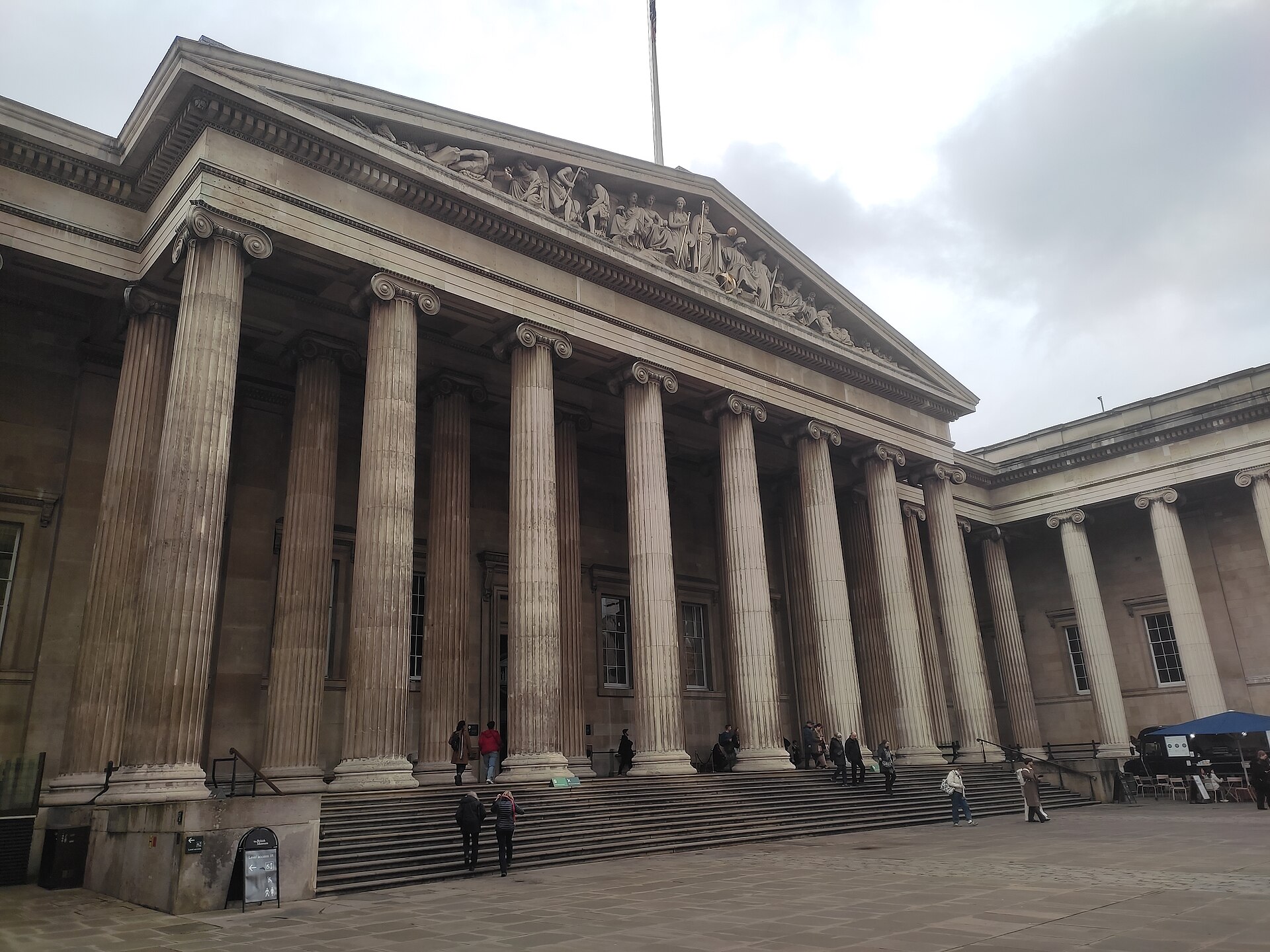 Shown: The British Museum - not the exhibition
Six weeks a year, and this is one of them
The Admonitions Scroll is painted in ink and colour on silk, and silk lit for long periods does not recover. The British Museum's conservation limit is absolute and public: the work may be displayed for six weeks in any year. This display, 13 July to 24 August 2026, is that entire allowance spent. For the other forty-six weeks the object is in the dark, and a visitor to Room 91a will find the case empty and a digital surrogate running downstairs in Room 33.
That single fact governs how this page should be read. Almost every other entry in this section is a show you can decide to see over some months. This is a forty-three-day window on an object that, on the museum's own reckoning, is one of the earliest surviving Chinese paintings on silk in any collection anywhere. Missing it means waiting a year, and the museum does not publish which six weeks it will choose next.
What is actually on the wall, and what is missing from it
The painting illustrates a poem written by the official Zhang Hua, who lived about AD 232 to 300, as a rebuke aimed at the conduct of an empress. It is traditionally attributed to Gu Kaizhi, about AD 345 to 406, and the museum states plainly that it probably dates instead to somewhere between AD 400 and 700 - which is to say it is very likely a later copy of a lost original, and the attribution is a tradition rather than a finding.
Scholarship has not settled it. The long-standing reading is that it is a Tang dynasty copy; a growing number of specialists now reject the supposed copyist's errors that argument rests on and place it earlier, in the Southern and Northern dynasties, between 420 and 589. Nothing in the room resolves this, and the honest position is that a range of roughly three centuries is still live.
What hangs is also incomplete. The original painting ran to twelve scenes. Nine survive here; the first three are gone. A complete twelve-scene version in monochrome, made in the Song dynasty, is in the Palace Museum in Beijing, so the missing opening is known from a copy rather than lost outright. Shown beside the scroll is the Ode to the Goddess of the Luo River, another handscroll in Gu's manner, illustrating Prince Cao Zhi's imagined meeting with a river deity. Seeing two works that preserve the same style in one room is the specific reason to make the journey.
How it came to London, and why that is contested
The scroll was in the Forbidden City in the eighteenth century. The Qianlong emperor, who reigned 1736 to 1795, treated it as a summit of Chinese painting, had it remounted in 1746 and added material of his own: a title inscription, a colophon, a painting of an orchid by his own hand, and a painting by Zou Yigui at the end. Those additions are part of the object now and are themselves evidence of how it was valued.
It left China during the suppression of the Boxer Rebellion. Captain Clarence Johnson, 1870 to 1937, of the First Bengal Lancers, was in Beijing between August and October 1900 and took part in the Siege of the International Legations. The British Museum's own page states only that it bought the scroll from him and that he was in Beijing in 1900. It does not say how he got it, and the accounts do not agree. Johnson's family maintained he was given it by a Chinese noblewoman in return for protecting her household; the researcher Si Xiao, writing for the 100 Histories of 100 Worlds in One Object project, records that this claim has no corroboration, sets it against the documented looting by the eight allied nations, and argues the acquisition cannot be treated as value-neutral whatever happened in the individual case. An encyclopaedic account instead places the removal among the looting at the Summer Palace. We record the disagreement rather than choosing between the three.
The purchase itself is not disputed: the museum bought it in 1903 for twenty-five pounds. Sidney Colvin and Laurence Binyon are credited with recognising what it was - the story runs that the seller's interest was in a jade toggle attached to it. Twenty-five pounds in 1903 for one of the earliest Chinese paintings in existence is the kind of transaction this archive exists to record precisely, and Si Xiao names it with the Chinese term jianlou, acquiring a thing at a grossly mistaken price.
The mounting is part of the damage
In 1914 and 1915 the museum had the handscroll taken apart and remounted, work carried out by Japanese specialists with the British conservator Stanley Littlejohn using Japanese folding-screen technique. The scroll was dismantled and laid onto two long stretchers: one carrying the nine scenes of the painting, the other carrying everything else, with the Zou Yigui painting mounted separately as an album leaf.
This is why the object is shown flat rather than as a scroll. A handscroll is designed to be unrolled by hand at arm's length, a section at a time, in an order the viewer controls; the colophons that follow it are part of that sequence and record who owned and judged it. Cutting the painting from its colophons and fixing both to boards ended that, and it cannot be undone. It was done in good faith by the standards of 1914 and it is now generally described as irreversible harm - a straightforward instance of a museum's own conservation decision becoming part of what a later visitor is looking at.
What is in the show
The scroll, nine scenes of twelve
Traditionally attributed to Gu KaizhiInk and colour on silk, traditionally attributed to Gu Kaizhi and probably made between AD 400 and 700, illustrating Zhang Hua's poem of admonition to an empress. Nine of the original twelve scenes survive here; the opening three are lost and known only from a Song dynasty monochrome copy in the Palace Museum, Beijing.1
Shown beside it: Ode to the Goddess of the Luo River
In the style of Gu KaizhiA second handscroll painted in the style of Gu Kaizhi, illustrating Prince Cao Zhi's imagined romantic encounter with a river deity. The museum presents the pairing as a rare chance to see two works preserving the same manner side by side, which is the argument for this display over a solo hang.1
What the Qianlong emperor added
The Qianlong emperor; Zou YiguiThe emperor had the scroll remounted in 1746 and added a title inscription, a long colophon, a painting of an orchid by his own hand, and a painting by Zou Yigui at the end. These are now inseparable from the object and are evidence of its standing in the imperial collection.4
The 1914-15 mounting, and what it cost
Stanley Littlejohn and Japanese mounting specialistsDismantled and laid on two long stretchers by Japanese specialists working with the conservator Stanley Littlejohn, using folding-screen technique: one stretcher for the nine painted scenes, one for everything else, with the Zou Yigui painting separated as an album leaf. The handscroll form and the sequence of painting and colophons were destroyed and cannot be restored.3
Who made it
- Organised by The British Museum
Tickets for this show
- Tickets
- General admissionFreefree, but a timed ticket must be booked for this display
- MembersFreemay enter without a timed ticket during opening hours, though the museum still advises booking for a specific slot
- Timed entry
- A free timed ticket is required and the slot is ten minutes long - it is the time to join the queue in Room 91 on Level 4, not the time you get in, and a short wait after that should be expected. Tickets are released on Mondays for the following week throughout the run, with a maximum of six per group; larger groups must telephone the box office. Guided tours are not permitted.
- Hours
- Daily 10.00 to 17.00, in Room 91a, reached through Room 90. The display closes at 17.00 on Fridays and is excluded from the museum's Friday late opening, so a Friday evening visit to the museum will not include this object. A digital screen of the scroll runs year-round in Room 33.
Prices and timing change. We take them from the page we used and print the day we read it: the source we used. Confirm before you travel.
What critics said
The display itself has drawn no published review that we could find; the sustained published argument around this object is not about how it is hung but about whether it should be in London at all, and about what the museum's own 1914 remounting did to it.
What is praised, what is criticised
- Praised: the rarity of the window - six weeks in any year, and the museum does not announce which six weeks it will choose next
- Praised: showing the Ode to the Goddess of the Luo River alongside it, so two works preserving the same manner can be compared directly
- Praised: the museum stating its own doubt in public, describing the Gu Kaizhi attribution as traditional and giving a date range of AD 400 to 700 rather than a single confident date
- Criticised: that the object is in London at all: Si Xiao, writing for the 100 Histories of 100 Worlds in One Object project, sets the family account of a gift against the documented looting by eight allied nations in 1900 and argues the acquisition cannot be treated as value-neutral, and Chinese commentary characterises the removal as theft of a national treasure
- Criticised: that twenty-five pounds paid in 1903 for one of the earliest surviving Chinese paintings is itself part of the objection, named in that essay with the term jianlou - acquiring a thing at a grossly mistaken price
- Criticised: that the museum's own 1914-15 decision to dismantle the handscroll and mount it flat on stretchers separated the painting from its colophons and is now described as irreversible damage
No published review found
Searched the London and national art press for a review of this specific six-week display - the Guardian, The Times, the Telegraph, the Financial Times, Apollo, The Art Newspaper, Hyperallergic and ARTnews were searched by name, alongside the East Asian art specialist press and the museum listings sites. We found listings entries and the museum's own material, but no critic published a review of the 2026 display. Published writing about this object is overwhelmingly art-historical and restitution-related rather than exhibition criticism, which is why the reception block above is drawn from that literature instead.
Everything on this page is our own research from the sources listed below, not a summary of anybody else's verdict.
Sources
- 1The British Museum, display page for Admonitions of the Instructress to the Court Ladies: the dates, Room 91a, the six-week annual conservation limit, the traditional attribution to Gu Kaizhi and the AD 400-700 dating, Zhang Hua's text, the Qianlong inscriptions, the purchase from Captain Clarence Johnson, the 1914 separation and mounting on panels, the Ode to the Goddess of the Luo River, and the full timed-ticket and booking rules. Read 7 August 2026. britishmuseum.org/exhibitions/admonitions-instructress-court-ladies
- 2The British Museum, exhibitions and events index: confirms this display is listed as free and requiring booking, and gives the run as 13 July to 24 August 2026. Read 7 August 2026. britishmuseum.org/exhibitions
- 3Si Xiao, 'The Traumatic Past of the Admonitions of the Instructress to the Court Ladies', 100 Histories of 100 Worlds in One Object: the 1903 purchase at twenty-five pounds, the roles of Sidney Colvin and Laurence Binyon, the uncorroborated family account of a gift from a noblewoman, the framing of the acquisition against the 1900 looting, the term jianlou, and the 1914-15 remounting by Japanese specialists with Stanley Littlejohn. 100histories100worlds.org/the-admonitions-scroll/
- 4'Admonitions Scroll', Wikipedia - a tertiary source, used here only for details corroborated elsewhere or flagged as contested: the 1746 Qianlong remounting and his added inscription, orchid painting, colophon and the Zou Yigui painting; the nine surviving scenes of twelve and the complete Song copy in the Palace Museum; the 1914-15 mounting onto two stretchers; and the live scholarly split between a Tang copy and a Southern and Northern dynasties date. It also places the removal among looting at the Summer Palace, which the museum's own page does not state. en.wikipedia.org/wiki/Admonitions_Scroll