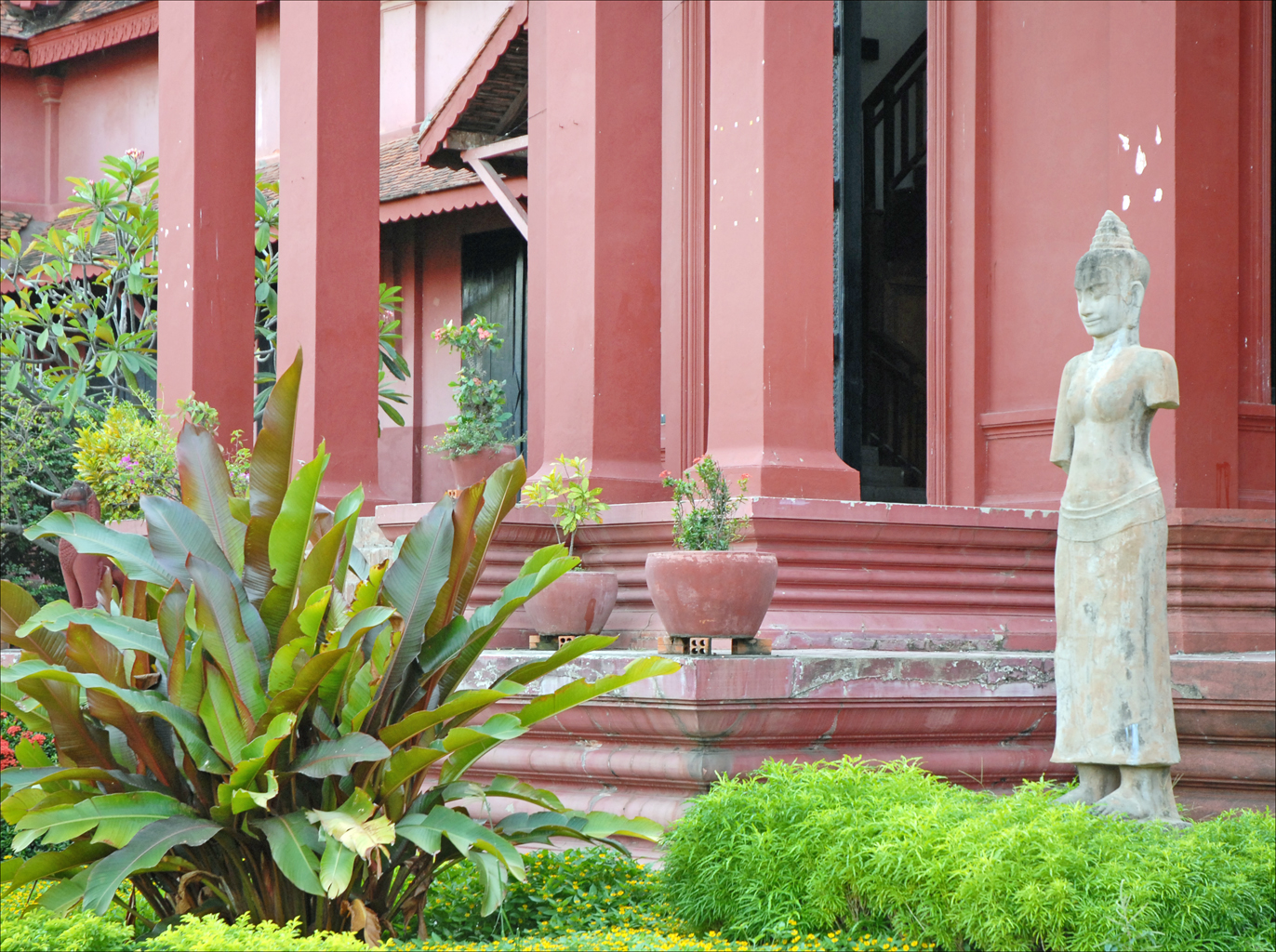
The museum's east facade, designed by George Groslier and completed in 1920, seen from Street 13.
Photograph by Jean-Pierre Dalbera, CC BY 2.0 · Photograph by Jean-Pierre Dalbéra from Paris, FranceNational Museum of Cambodia
Museum · Founded 1920
Open, admission and hours confirmed 3 September 2026 · 19 sources
On this page 14 sections
ContentsClose
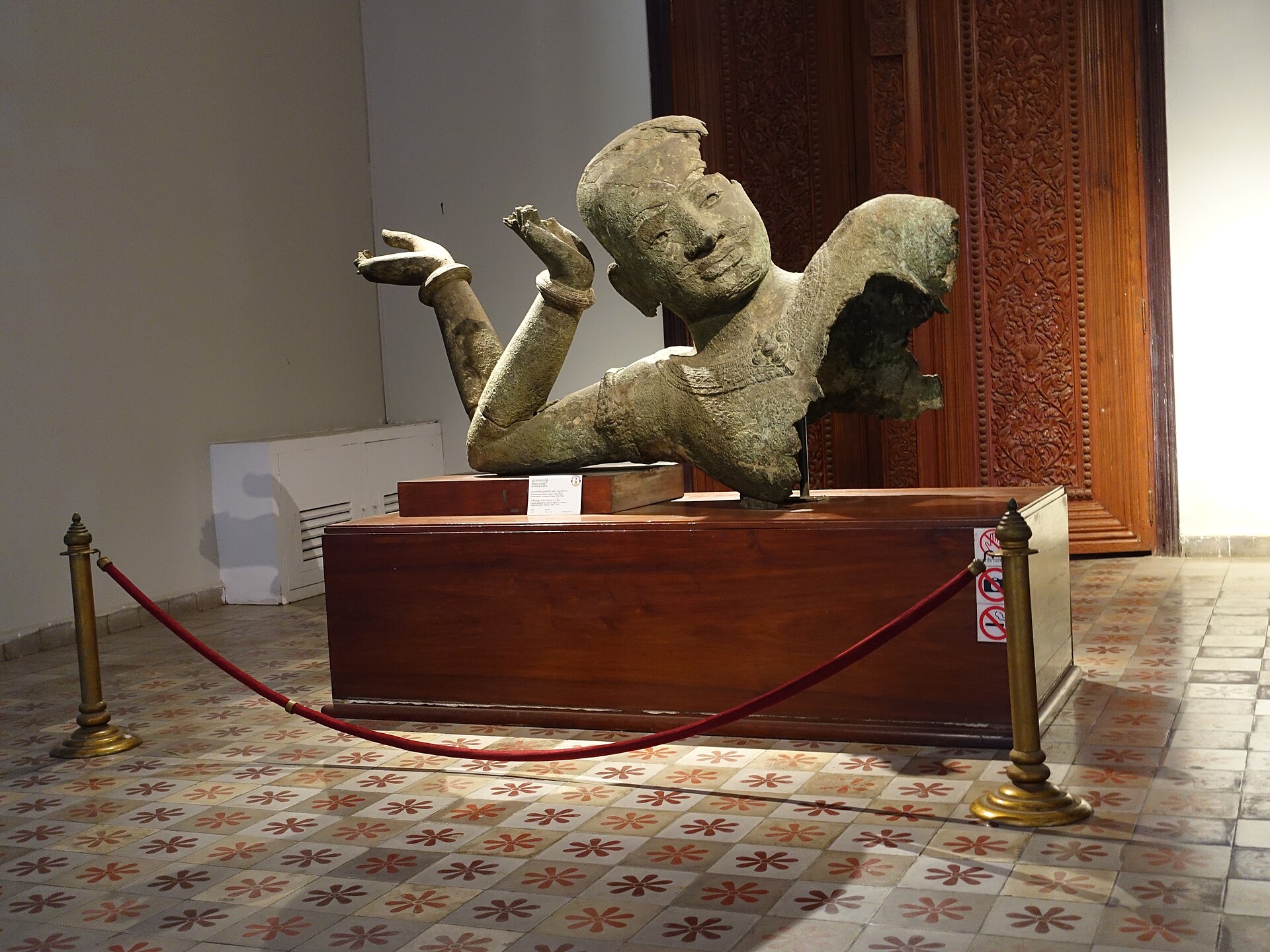
The National Museum of Cambodia holds the largest collection of Khmer cultural material in the world: roughly 14,200 stone, bronze, ceramic and wood objects spanning the prehistoric, pre-Angkorian, Angkorian and post-Angkorian periods, housed in the same purpose-built 1920 building the collection has occupied for over a century. Its strength is depth within a single national tradition rather than breadth across cultures: sandstone and bronze devotional sculpture excavated from named Angkorian sites, including material recovered directly from temple excavations such as the West Mebon reclining Visnu, sits alongside a growing body of objects repatriated from Western museums and from the market built around the dealer Douglas Latchford, making the museum, in effect, both an art-historical archive and an active party to Cambodia's ongoing restitution effort.
| Kind | Museum |
|---|---|
| Founded | 1920 |
| City and country |  Phnom Penh, Cambodia Phnom Penh, Cambodia |
| Address | Street 13, Sangkat Chey Chumneas, Khan Daun Penh, Phnom Penh, Cambodia |
| Website | cambodiamuseum.info |
| Status | Open, confirmed |
| Record last verified |
Visiting
- Hours
- Daily08:00 to 17:00Last admission tickets sold at 16:30
- Admission
- Foreigner, age 10-17USD 5
- Foreigner, age 18 and upUSD 10
- Cambodian citizenKHR 500
- Children and school groupsFreefree
- Do I need to book?
- No advance booking stated; tickets are sold at the booth at the corner of Streets 13 and 178
- Address
- Street 13, Sangkat Chey Chumneas, Khan Daun Penh, Phnom Penh, Cambodia MapWalking Immediately north of the Royal Palace; visitor entrance and ticket booth at the corner of Streets 13 and 178
- Website
- cambodiamuseum.info
- Telephone
- +855 23 211 753
- [email protected]
Before you go how long, access, photography, bags, eating, shop
- How long to allow
- One to two hours, per Tripadvisor's own listing; several visitors report the galleries feel repetitive without a guide
- Access
- Not addressed in any source consulted
- Photography
- Not permitted inside the galleries; visitors may photograph the exterior and courtyard
- Bags
- Cloakroom facilities at the main entrance for large items and bags
- Eating
- Not mentioned in any source consulted
- Shop
- Museum store at the main entrance selling postcards, souvenirs, replica sculptures and books
Prices and hours change. We take them from the institution's own pages and print the day we read them, and you can check the current position at the source we used. Confirm before you travel.
What is inside
Stone sculpture collection
Sandstone and schist sculpture from the pre-Angkorian period (6th-8th centuries), when statues needed carved struts or a horseshoe-shaped support arc to stand, through the Angkorian period (9th-13th centuries), when sculptors abandoned those supports; also temple lintels and bas-reliefs, including devotional images of the Hindu trinity Brahma, Visnu and Siva, and of the Buddha and Bodhisattva Lokesvara.
Bronze and metal collection
Bronze and mixed-metal devotional images cast by the lost-wax process, used in Cambodia since the Neolithic period and reaching its technical peak in the Angkorian Baphuon style; includes multi-armed Hindu and Buddhist divinities too intricate to carve safely in stone, some originally inlaid with precious stones in the eyes.
Ceramics collection
Pottery from Neolithic hand-built wares excavated at Samrong Sen through wheel-thrown, high-fired Angkor-period vessels; architectural fittings such as roof tiles and finials, ritual vases and statues, and household vessels, some shaped as animals such as elephants, birds and frogs.
Wood and ethnographic collection
Wood devotional sculpture and ethnographic objects from the Angkor and post-Angkor periods only; no pre-Angkorian wood object survives in the collection, because wood decays and burns far more readily than stone. Includes Buddhist images made for the wooden monastic buildings that replaced Brahmanic stone temples after Cambodia's turn to Theravada Buddhism at the end of the 12th century.
What to see first
Statue of Jayavarman VII
Unknown Khmer sculptor, Bayon styleSandstone portrait, late 12th-early 13th century, from Krol Romeas near Angkor Thom; one of only three known statues sharing this face (the others are in Bangkok and the Musee Guimet, Paris), and the museum's own text calls its modelling an exceptional mastery of Bayon-style portraiture.6
Devi
Unknown Khmer sculptor, Sambor Prei Kuk styleSandstone goddess figure, first half of the 7th century, from Koh Krieng near Sambor on the Mekong; lacking identifying attributes, so scholars cannot say whether she is the consort of Visnu or of Siva, and the museum's own description calls her an inspired personification of Khmer womanhood.7
Reclining Visnu
Unknown Khmer sculptor, Baphuon styleA monumental bronze, second half of the 11th century, cast for the West Mebon temple platform at Angkor and recovered there in 1936 excavations, brought to the museum in 1950; a rare survival of large-scale Khmer bronze casting, with traces of stone and metal inlay still visible in the eye sockets.9
Lintel from Sralao temple
Unknown Khmer sculptor, Banteay Srei stylePink sandstone temple lintel, third quarter of the 10th century, carved with Visnu riding Garuda flanked by symmetrical naga-headed foliage; the museum's own text calls the carving's rhythm and lyricism typical of Banteay Srei work at its most refined.8
Tep Pranam (worshipper)
Unknown Khmer sculptorA 16th-century wood devotional figure from Angkor Wat, hands joined in the anjali gesture of respect toward the Buddha; a cavity carved into the torso once held sacred deposits such as small Buddha images, relics or palm-leaf texts, and the museum treats it as a masterpiece of post-Angkorian wood sculpture.10
Elephant vessel
Unknown Khmer potterA glazed earthenware lime pot shaped as an elephant's head, feet and tail on a wheel-thrown body, excavated at Sras Srang near Angkor; representative of the Khmer habit of shaping everyday ceramic containers as animals, and evidence for how domestic and temple animals alike were decorated in daily Khmer life.11
The building and what it was built to hold
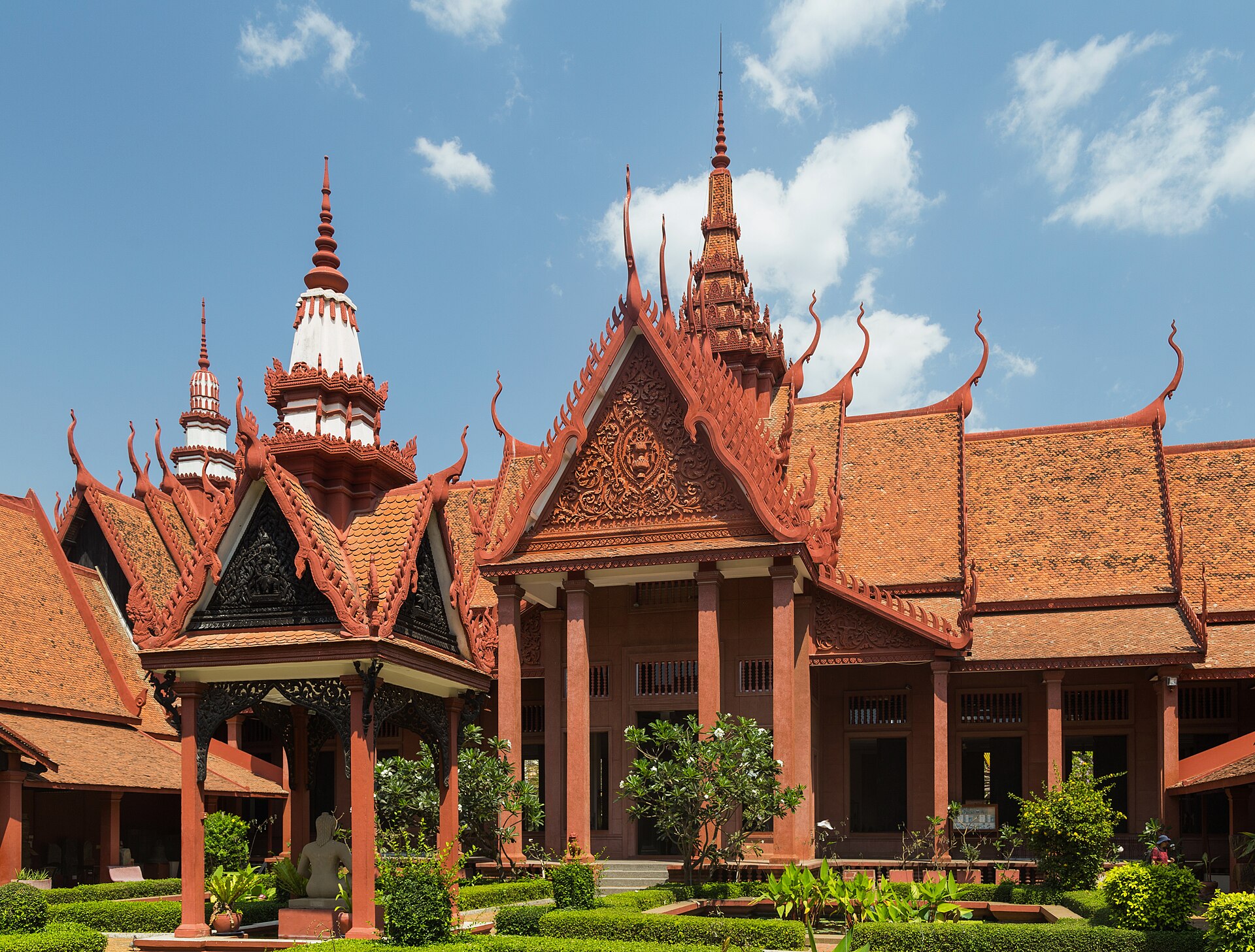
The red-roofed, ochre-walled building on Street 13 in central Phnom Penh, immediately north of the Royal Palace, was designed by George Groslier (1887-1945), a French-born historian, painter and curator who spent much of his career trying to revive Cambodian arts and crafts he believed were dying out under colonial rule. Groslier's design is not a copy of any single Khmer temple but an enlargement of temple forms taken from bas-reliefs, reinterpreted at museum scale. The foundation stone was laid on 15 August 1917, and the building rose alongside the newly founded Ecole des Arts Cambodgiens (1917), the craft school that trained Cambodian artisans in stone carving, wood carving, metalwork and lacquer. The completed museum was inaugurated during Khmer New Year on 13 April 1920, in the presence of King Sisowath, the French Resident-Superieur Francois-Marius Baudoin, and Groslier himself, who served as both director of the Ecole des Arts Cambodgiens and curator of the new museum. At its opening it was named the Musee Albert Sarraut, after the then Governor-General of French Indochina; the building was extended in 1924 with wings added at either end of its eastern facade, and the central section of that facade was renovated in 1968 under the Cambodian architect Vann Molyvann. The east facade measures just over 97 metres, the north-south faces just under 73 metres, and the complex totals around 5,190 square metres of galleries, stores, studios and offices.
From a French museum to Cambodian hands
Authority over the museum and Cambodia's arts administration passed from the French to the Cambodians on 9 August 1951, two years before independence, and the post-independence museum, then called the Musee National de Phnom-Penh, was the subject of a bilateral accord between France and Cambodia signed on 7 November 1956. Madeleine Giteau, as Conservatrice du Musee National, directed the museum through this transition from 1956 to 1966. In 1966 Chea Thay Seng became the first Cambodian director of the National Museum and, at the same time, dean of the newly created Department of Archaeology at the Royal University of Fine Arts, the successor institution to the Ecole des Arts Cambodgiens, which still stands behind the museum.
Evacuation, and a recovery that had to start with a roof
The museum closed in 1975 when the Khmer Rouge emptied Phnom Penh, and it stayed closed through the end of that regime, reopening on 13 April 1979, three months after the city's liberation. The building was found with a rotten roof, its collection in disarray and its garden overgrown; many of the museum's own staff had been killed under Khmer Rouge rule, and the loss of that expertise, layered onto the physical damage, made recovery slow. A colony of bats living in the roof was a later, more prosaic threat, its droppings damaging displayed objects and posing a health risk to staff and visitors before the colony was cleared. The museum's basement, which holds roughly 90 percent of the collection in storage, floods in the wet season; a UNESCO-backed renovation beginning in 1993 raised the storage shelving above ground level, and in 1997 added a pump and an internal catchment pond to manage floodwater, work supplemented since by private donors. Conservation capacity was rebuilt with help from the National Gallery of Australia in the 1990s and, afterward, the French government, which continues to fund a conservation workshop employing a stone and wood conservator who has trained a team of Khmer staff, with the funding also covering salary supplements for the Cambodian conservators involved.
Four collections, one story: stone, bronze, ceramic, wood
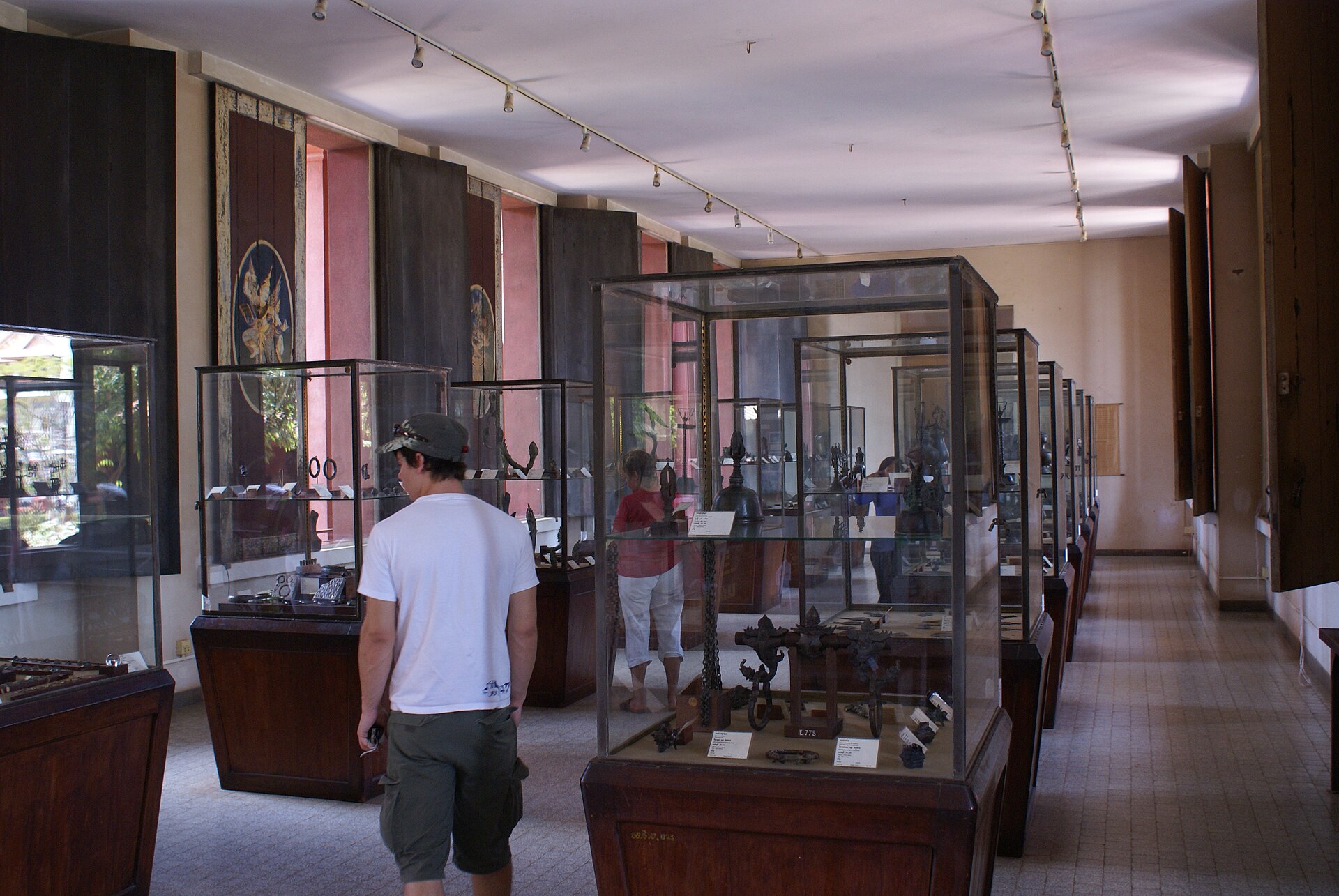
The museum divides its holdings by material rather than by period: stone, bronze and other metal, ceramic, and wood. On the museum's own current figures there are 1,877 works on display in the galleries and a further 12,320 in the basement store, a total of 14,197 pieces, of which only about 15 percent is ever on view at once. The stone collection is the core of what most visitors come to see: sandstone and schist sculpture spanning the pre-Angkorian period (6th-8th centuries), when statues needed carved struts or a horseshoe-shaped support arc to stand upright, through the Angkorian period (9th-13th centuries), when sculptors abandoned those supports altogether, plus temple lintels and bas-reliefs that double as dating evidence for the buildings they came from. Bronze casting, by the lost-wax process used in Cambodia since the Neolithic period and still practised today, reached its technical peak under the Angkorian Baphuon style and produced free-standing, multi-armed divinities that would have been difficult to carve safely in stone. The ceramics collection runs from Neolithic hand-built pottery excavated at Samrong Sen to Angkor-period wares thrown on a wheel and fired at high temperature, made for architectural decoration, ritual use and daily life alike, some shaped as animals. The wood and ethnographic collection is the thinnest of the four by chronology: no pre-Angkorian wood object survives in the collection at all, because wood decays and burns far more readily than stone, so what remains dates to the Angkor and post-Angkor periods, after Cambodia's turn to Theravada Buddhism at the end of the 12th century replaced Brahmanic stone temples with wooden monastic buildings that needed carved wooden images to fill them.
A restitution story still being written
The museum describes safeguarding Cambodian heritage and working toward the repatriation of stolen pieces as core parts of its own mission, and states on its own history page that, supported by UNESCO's International Council of Museums and its 'One Hundred Missing Objects' campaign, eight objects were returned to Cambodia between 1996 and the drafting of that page, from private individuals and from institutions including the Metropolitan Museum of Art in New York and the Honolulu Academy of Arts. That process has accelerated sharply since. The British collector and dealer Douglas Latchford, indicted in New York in 2019 for trafficking looted Khmer antiquities and dead within a year of the charge, had supplied Khmer material to at least ten American museums; when the 2021 Pandora Papers leak exposed the offshore trusts he used to manage that collection, several of those museums moved to return what they held. The Denver Art Museum announced in October 2021 that it would restitute four Cambodian antiquities connected to Latchford, after Cambodian officials said the museum had for years been slow to respond to requests for provenance records. The Metropolitan Museum of Art, which had already returned two looted Koh Ker temple statues in 2013, agreed in December 2023 to return a further sixteen Khmer works tied to Latchford and his network, completing the removal of every Latchford-linked Khmer object the Met had identified in its own collection. Seventy repatriated pieces, drawn from the Met and other collections, were formally welcomed home at a ceremony at the Peace Palace in Phnom Penh on 27 August 2024, after which, according to reporting on the ceremony, the statues were transferred to their permanent home at the National Museum. The Smithsonian's National Museum of Asian Art added three more sculptures in December 2025: a 10th-century sandstone head of Harihara, a 10th-century sandstone Uma, and a bronze Prajnaparamita of around 1200, with the Smithsonian's director stating there was strong evidence all three had left Cambodia amid war and the breakdown of order. None of the sources consulted for this page itemizes which of these recently returned objects are currently on public display in Phnom Penh rather than in storage or under study.
What the museum does beyond the display cases
Beyond exhibiting its own collection, the National Museum operates under Cambodia's Department of Museums with a stated responsibility to support and oversee every other museum in the country. It has an active international loan programme that predates Cambodia's decades of civil conflict and was revived in the 1990s, starting with an exhibition at the National Gallery of Australia in 1992 and followed by loans to museums in France, the United States, Japan, South Korea and Germany, loans which the museum says have in turn brought professional and structural assistance back to Phnom Penh from the French and Australian governments. Its first temporary exhibition since the 1920 opening, 'The Ganesha of the National Museum,' was held in 2000, and a permanent installation on Post-Angkorian Buddhist sculpture opened the same year, reflecting the fact that the museum's collection of Buddhist and Hindu sculpture is not treated purely as art history: it also serves an active religious function for Cambodian visitors. A comprehensive guidebook to the collection was published in Khmer, English and French in 2002.
What visitors say
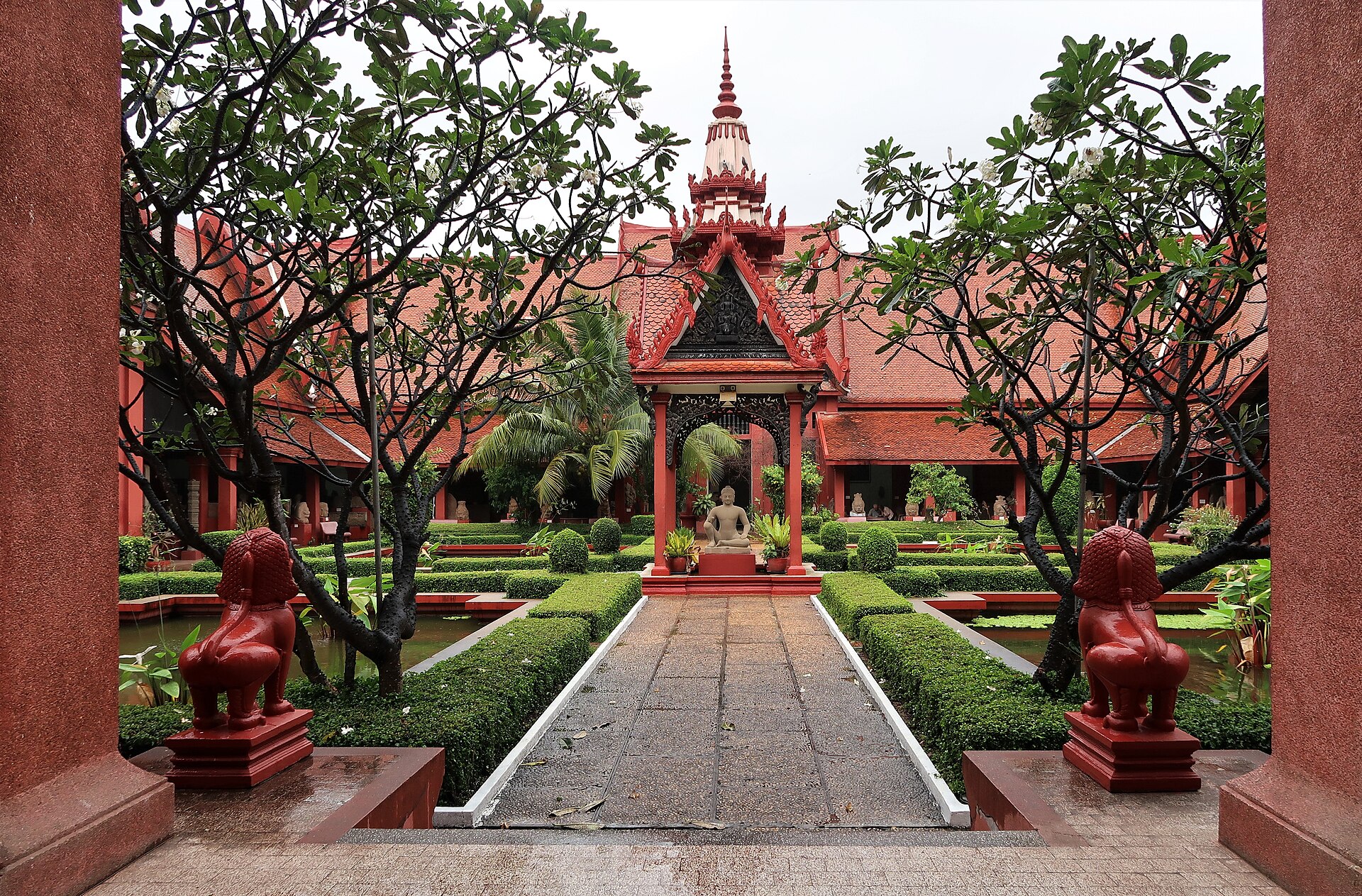
Visitors consistently single out the building and its courtyard garden as one of the most attractive museum settings in Phnom Penh, and rate the depth of the Angkor-period stone sculpture collection highly; the recurring complaint is that the galleries carry little on-object labelling, so a visitor who skips the guide or audio tour is left looking at a long run of similar-looking statues with no context.
What is praised, what is criticised
- Praised: the red terracotta, Khmer-temple-style building and its peaceful, plant-filled courtyard, called one of the calmest spots in central Phnom Penh
- Praised: the depth and quality of the Angkor-period stone and bronze sculpture collection
- Praised: several recently repatriated Khmer statues now on display, singled out by name by more than one recent visitor as a highlight of the visit
- Criticised: little labelling of individual objects for visitors who do not pay for a guide or audio tour, which several reviewers say makes the collection feel repetitive
- Criticised: no air conditioning in the galleries, combined with a strict no-photography rule inside, which some visitors find uncomfortable in Phnom Penh's heat
- Criticised: at least one detailed visitor account alleging inconsistent enforcement of the free-entry rule for Cambodian nationals at the ticket desk
Ratings on other platforms
Tripadvisor: 3.8 from 4,403 ratings, read 3 September 2026
A platform average is a tertiary source: it moves, it is not audited, and we quote no visitor's words.
Questions about National Museum of Cambodia
Where is National Museum of Cambodia?
Street 13, Sangkat Chey Chumneas, Khan Daun Penh, Phnom Penh, Cambodia.
How much does it cost to visit?
Foreigner, age 10-17: USD 5; Foreigner, age 18 and up: USD 10; Cambodian citizen: KHR 500; Children and school groups: free. As confirmed 3 September 2026.
When is it open?
Daily 08:00-17:00. As confirmed 3 September 2026.
How do you get there?
Walking: Immediately north of the Royal Palace; visitor entrance and ticket booth at the corner of Streets 13 and 178.
What should you see first?
Statue of Jayavarman VII (Unknown Khmer sculptor, Bayon style); Devi (Unknown Khmer sculptor, Sambor Prei Kuk style); Reclining Visnu (Unknown Khmer sculptor, Baphuon style); Lintel from Sralao temple (Unknown Khmer sculptor, Banteay Srei style); Tep Pranam (worshipper) (Unknown Khmer sculptor); Elephant vessel (Unknown Khmer potter).
What we could not confirm
- None of the named-journalism sources on the 2021-2025 restitution wave states which returned objects are currently on public display in Phnom Penh versus in storage or under conservation study; only the August 2024 ceremony is reported to have sent its items to 'their permanent home' at the museum.
- The museum-history page on cambodiamuseum.info is copyrighted 2013 and describes the Post-Angkorian Buddha installation that opened in 2000 as still 'presently on show'; whether that installation remains in the same gallery in 2026 was not independently confirmed.
Images
Sources
- 1Wikidata, Q1929750, National Museum of Cambodia wikidata.org/wiki/Q1929750
- 2National Museum of Cambodia, 'Information for Visitors' cambodiamuseum.info/en_information_visitors.html
- 3National Museum of Cambodia, 'Museum History' cambodiamuseum.info/museum_history.html
- 4National Museum of Cambodia, 'Contact Us' cambodiamuseum.info/en_information_visitors/contact.html
- 5National Museum of Cambodia, 'Collection: Stone Objects' cambodiamuseum.info/en_collection/stone_object.html
- 6National Museum of Cambodia, 'Jayavaraman VII' cambodiamuseum.info/en_collection/stone_object/jayavaraman.html
- 7National Museum of Cambodia, 'Devi' cambodiamuseum.info/en_collection/stone_object/devi.html
- 8National Museum of Cambodia, 'Lintel' cambodiamuseum.info/en_collection/stone_object/lintel.html
- 9National Museum of Cambodia, 'Reclining Visnu' cambodiamuseum.info/en_collection/bronze_object/reclining_visnu.html
- 10National Museum of Cambodia, 'Tep Pranam (Worshipper)' cambodiamuseum.info/en_collection/wooden_object/tep_pranam.html
- 11National Museum of Cambodia, 'Elephant Vessel' cambodiamuseum.info/en_collection/ceramics/elephant.html
- 12National Museum of Cambodia (nmc.gov.kh), 'Museum Admission' nmc.gov.kh/index.php/pages/museum-admission
- 13National Museum of Cambodia (nmc.gov.kh), homepage nmc.gov.kh/
- 14Sarah Cascone, 'The Denver Art Museum Is Returning Four Antiquities to Cambodia After the Pandora Papers Exposed Their Illicit Origins', Artnet News, 18 October 2021 news.artnet.com/art-world/denver-art-museum-pandora-papers-restitution-2021888
- 15'Met to return 16 Khmer relics linked to notorious artifact dealer', ICIJ, 15 December 2023 icij.org/investigations/hidden-treasures/met-to-return-16-khmer-relics-linked-to-notorious-artifact-dealer/
- 16'Cambodia celebrates return of dozens of Khmer treasures from the Met and other collections', ICIJ, 27 August 2024 ceremony report icij.org/investigations/hidden-treasures/cambodia-celebrates-return-of-dozens-of-khmer-treasures-from-the-met-and-other-collections/
- 17'Smithsonian's National Museum of Asian Art returns three sculptures to Cambodia', The Art Newspaper, 23 December 2025 theartnewspaper.com/2025/12/23/smithsonians-national-museum-of-asian-art-returns-three-sculptures-to-cambodia
- 18Tripadvisor, 'National Museum, Phnom Penh' (reviews and rating), read 3 September 2026 tripadvisor.com/Attraction_Review-g293940-d324624-Reviews-National_Museum-Phnom_Penh.html
- 19Wikimedia Commons, Category:National Museum of Cambodia commons.wikimedia.org/wiki/Category:National_Museum_of_Cambodia