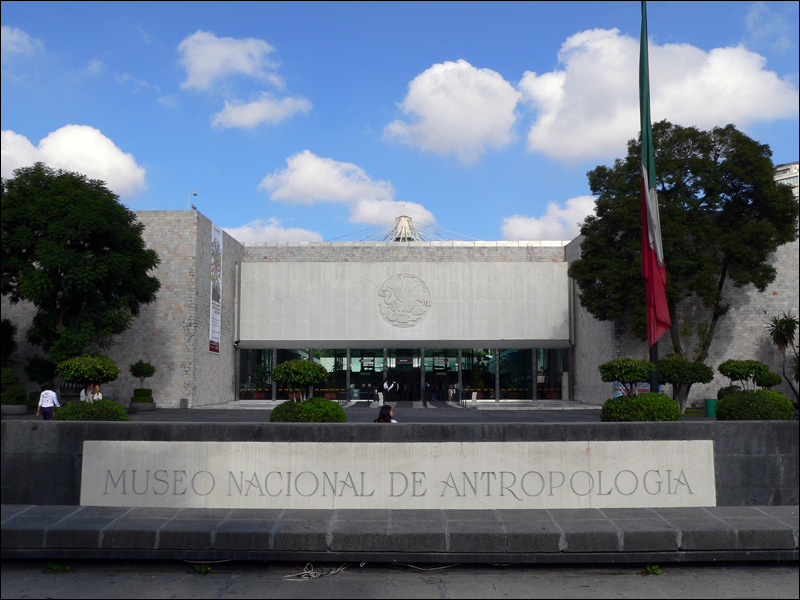
The entrance facade of the National Museum of Anthropology in Chapultepec Park, Mexico City, designed by Pedro Ramirez Vazquez and opened in 1964.
Photograph by kornemuz, CC BY-SA 3.0, via Wikimedia CommonsNational Museum of Anthropology
Museum · Museo Nacional de Antropologia · Founded 1964
Open, admission and hours confirmed 10 August 2026 · 22 sources
On this page 15 sections
ContentsClose
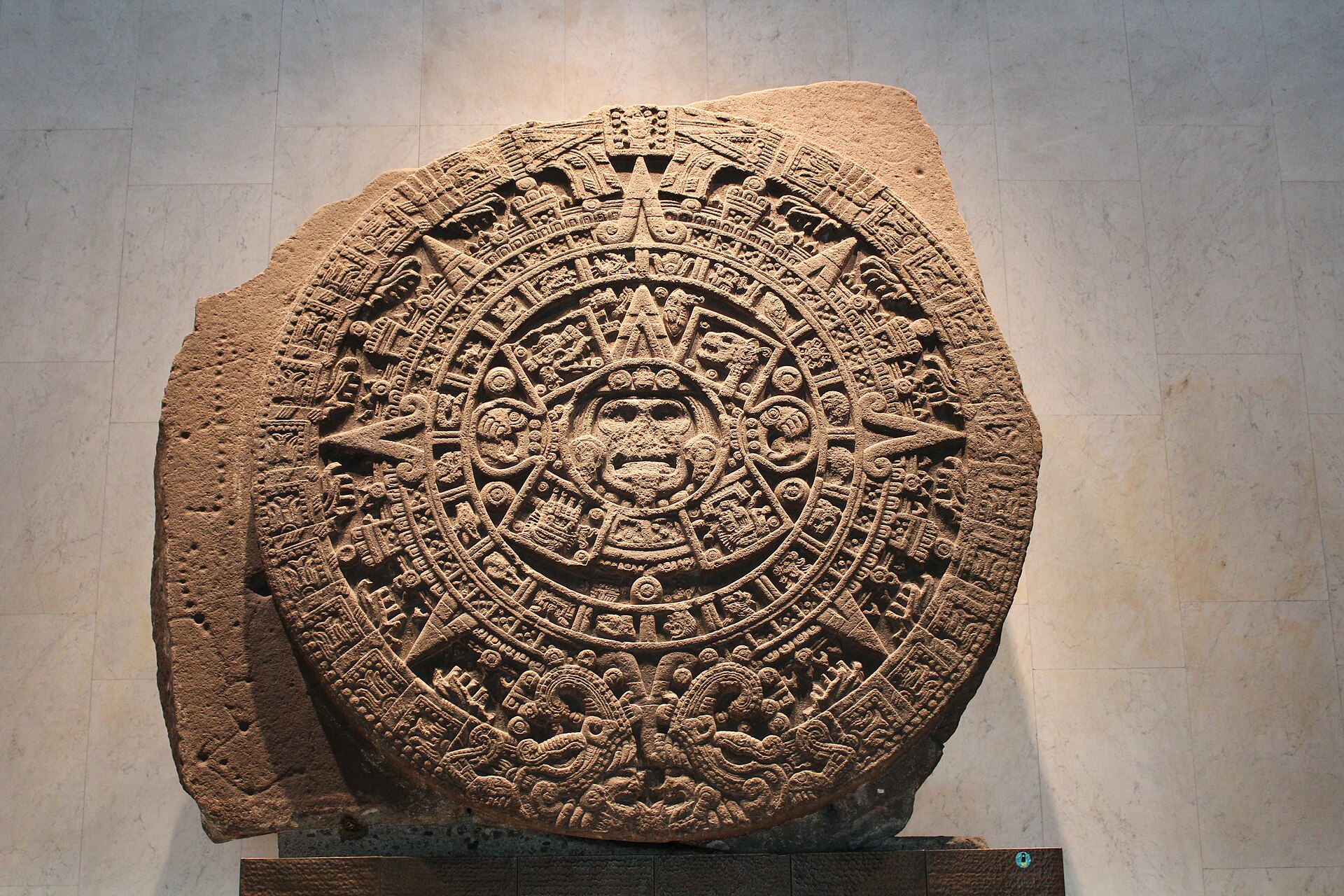
The museum's strength is breadth across the whole of pre-Columbian Mexico rather than depth in any one culture alone: it is the single place that holds the Aztec Sun Stone, Coatlicue and the Stone of Tizoc together, a reconstruction of Pakal's Maya burial crypt, a share of the Mixtec gold from Monte Alban's Tomb 7, and Olmec colossal heads, inside one building. Few institutions anywhere hold comparably deep representative series across that many distinct Mesoamerican cultures under a single roof, which is also why the losses and gaps in its own history - the 1790 reburial of Coatlicue, the four 1985 heist pieces never recovered - read as losses to the record of the region as a whole, not only to this collection.
| Local name | Museo Nacional de Antropologia |
|---|---|
| Kind | Museum |
| Founded | 1964 |
| City and country |  Mexico City, Mexico Mexico City, Mexico |
| Address | Av. Paseo de la Reforma y Calzada Gandhi s/n, Col. Chapultepec Polanco, Alcaldia Miguel Hidalgo, 11560 Ciudad de Mexico, Mexico |
| Website | mna.inah.gob.mx |
| Status | Open, confirmed |
| Record last verified |
Visiting
- Hours
- Tue-Sun09:00 to 18:00Ticket sales and last entry follow the same window on the museum's own information page
- Closed
- Monday.
- Admission
- GeneralMXN 210Standard adult admission
- Mexican nationals and foreign residents (with valid residency document)MXN 105
- Children under 13, seniors 60+ with INAPAM card, people with disabilities, students and teachers with valid current ID, and foreign exchange students enrolled at a Mexican institutionFreeFree Tuesday to Saturday on presentation of the qualifying ID. On Sunday, free entry instead applies to Mexican nationals (with valid ID) and foreign residents holding a temporary or permanent residency card, per the museum's own visitor page.
Free entry: Sundays, free for Mexican nationals and for foreign residents holding a valid FM residency document- Tickets
- mna.inah.gob.mx/informacion_general.php The museum's own ticket page.
- Do I need to book?
- No advance booking required for general admission. Free guided tours run Tuesday to Saturday without reservation, each covering two permanent halls or the current temporary exhibition
- Address
- Av. Paseo de la Reforma y Calzada Gandhi s/n, Col. Chapultepec Polanco, Alcaldia Miguel Hidalgo, 11560 Ciudad de Mexico, Mexico MapMetro Auditorio (Line 7) or Chapultepec (Line 1), both about 1.3 km from the museum entrance, a walk through Chapultepec Park
Car On-site parking, 24 hours a day, $50 MXN per hour for cars and motorcycles - Website
- mna.inah.gob.mx
- Telephone
- +52 55 5553 6332 ext. 412309 (information) / 412322 (tickets)
- [email protected]
Before you go how long, access, photography, bags, eating, shop
- How long to allow
- The museum's own guided tours run about two and a half hours and cover only part of the collection; independent tour operators sell half-day and full-day private visits (2 to 10 hours) to get through more of the 23 halls, which sit on a 70,000 square metre building with a further 15,000 square metres of underground workshop and study space
- Access
- Wheelchairs are lent at no cost, and elevators and stairlifts are available for visitors who cannot use the stairs; request either from security staff at the entrance
- Photography
- Personal, non-commercial photography is allowed. Flash, tripods and continuous lighting are not permitted. A same-day video permit costs $63 MXN; professional or commercial filming requires separate written approval
- Bags
- Only small bags are allowed inside; larger bags must be checked
- Eating
- A gastronomic hall serving regional Mexican cuisine, open Tuesday to Sunday 9:00 to 18:00
- Shop
- Museum shop selling reproductions and publications, open Tuesday to Sunday 10:00 to 18:00
Prices and hours change. We take them from the institution's own pages and print the day we read them, and you can check the current position at the source we used. Confirm before you travel.
What is inside
Sala Mexica (Mexica Hall)
The ground-floor hall built around the Aztec Sun Stone, with the Coatlicue statue and the Stone of Tizoc standing nearby; the three most reproduced monuments of the Aztec state, all excavated within yards of each other under Mexico City's main plaza in 1790-91
CC0 Sala Maya (Maya Hall)
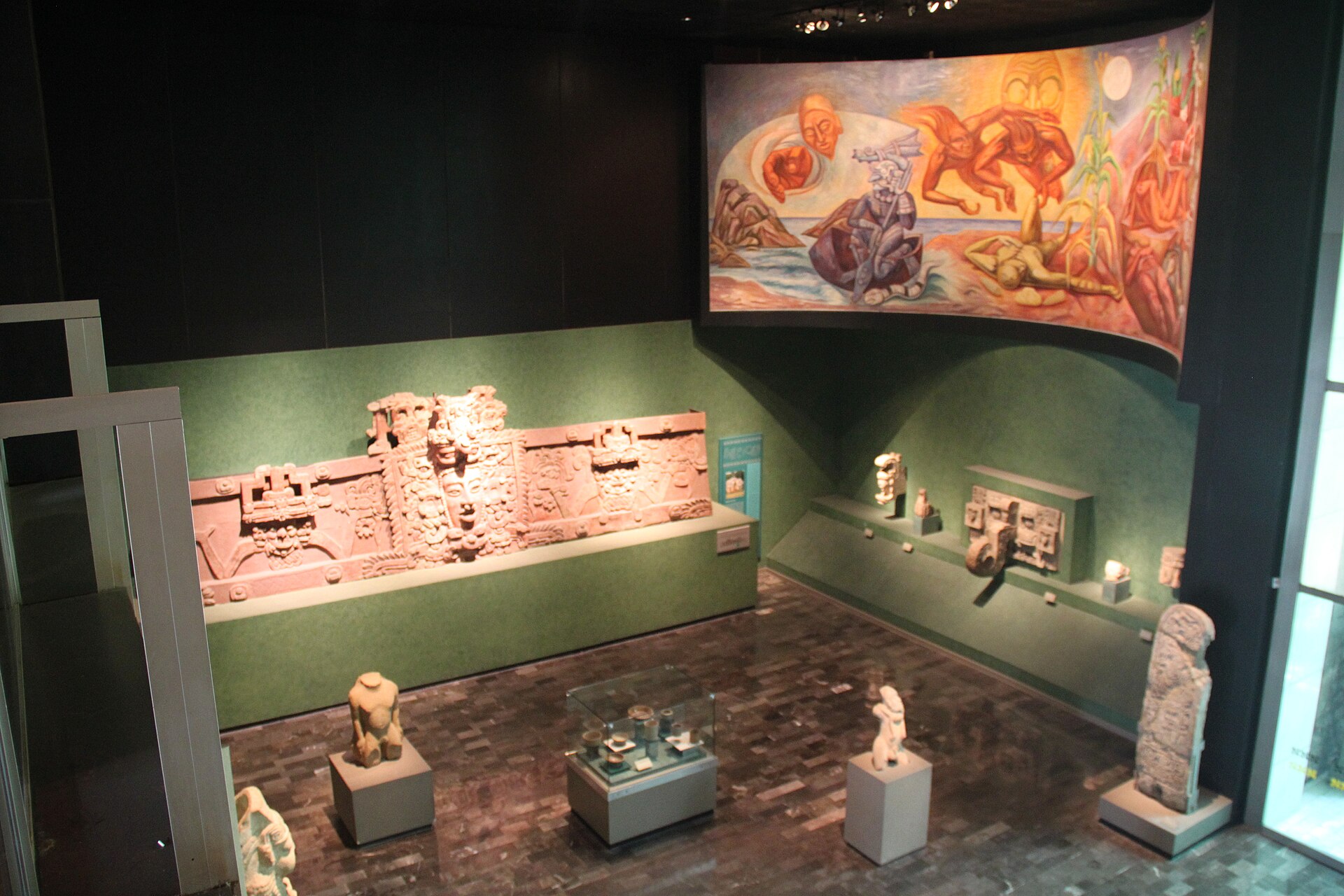
The jade mosaic funerary mask of K'inich Janaab' Pakal, and a full-scale walk-in reconstruction of the burial crypt found beneath the Temple of the Inscriptions at Palenque in 1952; also the full-scale facsimile of the Bonampak murals painted by Rina Lazo
Sala Teotihuacan (Teotihuacan Hall)
Material from Teotihuacan, including a reproduction of part of the Temple of the Feathered Serpent and mural fragments, set out around a partial reconstruction of the Pyramid of the Sun's scale
Sala Culturas de Oaxaca (Oaxaca Hall)
A selection of the roughly 500 objects, more than 120 of them gold, that Alfonso Caso excavated from Tomb 7 at Monte Alban in 1932, one of the richest burial finds ever recorded in the Americas; the bulk of the Tomb 7 material is held at the site's own regional museum in Oaxaca, with a smaller group of masterpieces kept permanently on display here
Sala Poblamiento de America (Peopling of the Americas Hall)
The introductory hall on how and when the Americas were first settled, laying out the museum's overall chronology before the culture-by-culture halls that follow it
Upper-floor ethnography halls
A set of galleries, reorganised in January 2025, on Mexico's living indigenous peoples: languages, textiles, food production, ritual and regional identity, distinct from the ground-floor archaeology halls beneath them
What to see first
Piedra del Sol (Aztec Sun Stone)
Mexica sculptors, reign of Moctezuma IIA basalt disc 3.6 metres across, 98 centimetres thick and weighing about 24.6 tonnes, carved with the sun god at its centre, the four preceding cosmic eras, and a ring of day-signs; found on 17 December 1790 under Mexico City's main plaza and the single object most identified with the museum7
Coatlicue
Mexica sculptor, unrecordedA 2.52 metre andesite statue found less than 100 feet from the Sun Stone on 13 August 1790; colonial clergy had it reburied within months because it was drawing worship, and it was not put on permanent public display again until the twentieth century8
Stone of Tizoc
Mexica sculptors, reign of Tizoc (1481-1486)A basalt cylinder 2.67 metres in diameter carved with 15 scenes of a warrior seizing a captive by the hair, found in December 1790 near the Sun Stone; probably a cuauhxicalli or temalacatl used in sacrificial ceremony6
Jade mosaic funerary mask of Pakal, with the reconstructed burial crypt
Maya artisans, Palenque, 7th century ADAssembled from more than 340 pieces of jade with shell-and-obsidian eyes, recovered by Alberto Ruz Lhuillier in 1952 from the sarcophagus inside the Temple of the Inscriptions; the museum's walk-in reconstruction of that crypt is one of the few ways to see the burial chamber's scale, since the actual tomb at Palenque is closed to visitors9
Gold treasure of Monte Alban Tomb 7
Mixtec goldsmiths, circa 1330 ADPart of roughly 500 objects Alfonso Caso pulled from a reused Zapotec tomb in 1932, including more than 120 gold ornaments; evidence, on this scale, of Mixtec goldworking skill that has never been matched by a comparable Mesoamerican find6
Olmec colossal heads
Olmec sculptors, San Lorenzo, before 900 BCColossal basalt heads among the seventeen known, each carved from a single boulder transported many kilometres from its source; among the oldest portrait sculpture in the Americas6
Facsimile of the Bonampak murals
Rina Lazo (facsimile painter, apprentice to Diego Rivera), after the original 8th-century Maya court paintersA full-scale, full-colour reproduction of all three painted chambers at the Bonampak site in Chiapas, showing court ceremony, music and battle; the murals are rated among the best-preserved painted records of Classic Maya court life and the originals are not open to this kind of close viewing on site6
Past exhibitions here
- Closed27 May to 30 Aug 2026Confirmed · check before you travel
The building and what it was built to hold
The National Museum of Anthropology occupies a purpose-built rectangular block in Chapultepec Park, designed by the architect Pedro Ramirez Vazquez with Rafael Mijares Alcerreca and Jorge Campuzano, and raised in nineteen months between February 1963 and September 1964. President Adolfo Lopez Mateos opened it on 17 September 1964. The finished building covers about 70,000 square metres above ground, with a further 15,000 square metres of workshop, laboratory and study space beneath it - the museum was designed from the outset to be a research institute as much as a public hall.
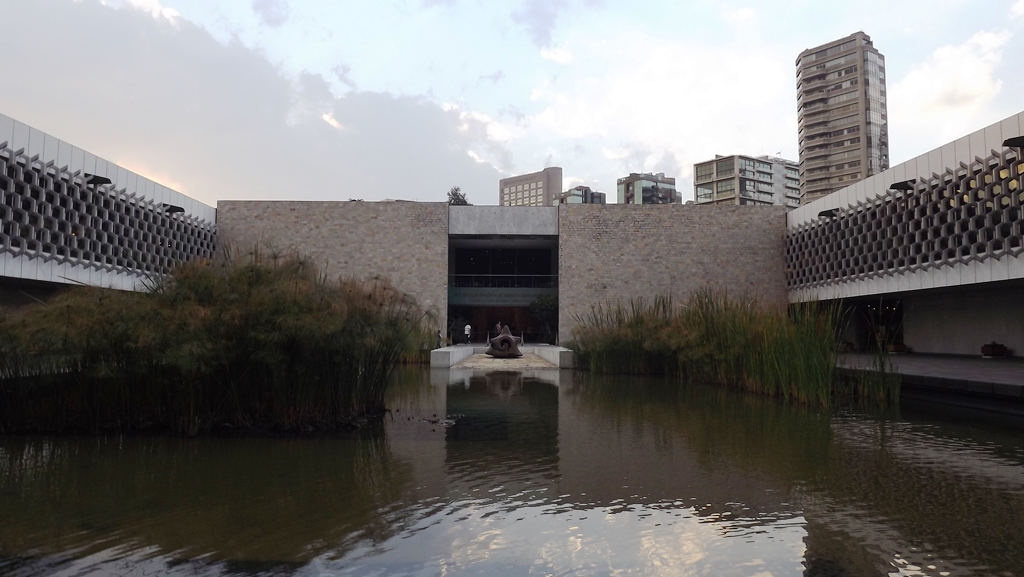
Its best-known feature is the courtyard at the centre of the plan, known as El Paraguas, the Umbrella: a cantilevered concrete roof of 4,467.5 square metres, among the largest suspended structures of its kind anywhere, held up by a single carved column clad in a bronze relief by the Chavez Morado brothers. The column was designed to double as a fountain, so that rainwater falls from its rim as a deliberate cascade rather than pooling on the roof above. The architects took the courtyard-ringed-by-galleries layout from Maya civic architecture, and paired lava stone facing with marble, aluminium and glass - a stated attempt, in the architects' own phrase, at arquitectura de servicio, service architecture, that put the visitor's route and the objects on display ahead of the building's own presence.
How the collection was assembled
The institution's lineage runs back further than its 1964 building. It starts with the Gabinete de Historia Natural de Mexico, a cabinet of curiosities founded by the botanist Jose Longinos Martinez in 1790 - the same year the Sun Stone and Coatlicue came out of the ground nearby. In 1825 President Guadalupe Victoria made that collection the basis of an autonomous National Mexican Museum; Emperor Maximilian relocated it again in 1865. The natural-history and human-history material were split apart in 1906, and the human-history side split again in 1940 into what would become, on the Chapultepec site in 1964, a museum dedicated specifically to archaeology, anthropology and ethnography. The 600,000-plus objects now catalogued to the museum are the accumulation of two centuries of that sequence of mergers, splits and site moves, not a single founding gift.
What is on the ground floor
The archaeology collection runs across ten halls on the ground floor, arranged roughly in the order the museum wants a visitor to walk them: Poblamiento de America (the peopling of the Americas), Preclasico en el Altiplano Central, Teotihuacan, Los Toltecas y el Epiclasico, Mexica, Culturas de Oaxaca, Culturas de la Costa del Golfo, Maya, Culturas de Occidente and Culturas del Norte. The Mexica hall carries the greatest concentration of famous single objects - the Sun Stone, Coatlicue and the Stone of Tizoc were all excavated within roughly a hundred feet of each other under Mexico City's main plaza in 1790 and 1791, and the museum keeps that proximity in the display. The Maya hall goes the furthest into reconstruction rather than object display alone: a walk-in replica of the burial crypt Alberto Ruz Lhuillier opened beneath Palenque's Temple of the Inscriptions in 1952, and a full-scale facsimile, painted by Rina Lazo, of the murals at Bonampak - the closest most visitors will get to either site, since the real crypt at Palenque is closed to the public and the real murals are on a remote site in Chiapas.
The upper floor and what has changed there recently
The upper floor pairs each archaeology hall below it with an ethnography gallery on the living communities descended from, or related to, that same cultural area - textiles, language, food production, ritual and regional identity among Mexico's contemporary indigenous peoples. INAH reopened a reworked set of these galleries in January 2025; The Art Newspaper, extrapolating from a public-records request covering two of the sections, estimated the spending may have stretched to as much as 70 million pesos, though INAH itself has not published a total figure. The reopening drew a pointed comment piece in The Art Newspaper on 1 April 2025, which argued the relaunch had been timed for political effect under President Claudia Sheinbaum and found the new rooms still without basic labels months on, including newly commissioned work by indigenous and Afro-Mexican artisans left unattributed, and facsimiles shown beside originals with no signage distinguishing the two. Whether the upper floor has since been brought up to the standard of the archaeology halls below it is not established in any source consulted for this page.
The 1985 theft
In the early hours of 25 December 1985, two veterinary students, Carlos Perches Trevino and Ramon Sardina Garcia, climbed the museum's perimeter wall on Paseo de la Reforma and got in through an air-conditioning duct. They had visited the museum at least fifty times over roughly six months to plan the route. Working through the night - reports of the exact duration range from about thirty minutes to three hours - they opened seven display cases across three halls and took 124 to 140 pre-Columbian objects, among them the mask of Pakal, the mask of the Zapotec Bat God, an obsidian monkey-shaped vessel and a gold-and-turquoise disc from Monte Alban's Tomb 7. The nine guards on duty had left their posts to celebrate Christmas; the theft was not discovered until the shift change at 8am. It went unsolved for three and a half years, until a wiretap on an unrelated narcotics investigation picked up Perches discussing the pieces; 111 of them were recovered in June 1989 from his parents' home, where they had been kept wrapped in toilet paper inside a duffel bag. Two objects had reportedly been traded for cocaine, and four were never recovered. Sardina Garcia was never found. Perches served over a decade in prison and was killed after his release. The Mexican government answered the case with 700 million pesos in new museum security the following year, and the theft is still referred to in Mexico as the robbery of the century.
Recognition, and a more recent lapse in security
On 4 June 2025 the Princess of Asturias Foundation gave the museum its Award for Concord, an honour that in most years goes to a person rather than an institution, citing its long record of defending and preserving anthropological heritage and its role in shaping Mexican national identity; the prize carries 50,000 euros and a sculpture by Joan Miro. The award landed in the same week the museum had to close abruptly, on 3 June 2025, after the private security firm contracted to guard it - Sistemas Practicos en Seguridad Privada SA de CV - failed to supply the agreed number of guards. The federal government reinstated police coverage and the museum reopened two days later, on 5 June. Attendance has kept climbing regardless: Mexico News Daily reported 5.04 million visitors in 2025, a new record and up from 3.78 million the year before, making it Mexico's most-visited museum by a wide margin.
What visitors say
The 4.8 Tripadvisor aggregate and the museum's own standing as Mexico's most-visited cultural institution point the same direction as its reputation among encyclopaedic archaeology museums; the building itself, not only the collection, is part of the draw. Scale is the recurring theme on both sides: praised as depth, flagged as more than a single visit can absorb.
What is praised, what is criticised
- Praised: The depth and quality of the pre-Columbian collection, led by the Sun Stone, Coatlicue and the Maya and Mexica halls
- Praised: The building itself, above all the central Paraguas courtyard with its cantilevered concrete umbrella and cascading water column - the museum's own presentation frames it as a destination in its own right, and independent coverage treats it the same way
- Criticised: The ethnographic galleries reinstalled in January 2025 were, months later, still short of basic didactic labels and carried section headings only in Spanish, a barrier named directly by The Art Newspaper (1 April 2025)
- Criticised: The museum's scale means the ground-floor archaeology halls alone take the better part of a day and the upper-floor ethnography galleries commonly need a separate visit; a single afternoon does not cover it
Ratings on other platforms
Tripadvisor: 4.8 from 20,433 ratings, read 10 August 2026
A platform average is a tertiary source: it moves, it is not audited, and we quote no visitor's words.
Questions about National Museum of Anthropology
Where is National Museum of Anthropology?
Av. Paseo de la Reforma y Calzada Gandhi s/n, Col. Chapultepec Polanco, Alcaldia Miguel Hidalgo, 11560 Ciudad de Mexico, Mexico.
How much does it cost to visit?
General: MXN 210; Mexican nationals and foreign residents (with valid residency document): MXN 105; Children under 13, seniors 60+ with INAPAM card, people with disabilities, students and teachers with valid current ID, and foreign exchange students enrolled at a Mexican institution: free. As confirmed 5 September 2026.
When is it open?
Tue-Sun 09:00-18:00. Closed: Monday. As confirmed 5 September 2026.
How do you get there?
Metro: Auditorio (Line 7) or Chapultepec (Line 1), both about 1.3 km from the museum entrance, a walk through Chapultepec Park; Car: On-site parking, 24 hours a day, $50 MXN per hour for cars and motorcycles.
What should you see first?
Piedra del Sol (Aztec Sun Stone) (Mexica sculptors, reign of Moctezuma II); Coatlicue (Mexica sculptor, unrecorded); Stone of Tizoc (Mexica sculptors, reign of Tizoc (1481-1486)); Jade mosaic funerary mask of Pakal, with the reconstructed burial crypt (Maya artisans, Palenque, 7th century AD); Gold treasure of Monte Alban Tomb 7 (Mixtec goldsmiths, circa 1330 AD); Olmec colossal heads (Olmec sculptors, San Lorenzo, before 900 BC).
What we could not confirm
- Two of the 124-140 objects taken in the 1985 theft were reportedly traded for cocaine and four were never located; whether any of the four still exist, and where, is unknown
- Scholars remain divided on what the Sun Stone was actually used for in Mexica ritual life - a calendar, a sacrificial altar (a cuauhxicalli or temalacatl), or a political monument asserting Tenochtitlan's cosmic centrality - and the museum's own labelling does not resolve the debate
- Whether the Coatlicue statue depicts the goddess Coatlicue herself or a Tzitzimitl star-demon is disputed among specialists
- Whether the upper-floor ethnography galleries, criticised in April 2025 for missing labels and Spanish-only signage months after reopening, have since been brought up to a finished standard is not established in any source consulted for this page
Images
Sources
- 1Wikidata, Q524249, National Museum of Anthropology. wikidata.org/wiki/Q524249
- 2Museo Nacional de Antropologia, Informacion General (hours, admission, contact, accessibility, photography and bag policy, cafe and shop hours). Read 2026-08-10. mna.inah.gob.mx/informacion_general.php
- 3Museo Nacional de Antropologia, 'Arquitectura y construccion' (architects, construction dates, building materials and dimensions, the Paraguas courtyard). mna.inah.gob.mx/historia_detalle.php?id=2
- 4Museo Nacional de Antropologia, homepage (list of the ten ground-floor archaeology halls). mna.inah.gob.mx/
- 5Chapultepec.com.mx, official Bosque de Chapultepec visitor site, museum listing (metro stations, parking, guided tour schedule). chapultepec.com.mx/visita/7
- 6Wikipedia, 'National Museum of Anthropology (Mexico)'. en.wikipedia.org/wiki/National_Museum_of_Anthropology_(Mexico)
- 7Wikipedia, 'Aztec sun stone'. en.wikipedia.org/wiki/Aztec_sun_stone
- 8Wikipedia, 'Coatlicue statue'. en.wikipedia.org/wiki/Coatlicue_statue
- 9Wikipedia, 'Jade mask of Pakal'. en.wikipedia.org/wiki/Jade_mask_of_Pakal
- 10Wikipedia, '1985 National Museum of Anthropology theft'. en.wikipedia.org/wiki/1985_National_Museum_of_Anthropology_theft
- 11Lydia Leija, 'The heist of the century: the night Mexico's National Anthropology Museum was stripped of its treasures', Mexico News Daily, 25 December 2025. mexiconewsdaily.com/mexico-city-plus/the-heist-of-the-century-the-night-mexicos-national-anthropology-museum-was-stripped-of-its-treasures/
- 12'Mexico City's world-renowned National Museum of Anthropology just had its best year yet', Mexico News Daily, 12 January 2026 (5.04 million visitors in 2025, a record, up from 3.78 million in 2024). mexiconewsdaily.com/culture/national-museum-of-anthropology-best-year/
- 13Maria del Carmen Barrios Giordano and Edgar Alejandro Hernandez, 'Hastily reinstalled ethnographic galleries have turned Mexico's National Museum of Anthropology into political theatre', The Art Newspaper, 1 April 2025. theartnewspaper.com/2025/04/01/museo-nacional-antropologia-mexico-city-ethnographic-galleries-claudia-sheinbaum-renovation
- 14'Mexico's most popular museum reopens after lack of security guards caused it to shutter', The Art Newspaper, 6 June 2025 (the 3-5 June 2025 closure). theartnewspaper.com/2025/06/06/national-museum-anthropology-mexico-city-reopens-security-shutdown
- 15'Mexico's National Museum of Anthropology wins prestigious Princess of Asturias Award', The Yucatan Times, 5 June 2025 (award date 4 June 2025, prize amount, jury's stated reasoning). theyucatantimes.com/2025/06/mexicos-national-museum-of-anthropology-wins-prestigious-princess-of-asturias-award/
- 16Tripadvisor, Museo Nacional de Antropologia listing, aggregate rating and review count. Read 2026-08-10. tripadvisor.com/Attraction_Review-g150800-d153711-Reviews-Museo_Nacional_de_Antropologia-Mexico_City_Central_Mexico_and_Gulf_Coast.html
- 17Wikimedia Commons, File:Musee_National_Anthropologie-Entree.jpg, licence and author verified via the Commons API (.LicenseShortName, .Artist). commons.wikimedia.org/wiki/File:Musee_National_Anthropologie-Entree.jpg
- 18Wikimedia Commons, File:Detalle del patio central del Museo Nacional de Antropologia (Mexico).jpg, licence and author verified via the Commons API. commons.wikimedia.org/wiki/File:Detalle_del_patio_central_del_Museo_Nacional_de_Antropolog%C3%ADa_(M%C3%A9xico).jpg
- 19Wikimedia Commons, File:Mexico City, Museo Nacional de Antropologia, Stone of the Sun (20693400581).jpg, licence and author verified via the Commons API. commons.wikimedia.org/wiki/File:Mexico_City,_Museo_Nacional_de_Antropologia,_Stone_of_the_Sun_(20693400581).jpg
- 20Wikimedia Commons, File:Main entrance from inside, National Anthropology Museum.jpg, licence and author verified via the Commons API. commons.wikimedia.org/wiki/File:Main_entrance_from_inside,_National_Anthropology_Museum.jpg
- 21Wikimedia Commons, File:Great Pyramids room - Teotihuacan - National Museum of Anthropology - Mexico 2024.jpg, licence and author verified via the Commons API. commons.wikimedia.org/wiki/File:Great_Pyramids_room_-_Teotihuac%C3%A1n_-_National_Museum_of_Anthropology_-_Mexico_2024.jpg
- 22Wikimedia Commons, File:Maya Terminal Classic Exhibit (9764604376).jpg, licence and author verified via the Commons API. commons.wikimedia.org/wiki/File:Maya_Terminal_Classic_Exhibit_(9764604376).jpg

.jpg)
.jpg)


.jpg)