The Corning Ewer
Unknown Islamic glass workshop · c. 9th - 11th century AD, most often placed around AD 1000 / the early 10th century
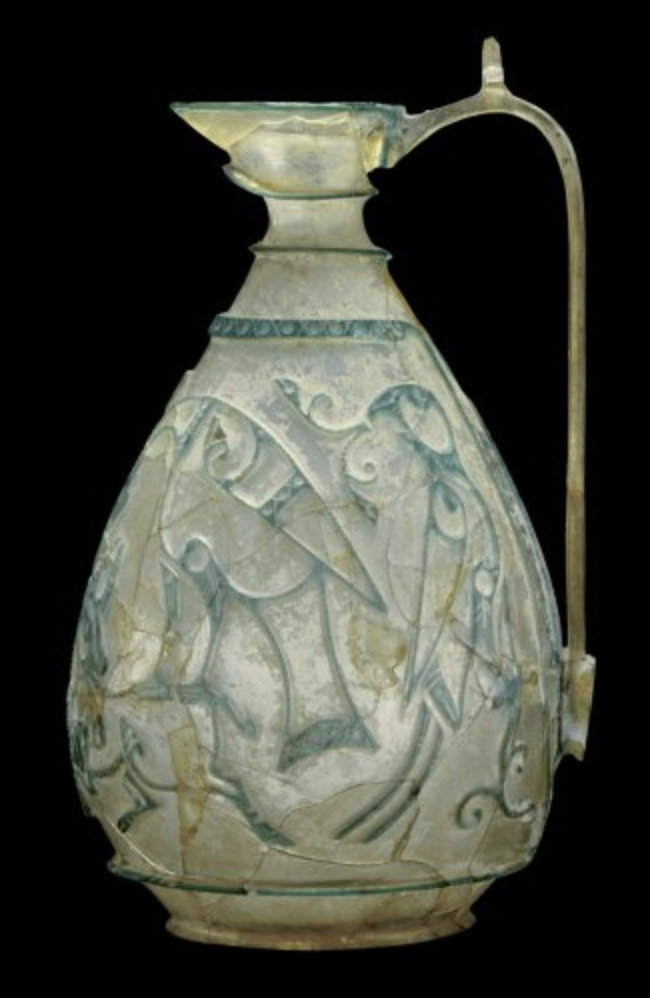
The record subject. Cameo-cut glass, colorless body cased in transparent light-green glass, c. 9th-11th century. Corning Museum of Glass, accession 85.1.1.
Photo: TiaIvy, via Wikimedia Commons · CC BY-SA 4.0| Artist | Unknown Islamic glass workshop |
|---|---|
| Date | c. 9th - 11th century AD, most often placed around AD 1000 / the early 10th century |
| Medium | Cameo-cut glass: a colorless glass body cased in transparent light-green glass, blown and then cold-cut in relief |
| Dimensions | Height 16 cm; maximum diameter 9.3 cm |
| Where it is now | Corning Museum of Glass, Corning, New Yorklast confirmed |
| Inventory number | 85.1.1 |
| Attribution | DisputedNo consensus on where the ewer was made. Full note |
| Object type | Glass |
| Period | Early Islamic |
| Cases | Disputed attribution |
| Inscriptions | None recorded |
| Owners on record | 4 links3 documented, 1 disputed |
| Sources | 19 cited |
About this record Last verified · 19 sources cited · Change log
On this page 11 sections
ContentsClose
A pear-shaped glass ewer, 16 centimetres high, cut from a colorless blank cased in transparent light-green glass so that two confronted birds of prey attacking two horned quadrupeds stand out in relief. It is repeatedly described as the finest known and most complete example of Islamic cameo glass, a technique attempted for only about two centuries in the early Islamic world and now represented almost everywhere else by fragments.
Where it was made is not settled. It surfaced on the art market in Tehran, entered Edmund de Unger's Keir Collection in England by the mid-1970s, and was bought by the Corning Museum of Glass in 1985. Nothing in that chain, and nothing in the scientific testing done on the glass itself, resolves whether it is Iranian or the product of a Fatimid Egyptian workshop cutting glass in imitation of the rock-crystal ewers made for the Fatimid court in Cairo.
Its rarity is real and also part of the problem: because so little cameo glass of this class survives intact, there is no second complete example to check any attribution against, only fragments and one badly damaged sibling in London.
Provenance
Each link is graded. Documented: a cited source supports it. Disputed: the identification is argued but not established. Unknown: no owner for that span, and the gap is not smoothed into a narrative. The grades in the glossary.
- Unknown workshopdisputed
Made somewhere in the early Islamic world, c. 9th-11th century. Production center disputed between Iran and Fatimid Egypt (see attribution). No excavation record or archaeological findspot is documented for the object itself.245
- - by 1976Edmund de Unger, Keir Collection, Ham, Surrey, Englanddocumented
Reported in a published review of Whitehouse's 2010 Corning catalogue as acquired by de Unger in Tehran; no bill of sale, dealer name, or excavation record was located. This is a market transaction, not a documented archaeological findspot. In the collection by 1976, when it was lent to The Arts of Islam, Hayward Gallery, London (8 April - 4 July 1976).415
- 1976 - 1985Edmund de Unger, Keir Collectiondocumented
Remained in de Unger's collection following the 1976 Hayward Gallery exhibition until its sale to Corning in 1985.46
- 1985 - presentCorning Museum of Glass, Corning, New Yorkdocumented
Purchased 1985 with funds from the Clara S. Peck Endowment; accession 85.1.1. The transaction mechanism (direct sale from de Unger, a dealer intermediary, or otherwise) is not stated in the sources consulted.16
Technical evidence
| Attribution note | No consensus on where the ewer was made. It was reportedly acquired on the art market in Tehran, and a small group of other cameo-cut vessels associated with Iran supports an Iranian origin. Against that, its close formal resemblance to the hard-stone (rock-crystal) ewers cut for the Fatimid court in Cairo, and Carl Johan Lamm's 1930 conclusion that comparable relief-cut and cameo material belongs to an Iraqi-or-Egyptian axis rather than an Iranian one, support a Fatimid Egyptian workshop. David Whitehouse tested the ewer's own ultraviolet fluorescence against reference fragments of known Egyptian and Iranian findspot, and it matched neither group. The question is unresolved in the literature consulted for this record. |
|---|---|
| Construction | Cased (two-layer) blown glass: a colorless glass body oversplashed with a second, thinner layer of transparent light-green glass.25 |
| Decoration technique | The outer green layer was cut away cold, after annealing, using a rotating wheel and a sharply pointed tool (the lapidary method used across Islamic cut and engraved glass of this period), leaving the design standing in relief against the colorless ground.24 |
| Dimensions | Height 16 cm; maximum diameter 9.3 cm.16 |
| Decorative scheme | Two confronted birds of prey attack two horned quadrupeds facing each other, with two further birds perched in stylised tree branches behind them, repeated rhythmically around the pear-shaped body.15 |
| Handle | A thin ribbon handle, uncoated colorless glass, rising from the lower body to the rim.1 |
| Condition | The body carries a network of old, mended cracks visible in published photography of the piece. No conservation or repair report was located for this record.11 |
| Ultraviolet fluorescence test | David Whitehouse tested the ewer's fluorescence under shortwave and longwave UV against reference fragments of colorless plant-ash soda glass from known Egyptian and Iranian sites. The ewer's colorless body fluoresced brownish-orange (shortwave) and greenish-yellow (longwave), with little or no reaction from the green overlay; both the Egyptian and Iranian reference groups fluoresced pinkish-orange (shortwave) and yellow (longwave). The ewer matched neither group, and the test did not resolve the attribution question.52 |
| Comparative construction | The related cameo-glass fragment from Nishapur (Metropolitan Museum of Art, 40.170.181) uses a three-layer sandwich with an opaque white middle layer, a technically more complex construction than the Corning Ewer's plain two-layer body.16 |
Images
The record in full
Chapter 1What it is
The Corning Ewer stands 16 centimetres high with a maximum diameter of 9.3 centimetres: a small pear-shaped vessel with a flaring neck, an oval mouth with a pouring lip, and a thin ribbon handle...
The Corning Ewer stands 16 centimetres high with a maximum diameter of 9.3 centimetres: a small pear-shaped vessel with a flaring neck, an oval mouth with a pouring lip, and a thin ribbon handle rising from the lower body to the rim. It was built as cased glass, a colorless body blown and then coated in a second, thinner layer of transparent light-green glass. Almost all of that green layer was then cut away, left standing only where the design required it, so that the decoration reads as green relief against a colorless ground.
The design is a band of confronted animals running around the body: two birds of prey, rendered in a stylised, almost heraldic manner, attack two horned quadrupeds that face each other, with two further birds perched in stylised tree branches behind the confrontation. The scheme repeats with the rhythmic, all-over patterning typical of luxury objects of the early Islamic courts. The body carries a network of old, mended cracks visible in every published photograph of the piece; no conservation report describing that repair work was located for this record.
Chapter 2How it was cut
Cameo glass is cold work. The two-layer blank was allowed to cool to room temperature, and the outer green layer was then cut away with a rotating wheel and a sharply pointed tool, the same lapidary...
Cameo glass is cold work. The two-layer blank was allowed to cool to room temperature, and the outer green layer was then cut away with a rotating wheel and a sharply pointed tool, the same lapidary approach used across Islamic relief-cut and engraved glass of this period, rather than any hot-working technique. It is exacting, slow, and unforgiving: a single slip removes material that cannot be put back.
The technique of cutting a colored outer skin away from a colorless or differently colored body to leave figures standing proud is older than Islamic glassmaking. Its most famous ancient exponents were Roman, and the most celebrated surviving Roman example, the Portland Vase, is already a separate record in this corpus at a much earlier date and from an unrelated tradition. Islamic glassworkers of the 9th to 11th century picked the method up again after a long gap in its practice, and did so as part of a wholly separate artistic and technical culture, with its own repertoire, its own workshops, and no documented chain of transmission linking a Roman cutter to an Islamic one. A second, much later revival of cameo cutting happened in 19th and early 20th century France, in the work of makers such as Daum and Galle, also already recorded separately in this corpus; that revival is closer in time to the present than to this ewer, and drew on its own set of models. The Corning Ewer's place in the history of cameo glass is the middle term: a genuinely separate Islamic tradition, related to the other two only by a shared cutting principle, not by any continuous lineage.
Chapter 3Where it was made: two positions, neither settled
Scholarship splits on the ewer's place of manufacture, and the split runs through the entire small class of objects it belongs to.The case for Iran rests on association: a pitcher, a bowl, and a cup...
Scholarship splits on the ewer's place of manufacture, and the split runs through the entire small class of objects it belongs to.
The case for Iran rests on association: a pitcher, a bowl, and a cup of comparable cameo-cut work are attributed to Iran, and the ewer itself surfaced on the market in Tehran, as did the Buckley Ewer, its closest surviving parallel, now in London. Circumstantial evidence of where an object was bought is not evidence of where it was made, and the reviewer of David Whitehouse's 2010 Corning catalogue of Islamic glass makes exactly that point about the volume's broader habit of defaulting to Iran: for the catalogue's scratch-engraved wares, the same reviewer notes that other scholars, including Stefano Carboni and Jens Kroger, have argued for an origin further west, in Syria, against Whitehouse's Iranian attributions. That specific argument concerns a different technical class of glass, not the cameo-cut ewers, but it is a documented instance of the same default label being challenged elsewhere in the same book, and it is a reason for caution rather than confidence.
The case for Egypt rests on close comparison to a different medium entirely: the rock-crystal ewers cut for Fatimid rulers in Cairo, of which the Corning Ewer and the Buckley Ewer are argued to be glass versions, cut in imitation of harder and more expensive quartz. In 1930 Carl Johan Lamm concluded, on the basis of relief-cut and cameo-glass fragments excavated at Samarra in Iraq, that the rock-crystal ewers were produced either in Iraq or in Egypt under strong Iraqi influence; the Victoria and Albert Museum's own catalogue entry for the Buckley Ewer hedges between Iraq and Iran while noting the Cairo-workshop possibility for its form. No named scholar in the sources consulted for this record argues for Egypt on documented archival grounds; the case is technical and stylistic comparison, not a paper trail.
Whitehouse tried to settle the question physically. He compared the ewer's own ultraviolet fluorescence, under both shortwave and longwave light, against reference fragments of colorless plant-ash soda glass recovered from known Egyptian and known Iranian sites. The Corning Ewer's colorless body fluoresced brownish-orange under shortwave and greenish-yellow under longwave, with little or no reaction from the green overlay. The Egyptian and Iranian reference groups both fluoresced pinkish-orange under shortwave and yellow under longwave; that is, the two supposedly rival source regions gave the same result as each other, and the ewer matched neither of them. The test did not fail to distinguish Egypt from Iran; it failed to place the ewer in either group at all. This record states both positions and does not choose between them.
Chapter 4A date that will not narrow
The ewer is conventionally dated to around AD 1000, and is described in the Corning Museum's own framing as early 10th century.
The ewer is conventionally dated to around AD 1000, and is described in the Corning Museum's own framing as early 10th century. Whitehouse's 2010 catalogue of the Corning collection's Islamic cut and engraved glass, of which this ewer is the single outstanding piece, dates its objects across the 8th to the 11th century as a group, and its reviewer notes that individual dates in the catalogue typically span two centuries rather than narrowing to one, because so much of the material lacks a controlled excavation context.
A closely comparable ewer of the same subject and technique, sold at Bonhams in London in 2025, illustrates why the range refuses to close. On stylistic grounds it was catalogued as late 10th or early 11th century; compositional analysis of its glass by Julian Henderson, however, was reported as consistent with production in around the 9th century or slightly later, a result that pulls in the opposite direction from the stylistic date. Where independent scientific dating exists for this class of object at all, it does not agree with the typology, and no comparable scientific dating study of the Corning Ewer's own glass composition was located for this record. The range stays wide because nothing has yet forced it narrower.
Chapter 5What "found near Tehran" actually means
This record has deliberately not called Tehran a findspot.
This record has deliberately not called Tehran a findspot. The only documented statement located for this record is that the ewer was acquired by the collector Edmund de Unger in Tehran, reported in a scholarly review of Whitehouse's 2010 catalogue. That is a description of where a purchase was made, not of where an object was dug up, and the two are routinely conflated in market-sourced Islamic art of this period.
No excavation report, no findspot coordinates, no export documentation, and no named dealer for the Tehran transaction were located in the sources consulted for this record. Whether the ewer came from a controlled or informal excavation, from an existing private Iranian collection, or from the antiquities trade with no documented findspot at all, is simply not stated anywhere this record could verify. Reporting it as a clean archaeological find would overstate what is actually known, and the honest position is that the object's find history is undocumented beyond the fact of a market transaction in Tehran.
Chapter 6From Tehran to Corning
The documented chain begins with Edmund de Unger, a Hungarian-born property developer who settled in England, built the Keir Collection into one of the major post-war private collections of Islamic...
The documented chain begins with Edmund de Unger, a Hungarian-born property developer who settled in England, built the Keir Collection into one of the major post-war private collections of Islamic art, and founded the Islamic Art Circle in London in 1964. The Corning Ewer was in his collection, at Ham in Surrey, by 1976, when it was lent to The Arts of Islam, the major loan exhibition held at the Hayward Gallery in London from 8 April to 4 July 1976, catalogued by Dalu Jones and George Michell for the Arts Council of Great Britain.
It remained with de Unger until the Corning Museum of Glass acquired it in 1985, using funds from the Clara S. Peck Endowment; the accession number 85.1.1 records the year. How the object passed from de Unger to Corning, whether by direct sale, through a dealer acting for either party, or by some other route, is not stated in any source consulted for this record. The Keir Collection as a whole was later bequeathed by de Unger in 2008 to the Pergamon Museum of Islamic Art in Berlin, and is now on long-term loan to the Dallas Museum of Art; the Corning Ewer left the collection well before that bequest and is not part of it.
Chapter 7The birds and the horned beasts
No inscription, contract, or record of commission survives to say what the ewer's imagery meant to whoever ordered it.
No inscription, contract, or record of commission survives to say what the ewer's imagery meant to whoever ordered it. What can be said rests on comparison rather than testimony. The confrontation of a bird of prey with a horned quadruped is an old motif in the art of greater Iran: a comparable image appears on a Sasanian seal now in the British Museum, predating the ewer by centuries, and animal-combat scenes of this general kind run continuously through Sasanian and post-Sasanian decorative art in metalwork, textiles, and glyptic seals before reappearing here on glass.
That continuity is a documented stylistic fact, not evidence of a specific doctrinal or courtly programme attached to this particular vessel. There is no known patron, no known findspot context, and no textual source connecting this ewer to a stated occasion or belief. The plainest and most defensible reading is that its maker drew on a long-available decorative repertoire of princely luxury imagery, used here as it was used elsewhere, without a documented deeper meaning specific to this object. That absence is itself worth recording rather than papering over with a symbolism the sources do not support.
The vivid figural imagery is also worth noting for what it is not: evidence against blanket claims that Islamic art avoided figuration. Aniconism in Islamic visual culture was, and is, primarily a matter of religious context; secular luxury objects made for courtly and domestic use, in glass, metalwork, and ivory, carried figural and animal imagery throughout the period this ewer belongs to. Nothing about its imagery required special explanation in its own time so far as the sources for this record show.
Chapter 8How rare is "finest and most complete"
The claim that this is the finest known and most complete example of Islamic cameo glass is repeated across the literature this record could check, and it holds up reasonably well against what else...
The claim that this is the finest known and most complete example of Islamic cameo glass is repeated across the literature this record could check, and it holds up reasonably well against what else survives, though it is worth setting out exactly what it is being measured against.
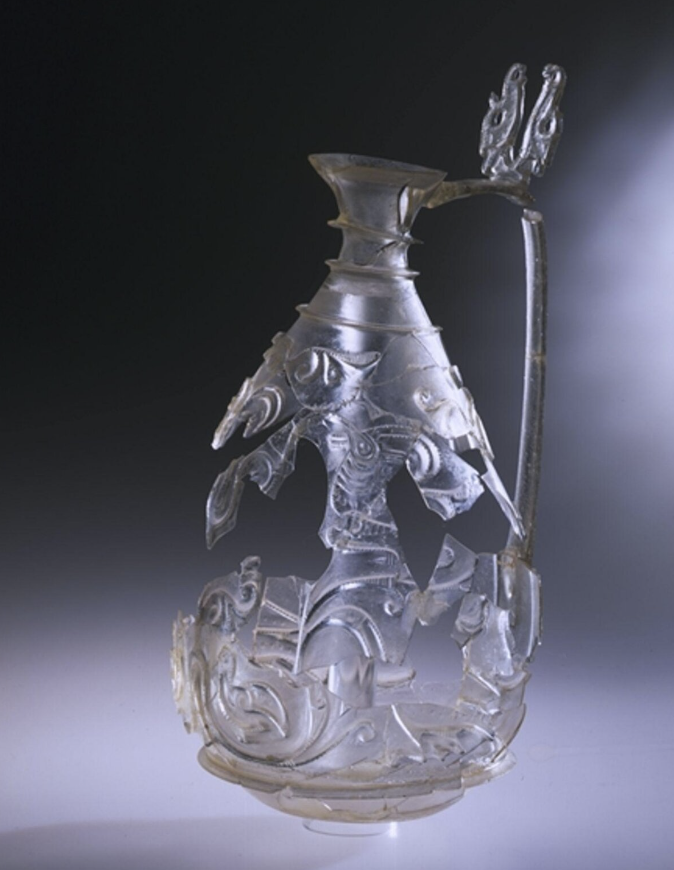
The closest whole comparable object is the Buckley Ewer in the Victoria and Albert Museum, named for a previous owner, Wilfrid Buckley, and given to the museum by his widow. It shares the same pear-shaped form and a thumb-rest modelled as two small birds, and is catalogued by the V&A itself as glass, blown and wheel-cut, of Iraq or Iran, possibly from a Cairo workshop; but it is colorless throughout, not cased in a second color, and survives only as a heavily fragmented reconstruction, considerably more broken than the Corning vessel. It is a close relative in form and in the underlying attribution dispute, not a rival for completeness.
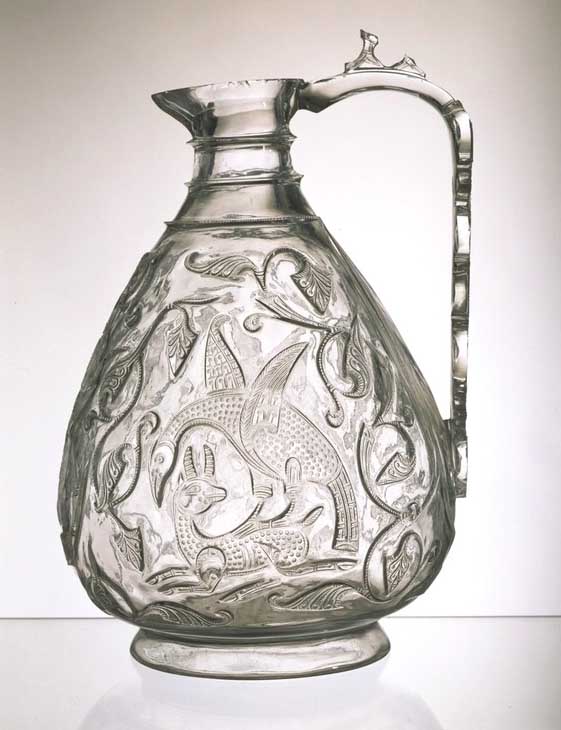
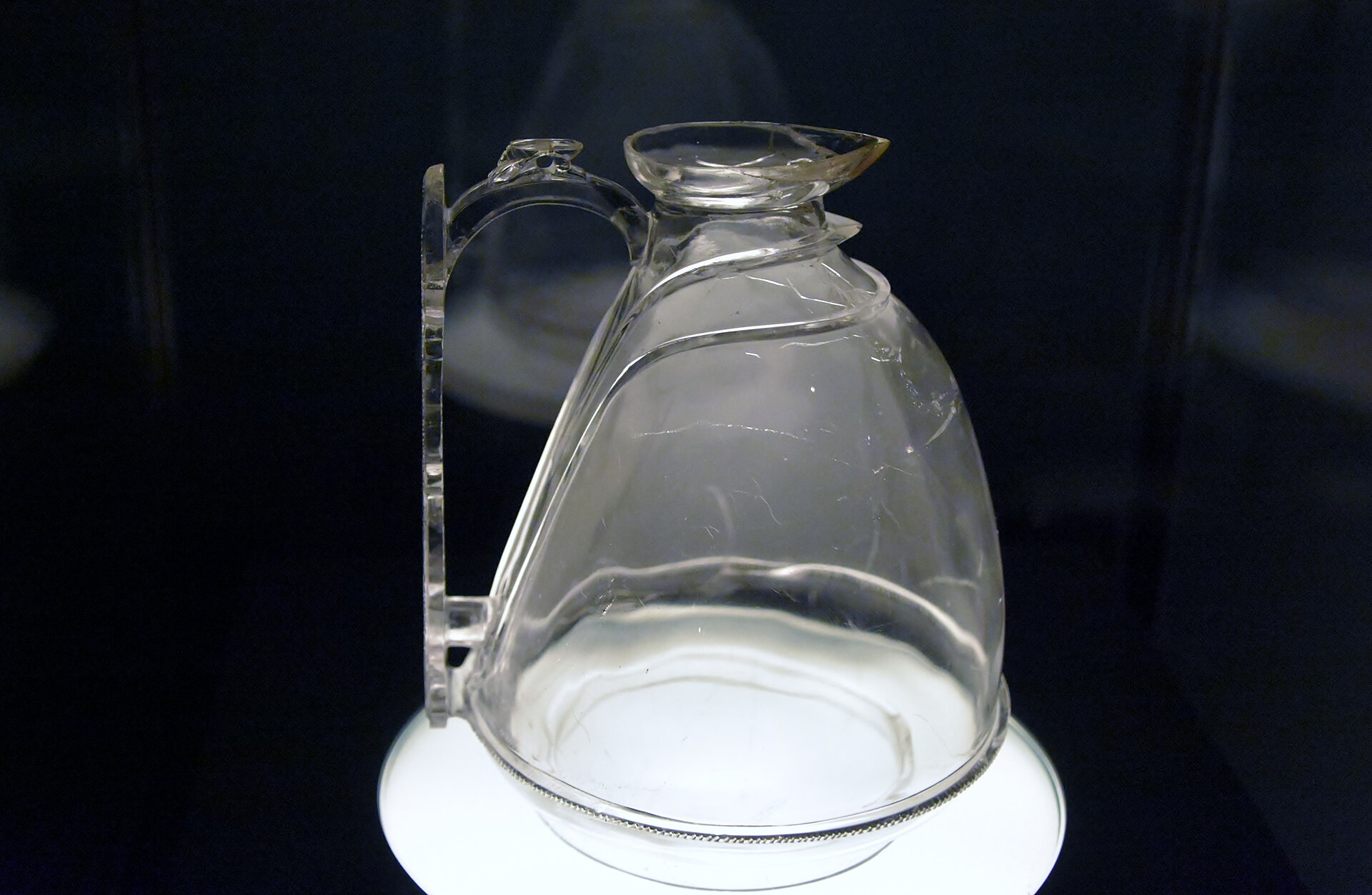
The hard-stone version of this same ewer type is better represented: rock-crystal ewers cut for the Fatimid court survive in London (Victoria and Albert Museum, 1000-1050) and in Copenhagen (The David Collection, Egypt, about 1000), among others, and Wikipedia's account of the type, citing a popular history of the Fatimid treasury, puts the number of surviving early Islamic carved rock crystals at around 200 worldwide, with most Fatimid court holdings lost when the treasury was dispersed during the crisis of the 1060s to early 1070s. That figure and that date range are given here as reported, from a source this record treats as tertiary and flags for replacement with Anna Contadini's specialist study of Fatimid rock crystal, which could not be independently checked for this record.
Cameo-cut glass proper is rarer still, and mostly fragmentary: a three-layer cameo fragment from Nishapur, with an opaque white middle layer, a more complex sandwich than the Corning Ewer's plain two-layer body, is in the Metropolitan Museum of Art. A cameo ewer of strikingly similar subject and technique, birds of prey attacking horned quadrupeds on a two-layer green-over-colorless body, was sold at Bonhams in London on 22 May 2025 for a total price of GBP 89,300 including buyer's premium; the hammer price alone was not published in the source consulted. That ewer's own catalogue entry cites both the Corning Ewer and the Buckley Ewer as comparanda, which is the clearest evidence available that this is a small, related group of surviving objects rather than a unique one, and that the Corning Ewer is judged the best-preserved and most fully worked member of it.
Chapter 9What is still unresolved
The two live questions are the same two the object has carried since it entered a public collection: where it was made, and how precisely it can be dated.
The two live questions are the same two the object has carried since it entered a public collection: where it was made, and how precisely it can be dated. Neither has moved in the literature consulted for this record. What has moved, comparatively little discussed, is the honesty of the find history: an object bought in Tehran is not thereby an object excavated in Iran, and the gap between those two claims is exactly the gap this record has tried to keep open rather than close by assumption.
The artist
Unknown Islamic glass workshop, production center disputed between Iran and Fatimid Egypt
No maker's name, workshop mark, or signature survives on the Corning Ewer or on any of its close relatives. What is being described here is not an individual hand but a small, technically demanding craft practice, cold-cutting a colored outer skin off a cased glass blank, that was worked for perhaps two centuries in the early Islamic world before it disappears from the record. Attribution debate for this class of object is a debate about workshops and regions, not about named artists, and this record treats it that way.
Exhibited
- 1976The Arts of IslamHayward Gallery, London (8 April - 4 July 1976, Arts Council of Great Britain, catalogue eds. Dalu Jones and George Michell)
Literature
- Whitehouse, David. "The Corning Ewer: A Masterpiece of Islamic Cameo Glass." Journal of Glass Studies 35 (1993): 48-56.
- Whitehouse, David, ed. Islamic Glass in the Corning Museum of Glass, vol. 1: Objects with Scratch-Engraved and Wheel-Cut Ornament. Corning, NY: Corning Museum of Glass, 2010.
Related works
| Work | Relation | Where it is |
|---|---|---|
| The Buckley Ewer Unknown workshop, Iraq or Iran (possibly Cairo) | Closest surviving parallel in form: same pear-shaped body and bird thumb-rest, same underlying attribution dispute Colorless wheel-cut glass, not cased in a second color, and survives as a heavily fragmented reconstruction. Named after a previous owner, Wilfrid Buckley; given by his widow. Dated 950-1050 by the V&A. | Victoria and Albert Museum, London (museum no. C.126-1936) |
| Rock Crystal Ewer Fatimid court workshop, Cairo | The hard-stone (quartz) version of the same ewer type the cameo-glass examples are argued to imitate Egypt, 1000-1050. Shares the thumb-rest and overall form; carved from a single block of rock crystal rather than glass. | Victoria and Albert Museum, London (museum no. 7904-1862) |
| Fatimid rock crystal ewer Fatimid court workshop, Cairo | A second surviving rock-crystal ewer of the same court type Egypt, c. 1000. Illustrates that only a small number of ewers of this general court type, in either material, survive complete. | The David Collection, Copenhagen |
| Cameo glass fragment (Nishapur, Tepe Madraseh X14) Unknown workshop | Comparanda for cameo-glass construction 9th century. Three-layer construction with an opaque white middle layer, technically more complex than the Corning Ewer's plain two-layer body; survives only as a fragment. | Metropolitan Museum of Art, New York (accession 40.170.181) |
| Relief-cut cameo glass ewer, Egypt or Near East Unknown workshop | Closest comparable cameo-glass ewer by subject: birds of prey attacking horned quadrupeds, same two-layer technique Catalogued late 10th/early 11th century on stylistic grounds; compositional analysis by Julian Henderson reported as consistent with a 9th-century-or-slightly-later date. Its own sale catalogue cites both the Corning Ewer and the Buckley Ewer as comparanda. Sold for GBP 89,300 including premium; hammer price not published in the source consulted. | Sold Bonhams, London, 22 May 2025, lot 21 (ex collection Madame Kismat Pilati, Vienna, from 1976) |
Open questions
- Where was the ewer made: Iran, a Fatimid Egyptian workshop, or somewhere else? Ultraviolet fluorescence testing matched neither an Egyptian nor an Iranian reference group.
- What is its precise date within the 9th-to-11th-century range? No excavated context exists for the object itself, and the one independent scientific dating result available for a close comparandum pulls earlier than the usual stylistic date.
- What actually happened at its reported findspot near Tehran? The only documented statement is a market acquisition by a private collector, not an excavation record; whether it was ever excavated at all is unknown.
- How did the ewer pass from Edmund de Unger's collection to the Corning Museum of Glass in 1985? No dealer, agent, or sale mechanism is named in the sources consulted.
- Does the bird-and-quadruped imagery carry a specific meaning for this object, or is it a stock courtly motif with no documented programme attached? No inscription or commission record survives.
- How many complete or near-complete Islamic cameo-glass vessels of this class actually survive worldwide? The sources consulted name only two whole examples (this ewer and the Buckley Ewer) against a wider field of fragments; a fuller census was not attempted for this record.
Questions about this object
What is The Corning Ewer?
The Corning Ewer is a glass, dated c. 9th - 11th century AD, most often placed around AD 1000 / the early 10th century. Medium: Cameo-cut glass: a colorless glass body cased in transparent light-green glass, blown and then cold-cut in relief.
Who made The Corning Ewer, and is the attribution settled?
The attribution to Unknown Islamic glass workshop is recorded here as disputed. No consensus on where the ewer was made. It was reportedly acquired on the art market in Tehran, and a small group of other cameo-cut vessels associated with Iran supports an Iranian origin. Against that, its close formal resemblance to the hard-stone (rock-crystal) ewers cut for the Fatimid court in Cairo, and Carl Johan Lamm's 1930 conclusion that comparable relief-cut and cameo material belongs to an Iraqi-or-Egyptian axis rather than an Iranian one, support a Fatimid Egyptian workshop. David Whitehouse tested the ewer's own ultraviolet fluorescence against reference fragments of known Egyptian and Iranian findspot, and it matched neither group. The question is unresolved in the literature consulted for this record.
Where is The Corning Ewer now?
Corning Museum of Glass, Corning, New York. Inventory number 85.1.1. Last confirmed 27 August 2026. Purchased 1985 with funds from the Clara S. Peck Endowment.
What is still unknown about The Corning Ewer?
Where was the ewer made: Iran, a Fatimid Egyptian workshop, or somewhere else? Ultraviolet fluorescence testing matched neither an Egyptian nor an Iranian reference group.
Sources
- 1Wikipedia, "Corning Ewer." source; with Whitehouse 1993 and Whitehouse 2010 (sources 2 and 3) wherever a claim can be traced to them directly. en.wikipedia.org/wiki/...
- 2Whitehouse, David. "The Corning Ewer: A Masterpiece of Islamic Cameo Glass." Journal of Glass Studies 35 (1993): 48-56. jstor.org/stable/...
- 3Whitehouse, David, ed. Islamic Glass in the Corning Museum of Glass, vol. 1: Objects with Scratch-Engraved and Wheel-Cut Ornament. Corning, NY: Corning Museum of Glass, 2010. info.cmog.org/publication/...
- 4caa.reviews, review of David Whitehouse, Islamic Glass in the Corning Museum of Glass, Vol. 1 (2010), published 2011-07-07. Reviewer's name could not be confirmed from the page as retrieved for this record; flagged for verification. caareviews.org/reviews/...
- 5Corning Museum of Glass, "The Corning Ewer," All About Glass. cmog.org/article/...
- 6Corning Museum of Glass, collection database record for the Corning Ewer (object 26983). Direct access was blocked by the site's bot-verification page during research for this record; details given here are as reported via secondary aggregation and should be checked directly against this record. glasscollection.cmog.org/objects/...
- 7Victoria and Albert Museum, "The Buckley Ewer," museum no. C.126-1936. collections.vam.ac.uk/item/...
- 8Bonhams, "An important relief-cut cameo glass ewer, Egypt or Near East, late 10th/early 11th century," sale 30703, lot 21, 22 May 2025. bonhams.com/auction/...
- 9Wikidata, Q125510316, "The Corning Ewer." structured-data source. wikidata.org/wiki/...
- 10Wikimedia Commons, File:The_Corning_Ewer.png, licence and uploader metadata verified directly via the Commons API on 2026-08-27. commons.wikimedia.org/wiki/...
- 11Direct visual examination of the lead photograph (File:The_Corning_Ewer.png) for condition (mended cracks) as part of independent verification for this record. upload.wikimedia.org/wikipedia/...
- 12Wikipedia, "Cameo glass." source, used only for the general statement that the technique lapsed after Rome and reappeared independently in the Islamic world and, later, in 19th-century France. en.wikipedia.org/wiki/...
- 13Contadini, Anna. "The Cutting Edge: Problems of History, Identification and Technique of Fatimid Rock Crystals," 1999. Cited via secondary reference; publication venue not independently confirmed for this record. en.wikipedia.org/wiki/...
- 14Wikipedia, "Edmund de Unger." source, biography of the collector. en.wikipedia.org/wiki/...
- 15The Arts of Islam: Hayward Gallery, 8 April - 4 July 1976. London: Arts Council of Great Britain, 1976 (eds. Dalu Jones and George Michell). Exhibition catalogue; existence and dates confirmed via library and archive catalogue records, contents of the specific entry for this ewer not examined directly. catalog.hathitrust.org/Record/...
- 16Pilosi, L., et al. "An Islamic Cameo Glass Fragment in the Metropolitan Museum of Art," 2012, on the Nishapur fragment, accession 40.170.181. researchgate.net/publication/...
- 17Wikimedia Commons, File:The_Buckley_Ewer.png, licence and uploader metadata verified directly via the Commons API on 2026-08-27. commons.wikimedia.org/wiki/...
- 18Wikimedia Commons, File:Rock_crystal_ewer.jpg (Victoria and Albert Museum, museum no. 7904-1862), licence and uploader metadata verified directly via the Commons API on 2026-08-27. commons.wikimedia.org/wiki/...
- 19Wikimedia Commons, File:Fatimid_rock_crystal_ewer,_Egypt,_ca._1000,_The_David_Collection,_Copenhagen_(1)_(36012520030).jpg, photo by Richard Mortel, licence and uploader metadata verified directly via the Commons API on 2026-08-27. commons.wikimedia.org/wiki/...


_(36012520030).jpg)
Last verified · Published
Change log
27 August 2026 - Record created at the house standard: researched narrative, technical evidence, maker dossier, graded provenance chain, prices with hammer and premium separated, related works, open questions and sources.