The Tara Brooch
Unknown Irish goldsmith (workshop) · Late 7th to early 8th century AD (commonly given as c. 700-750)
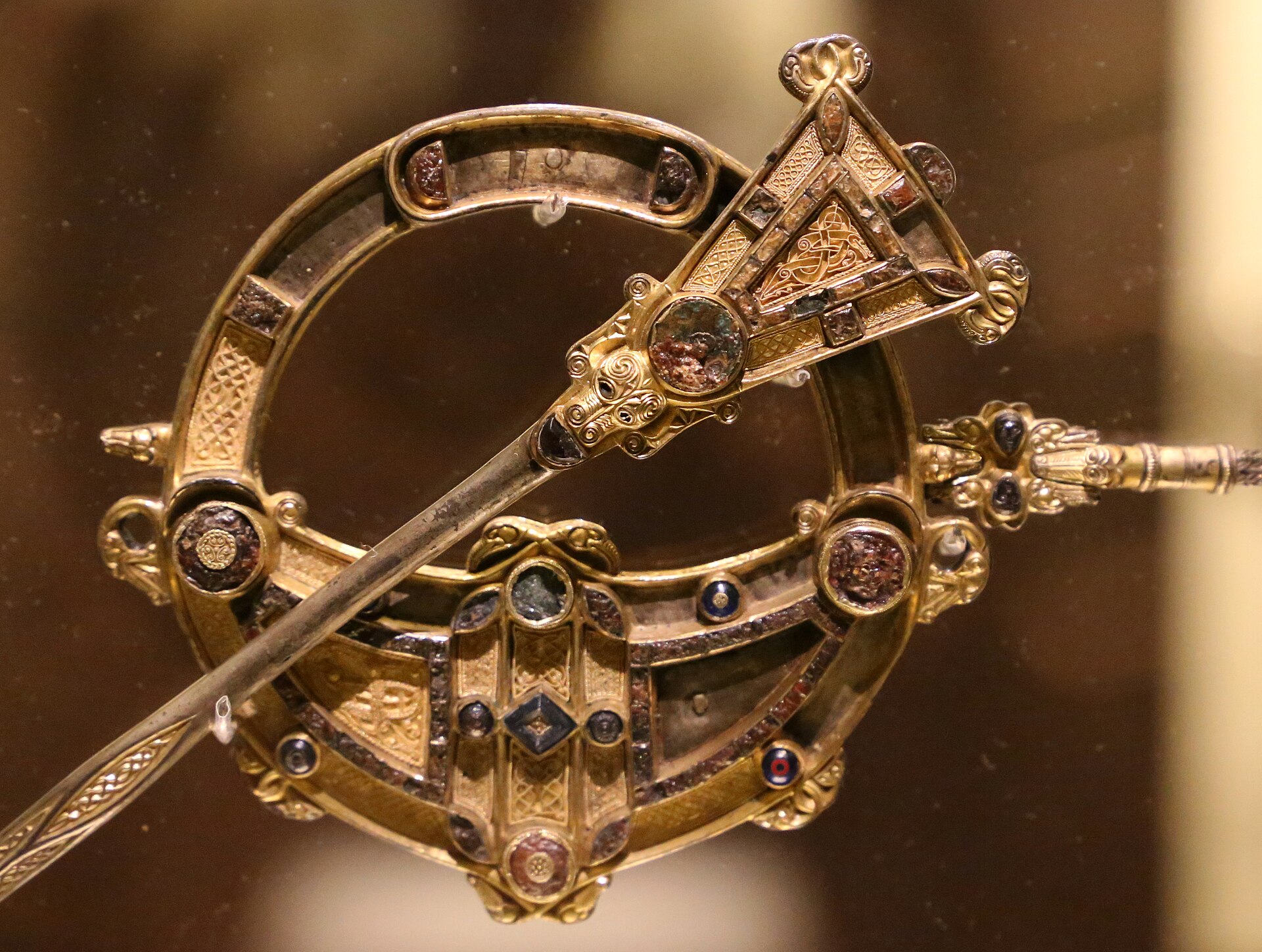
The Tara Brooch, silver-gilt with gold filigree, glass and amber, late 7th-early 8th century AD. National Museum of Ireland, Kildare Street, Dublin. Photographed by Francesco Bini (Wikimedia Commons user Sailko), 29 January 2020.
National Museum of Ireland; photograph by Francesco Bini (Sailko), CC BY 3.0| Artist | Unknown Irish goldsmith (workshop) |
|---|---|
| Date | Late 7th to early 8th century AD (commonly given as c. 700-750) |
| Medium | Cast and gilt silver with individually made gold filigree panels set in silver trays, cast and engraved ornament on the reverse, studs of glass and amber, and a plaited silver chain |
| Dimensions | Head (ring) diameter 8.7 cm; pin length 32 cm; weight 224.36 g |
| Where it is now | National Museum of Ireland - Archaeology, Kildare Street, Dublin, on permanent public display in the Treasurylast confirmed |
| Inventory number | Not confirmed against a citable primary or institutional source in this research pass; commonly rendered in secondary literature as NMI R.4015, but the museum's own catalogue record could not be retrieved directly (see notes_for_editor). |
| Attribution | UnknownNo maker's name, mark or inscription survives on the brooch. Full note |
| Object type | Goldsmith's work |
| Period | Early medieval Ireland (Insular art, late 7th-early 8th century) |
| Cases | Has a provenance gap |
| Inscriptions | None recorded. No maker's mark, owner's mark or inscription of any kind survives on the brooch itself, in contrast to some related Insular metalwork (for example the runic ownership inscription scratched onto the reverse of the Hunterston Brooch some centuries after it was made). |
| Owners on record | 7 links4 documented, 1 disputed, 2 unknown |
| Sources | 13 cited |
About this record Last verified · 13 sources cited · Change log
On this page 9 sections
ContentsClose
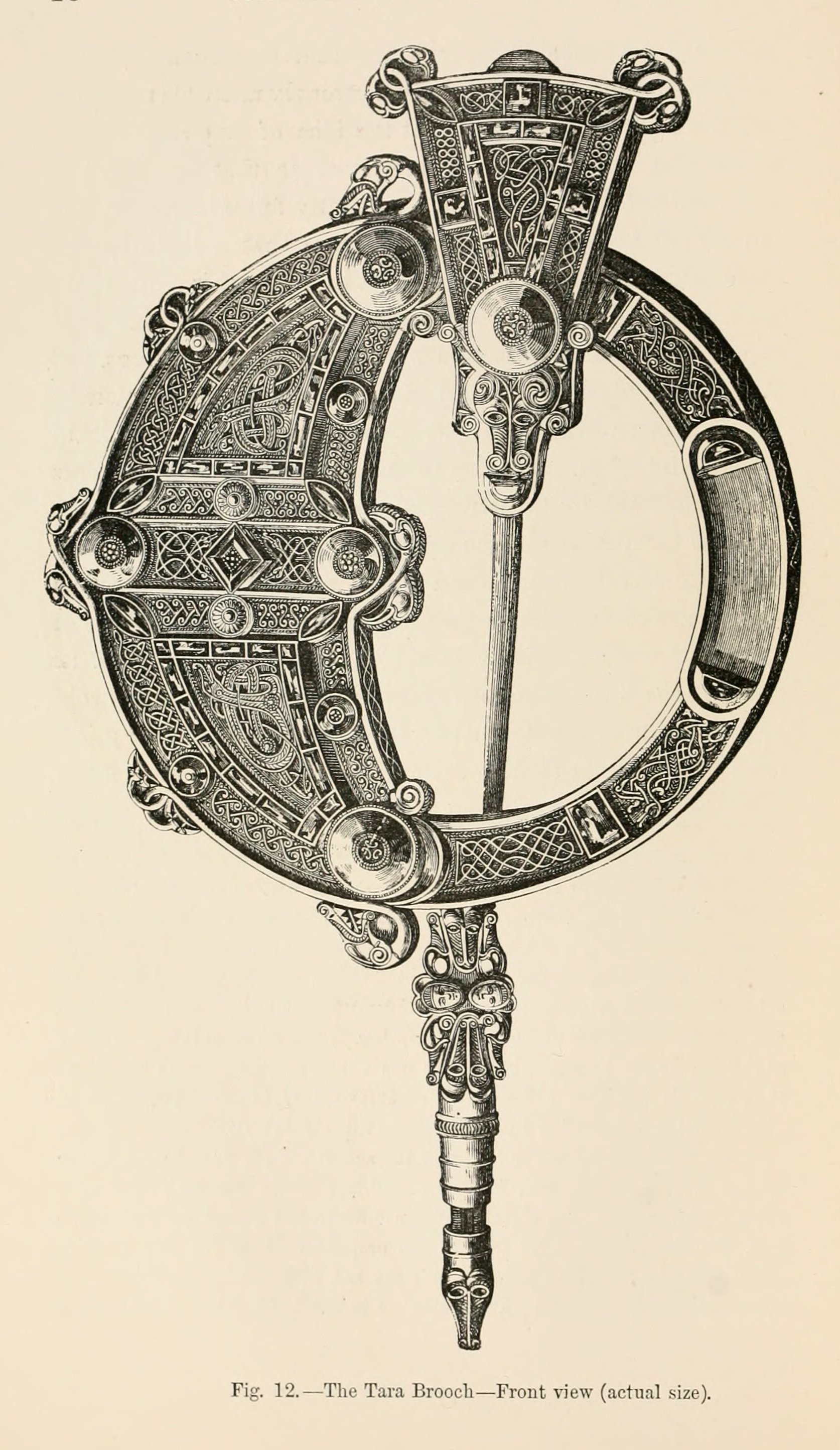
A silver-gilt pseudo-penannular brooch of the late 7th or early 8th century, decorated on both faces with gold filigree, cast ornament, glass and amber, and among the finest surviving objects of early medieval Irish metalwork. It carries a name it has no right to: a Dublin jeweller renamed it the 'Tara Brooch' in 1850 to link it commercially with the Hill of Tara, though it has no genuine connection to that site, and the replica trade the naming triggered helped drive the Victorian Celtic Revival in jewellery.
Its own discovery is disputed rather than simply romantic. The popular account has children finding it in a box on a beach at Bettystown; the antiquarian Sir William Wilde's later, independent account instead places the find at harbour-wall excavations on the River Boyne near Drogheda. Neither account is confirmed closely enough by the other to be preferred, and this record states both.
After a decade of international exhibition in private hands, the brooch was bought by the Royal Irish Academy, commonly dated to 1868, and transferred with the rest of the Academy's collection to the National Museum of Ireland on its foundation in 1890, where it remains on permanent public display.
Provenance
Each link is graded. Documented: a cited source supports it. Disputed: the identification is argued but not established. Unknown: no owner for that span, and the gap is not smoothed into a narrative. The grades in the glossary.
- c. 700-750 AD -Unidentified elite workshop and original ownerunknown
Dated by stylistic comparison with related Insular metalwork (principally the Hunterston Brooch) and manuscript ornament of the period. No direct dating evidence (inscription, coin association, or scientific analysis of the metal) is cited in the sources consulted.18
- c. 750 - 1850Unknownunknown
No owner, location or event is documented for roughly eleven centuries between the brooch's manufacture and its reported discovery.
- 1850 - 1850Found by a local family (popular account) or recovered during harbour-wall excavation works (Wilde's account)disputed
The popular account has children of a peasant family finding the brooch in a box buried in the sand at Bettystown beach, County Meath, possibly altering the true inland find-spot to avoid a landowner dispute. Sir William Wilde's account, written in the 1860s and published in 1915, instead places the find during excavation of a harbour wall at the mouth of the River Boyne near Drogheda, in an oak box with other silver objects. The two accounts share only the presence of a box and a general Drogheda-area location.123
- 1850 - 1850A Drogheda ironmonger, then a local watchmakerdocumented
The brooch is reported to have first been offered to an ironmonger in Drogheda, who dismissed it as worthless, before being bought by a local watchmaker who then sold it on to a Dublin jeweller. Sourced to secondary accounts rather than a primary record; flagged for replacement with Wilde's own catalogue text if it can be obtained directly.23
- 1850 - 1868Waterhouse & Co, Dublin (jewellers)documented
Bought by the Dublin jewelling firm trading as Waterhouse & Co, which renamed it the 'Tara Brooch' in 1850 to associate it commercially with the Hill of Tara, despite the object's having no genuine connection to that site. The individual responsible is universally described in secondary sources as 'George Waterhouse', but George Waterhouse (c. 1791-1855) had by most accounts retired around 1848; the Dublin shop was by 1850 run by his son Samuel Swinburne Waterhouse (c. 1819-1905). During this period the firm exhibited the brooch at the Great Exhibition, London (1851), the Great Industrial Exhibition, Dublin (1853, where Queen Victoria had it sent to Windsor Castle for inspection), and the Exposition Universelle, Paris (1855), and built a large replica trade on the back of its fame, including a distinct 'Royal Tara Brooch' pattern and a companion 'Tara Bracelet' (1851).123456
- 1868 - 1890Royal Irish Academydocumented
Purchased from Waterhouse & Co by the Royal Irish Academy, most commonly dated to 1868 for a price of 200 pounds, on the express condition that the brooch never leave Ireland. At least one source consulted gives 1872 instead of 1868; this record states both rather than resolving the conflict.135
- 1890 - presentNational Museum of Irelanddocumented
Transferred to the newly established National Museum of Ireland in 1890 along with the rest of the Royal Irish Academy's antiquities collection, including the Ardagh Chalice and the Cross of Cong. On permanent public display in the Treasury of the museum's Archaeology branch, Kildare Street, Dublin, as of 2026.13
Technical evidence
| Attribution note | No maker's name, mark or inscription survives on the brooch. Its date and place of origin rest entirely on stylistic comparison with other Insular metalwork and manuscript art of the late 7th to early 8th century, principally the Hunterston Brooch and the ornamental vocabulary of contemporary gospel books. No documentary or epigraphic evidence identifies the workshop, its location, or its patron. |
|---|---|
| Core and finish | Cast silver core, gilt overall on both faces.18 |
| Filigree construction | Individually made gold filigree panels, formed by fine beaded silver wire (the technique sometimes called jewellers' stitches), set into small silver trays. Twenty-eight trays are identifiable in the brooch's construction; eighteen retain their original filigree insert.11112 |
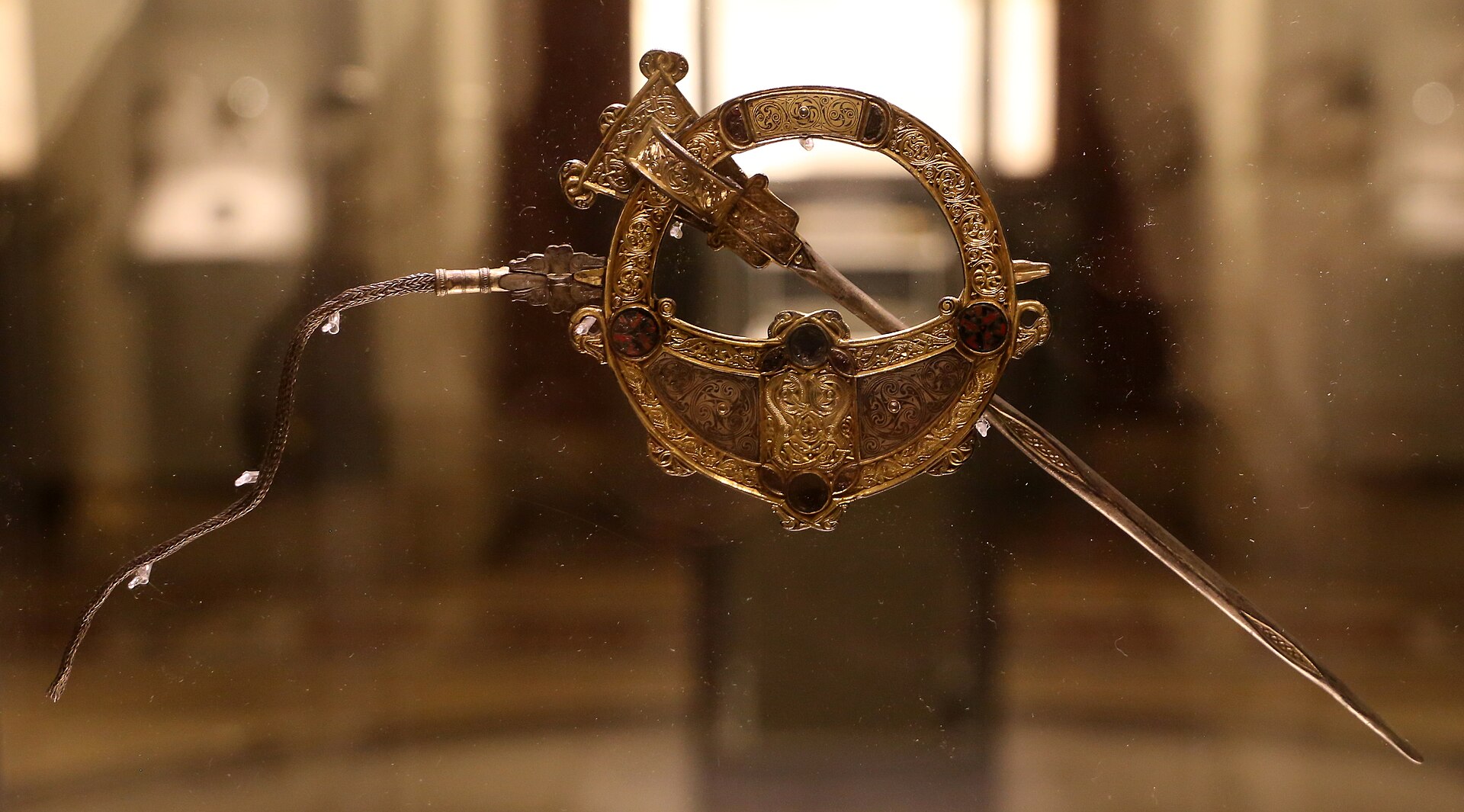
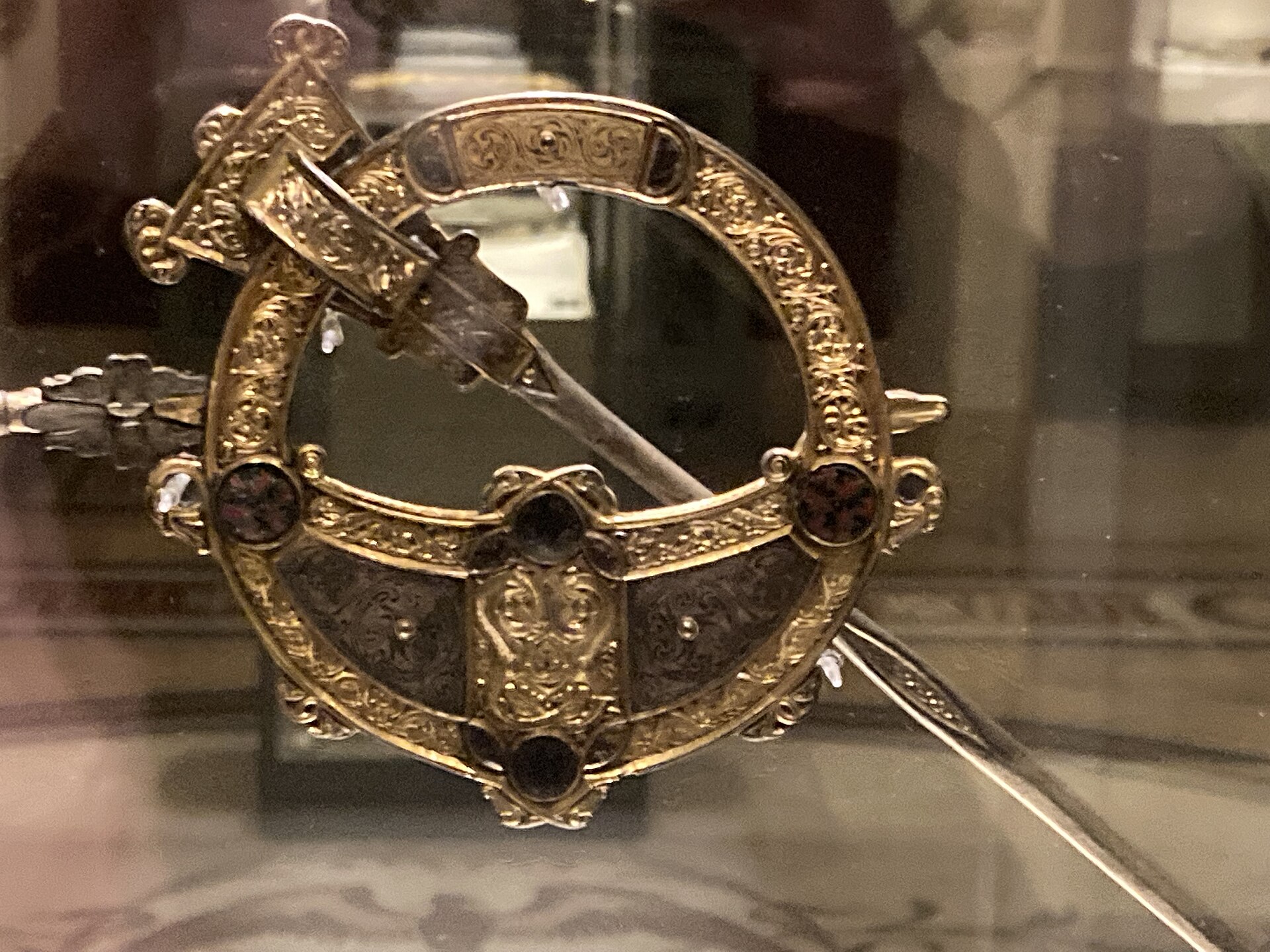
| Reverse ornament | Cast and engraved decoration of scrolls and triple spirals descended from the earlier La Tene tradition, plus engraved birds and reptiles, distinct in technique from the filigree of the front.1 |
| Inset materials | Studs of glass and amber set among the filigree panels; sources vary slightly on the glass colour (some describe it as amber and plain glass, at least one describes an amethyst-toned glass).15 |
| Dimensions and weight | Head (ring) diameter 8.7 cm; pin length 32 cm; total weight 224.36 g.110 |
| Form | Pseudo-penannular: the head is a single closed ring, decoratively rendered to resemble the gapped hoop of a true penannular brooch without functioning as one.18 |
| Pin | Long pin bearing a gilded, elongated panel shaped like a serpent with glass eyes.1 |
| Chain | Plaited (interlaced) silver chain, attached to the pin's hook by a swivel fitting, most likely functioning as a safety tether.1 |
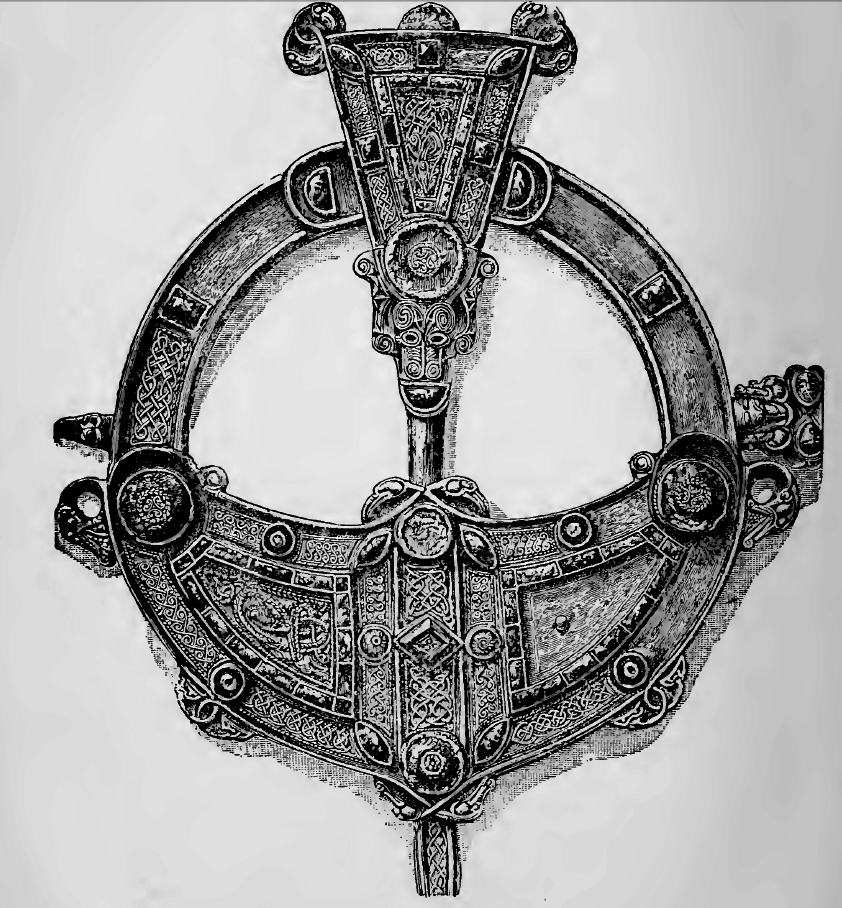
| Condition | Reported near-complete at discovery in 1850 and shown intact in 1852 engravings. Ten front filigree inserts and three studs are now missing, and two further inserts have lost their filigree, though the trays survive. The cause and date of this loss are not established in the sources consulted.1 |
Images
The record in full
Chapter 1A cloak-pin built to be looked at, not just worn
The Tara Brooch is a pseudo-penannular brooch: the ring of the head looks like the open, gapped hoop of a working cloak-pin, but it is in fact a single closed circle, its 'gap' rendered only in...
The Tara Brooch is a pseudo-penannular brooch: the ring of the head looks like the open, gapped hoop of a working cloak-pin, but it is in fact a single closed circle, its 'gap' rendered only in decoration. The head is 8.7 cm across; the pin that swings from it is 32 cm long, nearly four times the diameter of the ring it is attached to, and the whole object weighs 224.36 g. It is cast and gilt silver, decorated on both faces, which is itself a statement: the back, which would have been hidden against the wearer's clothing, is worked almost as densely as the front.
The front carries individually made gold filigree panels set into small trays around the ring and along the pin-head, separated by raised bosses and studs of glass and amber. The reverse is treated differently, in cast and engraved ornament of scrolls and triple spirals that descend from the earlier La Tene decorative tradition rather than the filigree technique used on the front. A plaited silver chain, attached by a swivel fitting, links the pin to the head, probably to stop the whole brooch from being lost if the pin worked loose.
Chapter 2How a goldsmith whose name is lost built it
The filigree is not a single continuous sheet of wirework.
The filigree is not a single continuous sheet of wirework. It was built as a set of separately made panels, each fitted into its own small tray on the ring and pin-head; twenty-eight such trays are identifiable in the brooch's construction, of which eighteen still hold their original filigree insert today. Each panel was formed from fine silver wire manipulated into the technique sometimes called jewellers' stitches or beaded wire, then gilded.
The scale of the technical study needed to establish this is itself telling. The independent scholar Niamh Whitfield, who has published two detailed technical papers on the brooch's construction and its fastening mechanism, has called it 'the most ornate and intricate piece of medieval jewellery ever found in Ireland'. Building twenty-eight individually fitted filigree trays into two faces of one small object implies a workshop capable of dividing that labour among more than one pair of hands, but nothing in the object or the record identifies who those hands belonged to. No mark, signature or inscription of any kind survives to name a maker, an apprentice, or a workshop.
Chapter 3Found on a beach at Bettystown, or so the popular story goes
The brooch is said to have been found in 1850 at Bettystown, on the coast of County Meath, roughly 25 km from the Hill of Tara.
The brooch is said to have been found in 1850 at Bettystown, on the coast of County Meath, roughly 25 km from the Hill of Tara. The commonly repeated version has children of a local peasant family finding it inside a box buried in the sand. Historians who have looked at the story doubt the beach setting specifically: the suspicion, recorded in more than one modern account, is that the family altered the details of where it was actually found, inland, to avoid a dispute with whoever owned that land.
What is more consistently reported is the chain of hands the brooch passed through immediately afterward. It was first offered to an ironmonger in Drogheda, who is said to have dismissed it as worthless; it was then bought by a local watchmaker, who in turn sold it to a Dublin jeweller trading as Waterhouse & Co. That sale is the point at which the documented history of the object, as opposed to the discovery story, begins.
Chapter 4Wilde's rival account complicates the beach story rather than resolving it
Sir William Wilde, the Dublin antiquarian and father of Oscar Wilde, later compiled a catalogue of the Royal Irish Academy's silver and ecclesiastical antiquities.
Sir William Wilde, the Dublin antiquarian and father of Oscar Wilde, later compiled a catalogue of the Royal Irish Academy's silver and ecclesiastical antiquities. It was written in the 1860s but not published until 1915, after his death. In it, Wilde describes certain silver objects as found 'in the excavation for the harbour wall at the mouth of the river Boyne, near Drogheda, in an oak box, and along with them the brooch called that of Tara.'
This is not the same story as the Bettystown beach account. It places the find at harbour works on the Boyne estuary near Drogheda, not on a beach several kilometres away, and it does not mention a peasant family or children at all. The only elements the two accounts share are that the brooch was found inside a box, and that the general area was the coast near Drogheda. This record states both versions rather than choosing between them: neither account is corroborated closely enough by an independent contemporary source, in the material reviewed here, to be preferred over the other, and the exact find-spot and circumstances remain unresolved.
Chapter 5A name invented in 1850 to sell it
Whatever the truth of the find-spot, the brooch has no genuine connection to the Hill of Tara, the traditional seat of the High Kings of Ireland.
Whatever the truth of the find-spot, the brooch has no genuine connection to the Hill of Tara, the traditional seat of the High Kings of Ireland. That connection was invented. The Dublin jeweller who bought it in 1850, trading as Waterhouse & Co, renamed it the 'Tara Brooch' specifically to link it in the public mind with Tara, at a moment when Irish Celtic Revival sentiment made that association commercially valuable. This is a documented, and unusually well-attested, case of invented provenance created for marketing purposes: the object is routinely called by a place name it has no historical connection to, a fact that is not disputed by any source consulted for this record.
The identity of the individual who did the naming needs a correction that the popular literature does not appear to make. Nearly every secondary account attributes the purchase and renaming to 'George Waterhouse'. But George Waterhouse (c. 1791-1855), who founded George Waterhouse & Co and registered its silver mark in 1830, is recorded as having retired from the firm around 1848 and died in France in 1855. The Dublin shop on Dame Street, where the brooch was bought and renamed in 1850, had been opened in 1841 and was by then being run by his son, Samuel Swinburne Waterhouse (c. 1819-1905), who continued the Dublin operation until his own death in 1905. If the retirement date is correct, the 1850 purchase and naming were almost certainly the son's doing, not the father's, and the popular attribution to 'George Waterhouse' is either a simplification or an error that this record has not seen corrected elsewhere.
Chapter 6The brooch that built an industry
In 1849 the Royal Irish Academy had given Waterhouse's firm permission to draw and copy antique brooches in its own collection.
In 1849 the Royal Irish Academy had given Waterhouse's firm permission to draw and copy antique brooches in its own collection. Once the Tara Brooch itself was in the firm's hands the following year, that permission became the basis of a substantial replica trade. By 1853 the firm was producing at least five named brooch patterns, including the Clarendon Brooch, the Knights Templar Brooch, the Dublin University Brooch, the Innisfallen Brooch, and the pattern named directly for the object itself, the Royal Tara Brooch. In 1851 the firm added a companion 'Tara Bracelet' in gilt silver. The replicas were typically about a third smaller than the original and considerably simpler in their filigree.
The Tara pattern became the industry's defining product. It was worn across Irish and British high society, its customers reportedly including Queen Victoria, and it is referenced in passing in James Joyce's 'A Portrait of the Artist as a Young Man' (1916), evidence of how far the pattern had penetrated middle-class Irish material culture by the early 20th century. The wider Celtic Revival jewellery trade of the second half of the 19th century, in which many other firms besides Waterhouse's took part, took its most famous single design directly from this one object.
Chapter 7On display before Ireland owned it
Long before it entered any public Irish collection, the brooch made an international reputation for itself while still Waterhouse's private property.
Long before it entered any public Irish collection, the brooch made an international reputation for itself while still Waterhouse's private property. It was shown at the Great Exhibition at the Crystal Palace, London, in 1851, within a year of its discovery, and again at the Great Industrial Exhibition in Dublin in 1853, where Queen Victoria is reported to have had it sent to Windsor Castle for her own inspection. It was shown again at the Exposition Universelle in Paris in 1855. Each of these appearances further entrenched both the brooch's fame and the marketability of Waterhouse's replicas, which traded directly on the exhibition publicity.
Chapter 8From a Dublin shop window into state hands
The brooch is most commonly reported as having been purchased by the Royal Irish Academy in 1868, for 200 pounds, on the express condition that it should never be allowed to leave Ireland.
The brooch is most commonly reported as having been purchased by the Royal Irish Academy in 1868, for 200 pounds, on the express condition that it should never be allowed to leave Ireland. At least one source consulted for this record instead gives 1872 as the acquisition year; this record could not resolve the discrepancy against a primary institutional source and states both figures rather than silently picking one.
Two hundred pounds in 1868 is worth approximately 29,356 pounds in 2026 terms, using the UK composite historical price index compiled from Bank of England and Office for National Statistics data (the calculation applies the Consumer Prices Index for the post-1988 portion of the period). That figure is offered only as a scale-of-money comparison; no source consulted records what contemporaries thought of the price as fair, high or low.
Chapter 9Into the National Museum in 1890
The Royal Irish Academy's antiquities collection, including the Tara Brooch, was transferred to the newly established National Museum of Ireland in 1890, along with other major pieces such as the...
The Royal Irish Academy's antiquities collection, including the Tara Brooch, was transferred to the newly established National Museum of Ireland in 1890, along with other major pieces such as the Ardagh Chalice and the Cross of Cong. The brooch has remained in the National Museum's care since, on long-term public display in the Treasury of the Archaeology branch on Kildare Street, Dublin, where it can be seen without charge.
Chapter 10What the ornament does and does not tell us
The brooch carries no narrative religious imagery, no inscription, and no maker's mark, so there is no textual or iconographic programme to decode in the way a manuscript illumination or a carved...
The brooch carries no narrative religious imagery, no inscription, and no maker's mark, so there is no textual or iconographic programme to decode in the way a manuscript illumination or a carved altarpiece might carry one. What it carries instead is abstract and zoomorphic ornament: interlace, spirals, and stylised birds and animals, executed with a level of technical refinement that scholars treat as the point in itself. That refinement, more than any specific decoded symbolism, is what identifies the brooch as an object of the highest status.
This vocabulary of interlace and spiral ornament is part of the same broad decorative language found in the great Insular gospel books of the same general period, and the brooch has been informally described in popular writing as a kind of 'Book of Kells' of Irish jewellery, a comparison of visual grammar across media rather than a documented link between this specific object and any specific manuscript or scriptorium. Who actually wore a brooch this large and this elaborate, whether a king, a bishop, an abbot, or another figure of high secular or ecclesiastical rank, is not established by any source consulted for this record and is treated here as an open question rather than settled by inference from the brooch's evident cost and craftsmanship.
Chapter 11The Tara Brooch among its own kind
The Tara Brooch is one of a small group of exceptionally elaborate pseudo-penannular brooches from Ireland and Scotland made within a few decades of 700 AD, and it is routinely discussed alongside...
The Tara Brooch is one of a small group of exceptionally elaborate pseudo-penannular brooches from Ireland and Scotland made within a few decades of 700 AD, and it is routinely discussed alongside the Hunterston Brooch, found in North Ayrshire and now in the National Museum of Scotland, whose own place of manufacture is debated between Ireland and western Scotland. A later and technically cruder pseudo-penannular brooch of the same broad type, the Roscrea Brooch, found before 1829 and now also in the National Museum of Ireland, has been dated by the scholar Michael Ryan to the mid-to-late 9th century, more than a century after the Tara Brooch and clearly derivative of the earlier, finer tradition it belongs to. The Londesborough Brooch, now in the British Museum, is grouped with the Tara and Hunterston brooches among the finest surviving examples of the wider group of more than fifty known elaborate Irish brooches of the period.
The Tara Brooch is also frequently discussed in the same breath as the Ardagh Chalice, another major piece of the same general 'Golden Age' of Irish ecclesiastical metalwork, found in 1868 and also eventually acquired for the nation, though by a different route: the Ardagh hoard's finder is recorded as having sold it to the diocese, and Bishop Butler of Limerick is recorded as having in turn accepted 100 pounds from the Royal Irish Academy for it in 1878, a decade after the Tara Brooch's own most commonly cited RIA acquisition date.
Chapter 12What is missing, and when it went missing
The brooch was reportedly found close to intact, and wood engravings published shortly afterward, in 1852, show it in near-perfect condition.
The brooch was reportedly found close to intact, and wood engravings published shortly afterward, in 1852, show it in near-perfect condition. Today ten of the original front filigree inserts and three studs are missing outright, and two further inserts have lost their filigree while the tray itself survives; of the twenty-eight original filigree trays, eighteen still hold their insert. No source consulted for this record identifies when between 1852 and the present these losses occurred, whether through display, handling, an identified incident, or slow attrition, or whether any conservation intervention has been carried out to stabilise the remaining panels. This record treats the timing and cause of that loss as unresolved rather than assume it happened at any particular point.
The artist
Unidentified Irish goldsmith or workshop, early 8th century
No name, mark, or documentary record identifies the maker of the Tara Brooch, and none is likely ever to. Attribution in Insular metalwork of this period does not work the way it does for a signed panel painting or a marked piece of later silver; it rests on typology and comparison with a small group of related objects and manuscripts, not on a paper trail leading back to an individual. Everything said here about 'the maker' describes a reconstructed craft context, not a documented person.
Related works
| Work | Relation | Where it is |
|---|---|---|
| Hunterston Brooch Unknown (Irish or west-of-Scotland workshop) | Closest comparable pseudo-penannular brooch, made within a few decades of 700 AD; its own place of manufacture is debated between Ireland and Scotland Found near Hunterston, North Ayrshire, in 1826 or 1830. Carries a later runic ownership inscription on the reverse, something the Tara Brooch does not have. | National Museum of Scotland, Edinburgh |
| Roscrea Brooch Unknown | Later, cruder pseudo-penannular brooch of the same broad type Found before 1829. Dated by the scholar Michael Ryan to the mid-to-late 9th century, over a century after the Tara Brooch and clearly working within the tradition it established. | National Museum of Ireland, Dublin (NMI P.737) |
| Londesborough Brooch Unknown | Another of the small group of the finest surviving elaborate Irish pseudo-penannular brooches Grouped with the Tara and Hunterston brooches among the finest of over fifty known elaborate Irish brooches of the period. | British Museum, London |
| Ardagh Chalice Unknown | Different object and function, but the other great fixed point of the same 'Golden Age' of Irish ecclesiastical metalwork, and acquired for the same institution by a parallel route Found in 1868. Sold by its finder to the local diocese; Bishop Butler of Limerick is recorded as having accepted 100 pounds from the Royal Irish Academy for it in 1878. | National Museum of Ireland, Dublin |
| Book of Kells Unknown (Columban monastic scriptorium) | Shares the same broad Insular decorative vocabulary of interlace, spiral and zoomorphic ornament, in a different medium The comparison is one of shared visual grammar across metalwork and manuscript illumination generally, not a documented link between this specific brooch and this specific manuscript. | Trinity College Library, Dublin |
Open questions
- Where exactly was the brooch found? The popular Bettystown beach account and Sir William Wilde's Boyne-estuary harbour-wall account agree only that it was found in a box somewhere near Drogheda; neither is corroborated closely enough by an independent contemporary source, in the material reviewed for this record, to be preferred over the other.
- Which Waterhouse actually bought and renamed the brooch in 1850? Popular sources uniformly credit 'George Waterhouse', but George Waterhouse (c. 1791-1855) is recorded as having retired from the firm around 1848, two years before the brooch surfaced; the Dublin shop was by then run by his son, Samuel Swinburne Waterhouse (c. 1819-1905). This record has not found a source that accounts for this discrepancy.
- What year and price did the Royal Irish Academy actually pay? Most sources give 1868 and 200 pounds; at least one gives 1872. This record could not resolve the difference against a primary institutional source.
- Where was the brooch actually made, and for whom? Neither the workshop's location nor the original patron's identity, whether secular ruler or senior cleric, is established by any source consulted here.
- When and how were the missing filigree inserts and studs lost? The brooch is shown essentially complete in engravings of 1852; ten front inserts and three studs are missing today, and this record found no account of when or how that loss occurred.
- What is the brooch's current National Museum of Ireland inventory number? Secondary sources give a registration number inconsistently and this record could not verify one against the museum's own catalogue, whose page returned an access error during this research pass (see notes_for_editor).
Questions about this object
What is The Tara Brooch?
The Tara Brooch is a goldsmith's work, dated late 7th to early 8th century AD (commonly given as c. 700-750). Medium: Cast and gilt silver with individually made gold filigree panels set in silver trays, cast and engraved ornament on the reverse, studs of glass and amber, and a plaited silver chain.
Who made The Tara Brooch, and is the attribution settled?
The attribution to Unknown Irish goldsmith (workshop) is recorded here as unknown. No maker's name, mark or inscription survives on the brooch. Its date and place of origin rest entirely on stylistic comparison with other Insular metalwork and manuscript art of the late 7th to early 8th century, principally the Hunterston Brooch and the ornamental vocabulary of contemporary gospel books. No documentary or epigraphic evidence identifies the workshop, its location, or its patron.
Where is The Tara Brooch now?
National Museum of Ireland - Archaeology, Kildare Street, Dublin, on permanent public display in the Treasury. Inventory number Not confirmed against a citable primary or institutional source in this research pass; commonly rendered in secondary literature as NMI R.4015, but the museum's own catalogue record could not be retrieved directly (see notes_for_editor).. Last confirmed 27 August 2026. Transferred to the National Museum of Ireland in 1890 with the rest of the Royal Irish Academy's antiquities collection, on the museum's opening.
What is still unknown about The Tara Brooch?
Where exactly was the brooch found? The popular Bettystown beach account and Sir William Wilde's Boyne-estuary harbour-wall account agree only that it was found in a box somewhere near Drogheda; neither is corroborated closely enough by an independent contemporary source, in the material reviewed for this record, to be preferred over the other.
Sources
- 1Wikipedia, 'Tara Brooch'. Consolidates dimensions, construction detail, exhibition and acquisition dates, and condition. en.wikipedia.org/wiki/...
- 2Mythical Ireland, 'The Tara Brooch: Ireland's finest piece of jewellery lost for centuries'. Popular secondary account; cites Sir William Wilde's 1860s catalogue (published 1915) for the harbour-wall find account. mythicalireland.com/blogs/...
- 3IrishCentral, 'What you should know about the Tara Brooch, one of Ireland's greatest treasures'. irishcentral.com/roots/...
- 4Victorian Web, 'Celtic Revival Brooch by Waterhouse and Company, Dublin', citing Jeanne Sheehy's exhibition catalogue on the Celtic Revival, 1830-1930. victorianweb.org/art/...
- 5Victorian Web (Byecroft), 'Popular and Applied Arts in the Celtic Revival'. Source for the 1849 Royal Irish Academy permission, the five 1853 brooch patterns, and the 1851 Tara Bracelet. victorianweb.org/art/...
- 6Hawley Sheffield Knives, 'George Waterhouse & Company'. Source for the Waterhouse family firm history and the 1848 retirement / 1855 death of George Waterhouse versus Samuel Swinburne Waterhouse's tenure of the Dublin shop from 1841 to 1905. hawleysheffieldknives.com/n-fulldetails.php
- 7Wikipedia, 'Roscrea Brooch'. en.wikipedia.org/wiki/...
- 8Wikipedia, 'Hunterston Brooch'. en.wikipedia.org/wiki/...
- 9officialdata.org, UK Inflation Calculator, 'Value of 1868 British pounds today'. Composite UK price index (Bank of England pre-1988 data, ONS Consumer Prices Index thereafter). officialdata.org/uk/...
- 10Wikidata, Q1922572, 'Tara Brooch'. Used to cross-check dimensions and weight; no inventory/accession number is recorded on this entry. wikidata.org/wiki/...
- 11Niamh Whitfield, ''A stitch in time: fastening the 'Tara' brooch'', in J. Fenwick (ed.), Lost and Found: Discovering Ireland's Past, 2 (Wordwell, Bray, 2009), 263-78. The principal technical study of the brooch's pin, chain and fastening mechanism. academia.edu/11086059/...
- 12Niamh Whitfield, '"More like the work of fairies than of human beings": the filigree on the 'Tara' brooch, a masterpiece of late Celtic metalwork'. The principal technical study of the brooch's filigree construction. researchgate.net/publication/...
- 13Wikimedia Commons, User:Sailko. Used to confirm the identity of the photographer (Francesco Bini) for the lead and detail plates, as required for CC BY attribution. commons.wikimedia.org/wiki/...
Last verified · Published
Change log
27 August 2026 - Record created at the house standard: researched narrative, technical evidence, maker dossier, graded provenance chain, prices with hammer and premium separated, related works, open questions and sources.