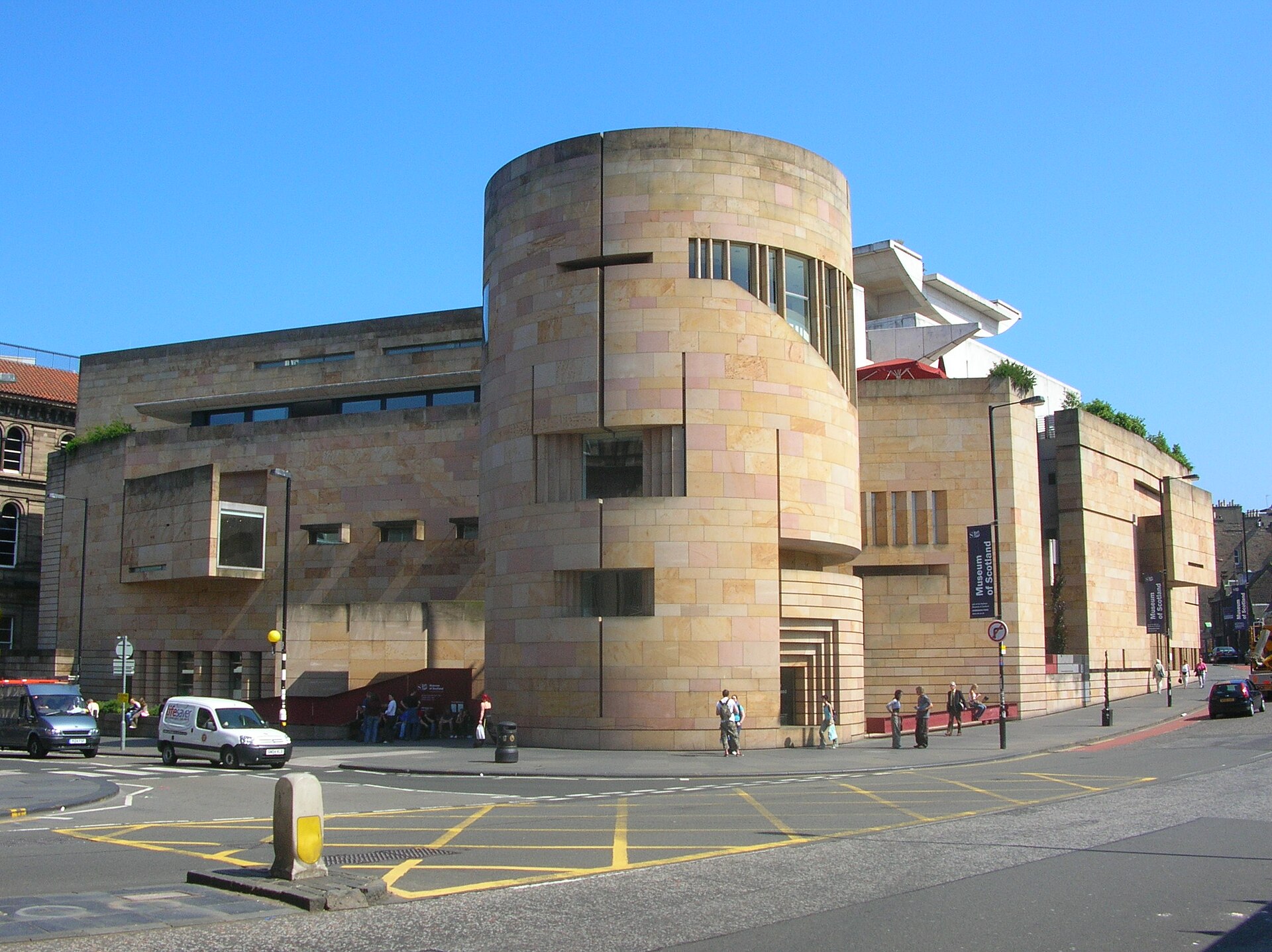
The golden sandstone tower of the 1998 Museum of Scotland building, its 'Museum of Scotland' signage visible on the facade, seen from Chambers Street. Photograph by Maccoinnich, CC BY-SA 3.0.
Maccoinnich, CC BY-SA 3.0, via Wikimedia Commons · Photograph by Maccoinnich~commonswikiNational Museum of Scotland
Museum · Founded 1854
Open, admission and hours confirmed 27 September 2026 · 35 sources
On this page 18 sections
ContentsClose
National Museums Scotland holds about 12 million objects and specimens, the largest multidisciplinary collection in Scotland, and the National Museum of Scotland is where the bulk of it is shown to the public across two joined buildings and seven levels. Its strength is breadth rather than one dominant field: natural sciences sit beside Scottish archaeology, decorative art beside the history of science and technology, and a world cultures wing that runs from the Pacific to East Asia. That range comes from a double inheritance, the Industrial Museum of Scotland's Victorian mandate to collect science, industry and natural history side by side, and the older core of national archaeological material built by the Society of Antiquaries of Scotland, transferred into public ownership in 1851 and merged into the same institution in 1985. The result is a museum that can put the Lewis Chessmen, a cloned sheep, an Egyptian coffin and a Pacific war canoe within a few minutes' walk of each other, and does.
| Kind | Museum |
|---|---|
| Founded | 1854 as the Industrial Museum of Scotland; the Chambers Street building opened 19 May 1866 as the Edinburgh Museum of Science and Art; united with the 1998 Museum of Scotland building as the National Museum of Scotland on 29 July 2011 |
| City and country |  Edinburgh, United Kingdom Edinburgh, United Kingdom |
| Address | Chambers Street, Edinburgh EH1 1JF, United Kingdom |
| Website | nms.ac.uk/national-museum-of-scotland |
| Status | Open, confirmed |
| Record last verified |
Visiting
- Hours
- Daily10:00 to 17:00The Roof Terrace closes slightly earlier, at 16:45.
- 26 December12:00 to 17:00Reduced hours.
- 1 January12:00 to 17:00Reduced hours.
- Closed
- Closed 25 December.
- Admission
- Permanent collection, all visitorsFreeFree entry, unticketed. The museum states charges apply only for some special exhibitions.
- Scotland's First Warriors, special exhibitionFreeFree. Runs 27 June 2026 to 16 May 2027, Exhibition Gallery 2, Level 3. Confirmed still open and free on 27 September 2026.
- Roman Scotland: Life on the Edge of Empire, special exhibition, adult (not yet open)GBP 13.50Tickets from GBP 13.50, concessions available. Runs 14 November 2026 to 18 April 2027, Exhibition Gallery 1. Announced and bookable as of 27 September 2026 but not yet open to visitors.
- MembersFreeFree entry to all special exhibitions with National Museums Scotland membership, which also covers the National Museum of Flight, National Museum of Rural Life and National War Museum. Membership from GBP 45 per year as of 27 September 2026.
Free entry: The permanent collection galleries are free every day the museum is open; this is not a periodic concession but the standing admission policy.. Ticketing applies only to headline temporary exhibitions. As of 27 September 2026 the only running temporary exhibition, Scotland's First Warriors, is itself free; the next ticketed show, Roman Scotland: Life on the Edge of Empire, does not open until 14 November 2026.- Tickets
- nms.ac.uk/whats-on The museum's own ticket page.
- Do I need to book?
- No booking is required for the permanent collection, which is free and unticketed. Special exhibitions such as Giants are ticketed and the museum recommends booking online.
- Address
- Chambers Street, Edinburgh EH1 1JF, United Kingdom MapOn foot / bus The Main Entrance and the Tower Entrance are both on Chambers Street. A number of city-centre buses stop directly outside on Chambers Street or nearby on George IV Bridge and South Bridge, and open-top Edinburgh Bus Tours buses also stop at the museum.
Train The nearest station is Edinburgh Waverley, a 10 to 15 minute walk away.
Car There is no museum car park. Four free designated disabled-visitor spaces are on Chambers Street; otherwise the museum points visitors to nearby NCP sites or limited Zone 3 on-street Pay and Display, and recommends public transport instead. - Website
- nms.ac.uk/national-museum-of-scotland
- Telephone
- +44 300 123 6789
- [email protected]
Before you go how long, access, photography, bags, eating, shop
- How long to allow
- TripAdvisor lists a typical visit as more than three hours. The museum spans seven levels across two joined buildings plus a roof terrace, so a first visit usually means choosing which of the six gallery groups to prioritise rather than trying to see all of them.
- Access
- Lifts and ramps reach every level. The Tower Entrance on Chambers Street gives step-free access to the main galleries and avoids the busier Main Entrance and Entrance Hall. Hearing loops are fitted at the information desks and in the Auditorium, large print guides are available in most galleries (not the Scottish History and Archaeology galleries), and sensory backpacks with ear defenders, torches, sunglasses and fidget toys can be borrowed at either entrance, including adult-sized ear defenders. BSL tours and audio-described or object-handling tours can be booked with six weeks' notice; assistance dogs are welcome and a wheelchair can be loaned on site. Four free disabled-visitor parking spaces sit on Chambers Street.
- Photography
- Personal photography, including flash, is permitted for visitors in the general galleries. Photography for commercial use or publication requires a completed Picture Library permission form and a photography pass collected from the Visitor Services desk on arrival.
- Bags
- Self-service lockers in the Entrance Hall hold luggage up to 58 x 44 x 66cm. The museum states that bag searches may be introduced at busy times as a security measure.
- Eating
- Balcony Cafe (Level 3), Hawthornden Cafe (Level 1) and Museum Kitchen (Level 0), all daily 10:00 to 17:00. A Lunch Space in the Entrance Hall is set aside for visitors eating food they have brought themselves.
- Shop
- Shops on Level 0 (Entrance Hall), Level 1 (Tower Entrance) and Level 3 (Exhibition Gallery foyer).
Prices and hours change. We take them from the institution's own pages and print the day we read them, and you can check the current position at the source we used. Confirm before you travel.
What is inside
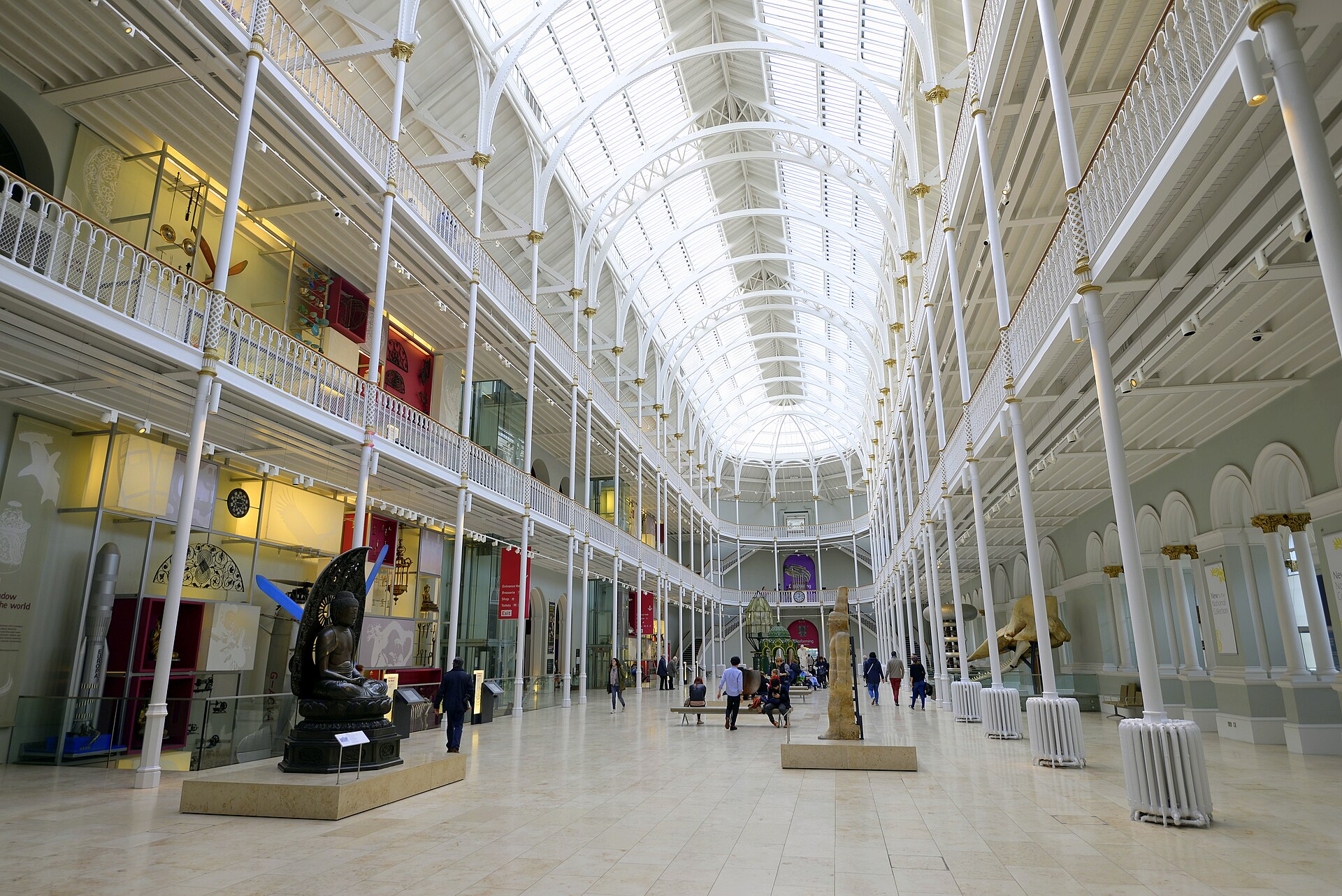
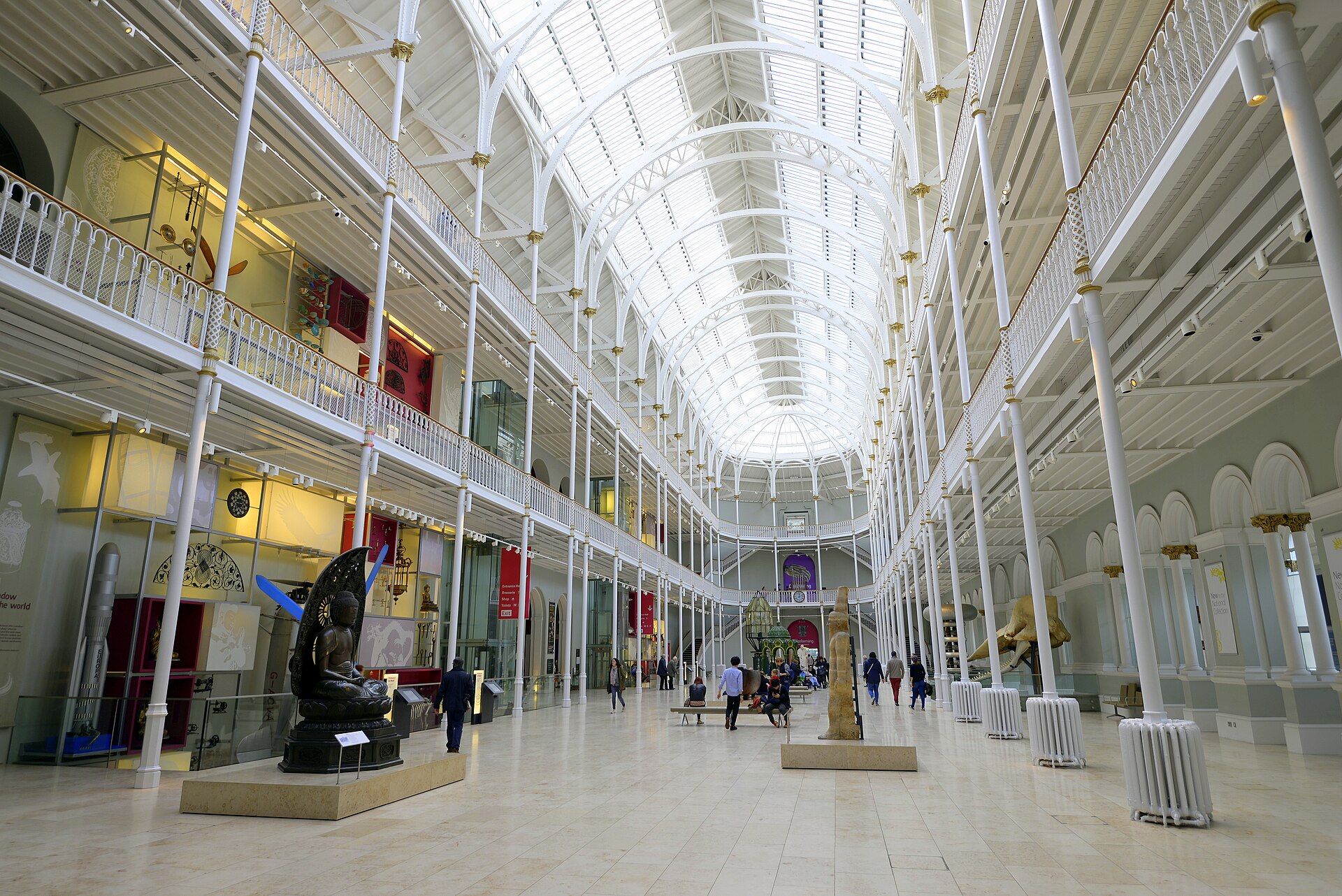
Photograph by Neuroforever · CC BY-SA 4.0 Grand Gallery, Level 1
The soaring, top-lit atrium of the Victorian building, with a 12-foot Pacific feast bowl and a 19th-century revolving lighthouse lens among the objects that greet visitors first. The Window on the World installation rises through four storeys here, showing over 800 objects from a girder of the original Tay Bridge to Art Nouveau glass. Collecting Stories, off the Grand Gallery, explains how and why the National Collection has been built over 200 years, and Art of Ceramics on Level 3 sits above it.
Natural World galleries, Levels 1, 3 and 5
Animal World and Earth in Space on Level 1, Animal Senses and Restless Earth on Level 3, and Survival and the interactive Adventure Planet on Level 5. A Tyrannosaurus rex skeleton guards the entrance; Ching Ching the giant panda and a Scottish wildcat are shown in Survival, and Restless Earth holds a geology collection built around an amethyst geode almost two metres high.
Scottish History and Archaeology galleries, Levels -1 to 6
Beginnings and Early People, on Level -1, cover three billion years of geological history and human life in Scotland from about 8000 BC, including the Pictish Hilton of Cadboll stone, an Iron Age carnyx and the Roman Cramond lioness. Kingdom of the Scots, spanning Levels 0 to 2, holds the Monymusk Reliquary, the Queen Mary harp and the Lewis Chessmen. Scotland Transformed, Industry and Empire, and Scotland: A Changing Nation carry the story from the Jacobite risings through the industrial and imperial 19th century to 20th-century war, politics and daily life.
World Cultures galleries, Levels 1, 3 and 5
Patterns of Life and Living Lands, on Level 1, look at how possessions mark identity across four continents. Facing the Sea, on Level 3, is the only UK gallery dedicated to the South Pacific and holds a Maori war canoe completed in Perspex by the contemporary artist George Nuku. Ancient Egypt and Exploring East Asia, on Level 5, hold coffins including that of the estate overseer Khnumhotep, a casing stone from the Great Pyramid of Giza, and a rare 13th-century Korean lotus-shaped cup.
Art, Design and Fashion galleries, Levels 1, 3 and 5
Fashion and Style, on Level 1, spans centuries of Scottish and international dress, from an 18th-century court mantua to Comme des Garcons. Making and Creating, on Level 3, holds a rare 1954 artist's proof by Picasso worked in glass. Design for Living, Art of Living and Traditions in Sculpture, on Level 5, run from the Arts and Crafts embroideries of May Morris to the Hamilton-Rothschild Tazza, a Byzantine sardonyx bowl mounted in Renaissance gold and enamel.
Science and Technology galleries, Levels 1, 3 and 5
Six galleries across three levels: Explore and Making It on Level 1, Communicate and Technology by Design on Level 3, Energise and Enquire on Level 5. Dolly the sheep, the first mammal cloned from an adult cell, is shown in Explore; Making It hangs an aerial history of aviation from the ceiling, and Enquire displays a giant copper accelerating cavity from CERN's LEP collider.
What to see first
The Lewis Chessmen
Probably Trondheim, Norway, late 12th centuryEleven of the 93 walrus-ivory chess pieces found on the Isle of Lewis in 1831 are held here against 82 at the British Museum, and they remain probably the best-known archaeological find ever made in Scotland.7
Dolly the sheep
Roslin Institute, born 5 July 1996The taxidermied remains of the first mammal ever cloned from an adult cell, donated by the Roslin Institute and shown in the Explore gallery alongside the genetics that made her possible.17
The Millennium Clock
Jane Clark and a Scottish design and making team, 1999A monumental mechanical automaton set in motion at fixed times each day in the Grand Gallery, built as a memorial to the twentieth century's conflicts and cruelties as much as to its achievements.5
The Atiu feast bowl
Atiu, Cook Islands, carved from a single tamanu logA 12-foot boat-shaped feast bowl, or umete, carved from a single piece of island mahogany, among the largest single objects in the Grand Gallery and one of the first things most visitors see.5
The Monymusk Reliquary
Pictish or Irish, 8th centuryA tiny house-shaped reliquary casket traditionally said to have been carried into battle by Scottish armies, including at Bannockburn in 1314, and now the centrepiece case in Kingdom of the Scots.7
The Hamilton-Rothschild Tazza
Byzantine sardonyx bowl on a Renaissance gold and enamel mountA cup built from an exceptionally large Byzantine sardonyx bowl married to a later gold and enamel mount, made purely to impress, on display in the Art of Living gallery.9
Tyrannosaurus rex
Natural World galleries, Level 1The skeleton the museum itself chooses to introduce 66 million years of life after the dinosaurs, positioned to guard the entrance to the Natural World galleries.6
The Benin Bronzes held here
Kingdom of Benin, taken in the British sacking of Benin City, 1897Seventy-four brass, ivory and bronze objects, of which only 14 are on display; Nigeria's National Commission for Museums and Monuments formally asked for their return in 2022, and no public decision has been traced since.23
Exhibitions on now
Past exhibitions here
Two museums, one address
The National Museum of Scotland is legally and architecturally two institutions wearing one name. Its archaeological core traces to the Society of Antiquaries of Scotland, founded in 1780 in the spirit of the Enlightenment to collect the archaeology of Scotland; that collection passed into public ownership in 1851, forming the original holdings of the National Museum of Antiquities of Scotland. Its natural history and applied science core traces to the Industrial Museum of Scotland, founded in 1854 on Victorian ideals of technical education, later renamed the Edinburgh Museum of Science and Art and then the Royal Scottish Museum. In 1985 the two merged, the Royal Scottish Museum becoming National Museums Scotland, today the largest multidisciplinary museum body in the country with the largest body of curatorial and conservation expertise in Scotland. The buildings themselves stayed physically separate for another thirteen years, and it was not until 29 July 2011, when new galleries opened after a five-year redevelopment, that the Museum united both strands of its history for the first time as the National Museum of Scotland.
Fowke's Crystal Palace on Chambers Street
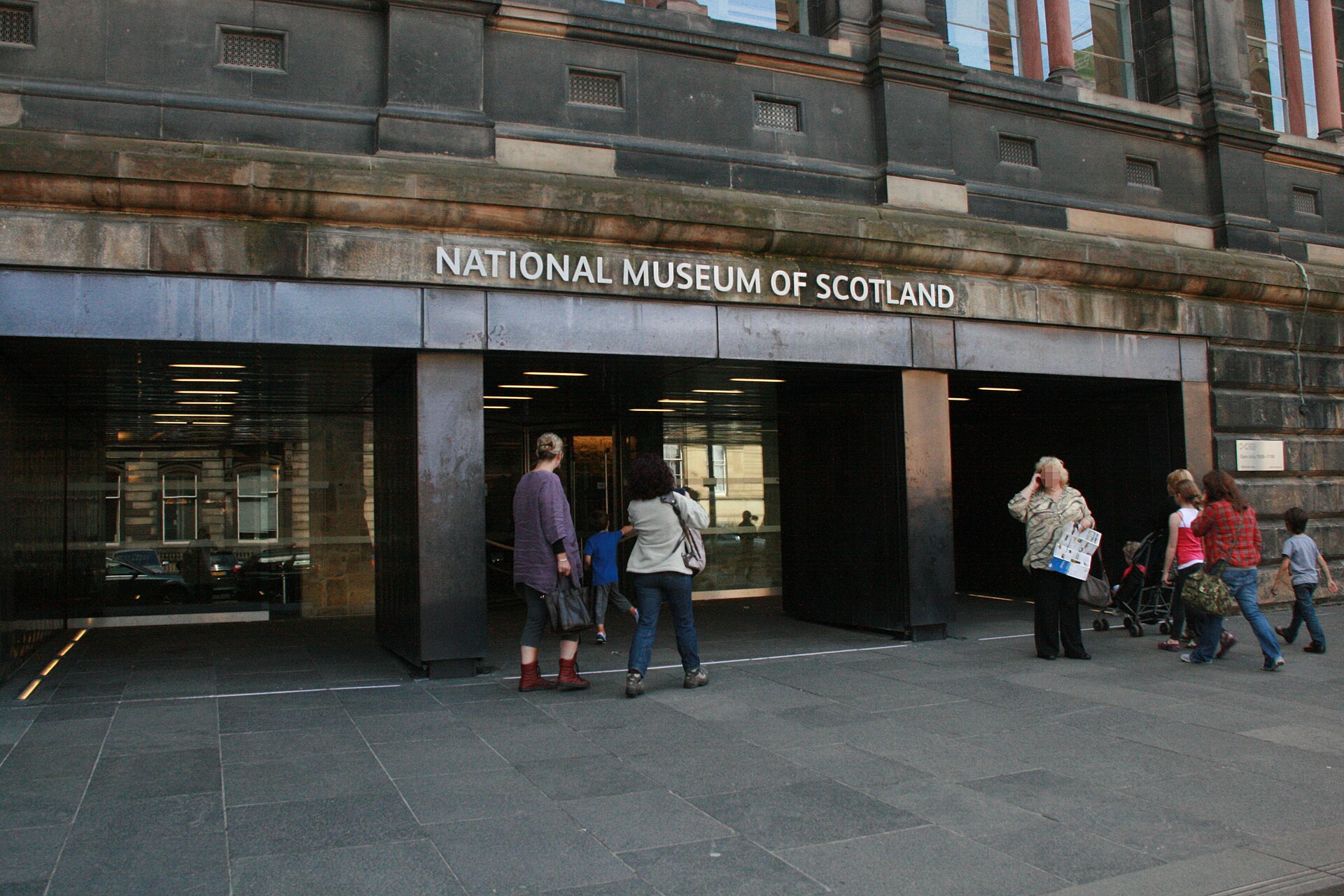
The Chambers Street building was designed by Captain Francis Fowke, the Royal Engineer also responsible for the Royal Albert Hall and the Victoria and Albert Museum, working with local architect Robert Matheson. Its foundation stone was laid in 1861 by Prince Albert, a driving force behind Britain's nineteenth-century museum movement; his visit to Edinburgh was his last public duty before his death that December. The building opened on 19 May 1866, with the east wing and a third of the main hall unveiled by Queen Victoria's son Prince Alfred, and it took a further thirty years to complete, culminating in the west wing in 1890. Fowke took his design directly from the Crystal Palace, built for the 1851 Great Exhibition in London; the result was a glass roof more than 80 metres long and 24 metres high, carried on the narrowest cast-iron pillars that could support it, with an innovative ventilation system built around gas lighting that let the museum open after dark. The decorative floor tiles came from Minton and Co of Stoke-on-Trent, and the front facade carries sculpture by the Edinburgh sculptor John Rhind: a central figure of Science flanked by groups representing Natural History and Applied Art, with six carved heads above the doorways naming Queen Victoria and Prince Albert, James Watt, Charles Darwin, Michelangelo and Sir Isaac Newton. A door on West College Street once led across a bridge to the University of Edinburgh, echoing Venice's Bridge of Sighs; it has been closed since the 1930s, after an 1871 student raid on a museum reception first shut it. The building carries a Category A listing.
A tower built from castles
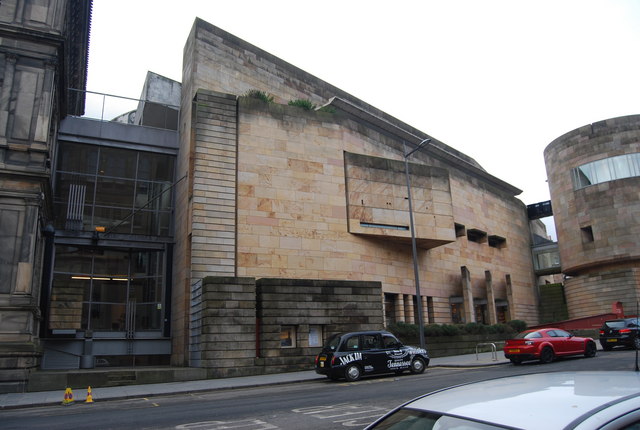
The second building, opened in 1998 as the Museum of Scotland and reached today through the Tower Entrance on Chambers Street, was designed by the architects Benson and Forsyth. Its design drew on the work of the modernist Le Corbusier and, more visibly, on Scottish vernacular building: medieval castles with spiral staircases, defensive towers and narrow arrow-loop windows, translated into golden sandstone and cast in a language the Victorian building next door does not share. The architects did not disguise the join. A glass curtain wall acknowledges the gap between old and new, and beyond it the stone wall of the new building begins with a rusticated pilaster that pays deliberate homage to the Victorian facade rather than pretending continuity with it. Inside, in Hawthornden Court, the vertical lines of the walkways are said to be inspired by the strings of a Scottish clarsach, one of several details through which the building tries to carry Scotland's history and landscape into its own fabric rather than simply housing objects that do the same job.
The rebuild that joined them, 2006 to 2011
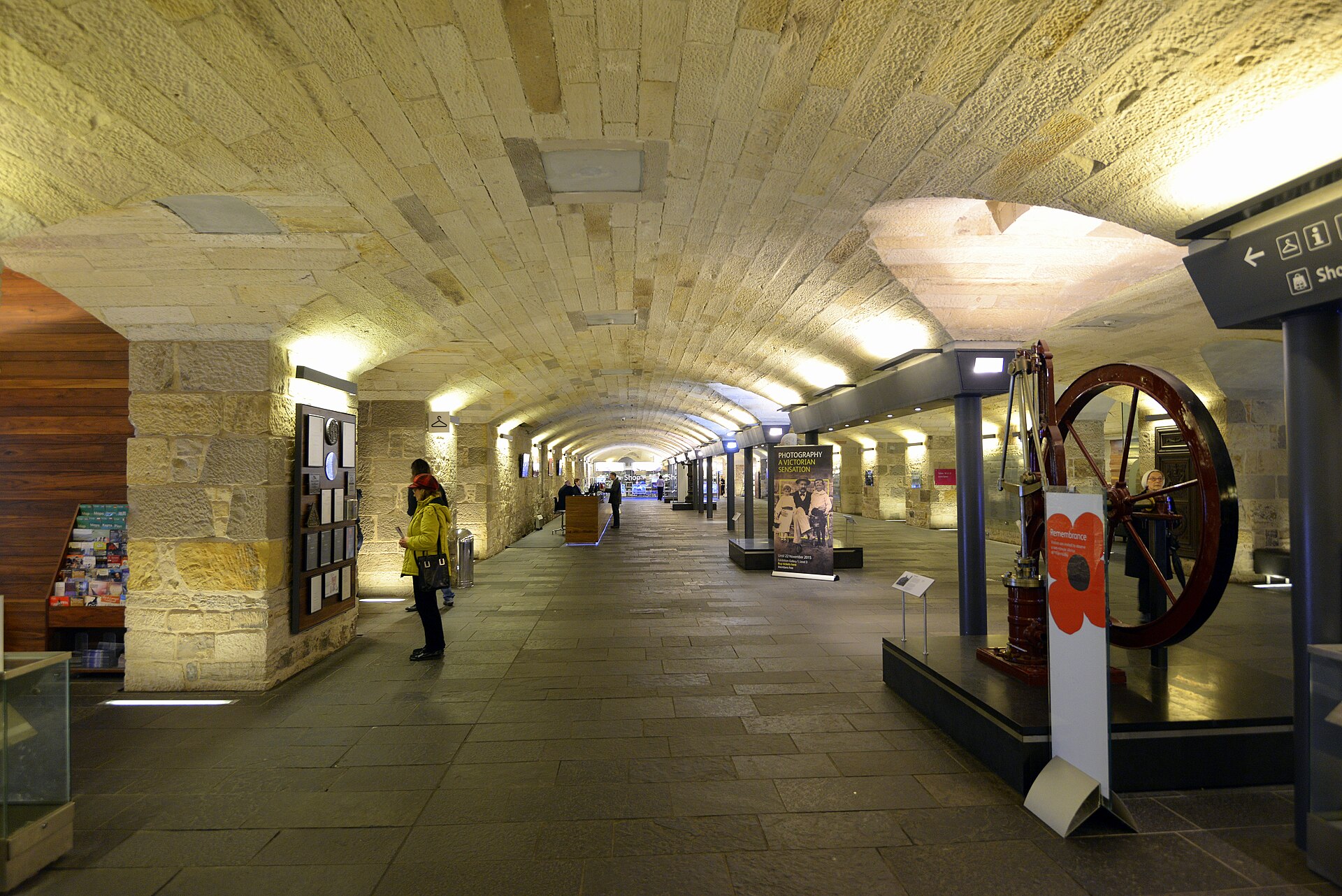
The two buildings functioned side by side but separately until a major redevelopment, led by Hoskins Architects under the late Gareth Hoskins, transformed the Victorian half of the museum between 2006 and 2011. The project opened up public spaces that had accumulated partitions and false floors over a century, refreshed the exhibition displays, and converted what had been a Victorian basement storage area into a new street-level Entrance Hall with its vaulted stone ceiling deliberately left exposed rather than plastered over. When the new galleries opened on 29 July 2011, the museum united both strands of its history for the first time as the National Museum of Scotland, and the redevelopment won the RIAS Andrew Doolan Best Building in Scotland Award that year. The project's momentum did not stop there: ten further Science and Technology and Art and Design galleries opened in July 2016, marking 150 years since the Chambers Street building first opened to the public, and new Ancient Egypt, East Asia and Ceramics galleries followed in February 2019. Within the first month of the 2011 reopening the museum had already passed half a million visitors, well ahead of its own targets.
Seven levels, six kinds of world
The museum organises what it shows into six gallery groups spread unevenly across seven levels and two buildings. The Grand Gallery, the light-filled atrium of the Victorian hall, is the usual starting point, and above and around it run the Natural World galleries (a Tyrannosaurus rex, a giant panda, an amethyst geode almost two metres high), the World Cultures galleries (a Pacific war canoe, ancient Egyptian coffins, East Asian lacquer and armour), the Art, Design and Fashion galleries (from an eighteenth-century court mantua to a Picasso glass proof), the Science and Technology galleries (Dolly the sheep, an Enigma machine, an aerial history of flight suspended from the ceiling), and the Scottish History and Archaeology galleries, which alone run from Level -1 to Level 6 and carry the Lewis Chessmen, the Monymusk Reliquary and the Queen Mary harp. A Roof Terrace on Level 7, reached from the Industry and Empire gallery or by lift, adds four sandstone sculptures by Andy Goldsworthy and a view across the Old Town skyline to Edinburgh Castle and Arthur's Seat. No single visit is designed to cover all of it; the museum's own advice, and the three-hour-plus typical visit reported by TripAdvisor, both assume a reader will choose.
Free to walk in, priced to see everything
Entry to the permanent collection has been free and unticketed since the museum reopened in 2011, and remains so across all seven levels and both buildings. What is ticketed is the programme of headline temporary exhibitions in the Exhibition Gallery on Level 3: Giants, the 2026 exhibition of prehistoric megafauna produced by the Royal Belgian Institute of Natural Sciences, ran from 31 January to 14 September 2026 and has since closed and moved to the museum's past exhibitions listing. As of 27 September 2026 the only temporary exhibition running is Scotland's First Warriors, which is itself free and continues to 16 May 2027. The next ticketed show, Roman Scotland: Life on the Edge of Empire, opens 14 November 2026 and runs to 18 April 2027, with tickets from GBP 13.50 and concessions available; it was announced and bookable as of this reconfirmation but had not yet opened. The Association of Leading Visitor Attractions counted 2,318,305 visits to the museum in 2025, making it the most-visited free attraction in Scotland for the year and 12th among all ALVA member sites across the UK, a ranking it has held near the top of for several years running. That scale is also why the building keeps expanding sideways rather than up: seven levels, six gallery groups, three cafes and a roof terrace all sit inside a footprint fixed by two nineteenth and twentieth-century buildings that were never going to grow any further outward.
What the collection does not settle
National Museums Scotland publishes its own statement on colonial histories and legacies, and it does not soften the point: important parts of the collection, and the way the museum has displayed them, were shaped by imperial and colonial thinking, including displays that for decades told the story of Empire through the achievements of Scots rather than its cost to the people whose objects were taken. The museum names its own holding plainly, 74 Benin Bronzes among them, brass, ivory and bronze objects taken in the British army's burning and looting of Benin City in February 1897 and later sold on to museums and private collectors, National Museums Scotland among them, between 1898 and 1903. Only 14 are currently on display. In September 2022 Nigeria's National Commission for Museums and Monuments and the Oba of Benin wrote formally asking for their return; the museum's reply, obtained under freedom of information law and reported by The Sunday Post in January 2023, promised only that trustees would weigh the case in spring 2023, and this desk traced no published decision since. The museum has returned objects before under the same policy: the House of Ni'isjoohl Memorial Pole, carved in 1855 and taken from the Nisga'a Nation of British Columbia in 1929, was agreed for permanent transfer in November 2022 after a Nisga'a delegation's request that August, and it left Edinburgh for the Nass Valley in September 2023. The Benin case, older and larger, remains open.
Visiting today
As of 13 August 2026 the museum opens daily from 10:00 to 17:00, with reduced hours on 26 December and 1 January and a full closure on 25 December. Both entrances are on Chambers Street: the Main Entrance leads into the vaulted Entrance Hall, while the Tower Entrance offers step-free access into the 1998 building and is the route the museum itself recommends for wheelchair users wanting to avoid the busier Entrance Hall. Lifts and ramps reach every level, hearing loops sit at the information desks and in the Auditorium, and sensory backpacks, large print guides and bookable BSL or object-handling tours are available on request. Three cafes, Balcony, Hawthornden and Museum Kitchen, run daily alongside a free Lunch Space for visitors bringing their own food, and shops sit at the Entrance Hall, the Tower Entrance and the Exhibition Gallery foyer. The nearest train station is Edinburgh Waverley, ten to fifteen minutes on foot; there is no museum car park, and the museum's own advice for anyone driving in is to use the Park and Ride instead.
What visitors say
We publish no visitor review prose and cite no aggregate score as fact, only as a dated tertiary reading. The National Museum of Scotland is, by the museum's own and its trade body's figures, the most-visited free attraction in Scotland: 2,318,305 visits in 2025, ranking 12th among all UK ALVA-member attractions. Admission to the permanent collection, across two joined buildings and seven levels, has been free since the 2011 reunification, and both TripAdvisor (4.7 from 22,789 reviews, Travelers' Choice 2026, #6 of 772 things to do in Edinburgh) and Google (4.8 from 59,032 reviews) register strong and consistent satisfaction, read live on 13 August 2026. Set against that, the museum's own published statement on colonial histories acknowledges that important parts of its collection and the way it has displayed them were shaped by imperial and colonial thinking, and a 2023 press investigation found a live, unresolved restitution request from Nigeria for the 74 Benin Bronzes in the collection, only 14 of which are on public display.
What is praised, what is criticised
- Praised: free, unticketed entry to the whole permanent collection across two joined buildings and seven levels, with paid entry reserved for headline temporary exhibitions such as Giants
- Praised: the sheer range under one roof, from a Tyrannosaurus rex and a cloned sheep to the Lewis Chessmen and a Pacific war canoe, which both major review platforms register as unusually broad appeal for a single museum
- Praised: an accessibility programme that is comprehensive by UK museum standards: lifts and ramps to every level, a step-free Tower Entrance, hearing loops, sensory backpacks and bookable BSL and object-handling tours
- Praised: the Grand Gallery itself as a free, walk-in public space, with its Victorian cast-iron structure kept legible rather than concealed behind the 2011 refit
- Criticised: of the 74 Benin Bronzes the museum holds, only 14 are on display; a January 2023 Sunday Post investigation, based on emails obtained under freedom of information law, found Nigeria's National Commission for Museums and Monuments and the Oba of Benin had formally asked in September 2022 for their return, and that the museum told campaigners only that trustees would "weigh the balance" of the case, with no later published decision traced by this desk
- Criticised: special exhibitions sit on top of a museum that is otherwise free, so the year's most family-marketed show, Giants, still costs a family of four the better part of fifty pounds before concessions
- Criticised: the museum's own colonial histories statement is candid that its displays have historically told imperial stories through the achievements of Scots rather than the exploitation of the people whose objects were taken, and says plainly that there is a lot more work to do
Ratings on other platforms
TripAdvisor: 4.7 from 22,789 ratings, read 13 August 2026
Google: 4.8 from 59,032 ratings, read 13 August 2026
A platform average is a tertiary source: it moves, it is not audited, and we quote no visitor's words.
Questions about National Museum of Scotland
Where is National Museum of Scotland?
Chambers Street, Edinburgh EH1 1JF, United Kingdom.
How much does it cost to visit?
Permanent collection, all visitors: free; Scotland's First Warriors, special exhibition: free; Roman Scotland: Life on the Edge of Empire, special exhibition, adult (not yet open): GBP 13.5; Members: free. As confirmed 27 September 2026.
When is it open?
Daily 10:00-17:00; 26 December 12:00-17:00; 1 January 12:00-17:00. Closed: Closed 25 December. As confirmed 27 September 2026.
How do you get there?
On foot / bus: The Main Entrance and the Tower Entrance are both on Chambers Street. A number of city-centre buses stop directly outside on Chambers Street or nearby on George IV Bridge and South Bridge, and open-top Edinburgh Bus Tours buses also stop at the museum; Train: The nearest station is Edinburgh Waverley, a 10 to 15 minute walk away; Car: There is no museum car park. Four free designated disabled-visitor spaces are on Chambers Street; otherwise the museum points visitors to nearby NCP sites or limited Zone 3 on-street Pay and Display, and recommends public transport instead.
What should you see first?
The Lewis Chessmen (Probably Trondheim, Norway, late 12th century); Dolly the sheep (Roslin Institute, born 5 July 1996); The Millennium Clock (Jane Clark and a Scottish design and making team, 1999); The Atiu feast bowl (Atiu, Cook Islands, carved from a single tamanu log); The Monymusk Reliquary (Pictish or Irish, 8th century); The Hamilton-Rothschild Tazza (Byzantine sardonyx bowl on a Renaissance gold and enamel mount).
What we could not confirm
- Whether National Museums Scotland's board of trustees has reached a decision on Nigeria's September 2022 request for the return of its 74 Benin Bronzes. The museum told campaigners in November 2022 that it hoped to bring the case to trustees in spring 2023; this desk found no later published outcome, and the museum's own collections policy states only a presumption against permanent transfer considered case by case.
- The exact current split of the 93 known Lewis Chessmen pieces between Edinburgh and London. The standard figure is 11 here and 82 at the British Museum, but pieces have occasionally travelled on loan between the two, and neither museum's own visitor-facing page states a re-confirmation date for the count.
- How the museum's two headline dates for the Chambers Street building, the 19 May 1866 opening given on its architecture trail and the 150th-anniversary framing on its own history page dated to 2016, are meant to be read together; both are the museum's own words and neither is wrong, but the page does not spell out why one is used as the anniversary year.
Images
Sources
- 1National Museums Scotland, Plan your visit (National Museum of Scotland): address, phone number, opening hours including 25 December closure and 26 December and 1 January reduced hours, free admission statement, getting here by bus, train, tram, bike and car, and on-site facilities including lockers, buggy park, cafes, shops and WiFi. Read in the in-app browser on 13 August 2026. nms.ac.uk/national-museum-of-scotland/plan-your-visit
- 2National Museums Scotland, National Museum of Scotland (main landing page): overview text, current exhibitions Giants and Scotland's First Warriors, events listing, and links to Plan your visit, See and do and Families. Read in the in-app browser on 13 August 2026. nms.ac.uk/national-museum-of-scotland/
- 3National Museums Scotland, See and do: description of the museum as the UK's most popular attraction outside London, and links to Explore the galleries, Tours and trails, Roof Terrace, Families and School visits. Read in the in-app browser on 13 August 2026. nms.ac.uk/national-museum-of-scotland/see-and-do
- 4National Museums Scotland, Explore the galleries: the six gallery groupings (Grand Gallery, Art Design and Fashion, Natural World, Science and Technology, Scottish History and Archaeology, World Cultures) with summary descriptions. Read in the in-app browser on 13 August 2026. nms.ac.uk/national-museum-of-scotland/see-and-do/explore-the-galleries
- 5National Museums Scotland, Grand Gallery: gallery-by-gallery detail for Grand Gallery, Window on the World, Collecting Stories and Art of Ceramics, including the Atiu feast bowl, the lighthouse lens and the Millennium Clock. Read in the in-app browser on 13 August 2026. nms.ac.uk/national-museum-of-scotland/see-and-do/explore-the-galleries/grand-gallery
- 6National Museums Scotland, Natural World galleries: gallery-by-gallery detail for Animal World, Earth in Space, Animal Senses, Restless Earth, Survival and Adventure Planet, including the Tyrannosaurus rex, Ching Ching the giant panda, the Scottish wildcat and the amethyst geode. Read in the in-app browser on 13 August 2026. nms.ac.uk/national-museum-of-scotland/see-and-do/explore-the-galleries/natural-world
- 7National Museums Scotland, Scottish History and Archaeology: gallery-by-gallery detail for Beginnings, Early People, Kingdom of the Scots, Scotland Transformed, Industry and Empire and Scotland: A Changing Nation, including the Lewis Chessmen, Monymusk Reliquary, Queen Mary harp, Hilton of Cadboll stone and Cramond lioness. Read in the in-app browser on 13 August 2026. nms.ac.uk/national-museum-of-scotland/see-and-do/explore-the-galleries/scottish-history-and-archaeology
- 8National Museums Scotland, World Cultures galleries: gallery-by-gallery detail for Patterns of Life, Living Lands, Imagine, Facing the Sea, Performances and Lives, Inspired by Nature, Artistic Legacies, Ancient Egypt and Exploring East Asia, including the Maori waka and the Khnumhotep coffin. Read in the in-app browser on 13 August 2026. nms.ac.uk/national-museum-of-scotland/see-and-do/explore-the-galleries/world-cultures
- 9National Museums Scotland, Art, Design, and Fashion galleries: gallery-by-gallery detail for Fashion and Style, Making and Creating, Design for Living, Art of Living and Traditions in Sculpture, including Picasso's Capra and the Hamilton-Rothschild Tazza. Read in the in-app browser on 13 August 2026. nms.ac.uk/national-museum-of-scotland/see-and-do/explore-the-galleries/art-design-and-fashion
- 10National Museums Scotland, Science and Technology galleries: gallery-by-gallery detail for Explore, Making It, Communicate, Technology by Design, Energise and Enquire, including Dolly the sheep, the Enigma machine and the CERN accelerating cavity. Read in the in-app browser on 13 August 2026. nms.ac.uk/national-museum-of-scotland/see-and-do/explore-the-galleries/science-and-technology
- 11National Museums Scotland, Roof Terrace: Level 7 location, opening hours 10:00 to 16:45, access via the Industry and Empire gallery or the Terrace Lift, the Andy Goldsworthy sandstone sculptures 'Hutton Roof', and the named skyline landmarks visible. Read in the in-app browser on 13 August 2026. nms.ac.uk/national-museum-of-scotland/see-and-do/roof-terrace
- 12National Museums Scotland, Architecture trail: 14 numbered stops covering the Entrance Hall conversion, John Rhind's facade sculpture, the West College Street bridge, the Crystal Palace influence, the glass roof and cast-iron structure, the Minton floor tiles, the 2016 piazza, Wilson Weatherley Phipson's radiators and ventilation, Francis Fowke and the 1861/1866 dates, the Hoskins Architects redevelopment and 2011 RIAS award, the Benson and Forsyth 'gap', the 1998 Museum of Scotland building, and the Hawthornden Court clarsach reference. Read in the in-app browser on 13 August 2026. nms.ac.uk/national-museum-of-scotland/see-and-do/tours-and-trails/architecture-trail
- 13National Museums Scotland, History of the National Museum of Scotland: the Society of Antiquaries of Scotland founded 1780 and its 1851 transfer into public ownership, the Industrial Museum of Scotland founded 1854, the 1985 merger forming National Museums Scotland, the 1998 Museum of Scotland opening by Queen Elizabeth II, the 2006-2011 redevelopment, the 29 July 2011 reunification, and further galleries opened in July 2016 and February 2019. Read in the in-app browser on 13 August 2026. nms.ac.uk/discover-catalogue/history-of-the-national-museum-of-scotland
- 14National Museums Scotland, Accessibility (National Museum of Scotland): the Main Entrance and Tower Entrance, accessible parking, information desks, induction loops, wheelchair loan, cloakroom, buggy park, toilets, lifts and escalators, seating, assistance dogs, sensory backpacks, communication cards, large print guides, and BSL and audio-described tour booking with six weeks' notice. Read in the in-app browser on 13 August 2026. nms.ac.uk/national-museum-of-scotland/plan-your-visit/accessibility
- 15National Museums Scotland, Contact us: main switchboard 0300 123 6789, international dialling code, text relay and BSL contact routes, general enquiry email [email protected], and the postal address at Chambers Street, Edinburgh EH1 1JF. Read in the in-app browser on 13 August 2026. nms.ac.uk/about-us/contact-us
- 16National Museums Scotland, Colonial histories and legacies in our museums: the museum's own statement that important aspects of its collections and displays were shaped by imperial and colonial thinking, its account of Scotland's role in the British Empire and the transatlantic slave trade, and its case study on the House of Ni'isjoohl Memorial Pole, returned to the Nisga'a Nation, agreed November 2022 and transferred September 2023. Read in the in-app browser on 13 August 2026. nms.ac.uk/collections/colonial-histories-and-legacies
- 17National Museums Scotland, The story of Dolly the sheep: Dolly's birth on 5 July 1996 at the Roslin Institute, the first mammal cloned from an adult cell, her display history, and her death in February 2003. Read in the in-app browser on 13 August 2026. nms.ac.uk/discover-catalogue/the-story-of-dolly-the-sheep
- 18National Museums Scotland, Giants (exhibition page): dates 31 January to 14 September 2026, venue Exhibition Gallery 1 Level 3, ticket prices from GBP 13 with concessions and free entry for Members, and the Great British Summer Savings discount period 25 June to 1 September 2026. Read in the in-app browser on 13 August 2026. nms.ac.uk/exhibitions/giants
- 19National Museums Scotland, Apply for permission to take photographs: the Picture Library permission form required for commercial or publication photography, and the requirement to collect a photography pass from the Visitor Services desk on arrival. Read in the in-app browser on 13 August 2026. nms.ac.uk/collections/facilities/picture-library/apply-for-permission-to-take-photographs
- 20Association of Leading Visitor Attractions, 'ALVA announces visitor numbers in 2025 to the UK's most popular attractions saw a rise of 2%', press release, 19-20 March 2026: the National Museum of Scotland's 2025 total of 2,318,305 visits, its 12th-place UK ranking, and its position as the most-visited free attraction in Scotland. Read in the in-app browser on 13 August 2026. alva.org.uk/details.cfm?p=403&codeid=895
- 21Wikidata, National Museum of Scotland (Q1633842): English label 'National Museum of Scotland', coordinate location 55.946944, -3.19, instance-of Museum, official website nms.ac.uk/national-museum-of-scotland, and inception 1998. Cross-checked against the museum's own published address and coordinates, and against the distinct entities for the Scottish National Gallery (Q942713), Scottish National Portrait Gallery (Q2441562) and Scottish National Gallery of Modern Art (Q1889944) to confirm no conflation. wikidata.org/wiki/Q1633842
- 22Wikimedia Commons, Category:National Museum of Scotland and its subcategory Buildings of the National Museum of Scotland. Queried 13 August 2026. commons.wikimedia.org/wiki/Category:National_Museum_of_Scotland
- 23Mark Aitken, 'Nigeria demands National Museums Scotland hands back its looted treasures', The Sunday Post, 2 January 2023. Read as raw page text on 13 August 2026: the September 2022 letter from Nigeria's National Commission for Museums and Monuments and the Oba of Benin, the museum's November 2022 reply promising to bring the case to trustees in spring 2023, the holding of 74 Benin Bronzes with 14 on display and one on loan, and named comment from Dr Emiline Smith of the University of Glasgow and Sir Geoff Palmer. sundaypost.com/fp/national-museums-scotland-looted-treasures/
- 24Duncan Macmillan, 'Art review: Wild and Majestic exhibition explores how potent images of Scotland were created', The Scotsman, 6 July 2019. Read as raw page text on 13 August 2026: a five-star review of Wild and Majestic: Romantic Visions at the National Museum of Scotland, covering the exhibition's argument about the invention of a romanticised Highland identity. scotsman.com/whats-on/arts-and-entertainment/art-review-wild-and-majestic-exhibition-explores-how-potent-images-of-scotland-were-created-1413856
- 25'Exhibition review: Rip It Up, National Museum of Scotland, Edinburgh', The Scotsman, 27 June 2018 (byline: The Newsroom). Read as raw page text on 13 August 2026: an unreservedly positive review of the Rip It Up exhibition on Scottish popular music, describing its breadth of objects and its closing tribute to Scott Hutchison. scotsman.com/arts-and-culture/exhibition-review-rip-it-national-museum-scotland-edinburgh-1428246
- 26TripAdvisor, National Museum of Scotland listing: rating 4.7 of 5 from 22,789 reviews, ranked #6 of 772 things to do in Edinburgh, Travelers' Choice 2026 badge. Read live in the in-app browser on 13 August 2026. tripadvisor.com/Attraction_Review-g186525-d2359701-Reviews-National_Museum_of_Scotland-Edinburgh_Scotland.html
- 27Google Search knowledge panel for 'National Museum of Scotland Edinburgh': aggregate rating 4.8 of 5 from 59,032 Google reviews. Read live in the in-app browser on 13 August 2026. google.com/search?q=National+Museum+of+Scotland+Edinburgh
- 28Admission line ('Free entry, charges for some special exhibitions'), opening hours (daily 10:00-17:00, closed 25 Dec, reduced hours 26 Dec and 1 Jan), address and phone number all read unchanged from the 13 August 2026 confirmation. nms.ac.uk/national-museum-of-scotland/plan-your-visit
- 29National Museums Scotland, Contact us: re-confirmed 27 September 2026 via a real Chrome session. Main switchboard 0300 123 6789, international dialling code, text relay and BSL routes, general enquiry email [email protected], and the postal address at Chambers Street, Edinburgh EH1 1JF all read unchanged. nms.ac.uk/about-us/contact-us
- 30National Museums Scotland, What's on: read 27 September 2026. Confirms Giants is no longer listed among current exhibitions (it closed 14 September 2026), that Scotland's First Warriors continues free to 16 May 2027, and that Roman Scotland: Life on the Edge of Empire has been announced for 14 November 2026 to 18 April 2027. nms.ac.uk/whats-on
- 31National Museums Scotland, Giants (now under Past exhibitions): read 27 September 2026. The URL https://www.nms.ac.uk/exhibitions/giants now redirects to https://www.nms.ac.uk/past-exhibitions/giants, confirming the exhibition's run ended 14 September 2026 as originally scheduled. nms.ac.uk/past-exhibitions/giants
- 32National Museums Scotland, Scotland's First Warriors: read 27 September 2026. Confirms free admission, dates 27 June 2026 to 16 May 2027 unchanged, venue Exhibition Gallery 2, Level 3, and that the exhibition is supported by Postcode Lottery players. nms.ac.uk/exhibitions/scotlands-first-warriors
- 33National Museums Scotland, Roman Scotland: Life on the Edge of Empire: read 27 September 2026. Dates 14 November 2026 to 18 April 2027, Exhibition Gallery 1, tickets from GBP 13.50 with concessions available, Members free, centred on finds from the Inveresk Roman fort including two Mithraeum altars. nms.ac.uk/exhibitions/roman-scotland-life-on-the-edge-of-empire
- 34National Museums Scotland, Colonial histories and legacies in our museums: re-read 27 September 2026. The House of Ni'isjoohl Memorial Pole case is described unchanged (transferred to the Nisga'a Museum, on permanent display there). The page names no Benin Bronzes decision; this desk found no published resolution to Nigeria's September 2022 request beyond the January 2023 reporting already cited, so the open question is carried forward unresolved rather than marked settled. nms.ac.uk/collections/colonial-histories-and-legacies
- 35National Museums Scotland, National Museum of Scotland (main landing page): read 27 September 2026. Confirms the museum open, unchanged admission and hours lines, and Roman Scotland: Life on the Edge of Empire as the currently featured (not-yet-open) exhibition. nms.ac.uk/national-museum-of-scotland/