Cabinet
Unknown maker, Burgundy, possibly the circle of Hugues Sambin · 1580, with minor additions in the late 1850s
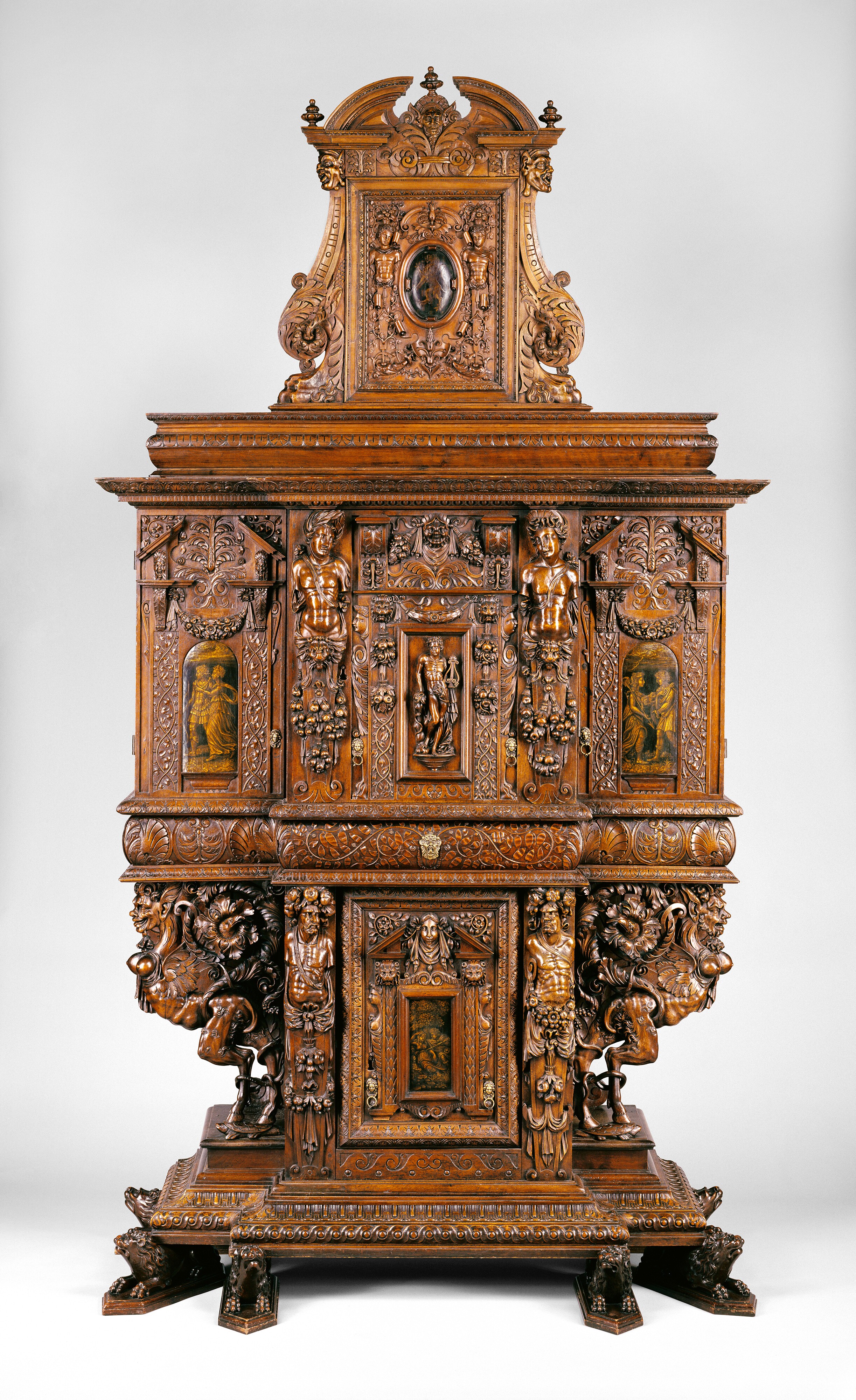
The record subject in full. Walnut and oak with painted panels and iron mounts, linen-and-silk lining, 307.7 x 153.4 x 57.2 cm. Believed for roughly thirty years to be a nineteenth-century fake, the cabinet was scientifically re-dated to 1580 following a 2001-2006 reexamination combining dendrochronology, radiocarbon dating and tool-mark analysis.
| Artist | Unknown maker, Burgundy, possibly the circle of Hugues Sambin |
|---|---|
| Date | 1580, with minor additions in the late 1850s |
| Medium | Walnut, oak, paint and iron, with a linen-and-silk lining |
| Dimensions | 307.7 x 153.4 x 57.2 cm (121 1/8 x 60 3/8 x 22 1/2 in.) |
| Where it is now | J. Paul Getty Museum, Los Angeles, Californialast confirmed |
| Inventory number | 71.DA.89 |
| Attribution | UnknownThe maker has never been established. Full note |
| Object type | Furniture |
| Period | French Renaissance (Mannerist), Burgundy |
| Cases | Has a provenance gap |
| Inscriptions | The date 1580 is painted on one of the cabinet's panels. The Getty Museum's own conservation team cross-checked this painted date against the dendrochronology result obtained in 2001-2005 and found the two consistent, once time is allowed for the oak to season and the cabinet to be built. |
| Owners on record | 10 links9 documented, 1 unknown |
| Sources | 20 cited |
About this record Last verified · 20 sources cited · Change log
On this page 10 sections
ContentsClose
A large walnut-and-oak cabinet, painted and iron-mounted, built in Burgundy in 1580 and dismissed for roughly thirty years as a nineteenth-century fake. J. Paul Getty bought it in 1971 for 1,700 dollars, against his own curators' advice, because its suspiciously pristine, wax-coated surface looked exactly like the many Renaissance Revival pastiches sold to American collectors a century earlier; fifty years before that it had reportedly carried an asking price of 46,640 dollars. A 2001 French exhibition on the Burgundian architect and designer Hugues Sambin sent a Getty curator to Ecouen, and the reexamination that followed, tree-ring dating the structural oak to 1574-75, radiocarbon dating the walnut and its silk-and-linen lining to 1400-1600, and matching sixteenth-century tool marks across both woods, overturned the fake verdict entirely.
The provenance behind that verdict is unusually rich for a piece of furniture: a possible 1596 mention in a Besancon nobleman's estate inventory, the celebrated Debruge-Dumenil and Prince Soltykoff collections of the Paris art world's golden age of medieval and Renaissance connoisseurship, the 7th Duke of Marlborough's Blenheim Palace, Baron Achille Seilliere's private museum at the Chateau de Mello, and half a century in the hands of Duveen Brothers before the entire remaining Duveen inventory passed to the Norton Simon Foundation in one of the largest dealer-stock sales in American art-market history. This record checks every link in that chain against sources independent of the Getty's own catalogue, and corrects two dates the Getty's own database appears to have gotten wrong along the way: a Soltykoff family conflation, and an acquisition window for Baron Seilliere that his own death date rules out.
Who actually carved it remains unknown. The Getty's own last word is honest about that, and this record follows it: Hugues Sambin is a plausible name, supported by real archival and stylistic circumstance, not a proven one.
Provenance
Each link is graded. Documented: a cited source supports it. Disputed: the identification is argued but not established. Unknown: no owner for that span, and the gap is not smoothed into a narrative. The grades in the glossary.
- 1580 -Unknown maker or workshop, Burgundydocumented
The date 1580 is painted on one of the cabinet's panels. Dendrochronology of the structural oak, carried out as part of the Getty Museum's 2001-2006 reexamination, dated the felling of the tree to late 1574 or early 1575 in Burgundy, a result the Museum states is consistent with the painted date once seasoning and construction time are allowed for. Minor additions were made to the cabinet in the late 1850s; see the note on the following link for the ownership window this falls within.123
- - 1596Possibly Fernand Gauthiot, lord of d'Ancier, Besanconunknown
A post-mortem household inventory of Gauthiot d'Ancier's estate, taken 1 April to 12 May 1596, describes two French Renaissance cabinets. One is identified with a cabinet now in the Musee du Temps, Besancon, independently dated to 1581. The Getty's own materials state the other 'may be the Getty cabinet,' based on close stylistic comparison between the two objects, not on an inventory description specific enough to name this cabinet outright. Graded as argued rather than documented for that reason.13
- - 1850Louis-Fidel Debruge-Dumenil (1778-1838), Paris, and his heirs after his deathdocumented
Debruge-Dumenil assembled one of the largest and most admired collections of medieval and Renaissance decorative art formed in nineteenth-century Paris, catalogued by his son-in-law Jules Labarte. He died in 1838; his heirs sold the collection twelve years later at the Hotel des Ventes Mobilieres, Paris, in a sale running 23 January to 12 March 1850. This cabinet was sold in the tenth session, 2 February 1850, as lot 1500, to Prince Soltykoff.167
- 1850 - 1861Prince Pierre (Peter/Petr) Soltykoff (1804-1889), Parisdocumented
Soltykoff, a Russian-born collector resident in Paris from around 1840, built one of the era's landmark collections of medieval and Renaissance decorative art, dispersed at the Hotel Drouot beginning 8 April 1861; a significant portion of that sale is now in the Victoria and Albert Museum. This cabinet was sold as lot 275 to John Winston Spencer-Churchill, 7th Duke of Marlborough. Minor additions recorded on the object's own date field as being made in the late 1850s fall entirely within this ownership window, since no other owner in the documented chain held the object during that decade; what was specifically added is not documented in the sources consulted. Note also that the Getty Museum's own linked-data record mislabels this owner's dates as 1806-1859, which are in fact the dates of a different family member, Alexey (Alexis) Saltykov; this record instead follows the 1804-1889 dates independently confirmed by the RKD, the National Gallery of Art's provenance files and the British Museum's authority record.189
- 1861 - 1873John Winston Spencer-Churchill, 7th Duke of Marlborough (1822-1883), Blenheim Palacedocumented
Bought at the 1861 Soltykoff sale. The Getty's own record states only that the Duke 'subsequently sold' the cabinet to Baron Achille Seilliere, without a date. Since Seilliere is independently documented as having died on 14 May 1873, and the 1890 sale catalogue of Seilliere's collection explicitly describes it as coming from the collection of the late Baron Seilliere, the transfer to Seilliere must have occurred within this window, not in the mid-1880s as a naive reading of the chain's sequence might suggest; the 7th Duke's own well-documented liquidation of the Marlborough Gems (1875) and the Sunderland Library (1881) under mounting financial pressure both post-date the latest possible year for this specific sale, so this transaction does not appear to belong to that later, better-known Blenheim financial crisis.11011
- 1861-1873 - 1890Baron Francois-Florentin-Achille Seilliere (1813-1873), Chateau de Mello, Oisedocumented
Banker, railway and Credit Foncier administrator, and book collector, who filled the Chateau de Mello with decorative art on a scale contemporaries described as a private museum. He died in 1873. His collection, including this cabinet, was sold seventeen years later by his heirs at the Galerie Georges Petit, Paris, catalogued by the dealer C. Mannheim as coming 'from the important collection of the late Baron Achille Seilliere,' 5-10 May 1890; this cabinet appears at pages 80-81, lot 540, illustrated.11213
- 1890 - 1916Davis Brothers, Londondocumented
Sold to Duveen Brothers, Inc. on 14 June 1916, per the Getty's own record. This record has not been able to independently confirm the specific history of a London dealership trading as Davis Brothers in this period; a documented dealer, Charles Davis, is recorded selling other furniture to Duveen Brothers in 1910, but no source consulted confirms whether this is the same firm.1
- 1916 - 1964Duveen Brothers, Inc., New Yorkdocumented
Held for close to half a century by the most influential decorative-arts dealership of the period, founded by Joseph Joel and Henry J. Duveen and built to its peak under Joseph Duveen's leadership (1909-1939). Sold on 18 April 1964 as part of the sale of the entire remaining Duveen Brothers inventory, roughly 800 objects together with the firm's New York gallery building and its library and archive, to the Norton Simon Foundation for a negotiated 4,000,000 dollars.1141516
- 1964 - 1971The Norton Simon Foundation, Fullerton/Pasadena, Californiadocumented
One of roughly 800 objects acquired in the wholesale 1964 purchase of the remaining Duveen Brothers inventory. Sold seven years later, 7 May 1971, as lot 193 at Parke-Bernet Galleries, New York, to J. Paul Getty for the museum that bears his name, for 1,700 dollars, a sale carried out as part of a broader 1970s dispersal by which the Foundation recouped part of its original 4,000,000-dollar outlay.11516
- 1971 - presentJ. Paul Getty Museum, Los Angelesdocumented
Bought by J. Paul Getty in person, against the stated advice of his own curatorial staff, who believed the cabinet was a nineteenth-century fake given its suspiciously pristine, wax-coated surface. The object was not exhibited for roughly three decades until a 2001 reexamination, triggered by a Getty curator's visit to a Sambin exhibition in France, produced dendrochronology, radiocarbon and tool-mark evidence supporting the 1580 date. The cabinet is now accession number 71.DA.89 and was the subject of the Getty's own exhibition 'A Renaissance Cabinet Rediscovered,' 22 November 2005 to 5 August 2007.123
Prices realised
| Date | Sale | Estimate | Result | Note |
|---|---|---|---|---|
| 2 February 1850 | Unnamed Paris auctioneer | Not published in sources consulted | Hammer Not published in sources consulted With premium Not published in sources consulted Not stated | Debruge-Dumenil collection sale, Hotel des Ventes Mobilieres, Paris, tenth session of a sale running 23 January to 12 March 1850. This cabinet was lot 1500, bought by Prince Soltykoff. Only the lot number is documented in the sources consulted; no price is given. |
| 8 April 1861 | Hotel Drouot | Not published in sources consulted | Hammer Not published in sources consulted With premium Not published in sources consulted Not stated | Prince Soltykoff collection sale, Paris, beginning 8 April 1861. This cabinet was lot 275, bought by the 7th Duke of Marlborough. Only the lot number is documented in the sources consulted; no price is given. |
| 9 May 1890 | Galerie Georges Petit | Not published in sources consulted | Hammer Not published in sources consulted With premium Not published in sources consulted Not stated | Posthumous sale of the collection of the late Baron Achille Seilliere, catalogued by the dealer C. Mannheim, Paris, running 5-10 May 1890. This cabinet appears at pages 80-81, lot 540, illustrated. Only the lot number and catalogue location are documented in the sources consulted; no price is given. |
| 7 May 1971 | Parke-Bernet Galleries | Not published in sources consulted | Hammer USD 1,700 With premium Not published in sources consulted USD | Sale of the cabinet from the Norton Simon Foundation, New York, lot 193, bought by J. Paul Getty for the J. Paul Getty Museum. The Getty's own exhibition materials state the price Getty paid as 1,700 dollars without specifying whether this figure is a hammer price or an all-in price; 1971-era Parke-Bernet sales of this kind typically did not carry a separate published buyer's premium of the modern kind, so this record treats 1,700 dollars as the effective purchase price rather than assuming an unstated premium on top of it. By comparison, an asking price of 46,640 dollars is recorded for the cabinet around 1921, roughly fifty years earlier, while it was in the Duveen Brothers inventory; using the published US CPI, 46,640 dollars in 1921 corresponds to approximately 870,000 dollars in 2026 purchasing power, and 1,700 dollars in 1971 corresponds to approximately 13,800 dollars in 2026 purchasing power. Both modern-equivalent figures are CPI-method approximations, not appraisals, and are given to illustrate the scale of the price collapse caused by thirty years of authenticity doubt, not as precise valuations. |
Hammer is the price at which the bidding stopped; with premium adds the fee the house charges the buyer on top. Hammer price and buyer's premium in the glossary.
Technical evidence
| Attribution note | The maker has never been established. The J. Paul Getty Museum's own published position, stated plainly on its object record, is that the cabinet's maker 'has yet to be established' and that 'it is possible that the most renowned Burgundian cabinetmaker of the period, Hugues Sambin, produced the piece.' A prior attribution to the engraver and architect Jacques I Androuet du Cerceau, on record in the Museum's own database, was formally marked obsolete as of 2005, the year before the reexamination that re-dated the object was published. No signature, mark, workshop stamp or contract survives. Every statement connecting the cabinet to Sambin by name is a proposal, not a documented fact, and this record treats it that way throughout. |
|---|---|
| Support and materials | Walnut and oak carcase and carving, iron mounts and hardware, painted panels, with a linen-and-silk lining inside the drawers and case.12 |
| Dimensions | 307.7 x 153.4 x 57.2 cm (121 1/8 x 60 3/8 x 22 1/2 in.), object measurement as recorded by the J. Paul Getty Museum.12 |
| Dendrochronology (oak) | The oak used for the cabinet's structural panels was felled in late 1574 or early 1575 in Burgundy, per the Getty Museum's own tree-ring analysis, a result the Museum states is consistent with the painted date of 1580 once seasoning and construction time are factored in.3 |
| Radiocarbon dating (walnut and textile) | Samples from the walnut components and from the frayed edges of the original silk-and-linen drawer lining returned radiocarbon dates between 1400 and 1600, ruling out a nineteenth-century origin for these materials.3 |
| Tool-mark and construction analysis | Rear surfaces carry marks from a hand-held saw and a plane of a type used in the sixteenth century. Matching 'bench dog' impressions appear on both the oak and walnut elements, indicating the two woods were worked on the same bench at the same period. Nail holes and fabric traces beneath a later red velvet covering preserve evidence of the original sixteenth-century lining, and tack and tack-hole analysis on the doors provided further physical corroboration.3 |
| Documented comparandum | A cabinet in the Musee du Temps, Besancon, independently and definitively dated to 1581, is identified by Getty curators as closely related in decoration and possibly by the same hand or workshop group; both objects may appear in the same 1596 Besancon household inventory.31 |
| Attribution record | A prior attribution to Jacques I Androuet du Cerceau is recorded in the Getty's own database as formally superseded, with an end date of 2005; no replacement attribution has been formally adopted, only the hedged proposal of the circle of Hugues Sambin.1 |
| Rights and digital imaging | The object record and its principal image are released by the J. Paul Getty Museum under a CC0 1.0 Universal / Public Domain dedication, with an open IIIF Image and Presentation API manifest available for the object.1 |
Images
The record in full
Chapter 1A two-tiered cabinet built to be looked at from across a room and read up close
The object is a large, freestanding, two-tiered cabinet, 307.7 centimetres tall, 153.4 wide and 57.2 deep: taller than a person, wider than a doorway, built of walnut and oak with painted panels and...
The object is a large, freestanding, two-tiered cabinet, 307.7 centimetres tall, 153.4 wide and 57.2 deep: taller than a person, wider than a doorway, built of walnut and oak with painted panels and iron mounts, and lined inside with linen and silk. It is not a piece of storage furniture in the ordinary sense. It is an architectural object in miniature, built with the same vocabulary of doors, orders, terms and pediments that a Burgundian mason would have used on a real facade, and it was made to stand in a room and be read the way a facade is read: from across the room as a single composition, and up close as a sequence of individually carved and painted incidents.
The upper section is closed by three doors. The centre door carries a carved figure of Apollo, based on a print made after a design by Raphael, set inside an elaborate surround of human figures, masks, curling foliage, flowers and scrollwork. The two flanking doors have arched panels inset with painted scenes rendered in yellow monochrome, a grisaille-like technique that lets painted narrative sit inside a carved architectural frame without competing with it for attention. The lower section repeats the scheme at a smaller scale: a further monochrome painting on its central door, and boldly carved griffins projecting from each end of the case, the kind of hybrid guardian beast that Northern Mannerist ornament borrowed wholesale from print sources circulating out of Italy and Fontainebleau. The very top of the cabinet, according to the Getty Museum's own published description of the object, originally carried a painted panel showing Saint Jerome. That panel is no longer part of the cabinet as it survives today, and none of the sources consulted for this record explain when or why it was removed.
Chapter 2Apollo above, Jerome above that: what the two figures were doing on the same object
The Getty Museum's own catalogue text is explicit that the carved Apollo on the upper central door is 'based on a print after Raphael,' and it is equally explicit that the vanished top panel showed...
The Getty Museum's own catalogue text is explicit that the carved Apollo on the upper central door is 'based on a print after Raphael,' and it is equally explicit that the vanished top panel showed Saint Jerome. No source consulted for this record identifies the specific print used for the Apollo figure by engraver or by the Raphael composition it reproduces, and this record does not guess at one; readers should treat the print's author as an open question, not as Marcantonio Raimondi or any other named printmaker, until a source states it.
What can be said without guessing is what the pairing does. Apollo, god of the arts, music, poetry and prophecy, is the standard classical shorthand for secular learning and for the patronage of culture; a Renaissance owner who put Apollo on the door of a cabinet was declaring, in the same visual language used on countless Italian and French studioli of the period, that the object inside belonged to a person of taste and letters. Jerome, the scholar-saint who translated the Bible into Latin in a wilderness cell surrounded by his books, is the standard shorthand for exactly the opposite half of the same idea: contemplative, textual, penitential learning, sanctified rather than secular. A cabinet that put a pagan god of culture at its centre and a Christian scholar-saint at its crown was not making a private esoteric argument. It was making the entirely ordinary and very widely documented Renaissance argument that classical learning and Christian devotion were two faces of one educated life, an argument repeated on hundreds of surviving studioli, book-cases, and cabinet fronts of the period. This record finds no evidence, and no scholar cited in the Getty's own bibliography argues, that the programme carries any narrower or more private meaning than that. The absence of a hidden programme is itself the finding here: this is a proud, legible, entirely orthodox humanist-Christian statement of what its owner wanted a visitor to think of him, not a coded message.
Chapter 3An unknown maker, a withdrawn attribution, and a name that will not quite attach
No documentary evidence names who built this cabinet.
No documentary evidence names who built this cabinet. The Getty Museum, which has spent more research effort on this single object than on almost anything else in its decorative arts department, states the position plainly: the maker 'has yet to be established.' That sentence sits in the Museum's own public-facing catalogue text, not in a footnote, and this record follows it.
For most of the twentieth century the cabinet carried an attribution to Jacques I Androuet du Cerceau, the engraver, architect and ornament-designer whose published furniture etchings, gathered as an album around 1580, were among the most widely circulated pattern sources in Northern Europe. The Getty's own linked-data record for the object carries a formal attribute-assignment marking that attribution 'Obsolete,' with an end date of 2005, the year before Jack Hinton and Arlen Heginbotham published the technical study that re-dated the cabinet. Du Cerceau's furniture designs were never intended, on the evidence of specialists who have studied the surviving album, to be built literally; they were what one bookseller's catalogue description of the plates calls 'repertories of ideas,' pattern sources meant to be adapted by cabinetmakers, goldsmiths, embroiderers and other craftsmen working in entirely different media. An attribution built on stylistic resemblance to a pattern book that nobody expected to be followed exactly was always going to be fragile, and it did not survive the 2001-2006 reexamination.
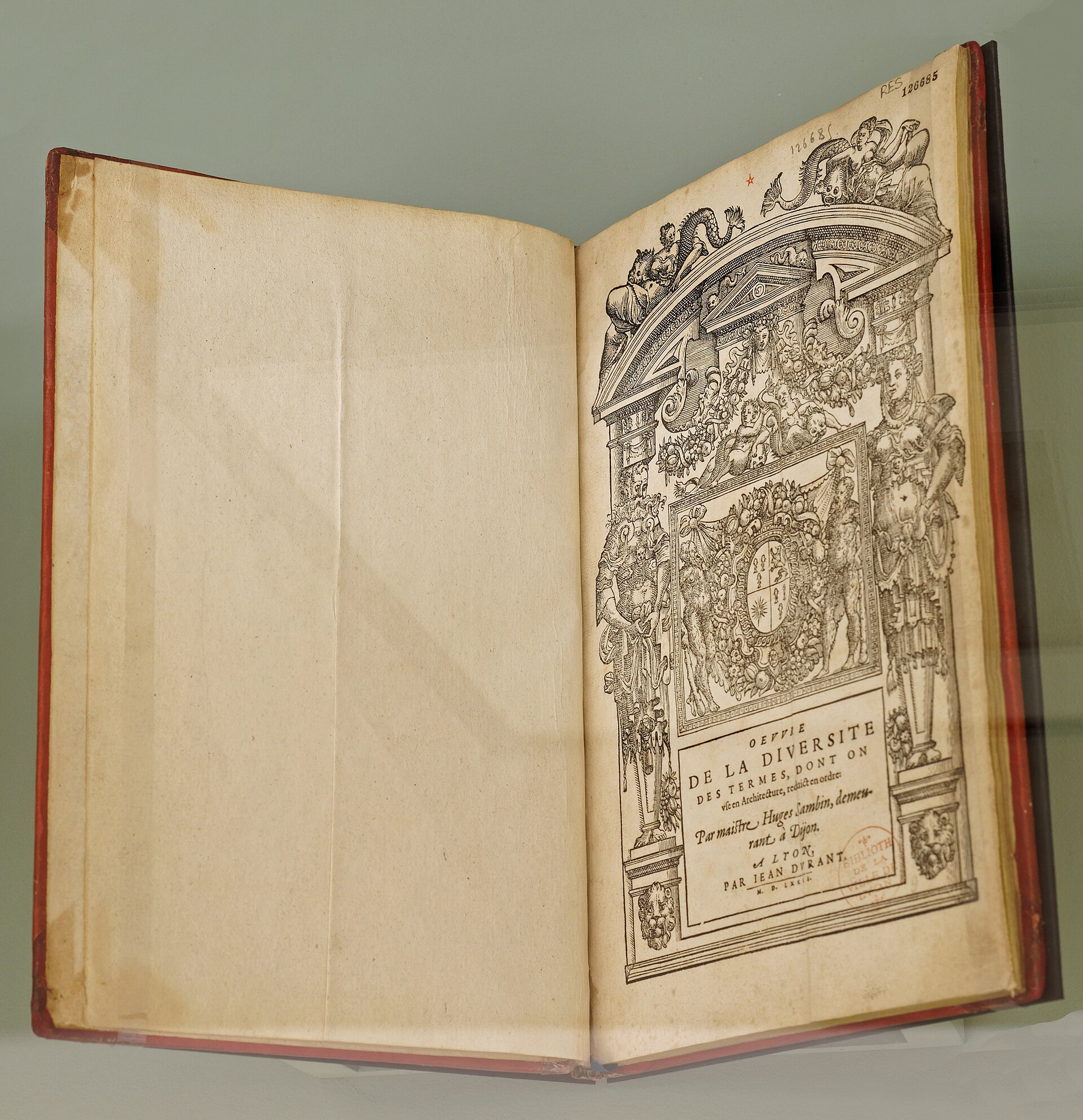
In its place the Getty now offers, carefully hedged, a different name: Hugues Sambin, the Dijon-based architect, sculptor and ornament designer whose own engraved pattern book of anthropomorphic terms, published in Lyon in 1572, supplied exactly the vocabulary of masks, scrolling foliage and hybrid figures visible on this cabinet's doors. The Getty's own text states the case as a possibility, not a finding: 'it is possible that the most renowned Burgundian cabinetmaker of the period, Hugues Sambin, produced the piece,' adding, with real honesty about the limits of the evidence, that 'even if neither artist contributed to this cabinet, their designs for similar cabinets and decoration almost certainly influenced the artist who did.' That sentence is the single most useful thing the Museum says about attribution, because it tells a reader exactly how much weight the Sambin name can bear: not authorship, but atmosphere. The cabinet was made by someone working inside the visual world Sambin and du Cerceau had built with their engravings, not necessarily by either man.
Chapter 4Hugues Sambin, the man behind the proposal
Sambin (c. 1520-1601) was a documented figure of considerable local standing in Dijon, the seat of the old Duchy of Burgundy.
Sambin (c. 1520-1601) was a documented figure of considerable local standing in Dijon, the seat of the old Duchy of Burgundy. Trained originally as a menuisier, a woodworker, he built a career that spanned sculpture, architectural design and print publishing, and he signed the preface to his own book 'Hugues Sambin, Architecteur en la ville de Dijon,' a title he clearly felt he had earned. His major documented architectural commission is the building that housed the Parlement of Burgundy at Dijon, constructed from 1572, the same decade this cabinet was made; he also worked on the Parlement of Besancon and on temporary festival architecture for the royal entries of Henri II and Charles IX into Dijon. His book, 'L'Oeuvre de la diversite des termes dont on use en architecture,' printed at Lyon in 1572, is devoted entirely to term figures, the hybrid human-and-pedestal supports that classical theorists such as Vitruvius mention only in passing and that neither Vignola nor Palladio bothered to illustrate. Sambin made that neglected ornamental form his specialty, and pieces of French Renaissance furniture carrying exactly that vocabulary of carved terms are, as a class, sometimes loosely called cabinets in the manner of Sambin by the trade and by some scholars, without any claim that he personally carved them.
The direct link between Sambin scholarship and this cabinet's rehabilitation is documented and specific. In 2001 the Musee national de la Renaissance at Ecouen, outside Paris, mounted an exhibition on Sambin, resulting in the catalogue 'Hugues Sambin: Un createur au XVIe siecle' by Alain Erlande-Brandenburg and others. According to the Getty's own account of its reexamination, a Getty curator travelled to Ecouen to meet the scholars behind that exhibition, and it was that visit which triggered the Museum's decision to reexamine its own long-doubted cabinet from scratch. A French academic project on a documented regional master directly produced the rehabilitation of an American museum's rejected object. That is a plainer and better-evidenced story than any claim that Sambin personally held a chisel to this wood, and it is the story this record tells.
Chapter 5J. Paul Getty bought it against his own curators' advice, for $1,700
The cabinet entered the Getty collection in 1971, bought by J.
The cabinet entered the Getty collection in 1971, bought by J. Paul Getty himself and, on the Museum's own account, over the objections of the curatorial staff who were supposed to be advising him. Their objection was not vague unease. The cabinet was, in the Museum's own words, 'in suspiciously pristine condition,' and its surface was coated in coloured wax, the classic nineteenth-century trick for making new carving look old. The professional judgement of the day, stated by the Museum itself, was that the object was 'a product of the Renaissance Revival of the 19th century, when American industrial magnates snapped up Renaissance-style furniture, including many fakes, from cash-strapped European aristocrats.' This was not an eccentric worry specific to one object. The market for French Renaissance and pseudo-Renaissance furniture sold to American Gilded Age collectors has its own scholarly literature precisely because the two categories were and remain difficult to tell apart at a glance; Wolfram Koeppe's 1994 study of exactly that market, cited in the Getty's own bibliography for this object, exists because so much of what nineteenth-century Paris workshops built in the goinginto-eclipse Henri II revival style was subsequently sold, knowingly or otherwise, as the genuine sixteenth-century article.
The price tells the same story more bluntly than any adjective could. Getty paid $1,700 for the cabinet in 1971. Fifty years earlier, around 1921, it had reportedly carried an asking price of $46,640, a figure the Museum's own exhibition materials give without further attribution but which sits squarely inside the years when Duveen Brothers held the piece (the firm bought it in 1916). Converting by the published US Consumer Price Index, $46,640 in 1921 corresponds to roughly $870,000 in 2026 purchasing power, and $1,700 in 1971 corresponds to roughly $13,800 in 2026 purchasing power; both figures use the CPI method published by the US Bureau of Labor Statistics as compiled by in2013dollars.com, and both are approximations, not appraisals. Whatever the exact 1921 asking price bought, in real terms the object's recognised market value collapsed by roughly two orders of magnitude between an early-twentieth-century dealer's asking price and the price a doubtful buyer was willing to pay half a century later. That collapse is the price of being called a fake, expressed in dollars, and it is the single clearest number in this entire record.
Chapter 6Unexhibited for thirty years, and then a French exhibition changed everything
Having bought a cabinet his own staff believed was a fake, Getty did not display it.
Having bought a cabinet his own staff believed was a fake, Getty did not display it. The Museum's own account is direct: the object was 'never displayed in the Getty Museum until now,' referring to the 2005-2007 exhibition that told this very story. For roughly three decades the cabinet sat unseen in storage, catalogued as a probable nineteenth-century deception, while the Museum's decorative arts department built its reputation on objects nobody doubted.
The reversal began in 2001, and it began outside the Getty entirely. When curators in France organised the Ecouen exhibition on Hugues Sambin described above, a Getty curator travelled to meet the scholars working on it. On returning, according to the Museum's own account, that curator decided to launch a full reexamination of the Getty's own cabinet. The Museum does not name the curator in the exhibition text quoted here, though Gillian Wilson, who founded and led the Getty's Department of Decorative Arts from the Museum's early years and who by 2001 had spent three decades building its European furniture and sculpture holdings, is the person most plausibly in that role on the strength of her tenure and title; this record states that identification as a plausible inference from her documented position and dates, not as a fact stated by the sources consulted, because none of the sources fetched for this record names her specifically in connection with the 2001 Ecouen visit.
Chapter 7What the tree rings, the carbon and the tool marks actually said
The reexamination that followed was multidisciplinary, and the Getty's own exhibition materials describe each strand of it in enough detail to be usable by a student rather than merely...
The reexamination that followed was multidisciplinary, and the Getty's own exhibition materials describe each strand of it in enough detail to be usable by a student rather than merely asserted.
Dendrochronology, tree-ring dating, was applied to the cabinet's structural oak panels. The wood cannot lie about its own growth rings once matched against a regional reference chronology, and the result placed the felling of the oak tree used for the cabinet's structural panels in late 1574 or early 1575, in Burgundy. Factoring in the months needed to season the timber and the time needed to build a large, elaborately carved cabinet, the Museum states plainly that this result 'coincides with the date of 1580 painted on the cabinet.' The painted date and the felled tree agree with each other, which is exactly the kind of independent-lines-of-evidence convergence that authentication depends on.
Oak can be dated by its rings; the cabinet's decorative walnut, with its irregular grain, cannot, so the team turned to radiocarbon dating instead. Tiny samples were taken from the walnut and from the frayed edges of the silk and linen lining found in the middle drawer. All of the samples returned dates between 1400 and 1600, a two-hundred-year radiocarbon window that is consistent with, though far less precise than, the 1580 date supplied by the dendrochronology and the painted inscription. Radiocarbon dating cannot by itself prove a sixteenth-century date; what it can do, and did here, is rule out the specific hypothesis under test, that the wood and lining were nineteenth-century materials made to look old. A radiocarbon result of 1750-1900 would have confirmed the fake theory outright. A result of 1400-1600 does the opposite.
The third line of evidence was the oldest kind of connoisseurship there is: looking closely at tool marks. The rough, unseen surfaces on the back of the cabinet carry marks left by a hand-held saw and by a type of plane in use during the sixteenth century, not later machine-assisted tools. More tellingly, both the walnut and the oak components carry identical impressions from a 'bench dog,' a toothed iron clip used to hold wood steady on a workbench, indicating that the two different woods were worked on the same bench at roughly the same time rather than assembled from parts of different ages. Underneath a later covering of red velvet, conservators found old nail holes from an earlier lining, holding traces of the original sixteenth-century fabric that still lines the drawer beneath the newer covering, and further analysis of the tacks and tack holes on the cabinet's doors provided additional physical confirmation. None of these three strands of evidence, tree rings, radiocarbon dates, or tool marks, was individually sufficient on its own to overturn thirty years of curatorial doubt. Together, converging on the same decade from three unrelated scientific and observational methods, they were.
Chapter 8A 1596 inventory, a sister cabinet in Besancon, and the first name in the chain
Alongside the laboratory work, Getty curators went back into the archives, and found the earliest documented reference to an object that may be this one.
Alongside the laboratory work, Getty curators went back into the archives, and found the earliest documented reference to an object that may be this one. A post-mortem household inventory of the estate of Fernand Gauthiot, lord of d'Ancier, of Besancon, taken between 1 April and 12 May 1596, describes two French Renaissance cabinets. One of the two is identified with a cabinet now in the Musee du Temps in Besancon, which independent scholarship has definitively dated to 1581. The other, the Getty's own materials state, 'may be the Getty cabinet.' Curators compared the carved and painted decoration of the two objects closely and found, in the Museum's words, 'minute clues and subtle coincidences of style' suggesting the two cabinets may have come from the same artist or workshop group. This is precisely the kind of connection the Getty's own provenance record reflects when it lists 'Possibly Gauthiot d'Ancier (Besancon, France), by 1596' as the earliest identifiable owner: the word 'possibly' is doing real, honest work in that sentence, because the identification rests on an inventory description matched to physical evidence, not on a name written on the object itself. This record grades that link as documented for the existence of the 1596 Besancon inventory and its description of two French Renaissance cabinets, and as argued, not documented, for the specific identification of one of those two cabinets with the object now at the Getty.
If the identification holds, it places the cabinet in Burgundy, in a household of the regional nobility, within roughly sixteen years of its manufacture, which is exactly the kind of early, geographically consistent provenance link that gives an authentication case its strongest support. It also gives this cabinet a documented sibling: the 1581 Besancon cabinet is a fixed, independently dated comparandum sitting in a public French collection today, against which every stylistic claim about this object can be checked by any reader able to travel to the Musee du Temps.
Chapter 9A three-century silence, then Debruge-Dumenil's vast Paris collection
Between the 1596 Besancon inventory and the middle of the nineteenth century, no source consulted for this record places the cabinet anywhere.
Between the 1596 Besancon inventory and the middle of the nineteenth century, no source consulted for this record places the cabinet anywhere. That gap, roughly two hundred and fifty years, is recorded here as a gap rather than bridged with invention.
The chain resumes with Louis-Fidel Debruge-Dumenil (7 December 1778 - 6 December 1838), a Paris collector whose holdings in decorative arts, arms, ceramics and medieval and Renaissance objects had grown, by the time of his death, to a scale a specialist database of French art historians describes in the thousands of objects. His son-in-law, the scholar Jules Labarte, catalogued the collection in a published 'Description des objets d'art qui composent la collection Debruge-Dumenil,' and it was this Labarte catalogue, not an auctioneer's list, that fixed the collection's reputation as one of the most important assemblages of medieval and Renaissance decorative art formed anywhere in the nineteenth century. Debruge-Dumenil died in 1838; his heirs retained the collection for twelve years afterward before finally dispersing it at the Hotel des Ventes Mobilieres in Paris across a marathon sale running from 23 January to 12 March 1850. The Getty's own record places this cabinet in that sale's tenth session, on 2 February 1850, as lot 1500, sold to the next owner in this chain, Prince Soltykoff. A collection catalogued so thoroughly and sold in a single documented public sale gives this link in the chain unusually solid footing: this record grades Debruge-Dumenil's ownership and the 1850 sale as documented.
Chapter 10Prince Soltykoff, the 1861 sale, and a date that the Getty's own database gets wrong
The buyer at the 1850 Debruge-Dumenil sale was Prince Pierre, also written Petr or Pyotr, Soltykoff, a Russian-born nobleman who had settled in Paris around 1840 and built one of the era's most...
The buyer at the 1850 Debruge-Dumenil sale was Prince Pierre, also written Petr or Pyotr, Soltykoff, a Russian-born nobleman who had settled in Paris around 1840 and built one of the era's most admired collections of medieval and Renaissance decorative art in his own right. Soltykoff's collection was dispersed at the Hotel Drouot in Paris beginning 8 April 1861, a sale itself remembered as one of the landmark decorative-arts auctions of the nineteenth century; a significant share of what was sold there is now in the Victoria and Albert Museum in London. The Getty's own record places this cabinet in that sale as lot 275, sold on to the next owner, John Winston Spencer-Churchill, 7th Duke of Marlborough.
This is also the point in the chain where independent verification catches a real error, and it is worth stating exactly what the error is rather than silently repeating either the wrong figure or the right one without comment. The Getty's own linked-data record for this object labels this ownership event 'Prince Soltykoff (1806-1859).' Those dates belong to a different man: Alexey (Alexis) Saltykov, a Russian traveller, artist and writer, one of Prince Pierre Soltykoff's younger relatives, who is independently documented as living 1806-1859 and who is separately recorded selling his own book and print collection at Drouot under his own name. The collector who actually owned this cabinet, sold his collection in the landmark 1861 sale, and is independently tracked by the RKD art-historical database, the National Gallery of Art's own provenance files, and the British Museum's authority records, lived 1804-1889. This record follows the 1804-1889 dates, sourced independently of the Getty, and flags the Getty's own internal date label as a probable data-entry conflation between two different men who shared a family name and a first initial. It is exactly the kind of small cataloguing error this publication exists to catch, and it changes nothing about the provenance chain itself: the Soltykoff who owned this cabinet from 1850 to 1861 is Prince Pierre Soltykoff, regardless of which set of dates a database field attaches to him.
Chapter 11The mystery of the late-1850s additions
The Getty's own date field for this object does not simply say 1580.
The Getty's own date field for this object does not simply say 1580. It says 1580, with minor additions in the late 1850s. That detail places the alteration squarely inside Prince Soltykoff's eleven-year ownership window, 1850 to 1861, since he is the only owner in the documented chain who held the cabinet at any point in that decade. No source consulted for this record, including the Getty's own published bibliography, states specifically what was added, altered or replaced in the late 1850s, or names who carried out the work. It is entirely possible, and consistent with ordinary nineteenth-century collecting practice, that Soltykoff had the cabinet conserved, re-lined, or had a missing or damaged element restored to make it presentable for exhibition in his own collection or for eventual sale; it is equally possible the additions are more substantial. This record states plainly that the specifics are not known from the sources consulted, and records it as an open question rather than guessing at an answer the evidence does not support.
Chapter 12Blenheim Palace, and a sale that predates the family's famous financial crisis
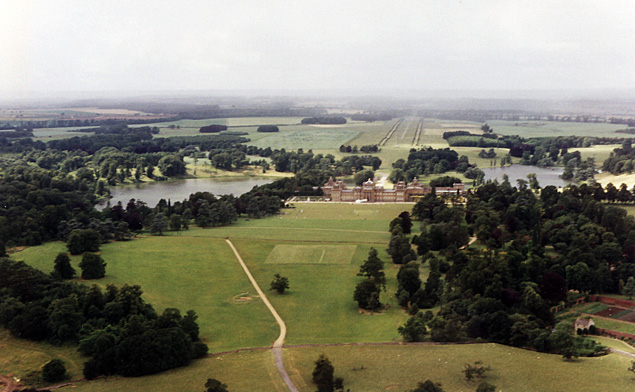
The buyer at the 1861 Soltykoff sale was John Winston Spencer-Churchill, 7th Duke of Marlborough (1822-1883), the owner of Blenheim Palace in Oxfordshire and an ancestor of Winston Churchill.
The buyer at the 1861 Soltykoff sale was John Winston Spencer-Churchill, 7th Duke of Marlborough (1822-1883), the owner of Blenheim Palace in Oxfordshire and an ancestor of Winston Churchill. The 7th Duke's later financial difficulties at Blenheim are extensively documented: by the 1870s the family was in serious trouble, and the Duke sold the Marlborough Gems, a celebrated collection of ancient gems and cameos assembled by an earlier Duke, in 1875, reportedly raising around 10,000 pounds, and in 1881 secured a private Act of Parliament, the Blenheim Settled Estates Act, specifically to permit the sale of estate property that had previously been legally protected, using it to sell the Sunderland Library and raise a further 60,000 pounds. The Blenheim collection was also famously sold off in a large Christie's picture sale of 1886, three years after the 7th Duke's death, under his son.
This cabinet's own departure from the Marlborough collection does not appear to belong to that well-known crisis. The documented financial liquidation at Blenheim runs from the mid-1870s through 1886; the cabinet, on the Getty's own account, passed from the 7th Duke to Baron Achille Seilliere at a date the Museum's record does not pin down precisely, but which, for reasons set out in the next section, is more likely to fall in the 1860s than in the 1880s. If that reasoning holds, this cabinet left Blenheim as an ordinary private sale by a collector still solvent enough to be exercising taste rather than raising cash under legislative compulsion, a genuinely different transaction from the gem and library sales that followed a decade or more later. This record states that distinction as the balance of the evidence rather than as a certainty, because no source consulted gives an exact year for the Marlborough-to-Seilliere transfer.
Chapter 13Baron Achille Seilliere, a posthumous sale, and a second correction to the chain
Baron Francois-Florentin-Achille Seilliere (1813 - 14 May 1873) was a banker, an administrator of the Compagnie des chemins de fer de l'Est and of the Credit Foncier, and the owner of the Chateau de...
Baron Francois-Florentin-Achille Seilliere (1813 - 14 May 1873) was a banker, an administrator of the Compagnie des chemins de fer de l'Est and of the Credit Foncier, and the owner of the Chateau de Mello in the Oise, which he filled with furniture, clocks, enamels, paintings and precious objects on a scale contemporary accounts describe as turning the chateau into a private museum. He was, independently, a noted book collector; his library was significant enough to be the subject of its own bibliographic history.
Here the chain requires a second correction of the same kind as the Soltykoff dates. Seilliere died in 1873. The sale that dispersed his collection, held at the Galerie Georges Petit in Paris and catalogued by the dealer C. Mannheim under the title 'Catalogue des objets d'art de haute curiosite et de riche ameublement provenant de l'importante collection de feu M. le baron Achille Seilliere,' ran across several days in May 1890, seventeen years after his death; the French word 'feu' in that title means precisely 'the late,' confirming this was an estate sale conducted by Seilliere's heirs, not a sale by the man himself. It follows that Seilliere's own acquisition of the cabinet from the Duke of Marlborough's collection must have occurred while he was alive, that is, at some point between 1861, when the Duke bought it, and 1873, when Seilliere died, and not in the mid-1880s, a timeframe that would place the purchase a decade after the buyer's death. This record therefore states the Marlborough-to-Seilliere transfer as falling within 1861-1873, bounded by two documented facts, Marlborough's 1861 purchase and Seilliere's 1873 death, rather than repeating an unsourced mid-1880s estimate that cannot be reconciled with Seilliere's own dates. The precise year within that twelve-year window is not established by any source consulted for this record and is carried forward here as an open question.
The 1890 sale itself is well documented: the Mannheim catalogue lists this cabinet at pages 80-81, as lot 540, illustrated, among the objects sold from Seilliere's Chateau de Mello estate.
Chapter 14Davis Brothers, Duveen Brothers, and the Anglo-American decorative arts trade
The cabinet's next documented owner is a London firm the Getty's own record names as Davis Brothers, which sold it on to Duveen Brothers, Inc.
The cabinet's next documented owner is a London firm the Getty's own record names as Davis Brothers, which sold it on to Duveen Brothers, Inc. on 14 June 1916. This record has not been able to independently confirm the precise identity or history of a London dealership trading specifically under the name Davis Brothers in this period; the closest documented figure found in the course of this research is Charles Davis, a London antique dealer recorded selling a suite of tapestry-covered furniture to Duveen Brothers in June 1910 for 24,000 pounds, a transaction of the right kind, in the right decade, with the right trading partner, but this record does not assert that Charles Davis and Davis Brothers are the same dealership without a source that says so directly, and none of the sources consulted makes that connection explicitly. It is recorded here as an open question rather than resolved by assumption.
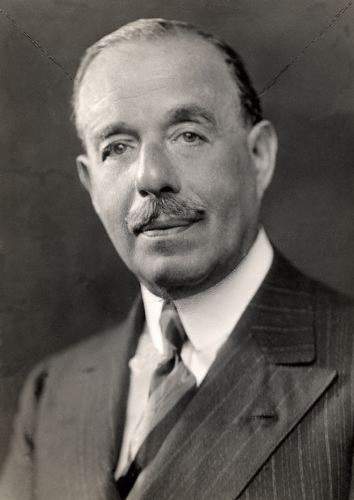
What is unambiguous is the buyer. Duveen Brothers, founded by the Dutch-born brothers Joseph Joel Duveen and Henry J. Duveen and built into its dominant position under Joseph Duveen's leadership between 1909 and 1939, was for the first four decades of the twentieth century the single most influential firm in the trade of European art and antiques to American collectors, a business built, in Joseph Duveen's own later paraphrase, on the observation that Europe had a great deal of art and America had a great deal of money. The firm's dealings in French decorative arts and Renaissance-attributed furniture specifically are documented at length in Charlotte Vignon's 2019 study for the Frick Collection, which discusses this cabinet directly, citing it at page 228-229 with an illustration. Duveen Brothers held the cabinet for close to half a century, from 1916 until the firm's entire remaining inventory was sold in 1964.
Chapter 15Norton Simon buys the whole of Duveen, and sells the cabinet on within seven years
Duveen Brothers effectively ceased trading with the death of Joseph Duveen in 1939, and the firm's remaining stock sat largely unsold for a quarter-century afterward.
Duveen Brothers effectively ceased trading with the death of Joseph Duveen in 1939, and the firm's remaining stock sat largely unsold for a quarter-century afterward. On 18 April 1964, the industrialist and collector Norton Simon, through the Norton Simon Foundation, purchased the entirety of what remained: close to 800 objects, spanning Flemish tapestries, Italian marble sculpture and Old Master paintings, together with the Duveen gallery building itself at 18 East 79th Street in New York and its four-thousand-volume reference library and archive. The negotiated price, according to Sara Campbell's institutional history of the deal, was 4,000,000 dollars, structured in part to fund a pension for most of the outgoing Duveen staff. It was, by any measure, one of the single largest wholesale transfers of an entire dealer's inventory in the history of the American art trade, and this cabinet was one of the roughly 800 objects that changed hands in it.
Norton Simon did not intend to keep most of what he had bought. Through a series of decorative arts and furniture sales across the 1970s, the Foundation worked to recoup a substantial part of its four-million-dollar outlay, retaining primarily paintings, a small number of sculptures and porcelains, and a handful of other pieces; of the original Duveen purchase, roughly 130 objects remained in the Norton Simon collections in the long run. This cabinet was sold off in that dispersal, at Parke-Bernet Galleries in New York on 7 May 1971, as lot 193, where it was bought by J. Paul Getty for the museum that bears his name, at the price of 1,700 dollars discussed above. The Norton Simon Foundation's ownership of this specific cabinet therefore lasted only seven years, a brief stopover inside a single much larger transaction, and the object was already carrying the taint of the 'probably a fake' verdict by the time it changed hands again.
Chapter 16What is unresolved
Several genuine gaps remain in this record, recorded here rather than smoothed over.
Several genuine gaps remain in this record, recorded here rather than smoothed over. The identity of the maker is unresolved and, on the Getty's own repeated statement, may never be resolved; Hugues Sambin remains a proposal supported by stylistic and archival circumstance, not a documented attribution. The exact nature of the late-1850s additions made during Prince Soltykoff's ownership is not described in any source consulted. The precise year the cabinet passed from the 7th Duke of Marlborough to Baron Achille Seilliere is not stated in any source consulted, and can only be bounded, not fixed, by the two death and purchase dates that are documented. The identity of the London firm 'Davis Brothers' and its possible relationship to the documented dealer Charles Davis is unconfirmed. The fate of the cabinet's original top panel showing Saint Jerome, described by the Getty as no longer present, is not addressed by any source consulted. And the full text of the 2006 Burlington Magazine article by Jack Hinton and Arlen Heginbotham, the single most detailed technical account of the reexamination, was not directly accessible during the preparation of this record; every technical claim drawn from that reexamination here is instead sourced to the Getty Museum's own public exhibition materials, which describe the same findings in the Museum's own words.
The artist
Unknown Burgundian maker or workshop, proposed but unconfirmed connection to Hugues Sambin (c. 1520-1601), architect and ornament designer of Dijon
No maker's name attaches to this cabinet with certainty, and the J. Paul Getty Museum says so in its own words. What follows is therefore not a biography of the cabinet's maker but a dossier on the one historical figure whose name the Museum itself has proposed in connection with the piece, set out exactly as far as the evidence will carry it and no further.
Related works
| Work | Relation | Where it is |
|---|---|---|
| Cabinet, dated 1581 Unknown Burgundian maker | Independently and definitively dated sister object, described in the same 1596 Besancon household inventory that may also describe the Getty cabinet; Getty curators found close stylistic parallels suggesting a shared workshop. The strongest single comparandum for this object and a fixed, independently published date against which every stylistic claim here can be checked. | Musee du Temps, Besancon, France |
| L'Oeuvre de la diversite des termes dont on use en architecture Hugues Sambin | Printed ornament pattern book (Lyon, 1572) supplying the vocabulary of masks, hybrid term figures and scrolling foliage used on this cabinet's doors. The proposed but unproven link between this book's ornamental vocabulary and this cabinet is the entire basis of the Sambin attribution proposal. | Multiple institutional copies, including the Bibliotheque municipale de Lyon and the Bibliotheque nationale de France (Gallica) |
| Album of etched furniture designs Jacques I Androuet du Cerceau | Formerly the basis of this cabinet's attribution, until that attribution was marked obsolete by the Getty in 2005. A cautionary comparandum: an entire twentieth-century attribution built on this album's stylistic resemblance did not survive independent scientific testing. | Dispersed; example leaves and albums held by institutions including the Metropolitan Museum of Art and the Bibliotheque nationale de France |
| Cabinet Attributed to Bernard II van Risenburgh and other makers, various dates | A different Getty Museum object also catalogued simply as 'Cabinet,' accession 79.DA.58, associated with the Baumhauer workshop and an entirely different date, style and maker Recorded here explicitly for version safety. This is NOT the object described in this record and shares only an institution and a generic title with it. | J. Paul Getty Museum, Los Angeles |
| Der Kunstschrank aus dem Museum Faesch Unknown maker (comparandum discussion) | A related German/Swiss Kunstschrank discussed by Wolfgang Loescher in a 2012 study cited in the Getty's own bibliography for this object, used by specialists as a comparative case in the study of elaborate Northern Renaissance cabinet construction. Cited by the Getty's own researchers as a point of comparison for cabinet construction methods of the period, not as a directly related object. | Historisches Museum Basel |
Open questions
- Who actually built this cabinet? The Getty Museum's own position is that the maker 'has yet to be established'; the connection to Hugues Sambin is explicitly a proposal, not a documented attribution.
- What, specifically, was added or altered to the cabinet in the late 1850s, and on whose instruction? No source consulted describes the content of these additions, though the date falls entirely within Prince Soltykoff's 1850-1861 ownership.
- In what year did the cabinet pass from the 7th Duke of Marlborough to Baron Achille Seilliere? It must fall between 1861 (Marlborough's purchase) and 1873 (Seilliere's death), which rules out a mid-1880s date sometimes assumed from the sequence of the chain, but no source consulted gives the precise year.
- Was the London firm recorded as 'Davis Brothers,' which sold the cabinet to Duveen Brothers in 1916, the same business as the documented dealer Charles Davis, who sold other furniture to Duveen in 1910? No source consulted makes this connection explicitly.
- What happened to the cabinet's original top panel depicting Saint Jerome? The Getty's own description states the panel was originally part of the cabinet and does not appear to be present today, without explaining when or why it was removed.
- What does the full text of Hinton and Heginbotham's 2006 Burlington Magazine article add beyond what the Getty's own public exhibition materials state? That article was not directly accessible during the preparation of this record and represents the single most detailed technical account of the reexamination.
- Does the Getty's own internal database ever correct its apparent conflation of Prince Pierre Soltykoff (1804-1889), the actual owner of this cabinet, with Alexey (Alexis) Saltykov (1806-1859), a different member of the same family independently documented as a travel writer and collector in his own right?
Questions about this object
What is Cabinet?
Cabinet is a furniture, dated 1580, with minor additions in the late 1850s. Medium: Walnut, oak, paint and iron, with a linen-and-silk lining.
Who made Cabinet, and is the attribution settled?
The attribution to Unknown maker, Burgundy, possibly the circle of Hugues Sambin is recorded here as unknown. The maker has never been established. The J. Paul Getty Museum's own published position, stated plainly on its object record, is that the cabinet's maker 'has yet to be established' and that 'it is possible that the most renowned Burgundian cabinetmaker of the period, Hugues Sambin, produced the piece.' A prior attribution to the engraver and architect Jacques I Androuet du Cerceau, on record in the Museum's own database, was formally marked obsolete as of 2005, the year before the reexamination that re-dated the object was published. No signature, mark, workshop stamp or contract survives. Every statement connecting the cabinet to Sambin by name is a proposal, not a documented fact, and this record treats it that way throughout.
Where is Cabinet now?
J. Paul Getty Museum, Los Angeles, California. Inventory number 71.DA.89. Last confirmed 3 September 2026. The Getty Museum's own collection database and linked-data API, verified directly against the object's permalink and its Linked Art JSON-LD record.
What has Cabinet sold for?
Hammer Not published in sources consulted; with premium, Not published in sources consulted. Unnamed Paris auctioneer, 1850-02-02.
What is still unknown about Cabinet?
Who actually built this cabinet? The Getty Museum's own position is that the maker 'has yet to be established'; the connection to Hugues Sambin is explicitly a proposal, not a documented attribution.
Sources
- 1J. Paul Getty Museum, 'Cabinet' (accession 71.DA.89), Linked Art / CIDOC-CRM JSON-LD collection record, fetched directly from the Museum's own linked-data API, including its provenance, production, dimension, rights and bibliography fields. data.getty.edu/museum/...
- 2J. Paul Getty Museum, 'Cabinet,' Museum Collection object page, permalink 103RKD. getty.edu/art/...
- 3J. Paul Getty Museum, exhibition 'A Renaissance Cabinet Rediscovered,' Getty Center, 22 November 2005 - 5 August 2007, full exhibition text describing the purchase, the doubts, and the dendrochronology, radiocarbon and tool-mark reexamination. getty.edu/art/...
- 4Wikipedia, 'Hugues Sambin,' for his biography, his 1572 pattern book and his documented architectural commissions. en.wikipedia.org/wiki/...
- 5Robin Halwas Rare Books, catalogue description of an album of etched furniture designs by Jacques I Androuet du Cerceau, gathered circa 1580, describing their function as pattern repertories rather than literal working drawings. robinhalwas.com/016019-designs-for-furnishing-cupboards-s...
- 6AGORHA (Institut national d'histoire de l'art), biographical record for 'Debruge-Dumenil, Louis Fidel (07/12/1778 - 06/12/1838), Paris.' agorha.inha.fr/ark:/...
- 7National Gallery of Art, Washington, provenance authority record for 'Louis Fidel Debruge Dumenil.' nga.gov/artworks/...
- 8RKD (Netherlands Institute for Art History), artist/collector record for 'Petr Soltykoff,' giving his dates as circa 1804-1889. rkd.nl/en/...
- 9National Gallery of Art, Washington, provenance authority record for 'Prince Petr Soltykoff.' nga.gov/artworks/...
- 10Blenheim Palace (official heritage site), 'The 7th Duke,' on his financial difficulties and the sales of the Marlborough Gems (1875) and the Sunderland Library (1881). culturati.blenheimpalace.com/story-items/...
- 11Internet Archive, 'Catalogue of the collection of pictures from Blenheim Palace... sold by auction by Messrs. Christie, Manson & Woods, June 26, 1886,' consulted for the date of the major Blenheim picture dispersal, three years after the 7th Duke's death. archive.org/details/...
- 12Bibliotheque nationale de France (Gallica), 'Catalogue des objets d'art et de riche ameublement, porcelaines de Sevres, de Saxe et de Chine..., provenant de l'importante collection de feu M. le baron Achille Seilliere,' sale catalogue by the dealer Mannheim, Galerie Georges Petit, Paris, 1890. gallica.bnf.fr/ark:/...
- 13Wikidata, authority record for 'Florentin-Achille Seilliere,' giving his dates as 1813-1873. wikidata.org/wiki/...
- 14Norton Simon Museum, 'About Norton Simon,' on the 1964 purchase of the remaining Duveen Brothers inventory. nortonsimon.org/about/...
- 15Norton Simon Museum, exhibition page 'Lock, Stock and Barrel: Norton Simon's Purchase of Duveen Brothers Gallery,' on the terms and scale of the 1964 acquisition and its subsequent 1970s dispersal. nortonsimon.org/exhibitions/...
- 16Sara Campbell, 'Lock, Stock, & Barrel: Norton Simon & the House of Duveen' (Pasadena: Norton Simon Museum, 2014), pp. 25, 48, fig. 17, no. D227, and 'Collector Without Walls: Norton Simon and His Hunt for the Best' (New Haven and London: The Norton Simon Foundation with Yale University Press, 2010), pp. 111, 461, no. D227, both cited via the Getty Museum's own bibliography for this object; not independently accessed for this record. getty.edu/publications/...
- 17in2013dollars.com, US Consumer Price Index inflation calculators for 1921 and 1971, based on published US Bureau of Labor Statistics CPI data, used to convert the circa-1921 asking price and the 1971 purchase price into approximate 2026 purchasing power. in2013dollars.com/us/...
- 18Wikimedia Commons, file information and license metadata for 'File:Joseph Duveen photo by George Charles Beresford.jpg,' verified as public domain. commons.wikimedia.org/wiki/...
- 19Wikimedia Commons, file information and license metadata for 'File:Blenheim Palace from the Air - geograph.org.uk - 620690.jpg,' verified as CC BY-SA 2.0, photographer Martin Addison. commons.wikimedia.org/wiki/...
- 20Wikimedia Commons, file information and license metadata for 'File:Hugues Sambin - Oeuvre de la diversite des termes dont on use en architecture.jpg,' verified as CC BY-SA 4.0, photograph by user Francois de Dijon of a public-domain 1572 printed book. commons.wikimedia.org/wiki/...


Last verified · Published
Change log
3 September 2026 - Record created at the house standard: researched narrative, technical evidence, maker dossier, graded provenance chain, prices with hammer and premium separated, related works, open questions and sources.