The Gilgamesh Dream Tablet
Unknown Babylonian scribe · c. 1600 BC
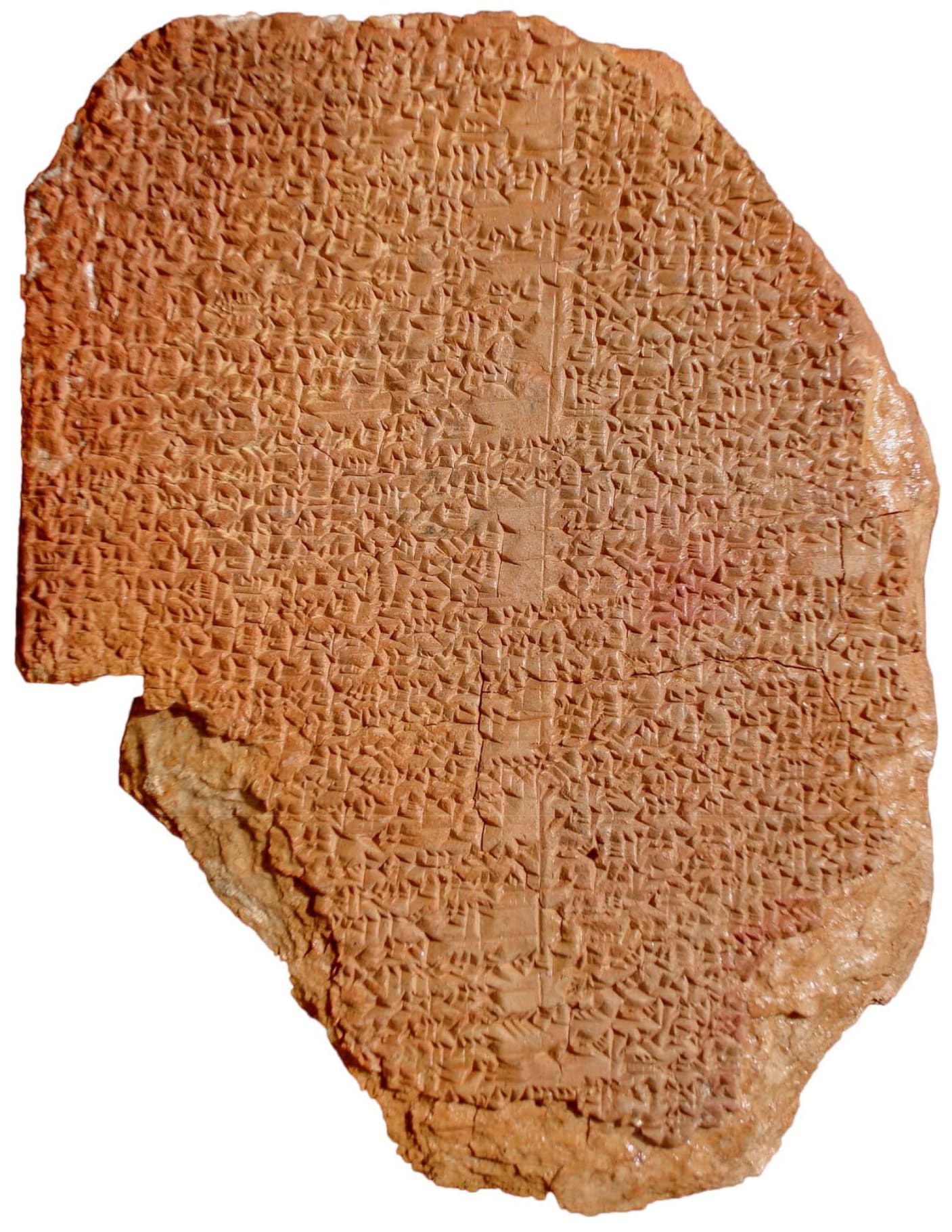
The record subject, photographed for the proceedings in the United States District Court for the Eastern District of New York in which the tablet itself was the named defendant. The object is now in the Iraq Museum, Baghdad.
| Artist | Unknown Babylonian scribe |
|---|---|
| Date | c. 1600 BC |
| Medium | Clay, incised in cuneiform script in the Akkadian language |
| Dimensions | Approximately 6 x 5 in (15 x 13 cm) |
| Where it is now | Iraq Museum, Baghdadlast confirmed 2 September 2026 |
| Inventory number | No Iraqi inventory number published in the sources consulted |
| Attribution | UnknownNo scribe is named and no colophon has been published. Full note |
| Object type | Antiquity |
| Period | Mesopotamian, Middle Babylonian |
| Cases | Has a provenance gap · Seized, looted or confiscated · Restituted or repatriated |
| Inscriptions | A passage of the Gilgamesh epic in which the protagonist recounts his dreams to his mother and she interprets them as foretelling the arrival of a friend, telling him: You will see him and your heart will laugh. In this tablet the names of Gilgamesh and Enkidu are replaced by those of the deities Sin and Ea |
| Owners on record | 10 links8 documented, 2 unknown |
| Sources | 8 cited |
About this record Last verified 2 September 2026 · 8 sources cited · Change log
On this page 10 sections
ContentsClose
A fragment of a clay tablet about six inches by five, written in Akkadian, carrying the passage of the Gilgamesh epic in which the hero tells his mother his dreams and she reads them as the promise of a friend: you will see him and your heart will laugh. In this copy the names of Gilgamesh and Enkidu are replaced by those of the gods Sin and Ea, which is why it matters to Assyriologists as well as to lawyers.
It surfaced in a London apartment about 2001 among unconserved and dirt-encrusted material belonging to the Jordanian dealer Ghassan Rihani. An American antiquities dealer bought a group of tablets from Rihani's family in the spring of 2003 for 50,350 dollars and shipped them to the United States without declaring formal entry. Cleaned and read, this one turned out to be Gilgamesh. In 2007 the dealer sold it for 50,000 dollars and, when the buyers asked for a provenance, wrote one: the tablet, he said, had been in Lot 1503 of a 1981 Butterfield and Butterfield sale in San Francisco, a box of miscellaneous ancient bronze fragments. That letter travelled with the object for seven years.
Christie's sold it to Hobby Lobby in a private sale in July 2014 for 1,674,000 dollars, for the Museum of the Bible. The government alleged that the auction house had been told by the dealer himself that the provenance would not withstand scrutiny and should not be used for a public sale, and that it withheld both the letter and the dealer's name from the buyer. Agents seized the tablet in September 2019. On 18 May 2020 two actions were filed in the Eastern District of New York on the same day: the United States sued the tablet itself under the customs forfeiture statute, and Hobby Lobby sued Christie's for fraud. Hobby Lobby consented to forfeiture in July 2021, and the ground was importation, not title. The tablet went to Baghdad, and the question of where in Iraq it came from has never been decided by anybody.
Provenance
Each link is graded. Documented: a cited source supports it. Disputed: the identification is argued but not established. Unknown: no owner for that span, and the gap is not smoothed into a narrative. The grades in the glossary.
- c. 1600 BC -Written in southern Mesopotamia; scribe, library and owner unknownunknown
The attribution to the First Sealand Dynasty, about the early sixteenth century BC, comes from Hobby Lobby's own complaint against the auction house and is an argument advanced by a party to litigation, not an excavation record. No findspot, no archive context and no colophon are published.3
- - c. 2001In Iraq; circumstances of removal never adjudicatedunknown
Iraqi officials and much press coverage state that the tablet was looted from an Iraqi museum during the 1991 Gulf War. That assertion has never been tested in any court. The United States forfeiture case did not rest on proving a particular theft; the government's position was that hundreds of thousands of objects have been looted from Iraqi sites since the early 1990s and that cuneiform tablets are among the most commonly trafficked, and its legal ground was the manner of importation. The distinction is the whole point of this record.235
- c. 2001 - spring 2003Ghassan Rihani, Jordanian antiquities dealer, London; then his familydocumented
The tablet was seen, still encrusted and unconserved, at Rihani's London apartment about 2001 by an American antiquities dealer. Rihani is reported to have died later that year. In the spring of 2003 the dealer and a cuneiform expert met members of the Rihani family at the apartment and inspected a group of tablets.3
- spring 2003 - 2007An American antiquities dealer, unnamed in the government's filingsdocumented
The dealer bought the group from the Rihani family for 50,350 dollars. He and the cuneiform expert shipped the tablets to the United States without declaring formal entry. After cleaning, cuneiform scholars recognised the Gilgamesh passage. About 2005 the tablet was sent to Princeton, where a scholar studied it for several weeks.13
- 2007 - December 2013Two antiquities dealers, then further ownersdocumented
Sold for 50,000 dollars with a translation. The dealer supplied no provenance at first; asked for one, he produced what the pleadings call the False Provenance Letter, claiming the tablet had been deaccessioned by an unidentified small museum and sold in Lot 1503 of a 1981 Butterfield and Butterfield auction in San Francisco described as a box of miscellaneous ancient bronze fragments. One buyer catalogued the tablet as having a clean provenance and a single American owner for twenty-five years; it appeared in an October 2007 catalogue of Michael Sharpe Rare and Antiquated Books offering a translation, an authentication and a clear provenance.3
- December 2013 - July 2014Consigned to Christie's, London, for private saledocumented
A later owner approached the auction house's London office to consign the tablet for a private rather than a public sale. A representative of the Museum of the Bible viewed it in London in March 2014. The government alleged that the auction house's antiquities director spoke to the original dealer, who said the provenance would not withstand scrutiny and should not be used in connection with a public sale.13
- July 2014 - September 2019Hobby Lobby Stores, Inc., Oklahoma City; on loan to the Museum of the Bible, Washingtondocumented
Bought for 1,674,000 dollars. The auction house shipped the tablet to its New York office and hand-delivered it to Oklahoma City; an employee carried it on a flight from London. On 22 July 2014 the museum's registrar emailed the auction house to point out that the invoice gave neither a date for the tablet nor a country of origin, and asked for the auction listing. Correspondence about the provenance continued until at least October 2017.13
- September 2019 - July 2021Seized by federal agents under a judicially authorised warrant; held at a Customs and Border Protection facility in Queens, New Yorkdocumented
The tablet was taken from the Museum of the Bible. On 18 May 2020 the United States filed an in rem civil forfeiture complaint under 19 U.S.C. 1595a(c)(1)(A) in the Eastern District of New York, case 1:20-cv-02222, before Judge Ann Marie Donnelly. Hobby Lobby filed a Claim of Interest in June 2020 seeking the tablet's return to itself.136
- July 2021 - 23 September 2021The United States of Americadocumented
Hobby Lobby consented to forfeiture, which was entered on the ground of the tablet's illegal importation into the United States in 2014. The docket records the case as terminated on 26 July 2021; the forfeiture was reported on 27 July.146
- 23 September 2021 - presentRepublic of Iraq; Iraq Museum, Baghdaddocumented
A ceremonial certificate transferring ownership was signed at the Smithsonian Institution's National Museum of the American Indian in Washington by Steve K. Francis of Homeland Security Investigations and Fareed Yasseen, Iraq's ambassador to the United States. The tablet went on display in Baghdad on 7 December 2021, one of 17,926 objects Iraq reported recovering from the United States, the United Kingdom, Italy, Japan and the Netherlands in a single year.15
Prices realised
This tablet has never been sold at public auction and has no hammer price. The 1,674,000 dollars Hobby Lobby paid in July 2014 was a PRIVATE TREATY sale through Christie's London: a negotiated figure, no underbidder, no published premium, no catalogue. That is not incidental to the case. The government alleged that the parties chose a private sale precisely because the provenance would not survive the scrutiny a public offering attracts, and the dealer who wrote the false letter is said to have told the auction house so. The other two prices on record are dealer prices: 50,350 dollars paid to the Rihani family in 2003 for a group of tablets including this one, and 50,000 dollars in 2007. The only auction in the story, Butterfield and Butterfield's 1981 sale of Lot 1503 in San Francisco, was real, and this tablet was not in it.
Technical evidence
| Attribution note | No scribe is named and no colophon has been published. The date and place of writing rest on argument, not on excavation: Hobby Lobby's own pleading in its suit against the auction house states that the tablet was likely created during the First Sealand Dynasty, about the early sixteenth century BC, in the swampy province at the head of the Gulf between the Tigris and the Euphrates. Press accounts range from 3,500 to 3,600 years old, and one widely read report calls the language Sumerian; the United States government's own description says Akkadian, which is correct. |
|---|---|
| Material and script | Fired clay, incised in cuneiform. The language is Akkadian, an extinct Semitic language of ancient Mesopotamia.13 |
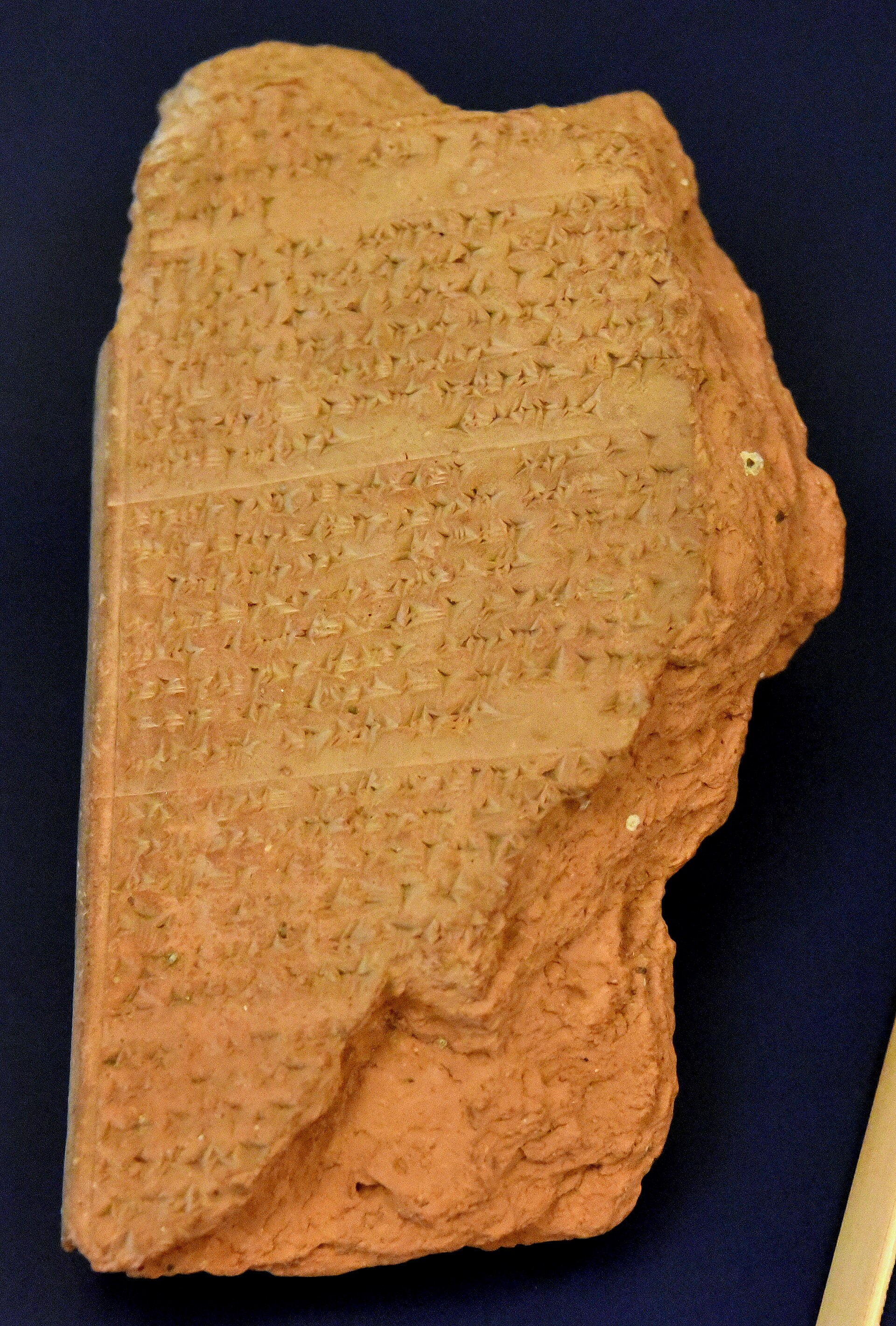
| Dimensions | Approximately 6 inches by 5 inches. Described in the government's account as a fragment; the surviving piece is the upper left part of what was a six-column tablet, three columns on each face.17 |
| Text | The passage in which the protagonist recounts his dreams to his mother and she interprets them as foretelling the arrival of a friend, with the line: You will see him and your heart will laugh.13 |
| The substitution of names | In this tablet the names of Gilgamesh and Enkidu are replaced by those of the deities Sin and Ea. This is a substantive textual variant, not a scribal slip, and it is the object's principal claim on Assyriological attention.13 |
| Condition on discovery | Encrusted with dirt and unreadable when first seen in London about 2001. It was cleaned only after importation into the United States, which is when the text was identified.13 |
| Study | About 2005 the tablet was sent to Princeton, where a scholar studied it for several weeks. A translation prepared by a cuneiform expert accompanied the 2007 sale and was offered with the object in a dealer's catalogue.3 |
| Dating | Reported as approximately 3,500 to 3,600 years old. Hobby Lobby's pleading attributes it to the First Sealand Dynasty, about the early sixteenth century BC. There is no scientific dating and no archaeological context.345 |
| Case identity | The object is the named defendant in United States v. One Cuniform Tablet Known as the 'Gilgamesh Dream Tablet', 1:20-cv-02222 (E.D.N.Y.), filed 18 May 2020, terminated 26 July 2021. The misspelling of cuneiform is the court's, in the case caption.6 |
Images
The record in full
Chapter 1A tablet six inches across that changes two names
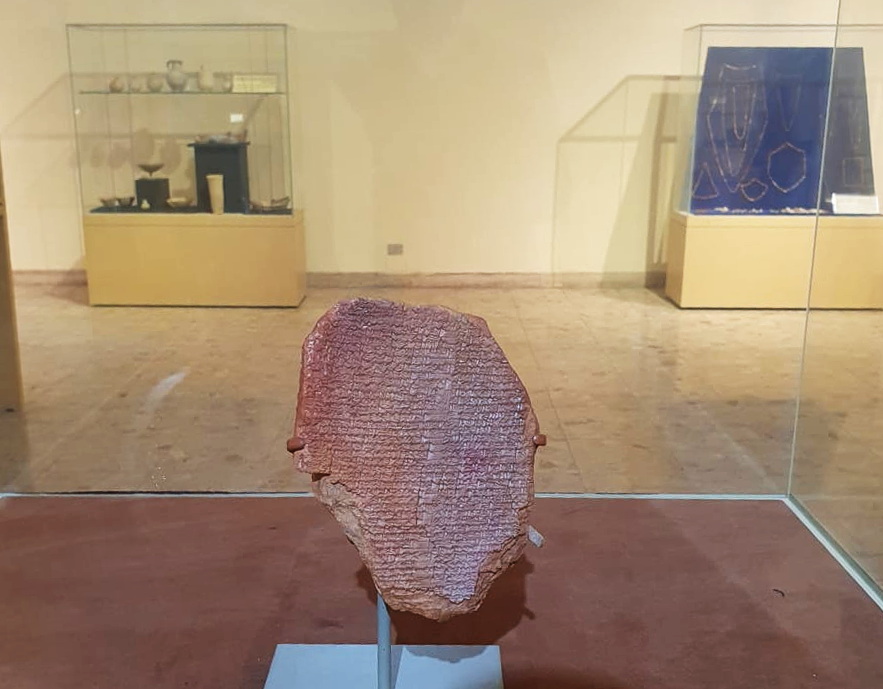
The object is a fragment of fired clay about six inches by five, incised on both faces in cuneiform, in Akkadian.
The object is a fragment of fired clay about six inches by five, incised on both faces in cuneiform, in Akkadian. It is the upper left portion of what was once a six-column tablet, three columns to a side.
The text is the passage of the Gilgamesh epic in which the protagonist tells his mother his dreams and she interprets them as foretelling the arrival of a friend. The United States quoted her words in its forfeiture complaint: you will see him and your heart will laugh. That is why the object is called the Dream Tablet, and it is a name given by the American market in the 2000s, not an ancient title.
The philologically interesting fact, and the one that survives every legal argument, is that in this copy the names of the hero Gilgamesh and of the friend Enkidu are replaced with the names of the deities Sin and Ea. A version of the epic in which the two central human figures carry divine names is not a curiosity of packaging; it is evidence about how the poem was transmitted, adapted and used in whatever setting produced this tablet. That setting is exactly what was destroyed when the tablet was removed from the ground without record.
One widely circulated report describes the inscription as Sumerian. It is Akkadian, as the government's own description states, and the distinction is not pedantry: the two are unrelated languages that share a script.
Chapter 2The claim that it came from a museum in 1991 has never been tested
Iraqi officials, and most press coverage of the return, state that the tablet was looted from an Iraqi museum during the 1991 Gulf War, when central control lapsed in parts of the country and...
Iraqi officials, and most press coverage of the return, state that the tablet was looted from an Iraqi museum during the 1991 Gulf War, when central control lapsed in parts of the country and regional museums were emptied. The BBC put it flatly on the day the object went on show in Baghdad.
No court has found that. The United States did not have to prove it and did not try. The government's complaint set out the general context - hundreds of thousands of objects looted from Iraqi sites since the early 1990s, cuneiform tablets among the most commonly trafficked classes - and then rested its case on something narrower and provable.
This is the recurring pattern in antiquities enforcement and it is routinely misreported. The state that receives an object back is not necessarily the state that proved anything. Here the assertion of a 1991 museum theft is a claim by the claimant government and a repetition by journalists, and this record grades it as such: outstanding, plausible, unadjudicated.
Chapter 3London, about 2001: a flat full of unconserved tablets
The tablet's first documented appearance is in the London apartment of Ghassan Rihani, a Jordanian antiquities dealer, about 2001.
The tablet's first documented appearance is in the London apartment of Ghassan Rihani, a Jordanian antiquities dealer, about 2001. An American antiquities dealer saw it there among a quantity of encrusted, unconserved material. Rihani is reported to have died later that year.
In the spring of 2003 the American dealer returned to the apartment with a cuneiform expert and met members of the Rihani family. They inspected a number of tablets and judged, from what could be seen through the dirt, that these were likely to be literary texts rather than the ordinary administrative documents that make up most of the surviving cuneiform corpus. On that judgement the dealer bought the group for 50,350 dollars.
The purchase is the hinge of the whole case, and it is worth being precise about what it was. A dealer paid about fifty thousand dollars for a lot of unreadable objects on the expectation that at least one would turn out to be literature. Eleven years later one of them sold for 1,674,000 dollars. The margin is the reward for taking the risk of not knowing - and, on the government's account, for supplying a document that made the not-knowing disappear.
Chapter 4It was imported twice, and the importation is the case
The dealer and the cuneiform expert shipped the tablets from London to the United States without declaring formal entry.
The dealer and the cuneiform expert shipped the tablets from London to the United States without declaring formal entry. Once here, the tablet was cleaned and read; about 2005 it went to Princeton, where a scholar studied it for several weeks. In July 2014 an employee of the auction house carried it on a flight from London to New York and it was hand-delivered to Oklahoma City.
Those two movements, in 2003 and in 2014, are what the case was about. The forfeiture statute the government used, 19 U.S.C. 1595a(c)(1)(A), provides that merchandise introduced into the United States contrary to law shall be seized and forfeited if it is stolen, smuggled or clandestinely imported. The legal argument runs through cultural property law only indirectly: property is treated as stolen for these purposes if it was taken without official authorisation from a country whose law vests ownership of such material in the state, and Iraq's patrimony law, originally of 1935, does exactly that for anything man-made over two hundred years old. Layered on top is the American sanctions regulation prohibiting trade in Iraqi cultural property illegally removed since 6 August 1990.
The practical consequence for collectors is the one Hobby Lobby set out in its own pleading: to comply with American law, prudent buyers deal only in Iraqi cuneiform with an ownership history that predates August 1990. A provenance document taking the object outside Iraq before that date is therefore not a nicety. It is the entire licence to own the thing. Which is precisely why one was written.
Chapter 5The letter: Lot 1503, a box of miscellaneous ancient bronze fragments
In 2007 the dealer sold the tablet, with a translation, to two antiquities dealers for 50,000 dollars.
In 2007 the dealer sold the tablet, with a translation, to two antiquities dealers for 50,000 dollars. He gave them no provenance. When they asked for one, he wrote it.
The document that the pleadings call the False Provenance Letter said that the tablet had been deaccessioned by a small museum, which it did not name, and had formed part of Lot 1503 in a 1981 sale by Butterfield and Butterfield in San Francisco, a lot the catalogue described as a box of miscellaneous ancient bronze fragments. There is no mention of Rihani, of London, or of 2003.
Look at the construction. The sale is real and the lot is real and the catalogue description is quotable; a diligent buyer can find Lot 1503 and read those words. The claim being smuggled through is that this clay object was inside that box of bronze. A miscellaneous lot is unphotographed and unitemised by definition, which makes it the ideal place to have found something: nothing in the record contradicts it, because the record contains nothing.
The date does the legal work. 1981 is comfortably before August 1990, so a tablet that was in that box was outside Iraq when it needed to be. One sentence converts an object that cannot lawfully be imported into one that can.
The letter then travelled. One of the 2007 buyers catalogued the tablet as having a clean provenance and a single American owner for twenty-five years. It appeared in an October 2007 catalogue of Michael Sharpe Rare and Antiquated Books, offered with a translation, an authentication and a clear provenance. Each resale laundered the claim a little further by adding a respectable name on top of it.
Chapter 6A private sale is a decision about scrutiny
In December 2013 a later owner approached the London office of Christie's, wanting to consign the tablet for a private sale rather than a public auction.
In December 2013 a later owner approached the London office of Christie's, wanting to consign the tablet for a private sale rather than a public auction. A representative of the Museum of the Bible saw it in London in March 2014. In July 2014 Hobby Lobby bought it for 1,674,000 dollars.
According to the government's complaint, the auction house's antiquities director had by then spoken to the dealer who wrote the letter, and had been told by him that the provenance would not withstand scrutiny and should not be used in connection with a public sale. The house nonetheless represented to Hobby Lobby that the tablet had been bought in the 1981 auction. When the buyer and the museum later asked for more detail - the museum expressed discomfort with the provenance in 2017 - they were told the dealer had confirmed the details. The letter itself, and the dealer's name, were withheld from them.
The United States Attorney for the Eastern District of New York, Richard P. Donoghue, put the government's characterisation on the record when the complaint was filed: a major auction house failed to meet its obligations by minimizing its concerns that the provenance of an important Iraqi artifact was fabricated, and withheld from the buyer information that undermined the provenance's reliability. Christie's said it had not known the documents were false at the time.
The structural point is that the choice between a public auction and a private treaty sale is not merely commercial. A public sale generates a catalogue, a photograph, a lot number, a published estimate and a result, all of which enter databases and become searchable by source countries and by researchers for decades. A private sale generates an invoice. The market's own diligence machinery is switched on by publication, and the parties here, on the government's account, understood that and chose accordingly.
Chapter 7Two lawsuits, filed the same day, pointing in opposite directions
Agents seized the tablet from the Museum of the Bible in September 2019 under a judicially authorised warrant.
Agents seized the tablet from the Museum of the Bible in September 2019 under a judicially authorised warrant. On 18 May 2020 two separate actions were filed in the same courthouse in Brooklyn.
The first was the government's: United States v. One Cuniform Tablet Known as the Gilgamesh Dream Tablet, docket 1:20-cv-02222, assigned to Judge Ann Marie Donnelly. It is an in rem action, meaning that the defendant is the object. The tablet, not Hobby Lobby, was the party being sued, which is why no finding of wrongdoing against the purchaser follows from the result.
The second was Hobby Lobby's, against the auction house, for fraud and breach of express and implied warranties. In both proceedings Hobby Lobby maintained that it was an innocent purchaser who had done appropriate diligence and had reasonably relied on the seller's representations.
In June 2020 Hobby Lobby filed a Claim of Interest in the forfeiture, asking for the tablet back. A commentator writing in January 2021 noted the tactical value of that step: the claim gave Hobby Lobby a right to serve discovery on the auction house inside the forfeiture case at a time when its own suit was stalled, the house having moved to compel arbitration under the sale contract. The buyer, in other words, used the government's action against the object as a discovery instrument against its seller.
Chapter 8Forfeiture on the customs ground, not on title
Hobby Lobby consented to forfeiture and the decree was entered in July 2021; the docket records the case terminated on 26 July and the announcement came on the 27th.The Justice Department's own...
Hobby Lobby consented to forfeiture and the decree was entered in July 2021; the docket records the case terminated on 26 July and the announcement came on the 27th.
The Justice Department's own account of the basis is exact and it is the most important sentence in the case: Hobby Lobby consented to the tablet's forfeiture based on the tablet's illegal importation into the United States in 2014.
So the United States did not obtain a judgment that Iraq owns this tablet. It did not obtain a finding about which site or museum the tablet left, or when. It obtained a forfeiture because merchandise came into the country contrary to law, and it then transferred what it had forfeited to the Republic of Iraq as a matter of executive action. Forfeiture, repatriation, settlement, restitution and conviction are five different things, and this case is the first two only. No one was prosecuted. Nobody was convicted. Christie's was not a defendant in the government's action.
That is not a criticism of the outcome. It is the reason the outcome was achievable. Proving where an unprovenanced tablet came from is often impossible; proving how it crossed a border is a documents exercise. The customs route is the workhorse of American antiquities enforcement precisely because it substitutes a provable question for an unprovable one.
Chapter 9Washington, then Baghdad
On 23 September 2021 a ceremonial certificate transferring ownership from the United States to Iraq was signed at the Smithsonian Institution's National Museum of the American Indian by Steve K.
On 23 September 2021 a ceremonial certificate transferring ownership from the United States to Iraq was signed at the Smithsonian Institution's National Museum of the American Indian by Steve K. Francis of Homeland Security Investigations and by Fareed Yasseen, Iraq's ambassador to the United States. Kenneth A. Polite Jr, Assistant Attorney General for the Criminal Division, said the return was meant as a message that the United States government will take action to seize and repatriate antiquities and other significant items of cultural heritage that have been unlawfully brought into the United States. Audrey Azoulay of UNESCO, Iraq's Minister of Culture, Tourism and Antiquities Hassan Nadhem, and State Department officials took part.
The tablet went on display in Baghdad on 7 December 2021, its first public showing in the country in three decades. Iraq's foreign minister, Fuad Hussein, said at the ceremony that it was one of 17,926 objects recovered from the United States, the United Kingdom, Italy, Japan and the Netherlands over the preceding year. A single famous tablet is the visible fraction of a number that large.
Chapter 10The buyer's other eleven thousand five hundred objects
This tablet is not an isolated purchase and cannot honestly be read as one.
This tablet is not an isolated purchase and cannot honestly be read as one. In 2017 Hobby Lobby agreed to pay a three million dollar penalty in a settlement with the Justice Department and to return thousands of clay tablets that had been illegally imported. In March 2020, two months before the forfeiture complaint was filed, Steve Green announced that the Museum of the Bible would return 11,500 objects to Iraq and Egypt. Green has said publicly that he knew little about collecting when he began buying in 2009 and did not adequately ensure that he was not buying stolen items.
A settlement with a penalty is not a conviction, and a voluntary return of 11,500 objects is not an adjudication that all 11,500 were stolen. But the pattern is the context in which the Dream Tablet was bought, and it is the reason the museum's cooperation with the investigation - which the government acknowledged - reads as a policy rather than a gesture.
Chapter 11What a diligent buyer could have done, and what it costs
Every red flag in this case was visible from the buyer's side of the table in July 2014, and the museum's own registrar spotted two of them within days: on 22 July 2014 she emailed the auction house...
Every red flag in this case was visible from the buyer's side of the table in July 2014, and the museum's own registrar spotted two of them within days: on 22 July 2014 she emailed the auction house to say that the invoice carried neither a date for the tablet nor a country of origin, and asked for the auction listing. The listing could not be produced because the sale it referred to had nothing to do with this object.
The available checks were not exotic. A 1981 Butterfield and Butterfield catalogue is a findable document; Lot 1503 could have been looked up and its description read, and the question asked how a clay tablet came to be inside a box catalogued as bronze. The seller could have been asked for the name of the deaccessioning museum. The chain could have been asked to produce one owner, in person, for the twenty-five years the catalogue claimed. Instead the buyer asked the seller, and the seller asked the man who had written the letter, and the answer came back that the letter was correct.
The market's habitual defence is that these standards are impossible - that dealers are being asked to prove ownership from the moment of excavation. That is a real objection in many cases and it deserves a hearing. It has no application here. Nobody needed a chain back to antiquity. They needed one document, from 1981, that existed or did not, and the party best placed to check was the party who was paid 1,674,000 dollars.
Chapter 12What is still unsettled
The tablet is in Baghdad and its legal position is closed.
The tablet is in Baghdad and its legal position is closed. Almost everything else about it is open.
The findspot is unknown and, absent a confession, unknowable: the object carries no excavation number and the 1991 museum-looting account has never been tested. The scholarly reading of the object is only beginning, because for its entire modern life it has been a chattel in litigation rather than a text in a collection. The commercial dispute between the buyer and the auction house was, at the last public account located, mired in an argument about whether the sale contract compelled arbitration; this record does not assert an outcome it has not seen.
And the dealer who wrote the letter has never been named in a public filing. The government's papers call him the Antiquities Dealer. He bought for fifty thousand, sold for fifty thousand, supplied on request a fiction that added a million and a half dollars of value to somebody else's object, and appears in the record of the case as a role rather than a person.
The artist
The anonymous scribal culture of Middle Babylonian Mesopotamia
There is no artist here in any sense the art market recognises, and pretending otherwise would misdescribe the object. What exists is a scribal tradition: a school system in which the Gilgamesh epic was copied, adapted and taught for well over a thousand years, and a vast surviving corpus of clay in which literary tablets are a small minority. Understanding this tablet means understanding that corpus, how its pieces are identified and dated, and why cuneiform in particular has become the most heavily trafficked class of Iraqi antiquity.
Related works
| Work | Relation | Where it is |
|---|---|---|
| The Ashurbanipal library tablets of the Gilgamesh epic Neo-Assyrian scribes | The fullest surviving version of the same text Twelve tablets found in 1853 at Nineveh, still incomplete. Excavated with a recorded findspot, which is what this tablet lacks. | British Museum, London |
| The 5,500 cuneiform tablets and clay bullae imported by Hobby Lobby Various Mesopotamian scribes | Same buyer, earlier case The subject of a 2017 settlement in which Hobby Lobby paid a three million dollar penalty and agreed to return the objects, which had been shipped with false customs declarations. | Returned to Iraq |
| The 11,500 objects announced for return by the Museum of the Bible in March 2020 Various | Same collection, same period of acquisition Announced two months before the forfeiture complaint in this case was filed. | Iraq and Egypt |
| The Gilgamesh tablet from Hattusa Hittite-period scribe | Another ancient copy of the same epic, excavated with a recorded provenance Thirteenth century BC, from the Hittite capital in modern Turkey, inventory VAT 12890. A comparison of what the same text looks like when it comes out of a dig rather than out of a flat. | Neues Museum, Berlin |
Open questions
- Where in Iraq did the tablet come from? The 1991 museum-looting account is asserted by Iraqi officials and repeated in the press but was never adjudicated, and the forfeiture rested on importation rather than on any finding about a site or an institution.
- Who is the Antiquities Dealer? The government's filings identify by role, not by name, the American dealer who bought the tablet in 2003 and wrote the false provenance letter in 2007. No prosecution of that individual has been located.
- What happened to Hobby Lobby's suit against Christie's? The auction house moved to compel arbitration under the sale contract; that motion was denied and the suit (1:20-cv-02239, E.D.N.Y.) was pending at the last account located, dated January 2021. A 2026-09-02 check of docket-aggregator search results shows the case marked terminated 5 January 2022, but CourtListener's own docket page returned a bot-verification wall on direct fetch and no settlement, dismissal order or news account of the outcome has been located by this record, so what the termination actually resolved (settlement, voluntary dismissal, judgment) remains unconfirmed.
- What became of the other tablets bought from the Rihani family in 2003 for 50,350 dollars? The group is described in the pleadings but not itemised, and no account of the rest of it has been located.
- Was any duty, penalty or criminal charge pursued over the undeclared 2003 importation? The forfeiture was grounded on the 2014 importation. Nothing consulted says what became of the earlier one.
- Has the tablet been published scholarly since its return? No edition, photograph series or study of the text after 2021 has been located, and the object was in litigation or in custody for most of the period in which it was known to exist.
- Where exactly was the tablet between about 1991 and 2001? Nothing in any source consulted fills that decade.
- Is the tablet on display in Baghdad in 2026? The Iraq Museum was reported to be undergoing renovation in mid-2026 and the last confirmed display date is 7 December 2021.
Questions about this object
What is The Gilgamesh Dream Tablet?
The Gilgamesh Dream Tablet is an antiquity, dated c. 1600 BC. Medium: Clay, incised in cuneiform script in the Akkadian language.
Who made The Gilgamesh Dream Tablet, and is the attribution settled?
The attribution to Unknown Babylonian scribe is recorded here as unknown. No scribe is named and no colophon has been published. The date and place of writing rest on argument, not on excavation: Hobby Lobby's own pleading in its suit against the auction house states that the tablet was likely created during the First Sealand Dynasty, about the early sixteenth century BC, in the swampy province at the head of the Gulf between the Tigris and the Euphrates. Press accounts range from 3,500 to 3,600 years old, and one widely read report calls the language Sumerian; the United States government's own description says Akkadian, which is correct.
Where is The Gilgamesh Dream Tablet now?
Iraq Museum, Baghdad. Inventory number No Iraqi inventory number published in the sources consulted. Last confirmed 2 September 2026. Forfeited to the United States by decree of the Eastern District of New York in July 2021 and transferred to the Republic of Iraq at a ceremony in Washington on 23 September 2021; put on display in Baghdad on 7 December 2021.
What is still unknown about The Gilgamesh Dream Tablet?
Where in Iraq did the tablet come from? The 1991 museum-looting account is asserted by Iraqi officials and repeated in the press but was never adjudicated, and the forfeiture rested on importation rather than on any finding about a site or an institution.
Sources
- 1United States Department of Justice, Office of Public Affairs, press release 21-922, 'United States Returns to Iraq Rare Tablet Bearing Portion of the Epic of Gilgamesh', 23 September 2021. Primary source for the 2003 purchase from a family member of a London coin dealer, the undeclared entry, the text and the substituted names of Sin and Ea, the dimensions, the 2007 false provenance letter, the 2014 private sale and hand-carried importation, and the statement that Hobby Lobby consented to forfeiture on the ground of the illegal importation of 2014. Consulted in the Internet Archive capture of 26 December 2022. web.archive.org/web/...
- 2U.S. Immigration and Customs Enforcement, Homeland Security Investigations, press release, 'Civil action filed to forfeit rare cuneiform tablet from Hobby Lobby', 18 May 2020. Source for the September 2019 seizure, the statements of Peter C. Fitzhugh and United States Attorney Richard P. Donoghue, and the allegation that the auction house was told the provenance would not withstand scrutiny and withheld the letter and the dealer's name. Consulted in the Internet Archive capture of 31 December 2021 because ice.gov returns 403 to direct requests. web.archive.org/web/...
- 3Nicholas M. O'Donnell and colleagues, 'Problems of Provenance: The Gilgamesh Dream Tablet', Greenberg Traurig LLP, published by the National Law Review, 19 January 2021. Detailed reading of both complaints: the statutory basis under 19 U.S.C. 1595a(c)(1)(A), Ghassan Rihani, the 50,350 dollar purchase, the Princeton study, the 50,000 dollar sale, Lot 1503 of the 1981 Butterfield and Butterfield auction, the Michael Sharpe catalogue, the December 2013 consignment, the 1,674,000 dollar purchase price, the registrar's email of 22 July 2014, Hobby Lobby's Claim of Interest and the arbitration motion. natlawreview.com/article/...
- 4CNBC, 'Hobby Lobby's $1.6 million Gilgamesh tablet has been forfeited to the U.S.', 27 July 2021. Source for the date of the forfeiture announcement and for the statement that the tablet was illegally transported to the United States in 2003 and 2014. cnbc.com/2021/...
- 5BBC News, 'Gilgamesh Dream Tablet: Iraq puts looted artefact on display', 7 December 2021. Source for the Baghdad display, the figure of 17,926 objects recovered in a year, the statement of Foreign Minister Fuad Hussein and the widely repeated claim of a 1991 museum theft. bbc.com/news/...
- 6CourtListener docket, United States v. One Cuniform Tablet Known as the 'Gilgamesh Dream Tablet', 1:20-cv-02222 (E.D.N.Y.). Source for the filing date of 18 May 2020, the assignment to Judge Ann Marie Donnelly and Magistrate Judge Peggy Kuo, and the termination date of 26 July 2021. courtlistener.com/docket/...
- 7NPR, 'An Ancient Tablet, Stolen Then Acquired By Hobby Lobby, Will Be Returned To Iraq', 21 September 2021. Source for the identification of the auction house as Christie's, for Christie's statement that it did not know the documents were false at the time, for the 2017 three million dollar settlement and for the March 2020 announcement of 11,500 objects to be returned. Note that this report describes the inscription as Sumerian; the government's filings say Akkadian, and this record follows the government. npr.org/2021/...
- 8Cultural Property Disputes Resource, Claremont Graduate University, 'Iraqi Gilgamesh Dream Tablet'. TERTIARY, used only for the note that the Iraq Museum was undergoing renovation as at June 2026. Its assertion that the object was removed from the Royal Library of Ashurbanipal in 1853 is not adopted and is contradicted by every primary account of the tablet's modern history. research.cgu.edu/cultural-property-disputes-resource/...
Last verified 2 September 2026 · Published 4 August 2026
Change log
4 August 2026 - Record created at the house standard: researched narrative, technical evidence, maker dossier, graded provenance chain, prices with hammer and premium separated, related works, open questions and sources.
2 September 2026 - Re-verified. No change to location (still the Iraq Museum, Baghdad) or to the graded provenance chain. Checked for a resolution of Hobby Lobby Stores, Inc. v. Christie's Inc. (1:20-cv-02239, E.D.N.Y.), which the record's own open questions flag as unresolved at last check (January 2021): a search-engine summary of CourtListener's docket metadata for that case indicates it was marked terminated on 5 January 2022, but CourtListener itself returned a bot-verification wall on direct fetch and no independent news account of a settlement, dismissal or judgment could be located, so this is NOT added as a documented fact per house rule (a search summary is not a fetched source) - the open question stands as still genuinely unresolved by any source this record can cite, with a note that the docket now shows a termination date worth re-checking through an accessible primary source. All other sources re-checked and resolve.