Armor for Man and Horse with Voels-Colonna Arms
Unidentified North Italian armourer (workshop not recorded) · c. 1575 (arm defences c. 1517)
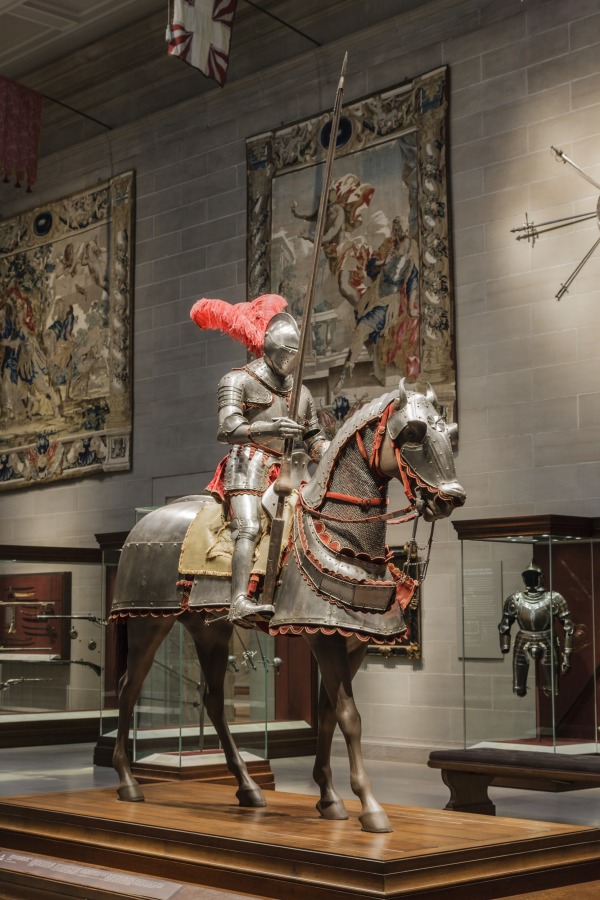
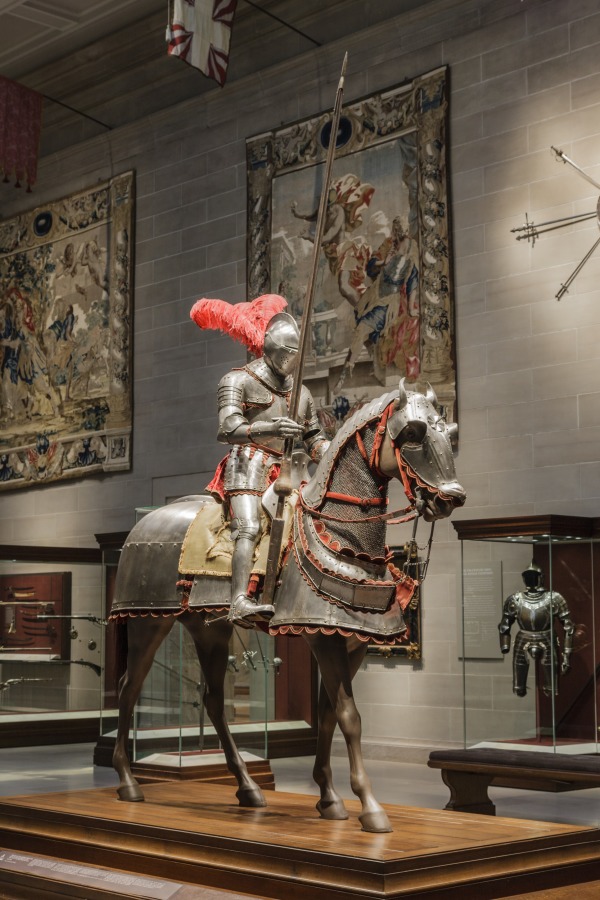
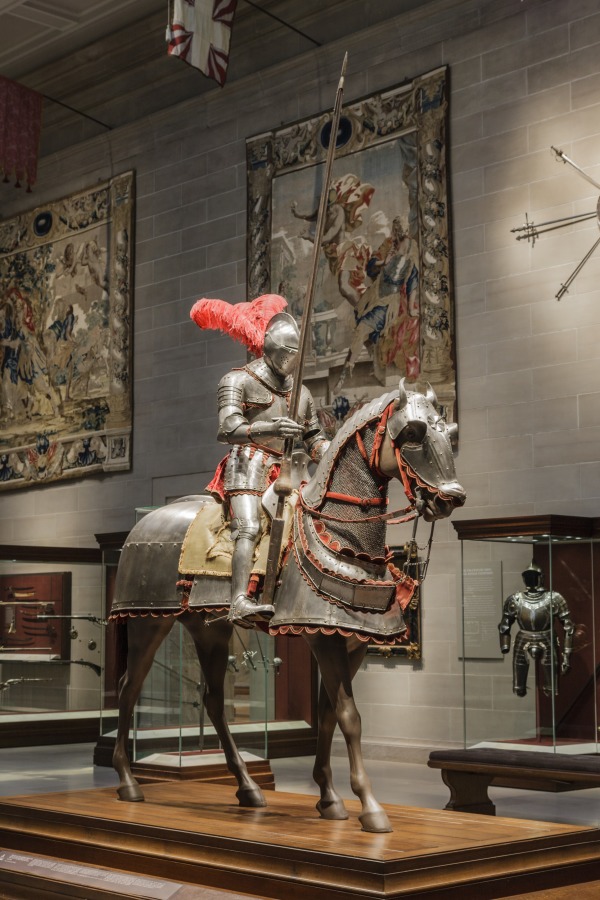
Two views of the mounted suit as displayed at the Cleveland Museum of Art: the rider in a close helmet and the horse with chanfron, crinet and peytral. This is the object described in this record.
| Artist | Unidentified North Italian armourer (workshop not recorded) |
|---|---|
| Date | c. 1575 (arm defences c. 1517) |
| Medium | Steel, etched in bands; mail neck defence; saddle mostly modern reconstruction |
| Dimensions | No overall dimensions published; 31 components individually measured (for example peytral 75.2 x 58.5 cm); combined weight of man's and horse's armor 114 lb (about 52 kg) |
| Where it is now | The Cleveland Museum of Art, Jack, Joseph and Morton Mandel Armor Court (210A)last confirmed |
| Inventory number | 1964.88 (components .a to .ee) |
| Attribution | UnknownCleveland catalogues the origin as North Italy, 16th century, with no maker, mark or inscription. Full note |
| Object type | Arms and armour |
| Period | Italian, sixteenth century |
| Cases | Has a provenance gap |
| Inscriptions | None recorded; the coat of arms appears seven times |
| Owners on record | 7 links4 documented, 2 disputed, 1 unknown |
| Sources | 11 cited |
About this record Last verified · 11 sources cited · Change log
On this page 10 sections
ContentsClose
A suit of armor for a rider and his horse, made in northern Italy about 1575 and etched with a coat of arms that Cleveland reads as Colonna quartered with an unidentified family, probably for a member of the Voels-Colonna family of the South Tyrol. It is made of 31 catalogued pieces, some of them about sixty years older than the rest and one, the saddle, mostly modern reconstruction.
Its chain runs from a Tyrolean castle that the records cannot prove it ever left, through the town hall of Bolzano and a Paris prince whose identity is uncertain, to William H. Riggs, a collector whose heavy cleaning gave Paris a verb, and then the Metropolitan Museum of Art. The Metropolitan sold it to Cleveland in 1964 and kept the matching shield.
Provenance
Each link is graded. Documented: a cited source supports it. Disputed: the identification is argued but not established. Unknown: no owner for that span, and the gap is not smoothed into a narrative. The grades in the glossary.
- c. 1570 -Made in North Italy, probably for an unidentified member of the Voels-Colonna familydisputed
Cleveland dates the suit c. 1575 (range 1570-1580), reads the quartered arms as Colonna with an unidentified family and says it probably belonged to an unknown Voels-Colonna of the South Tyrol. The arm defences are dated c. 1517 and are older than the rest. No maker, mark or inscription is recorded.12
- - ?Schloss Proesels, Fie allo Sciliar, Italyunknown
First entry of Cleveland's provenance list, with no dates. The castle was the seat of the lords of Voels. No source consulted records a suit of armor leaving the castle, and the family line ended in 1804 or 1810 depending on the source.156
- ? - 1832Town Hall, Bolzano, Italydocumented
Dated to 1832 at the end by Cleveland. The start of the Bolzano period, the reason for the holding and the terms of the 1832 transfer are not recorded in the sources consulted. This grade rests on the museum's statement and on a Bolzano art-historical volume of 2004 that Cleveland cites; the underlying document was not seen.1
- 1832 - ?Prince Peter Soltykoff, Parisdisputed
Cleveland names Prince Peter Soltykoff, active 1840-1861, with ownership from 1832. Carrara describes an arms collector Prince Alexei Soltykoff (1806-1859) and an 1854 sale; a separate Soltykoff sale of objets d'art began on 7 April 1861. Which man bought the suit is not established, and the end of his ownership is not dated.148
- ? - 1913William H. Riggs, Parisdocumented
Riggs, 1837-1924 on Carrara's dates (1928 in Cleveland's note), bought the bulk of his arms in the 1860s and lived at 13 rue Murillo from 1871. The date, the seller and the price of this purchase are not recorded in the sources consulted.14
- 1913 - 1964The Metropolitan Museum of Art, New Yorkdocumented
Riggs's gift of nearly two thousand objects was accepted on 19 May 1913 and announced on 2 February 1914. The matching shield carries the same credit line (Gift of William H. Riggs, 1913, accession 14.25.768).134
- 1964 - presentThe Cleveland Museum of Artdocumented
Accession date 6 May 1964; John L. Severance Fund. The price and the reason for the Metropolitan Museum's sale are not published in the sources consulted. The Metropolitan Museum retained the shield.13
Prices realised
No auction sale of this suit is recorded in the sources consulted, and no hammer price, premium or estimate exists for it. The only price figures near it are for other objects at the Paris and London sales of Riggs's day, and are set out in the narrative as context only. A museum sale from the Metropolitan Museum to Cleveland in 1964 is recorded without a price, so no hammer, premium or currency can be given.
Technical evidence
| Attribution note | Cleveland catalogues the origin as North Italy, 16th century, with no maker, mark or inscription. The left arm defence is given as Italy, probably Milan, and the Metropolitan Museum attributes the companion shield to Milan. The first owner is described only as probably an unknown member of the Voels-Colonna family; the second quarter of the arms is unidentified. The set is composite: the arm defences are dated c. 1517, the body armor c. 1575 and the saddle is mostly modern reconstruction. |
|---|---|
| Accession | 1964.88 (the whole suit) with 31 component records, 1964.88.a to 1964.88.ee12 |
| Credit line and accession date | John L. Severance Fund; accession date recorded as 6 May 19641 |
| Date | c. 1575 for the principal body of the armor (range 1570-1580); the two arm defences c. 151712 |
| Origin | North Italy, 16th century (left arm defence: Italy, probably Milan, 16th century); saddle: North Italy, 16th century, but mostly modern reconstruction12 |
| Material | Steel, with etched bands (the 'Pisan' style) of figures, animals, portrait busts and armor trophies; a mail defence for the horse's neck is among the components12 |
| Weight | 114 lb (about 52 kg), man's and horse's armor combined1 |
| Close helmet | 38 x 31.2 x 27 cm (about 14 15/16 x 12 5/16 x 10 5/8 in)2 |
| Breastplate | 46.2 x 35.5 x 15.8 cm (about 18 3/16 x 14 x 6 1/4 in)2 |
| Chanfron | 62.5 x 25.5 x 19.4 cm (about 24 5/8 x 10 1/16 x 7 5/8 in)2 |
| Peytral | 75.2 x 58.5 cm (about 29 5/8 x 23 1/16 in)2 |
| Crupper | 80.5 x 79 cm (about 31 11/16 x 31 1/8 in)2 |
| Heraldry | Colonna arms quartered with an unidentified family, shown seven times: centre of breastplate and backplate, front and back of each pauldron, centre of peytral1 |
| Inscriptions and marks | None recorded in the museum data1 |
| Location | Jack, Joseph and Morton Mandel Armor Court, gallery 210A111 |
Images
The record in full
Chapter 1A suit for a rider and a horse, with one coat of arms repeated seven times
The Cleveland Museum of Art catalogues it as Armor for Man and Horse with Voels-Colonna Arms, accession 1964.88, North Italy, about 1575, steel, bought in 1964 with the John L.
The Cleveland Museum of Art catalogues it as Armor for Man and Horse with Voels-Colonna Arms, accession 1964.88, North Italy, about 1575, steel, bought in 1964 with the John L. Severance Fund. It is not one object but a set of 31 separately numbered components, from a close helmet (1964.88.a) and a gorget through the whole harness of the rider to the horse's chanfron, crinet, peytral, flanchards and crupper, a mail defence for the horse's neck, the reins, the stirrups and a saddle. The museum gives the combined weight of the man's and the horse's armor as 114 pounds, about 52 kilograms.
Its decoration is the thing a visitor sees first. The steel is etched in bands of figures, animals, portrait busts and armor trophies, a manner Cleveland records as fashionable in northern Italy in the late 1500s and files under the label of the Pisan style. A coat of arms appears seven times: at the centre of the breastplate and the backplate, on the front and back of each pauldron and at the centre of the peytral, the horse's breastplate. The museum describes the arms as those of the Colonna family quartered with another family that remains unidentified, and says the suit probably belonged to an unknown member of the Voels-Colonna family of the South Tyrol, which is now part of northern Italy.
That sentence is the whole of what the museum claims about the first owner, and it is hedged twice: probably, and unknown. This record keeps that hedge. Everything after the making of the suit is a chain of owners that runs through a Tyrolean castle or a town hall, a Russian prince whose identity is itself uncertain, a Paris collector famous for cleaning armor too hard, and the Metropolitan Museum of Art, which sold the suit to Cleveland in 1964 while keeping a matching shield.
Chapter 2A garniture, or something assembled to look like one
Cleveland's own wall text raises the possibility that the suit originally belonged to a garniture, an armor with multiple customised exchange elements that could convert the basic suit to field use...
Cleveland's own wall text raises the possibility that the suit originally belonged to a garniture, an armor with multiple customised exchange elements that could convert the basic suit to field use or to sporting uses, so that with different pieces attached the same suit could have been worn in battle or in tournament games. The museum words this as a possibility, not a finding, and no inventory, contract or description of the original set was found in any source consulted for this record.
The component records show that the suit as displayed is not uniform. The two arm defences, each made up of a vambrace, a rerebrace and a couter, are dated about 1517 in the museum's catalogue, against about 1575 for most of the rest. The left arm is given a different origin from the main entry, Italy, probably Milan, where the right arm and the rest say North Italy. The saddle is catalogued as North Italy, 16th century, but mostly modern reconstruction. The records give a spread of about sixty years in the dating of the sixteenth-century material and describe at least one element as largely modern. They do not say who made the replacement saddle or when.
That spread matters for any reading of the object as a single commission. A pair of arm defences some six decades older than the body armor either belonged to an earlier suit of the same family, or came from another harness altogether and were fitted in at a later stage of the suit's life. The sources consulted do not decide between those readings. The Cleveland entry for the whole suit nevertheless dates it to a single year, about 1575, with a stated range of 1570 to 1580, which is the dating used in the heading fields of this record and which should be read as the date of the principal body of the armor.
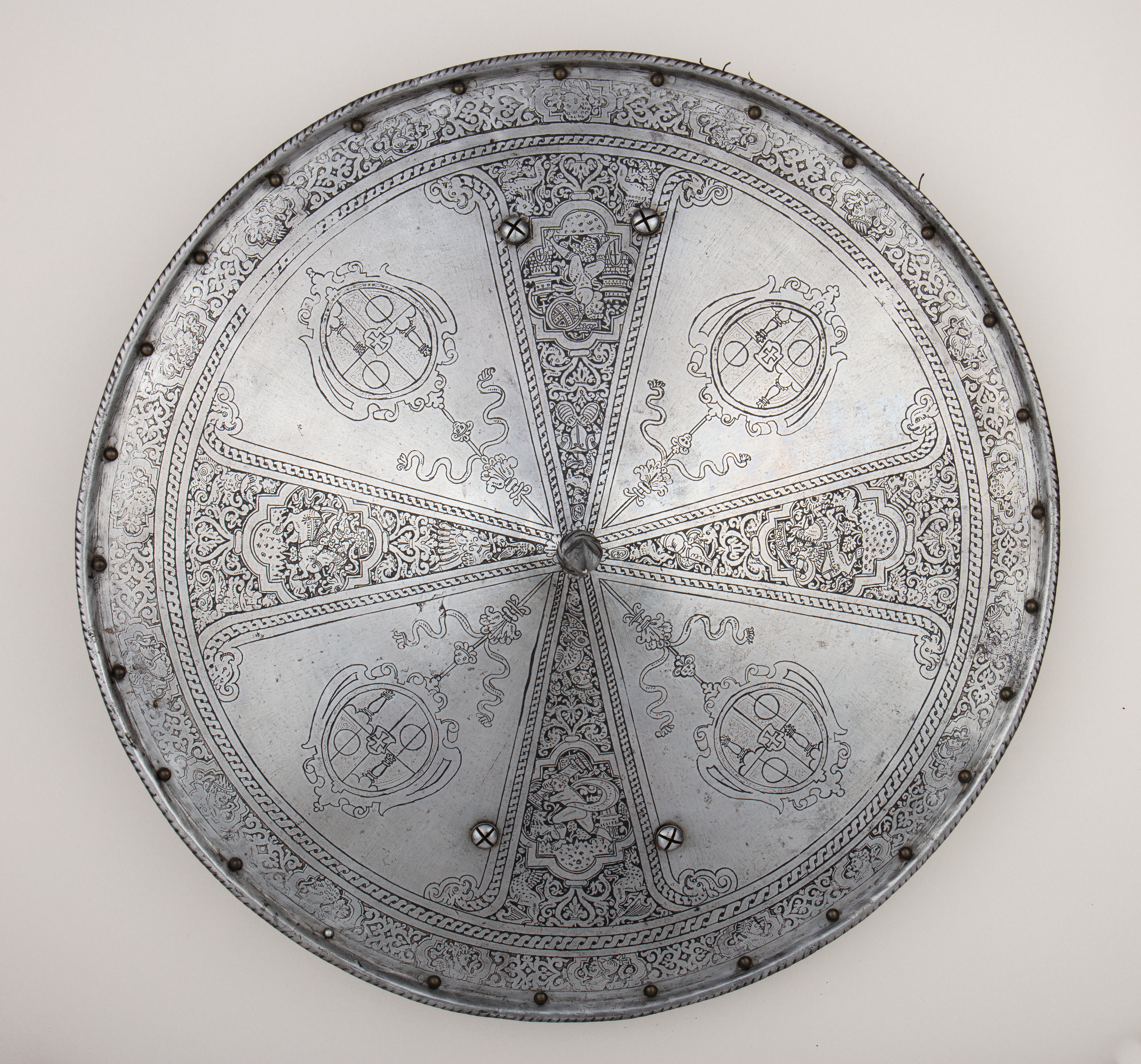
There is a fixed point on the other side of the garniture question. The Metropolitan Museum's Open Access record for a shield, accession 14.25.768, is titled as a shield from an armor garniture of the Voels-Colonna family, and is dated about 1570-80 and attributed to Milan. A shield in the same set implies that the set included an item for use with arms in hand, which fits the tournament and field uses Cleveland mentions. Both the shield and the armor are recorded as coming through William H. Riggs, so the division of the suit from the shield appears to date from 1964, not earlier, although the sources do not say whether the two were ever displayed together.
Chapter 3The arms: a Roman column on a Tyrolean shield
The seven coats of arms are the only evidence on the object that names a family.
The seven coats of arms are the only evidence on the object that names a family. Cleveland reads them as Colonna quartered with a family it cannot identify. The Colonna half of the claim is the surprising one, because the family Cleveland has in mind, the lords of Voels in the South Tyrol, are not obviously a Roman family, and the sources consulted explain the name only as an adoption.
The Wikipedia article on Proesels Castle, a tertiary source flagged for replacement, says the lords of Voels are believed to have built the castle before 1200, that Leonhard of Voels, born in 1458, rebuilt it in Gothic form with money from a salt-mine post at Hall in Tirol and from three wealthy marriages, and that he became governor of the County of Tyrol in 1498. Around the time of Leonhard II the family began to add the Colonna name. The article says the reason is unclear and lists several hypotheses. The castle's own history page names Leonhard von Voels-Colonna as the man, between 1458 and 1530, who expanded the fortress with late Gothic and Renaissance features.
What can be said is narrow. A family that took the Colonna name into its arms and style in the lifetime of Leonhard (1458-1530) is a plausible bearer of a Colonna quartering in the 1570s. The identity of the second quarter is not known, and nobody has been named as the man the suit was made for. Cleveland writes of an unknown member of the Voels-Colonna family, and that is as far as the evidence goes.
One further fact limits the family story. The Voels line was extinct by the early nineteenth century. Proesels Castle's own page says the last member of the family died in 1804, while the Wikipedia article gives 1810 and names him as Felix, Freiherr von Voels, who died childless. Both agree that the castle then declined. A suit made for a Voels-Colonna in the 1570s therefore had at most two centuries in family hands, and the evidence that it stayed in the family's castle for any part of that time is the first line of Cleveland's provenance list, which carries no date.
Chapter 4Proesels or Bolzano: the first gap
Cleveland's provenance list opens with Schloss Proesels at Fie allo Sciliar in Italy, with no date, and goes on to the Town Hall in Bolzano, dated question mark to 1832, and then to Prince Peter...
Cleveland's provenance list opens with Schloss Proesels at Fie allo Sciliar in Italy, with no date, and goes on to the Town Hall in Bolzano, dated question mark to 1832, and then to Prince Peter Soltykoff of Paris from 1832. The empty date on the first entry and the question mark on the second are the museum's own signal that it does not know when, or whether, the suit left the castle for the town hall, nor how it came to be in the town hall at all.
Proesels and Bolzano both lie in the South Tyrol, and the castle's history is one of decline and neglect after the family died out: Wikipedia says it stood empty for about fifty years from around 1810 and that between 1860 and 1978 it changed hands fourteen times. Neither page mentions an armory sale or a suit of armor leaving the castle in the early nineteenth century. The castle's present display of weapons is described by Wikipedia without any origin and by a search summary of other pages as a collection from the nineteenth century. Nothing found links that display to this suit.
Cleveland also cites a Silvana volume of 2004, Bolzano 1700-1800: la citta e le arti, at page 77, figure 9, among the literature on the suit. The title is all that could be established about that reference, but it means the suit has been published in a Bolzano art-historical context, which is consistent with a town-hall provenance in the period the volume covers. It does not tell us what the town hall used the armor for, why it held it, or on what terms it let it go in 1832.
The sources consulted include one scholarly study that deals with exactly this stage. A chapter by Donald J. La Rocca, curator of arms and armor at the Metropolitan Museum, appears in the 2023 Fliegel festschrift under the title The Voels-Colonna Armor for Man and Horse in the Cleveland Museum of Art and Its Matching Shield in the Metropolitan Museum of Art, at pages 133 to 146, and Cleveland lists it as reproducing the suit as figure 7.1. Project MUSE lists the chapter but shows no abstract and the text of the chapter was not available for this record, so its argument is not reported here. Whoever wants the chain from Proesels to the Bolzano town hall to Paris in documentary detail must read that chapter, and this record flags that as the first thing to check.
Chapter 5Which Soltykoff? A name and a date that do not quite agree
Cleveland names the 1832 buyer as Prince Peter Soltykoff, active 1840 to 1861, in Paris, and gives the date of his ownership as 1832 onward.
Cleveland names the 1832 buyer as Prince Peter Soltykoff, active 1840 to 1861, in Paris, and gives the date of his ownership as 1832 onward. The two statements do not sit together comfortably: a collector recorded as active from 1840 is shown as buying in 1832. The record does not explain the difference, which may only reflect the museum's way of summarising the span of his collecting.
The larger problem is that the Soltykoff name covers two collectors in the secondary literature. Elena Carrara's article in the Metropolitan Museum Journal for 2012, which draws on the Riggs correspondence at the Met, calls the great arms collector of Paris the Russian prince Alexei Soltykoff, 1806 to 1859, whose collections she says were added to the emperor's collection at the Chateau de Pierrefonds; she cites a Soltykoff sale of 1854 with 517 pieces. She adds that the Lyons archivist and restorer Jean-Baptiste Carrand helped Soltykoff assemble his cabinet d'armes, advising him on the purchase of the Debruge-Dumenil collection, which was sold in 1850. A separate Paris catalogue records a sale of the objets d'art and curiosities of the celebrated collection of the prince Soltykoff beginning on 7 April 1861, and Frederic Tixier cites a doctoral thesis by C. E. Brennan, 2003, on Prince Petr Soltykoff as a nineteenth-century collector of medieval art. The 1854 and 1861 sales are therefore, on this reading, the dispersal of two different Soltykoff collections.
Which of the two, if either, bought a suit of armor at Bolzano in 1832 is not settled by anything consulted. Carrara's dates make Alexei about twenty-six in 1832, but no birth date was found for the Soltykoff that Cleveland names, and nothing consulted ties either man to this suit by a document. The record therefore grades this link as disputed and lists the identity of the Soltykoff as an open question.
Cleveland's list gives no date at which the suit left Soltykoff for Riggs and no price: the line is a bare succession, with Riggs's ownership running to 1913.
Chapter 6William H. Riggs, the buyer who cleaned too hard
Riggs is the best-documented link in the chain.
Riggs is the best-documented link in the chain. Carrara, who draws on 130 letters written by the Italian diplomat Costantino Ressman to Riggs between 1878 and 1899 in the Met's arms and armor department files, gives his dates as 1837 to 1924, although Cleveland's note on the suit gives 1837 to 1928. In 1853, after the death of his banker father, he moved to Europe, studied at Vevey in Switzerland, where J. P. Morgan was a classmate, and went to Germany intending to study engineering, which is where, Carrara says, he began to buy arms and armor. He settled in Paris in 1857, in the rue d'Aumale, and in 1871 moved to 13 rue Murillo, a house near the Parc Monceau that had belonged to another arms collector, the comte de Nieuwerkerke; the purchase was made on 16 April 1871 for 188,500 francs. He devoted his life to the collection and bought the bulk of it, mainly sixteenth and seventeenth century European arms, in the 1860s, adding to it selectively later. He trimmed duplicates and lesser pieces by what he called sales a nettoyage, weeding-out sales.
He was famous among his friends for what he did to the pieces. Carrara notes that Riggs's tendency to clean objects excessively may have been influenced by his early acquaintance with Carrand, whose restorations were debated by his peers, and that Ressman coined a French verb, riggser, for the habit. Ressman warned a mutual friend, the Baron de Cosson, that the first rule is to avoid Riggs's system and never touch the interior of antique arms. The critic Edouard de Beaumont, writing in 1878, is cited for Riggs's overcleaning. Bashford Dean, the Met's curator, remembered him as a man who spent most of his time in his gallery removing deep-seated rust, replacing straps and making necessary restorations.
For this suit, that is a warning with a specific shape. Whatever the surface of the etched bands looked like when the Bolzano town hall let the suit go, it passed through a collector whose hands were on it for a long time, and the leather, the straps, the mail and the saddle that make up the non-steel parts of the set are the elements most likely to have been replaced. Cleveland's catalogue records the saddle as mostly modern reconstruction but gives no date for the work. No document in the sources consulted ties any particular restoration of this suit to Riggs.
He was also a reluctant seller of access. His gallery on the top floor of the rue Murillo house was shown to few, and Belleval, a fellow collector, left the one contemporary description of the display in 1895: mail shirts, shafted weapons and rare armors above a shelf of helmets. Riggs exhibited at the Trocadero in 1878, in gallery 13, where Beaumont placed his display second only to the Spitzer pieces. By 1889 he told Ressman he proposed to show about 2,500 pieces, which he described as half of what he owned. The gift to the Metropolitan Museum, accepted by its trustees on 19 May 1913, comprised nearly two thousand objects and a library of almost three thousand books, and was the second grand collection of arms and armor to come to the museum after that of the duc de Dino in 1904. Riggs came to New York with Dean in 1912, on his first visit since 1868, and was asked to act as a trustee of the collection during his lifetime. The museum bought his house in Luchon for 400,000 francs in 1912 to release him for the move, and sold the Grand Hotel et Casino de Luchon in 1920 for 150,000 francs.
Chapter 7What armor cost in Riggs's Paris
No price for this suit is recorded in any source consulted: not what Bolzano received in 1832, not what Riggs paid, not what Cleveland paid the Metropolitan Museum in 1964.
No price for this suit is recorded in any source consulted: not what Bolzano received in 1832, not what Riggs paid, not what Cleveland paid the Metropolitan Museum in 1964. What can be given is the market around Riggs, taken from Carrara and kept to what she reports, with each figure being for a different object and none a valuation of this one.
In 1880 Ressman bought two small pieces for Riggs at the Hotel Drouot for 39 francs 90 and 25 francs 20, fees included, and recommended a complete painted pavise from the architect and writer Victor Gay, who was asking 400 francs. In 1887 Riggs telegraphed his limit for a helmet and shield described in a sale as Louis XIV: at least 3,500 francs for the helmet and 1,500 for the shield. The dealer Bachereau bought them at 3,600 and 1,800, and Ressman thought the two worth at least 10,000 francs together. In 1888, at the Londesborough sale, Ressman wrote that it would be a battle fought with thousand-franc notes. At the Spitzer sale in 1893 he reported takings of 300,000 to 400,000 francs a day, and he predicted a total of eight or nine million; the Spitzer arms sale of 1895 did not fetch record prices. At the Zschille sale in London in January 1897, 862 pieces made 16,254 pounds in total, and Riggs did not pursue a halberd that Bachereau had bought for 62 pounds and offered him for 2,000 francs.
These show the arms market as one in which a first-quality helmet could make a few thousand francs and a whole collection of hundreds of pieces a few thousand pounds, and in which Riggs bargained hard and was often outbid. No source consulted gives a wage, a house price or a retail price index for 1860 or 1832 in these terms, so no modern equivalent is offered; any such figure would need its method named and none was found.
Chapter 8From New York to Cleveland, 1964
The Metropolitan Museum held the suit from 1913 to 1964, according to Cleveland's provenance list, and Cleveland records the accession on 6 May 1964, credit line John L.
The Metropolitan Museum held the suit from 1913 to 1964, according to Cleveland's provenance list, and Cleveland records the accession on 6 May 1964, credit line John L. Severance Fund. The sources consulted do not say why the Metropolitan Museum sold it, to whom it was offered, or at what price. That the museum parted with an object that had arrived in the 1913 Riggs gift is a fact; the reason is absent.
Cleveland recorded the suit in its Year in Review exhibition from 8 December 1964 to 31 January 1965 and in the reinstallation of its armor court, dated 10 September 1998. It is now on view in the Jack, Joseph and Morton Mandel Armor Court, location 210A. Cleveland's record states that the suit is not flagged as having Nazi-era provenance concerns, and no export licence, restitution claim, theft or war loss appears in any of the sources consulted. The Metropolitan Museum to Cleveland transfer was a sale between American museums and triggers no export mechanism; the earlier moves, from Bolzano to Paris in 1832 and from Paris to New York in 1913, were across borders at times and in places whose export rules were not examined here, and no record of any licence or objection was found.
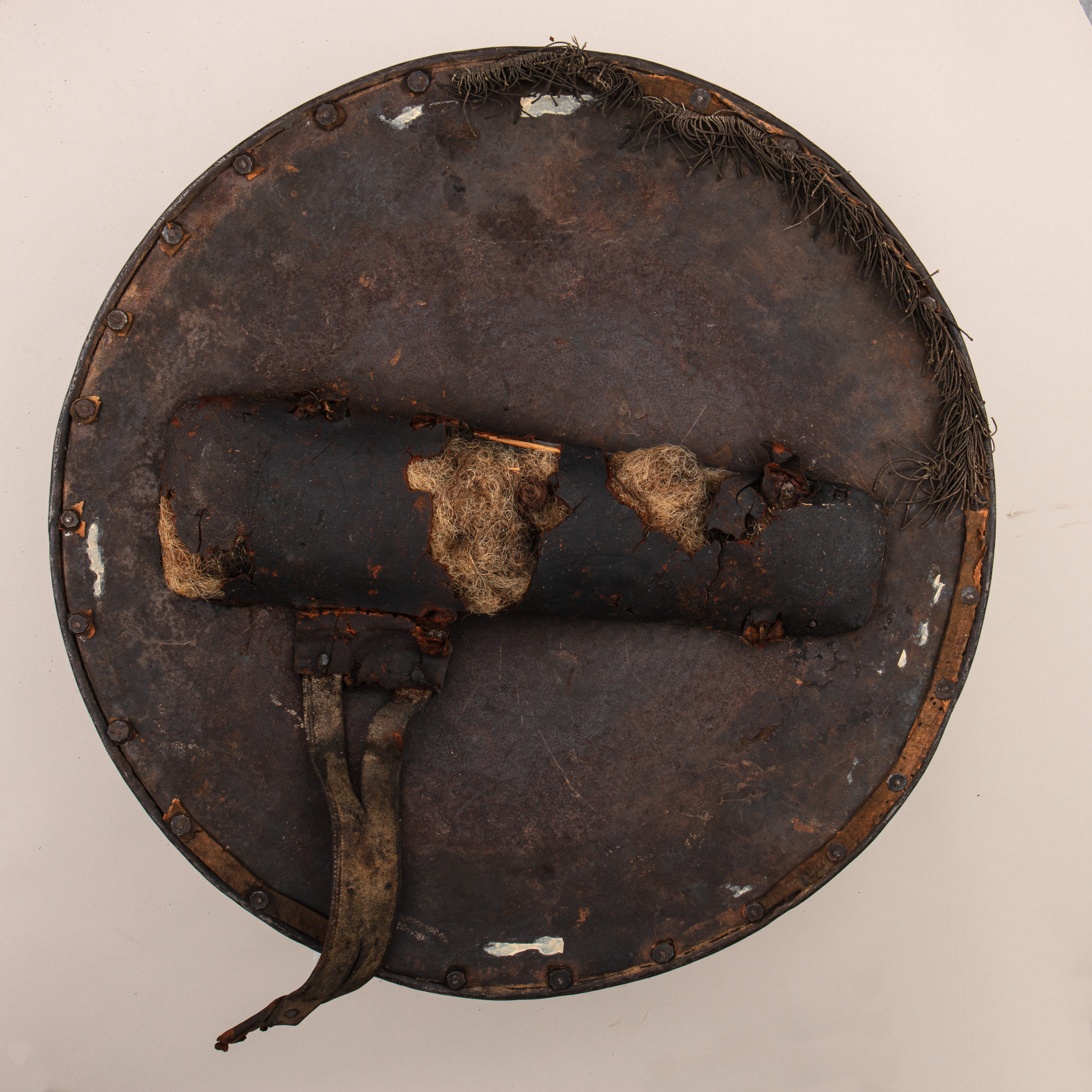
The Riggs gift also left the shield behind. Because the Met's Open Access record for the shield carries the credit Gift of William H. Riggs, 1913, with the accession number 14.25.768 and accession year 1914, the shield and the suit entered the Metropolitan Museum together or at about the same time and were separated only when the suit left in 1964. The shield remains in New York, where the Met lists it in gallery 380: a steel disc of 55.2 centimetres in diameter and 18.7 centimetres deep, weighing 3,895 grams, made of steel, brass, leather, horsehair and textile and dated about 1570 to 1580. Its reverse, as shown in the Met's second image, still carries its leather and textile fittings.
Chapter 9How the suit became known, and what can be studied remotely
The suit has a thin publication record in the sources consulted, and every item on it is cited by Cleveland's own entry.
The suit has a thin publication record in the sources consulted, and every item on it is cited by Cleveland's own entry. Bashford Dean wrote on Riggs in the Metropolitan Museum of Art Bulletin in 1914, under the title Mr. Riggs as a Collector of Armor, and Cleveland cites page 72 of that article and of Dean's 1921 Handbook of Arms and Armor including the Riggs collection. Cleveland also lists George Cameron Stone's 1934 Glossary, at page 96, figure 123, number 4; Stephen N. Fliegel's catalogue of the museum's arms and armor, 1998 at pages 20, 57 and 162, catalogue number 6, and again in 2007; Carrara's 2012 article at page 169; a 2002 Shakespeare encyclopedia at page 44; a California state schoolbook of 1966, Open Highways Book 6, at page 233; the 2004 Bolzano volume; a 2019 piece in the Cleveland members' magazine, which reproduces a detail of the suit; and the 2023 La Rocca chapter.
The list runs from a standard museum catalogue to a school reader and a literary encyclopedia, which shows the suit has circulated as an illustration well beyond the specialist literature. Cleveland's did-you-know text for the suit remarks that the crest appears seven times.
A student has more to work with than for most armor. Cleveland has released the suit and its 31 components as Creative Commons Zero open access data, with high resolution images. A three-dimensional model of the whole suit, made by Dale Utt and sourced from Sketchfab, was deposited in Zenodo on 21 January 2022 under a CC0 licence as a glb file of about eight megabytes. The museum's data also point to a Wikidata entry and an Internet Archive item. Those materials allow the measurements, the placement of the arms and the construction of the etched bands to be checked without travelling to Cleveland.
Chapter 10What the record cannot say
The suit has no known maker, no named first owner, no documented route from the Tyrol to Paris, no price at any stage, no recorded auction sale and no recorded theft.
The suit has no known maker, no named first owner, no documented route from the Tyrol to Paris, no price at any stage, no recorded auction sale and no recorded theft. The only two points in the chain at which the sources agree on dates are the transfer in 1832 and the gift in 1913. Between them, and after them, the chain depends on a museum database line, each entry of which is the museum's own statement, and on two publications that could not be read for this record, La Rocca's 2023 chapter and Dean's 1914 article.
That is a better position than a smooth story would be. A reader who finds the suit described elsewhere as made for a named Voels-Colonna count, taken from the castle of Proesels, sold to Soltykoff at a stated price and bought by Riggs in a named year should ask for the source. This record has not found one.
The artist
Unidentified North Italian armourer or workshop (no maker recorded)
No maker, workshop or mark is recorded for this suit. Cleveland's catalogue gives its culture as North Italy, 16th century, and nothing in the museum data names an armourer, a guild stamp or a town. The matching shield at the Metropolitan Museum is attributed to Milan, and the museum's data give one component, the left arm defence, as Italy, probably Milan. This dossier therefore covers what the objects themselves and their catalogue say about how the suit was made and identified, not a named individual.
Related works
| Work | Relation | Where it is |
|---|---|---|
| Shield (Rotella or Brocchiere) from an Armor Garniture of the Voels-Colonna Family Italian, Milan | A companion element of the same garniture, according to the museum's own title Steel, brass, leather, horsehair and textile, about 1570-80, diameter 55.2 cm, 3,895 g. Gift of William H. Riggs, 1913. The shield and the suit reached the Metropolitan Museum through the same gift; the museum kept the shield when the suit was sold in 1964. | Metropolitan Museum of Art, New York, 14.25.768 (gallery 380) |
| Saddle, component of the same suit (1964.88.z) North Italy, 16th century, but mostly modern reconstruction | The one component of the suit catalogued as largely not original The component record is the clearest example of the suit's composite state. It is dated c. 1575 and measures 52 x 40.5 x 57 cm. | Cleveland Museum of Art |
| Proper left and proper right arm defences (1964.88.i and 1964.88.j) North Italy; the left arm probably Milan | The oldest dated parts of the suit Both dated c. 1517, about sixty years before the body armor. | Cleveland Museum of Art |
| Proesels Castle, Fie allo Sciliar Lords of Voels, Voels-Colonna | First place in Cleveland's provenance list, undated The family's seat until the line died out in 1804 (the castle's own page) or 1810 (Wikipedia); the castle now has a display of weapons and armor of which no origin was found. | South Tyrol, Italy |
Open questions
- Who was the suit made for? Cleveland reads the arms as Colonna quartered with a still unidentified family and says only that the owner was probably an unknown member of the Voels-Colonna family of the South Tyrol. Identifying the second quarter would identify the man.
- Was the suit ever at Proesels Castle? Cleveland lists the castle first, with no date, and lists the Bolzano town hall second with a question mark on its start. The Wikipedia and castle pages consulted record no armor leaving the castle. The chain from the castle to the town hall to Paris awaits the documents in La Rocca's 2023 chapter.
- Which Soltykoff bought it in 1832? Cleveland gives Prince Peter Soltykoff, active 1840 to 1861, but Carrara's article describes the arms collector Alexei Soltykoff, 1806 to 1859, whose armoury went to Pierrefonds, and the 1861 Paris sale is of a different collection. Neither source assigns the 1832 purchase.
- When and for how much did Riggs buy it? Cleveland gives his ownership as ending in 1913 and no start. Carrara dates the bulk of Riggs's buying to the 1860s and the Ressman letters begin in 1878, and her article does not mention the suit.
- How and when did the arm defences of about 1517 come to be on a suit of about 1575, and who made the modern saddle? The component records give dates and origins but not the history of the assembling.
- Where are the other elements of the garniture? A set with exchange pieces implies more than 31 components, yet only the Met shield has been identified in the sources consulted.
- Why did the Metropolitan Museum sell the suit in 1964, to whom was it offered and at what price, when it kept the shield?
Questions about this object
What is Armor for Man and Horse with Voels-Colonna Arms?
Armor for Man and Horse with Voels-Colonna Arms is an arms and armour, dated c. 1575 (arm defences c. 1517). Medium: Steel, etched in bands; mail neck defence; saddle mostly modern reconstruction.
Who made Armor for Man and Horse with Voels-Colonna Arms, and is the attribution settled?
The attribution to Unidentified North Italian armourer (workshop not recorded) is recorded here as unknown. Cleveland catalogues the origin as North Italy, 16th century, with no maker, mark or inscription. The left arm defence is given as Italy, probably Milan, and the Metropolitan Museum attributes the companion shield to Milan. The first owner is described only as probably an unknown member of the Voels-Colonna family; the second quarter of the arms is unidentified. The set is composite: the arm defences are dated c. 1517, the body armor c. 1575 and the saddle is mostly modern reconstruction.
Where is Armor for Man and Horse with Voels-Colonna Arms now?
The Cleveland Museum of Art, Jack, Joseph and Morton Mandel Armor Court (210A). Inventory number 1964.88 (components .a to .ee). Last confirmed 17 November 2026. Bought 1964, John L. Severance Fund, from the Metropolitan Museum of Art.
What is still unknown about Armor for Man and Horse with Voels-Colonna Arms?
Who was the suit made for? Cleveland reads the arms as Colonna quartered with a still unidentified family and says only that the owner was probably an unknown member of the Voels-Colonna family of the South Tyrol. Identifying the second quarter would identify the man.
Sources
- 1The Cleveland Museum of Art Open Access record for 1964.88, Armor for Man and Horse with Voels-Colonna Arms (title, date, description, provenance, citations, exhibitions, accession date, images), retrieved 17 November 2026. Museum database; the provenance entries carry no document citations. openaccess-api.clevelandart.org/api/...
- 2The Cleveland Museum of Art Open Access records for the 31 components 1964.88.a to 1964.88.ee (dimensions, dates, origins, saddle note), retrieved 17 November 2026. openaccess-api.clevelandart.org/api/...
- 3The Metropolitan Museum of Art Open Access record, objectID 27247, Shield (Rotella or Brocchiere) from an Armor Garniture of the Voels-Colonna Family, 14.25.768 (date, culture, medium, dimensions, credit line, gallery). The museum's own catalogue page with provenance and description could not be retrieved and is not relied on. collectionapi.metmuseum.org/public/...
- 4Elena Carrara, 'Mon cher ami et frere d'armes: Letters from Costantino Ressman to William Riggs, Collectors of Arms and Armor in Nineteenth-Century Paris', Metropolitan Museum Journal 47 (2012), pp. 169-177. A peer-reviewed article published by the museum. resources.metmuseum.org/resources/...
- 5Wikipedia, 'Proesels Castle'. en.wikipedia.org/wiki/...
- 6Schloss Proesels, official history page (Kuratorium Schloss Proesels), for the 1279 first mention, Leonhard von Voels-Colonna (1458-1530), the death of the last Voels in 1804 and the 1981 acquisition. schloss-proesels.seiseralm.it/en/...
- 7Project MUSE, table of contents of Collectors, Commissioners, Curators: Studies in Medieval Art for Stephen Fliegel, ed. Elina Gertsman (Medieval Institute Publications, 2023): chapter 7, Donald J. La Rocca, pp. 133-146. The chapter text itself was not available and is not reported. muse.jhu.edu/book/...
- 8Frederic Tixier, article in Palazzo Madama, Studi e notizie (Turin), footnotes on the sale catalogue of the collection of the prince Soltykoff, Paris, from 7 April 1861, and the doctoral thesis of C. E. Brennan, 2003, on Prince Petr Soltykoff. gestione.fondazionetorinomusei.it/media/...
- 9Zenodo record 10318486, '1964.88 Armor for Man and Horse', a CC0 3D model (glb) made by Dale Utt from Sketchfab, published 21 January 2022. zenodo.org/records/...
- 10Cleveland Art, members magazine, January/February 2019, p. 22, which reproduces a detail of the suit with its credit line (Internet Archive full text). archive.org/details/...
- 11The Cleveland Museum of Art, collection page for 1964.88 (weight, etched decoration, location), cross-checked against the Open Access data. clevelandart.org/art/...
Last verified · Published
Change log
17 November 2026 - Record created at the house standard: researched narrative, technical evidence, maker dossier, graded provenance chain, prices with hammer and premium separated, related works, open questions and sources.