Bath Pail (Satl)
Unidentified brass workshop, Isfahan (maker not recorded) · c. 1580-1610
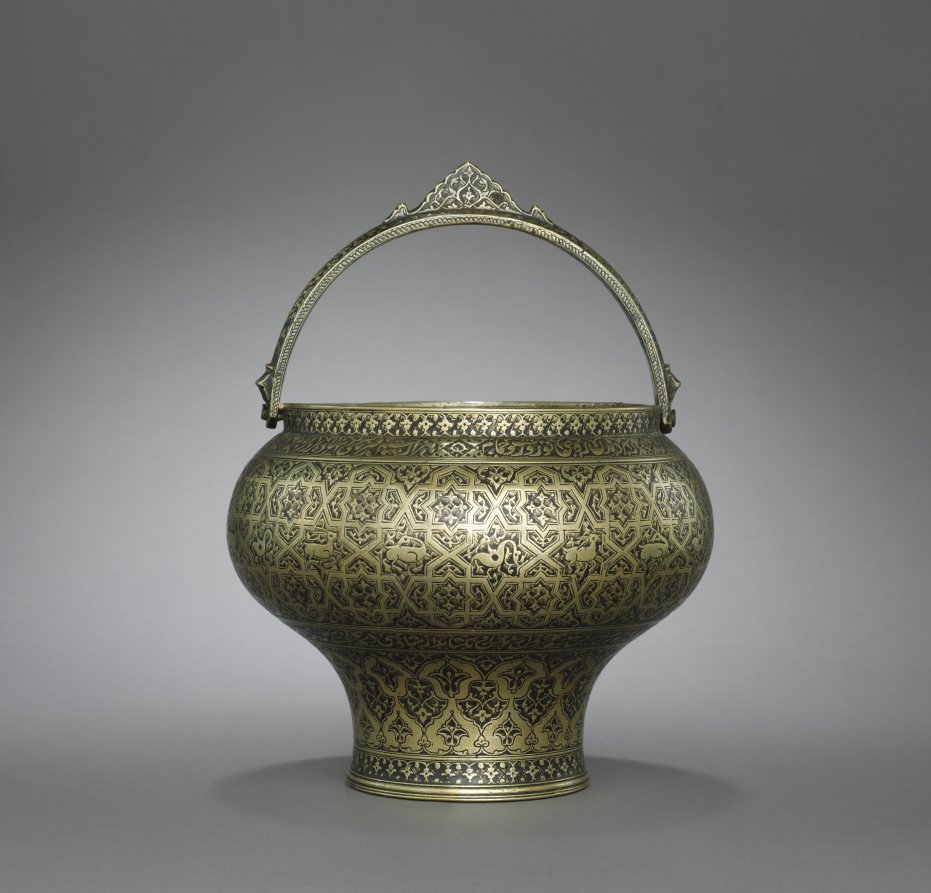
The pail in the museum's primary photograph: a brass body widening to the rim, with the geometric interlace and the verse bands engraved and inlaid in black. Cleveland Open Access, CC0.
| Artist | Unidentified brass workshop, Isfahan (maker not recorded) |
|---|---|
| Date | c. 1580-1610 |
| Medium | Cast brass, turned, engraved, inlaid with black compound (niello) |
| Dimensions | Overall height 17 cm (6 11/16 in.); diameter of base 11 cm (4 5/16 in.); diameter of rim 16.8 cm (6 5/8 in.) |
| Where it is now | The Cleveland Museum of Art, gallery 116 (Islamic)last confirmed |
| Inventory number | 1969.291 |
| Attribution | UnknownCleveland gives no maker and no workshop. Full note |
| Object type | Islamic metalwork |
| Period | Iranian, Safavid |
| Cases | Has a provenance gap |
| Inscriptions | Two bands of Persian verse in nasta'liq about the bath. Upper band: a beloved coming to the bath at dawn, hearts turned to dust beneath her steps, the bath-house with a thousand coloured eyes on door and ceiling, the eye becoming the bathing cup and the eyebrow its handle. Lower band: an old master in the bathhouse, a young person's question about why a saddened heart opens to joy there, and the answer that the bather has only a bathing-bowl and towel and even those belong to others. Translation as given by Cleveland. |
| Owners on record | 5 links2 documented, 1 disputed, 2 unknown |
| Sources | 14 cited |
About this record Last verified · 14 sources cited · Change log
On this page 9 sections
ContentsClose
A brass bath pail 17 cm high, made in Isfahan about 1580 to 1610 and engraved and inlaid in black with an interlace, a band of animals and two bands of Persian verse about the bath. Cleveland says it carried a wealthy owner's bathing equipment to the hammam. It entered the museum in 1969 as a gift of the New York dealers Rosenberg & Stiebel.
The museum's chain begins with an undated de Rothschild collection in Paris and no first name. Nothing earlier is recorded and no source seen confirms the Rothschild link, so the record keeps it as an untested assertion and the centuries before it as a gap. No sale, price or conservation history is published.
Provenance
Each link is graded. Documented: a cited source supports it. Disputed: the identification is argued but not established. Unknown: no owner for that span, and the gap is not smoothed into a narrative. The grades in the glossary.
- c. 1580-1610 - ?Unknown (made in Iran, Isfahan, per Cleveland)unknown
No owner, patron or inscription naming a person is recorded for the first centuries of the pail's life, and no source consulted gives its route to Europe.12
- Date not recorded - Date not recordedde Rothschild collection, Paris, Francedisputed
Asserted by Cleveland's first provenance line with no date, no forename and no citation; the museum's page also says provenance information may not be current. No source confirming which Rothschild, or any Rothschild, owned it was found. Graded disputed because asserted and untested; an unverified assertion, not a contradicted one.12
- Date not recorded - ?Unknownunknown
How and when the pail passed from the de Rothschild collection to the dealer is not recorded.12
- ? - 1969Rosenberg and Stiebel, Inc., New York (dealer)documented
Cleveland's second provenance line, dated ?-1969, annotated given to the Cleveland Museum of Art. The firm is documented by the Frick archive and press release as a four-generation dealing family with a New York gallery from 1939. The start date of its ownership of this pail is not recorded.12910
- 1969 - presentThe Cleveland Museum of Artdocumented
Gift of Rosenberg & Stiebel, Inc.; accession date 13 December 1969 in the open-access data. No value or tax treatment is published.12
Technical evidence
| Attribution note | Cleveland gives no maker and no workshop. Its place of making, Isfahan, and its date of c. 1580-1610 are the museum's attribution; the sources consulted give no stated basis for either, and no signature is recorded among the inscriptions. The attribution is therefore the museum's, not an independently tested one. |
|---|---|
| Object | Bath pail (satl); Cleveland Museum of Art 1969.291; Gift of Rosenberg & Stiebel, Inc.12 |
| Date | c. 1580-161012 |
| Place and period | Iran, Isfahan, Safavid period (1501-1722)12 |
| Technique | Cast brass, turned, engraved, inlaid with black compound (niello)12 |
| Dimensions | Overall 17 cm high; diameter of base 11 cm; diameter of rim 16.8 cm2 |
| Script | Nasta'liq; two bands of Persian verse, upper and lower, about the bath2 |
| Decoration | Interlacing geometric design with a central band of repeating animals: a doe looking back, a waterfowl and a horned animal, possibly an ibex12 |
| Function (museum's account) | Carried bathing equipment for a wealthy individual from the home to the hammam2 |
| Accession | Accessioned 13 December 1969; legal status accessioned2 |
| Exhibition | Art of the Islamic World (Islamic art rotation), Cleveland Museum of Art, 21 May 2021 to 31 May 20222 |
| Conservation and bibliography | No conservation statement and no citations published in the open-access data2 |
| Licence | Images and data CC0 (Cleveland Open Access)2 |
Images
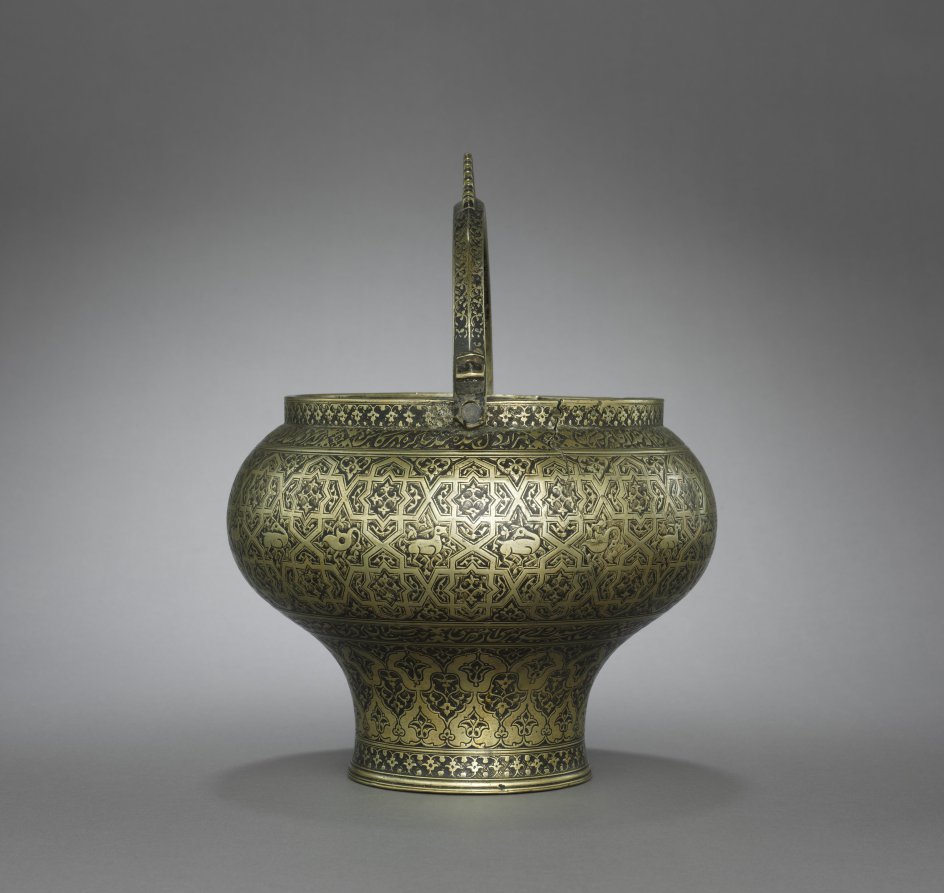
The record in full
Chapter 1A brass pail 17 centimetres high made to be carried
The Cleveland Museum of Art catalogues this as a bath pail, the museum's term in the title being satl, from Iran, Isfahan, Safavid period, c.
The Cleveland Museum of Art catalogues this as a bath pail, the museum's term in the title being satl, from Iran, Isfahan, Safavid period, c. 1580-1610. It is cast brass, turned, engraved and inlaid with a black compound that the museum identifies as niello. It stands 17 cm high on a base 11 cm across and opens to a rim 16.8 cm across, so it widens upward from a narrow foot. The open-access data gives these three measurements and no weight, no wall thickness and no handle dimension.
Cleveland's collection text says that the pail carried bathing equipment for a wealthy individual from the house to the hammam. That is the museum's account of its use; the sources consulted give no inscription naming an owner and no other document tying this pail to a person or a household. The decoration, in the museum's words, is an interlacing geometric design with a central band of repeating animals, and the two verse bands run above and below it.
Chapter 2How a brass pail came to carry black ornament
Cleveland's technique line lists four operations: casting, turning, engraving and inlay with a black compound.
Cleveland's technique line lists four operations: casting, turning, engraving and inlay with a black compound. Casting makes the form, turning on a lathe true-ups the surface and the foot, engraving cuts the pattern into the brass, and the black material is set into the cut lines so that the design reads dark against yellow metal. Those are the museum's operations; the sources consulted do not describe the workshop practice for this object or analyse the black compound, and the record does not claim a composition beyond Cleveland's word niello.
The same combination appears on a securely dated and localised Isfahan piece in London. The Victoria and Albert Museum catalogues a ewer dated 1602, probably made in Isfahan, as brass, cast, engraved and inlaid with a black composition, and describes it as the earliest dated example of its kind. Its curators add that around 1550 Iran developed a new style of engraved brassware with stylised plant ornament and with bands or cartouches matching the shape of the object, that poetic inscriptions in nasta'liq were common, and that human and animal motifs returned. The Cleveland pail fits that description on every point the two records share, and the ewer is the closest dated anchor for the pail's c. 1580-1610 range found in this research. It is a comparison, not proof of where this pail was made.
Chapter 3What the pail was for
The hammam, the public bath, descends from Roman and Hellenistic bathing, according to the Wikipedia article on the type, which also records that many Iranian hammams of the Safavid period survive...
The hammam, the public bath, descends from Roman and Hellenistic bathing, according to the Wikipedia article on the type, which also records that many Iranian hammams of the Safavid period survive, especially in Isfahan. That article is a tertiary source and is flagged below for replacement with a scholarly study of Iranian bathhouses; the Encyclopaedia Iranica article on bathhouses was not readable during this research.
A second Safavid object shows how bath equipment was inscribed. A tinned copper long-spouted bowl of c. 1600 at the Harvard Art Museums (1999.311) carries Persian verses in cartouches whose translation describes going to the bath, and a second inscription under the spout names its owner as Shah Begi Khanum, daughter of Mirza 'Ali Khan. Harvard's catalogue concludes from the verses that the bowl was used primarily in the bath. That is a different object, and nothing about its owner applies to the Cleveland pail. It does establish that bath vessels of c. 1600 were made to carry verse about the bath, which is exactly what the Cleveland pail does.
Chapter 4The two bands of verse
Cleveland transcribes both bands in English and records the script as nasta'liq.
Cleveland transcribes both bands in English and records the script as nasta'liq. The upper band is a love poem set at the bath: at dawn the beloved goes from her house toward the bath, a thousand hearts turn to dust on the road beneath her steps, and the speaker asks that his eye become the bathing cup and his eyebrow its handle. The last couplet turns the pail's own parts into the lover's body, a play that suits an object with a cup form and a handle.
The lower band is a short story told in the first person. An old master is remembered in the bathhouse; a young person asks an old man why anyone who sets foot there finds a saddened heart opened to joy; the old man answers that the bather has none of the trappings of the world, only a bathing-bowl and a towel, and even those belong to others.
Cleveland's collection text attributes the verses to Jami (died 1492) and says they relay a youth's question about why the hammam brings so much joy. Jami was born in 1414 in Khorasan and died in Herat in 1492 according to the Wikipedia article on him, which lists among his works the Baharestan, a book modelled on Sa'di's Gulistan; that is a tertiary source. This research did not trace either band to a named work of Jami, so the attribution rests on the museum's statement alone, and Cleveland's two inscription fields name no poet. The reading also carries a plain irony that the museum's own text half draws out: the object is a costly engraved pail for a wealthy owner and the verse on it says a bather owns only a bowl and a towel borrowed from others. That is an observation about the pairing, not a claim about what the patron or the maker intended.
Chapter 5Animals in the geometry
Cleveland's note for visitors says three animal motifs recur within the geometric interlacing: a doe with its head turned backward, a waterfowl and a horned animal, possibly an ibex.
Cleveland's note for visitors says three animal motifs recur within the geometric interlacing: a doe with its head turned backward, a waterfowl and a horned animal, possibly an ibex. The museum words the ibex with a possibly, and this record keeps that doubt. The V&A ewer's curators say human and animal motifs returned to Iranian engraved brass in the later sixteenth century, and the ewer shows animals in cartouches on its body, so a band of animals on a bath pail belongs to a documented habit of the period and does not need a separate explanation.
No source consulted assigns a meaning to the doe, the fowl or the ibex on this pail. The absence of a stated programme is recorded here as a finding; the verse is the only text that tells a reader what the object was thought to be about.
Chapter 6Other pails and what each is
Two pails sold at Sotheby's London in 2008, in the sale Arts of the Islamic World, are close in type and are not this object.
Two pails sold at Sotheby's London in 2008, in the sale Arts of the Islamic World, are close in type and are not this object. Lot 196 (sale L08220, estimated at GBP 20,000 to 30,000, price realised not shown on the page) is a Safavid cast brass bucket of the late sixteenth or early seventeenth century with niello in the hatched ground and Persian verses including couplets by Sa'di and Daqiqi. Lot 154 (sale L08222, estimated at GBP 15,000 to 20,000, price realised not shown) is a similar bucket whose shoulder bears verses from a Persian ghazal about a beloved going to the bathhouse. Sotheby's catalogue note on that lot states that the pail form goes back at least to the late Timurid period and that a similar Safavid pail is in the Victoria and Albert Museum; lot 196 cites Melikian-Chirvani (1982), pp. 256 (no. 115) and pp. 305-7 (no. 135) for comparable material.
The shared subject on lot 154, a beloved going to the bath, is a theme and not a link: nothing seen shows that its verses and the Cleveland upper band are the same poem, and the lot is not assigned any fact belonging to 1969.291. The Courtauld Institute's brass bucket attributed to Zayn al-Din, dated 1475-1550, is also associated by the Courtauld with the hammam, but the Courtauld says its decoration suggests it held wine and gives its origin as northwestern Iran, Turkey, Egypt or Syria; the V&A holds a bucket by the same Zayn al-Din signature (1826-1888) that it places in southern Germany or northern Italy with Egyptian or Syrian decoration. Neither belongs to the Safavid pail group.
This research did not find the V&A Safavid pail that Sotheby's cites, nor any catalogue entry for a comparable pail at the Metropolitan Museum, the Louvre or the Khalili collection; those are gaps in the search, not statements that no pail exists there.
Chapter 7The chain: a Rothschild, a dealer, a gift
Cleveland's provenance has three lines and no dates for the first.
Cleveland's provenance has three lines and no dates for the first. The first is the collection of de Rothschild, Paris, France. The second is Rosenberg and Stiebel, Inc., New York, dated ? to 1969 and annotated given to the Cleveland Museum of Art. The third is the museum itself from 1969. The page itself warns that provenance information may not be current, and its citations and footnotes fields are empty.
Which Rothschild is not stated and is not guessed here. The record gives a surname, a city and a collection label with no forename, no date of acquisition and no evidence. No Rothschild inventory, sale catalogue or letter linking a Safavid pail to any member of the Paris family was found. The first link is therefore recorded as disputed in the sense that it is asserted by the museum and untested, and the gap before it, from the sixteenth century to the Rothschild collection, is complete.
The dealer is better known. The Frick Collection's archive describes Rosenberg & Stiebel as a four-generation family firm: Jakob Rosenbaum founded it in Frankfurt in the 1870s (the Frick press release says 1874), his son Isaak moved it to Amsterdam in 1930 and died in 1936, Saemy and Raphael Rosenberg opened S. & R. Rosenberg in London in 1936, Hans Stiebel ran Stiebel et Cie in Paris from 1935 to 1951, and Eric Stiebel opened Rosenberg & Stiebel, Inc. in New York in 1939; the New York firm operated at 32 East 57th Street from 1944 to 2000. The Frick records Rothschild dealings, among them the 1949 sale of a restituted Ruisdael to the Frick from the collection of Baron Louis von Rothschild, and says the family's ties to the gallery went back to its Frankfurt days. That is a general Rothschild connection of the firm and says nothing about this pail; a Paris Rothschild collection and a firm with a Paris branch in the relevant decades make a link plausible, but no document seen supports it and the record does not bridge the gap.
The Frick holds the firm's archive and describes sales and inventory records, mostly 1939 to 2000. A search of the archive for the pail is the single most direct next step and was not possible from the pages read. Cleveland's own archives hold a 1942-1958 correspondence file with the firm in the William Milliken papers, which shows the firm dealt with Cleveland a generation before this gift; the folder's contents are not described and the file ends eleven years before 1969.
Chapter 8What the record cannot say
No sale of this pail at auction is recorded in the sources consulted, so there is no hammer price, no premium and no currency to give.
No sale of this pail at auction is recorded in the sources consulted, so there is no hammer price, no premium and no currency to give. Neither the date the firm acquired it nor the price it paid is known. It was a gift, and the sources consulted say nothing of a tax deduction attaching to it, so the record does not suggest one. No conservation statement is published on the Cleveland page and the open-access data lists none; the condition therefore cannot be described beyond what the photographs show. No export licence, restitution claim or legal dispute touching the pail was found, and Cleveland's data flags it as not subject to Nazi-era provenance concern.
For the Rothschild step the record offers one fact and one caution. The fact is that the firm's archive contains documentation on Rothschild family collections, which makes the archive the place to look. The caution is that the Rothschild surname covers several collecting branches in Paris and elsewhere, and a pail described as from the de Rothschild collection might as easily have come to the firm through an estate sale or a dealer as directly from a family member.
Chapter 9Where it is now
The Cleveland Museum of Art lists the pail in gallery 116, Islamic, and its open-access record gives the 2021 to 2022 Islamic art rotation as its only exhibition.
The Cleveland Museum of Art lists the pail in gallery 116, Islamic, and its open-access record gives the 2021 to 2022 Islamic art rotation as its only exhibition. The museum releases the object's images and data under CC0, which is why this record carries two plates, the front view and the one alternate view the museum photographed, which shows the design from a second angle. The open-access record also lists a Wikidata item and an Internet Archive page for the object; neither was read for this record.
The artist
Isfahan brass-engraving workshops of the Safavid period (maker of this pail not recorded)
No name, signature or workshop is recorded for this pail, so the dossier covers the tradition it belongs to. What can be said rests on a handful of museum records and one scholarly warning: A.S. Melikian-Shirvani opened his 1974 article on Safavid metalwork by stating that the history of Iranian metalwork had not yet been written and that the Safavid period, with the half century of Timurid rule before it, had been especially neglected. The standard reference is his 1982 catalogue, cited in the Sotheby's notes and not seen for this record.
Related works
| Work | Relation | Where it is |
|---|---|---|
| Safavid cast brass bucket, Sotheby's London, Arts of the Islamic World, 2008, lot 196 Unidentified | Same type; a different object, not this pail Late 16th or early 17th century; niello in the hatched ground; Persian verses including couplets by Sa'di and Daqiqi; estimate GBP 20,000-30,000; price realised not shown on the page. Cites Melikian-Chirvani (1982), no. 115 and no. 135. | Sold at auction 2008; present location not known |
| Safavid cast brass bucket, Sotheby's London, Arts of the Islamic World, 2008, lot 154 Unidentified | Same type with a ghazal on a beloved going to the bathhouse; a different object, not this pail Estimate GBP 15,000-20,000; price realised not shown on the page. Shared theme with the Cleveland upper band is not evidence of a shared text. | Sold at auction 2008; present location not known |
| Ewer, dated 1602 (458-1876) Unidentified; owner Qasim | Closest dated Isfahan comparandum for technique and style; not a pail Brass, cast, engraved, inlaid with a black composition; height 32 cm; probably Isfahan; earliest dated example of its kind per the V&A. | Victoria and Albert Museum, London |
| Long-spouted vessel with engraved decoration and inscription (1999.311) Unidentified; owner Shah Begi Khanum | Safavid bath bowl with bath verses; a different vessel Tinned copper, c. 1600, 13.8 x 36.5 cm; lost most of its tin coating. | Harvard Art Museums, Cambridge, Massachusetts |
| Bucket attributed to Zayn al-Din (1475-1550) Zayn al-Din (attributed) | Not a Safavid pail; named only to prevent confusion Brass inlaid with silver; the Courtauld associates it with the hammam and thinks it held wine; its origin is given as northwestern Iran, Turkey, Egypt or Syria. | The Courtauld, London (Samuel Courtauld Trust) |
Open questions
- Which de Rothschild owned the pail, and when? Cleveland gives a surname and a city and no date.
- How did a Safavid pail of c. 1580-1610 pass from Isfahan to a Paris collection, and where was it in the intervening centuries? Nothing is recorded.
- When did Rosenberg & Stiebel acquire it and from whom? Cleveland's date range for the firm begins with a question mark.
- Is the pail recorded in the Rosenberg & Stiebel archive at the Frick, which holds sales and inventory records for the New York firm?
- On what evidence does Cleveland place the pail in Isfahan specifically, and on what basis the c. 1580-1610 range?
- Do the verse bands trace to a named work of Jami, as the museum says, or to another poet? The upper band and the lower band may not share an author.
- Is this the pail the Victoria and Albert Museum or Melikian-Chirvani (1982) would count among the Safavid pails of its type, and which comparable pails survive at the Met, the Louvre and the Khalili collection?
Questions about this object
What is Bath Pail (Satl)?
Bath Pail (Satl) is an islamic metalwork, dated c. 1580-1610. Medium: Cast brass, turned, engraved, inlaid with black compound (niello).
Who made Bath Pail (Satl), and is the attribution settled?
The attribution to Unidentified brass workshop, Isfahan (maker not recorded) is recorded here as unknown. Cleveland gives no maker and no workshop. Its place of making, Isfahan, and its date of c. 1580-1610 are the museum's attribution; the sources consulted give no stated basis for either, and no signature is recorded among the inscriptions. The attribution is therefore the museum's, not an independently tested one.
Where is Bath Pail (Satl) now?
The Cleveland Museum of Art, gallery 116 (Islamic). Inventory number 1969.291. Last confirmed 23 November 2026. Gift of Rosenberg & Stiebel, Inc.; accession date 13 December 1969 in the museum's open-access data. Cleveland's page lists the object in gallery 116 and its open-access data records it in the exhibition Art of the Islamic World (Islamic art rotation), 21 May 2021 to 31 May 2022.
What is still unknown about Bath Pail (Satl)?
Which de Rothschild owned the pail, and when? Cleveland gives a surname and a city and no date.
Sources
- 1The Cleveland Museum of Art, collection page, Bath Pail (Satl), 1969.291 (tombstone, description, did-you-know note; inscription, provenance and bibliography fields blank on the rendered page). clevelandart.org/art/...
- 2Cleveland Museum of Art Open Access API, record 144668 (dimensions, inscriptions and translation, provenance lines, accession date, exhibition, CC0). openaccess-api.clevelandart.org/api/...
- 3Harvard Art Museums, Long-spouted vessel with engraved decoration and inscription, 1999.311 (a different object; comparandum). Record flagged by Harvard as possibly unreviewed. harvardartmuseums.org/collections/...
- 4Sotheby's London, Arts of the Islamic World, 2008, sale L08220, lot 196, Safavid cast brass bucket (a different object; comparandum; estimate shown, price realised not shown). sothebys.com/en/...
- 5Sotheby's London, Arts of the Islamic World, 2008, sale L08222, lot 154, Safavid cast brass bucket (a different object; comparandum; estimate shown, price realised not shown). sothebys.com/en/...
- 6Victoria and Albert Museum, Ewer, dated 1602, 458-1876 (technique, Isfahan, description of the style around 1550). collections.vam.ac.uk/item/...
- 7The Courtauld, Bucket of engraved brass with silver inlay attributed to Zayn al-Din (hammam association; a different type; named for version safety). courtauld.ac.uk/highlights/...
- 8Victoria and Albert Museum, Bucket, Zayn al-Din, 1826-1888 (a different type; named for version safety). collections.vam.ac.uk/item/...
- 9The Frick Collection, Rosenberg & Stiebel Archive, finding aid (firm history, locations and dates, Rothschild-related content). archives.frick.org/repositories/...
- 10The Frick Collection, press release, 'Frick Collection Acquires Rosenberg & Stiebel Archive', 24 January 2022 (firm history, 1949 Ruisdael sale, Rothschild ties). frick.org/press/...
- 11A.S. Melikian-Shirvani, 'Safavid Metalwork: A Study in Continuity', Iranian Studies 7, nos. 3-4 (1974), pp. 543-585 (Cambridge Core abstract page only; full text not read). cambridge.org/core/...
- 12Wikipedia, 'Hammam' (: Roman descent, Safavid hammams of Isfahan, equipment). en.wikipedia.org/wiki/...
- 13Wikipedia, 'Jami' (: dates and works). en.wikipedia.org/wiki/...
- 14Cleveland Museum of Art Archives, William Mathewson Milliken records, Box 37, Folder 13, 'Rosenberg and Stiebel, Inc., 1942-1958' (finding-aid entry; contents not described). clevelandartarchives.libraryhost.com/repositories/...
Last verified · Published
Change log
23 November 2026 - Record created at the house standard: researched narrative, technical evidence, maker dossier, graded provenance chain, prices with hammer and premium separated, related works, open questions and sources.