Bull-Headed Lyre of Ur
Unknown Sumerian craftsmen, Ur · c. 2550-2450 BC (Early Dynastic IIIa)
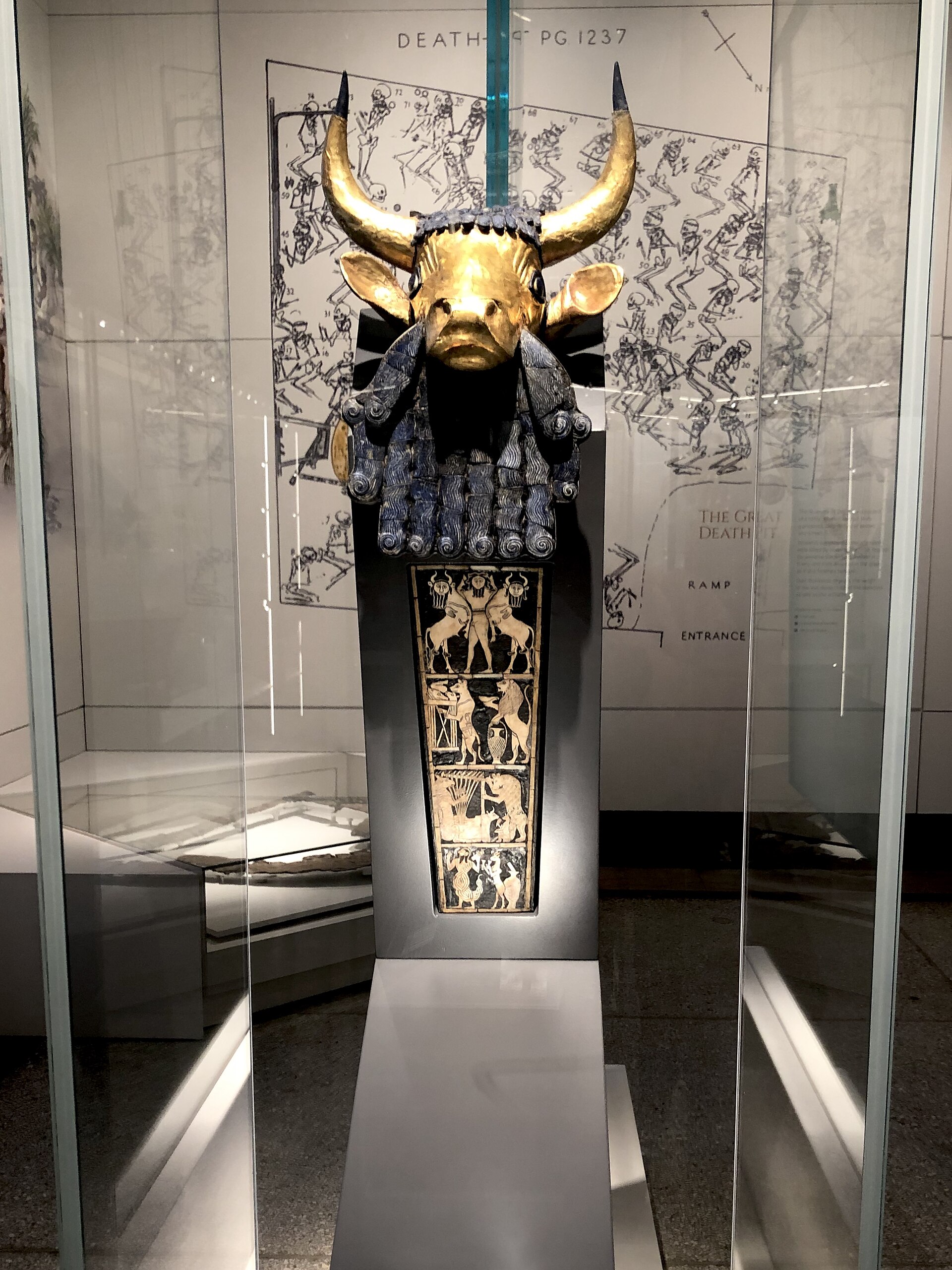
The lyre as displayed today, on the soundbox rebuilt to Leonard Woolley's original excavation measurements in 1976-80. Photographed by Binxedits in the Middle East gallery of the University of Pennsylvania Museum.
Photo: Binxedits, via Wikimedia Commons · CC BY-SA 4.0| Artist | Unknown Sumerian craftsmen, Ur |
|---|---|
| Date | c. 2550-2450 BC (Early Dynastic IIIa) |
| Medium | Gold and silver sheet, lapis lazuli, and shell over a wood core, with a modern reconstructed wood soundbox |
| Dimensions | Head and beard (B17694B): 40 x 25 x 19 cm per the Penn Museum's online catalog; the head alone is given as 35.6 cm in height in the 2003 conservation literature. Frontal plaque (B17694A): 31.5 x 11 x 1.5 cm. |
| Where it is now | University of Pennsylvania Museum of Archaeology and Anthropology (Penn Museum), Philadelphialast confirmed 23 September 2026 |
| Inventory number | B17694B (bull head and beard); B17694A (frontal plaque); B17694C (reconstructed soundbox); field number U.10556 |
| Attribution | UnknownNo maker is named or knowable. Full note |
| Object type | Musical instrument |
| Period | Mesopotamian, Early Dynastic III (Sumerian) |
| Cases | Has a provenance gap |
| Inscriptions | None recorded |
| Owners on record | 9 links9 documented |
| Sources | 13 cited |
About this record Last verified 23 September 2026 · 13 sources cited · Change log
On this page 9 sections
ContentsClose
What is on display in Philadelphia is a gold, silver, lapis lazuli and shell bull's head, beard and plaque excavated from the King's Grave at Ur in 1926-27, mounted on a wooden soundbox that Penn Museum conservators built in 1976-80 after discovering that the museum's own first reconstruction, made in 1929-30, was the wrong size. Leonard Woolley recovered the original ancient soundbox not as wood, which had rotted away completely in the ground, but as a plaster cast poured into the void the wood left behind, and his own published measurements of that cast were, decades later, the evidence that proved the first Penn Museum reconstruction wrong by roughly a third.
The object was excavated by a joint British Museum and University of Pennsylvania Museum expedition and assigned to the University of Pennsylvania Museum's share under Iraq's 1920s division-of-finds law, alongside sibling instruments from the same cemetery now held in London and Baghdad. It is one of at least nine lyres and harps recovered from the Royal Cemetery's royal graves, buried as part of documented funerary rites involving mass sacrificial interment, and its maker, unlike the grave's principal occupant, left no name or trace beyond the physical evidence of the specialist gold, stone and wood work the head, beard and plaque still show under close examination.
No maker is known. No market history exists; the object has never been sold and has been institutionally held since the 1920s division of finds. What is documented is a genuine, fifty-year mistake in its own museum's reconstruction, caught, corrected and published by the conservators who found it.
Provenance
Each link is graded. Documented: a cited source supports it. Disputed: the identification is argued but not established. Unknown: no owner for that span, and the gap is not smoothed into a narrative. The grades in the glossary.
- c. 2550-2450 BC -Made for burial with the primary occupant of PG 789, the King's Grave, Royal Cemetery of Urdocumented
Buried in a grave containing more than sixty sacrificed attendants in addition to the primary burial, adjacent to Queen Puabi's grave PG 800. The maker is unknown.124
- c. 2450 BC - 1926In the ground, undisturbeddocumented
The wooden soundbox decayed completely in situ over roughly four thousand years, surviving only as a void lined by the non-perishable gold, silver, lapis and shell decoration.4
- 1926 - 1927Excavated by Leonard Woolley's joint British Museum and University of Pennsylvania Museum expeditiondocumented
The soundbox void was cast in plaster of Paris in the field to preserve its form; the crushed head was stabilized with paraffin wax and muslin bandaging before removal.45
- 1927 - 1929Allocated to the University of Pennsylvania Museum in the division of findsdocumented
Divided under Iraq's 1924 Antiquities Law between the Iraqi state, the British Museum and the University of Pennsylvania Museum. The Penn Museum's own online catalog records the expedition/accession year as 1928; the object's arrival in Philadelphia is generally dated 1929 in secondary accounts.1267
- 1929 - 1930University of Pennsylvania Museumdocumented
A new wooden soundbox was built around the surviving head, beard and plaque and decorated by museum artist M. Louise Baker. This reconstruction's soundbox dimensions did not match those Woolley had already published from the excavation cast, though this was not established until decades later.34
- 1955 - 1976University of Pennsylvania Museumdocumented
Leonard Woolley, visiting the museum in 1955, is reported to have remarked that the reproduction soundbox looked too large; comparison of the reconstruction against his own 1934 published excavation measurements later confirmed a mismatch. The 1955 visit itself is reported in tertiary literature (Wikipedia) and is flagged here for replacement with a citation to Maude de Schauensee's monograph directly; the underlying measurement mismatch is independently confirmed in the 2003 primary conservation literature.48
- 1976 - 1980University of Pennsylvania Museumdocumented
The head and beard were fully disassembled, cleaned and documented, then reassembled on a new soundbox built to Woolley's original excavation measurements, roughly a third larger than the 1929-30 reconstruction it replaced. Reinstalled in the Mesopotamian Gallery in 1980.49
- 1996 - 1996University of Pennsylvania Museumdocumented
Examined by conservator Lynn A. Grant ahead of the traveling exhibition Treasures from the Royal Tombs of Ur; no deterioration found in the 1976-80 repair after sixteen years on exhibit.4
- 2009 - presentUniversity of Pennsylvania Museum of Archaeology and Anthropologydocumented
Featured in the Penn Museum's 2009 exhibition Iraq's Ancient Past: Rediscovering Ur's Royal Cemetery, and currently on permanent display in the Middle East Galleries.10
Technical evidence
| Attribution note | No maker is named or knowable. Early Dynastic Mesopotamia left no signing convention for luxury craft goods, and nothing in the excavation record identifies the individuals who worked the gold, cut the lapis tesserae, or built the wooden core. Technical examination shows the object required at least three distinct specialisms working to a single design: a metalworker who raised and seamed the gold sheet, a lapidary who cut and drilled the lapis and shell elements, and a woodworker who carved the core and the soundbox. The object is therefore catalogued to the workshop tradition of Ur in the mid-third millennium BC, not to a person. |
|---|---|
| Core and construction | Gold sheet raised and hammered around a solid wood core, most likely palm or poplar; horns and ears built the same way around their own wood cores and attached to the head with tacks and wooden pegs.4 |
| Beard | Fifty-eight lapis lazuli tesserae arranged in six long central locks and three shorter curls per side, each tile drilled with a biconical hole on the reverse for a copper alloy wire; built in three sections, each with a wood support, backed with hammered silver sheet and joined with copper alloy pins.4 |
| Eyes | Shell (white) and lapis lazuli (iris and lids), a three-part assembly evidently pre-made by a stone specialist and set into the head with bitumen adhesive; a fragment of mineralized copper alloy wire survives in one eyeball's assembly hole.4 |
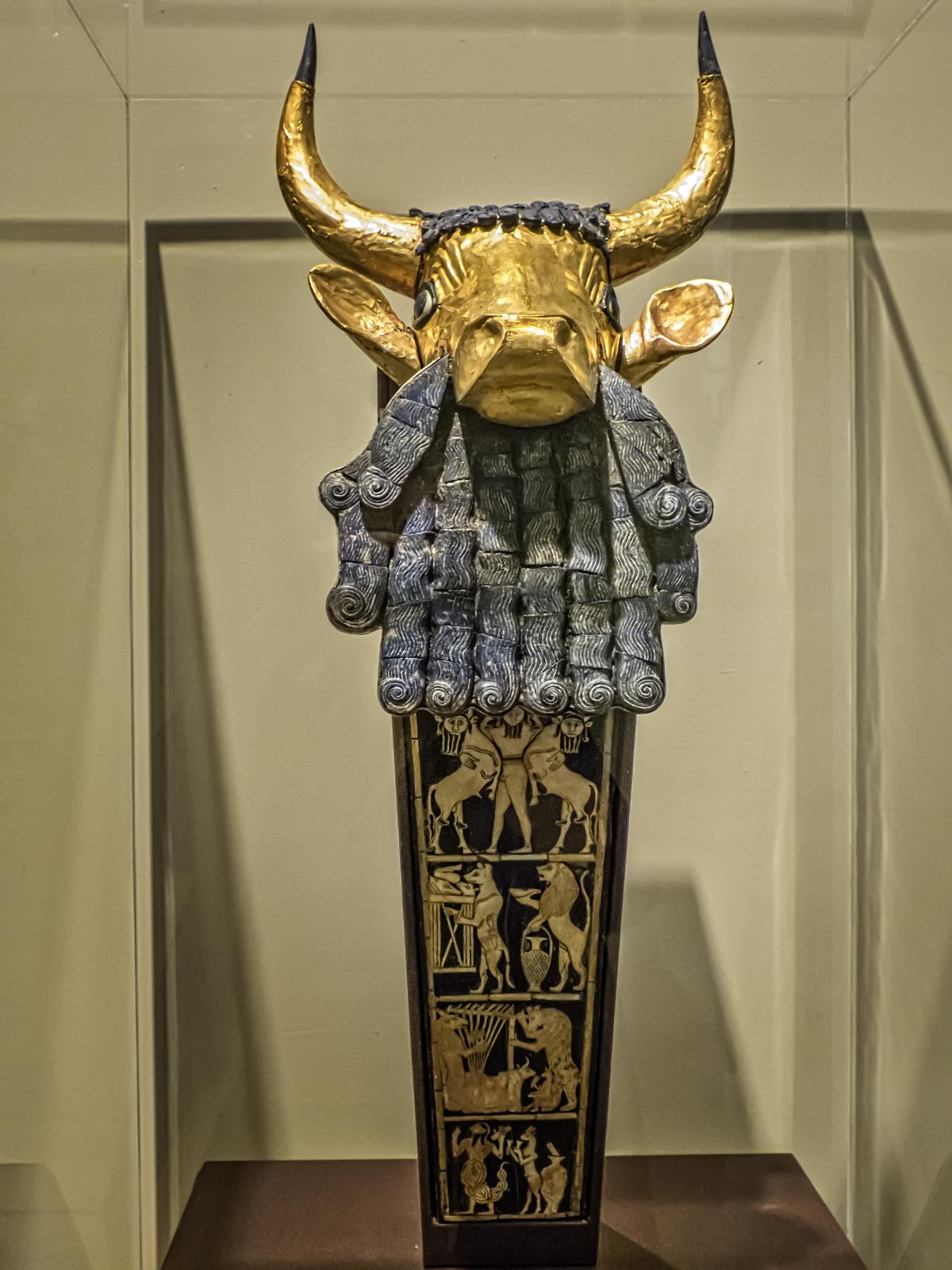
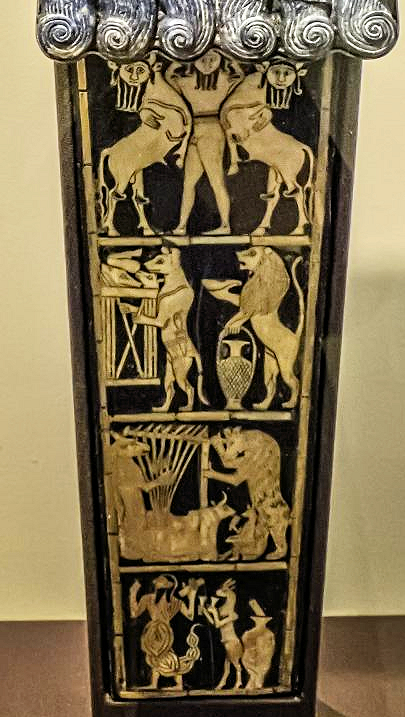
| Frontal plaque | Shell figures set into a bed of bitumen, 31.5 x 11 x 1.5 cm, in four registers: a hero grasping two human-headed bulls, an animal banquet scene, animals in procession and music, and a scorpion-man.12 |
| Head dimensions | 40 x 25 x 19 cm per the Penn Museum's online catalog entry for B17694B; the 2003 conservation literature separately gives the head's height as 35.6 cm. The two figures are not reconciled in the sources consulted.14 |
| Excavation recovery method | The decayed wooden soundbox survived only as a void in the soil, its surviving gold, silver and shell skin lifted intact by pouring liquid plaster of Paris into the cavity in the field; the crushed head was separately stabilized with molten paraffin wax and muslin bandaging before removal.45 |
| Field and accession numbers | Field number U.10556; Penn Museum accession B17694A (plaque), B17694B (head and beard), B17694C (reconstructed soundbox); cited in the conservation literature under the older register number CBS 17694.1234 |
| 1976-80 conservation materials | Reversible core of polyethylene glycol 6000 wax thickened with fumed silica and loaded with styrene pellets; fiberglass cloth and Paraloid B-72 acrylic resin lining on the gold and silver; a two-piece Plexiglas armature, designed with W. Thomas Chase of the Freer Gallery of Art, bolted together to carry the structural weight of the beard independently of the ancient gold sheet.4 |
| Dating basis | Early Dynastic IIIa, c. 2550-2450 BC; the royal tomb level at Ur has been dated by radiocarbon to approximately 2600-2500 BC.14 |
Images
The record in full
Chapter 1What survives, and what does not
The object on view in Philadelphia is not, strictly, a lyre that has come down from the third millennium BC intact.
The object on view in Philadelphia is not, strictly, a lyre that has come down from the third millennium BC intact. It is a gold, silver, lapis lazuli and shell bull's head and beard, a shell-and-bitumen plaque that sat beneath it, and a wooden soundbox built by Penn Museum conservators in the 1970s to the excavator's own measurements. The wooden body of the original instrument had decayed completely in the ground more than four thousand years before anyone dug it up. What the excavators actually recovered was a void in the soil in the shape of the vanished wood, still wrapped in its surviving skin of precious metal, stone and shell.
This is true of every Early Dynastic lyre or harp recovered from the Royal Cemetery at Ur, and it is the single fact a reader needs before anything else on this page makes sense. The gold head is ancient. The beard's lapis tesserae are ancient. The shell plaque is ancient. The wood underneath all of it, the thing that actually made the object a lyre rather than a sculpture, is a reconstruction, and it has been rebuilt more than once, at more than one size.
Chapter 2The King's Grave
The bull's head, its beard, and the plaque were excavated by Leonard Woolley's joint expedition of the British Museum and the University of Pennsylvania Museum in the 1926-27 season, in a grave the...
The bull's head, its beard, and the plaque were excavated by Leonard Woolley's joint expedition of the British Museum and the University of Pennsylvania Museum in the 1926-27 season, in a grave the excavation numbered PG 789 and which the expedition called the King's Grave. It lies adjacent to the grave of Queen Puabi, PG 800, one of the small number of burials in the cemetery that Woolley identified as royal on the basis of their construction and contents. PG 789 held the bodies of more than sixty soldiers and attendants in addition to the primary burial, sacrificed retainers of the kind that give the Royal Cemetery its name and its reputation.
The cemetery as a whole was excavated over more than a decade, from 1922 to 1934, under a permit from the Iraq Antiquities Service. The royal tombs, including PG 789, belong to a level that has since been dated by radiocarbon to approximately 2600-2500 BC. This bull-headed lyre is one of at least nine lyres and harps recovered from the cemetery's royal graves, evidence that stringed instruments of this quality were not a singular treasure but an expected furnishing of an elite Sumerian burial.
Chapter 3How Woolley got it out of the ground
The excavation technique used to recover the lyre is the reason any of it survives in recognisable form, and it is one of the notable field methods of early twentieth-century Mesopotamian archaeology.
The excavation technique used to recover the lyre is the reason any of it survives in recognisable form, and it is one of the notable field methods of early twentieth-century Mesopotamian archaeology. By the time Woolley's team reached the instrument, the wood had rotted away entirely, leaving only a cavity in the compacted soil where the soundbox had been, lined on the inside by the sheets of gold, silver and shell that had once covered its surface and had not decayed.
Rather than lift the fragile metal skin alone and lose the object's original shape, Woolley poured liquid plaster of Paris into the void left by the vanished wood. The plaster set inside the cavity, capturing the soundbox's form and holding the surviving metal and shell decoration in place against it, so that the whole assembly, gold sheet, silver, lapis and all, could be lifted from the ground as a single rigid block rather than as loose fragments. The bull's head itself, crushed and distorted where the roof of the grave had collapsed onto it, was separately reinforced in the field: molten paraffin wax was poured over the pieces and the whole was wrapped in muslin bandaging before removal, then reshaped and filled with plaster once in the workroom.
The plaster casts taken from the soundbox voids are why the later corrected reconstruction of this lyre, and the reconstructions of its sibling instruments from the same cemetery, could be built to the actual excavated dimensions at all. Woolley's excavation report of 1934 records the soundbox's original measurements from these casts. It is a measurement his own museum would fail to use correctly for nearly fifty years.
Chapter 4How it was made
Technical examination carried out when the head was disassembled in 1976 established, for the first time, how the object was actually built, none of which had been recorded at the time of the first...
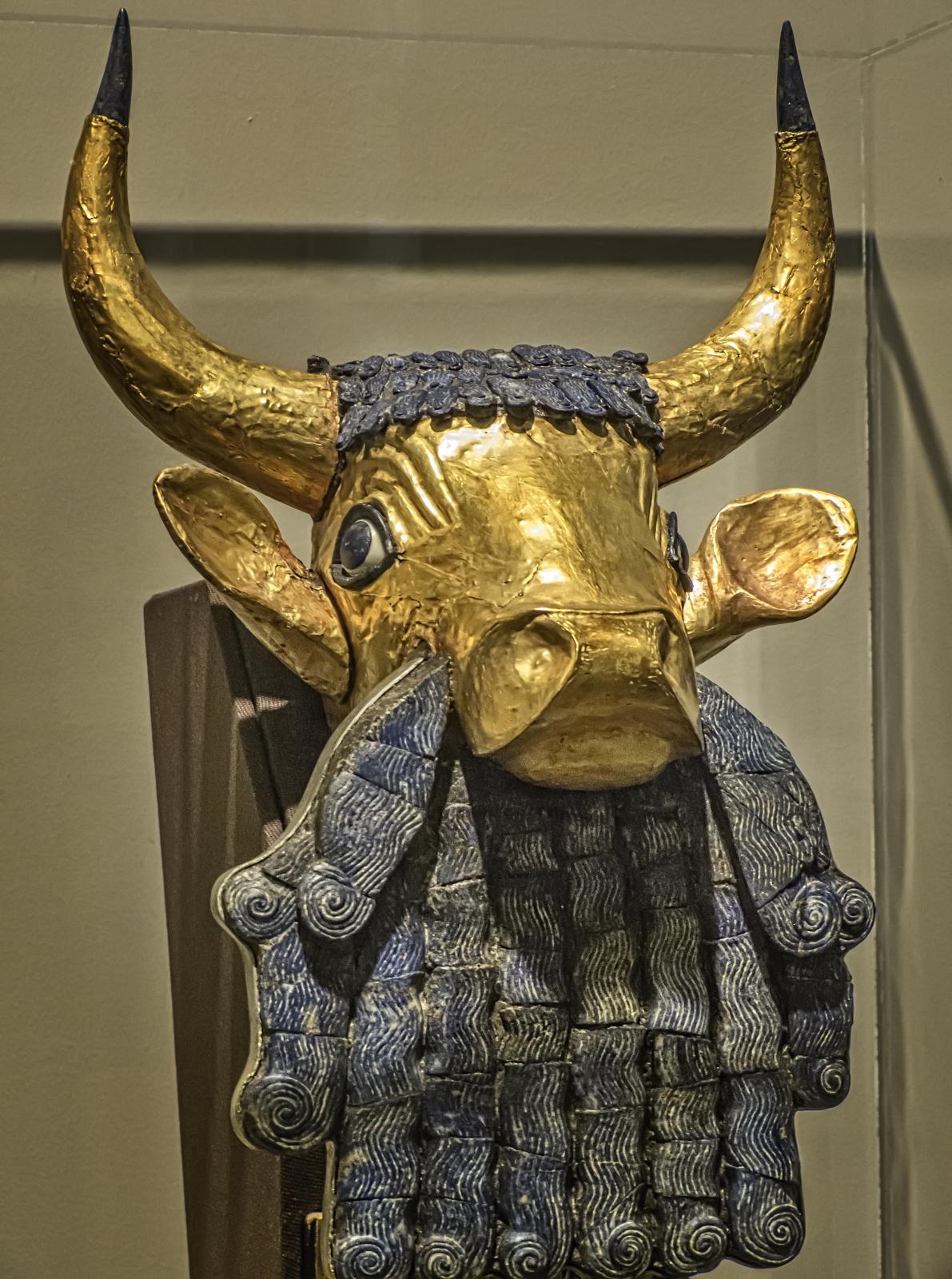
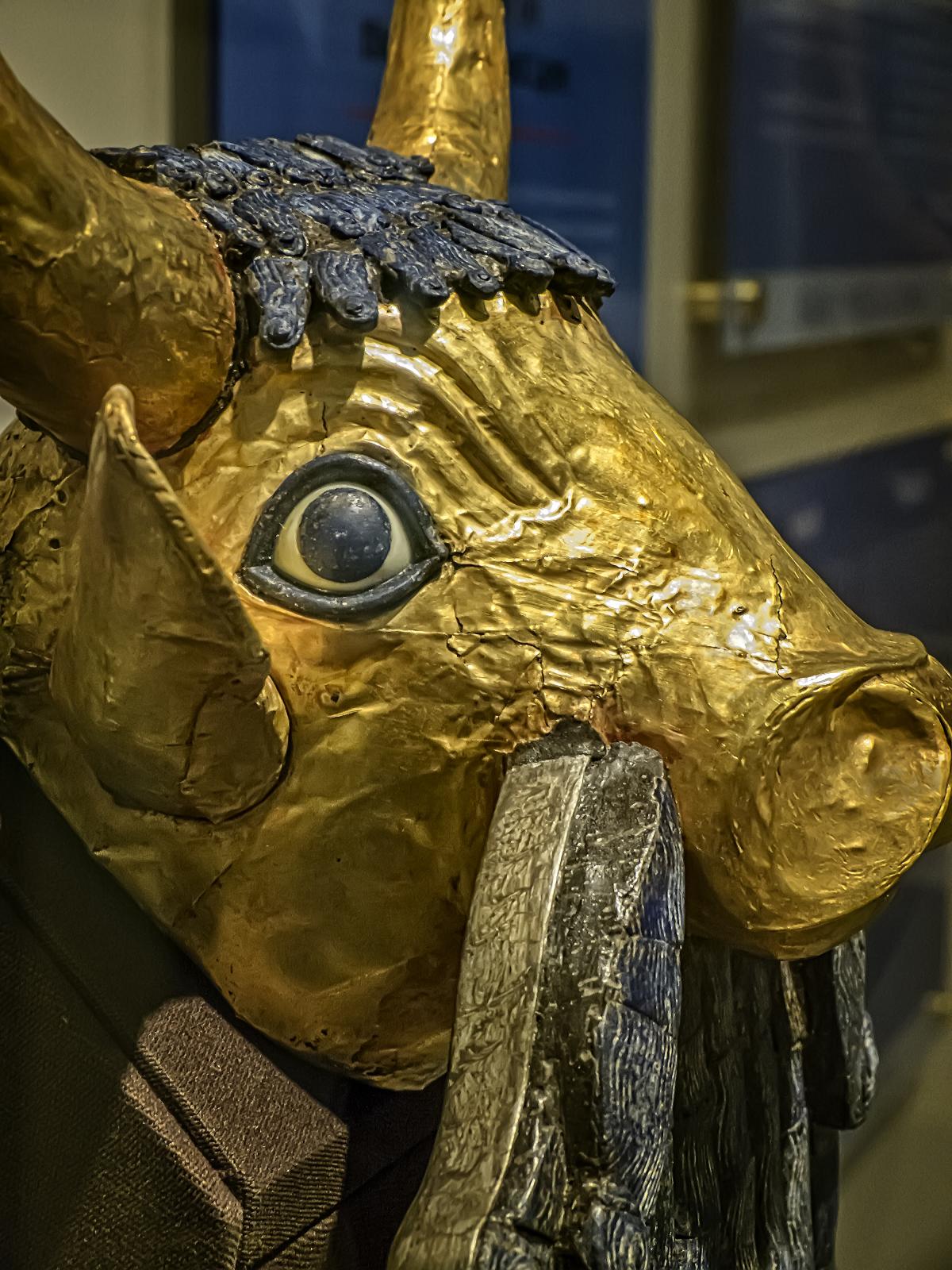
Technical examination carried out when the head was disassembled in 1976 established, for the first time, how the object was actually built, none of which had been recorded at the time of the first restoration. The front and sides of the head are a single piece of gold sheet, raised and hammered around a solid wood core, most likely palm or poplar, both available locally. The ears and horns were formed the same way, each from a single seamed sheet of gold wrapped around its own wood core, the ears secured to the head with small gold tacks and wooden pegs, the horns fitted with lapis lazuli tips attached by a tenon and, probably, an organic pin.
The beard is a separate, more complex assembly: fifty-eight individual lapis lazuli tesserae, carved to represent long central locks and shorter curls at the sides, each tile drilled with a small biconical hole on its reverse through which a copper alloy wire was threaded, evidence, unrecorded before the 1976 disassembly, that the tiles were pre-assembled on a thin backing of fabric or leather before being mounted. The assembled beard was built in three separate sections, each with its own wood support, then backed with hammered silver sheet held by small silver tacks, and the three sections were joined with long copper alloy pins driven through the wood supports. The finished beard was then nailed onto the head core through a deliberate gap left in the gold sheet. The eyes were built the same way, as a three-part assembly of lapis lazuli iris and lid over a white shell ground, evidently made and pre-assembled by a stone specialist before being set into the head with bitumen adhesive.
None of this was recorded by Woolley's own excavation report, which gives only a brief account of the first restoration and does not say when it was carried out, where, or by whom. Everything above comes from what conservators found when they physically took the object apart half a century later.
Chapter 5The frontal plaque
Below where the head was mounted, the soundbox carried a rectangular plaque of shell figures set into a bed of bitumen, 31.5 by 11 centimetres, arranged in four horizontal registers.
Below where the head was mounted, the soundbox carried a rectangular plaque of shell figures set into a bed of bitumen, 31.5 by 11 centimetres, arranged in four horizontal registers. Reading from the top: a bearded, naked hero grasps a pair of human-headed bulls, one in each arm; below that, animals take on human roles in a banquet scene, most prominently a hyena carrying a laden table and armed with a knife, and a lion carrying a jug and cup; a further register shows animals in procession and at music, including, notably, a smaller animal figure playing a bull-headed lyre of its own; and the lowest register is occupied by a scorpion-man, a hybrid figure known elsewhere in Mesopotamian tradition as a guardian or boundary figure.
What this sequence of scenes actually meant to the people who commissioned it is not settled, and this record does not adopt any one reading as fact. The imagery belongs to a wider Early Dynastic repertoire of animals acting in human roles that appears on other objects from the same cemetery, including the Standard of Ur, and scholars agree the genre draws on a body of Sumerian animal fable and proverb literature that existed in oral and later written form. Beyond that broad placement, published readings diverge: some treat the register as a coherent narrative tied to the funerary banquet ritual actually practiced at burials like PG 789, others as a looser assembly of stock motifs without a single fixed story. Popular writing on the object has in places proposed that the scene is a piece of social satire, mocking specific human vices through its animal cast; that reading has not been advanced by an identifiable specialist in a citable academic publication in the sources consulted for this record, rests on resemblance rather than textual or archaeological evidence, and is not adopted here.
Chapter 6The bull, the sun, and the grave it stood in
The Penn Museum's own published position, repeated in its collections catalog, is that the bull's head represents the sun god Utu, known in the Akkadian-speaking world as Shamash.
The Penn Museum's own published position, repeated in its collections catalog, is that the bull's head represents the sun god Utu, known in the Akkadian-speaking world as Shamash. The connection rests on a documented association in Mesopotamian tradition between Utu and the bull, particularly in the god's role at sunrise, and on Utu/Shamash's separate, well-attested role as judge of the dead. Read this way, the bull's head presiding physically above the plaque's scenes of feasting, procession and the scorpion-man guardian casts the whole object as an image of divine judgment set over a funerary rite, appropriate to an instrument buried with a royal grave's sacrificed retinue. This is the museum's stated interpretation, not an independently established fact beyond dispute, and it should be read as an argued position rather than as the maker's confirmed intention; no contract, inscription or textual source ties this specific object to Utu's cult by name.
What is documented, rather than argued, is the function the lyre served in its own burial. It was placed in a grave built for mass sacrificial interment, one of at least nine lyres and harps recovered across the cemetery's royal graves, several of them found still close to the skeletal remains of the individuals who had apparently been playing them when the pit was filled. Music was not incidental furniture in these burials; it was part of the rite being performed at the moment of interment. Whatever the frontal plaque's animal scenes meant in detail, the object as a whole belonged to a documented funerary practice, not to household or secular use.
Chapter 7Dividing the finds
The excavation operated under Iraq's 1924 Antiquities Law, negotiated in large part by Gertrude Bell in her capacity as the country's Director of Antiquities, and the 1924-1928 permit for Ur was...
The excavation operated under Iraq's 1924 Antiquities Law, negotiated in large part by Gertrude Bell in her capacity as the country's Director of Antiquities, and the 1924-1928 permit for Ur was formally accepted by Woolley on behalf of both the British Museum and the University of Pennsylvania Museum. Under that law, finds were divided between the Iraqi state and the excavating institutions, broadly on a formula that left half the material in Iraq and split the remaining half between the two foreign museums, so that roughly a quarter of what came out of the ground at Ur in a given season went to Philadelphia and a quarter to London. The final say over which specific objects went where rested with the Iraqi Director of Antiquities; Bell herself accepted that the foreign museums needed to retain genuine treasures as an incentive to keep funding and staffing the dig, and by some accounts individual allocation decisions in the field were settled as informally as the toss of a coin.
This is the mechanism, not a vague word like acquired, by which a royal grave excavated in southern Iraq produced an object now owned outright by a museum in Philadelphia, another share of the same cemetery's finds owned by the British Museum in London, and the remainder retained by what is now the Iraq Museum in Baghdad. It was a legal, treaty-based division of excavated material under the law in force at the time, carried out with the involvement of the Iraqi antiquities authority, not a private removal. The bull-headed lyre's gold head, beard and plaque were assigned to the University of Pennsylvania Museum's share.
Chapter 8The first reconstruction, 1929-1930
Once in Philadelphia, the surviving head, beard and plaque needed a soundbox to be displayed as a lyre at all, since the original wood had not survived even as the plaster-filled void; that void...
Once in Philadelphia, the surviving head, beard and plaque needed a soundbox to be displayed as a lyre at all, since the original wood had not survived even as the plaster-filled void; that void itself did not travel to Philadelphia as a usable structural element. Museum conservators built an entirely new wooden soundbox around the ancient elements, and the watercolorist and museum artist M. Louise Baker, a long-serving member of the Penn Museum's scientific illustration staff, applied the finishing decorative work and painted its surface, including inlay patterned after the genuine decoration of a different lyre from the same cemetery, since the plaque available for this particular lyre did not cover the whole soundbox. A photograph in the museum's own archive, captioned to around 1930, shows Baker at work adding the final touches to this reconstruction.
This was the version of the lyre that went on exhibition and that the public, and Woolley himself, knew for the next several decades. It gave the object a plausible, complete appearance. It also, as it turned out, gave it the wrong proportions.
Chapter 9Getting it wrong, and finding out
Woolley's own 1934 excavation report on the Royal Cemetery recorded the dimensions of the soundbox as measured from the plaster cast taken in the ground in 1926-27.
Woolley's own 1934 excavation report on the Royal Cemetery recorded the dimensions of the soundbox as measured from the plaster cast taken in the ground in 1926-27. When conservators finally compared the 1929-30 reconstructed soundbox against those published figures, decades after it had been built and put on display, the two did not match. According to the excavator's own numbers, the reconstruction the museum had built and exhibited for a generation was wrong.
How this happened is one of the genuine gaps in the object's record. The Penn Museum's own conservation literature on the head states plainly that it is not even certain when the first restoration was carried out, where, or by whom; Woolley's excavation report gives only the briefest account of the restoration procedure and no dimensions for the reconstructed soundbox itself, only for the original as measured from the cast. Whoever built the 1929-30 soundbox appears not to have worked from, or not to have correctly applied, the measurements the excavation had already produced.
Chapter 10Taking the head apart, 1976-1980
When it finally became possible to build a corrected soundbox, the head was removed from its 1929-30 mount and brought to the Penn Museum Conservation Laboratory.
When it finally became possible to build a corrected soundbox, the head was removed from its 1929-30 mount and brought to the Penn Museum Conservation Laboratory. The initial intention, according to the conservator who carried out and later published the work, Virginia Greene, was minor: clean the surface, make small repairs, and remount the head on the new box. X-radiography at the Hospital of the University of Pennsylvania instead revealed a large iron armature buried inside the old plaster fill, and once conservators began removing the plaster neck to get at it, the beard broke away at a weak point between two sets of modern wooden dowels, forcing a full disassembly that had not been planned.
What followed, across 1976 into 1980, was the most detailed physical examination the object has ever received. Conservators removed three separate batches of old plaster fill, exposed for the first time the original silver beard backing (much of it not visible in the first restoration and some of it, discovered afterward, misfiled under a different catalog number in storage), documented the biconical wire-holes in the lapis beard tiles that had never before been recorded, and established the actual original construction sequence described above. The head, ears and horns were refilled not with plaster but with a reversible wax core of polyethylene glycol 6000 thickened with silica and loaded with styrene pellets, chosen because it could later be dissolved out with water without disturbing the ancient gold. A Plexiglas armature, designed with the assistance of W. Thomas Chase of the Smithsonian's Freer Gallery of Art, was built in two bolted sections to carry the actual physical weight of the lapis beard independently of the fragile gold sheet, an engineering problem the original 1929-30 restoration had not had to solve in the same way because its plaster fill did the structural work instead. Mervin Martin then designed the mounting system, allowing the head and plaque to be lifted cleanly off the new soundbox for future study, and the reassembled lyre, on its new, correctly sized wooden body, went back on exhibition in the museum's Mesopotamian Gallery in 1980.
The new soundbox, built this time to Woolley's own excavated measurements rather than around them, came out roughly a third larger than the one it replaced. A visitor standing in front of the lyre today is looking at an instrument closer in scale to what the excavation record actually says stood in PG 789 in 2550 BC, not the somewhat smaller, freely estimated object the public saw between 1930 and the late 1970s.
Chapter 111996: checking the repair
Sixteen years after the 1980 reinstallation, the head was examined again in preparation for a traveling exhibition, Treasures from the Royal Tombs of Ur.
Sixteen years after the 1980 reinstallation, the head was examined again in preparation for a traveling exhibition, Treasures from the Royal Tombs of Ur. Conservator Lynn A. Grant found no deterioration in either the reversible wax core or the beard's Plexiglas support, despite the head and plaque having been removed and remounted several times for study and travel and despite the gallery lacking climate control. Greene's own 2003 published account of the 1976-80 treatment is candid that several of the specific materials chosen at the time, a toluene-based acrylic resin solution, a polyvinyl acetate consolidant later swapped for an acrylic emulsion, styrene pellets originally sourced from a bean-bag chair supplier, would not be the first choice of a conservator working today, even as the overall structural design of the repair held up completely on reexamination.
Chapter 12Reputation and reproduction
Thomas Hoving, the former director of the Metropolitan Museum of Art, is on record singling out this lyre, alongside four other Ur objects in the Penn Museum's collection, Queen Puabi's jewelry, an...
Thomas Hoving, the former director of the Metropolitan Museum of Art, is on record singling out this lyre, alongside four other Ur objects in the Penn Museum's collection, Queen Puabi's jewelry, an electrum drinking tumbler, a gold ostrich egg, and the Ram Caught in a Thicket, as among what he called the finest, most resplendent and magical works of art in all of America. Whatever one makes of the ranking, the bull's head has become one of the most widely reproduced single images to survive from third-millennium Mesopotamia, appearing routinely in textbooks and museum branding as shorthand for Sumerian civilization generally.
That reach has extended to functioning replicas built specifically to test how the instrument actually sounded, since the original strings did not survive and cannot be reconstructed from the archaeological record alone. A playable reconstruction built by the luthier Eli Richman, inspired directly by seeing the Penn Museum's 1970s-rebuilt lyre on display, is now held by the Phoebe A. Hearst Museum at the University of California, Berkeley, one of several modern attempts to give the object a voice rather than only a shape.
Chapter 13The site since 2003
Ur itself, the archaeological site rather than this particular object, came under the control of a nearby military installation during the Iraq War and was, according to the Penn Museum's own account...
Ur itself, the archaeological site rather than this particular object, came under the control of a nearby military installation during the Iraq War and was, according to the Penn Museum's own account of its 2009 exhibition on the excavation, largely preserved as a result before being returned to the custody of Iraq's State Board of Antiquities and Heritage in May 2009. That is a statement about the physical site's custody, not about ownership of objects already divided out under the 1920s partage system and held abroad, including this lyre; the sources consulted for this record report no restitution claim, dispute or legal action concerning the Penn Museum's holding of B17694 specifically. Separately, and importantly for anyone researching this object online, a different bull-headed lyre from the same excavation, now in the Iraq Museum in Baghdad and commonly called the Golden Lyre, was affected by the 2003 looting of that museum; that is a documented event concerning a different object in a different collection, and this record does not extend it to the Penn Museum's lyre.
The artist
Unknown Sumerian craftsmen, royal workshop tradition of Ur
Nobody excavated a name to go with this object. Early Dynastic Mesopotamia, unlike its own later scribal culture, left no convention of a maker signing a luxury object of this kind, and the excavation and conservation record identifies no individual. What can be said comes entirely from taking the object apart and reading its construction, which is the only record its makers left.
Related works
| Work | Relation | Where it is |
|---|---|---|
| Silver Lyre (cow's head) Sumerian workshop, Ur | A related but distinct lyre from the same excavation and cemetery Recovered from the Great Death Pit, PG 1237, a different grave from this lyre's PG 789. Beardless, with a cow's rather than a bull's head, wood construction covered in silver rather than gold. Not to be confused with this object. | British Museum, London |
| Queen's Lyre Sumerian workshop, Ur | A related but distinct lyre from the same cemetery A gold bull-headed lyre from Queen Puabi's grave, PG 800, adjacent to this lyre's grave PG 789. A separate object with its own excavation and conservation history; sources describe its brow profile as curved where this lyre's is straight. | British Museum, London |
| Golden Lyre (Bull's Lyre) Sumerian workshop, Ur | A related but distinct lyre from the same excavation The share of the Royal Cemetery's lyres retained in Iraq under the division of finds. A separate object with its own display and conservation history; this record does not extend any fact about that object, including any event of the 2000s, to the Penn Museum's lyre. | Iraq Museum, Baghdad |
| Boat-shaped Lyre (silver) Sumerian workshop, Ur | A second lyre in the Penn Museum's own share of the Royal Cemetery finds, studied and published alongside this one Covered together with this bull-headed lyre in Maude de Schauensee's 2002 monograph 'Two Lyres from Ur' and separately reconserved by the museum in 1994. | University of Pennsylvania Museum, Philadelphia |
| The Standard of Ur Sumerian workshop, Ur | Comparandum for material and technique A shell, lapis lazuli and red limestone mosaic set in bitumen over a wood core, recovered from the same cemetery and built with the same inlay technique used on this lyre's frontal plaque. | British Museum, London |
| Ram Caught in a Thicket Sumerian workshop, Ur | Companion showpiece from the same cemetery and the same museum's share of the finds One of the other four objects Thomas Hoving grouped with this lyre as among the finest works of art in an American collection. | University of Pennsylvania Museum, Philadelphia |
Open questions
- Who built the 1929-30 soundbox, and where, and by what process. The Penn Museum's own conservation literature states plainly that it is not certain when the first restoration was done, where, or by whom.
- Why the 1929-30 reconstruction came out the wrong size at all, when Woolley's 1934 excavation report already published the soundbox's original measurements as taken from the plaster cast made in the field. No source consulted explains the discrepancy.
- How the lyre was originally strung and tuned. The organic strings did not survive, and reconstructions of stringing and tuning rest on comparison with other depicted or excavated instruments rather than on direct evidence from this object.
- What the frontal plaque's animal registers meant to the people who buried it. Scholars agree the imagery draws on a wider Early Dynastic repertoire of animal fable, but published readings diverge on whether the sequence is a coherent narrative or a looser assembly of stock motifs, and this record does not resolve that disagreement.
- How the head was originally attached to the soundbox. The 2003 conservation literature states this directly: the system used to attach the head to the original ancient soundbox is unknown, and the surviving evidence does not allow it to be reconstructed with confidence.
- Whether the accession year the Penn Museum's own online catalog records for this object, 1928, or the year commonly given in secondary literature for the division of finds, 1929, is the more accurate date for when the object physically reached Philadelphia. This record has not been able to reconcile the two from the sources consulted.
Questions about this object
What is Bull-Headed Lyre of Ur?
Bull-Headed Lyre of Ur is a musical instrument, dated c. 2550-2450 BC (Early Dynastic IIIa). Medium: Gold and silver sheet, lapis lazuli, and shell over a wood core, with a modern reconstructed wood soundbox.
Who made Bull-Headed Lyre of Ur, and is the attribution settled?
The attribution to Unknown Sumerian craftsmen, Ur is recorded here as unknown. No maker is named or knowable. Early Dynastic Mesopotamia left no signing convention for luxury craft goods, and nothing in the excavation record identifies the individuals who worked the gold, cut the lapis tesserae, or built the wooden core. Technical examination shows the object required at least three distinct specialisms working to a single design: a metalworker who raised and seamed the gold sheet, a lapidary who cut and drilled the lapis and shell elements, and a woodworker who carved the core and the soundbox. The object is therefore catalogued to the workshop tradition of Ur in the mid-third millennium BC, not to a person.
Where is Bull-Headed Lyre of Ur now?
University of Pennsylvania Museum of Archaeology and Anthropology (Penn Museum), Philadelphia. Inventory number B17694B (bull head and beard); B17694A (frontal plaque); B17694C (reconstructed soundbox); field number U.10556. Last confirmed 23 September 2026. On permanent display in the Middle East Galleries. Held by the Penn Museum since the division of finds from the Joint Expedition to Ur; the museum's own online catalog records the expedition/accession year as 1928, while the division of finds that brought the object to Philadelphia is generally dated 1929 in the secondary literature.
What is still unknown about Bull-Headed Lyre of Ur?
Who built the 1929-30 soundbox, and where, and by what process. The Penn Museum's own conservation literature states plainly that it is not certain when the first restoration was done, where, or by whom.
Sources
- 1Penn Museum online collections catalog, 'Lyre Fragment, Bull Head - B17694B'. collections.penn.museum/collections/...
- 2Penn Museum online collections catalog, 'Lyre Fragment, Plaque - B17694A'. collections.penn.museum/collections/...
- 3Penn Museum online collections catalog, 'Lyre, Sound Box, Reproduction - B17694C'. collections.penn.museum/collections/...
- 4Virginia Greene, 'Conservation of a Lyre from Ur: A Treatment Review', Journal of the American Institute for Conservation 42, no. 2 (2003): 261-278. cool.culturalheritage.org/jaic/...
- 5Penn Museum, Expedition Magazine, 'A Spectacular Discovery'. penn.museum/sites/...
- 6Penn Museum, Expedition Magazine, 'The Musical Instruments from Ur and Ancient Mesopotamian Music'. penn.museum/sites/...
- 7Tees Valley Museums, 'Gertrude Bell and the Law of Excavation', on the 1924 Iraq Antiquities Law and the division-of-finds system used at Ur. teesvalleymuseums.org/blog/...
- 8Wikipedia, 'Bull Headed Lyre of Ur', for the 1955 Woolley visit and remark on the soundbox's proportions. Tertiary source, flagged for replacement with Maude de Schauensee, 'Two Lyres from Ur' (University of Pennsylvania Museum of Archaeology and Anthropology, 2002), the academic monograph it and this record both ultimately depend on for that detail. en.wikipedia.org/wiki/...
- 9Review of Maude de Schauensee, 'Two Lyres from Ur', Ethnodoxology.org, corroborating the approximately one-third size increase between the first and second soundbox reconstructions. ethnodoxology.org/reviews/...
- 10Penn Today, 'Iraq's Ancient Past: Rediscovering Ur's Royal Cemetery', on the Penn Museum's 2009 exhibition, the Thomas Hoving quotation, and the site's return to Iraqi state custody in 2009. penntoday.upenn.edu/news/...
- 11Penn Museum, Expedition Magazine, 'Mary Louise Baker', for the circa-1930 photograph of Baker completing the first soundbox reconstruction. penn.museum/sites/...
- 12Penn Museum Publications, 'Two Lyres from Ur' by Maude de Schauensee (2002), publication listing. penn.museum/research/...
- 13Wikimedia Commons file metadata (extmetadata/LicenseShortName) for each image used in this record's gallery, verified individually against the Commons API. commons.wikimedia.org/wiki/...
Last verified 23 September 2026 · Published 23 September 2026
Change log
23 September 2026 - Record created at the house standard: researched narrative, technical evidence, maker dossier, graded provenance chain, prices with hammer and premium separated, related works, open questions and sources.