The Weary Herakles
Roman copyist after Lysippos of Sikyon · AD 170-192 (late Antonine)
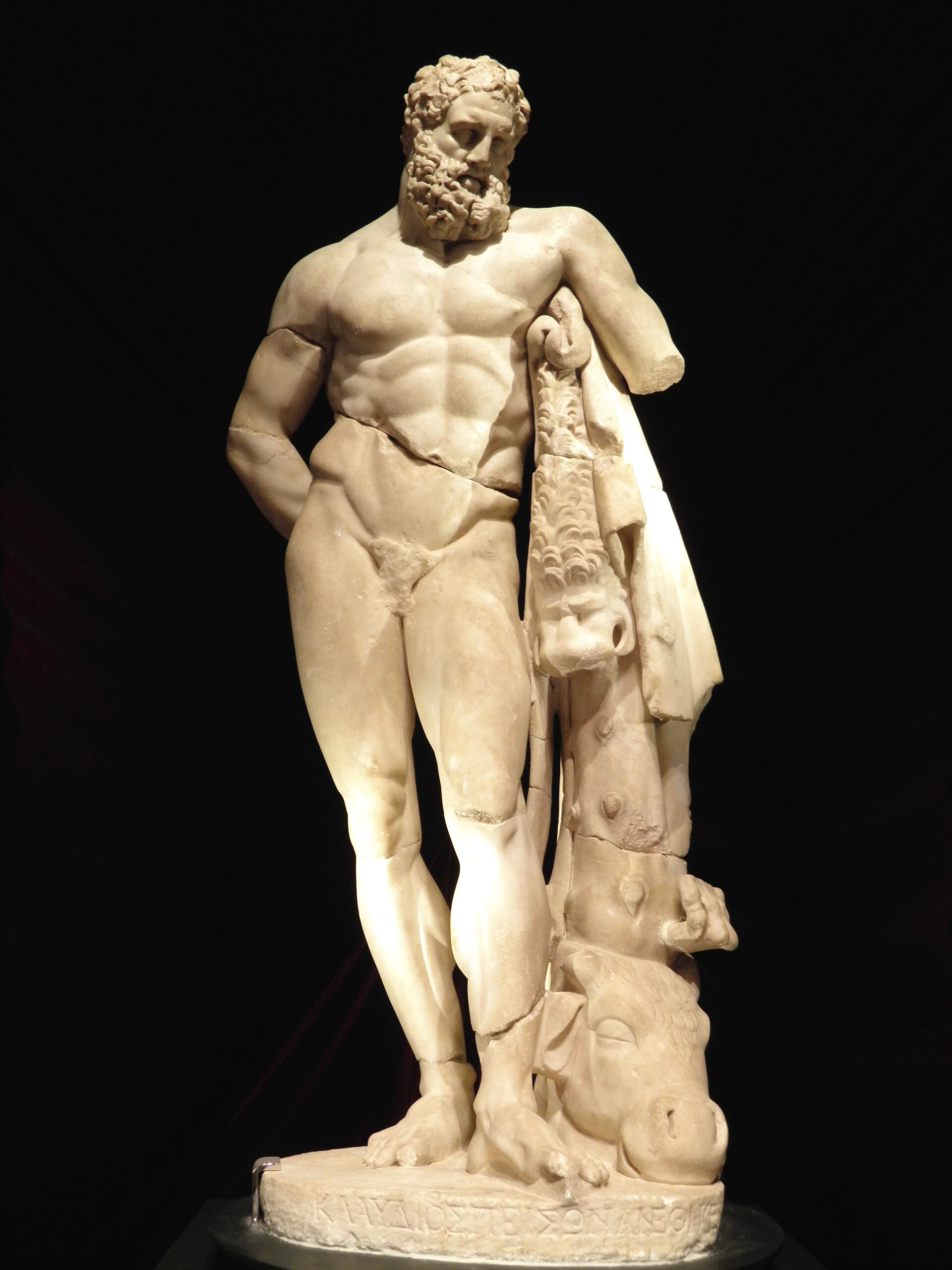
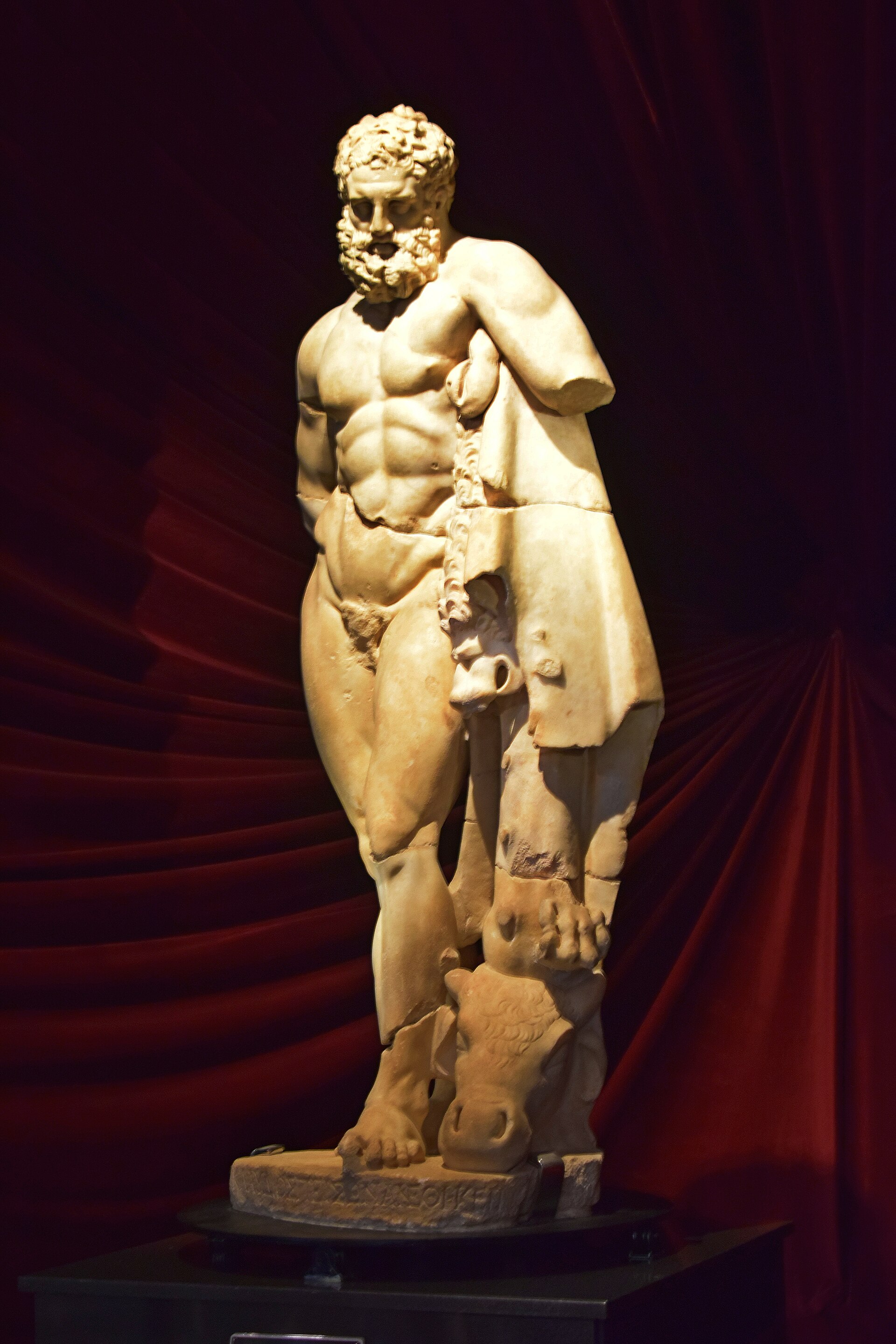
The record subject: the Perge Weary Herakles in the Antalya Museum, with the upper half returned by the Museum of Fine Arts, Boston, in 2011 set back on the lower half excavated in 1980. The fracture that divided the statue between two continents for thirty-one years runs across the hips and upper thighs and is visible in this photograph.
Photograph by Carole Raddato, via Wikimedia Commons; Antalya Museum, Antalya · CC BY-SA 2.0| Artist | Roman copyist after Lysippos of Sikyon |
|---|---|
| Date | AD 170-192 (late Antonine) |
| Medium | Marble |
| Dimensions | Not published in the sources consulted; the statue is under life size and survives in two joining halves |
| Where it is now | Antalya Museum, Antalya (museum closed and under reconstruction; holdings moved to temporary on-site storage)last confirmed 4 August 2026 |
| Inventory number | No inventory number published in the sources consulted |
| Attribution | WorkshopA late Antonine marble of a type known as the Weary Herakles, one of a large number of Roman copies and variants derived from a fourth-century BC bronze attributed to Lysippos of Sikyon. Full note |
| Object type | Antiquity |
| Period | Roman imperial, Pamphylia |
| Cases | Has a provenance gap · Seized, looted or confiscated |
| Inscriptions | The base carries a Greek inscription, legible in photographs of the reunited statue; no publication of its text has been located |
| Owners on record | 9 links7 documented, 1 disputed, 1 unknown |
| Sources | 6 cited |
About this record Last verified 11 September 2026 · 6 sources cited · Change log
On this page 10 sections
ContentsClose
A Roman marble of the Weary Herakles type, carved between AD 170 and 192, that spent thirty years in two pieces on two continents. The lower half was excavated at Perge in southern Turkey in 1980 by Jale Inan, the first Turkish woman to lead excavations, who had been hearing rumours that something important had been stolen from the site. The upper half surfaced in the United States the following year and was bought in 1981 by the Museum of Fine Arts, Boston, in a fifty-fifty partnership with the New York collectors Leon Levy and Shelby White, on terms that gave the museum full ownership when Levy died.
The two halves fit. That has been demonstrable since 1992, when a plaster cast of the legs was flown from Antalya to Boston after two earlier attempts had failed. The museum did not accept the conclusion. Its argument was that the Weary Herakles was a common type, that the break might be ancient, and that the top could therefore have left Anatolia long before any Turkish law forbade it. Its head of public relations said in 1994 that the museum did not acknowledge Turkey's claim to ownership and that there had never been any evidence that the statue was stolen.
No case was ever filed. What moved the object was not a court but a change in Turkish policy - from 2010 Turkey withheld loans from institutions holding contested objects, and in May 2011 Germany's Pergamon Museum returned a Hittite sphinx after Turkey threatened the excavation permits of German archaeologists - and the death of a co-owner, which left the museum free to negotiate without a donor in the room. The MFA announced the transfer on 23 September 2011, as part of a broader cultural cooperation agreement. The statue was made whole in Antalya. Jale Inan had died in 2001.
Provenance
Each link is graded. Documented: a cited source supports it. Disputed: the identification is argued but not established. Unknown: no owner for that span, and the gap is not smoothed into a narrative. The grades in the glossary.
- AD 170-192 -Carved in a Roman workshop for a setting at or near Perge in Pamphyliadocumented
A late Antonine copy of the Weary Herakles type derived from a fourth-century BC original attributed to Lysippos. Perge's public buildings were filled with sculpture of exactly this date and class; the statues from its baths and gates fill several halls of the Antalya Museum. The specific building this figure stood in is not recorded in the sources consulted.14
- - 1980Buried at Pergeunknown
Nothing is recorded of the statue between antiquity and 1980. The two halves were separated at some point; whether the break is ancient or modern became the central contested question in the dispute, because an ancient break would allow the upper half to have left Anatolia at any time in the last five centuries.1
- 1980 - presentRepublic of Turkey; the lower half, excavated at Perge and held at the Antalya Museumdocumented
Jale Inan, director of the Perge excavations, uncovered the lower half in 1980. She had heard rumours at the dig that something important had been stolen from the site, and suspicion at the time fell on a workman; nobody yet knew that the missing part was the upper torso of the statue she had just found. The lower half has been in the Antalya Museum ever since.13
- c. 1980 - 1981Removed from Turkey; route and intermediaries unrecordeddisputed
The upper half surfaced in the United States in 1981. It was bought from a German dealer, unnamed in the sources consulted. No documentation of its removal from Turkey has ever been produced by any party, which is the void that the whole dispute was conducted in.12
- 1981 - 2003Museum of Fine Arts, Boston, in fifty per cent partnership with Leon Levy and Shelby White, New Yorkdocumented
The agreement provided that the museum would take full ownership on the death of Leon Levy. The upper half was exhibited the following year in a temporary exhibition at the Metropolitan Museum of Art in New York. Note a discrepancy in the sources: the acquisition is given as 1981 in most accounts, including the museum's own chronology as reported, and as 1982 in others. The price has never been published.125
- 1992 - 2011Subject of a Turkish restitution claim; possession unchangeddocumented
A plaster cast of the lower half was flown from Antalya to Boston in 1992, after two earlier attempts using casts had failed, and satisfied the observers present - including Turkish officials and Thomas Hoving, the former director of the Metropolitan Museum - that the halves belonged to one statue. The museum did not accept that this settled ownership. No lawsuit was ever filed by Turkey.15
- 2003 - 2011Museum of Fine Arts, Boston, sole ownerdocumented
Leon Levy died in 2003 and by 2004 the museum held the upper half outright, at which point it reopened discussions with the Turkish government. Reporting at the time noted that negotiations were easier once a donor no longer had to be involved. The upper half was put into storage in 2007 and was not on display when the agreement was made.12
- 23 September 2011 - presentRepublic of Turkey; Antalya Museumdocumented
The Museum of Fine Arts announced an agreement with the Turkish Republic for the transfer of the top half. The return formed part of a broader cultural cooperation agreement, and it was reported at the time that the reunited statue would go back to Boston on a short-term loan. The two halves were reunited at the Antalya Museum, where photographs show the join running across the hips.125
- July 2025 - presentRepublic of Turkey; in temporary on-site storage during the demolition and rebuilding of the Antalya Museumdocumented
The Antalya Museum closed in July 2025 and its holdings were moved to temporary storage on the site. Demolition began in September 2025 after public and academic objections, and the site was still under reconstruction in May 2026. No statement specific to this statue has been located, so its exact present location within that process is not asserted here.4
Prices realised
Neither half of this statue has ever been offered at public auction and there is no hammer price for it. The upper half was acquired in 1981 by private purchase from a German dealer, jointly by the Museum of Fine Arts, Boston, and the collectors Leon Levy and Shelby White; no figure has been published by any party, and none of the accounts consulted names the dealer. A record of this object that quotes a value is quoting a guess.
Technical evidence
| Attribution note | A late Antonine marble of a type known as the Weary Herakles, one of a large number of Roman copies and variants derived from a fourth-century BC bronze attributed to Lysippos of Sikyon. No copyist is named. The abundance of the type is not a footnote in this record: it was the central argument used against Turkey's claim, on the reasoning that two halves of a common composition need not belong to one another. |
|---|---|
| Material | Marble, in two joining halves broken across the hips and upper thighs.15 |
| Date | Late Antonine, AD 170-192.1 |
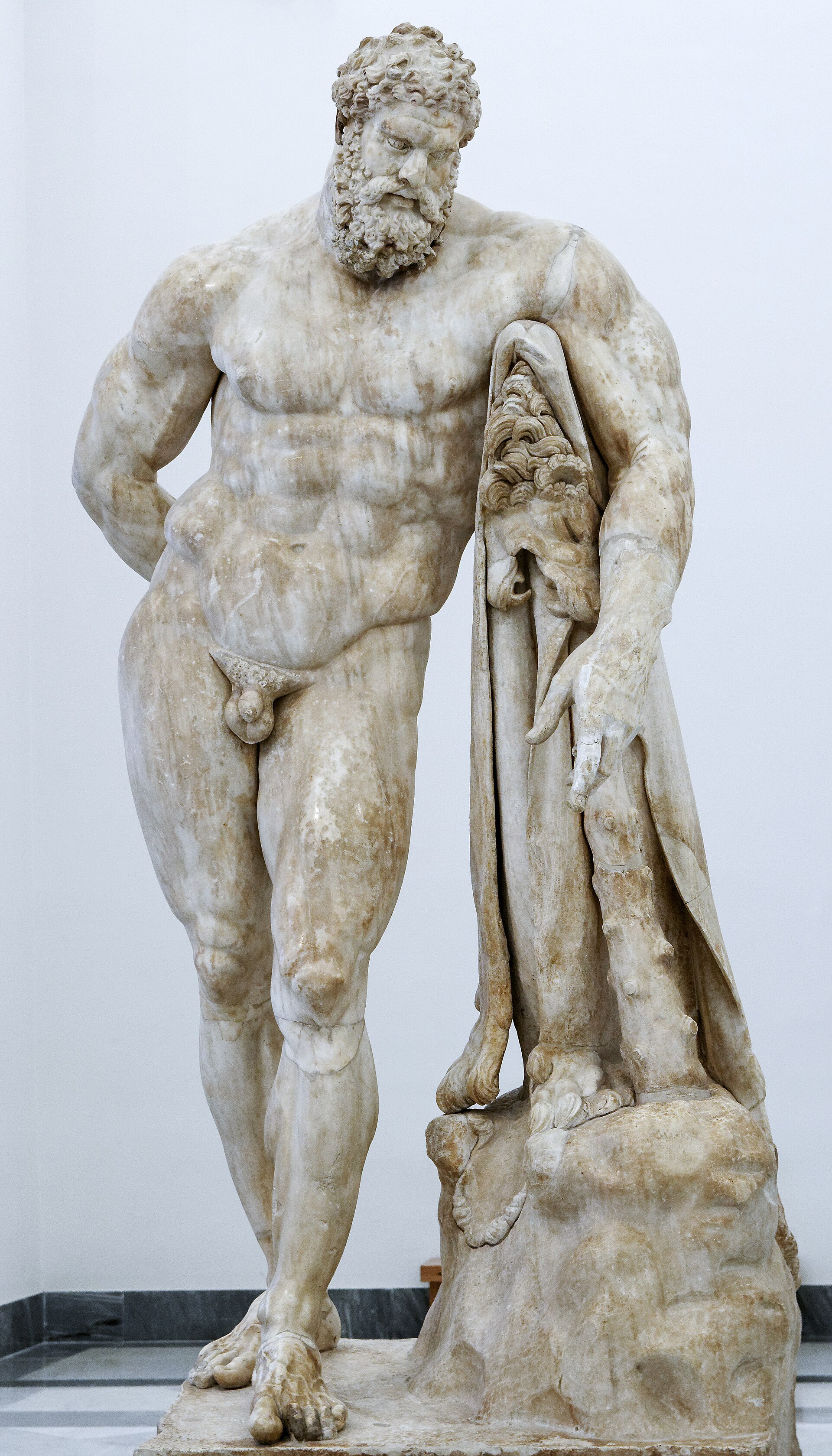
| Type | The Weary Herakles, a Roman copy type derived from a fourth-century BC original attributed to Lysippos of Sikyon. The type was produced in quantity in the Roman period; the colossal Farnese Hercules signed by Glykon of Athens is the best-known member of the family.1 |
| The join | Three attempts were made to demonstrate that the halves belonged together using plaster casts. The third, in 1992, in which a cast of the lower half was flown from Antalya to Boston, satisfied the observers present.1 |
| Digital recording | A study titled 3D Modeling of the Weary Herakles Statue was presented by Devrim Akca and colleagues at the fifth International Symposium of Turkish-German Geodetic Days in Berlin in 2006. Cited here from the Trafficking Culture bibliography; the paper itself was not retrieved.1 |
| Inscription | The plinth carries a Greek inscription, clearly legible in photographs of the reunited statue. No transcription or publication of the text has been located in the sources consulted.5 |
| Display history of the lower half | Exhibited at the Antalya Museum from 1980, latterly beside a photograph of the upper half in Boston and a collage of newspaper cuttings about the dispute.1 |
| Display history of the upper half | Exhibited in a temporary exhibition at the Metropolitan Museum of Art, New York, in 1982; on view at the Museum of Fine Arts, Boston, until it was placed in storage in 2007.12 |
Images
The record in full
Chapter 1The break is across the hips, and the break is the case
Photographs of the statue as it now stands show a horizontal fault line running across the upper thighs and hips, visible on both legs and through the drapery of the lion skin.
Photographs of the statue as it now stands show a horizontal fault line running across the upper thighs and hips, visible on both legs and through the drapery of the lion skin. Above it is marble that spent thirty years in Boston. Below it is marble that spent the same thirty years in Antalya.
Every other question in this case is downstream of that line. If the break happened in antiquity, the upper half could have travelled at any point in the last two thousand years, including centuries in which no law prohibited it, and Turkey's claim collapses. If the break is recent - made by whoever took the top of a statue out of an excavation site and left the legs behind - then the object was removed from Turkey after Turkish law had vested ownership of antiquities in the state, and it is stolen property.
The two halves fit. That has been demonstrable since 1992. What the fit does not by itself establish is when they were parted, and that gap between a physical fact and a legal conclusion is where the argument lived for nineteen more years.
Chapter 2Perge, 1980: an excavation that found half a statue
Jale Inan had been running the excavations at Perge, in Pamphylia on the south coast of Turkey, since 1967.
Jale Inan had been running the excavations at Perge, in Pamphylia on the south coast of Turkey, since 1967. In 1980 her team uncovered the lower half of a marble Weary Herakles.
She was already uneasy. There were rumours at the dig that something important had been stolen from the site, and suspicion had fallen on a workman. What nobody worked out at the time was that the missing thing and the found thing were the same object, cut in two.
Perge is not a marginal site and Inan was not a marginal archaeologist. She was the first Turkish woman to work in the discipline, trained in Berlin under Gerhart Rodenwaldt, and completed her doctorate in 1943 by carrying her thesis and notes into an air-raid bunker while the city was bombed. She had helped found the chair of classical archaeology at Istanbul University in 1946. The sculpture from her excavations at Perge and Side is the reason the Antalya Museum had to be enlarged twice.
The lower half went into that museum, where it stayed on its own for thirty-one years.
Chapter 3A museum, two collectors, and a gift that had to wait for a death
In 1981 the upper half appeared in the United States, bought from a German dealer.
In 1981 the upper half appeared in the United States, bought from a German dealer. The Museum of Fine Arts in Boston acquired it in a fifty per cent partnership with Leon Levy and Shelby White, the New York collectors whose antiquities collection became one of the most scrutinised in America. The following year it was exhibited in a temporary show at the Metropolitan Museum in New York.
The terms of that partnership matter more than they look. The museum would take full ownership only when Levy died. Until then, any decision about the object required the agreement of living donors who had paid for half of it.
This is a structural feature of American museum collecting that almost never appears in restitution coverage, and it has consequences. A fractional gift ties an institution's hands: the museum cannot deaccession, transfer or surrender an object it only half owns, and any discussion about doing so is a conversation with a benefactor about their money and their judgement. When Levy died in 2003 and the museum held the object outright by 2004, it reopened discussions with Turkey. Reporting at the time made the connection explicit - the negotiation was easier once a donor no longer had to be in the room.
Nineteen of the thirty years this statue spent apart were years in which the museum could not have returned it alone even if it had wanted to.
Chapter 4Three casts, and the one that fitted
Turkey's evidence was never a document, because there is no document.
Turkey's evidence was never a document, because there is no document. It was a shape.
Three separate attempts were made to prove that the two pieces were parts of one statue using plaster casts. The first two were unproductive. In 1992 a cast of the lower half was transported from Antalya to Boston, and this one satisfied those who saw it - Turkish officials, scholars, and Thomas Hoving, the former director of the Metropolitan Museum - that the halves were from the same object.
A join is the strongest kind of provenance evidence there is, and it is worth being clear why. It is not stylistic, so connoisseurship cannot argue with it. It is not testimonial, so nobody's credibility is in issue. Two broken surfaces either interlock at every point or they do not, and the probability that two independently broken marbles of the same type match along an irregular fracture is negligible. The Euphronios krater case turned on matching Polaroids; the Cimabue diptych reconstruction turned on worm tunnels bored through joined panels. This is the same class of evidence and it is the best available in the field.
A 3D modelling study of the statue was presented at the Turkish-German Geodetic Days in Berlin in 2006, digitising the halves rather than casting them. By then the physical question had been closed for fourteen years.
Chapter 5The museum's answer: the type is common and the break may be ancient
The Museum of Fine Arts did not concede.
The Museum of Fine Arts did not concede. Its arguments were of two kinds and both are worth stating precisely, because they are the arguments any holding institution will make.
The first was about abundance. Cornelius C. Vermeule III, the museum's department head, pointed out that Weary Herakles statues were made in quantity in the Roman period, so that fragments of many different examples exist. If there are dozens of these torsos, the fact that one of them resembles the top of a Turkish pair proves nothing on its own. As a general proposition this is true, and it is the reason the cast test was necessary.
The second was about time. In 1994 the museum's director of public relations, Robert P. Mitchell, told the Los Angeles Times that the museum did not acknowledge Turkey's claim to ownership, that there had never been any evidence that the statue was stolen and that allegations to that effect were entirely unsupported. He went on: the break between the top and bottom halves of the statue appears to be an ancient one, such that the top half could have been removed long ago from the territory that is now known as Turkey. He added that if settlement discussions failed, a lawsuit would be necessary, and that such a case would raise significant questions.
The museum's public line in 2011 was still that the piece could have been found at any time since the Italian Renaissance.
None of this was ever tested. Turkey never sued. The proposition that the break was ancient was never subjected to examination by an independent body, and it was never withdrawn either.
Chapter 6What changed was policy, not proof
The evidence in 2011 was the evidence of 1992.
The evidence in 2011 was the evidence of 1992. What had changed was the cost of saying no.
From 2010 Turkey took a harder line, refusing loans to institutions holding objects it considered contested. The Art Newspaper reported in early 2012 that two British museums had recently been denied loans. In May 2011, four months before the Boston agreement, the Pergamon Museum in Berlin agreed to return a Hittite sphinx from Bogazkoy after the Turkish culture minister threatened to bar German archaeologists from excavating in the country. Ertugrul Gunay, the minister, said Turkey would fight in the same way for all its other artefacts.
These are the two levers a source country actually holds over a universal museum, and neither is a court. The first is loans: a museum that cannot borrow cannot mount exhibitions, and a country with as much material as Turkey is a lender nobody can afford to lose. The second is excavation permits, which are what keep foreign university departments and their funding alive.
Turkey did not win this object by proving anything new. It made the refusal expensive.
Chapter 7September 2011: an agreement, and what it is not
On 23 September 2011 the Museum of Fine Arts announced that it and the Turkish Republic had reached an agreement for the transfer of the top half of the Weary Herakles to Turkey.
On 23 September 2011 the Museum of Fine Arts announced that it and the Turkish Republic had reached an agreement for the transfer of the top half of the Weary Herakles to Turkey. It formed part of a wider cultural cooperation agreement, and it was reported at the time that the reunited statue would come back to Boston on a short-term loan.
Six distinctions matter here, and coverage of restitution routinely collapses them.
This was not a court judgment: no case was filed, in any jurisdiction, at any point in nineteen years. It was not a forfeiture: no state seized anything. It was not a settlement of litigation, because there was no litigation to settle. It was not a criminal proceeding and nobody was charged. It was not an admission that the museum had bought stolen property, and the museum did not make one; asked why it had moved, its deputy director Katherine Getchell said it was only in the last couple of years that Turkey had presented photographs and other evidence of looting from the site. And it was not unilateral generosity, because the museum received something - the cooperation agreement, and the prospect of loans from a country that had stopped lending.
It was a negotiated transfer of title by a private institution, made when the balance of advantage changed. That is a real and honourable outcome, and describing it as an admission would misstate what the museum said.
Chapter 8The woman who found the legs died ten years too early
Jale Inan died in Istanbul on 26 February 2001, aged eighty-seven.
Jale Inan died in Istanbul on 26 February 2001, aged eighty-seven. The upper half of the statue she had spent two decades pursuing came home ten years and seven months later.
Her work on this statue is described as having formed the basis on which the return was argued, and the description is fair: she found the lower half, she connected the rumour of a theft to the object, and she drove the casting tests. But the Herakles is not her largest contribution to this subject.
In 1967, the year she took charge of Perge, a group of Roman bronzes appeared on the American market with a murky provenance and vague claims of a south-west Anatolian origin. She began in 1973 to try to establish where they had actually come from. In 1990 she excavated at Bubon and identified a Sebasteion, an imperial cult temple, as the building those bronzes had stood in, publishing the case in 1994. That identification is the foundation of the seizures of Bubon bronzes from American museums that are still going on three decades later.
The pattern of her career is the inverse of the usual restitution story. Ordinarily a site is known and an object appears in a museum. In the Bubon case the objects were known and the site was not, and she went and found it.
Chapter 9A museum that displayed its own dispute
For thirty-one years the Antalya Museum showed the lower half of the statue on its own.
For thirty-one years the Antalya Museum showed the lower half of the statue on its own. That is an unusual object to exhibit: a pair of marble legs, cut off at the hip.
The museum did not disguise it. The legs were displayed in recent years alongside a photograph of the upper half in Boston, and next to a collage of newspaper cuttings describing the dispute with the Museum of Fine Arts.
Whatever else that is, it is a piece of museology worth noticing. Most institutions put a tombstone label under an object and leave the argument out of the gallery. Antalya turned the absence into the exhibit, and made every visitor a witness to a claim. The best evidence of the effect is that the display is remembered and described by American reporters who came to write about the Boston end of the story.
Chapter 10The type, and why abundance was a defence
The Weary Herakles shows the hero at rest, leaning on his club with the lion skin draped over it, exhausted after the labours.
The Weary Herakles shows the hero at rest, leaning on his club with the lion skin draped over it, exhausted after the labours. The composition descends from a bronze of about 320 BC attributed to Lysippos of Sikyon, court sculptor to Alexander, and its most famous descendant is the colossal Farnese Hercules signed by Glykon of Athens, found in the Baths of Caracalla and now in Naples.
Roman patrons bought this figure repeatedly for baths, gymnasia and palaestrae, where a resting Herakles is a joke and a compliment at once: the strongest man who ever lived, worn out, standing where men come to exercise. The Perge statue is one of a large family, made between AD 170 and 192.
That ordinariness is the point at which art history entered the legal argument. Because the type is common, the museum could say that a torso in Boston and legs in Antalya were not necessarily one object - and it was right that the resemblance alone proved nothing. Rarity would have made the claim easy. Abundance made a physical test necessary, and it took twelve years and three casts to run it.
Chapter 11Where the statue is in August 2026
The statue is not on public view, and a record that stops in 2011 would tell a reader the opposite.The Antalya Museum closed in July 2025 and its holdings were moved into temporary storage on the...
The statue is not on public view, and a record that stops in 2011 would tell a reader the opposite.
The Antalya Museum closed in July 2025 and its holdings were moved into temporary storage on the site. A seismic analysis carried out in 2020 was cited as showing that the 1970s building was at high risk in an earthquake; the replacement is planned at around twenty thousand square metres and a cost of about sixty-five million dollars, tripling storage and modernising conservation. Demolition began in September 2025 over the objections of academics and professional bodies who wanted the building reinforced rather than demolished, noted that it was the first Turkish museum to be built from an architectural competition, held in 1964, and asked for the seismic report to be published. As at May 2026 the site was still under reconstruction.
So the object that took thirty-one years to be made whole has been in a crate for most of the last year. Nothing in the sources consulted says where, and this record does not guess.
The artist
The Roman copying industry and the Lysippan Weary Herakles type
There is no named sculptor here, and the interesting questions are about an industry rather than an individual. Roman marble sculpture of the second century AD was produced by workshops replicating a canon of Greek prototypes for buildings that needed decoration on a schedule: baths, gymnasia, theatres, colonnaded streets, city gates. Perge is a textbook example, and the halls of the Antalya Museum are full of the results. Understanding this object means understanding that its ordinariness is not a defect but the condition of its existence - and, as it turned out, the pivot of a thirty-year legal argument.
Related works
| Work | Relation | Where it is |
|---|---|---|
| Farnese Hercules Glykon of Athens, after Lysippos | The best-known example of the same copy type Colossal, found in the Baths of Caracalla. A different statue entirely; it appears here because the abundance of the type was the museum's principal argument against the Perge claim. | Museo Archeologico Nazionale, Naples, inv. 6001 |
| The Bubon bronzes Unknown, Roman imperial | Identified as looted from a site located by the same archaeologist Jale Inan excavated at Bubon in 1990 and identified the Sebasteion there as the building from which a group of Roman bronzes on the American market had come. American museums have been surrendering them since. | Dispersed; seizures and returns continuing |
| Hittite sphinx from Bogazkoy Unknown, Hittite | Returned to Turkey by the same mechanism four months earlier The Pergamon Museum in Berlin agreed in May 2011 to return it after the Turkish culture minister threatened to bar German archaeologists from excavating in Turkey. | Turkey |
| The Lydian Hoard Unknown Lydian goldsmiths | The precedent for Turkish claims against American museums Recovered from the Metropolitan Museum of Art in 1993 after a six-year action in New York. Held as a separate record in this archive. | Usak Museum of Archaeology |
Open questions
- Is the break ancient or modern? The museum argued for centuries; Turkey argued for 1980. The fit was proved in 1992; the date of the fracture never was, and no independent examination of the break surfaces has been published.
- Who removed the upper half from Perge, and how did it reach Europe? No route, no intermediary and no export document has ever been produced. The German dealer who sold it in 1981 is not named in any source consulted.
- What did the Museum of Fine Arts and the Levy-White partnership pay in 1981? No price has been published by any party.
- Did the reunited statue ever travel to Boston on the short-term loan reported in 2011? No account of such a loan taking place has been located.
- What are the statue's dimensions, and where in Perge was the lower half found? Neither is given in the sources consulted, which is a striking gap for an object this well known.
- What does the Greek inscription on the plinth say? It is legible in photographs and no transcription has been located.
- Where is the statue now? The Antalya Museum closed in July 2025 and was demolished from September 2025; the holdings went into temporary on-site storage, and nothing specific to this object has been published.
- Was the acquisition made in 1981 or 1982? Accounts differ, including within a single BBC report.
Questions about this object
What is The Weary Herakles?
The Weary Herakles is an antiquity, dated AD 170-192 (late Antonine). Medium: Marble.
Who made The Weary Herakles, and is the attribution settled?
The attribution to Roman copyist after Lysippos of Sikyon is recorded here as workshop. A late Antonine marble of a type known as the Weary Herakles, one of a large number of Roman copies and variants derived from a fourth-century BC bronze attributed to Lysippos of Sikyon. No copyist is named. The abundance of the type is not a footnote in this record: it was the central argument used against Turkey's claim, on the reasoning that two halves of a common composition need not belong to one another.
Where is The Weary Herakles now?
Antalya Museum, Antalya (museum closed and under reconstruction; holdings moved to temporary on-site storage). Inventory number No inventory number published in the sources consulted. Last confirmed 4 August 2026. Upper half transferred by the Museum of Fine Arts, Boston, under an agreement announced 23 September 2011 and reunited with the lower half excavated at Perge in 1980.
What is still unknown about The Weary Herakles?
Is the break ancient or modern? The museum argued for centuries; Turkey argued for 1980. The fit was proved in 1992; the date of the fracture never was, and no independent examination of the break surfaces has been published.
Sources
- 1Suzie Thomas, 'Weary Herakles', Trafficking Culture encyclopedia, University of Glasgow, last modified 31 December 2012. The fullest single account: the AD 170-192 date, the 1980 excavation and the rumours of theft, the 1981 acquisition in fifty per cent partnership with White and Levy, the terms of full ownership on Levy's death, the three cast tests and the successful 1992 test, Cornelius Vermeule's argument from the abundance of the type, the 1994 statement of Robert P. Mitchell as quoted by Rose and Acar in Archaeology (1995), the Antalya display with newspaper cuttings, the 2004 reopening of talks and the 2011 agreement, and the bibliography including Akca and colleagues on the 3D modelling. traffickingculture.org/encyclopedia/...
- 2BBC News, 'Weary Herakles bust to be returned by US to Turkey', 22 July 2011. Source for the purchase from a German dealer, the 2007 move into storage, the museum's position that the piece could have been found at any time since the Italian Renaissance, Katherine Getchell's statement about evidence presented in the previous couple of years, the expected short-term loan back to Boston, the Pergamon Museum sphinx and the statement of culture minister Ertugrul Gunay. Note that this report gives 1982 in its opening line and 1981 in the body. bbc.co.uk/news/...
- 3Wikipedia, 'Jale Inan'. TERTIARY, used for her dates (1 February 1914 to 26 February 2001), her training in Berlin under Gerhart Rodenwaldt, the 1946 foundation of the chair of classical archaeology at Istanbul University, the 1980 discovery of the lower half at Perga, and her 1990 identification of the Sebasteion at Bubon. To be replaced with Stephanie Muller's biographical study of 1913 and with Inan's own Boubon Sebasteionu ve heykelleri uzerine son arastirmalar (1994). en.wikipedia.org/wiki/...
- 4Wikipedia, 'Antalya Museum'. TERTIARY, used for the museum's closure in July 2025, the transfer of holdings to temporary on-site storage, the 2020 seismic analysis, the demolition from September 2025, the objections raised by academics and professional bodies, the 1964 architectural competition, the twenty thousand square metre and sixty-five million dollar replacement, and the statuary halls of material from Perge. To be replaced with a statement from the Turkish Ministry of Culture and Tourism. en.wikipedia.org/wiki/...
- 5Jason Felch, 'Scoop: Turkey asks Getty, Met, Cleveland and Dumbarton Oaks to Return Dozens of Antiquities', Chasing Aphrodite, 30 March 2012. Source for the 1981 joint purchase with Levy and White, the statement that the fit has been known since 1992, the characterisation of the September 2011 return as part of a broader cultural cooperation agreement, and Turkey's 2010 policy of barring loans to institutions holding contested objects. chasingaphrodite.com/2012/...
- 6Wikimedia Commons file page for the lead plate, 'Statue of Hercules from Perge, reproduced in the late 2nd century AD from the 4th century BC original by Lysippos, Antalya Museum, Turkey.jpg', photograph by Carole Raddato, licensed CC BY-SA 2.0 and Flickr-reviewed on 11 March 2021. Used for the licence and the attribution, and read in the raw wikitext rather than through the API summary. commons.wikimedia.org/wiki/...

Last verified 11 September 2026 · Published 4 August 2026
Change log
4 August 2026 - Record created at the house standard: researched narrative, technical evidence, maker dossier, graded provenance chain, prices with hammer and premium separated, related works, open questions and sources.
11 September 2026 - Re-verified 2026-09-11: checked current custody and museum status against fresh searches. Antalya Museum remains closed for reconstruction (demolition began September 2025, rebuild in progress as of the search date, reopening targeted end of 2026); holdings, including this statue, remain in temporary on-site storage per Turkish Ministry of Culture and Tourism reporting. No change to attribution, no new litigation or claim, no change in custody. Location text and as_of date confirmed current; no factual correction required.