Antalya Museum is currently closed. Not open and not permanently closed. The museum's own visit-and-ticketing page states plainly that it is closed to visitors (Ziyarete kapatilmistir); the Ministry of Culture and Tourism's own price list marks the entry KAPALI. This follows a 16 July 2025 closure and a September 2025 demolition of the 1972 building for a full rebuild on the same site, officially targeted for completion by the end of 2026.
Expected to reopen: 26 December 2026, per the construction site's own project signage (Antalya Yeni Muze Yapimi 2. Etap Isi) · a target, not yet confirmed
Closure confirmed 27 August 2026 from the institution's own page. We re-check this page on a schedule and will update it, from the institution's own announcement, the moment it reopens.
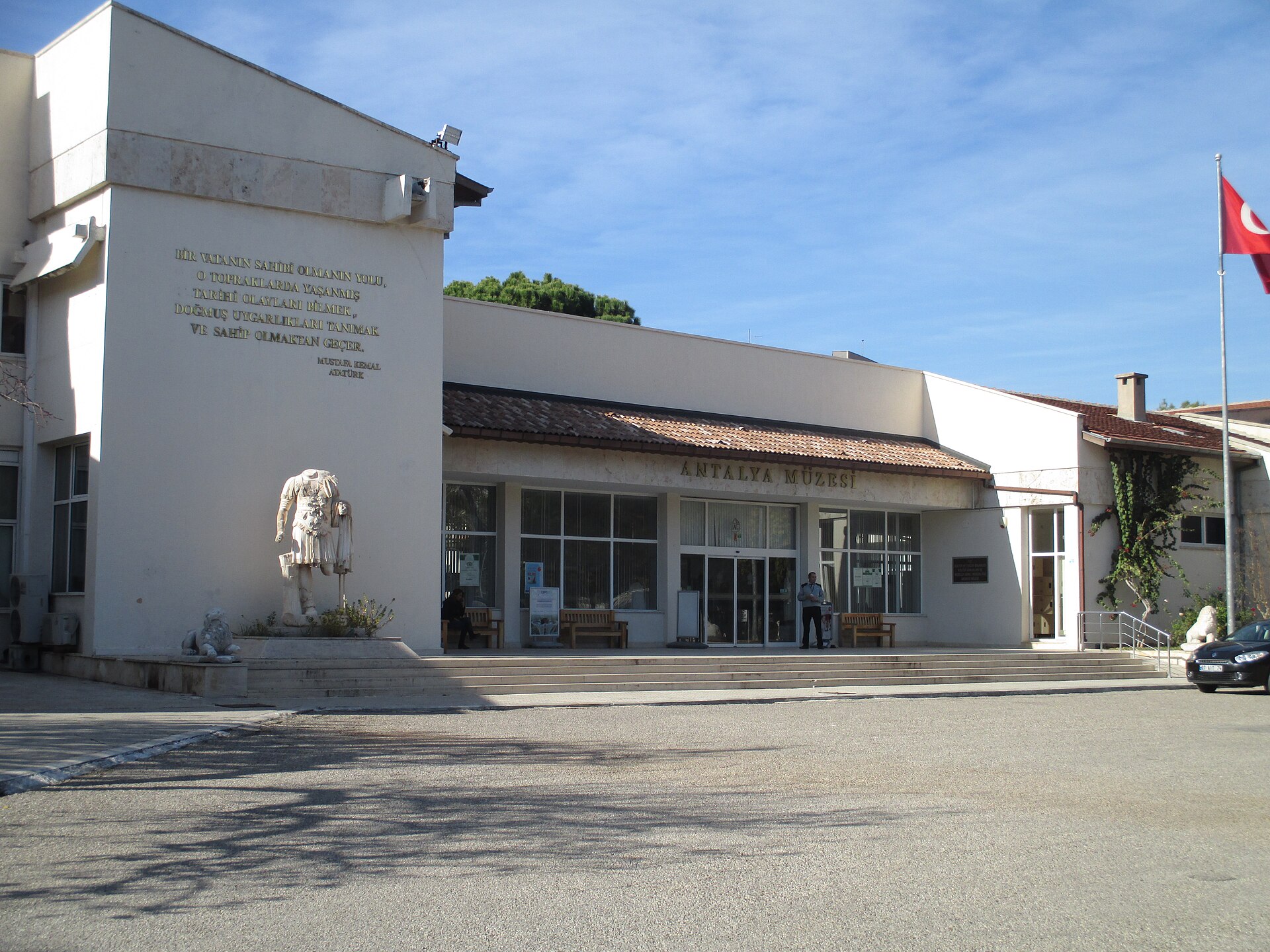
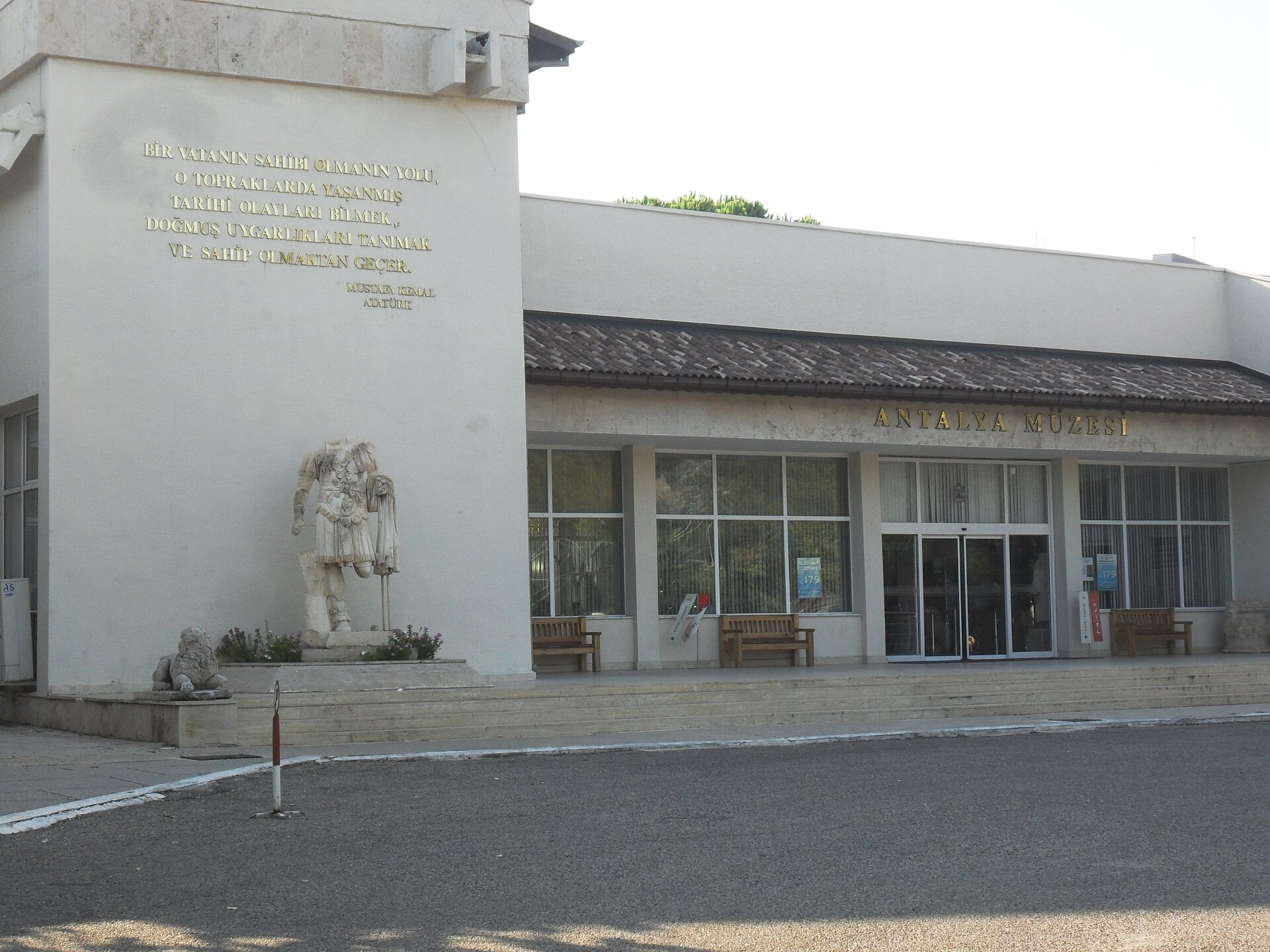
On this page 14 sectionsContentsCloseThe museum's main entrance, photographed in 2011, with its own inscribed dedication to Ataturk on the end wall, a marble statue of a cuirassed Roman commander from Perge standing before it, and ANTALYA MUZESI lettered above the doors. The 1972 building shown here was demolished in September 2025 for a full rebuild on the same site.Public domain
On the order of 100,000 objects, of which roughly 5,000 were on public display before the 2025 closure, overwhelmingly excavated within Antalya province rather than acquired by purchase. Perge alone supplied most of the Roman-period marble sculpture that was the museum's real centre of gravity - the Hall of the Gods and Hall of the Emperors, the Dancer, Plancia Magna, the Herakles sarcophagus - while Karain Cave gives the collection an unusually deep prehistoric holding for a regional museum, and a smaller run of Byzantine, Seljuk and Ottoman material closes the chronology. It is also one of the more prominent sites in Turkey's own restitution history: the Weary Herakles, reunited here in 2011 after thirty years split between Antalya and Boston, is a directly documented case of an object this archive also holds a record on.
Antalya Museum at a glance
Local name
Antalya Müzesi
Kind
Museum
Founded
Collecting began in 1919 under Suleyman Fikri (later Erten); formalised as a museum in 1922; the Konyaalti building opened 25 November 1972 and was demolished in September 2025 for a full rebuild on the same site
City and country
Antalya, Turkey
Address
Bahcelievler Mahallesi, Konyaalti Caddesi No 88, 07050 Muratpasa, Antalya, Turkey
What it cost and when it was open, before the closureConfirmed 27 August 2026
Hours (pre-closure)
All daysNo visiting hours currently apply. The museum has been closed to all visitors since 16 July 2025 for demolition and full reconstruction on the same site, and the ministry's own visit page confirms the closure directly rather than publishing hours.
Closed
Entirely closed to visitors since 16 July 2025, with the 1972 building demolished in September 2025 and reconstruction officially targeted for completion by the end of 2026.
Admission (pre-closure)
Foreign visitorsEUR 15Last figure published on the Ministry of Culture and Tourism's own museum and site price list (DOSIM), which lists the museum's entry as KAPALI, meaning closed. This is not a current, payable price; it is the figure the ministry's own system still carries against the closed entry, and needs reconfirming once the museum reopens.
Turkish Republic ID holders and Muze KartFreeEntry is administered through the Muze Kart annual museum pass system for Turkish citizens and residents rather than a per-visit cash price; the museum's own ticketing page states the card or ticket is bought at the counter and does not publish a separate walk-up figure.
Free entry: No free-admission day is published in the sources read for this record; the entire question is moot while the museum is closed
Do I need to book?
Not applicable while the museum is closed. It was not a timed-entry venue in ordinary operation, on the evidence of the sources read here.
Nostalgic tramway The heritage Nostalji Tramvayi line has its first stop, named Muze, directly at the museum, at the Konyaalti Beach end of an eleven-stop single-track route that runs on to Barbaros, Cumhuriyet Meydani, Kale Kapisi, Uc Kapilar (Hadrian's Gate), Karaalioglu Park's Hidirlik Tower and on into Kaleici old town, ending at Isiklar in Muratpasa. Two cars run the line roughly every half hour; fares are paid with the Antalyakart transit card or by contactless card. The tram's own timetable runs independently of the museum's closure. Light rail The separate AntRay light rail line serves central Antalya with trains roughly every 10 to 20 minutes between about 06:00 and midnight; its nearest stop is a walk from the museum rather than immediately outside it, unlike the nostalgic tram.
Before you go how long, access, photography, bags, eating, shop
How long to allow
Not applicable while closed. Before the 2025 closure, published guides commonly suggested at least half a day for the thirteen exhibition halls.
Access
Not published in the sources read for this record; none of the ministry's own pages fetched here address accessibility.
Photography
Not published in the sources read for this record.
Bags
Not published in the sources read for this record.
Eating
The 1972 building held a cafeteria and a video screening room alongside its exhibition halls, on the museum directorate's own description; nothing in the sources read here states whether either exists in, or is planned for, the rebuilt museum.
Shop
Not published in the sources read for this record.
The museum is closed (see above). These are the figures published before the closure, kept here for a visitor planning ahead rather than presented as bookable today, and you can check the current position at the source we used. We will re-confirm them once it reopens.
What is inside
5 spaces, 1 photographed
Hall of the Gods and the Hall of the Emperors
Before the September 2025 demolition, these two halls held the core of the museum's Roman-period marble from Perge: cult and votive statues of Zeus, Aphrodite and Apollo among others, second and third century AD copies after older Greek originals, alongside imperial portraiture of Hadrian, Trajan, Caracalla and Lucius Verus. The single most documented figure from this material is not an emperor: Plancia Magna, a wealthy Pergean woman honoured as priestess of Artemis Pergaia and of the imperial cult and, on the evidence of Perge's own inscriptions, the only woman known to have held the city's chief magistracy, the demiourgia. Her statue and inscribed base, recovered from the public square in front of Perge's Hellenistic gate that she herself rebuilt under Hadrian, stood in this hall. All of it is now in the on-site storage described below.
Sarcophagus Hall
Roman-period stone sarcophagi in the three forms characteristic of the region, including a marble sarcophagus carved with twelve reliefs of the Labours of Herakles. A separate published account singles out the hall's use of medallion-portrait decoration as unusual even within that regional group. No free-licence photograph of this specific hall was located on Wikimedia Commons.
Hall of Small Finds, Coins and Church Artifacts
Lamps, glass and silver from the Roman and Byzantine periods, a coin sequence running from the Hellenistic period to the Ottoman era, and the museum's own contested relic: a red-lined box, found in Antalya in the 1920s and displayed beside a nineteenth-century icon of the enthroned saint, presented for decades as bones of Saint Nicholas of Myra missed when the bulk of his remains were taken to Bari in 1087. A 2004 forensic examination of the bones by Francesco Introna, a forensic pathologist at the University of Bari, found them to duplicate bones already present in the Bari skeleton and to belong to a distinctly younger individual - a conclusion the museum's own long-standing label does not reflect in any source read for this record.
Prehistory and Natural History Halls
Paleolithic through early Bronze Age material from excavations in Antalya province, including finds from Karain Cave, one of Anatolia's longest-inhabited prehistoric sites, alongside a natural-history display of regional fossils and fauna. This was the chronological starting point of the museum's own hang, opposite the classical and Roman halls that made up most of its floor space.
Photograph by Dosseman · CC BY-SA 4.0
Mosaic Hall and the Ethnography Hall
Byzantine floor mosaics and icons in one hall; Seljuk and Ottoman carpets, costumes, weapons and a reconstructed Anatolian house interior in the other, plus a children's section the museum's own material describes as the first of its kind in Turkey. One published account of a 2015 visit judged the ethnographic material prepared with less curatorial rigour than the archaeological galleries around it - the one piece of named published criticism of the collection itself, as opposed to the building, located for this record.
What to see first
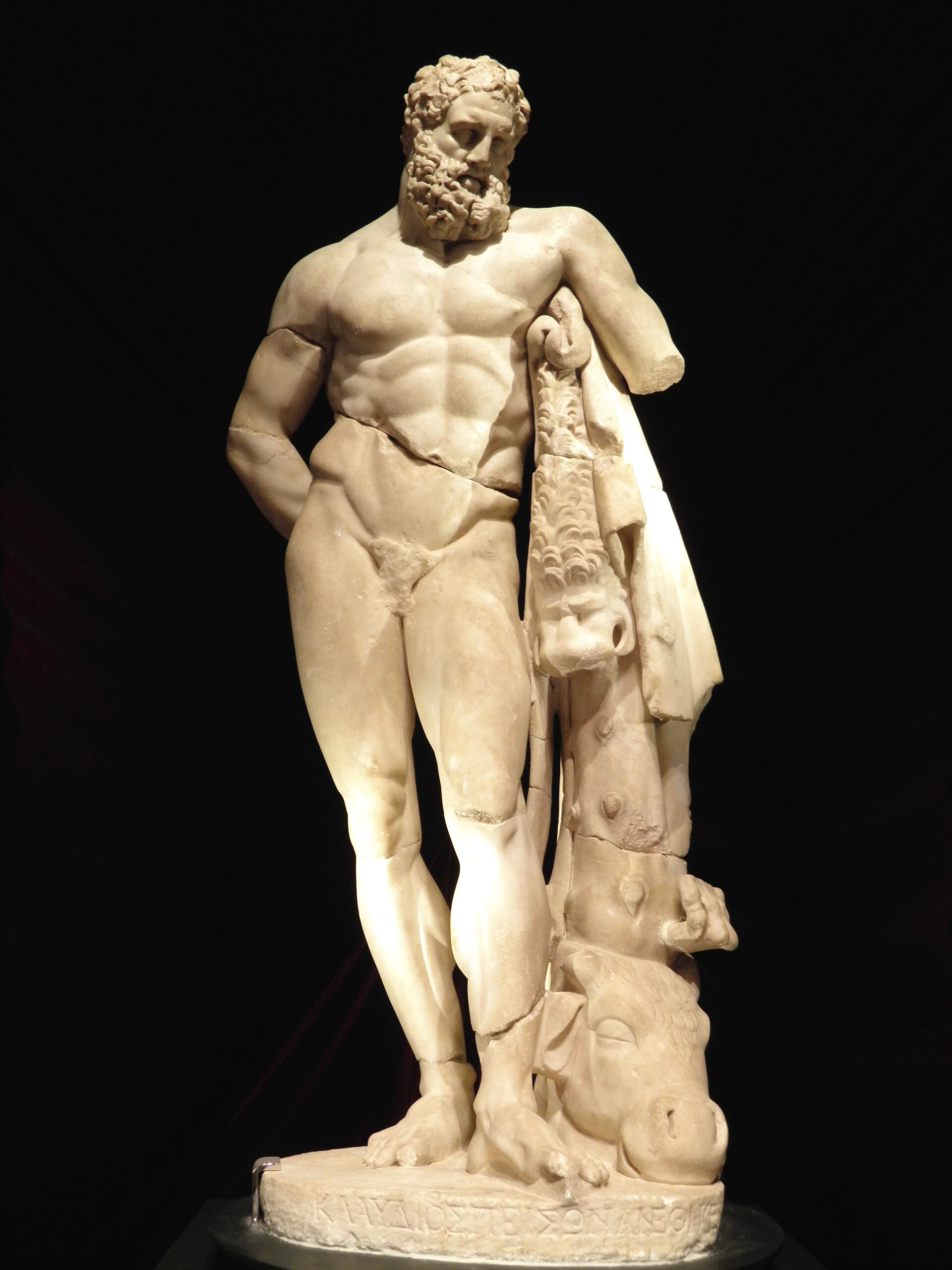
The Weary Herakles
Roman copyist after a bronze attributed to Lysippos of Sikyon, carved AD 170-192
A Roman marble that spent thirty years in two pieces on two continents. The lower half was excavated at Perge in 1980 by Jale Inan; the upper half had surfaced in the United States and was bought in 1981 by the Museum of Fine Arts, Boston, in partnership with the collectors Leon Levy and Shelby White. A plaster cast proved the fit in 1992, but the museum did not concede the two halves were the same statue until 2011, after Turkey began withholding loans and excavation permits from institutions holding contested objects and after Levy's death removed a co-owner from the negotiation. The transfer was announced 23 September 2011 and the statue was reunited here. This archive holds a full record on it.9
Unknown Roman sculptor, 2nd century AD, after a Hellenistic Rococo-style original
A marble figure of a dancing woman, carved in contrasting black and white marble - black for the hair and drapery, white for the face, neck and arms - and reassembled from 103 broken and weathered fragments after its discovery in 1981 during excavation of the Gallery of Claudius Peison at Perge's South Bath. It is one of the museum's most reproduced single objects.16
Statue and inscribed base of Plancia Magna
Unknown Roman sculptor, early 2nd century AD
A civic benefactress of Perge under Hadrian, honoured in her city's own inscriptions as priestess of Artemis Pergaia and of the imperial cult and as the only woman recorded holding Perge's chief magistracy. She personally funded the rebuilding of the city's Hellenistic gate into a monumental entrance and financed an honorific triple arch naming her father; her statue, recovered from the square in front of that gate, is one of the few named individual women, rather than gods or emperors, in the museum's Roman galleries.15
Herakles Sarcophagus
Unknown Roman workshop, Pamphylian region
A marble sarcophagus carved with twelve reliefs illustrating the Labours of Herakles, one of the more fully narrative sarcophagi in a hall built almost entirely from Perge and other Pamphylian excavations.17
Marble portrait of Alexander the Great
Unknown Roman sculptor, after an earlier Hellenistic type
Recovered from the decoration of the stage building of Perge's Roman theatre, alongside figures of Hermes and the satyr Marsyas from the same building; the museum's own theatre-sculpture group is among the largest assemblies of decorative statuary from a single Roman theatre anywhere in Turkey.18
The Saint Nicholas reliquary and icon
Reliquary box found in Antalya in the 1920s; icon of the 19th century
Displayed for decades as bones of Saint Nicholas of Myra overlooked when his remains were removed to Bari in 1087, the relics were forensically examined in 2004 by Francesco Introna of the University of Bari, whose findings identified the bones as duplicates of material already present in the Bari skeleton and as belonging to a younger individual. The object is included here because the gap between the museum's traditional presentation and the forensic finding is itself part of the record.14
Cult statues from the Hall of the Gods
Roman copyists, 2nd-3rd century AD, after Greek originals
Marble figures of Zeus, Aphrodite and Apollo among others, excavated at Perge and forming the core of the hall that, with the adjoining Hall of the Emperors, held most of the museum's Roman sculpture before the 2025 closure.18
A rescue collection becomes a museum, 1919 to 1972
Antalya's museum did not begin as a museum. In 1919, with the city under Italian occupation after the First World War, a local schoolteacher named Suleyman Fikri began gathering antiquities to keep them out of foreign hands, first storing what he found in the abandoned tomb of Bayraktar Baba. He later took the surname Erten and served as the collection's first director until 1941. In 1922 the pieces moved into the Panaya Church, by then in use as the Alaaddin Mosque; in 1937 they moved again, to the Yivli Minare mosque complex in the old walled city, where the museum stayed for thirty-five years.
The purpose-built museum that most of the twentieth century associated with Antalya came out of a 1964 architectural competition, the first held in Turkey for a museum project. The winning design, by Dogan Tekeli, Sami Sisa and Metin Hepguler, opened on Konyaalti Caddesi on 25 November 1972. In 1988 the Council of Europe gave the building its Museum of the Year Special Award. The museum closed briefly for reorganisation in 1982 and reopened in 1985; nothing in the sources read for this record explains that closure in detail, and it is noted here as a minor, tertiary-sourced fact rather than a settled one.
Thirteen halls, almost entirely from one province
At its fullest, before the 2025 closure, the museum held on the order of 100,000 objects across roughly 30,000 square metres, of which the museum's own material put about 5,000 on public display at any time, the rest in storage, across thirteen exhibition halls plus open-air galleries. Unlike an encyclopedic museum assembled by purchase across continents, almost everything in the building was excavated in Antalya province itself: the collection runs chronologically from Paleolithic and early Bronze Age material at Karain Cave, one of Anatolia's longest-inhabited prehistoric sites, through Bronze Age finds from Hacilar and Semahoyuk and Mycenaean-to-Hellenistic pottery, to the section that actually filled most of the floor space, the Roman-period marble recovered from Perge, the major Pamphylian city an hour east of the city.
That Perge material carried the Hall of the Gods, with second and third century AD copies of Greek cult statues of Zeus, Aphrodite and Apollo among others, and the adjoining Hall of the Emperors, with portraits of Hadrian, Trajan, Caracalla and Lucius Verus alongside civic figures such as Plancia Magna. A separate Sarcophagus Hall held the region's characteristic tomb forms, including a sarcophagus carved with the twelve Labours of Herakles. Smaller halls covered Byzantine mosaics and icons, small finds and coinage from the Hellenistic to the Ottoman period, Seljuk and Ottoman ethnography with a reconstructed Anatolian house interior, and a children's section the museum's own material describes as the first purpose-built one of its kind in Turkey. One published 2015 account judged the ethnography hall prepared with less rigour than the archaeological galleries around it - the single piece of named published criticism of the collection's own curation, as distinct from the building, located for this record.
The Weary Herakles: reunited after thirty years apart
The clearest instance of this museum's own place in the restitution history this archive exists to record is a statue that spent thirty years as two objects. In 1980 the archaeologist Jale Inan, excavating at Perge, uncovered the lower half of a Roman marble Weary Herakles. The upper half had already left the country; it surfaced in the United States and was bought in 1981 by the Museum of Fine Arts, Boston, in a fifty-fifty partnership with the New York collectors Leon Levy and Shelby White, on terms giving the museum full ownership once Levy died. A plaster cast of the Antalya legs, flown to Boston in 1992, proved the two halves physically fit. The museum did not accept that this settled ownership: its position for the next nineteen years was that the Weary Herakles was a common type, that the break across the hips could be ancient, and that the top half could therefore have left Turkey long before any law forbade it.
What moved the object in the end was not a court judgment - no case was ever filed - but a shift in the terms of the argument. From 2010 Turkey began withholding loans and excavation permits from foreign institutions holding objects it considered contested; in May 2011 Germany's Pergamon Museum returned a Hittite sphinx to Turkey under comparable pressure; and Leon Levy's 2003 death had already removed a co-owner from the room. The Museum of Fine Arts announced the transfer of its half to Turkey on 23 September 2011, and the statue was made whole again in this building. Jale Inan, who had excavated the lower half in 1980, had died in 2001 and did not see the reunion. This archive holds a full record on the object; its current_location there independently confirms it belongs to this museum and nowhere else, and that record now also carries the same fact this page must carry: as of 2026 the statue is not on display but in the on-site storage described below.
The building nobody agreed to lose
On 16 July 2025 the museum closed to visitors. The Ministry of Culture and Tourism's own director general of cultural assets and museums, Birol Incecikoz, said the decision followed a 2020 seismic performance assessment that classified the 1972 building as a high-risk structure; a separate ministry statement cited inadequate reinforcement, water damage and concrete deterioration found during testing. The first construction contract for a replacement was signed 1 July 2025, and by September 2025 the 1972 building had been demolished. A year on, in July 2026, a local report described the site as vacant, with the collection - on the order of 100,000 objects, including some 200 large statues and sarcophagi - held in two secured, climate-monitored warehouses built inside the museum's own grounds; the ministry's own statements insist nothing has left the city and that the new museum, designed by the architect Abdurrahman Cekim with a form drawing on ancient Perge, will rise on the same ground, at a reported cost of two to two and a half billion Turkish lira, with completion officially targeted for the end of 2026, though a report from July 2026 already had officials citing October rather than an earlier mid-year date - reason enough to treat any completion date here as provisional rather than confirmed.
The ministry's own regional director has publicly rejected the word demolition, telling reporters the project should be understood as transformation rather than destruction and dismissing rumours that the museum might be relocated or the land repurposed. That framing has not persuaded the building's own defenders. On 7 July 2025, ICOMOS Turkiye's national committees on twentieth-century heritage and on the restoration of historic structures, together with the conservation body KorDer and Docomomo Turkiye, issued a joint declaration calling for the existing building to be preserved, strengthened and restored rather than demolished, on the grounds that it was Turkey's first museum project born of a national architectural competition and a rare instance of modern Turkish civic architecture recognised internationally. Dogan Tekeli, one of the building's three original architects, said publicly that the structure could be repaired and called the demolition decision hasty. A locally formed Antalya Museum Working Group, including academics, has gone further, criticising not only the decision but the closed and non-participatory way it was reached, and has voiced concern - not yet borne out by anything in the sources read here - that a vacant flagship site of this kind could in principle be used for something other than a rebuilt museum.
A hundred thousand objects in a warehouse, as of this record
What that leaves, at the date this page was researched, is a museum with no building. The Ministry of Culture and Tourism's own visit page for the institution states plainly, in Turkish, that it is closed to visitors; the ministry's separate price list for museums and archaeological sites marks the same entry closed while still carrying a foreign-visitor admission figure of 15 euros, a figure this page records as the last published one rather than as a current, payable price. Every object discussed above - the Weary Herakles, the Dancer of Perge, Plancia Magna's statue, the Herakles sarcophagus, the contested Saint Nicholas relics - is, on the ministry's own account, individually packaged and held in the on-site storage built for the purpose, with security cameras, alarms and climate control, while conservation and laboratory staff are reported to be continuing their work uninterrupted. Nothing in the sources read here states when, or in what form, any of it will next be on public view; the end-of-2026 completion date is the ministry's own target, already once revised in the reporting available, and this page treats it as exactly that - a target, not a fact confirmed on the day of reopening.
What visitors say
We publish no visitor-review prose and no unverified aggregate score, so what follows draws on named published accounts. Before the 2025 closure, the collection was consistently described as one of the strongest assemblies of Roman-period marble sculpture in Turkey, built almost entirely from excavations in the museum's own province rather than by purchase - Perge above all, with Karain Cave giving it an unusually deep prehistoric holding as well. Since July 2025 the dominant fact about the museum is not what is on its walls but that it has none: the 1972 building was demolished in September 2025, its roughly 100,000 objects moved into secured, climate-monitored storage built inside the museum's own grounds, and a replacement building, designed by the architect Abdurrahman Cekim with a form drawing on ancient Perge, is under construction on the same site with completion officially targeted for the end of 2026. The Ministry of Culture and Tourism's own director general of cultural assets and museums has said the decision followed a 2020 seismic assessment that found the old building a high-risk structure; the ministry's own regional spokesman characterised the project publicly as transformation rather than demolition, a framing that a body of Turkish and international heritage professionals, and one of the building's own three original architects, has rejected as understating what actually happened to it.
What is praised, what is criticised
Praised: the depth and origin of the Roman-period sculpture collection, built almost entirely from Perge and other Pamphylian excavations rather than assembled by purchase, and repeatedly named in published guides as among the strongest in Turkey
Praised: the breadth of chronological coverage in one building, from Karain Cave's Paleolithic material through Roman Perge to Seljuk and Ottoman ethnography, with a children's section the museum's own material describes as the first of its kind in the country
Praised: the 1972 building itself, which architectural historians and Turkish heritage bodies have defended as a rare Turkish museum project born of a national design competition, rather than treating the structure as mere shell for the collection
Criticised: the ethnography hall, judged by one published account to have been curated with less rigour than the archaeological galleries around it
Criticised: the museum's own long-standing presentation of its Saint Nicholas relics, which a 2004 forensic examination found do not match the saint's remains in Bari and belong to a younger individual - a finding not reflected in the museum's traditional labelling on the evidence available here
Criticised: the 2025 demolition of the award-winning 1972 building itself, opposed in a joint 7 July 2025 declaration by ICOMOS Turkiye's committees on twentieth-century heritage and on the restoration of historic structures, the conservation body KorDer and Docomomo Turkiye, who argued for strengthening and restoring the existing structure instead; one of the building's three original architects, Dogan Tekeli, said publicly that it could be repaired and called the demolition decision hasty; and a locally formed Museum Working Group has criticised both the decision itself and the closed, non-participatory way it was reached, with concern that the vacated site could in principle be used for something other than a rebuilt museum
Set out the building's origin in Turkey's first architectural competition for a museum, held in 1964 and won by Dogan Tekeli, Sami Sisa and Metin Hepguler, its 1972 completion and 1988 Council of Europe Museum of the Year Special Award, and reported the 7 July 2025 joint declaration by ICOMOS Turkiye's twentieth-century-heritage and structural-restoration committees together with KorDer and Docomomo Turkiye calling for the building's preservation, strengthening and restoration rather than demolition.Docomomo International, Docomomo International, 21 September 2026 [6]
Reported, one year after the closure, that the building had in fact been demolished and the collection moved into two on-site storage warehouses, and quoted Hilmi Uysal, speaking for the Antalya Museum Working Group, connecting the loss to the museum's own founding by Suleyman Fikri Erten during the post-First World War occupation and objecting to the site's memory being reduced to boxed storage.antalyakorfez.com, not bylined in the page fetched, 16 July 2026 [7]
Carried the regional cultural-assets director Birol Incecikoz's public response to demolition claims, insisting the project should be described as transformation rather than demolition, dismissing relocation rumours, and citing structural defects - inadequate reinforcement, water damage and concrete deterioration - alongside the 2020 seismic finding as the basis for the decision.Hurriyet, not bylined in the page fetched, 21 September 2026 [8]
Questions about Antalya Museum
Where is Antalya Museum?
Bahcelievler Mahallesi, Konyaalti Caddesi No 88, 07050 Muratpasa, Antalya, Turkey.
How much does it cost to visit?
Foreign visitors: EUR 15; Turkish Republic ID holders and Muze Kart: free. As confirmed 27 August 2026.
When is it open?
All days closed. Closed: Entirely closed to visitors since 16 July 2025, with the 1972 building demolished in September 2025 and reconstruction officially targeted for completion by the end of 2026. As confirmed 27 August 2026.
How do you get there?
Nostalgic tramway: The heritage Nostalji Tramvayi line has its first stop, named Muze, directly at the museum, at the Konyaalti Beach end of an eleven-stop single-track route that runs on to Barbaros, Cumhuriyet Meydani, Kale Kapisi, Uc Kapilar (Hadrian's Gate), Karaalioglu Park's Hidirlik Tower and on into Kaleici old town, ending at Isiklar in Muratpasa. Two cars run the line roughly every half hour; fares are paid with the Antalyakart transit card or by contactless card. The tram's own timetable runs independently of the museum's closure; Light rail: The separate AntRay light rail line serves central Antalya with trains roughly every 10 to 20 minutes between about 06:00 and midnight; its nearest stop is a walk from the museum rather than immediately outside it, unlike the nostalgic tram.
What should you see first?
The Weary Herakles (Roman copyist after a bronze attributed to Lysippos of Sikyon, carved AD 170-192); The Dancer of Perge (Unknown Roman sculptor, 2nd century AD, after a Hellenistic Rococo-style original); Statue and inscribed base of Plancia Magna (Unknown Roman sculptor, early 2nd century AD); Herakles Sarcophagus (Unknown Roman workshop, Pamphylian region); Marble portrait of Alexander the Great (Unknown Roman sculptor, after an earlier Hellenistic type); The Saint Nicholas reliquary and icon (Reliquary box found in Antalya in the 1920s; icon of the 19th century).
What we could not confirm
The founding date is given as 1919 (when Suleyman Fikri Erten began gathering artifacts) by the museum's own directorate page and as 1922 (formal establishment) by Turkish and English Wikipedia; this page follows the directorate's own account and notes the discrepancy rather than resolving it.
Wikidata's P131 places the museum administratively in Konyaalti; the museum's own published postal address places it in Muratpasa. The building sits near enough to that district boundary that both may be defensible; this page has not resolved which is currently correct.
The rebuilt museum's official completion date has already moved once in the reporting read here, from an initial 'summer 2026' framing to an October 2026 date cited by officials in July 2026 reporting; end-of-2026 is treated in this page as a target rather than a confirmed date.
The project's cost is reported inconsistently, between two and two and a half billion Turkish lira across different outlets, and no figure was read directly from a ministry-published budget document; USD equivalents circulating in some reporting (in the sixty-million-dollar range) are not derived from any source read here and are not repeated as fact.
No inventory number for the Weary Herakles, and no published text of the Greek inscription on its base, was located in the sources read for this record.
Whether pre-closure practical visitor information - accessibility provision, photography rules, bag policy - will carry over unchanged to the rebuilt museum is not addressed in any source read here.
Images
3 plates
The same facade, a different dayA second photograph of the Konyaalti Caddesi entrance, taken from a different angle and in different light than the lead image, showing the same statue, the same Ataturk inscription and the flagpole beside the museum's name. It records the same now-demolished building.Photograph by Dat doris · CC BY-SA 4.0
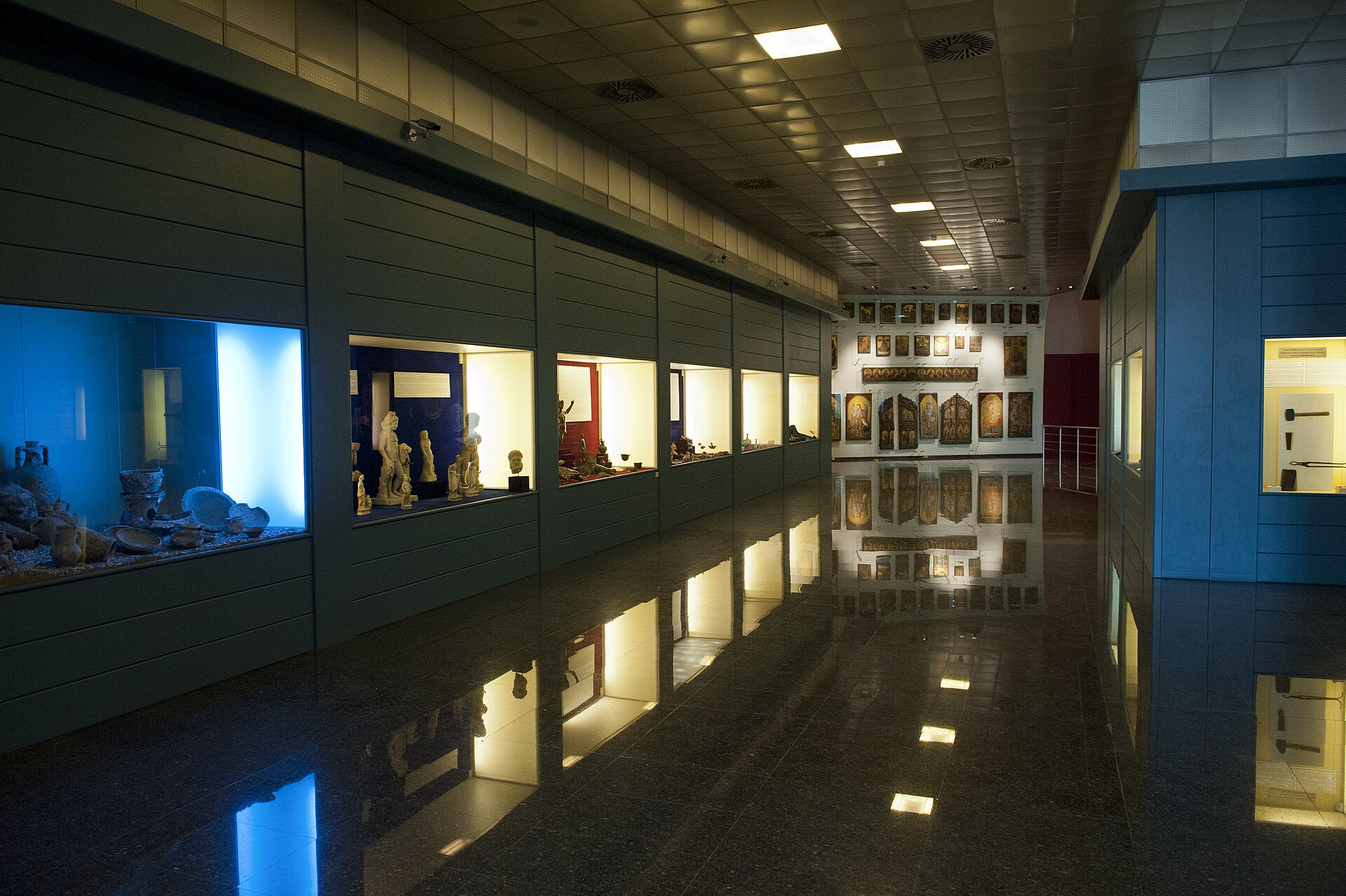
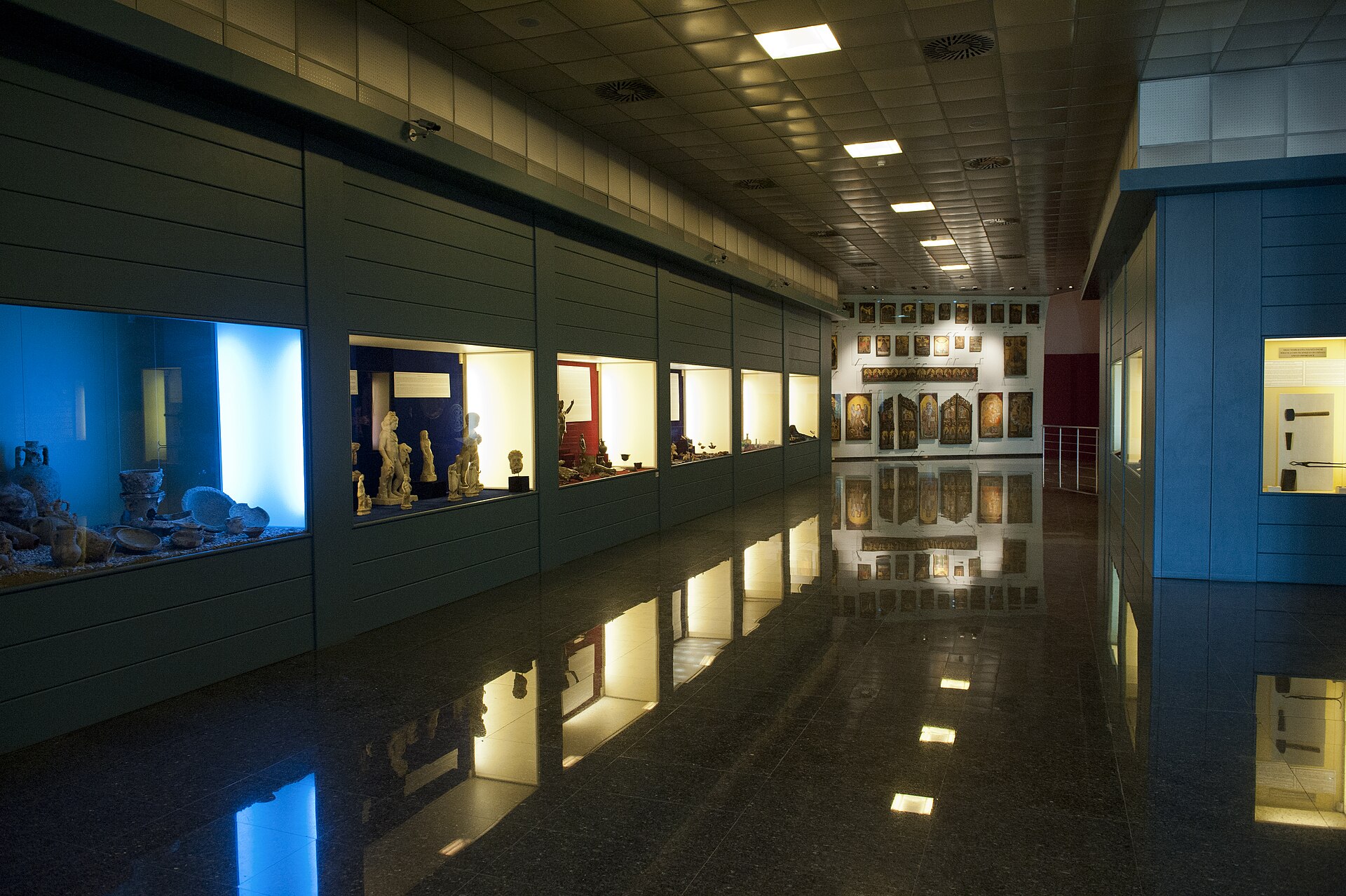
A first-floor display corridorOne of the museum's internal galleries as it stood before the 2025 closure: wall cases of small finds along one side and a run of framed panels on the far wall. Which of the numbered halls this corridor belonged to is not established from the source, so it is captioned for what is visible rather than for a specific gallery name.Photograph by Dosseman · CC BY-SA 4.0
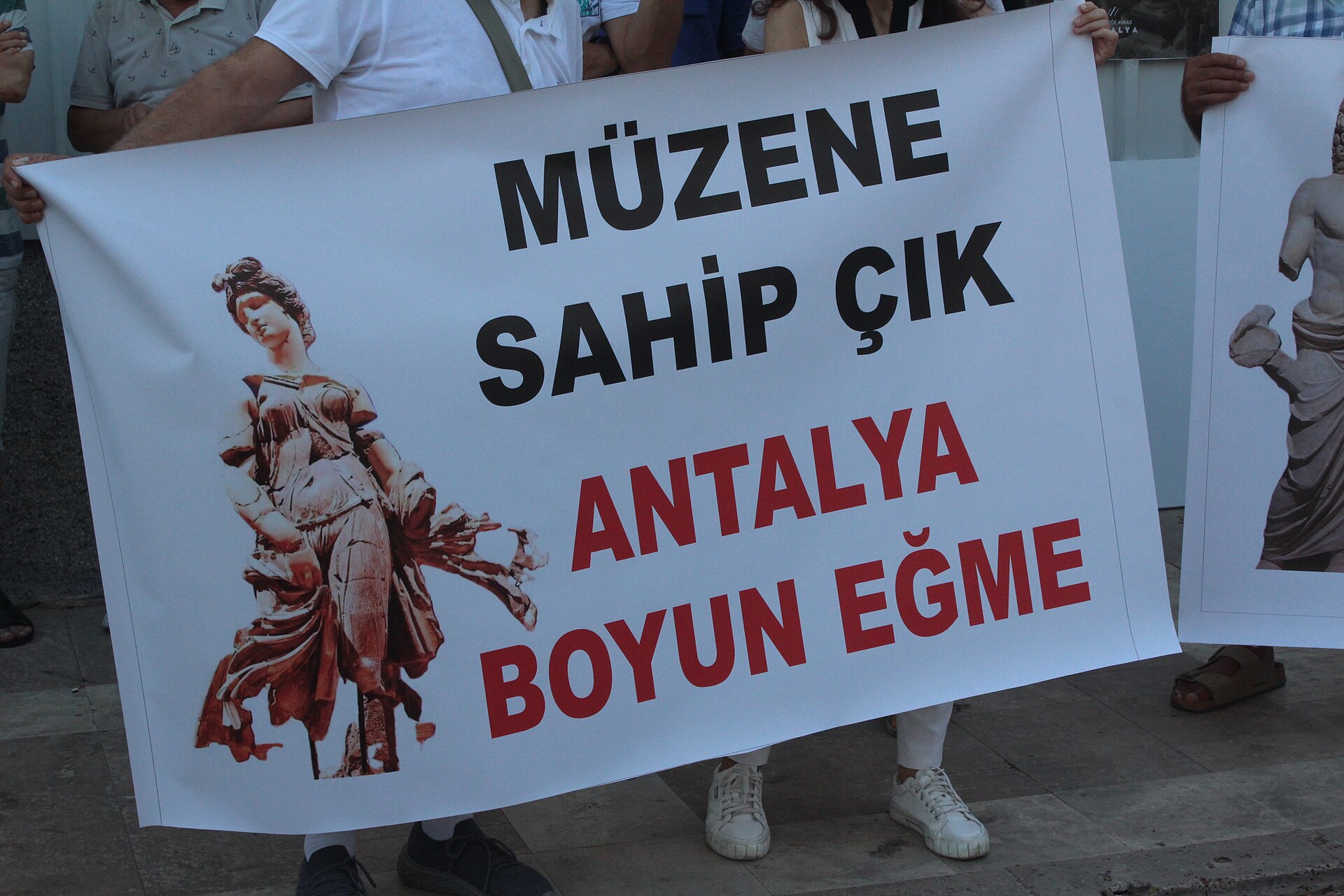
A demonstration against the demolitionA banner at a public protest against the building's demolition, its Turkish text translating roughly as Own your museum; Antalya, do not bow down, illustrated with an image of one of the museum's own Perge statues. The protest and the dispute it belongs to are discussed in the narrative above.Photograph by Onur Taner · CC BY-SA 4.0
Sources
21
1Wikidata, Antalya Museum (Q843241). Verified by label match and by claims: P31 archaeological museum / public art museum / museum, P17 Turkey, P131 Konyaalti / Antalya Province, P625 coordinates 36.8856, 30.6797, P856 official website antalyamuzesi.gov.tr, no P576 dissolved date. TERTIARY, used only for machine identity and coordinates, never for a price or an opening hour. wikidata.org/wiki/Q843241
2T.C. Kultur ve Turizm Bakanligi, Antalya Muze Mudurlugu (Antalya Museum Directorate), official page. The museum's own account of its 1919-1922 founding by Suleyman Fikri (Erten), its moves through the Bayraktar Baba tomb, the Panaya Church / Alaaddin Mosque and the Yivli Minare mosque, its collection description by material and period, its holdings, its address, telephone and email, and the eight archaeological sites and three smaller museums the same directorate also administers. Fetched as raw HTML on 7 August 2026. kvmgm.ktb.gov.tr/TR-281274/antalya-muze-mudurlugu.html
3T.C. Kultur ve Turizm Bakanligi, muze.gov.tr, Antalya Muzesi visit and Muze Kart page. States directly, in Turkish, that the museum is closed to visitors (Ziyarete kapatilmistir), gives placeholder (00:00) opening and closing times consistent with that closure, and confirms Muze Kart validity for Turkish Republic ID holders. Fetched as raw HTML on 7 August 2026. muze.gov.tr/muze-detay?SectionId=ANT01&DistId=ANT
4T.C. Kultur ve Turizm Bakanligi DOSIM, Muze ve Oren Yeri Ucretleri (Museum and Archaeological Site Fees), official price list. Marks the Antalya Muzesi entry KAPALI (closed) and carries a foreign-visitor figure of 15 euros against that closed entry, plus the note that Turkish Republic ID holders enter with Muze Kart. Fetched as raw HTML on 7 August 2026. dosim.ktb.gov.tr/TR-218202/muze-ve-oren-yeri-ucretleri.html
5T.C. Kultur ve Turizm Bakanligi, muze.gov.tr, e-ticket product page for Antalya Muzesi. A placeholder product page directing visitors to buy a ticket or card at the counter, with no online price displayed; read as corroborating evidence that the museum is not operating a normal visitor-facing sales flow. Fetched as raw HTML on 7 August 2026. muze.gov.tr/urun-detay?CatalogNo=WEB-ANT01-87-009
6Docomomo International, 'MoMo at Risk - Antalya Archaeology Museum'. The 1964 national architectural competition and its winners Dogan Tekeli, Sami Sisa and Metin Hepguler, the 1972 completion, the 1988 Council of Europe Museum of the Year Special Award, the March 2025 demolition announcement, and the 7 July 2025 joint declaration by ICOMOS Turkiye's twentieth-century-heritage and structural-restoration committees, KorDer and Docomomo Turkiye calling for preservation and restoration instead of demolition. Fetched as raw HTML/text on 7 August 2026. docomomo.com/momo-at-risk-antalya-archaeology-museum/
7antalyakorfez.com, 'Antalya Arkeoloji Muzesi 1 yil once yikildi: Tarihi yiktilar' ('Antalya Archaeological Museum demolished a year ago: They demolished history'), published 16 July 2026, one year after the closure. Confirms the building has been fully demolished, describes the collection as held in two on-site storage warehouses, and reports comments from Hilmi Uysal of the Antalya Museum Working Group connecting the loss to the museum's own founding history and objecting to the closed process. Fetched as raw HTML on 7 August 2026. antalyakorfez.com/antalya-arkeoloji-muzesi-1-yil-once-yikildi-tarihi-yiktilar
8Hurriyet, 'Antalya Arkeoloji Muzesi ile ilgili iddialara yanit: Yikilmiyor, donusuyor' ('Response to claims about Antalya Archaeological Museum: Not being demolished, being transformed'). Carries the regional cultural-assets director Birol Incecikoz's public rejection of the word demolition in favour of transformation, his dismissal of relocation claims, and the ministry's cited structural defects (reinforcement, water damage, concrete deterioration) and the 2020 seismic finding behind the rebuild decision. Fetched as raw HTML on 7 August 2026. hurriyet.com.tr/gundem/antalya-arkeoloji-muzesi-ile-ilgili-iddialara-yanit-yikilmiyor-donusuyor-42880610
9Trafficking Culture, 'Weary Herakles' case study. Full chronology: the 1980 Perge excavation of the lower half by Jale Inan, the 1981 acquisition of the upper half by the Museum of Fine Arts, Boston in partnership with Leon Levy and Shelby White, the 1992 plaster-cast fit confirmation, Leon Levy's 2003 death, and the September 2011 return agreement. Fetched as raw HTML on 7 August 2026. traffickingculture.org/encyclopedia/case-studies/weary-herakles/
10Wikimedia Commons, Category:Antalya Museum, Category:Antalya Museum building and Category:Antalya Museum Protests. Every plate used on this page had its licence read per file from extmetadata.LicenseShortName and its wikitext, and its author read from extmetadata.Artist, on 7 August 2026; every plate was downloaded at 960px and inspected by eye before use. commons.wikimedia.org/wiki/Category:Antalya_Museum
11Turkish Archaeological News, 'Archaeological Museum in Antalya', published 28 May 2015. The 1919 founding by Suleyman Fikri Erten, the 1972 building, the thirteen exhibition halls and their contents hall by hall, the 1988 Council of Europe award, 2015-era hours and admission, and a critical judgement that the ethnography section was prepared with less rigour than the archaeological galleries. Fetched as raw HTML on 7 August 2026. turkisharchaeonews.net/museum/archaeological-museum-antalya
12Turkish Wikipedia, Antalya Muzesi. The 1922 founding date, the sequence of locations (Bayraktar Baba tomb, Panaya Church, Yivli Minare mosque), the 1964 competition and 1972 opening, a holdings figure of about 100,000 objects across fourteen halls, and the 2025-2026 closure and demolition timeline. TERTIARY, cross-checked against the museum's own directorate page rather than relied on alone. tr.wikipedia.org/wiki/Antalya_M%C3%BCzesi
13English Wikipedia, Antalya Museum. The 1922 founding, the 1972 building and its 1982 closure and 1985 reopening for reorganisation, a holdings figure of about 5,000 displayed and 25,000-30,000 stored objects across thirteen halls, and the 2025 closure and demolition, including a reported new-building cost around 65 million US dollars. TERTIARY, used here only where corroborated by other sources and flagged as an open question where it was not. en.wikipedia.org/wiki/Antalya_Museum
14St Nicholas Center, 'St. Nicholas in Antalya Museum'. The reliquary box found in Antalya in the 1920s, its traditional presentation as relics of Saint Nicholas missed in the 1087 transfer to Bari, and the 2004 forensic examination by Francesco Introna of the University of Bari finding the bones to duplicate material already present in the Bari skeleton and to belong to a younger individual; also describes the accompanying nineteenth-century icon. Fetched as raw HTML on 7 August 2026. stnicholascenter.org/who-is-st-nicholas/real-face/antalya-museum
15Following Hadrian, 'Plancia Magna and the role of a Roman benefactress in Perge', published 4 December 2025. Plancia Magna's statue (recovered from the square before Perge's Hellenistic gate, now in the Antalya Museum), the inscriptions naming her priestess of Artemis Pergaia and of the imperial cult and Perge's only known female demiourgos, and her funding of the gate's Hadrianic rebuilding and an honorific triple arch. Fetched as raw HTML on 7 August 2026. followinghadrian.com/2025/12/04/plancia-magna-and-the-role-of-a-roman-benefactress-in-perge/
16Ancient Anatolia (blog), 'Roman Dancer at Antalya Museum', 2009. The Dancer of Perge's black-and-white marble technique, its reassembly from 103 fragments, and its 1981 discovery during excavation of the Gallery of Claudius Peison at Perge's South Bath. Fetched as raw HTML on 7 August 2026 and cross-checked against source 17. ancient-anatolia.blogspot.com/2009/07/roman-dancer-at-antalya-museum.html
17Motley Turkey, 'Perge Ancient City & Antalya Museum: Echoes of a Glorious Civilization'. The Dancer statue's black-and-white marble and 2.25 metre height, its display context, and the Herakles Sarcophagus carved with twelve reliefs of the Labours of Herakles. Fetched as raw HTML on 7 August 2026. motleyturkey.com/perge-ancient-city-antalya-museum-echoes-of-a-glorious-civilization/
18Yerelrehber, 'Antalya Archaeology Museum Tour: Gods, Statues, and the Story of Weary Heracles'. The Hall of the Gods (Zeus, Aphrodite, Apollo among others, 2nd-3rd century AD copies after Greek originals) and the Perge theatre sculpture group, including the portrait of Alexander the Great, Hermes and Marsyas from the theatre's stage building, and an independent account of the Weary Herakles reunification. Fetched as raw HTML on 7 August 2026. yerelrehber.com/en/explore/things-to-do/antalya-archeology-museum
19Turkey Travel Planner, 'Antalya Nostalgic Tramway'. The Nostalji Tramvayi route and its eleven stops from Muze, at the museum itself, through Kale Kapisi, Uc Kapilar (Hadrian's Gate) and Karaalioglu Park to Isiklar, its half-hourly service and Antalyakart fare system, run independently of the AntRay light rail line. Fetched as raw HTML on 7 August 2026. turkeytravelplanner.com/antalya-nostalgic-tramway/
20Turkiye Today, 'Antalya Archaeology Museum closed - new design inspired by ancient Perge'. The 16 July 2025 closure date, the 1 July 2025 first-phase construction contract, the architect Abdurrahman Cekim and a design drawing on ancient Perge, a project cost reported up to 2.5 billion Turkish lira, and an end-of-2026 target completion, alongside the 2020 seismic risk finding. Fetched as raw HTML on 7 August 2026. turkiyetoday.com/culture/antalya-archaeology-museum-closednew-design-inspired-by-ancient-perge-3204416
21Hurriyet Daily News, 'Antalya Archaeological Museum closed for renovations'. The 16 July 2025 closure date, director general Birol Incecikoz's statement on the 2020 seismic assessment, the end-of-2026 reopening target, and the ministry's own statement that the collection is held in secure temporary depots within the museum grounds with no items transferred outside the city. Fetched as raw HTML on 7 August 2026. hurriyetdailynews.com/antalya-archaeological-museum-closed-for-renovations-211582
Last verified 7 August 2026Closed temporarily, confirmed 27 August 2026Wikidata Q843241
One artwork and its story every Tuesday, with the picture: who owned it, what it made, and what closes soon in the exhibition calendar. No promotion, and nothing we cannot cite.
We send one email to confirm the address and keep nothing else. Every letter carries a one-click unsubscribe. How we handle your data.
 Antalya, Turkey