Royal Round Tent Made for Muhammad Shah
Royal workshop, Rasht (master named Fath 'Ali on the tent) · 1834-48
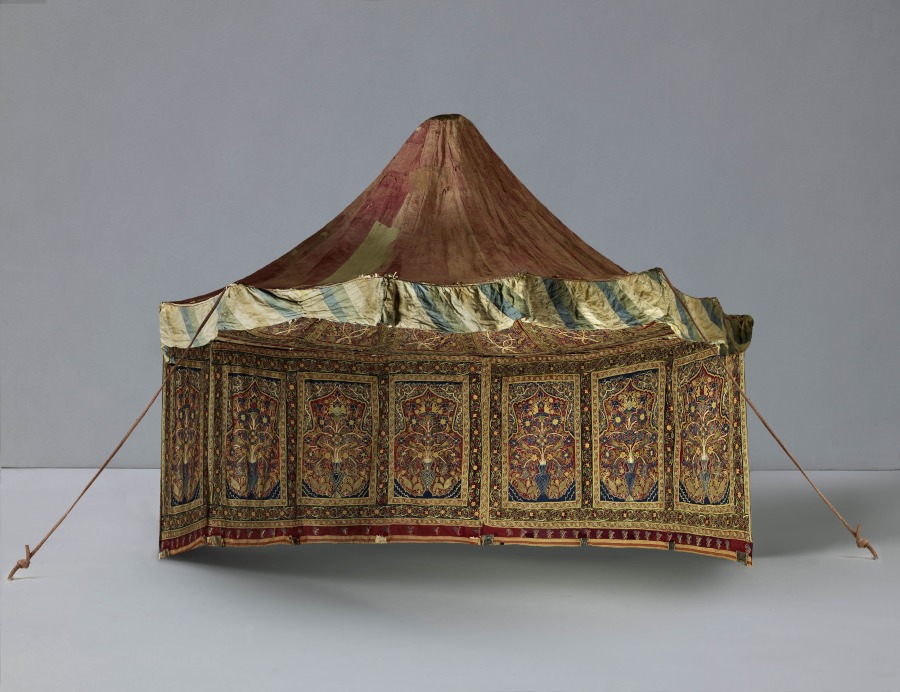
The whole tent in the museum's primary photograph: the conical roof with its striped valance and the seven surviving wall panels standing as a half circle, with the guy ropes. Museum's cover record, 360 by 400 cm, CC0.
| Artist | Royal workshop, Rasht (master named Fath 'Ali on the tent) |
|---|---|
| Date | 1834-48 |
| Medium | Interior: wool plain weave, inlaid work; silk embroidery in chain stitch; tape, leather. Exterior: cotton and wool plain weave; rope; iron ring. |
| Dimensions | 360 x 400 x 400.1 cm overall (141 3/4 x 157 1/2 x 157 1/2 in.) |
| Where it is now | The Cleveland Museum of Art, Cleveland, Ohio; not on view at the time of checkinglast confirmed |
| Inventory number | 2014.388 (cover record, Open Access id 171606) with components 2014.388.1-.4 (ids 171607-171610) |
| Attribution | AcceptedThe owner is named by an embroidered inscription (Muhammad shah sultan-e ghazi) and the museum dates the tent to his reign, 1834-48, and places it in Rasht. Full note |
| Object type | Textile |
| Period | Qajar, reign of Muhammad Shah (1834-48) |
| Cases | Has a provenance gap |
| Inscriptions | Two embroidered inscriptions in the central design unit of wall panels 2014.388.2 and 2014.388.4: upper, at the centre of the top blossom, 'Muhammad shah sultan-e ghazi' (Muhammad Shah, Warrior Sultan); lower, on the base of the vase, 'Kamtarin bandeh-ye dargah Fath'ali' (The lowliest slave of the court, Fath 'Ali). |
| Owners on record | 7 links6 documented, 1 unknown |
| Sources | 16 cited |
About this record Last verified · 16 sources cited · Change log
On this page 11 sections
ContentsClose
A round royal tent of inlaid wool and silk chain-stitch embroidery, 360 cm high and about 400 cm across, made in Rasht for Muhammad Shah Qajar between 1834 and 1848. Its complete ceiling and seven of its fourteen wall panels survive, and two panels carry inscriptions naming the shah and a humble court servant called Fath 'Ali. It is held by the Cleveland Museum of Art as 2014.388, with four catalogued components.
The documented trail begins with Mehdi Mahboubian in the early 1980s, runs through lot 12 of Sotheby's London sale of 24 April 1991 (shared with a second Qajar tent), a private collection and the London dealer Francesca Galloway Ltd, and ends with a Cleveland purchase from the J. H. Wade Fund in 2014. The century and a half before Mahboubian is a recorded gap, and no price is published for any sale.
The museum showed it in 2015-16 on a metal armature built for the purpose, because the original supports are lost. Other Qajar tent panels in London, Cleveland and Saint Louis are kept here as comparanda and are not merged with it.
Provenance
Each link is graded. Documented: a cited source supports it. Disputed: the identification is argued but not established. Unknown: no owner for that span, and the gap is not smoothed into a narrative. The grades in the glossary.
- 1834 - 1848Muhammad Shah Qajar (reigned 1834-48), for whom the tent was madedocumented
Two embroidered inscriptions on panels 2014.388.2 and 2014.388.4 name Muhammad Shah, warrior sultan. The museum dates the tent 1834-48 on that basis. No commission document, receipt or date within the reign is cited, and the occasion for the order is unknown.213
- 1848 - by early 1980sUnknownunknown
Nothing consulted says who owned the tent, where it was kept or how and when it left the royal household and Iran. The record does not bridge this gap.2
- by early 1980s - 1991Mehdi Mahboubian (1921-2005), Oxfordshire, United Kingdomdocumented
The museum's provenance dates his ownership 'by early 1980s-1991?', with its own question mark. The museum's record gives his life dates; nothing else about him is in any source consulted. The source for the early 1980s start is not given.2
- 24 April 1991 - 24 April 1991Sotheby's, London, European and Oriental Rugs, Carpets and Textiles, lot 12documented
One lot for two Qajar tents, the round Cleveland tent and a somewhat earlier rectangular tent, according to the museum's footnote. Reproduced in the catalogue on pages 12-13 and in HALI 59 (October 1991). Whether the lot sold, the buyer, the estimate and the price are not in any source consulted.213
- after 1991 - before 2014A private collection, not named, which consigned the tent to Francesca Galloway Ltddocumented
The museum names the collection only as private. Whether it was the 1991 buyer is not stated.2
- before 2014 - 2014Francesca Galloway Ltd, Londondocumented
The museum's provenance names the firm as the seller to the museum. A public radio report quotes the curator saying she found the tent by chance while telephoning a London dealer about nineteenth-century Persian textiles; the dealer is not named there, so the link to this firm is an inference. The price is not published.27
- 2014 - presentThe Cleveland Museum of Art, Cleveland, Ohiodocumented
Purchase from the J. H. Wade Fund; accession 2014.388, accession date 1 December 2014 in the museum's data; announced 21 April 2015. Collection page lists it as not on view.123
Prices realised
| Date | Sale | Estimate | Result | Note |
|---|---|---|---|---|
| 24 April 1991 | Sotheby's, London | Not published in any source consulted | Hammer Not published in any source consulted With premium Not published in any source consulted Not stated; the sale was in London | Lot 12 covered two Qajar tents together, the round Cleveland tent and a somewhat earlier rectangular tent, so any price would not be for this tent alone. Whether the lot sold is not recorded in the sources consulted. The sale catalogue and HALI 59 are cited by the museum but were not read. |
Hammer is the price at which the bidding stopped; with premium adds the fee the house charges the buyer on top. Hammer price and buyer's premium in the glossary.
Technical evidence
| Attribution note | The owner is named by an embroidered inscription (Muhammad shah sultan-e ghazi) and the museum dates the tent to his reign, 1834-48, and places it in Rasht. The maker is not named in the usual sense: a second inscription, 'Kamtarin bandeh-ye dargah Fath'ali', which the museum translates as the lowliest slave of the court, Fath 'Ali, is read by the museum as a master artisan's humble signature and an indication that he had worked in the workshop of Fath 'Ali Shah. The curator's printed account says only that the name may identify the master court artist. |
|---|---|
| Object | Royal round tent, cover record 2014.388 with components .1 (roof), .2 and .4 (wall panels of three design units) and .3 (wall panel of one design unit).2 |
| Date | 1834-48, the reign of Muhammad Shah; the date within the reign is not recorded.12 |
| Place | Rasht, Iran, Qajar period (1779-1925), as catalogued by the museum.12 |
| Overall size | 360 by 400 by 400.1 cm (141 3/4 by 157 1/2 by 157 1/2 in.); the press release gives 360 cm high and 400 cm in diameter.23 |
| Component sizes | Wall panel .2: 172.1 by 309.2 cm. Wall panel .3: 166.1 by 119.4 cm. Wall panel .4: 167.6 by 286.4 cm. Roof .1: 360 by 400 by 400.1 cm.2 |
| Interior | Wool plain weave with inlaid work, silk chain-stitch embroidery, tape and leather.12 |
| Exterior and fittings | Cotton and wool plain weave, rope, iron ring; red plain cotton in the museum's descriptions; striped valance.145 |
| Structure | Fourteen radial roof panels with concealed radial straps; leather patches with iron rings for guy ropes; wooden struts between wall niches; walls joined to the ceiling by a looped cord. The centre pole is modern.5 |
| Surviving elements | Complete ceiling and seven of fourteen original wall panels.345 |
| Inscriptions | Two embroidered inscriptions in the central design unit of panels .2 and .4: 'Muhammad shah sultan-e ghazi' and 'Kamtarin bandeh-ye dargah Fath'ali'.2 |
| Present mount | Metal cantilevered armature built by the museum to support the roof edges and suspend the walls.57 |
| Storage | Walls rolled on padded archival tubes in undyed cotton muslin; roof in a sealed wooden box 79 by 310 by 157 cm with the armature.2 |
| Licence of the images | CC0 for the cover record and each component in the museum's open access data.2 |
Images
The record in full
Chapter 1A round tent for one shah, with his name embroidered in two of its panels
The Cleveland Museum of Art catalogues the object as a royal round tent made for Muhammad Shah, who ruled Iran from 1834 to 1848 in the Qajar dynasty.
The Cleveland Museum of Art catalogues the object as a royal round tent made for Muhammad Shah, who ruled Iran from 1834 to 1848 in the Qajar dynasty. It is 360 centimetres high and about 400 centimetres across. The interior is wool cloth inlaid with coloured wool and worked in silk chain stitch; the exterior is cotton and wool plain weave with rope and an iron ring. The museum's catalogue culture line reads Iran, Rasht, Qajar period (1779-1925).
Three facts set it apart from almost everything else in the textile record. It keeps its complete ceiling. It keeps seven of its original fourteen wall panels, which stand as a half circle a visitor can walk into. And two of those wall panels carry embroidered inscriptions, one naming the owner and one naming a person who calls himself the lowliest slave of the court. Very few Iranian royal tents are known at all. The museum's own catalogue text says royal tents from Iran are extremely rare, and the museum's director called the purchase a prize acquisition.
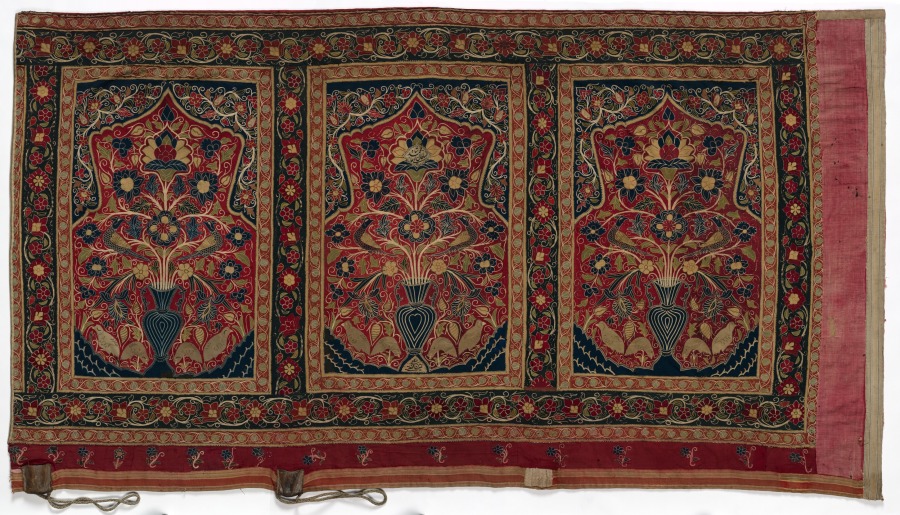
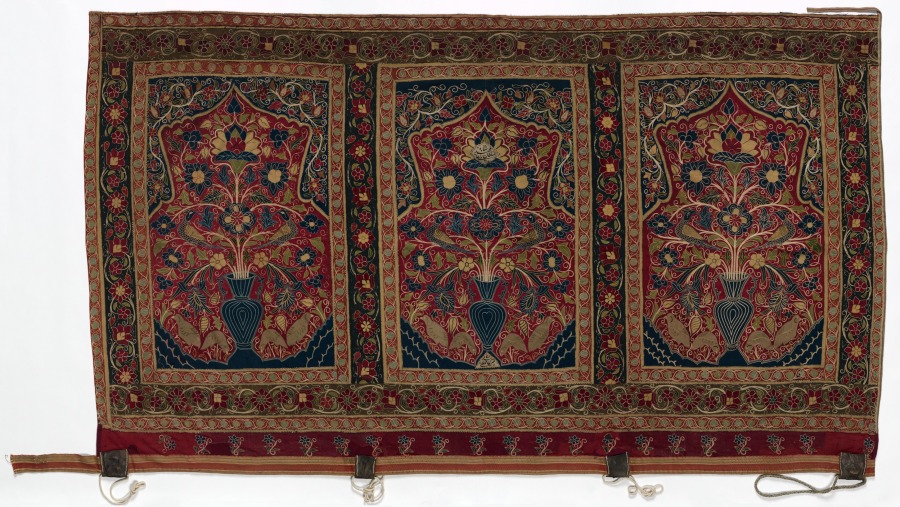
The accession is 2014.388. The tent is catalogued as a cover record with four components: 2014.388.1 is the roof, 2014.388.2 and 2014.388.4 are wall panels with three design units each, and 2014.388.3 is a wall panel with one design unit. Adding the design units of the three panels gives seven, the number the museum counts. That sum is this record's arithmetic from the catalogue titles, not a figure the museum prints.
Chapter 2What it is physically: roof, walls and the frame that is no longer there
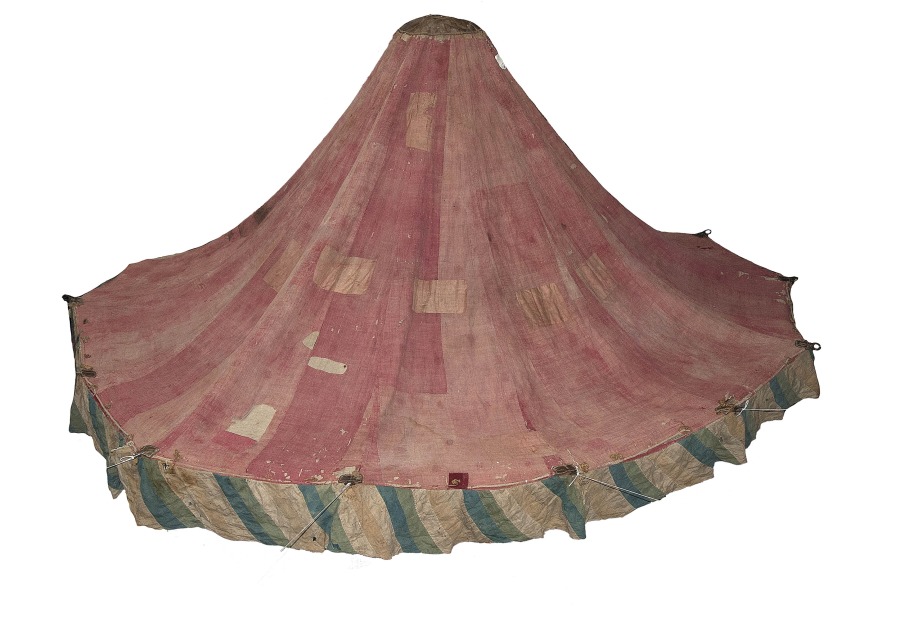
The roof is a cone built from fourteen radial panels, each with the same pair of birds beside the base of a blossoming branch.
The roof is a cone built from fourteen radial panels, each with the same pair of birds beside the base of a blossoming branch. The curator's account says the roof is held by fourteen radial straps hidden in the ceiling, that leather patches with iron rings carry the guy ropes, and that wooden struts run between the niches of the wall panels and a cord with loops that once joined the walls to the ceiling, a fastening she compares to an early zipper. A scrolling floral vine frames every wall and ceiling panel.
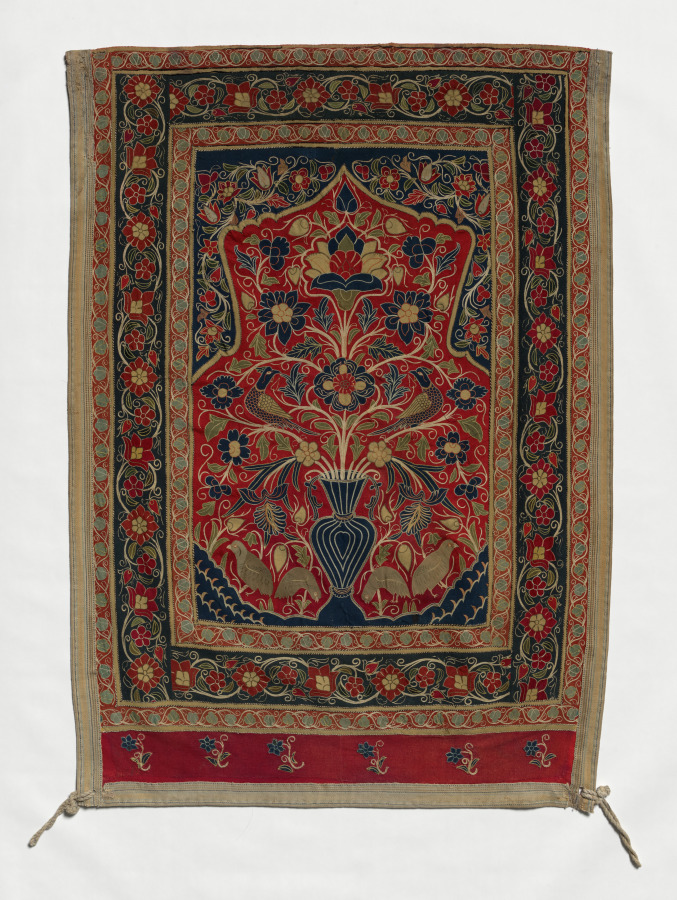
The wall panels are the famous part. Each has one large vase of flowers set between two birds on a rocky mound, under a niche the curator says suggests an architectural arcade. In the museum's photograph the seven panels form a continuous band of red, blue, green and yellow rectangles on a dark ground. The birds are identified in the curator's account as possibly see-see partridges and black francolins; the word is hers and the identification is tentative.
The outside is deliberately plain. The museum describes a plain cotton exterior, red in the press and exhibition texts, with a striped valance; the museum's photograph of the roof shows a faded rose-pink cloth with several visible patches and a blue and cream striped skirt. Whether the patches are period repairs is not stated in any source consulted.
What the tent no longer has is its own pole and framing. The curator's account says the centre pole is now modern. A public radio report quoted the museum's account that the original wooden supports were gone and that the museum built a metal cantilevered framework with cables and guy lines hidden from view. The museum says the tent has had little conservation treatment.
Chapter 3How it was made: inlay, punching and chain stitch
Cleveland's account of this tent is short.
Cleveland's account of this tent is short. Motifs such as vases, birds and blossoms were cut from coloured wool cloth and inlaid in the wool ground cloth, held by a few stitches so that the surface is smooth. The joins were then covered by silk thread in chain stitch, which also forms the branches, vines and details. The curator says it was made by professional craftsmen in a royal workshop in Rasht, on the Caspian Sea, in a technique recorded in the 1670s and used in Asia but seemingly not in Europe.
The museum's page for a different Cleveland panel, 1916.1297, gives the general method of Rasht work and is used here only for that. It begins with a felted plain weave wool ground; desired shapes are punched out with a metal die and hammer; and the museum says that generally Rasht work was made by men, with boys doing the delicate embroidery and older men designing the cartoons and punching the wool. That is a general description, not a statement about who made this tent, and 1916.1297 is a separate object, catalogued with a question mark as a possible tent wall panel.
The Victoria and Albert Museum's record for tent panel 858-1892, also a different object, describes felted wool patchwork with Resht work and inlaid work embroidered with silk mainly in chain stitch, and dates it 1830-1850. It says the panel is pieced and embroidered over its seams. A general encyclopaedia article on Rasht embroidery, a tertiary source, adds that designs are transferred with powdered chalk and that the chain stitch is worked with a metal hook; no museum source consulted says that was done on this tent.
Chapter 4The inscriptions: a name for the owner and a humble name for the maker
The museum's catalogue transcribes two embroidered inscriptions in the central design unit of panels 2014.388.2 and 2014.388.4.
The museum's catalogue transcribes two embroidered inscriptions in the central design unit of panels 2014.388.2 and 2014.388.4. The upper one, at the centre of the top blossom, reads Muhammad shah sultan-e ghazi and is translated Muhammad Shah, Warrior Sultan. The museum notes that it shows the tent was made for Muhammad Shah, who reigned 1834-1848. The lower one, on the base of the vase, reads Kamtarin bandeh-ye dargah Fath'ali and is translated by the museum as The lowliest slave of the court, Fath 'Ali.
The museum reads the second inscription as a master artisan's customary humble self-description, and infers that the artisan had worked in the workshop of Fath 'Ali Shah (reigned 1797-1837), Muhammad Shah's father. The curator's own printed account is more careful: a second inscription with the name Fath 'Ali may identify the master court artist. These are two different positions. One reads the name as that of an artisan trained in the late shah's workshop; the other says only that the name may be the master's. Neither source says what was inscribed on any of the other panels, and no source consulted gives the inscriptions' script or style in detail.
There is a small discrepancy to record. The members' magazine text says the centre pole bears the name of Muhammad Shah, while the same text says the pole is modern and the museum's catalogue places the inscriptions on the wall panels. HALI, reporting the installation, says two wall panels carry inscribed cartouches. The catalogue is the controlling source, and the pole phrase is treated here as a slip in the magazine text.
The shah's name is in the form sultan-e ghazi, translated by the museum as warrior sultan. No source consulted connects that title to a particular campaign or date, and none should be assumed.
Chapter 5Muhammad Shah, the man the tent was made for
A general encyclopaedia source (tertiary, to be replaced by Encyclopaedia Iranica, which blocked automated access) gives these outlines.
A general encyclopaedia source (tertiary, to be replaced by Encyclopaedia Iranica, which blocked automated access) gives these outlines. Muhammad Mirza was born in Tabriz on 5 January 1808, the eldest son of Crown Prince Abbas Mirza. His grandfather Fath 'Ali Shah died in October 1834 and he was crowned on 14 January 1835 after rival princes were defeated; his reign is dated from 23 October 1834, and the article gives his death as 4 or 5 September 1848 in different places. His first minister Qa'em-Maqam was arrested and executed in 1835 and replaced by Haji Mirza Aqasi, who held the post for most of the reign. He besieged Herat in 1837-38 and withdrew after British pressure and a failed assault.
The same source says he was devoted to Sufism, was a skilled calligrapher and painter who learned from the Scottish artist Robert Ker Porter, and had lithographic presses set up in Tehran, Urmia, Tabriz and Isfahan. None of those facts is tied to this tent by any source. They tell us only the kind of court that would have owned it. The museum says a portrait of the shah and a video on the royal family and court life were shown with the tent, and the portrait is recorded in a visitor's question in the museum's own magazine, which asked what its inscriptions said.
The tent's own evidence about him is thin and exact: his name and a warrior title, embroidered in wool and silk. Nothing consulted says on what occasion it was ordered, whether for the Herat campaign or for a garden, or whether it was ever pitched in his lifetime.
Chapter 6What a tent like this was for
The museum's text places royal tents inside a long Middle Eastern tradition: rulers owned thousands of tents; they gave shelter and shade and served essential functions in tent compounds for imperial...
The museum's text places royal tents inside a long Middle Eastern tradition: rulers owned thousands of tents; they gave shelter and shade and served essential functions in tent compounds for imperial ceremonies, travel and military campaigns; the largest could be as large as castles; and they were often given as imperial gifts. It cites Harun al-Rashid's 4,000 ceremonial tents in Baghdad in 809 and the Fatimid tent storeroom in Cairo in 1068-69, and says that before 1600 tents are known only from documents.
For this particular tent the curator's judgement, quoted by a public radio station, is that the shah likely used it for entertaining guests, as a pleasure tent in a garden. She also says it continues the tradition shown in Persian paintings of pleasure tents in garden settings 300 years earlier, with decorated interior walls and ceiling, a plain cotton exterior and a striped exterior valance. Both statements are her reading of its form and are phrased as likelihood; no source records the tent in use.
Ottoman tents, the museum notes, survive in Istanbul and in European collections largely as war booty from the 1683 attempt on Vienna, and they are appliqued, not worked in the Rasht technique. That contrast is the museum's.
Chapter 7The decorative programme: what the sources say and what they do not
The only programme the sources describe is visible: a vase of blossoms between birds under an arcade-like niche, framed by a scrolling vine, repeated on seven wall panels, with birds among entwined...
The only programme the sources describe is visible: a vase of blossoms between birds under an arcade-like niche, framed by a scrolling vine, repeated on seven wall panels, with birds among entwined branches on the roof. The curator compares the arrangement to garden pleasure tents in earlier Persian painting. The museum says the radiant interior features exuberant flora, blossoming vines and robust birds.
No source consulted assigns a symbolic meaning to the birds, the vase or the niche on this tent, names a text or poem the scheme draws on, or records a patron's instruction. Another Cleveland panel, 1916.1297, has a mihrab-shaped niche with a cypress above peacocks and dragon heads, but that is a different object and its niche is not evidence for this one. The absence of a documented hidden programme is a finding. What is documented is the tent's function as a sign of royal power, the sovereign's name placed in the middle of the garden scheme, and the humble name placed beneath it.
Chapter 8From the court to a London dealer: the provenance and its gaps
The museum's provenance has five lines. Mehdi Mahboubian (1921-2005) of Oxfordshire, dated by early 1980s to 1991 with a question mark in the museum's own record.
The museum's provenance has five lines. Mehdi Mahboubian (1921-2005) of Oxfordshire, dated by early 1980s to 1991 with a question mark in the museum's own record. The Sotheby's London sale of 24 April 1991, lot 12. A private collection, after 1991, which consigned the tent to Francesca Galloway Ltd. Francesca Galloway Ltd of London, which sold it to the museum. The museum, from 2014.
Everything before Mahboubian is a gap. Nothing consulted says when, why or by what route the tent left Iran or the royal household between 1848 and the 1980s; no export document, inventory or earlier sale is cited. Cleveland's provenance runs for about a century and a half from 1834-48 to the early 1980s with no owner named, and the way the record is written does not claim otherwise.
On the dealer's side, a public radio report quotes the curator saying that she found the tent by chance while telephoning a London dealer about nineteenth-century Persian textiles, and that it was not on her wish list. The report does not name the dealer. The museum's provenance names Francesca Galloway as the seller, so the two are probably the same event, but no source consulted says so in terms and the link is recorded here as an inference.
Chapter 9The 1991 Sotheby's lot and the problem of two tents
The museum's provenance footnote says that Sotheby's lot 12 was one lot for two Qajar tents, the round Cleveland tent and a somewhat earlier rectangular tent.
The museum's provenance footnote says that Sotheby's lot 12 was one lot for two Qajar tents, the round Cleveland tent and a somewhat earlier rectangular tent. The Cleveland bibliography lists the Sotheby's catalogue for European and Oriental Rugs, Carpets and Textiles, 24 April 1991, with the tent reproduced on pages 12 and 13, and a HALI issue of October 1991 (no. 59, pp. 118-123) carrying articles titled The Shahs' Tents by Toby Falk, Rasht Textiles by Jennifer Wearden and A Qajar Masterpiece by Ian Bennet, in which the tent is mentioned and reproduced.
Neither the catalogue nor the magazine was available to read, so this record carries no estimate, hammer price, premium or buyer for the sale and cannot say whether the lot sold on the day. No source consulted states a currency or a figure. The museum's provenance is silent on the buyer, and describes the next owner only as a private collection.
The V&A's record for panel 858-1892 mentions that a similar panel appears in an early nineteenth-century tent sold at Sotheby's in April 1991, now in a private collection. The Cleveland footnote says the other tent in the lot was somewhat earlier and rectangular. These two statements probably refer to the same rectangular tent, but neither source says so. That tent is not this object, and nothing about it should be read into this record.
Chapter 10Purchase, acquisition and the museum's announcement
The Cleveland Museum of Art acquired the tent by purchase from the J.
The Cleveland Museum of Art acquired the tent by purchase from the J. H. Wade Fund. The accession date in the museum's data is 1 December 2014 and the accession number is 2014.388. The museum's press release is dated 21 April 2015. It describes the purchase as a prize acquisition and gives the museum director's name, William M. Griswold, as the speaker. No price is published in the press release, in the museum's record, or in any other source consulted, and the seller is named only in the museum's provenance. The credit line appears as the J. H. Wade Fund in the museum's catalogue and as the J. H. Wade Trust Fund in the press release.
The tent's first public display opened in July 2015 in the Arlene M. and Arthur S. Holden Textile Gallery, gallery 234. The dates are given differently by the museum's own texts: the press release says 17 July 2015 to 26 June 2016, the museum's exhibition page gives 19 July 2015 to 21 August 2016, and the catalogue's exhibition record gives 13 July 2015 to 23 August 2016, while the members' magazine and HALI both say it was on view until 26 June 2016. The exhibition was titled Muhammad Shah's Royal Persian Tent. A talk, Pitching the Royal Tent, was held on 19 March 2016 with the curator Louise W. Mackie, the scholar Layla Diba and the staff who prepared the installation. As of this record's check, the museum's collection page lists the tent as not on view.
This is a purchase, not a tax transaction, so no tax relief or dation figure applies. No export licence procedure is documented in any source consulted, and the record does not infer one.
Chapter 11Condition, storage and what happened after the show
The museum's conservation text says that when the tent was deinstalled it was vacuumed front and back and stored.
The museum's conservation text says that when the tent was deinstalled it was vacuumed front and back and stored. The wall panels were rolled on separate padded archival tubes and covered in undyed cotton muslin. The roof is stored in a sealed wooden box 79 by 310 by 157 centimetres, built by the museum's cabinetmakers, which also holds the metal armature used to erect the tent; the boss at the roof's apex is supported at one end of the box, and specialised lift equipment is needed to move it. The text gives the deinstallation year as 2015, but the exhibition ran into 2016 on every date given above. The year is either a slip in the museum's text or refers to a different deinstallation; the record does not choose.
Moth damage is mentioned in the museum's page for a different Cleveland panel, 1916.1297, and is not stated for this tent. The public radio report says only that the tent has had little conservation treatment and that light levels are kept low in the gallery. No condition report, fibre analysis, dye analysis or radiocarbon date for the tent is published in any source consulted.
Chapter 12Comparanda: other Iranian tents and panels, kept separate
These are comparanda and are not part of this object.
These are comparanda and are not part of this object. The V&A holds tent panel 858-1892, a fragment 63.5 by 43 centimetres dated 1830-1850 from Rasht, bought in 1892 from Howell and James of Regent Street for 1 pound 2 shillings and 6 pence; its museum number 787-1899 is probably the top part of the same panel. The Cleveland Museum has the separate panel 1916.1297, a gift of Mr and Mrs J. H. Wade, catalogued as a possible tent wall panel of the 1800s. The curator told a public radio station that the only other known example in the United States is in the Saint Louis Art Museum and that none is known in Europe; the museum's members' magazine calls this the only known imperial Persian tent. The collection search for the Saint Louis Art Museum shows two late nineteenth-century Rasht pavilion tents, a rectangular one in wool, cotton, silk and leather and an octagonal one in silk, cotton and metallic yarns, both a gift of James F. Ballard. Those pages blocked automated reading, so only the search result lines are cited and nothing more is claimed about them.
A reviewer of the museum's 2015 book on luxury textiles from Islamic lands mentions, in the chapter on Iran and Central Asia, a nineteenth-century tent in the State Hermitage Museum, without calling it Qajar. It is noted only so that it is not confused with this tent. No source consulted lists the royal tents of the Golestan Palace or other Iranian palace holdings, and the record does not use any fact about them.
Chapter 13Where the tent has been published
The museum's bibliography for the tent lists the 1991 HALI feature and Sotheby's catalogue already described; Patricia L.
The museum's bibliography for the tent lists the 1991 HALI feature and Sotheby's catalogue already described; Patricia L. Baker, Islamic Textiles, 1995, pp. 138-139; Nurhan Atasoy, Otag-i Humayun: Ottoman imperial tent complex, Istanbul, 2000; Louise W. Mackie, Symbols of Power: Luxury Textiles from Islamic Lands, 7th-21st Century, Cleveland and New Haven, 2015, where it is reproduced on pages 8 and 392-393 (figure 9.55) and mentioned on pages 226, 391, 392 and 395; HALI 185 (Autumn 2015), pages 94-95; the museum's Museum Masters 2016-17 companion guide; Mackie's Acquisitions 2015 in the March/April 2016 members' magazine, pages 20-21; and William M. Griswold, Recent Acquisitions (2013-20) at the Cleveland Museum of Art, Burlington Magazine 163, no. 1414 (January 2021), pages 93-104, number 21 on pages 102-103. Of these only the members' magazine and the news items were read for this record.
The museum offers an Internet Archive entry for the tent and a Wikidata item, Q80082250, in its open access record, and publishes images of the cover record and each component under a CC0 licence.
The artist
Muhammad Shah Qajar (patron) and the Rasht royal workshop
The tent is a royal commission with no named maker beyond one embroidered phrase, so this dossier treats the patron, the Rasht workshop tradition and the inscription together. The patron is Muhammad Shah Qajar. The workshop is known only as a type: a wool inlay and silk chain-stitch technique named for Rasht on the Caspian coast, with royal workshops according to the curator. The one personal name on the tent is Fath 'Ali, written as the lowliest slave of the court.
Exhibited
- Muhammad Shah's Royal Persian TentCleveland Museum of Art, Arlene M. and Arthur S. Holden Textile Gallery (234)
Related works
| Work | Relation | Where it is |
|---|---|---|
| Tent panel, 858-1892 Unknown | Comparandum: Qajar Rasht tent panel, 1830-1850 63.5 by 43 cm, felted wool with Resht work and inlay, silk chain stitch and couched silver thread. Bought in 1892 from Howell and James for 1 pound 2 shillings and 6 pence. Museum number 787-1899 is probably its top part. Not part of this object. | Victoria and Albert Museum, London |
| Tent Wall Panel(?) Unknown | Comparandum in the same museum: a separate Rasht panel 194.9 by 132.7 cm, 1800s, gift of Mr and Mrs J. H. Wade. A query marks the tent-panel identification. Source of the museum's general description of Rasht work. Not part of this object. | Cleveland Museum of Art, 1916.1297 |
| Small Rectangular Pavilion Tent Unknown | Comparandum: Rasht pavilion tent, late nineteenth century Known only from a search-result line: wool, cotton, silk and leather. The page blocked automated reading. Not part of this object. | Saint Louis Art Museum, 33044 (Ballard gift) |
| Small Octagonal Pavilion Tent Unknown | Comparandum: Qajar Rasht pavilion tent, late nineteenth century Known only from a search-result line: silk, cotton and metallic yarns. Not part of this object. | Saint Louis Art Museum, 132:1929a,b (Ballard gift) |
| Rectangular Qajar tent in the same 1991 Sotheby's lot Unknown | Companion in lot 12, 24 April 1991; a somewhat earlier rectangular Qajar tent Named only in the museum's provenance footnote. Whether it is the tent the V&A record says was sold at Sotheby's in April 1991 and is now private is not stated. | Not traced |
Open questions
- Where was the tent between the death of Muhammad Shah in 1848 and Mehdi Mahboubian's ownership by the early 1980s, and what route took it out of Iran? No source consulted records an owner, a sale or an export.
- What did Sotheby's lot 12 of 24 April 1991 make, did it sell, who bought it, and is the private collection that later consigned the tent to Francesca Galloway the buyer? The 1991 catalogue and the HALI articles were not available to read.
- Is the name Fath 'Ali in the lower inscription the name of the master embroiderer himself, a reference to the workshop of Fath 'Ali Shah, or both? The museum's catalogue and the curator's printed account put it differently.
- Who were the maker, workshop and patron's agent in Rasht, and is there a document that dates the commission inside the reign of 1834-48? No contract, receipt or court record is cited.
- Which of the original fourteen wall panels are the seven missing ones, and did they survive separately? No source consulted says what happened to them.
- Is the rectangular Qajar tent that shared Sotheby's lot 12 the early nineteenth-century tent mentioned in the V&A's record, and where is it now?
- Does the Saint Louis Art Museum's rectangular Rasht pavilion tent come from the same workshop tradition, and are any of its panels inscribed? Its collection pages blocked automated reading.
Questions about this object
What is Royal Round Tent Made for Muhammad Shah?
Royal Round Tent Made for Muhammad Shah is a textile, dated 1834-48. Medium: Interior: wool plain weave, inlaid work; silk embroidery in chain stitch; tape, leather. Exterior: cotton and wool plain weave; rope; iron ring.
Who made Royal Round Tent Made for Muhammad Shah, and is the attribution settled?
The attribution to Royal workshop, Rasht (master named Fath 'Ali on the tent) is recorded here as accepted. The owner is named by an embroidered inscription (Muhammad shah sultan-e ghazi) and the museum dates the tent to his reign, 1834-48, and places it in Rasht. The maker is not named in the usual sense: a second inscription, 'Kamtarin bandeh-ye dargah Fath'ali', which the museum translates as the lowliest slave of the court, Fath 'Ali, is read by the museum as a master artisan's humble signature and an indication that he had worked in the workshop of Fath 'Ali Shah. The curator's printed account says only that the name may identify the master court artist.
Where is Royal Round Tent Made for Muhammad Shah now?
The Cleveland Museum of Art, Cleveland, Ohio; not on view at the time of checking. Inventory number 2014.388 (cover record, Open Access id 171606) with components 2014.388.1-.4 (ids 171607-171610). Last confirmed 20 November 2026. Purchase from the J. H. Wade Fund, accession date 1 December 2014 in the museum's data; seller Francesca Galloway Ltd, London. Location 'Not on view' from the museum's collection page.
What has Royal Round Tent Made for Muhammad Shah sold for?
Hammer Not published in any source consulted; with premium, Not published in any source consulted. Sotheby's, London, 24 April 1991.
What is still unknown about Royal Round Tent Made for Muhammad Shah?
Where was the tent between the death of Muhammad Shah in 1848 and Mehdi Mahboubian's ownership by the early 1980s, and what route took it out of Iran? No source consulted records an owner, a sale or an export.
Sources
- 1Cleveland Museum of Art, collection page for 2014.388, Royal Round Tent Made for Muhammad Shah (title, date, culture, medium, dimensions, credit line, description, location not on view). clevelandart.org/art/...
- 2Cleveland Museum of Art Open Access API, accession 2014.388 and components .1-.4 (object ids 171606-171610): provenance with footnote, inscriptions with translations and remarks, citations, exhibition record, conservation statement, accession date, CC0 flag, images. openaccess-api.clevelandart.org/api/...
- 3Cleveland Museum of Art, press release 'Cleveland Museum of Art Acquires Imperial Iranian Tent', 21 April 2015. clevelandart.org/about/...
- 4Cleveland Museum of Art, exhibition page 'Muhammad Shah's Royal Persian Tent'. clevelandart.org/exhibitions/...
- 5Louise W. Mackie, 'Royal Tent Made for Muhammad Shah', in 'Acquisitions 2015', Cleveland Art: Members Magazine 56, no. 2 (March/April 2016), pp. 20-21; full text via Internet Archive OCR. archive.org/details/...
- 6Bethany Corriveau, 'Pitching the Royal Tent', Cleveland Art: Members Magazine 56, no. 2 (March/April 2016), p. 42, and Ask an Expert note (same issue). archive.org/details/...
- 7Ideastream Public Media, 'Opening a tent flap for a unique view of Middle Eastern culture', 28 January 2016 (curator Louise Mackie quoted; fetched through the page summary). ideastream.org/news/...
- 8Daniel Shaffer, 'Qajar imperial tent in Cleveland', HALI news, 29 July 2015. hali.com/news/...
- 9Cleveland Museum of Art, collection page for 1916.1297, Tent Wall Panel(?) (a separate object; used for the museum's general description of Rasht work). clevelandart.org/art/...
- 10Victoria and Albert Museum, Tent Panel, museum number 858-1892 (a separate object; comparandum). collections.vam.ac.uk/item/...
- 11Wikipedia, 'Rasht embroidery' (; replace with Encyclopaedia Iranica 'Rasht' and Wulff, The Traditional Crafts of Persia, 1966). en.wikipedia.org/wiki/...
- 12Wikipedia, 'Mohammad Shah Qajar' (; Encyclopaedia Iranica entry, which returned ). en.wikipedia.org/wiki/...
- 13Cleveland bibliography for the tent (within source 2): Sotheby's London, European and Oriental Rugs, Carpets and Textiles, 24 April 1991, lot 12, pp. 12-13; HALI 59 (October 1991), pp. 118-123. Cited by the museum, not read directly. openaccess-api.clevelandart.org/api/...
- 14Saint Louis Art Museum collection search results for Rasht pavilion tents 33044 and 33047 (page text blocked with ; only the search result lines were seen). slam.org/collection/...
- 15Amanda Phillips, review of Mackie, Symbols of Power, West 86th, 21 March 2017 (mentions a nineteenth-century tent in the State Hermitage Museum, not identified as Qajar). west86th.bgc.bard.edu/bookreviews/...
- 16Leiden Textile Research Centre, entries 'Royal Tent of Muhammad Shah of Iran' and 'Qajar-Era Tent Panel from Iran' (page text bot-blocked; only search-result lines seen: size 360 by 400 cm, inlay typical of Rasht, V&A 858-1892 comparison). trc-leiden.nl/trc-needles/...
Last verified · Published
Change log
20 November 2026 - Record created at the house standard: researched narrative, technical evidence, maker dossier, graded provenance chain, prices with hammer and premium separated, related works, open questions and sources.