Covered Tureen on Stand (Pot-a-oille)
Juste-Aurele Meissonnier (designer), with the silversmiths Pierre-Francois Bonnestrenne and Henry Adnet · 1735-38 (Cleveland); executed 1734-36 according to the museum's 1978 press release
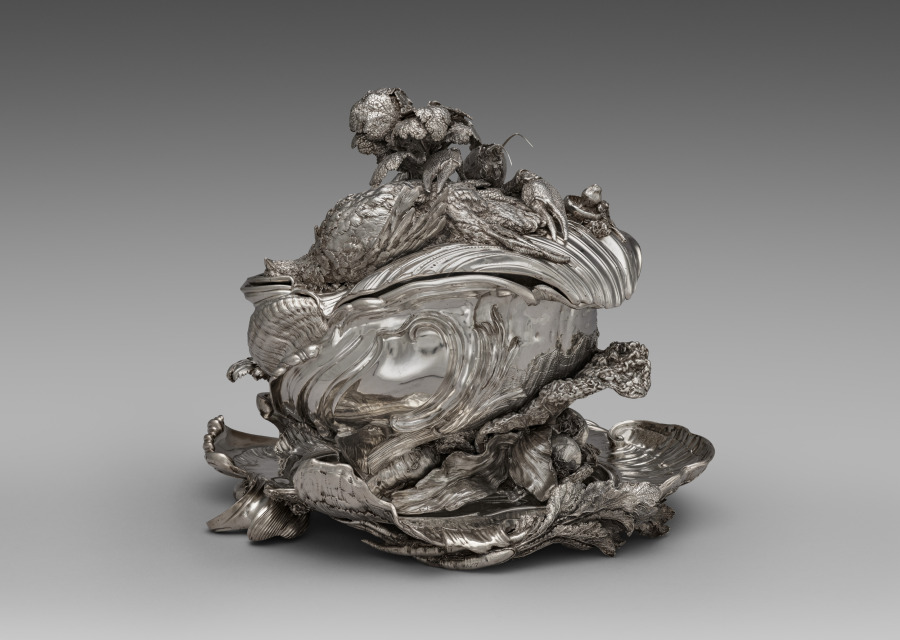
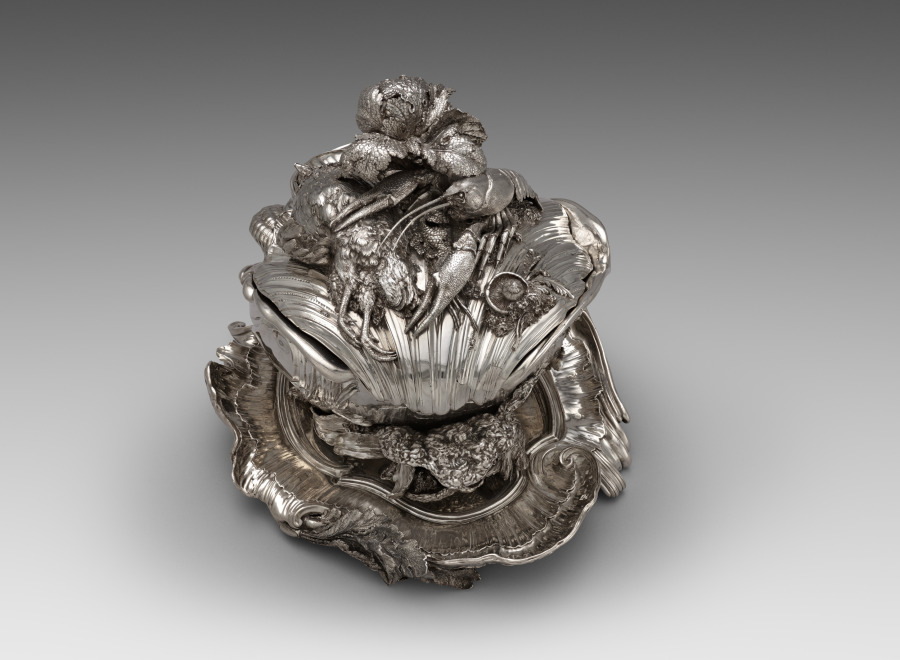
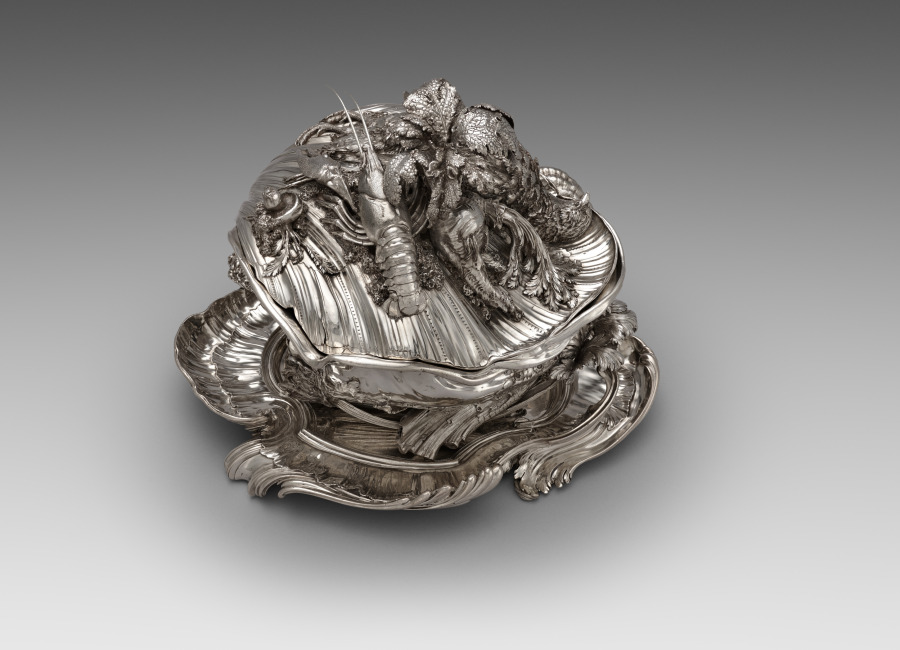
The tureen as the museum shows it: a shell-shaped body with a partridge, crayfish and foliage on the cover, resting on cast vegetables on an asymmetrical stand. Cleveland Open Access, CC0.
| Artist | Juste-Aurele Meissonnier (designer), with the silversmiths Pierre-Francois Bonnestrenne and Henry Adnet |
|---|---|
| Date | 1735-38 (Cleveland); executed 1734-36 according to the museum's 1978 press release |
| Medium | Silver, cast and chased |
| Dimensions | Height 37.1 cm, width 37.9 cm, length 45.1 cm (14 5/8 x 14 15/16 x 17 3/4 in); weight nearly 20 kg (nearly 44 lb) |
| Where it is now | The Cleveland Museum of Art, Cleveland, Ohio (010 Focus Gallery)last confirmed |
| Inventory number | 1977.182 |
| Attribution | AcceptedThe Cleveland Museum of Art credits Meissonnier as designer and the Paris master silversmiths Pierre-Francois Bonnestrenne (master 1714) and Henry Adnet (master 1712, died 1745) as makers, on the strength of the marks struck on the piece and an engraved signature on the stand reading FAIT-PAR-I-A-MEISSONIER-ARCHITECTTE. Full note |
| Object type | Silver |
| Period | French, Regence and Louis XV, Rococo |
| Cases | Seized, looted or confiscated · Has a provenance gap |
| Inscriptions | Engraved under the platter: FAIT-PAR-I-A-MEISSONIER-ARCHITECTTE, with an engraved weight and assembly numbers (A no 1 to A no 7); MEISSONIER on the tureen lip; Paris maker's marks of Bonnestrenne and Adnet; Paris warden, charge and discharge marks of 1734 to 1744; a possible London import mark of 1925. |
| Owners on record | 13 links7 documented, 4 disputed, 2 unknown |
| Sources | 12 cited |
About this record Last verified · 12 sources cited · Change log
On this page 10 sections
ContentsClose
One of a pair of silver tureens made in Paris in the 1730s for the English 2nd Duke of Kingston, designed by Juste-Aurele Meissonnier and struck with the marks of the silversmiths Bonnestrenne and Adnet. Its shell body, vegetable feet and cover of partridge and crayfish made it, for its museum, a defining object of the Rococo.
The recorded chain runs through the Duke's widow, Russian owners, Jacques Seligmann for J. Pierpont Morgan in 1909 and a London dealer in 1925-26, with fifty-one undocumented years before the pair came up at Christie's Geneva in November 1977. Cleveland bought jointly with the Thyssen-Bornemisza foundation, took its choice of the two and accessioned this one on 15 December 1977.
Several links are graded disputed because the museum's own press release and its later provenance entry disagree, and the other tureen has a separate and still unsettled history that this record keeps apart.
Provenance
Each link is graded. Documented: a cited source supports it. Disputed: the identification is argued but not established. Unknown: no owner for that span, and the gap is not smoothed into a narrative. The grades in the glossary.
- 1734 - 1737Commissioned in Paris by Evelyn Pierrepont, 2nd Duke of Kingstondocumented
Christie's and the 1978 press release say the pair was commissioned and made in Paris in 1734-36. The museum dates the object 1735-38. No contract has been cited.361
- 1740 - 1773Evelyn Pierrepont, 2nd Duke of Kingston (1711-1773), Englanddocumented
The museum lists the duke from 1740. The four years between the making and 1740 are not accounted for in the museum's entry.110
- 1773 - 1788Elizabeth Chudleigh, sometime Duchess of Kingston (1721-1788)documented
The duke left her his property on condition she remain a widow. The 1978 press release says she took most of his art collection to an estate near St Petersburg. A modern encyclopaedia places that estate in Estonia and reports her 1776 conviction for bigamy.139
- 1788 - before 1799Russian creditors, St Petersburg (press release only)disputed
The 1978 press release says her creditors seized the tureens at her death and sold them in St Petersburg. The museum's later entry shows no such step and no sale date.31
- c. 1788-99 - 1855Prince Alexander Bezborodko (1747-1799); Count Elie Bezborodko (1756-1815); Count Alexander Kushelev-Bezborodko (1800-1855)disputed
The museum marks all three links with a question mark. The 1978 press release names only Prince Bezborodko and says his heirs sold to Polovtzoff.13
- 1855 (?) - 1909Alexander Alexandrovich Polovtsoff (1832-1909), Russia, by descent to his heirsdisputed
The museum gives 1855 with a question mark. The press release describes Polovtzoff as Secretary of State under Alexander III and says his heirs sold the pair at auction in Paris in 1909.13
- 1909 - 1909Jacques Seligmann, Paris, for John Pierpont Morgandocumented
The museum and the press release agree on Seligmann in 1909 and Morgan as the buyer. The press release adds that it was a Paris auction and that Polovtzoff's children were the sellers. No price is given.13
- 1909 - 1913John Pierpont Morgan (1837-1913)documented
Morgan's end date is marked with a question mark by the museum.1
- 1913 - 1925Unknownunknown
Nothing recorded.1
- 1925 - 1926Charles and Richard Comyns, London, selling to an anonymous buyerdocumented
From the museum's provenance entry. The platter carries marks the museum reads as possibly the London import mark of 1925 and possibly that of the Comyns firm.12
- 1926 - 1977Anonymous buyer, then unknownunknown
The anonymous buyer is not identified and nothing is recorded for the 51 years to 1977.1
- 8 November 1977 - 1977Christie's, Geneva, bought jointly by the Cleveland Museum of Art and the Stichting Collectie Thyssen-Bornemiszadisputed
The press release says the pair was bought at public auction at Christie's, Geneva, on 8 November 1977, with Cleveland having first choice. The museum's provenance entry gives Peter Zervudachi, Galerie du Lac, Vevey, as the seller. The two statements are not reconciled in any source read.316
- 15 December 1977 - presentThe Cleveland Museum of Art, Cleveland, Ohiodocumented
Leonard C. Hanna Jr. Fund; accession 1977.182. Announced 4 January 1978.23
Prices realised
| Date | Sale | Estimate | Result | Note |
|---|---|---|---|---|
| 1909 | Auction in Paris, house not named in the source | Not stated | Hammer Not stated With premium Not stated Not stated | Per the 1978 press release, Polovtzoff's children sold the pair here to Jacques Seligmann, who bought for J. Pierpont Morgan. The museum's own provenance entry records only a sale by Seligmann to Morgan. |
| 8 November 1977 | Christie's, Geneva | Not stated | Hammer Not stated With premium Not stated CHF | Christie's 2026 announcement says the pair sold for CHF 2.79 million and broke the world auction record for silver. Whether that figure is the hammer or includes premium is not stated. It is the price of the pair, split between Cleveland and the Thyssen-Bornemisza foundation. A reader's comment on a Cooper Hewitt page gives figures for the sibling tureen's 1998 sale that no other source repeats. |
Hammer is the price at which the bidding stopped; with premium adds the fee the house charges the buyer on top. Hammer price and buyer's premium in the glossary.
Technical evidence
| Attribution note | The Cleveland Museum of Art credits Meissonnier as designer and the Paris master silversmiths Pierre-Francois Bonnestrenne (master 1714) and Henry Adnet (master 1712, died 1745) as makers, on the strength of the marks struck on the piece and an engraved signature on the stand reading FAIT-PAR-I-A-MEISSONIER-ARCHITECTTE. The design is also published in Meissonnier's Oeuvre, engraved by Gabriel Huquier. Who among the three held the chasing tools is not stated in the sources read. |
|---|---|
| Material | Silver. The museum's record gives no fineness or alloy standard.2 |
| Dimensions | Height 37.1 cm, width 37.9 cm, length 45.1 cm (14 5/8 x 14 15/16 x 17 3/4 in), as given by the museum's open-access data. The 1978 press release gives approximately 18 in long by 15 in wide.23 |
| Weight | Nearly 44 lb (20 kg), per the museum; an engraved weight of 673=5 on the platter is unexplained in the record.12 |
| Technique | Cast and chased. Cooper Hewitt says the pair was realised in solid silver by lost-wax casting. The museum says the crayfish, partridge and vegetables were cast from real examples.124 |
| Maker's marks | Pierre-Francois Bonnestrenne (beneath platter and twice inside tureen); Henry-Guillaume Adnet (inside cover).2 |
| Paris control marks | Warden's marks for 1734-35, 1735-36 and 1736-37; charge mark of Hubert Louvet (1732-38); discharge mark of Louis Robin (1738-44).2 |
| Later marks | A possible British import mark, London, 1925, and possibly the mark of Charles and Richard Comyns, both on the platter border. The museum records them as uncertain.2 |
| Signature | Engraved under the platter, FAIT-PAR-I-A-MEISSONIER-ARCHITECTTE; MEISSONNIER also on the tureen lip.2 |
| Assembly numbers | A no 1 to A no 7 engraved on the platter, tureen and cover to show how the parts fit.2 |
| Accession | 1977.182, Leonard C. Hanna Jr. Fund; accessioned 15 December 1977. Open access, CC0. The museum also publishes a 3D model of the object.2 |
Images
The record in full
Chapter 1A soup tureen that is also a manifesto of the Rococo
This is one half of a pair of silver tureens made in Paris in the 1730s for an English duke, designed by Juste-Aurele Meissonnier and now in Cleveland.
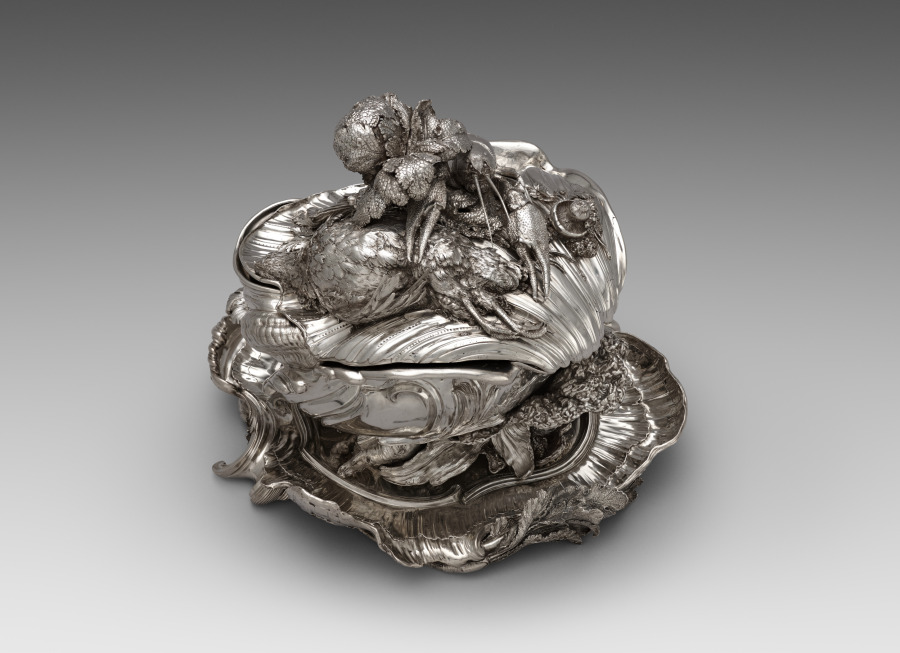
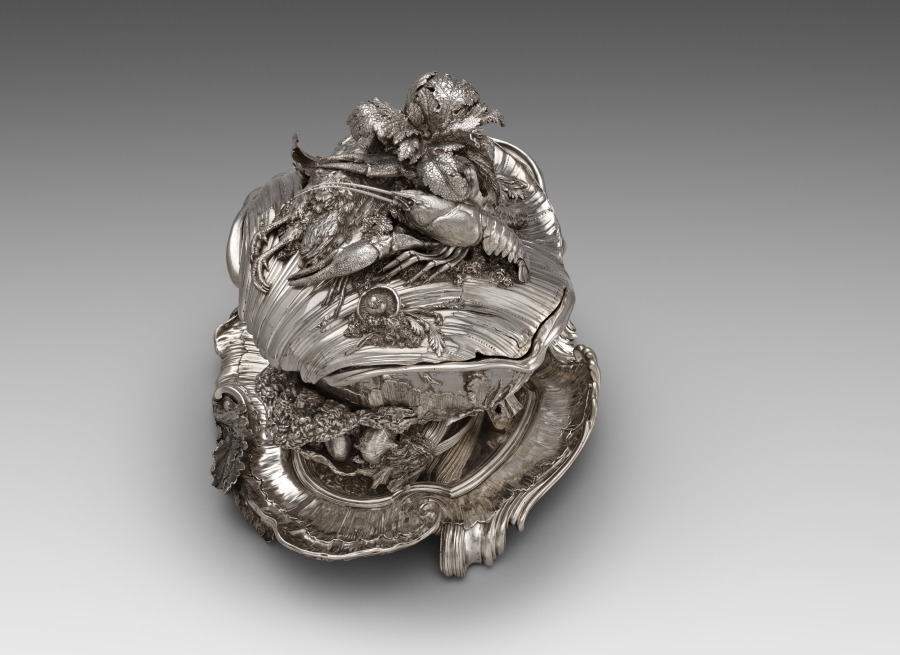
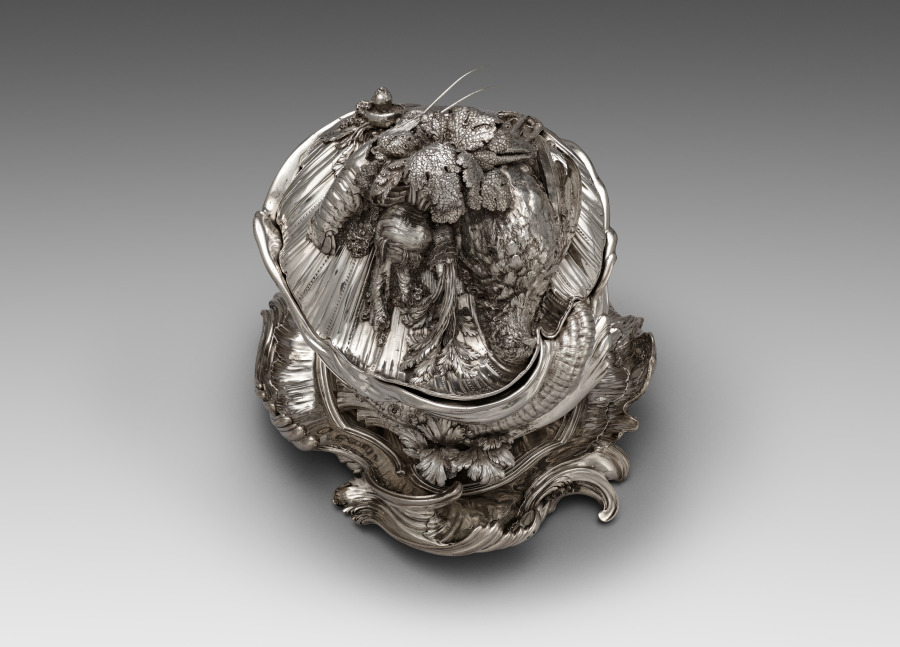
This is one half of a pair of silver tureens made in Paris in the 1730s for an English duke, designed by Juste-Aurele Meissonnier and now in Cleveland. The body is a great shell resting on cast bunches of celery, onions and carrots. On the cover a partridge, a crayfish and a mushroom lie among a spray of foliage. The stand beneath is asymmetrical, its upturned border chased into waves, scrolls and leaves.
The Cleveland Museum of Art calls the pair among the most celebrated surviving examples of eighteenth-century French silver and defining objects of the Rococo. Its director in 1978, Sherman E. Lee, went further in the press release announcing the purchase and called them the most important works in silver made in Europe since the Renaissance. That is a director's claim on the day of an acquisition, recorded here as his and not as settled fact.
Chapter 2What it is, physically
The museum gives the dimensions as 37.1 cm high, 37.9 cm wide and 45.1 cm long, and the weight as nearly 44 pounds (20 kilograms).
The museum gives the dimensions as 37.1 cm high, 37.9 cm wide and 45.1 cm long, and the weight as nearly 44 pounds (20 kilograms). The tureen has three parts: the shell-shaped body, a cover, and the stand or platter.
The cover is the part that tells the cook's story. Cleveland says the vegetables and animals on it refer to the ingredients of the stew, the oille, served from the vessel. Its curators add that the crayfish, partridge and vegetables were cast from real examples, which is why the silver copies look so lifelike. The sources disagree in small ways about the vegetable among the cover's ornaments: the 1978 press release names a parsnip and a Cooper Hewitt essay names a turnip. Both agree on the partridge, the crayfish and the mushroom.
Chapter 3The commission: an English duke in Paris
The patron was Evelyn Pierrepont, 2nd Duke of Kingston (1711-1773), who succeeded his grandfather in 1726 and then spent ten years on the Continent, according to the standard encyclopaedia summary of...
The patron was Evelyn Pierrepont, 2nd Duke of Kingston (1711-1773), who succeeded his grandfather in 1726 and then spent ten years on the Continent, according to the standard encyclopaedia summary of his life. Christie's, in its 2026 announcement of the other tureen, says the pair was commissioned in Paris in 1734-36. Cleveland's 1978 press release says the same span for the making, 1734 to 1736, and today the museum dates the object 1735-38. The dates differ because the commission, the casting and the hallmarking were separate events, and the hallmarks on the piece (see below) run from 1734-35 to a discharge mark of 1738 or later.
No contract, bill or letter between the duke and Meissonnier is cited in any source read for this record. What is known comes from the objects themselves, from Meissonnier's published engraving of the design and from the museum's research. Cooper Hewitt writes only that the duke likely commissioned the tureens after discovering the new Rococo style on his travels, which is an inference and is labelled as one there.
Chapter 4Three names on one object: the designer and the two silversmiths
Cleveland credits three men. Meissonnier designed it.
Cleveland credits three men. Meissonnier designed it. Pierre-Francois Bonnestrenne (master 1714) and Henry Adnet (master 1712, died 1745) are listed as makers, and the museum records the maker's mark of Bonnestrenne beneath the platter and twice inside the tureen, and the mark of Henry-Guillaume Adnet inside the cover. The museum's own wording is that Meissonnier collaborated with two master silversmiths but asserted his authorship through the inscription on the stand, reading in the museum's English: Made by J. A. Meissonnier, Architect.
That signature is the interesting thing. Meissonnier had been named goldsmith to the king, but he signed as an architect, and the museum reads this as ambition to rise above an artisan's background. The engraved French reads FAIT-PAR-I-A-MEISSONIER-ARCHITECTTE, with the doubled T copied exactly as transcribed by the museum. Whether the two silversmiths themselves made the cast pieces or sub-contracted founders is not documented in the sources read.
Chapter 5Marks: a record of Paris stamping across four years
The museum's transcription of the marks lists a warden's mark for Paris of 1734-1735 beneath the platter, inside the tureen and inside the cover, a second warden's mark for 1735-1736 beneath the...
The museum's transcription of the marks lists a warden's mark for Paris of 1734-1735 beneath the platter, inside the tureen and inside the cover, a second warden's mark for 1735-1736 beneath the tureen, and a third for 1736-1737 on the platter border. It lists the charge mark of Hubert Louvet (Paris, 1732-1738) on the platter border, beneath the platter, beneath the tureen and inside the cover, and the discharge mark of Louis Robin (Paris, 1738-1744) on the platter border, beneath the tureen and on the outside of the cover.
Read together, the marks show the parts passing through the Paris guild's assay at different times, with the last discharge stamps falling in or after 1738. That reading is the editor's inference from the museum's list and not a statement in the sources. It fits the museum's date of 1735-38 better than the single span of 1734-36 in the 1978 press release.
Two later marks are recorded as uncertain: a possible British import mark for London, 1925, on the platter border, and possibly the mark of the firm of Charles and Richard Comyns beside it. These tally with the museum's provenance entry for the firm in 1925-26 (see the chain) and are the only physical trace of the piece's time in England between the wars.
Chapter 6Assembly numbers, and how it was meant to be put together
The museum records numbers engraved on the parts to show how the piece should be assembled: A no 1 on the base of the tureen, beneath the cover and on the platter, A no 2 on the platter, A no 3 on...
The museum records numbers engraved on the parts to show how the piece should be assembled: A no 1 on the base of the tureen, beneath the cover and on the platter, A no 2 on the platter, A no 3 on the exterior rim of the tureen, A no 4 and A no 5 outside the cover, and A no 7 on the platter border. A no 3 and A no 2 on the tureen lip place the tureen correctly on the stand. The name MEISSONNIER is also engraved on the tureen lip.
An engraved weight, transcribed by the museum as 673=5, is also on the underside of the platter. The units are not explained in the record and no conversion is offered here.
Chapter 7The design in print: Huquier's engraving and the missing centrepiece
The design was published after Meissonnier's lifetime in the Oeuvre de Juste-Aurele Meissonnier, engraved by Gabriel Huquier.
The design was published after Meissonnier's lifetime in the Oeuvre de Juste-Aurele Meissonnier, engraved by Gabriel Huquier. The Cleveland tureen is the one illustrated on folio 72, according to the 1978 press release, which dates Huquier's publication 1742 to 1751. Cleveland's own print record, plate 115 of the Oeuvre, is titled as a silver sculptural project for a large centrepiece and two tureens executed for the Duke of Kingston, and dates the plate c. 1735-37. Cooper Hewitt, which holds another impression, dates the Oeuvre 1742-48 and says Huquier published it around 1748.
Cooper Hewitt adds that the two tureens in the print are mirror images, with different covers: a partridge, crayfish, mushroom and turnip on the first, and a duck, crab, fish, oysters, snails and an artichoke on the second. Christie's says the etching showed the two tureens flanking a centrepiece that was probably never made. So the print documents a grander scheme than the commission delivered, or at least than survives.
Chapter 8The first century and a half: from the Duke to J. P. Morgan
Cleveland's provenance entry gives the duke 1740 to 1773, then his wife Elizabeth Chudleigh, sometime Duchess of Kingston, from 1773 to 1788.
Cleveland's provenance entry gives the duke 1740 to 1773, then his wife Elizabeth Chudleigh, sometime Duchess of Kingston, from 1773 to 1788. The duke died on 23 September 1773. He left his property to Chudleigh on condition that she remain a widow, according to the encyclopaedia entry on her. In 1776 she was tried in Westminster Hall as a peeress for bigamy and found guilty by the peers, the same source says, and she then left England with her fortune. She bought properties in Estonia in 1777 and named the estate Chudleigh, and died in 1788 at Saint-Assise near Paris.
The 1978 press release gives a more dramatic account of what followed for the tureens. It says the widow took most of the duke's art to an estate near St Petersburg, that her Russian creditors seized the tureens at her death and sold them there, and that they next appear with Prince Bezborodko (1747-1799), Grand Chancellor of Russia. It says his heirs sold them to Alexander Polovtzoff (1832-1909), Secretary of State under Alexander III, and that Polovtzoff's children sold them at auction in Paris in 1909 to the dealer J. Seligmann, who bought for J. Pierpont Morgan.
Cleveland's later provenance entry differs in detail. It has Prince Alexander Bezborodko 1788 to 1799, Count Elie Bezborodko 1799 to 1815 and Count Alexander Kushelev-Bezborodko 1815 to 1855, all marked with a question mark, then Polovtsoff 1855 to 1909 by descent to his heirs, then Seligmann in Paris in 1909 selling to Morgan. The museum's entry has no seizure by creditors and the press release has no Kushelev-Bezborodko, and neither document sources its dates. The record grades these links disputed for that reason.
Chapter 9The long silence between Morgan and Comyns
Morgan died in 1913. Cleveland's entry places the next recorded owner in 1925-26: Charles and Richard Comyns of London, who sold to an anonymous buyer.
Morgan died in 1913. Cleveland's entry places the next recorded owner in 1925-26: Charles and Richard Comyns of London, who sold to an anonymous buyer. Nothing is recorded for 1913 to 1925 and nothing for the anonymous buyer from 1926 to 1977, a span of fifty-one years. This record shows that as a gap and not as a guess about Morgan's heirs or the buyer. That the pair stayed together throughout is implied by the 1978 press release, which treats the tureens as a single lot of two, but no sale document for those years is cited.
Chapter 10Geneva, 8 November 1977: the pair is bought and divided
The 1978 Cleveland press release says the pair was bought on 8 November 1977 at public auction at Christie's in Geneva, jointly by the Cleveland Museum of Art and the Stichting Collectie...
The 1978 Cleveland press release says the pair was bought on 8 November 1977 at public auction at Christie's in Geneva, jointly by the Cleveland Museum of Art and the Stichting Collectie Thyssen-Bornemisza, with an agreement that Cleveland would have its choice of the two and the Stichting would take the other. The Stichting's tureen was to be on extended loan to Cleveland. Christie's own 2026 announcement says the pair sold for CHF 2.79 million and that this broke the world auction record for any piece of silver at that time.
Neither source says whether CHF 2.79 million was the hammer price or included the buyer's premium, whether it was the price for the pair as a single lot, or how the two buyers divided the cost. Hammer and premium are not separated in any source read. The Cleveland object page lists a different mechanism for the same year: Peter Zervudachi, Galerie du Lac, Vevey, selling to the museum. The two statements may describe the same event from two angles, with a dealer acting at the sale, but no source says so, and the record leaves it as an open question.
The museum accessioned the piece on 15 December 1977 under the Leonard C. Hanna Jr. Fund, and announced the purchase on 4 January 1978. Henry H. Hawley published the full study of the pair in the Bulletin of the Cleveland Museum of Art in December 1978. That article was not available for this record and should be read for every provenance link above.
Chapter 11The other tureen: a different object with the same design
The Thyssen-Bornemisza tureen is not the Cleveland piece and no fact about it is attached to Cleveland 1977.182 here.
The Thyssen-Bornemisza tureen is not the Cleveland piece and no fact about it is attached to Cleveland 1977.182 here. Christie's says it went to Baron Heinz Thyssen-Bornemisza after the 1977 sale and later entered the collection formed by Carlos Pedro Blaquier and Nelly Arrieta de Blaquier, and has announced it for sale in London on 1 and 2 December with an estimate of GBP 4 million to 6 million. Cooper Hewitt's essay of 2014 instead says that tureen is in the Museo Thyssen-Bornemisza in Madrid, and a reader's comment under it says it was sold at Sotheby's New York on 13 May 1998. The Sotheby's catalogue that is dated that day, The Thyssen Meissonnier silver tureen made for the 2nd Duke of Kingston, with essays by Peter Fuhring, Ubaldo Vitali and John Culme, was consigned by a Thyssen-Bornemisza de Kaszon family trust, and a bookseller describes the tureen in it as 30.5 cm high and 18.44 kg. No hammer price for that sale was found in any source that could be read, and the figures quoted in a reader's comment are not repeated here.
Cleveland itself says the piece in its collection has recently undergone scientific analysis, and shows it in Juste-Aurele Meissonnier: Rococo Goldsmith in Focus (25 October 2026 to 14 March 2027), organised with a publication by Ada de Wit. The analysis results were not published in anything read for this record.
The artist
Juste-Aurele Meissonnier
Meissonnier (1695-1750) was born in Turin and worked in Paris as goldsmith, designer, sculptor and architect. He is counted among the principal originators of the Rococo, and very few of his works survive, which is why a tureen of this size and completeness weighs so heavily in his record. The Kingston tureens are, in the Cleveland Museum of Art's phrase, among the most celebrated surviving examples of eighteenth-century French silver.
Related works
| Work | Relation | Where it is |
|---|---|---|
| The Thyssen-Bornemisza tureen (Blaquier-Arrieta collection) Meissonnier, Bonnestrenne and Adnet | The other tureen of the pair, bought at the same Geneva sale in 1977 A different object: cover with a duck, crab, fish, oysters and snails. Its 1998 sale and present location conflict between sources. | Private collection per Christie's 2026; Museo Thyssen-Bornemisza, Madrid per Cooper Hewitt 2014 |
| Works of Juste-Aurele Meissonnier (Oeuvre), plate 115 Gabriel Huquier after Meissonnier | Printed design for the centrepiece and two tureens Cleveland dates the plate c. 1735-37; Cooper Hewitt dates the Oeuvre 1742-48. | Cleveland Museum of Art, 2000.76; Cooper Hewitt, 1921-6-212-72 |
| Silver-plated tureen copied from one of the Kingston tureens Unknown maker after Meissonnier | Later copy Sotheby's catalogue gives it as copied from one of two tureens made in 1736 for the Duke of Kingston; not a Kingston tureen. | Sold at Sotheby's, 2010; earlier Drouot, Paris, 5 December 1980, lot 67 |
| The Hardwicke Soup Tureen and Cover Paul de Lamerie | Comparison only: another celebrated silver soup tureen of the same decade A different maker and a different object; no fact is shared with this record. | See the live Iconotheca record lamerie-hardwicke-tureen |
| Gold box made for the queen of Spain Meissonnier | Recent Cleveland acquisition shown beside the tureen in the 2026 exhibition Described by the museum as never before shown in a museum. | Cleveland Museum of Art |
Open questions
- Who actually sold the pair at Geneva in November 1977? The 1978 press release says it was bought at Christie's Geneva on 8 November 1977, and Cleveland's provenance entry names Peter Zervudachi of the Galerie du Lac, Vevey, as the seller. Does one of them describe an agent or a pre-sale arrangement?
- Did CHF 2.79 million include the buyer's premium, was it for the pair as one lot, and how was the cost divided between Cleveland and the Stichting Collectie Thyssen-Bornemisza? None of the sources read says.
- What happened between 1788 and the Bezborodko family: were the tureens seized by creditors and sold in St Petersburg, as the 1978 press release says, or did they pass directly, as the museum's later entry reads? Henry Hawley's 1978 article in the Bulletin of the Cleveland Museum of Art should answer it.
- Where were the tureens between J. Pierpont Morgan's death in 1913 and the Comyns firm in 1925, and who bought from Comyns in 1926? The 51 years from 1926 to 1977 are undocumented.
- Did the duke commission the pair in Paris in 1734, as Christie's and the 1978 press release say, and is there any surviving contract or bill? None is cited.
- Which silversmith struck which parts, and who cast the vegetables and animals? The record shows two makers' marks and no workshop papers.
- Was an export licence, a tax relief or a donor deduction involved in any of the moves to or from Britain, Switzerland or the United States in 1925 and 1977? Nothing is documented in the sources read.
- What did the scientific analysis mentioned for the 2026 exhibition find, and will it change the dates 1735-38 or the attribution of parts?
Questions about this object
What is Covered Tureen on Stand (Pot-a-oille)?
Covered Tureen on Stand (Pot-a-oille) is a silver, dated 1735-38 (Cleveland); executed 1734-36 according to the museum's 1978 press release. Medium: Silver, cast and chased.
Who made Covered Tureen on Stand (Pot-a-oille), and is the attribution settled?
The attribution to Juste-Aurele Meissonnier (designer), with the silversmiths Pierre-Francois Bonnestrenne and Henry Adnet is recorded here as accepted. The Cleveland Museum of Art credits Meissonnier as designer and the Paris master silversmiths Pierre-Francois Bonnestrenne (master 1714) and Henry Adnet (master 1712, died 1745) as makers, on the strength of the marks struck on the piece and an engraved signature on the stand reading FAIT-PAR-I-A-MEISSONIER-ARCHITECTTE. The design is also published in Meissonnier's Oeuvre, engraved by Gabriel Huquier. Who among the three held the chasing tools is not stated in the sources read.
Where is Covered Tureen on Stand (Pot-a-oille) now?
The Cleveland Museum of Art, Cleveland, Ohio (010 Focus Gallery). Inventory number 1977.182. Last confirmed 24 November 2026. Purchase, Leonard C. Hanna Jr. Fund; accessioned 15 December 1977.
What has Covered Tureen on Stand (Pot-a-oille) sold for?
Hammer Not stated; with premium, Not stated. Auction in Paris, house not named in the source, 1909.
What is still unknown about Covered Tureen on Stand (Pot-a-oille)?
Who actually sold the pair at Geneva in November 1977? The 1978 press release says it was bought at Christie's Geneva on 8 November 1977, and Cleveland's provenance entry names Peter Zervudachi of the Galerie du Lac, Vevey, as the seller. Does one of them describe an agent or a pre-sale arrangement?
Sources
- 1The Cleveland Museum of Art, object page for Covered Tureen on Stand (Pot-a-oille), 1977.182 (description, provenance, exhibition history and bibliography). clevelandart.org/print/...
- 2The Cleveland Museum of Art Open Access API record for object 149041 (makers, inscriptions and marks, dimensions, accession date, licence). openaccess-api.clevelandart.org/api/...
- 3Cleveland Museum of Art press release of 4 January 1978, Cleveland Museum of Art Has Purchased Jointly with Stichting Collectie Thyssen-Bornemisza the Kingston Tureens (Internet Archive item cmapr2515, full text read). archive.org/details/...
- 4Cooper Hewitt, Smithsonian Design Museum, Surf and Turf: A Silver Tureen for a Duke (blog, 8 September 2014). cooperhewitt.org/2014/...
- 5Cooper Hewitt, Having your vegetables and eating them too (blog, 31 January 2016), citing Peter Fuhring, The Thyssen Meissonnier silver tureen made for the 2nd Duke of Kingston (Sotheby's, 1998). cooperhewitt.org/2016/...
- 6Art Daily, Christie's London to auction GBP 6M Meissonnier Rococo tureen from Blaquier-Arrieta Collection (reproducing the pre-sale announcement; a house announcement, not an independent source). artdaily.com/news/...
- 7Robin Halwas Ltd, bookseller's listing of the Sotheby's New York catalogue of 13 May 1998, The Thyssen Meissonnier silver tureen made for the 2nd Duke of Kingston. robinhalwas.com/002306-thyssen-meissonnier-silver-tureen-...
- 8Sotheby's, Important European Silver, Gold Boxes and Vertu, 2010, lot 89 (silver-plated copy after one of the Kingston tureens). sothebys.com/en/...
- 9Wikipedia, Elizabeth Chudleigh. en.wikipedia.org/wiki/...
- 10Wikipedia, Evelyn Pierrepont, 2nd Duke of Kingston-upon-Hull. en.wikipedia.org/wiki/...
- 11Wikipedia, Juste-Aurele Meissonnier. en.wikipedia.org/wiki/...
- 12The Cleveland Museum of Art, exhibition page for Juste-Aurele Meissonnier: Rococo Goldsmith in Focus, 25 October 2026 to 14 March 2027. clevelandart.org/exhibitions/...
Last verified · Published
Change log
24 November 2026 - Record created at the house standard: researched narrative, technical evidence, maker dossier, graded provenance chain, prices with hammer and premium separated, related works, open questions and sources.