The David Vases
Unidentified Jingdezhen-region kilns, Yuan dynasty · 1351 CE (11th year of the Zhizheng reign, Yuan dynasty)
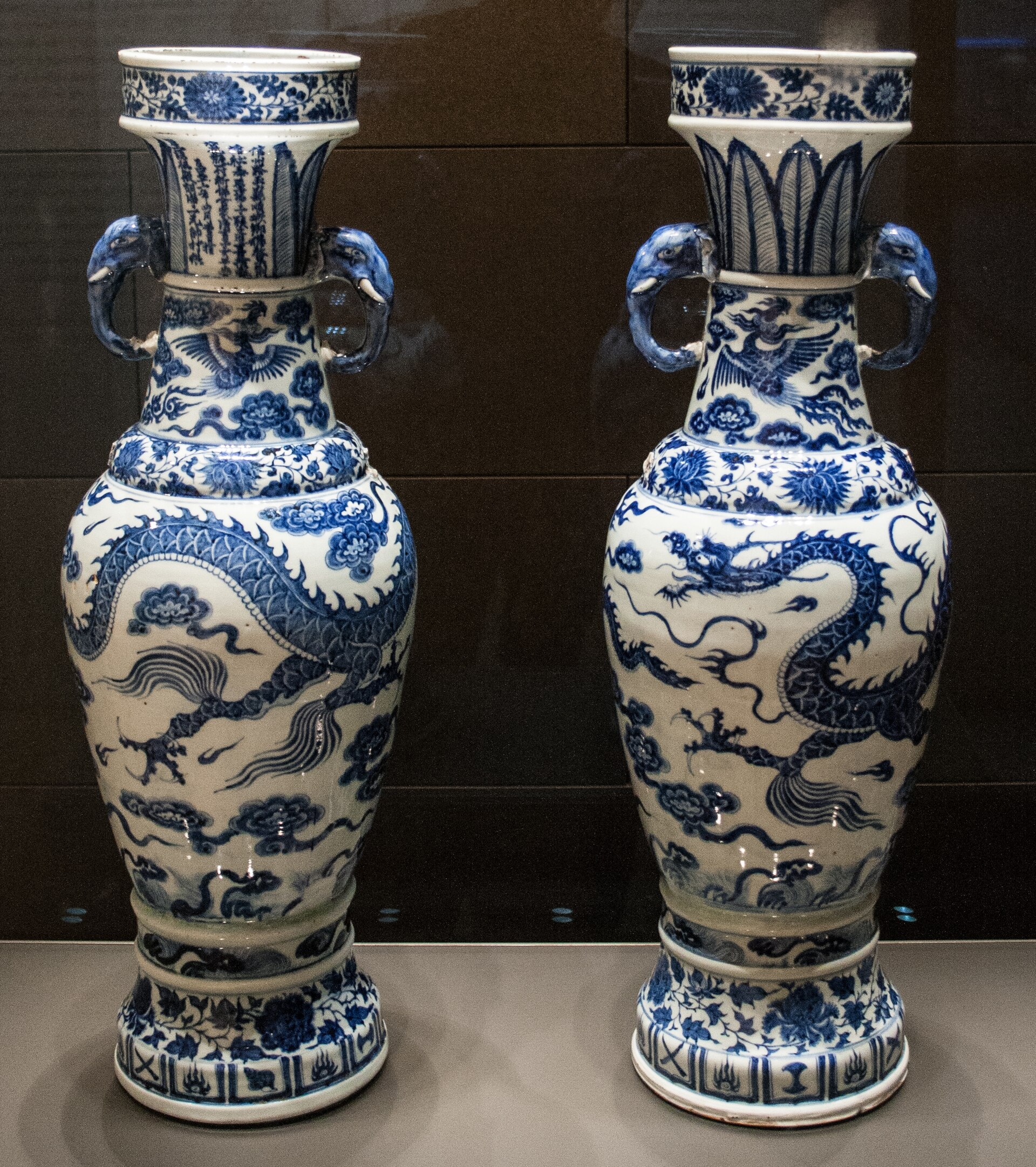
Both vases together, as displayed in Room 95 of the British Museum. Photograph by Szilas, released to the public domain by the photographer; the vases themselves are Yuan dynasty, dated 1351.
| Artist | Unidentified Jingdezhen-region kilns, Yuan dynasty |
|---|---|
| Date | 1351 CE (11th year of the Zhizheng reign, Yuan dynasty) |
| Medium | Porcelain, painted in underglaze cobalt blue |
| Dimensions | Each vase approximately 63.5 cm high, 20.5 cm wide at the broadest point (published figures vary slightly by source, between 63.5 and 63.8 cm high and 19.6 and 20.5 cm wide; the British Museum's own figures have not been independently confirmed in the sources consulted for this record) |
| Where it is now | British Museum, London, Sir Joseph Hotung Centre for Ceramic Studies, Room 95 (the Sir Percival David Collection gallery)last confirmed |
| Inventory number | PDF,B.614 and PDF,B.613 |
| Attribution | AcceptedNo individual potter, painter or workshop is named on either vase or in any surviving document. Full note |
| Object type | Ceramic |
| Period | Yuan dynasty (Mongol China), mid-14th century |
| Cases | Has a provenance gap |
| Inscriptions | Long dedicatory inscription in Chinese around the neck of each vase, with minor wording differences between the two. English translation (British Museum/Wikipedia rendering): "The respectful disciple of the sages, Zhang Wenjin from Jintang Section of Dejiao Lane, Shungchen Village, Yushan County of Xingzhou Circuit, happily presents a set of incense burner and flower vases as prayer for the protection of the whole family and for peace and prosperity of his descendants. Recorded in reverent remembrance on a propitious day in the 11th year and 4th month of the Zhizheng era, as offering for the Xingyuan temple of Generalissimo Hujingyi." The two inscriptions differ in their penultimate line: one reads liang chen jin ji ("reverently recorded on a propitious day"), the other ji ri she ("offers on an auspicious day"). Neither inscription is signed by a court official, and the calligraphy is described in the literature as unevenly spaced and containing miswritten characters. |
| Owners on record | 8 links6 documented, 1 disputed, 1 unknown |
| Sources | 10 cited |
About this record Last verified · 10 sources cited · Change log
On this page 10 sections
ContentsClose
A matched pair of blue-and-white porcelain temple vases, each about 63.5 centimetres tall, made at the Jingdezhen kilns and inscribed with a dedication naming a donor, Zhang Wenjin, and a date equivalent to 1351. Sir Percival David bought them separately, from different dealers, years apart, and recognised from their inscriptions that they belonged together; reunited in his hands in 1935, they became the first securely dated example of Yuan blue-and-white porcelain known in the West and rewrote the chronology of the whole class of ware.
They are the centrepiece of the Percival David Collection, which David gave to the University of London in 1950, which moved to the British Museum on long-term loan in 2009 after a funding crisis closed its Bloomsbury home, and which the Percival David Foundation of Chinese Art formally gave outright to the British Museum in April 2025 in what the museum describes as the largest gift in its history.
Neither vase carries a maker's mark. The identity of the donor is itself disputed: the crude calligraphy set against the imperial dragon-and-phoenix imagery has led scholars to wonder whether "Zhang Wenjin" conceals the rebel leader Zhang Shicheng, active in the same region two years later.
Provenance
Each link is graded. Documented: a cited source supports it. Disputed: the identification is argued but not established. Unknown: no owner for that span, and the gap is not smoothed into a narrative. The grades in the glossary.
- 1351 -Xingyuan temple of Generalissimo Hu Jingyi (Daoist), near present-day Wuyuan County, Jiangxidocumented
Commissioned by Zhang Wenjin of Yushan County as a pair of altar vases together with an incense burner (not surviving/not identified), dedicated per the vases' own inscriptions on a propitious day in the fourth month of the eleventh year of the Zhizheng era (1351).12
- 1351 - c. 1920Unknownunknown
No owner, location, or event is documented for approximately 570 years. Neither vase's route out of China, nor the date either left, is recorded in any source consulted.1
- c. 1920 - 1927Mountstuart William Elphinstone (1871-1957)documented
Elphinstone is recorded as having brought this vase (later PDF,B.614) to England around 1920. How or from whom he acquired it in China is not documented in the sources consulted.23
- unknown - 1935Charles Ernest Russell, said via the dealer Wu Laixi from a priest of the Zhilun temple, Beijingdisputed
Russell's account of his vase's origin (later PDF,B.613), relaying a claim that it came from a Beijing temple priest via the dealer Wu Laixi, could not be verified when first reported and has not since been corroborated. Russell's own ownership by the time of the 1935 sale is documented; the chain before that is not.2
- 1927 - 1964Sir Percival David (1892-1964)documented
David purchased the Elphinstone vase in 1927. He purchased the second vase at the Sotheby's, London, sale of the Charles E. Russell collection in June 1935, for 360 pounds, having recognised from the matching inscriptions that the two vases were a dedicated pair. This reunited the pair in single ownership for the first time since 1351, so far as is documented.23
- 1950 - 2007Percival David Foundation of Chinese Art (University of London / SOAS), 53 Gordon Square, Bloomsburydocumented
David gave his full collection, including the vase pair, to the University of London in 1950, establishing the Foundation. Public gallery opened at 53 Gordon Square on 10 June 1952; the Foundation also functioned as a teaching resource for SOAS's Chinese art programme. The Gordon Square premises closed at the end of 2007 after a funding cut of more than two-thirds to the Foundation's annual budget in 2006.35
- 2009 - 2025Percival David Foundation of Chinese Art (owner), on long-term loan to the British Museum, Londondocumented
Long-term loan agreed after the 2007 closure; Room 95, the Sir Joseph Hotung Centre for Ceramic Studies, opened 23 April 2009, sponsored by Sir Joseph Hotung, displaying close to the full collection with the David vases positioned near the gallery entrance. Ownership remained with the Foundation throughout this period; the British Museum was borrower and exhibitor, not owner.56
- 2025 - presentBritish Museum, London (outright ownership)documented
The Foundation's trustees announced intent to gift the entire collection outright in November 2024; the Charity Commission approved the necessary amendment to the Foundation's governing document in March 2025; ownership transferred on 2 April 2025. Widely reported as the most valuable single gift in the British Museum's history, valued at approximately one billion pounds for the collection as a whole (no separate valuation for the vase pair alone has been published in the sources consulted). The vases remain on display in Room 95; selected other pieces from the wider collection were separately arranged for loan to the Shanghai Museum and the Metropolitan Museum of Art, New York.6
Prices realised
| Date | Sale | Estimate | Result | Note |
|---|---|---|---|---|
| 1935-06 | Sotheby's | Not documented in the sources consulted. | Hammer GBP 360 With premium Not separately documented in the sources consulted; a buyer's premium in the modern sense was not standard London auction-house practice in 1935, so the hammer figure and the total price paid are likely the same or very close, but this record does not assert that as fact absent a source stating it explicitly. GBP | Sale of the Charles E. Russell collection, London, June 1935. Percival David purchased the second of the two vases (later catalogued PDF,B.613) at this sale, reuniting the pair. No lot number, sale catalogue title, or estimate has been recovered from the sources consulted for this record; the figure of GBP 360 for the hammer price is reported in secondary literature and has not been cross-checked against a Sotheby's sale record directly. |
Hammer is the price at which the bidding stopped; with premium adds the fee the house charges the buyer on top. Hammer price and buyer's premium in the glossary.
Technical evidence
| Attribution note | No individual potter, painter or workshop is named on either vase or in any surviving document. The vases are accepted as products of the Jingdezhen porcelain region on the strength of their body, glaze and cobalt decoration, all consistent with other Jingdezhen wares of the period. It has been proposed, but not proven, that they were made at the Hengfeng Zhen kilns near the recipient temple rather than at the walled Jingdezhen town centre itself. No maker's mark, reign mark or workshop signature appears on either vessel, which is normal for the period: reign marks on Jingdezhen porcelain are essentially a Ming and Qing convention. |
|---|---|
| Body and glaze | High-fired white porcelain body under a clear, colourless glaze; decoration painted in cobalt oxide directly onto the unfired body before glazing (underglaze technique), so the blue sits beneath a transparent glaze layer.47 |
| Pigment source | The cobalt used at Jingdezhen in this period is understood, from later Chinese ceramic treatises calling it sumali qing/sulima qing and from modern compositional analysis, to have been substantially imported, plausibly via Persian sources associated with the Kashan region, reaching China along trade corridors the Mongol conquests had opened westward.8 |
| Dimensions | Each vase approximately 63.5 cm high and 20.5 cm wide at the broadest point; minor variation in published figures (63.5-63.8 cm high, 19.6-20.5 cm wide) reflects differences between secondary sources rather than a documented difference between the two vessels.16 |
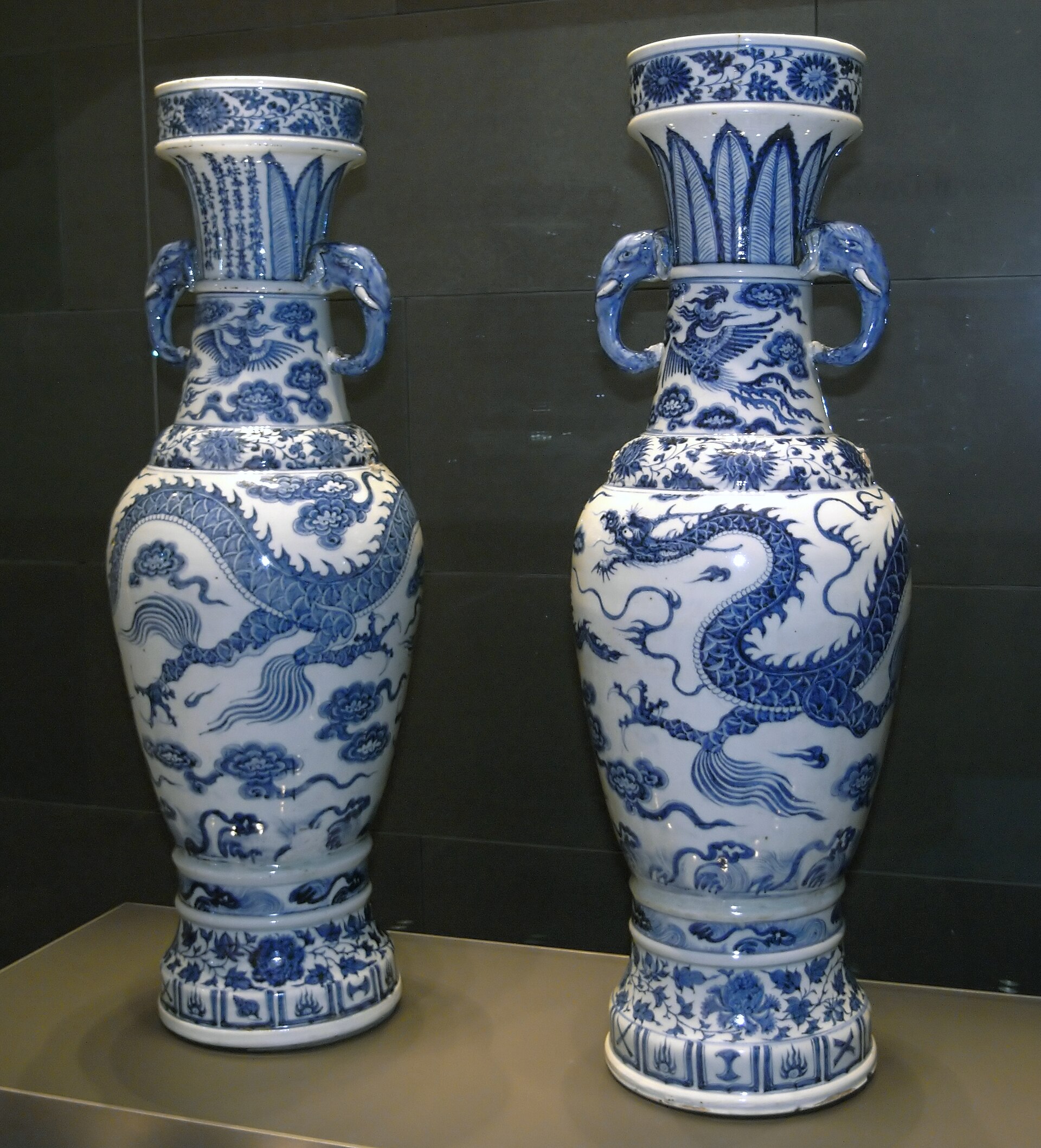
| Handles | Two elephant-head handles applied at the neck of each vase; each originally held a separate porcelain ring, cast loose and threaded through the elephants' trunks before firing. No ring survives attached to either vase in its current state.1 |
| Decoration scheme | From foot to mouth: a peony scroll above a band of petal panels each enclosing an auspicious emblem; a four-clawed dragon in clouds around the body; overlapping plantain leaves and lotus scroll on the shoulder; paired phoenixes in flight on the neck, carrying the inscription; a chrysanthemum scroll around the mouth.16 |
| Inter-vase variation | The two vases are hand-painted variants of a shared scheme, not mechanical duplicates: the dragon's mouth is closed on one vase and open on the other, and the inscriptions diverge in wording at one point (liang chen jin ji versus ji ri she in the penultimate line).1 |
| Inscription script | Both inscriptions are executed in a hand described in the literature as unevenly spaced with miswritten characters, inconsistent with production by a court-trained scribe, despite the vases' use of dragon and phoenix imagery elsewhere associated with elite or imperial commissions.1 |
| Maker's marks | Neither vase carries a reign mark, kiln mark or workshop signature. Reign-mark practice at Jingdezhen is essentially a Ming-and-later convention; its absence here is period-typical, not anomalous.1 |
| Museum numbers | PDF,B.614 (the Elphinstone/1927 vase) and PDF,B.613 (the Russell/1935 vase); "PDF" denotes the Percival David Foundation collection prefix retained by the British Museum after transfer.35 |
Images
The record in full
Chapter 1A pair made to stand on an altar, not a shelf
Each vase stands about 63.5 centimetres, a scale that rules out a domestic or export function from the outset: this is furniture for a temple hall, sized to be seen from a few paces back, flanking an...
Each vase stands about 63.5 centimetres, a scale that rules out a domestic or export function from the outset: this is furniture for a temple hall, sized to be seen from a few paces back, flanking an incense burner on a stone or wooden altar table. The form derives from bronze ritual vessels rather than from earlier ceramic shapes, a swollen pear-shaped body narrowing sharply at a long neck, itself narrowing again toward an everted mouth. Two elephant-head handles project from the neck; each originally carried a loose porcelain ring, cast separately and threaded through the elephants' trunks before firing, of which none now survives attached to either vase.
The decoration is painted in cobalt blue under a clear glaze, in bands running the full height of the body: scrolling peony at the foot above a ring of petal panels each holding a separate auspicious emblem, a four-clawed dragon coiled through clouds around the widest part of the body, a band of overlapping plantain leaves and lotus scroll on the shoulder, paired phoenixes in flight on the neck, and a chrysanthemum scroll circling the mouth. The two vases are not identical. The dragon's mouth is closed on one vase and open on the other, and the inscriptions differ in wording at one point, both consistent with two vessels painted by hand to a shared programme rather than mechanically matched.
Chapter 2How Jingdezhen made blue-and-white, and why the blue came from Persia
The vases are Jingdezhen porcelain: a white, high-fired stoneware body covered in a clear glaze, with the design painted onto the unfired body in cobalt oxide before glazing, so that the blue sits...
The vases are Jingdezhen porcelain: a white, high-fired stoneware body covered in a clear glaze, with the design painted onto the unfired body in cobalt oxide before glazing, so that the blue sits beneath a transparent glaze rather than on top of it. Getting a rich, stable blue this way depends on the purity and iron content of the cobalt ore used, and the cobalt used at Jingdezhen in this period was substantially an import.
Chinese ceramic literature of later centuries calls the imported ore sumali qing or sulima qing, a transliteration usually traced to a Persian or Central Asian place-name, and modern compositional analysis of Yuan and early Ming blue-and-white supports a Persian source, plausibly linked to cobalt-bearing deposits worked around Kashan. The route the mineral travelled ran overland and by sea along channels the Mongol conquest had itself opened: Yuan China's control extended, through allied and rival khanates, into direct contact with Ilkhanid Persia, and cobalt moved east along the same corridors that carried textiles, horses and diplomats. The vases are therefore physical evidence of a trade network, not only a decorative choice: the blue on a temple offering commissioned by a private individual in inland Jiangxi province had, within living memory of its being mined, been rock in Iran.
The vases were made within roughly two decades of Mongol authority collapsing across the region: Zhu Yuanzhang would found the Ming dynasty in 1368, and Zhang Shicheng's own rebellion, whatever its bearing on the donor's identity, began just two years after the dedication, in 1353. Scholarship that treats the David vases as representative of "Yuan blue-and-white at its ebb" is describing production at a kiln complex operating in a province sliding toward civil war, which is one reason the vases are read as a lower bound on Yuan quality rather than a typical example of it: better-controlled, more consistently potted Yuan blue-and-white from earlier and more stable years has since been identified from officially-run kilns.
Chapter 3The dedication, and the puzzle of who wrote it
The inscription names the donor as Zhang Wenjin, resident of Dejiao Lane in Shuncheng Village, Yushan County, in what the text calls Xingzhou Circuit, and states that he presents "a set of incense...
The inscription names the donor as Zhang Wenjin, resident of Dejiao Lane in Shuncheng Village, Yushan County, in what the text calls Xingzhou Circuit, and states that he presents "a set of incense burner and flower vases" in prayer for the protection of his family and the wellbeing of his descendants. It dates the offering to a propitious day in the fourth month of the eleventh year of the Zhizheng reign era, which converts to 1351, and names the recipient as the Xingyuan temple of Generalissimo Hu Jingyi, a Daoist military deity. The incense burner that would have completed a three-piece altar set has never been identified.
What makes the inscription a puzzle rather than a straightforward donor's record is the mismatch between the object and the hand that labelled it. Commissioning a pair of vases of this size and quality from an accomplished kiln, decorated with dragon and phoenix motifs closely associated with imperial and elite patronage, implies real resources and standing. Yet the inscribed characters are unevenly spaced and include miswritten characters, which scholarship reads as inconsistent with a text drafted or checked by a court-trained scribe. Zhang Wenjin funded porcelain of a quality that suggests connections to power, in an inscription that reads as though nobody with formal training proofread it.
Chapter 4An open question: was Zhang Wenjin someone else
The 1350s in Jiangxi and neighbouring provinces were the opening years of the Red Turban and salt-worker rebellions that would end Mongol rule in China within two decades.
The 1350s in Jiangxi and neighbouring provinces were the opening years of the Red Turban and salt-worker rebellions that would end Mongol rule in China within two decades. Zhang Shicheng, a salt-trade leader from northern Jiangsu, rose through exactly this unrest, leading a rebellion against Yuan authority from 1353 and ruling as a self-declared king of Wu until his defeat in 1367. His base of operations and the years of his rise sit close enough, in both geography and time, to the 1351 dedication that some scholarship has floated the possibility that "Zhang Wenjin" was an alias used by Zhang Shicheng himself, or by someone operating in his circle, before the rebellion became public.
This is a speculative reading, not a documented identification, and this record treats it as exactly that: a proposal resting on coincidence of name, place and moment, offered to explain why a temple donor with modest calligraphy could commission porcelain fit for a palace. No inscription, seal, or independent record ties the historical Zhang Shicheng to the Xingyuan temple or to these two vases, and the plainer explanation, that Zhang Wenjin was simply a locally prosperous man devout enough to spend heavily on a Daoist dedication, remains available and unrefuted.
Chapter 5Seven centuries in the dark, then Sir Percival David
Between the dedication in 1351 and the vases' appearance in an English collection in the 1920s, nothing about their whereabouts is documented in any source consulted for this record.
Between the dedication in 1351 and the vases' appearance in an English collection in the 1920s, nothing about their whereabouts is documented in any source consulted for this record. No inventory, sale record, temple register or travellers' account bridges the gap. What can be said is only where each vase surfaces once evidence begins: one, later catalogued as PDF,B.614, reached the London-based collector Mountstuart William Elphinstone (1871-1957), who is recorded as having brought a vase to England around 1920. The other, later PDF,B.613, entered the collection of Charles Ernest Russell; Russell's own account, relayed at second hand, was that his vase had come from the Chinese collector and dealer Wu Laixi, who in turn claimed to have obtained it from a priest at the Zhilun temple in eastern Beijing. That claim could not be verified even at the time and remains unconfirmed.
Sir Percival David (1892-1964) bought the Elphinstone vase in 1927. According to an account attributed to Lady David, David recognised that his vase and Elphinstone's were a dedicated pair from their matching inscriptions, and "persuaded Elphinstone to exchange some things for his [vase], and as Elphinstone felt that the vases should be a pair, he let my husband have it" -- except that by David's own later account it was Russell, not Elphinstone, who held the second vase by the time it changed hands. What is firmly documented is the outcome: Russell's vase was sold at Sotheby's, London, in June 1935, as part of the sale of the Charles E. Russell collection, and David bought it there for 360 pounds. For the first time since 1351, both vases belonged to one owner.
Chapter 6R.L. Hobson's 1929 identification, and the assumption it overturned
Before either vase's inscription was widely understood, the working assumption among Western collectors and curators was that fine blue-and-white porcelain of this refinement belonged to the Ming...
Before either vase's inscription was widely understood, the working assumption among Western collectors and curators was that fine blue-and-white porcelain of this refinement belonged to the Ming dynasty (1368-1644), not to the Mongol Yuan that preceded it. Most Yuan-period blue-and-white porcelain then in British collections was accordingly dated, when dated at all, to the Song or the early Ming.
Robert Lockhart Hobson (1872-1941), Keeper of Oriental Antiquities at the British Museum, was the first in Britain to publish and press the significance of the vases' own inscriptions, in a 1929 article in the magazine Old Furniture. His point was simple and, for the field, seismic: an inscription reading the eleventh year of Zhizheng is not ambiguous, and it places the vase's manufacture squarely within the Yuan dynasty, decades before the date most specialists had assumed such quality was even possible. It was the first time in Britain that a piece of this class of blue-and-white porcelain had a fixed, textually secure date rather than a stylistic guess.
Chapter 7A dated anchor, and the scholarship it made possible
David's 1935 reunification of the pair meant that, for the first time, connoisseurs and curators studying Yuan blue-and-white had a single object whose date was not inferred from style but stated in...
David's 1935 reunification of the pair meant that, for the first time, connoisseurs and curators studying Yuan blue-and-white had a single object whose date was not inferred from style but stated in its own text. Everything else in the still-forming Yuan blue-and-white corpus could now, in principle, be compared against a fixed point instead of against other equally undated pieces.
The scholar who did the most to build that comparison into a working chronology was John Alexander Pope (1906-1982) of the Freer Gallery of Art in Washington. His 1952 monograph Fourteenth-Century Blue-and-White: A Group of Chinese Porcelains in the Topkapu Sarayi Muzesi, Istanbul, published as a Freer Gallery Occasional Paper, used the David vases as the fixed reference point to date and organise a much larger group of Yuan blue-and-white porcelain preserved in the Ottoman imperial collection at Topkapi, and a companion study extended the method to the comparably important holdings of the Ardabil shrine in Iran. Pope's work is credited in the specialist literature with finally establishing a workable dating framework for Yuan blue-and-white for scholars in the West, using the David vases as the keystone that let the Istanbul and Ardabil groups be linked to a secure calendar year. The vases are described in the literature that followed as a cornerstone of blue-and-white chronology and a linchpin of Chinese ceramic studies generally: not because they are the earliest blue-and-white ware known, but because they were, for decades, the earliest one whose date nobody had to argue about.
That status has narrowed since. Later research pushes the origins of underglaze cobalt-blue decoration on Chinese ceramics earlier than the Yuan, including isolated Tang-dynasty examples; a blue-and-white dish from the Belitung shipwreck, made at kilns in Gongxian, Henan, and dated to roughly 825-850, is the most frequently cited case. The David vases were never the first blue-and-white porcelain made in China. They remain, on the evidence assembled in the sources for this record, the object that gave twentieth-century Western scholarship its first indisputable date for the mature, cobalt-under-glaze tradition associated with Jingdezhen, and scholarship built the Yuan chronology outward from that fixed point rather than finding it independently.
Chapter 8What the vases show about religion, and about the limits of reading too much into it
The dedication is explicitly Daoist: it names a specific deified general, Hu Jingyi, and a specific temple, and states a specific devotional purpose, the protection of Zhang's household and...
The dedication is explicitly Daoist: it names a specific deified general, Hu Jingyi, and a specific temple, and states a specific devotional purpose, the protection of Zhang's household and descendants. That the vessel chosen to carry this private, local prayer borrows imagery, the four-clawed dragon and the phoenix, associated elsewhere in Yuan material culture with imperial and elite status, says something documented and specific about Jingdezhen's fourteenth-century output: motifs coded as high-status were not restricted to court commissions, and a provincial donor with enough money could buy porcelain decorated in a visual language that, on its face, gestured toward the throne. This record treats that as a fact about access to imagery and craftsmanship in the last Yuan decades, not as evidence of any claim by Zhang Wenjin to imperial status himself; no source consulted argues that the dragon and phoenix bands on a temple altar vase were read by contemporaries as anything other than auspicious ornament appropriate to a lavish gift.
Beyond the inscription itself, no source consulted for this record documents a specific liturgical use for the vase pair within Daoist ritual practice at the Xingyuan temple, nor any surviving record of the temple's own history, foundation, or the cult of Hu Jingyi beyond what the vases themselves state. Where a reader might expect a fuller picture of the deity, the temple, or the ceremony the vases were made for, that picture does not exist in the literature surveyed here, and this record says so rather than filling the gap.
Chapter 9Percival David: the man who made the identification possible
Percival Victor David Ezekiel David was born in Bombay on 21 July 1892, into a prominent Baghdadi Jewish merchant family; his father, Sir Sassoon David, founded the Bank of India.
Percival Victor David Ezekiel David was born in Bombay on 21 July 1892, into a prominent Baghdadi Jewish merchant family; his father, Sir Sassoon David, founded the Bank of India. He was educated at Elphinstone College and the University of Bombay before further study at the University of London, and inherited his father's baronetcy in 1926, serving as chairman of the family firm, Sassoon, J. David and Co Ltd.
He began collecting Chinese art around 1913, made his first visit to China in 1923 or 1924, and in 1925 helped finance an exhibition drawn from the Qing imperial collection then still held in Beijing's Forbidden City. By 1927, with the imperial court's finances in disarray and its holdings increasingly reaching the market through former Imperial Household Department channels, David acquired roughly forty pieces that had come out of the former imperial collection. He joined the Oriental Ceramic Society in London in 1930, translated and published the Ming-dynasty connoisseurship manual Ko Ku Yao Lun as Chinese Connoisseurship, and in 1935 directed the International Exhibition of Chinese Art at the Royal Academy in London, to which he lent over three hundred objects from his own collection, including the newly reunited vase pair. He also assembled, separately, one of the most important collections of Chinese postage stamps and postal history ever formed, sold in stages between 1964 and 1975. He died on 9 October 1964; his baronetcy became extinct.
Chapter 10The Foundation, the funding crisis, and two moves to the British Museum
In 1950 David gave his collection, by then numbering around 1,700 pieces spanning the tenth to eighteenth centuries, to the University of London, establishing the Percival David Foundation of Chinese...
In 1950 David gave his collection, by then numbering around 1,700 pieces spanning the tenth to eighteenth centuries, to the University of London, establishing the Percival David Foundation of Chinese Art. The Foundation opened to the public at 53 Gordon Square, Bloomsbury, on 10 June 1952, and functioned for over half a century as both a public gallery and a teaching resource for Chinese art history at the School of Oriental and African Studies (SOAS), which David also endowed with a chair, the Percival David Professorship, initially held at the Courtauld Institute before moving to SOAS.
That arrangement ended abruptly in 2006, when the Foundation's annual funding was cut by more than two-thirds, to under 100,000 pounds, making the Gordon Square operation unsustainable. The Foundation's trustees closed 53 Gordon Square at the end of 2007 and agreed a long-term loan of the ceramics collection to the British Museum, while a separate arrangement kept the Foundation's library and a smaller teaching collection at Gordon Square under SOAS. The British Museum opened a purpose-built gallery, Room 95, the Sir Joseph Hotung Centre for Ceramic Studies, funded by the collector and philanthropist Sir Joseph Hotung, on 23 April 2009, displaying close to the full 1,700-object collection with the David vases given pride of place near the entrance.
The 2009 move was explicitly a loan, not a change of ownership: the Percival David Foundation of Chinese Art remained the legal owner, and the British Museum a long-term borrower and exhibitor. That changed in 2025. In November 2024 the Foundation's trustees announced their intention to give the entire collection outright to the British Museum; the Charity Commission approved the necessary change to the Foundation's governing document in March 2025, and the transfer of ownership was completed on 2 April 2025. The British Museum and the press describe the gift, valued at roughly one billion pounds, as the most valuable single donation in the museum's history. Colin Sheaf, chair of the Foundation, is quoted framing the decision as fulfilling David's own intention: that the collection's most suitable permanent home was the British Museum. As part of the same announcement, selected pieces from the wider collection were to be lent to the Shanghai Museum and the Metropolitan Museum of Art in New York, though the two David vases themselves remain on display in Room 95.
Chapter 11How the vases became famous
The vases' reputation was built by scholarship before it was built by publicity.
The vases' reputation was built by scholarship before it was built by publicity. Hobson's 1929 note and Pope's 1952 and follow-on studies circulated within a narrow specialist readership of curators, dealers and academics, and it was that readership, not a general public, that first attached the phrase "cornerstone of the chronology" to the pair. Public-facing fame came later and largely through museum display and broadcast: the vases are included among the objects selected for the BBC radio series and companion book A History of the World in 100 Objects, a project produced with the British Museum that reached a mass audience well beyond specialist ceramics literature, and they occupy a deliberately prominent position, near the entrance, in the British Museum's Room 95 rather than being one exhibit among many in a case. The description "the best-known porcelain vases in the world", now repeated across museum, broadcast and general-reference sources, describes an object whose fame is inseparable from its display history and from the 2009 and 2025 moves that put it, and kept it, in one of the most-visited museums on earth.
Chapter 12What is still unresolved
The identity of Zhang Wenjin is unresolved, as is the entire seven-century gap in the vases' whereabouts between 1351 and their appearance in 1920s England.
The identity of Zhang Wenjin is unresolved, as is the entire seven-century gap in the vases' whereabouts between 1351 and their appearance in 1920s England. The incense burner named in both inscriptions, which would have completed the original three-piece altar set, has never been located or identified. The claimed chain of custody for the Russell vase, from a Beijing temple priest through the dealer Wu Laixi to Russell himself, rests on an account that could not be verified when first recorded and has not since been corroborated. The proposed attribution of manufacture to the Hengfeng Zhen kilns, rather than to Jingdezhen's main kiln complex, remains a proposal rather than an established fact. None of these gaps is filled in the sources consulted for this record, and none should be treated as settled.
The artist
Sir Percival David, 2nd Baronet (1892-1964)
The vases were made seven centuries before Percival David ever saw them, and no maker's name survives for either the potter or the kiln. It was David, not the workshop, who gave this record its subject: the collector who reunited the pair in 1935 and, in doing so, turned an inscribed date on two temple vases into the fixed point against which an entire chronology of Yuan blue-and-white porcelain would be built.
Related works
| Work | Relation | Where it is |
|---|---|---|
| Yuan blue-and-white porcelain group Jingdezhen kilns, Yuan dynasty | Comparanda used by John Pope to build the dating framework anchored on the David vases Subject of Pope's 1952 Freer Gallery monograph, which used the David vases' fixed date to organise this much larger Ottoman imperial holding into a working Yuan chronology. | Topkapi Palace Museum, Istanbul |
| Yuan and early Ming blue-and-white porcelain group Jingdezhen kilns | Second major comparanda group Pope linked to the David-vase chronology Extended the Topkapi methodology to the comparably important Ardabil holdings. | Ardabil shrine collection, Iran (now largely National Museum of Iran) |
| Blue-and-white dish, Belitung shipwreck Kilns of Gongxian, Henan (Tang dynasty) | Earlier, isolated antecedent that qualifies the David vases' historical claim to be the earliest blue-and-white Dated approximately 825-850 CE; cobalt-blue over white slip rather than the mature underglaze technique of the David vases, but evidence that blue-decorated ceramics existed in China roughly five centuries earlier. | ArtScience Museum, Singapore |
| "Chicken cup", Chenghua reign Jingdezhen imperial kilns, Ming dynasty | Another headline object of the same collection, now the same gallery Illustrates the range of the wider Percival David gift beyond the Yuan material; not directly related to the David vases beyond shared ownership and display history. | British Museum, Room 95, Percival David Collection |
Open questions
- Where were the two vases between their dedication in 1351 and their documented appearance in English collections in the 1920s? No owner, inventory, or location is recorded for roughly 570 years.
- Who was Zhang Wenjin? The mismatch between the vases' elite imagery and the inscription's uneven, unofficial calligraphy has never been resolved, and the proposal that the name conceals the rebel leader Zhang Shicheng remains speculative and unconfirmed by any independent record.
- Where is the incense burner named in both inscriptions as part of the original three-piece altar offering? It has never been located or identified.
- Is the claimed chain of custody for the Russell vase, from a priest at the Zhilun temple in Beijing through the dealer Wu Laixi to Charles Russell, accurate? It could not be verified when first recorded and remains uncorroborated.
- Were the vases made at the Hengfeng Zhen kilns near the Xingyuan temple, or at Jingdezhen's main kiln complex and transported? The Hengfeng Zhen attribution is a proposal in the literature, not an established finding.
- What, if anything, is documented about the Xingyuan temple itself and the cult of Generalissimo Hu Jingyi, beyond what the vases' own inscriptions state? No source consulted for this record supplies an independent temple history.
Questions about this object
What is The David Vases?
The David Vases is a ceramic, dated 1351 CE (11th year of the Zhizheng reign, Yuan dynasty). Medium: Porcelain, painted in underglaze cobalt blue.
Who made The David Vases, and is the attribution settled?
The attribution to Unidentified Jingdezhen-region kilns, Yuan dynasty is recorded here as accepted. No individual potter, painter or workshop is named on either vase or in any surviving document. The vases are accepted as products of the Jingdezhen porcelain region on the strength of their body, glaze and cobalt decoration, all consistent with other Jingdezhen wares of the period. It has been proposed, but not proven, that they were made at the Hengfeng Zhen kilns near the recipient temple rather than at the walled Jingdezhen town centre itself. No maker's mark, reign mark or workshop signature appears on either vessel, which is normal for the period: reign marks on Jingdezhen porcelain are essentially a Ming and Qing convention.
Where is The David Vases now?
British Museum, London, Sir Joseph Hotung Centre for Ceramic Studies, Room 95 (the Sir Percival David Collection gallery). Inventory number PDF,B.614 and PDF,B.613. Last confirmed 2 August 2026. Outright gift to the British Museum from the Sir Percival David Foundation of Chinese Art, ownership transferred 2 April 2025 following Charity Commission approval in March 2025; the collection had been on long-term loan to the British Museum and on public display in Room 95 since 23 April 2009, after the Foundation's teaching premises at 53 Gordon Square, Bloomsbury, closed at the end of 2007 in a funding crisis.
What has The David Vases sold for?
Hammer GBP 360; with premium, Not separately documented in the sources consulted; a buyer's premium in the modern sense was not standard London auction-house practice in 1935, so the hammer figure and the total price paid are likely the same or very close, but this record does not assert that as fact absent a source stating it explicitly. Sotheby's, 1935-06.
What is still unknown about The David Vases?
Where were the two vases between their dedication in 1351 and their documented appearance in English collections in the 1920s? No owner, inventory, or location is recorded for roughly 570 years.
Sources
- 1Wikipedia, 'David Vases' (full article text and wikitext, including bibliography citing Krahl and Harrison-Hall 2009 and the British Museum's own object page). en.wikipedia.org/wiki/...
- 2China Online Museum, 'Yuan: The David Vases', descriptive and provenance summary including the Elphinstone and Charles Russell acquisition chain. comuseum.com/arts/...
- 3Wikipedia, 'Percival David', biographical summary of Sir Percival David including his collecting history, the 1927 and 1935 acquisitions, and the Oriental Ceramic Society and Ko Ku Yao Lun details. en.wikipedia.org/wiki/...
- 4Wikipedia, 'Percival David Foundation of Chinese Art', history of the Foundation, the 1950 gift, the 2007 Gordon Square closure and funding crisis, the 2009 loan to the British Museum, and the 2025 outright gift. en.wikipedia.org/wiki/...
- 5Antiques Trade Gazette, 'Percival David collection moves to British Museum' (2007), on the funding crisis and loan terms. antiquestradegazette.com/news/...
- 6Museums + Heritage Advisor, 'British Museum to receive historic GBP 1bn collection gift', on the 2024-2025 gift announcement, Charity Commission approval, Room 95/Hotung sponsorship, and the Colin Sheaf quotation. museumsandheritage.com/advisor/...
- 7Krahl, Regina, and Jessica Harrison-Hall. Chinese Ceramics: Highlights of the Sir Percival David Collection. London: British Museum Press, 2009. ISBN 9780714124544. The Museum's own catalogue of the collection, cited here via its Wikipedia bibliography entry; not directly consulted in full text. Flagged for direct consultation. Not directly consulted; cited here via its appearance in Wikipedia's own bibliography (source 1), which is the URL given here pending direct verification of the original 2009 catalogue. en.wikipedia.org/wiki/...
- 8Gerritsen, Anne. The City of Blue and White: Chinese Porcelain and the Early Modern World. Cambridge University Press, 2020. ISBN 9781108499958. Consulted via publisher's book description and chapter abstracts for the Jingdezhen cobalt-sourcing and Yuan-to-Ming production context; full monograph text not directly consulted. Flagged for direct consultation of the relevant chapters. cambridge.org/9781108499958
- 9Wikimedia Commons file page, File:The David Vases.jpg, for image licence (public domain, released by photographer Szilas) and description. commons.wikimedia.org/wiki/...
- 10Wikimedia Commons file page, File:Room 95 David Vases 6747.JPG, for image licence (CC BY-SA 3.0, photographer Patche99z, dated 4 May 2009) and description. commons.wikimedia.org/wiki/...


Last verified · Published
Change log
18 August 2026 - Record created at the house standard: researched narrative, technical evidence, maker dossier, graded provenance chain, prices with hammer and premium separated, related works, open questions and sources.