La Pendaison (The Hanging), plate 11 from Les Miseres et les Mal-Heures de la Guerre
Jacques Callot · 1633
Last verified 14 September 2026 · 19 sources cited · Change log
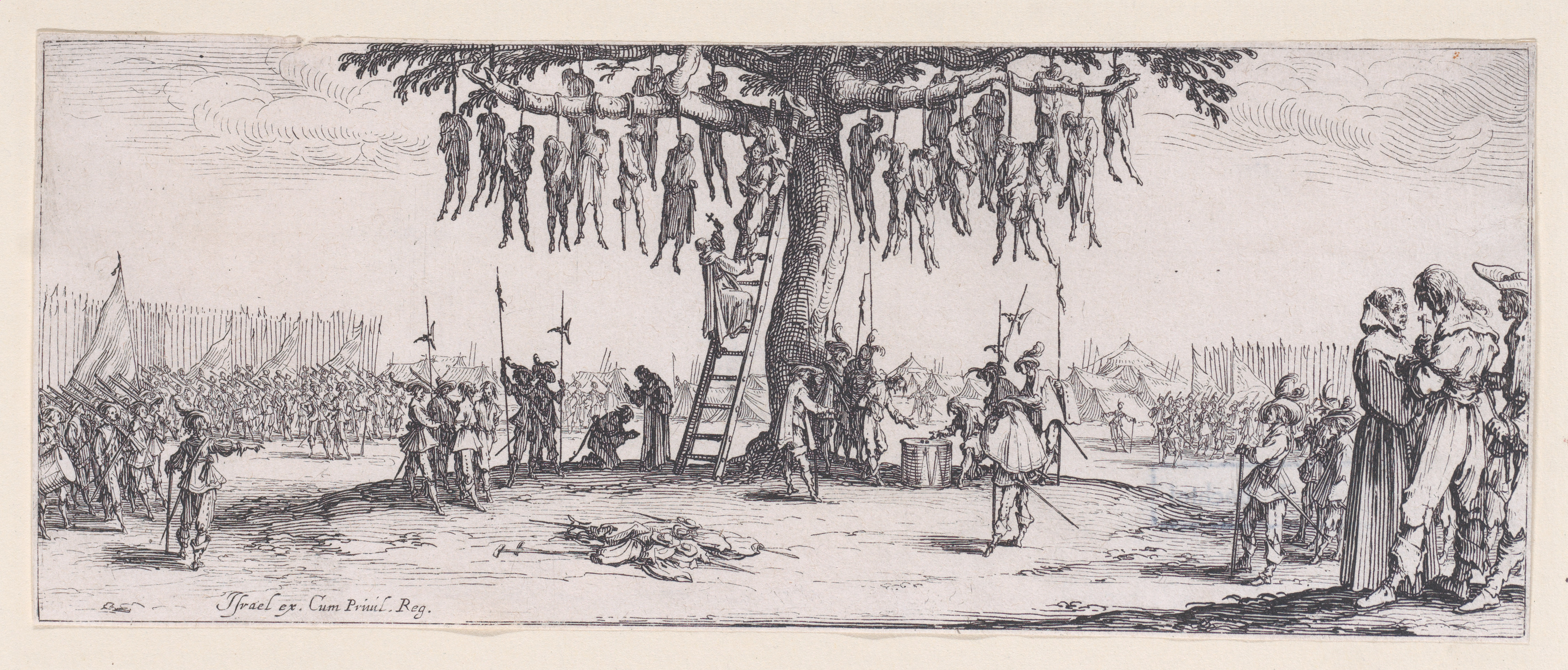
The record subject: the Metropolitan Museum of Art's impression from the Bequest of Edwin De T. Bechtel, 1957, accession 57.650.404(10). Etching, second state of three (Lieure 1349), sheet trimmed to 7.4 x 18.7 cm.
| Artist | Jacques Callot |
|---|---|
| Date | 1633 |
| Medium | Etching, second state of three (Lieure 1349); the Museum's own catalogue record for this impression is not fully decided between the first and second state |
| Dimensions | Sheet: 7.4 x 18.7 cm (2 15/16 x 7 3/8 in.), trimmed |
| Where it is now | Metropolitan Museum of Art, New York, Department of Drawings and Prints, 57.650.404(10)last confirmed 14 September 2026 |
| Attribution | acceptedUniversally attributed to Jacques Callot and catalogued as his work in both standard raisonnes of his printed oeuvre: Edouard Meaume's 1860 catalogue (no. Full note |
| Object type | |
| Period | French, 17th century (Baroque, Lorraine and Paris) |
| Cases | Has a provenance gap |
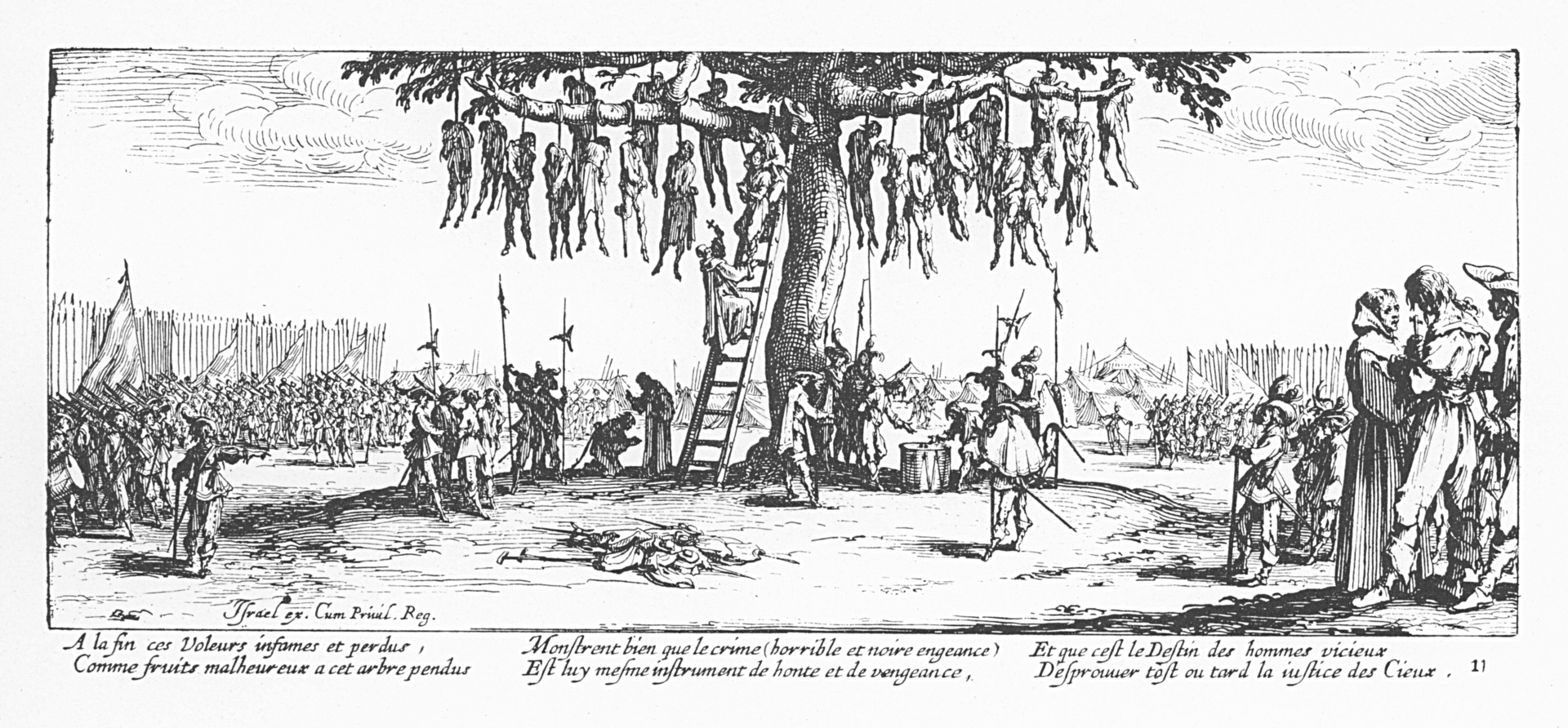
| Inscriptions | Lower left, etched in the plate: Israel excud. cum privil. Reg. (in the first and second states; replaced by Callot inv. et fec. in the third). Lower right, etched in the plate: the plate number 11. Lower margin, in the second and third states only: a six line French verse, attributed to the abbe Michel de Marolles, beginning A la fin ces voleurs infames et perdus and ending on the theme of divine justice overtaking corrupt men. |
- Where it is now
- Metropolitan Museum of Art, New York, Department of Drawings and Printslast confirmed 14 September 2026
- Attribution
- accepted
- Provenance
- 5 links4 documented, 1 unknown
- Sources
- 19 cited
- Last verified
- 14 September 2026Change log
On this page 9 sections
This is the Metropolitan Museum of Art's impression of La Pendaison, The Hanging, plate 11 of Jacques Callot's eighteen plate Les Miseres et les Mal-Heures de la Guerre of 1633, etched in the year French royal troops occupied Callot's native Nancy and published in Paris by his childhood friend Israel Henriet under a privilege from the same crown. It came to the Museum in the Bequest of Edwin De T. Bechtel, 1957, a New York lawyer who wrote his own book on Callot; a second Bechtel-bequest impression of the identical plate, and a third, wholly unrelated Met impression bought in 1922, are both named here and kept firmly apart from this one.
The plate shows soldiers hanged from a tree by their own army for the pillage the series' earlier plates had just shown them committing. Scholars remain divided on whether that makes the series an early anti-war statement or an image that quietly endorses the very military authority that had occupied the artist's home duchy; this record gives both readings rather than choosing between them. The Museum's own catalogue leaves this sheet's exact state undecided between first and second, most likely because trimming has cut close to the verse text that would settle the question, an honest gap this record records rather than resolves.
What is documented without dispute is the object's identity: accession 57.650.404, item 10, Lieure 1349, Meaume 574, credited to Bechtel's 1957 bequest, and distinct from every other impression of the same plate named in this file.
Provenance
Each link is graded. Documented: a cited source supports it. Disputed: the identification is argued but not established. Unknown: no owner for that span, and the gap is not smoothed into a narrative. The grades in the glossary.
- 1633 - 1635Published by Israel Henriet, Paris, under royal privilege; plate etched by Jacques Callotdocumented
Common to every impression of this plate, not specific to the Bechtel sheet. Israel Henriet was Callot's Paris publisher and a childhood friend from Nancy.4612
- 1635 - 1661Israel Henriet, and after his death his successors, continuing to print from the inherited platesdocumented
General publication history of the plate itself, common to all impressions, not a statement about this specific sheet's printing date.1213
- 1661 - 1957Unknownunknown
No owner, dealer or sale is documented for this specific impression across roughly three centuries. Its state (second, on present evidence) is consistent with, but does not prove, an early printing.
- - 1957Edwin De T. Bechtel, New Yorkdocumented
Bechtel was a New York lawyer and Callot collector and scholar who published Jacques Callot (Braziller, New York, 1955). How or when he acquired this impression is not stated in the sources consulted.891011
- 1957 - presentMetropolitan Museum of Art, New Yorkdocumented
Accessioned as 57.650.404, item 10, following Bechtel's death on 4 July 1957. Credit line: Bequest of Edwin De T. Bechtel, 1957.19
Technical evidence
| Attribution note | Universally attributed to Jacques Callot and catalogued as his work in both standard raisonnes of his printed oeuvre: Edouard Meaume's 1860 catalogue (no. 574) and Jules Lieure's 1924-1929 catalogue raisonne (no. 1349). The plate itself carries an etched publisher's imprint, Israel excud. cum privil. Reg., in its first and second states, replaced by Callot inv. et fec. in the third state issued after Israel Henriet's ownership of the plate ended. No attribution dispute exists for this print or this series. |
|---|---|
| Support | Laid paper sheet, trimmed at the margins; the Museum's public record for this impression does not separately state a platemark measurement or a watermark.1 |
| Medium | Etching.1 |
| Sheet dimensions | 7.4 x 18.7 cm (2 15/16 x 7 3/8 in.), trimmed.1 |
| State | Recorded by the Metropolitan Museum as first or second state of three (per Lieure); the surviving verse text on the sheet points toward the second state, but this record follows the Museum in not resolving the ambiguity beyond its own published data.14 |
| Lieure catalogue number | 1349, cross-confirmed independently by the Louvre's own collection record and by Princeton University Art Museum's catalogue entry for a separate impression.45 |
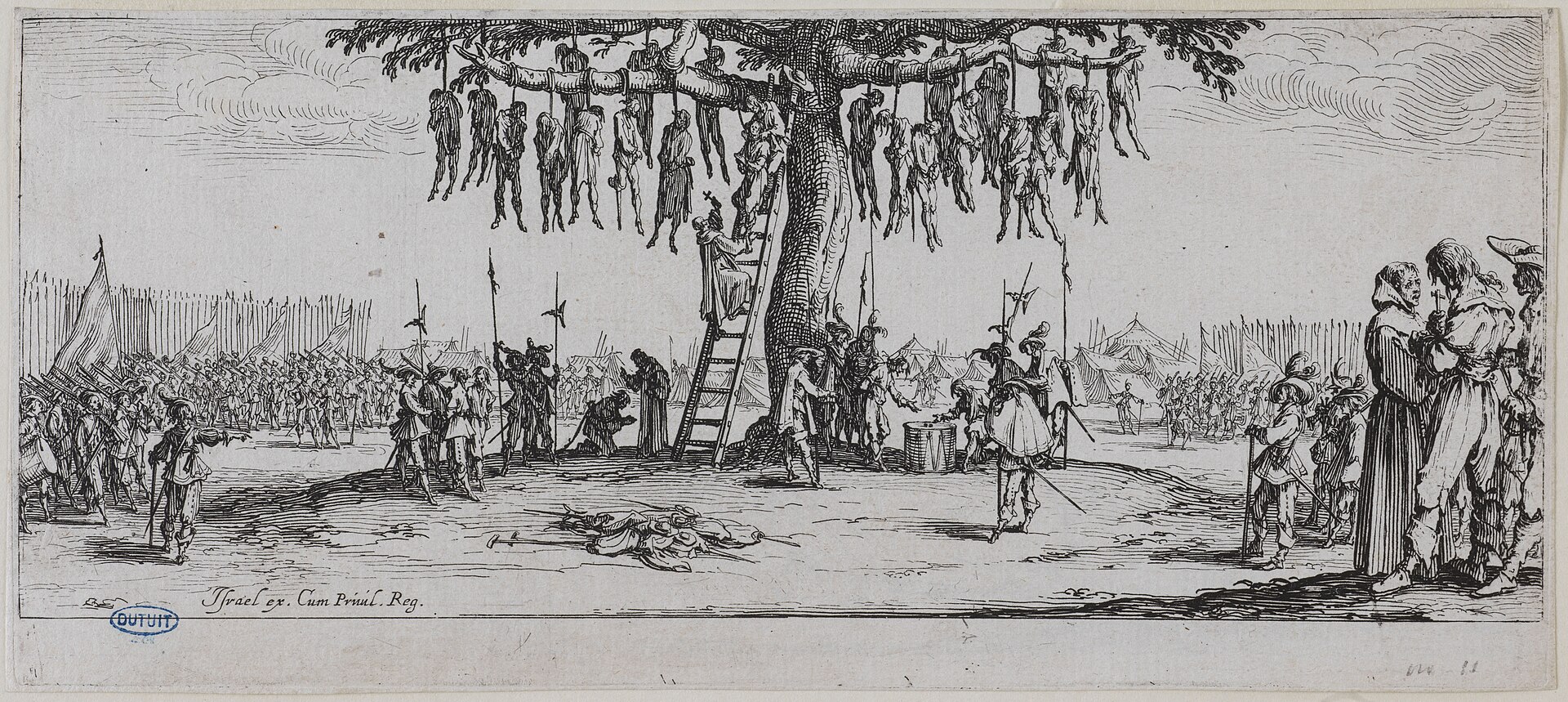
| Meaume catalogue number | 574, per the caption data accompanying a Petit Palais impression of the plate.17 |
| Publisher's imprint | Israel excud. cum privil. Reg., etched lower left in the first and second states; replaced by Callot inv. et fec. in the third state.46 |
| Inscription (verse) | A six line French verse in the lower margin, present from the second state onward, attributed to Michel de Marolles, opening A la fin ces voleurs infames et perdus and closing on the theme of divine justice reaching corrupt men.456 |
| Plate numbering | Numbered 11 lower right in the plate itself, fixing its position in the eighteen plate sequence independent of any album mounting order.4 |
| Credit line and accession | Bequest of Edwin De T. Bechtel, 1957; accession 57.650.404, item 10.1 |
Images
The record in full
What the plate shows
A gallows tree fills the center of a small horizontal sheet, its branches hung with the bodies of men who have already been hanged and, at its foot, more men waiting their turn under guard. A priest attends one of the condemned. Soldiers stand watch in ranks to either side, and further groups recede into a shallow, silvery landscape typical of Callot's late manner, built from thousands of tiny etched marks rather than broad tonal masses. Nothing in the scene identifies a specific place or campaign. That is deliberate: this is plate 11 of an eighteen plate sequence that narrates the anonymous, repeatable mechanics of a seventeenth century army's own justice, not a single reported event.
The six line verse etched into the lower margin, attributed to the French translator and man of letters Michel de Marolles, states the plate's argument outright: the men hanging from the tree like fruit are thieves, and their deaths are the working of a shame and vengeance that is also, in the verse's own terms, the justice of Heaven. The image does not show an atrocity committed against soldiers. It shows soldiers being executed by their own side, under a code that reached this severity for the crime the previous plates in the sequence had just finished depicting: pillage.
This impression
The impression catalogued here is accession 57.650.404, item 10, part of the print collection Edwin De T. Bechtel left to the Metropolitan Museum of Art on his death in 1957. It is a small, trimmed sheet, 7.4 by 18.7 centimeters, with the platemark itself not separately measured in the Museum's published record. The Museum's own catalogue entry records the state only as first or second of three, a rare piece of institutional hedging worth taking at face value rather than resolving for it: trimming a sheet this closely can remove or crop the very verse text that distinguishes a first state print, without verses, from a second state print, with them. Where the surviving margin runs, six lines of verse are present, which points toward the second state, but this record follows the Museum in not overstating certainty beyond what its own published data commits to.
The credit line is unambiguous: Bequest of Edwin De T. Bechtel, 1957. Nothing in the object's own Museum record states a price, a dealer or a prior owner. That silence is itself recorded below rather than filled in.
Two Bechtel impressions of the same plate
The Bechtel bequest did not give the Met a single impression of La Pendaison. A second impression of the identical plate, also second state, also carrying the credit line Bequest of Edwin De T. Bechtel, 1957, is catalogued separately as accession 57.650.417, item 11 (Met object 416025). Its sheet is slightly larger, 8.1 by 18.6 centimeters, and no public image of it has been published by the Museum.
The two accessions carry different parent numbers, 57.650.404 and 57.650.417, which is how the Met distinguishes separate albums or mounted groups within one large bequest rather than separate donations. The simplest reading is that Bechtel owned at least two bound or mounted sets of the eighteen plate series, and that the two sets were catalogued into the Museum's system as two distinct groups, with La Pendaison landing at item 10 in one and item 11 in the other. That one-item offset is most easily explained if one set's items were numbered from the frontispiece and the other's were not, but the Museum's public data does not say so and this record does not assert it as fact. It is a case study in exactly the discipline this publication exists to apply: a collector owning more than one impression of the same print is not a version problem so long as every accession number is kept distinct, which is why both are named here rather than silently merged into one.
A third Met impression exists and is unrelated to Bechtel entirely: accession 22.68.14, acquired via the Rogers Fund in 1922, thirty five years before the Bechtel bequest. Its sheet is uncut, 10.5 by 21 centimeters against a platemark of 8.2 by 18.6, and the Museum publishes an image of it. It is named here only to keep it from ever being confused with either Bechtel impression; none of its provenance belongs to this record's subject.
The eighteen plate sequence
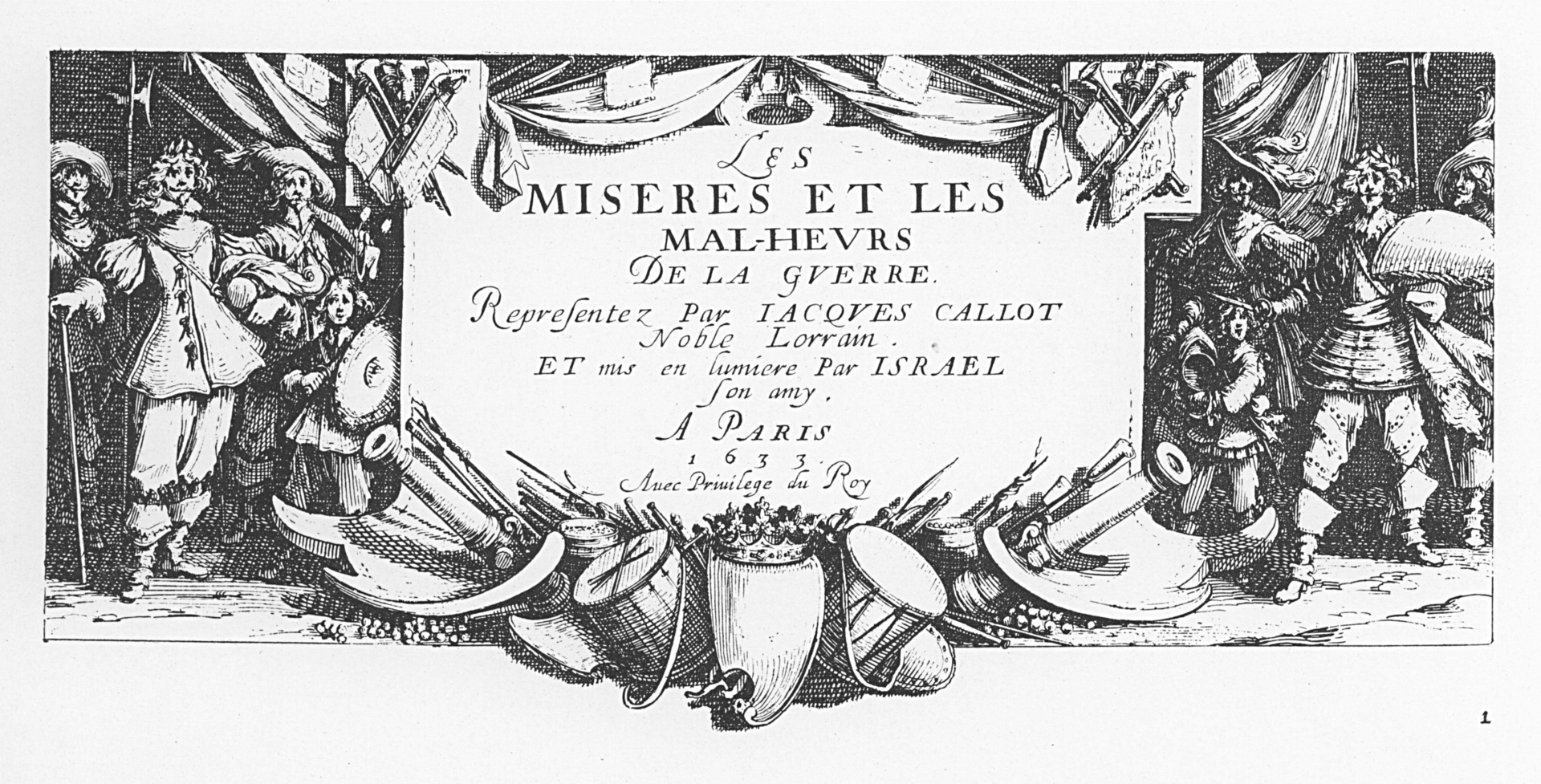
Les Miseres et les Mal-Heures de la Guerre runs, in the order etched and numbered on the plates themselves, from a frontispiece through the raising of an army, a battle, and then a run of plates on what victorious soldiers do to civilians once discipline breaks down: raiding a farm, pillaging a monastery, robbing travelers on the highway, burning a village. The back half of the sequence, plates 9 through 14, turns the same violence back on the soldiers themselves: their arrest, the strappado, the hanging shown here, the firing squad, and burning and breaking on the wheel. The final plates show a military hospital, dying men by the roadside, peasants taking their own revenge, and a closing scene of commanders being rewarded, a plate many readers of the series have found the most bitter of the eighteen precisely because nothing in it is punished.
Plate 11 is the fulcrum of that second half and, by wide agreement among dealers, museums and the print's own reputation, the single most reproduced and most frequently illustrated image from the entire series. Its place in the sequence matters to reading it correctly: it follows directly from the strappado of plate 10 and precedes the firing squad of plate 12, forming a triptych of military punishments rather than standing alone.
Lorraine, 1633, and the occupation behind the series
Callot was a native of Nancy, the capital of the independent duchy of Lorraine, at a moment when Lorraine's independence was ending. In 1633, the year this series was etched and published, French royal troops under Louis XIII occupied Nancy itself, a step in Cardinal Richelieu's absorption of the duchy that the Thirty Years War made possible. Callot did not merely witness this at a distance. According to an early biographical tradition, when the French court asked him to engrave a commemorative plate of the reduction of his own city, he refused, reportedly saying he would rather cut off his right hand than use it on such a work. That anecdote is carried by early encyclopedic sources rather than by a document in Callot's own hand, and is flagged here as such, but the occupation itself, and its date, are not in dispute.
The Miseries series was published in Paris the same year, with a royal privilege from the same king whose army had just taken Callot's home city. That is the tension a reader has to hold: the object was licensed by the power that occupied Lorraine, made by a Lorrainer, and shows the abuses of exactly the kind of army that had done the occupying, without a single plate naming a nationality, a campaign or a side.
Publication: Israel Henriet and the Paris edition
The series was etched by Callot and published in Paris by Israel Henriet (c. 1590-1661), who was not a casual business contact but a childhood friend from Nancy and the son of Claude Henriet, the court painter under whom Callot had received his earliest training in Lorraine. Henriet had established himself in Paris as a printmaker, print seller and publisher, and became, in effect, Callot's sole outlet there; the two men's Nancy origins and Henriet's father's role as Callot's first teacher are the reasons this was a publisher a war-displaced Lorraine artist could trust with his most politically pointed work.
Henriet's name appears etched directly into the plate of La Pendaison, Israel excud. cum privil. Reg., meaning published by Israel under royal privilege, in the earlier states. After Callot's death in 1635, Henriet continued to issue impressions from plates he had inherited or acquired, which is the origin of the print's long afterlife independent of its maker; his own death in 1661 passed that stock of plates on again. More than three hundred of Callot's original copper plates, from across his output, survive today at the Musee Historique Lorrain in Nancy, physical objects that can still, in principle, be reprinted.
States, and how a period impression is told from a later one
Lieure catalogues La Pendaison as number 1349, in three states. The first state, exceptionally rare, carries neither the six line verse nor a plate number. The second state adds Michel de Marolles's verse in the lower margin along with Henriet's Israel excud. imprint, which is the state this impression is closest to. The third state replaces that imprint with Callot inv. et fec., etched in after ownership of the plate passed on from Henriet's original arrangement. Early, well printed sets of the eighteen plates are generally found with the frontispiece in its third state and most interior plates, including this one, in their second, with the final plate alone reaching a fourth state; a plate this far along in its own state history was already being reprinted repeatedly within Callot's lifetime and shortly after it.
Separating a genuine seventeenth century impression from a later restrike of the same unaltered plate rests on the same evidence print connoisseurship always uses: the sharpness of the fine hatching that builds Callot's silvery distances, which coarsens visibly as a copper plate wears under repeated printing and rebiting; the paper itself, since a seventeenth century laid sheet differs in structure from later paper even before any watermark is legible; and the presence or absence of later published sets that reprinted the original Henriet plates well after Callot's death. This record has not undertaken paper or plate wear analysis of the Bechtel sheet itself; it states the general method rather than a conclusion about this specific impression, which the Museum's own uncertainty over its exact state already signals as a live question rather than a settled one.
The scholarly debate: indictment or accommodation
Two readings of this series have coexisted in the literature for decades and neither has retired the other. One, associated with the series' long popular reputation, treats it as the first sustained anti-war statement in European printmaking: eighteen plates that refuse heroism, refuse a named enemy, and dwell instead on what war does to the people caught inside it, civilian and soldier alike. The art historian Diane Wolfthal argued a more qualified version of this position in a 1977 Art Bulletin article on the series, and later, with a co-author, in a fuller study of Callot's military prints; H. Diane Russell's chapter on Callot's military work in the National Gallery of Art's 1975 Callot exhibition catalogue is the other point scholars return to on this question.
The competing reading notes that the second half of the series, plates 9 through 14 and this plate in particular, does not simply document cruelty; it shows the French military's own disciplinary code being enforced, thieves and looters punished by the same authority that licensed the series' publication. Read this way, the sequence can be seen as endorsing, or at minimum accommodating, the just, crime-punishing authority of the royal army that had just occupied the artist's own homeland, rather than condemning war as such. Recent commentary on the series describes its overall tone as ambivalent or impartial rather than as a clear moral verdict, a description this record adopts as the fairer summary of where the debate currently sits: the series depicts violence without an easy moral judgment attached to it, and plate 11 is the image in which that ambivalence is hardest to resolve, since it asks the viewer to read a hanging as both an atrocity and as justice being done, in the same six lines of verse.
No consensus resolves this, and this record does not arbitrate it. What can be said without dispute is that Callot, a Lorrainer who had just refused to commemorate his own city's fall, chose to close the middle of this series with an image of an army executing its own men, published under the license of the very crown that had taken Nancy.
Reception and afterlife
The gallows tree of plate 11 became one of the most borrowed images in the whole series. William Hogarth reused its silhouette, decades later and in a wholly different register, in his satirical print on the collapse of the South Sea Company, replacing Callot's condemned men with the ruined speculators of his own day; that print survives in public collections and documents the borrowing independently of any claim made here about Callot's original intent. The wider series, and this plate specifically, is regularly cited as a forerunner of Francisco Goya's Disasters of War nearly two centuries later, a lineage scholarship on both artists treats as well established even though Callot's restraint, small format and lack of a single named victim differ sharply from Goya's closer, more visceral focus.
The series' modern popularity rests on this plate more than on any other single image in it. It is the plate most frequently reproduced in survey texts on the history of war imagery, and the one most often illustrated when the series is mentioned in passing rather than studied plate by plate, which is itself worth noting: the series' reputation for pacifism is carried disproportionately by its single most punitive image.
Edwin De T. Bechtel and the 1957 bequest
Edwin DeTurck Bechtel (1880-1957) was a New York lawyer, not a professional art historian by training. Born in Bechtelsville, Pennsylvania, a town his own family had founded, he took a law degree at Harvard and practiced from 1911 to 1948 with the New York firm Carter, Ledyard and Milburn. Alongside that career he collected the prints of Jacques Callot and of Honore Daumier and wrote on both. His study Jacques Callot appeared from George Braziller in New York in 1955, two years before his death, in a printing limited to 750 copies, with 46 pages of text followed by 233 plates of illustration, an unusually large plate section for a text of that length and a sign of how much of the book's argument Bechtel was content to let the prints themselves carry.
Bechtel's public life ran well outside art history. He was president and board chairman of the New York Botanical Garden and chairman of the Horticultural Society of New York and of the International Flower Show, and won the Garden Club of America's Jane Righter Rose Medal in 1953; the Bechtel Rose Garden at the New York Botanical Garden was dedicated to his memory in 1972. He died at his home in Bedford, New York, on 4 July 1957. His will left his Callot and Daumier prints to the Metropolitan Museum of Art, the bequest recorded in the Museum's accession registers that same year and carried today on every sheet from his collection as the credit line Bequest of Edwin De T. Bechtel, 1957, including both Met impressions of this plate.
Market context, kept separate from this impression's own history
This impression did not pass through a sale; it came to the Museum by bequest, and no purchase price for it by Bechtel has been found in the sources consulted for this record. That silence is recorded as a gap, not filled with an estimate.
Separately, complete eighteen plate sets of the series, not this impression and not from this collection, do appear at auction with some regularity, generally in later, well used states and at prices in the low thousands of pounds or euros for a full run, reflecting both the size of the edition Henriet and his successors printed over more than two centuries and the fact that a complete set commands more than the sum of scattered single sheets. A single impression of this specific plate was entered for sale at Christie's, New York, on 2 November 1983 as lot 18 and did not sell. No further individual sale of this exact plate, isolated from a complete set, was located during this research. This market information describes the plate in general, not the Bechtel or Rogers Fund impressions specifically, and should never be read as a valuation of either.
The artist
Jacques Callot
Callot is one of the few printmakers of his century whose technical innovations are as well documented as his imagery. He worked almost entirely in etching rather than engraving, produced an unusually large body of work in a short life, and left behind a series on war that his native region's own occupation gave a weight beyond the ordinary print of the period. The facts below are drawn from his documented biography rather than from the connoisseurship debates that surround individual attributions in his oeuvre, since no attribution question attaches to this print.
Related works
| Work | Relation | Where it is |
|---|---|---|
| La Pendaison (The Hanging), plate 11, accession 57.650.417(11) Jacques Callot | A second impression of the identical plate, also from the Bechtel bequest, also second state Slightly larger sheet, 8.1 x 18.6 cm; no image published by the Museum. Evidence Bechtel owned more than one mounted set of the series. | Metropolitan Museum of Art, New York |
| La Pendaison (The Hanging), plate 11, accession 22.68.14 Jacques Callot | An unrelated Met impression of the same plate, uncut Rogers Fund, 1922, thirty five years before the Bechtel bequest. Uncut sheet, 10.5 x 21 cm. Named to prevent it ever being conflated with either Bechtel impression. | Metropolitan Museum of Art, New York |
| Les Grandes Miseres de la Guerre, La Pendaison Jacques Callot | Another impression of the same plate, ex-collection James Mayer de Rothschild Acquired by Rothschild in 1856, bequeathed within the family, given to the Louvre in 1935. Independently confirms Lieure 1349 and the plate's second/third state inscriptions. | Musee du Louvre, Paris |
| The Hanging Jacques Callot | Another impression of the same plate Bequest of Junius S. Morgan, Class of 1888. Independently confirms Lieure 1349. | Princeton University Art Museum |
| Frontispiece, from Les Miseres et les Mal-Heures de la Guerre Jacques Callot | Plate 1 of the same eighteen plate series The series' opening plate, used here for context only, not as this record's subject. | Reproduced from a Wikimedia Commons scan, public domain |
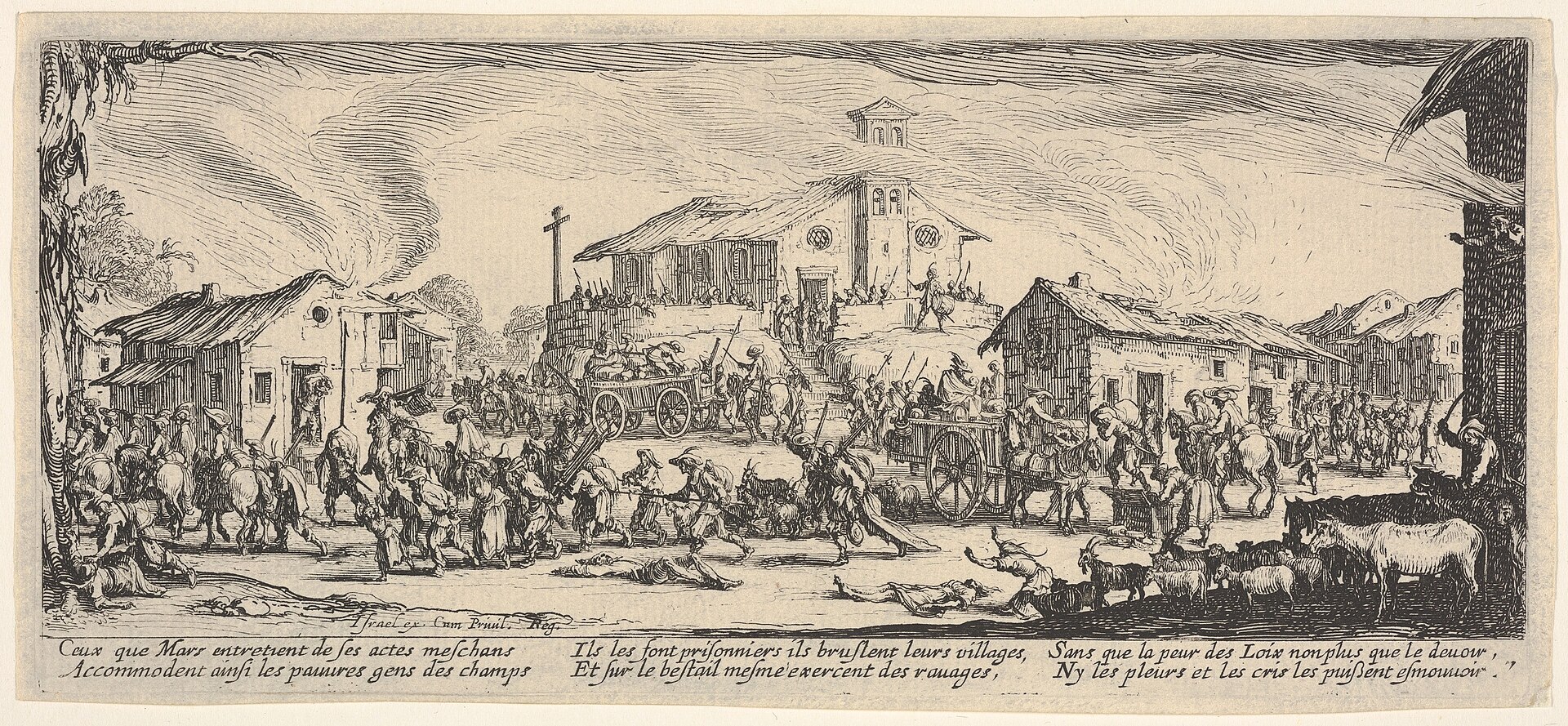
| Pillage and burning of a village, plate 7 Jacques Callot | A different plate in the same eighteen plate series Included as a gallery comparison only. This is plate 7, not plate 11, and is not the picture described in this record. | Metropolitan Museum of Art, New York (image via Wikimedia Commons) |
| Les Petites Miseres de la Guerre Jacques Callot | A different, earlier six plate series on the same general theme, c. 1632 Named here only to keep it separate from this record. No fact, date or dimension in this record is drawn from the Petites Miseres series. | Various collections |
Open questions
- Is this impression's trimming responsible for the Museum's own uncertainty over whether it is a first or second state, by removing or cropping the distinguishing verse text? Not established in the sources consulted.
- Where and from whom did Edwin De T. Bechtel acquire his Callot material, and what did he pay? No dealer, sale or price for this impression or its companion has been located.
- Why does La Pendaison fall at item 10 in one Bechtel-bequest album (57.650.404) and item 11 in another (57.650.417)? The one-item offset is unexplained in the Museum's public data.
- Does a documented fourth state of this specific plate exist, distinct from the fourth state recorded for plate 18 of the same series? Not confirmed for plate 11 in the sources consulted.
- What happened to this print, or to the Henriet stock of Miseries plates generally, between Callot's death in 1635 and Bechtel's twentieth century ownership? No chain of custody was located.
- Has any technical examination (paper analysis, plate wear comparison) been carried out on either Bechtel impression to confirm it as an impression printed within or close to Callot's lifetime rather than a later pull from the same unaltered plate? None was located during this research.
Questions about this object
What is La Pendaison (The Hanging), plate 11 from Les Miseres et les Mal-Heures de la Guerre?
La Pendaison (The Hanging), plate 11 from Les Miseres et les Mal-Heures de la Guerre is a print, dated 1633. Medium: Etching, second state of three (Lieure 1349); the Museum's own catalogue record for this impression is not fully decided between the first and second state.
Who made La Pendaison (The Hanging), plate 11 from Les Miseres et les Mal-Heures de la Guerre, and is the attribution settled?
The attribution to Jacques Callot is recorded here as accepted. Universally attributed to Jacques Callot and catalogued as his work in both standard raisonnes of his printed oeuvre: Edouard Meaume's 1860 catalogue (no. 574) and Jules Lieure's 1924-1929 catalogue raisonne (no. 1349). The plate itself carries an etched publisher's imprint, Israel excud. cum privil. Reg., in its first and second states, replaced by Callot inv. et fec. in the third state issued after Israel Henriet's ownership of the plate ended. No attribution dispute exists for this print or this series.
Where is La Pendaison (The Hanging), plate 11 from Les Miseres et les Mal-Heures de la Guerre now?
Metropolitan Museum of Art, New York, Department of Drawings and Prints, 57.650.404(10). Last confirmed 14 September 2026. Verified directly against the Met's open-access collection API (object 420826), which gives creditLine Bequest of Edwin De T. Bechtel, 1957, accessionNumber 57.650.404(10) and isPublicDomain true. Cross-checked against two other Met impressions of the same plate to rule out confusion: a second Bechtel-bequest impression, accession 57.650.417(11), object 416025, second state, no published image; and an unrelated 1922 acquisition, accession 22.68.14, object 420819, Rogers Fund, uncut sheet.
What is still unknown about La Pendaison (The Hanging), plate 11 from Les Miseres et les Mal-Heures de la Guerre?
Is this impression's trimming responsible for the Museum's own uncertainty over whether it is a first or second state, by removing or cropping the distinguishing verse text? Not established in the sources consulted.
Sources
- 1Metropolitan Museum of Art, Open Access Collection API, object 420826 (accession 57.650.404(10), La Pendaison/La Pendasion, plate 11, Bequest of Edwin De T. Bechtel, 1957). metmuseum.org/art/...
- 2Metropolitan Museum of Art, Open Access Collection API, object 416025 (accession 57.650.417(11), a second Bechtel-bequest impression of the same plate). metmuseum.org/art/...
- 3Metropolitan Museum of Art, Open Access Collection API, object 420819 (accession 22.68.14, Rogers Fund, 1922, an unrelated impression of the same plate). metmuseum.org/art/...
- 4Musee du Louvre, collections online, Les Grandes miseres de la Guerre: La Pendaison (Lieure 1349), with state, inscription and Rothschild provenance. collections.louvre.fr/en/...
- 5Princeton University Art Museum, The Hanging, from the series Les Grandes Miseres de la Guerre (Lieure 1349, Bequest of Junius S. Morgan). artmuseum.princeton.edu/art/...
- 6Annex Galleries Fine Prints, The Hanging, pl. 11, The Miseries and Misfortunes of War (state II/III, inscription transcription). annexgalleries.com/inventory/...
- 7Wikipedia, Les Grandes Miseres de la guerre. Tertiary source, used for the eighteen plate title list and general series context; flagged for replacement with a published catalogue raisonne entry. en.wikipedia.org/wiki/...
- 8New York Botanical Garden, finding guide to the Edwin DeTurck Bechtel Papers. nybg.org/library/...
- 9Social Networks and Archival Context (SNAC), biographical record for Bechtel, Edwin DeTurck, 1880-1957. snaccooperative.org/ark:/...
- 10AbeBooks listing for Bechtel, Edwin De T., Jacques Callot (Braziller, New York, 1955), confirming the 1955 publication, page and plate count and limited printing. abebooks.co.uk/Jacques-Callot-Bechtel-Edwin-T-Braziller/...
- 11Google Books record, Jacques Callot, New York: Braziller (1955), Edwin De Turck Bechtel. books.google.com/books/...
- 12Online Archive of California, finding aid for Callot (Jacques) Etchings, ca. 1615-1635, with biographical note on Callot's technique, output and on Israel Henriet. oac.cdlib.org/findaid/...
- 13Wikidata, Israel Henriet (Q3155663), biographical dates and occupations. wikidata.org/wiki/...
- 14Encyclopedia.com, Jacques Callot, biographical entry covering training, the Medici court and the 1633 refusal of the Nancy commission. encyclopedia.com/people/...
- 15Catholic Encyclopedia (New Advent), Jacques Callot, for the verbatim quotation on refusing to engrave the fall of Nancy. Tertiary, early twentieth century source; flagged for replacement with a modern scholarly biography. newadvent.org/cathen/...
- 16Wikimedia Commons, File:Les miseres et les malheurs de la guerre - 11 - La pendaison.png, imageinfo/extmetadata confirming public domain licensing and plate identification. commons.wikimedia.org/wiki/...
- 17Wikimedia Commons, File:Les Grandes miseres de la guerre, La Pendaison...GDUT1283.jpg (Petit Palais/Paris Musees), imageinfo/extmetadata confirming CC0 licensing and giving the Meaume 574 cross-reference. commons.wikimedia.org/wiki/...
- 18Wikimedia Commons, File:Plate 7- A town being sacked...MET DP833463.jpg, imageinfo/extmetadata confirming CC0 licensing and identifying the file as plate 7, not plate 11. commons.wikimedia.org/wiki/...
- 19University of Michigan, Bulletin of the University of Michigan Museum of Art, Just Violence: Jacques Callot's Grandes Miseres et Malheurs de la Guerre. Summary of the ambivalence reading of the series and its scholarly literature (Wolfthal, Russell); accessed via search summary after direct fetch was blocked, flagged for replacement with the primary text. quod.lib.umich.edu/b/...

,_GDUT1283.jpg)
_MET_DP833463.jpg)
Last verified 14 September 2026 · Published 14 September 2026
Change log
14 September 2026 - Record created at the house standard: researched narrative, technical evidence, maker dossier, graded provenance chain, prices with hammer and premium separated, related works, open questions and sources.