Yongle Dadian, juan 10,110-10,112 (Chester Beatty Library, C 1757)
The Hanlin Academy compilation project, under chief compilers Xie Jin and Yao Guangxiao (Daoyan) · 1562-1567 (this copy); text originally compiled 1403-1408
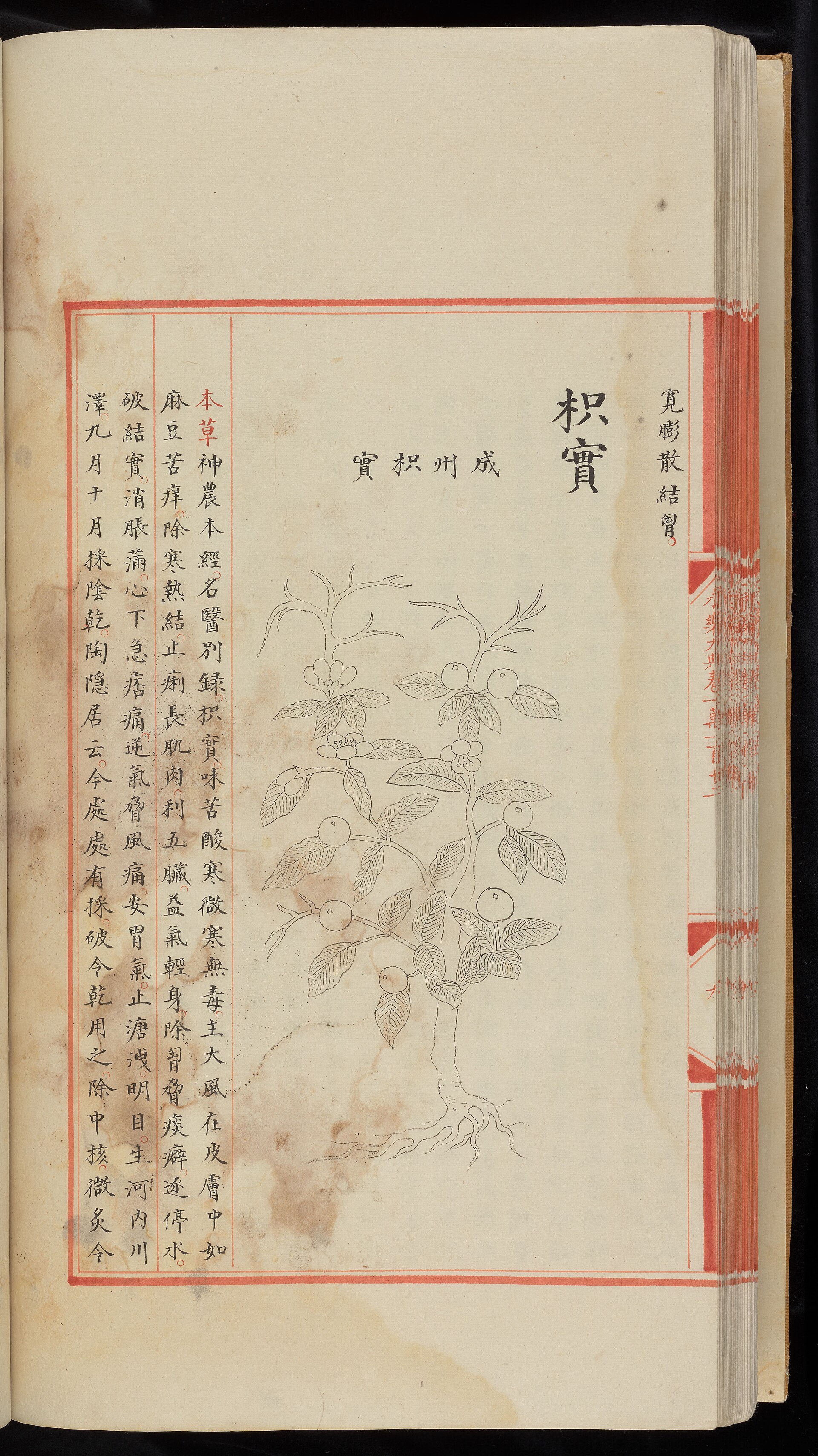
The record subject: a page from Chester Beatty Library C 1757 (juan 10,110-10,112), copied 1562-1567. Public domain, via the Chester Beatty Library's own online viewer.
| Artist | The Hanlin Academy compilation project, under chief compilers Xie Jin and Yao Guangxiao (Daoyan) |
|---|---|
| Date | 1562-1567 (this copy); text originally compiled 1403-1408 |
| Medium | Hand-copied text in red and black ink on Xuan paper, bound in yellow silk-covered boards |
| Dimensions | The edition's standard format is approximately 40.6 x 25.4 cm (Huntington Library volume, published measurement). Exact dimensions of this specific volume, C 1757, are not published in the sources consulted for this record. |
| Where it is now | Chester Beatty Library, Dublin, Irelandlast confirmed |
| Inventory number | C 1757 |
| Attribution | AcceptedThere is no single artist. Full note |
| Object type | Manuscript |
| Period | Chinese, Ming dynasty (Jiajing-Longqing reigns) |
| Cases | Has a provenance gap |
| Inscriptions | A red paper name-slip kept with the volume bears the characters read as "bai lai xi", believed to be a transliteration of the name of James Russell Brazier, into whose hands the volume passed after the Boxer Rebellion siege of 1900. |
| Owners on record | 7 links6 documented, 1 unknown |
| Sources | 15 cited |
About this record Last verified · 15 sources cited · Change log
On this page 9 sections
ContentsClose
One physical volume, three juan, out of the roughly 400 that survive from an encyclopedia that once ran to 11,095. It is not the 1408 original commissioned by the Yongle Emperor, which no longer exists in any form; it is part of a hand copy made in 1562-1567 on the order of the Jiajing Emperor, the only later emperor known to have actually used the book.
This particular volume, Chester Beatty Library C 1757, spent about three centuries in the Hanlin Academy library in Peking until Boxer forces set the Academy alight on 23 June 1900 during the siege of the Legations. It was taken from the ruins by a British customs official present at the siege, kept by his family for more than half a century, and sold to the mining magnate and collector Alfred Chester Beatty in London in September 1954 for 120 pounds sterling, together with a sibling volume. It has been in Dublin, on public view, ever since.
The corpus it belongs to is still being pieced back together: volumes continue to surface at auction and in private hands into the 2020s, and Chinese institutions are actively buying them back.
Provenance
Each link is graded. Documented: a cited source supports it. Disputed: the identification is argued but not established. Unknown: no owner for that span, and the gap is not smoothed into a narrative. The grades in the glossary.
- 1403 - 1408Ming imperial court (Yongle Emperor)documented
The text was compiled 1403-1408 by a project of some 2,169 scholars under Yao Guangxiao and Xie Jin, on the Yongle Emperor's orders. This original fine copy (zhengben) does not survive; no page of it has been identified since the Qing dynasty. Its fate is unknown.14
- 1562 - 1567Ming imperial court (Jiajing Emperor)documented
After a series of fires in the Forbidden City in the mid-16th century, the Jiajing Emperor ordered a full duplicate copy (fuben) made. This volume is part of that duplicate copy, not the lost 1408 original. Every surviving volume of the Yongle Dadian known today, at every institution, is understood to be from this Jiajing-Longqing copy.14
- 1567 - 1900Hanlin Academy library, Pekingunknown
No specific record of this volume's location or handling during this period was found in the sources consulted. It is assumed, on the basis of where it resurfaced, to have remained in the Hanlin Academy library, but the volume is not individually documented before 1900.4
- 1900-06-23 - 1900James Russell Brazierdocumented
On 23 June 1900, forces under General Dong Fuxiang set fire to the Hanlin Academy during the siege of the Legations. A mixed party of British and American marines and Customs volunteers entered and put out the fire; volumes of the encyclopedia not destroyed were subsequently taken by individuals present. David Helliwell's provenance research traces this volume, together with its sibling C 1756 (juan 803-806), to James Russell Brazier, at the time Chief Secretary of the Inspectorate of the Imperial Maritime Customs and present at the siege.1
- 1900 - 1954-09-21James Russell Brazier, then his son Col. William Russell Brazierdocumented
The volume, with its sibling, remained with the Brazier family for 54 years. James Russell Brazier gave a separate single volume (juan 11907) to his alma mater, the University of Aberdeen, in 1922. This pair passed to his son, William Russell Brazier, born in Aberdeen in 1897, who sold them in 1954. The exact date and manner of the transfer between father and son is not documented in the sources consulted.1
- 1954-09-21 - 1954-09-22Sir Alfred Chester Beattydocumented
Col. Brazier brought the two volumes (C 1756 and C 1757) to the British Museum's Department of Oriental Printed Books and Manuscripts intending to sell them to a dealer for 100 pounds. H.C. Lowe of that department, also an advisor to Chester Beatty, offered 110 pounds; Brazier asked for 120 and Lowe agreed on the spot, by telephone, the same morning, 21 September 1954. Chester Beatty's secretary John Wooderson collected the volumes from the British Museum the following day. The transaction is documented in two letters in the Chester Beatty Library Archives (Chester Beatty Papers 474).1
- 1954 - presentChester Beatty Library, Dublindocumented
In the collection of Alfred Chester Beatty at his private library on Shrewsbury Road, Dublin, from 1954. On Beatty's death in 1968 the library and its collection passed, per his bequest, to the Irish nation as a public institution, now housed at Dublin Castle since 2000.1610
Technical evidence
| Attribution note | There is no single artist. The text was assembled by a state compilation project of some 2,169 scholars working under the nominal general editorship of the monk-advisor Yao Guangxiao (Daoyan) and the Hanlin academician Xie Jin, on the direct orders of the Yongle Emperor, 1403-1408. The physical object catalogued here is not that 1408 manuscript, which no longer exists, but a hand copy of it made in 1562-1567 on the order of the Jiajing Emperor. No individual copyist, scribe or calligrapher is named in the sources consulted for this record; the copy is anonymous, produced by the Hanlin Academy scriptorium. |
|---|---|
| Support | Fine white Xuan paper, described by the Qing scholar Zhang Tingyu as retaining the fragrance of antiquity in both paper and ink.4 |
| Script and ink | Hand-copied in the formal palace 'Academy Style' (guangeti / taigeti) calligraphy associated with the early Ming court calligrapher Shen Du. Red ink for author names, book titles, punctuation marks, borderlines and running heads; black ink for the main text, in three graduated point sizes for text, commentary, and comments on commentary.4 |
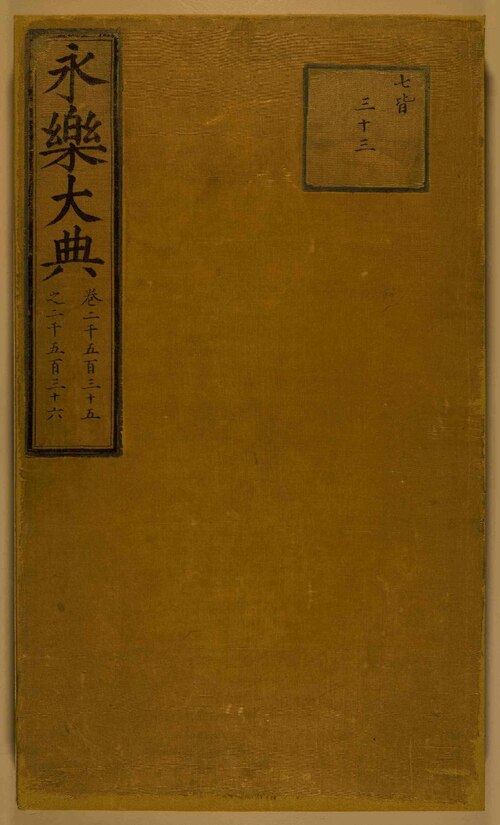
| Binding | Boards covered in yellow silk brocade, in the standard format for the edition; stored in sets of ten volumes to a protective wrapper (tao). This volume's silk covers appear original; the boards beneath have become limp with age.14 |
| Format | One physical volume (ce) containing three juan, numbered 10,110 to 10,112. Its sibling volume, purchased in the same 1954 transaction and also at the Chester Beatty Library (C 1756), contains four juan, 803 to 806.1 |
| Condition | Water damage and mould spreading from the spine towards the foredge of the leaves, consistent with the volume having stood on its lower edge when doused with water, plausibly during the 1900 fire-fighting.1 |
| Provenance marker | A red paper name-slip kept with the volume bears the characters read as 'bai lai xi', believed to transliterate the name of James Russell Brazier.1 |
| Classification system | Text is arranged not alphabetically but by rhyme category, keyed to the last character of a term, using the Correct Rhymes of the Hongwu Era, a rhyming dictionary compiled in 1375. A 60-fascicle index accompanied the complete work as a finding aid.4 |
| Standard page format | Approximately 40.6 x 25.4 cm, per the published measurement of the comparable Huntington Library volume; the exact dimensions of this specific volume are not published in the sources consulted.4 |
Images
The record in full
Chapter 1One volume out of eleven thousand
The Yongle Dadian was compiled between 1403 and 1408 on the order of the Yongle Emperor of the Ming dynasty: a state attempt to copy out, in full or in part, essentially every book then held in the...
The Yongle Dadian was compiled between 1403 and 1408 on the order of the Yongle Emperor of the Ming dynasty: a state attempt to copy out, in full or in part, essentially every book then held in the imperial library, arranged not alphabetically but by rhyme category, so that a reader could search by the sound of the last character of a term. Completed, it ran to 22,877 juan (chapters), bound into 11,095 physical volumes (ce), and comprised, on one scholarly estimate, around 370 million characters. Nothing else made in the pre-modern world approached its scale.
That original fine copy no longer exists. What survives, in scattered pieces across more than thirty collections in about eight countries, is a small fraction of a duplicate copy made a century and a half later. This record is about one physical volume of that duplicate: Chester Beatty Library C 1757, containing juan 10,110 to 10,112, now in Dublin. It is not the 1408 original. No volume anywhere claiming to be the 1408 original has been authenticated; the object described here, like every other surviving Yongle Dadian volume in every institution that holds one, is understood by its own holding institution's cataloguing to date from 1562-1567.
Chapter 2Why it was made
The Yongle Emperor's own preface, recorded in the Ming Veritable Records, states the ambition plainly: to gather the scattered contents of every book, ancient and modern, into one arrangement, so...
The Yongle Emperor's own preface, recorded in the Ming Veritable Records, states the ambition plainly: to gather the scattered contents of every book, ancient and modern, into one arrangement, so that a reader could trace anything as easily as shooting a swan with one's bow, and that nothing will remain hidden once you open up the pages of this book. He had already rejected one attempt, an earlier compilation by Xie Jin called A Grand Compendium of Literary Sources, as insufficiently exhaustive, and ordered it done again on a far larger scale.
The scholar Duncan Campbell has argued, citing the contemporary Ming writer Sun Chengze, that the project cannot be read only as a scholarly ambition. The Yongle Emperor had seized the throne from his nephew, the Jianwen Emperor, in a campaign he called 'calming a troubled age', and followed the coup with a purge in which his predecessor's chief advisor was executed and some 870 of his associates put to death. Sun Chengze's near-contemporary account holds that the emperor used the compilation project, in part, to occupy and pacify a scholar-official class he had reason to distrust, and to present himself as a patron of learning rather than a usurper. This is Campbell's argument, made in a citable peer-reviewed publication; it is not universally repeated in general accounts of the encyclopedia, which more often present the project simply as an act of Confucian cultural patronage.
Chapter 3How it was made
Some 2,169 scholars worked on the project under the nominal general editorship of the monk and advisor Yao Guangxiao, known by his clerical name Daoyan, and the Hanlin academician Xie Jin, with the...
Some 2,169 scholars worked on the project under the nominal general editorship of the monk and advisor Yao Guangxiao, known by his clerical name Daoyan, and the Hanlin academician Xie Jin, with the bulk of the actual editorial work carried out by men including Hu Yan, Liu Jichi and Chen Ji. Existing books held in the imperial library, the Pavilion of Literary Profundity, were copied out, broken into their constituent passages, and reassembled under the rhyme category of the last character of the relevant chapter heading, using a rhyme dictionary called the Correct Rhymes of the Hongwu Era, compiled in 1375 on the order of Yongle's father. A 60-fascicle index was provided as a finding aid.
Neither Xie Jin nor Chen Ji fared well afterward: Xie Jin was executed and Chen Ji imprisoned, in the years following the encyclopedia's completion, for reasons connected to court politics rather than to the project itself. No individual scribe who worked on the later 1562-1567 copy, the version this volume belongs to, is identified in any source consulted for this record.
Chapter 4The original that vanished
Nobody living today has seen the 1408 fine copy, and not one page of it has been identified since the fall of the Ming dynasty.
Nobody living today has seen the 1408 fine copy, and not one page of it has been identified since the fall of the Ming dynasty. The most likely explanation is that it was lost or destroyed during the fighting of 1644-45, when Peking and then Nanking fell first to the rebel army of Li Zicheng and then to the invading Manchu forces that founded the Qing dynasty; but its exact location and fate at that moment are not recorded, and Duncan Campbell notes that the completeness and suddenness of its disappearance, without even bureaucratic trace, points to deliberate concealment of the loss by those responsible for it, as much as to the loss itself.
A second, more colourful explanation circulates: that the Jiajing Emperor, who alone among later emperors is known to have actually consulted the book, ordered the original buried with him when he died in December 1566. This claim originates with the writer Zhang Chenshi in his Anecdotes about the Yongle Encyclopaedia, and Campbell describes it as almost certainly apocryphal. No excavation or documentary evidence supports it. It is included here as a proposal attributed to a named source, not as an established fact.
What is certain is the copy that was made instead. After fires in the Forbidden City in the mid-16th century threatened the imperial libraries, the Jiajing Emperor ordered a full duplicate, the fuben, transcribed from the original. It took from 1562 to 1567 to complete, finishing only months after the emperor's own death. Every volume known to survive today, at every institution that holds one, is part of this Jiajing-Longqing duplicate. The Chester Beatty volume is dated by its own holding institution, in the Wikimedia Commons record of the leaf reproduced here, to exactly this window: 1562-1567.
Chapter 5Two catastrophes, and how the loss is apportioned
The duplicate copy did not fare much better than the original.
The duplicate copy did not fare much better than the original. By 1875 it had already been reduced from around 11,000 volumes to about 5,000, a loss generally attributed to the Anglo-French occupation of Peking during the Second Opium War in 1860, when British and French soldiers are recorded to have taken sections of the manuscript as souvenirs alongside destruction and fire. By 1894, on the numbers most commonly cited, only around 800 volumes remained in the Hanlin Academy library in Peking. Fewer than 400 volumes survive worldwide today, across all institutions.
The 1900 event most associated with the encyclopedia's destruction is the burning of the Hanlin Academy on 23 June, during the siege of the Foreign Legations in the Boxer Rebellion. Troops under General Dong Fuxiang set fire to the Academy buildings, immediately adjacent to the British Legation, apparently hoping the wind would carry the flames into the Legation compound itself. A mixed force of British and American marines and Imperial Maritime Customs volunteers, together with the journalist George Ernest Morrison and others, breached the Academy wall and fought the fire; contemporary accounts record that volumes of the encyclopedia had already been used by combatants on both sides to build barricades. Once the fire was under control, several of those present took surviving volumes away as personal souvenirs, including the man who later held the volume described in this record.
Two framings of this loss coexist in the scholarship, and this record gives both rather than choosing between them. The framing more common in general and Chinese-language accounts holds the 1860 and 1900 foreign interventions chiefly responsible for the destruction and dispersal of the corpus. Duncan Campbell, in the peer-reviewed source cited throughout this record, argues that this is, in his words, a 'convenient and nationalistic attribution' that is 'simplistic and far from the truth of the matter': on his reading, the numbers already show the bulk of the loss, from roughly 11,000 volumes down to around 800, had occurred by 1894, well before the Boxer Rebellion, through the ordinary neglect, mismanagement, and internal pilferage that afflicted large imperial book collections across the Qing dynasty generally. The 1900 fire and its aftermath, on this view, accounts for only the final and smallest fraction of a loss that was already close to total.
Chapter 6This volume: from the ruins to a customs officer
The provenance of Chester Beatty Library C 1757, together with its sibling volume C 1756 (juan 803-806), has been traced by the bibliographer David Helliwell to James Russell Brazier, who at the time...
The provenance of Chester Beatty Library C 1757, together with its sibling volume C 1756 (juan 803-806), has been traced by the bibliographer David Helliwell to James Russell Brazier, who at the time of the siege was Chief Secretary of the Inspectorate of the Imperial Maritime Customs, and who was present in the Legation Quarter throughout. Helliwell states plainly that 'the provenance of all three volumes' obtained by Brazier during the siege 'can thus be traced to the Siege' of 1900. Brazier gave one further volume he had obtained, juan 11,907, to his alma mater, the University of Aberdeen, in 1922.
A red paper name-slip still kept with this volume bears characters read as 'bai lai xi', understood to be a Chinese transliteration of Brazier's own name. The volume's silk-covered tao, or protective wrapper, along with its sibling's, is of a construction and labelling that suggests it was made in Peking, consistent with having remained in China, in Brazier family hands, for some time after 1900 rather than being immediately rebound in Britain.
Chapter 7Fifty-four years, then a phone call
The two volumes passed to Brazier's son, William Russell Brazier, born in Aberdeen in 1897 and known in later correspondence as 'Col.
The two volumes passed to Brazier's son, William Russell Brazier, born in Aberdeen in 1897 and known in later correspondence as 'Col. Brazier'. In September 1954 he brought both volumes to the British Museum's Department of Oriental Printed Books and Manuscripts, intending to sell them to the dealers Kegan Paul & Co. for 100 pounds.
What happened next is recorded in a letter, preserved in the Chester Beatty Library Archives, written the same day by H.C. Lowe, a curator in that department and also an outside advisor to Chester Beatty: 'Col. Brazier walked into the Dept. this morning when by luck I was in Mac's room; he was just on his way to K. and P., to sell those two vols of the Chinese Encyclopedia for 100 pounds. I said I could offer him a better price at 110 pounds, he said he would feel happier at 120, so at this price we closed; he was happy, and SO WAS I.' A second letter, dated the following day, records that Chester Beatty's secretary, John Wooderson, collected the two volumes from the British Museum at noon on 22 September 1954.
120 pounds in September 1954 sits, by a rough and disclosed method only, somewhere in the range of three to four months' pay for an average UK worker at the time: the Bank of England's 'Three Centuries of Data' series gives average UK weekly earnings of 5.60 pounds in 1950 and 8.90 pounds in 1959, and a straight-line interpolation between those two published figures puts 1954 earnings at somewhere around 7 pounds a week. That is a period-appropriate order of magnitude only, not a precise contemporary figure, and it should be read as such.
Chapter 8The collector and the library that holds it now
Alfred Chester Beatty was born in New York in 1875, made a fortune as a mining engineer and consulting geologist across the American West and Mexico, and was known in the business press as the 'King...
Alfred Chester Beatty was born in New York in 1875, made a fortune as a mining engineer and consulting geologist across the American West and Mexico, and was known in the business press as the 'King of Copper'. He built his personal library of Asian, Middle Eastern and Western manuscripts, papyri and miniatures over decades in London, then, in May 1950, at the age of 75, moved himself and his collection to Dublin, a relocation that reportedly caused consternation in London and delight in Ireland. In 1957 he became the first person granted honorary Irish citizenship, a distinction created for him under the Irish Nationality and Citizenship Act of 1956, and which he called the proudest moment of his life.
He bought this volume, with its sibling, in London three years before that citizenship was conferred, while still assembling the collection that would become a public bequest. On his death in Monte Carlo in January 1968, he was given a state funeral at St Patrick's Cathedral in Dublin, the first private citizen and the first person born outside Ireland to be so honoured. His library and collection passed to the Irish state, and now form the Chester Beatty Library, a public museum on the grounds of Dublin Castle since 2000, and European Museum of the Year in 2002.
Chapter 9What the volume looks like
Volumes of this edition are written by hand in two colours of ink, red for author names, book titles, punctuation marks and the ruled borders and running heads, black for the body text, in three...
Volumes of this edition are written by hand in two colours of ink, red for author names, book titles, punctuation marks and the ruled borders and running heads, black for the body text, in three graduated sizes of the formal 'Academy Style' court calligraphy associated with the early Ming calligrapher Shen Du. They are copied onto fine white Xuan paper and bound, in the standard format, in boards covered with coarse yellow silk brocade; the standard page measures approximately 40.6 by 25.4 centimetres.
Chester Beatty Library C 1757 shows condition problems consistent with a hard survival: water damage and mould spread from the spine towards the outer edge of the leaves, suggesting to Helliwell that the volume was at some point stored or exposed while standing on its lower edge and doused with water, plausibly during the firefighting of 1900 itself. The yellow silk covers appear to be original to the volume, though the supporting boards beneath them have become limp. No formal conservation report for this specific volume was located in the sources consulted for this record.
Chapter 10A pattern, repeated at other institutions
This volume's path, a volume grabbed from the Hanlin ruins by a foreign national present at the siege, kept in a family for decades, then sold or given to an institution, recurs closely enough across...
This volume's path, a volume grabbed from the Hanlin ruins by a foreign national present at the siege, kept in a family for decades, then sold or given to an institution, recurs closely enough across the surviving corpus that it amounts to a documented pattern rather than an isolated story. Lancelot Giles, son of the sinologist Herbert Giles and himself present at the siege, wrote in his own diary that after the Hanlin library was 'almost entirely destroyed', he 'secured volume 13,345 for myself, merely as a specimen'; that volume is now at the Library of Congress. He kept a second volume, juan 16,343-16,344, which his father presented to Cambridge University Library on his behalf in April 1901, where it remains today, catalogued as manuscript FH.20.71.
An American missionary, Joseph L. Whiting, picked a volume, juan 10,270-10,271, out of the same debris and used it to barricade a window during the siege; it travelled home with him, was donated to the Huntington Library in California by his daughter in 1968, and was not recognised for what it was until 2014. All three men were present in the besieged Legation Quarter in the same weeks as James Russell Brazier.
Chapter 11Piecing the corpus back together
Interest in relocating and reuniting the scattered volumes is not new.
Interest in relocating and reuniting the scattered volumes is not new. The librarian Yuan Tongli conducted an early census of known surviving volumes, completed in 1928, and corresponded directly with private owners, including the collector Wilfred Merton, offering photostat exchanges from the National Library of Peiping's own holdings in return for copies of volumes in private hands; that correspondence survives in the Chester Beatty Library's own archives, concerning a different volume the library later acquired. In 1951 two volumes were returned to the National Library of China from the Department of East Asian Studies at Leningrad University, by way of a gift to the new government's Ministry of Culture.
The search continues into the present decade. Volumes have surfaced in Shandong province in 1983, at the University of Aberdeen in 1997, in Canada in private hands more recently, and, most recently documented, at a French auction house in May 2020, when two further volumes, covering juan 2,268-2,269 and 7,391-7,392, were bought privately by the collector Jin Liang because Chinese public institutions cannot bid at foreign auction; after clearing export approvals and customs, they were formally donated to the Hangzhou branch of the China National Archives of Publications and Culture in July 2026. In January 2026 the National Library of China Publishing House unveiled a new facsimile edition of the Jiajing-Longqing copy, reproduced on handmade Xuan paper with high-precision colour printing, intended, in the words of its project director Xu Haiyan, to be 'the closest we can get to touching what was lost'. The Library of Congress separately completed digitisation of its own 41 volumes in 2023, publishing them online with no known copyright restrictions.
Chapter 12What is still unresolved
The fate of the 1408 original remains genuinely unknown, and the burial legend attached to it is flagged in the scholarship itself as unproven.
The fate of the 1408 original remains genuinely unknown, and the burial legend attached to it is flagged in the scholarship itself as unproven. The precise custody of this particular volume between 1900 and 1954, within the Brazier family, is not documented beyond the fact that both father and son at different times possessed it. No source consulted for this record states which rhyme category or which underlying text juan 10,110-10,112 actually preserves, a gap a specialist reader would expect this record to close and cannot.
Even the basic count of what survives is not fully settled: the National Library of China's own holdings are given as 221 volumes in one 2023 source and as considerably more in looser recent summaries, a discrepancy this record has not been able to resolve, and one made more unstable by the fact that volumes are still actively being repatriated. What is settled is smaller and more solid: this one volume, its condition, and the names of the men who carried it out of Peking in 1900, sold it in a phone call in 1954, and bought it.
The artist
The Hanlin Academy compilation project: Yao Guangxiao (Daoyan) and Xie Jin, chief compilers, and the anonymous Jiajing-era scriptorium that copied this volume
There is no single artist to attach to this object, and treating it as though there were would misrepresent it. The text was produced by a state project of more than two thousand scholars; the physical volume in this record was produced, more than a century and a half later, by copyists whose names are not recorded in any source consulted for this record. What can be documented is the small group of men who directed the original compilation, and what happened to two of them afterward, which says something about the political weather the project was made in.
Related works
| Work | Relation | Where it is |
|---|---|---|
| Yongle Dadian, juan 803-806 (Chester Beatty Library, C 1756) Hanlin Academy scriptorium (Jiajing-Longqing copy) | Sibling volume, purchased in the same transaction from Col. William Russell Brazier on 21 September 1954 Bought together with the volume in this record for a combined 120 pounds. | Chester Beatty Library, Dublin |
| Yongle Dadian, juan 16,343-16,344 (Cambridge University Library, MS FH.20.71) Hanlin Academy scriptorium (Jiajing-Longqing copy) | Also removed from the Hanlin Academy during the same 1900 siege Presented by Herbert A. Giles on behalf of his son Lancelot Giles, 16 April 1901. | Cambridge University Library |
| Yongle Dadian, juan 13,344-13,345 (Library of Congress) Hanlin Academy scriptorium (Jiajing-Longqing copy) | Removed from the same Hanlin ruins in the same week Lancelot Giles wrote in his diary that he 'secured volume 13,345 for myself, merely as a specimen'. | Library of Congress, Washington DC |
| Yongle Dadian, juan 10,270-10,271 (Huntington Library, RB 645576) Hanlin Academy scriptorium (Jiajing-Longqing copy) | Also taken from the Hanlin ruins in 1900, by a different foreign national present at the siege Taken by the missionary Joseph L. Whiting to barricade a window during the siege; donated by his daughter in 1968, identified as authentic only in 2014. | Huntington Library, San Marino, California |
| Yongle Dadian, juan 2,535-2,536 Hanlin Academy scriptorium (Jiajing-Longqing copy) | A different surviving volume, illustrating the edition's standard physical form Digitised through the World Digital Library; in the public domain. | National Library of China |
| Yongle Dadian, juan 2,268-2,269 ('Hu') and 7,391-7,392 ('Sang') Hanlin Academy scriptorium (Jiajing-Longqing copy) | Two further volumes, most recently repatriated to China Surfaced at a French auction house in May 2020; privately purchased and donated by the collector Jin Liang; formally donated July 2026. | China National Archives of Publications and Culture, Hangzhou branch |
Open questions
- What became of the 1408 original (the zhengben)? Its loss around 1644-45 is the best-supported explanation but is not documented at the moment of loss; the story that it was buried with the Jiajing Emperor is explicitly labelled apocryphal by the scholar who reports it.
- How exactly did this volume pass from James Russell Brazier to his son William Russell Brazier, and where was it kept between 1900 and 1954? No continuous chain of custody is published.
- What text does juan 10,110-10,112 actually preserve, and under which of the encyclopedia's rhyme categories does it fall? Not stated in any source consulted for this record.
- Was any export formality required to move the volume from London to Dublin in September 1954? No customs or export record was located.
- What is the current, reconciled total of surviving Yongle Dadian volumes worldwide? Recent sources give figures from just over 400 to 'more than 400 across 30-plus collections', and the National Library of China's own count is given as 221 in one 2023 source; ongoing repatriations, including the 2026 Hangzhou donation, make this a moving target rather than a settled figure.
- Has Chester Beatty Library published a formal conservation or condition report on C 1757 specifically? None was located for this record.
Questions about this object
What is Yongle Dadian, juan 10,110-10,112 (Chester Beatty Library, C 1757)?
Yongle Dadian, juan 10,110-10,112 (Chester Beatty Library, C 1757) is a manuscript, dated 1562-1567 (this copy); text originally compiled 1403-1408. Medium: Hand-copied text in red and black ink on Xuan paper, bound in yellow silk-covered boards.
Who made Yongle Dadian, juan 10,110-10,112 (Chester Beatty Library, C 1757), and is the attribution settled?
The attribution to The Hanlin Academy compilation project, under chief compilers Xie Jin and Yao Guangxiao (Daoyan) is recorded here as accepted. There is no single artist. The text was assembled by a state compilation project of some 2,169 scholars working under the nominal general editorship of the monk-advisor Yao Guangxiao (Daoyan) and the Hanlin academician Xie Jin, on the direct orders of the Yongle Emperor, 1403-1408. The physical object catalogued here is not that 1408 manuscript, which no longer exists, but a hand copy of it made in 1562-1567 on the order of the Jiajing Emperor. No individual copyist, scribe or calligrapher is named in the sources consulted for this record; the copy is anonymous, produced by the Hanlin Academy scriptorium.
Where is Yongle Dadian, juan 10,110-10,112 (Chester Beatty Library, C 1757) now?
Chester Beatty Library, Dublin, Ireland. Inventory number C 1757. Last confirmed 12 August 2026. Purchased by Sir Alfred Chester Beatty, through his advisor H.C. Lowe of the British Museum, from Col. William Russell Brazier, 21 September 1954.
What is still unknown about Yongle Dadian, juan 10,110-10,112 (Chester Beatty Library, C 1757)?
What became of the 1408 original (the zhengben)? Its loss around 1644-45 is the best-supported explanation but is not documented at the moment of loss; the story that it was buried with the Jiajing Emperor is explicitly labelled apocryphal by the scholar who reports it.
Sources
- 1David Helliwell, 'Holdings of Yongle dadian in European Libraries', revised 14 April 2021. The single most detailed published provenance census of the European holdings, drawing on Chester Beatty Library archives, Cambridge University Library, University of Aberdeen and other institutional records. serica.blog/wp-content/...
- 2Note: the uploaded filename reads 'C 1751' but the image's own description text and the linked CBL viewer URL both read 'C 1757'; this record follows the viewer URL and description text as the more specific identifier and flags the filename discrepancy for the editor. commons.wikimedia.org/wiki/...
- 3Chester Beatty Library online image viewer, item C_1757. viewer.cbl.ie/viewer/...
- 4Duncan M. Campbell, 'The Huntington Library's Volume of the Yongle Encyclopaedia (Yongle Dadian): A Bibliographical and Historical Note', East Asian History, no. 42. Peer-reviewed bibliographical and historical study, the source for the compilation process, the Jiajing recopy, physical format, and a direct critique of the standard loss narrative. eastasianhistory.org/42/...
- 5Library of Congress, 'About this Collection', Yongle Da Dian digital collection. States the Library's 41 volumes are from the 1562-1567 Jiajing-Longqing hand copy, 'mainly inconsecutive', acquired in the early 20th century by purchase and donation. loc.gov/collections/...
- 6Library of Congress Newsroom, 'Library of Congress Completes Digitization of Yongle Encyclopedia, Largest Reference Work of Pre-Modern Era', 9 May 2023. newsroom.loc.gov/news/...
- 7Wikipedia, 'Yongle Encyclopedia'. en.wikipedia.org/wiki/...
- 8Global Times, 'Two volumes of "world's largest encyclopedia" return to China after century abroad', July 2026. Reports the private purchase, repatriation and July 2026 donation of two further volumes (juan 2268-2269 and 7391-7392) surfaced at a French auction house in May 2020. globaltimes.cn/page/...
- 9China Daily, 'The return of Yongle Dadian', 23 January 2026. Reports the National Library of China Publishing House's facsimile edition of the Jiajing-Longqing copy, unveiled January 2026. chinadaily.com.cn/a/...
- 10Wikipedia, 'Alfred Chester Beatty'. en.wikipedia.org/wiki/...
- 11China Daily (regional), 'China boosts ancient book preservation with modern technology', 6 March 2023. States the National Library of China holds 221 volumes, and describes the Yongle Canon HD Images Database released February 2023. chinadaily.com.cn/a/...
- 12Cornell Chronicle, 'Talk to describe conserving centuries-old Chinese encyclopedia', September 2022. Describes the Library of Congress conservation and digitization programme (41 volumes) and Cornell University's own five volumes and their donors. news.cornell.edu/stories/...
- 13Retrowow, 'How much did people earn in the 1950s?', citing the Bank of England 'Three Centuries of Data' dataset for average UK weekly wages in 1950 (5.60 pounds) and 1959 (8.90 pounds). Used, with the method disclosed in the text, to give an order-of-magnitude sense of the 1954 sale price. retrowow.co.uk/social_history/...
- 14Wikimedia Commons file description and , 'Yongle Encyclopedia(2535-2536).pdf', sourced from the World Digital Library, crediting the National Library of China and dated 1403-1408 by the uploader (the volume itself, per the Library of Congress's own cataloguing convention for the same WDL item, is part of the Jiajing-Longqing copy rather than the lost original). commons.wikimedia.org/wiki/...
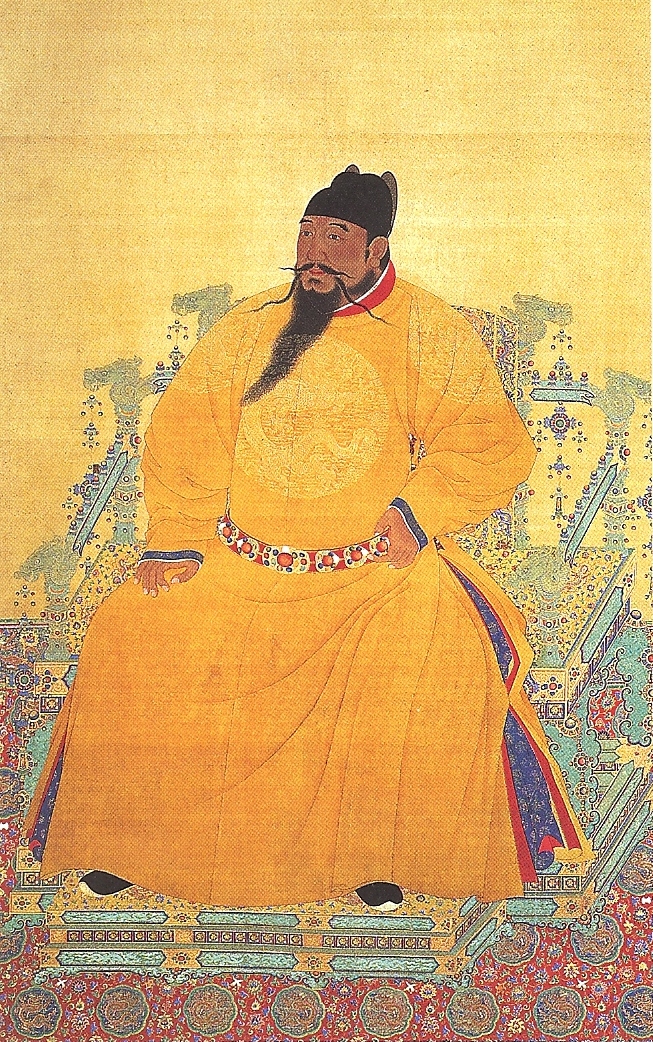
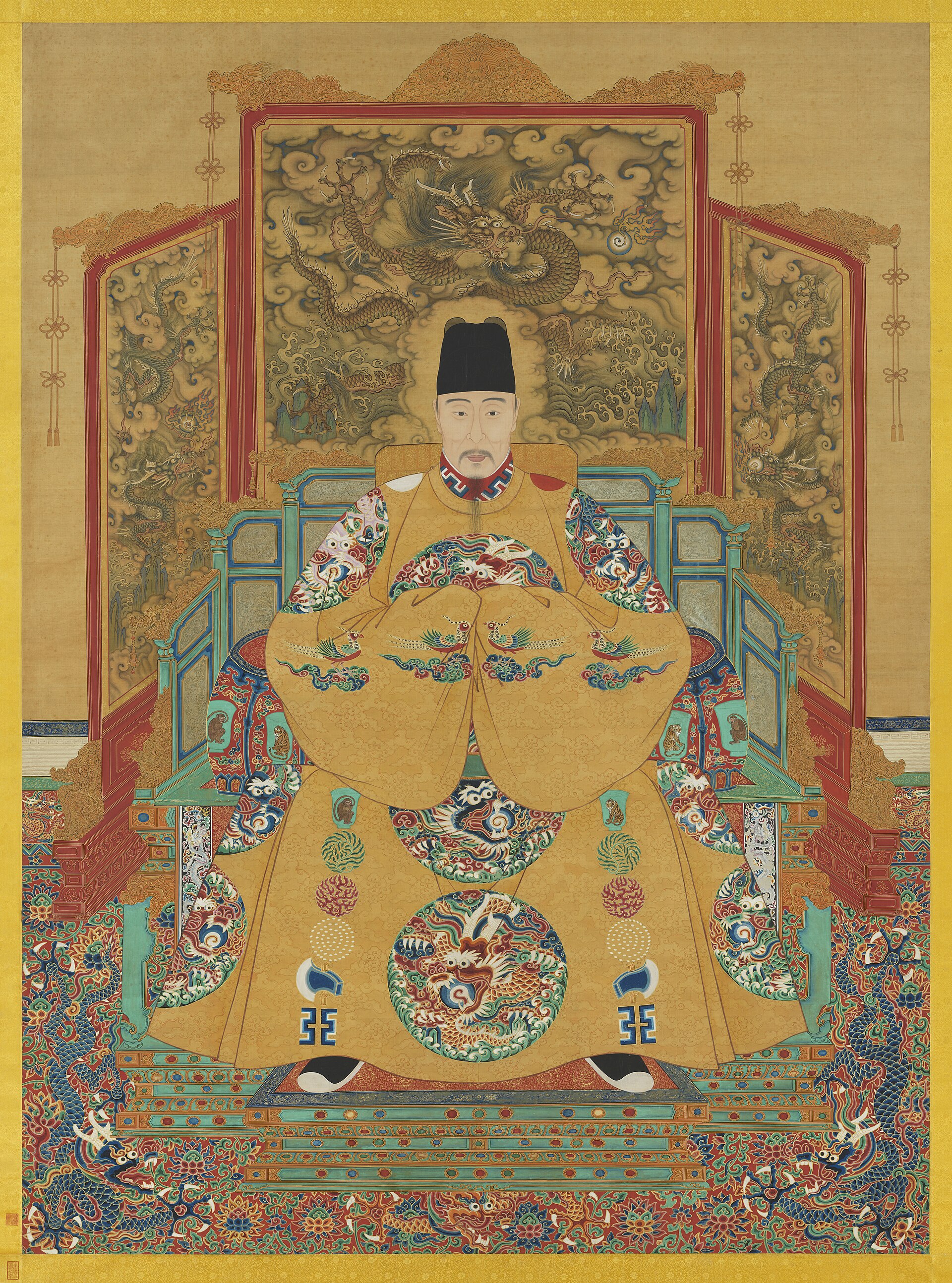
- 15Wikimedia Commons file descriptions for 'Yongle Emperor portrait.jpg' and 'Portrait officiel de l'empereur Jiajing.jpg', both official Ming court hanging-scroll portraits held by the National Palace Museum, Taipei, in the public domain. commons.wikimedia.org/wiki/...
_(CBL_C_1751,_f.34v).jpg)

Last verified · Published
Change log
12 August 2026 - Record created at the house standard: researched narrative, technical evidence, maker dossier, graded provenance chain, prices with hammer and premium separated, related works, open questions and sources.