Celestial Globe with Clockwork
Gerhard Emmoser · 1579
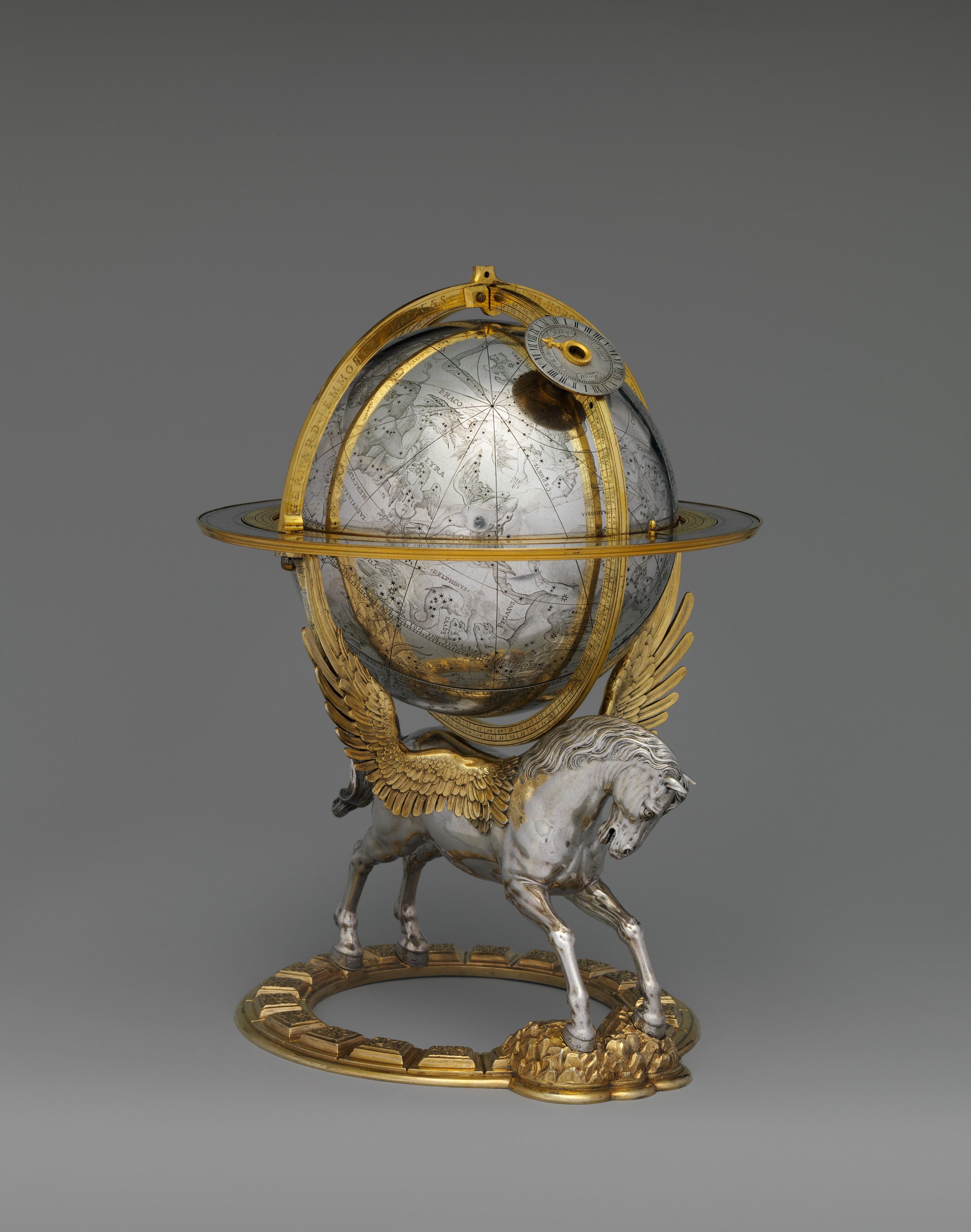
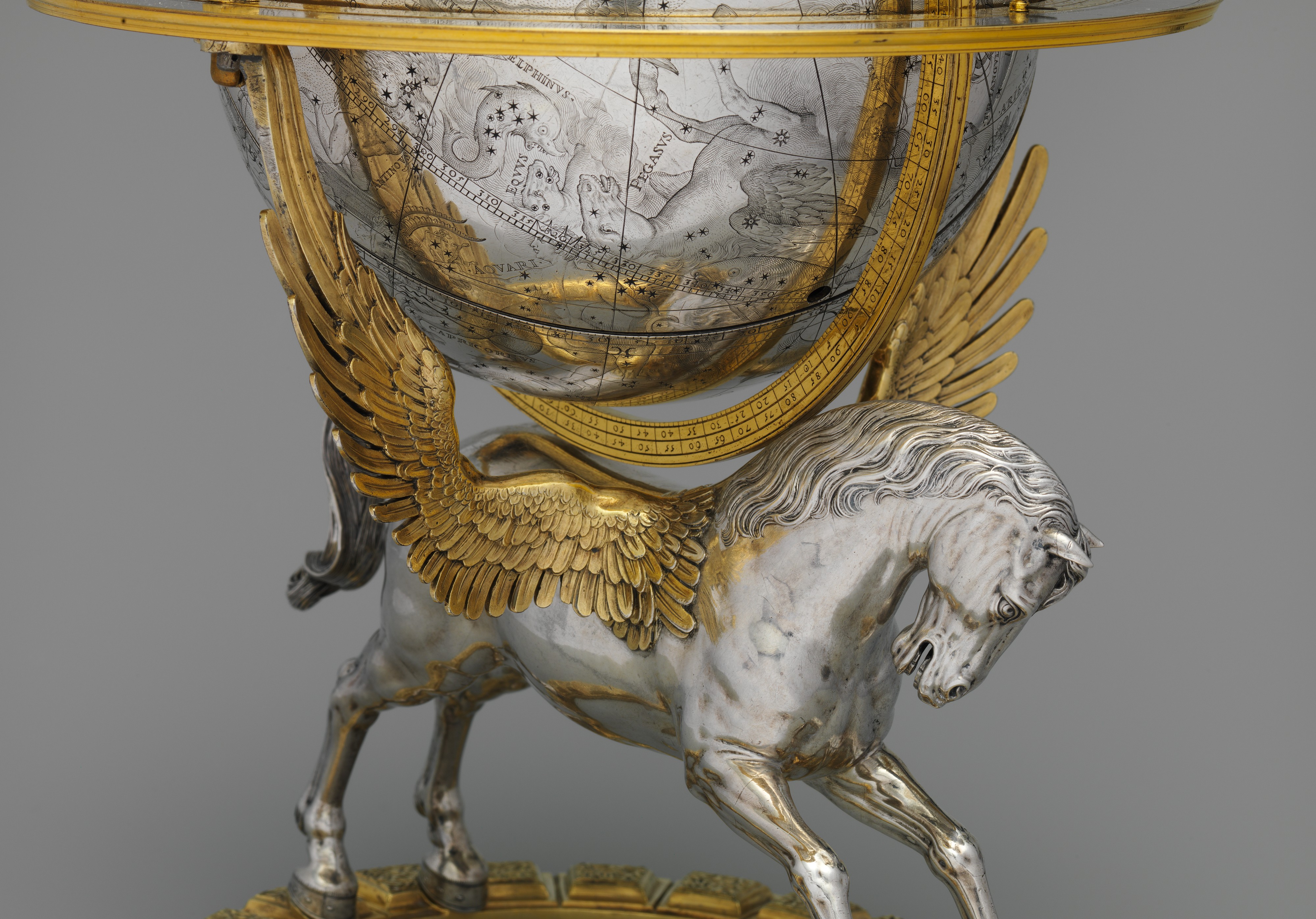
The record subject in full: the engraved silver celestial sphere within its meridian and horizon rings, carried on the back of the silver, partially gilded figure of Pegasus. Gerhard Emmoser, Vienna, 1579.
| Artist | Gerhard Emmoser |
|---|---|
| Date | 1579 |
| Medium | Case: partially gilded silver and gilded brass; movement: brass and steel |
| Dimensions | 27.3 x 20.3 x 19.1 cm (10 3/4 x 8 x 7 1/2 in) overall without the clockwork mechanism, weight 2450 g; globe diameter 14 cm (5 1/2 in); clockwork mechanism alone weighs 1000 g |
| Where it is now | Metropolitan Museum of Art, New York, Gallery 520 (European Sculpture and Decorative Arts)last confirmed |
| Inventory number | 17.190.636 |
| Attribution | AcceptedCatalogued by the Metropolitan Museum of Art as the work of Gerhard Emmoser, Imperial Clockmaker to the Habsburg court, dated 1579. Full note |
| Object type | Clocks and instruments |
| Period | Northern Mannerist, Habsburg court, 16th century |
| Cases | Has a provenance gap |
| Inscriptions | An inscription inside the globe records a repair dated 15 May 1781 by a Paris clockmaker named Gautrin, probably Pierre-Laurent Gautrin (d. 1823). No maker's signature or date inscription in Emmoser's own hand is recorded in the sources consulted for this record. |
| Owners on record | 11 links7 documented, 4 unknown |
| Sources | 10 cited |
About this record Last verified · 10 sources cited · Change log
On this page 9 sections
ContentsClose
A silver-and-gilt-brass globe engraved with the constellations, carried on the back of a large silver figure of the winged horse Pegasus, with a clockwork movement inside that once turned the sphere and moved a small gilt sun along its engraved ecliptic. Made in Vienna in 1579 by Gerhard Emmoser, Imperial Clockmaker to the Habsburg court, it is identified in the 1607-1611 inventory of Emperor Rudolf II's Prague Kunstkammer, one of the greatest princely collections of scientific instruments and automata ever assembled.
After that its trail goes dark for well over a century. It resurfaces in Stockholm in the collection of the exiled Queen Christina of Sweden by 1652, almost certainly among the plunder Swedish troops carried out of Prague Castle in 1648, then vanishes again until a Paris estate sale in 1770 and a repair inscription of 1781. How it crossed the following 136 years to reach J. Pierpont Morgan, who gave it to the Metropolitan Museum in 1917, is not recorded in any source consulted here.
What survives is a working demonstration of how a Renaissance court fused astronomy with princely display: a scientific instrument built to the accuracy of a working clock and the splendor of a goldsmith's masterpiece, mounted on a mythological beast chosen, the Museum's own curators argue, because Pegasus stood for the wings of the human mind lifting the science of astronomy.
Provenance
Each link is graded. Documented: a cited source supports it. Disputed: the identification is argued but not established. Unknown: no owner for that span, and the gap is not smoothed into a narrative. The grades in the glossary.
- 1579 -Made by Gerhard Emmoser, Imperial Clockmaker, Viennadocumented
Dated 1579 by the Metropolitan Museum's own cataloguing, three years into Rudolf II's reign. No commission record survives naming an original patron.1
- 1579 - 1607Unknownunknown
No owner or location is documented between the globe's manufacture and its identification in Rudolf II's Kunstkammer inventory.2
- 1607 - 1611Holy Roman Emperor Rudolf II, Prague Kunstkammerdocumented
Identified from a description in the Kunstkammer inventory compiled by imperial antiquarian Daniel Froeschl between 1607 and 1611; the manuscript survives in the Princely Library of Liechtenstein, Vaduz.2
- 1611 - 1652Unknownunknown
No specific document for this object bridges the inventory of 1607-1611 and Queen Christina's recorded ownership by 1652, though the 1648 Swedish sack of Prague Castle is well documented as the general mechanism by which much of Rudolf II's Kunstkammer reached Sweden.2
- by 1652 - 1654Queen Christina of Swedendocumented
Recorded in the Metropolitan Museum's own catalogue note as in Christina's collection by 1652, two years before her abdication.2
- 1654 - 1770Unknownunknown
No owner, dealer or location is documented across the roughly 116 years between Christina's abdication and the globe's reappearance in Paris.2
- 1770 - 1770Avocat Fortier, conseiller du roidocumented
The globe reappeared on 20 April 1770 at the Paris sale of the collection of Avocat Fortier. No sale price is recorded in the sources consulted.2
- 1770 - 1781Unknown (in Paris)documented
An inscription inside the globe dated 15 May 1781 records a repair by the Paris clockmaker Gautrin, probably Pierre-Laurent Gautrin (d. 1823), establishing the globe was in Paris at that date even though the owner who commissioned the repair is not named.2
- 1781 - 1917Unknownunknown
No dealer or collector is identified between the 1781 repair and J. Pierpont Morgan's ownership, a gap of roughly 136 years.2
- by 1913 - 1917J. Pierpont Morgan estatedocumented
Morgan died in 1913; the gift to the Metropolitan Museum was completed in 1917, as part of a large group of European clocks and watches from his collection carrying consecutive accession numbers in the 17.190 series.1
- 1917 - presentMetropolitan Museum of Art, New Yorkdocumented
Accession 17.190.636, Department of European Sculpture and Decorative Arts, credited Gift of J. Pierpont Morgan, 1917. Shown in "The Luxury of Time" (2015-16) and "Making Marvels" (2019-20).134
Technical evidence
| Attribution note | Catalogued by the Metropolitan Museum of Art as the work of Gerhard Emmoser, Imperial Clockmaker to the Habsburg court, dated 1579. Emmoser was reappointed court clockmaker by Rudolf II after Maximilian II's death in 1576, so the 1579 date places the globe's manufacture squarely within Rudolf II's reign rather than Maximilian's, though no surviving commission document names the original patron. No countervailing attribution has been proposed in the sources consulted for this record. |
|---|---|
| Case and materials | Partially gilded silver and gilded brass case; brass and steel movement.1 |
| Dimensions | 27.3 x 20.3 x 19.1 cm (10 3/4 x 8 x 7 1/2 in) overall without the clockwork, 2450 g; globe diameter 14 cm (5 1/2 in); clockwork mechanism alone 1000 g.1 |
| Support figure | A silver, partially gilded figure of the winged horse Pegasus, one foreleg raised on a gilded rocky outcrop, set within a broad flat foot-ring with repeating panelled decoration.13 |
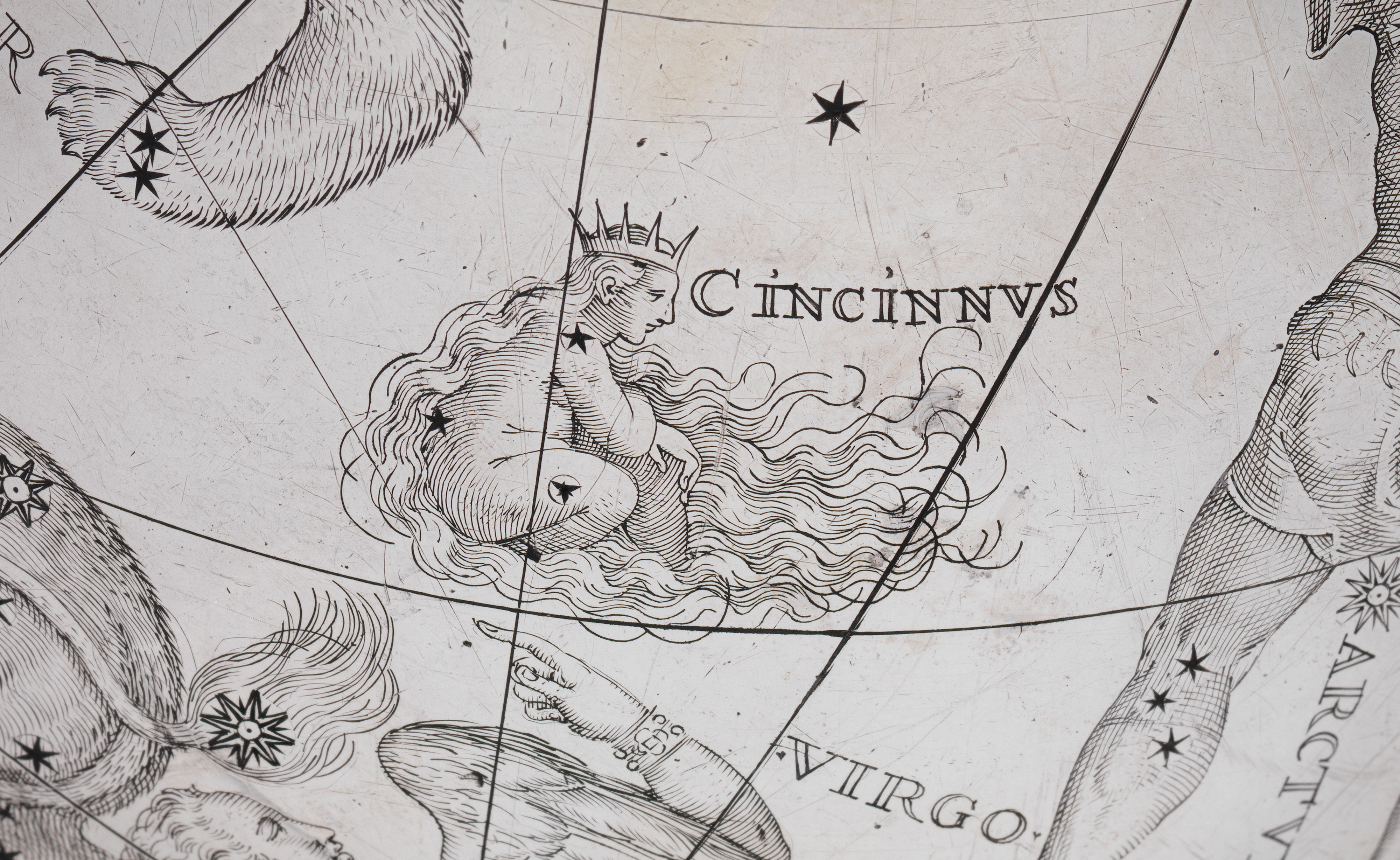
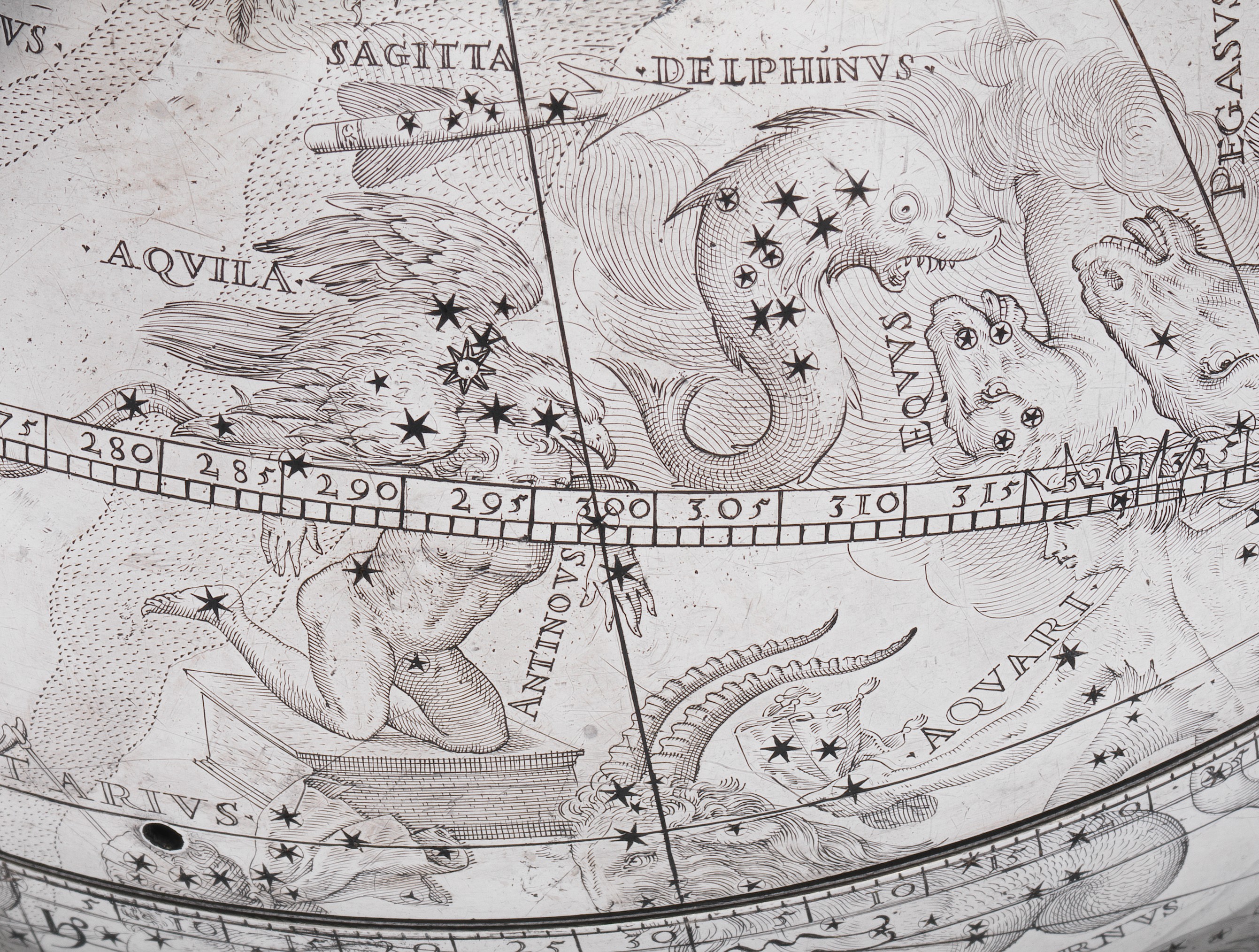
| Celestial mapping | Engraved over the whole sphere with the traditional Ptolemaic constellation figures and their stars graded by magnitude, including the now-obsolete names Cincinnus (today Coma Berenices) and Antinous (absorbed into Aquila in the 1922 IAU reform).167 |
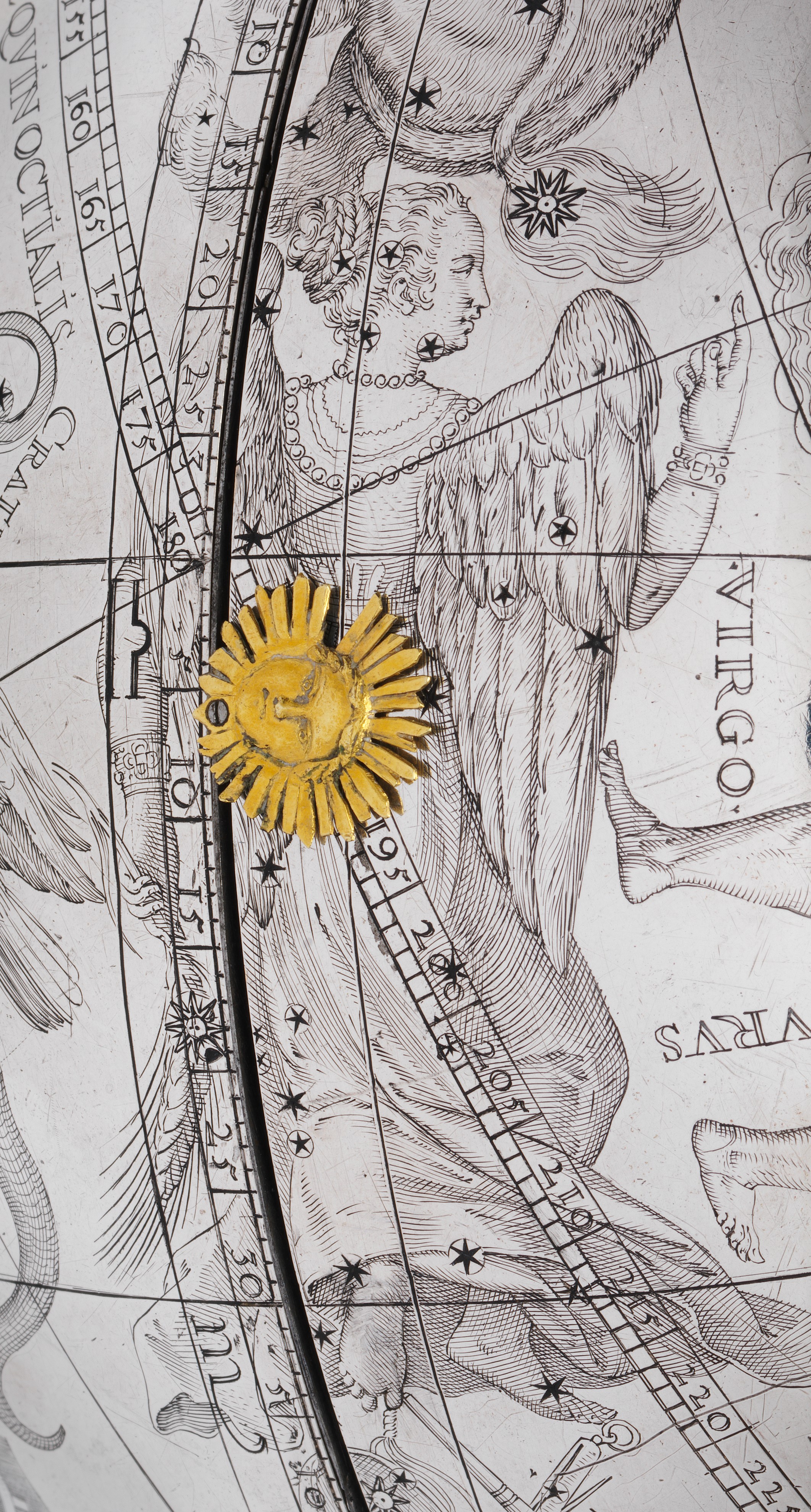
| Ecliptic and meridian | A graduated ecliptic scale is engraved on the globe's own surface, carrying a small gilt figure of the sun that the Museum's own text states originally moved along the path of the ecliptic; an openwork meridian ring engraved MERIDIANVS and a horizon ring complete the mounting.13 |
| Movement | A brass-and-steel spring-driven train with a crown-wheel verge escapement, built to be lifted complete out of the case; the Museum's own text states the globe originally rotated, powered by this internal movement.13 |
| Subsidiary dial | A small graduated dial is mounted on an arm attached to the horizon-ring framework; published summaries of the Museum's catalogue describe an hour dial at the top of the polar axis and a calendar rotating within the horizon ring, not independently confirmed against the Museum's full catalogue text for this record.12 |
| Later repair | An inscription inside the globe, dated 15 May 1781, records a repair by the Paris clockmaker Gautrin, probably Pierre-Laurent Gautrin (d. 1823).2 |
Images
The record in full
Chapter 1What it is
The globe itself is a sphere of silver 14 centimeters across, engraved over its entire surface with the traditional figures of the constellations and their stars, graded by magnitude from the first...
The globe itself is a sphere of silver 14 centimeters across, engraved over its entire surface with the traditional figures of the constellations and their stars, graded by magnitude from the first through the sixth. It sits inside an openwork meridian ring engraved MERIDIANVS and a graduated horizon ring, the whole assembly resting on the outstretched back of a silver, partially gilded figure of the winged horse Pegasus. Pegasus stands with one foreleg raised on a rough, gilded rocky outcrop set into a broad, flat foot-ring, itself decorated with small repeating panels around its edge.
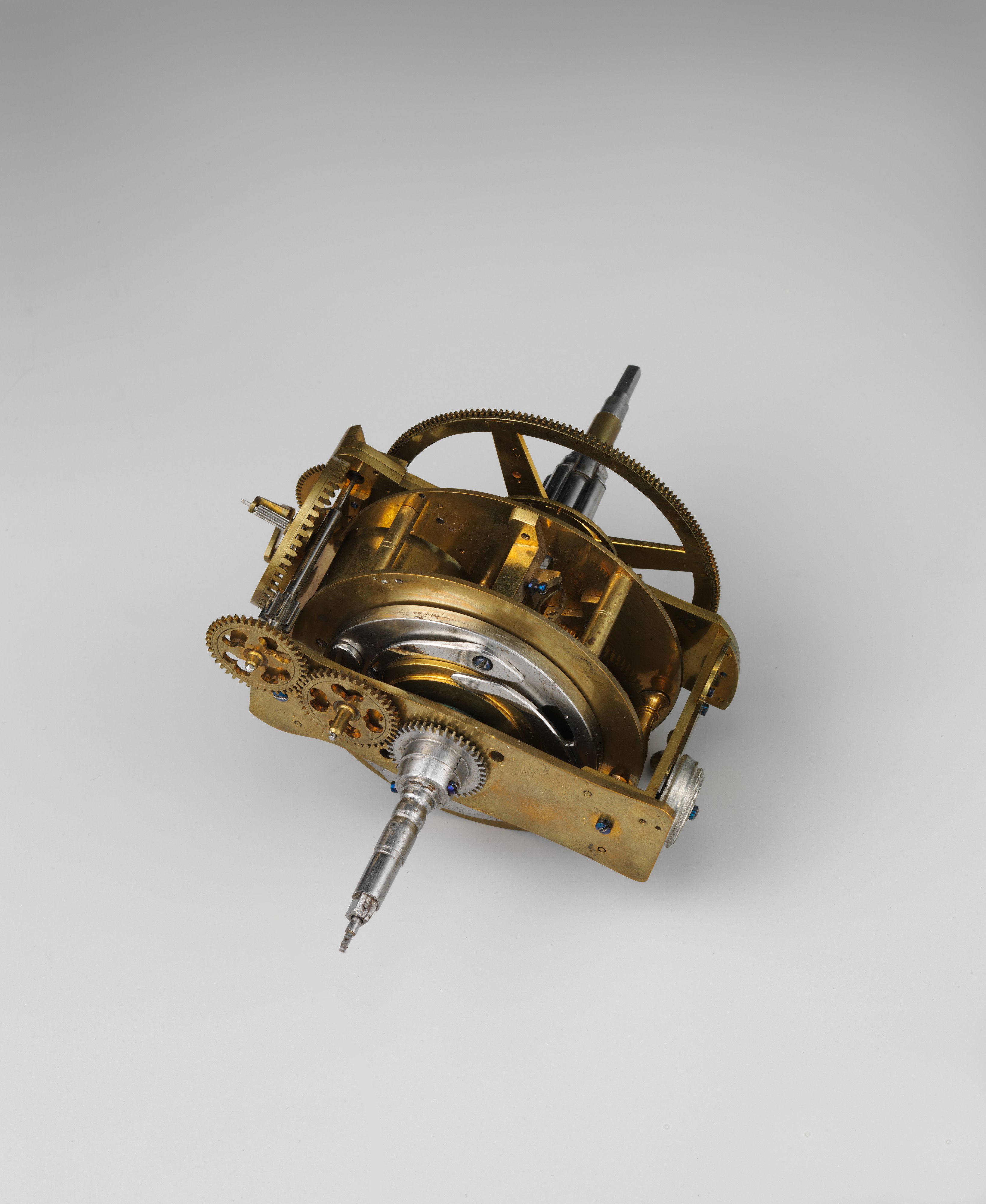
Overall, without its clockwork, the object stands 27.3 by 20.3 by 19.1 centimeters and weighs 2450 grams; the clockwork mechanism alone, which can be lifted out of the case, weighs a further 1000 grams. The case is partially gilded silver and gilded brass; the movement inside is brass and steel. Small gilt details pick out the sun, the horse's wings and harness, and the mounting collars of the rings against the bright, only lightly gilded silver of the sphere and the horse's body.
Chapter 2How the clockwork works
This is not a static sculpture with a clock added to it.
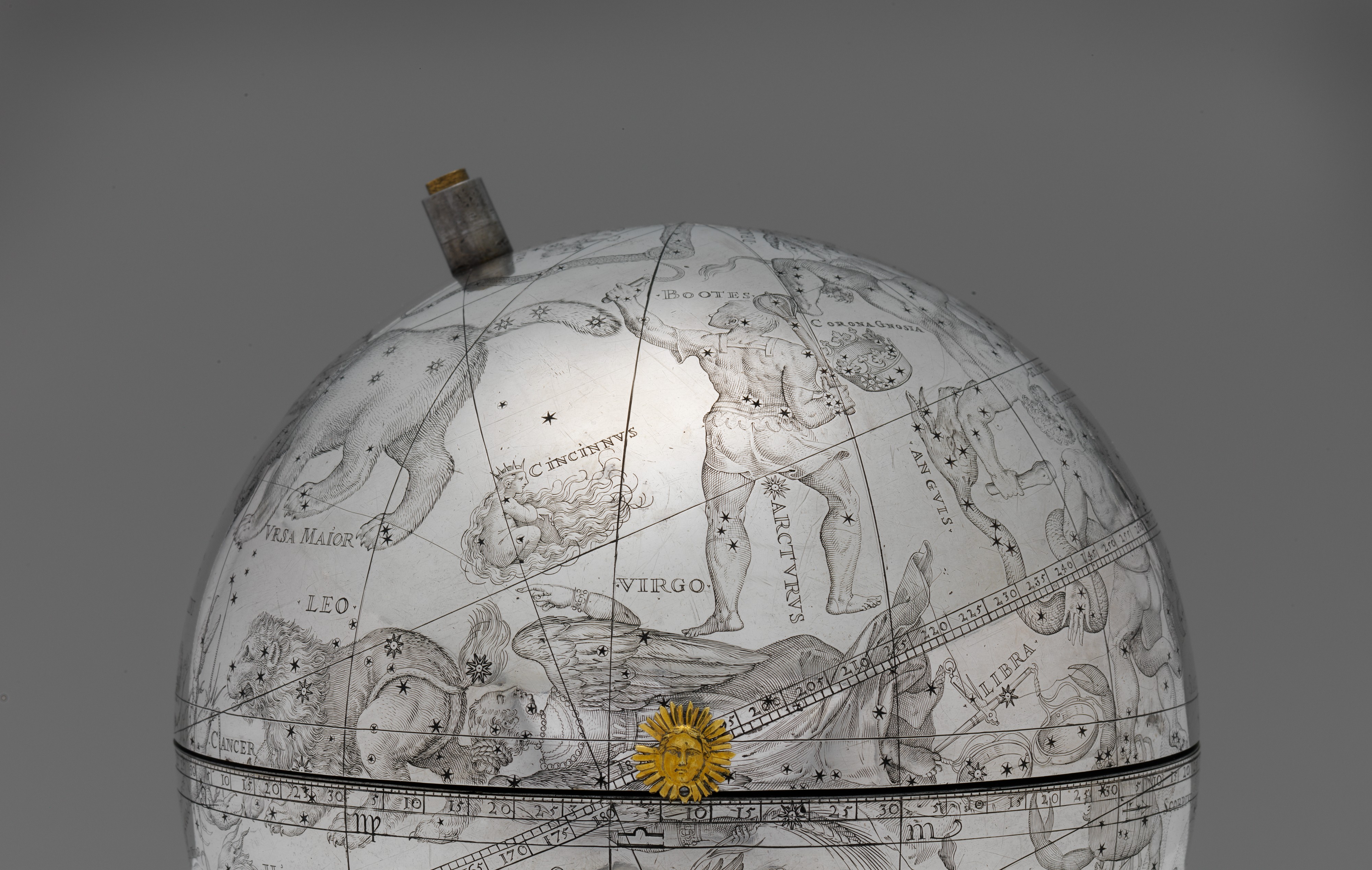
This is not a static sculpture with a clock added to it. According to the Metropolitan Museum's own gallery text for the piece, the globe originally rotated, powered by an internal movement, while a small gilt image of the sun moved along the path of the ecliptic engraved on the sphere's own surface. That gilt sun and the graduated ecliptic band it travels along are both original to the object and clearly visible today, crossing the constellations Virgo and Leo on the surviving photography of the piece.
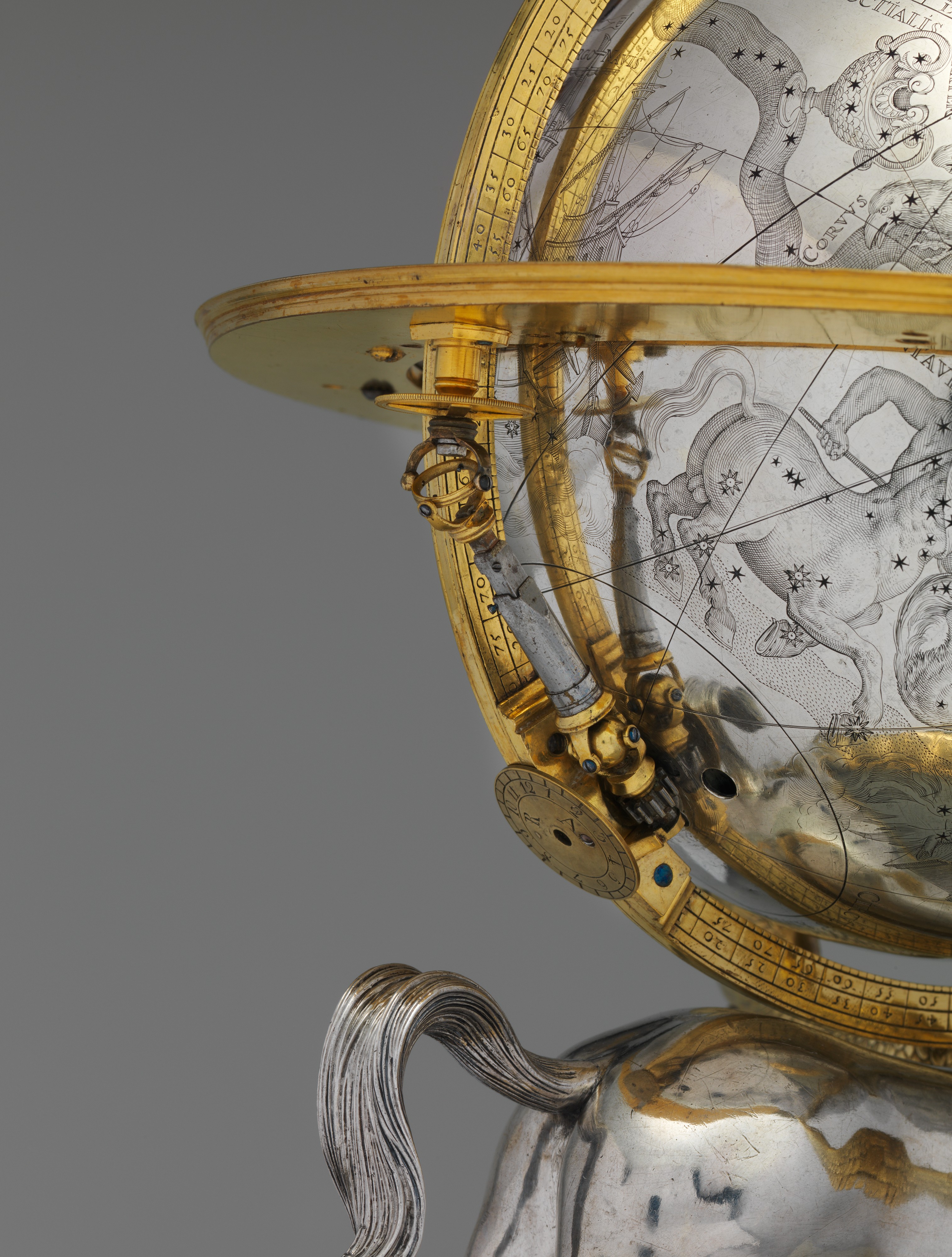
The movement itself, a brass-and-steel train that can be withdrawn complete from beneath the case, is built around a crown-wheel verge escapement of the kind standard in Northern European clockwork of the 1570s, driven by a mainspring rather than weights, consistent with an object meant to sit on a table or in a display cabinet rather than to hang or stand fixed to a wall. A separate small dial is mounted on an arm attached to the horizon-ring framework near the base of the meridian ring; published summaries of the Museum's catalogue note describe an hour dial attached to the meridian ring at the top of the polar axis and a calendar that rotates within the horizon ring, which is consistent with what the surviving photography shows but was not independently confirmed against the Museum's full catalogue text during the research for this record, since the Museum's own object page could not be retrieved directly in the time available.
Whether the movement still runs today, or has been arrested for conservation, is not stated in any source consulted for this record; the Museum's own wording, that the globe "originally rotated," is in the past tense and is noted here as a possible signal rather than a confirmed fact.
Chapter 3The sky it maps
The engraved sky follows the traditional Ptolemaic figures rather than any of the later constellation reforms.
The engraved sky follows the traditional Ptolemaic figures rather than any of the later constellation reforms. Labels visible on the surviving photography include Ursa Major, Bootes, Corona Borealis, Virgo, Leo, Cancer, Libra, Scorpius, Cepheus, Cassiopeia, Draco, Lyra, Aquila, Sagitta, Delphinus, Equus (Pegasus), Aquarius, and Corvus, among others, together with the zodiac band and a scale of ecliptic longitude in degrees.
Two labels are worth pausing on because both constellations have since vanished from the sky. Alongside Virgo, a crowned female figure is labeled CINCINNVS, Latin for a lock of hair: this is the constellation now known as Coma Berenices, Berenice's Hair, first drawn as a separate constellation in 1536 by Caspar Vopel and given the name Cincinnus by Gerardus Mercator on his celestial globe of 1551. Tycho Brahe's star catalogue of 1602 later fixed the name Coma Berenices, which is the one still used today; Emmoser's globe of 1579 falls in the brief window when Mercator's Latin name for it was current. Near Aquila and Sagitta, a kneeling nude labeled ANTINOVS represents the emperor Hadrian's companion, an ancient but non-Ptolemaic constellation that remained in use on globes and star atlases until the International Astronomical Union's 1922 standardization of the modern eighty-eight constellations, when it was formally merged into Aquila.
A pure star globe of this kind is, by its nature, silent on the geocentric-versus-heliocentric debate: it maps the fixed stars as seen from outside the celestial sphere, a representation equally compatible with a Ptolemaic or a Copernican universe. The question does apply to Emmoser's earlier work: a planetary clock he helped build between 1556 and 1561, now in the Technisches Museum Wien, explicitly models a geocentric, Ptolemaic arrangement of the planets, which was still the working assumption of court astronomy in the generation after Copernicus published in 1543.
Chapter 4The horse that carries the sky
The choice of Pegasus as the globe's support is not incidental.
The choice of Pegasus as the globe's support is not incidental. Pegasus is himself one of the constellations engraved on the sphere he carries, labeled EQVVS and PEGASVS beside Delphinus and Aquarius in the surviving photography, so the object contains a deliberate visual doubling: the winged horse depicted in miniature on the silver sky is, at full scale, the very figure holding that sky aloft.
The Metropolitan Museum's own curators, writing for the gallery in which the piece was shown in 2015-16, argue that the use of the mythological winged Pegasus to support the celestial sphere conveys a Renaissance idea that the wings of the human mind support the science of astronomy. A separate account of the Museum's 2019-20 exhibition of scientific marvels connects the rocky outcrop beneath Pegasus's raised hoof to the myth of the spring Hippocrene on Mount Helicon, said to have burst from the rock wherever Pegasus's hooves struck it, and from which poets and scholars were said to drink for inspiration. Both readings are institutional interpretations rather than statements from Emmoser's own hand or from a documented patron's instructions, and this record presents them as such.
Chapter 5Gerhard Emmoser and three emperors
Nothing definite is known of Emmoser before 1556, when Prince Ottheinrich of Pfalz-Neuburg sent him to Tuebingen to help build an ambitious planetary clock with a clockwork-driven celestial sphere...
Nothing definite is known of Emmoser before 1556, when Prince Ottheinrich of Pfalz-Neuburg sent him to Tuebingen to help build an ambitious planetary clock with a clockwork-driven celestial sphere, designed under the guidance of the Strasbourg mathematician and astronomer Philipp Imser. The clock was still unfinished when Ottheinrich died in 1559, and it was eventually sold to Emperor Ferdinand I; it survives today, restored and much traveled, as the Astronomische Prunkuhr Philippus Imsserus in the Technisches Museum Wien.
Ferdinand I installed Emmoser in the imperial city of Augsburg in 1563, then a major center of European clockmaking, so that he could complete the guild work required for full standing as a master. Before he could finish it, Ferdinand died in 1564, and his successor Maximilian II called Emmoser back to Vienna, formally appointing him Imperial Clockmaker in 1566. In 1568 Emmoser was paid for two small clocks or watches sent to Turkey, part of the steady traffic of elaborate Habsburg clockwork used as diplomatic gifts to the Ottoman court. When Maximilian II died in 1576, Rudolf II reappointed Emmoser, who kept the title of Imperial Clockmaker until his own death in 1584.
A second surviving object generally attributed to Emmoser, an astronomical table clock now in the Museum of Applied Arts in Budapest, is described by that museum as commissioned by Maximilian II under the guidance of a court astronomer it names as Philipp Imser. The Metropolitan Museum's own published catalogue note on the present globe gives Imser's dates as active 1531 to 1562 and probably dead by 1570, which does not conflict with Maximilian II's reign beginning in 1564, so the Budapest museum's account of Imser advising on that later commission is not contradicted by the record consulted for this page; an earlier draft of this record had flagged an apparent conflict based on a different, unverified 1557 death date, and that claim is withdrawn now that the Metropolitan's own catalogue text has been read directly.
Chapter 6Made in Rudolf's Vienna
The 1579 date places the globe's manufacture three years into Rudolf II's reign, while the imperial court was still based in Vienna; Rudolf did not move his court and its collections definitively to...
The 1579 date places the globe's manufacture three years into Rudolf II's reign, while the imperial court was still based in Vienna; Rudolf did not move his court and its collections definitively to Prague until 1583. No contract, payment record, or correspondence naming the globe's original commission has surfaced in the sources consulted for this record, so the identity of whoever first ordered or received it, whether Rudolf II himself or another patron who later passed it to him, cannot be stated as documented fact. What is documented is that a Habsburg court clockmaker holding the specific title of Imperial Clockmaker to Rudolf II produced, in the emperor's own capital, an object of exactly the kind Rudolf is independently and extensively documented to have collected: it is a reasonable inference, not a proven commission.
Chapter 7Into the Kunstkammer
The earliest secure documentation of the globe's ownership comes not from its manufacture but from an inventory.
The earliest secure documentation of the globe's ownership comes not from its manufacture but from an inventory. The globe has been identified from a description recorded in the inventory of the Prague Kunstkammer of Emperor Rudolf II compiled between 1607 and 1611 by Daniel Froeschl, the painter who succeeded Octavio Strada as imperial antiquarian on 1 May 1607. Froeschl's manuscript inventory survives in the library of the Prince of Liechtenstein at Vaduz.
By the time of that inventory, Rudolf's Kunstkammer was already regarded as one of the greatest princely collections in Europe, combining naturalia, artificialia and scientifica, the last category covering precisely the astrolabes, automata and clockwork instruments that demonstrated a ruler's command of natural philosophy alongside his wealth. A celestial globe that told time, mapped the zodiac and rotated on the back of a mythological horse was exactly the kind of object the category was built around.
Chapter 8War, Stockholm, and a long silence
By 1652 the globe was in the collection of Queen Christina of Sweden, according to the Metropolitan Museum's own catalogue note.
By 1652 the globe was in the collection of Queen Christina of Sweden, according to the Metropolitan Museum's own catalogue note. The likely mechanism, though not documented specifically for this object, is well established for the class of objects it belonged to: in 1648, in the final months of the Thirty Years' War, Swedish troops under the command of General Hans Christoff von Koenigsmarck sacked Prague Castle and carried off a large part of Rudolf II's Kunstkammer down the Elbe to Sweden, where much of it entered Christina's own collection. This record treats Christina's ownership by 1652 as documented and the 1648 looting as strongly probable historical context rather than as a fact proven for this specific globe.
After Christina abdicated in 1654 and moved to Rome, taking a large part of her collection with her while dispersing other portions along the way, the globe disappears from the documentary record for well over a century. No owner, dealer, sale or location is recorded between 1652 and 1770 in the sources consulted for this record; that gap of roughly 118 years is recorded here as unknown, not bridged by inference.
Chapter 9Paris, twice
The globe reappears on 20 April 1770 in Paris, at the sale of the collection of Avocat Fortier, described as conseiller du roi.
The globe reappears on 20 April 1770 in Paris, at the sale of the collection of Avocat Fortier, described as conseiller du roi. No price for that sale is recorded in the sources consulted for this record. Eleven years later, an inscription placed inside the globe itself and dated 15 May 1781 records a repair carried out by a Paris clockmaker named Gautrin, almost certainly Pierre-Laurent Gautrin, who died in 1823. Both the 1770 sale and the 1781 repair inscription come from the Metropolitan Museum's own catalogue note; this record has not been able to independently verify either against the Museum's page directly, since it could not be retrieved at the time of research, and flags that verification as outstanding.
From the 1781 repair to J. Pierpont Morgan's ownership before his death in 1913, a further gap of some 136 years, no owner, dealer or intermediary is identified in any source consulted for this record. Morgan assembled an exceptionally large collection of European clocks and watches, several dozen of which, including this globe, were given to the Metropolitan Museum as a single group credited "Gift of J. Pierpont Morgan, 1917", four years after his death, evidently as part of the posthumous settlement of his estate; the accession numbers of that clock-and-watch group run consecutively through the 17.190 series, which is consistent with a single large purchase or bequest rather than piecemeal acquisition, but this record has not traced the immediate dealer or prior collector who supplied Morgan with this particular piece.
Chapter 10Morgan's gift and the Metropolitan Museum
The globe entered the Metropolitan Museum's collection in 1917 as part of the Morgan gift and has remained there since, catalogued as accession 17.190.636 in the Department of European Sculpture and...
The globe entered the Metropolitan Museum's collection in 1917 as part of the Morgan gift and has remained there since, catalogued as accession 17.190.636 in the Department of European Sculpture and Decorative Arts and marked by the Museum itself as a highlight of its horological holdings. It was shown publicly at the Museum in "The Luxury of Time: European Clocks and Watches" (16 November 2015 to 27 March 2016, Gallery 521, organized by Elizabeth Sullivan and Clare Vincent) and again in the larger "Making Marvels: Science and Splendor at the Courts of Europe" (25 November 2019 to 1 March 2020, edited by Wolfram Koeppe), a survey of some 170 scientific and mechanical marvels from European courts between 1550 and 1750. No conservation campaign, loan history beyond these two exhibitions, or further sale is recorded in the sources consulted for this record; so far as those sources show, the globe has not left the Museum's keeping, and has not been offered at auction, since 1917.
The artist
Gerhard Emmoser
Emmoser's career is documented almost entirely through his employers rather than through his own words. Nothing is known of him before 1556, when a German prince sent him to help build an ambitious astronomical clock, and everything after that traces a single line upward through the Habsburg court: Augsburg, then Vienna, then the personal service of two emperors in succession, ending only with his death in 1584. No birth date, birthplace or family is securely established in the sources consulted for this record.
Related works
| Work | Relation | Where it is |
|---|---|---|
| Astronomische Prunkuhr Philippus Imsserus Gerhard Emmoser, to a design by Philipp Imser | Emmoser's earlier documented work, a planetary clock with clockwork celestial sphere built 1556-1561, commissioned by Ottheinrich of Pfalz-Neuburg and later sold to Ferdinand I; a distinct object with its own separate provenance, not to be confused with the 1579 globe in this record Rediscovered in Graz in 1750, given to a Jesuit museum in 1752, transferred to the Vienna court in 1801, and acquired by the museum's predecessor institution in 1890. | Technisches Museum Wien, Vienna |
| Astronomical table clock Attributed to Gerhard Emmoser | A second surviving clock generally attributed to Emmoser, described by its holding museum as made for Maximilian II; a distinct object with its own catalogue history, kept separate here from the Metropolitan Museum's 1579 globe The museum's own account names Philipp Imser as guiding astronomer; the Metropolitan Museum's own catalogue note on this record's globe gives Imser's dates as active 1531-1562, probably dead by 1570, consistent with an active role under Maximilian II (r. 1564-1576), so no conflict with the Budapest account is established. | Museum of Applied Arts (Iparmuveszeti Muzeum), Budapest |
| Celestial globe clock Georg Roll and Johannes Reinhold | A comparable Augsburg-made clockwork celestial globe of the same Habsburg court milieu, bought directly by Rudolf II at Christmas 1584, five years after the Metropolitan Museum's Emmoser globe was made; a different maker, a later date and a separately documented purchase, not part of the same commission A second globe by the same makers was bought the same year by Rudolf's brother, Archduke Ernst, for a higher price, and the emperor is recorded as having complained that Roll had sold him an inferior piece. | Kunsthistorisches Museum, Vienna |
Open questions
- Who first commissioned or received the 1579 globe? No contract, payment or correspondence naming an original patron has surfaced; its documented history begins only with its identification in Rudolf II's own Kunstkammer inventory of 1607-1611.
- Does the clockwork still function, or has it been arrested for conservation? The Museum's own text says the globe 'originally rotated', in the past tense, but no source consulted for this record states its present mechanical condition directly.
- Where was the globe between about 1652, when it is recorded in Queen Christina of Sweden's collection, and 20 April 1770, when it reappeared at the Avocat Fortier sale in Paris? No owner is documented across that roughly 118-year gap.
- Who owned the globe between the Gautrin repair inscription of 15 May 1781 and J. Pierpont Morgan's acquisition of it before his death in 1913? No dealer or intermediate collector is identified in any source consulted for this record.
- What exactly does the subsidiary dial mounted on the horizon-ring arm display? Secondary summaries of the Museum's catalogue describe separate hour and calendar functions, but this could not be verified against the Museum's own full catalogue text during research for this record.
- When and where was Gerhard Emmoser born? Only his active career, from 1556 to his death in 1584, is documented in the sources consulted; a single unverified secondary source gives Heidelberg, which this record has not been able to confirm.
Questions about this object
What is Celestial Globe with Clockwork?
Celestial Globe with Clockwork is a clocks and instruments, dated 1579. Medium: Case: partially gilded silver and gilded brass; movement: brass and steel.
Who made Celestial Globe with Clockwork, and is the attribution settled?
The attribution to Gerhard Emmoser is recorded here as accepted. Catalogued by the Metropolitan Museum of Art as the work of Gerhard Emmoser, Imperial Clockmaker to the Habsburg court, dated 1579. Emmoser was reappointed court clockmaker by Rudolf II after Maximilian II's death in 1576, so the 1579 date places the globe's manufacture squarely within Rudolf II's reign rather than Maximilian's, though no surviving commission document names the original patron. No countervailing attribution has been proposed in the sources consulted for this record.
Where is Celestial Globe with Clockwork now?
Metropolitan Museum of Art, New York, Gallery 520 (European Sculpture and Decorative Arts). Inventory number 17.190.636. Last confirmed 2 September 2026. Gift of J. Pierpont Morgan, 1917.
What is still unknown about Celestial Globe with Clockwork?
Who first commissioned or received the 1579 globe? No contract, payment or correspondence naming an original patron has surfaced; its documented history begins only with its identification in Rudolf II's own Kunstkammer inventory of 1607-1611.
Sources
- 1Metropolitan Museum of Art, Collection API, object record 193606 (Celestial globe with clockwork, accession 17.190.636). collectionapi.metmuseum.org/public/...
- 2Metropolitan Museum of Art, object page for Gerhard Emmoser, Celestial globe with clockwork, accession 17.190.636: catalogue note covering the maker's biography, the mechanism, the Froeschl-inventoried identification in Rudolf II's Prague Kunstkammer (1607-1611), the Christina of Sweden ownership by 1652, the 20 April 1770 Fortier sale in Paris, and the 1781 repair inscription naming a clockmaker Gautrin. The provenance facts and biography in this record match the page's own text; the only correction made against it is Imser's death date (the page says active 1531-1562, probably dead by 1570, not 1557 as an earlier draft of this record had it). metmuseum.org/art/...
- 3Metropolitan Museum of Art, gallery checklist and exhibition text for "The Luxury of Time: European Clocks and Watches", Wrightsman Exhibition Gallery (Gallery 521), 16 November 2015 - 27 March 2016, organized by Elizabeth Sullivan and Clare Vincent, exhibition text by Elizabeth Sullivan. libmma.contentdm.oclc.org/digital/...
- 4Metropolitan Museum of Art, "Making Marvels: Science and Splendor at the Courts of Europe", 25 November 2019 - 1 March 2020, edited by Wolfram Koeppe (New York: The Metropolitan Museum of Art / New Haven: Yale University Press, 2019), as reported via press coverage of the exhibition. artandobject.com/press-release/...
- 5Museum of Applied Arts (Iparmuveszeti Muzeum), Budapest, collection database entry for the astronomical clock attributed to Gerhard Emmoser, described as commissioned by Emperor Maximilian II. collections.imm.hu/gyujtemeny/...
- 6Technisches Museum Wien, object database record 154903, "Astronomische Prunkuhr Philippus Imsserus" (Ottheinrich of Pfalz-Neuburg's planetary clock, built 1556-1561 with Emmoser's participation, now in Vienna). data.tmw.at/object/...
- 7Ian Ridpath, "Star Tales: Coma Berenices", covering the constellation's naming history including Caspar Vopel's Berenices Crinis (1536), Gerardus Mercator's Cincinnus (1551), and Tycho Brahe's Coma Berenices (1602). ianridpath.com/startales/...
- 8Wikipedia, "Antinous (constellation)", for the constellation's history and its merger into Aquila in the International Astronomical Union's 1922 standardization. en.wikipedia.org/wiki/...
- 9History of Science Museum, Oxford, "Prague, 1584: Celestial globe clock", on the comparable clockwork celestial globe by Georg Roll and Johannes Reinhold bought by Rudolf II in 1584 and now in the Kunsthistorisches Museum, Vienna. cabinet.ox.ac.uk/prague-1584-celestial-globe-clock
- 10Wikidata, item Q29383537 (Celestial globe with clockwork) and item Q55454454 (Gerhard Emmoser), for structured identifiers cross-checked against the Metropolitan Museum's own record. wikidata.org/wiki/...
Last verified · Published
Change log
2 September 2026 - Record created at the house standard: researched narrative, technical evidence, maker dossier, graded provenance chain, prices with hammer and premium separated, related works, open questions and sources.