Knight, Death and the Devil
Albrecht Durer · 1513
Last verified 15 September 2026 · 20 sources cited · Change log
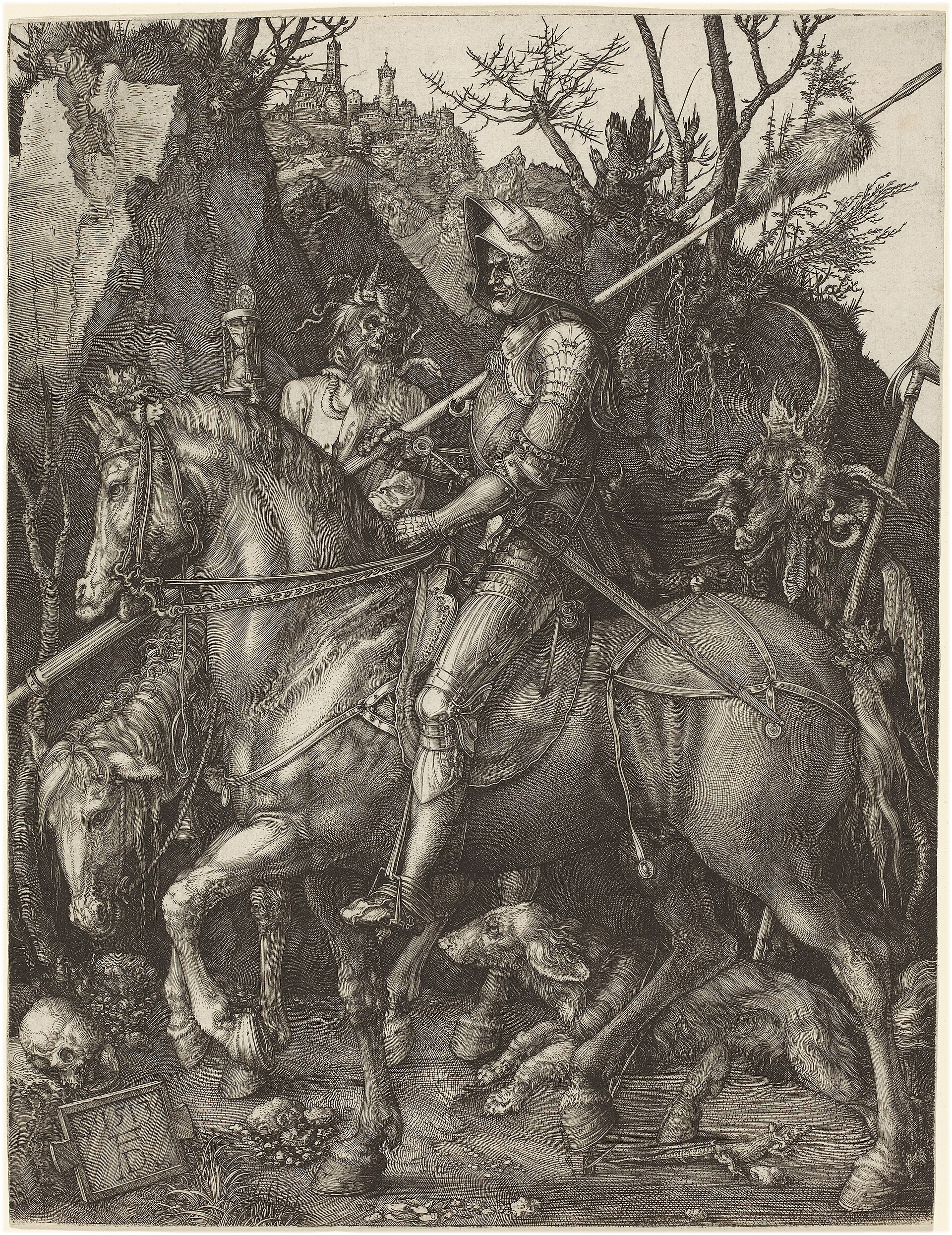
The sheet described in this record. Engraving on laid paper, 24.8 x 19 cm, National Gallery of Art, accession 1941.1.20, gift of W.G. Russell Allen, 1941.
| Artist | Albrecht Durer |
|---|---|
| Date | 1513 |
| Medium | Engraving on laid paper |
| Dimensions | 24.8 x 19 cm (9.7 x 7.4 in.), this impression (National Gallery of Art, 1941.1.20) |
| Where it is now | National Gallery of Art, Washington, D.C., 1941.1.20last confirmed 15 September 2026 |
| Attribution | acceptedUndisputed. Full note |
| Object type | |
| Period | German, early sixteenth century (Northern Renaissance) |
| Cases | Has a provenance gap |
| Inscriptions | Tabula ansata at lower left inscribed S 1513, with Durer's AD monogram. The S is generally read by scholars as an abbreviation of Salus, an 'anno salutis' (year of grace) dating formula Durer used elsewhere in his writing at this period. No title appears on the plate. |
- Where it is now
- National Gallery of Art, Washington, D.C.last confirmed 15 September 2026
- Attribution
- accepted
- Provenance
- 5 links4 documented, 1 unknown
- Sources
- 20 cited
- Last verified
- 15 September 2026Change log
On this page 9 sections
A knight in full armor rides through a narrow, rock-choked ravine, a dog trotting at his horse's heels, while a corpse-faced figure of Death holds up an hourglass on one side and a goat-horned devil shadows him on the other. Engraved by Albrecht Durer in 1513, it is one of his three so-called Meisterstiche, or master engravings, and its meaning has been argued over for five centuries: is the rider an undistracted Christian soldier, a reading tied to Erasmus of Rotterdam's Handbook of the Christian Soldier, or something closer to a Raubritter, one of the armed robber-knights who genuinely terrorized merchants and towns in Durer's Holy Roman Empire.
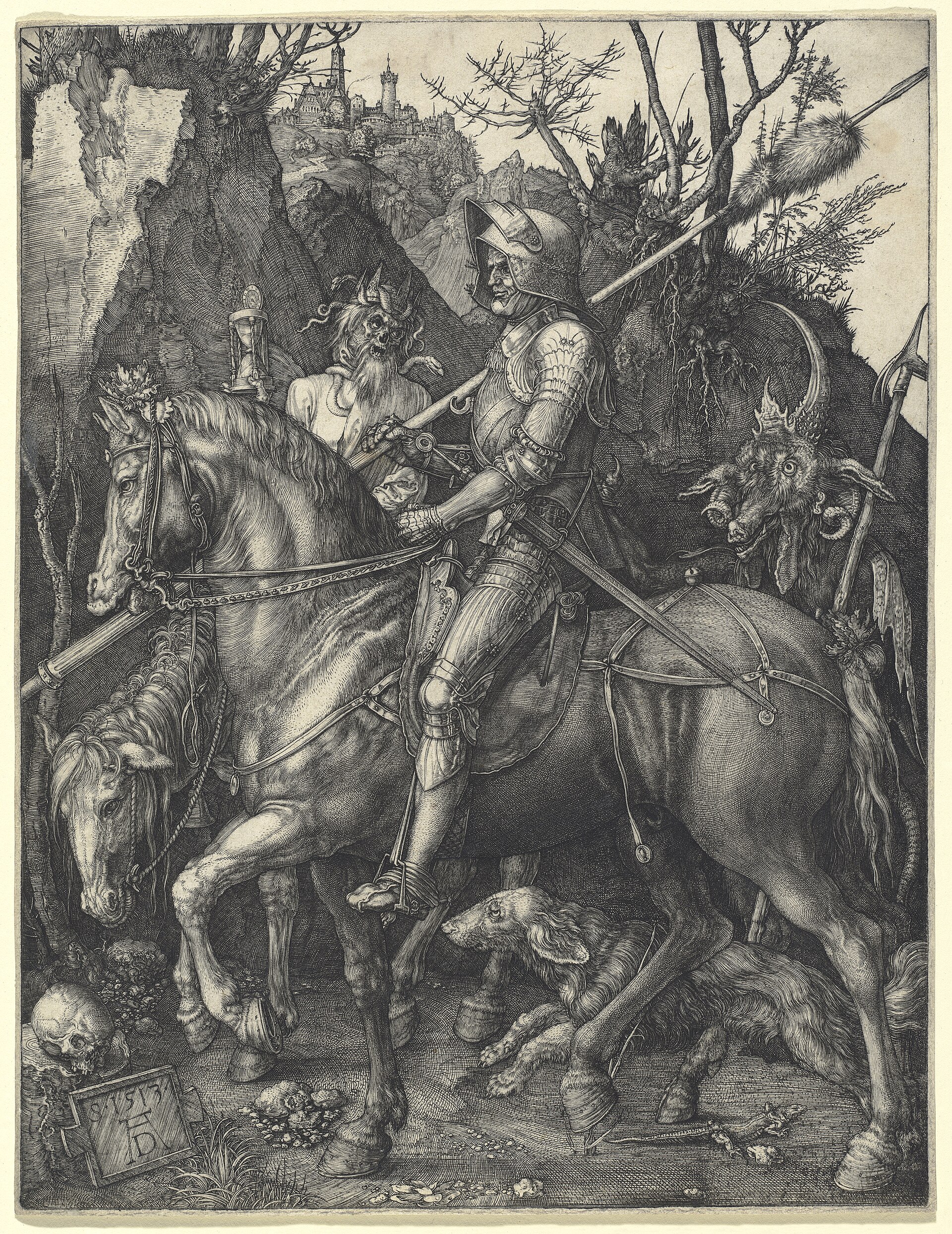
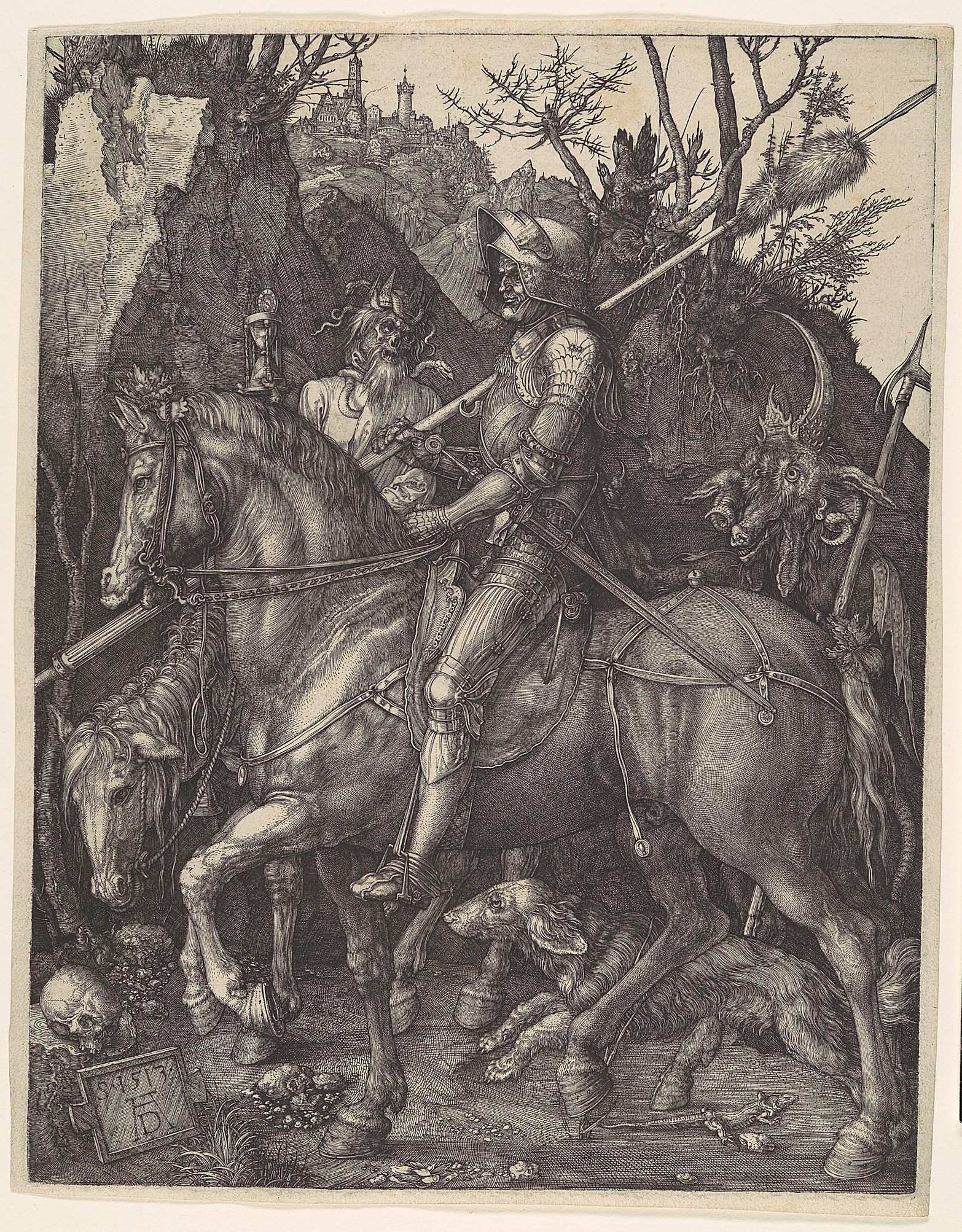
This record follows one specific sheet, the impression at the National Gallery of Art in Washington, accession 1941.1.20, engraved on laid paper and catalogued as Meder no. 74, state a. Its documented ownership runs from the nineteenth-century Silesian collector Count Ludwig Yorck von Wartenburg to the Boston-area print collector W.G. Russell Allen, who gave it to the Gallery in 1941. It is not the same object as the Gallery's second impression of the same plate (Rosenwald Collection, 1943.3.3519), nor the Metropolitan Museum's impression (43.106.2), both of which are shown here only for comparison.
Durer himself never called it 'Knight, Death and the Devil.' In his own account book he referred to it simply as 'the Knight,' and the now-standard title is a later descriptive label, not an inscription on the plate or a documented title of the artist's choosing.
Provenance
Each link is graded. Documented: a cited source supports it. Disputed: the identification is argued but not established. Unknown: no owner for that span, and the gap is not smoothed into a narrative. The grades in the glossary.
- 1513 -Albrecht Durer, Nurembergdocumented
Engraved and printed by the artist in his own Nuremberg workshop, 1513. Durer continued to sell and trade impressions of the plate for years afterward, including as late as 1520-1521 on his journey to the Netherlands.119
- - 1865Count Ludwig Yorck von Wartenburg (1805-1865), Klein Ols, Silesiadocumented
Owned by Yorck von Wartenburg, a major nineteenth-century collector of German prints (collector's mark Lugt 2669), by the date of his death in 1865 at the latest. When or how he acquired this sheet is not recorded in the sources consulted.34
- 1865 -Unknownunknown
No owner is documented between Yorck von Wartenburg's death in 1865 and this sheet's appearance in W.G. Russell Allen's collection. The Yorck von Wartenburg collection is known to have been dispersed at auction by Boerner, Leipzig, on 2 and 3 May 1932, but this record has found no confirmation that this specific impression passed through that sale.3
- - 1941W.G. Russell Allen (1882-1955), Boston areadocumented
Allen was one of five collectors who jointly gave roughly 400 prints, including this sheet, to the National Gallery of Art in 1941, laying part of the foundation of its print collection.41
- 1941 - presentNational Gallery of Art, Washington, D.C.documented
Accession 1941.1.20, gift of W.G. Russell Allen, 1941.1
Technical evidence
| Attribution note | Undisputed. The plate carries Durer's AD monogram and the date 1513 within a tabula ansata at lower left, and the print has been continuously catalogued in his oeuvre since the sixteenth century (Bartsch 98; Meder 74; Schoch, Mende and Scherbaum 69). |
|---|---|
| Medium | Engraving (copperplate intaglio) on laid paper.12 |
| Dimensions (this impression) | 24.8 x 19 cm (9.7 x 7.4 in.), National Gallery of Art 1941.1.20.1 |
| Inscription | Tabula ansata at lower left: S 1513 with Durer's AD monogram. No title is engraved on the plate.1415 |
| Catalogue numbers | Bartsch 98; Meder 74; Schoch, Mende and Scherbaum 69.18 |
| State (this impression) | Meder no. 74, state a, per the National Gallery of Art's own cataloguing.1 |
| State chronology | A 2022 digital-microscopy study by Angela Campbell documents progressive plate wear and scratching across surviving impressions of Durer's three Meisterstiche, building an evidence-based sequence of pulls independent of subjective 'rich' or 'silvery' impression grading.17 |
| Edition size | Survives today in hundreds of known impressions across public collections; Durer's own account book records him still selling and trading pulls of the plate as ordinary stock in 1520 and 1521.1719 |
Images
The record in full
What the print shows
An armored knight rides in profile through a narrow defile between rock outcrops, mounted on a powerful horse and followed by a small dog. Riding beside him, close enough to hold up an hourglass at his eye level, is Death, crowned with snakes and mounted on a gaunt pale horse. Behind and slightly above, a goat-horned devil with a boar's snout and a long pike-like weapon shadows the group. A human skull rests in the foreground on a tree stump near the horse's hooves, and a lizard is worked into the undergrowth. In the far distance, on a crag beyond the ravine, a walled and turreted town sits under open sky.
The knight's own expression is famously hard to read: neither triumphant nor visibly afraid, he looks ahead along the path rather than at either of his companions. That refusal to react is the single fact that every interpretation of the print, on every side of the argument, has had to explain.
How it was made
The print is a copperplate engraving, an intaglio technique in which the image is cut directly into a metal plate with a burin rather than built up by acid as in etching. Nothing can be erased from an engraved plate once cut, so the entire composition, including its tonal structure, has to be resolved before the first line is made. Durer built the print's range of light and shadow from cross-hatched line alone, without the aquatint or wash tools later engravers would use, achieving a depth of modeling that contemporaries and later print scholars alike singled out as unusual for the medium.
The plate is catalogued under three parallel reference systems still used by museums and dealers: Bartsch 98, Meder 74, and Schoch, Mende and Scherbaum 69. Because copper wears with each pull, cataloguers distinguish 'states' and, within a state, earlier and later impressions by the sharpness of the finest lines; the National Gallery catalogues its 1941.1.20 sheet as Meder no. 74, state a. A 2022 study by Angela Campbell used digital microscopy to document the progressive wear and microscopic scratching across surviving impressions of Durer's three Meisterstiche plates, building an evidence-based chronology of pulls that does not depend on a cataloguer's subjective sense of a 'rich' or 'silvery' impression. Campbell's study also records that Knight, Death and the Devil survives today in hundreds of known impressions, a function of a hugely popular plate that Durer and his workshop printed and sold over years rather than a single limited run.
The inscription, and the title Durer never used
The only text on the plate itself is the small tablet at lower left: the date 1513, preceded by a single S, with Durer's AD monogram worked into the same tablet. Print historians read the S as an abbreviation of Salus, part of a Latin 'anno salutis' dating formula, 'in the year of grace,' that Durer used in other writing from the same period. There is no title, motto, or descriptive text engraved anywhere on the plate.
Durer's own name for the print survives in his account book from his journey to the Netherlands in 1520 and 1521, where he repeatedly logs disposing of impressions under the short name 'Knight' (in the German of his diary, some form of Reuter or Ritter), never under anything resembling the full title now in use. William Martin Conway's edition of Durer's writings gives this short form as 'Der Reuter,' The Rider, putting the emphasis squarely on the horseman rather than on his two companions. 'Ritter, Tod und Teufel' in German and 'Knight, Death and the Devil' in English are cataloguers' descriptive titles that became standard only afterward; they are accurate to what the print shows, but they are not Durer's own words for his own print, so far as this record has been able to establish.
The Christian knight: the traditional reading
The dominant interpretation for most of the print's modern scholarly life ties the knight to Erasmus of Rotterdam's Enchiridion militis Christiani, published in 1503 and known in English as the Handbook of the Christian Soldier or Handbook of the Christian Knight. The connection was first proposed by Hermann Grimm in 1875 and was given its most influential statement by Erwin Panofsky, who in his 1943 monograph on Durer argued the engraving was probably inspired by Erasmus's text, quoting its instruction that the Christian must not be deterred by 'all those spooks and phantasms which come upon you as in the very gorges of Hades.' On this reading the knight is a figure of steadfast faith who presses on through mortal terrors, Death and the Devil, without so much as a backward glance; the small dog is read as an emblem of fidelity, and the whole scene is set against the resonance of Psalm 23's 'valley of the shadow of death.' There is no documentary proof that Durer had read the Enchiridion by 1513, but the humanist circles he moved in at Nuremberg made Erasmus's writing broadly available, and this reading remains the one most museum labels and general audiences encounter first.
A robber knight: the dissenting reading
A competing reading rejects the pious frame outright. Sten Karling in 1970, and later Ursula Meyer, argued that the print does not glorify its rider at all but instead shows a Raubritter, a robber-knight, one of the real, armed petty nobles who extorted tolls and preyed on merchant caravans across the fragmented Holy Roman Empire, including on the roads around Durer's own Nuremberg, a city whose trade depended on exactly the safe passage this figure threatens. On this reading, Death and the Devil are not the knight's adversaries at all but his companions, riding with him rather than against him. The strongest visual evidence offered for this view is the fox tail bound to the tip of the knight's lance, a fox in early Christian symbolism being an emblem of cunning and greed rather than virtue. Scholars skeptical of the robber-knight reading counter that a fox tail on a lance tip was an ordinary period accessory, worn on contemporary knights in unrelated and clearly non-sinister contexts, which weakens an argument that rests heavily on that single detail. Popular and devotional surveys of the print's interpretive history add a wider, looser list of proposed identities for the rider beyond these two poles, including Saint George, Martin Luther, Pope Julius II and Savonarola, which is itself evidence of how unsettled the reading has remained across five centuries rather than a set of claims this record can verify individually.
Durer in 1513: an established workshop, after Italy
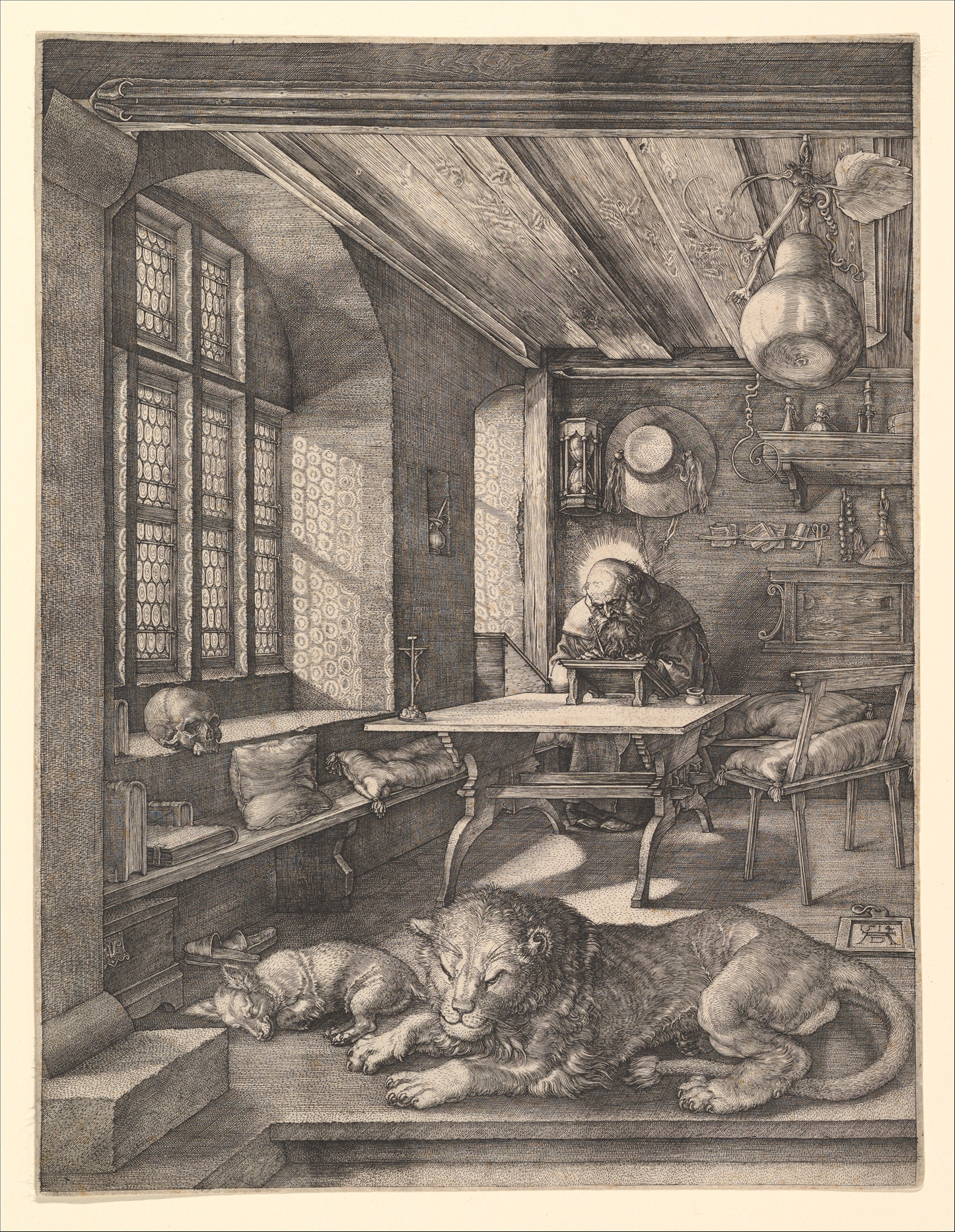
By 1513 Durer was not a young artist finding his way. He had made two journeys to Italy, in 1494 and 1495 and again in 1505 to 1507, and had run his own workshop in Nuremberg since 1495. From 1512 he began receiving commissions from the Holy Roman Emperor Maximilian I, work for which the Nuremberg city council granted him a tax exemption and an annual pension. Around 1513 and 1514 Durer turned his attention chiefly to engraving rather than to panel painting or the large woodcuts that had dominated the previous decade, and in quick succession produced the three prints later grouped as his Meisterstiche: this one in 1513, then Saint Jerome in His Study and Melencolia I in 1514.
The same period brought private loss. Durer's mother Barbara, who had lived in his household since 1504, fell seriously ill in 1513 and, after a long decline, died on 16 May 1514. Two months before her death Durer drew her from life in a charcoal portrait now in Berlin's Kupferstichkabinett, and in his own memorial book he wrote afterward that she had died hard and that he 'felt so grieved for her that I cannot express it.' The engraving and the drawing belong to the same short stretch of the artist's working life, one a public, sold and traded print, the other a private record of a death he witnessed at close range; this record does not claim any documented link between the two beyond their shared moment, since none has been found.
Three prints, one programme? The Meisterstiche question
Whether Durer meant the three engravings as a deliberate trilogy is a separate and older question from what any one of them means on its own. Panofsky, who did more than anyone to fix them together in the modern imagination, was also careful to note that the three share no compositional relationship with one another and are not, strictly, companion pieces in the way a triptych's panels are. What he identified instead, crediting the idea to Friedrich Lippmann, is a 'spiritual unity' built on a scholastic model of three kinds of virtue: the moral life of the active Christian in Knight, Death and the Devil, the theological life of contemplative faith in Saint Jerome in His Study, and the intellectual life of melancholic genius in Melencolia I. No surviving letter, diary entry or inscription from Durer himself states that he conceived the three as a set at the time he made them; the grouping and its three-part reading are a later scholarly framework laid over three prints that were made across two separate years, and this record treats that framework as an argument about the prints' reception, not a proven fact about the artist's intention.
The National Gallery impression, and how it got there
The sheet this record follows is accession 1941.1.20 at the National Gallery of Art in Washington, engraving on laid paper, 24.8 by 19 centimeters, catalogued as Meder no. 74, state a. Its documented ownership begins with Count Ludwig Yorck von Wartenburg (1805-1865) of Klein Ols in Silesia, son of the Napoleonic-era Prussian field marshal of the same name and himself the builder of a substantial collection of German prints identified by the collector's mark known to specialists as Lugt 2669. The National Gallery's own provenance note states that the sheet 'previously belonged to' Yorck von Wartenburg before it came to the Boston-area collector W.G. Russell Allen (1882-1955). Allen gave it to the Gallery in 1941, one of roughly 400 prints donated jointly that year by five collectors to lay the foundation of the young museum's print collection.
What the Gallery's own note does not supply is the route between the two men. Yorck von Wartenburg died in 1865; his collection is known to have been dispersed at the Boerner auction house in Leipzig on 2 and 3 May 1932, but nothing found for this record confirms that this specific sheet passed through that specific sale on its way to Allen, and the intervening six and a half decades of ownership are undocumented here. That gap is recorded as a gap, not bridged with a guess.
Not this impression: the Gallery's other sheet, and the Met's
The National Gallery holds a second, physically distinct impression of the same plate, accession 1943.3.3519, from the Rosenwald Collection, given to the museum in 1943 by Lessing J. Rosenwald and catalogued as Meder no. 74, state a or before. It is a different object with a different ownership history from 1941.1.20, and the two should not be conflated because they share an artist, a date and a museum.
A third documented impression is at the Metropolitan Museum of Art, accession 43.106.2, purchased through the Harris Brisbane Dick Fund in 1943; the Met's own published record for this sheet does not include a pre-acquisition provenance beyond that fund and date. Further impressions, among many worldwide, are held by the Rijksmuseum in Amsterdam (RP-P-OB-1269) and the Cleveland Museum of Art (1965.231, from the Elisabeth Severance Prentiss and Leonard C. Hanna Jr. collections, by exchange). A popular plate of this kind survives in enough separately accessioned sheets that any claim about 'the' Knight, Death and the Devil, its condition, its provenance or its price, has to specify which one.
Circulation in Durer's own lifetime
Durer's own account book from his 1520-1521 journey to the Netherlands, kept as both diary and ledger, shows the plate still earning its keep seven years after it was cut. In Antwerp in November 1520 he records selling a large bundled lot, including two impressions of Adam and Eve, a Sea Monster, a Saint Jerome, a Nemesis and 'one Knight' among other prints and woodcuts, for eight florins total. The following month he records giving 'an engraved Knight' to a correspondent named Rudiger von Gelern in exchange for three printed books. These entries show the print circulating as ordinary, saleable stock nearly a decade on, handled by Durer himself as both cash goods and trade currency, but because the transactions are bundled and bartered rather than itemized, they cannot be used to state a single-sheet price for the print in 1520 florins; this record does not attempt to derive one.
Afterlife: from Vasari to a Nuremberg rally
Giorgio Vasari, writing later in the sixteenth century, counted Durer's engravings among sheets 'of such excellence that nothing finer can be achieved,' and the plate was popular and imitated early: Jan Wierix produced a copy of it around fifty years after the original. Its afterlife runs well past the print trade. John Tenniel drew on its composition for two Victorian images, the frontispiece knight in Lewis Carroll's Through the Looking-Glass and an 1887 Punch cartoon of Otto von Bismarck; Jorge Luis Borges wrote two poems titled 'Ritter, Tod und Teufel'; Marco Denevi retold the scene from the dog's point of view; and Ingmar Bergman named the image among the visual sources behind The Seventh Seal.
Friedrich Nietzsche is reported, in Werner Steigmaier's short introduction to his thought, to have given a print of the engraving to Richard Wagner at a shared Christmas gathering at Tribschen in 1870, and to have invoked the image afterward as a figure for pessimism. From the 1920s, Nazi-era cultural propaganda promoted Durer as, in a phrase used at the time, 'the most German of German artists,' and this print in particular was drawn into that promotion: secondary accounts report that the party ideologue Alfred Rosenberg likened assembled stormtroopers to Durer's rider at a 1927 rally, and that in 1933 the mayor of Nuremberg presented Adolf Hitler with an impression of the print, describing him as a 'knight without fear or blame.' This record has traced both episodes only to encyclopedic and popular secondary sources rather than to an archival transcript or a peer-reviewed study of Durer's reception under National Socialism, and flags them accordingly rather than presenting them as fully settled.
The artist
Albrecht Durer
By 1513 Durer was the most technically accomplished engraver in Northern Europe and knew it. He had already made two journeys to Italy, built a workshop of his own in Nuremberg, and begun working directly for an emperor. The three prints he made in the year on either side of his mother's death, including this one, represent the peak of what engraving alone, without a brush or a woodblock, could be made to do.
Related works
| Work | Relation | Where it is |
|---|---|---|
| Melencolia I Albrecht Durer | The second of the three Meisterstiche, engraved 1514; already recorded in this corpus See the existing record durer-melencolia-i. This record does not repeat that record's provenance or interpretive content. | National Gallery of Art, Washington, D.C. (Rosenwald Collection, 1943.3.3523) |
| Saint Jerome in His Study Albrecht Durer | The third of the three Meisterstiche, engraved 1514 Panofsky, crediting Friedrich Lippmann, read the three prints together as a scholastic triad of moral, theological and intellectual virtue, a framework this record treats as an interpretive proposal rather than a documented statement of Durer's own intent. | Metropolitan Museum of Art, New York (accession 19.73.68, Fletcher Fund, 1919) |
| Knight, Death and the Devil (second National Gallery impression) Albrecht Durer | A separate, physically distinct impression of the same 1513 plate Not the sheet described in this record. Given by Lessing J. Rosenwald, 1943; catalogued as Meder no. 74, state a or before. | National Gallery of Art, Washington, D.C. (Rosenwald Collection, 1943.3.3519) |
| Knight, Death and the Devil (Metropolitan Museum impression) Albrecht Durer | A separate, physically distinct impression of the same 1513 plate Not the sheet described in this record. Purchased through the Harris Brisbane Dick Fund, 1943; no pre-acquisition provenance published by the Met in the sources consulted. | Metropolitan Museum of Art, New York (accession 43.106.2) |
| Knight, Death and the Devil (Rijksmuseum impression) Albrecht Durer | A further separate impression of the same plate, cited for comparanda only Not the sheet described in this record. | Rijksmuseum, Amsterdam (RP-P-OB-1269) |
| Knight, Death and the Devil (Cleveland impression) Albrecht Durer | A further separate impression of the same plate, cited for comparanda only Not the sheet described in this record. From the Elisabeth Severance Prentiss and Leonard C. Hanna Jr. collections, by exchange, 1965. | Cleveland Museum of Art (accession 1965.231) |
Open questions
- Is the rider a steadfast Christian soldier or an ambiguous, possibly sinister Raubritter figure? Named scholars hold both positions and the debate remains unresolved.
- By what route, if any, did this specific sheet pass from Count Ludwig Yorck von Wartenburg's collection to W.G. Russell Allen? The Yorck von Wartenburg collection was dispersed at Boerner, Leipzig, on 2 and 3 May 1932, but the National Gallery's own provenance note does not confirm this impression passed through that sale, and no intervening owner or dealer is documented here.
- Did Durer himself conceive the three Meisterstiche as a deliberate conceptual trilogy, or is the moral, theological and intellectual reading a scholastic framework applied afterward by Lippmann and Panofsky? No statement from Durer himself on the question has been found.
- Are the reported 1927 and 1933 Nazi-era appropriations of this print (the Rosenberg rally comparison and the Hitler gift) documented in an archival transcript or peer-reviewed study, or do they rest only on repeated secondary paraphrase? This record could not verify them beyond encyclopedic sources.
- What did a single impression of this print actually sell for in Durer's own lifetime? His 1520-1521 account book records only bundled and bartered transactions, never a per-sheet price, so no period value for the print alone can currently be established.
Questions about this object
What is Knight, Death and the Devil?
Knight, Death and the Devil is a print, dated 1513. Medium: Engraving on laid paper.
Who made Knight, Death and the Devil, and is the attribution settled?
The attribution to Albrecht Durer is recorded here as accepted. Undisputed. The plate carries Durer's AD monogram and the date 1513 within a tabula ansata at lower left, and the print has been continuously catalogued in his oeuvre since the sixteenth century (Bartsch 98; Meder 74; Schoch, Mende and Scherbaum 69).
Where is Knight, Death and the Devil now?
National Gallery of Art, Washington, D.C., 1941.1.20. Last confirmed 15 September 2026. Gift of W.G. Russell Allen, 1941.
What is still unknown about Knight, Death and the Devil?
Is the rider a steadfast Christian soldier or an ambiguous, possibly sinister Raubritter figure? Named scholars hold both positions and the debate remains unresolved.
Sources
- 1National Gallery of Art, object page for Knight, Death and Devil, accession 1941.1.20. nga.gov/artworks/...
- 2National Gallery of Art, object page for Knight, Death and Devil, accession 1943.3.3519 (Rosenwald Collection). nga.gov/artworks/...
- 3National Gallery of Art, provenance note, 'Count Ludwig Yorck von Wartenburg.' nga.gov/artworks/...
- 4National Gallery of Art, provenance note, 'Mr. W.G. Russell Allen.' nga.gov/artworks/...
- 5Metropolitan Museum of Art Collection API, object record, accession 43.106.2 (objectID 336223). metmuseum.org/art/...
- 6Metropolitan Museum of Art Collection API, object record for Saint Jerome in His Study, accession 19.73.68 (objectID 336229). metmuseum.org/art/...
- 7Rijksmuseum, object page for Knight, Death, and the Devil, accession RP-P-OB-1269. rijksmuseum.nl/en/...
- 8Cleveland Museum of Art, object page for Knight, Death, and the Devil, accession 1965.231. clevelandart.org/art/...
- 9Wikimedia Commons, File:Albrecht Durer, Knight, Death and Devil, 1513, NGA 598.jpg, imageinfo and licence (CC0). commons.wikimedia.org/wiki/...
- 10Wikimedia Commons, File:Albrecht Durer, Knight, Death and Devil, 1513, NGA 6637.jpg, imageinfo and licence (CC0). commons.wikimedia.org/wiki/...
- 11Wikipedia, 'Knight, Death and the Devil.' Tertiary source consolidating the interpretive debate and reception history. Flagged for replacement with Panofsky's monograph and the named journal articles it cites. en.wikipedia.org/wiki/...
- 12Wikipedia (German), 'Ritter, Tod und Teufel.' Tertiary source; cites Werner Steigmaier, Friedrich Nietzsche zur Einfuhrung (2011), p. 27, for the Nietzsche-Wagner gift. Flagged for replacement. de.wikipedia.org/wiki/...
- 13Wikipedia, 'Meisterstiche.' Tertiary source on Panofsky's and Lippmann's readings of the three prints as a group. Flagged for replacement with Panofsky, The Life and Art of Albrecht Durer (1943, rev. 1955). en.wikipedia.org/wiki/...
- 14Lutheran Reformation, 'Albrecht Durer's Knight, Death, and the Devil.' Cites William Martin Conway, ed. and trans., The Writings of Albrecht Durer (New York: Philosophical Library, 1958), p. 78, for the 'Der Reuter' title. lutheranreformation.org/history/...
- 15LCMS Resources, 'Knight, Death, and the Devil: Albrecht Durer's Mystery Man.' Same author/content family as source 14; corroborating. resources.lcms.org/history/...
- 16Wikipedia, 'Portrait of the Artist's Mother at the Age of 63,' for Barbara Durer's illness, death and Durer's own memorial-book quotation. en.wikipedia.org/wiki/...
- 17Angela Campbell, 'Meticulous Matrices: Building a Chronology of Albrecht Durer's Meisterstiche Impressions through the Analysis and Documentation of Microscopic Scratches in His Engraved Plates,' in Reassessing Epistemic Images in the Early Modern World, ed. Ruth Noyes (Amsterdam University Press, 2022). cambridge.org/core/...
- 18Artsy, object listing citing the Bartsch, Meder/Hollstein and Schoch-Mende-Scherbaum catalogue numbers for this print. artsy.net/artwork/...
- 19Albrecht Durer, Diary of His Journey to the Netherlands, 1520-1521 (translated edition), entries recording the sale and trade of prints including 'one Knight,' November and December 1520. Accessed via secondary synthesis rather than a direct fetch of the translated text; flagged for verification against the Conway or Goris and Marlier edition directly. books.google.com/books/...
- 20Encyclopedia.com, biographical entry on Albrecht Durer, for the Italian journeys, the 1495 Nuremberg workshop and the 1512 Maximilian I commissions. Tertiary source; flagged for replacement with a scholarly biography such as Jane Campbell Hutchison's Albrecht Durer: A Biography. encyclopedia.com/people/...


Last verified 15 September 2026 · Published 15 September 2026
Change log
15 September 2026 - Record created at the house standard: researched narrative, technical evidence, maker dossier, graded provenance chain, prices with hammer and premium separated, related works, open questions and sources.