The Berlin Secretary Cabinet
David Roentgen · 1777-1779
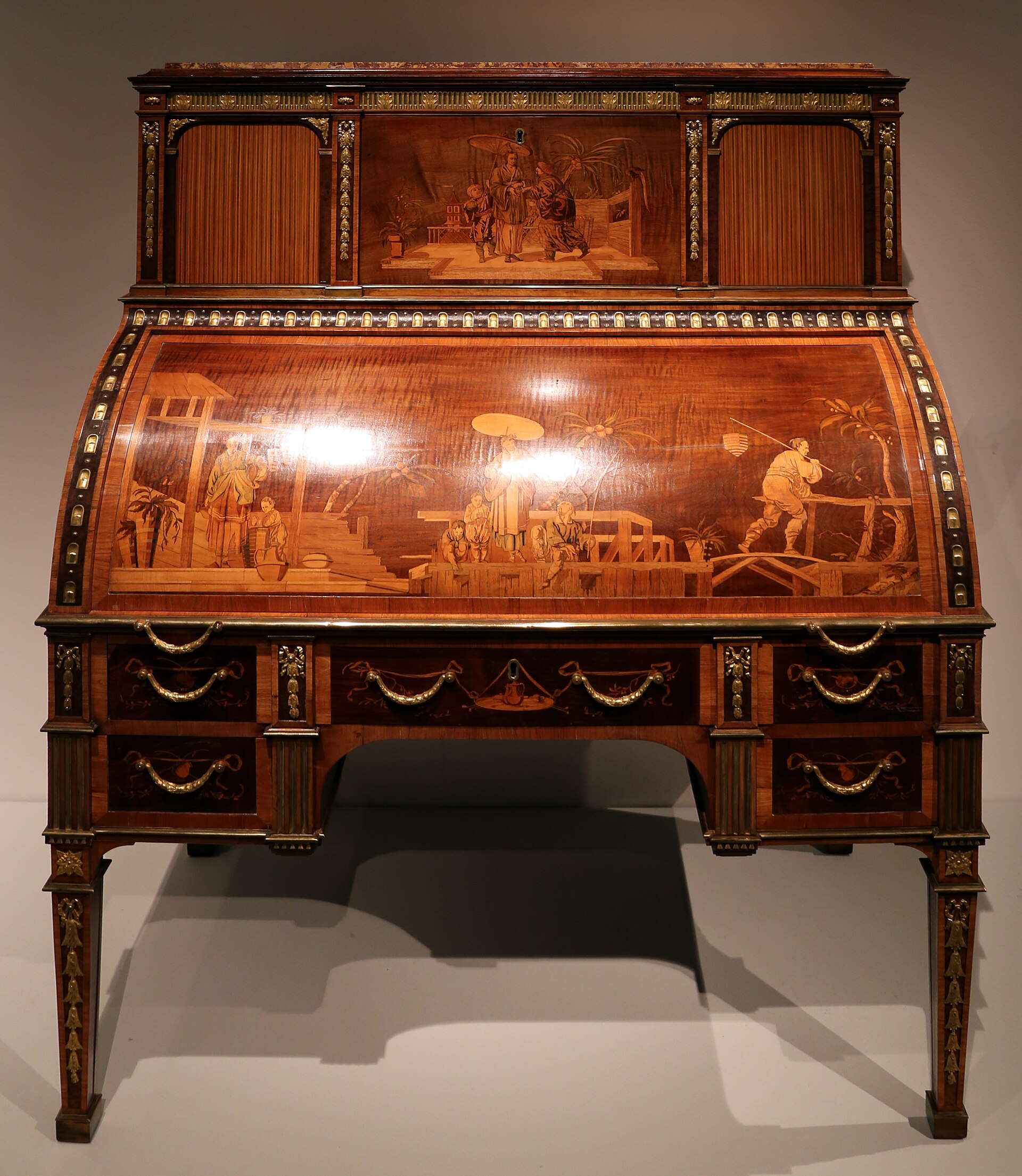
The cabinet as it stands in the Kunstgewerbemuseum Berlin, showing the fall-front writing section, the clock and carillon superstructure, and the gilt Apollo at the crest.
Photograph by Sailko, Kunstgewerbemuseum Berlin · CC BY 3.0| Artist | David Roentgen |
|---|---|
| Date | 1777-1779 |
| Medium | Curly and grained maple veneer and mahogany, with marquetry in rosewood, palisander, apple and mulberry woods, on a carcase of oak, pine, cherry and cedar; gilt bronze, enamel, brass and steel mounts and mechanism; eight-day clock movement with moon-phase dial and a ten-bell carillon; gilt-bronze figure of Apollo at the crest |
| Dimensions | 359 x 152 x 88 cm (H x W x D) |
| Where it is now | Kunstgewerbemuseum, Staatliche Museen zu Berlinlast confirmed |
| Inventory number | O-1962,24 |
| Attribution | AcceptedNot a stylistic attribution but an institutional one, resting on the object's own unbroken paper trail: the cabinet is recorded as delivered to the Prussian crown prince in December 1779 for 12,000 gold taler, and its central marquetry panel was replaced in 1786 when the same customer, by then King Frederick William II, was presented with the outstanding balance. Full note |
| Object type | Furniture |
| Period | German, Neoclassical, late eighteenth century |
| Cases | Has a provenance gap |
| Inscriptions | No maker's stamp or signature is reported in the museum's published documentation. This is typical rather than exceptional for Roentgen furniture: the workshop largely bypassed the Parisian guild's stamping requirement, and only a small number of surviving pieces carry an inlaid 'DR' monogram (an example sold at Christie's, marked beneath the kneehole drawer's keyhole, is one of the few known instances). |
| Owners on record | 7 links6 documented, 1 unknown |
| Sources | 14 cited |
About this record Last verified · 14 sources cited · Change log
On this page 9 sections
ContentsClose
A 359-centimetre mechanical cabinet built by David Roentgen's Neuwied workshop between 1777 and 1779 and delivered to the Prussian crown prince, the future Frederick William II, in December 1779 for 12,000 gold taler. Its fall-front writing section, eight-day moon-phase clock and ten-bell carillon are operated by hidden buttons; the marquetry on its centre door was replaced in 1786, when the new king was presented with the balance still owed on the original purchase, with a panel celebrating him as patron of the arts.
The object's own institutional record is unbroken from workshop to royal palace, which is why its authorship, unlike much of the wider Roentgen corpus, was never a matter of stylistic guesswork. What is not documented is where the cabinet spent the fifty-five years between 1930, when it is last recorded in the royal chambers of the Berlin Palace, and 1985, when it entered the Kunstgewerbemuseum - a gap that runs straight through the palace's wartime destruction and its demolition by the East German state. Its original, pre-1786 doors are separately recorded as lost since 1945.
It survives today as one of the clearest documented instances of Roentgen's court trade across a divided eighteenth-century Europe: real, extensive, commercially calculated access to rival royal households, sustained by unpaid balances and diplomatic favour-trading, and never more than that.
Provenance
Each link is graded. Documented: a cited source supports it. Disputed: the identification is argued but not established. Unknown: no owner for that span, and the gap is not smoothed into a narrative. The grades in the glossary.
- 1777 - 1779David Roentgen manufactory, Neuwieddocumented
Built speculatively, without a firm order in hand. The workshop produced three variants of this large cabinet design; this example is described in the sources as the most fully realised of the three.35
- 1779-12 - 1786Crown Prince Frederick William of Prussia (from 1786, King Frederick William II)documented
Delivered to the crown prince in Berlin in December 1779 for 12,000 gold taler (reported elsewhere as approximately 21,500 gulden). An initial payment of 6,000 taler was made, with the balance left outstanding for years.58
- 1786 - 1793King Frederick William II of Prussiadocumented
On his accession in summer 1786, Roentgen presented the king with an invoice for the outstanding balance, by then 8,100 taler with interest, and replaced the cabinet's centre and lower-right door marquetry with a new panel depicting an apotheosis of the sovereign.58
- 1793 - 1877Prussian royal housedocumented
Recorded in the palace inventories from 1793.5
- 1877 - 1930Prussian royal housedocumented
Inventories place the cabinet at Monbijou Palace, Berlin, from 1877.5
- 1930 - 1985unrecorded in sources consultedunknown
Recorded in the royal chambers of the Berlin Palace from 1930. No source consulted documents the cabinet's custody, location or survival through the Second World War, the palace's destruction by bombing in 1945, its demolition by the East German state in 1950, or the division of Berlin, up to 1985. The cabinet's own separately-stored original doors are independently recorded as present until 1939 and lost since 1945, which confirms at least that the palace museum's holdings were disrupted in this period, without establishing what happened to the cabinet itself.58
- 1985 - presentKunstgewerbemuseum, Staatliche Museen zu Berlindocumented
Recorded as entering the Kunstgewerbemuseum's collection in 1985, inventory number O-1962,24. The specific acquisition mechanism (purchase, transfer between state institutions, or another route) is not given in the sources consulted.345
Technical evidence
| Attribution note | Not a stylistic attribution but an institutional one, resting on the object's own unbroken paper trail: the cabinet is recorded as delivered to the Prussian crown prince in December 1779 for 12,000 gold taler, and its central marquetry panel was replaced in 1786 when the same customer, by then King Frederick William II, was presented with the outstanding balance. Most surviving Roentgen furniture carries no maker's stamp at all, which makes authorship a live problem across the corpus (the Royal Collection Trust catalogues a comparable cylinder bureau only as 'attributed to David Roentgen'); this piece is one of the minority whose authorship was never actually in question, because the commission and the object stayed on the same institutional record from the workshop to the museum. |
|---|---|
| Construction and materials | Carcase of oak, pine, cherry and cedar; veneered in curly and grained maple and mahogany; marquetry in rosewood, palisander, apple and mulberry woods; mounts in gilt bronze, with enamel, brass and steel used in the mechanism and fittings.34 |
| Dimensions | 359 x 152 x 88 cm (height x width x depth).34 |
| Clock movement | Eight-day movement with a moon-phase dial, built into the superstructure above the writing compartment.7 |
| Carillon | Ten bells, playing six different melodies, triggered in connection with the cabinet's other mechanisms.7 |
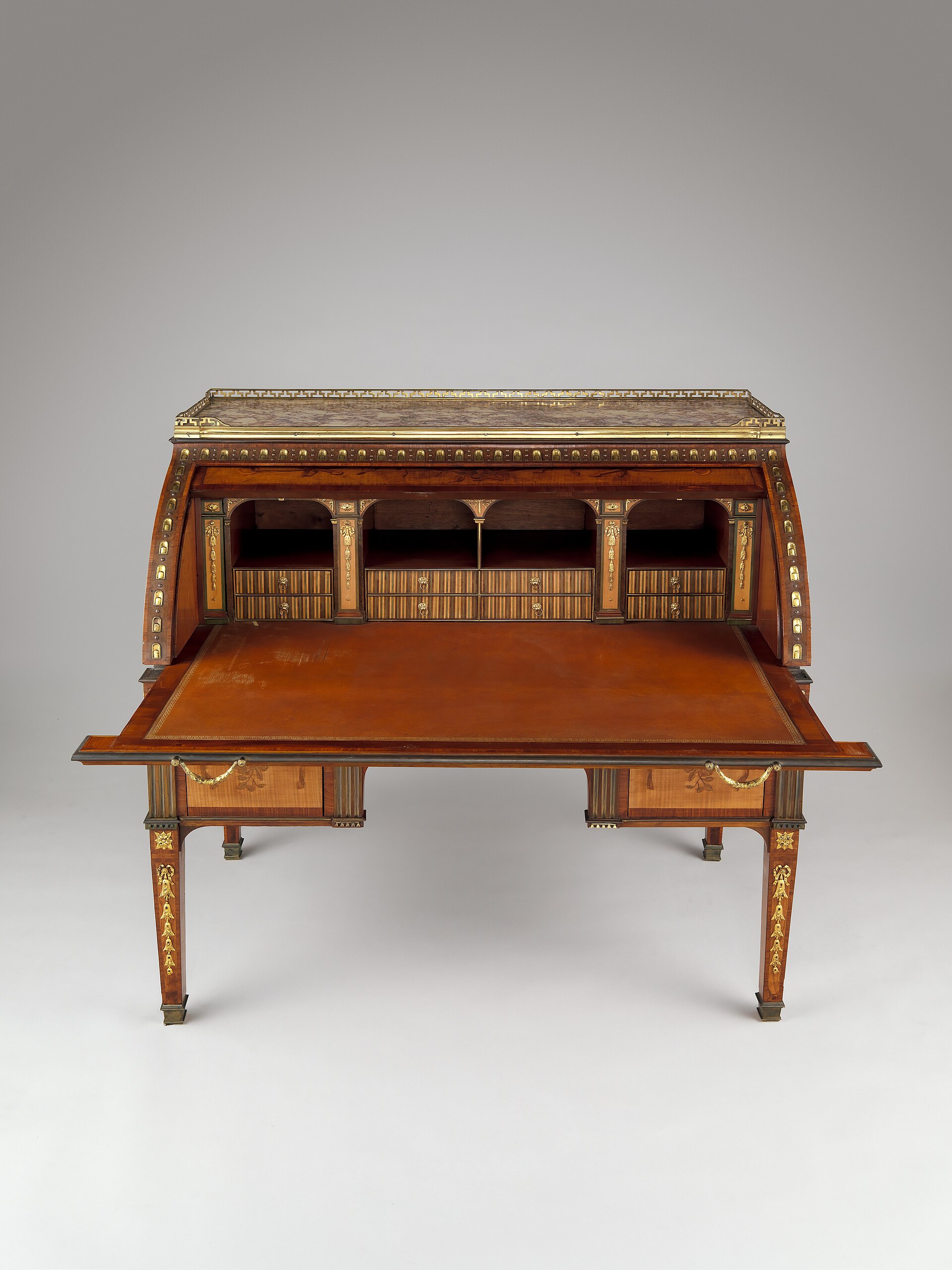
| Writing-compartment marquetry | Rotating cylinders inlaid with figures from the Italian comedy (commedia dell'arte stock characters), set within the fitted writing section.57 |
| Concealed mechanisms | Button-activated doors, drawers and writing surfaces; a retractable compartment for valuables; a pull-out writing desk released by turning a key.567 |
| Crest figure | A gilt-bronze figure of Apollo holding a lyre surmounts the cabinet; the design has been associated with the French sculptor Louis-Simon Boizot.7 |
| 1786 door replacement | The centre door (originally a personification of Geometry and Astronomy) and the lower right door (originally Sculpture) were replaced in 1786 with a new marquetry panel showing an apotheosis of Frederick William II. The original doors were recorded at the palace museum until 1939 and have been lost since 1945.58 |
| Maker's mark | No signature or workshop stamp is recorded on the piece in the sources consulted, consistent with the wider Roentgen corpus rather than exceptional to it.1112 |
Images
The record in full
Chapter 1What it is
This is not a desk in the ordinary sense.
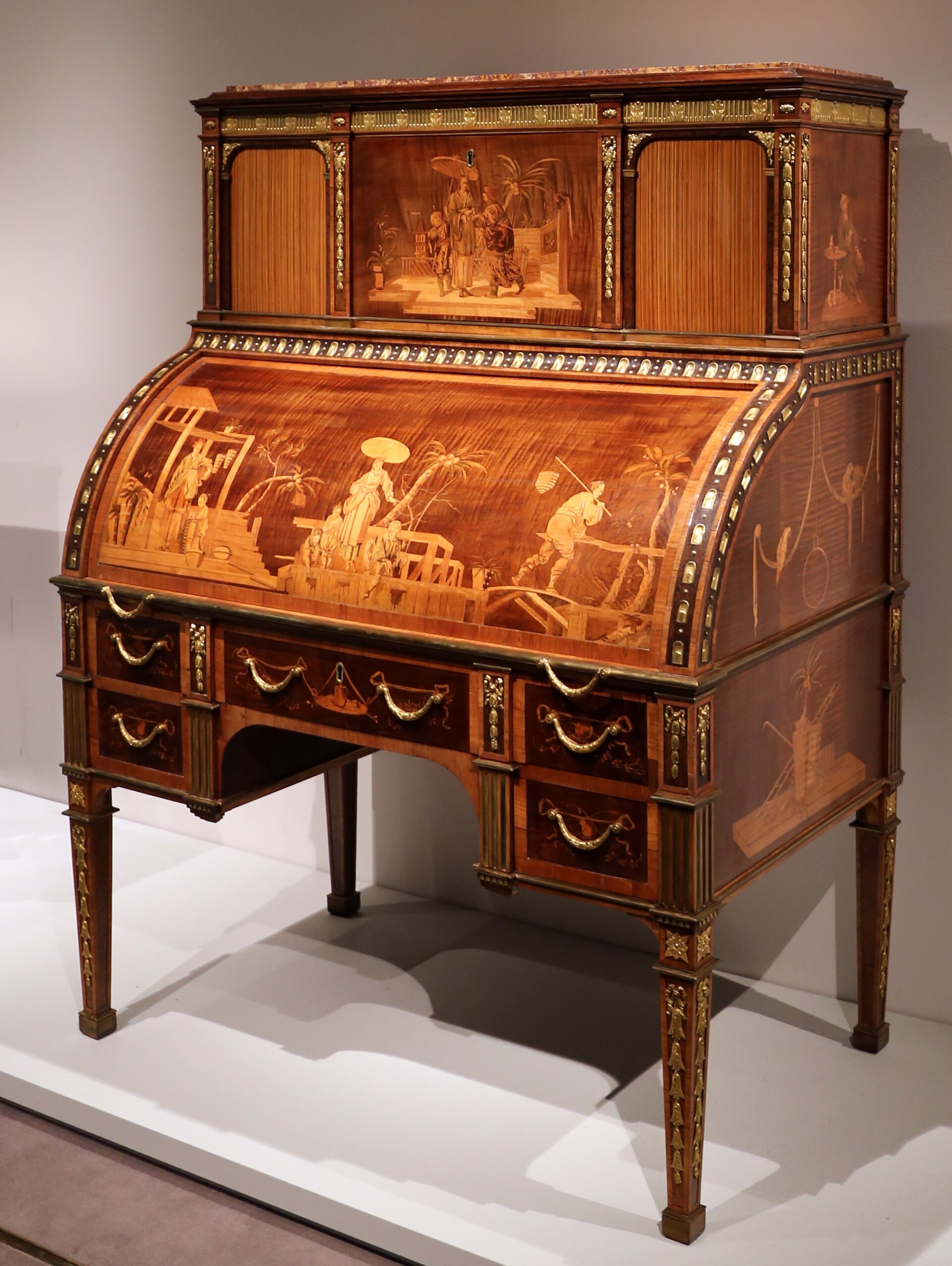
This is not a desk in the ordinary sense. It is a free-standing cabinet 359 centimetres tall, more than a metre and a half wide, built around a fall-front (the Commons cataloguer's Italian description, scrittoio a ribalta, is accurate but modest) writing section set into an architectural superstructure. Above the writing compartment sits an eight-day clock with a moon-phase dial, a carillon of ten bells that plays six tunes, and, at the very top, a gilt-bronze figure of Apollo holding a lyre. The whole surface is worked in marquetry of maple, mahogany, rosewood, palisander, apple and mulberry wood over a structural carcase of oak, pine, cherry and cedar, with gilt bronze, enamel, brass and steel used for the mounts and the mechanism itself.
The scale matters. Most of what is written about David Roentgen concerns small mechanical desks made for a writing table or a study. This object was built to stand in a room and be looked at as furniture-as-architecture: a piece of princely display first, and a writing surface second.
Chapter 2How it was made: Neuwied and the Kintzing partnership
The cabinet came out of the furniture manufactory that Abraham Roentgen founded in 1753 at Neuwied on the Rhine, a settlement of the Moravian Church, and which his son David took over in 1772.
The cabinet came out of the furniture manufactory that Abraham Roentgen founded in 1753 at Neuwied on the Rhine, a settlement of the Moravian Church, and which his son David took over in 1772. By the time this piece was built, the Neuwied workshop's reputation rested on two things done together: cabinetwork of exceptional technical finish, and mechanisms - hidden drawers, spring-triggered compartments, automated openings - that no ordinary joiner's shop could supply.
The mechanism and the clockwork on pieces like this one were the responsibility of Peter Kintzing, a clockmaker who worked in partnership with Roentgen. When Marie Antoinette later granted Roentgen the title ebeniste-mecanicien du Roi et de la Reine, the title was in practice shared with Kintzing, whose clockwork made the mechanical half of the Roentgen name possible. The cabinet's clock, moon-phase dial and ten-bell carillon are products of that partnership, not of the cabinetmaking side of the business alone.
Chapter 3The mechanism: what conceals what
According to the Kunstgewerbemuseum's own published description, the cabinet is operated by buttons: pressing them opens doors, drawers and entire writing surfaces, along with cases and compartments...
According to the Kunstgewerbemuseum's own published description, the cabinet is operated by buttons: pressing them opens doors, drawers and entire writing surfaces, along with cases and compartments that are not visible when the piece is closed. The writing compartment itself is fitted with rotating cylinders carrying marquetry figures from the Italian comedy - the commedia dell'arte stock characters that were a staple of eighteenth-century court entertainment - worked in fine, mosaic-like inlay rather than paint. A retractable compartment for valuables and a pull-out desk surface activated by turning a key are also recorded as part of the mechanism, and door and drawer movements are accompanied by the carillon.
What none of the sources consulted for this record establish is a full technical account of the mechanism's internal construction - the springs, the linkages, the sequence in which one action triggers the next. That kind of granular description exists for other, better-published Roentgen pieces (the Metropolitan Museum published animated diagrams of several mechanisms for its 2012-13 exhibition); it has not been located here for this specific cabinet, and is recorded in open_questions rather than guessed at.
Chapter 4The commission and its price
The workshop built this design in three variants; this is described in the sources as the most fully realised of the three.
The workshop built this design in three variants; this is described in the sources as the most fully realised of the three. It was made speculatively - without a firm order in hand - and delivered to the Prussian crown prince, the future Frederick William II, in Berlin in December 1779. The price was 12,000 gold taler, given elsewhere as roughly 21,500 gulden, a figure that itself signals the scale of the object: this was a princely purchase, not a domestic one.
The crown prince paid 6,000 taler up front. That partial payment mattered commercially as much as symbolically: it bound the Neuwied workshop's manufacture to the Prussian court for years, since the balance remained outstanding and unresolved while Roentgen continued to supply the household. This is a documented instance of exactly the kind of commercial leverage that ran through Roentgen's dealings with every court he sold to - speculative production, part-payment, and a debt that kept the relationship (and the workshop's access) alive.
Chapter 51786: the throne, the unpaid balance and the rebuilt door
Frederick William II acceded to the Prussian throne in the summer of 1786.
Frederick William II acceded to the Prussian throne in the summer of 1786. By then the balance on the cabinet, with interest, had grown to 8,100 taler, and Roentgen presented the new king with an invoice for it - what one source describes, accurately, as 'a demand of truly royal proportions'. He accompanied the demand with a gift calculated to make it easier to pay: he replaced the cabinet's original marquetry, on the centre door (a personification of Geometry and Astronomy) and the lower right door (Sculpture), with a new panel showing an apotheosis of the sovereign - Athena crowning a column bearing the king's portrait, presenting him as patron of the arts and sciences.
This is the panel that is on the cabinet today. It is worth being precise about what that means: the marquetry a visitor sees on the doors now dates from 1786, seven years after the cabinet itself was built, and it was made as an instrument of debt collection as much as of flattery. Both things are true at once, and the surviving object records only the second campaign of decoration, not the first.
Chapter 6Roentgen among the rival courts
This cabinet was one commission among many that took David Roentgen between the courts of a divided and often mutually suspicious Europe, and it is worth setting out plainly what is actually...
This cabinet was one commission among many that took David Roentgen between the courts of a divided and often mutually suspicious Europe, and it is worth setting out plainly what is actually documented about that movement, because the temptation to read a furniture-maker's court access as something more dramatic than salesmanship is real and should be resisted.
Roentgen first appeared in Paris in 1774, and returned in force in 1779, when Marie Antoinette and the king's brother, the Comte d'Artois, bought furniture from him; his access to the French court that year is reported to have been arranged with help from a well-placed intermediary. Louis XVI paid an unprecedented sum for a Roentgen piece that year, in the process outdoing the cost of the celebrated Bureau du Roi by Oeben and Riesener already in the royal collection - a comparison of price, not a claim that Roentgen's piece and the Bureau du Roi are the same object. The Parisian guild of master cabinetmakers initially disputed his right to sell foreign-made furniture in the city; he answered that in 1780 with a new marquetry technique that won him admission. Marie Antoinette and Louis XVI jointly granted Roentgen and Kintzing the title of ebeniste-mecanicien du Roi et de la Reine.
In Russia, Roentgen sold extensively to Catherine the Great through the 1780s, including a delivery of more than 130 pieces in 1786 alone, and he maintained a shop in St Petersburg to service the trade. The relationship had limits: in 1790 the Empress bluntly refused a cylinder bureau he sent unsolicited, writing that she did not know why she should buy something useless that she had neither seen nor ordered, adding that this was 'improper of Herr David Roentgen'. In Prussia, his standing with Frederick William II was formalised in 1792, when the king made him a Commerzienrat (commercial councillor) with agent status for the Lower Rhine district.
What is documented across all three courts is a merchant's diplomacy: recommendation letters (an Austrian ambassador in Paris, Florimund Mercy d'Argenteau, is named as one useful contact), arrangements for duty-free transport of goods across hostile borders, and active intelligence-gathering about what a given ruler actually wanted to buy. That is a genuinely unusual degree of access for a furniture-maker to rival courts during a period of real European tension - but it is access as a supplier, sustained by unpaid balances and personal favour, not a documented intelligence or diplomatic role in any formal sense. No source consulted for this record supports characterising it as espionage, and this record does not either.
Chapter 7From the royal palace to the state museum: a broken chain
The cabinet's own institutional record gives a location history, not a continuous ownership history, and the two are not the same thing.
The cabinet's own institutional record gives a location history, not a continuous ownership history, and the two are not the same thing. German Wikipedia's account of the Roentgen art cabinets states the sequence as follows: the Berlin cabinet is documented in the Berlin Palace (Schloss Berlin, the Hohenzollern city residence) from 1793; the inventories place it in Schloss Monbijou after 1877; from 1930 it is recorded in the royal chambers of the Berlin Palace; and since 1985 it has been part of the Kunstgewerbemuseum of the Staatliche Museen zu Berlin.
That leaves a fifty-five-year gap, from 1930 to 1985, undocumented in any source consulted for this record. It is not a small gap. The Berlin Palace was gutted by Allied bombing in 1945 and its ruin was demolished by the East German government in 1950; Berlin itself was divided for most of the intervening period, and Cold War institutional custody across that divide is rarely simple. None of the sources used here state whether the cabinet was evacuated before the bombing, survived it in situ, passed through Soviet or East German custody, or reached the Kunstgewerbemuseum by some other route in 1985. This record does not supply an answer where the evidence does not, and it is listed as an open question rather than filled with a plausible-sounding guess.
Chapter 8The lost doors
One specific and sourced fact does survive from that gap.
One specific and sourced fact does survive from that gap. According to the Museum fur angewandte Kunst (Vienna) blog's account of the Roentgen manufactory's court strategy, the original pre-1786 marquetry doors - the ones removed and replaced with the king's apotheosis panel - were kept, apparently as a set with the cabinet, and were recorded at the palace museum as late as 1939. They have been lost since 1945.
That means the Geometry-and-Astronomy and Sculpture panels described in the sources for this record exist only as descriptions now, not as objects that could be examined or reunited with the cabinet. It also means that whatever happened to the cabinet itself between 1930 and 1985, something distinct and unrecovered happened to the doors specifically in the same general period, which is itself evidence that the object and its dismembered decorative history were not necessarily kept together, or kept safe together, through the war.
Chapter 9Attribution: settled here, contested elsewhere
Roentgen furniture as a body of work has a genuine authentication problem, and it is worth stating plainly rather than passing over.
Roentgen furniture as a body of work has a genuine authentication problem, and it is worth stating plainly rather than passing over. The Neuwied workshop largely did not comply with the Parisian guild convention of stamping a maker's mark into a piece, even after Roentgen gained guild admission in Paris. The result is that a large share of surviving Roentgen and Roentgen-attributed furniture carries no signature at all, and major institutions catalogue accordingly: the Royal Collection Trust lists a comparable mechanical cylinder bureau only as 'Attributed to David Roentgen', not as a documented work. Where a mark does survive - an inlaid 'DR' monogram beneath the keyhole of a cylinder bureau sold at Christie's, for instance - specialists treat it as exceptional, on the reasoning that Roentgen only monogrammed pieces he personally considered worthy of it.
This particular cabinet sits outside that problem, and for a specific reason: its authorship was never established by connoisseurship in the first place. It is documented by a continuous institutional record - delivery to the crown prince in 1779, the price, the part-payment, the 1786 rebuilding of the door to settle the balance - that ties the object to Roentgen's workshop by transaction rather than by style. The attribution risk that affects the wider Roentgen corpus (a later copy, a misattributed workshop piece, a pastiche assembled from genuine parts) does not apply here in the same way, because there was never a moment when this object's maker had to be inferred.
Chapter 10The maker's world: Neuwied, the Moravian Church, and princely mechanism
Abraham Roentgen, the founder of the workshop David inherited, was a documented member of the Moravian Church (the Herrnhuter Brudergemeine): he joined the movement in London after hearing the...
Abraham Roentgen, the founder of the workshop David inherited, was a documented member of the Moravian Church (the Herrnhuter Brudergemeine): he joined the movement in London after hearing the preacher Peter Bohler, married a woman from the Moravian centre at Herrnhut in 1739, and in 1753 moved his family and his business to Neuwied specifically because it was a Moravian settlement. He died at Herrnhut in 1793. That is a documented fact about Abraham's own religious life and about why the workshop existed where it did; none of the sources consulted for this record establish that David personally held the same commitment, and this record does not assume that he did.
Beyond that, there is no hidden programme to report in the cabinet's own decoration, and saying so plainly is the honest finding. The gilt Apollo with his lyre at the crest, and the commedia dell'arte figures worked into the writing-compartment marquetry, are conventional Enlightenment courtly iconography - reason, the arts, and theatrical entertainment as attributes of an enlightened prince - not evidence of any esoteric or coded content. The 1786 apotheosis panel is explicit political flattery with a commercial motive behind it, already discussed above, and it does not require a second, hidden layer of meaning to be understood.
Chapter 11The market cohort: what comparable Roentgen furniture shows
This cabinet has never been sold at public auction and there is no market history to report for it directly.
This cabinet has never been sold at public auction and there is no market history to report for it directly. But placing it against other documented Roentgen furniture shows what a bespoke royal commission of this kind actually cost relative to the workshop's ordinary production. A rolltop desk veneered in yellowheart wood, now in the Metropolitan Museum of Art's Wrightsman Collection, survives with its own invoice: delivered to Catherine the Great in March 1786 at a price of 250 roubles plus 90 for transport and packing - a modest, standard-catalogue price for a smaller desk, against the 12,000 taler paid for this one-off cabinet seven years earlier. The gap in price is a gap in kind, not just in scale: most of what the Neuwied workshop sold, even to an empress, was closer to the smaller desk than to this cabinet.
The attribution spectrum runs the other way. Where this cabinet's authorship is institutionally certain, the Royal Collection's comparable cylinder bureau is catalogued only as 'attributed to' Roentgen, and the Christie's example with its inlaid DR monogram is treated as unusually well-evidenced precisely because most pieces are not. Seen together, the three objects sketch the range: a documented royal commission at one end, an inlaid monogram as the exception in the middle, and unmarked, stylistically-attributed workshop production - the majority of what survives - at the other.
The artist
David Roentgen
David Roentgen ran the most famous furniture workshop in Europe for roughly two decades and died ruined. Both halves of that sentence are documented. He inherited a highly capable but regionally confined cabinetmaking business from his father in 1772 and turned it, within a decade, into a supplier to Louis XVI, Marie Antoinette, Catherine the Great and Frederick William II of Prussia at once - an extraordinary feat of access across courts that were frequently at odds with one another. He was also, by any strict standard, half of a partnership: the mechanisms and clockwork that made his furniture famous were built by Peter Kintzing, and the workshop that made the furniture itself was staffed by cabinetmakers whose individual names rarely survive attached to specific pieces.
Related works
| Work | Relation | Where it is |
|---|---|---|
| Rolltop desk (yellowheart veneer) David Roentgen | Standard-production Roentgen rolltop desk, documented in a 1786 invoice to Catherine the Great; a price and scale comparison for the bespoke Berlin cabinet. Invoiced at 250 roubles plus 90 roubles for transport and packing, against 12,000 taler for this cabinet - the two objects mark the range of the Neuwied workshop's royal output. | The Metropolitan Museum of Art, New York (Wrightsman Collection) |
| Mechanical cylinder bureau Attributed to David Roentgen | Comparable mechanical cylinder bureau catalogued only as an attribution, illustrating the authentication problem that affects most unmarked Roentgen furniture. Catalogued as 'Attributed to David Roentgen (1743-1807)' rather than as a documented work, unlike the Berlin cabinet. | Royal Collection Trust, United Kingdom |
| Mechanical cylinder bureau with inlaid 'DR' monogram David Roentgen | One of the small number of surviving Roentgen pieces to carry the maker's own monogram, offered at auction. Circa 1776-79. The inlaid 'DR' monogram beneath the kneehole drawer's keyhole is treated by specialists as evidence Roentgen personally regarded this piece as worth signing. | Sold via Christie's (mounts attributed to Francois Remond); present whereabouts as of a private sale not established in sources consulted. |
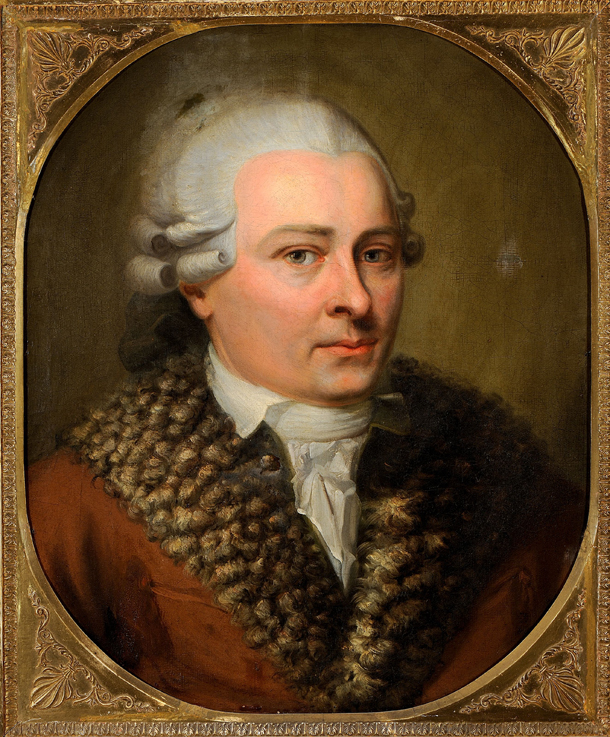
| Portrait of David Roentgen Unidentified painter | The only likeness of the maker located for this record. Circa 1785-90, showing Roentgen at approximately 45 - roughly contemporary with this cabinet's 1786 modification. | Reproduced via the Victoria and Albert Museum's published article on Abraham Roentgen |
Open questions
- Where was the cabinet, and in whose custody, between 1930 (last recorded in the royal chambers of the Berlin Palace) and 1985 (recorded entry into the Kunstgewerbemuseum)? No source consulted for this record documents its fate through the 1945 destruction of the Berlin Palace, the palace's 1950 demolition by the East German government, or the following three and a half decades.
- What specifically happened to the cabinet's original pre-1786 marquetry doors, recorded at the palace museum until 1939 and lost since 1945? Whether they were destroyed, dispersed, or simply misplaced in wartime storage is not established.
- What is the precise internal mechanical construction of the button-activated doors, drawers and writing surfaces - the springs, linkages and sequence of operation? A general description of what the mechanism does survives; a technical account of how it does it, of the kind published for other Roentgen pieces, was not located for this specific cabinet.
- Was this cabinet included as a loan in the Metropolitan Museum's 2012-13 exhibition 'Extravagant Inventions: The Princely Furniture of the Roentgens'? Search results suggested a Kunstgewerbemuseum Berlin loan to that exhibition but this could not be confirmed against a primary checklist or catalogue entry, so it is not asserted in this record.
- What did the Kunstgewerbemuseum pay, or receive as a transfer, for the 1985 acquisition, and by what mechanism (purchase, inter-museum transfer, restitution) did the object move from the Berlin Palace's royal chambers into the museum's collection?
Questions about this object
What is The Berlin Secretary Cabinet?
The Berlin Secretary Cabinet is a furniture, dated 1777-1779. Medium: Curly and grained maple veneer and mahogany, with marquetry in rosewood, palisander, apple and mulberry woods, on a carcase of oak, pine, cherry and cedar; gilt bronze, enamel, brass and steel mounts and mechanism; eight-day clock movement with moon-phase dial and a ten-bell carillon; gilt-bronze figure of Apollo at the crest.
Who made The Berlin Secretary Cabinet, and is the attribution settled?
The attribution to David Roentgen is recorded here as accepted. Not a stylistic attribution but an institutional one, resting on the object's own unbroken paper trail: the cabinet is recorded as delivered to the Prussian crown prince in December 1779 for 12,000 gold taler, and its central marquetry panel was replaced in 1786 when the same customer, by then King Frederick William II, was presented with the outstanding balance. Most surviving Roentgen furniture carries no maker's stamp at all, which makes authorship a live problem across the corpus (the Royal Collection Trust catalogues a comparable cylinder bureau only as 'attributed to David Roentgen'); this piece is one of the minority whose authorship was never actually in question, because the commission and the object stayed on the same institutional record from the workshop to the museum.
Where is The Berlin Secretary Cabinet now?
Kunstgewerbemuseum, Staatliche Museen zu Berlin. Inventory number O-1962,24. Last confirmed 21 August 2026. Inventory number and holding institution as published by museum-digital: Staatliche Museen zu Berlin and corroborated by the Deutsche Digitale Bibliothek's object record for the same piece.
What is still unknown about The Berlin Secretary Cabinet?
Where was the cabinet, and in whose custody, between 1930 (last recorded in the royal chambers of the Berlin Palace) and 1985 (recorded entry into the Kunstgewerbemuseum)? No source consulted for this record documents its fate through the 1945 destruction of the Berlin Palace, the palace's 1950 demolition by the East German government, or the following three and a half decades.
Sources
- 1Wikimedia Commons, File:David roentgen, scrittoio a ribalta, neuwied 1778-79, 01.jpg, photograph by Sailko, CC BY 3.0. commons.wikimedia.org/wiki/...
- 2Wikimedia Commons, File:David roentgen, scrittoio a ribalta, neuwied 1778-79, 02.jpg, photograph by Sailko, CC BY 3.0. commons.wikimedia.org/wiki/...
- 3museum-digital: staatliche museen zu berlin, object record for the 'Neuwieder Kabinett', Kunstgewerbemuseum, inventory O-1962,24. smb.museum-digital.de/object/...
- 4Deutsche Digitale Bibliothek, item record for the 'Neuwieder Kabinett', Kunstgewerbemuseum Berlin. deutsche-digitale-bibliothek.de/item/...
- 5Wikipedia (German), 'Kunstschranke aus der Manufaktur David Roentgen', section on the Berlin cabinet: provenance chain, price, and the 1786 door replacement. Wolfram Koeppe's Extravagant Inventions catalogue). de.wikipedia.org/wiki/...
- 6Google Arts & Culture, 'Secretary Cabinet, Neuwieder Kabinett - David Roentgen', published via the Kunstgewerbemuseum Berlin's partnership content. artsandculture.google.com/asset/...
- 7The Decorative Arts Trust, photograph caption and entry for the Roentgen secretary cabinet at the Kunstgewerbemuseum Berlin, in 'Discovering Eastern Germany's Treasures'. decorativeartstrust.org/discovering-eastern-germanys-trea...
- 8MAK Blog (Museum fur angewandte Kunst, Vienna), 'Kundschaft in den hochsten Kreisen: Die Strategen der Roentgen Manufaktur', on Roentgen's court sales strategy, the Berlin cabinet's price and 1786 modification, and the loss of its original doors since 1945. blog.mak.at/david-roentgen
- 9Wikipedia (English), 'David Roentgen', for biography, the Marie Antoinette and Catherine the Great sales, and the 1792 Commerzienrat title. en.wikipedia.org/wiki/...
- 10Wikipedia (English), 'Abraham Roentgen', for Abraham Roentgen's biography and documented Moravian Church membership. en.wikipedia.org/wiki/...
- 11Christie's, lot description for 'A German ormolu-mounted and brass-inlaid amboyna, tulipwood, stained sycamore and marquetry mechanical cylinder bureau, by David Roentgen, Neuwied, circa 1776-1779', noting the inlaid 'DR' monogram. christies.com.cn/en/...
- 12Royal Collection Trust, 'Attributed to David Roentgen (1743-1807), Mechanical cylinder bureau'. rct.uk/collection/...
- 13The Metropolitan Museum of Art, collection object page for a David Roentgen rolltop desk (Wrightsman Collection), documenting its 1786 invoice to Catherine the Great. metmuseum.org/art/...
- 14The Metropolitan Museum of Art, press release for 'Extravagant Inventions: The Princely Furniture of the Roentgens', October 2012 - January 2013, curated by Wolfram Koeppe. metmuseum.org/press-releases/...


Last verified · Published
Change log
21 August 2026 - Record created at the house standard: researched narrative, technical evidence, maker dossier, graded provenance chain, prices with hammer and premium separated, related works, open questions and sources.