The Book of Kells
Columban scriptorium (Iona, Kells or both; scribes and artists anonymous) · c. 800
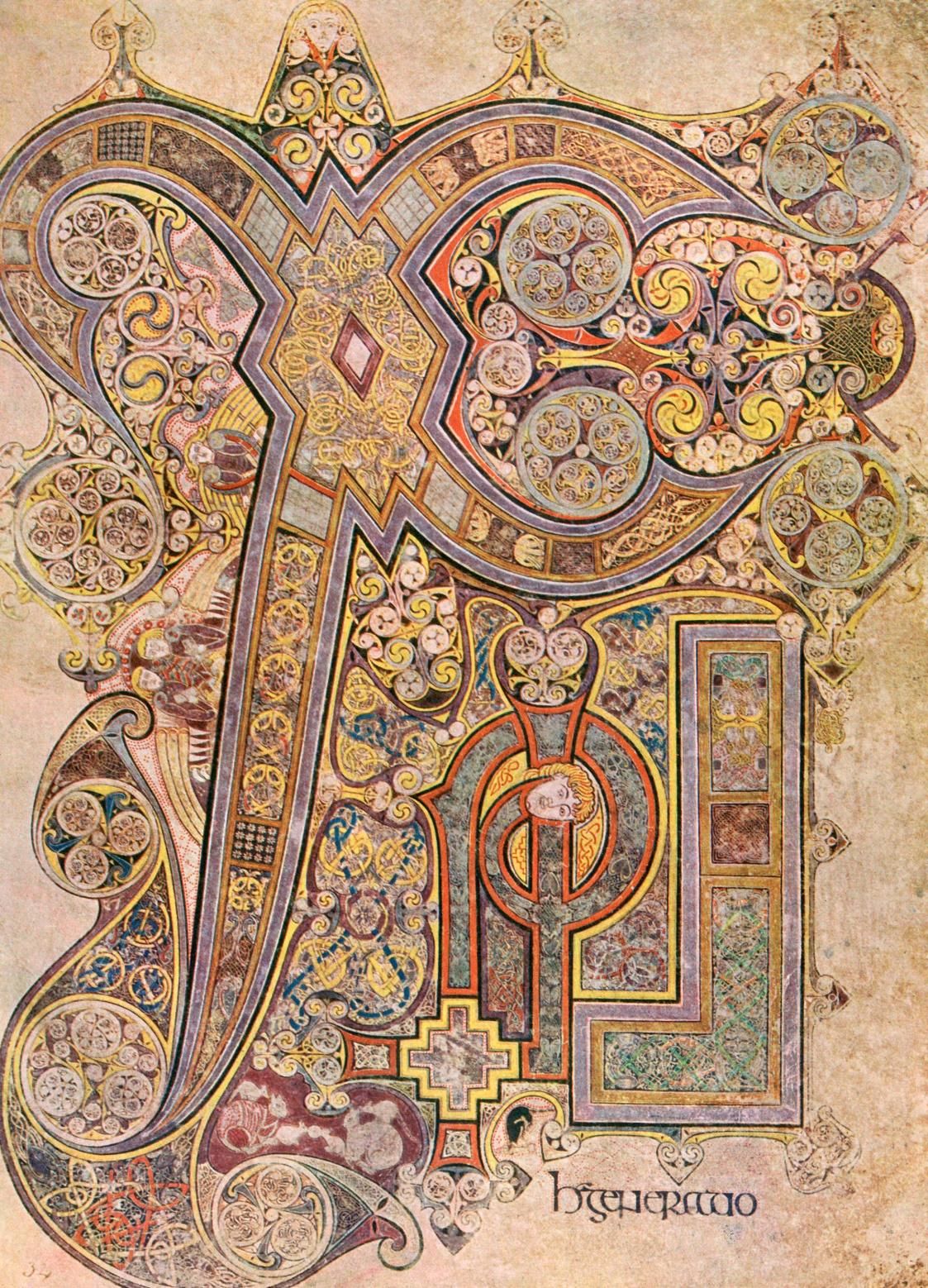
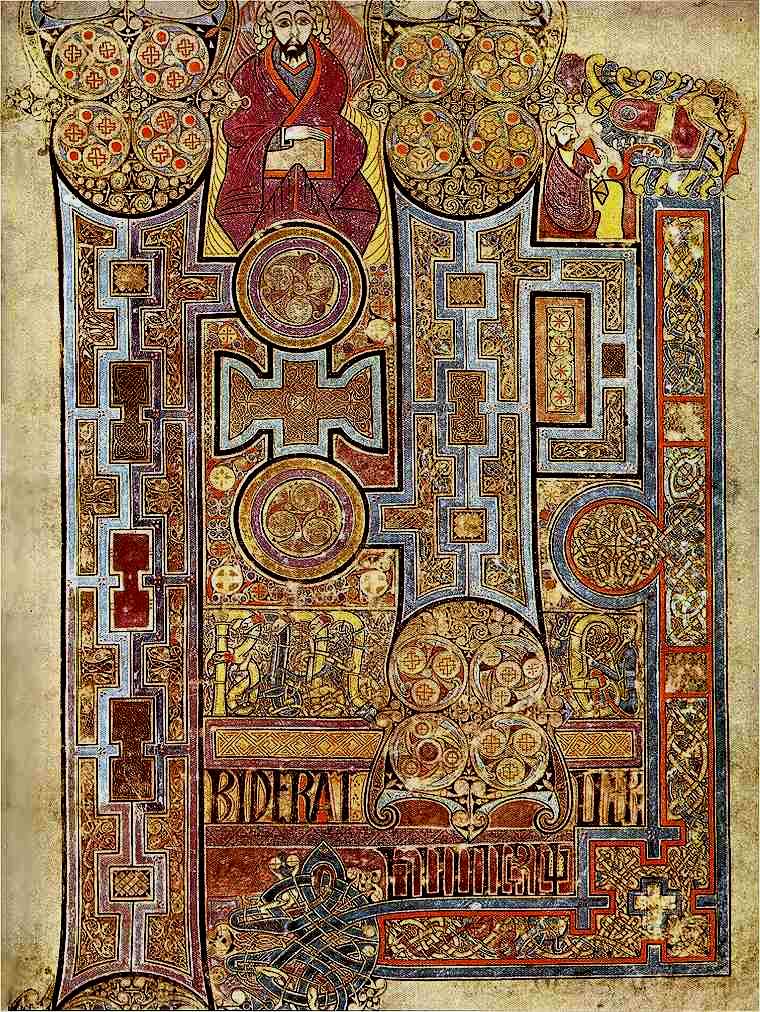
The Chi Rho monogram opening the Christmas narrative in Matthew, folio 34r of Trinity College Dublin MS 58, the most famous page of the book.
| Artist | Columban scriptorium (Iona, Kells or both; scribes and artists anonymous) |
|---|---|
| Date | c. 800 |
| Medium | Iron gall and carbon ink and pigments on calf vellum; no gold or silver leaf |
| Dimensions | c. 330 x 255 mm; 340 folios (680 pages) |
| Where it is now | Library of Trinity College Dublin, Dublinlast confirmed |
| Inventory number | MS 58 (old press mark A. I. 6); bound in four volumes since 1953 |
| Attribution | DisputedNo scribe, artist or place is named in the book itself and the final leaves, which might have carried a colophon, are lost. Full note |
| Object type | Manuscript |
| Period | Insular, c. 800 |
| Cases | Disputed attribution · Has a provenance gap |
| Inscriptions | Latin text of the four Gospels in insular majuscule with prefatory matter and canon tables. Eleventh and twelfth century land charters were added in blank spaces. |
| Owners on record | 5 links3 documented, 1 disputed, 1 unknown |
| Sources | 17 cited |
About this record Last verified · 17 sources cited · Change log
On this page 11 sections
ContentsClose
A Latin Gospel book of about 800, made by the Columban community and the most heavily decorated insular manuscript to survive. It was stolen from the stone church at Kells in 1007 and found again under a sod, was sent to Dublin around 1653 and was given to Trinity College by Bishop Henry Jones in 1661.
Where it was made is still argued: Iona, Kells, both, or Pictish Scotland. Since 1953 it has been bound in four volumes by Roger Powell. It has left Ireland rarely, and Trinity ruled out further loans after the Mark volume lost microscopic fragments of pigment on the way to Canberra in 2000.
One volume is on view in the Old Library. The Library is to be redeveloped and the book is planned to move to the Printing House in late 2027.
Provenance
Each link is graded. Documented: a cited source supports it. Disputed: the identification is argued but not established. Unknown: no owner for that span, and the gap is not smoothed into a narrative. The grades in the glossary.
- c. 800 - 1007Columban community (Iona, Kells or both)disputed
Made close to 800 by the Columban community. The place is disputed between Iona, Kells, both, Pictland and Northumbrian-influenced centres; no colophon survives.123417
- 1007 - 1007Church of Cenannas (Kells)documented
The Annals of Ulster record the Great Gospel of Colum Cille stolen by night from the western sacristy and recovered after two months and twenty nights with its gold taken off and a sod over it. Identification with MS 58 is probable and not provable. Trinity gives 1006.129
- 1007 - c. 1653Kells, later a parish churchunknown
Held at Kells and venerated as a relic of Colum Cille; charters added in blank spaces in the eleventh and twelfth centuries; the abbey was dissolved in the twelfth century reforms. No other custody is documented in sources consulted.12
- c. 1653 - 1661Dublin, by order of the Kells governordocumented
Sent to Dublin for safekeeping around 1653 (Trinity) or 1654 (Wikipedia) when Cromwellian cavalry were at Kells. Details of the interval to 1661 are not in the sources consulted.12
- 1661 - presentLibrary of Trinity College Dublindocumented
Presented by Henry Jones, bishop of Clogher and then of Meath and vice-chancellor of the University. Rebound in four volumes by Roger Powell in 1953. Lent to Canberra in 2000; Board ruled out further external loans.12681011
Technical evidence
| Attribution note | No scribe, artist or place is named in the book itself and the final leaves, which might have carried a colophon, are lost. Scholars agree on a Columban origin close to 800 and disagree on the place: begun at Iona and finished at Kells, wholly at Iona, wholly at Kells, in Pictland (Whitworth) or in a Northumbrian-influenced centre (Masai; Brown and Verey argued the Northumbrian case). The traditional ascription to Colum Cille himself is discredited on script and style. |
|---|---|
| Support | Calf vellum, of uneven thickness; some leaves close to leather and some almost translucent.1 |
| Extent | 340 folios (680 pages) survive; Ussher counted 344 in 1621 and the original was perhaps 370 folios.12 |
| Quires | 38 quires, usually of ten folios.1 |
| Page size | About 330 x 255 mm; text area about 250 x 170 mm; cropped in a nineteenth century rebinding.12 |
| Script | Insular majuscule; three or four principal scribes (hands A, B, C and a proposed D).12 |
| Text ink | Iron gall ink, with carbon black in the decoration.116 |
| Pigments | Indigo (woad) blue, red lead, orpiment yellow, vergaut green, orcein purple, gypsum white. Not lapis lazuli. No gold or silver leaf.116 |
| Binding | Four volumes by Roger Powell, 1953, replacing a nineteenth century binding that had failed.267 |
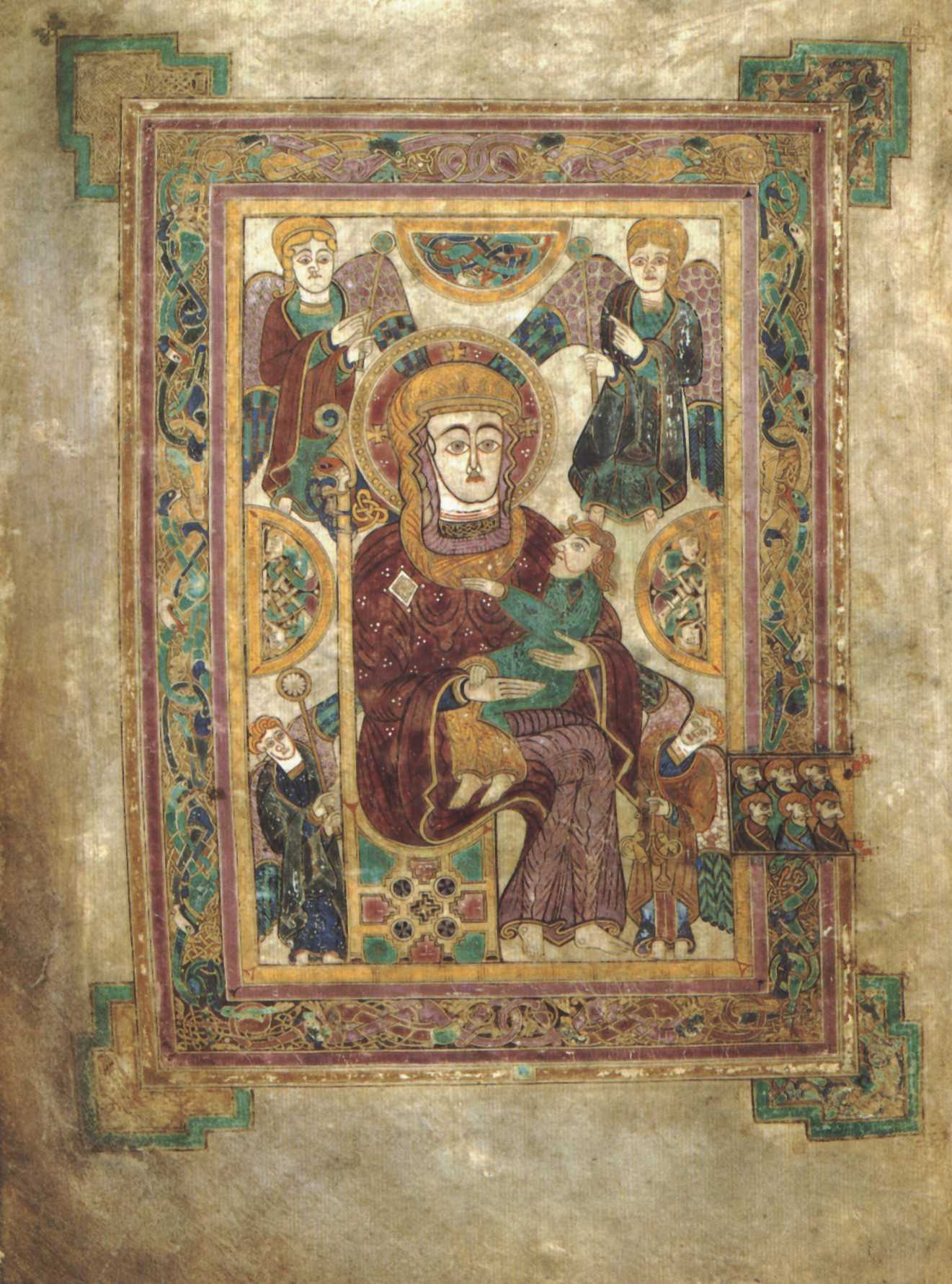
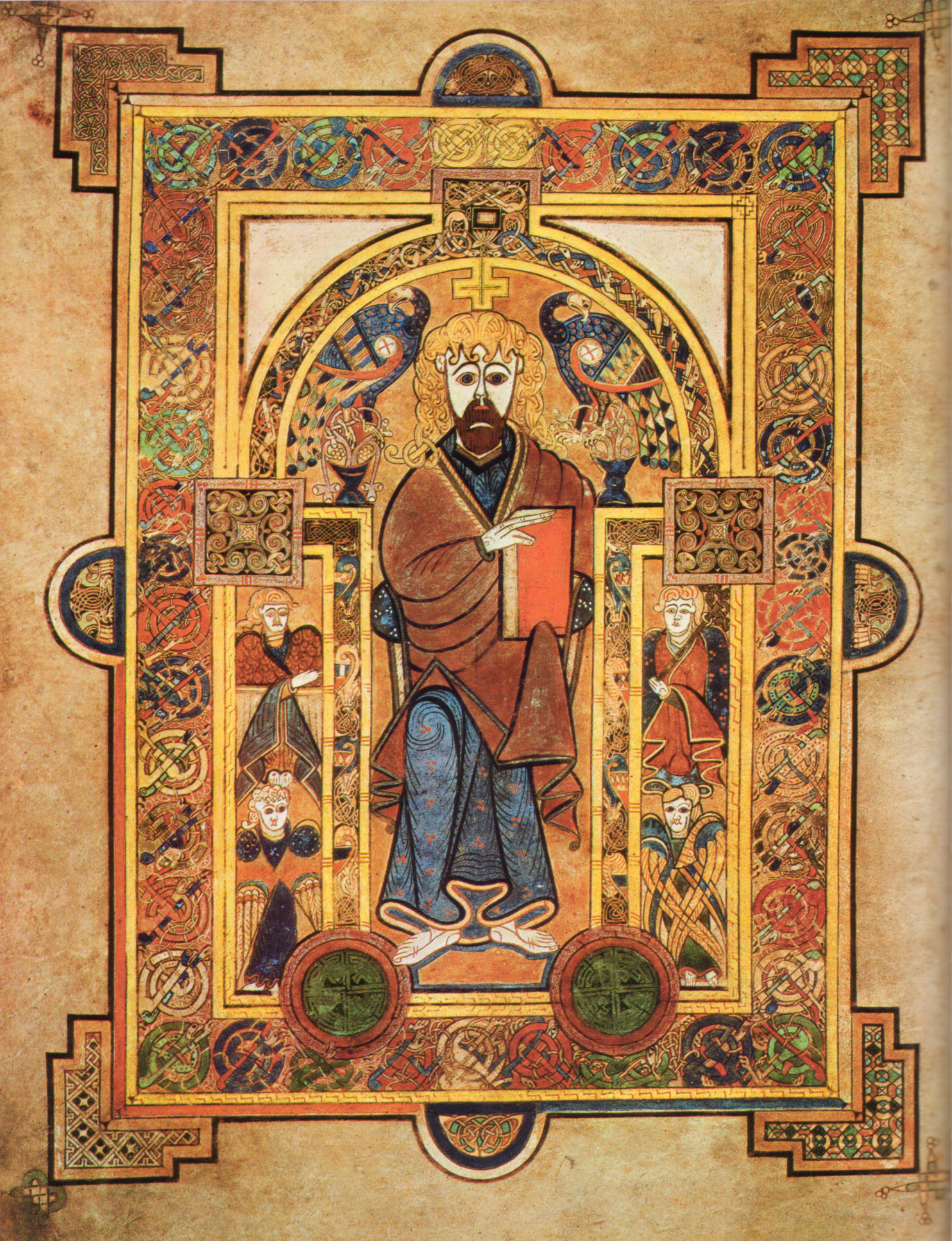
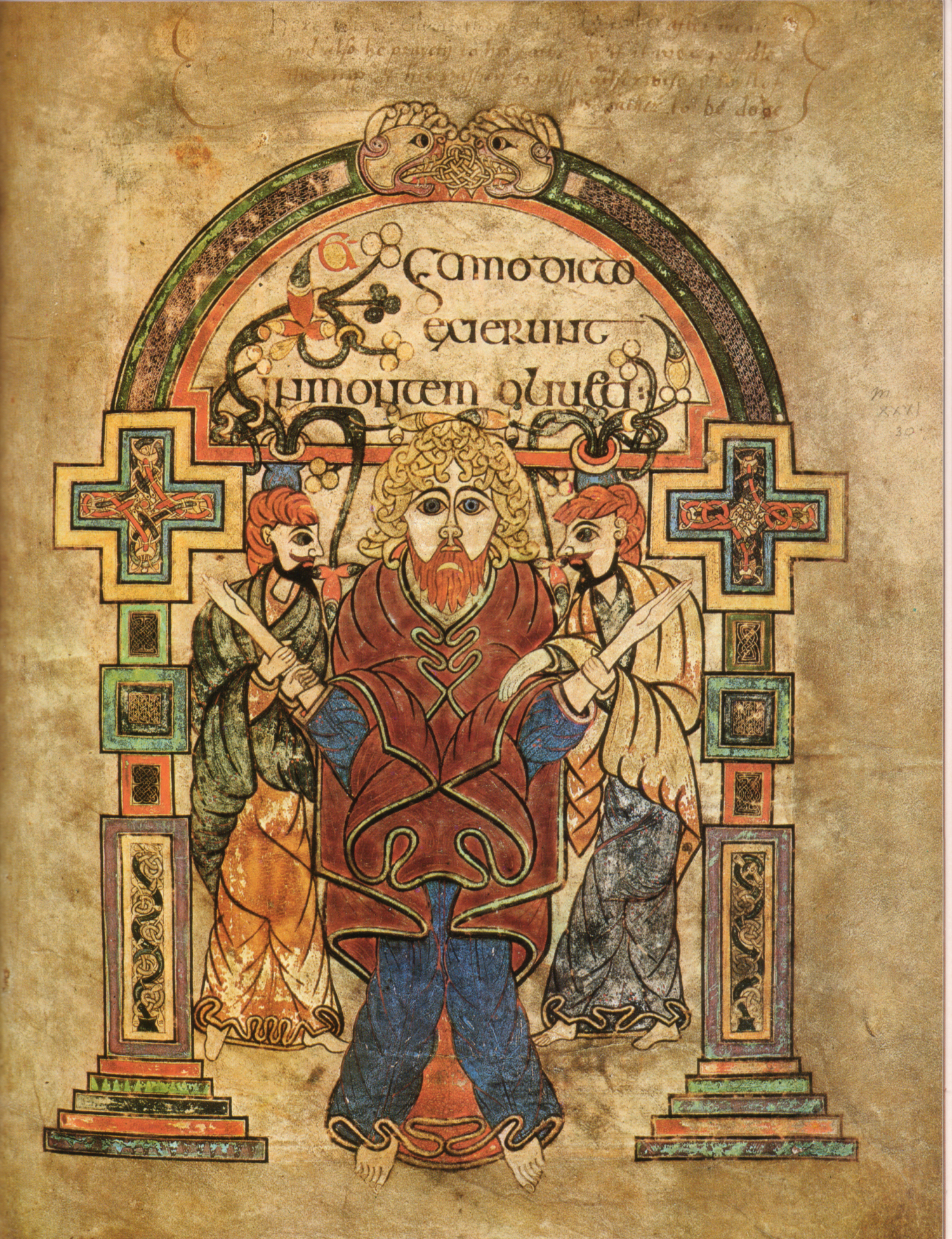
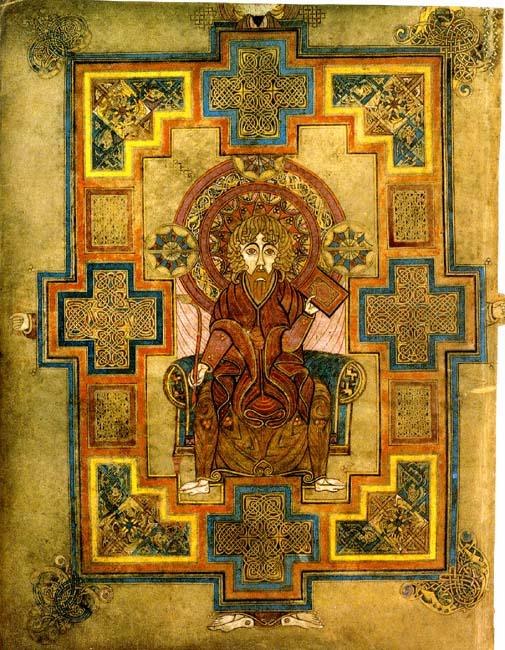
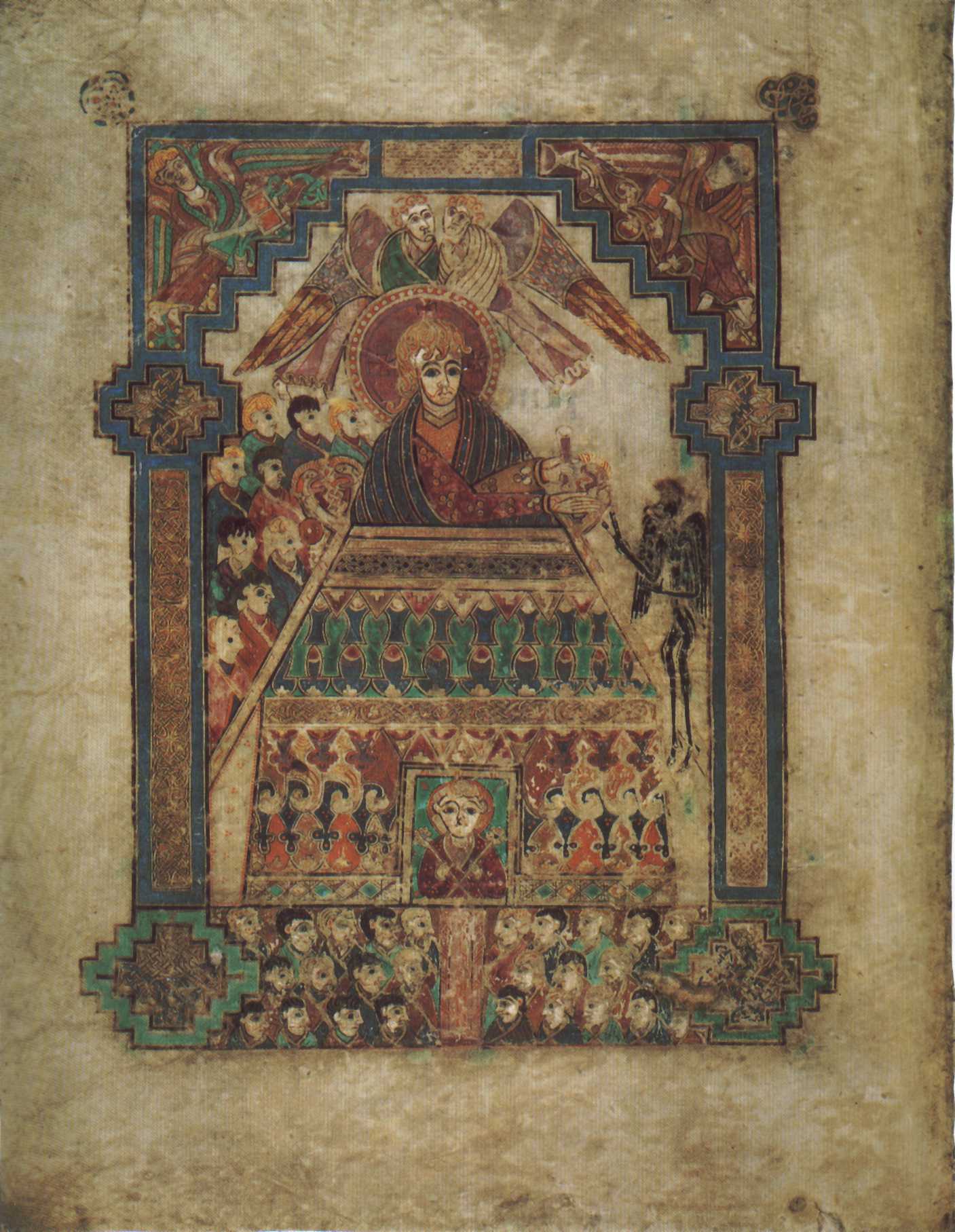
| Decoration | Full decorated pages, evangelist symbols, narrative scenes; Matthew and John portraits survive, Mark and Luke lost.2 |
| Shelfmark | Trinity College Library MS 58 (old press mark A. I. 6).2 |
Images
The record in full
Chapter 1What it is
The Book of Kells is a manuscript of the four Gospels in Latin, based on Jerome's Vulgate with readings from the older Old Latin translation, written in insular majuscule on 340 surviving vellum...
The Book of Kells is a manuscript of the four Gospels in Latin, based on Jerome's Vulgate with readings from the older Old Latin translation, written in insular majuscule on 340 surviving vellum folios measuring about 330 by 255 millimetres. It also carries canon tables, summaries of the Gospel narratives and prefaces on the evangelists. Trinity College Library gives it the shelfmark MS 58.
It is famous for its ornament: full decorated pages, evangelist symbols, narrative scenes. The Chi Rho page, folio 34r, is often called the most famous page in medieval art. The portraits of Matthew and John survive and those of Mark and Luke are lost. About thirty folios went missing over the medieval and early modern centuries.
The text is full of copying errors. Trinity reads the lavishness of the book against that and concludes that it was made for ceremonial liturgical occasions such as Easter and not for daily reading. That is Trinity's reading of the evidence, not a documented statement of its function.
Chapter 2Made of calf, ink and a short list of pigments
The vellum is calf, of uneven quality: some leaves are close to leather and others almost translucent.
The vellum is calf, of uneven quality: some leaves are close to leather and others almost translucent. It was gathered in 38 quires, usually of ten folios. The text ink is iron gall. No gold or silver leaf was used anywhere in the book.
The pigment question has a history of its own. For a long time the blue was taken to be lapis lazuli, which in the medieval period came from Afghanistan and would have implied a long supply chain. A micro-Raman campaign of 2004 to 2006 by Susan Bioletti, Rory Leahy, John Fields, Bernard Meehan and Werner Blau, covering 681 sites across the four volumes, found the blue to be indigo, the dye plant woad that grows locally. The same study identified red lead, orpiment, vergaut for green, carbon and iron gall ink for black, gypsum for white and orcein for purple. It is described as the most extensive Raman investigation of a single medieval manuscript.
The finding matters for dating and place less than people hoped. It shows that the artists worked with materials available in the north Atlantic world and not with the most expensive imports. Rachel Moss of Trinity notes that it does not settle where the book was made.
Chapter 3Who made it, and where
No scribe or artist is named. The final leaves, which might have carried a colophon, have been lost for centuries, so the question of origin has always been argued from script, style and the history...
No scribe or artist is named. The final leaves, which might have carried a colophon, have been lost for centuries, so the question of origin has always been argued from script, style and the history of the Columban houses. Three or four principal scribes were distinguished by Francoise Henry, who labelled hands A, B and C; a hand D has been proposed. Henry's 1974 study also separated the work of several artists, and how far scribes and artists overlapped is still an open question.
The traditional attribution to Colum Cille himself is discredited on palaeographic and stylistic grounds, and most evidence points to a date close to 800, which is two centuries after his death in 597. Within that frame four positions are held. The most widely accepted is that the book was begun at Iona and completed at Kells. Others hold that it was made wholly at Iona or wholly at Kells. A fourth, argued by Victoria Whitworth, puts it in Pictish eastern Scotland, possibly at Portmahomack, and rests on resemblances between the book's art and Pictish sculpture and on the tools for making vellum and carving stone found at Portmahomack in Martin Carver's excavations of 1994 to 2015. Rachel Moss calls the case for Iona strong but circumstantial and points out that Irish mainland monasteries are less excavated than Scottish ones. Whitworth's theory is described as contentious and the debate as far from settled.
A separate dispute concerns the Northumbrian share. Francois Masai had argued that the book was in fact made in Northumbria, probably at Lindisfarne or at a centre influenced by it and by Wearmouth and Jarrow. T. J. Brown and C. D. Verey took up the Northumbrian connection in an influential 1972 paper in Anglo-Saxon England, reconsidering manuscripts associated with Wearmouth and Jarrow, while saying that some of Masai's conclusions were false and poorly founded. That is a fact about the 1972 paper's opening argument; this record does not rest on any one of these positions.
The historical frame the Iona and Kells accounts share is Viking raiding. Iona was attacked from the 790s and 68 monks were killed there in 806. Kells was founded or refounded as a Columban house, with building from 807 and consecration in 814. The Irish Times summary of the Iona-first view is plain about its limits: it is an inference from the monastery's history, not documentary proof.
Chapter 4The theft of 1007 and the sod
The first reference that is generally taken to be to this book is an entry in the Annals of Ulster at 1007.
The first reference that is generally taken to be to this book is an entry in the Annals of Ulster at 1007. In the CELT edition (U1007.11) it records that the Great Gospel of Colum Cille was wickedly stolen by night from the western sacristy in the great stone church of Cenannas, the old name of Kells. It was recovered after two months and twenty nights, its gold taken off and a sod placed over it. The target was the shrine or cover, not the vellum.
Trinity College Library gives the year as 1006 and most other sources say 1007; the annal itself is the authority and it stands under 1007 in the CELT numbering. The identification of the book in the annal with the surviving Gospel book is probable and widely accepted but cannot be proved, because the annal describes a gospel book and a precious cover, not an object that can be matched to MS 58. The cover has not survived. It is the best documented thing that ever happened to the book and it records the loss of the part of it that is not here.
Some sources add that the book was dumped under a sod; the annal's own wording is that a sod was placed over it, and this record keeps to that. Gerald of Wales described a Gospel book at Kildare in the twelfth century which many think was Kells; that identification is a proposal, not a fact.
Chapter 5Kells, the charters and the dissolved abbey
Through the eleventh and twelfth centuries the book stayed at Kells and was venerated as a relic of Colum Cille.
Through the eleventh and twelfth centuries the book stayed at Kells and was venerated as a relic of Colum Cille. Land charters were copied into blank spaces on its pages, which is why the book is also a source for the property of the monastery. The abbey was dissolved in the twelfth century church reforms and the church became a parish church, and the book remains in the record, without detail, until the seventeenth century.
That long gap is a finding. For roughly four hundred years nothing on the book's custody is documented in the sources consulted here beyond the charters and the fact that it was at Kells in the 1650s. A Gospel book that was a relic and a treasured object did not need to be written about to be kept, and that is the best that can be said.
Chapter 6From Kells to Trinity, 1653 to 1661
In 1654, according to the encyclopaedic account, when Cromwell's cavalry was quartered at Kells, the governor of the town sent the book to Dublin for safekeeping.
In 1654, according to the encyclopaedic account, when Cromwell's cavalry was quartered at Kells, the governor of the town sent the book to Dublin for safekeeping. Trinity's own page puts the move around 1653. James Ussher is recorded as counting 344 folios in 1621, which is the earliest census of its leaves and shows that about 4 more folios have been lost since.
In 1661 Henry Jones, then bishop of Clogher and soon bishop of Meath, presented it to Trinity College. William O'Sullivan's note of 1958 in Irish Historical Studies identifies Jones (1605 to 1682) as the donor, eldest son of Lewis Jones, bishop of Killaloe, Cromwell's scoutmaster general, bishop of Clogher and later of Meath, vice-chancellor of the University of Dublin and a benefactor of its library. O'Sullivan observes that Jones was remembered as the donor of the Book of Durrow and that his gift of the Book of Kells had been largely forgotten, though the Book of Kells is the far more lavishly illuminated. The two books are different objects with different histories and must not be confused.
The interval 1653 to 1661 is thin in the sources consulted. Kells has since wanted the book back or at least a loan: in June 2000 Kells Urban District Council asked to borrow four volumes for its new heritage centre, and Trinity's Board declined on security and environmental grounds.
Chapter 7Binding, rebinding and the four volumes
The book was rebound in the nineteenth century and the leaves were cropped and their edges gilded; the page measure given today of about 330 by 255 millimetres comes after that trimming.
The book was rebound in the nineteenth century and the leaves were cropped and their edges gilded; the page measure given today of about 330 by 255 millimetres comes after that trimming. A rebinding of 1895 is reported to have failed quickly, and by the late 1920s several folios had come loose.
In 1953 the Board of Trinity College engaged the English binder Roger Powell of Petersfield in Hampshire, with his assistant Pamela Fowler, who set up a workshop in the manuscripts room of the library the previous August. A photograph published by the Irish Times on 24 October 1953 reports the work as almost complete. The book was divided into four volumes. Aubrey Gwynn, writing in 1954, called the division a drastic step that shocked many manuscript lovers, but said the College had compelling reasons for it. One effect he noted is that each page of each volume is now shown in turn, so that the great illuminated pages are displayed less often.
Powell published on the vellum and make-up in the journal Scriptorium in 1956. His conservation papers and the 1953 report itself were not seen in the course of this research. A rebinding in the 1990s that is sometimes mentioned was not confirmed in any source consulted and is not asserted here.
Chapter 8Facsimiles and circulation
Fame was made by reproduction. In the nineteenth century Helen Campbell D'Olier made faithful hand copies of pages.
Fame was made by reproduction. In the nineteenth century Helen Campbell D'Olier made faithful hand copies of pages. The first modern facsimile was published in 1951 by Urs Graf Verlag of Bern with 48 colour reproductions. In 1974 Thames and Hudson issued reproductions with a commentary by Francoise Henry. Faksimile Verlag asked for permission in 1979, was refused, and by 1986 had developed a process that did not require disbinding; its full-size two-volume fine art facsimile appeared in 1990 in an edition of 1,480 copies plus 80 in roman numerals, with commentary by Peter Fox, Jonathan Alexander, Bernard Meehan, Umberto Eco and others, and a white leather binding patterned on Irish book shrines. A further Faksimile Verlag portfolio of selected leaves followed in 1999 in 680 copies.
Bernard Meehan, Keeper of Manuscripts at Trinity, published an illustrated introduction in 1994 and a book with over 80 full-size colour pages in 2012. Trinity has also published the whole manuscript online. UNESCO placed the book on its Memory of the World International Register in 2011.
Chapter 9Loans and the Canberra damage of 2000
The book has travelled to European displays and in 2000 to Australia.
The book has travelled to European displays and in 2000 to Australia. The Irish Times reported on 24 December 1999 that a loan to the National Gallery in Canberra was planned for early 2000 after lengthy discussions among Trinity, the Department of Arts and Heritage and Australian experts, and named the Gospel of Luke. RTE reported on 14 April 2000 that one volume, the Gospel of Mark, was on display in Canberra and that one or two fragments of pigment had come off the vellum in transit. The Chief Librarian, Bill Simpson, would not call it damage and described the fragments as literally microscopic; Trinity said it would inspect the manuscript fully on its return. The two reports differ on the volume, and the later one is the better evidence of what was sent.
Trinity's current loans policy states that in 2000 its Board decided the book would not be lent for external exhibition. That decision was applied to the Kells request of June 2000, and it remains Trinity's position in the sources consulted. The record of the 1990s volumes that went abroad earlier was not found.
Chapter 10On view now, and what is planned
One volume is always on display in the Old Library, opened at a major decorated page or at a text page with smaller decorations, and the volume is changed regularly.
One volume is always on display in the Old Library, opened at a major decorated page or at a text page with smaller decorations, and the volume is changed regularly. Trinity's own page gives annual visitor numbers above half a million.
Trinity is carrying out a major redevelopment of the Old Library for fire protection and environmental control. According to a University Times report of 8 March 2026 the manuscript is planned to move to the restored Printing House, a building of the 1730s designed by Richard Cassels, in late 2027, and to stay there during the works, which are expected to finish by 2030. Trinity's FAQ says the Old Library and Long Room stay open until the end of 2027. On 11 March 2026 Trinity announced a seven million euro gift from the Hilary and Galen Weston Foundation toward a ground floor Hilary Weston Treasures Gallery in the Old Library from which visitors will see the book. In the meantime the digital Book of Kells Experience in New Square, which opened in early 2024, is part of the visit.
The artist
The Columban scriptorium of Iona and Kells (scribes and artists anonymous)
The maker of the Book of Kells is a community, not a person. Nothing in the book names a scribe or artist and the leaves that might have done so are lost. What can be said is argued from the hands, the style and the history of the Columban houses, and the two lists below keep what is documented apart from what is proposed.
Exhibited
- 2000Canberra exhibition, Gospel of Mark volume (RTE) or Luke (Irish Times, planned)National Gallery of Australia, Canberra
Literature
- Aubrey Gwynn, Some notes on the history of the Book of Kells, Irish Historical Studies 9 no. 34 (1954), pp. 131-161.
- William O'Sullivan, The donor of the Book of Kells, Irish Historical Studies 11 no. 41 (1958), pp. 5-7.
- T. J. Brown and C. D. Verey, Northumbria and the Book of Kells, Anglo-Saxon England 1 (1972), pp. 219-246.
- Francoise Henry, The Book of Kells: Reproductions from the Manuscript in Trinity College Dublin (Knopf, 1974).
- Bernard Meehan, The Book of Kells: An Illustrated Introduction (Thames and Hudson, 1994).
- S. Bioletti, R. Leahy, J. Fields, B. Meehan and W. Blau, The examination of the Book of Kells using micro-Raman spectroscopy, Journal of Raman Spectroscopy 40 (2009).
Related works
| Work | Relation | Where it is |
|---|---|---|
| The Book of Durrow Insular scribe-artist unnamed | Gospel book also associated with Henry Jones as donor to Trinity; not this book O'Sullivan 1958 notes that Jones was remembered as the donor of Durrow and that his gift of Kells had been forgotten. Do not confuse them. | Library of Trinity College Dublin |
| The Lindisfarne Gospels Lindisfarne scriptorium | Northumbrian comparison in the Masai and Brown and Verey arguments Separate object (Cotton Nero D IV). Compared, not identified. | British Library, London |
| The Trier Gospels Echternach scriptorium | Insular and continental manuscript link studied by Nancy Netzer Netzer's 1994 book concerns Trier and Echternach; no statement about Kells by her was verified for this record. | Trier |
| The Annals of Ulster entry U1007.11 Compilers of the Annals of Ulster | Earliest probable reference to this book Describes a gospel and its cover; does not name MS 58. | Edited text on the CELT site |
| Facsimile of 1990 Faksimile Verlag, Lucerne | The reproduction most students use Not the original and not the 1951 Urs Graf facsimile. | Held by libraries; 1,480 numbered copies |
Open questions
- Where was the book made: Iona, Kells, both, Pictland or a Northumbrian-influenced centre? No document settles it.
- Is the Great Gospel of Colum Cille of the Annals of Ulster in 1007 this book? It is probable and unproven, and the cover that was the thieves' target is lost.
- What happened to the book between the twelfth century and about 1653, and what was its custody at Kells?
- How did the book pass from Kells to Henry Jones in the 1650s, and was the 1661 gift made with the agreement of the parish of Kells? The sources consulted do not say.
- Were scribes and artists the same people? Henry's hands and artists are a classification by style.
- Did any rebinding take place in the 1990s? None was found in sources consulted.
- What does Roger Powell's own 1953 report record on the original sewing and bindings before they were removed?
- Which volume went to Canberra in 2000, Luke as planned or Mark as reported, and was the pigment loss in transit or earlier?
Questions about this object
What is The Book of Kells?
The Book of Kells is a manuscript, dated c. 800. Medium: Iron gall and carbon ink and pigments on calf vellum; no gold or silver leaf.
Who made The Book of Kells, and is the attribution settled?
The attribution to Columban scriptorium (Iona, Kells or both; scribes and artists anonymous) is recorded here as disputed. No scribe, artist or place is named in the book itself and the final leaves, which might have carried a colophon, are lost. Scholars agree on a Columban origin close to 800 and disagree on the place: begun at Iona and finished at Kells, wholly at Iona, wholly at Kells, in Pictland (Whitworth) or in a Northumbrian-influenced centre (Masai; Brown and Verey argued the Northumbrian case). The traditional ascription to Colum Cille himself is discredited on script and style.
Where is The Book of Kells now?
Library of Trinity College Dublin, Dublin. Inventory number MS 58 (old press mark A. I. 6); bound in four volumes since 1953. Last confirmed 15 November 2026. Trinity College Library's own page on the manuscript; presented to the College by Henry Jones in 1661 per O'Sullivan 1958.
What is still unknown about The Book of Kells?
Where was the book made: Iona, Kells, both, Pictland or a Northumbrian-influenced centre? No document settles it.
Sources
- 1Wikipedia, 'Book of Kells' (; by Meehan 1994 and Henry 1974), used for physical description, origin theories, 1654 transfer, 1895 and 1953 rebinding, facsimiles and bibliography. en.wikipedia.org/wiki/...
- 2Library of Trinity College Dublin, page on the Book of Kells (MS 58): description, origin, display and four-volume binding. tcd.ie/library/...
- 3National Geographic, 'The Book of Kells might not be Irish after all' (Whitworth, Moss, Portmahomack, 2009 pigment study). nationalgeographic.com/history/...
- 4Irish Times, 'Work on book was probably begun in monastery on Scottish island of Iona', 13 March 2000. irishtimes.com/news/...
- 5University Times, 'Printing House restored to house Book of Kells', 8 March 2026. universitytimes.ie/2026/...
- 6Irish Times, 'From the archive: Handled with care and great dedication' (Roger Powell and Pamela Fowler, 24 October 1953). irishtimes.com/culture/...
- 7Aubrey Gwynn, 'Some notes on the history of the Book of Kells', Irish Historical Studies 9 no. 34 (1954), extract. cambridge.org/core/...
- 8William O'Sullivan, 'The donor of the Book of Kells', Irish Historical Studies 11 no. 41 (1958), extract. cambridge.org/core/...
- 9Annals of Ulster, CELT edition, entry U1007.11 (translator not named on the page). celt.ucc.ie/published/...
- 10RTE Archives, 'Book of Kells damaged', report of 14 April 2000. rte.ie/archives/...
- 11Irish Times, 'Book will not return to Kells-TCD', 22 June 2000. irishtimes.com/news/...
- 12Irish Times, 'Part of Book of Kells to go abroad', 24 December 1999. irishtimes.com/news/...
- 13Trinity College Dublin news, landmark gift (Hilary and Galen Weston Foundation), 11 March 2026. tcd.ie/news_events/...
- 14Trinity College Dublin, Old Library Campaign FAQ. tcd.ie/old-library-campaign/...
- 15Facsimile Finder, Book of Kells facsimile entry (Faksimile Verlag 1990 and 1999). facsimilefinder.com/facsimiles/...
- 16Medievalists.net on Bioletti, Leahy, Fields, Meehan and Blau, 'The examination of the Book of Kells using micro-Raman spectroscopy', Journal of Raman Spectroscopy 40 (2009). medievalists.net/2014/...
- 17T. J. Brown and C. D. Verey, 'Northumbria and the Book of Kells', Anglo-Saxon England 1 (1972), pp. 219-246, extract. cambridge.org/core/...
Last verified · Published
Change log
15 November 2026 - Record created at the house standard: researched narrative, technical evidence, maker dossier, graded provenance chain, prices with hammer and premium separated, related works, open questions and sources.