The Sutton Hoo Lyre
Unknown maker, Anglo-Saxon craft tradition · Early 7th century AD, before the ship burial, which is itself usually dated c. 610-635 on the evidence of the accompanying coins
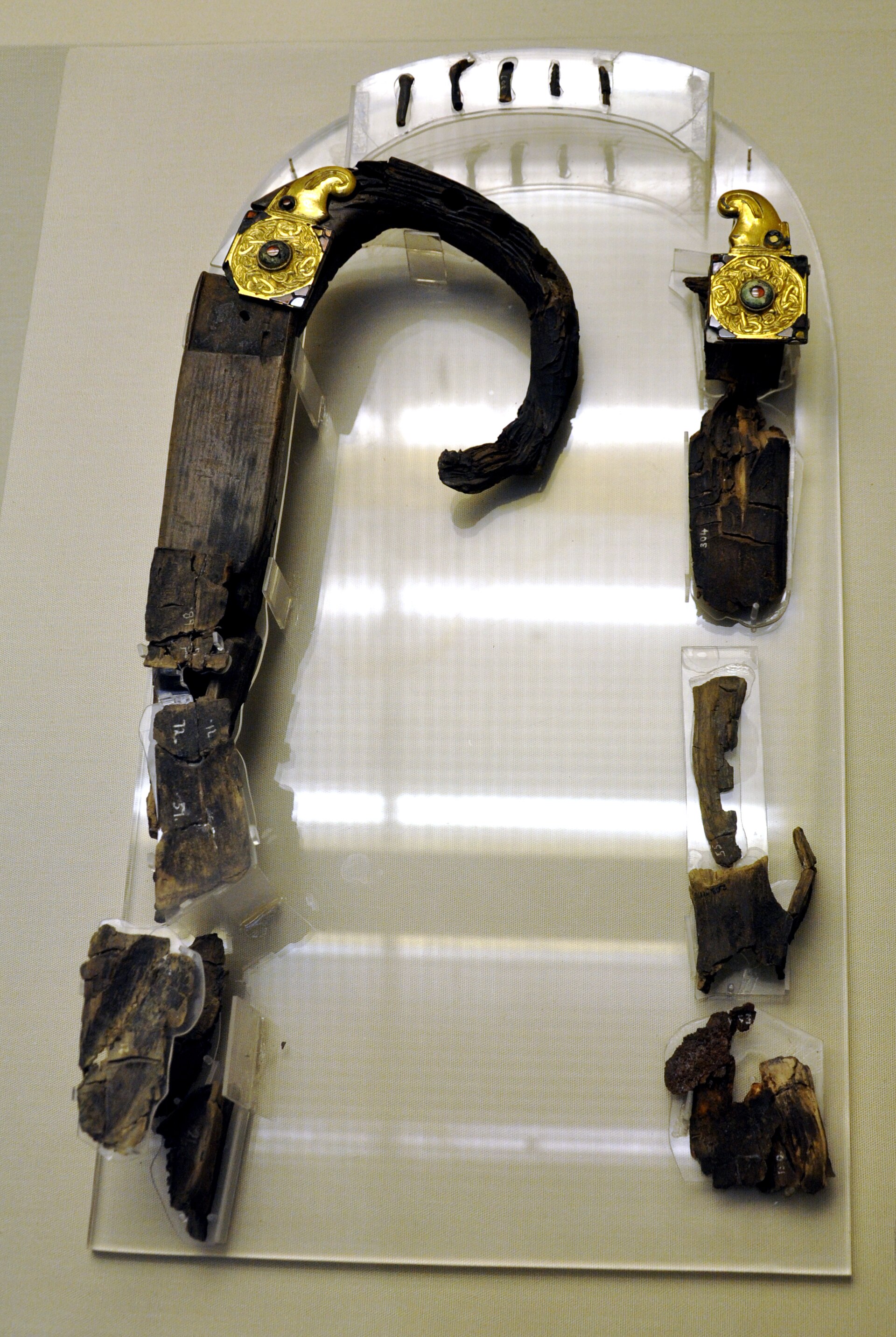
The genuine excavated material: fragments of the seventh-century maple-wood lyre, museum number 1939,1010.203, photographed at the British Museum. This is the ancient object itself, not a reconstruction.
| Artist | Unknown maker, Anglo-Saxon craft tradition |
|---|---|
| Date | Early 7th century AD, before the ship burial, which is itself usually dated c. 610-635 on the evidence of the accompanying coins |
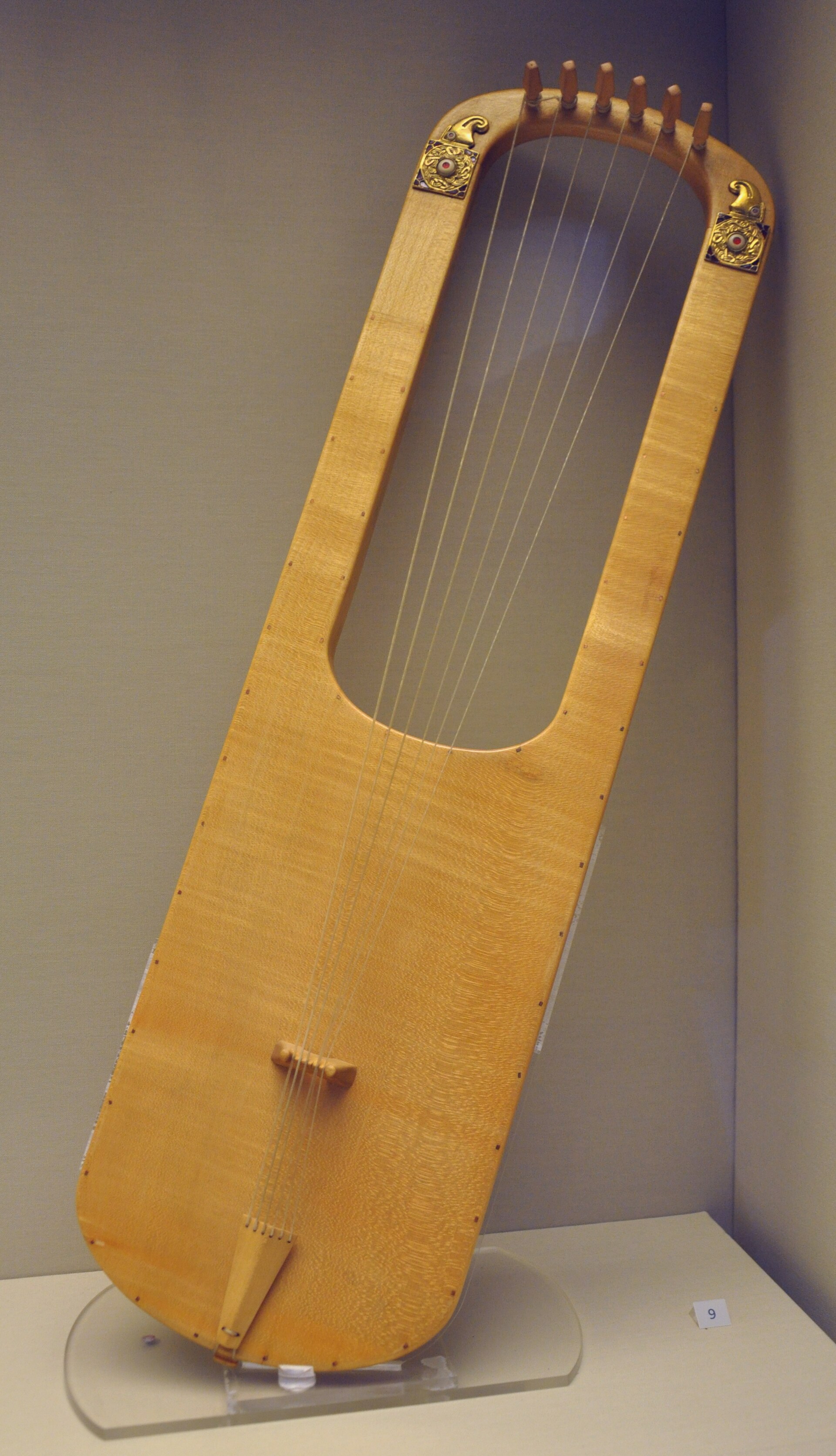
| Medium | Maple wood body with willow and alder tuning pegs and gilt copper-alloy bird-head escutcheons inlaid with garnet, surviving as fragments; the instrument as normally seen by visitors is the British Museum's own modern reconstruction, in new maple wood with electrotyped fittings, a bone bridge and gut strings |
| Dimensions | Reconstructed instrument, per the Museum's own replica (SHR.9): 74.5 x 21.0 cm. The surviving ancient fragments are far smaller: one registered maple strip, museum number 1939,1010.203.60, measures 9.3 x 3 cm |
| Where it is now | The British Museum, London. The ancient fragments are held in the Britain, Europe and Prehistory department; the Museum's full-size modern reconstruction is on display in Room 41 (Europe AD 300-1100, Sutton Hoo and Europe)last confirmed |
| Inventory number | 1939,1010.203 (ancient fragments, registered in more than 70 individually numbered pieces); SHR.9 (the Museum's modern reconstruction) |
| Attribution | UnknownNo maker is named or documented for this instrument, and none could be: Anglo-Saxon craftsmen of this period did not sign their work and no contemporary written source names a lyre-maker. Full note |
| Object type | Musical instrument |
| Period | Anglo-Saxon England, early 7th century |
| Inscriptions | None |
| Owners on record | 4 links4 documented |
| Sources | 19 cited |
About this record Last verified · 19 sources cited · Change log
On this page 9 sections
ContentsClose
What the British Museum actually holds of the Sutton Hoo lyre is a small group of broken seventh-century maple wood and gilt, garnet-set metal fittings, excavated in 1939 from the same ship-burial chamber that produced the Sutton Hoo helmet. What most visitors see is something else: the Museum's own full-size modern reconstruction, built in the 1970s after an earlier, published and publicly displayed attempt to rebuild the instrument as a rectangular harp turned out to be wrong.
The correction, published in 1970 by Rupert Bruce-Mitford and his daughter Myrtle, reidentified the instrument as a round lyre by comparison with related finds on the Continent and a reassessed English example from Taplow -- a piece of archaeological self-correction later confirmed by the discovery of a near-complete comparandum at Trossingen. Whose grave the lyre was buried in remains genuinely disputed: Raedwald of East Anglia is the most commonly repeated candidate, proposed within days of the discovery and elaborated over decades, but named scholars have called the direct evidence for it thin, and a 2025 proposal offers a substantially different account of who lies in Mound 1 altogether.
This record treats the ancient fragments and the modern reconstruction as two distinct things, names the reconstruction history and its cited comparanda directly rather than repeating a smoothed-over version of events, and leaves the identity of the burial's occupant exactly as uncertain as the current scholarship actually leaves it.
Provenance
Each link is graded. Documented: a cited source supports it. Disputed: the identification is argued but not established. Unknown: no owner for that span, and the gap is not smoothed into a narrative. The grades in the glossary.
- early 7th century - early 7th centuryUnrecorded Anglo-Saxon ownerdocumented
The act of burial is archaeologically documented: the lyre was placed in the chamber, hung in a beaver-skin bag on the western wall. The identity of the individual for whom the burial was made is not documented and is treated separately below.49
- early 7th century - 1939Undisturbed within Mound 1, Sutton Hoodocumented
The 1939 treasure trove inquest found no evidence of intent to recover the buried goods, consistent with an undisturbed deposit; several other Sutton Hoo mounds show evidence of earlier robbing, but Mound 1 does not.9
- 1939 - 1939Mrs Edith M. Pretty, landownerdocumented
Excavated May-August 1939, initially by Basil Brown for Ipswich Museum and then, once the scale of the find was clear, under the direction of Charles Phillips of Cambridge University. The treasure trove inquest of 14 August 1939 found the objects belonged to Pretty as landowner, since there was no evidence of intent to recover them.9
- 1939 - presentThe British Museum, Londondocumented
Pretty's gift of the entire find to the nation, via the British Museum, was announced in the press on 23 August 1939, days before the outbreak of the Second World War. The collection, including the lyre fragments, was evacuated for safekeeping to Aldwych Underground station for the duration of the war; full scholarly study and conservation resumed under Rupert Bruce-Mitford after 1945, and the complete three-volume publication of the ship-burial appeared in 1975-1983.1915
Technical evidence
| Attribution note | No maker is named or documented for this instrument, and none could be: Anglo-Saxon craftsmen of this period did not sign their work and no contemporary written source names a lyre-maker. What can be said rests entirely on comparison. The instrument belongs to a design family shared across Anglo-Saxon England and the wider Germanic-speaking world of the sixth and seventh centuries, known from related finds at Taplow, Bergh Apton and Prittlewell in England and Oberflacht and Trossingen on the Continent, which together indicate a recognised craft tradition rather than a single workshop or a unique invention. |
|---|---|
| Body | Maple wood; the arms were hollowed out almost to the joint and closed with a thin maple soundboard fixed with bronze pins.413 |
| Tuning pegs | Six pegs on the yoke: five of willow and one of alder.4 |
| Fittings | Two gilt copper-alloy escutcheons in the form of interlaced bird heads, inlaid with garnet, joining the yoke to the arms.413 |
| Strings | Six strings.413 |
| Findspot detail | Hung on the western wall of the burial chamber in a beaver-skin bag; fell and broke against a Coptic bronze bowl, probably as the chamber roof collapsed.4 |
| Registration, ancient fragments | 1939,1010.203, registered in more than 70 individually numbered pieces. One example, 1939,1010.203.60, a maple strip forming three sides of a box shape, measures 9.3 x 3 cm and is currently recorded by the Museum as not on display.13 |
| Registration, Museum reconstruction | SHR.9. Maple wood with electrotyped fittings, bone bridge and gut strings; 74.5 x 21.0 cm; made in the 1970s by the Dolmetsch Workshops, Haslemere, under the supervision of G. H. Carley; on display in Room 41.2 |
| Other Museum lyre replicas | The Museum's collection also includes replica numbers SHR.8, SHR.10 and SHR.18, distinct from SHR.9 and from each other; this record's images and description concern SHR.9 specifically where a reconstruction is shown.3 |
| Acquisition | Donated by Mrs Edith M. Pretty, 1939, following the treasure trove inquest of 14 August 1939.19 |
Images
The record in full
Chapter 1What survives, and what does not
What the British Museum owns of the Sutton Hoo lyre is a small collection of broken maple wood, some gilt metal fittings, and a set of tuning pegs, registered together under the accession group...
What the British Museum owns of the Sutton Hoo lyre is a small collection of broken maple wood, some gilt metal fittings, and a set of tuning pegs, registered together under the accession group 1939,1010.203 in more than seventy individually numbered pieces. What most visitors actually see and photograph is something else: a full-size modern reconstruction, museum number SHR.9, built in the 1970s to show what the instrument is now believed to have looked like.
This record treats the two as what they are: the ancient fragments are the object; the reconstruction is a scholarly model of it, made from new wood and reproduction metalwork. Confusing the two, or letting a photograph of the replica stand in silently for the excavated original, is exactly the kind of error this record exists to prevent.
Chapter 2Found in a burial chamber, and broken again in finding it
The lyre was excavated in 1939 from the ship-burial in Mound 1 at Sutton Hoo, Suffolk, where it had hung on the western wall of the burial chamber inside a bag made of beaver skin; fragments of the...
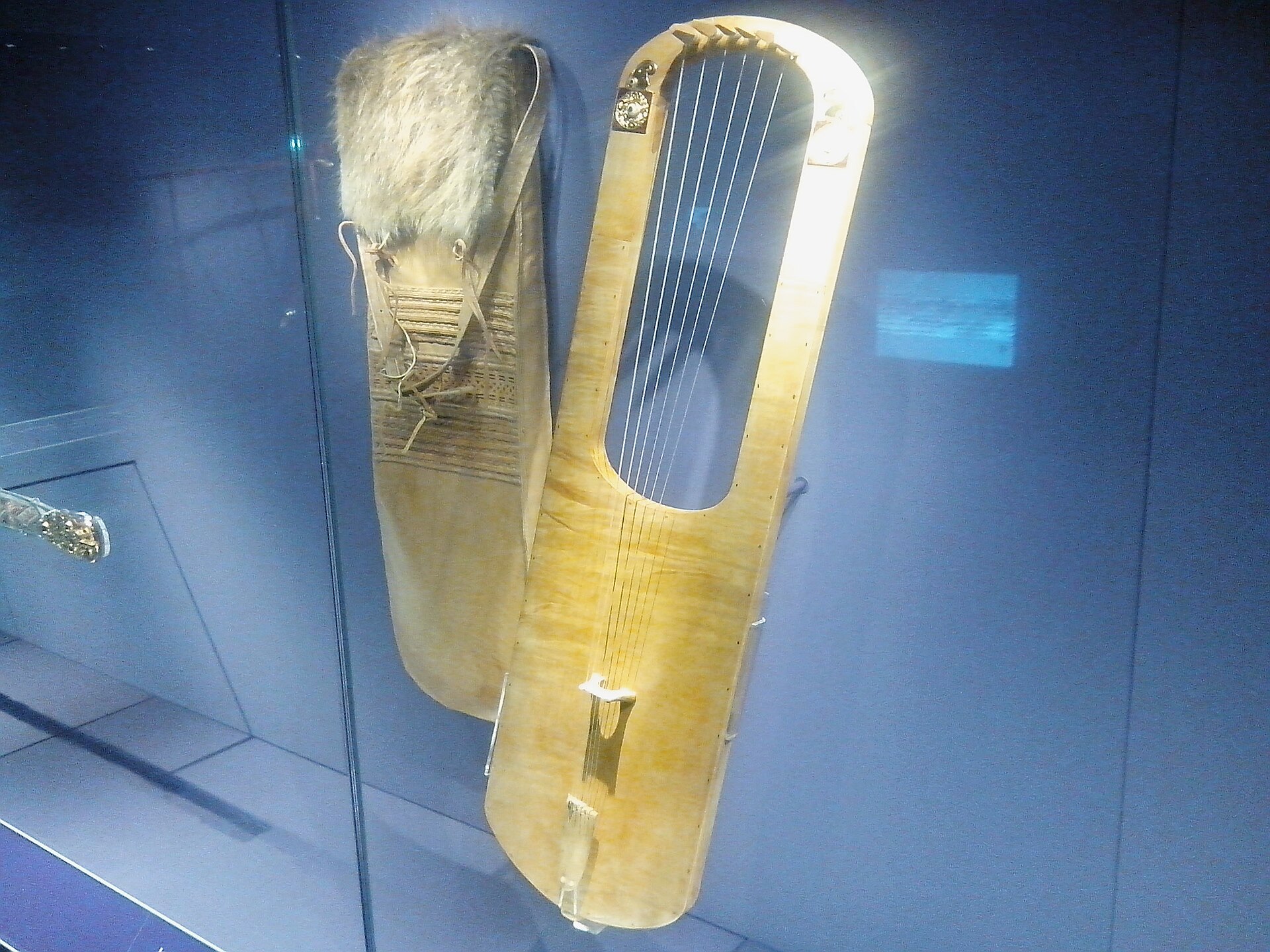
The lyre was excavated in 1939 from the ship-burial in Mound 1 at Sutton Hoo, Suffolk, where it had hung on the western wall of the burial chamber inside a bag made of beaver skin; fragments of the wood still carried pressed beaver hair from the bag when they were lifted. At some point after the chamber roof collapsed, the instrument fell and struck a Coptic bronze bowl standing nearby, breaking into the pieces that were eventually recovered thirteen centuries later.
The find therefore reached excavators already fragmentary and distorted by the weight of collapsed earth, which is the root of every reconstruction difficulty that follows: there was no single moment at which anyone saw the complete, undamaged instrument and could simply describe it.
Chapter 3The first reconstruction: a rectangular harp, 1948-49
The first attempt to put the fragments back together, published in 1948 and put on display at the British Museum in 1949, reconstructed the instrument as a rectangular harp.
The first attempt to put the fragments back together, published in 1948 and put on display at the British Museum in 1949, reconstructed the instrument as a rectangular harp. The model leaned on later medieval evidence that had nothing to do with the seventh century: harps carved on Irish stone crosses of the ninth century, and harps drawn in two English manuscripts of the eleventh and twelfth centuries. Rupert Bruce-Mitford, the archaeologist responsible for the Sutton Hoo finds at the Museum, led this first reconstruction.
It was, on the evidence available at the time, a reasonable attempt. It was also wrong, and it remained on public display as the accepted form of the instrument for more than twenty years.
Chapter 4The revision: a round lyre, 1970
In 1970 Rupert Bruce-Mitford and his daughter Myrtle Bruce-Mitford, a professional cellist, published a reassessment that overturned the harp reconstruction entirely.
In 1970 Rupert Bruce-Mitford and his daughter Myrtle Bruce-Mitford, a professional cellist, published a reassessment that overturned the harp reconstruction entirely. Working from the same fragments, and comparing them against surviving remains of related instruments elsewhere, they concluded the Sutton Hoo instrument was not a harp at all but a round lyre of a type known from early medieval Germanic graves: a shallow wooden soundbox with two arms rising to a crossbar yoke, strung with six strings running the length of the box rather than fanned out as a harp's strings are.
The comparanda that carried the argument were the lyre preserved from Oberflacht, in the Stuttgart museum's collection, together with the fragmentary English lyre excavated in 1883 from the barrow at Taplow in Buckinghamshire, which by 1970 had itself finally been recognised as a lyre rather than something else, and published accounts of a further, since-lost German example from Cologne. Three decades later, the excavation of a near-complete lyre from a grave at Trossingen in 2001-2002 confirmed the general accuracy of the 1970 Sutton Hoo revision, since the Trossingen instrument matched the revised reconstruction's proportions closely.
Chapter 5What is ancient and what is modern
The instrument now on view, SHR.9, is a full remake: new maple wood, electrotyped reproductions of the original metal fittings rather than the fittings themselves, a bone bridge, and gut strings...
The instrument now on view, SHR.9, is a full remake: new maple wood, electrotyped reproductions of the original metal fittings rather than the fittings themselves, a bone bridge, and gut strings, made in the 1970s by the Dolmetsch Workshops of Haslemere under the supervision of G. H. Carley. It is not a hybrid object built around surviving ancient timber, and the British Museum's own catalogue record describes it plainly as a replica.
The genuine seventh-century material -- the maple wood strips, the willow and alder tuning pegs, the two gilt bird-head escutcheons inlaid with garnet -- remains catalogued separately under 1939,1010.203. A 2011 photograph shows a group of these fragments displayed in Room 41; the Museum's current online catalogue record for at least one individual fragment (1939,1010.203.60) lists it as not on display, so the present display status of the original material should be checked at the gallery rather than assumed from either source.
Chapter 6How it was made
The surviving evidence indicates a maple-wood body, its arms hollowed out almost to the joint and then closed with a thin maple soundboard fixed in place with bronze pins.
The surviving evidence indicates a maple-wood body, its arms hollowed out almost to the joint and then closed with a thin maple soundboard fixed in place with bronze pins. The yoke carried six tuning pegs, five of willow and a sixth of alder -- a detail suggesting either an ordinary repair with whatever timber was to hand, or simply that peg wood was not chosen with the same care as the body itself. Where the yoke met the arms, two gilt copper-alloy escutcheons in the form of interlaced bird heads, inlaid with garnet, closed the joints and provided the instrument's only surviving decoration.
Set beside the gold and garnet cloisonne work on the regalia from the same burial chamber, the lyre's fittings are modest. That is itself informative: the instrument was valued enough to be buried with a man commemorated by some of the finest metalwork of the period, but its own ornament did not need to compete with the shoulder-clasps or the purse-lid to earn its place among the grave goods.
Chapter 7A lyre among the weapons and the regalia
Anglo-Saxon written sources describe the lyre, called in Old English the hearpe, as ordinary equipment of aristocratic hall life.
Anglo-Saxon written sources describe the lyre, called in Old English the hearpe, as ordinary equipment of aristocratic hall life. Beowulf places it explicitly in Hrothgar's hall: "there was the sound of the harp, the clear song of the singer" (lines 89-90), sung or recited by a scop to the accompaniment of the instrument while the hall feasted. The Sutton Hoo find gives that documentary picture a physical object from the right period and, very nearly, the right cultural world.
What the presence of a lyre specifically says about the person buried in Mound 1 is argued rather than settled. Martin Carver, whose excavations at Sutton Hoo in the 1980s and 1990s produced the modern standard account of the site, reads the whole burial as a deliberately composed statement of rank, ancestry and allegiance rather than a simple inventory of personal property, describing a ship burial as being as much a composed statement as Beowulf itself is a poem, and open to being read the same way. On that argument the lyre is there to declare that this was a hall where poetry and music mattered, not necessarily to record that the dead man played it himself. Other early Germanic lyre graves make the same connection more directly: the richly furnished grave 58 at Trossingen, containing the best-preserved lyre yet found from the period, has been called by its excavators the singer's grave, on the strength of its contents alone. No comparable direct claim has been made for the identity of the Sutton Hoo lyre's owner, and this record does not make one either.
Chapter 8Whose grave is this
The body in the ship-burial chamber had entirely dissolved in Suffolk's acid sand, leaving no bone and no name.
The body in the ship-burial chamber had entirely dissolved in Suffolk's acid sand, leaving no bone and no name. The standard candidate for the occupant, repeated in most general accounts, is Raedwald, king of the East Angles, who died around 624-625 and who Bede records as having briefly held authority (bretwalda) over the other Anglo-Saxon kingdoms. The identification was first proposed within days of the discovery: Hector Munro Chadwick, visiting the site in 1939, told the excavator Charles Phillips, "It's the grave of King Raedwald you know. I've no doubt of that," and set out the case in print the following year. Rupert Bruce-Mitford later built the fuller argument, pointing to the burial's imperial and Christian-adjacent symbolism -- a Byzantine silver dish, a set of apparently Christian spoons, a whetstone-sceptre read as a mark of high office -- alongside the burial's proximity to Rendlesham, a documented East Anglian royal residence four miles away, and coins in the purse dated close to Raedwald's death.
The identification is widely repeated but not proven, and serious scholars have said so plainly: the Oxford Dictionary of National Biography notes that the case for Raedwald "has been argued, more strongly than convincingly"; the historians McClure and Collins describe the direct evidence as almost non-existent. Alternative candidates proposed over the decades include Raedwald's son or stepson Sigeberht, other East Anglian kings, and, more speculatively, a wealthy man of high status who was not a king at all. Most recently, in 2025, the historian Helen Gittos proposed a different framework entirely, arguing on the strength of Syrian-linked material among the Sutton Hoo grave goods that the occupants of the richest Sutton Hoo graves may have been Anglo-Saxons who had served as mercenary cavalry with Byzantine forces against the Sasanian Persians in the later sixth century, returning with prestige goods that were never part of ordinary trade. This record treats Raedwald as the most commonly cited candidate and no more than that: a standing scholarly position, not an established fact, and one actively contested at the time of writing.
Chapter 9The excavation of 1939
The dig belonged, at every stage, to a specific set of people.
The dig belonged, at every stage, to a specific set of people. Edith Pretty, the widow who owned the Sutton Hoo estate, had long been curious about the mounds visible on her land and in 1937 commissioned an excavation, engaging Basil Brown, a self-taught local archaeologist working through Ipswich Museum, to investigate. Brown opened several of the smaller mounds first before turning to Mound 1 in May 1939, where his team's discovery of ship rivets in the soil signalled something far larger than anything found before it.
Once the scale of the find became clear, Charles Phillips of Cambridge University took over direction of the excavation, assembling a larger team to complete the work at speed as the political situation in Europe worsened through the summer of 1939. The full extent of the ship and its burial chamber, and the astonishing quantity and quality of the grave goods inside it -- among them the lyre, still then thought to be a harp -- were recovered in a matter of weeks that August.
Chapter 10A find made in the last weeks of peace
The treasure trove inquest that determined ownership of the finds sat on 14 August 1939, ruling that because there was no evidence anyone had buried the objects with the intention of recovering them...
The treasure trove inquest that determined ownership of the finds sat on 14 August 1939, ruling that because there was no evidence anyone had buried the objects with the intention of recovering them later, they belonged to Edith Pretty as the landowner rather than to the Crown. The gift of the entire find to the British Museum was announced in the press on 23 August 1939, so that within days of the announcement Britain was at war.
The Sutton Hoo material was among the objects the British Museum evacuated for safekeeping, spending the war stored in Aldwych Underground station in London, one of several disused or partially used Tube stations the Museum fitted out with humidity and temperature control and round-the-clock guarding for its most important holdings. Detailed study of the fragile, still partly unconserved finds, including the lyre fragments, did not resume in earnest until after 1945, under Rupert Bruce-Mitford's direction, and the full three-volume scholarly publication of the whole ship-burial did not appear until 1975-1983.
Chapter 11Comparanda: the lyre was not unique
Sutton Hoo is the richest of a small but growing group of early Anglo-Saxon lyre finds.
Sutton Hoo is the richest of a small but growing group of early Anglo-Saxon lyre finds. A very fragmentary example was excavated from the princely barrow at Taplow in 1883 -- the most important Anglo-Saxon burial known in Britain until Sutton Hoo itself displaced it in 1939 -- and only correctly identified as a lyre once the Sutton Hoo revision gave scholars a clearer idea of what to look for. At Bergh Apton in Norfolk, excavated in 1973, grave 22 produced lyre fragments in a burial that has been read, on the strength of its contents, as possibly that of a minstrel or poet; the find was reconstructed by the archaeomusicologist Graeme Lawson. At Prittlewell in Essex, a richly furnished burial excavated in 2003 and now recognised as one of the most important Anglo-Saxon graves found since Sutton Hoo produced a lyre of which no wood survived at all, its outline recoverable only as a stain in the soil, with chemical traces confirming the timber had again been maple.
On the Continent, the tradition runs deeper still. The lyre preserved at Oberflacht and the related, formerly Berlin-held Oberflacht example -- lost after the Second World War and known now only from the earlier published record -- supplied comparanda for the 1970 Sutton Hoo revision, and the near-complete lyre from grave 58 at Trossingen, excavated in 2001-2002 from a burial rich enough that its excavators nicknamed it the singer's grave, later confirmed how accurate that revision had been. None of these instruments is identical to the Sutton Hoo lyre in its detail, but together they establish that this was a recognised, widely shared type of instrument across the early medieval Germanic-speaking world, not a one-off.
Chapter 12An unexpected connection to Central Asia
In 2021 the Norwegian archaeologist Gjermund Kolltveit published a reassessment of material excavated decades earlier at Dzhetyasar, in what is now southern Kazakhstan, identifying among it a wooden...
In 2021 the Norwegian archaeologist Gjermund Kolltveit published a reassessment of material excavated decades earlier at Dzhetyasar, in what is now southern Kazakhstan, identifying among it a wooden lyre of around the fourth century AD -- some three hundred years older than Sutton Hoo -- built to a strikingly similar design: a long, shallow soundbox with parallel sides and a curved base, quite unlike the round-bodied lyres of the classical Mediterranean world. Kolltveit's argument is that the Sutton Hoo lyre's design tradition has an eastern history reaching back along trade and migration routes associated with the Silk Road, considerably earlier and further east than had previously been suspected.
The claim is recent and, at the time of writing, has not yet been tested by the kind of accumulated scholarly response that settled the 1970 harp-to-lyre revision. It is presented here as an active line of research rather than an established fact, which is exactly the state it is in.
Chapter 13A name that still causes confusion
Even after 1970 the older name has never fully gone away.
Even after 1970 the older name has never fully gone away. "Sutton Hoo harp" remains in wide informal and popular use, including in some museum-adjacent and educational material, more than half a century after the instrument was correctly reidentified as a lyre. Readers researching the object should expect to meet both names and should not assume a source using "harp" is describing a different, unrelated object -- nor assume the reverse, that every reference to a "lyre" from Sutton Hoo is discussing the same reconstruction, since the Museum's own collection includes at least four separate registered lyre-related replica objects (SHR.8, SHR.9, SHR.10 and SHR.18) alongside the ancient fragment group 1939,1010.203. This record concerns the ancient fragments as its primary subject, with SHR.9 as the Museum's own current full reconstruction of them.
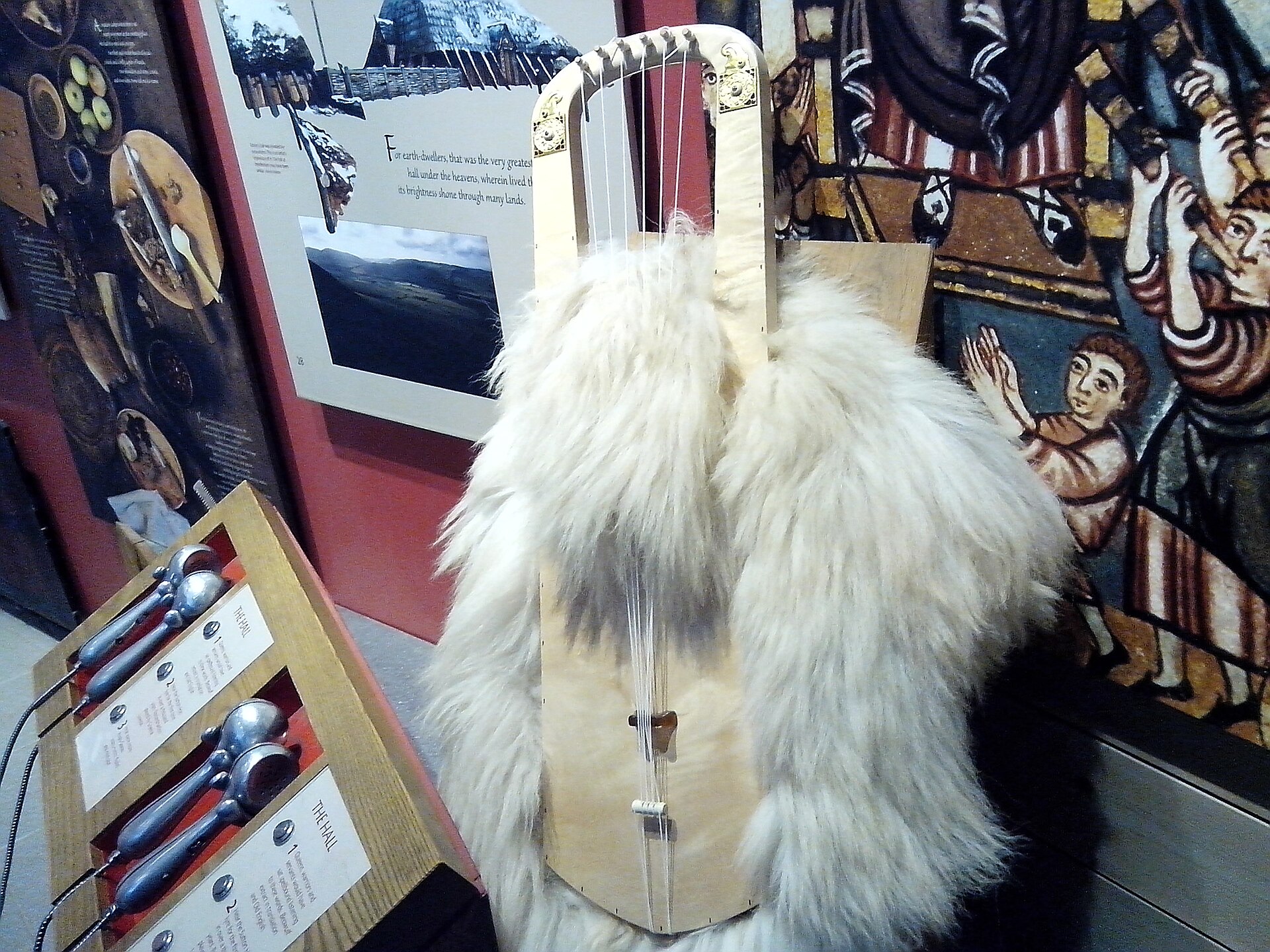
A further, and separate, source of possible confusion is that at least two other complete modern replicas of the Sutton Hoo lyre exist and are on public display, made independently of the British Museum's own SHR.9: one attributed by the National Trust to the archaeomusicologist Graeme Lawson and a second attributed to the maker Michael King, both shown at the Sutton Hoo visitor centre run by the National Trust, a different institution from the British Museum. None of these should be mistaken for one another, and none of them is the ancient object.
Chapter 14What is unresolved
This is not, and by the nature of the evidence cannot become, a closed file.
This is not, and by the nature of the evidence cannot become, a closed file. No name survives for the maker, no body survived to be identified, and even the accepted modern reconstruction is itself an interpretive model rather than a restoration of a complete original -- the third attempt in less than a century to say confidently what the fragments once formed, after a first attempt already proved wrong. What can be said with confidence is narrower than what is often claimed for it: that a lyre of a well-attested early medieval type was deliberately placed among the grave goods of a very wealthy seventh-century burial, and that its presence connects that burial to a documented culture of hall music and sung or recited verse. Everything beyond that -- who exactly was buried, whether he played the instrument himself, and how far east its design tradition really reaches -- remains argument, not record.
The artist
Unknown maker, working within an Anglo-Saxon and wider Germanic lyre-making tradition
Nobody knows who made this instrument, and no source from the period names a maker of any lyre of this type. What can be reconstructed is not a biography but a craft tradition: a recognisable design, shared with variations across Anglo-Saxon England and the neighbouring Germanic-speaking world, practised by people whose names have not come down to us at all.
Related works
| Work | Relation | Where it is |
|---|---|---|
| The Sutton Hoo Helmet Unknown maker, Anglo-Saxon | Found in the same burial chamber, Sutton Hoo Mound 1, and donated by the same owner in the same year A separate object and a separate Iconotheca record; the helmet's material and history belong there, not here. | British Museum, London |
| Taplow lyre Unknown maker, Anglo-Saxon | Comparandum used in the 1970 reassessment of the Sutton Hoo instrument as a lyre Excavated 1883 from the Taplow barrow, the most important Anglo-Saxon princely burial known before Sutton Hoo; only recognised as a lyre once the Sutton Hoo revision clarified what to look for. | British Museum, London |
| Bergh Apton lyre Unknown maker, Anglo-Saxon | Comparandum; a related grave sometimes read as belonging to a minstrel or poet Excavated 1973, grave 22; reconstructed by the archaeomusicologist Graeme Lawson. | Norwich Castle Museum |
| Prittlewell lyre Unknown maker, Anglo-Saxon | Comparandum from a princely burial of comparable richness to Sutton Hoo Excavated 2003; the wood had entirely decayed and survives only as a soil stain, with maple confirmed by chemical trace analysis. | Southend Central Museum |
| Oberflacht lyre Unknown maker, Alemannic | Continental Germanic comparandum central to the 1970 Sutton Hoo revision A related example formerly held in Berlin was lost after the Second World War and is known today only from earlier published records. | Landesmuseum Wurttemberg, Stuttgart |
| Trossingen lyre, grave 58 Unknown maker, Alemannic | Later find that confirmed the accuracy of the 1970 Sutton Hoo reconstruction Excavated 2001-2002; the best-preserved early medieval lyre yet found, from a richly furnished grave its excavators nicknamed the singer's grave. | Landesmuseum Wurttemberg, Stuttgart |
| Dzhetyasar lyre Unknown maker | Proposed distant ancestor of the same design tradition, published 2021 Dated to around the 4th century AD, roughly three centuries earlier than Sutton Hoo; the connection is a recent, actively debated proposal. | Excavated in southern Kazakhstan; current repository not established in sources consulted |
Open questions
- Whose grave is Mound 1? Raedwald is the most commonly cited candidate, proposed by H. M. Chadwick within months of the 1939 discovery and elaborated by Rupert Bruce-Mitford, but no body survived and the identification is explicitly disputed by other scholars; a 2025 proposal by Helen Gittos offers a substantially different framework (returning Byzantine-service veterans) for the whole group of rich Sutton Hoo graves.
- What did the actual seventh-century instrument look like in full? Even the corrected 1970 round-lyre reconstruction is an interpretive model built partly from comparanda at other sites, not a straightforward restoration of surviving Sutton Hoo material alone.
- What is the current display status of the ancient fragments themselves? A 2011 photograph shows fragments displayed in Room 41, but the Museum's online catalogue currently lists at least one fragment (1939,1010.203.60) as not on display; this needs checking against a current gallery visit rather than either source alone.
- Did the man buried in Mound 1 play the lyre himself, or was its presence a status marker among many, independent of his own musicianship? No source addresses this for Sutton Hoo specifically; the comparison with the Trossingen singer's grave is suggestive, not evidence.
- How far does the design tradition really extend? The 2021 proposal linking the Sutton Hoo lyre's form to a fourth-century instrument from Kazakhstan is recent and has not yet had the extended scholarly testing that settled the 1970 harp-to-lyre revision.
- Which comparandum carried the most weight in the 1970 revision? Published accounts vary in how much emphasis they place on Oberflacht against the reassessed Taplow fragments and the lost Cologne example; a full reading of Bruce-Mitford and Bruce-Mitford 1970 and the 1983 catalogue volume would settle the relative weighting, which this record has not been able to verify in full.
Questions about this object
What is The Sutton Hoo Lyre?
The Sutton Hoo Lyre is a musical instrument, dated early 7th century AD, before the ship burial, which is itself usually dated c. 610-635 on the evidence of the accompanying coins. Medium: Maple wood body with willow and alder tuning pegs and gilt copper-alloy bird-head escutcheons inlaid with garnet, surviving as fragments; the instrument as normally seen by visitors is the British Museum's own modern reconstruction, in new maple wood with electrotyped fittings, a bone bridge and gut strings.
Who made The Sutton Hoo Lyre, and is the attribution settled?
The attribution to Unknown maker, Anglo-Saxon craft tradition is recorded here as unknown. No maker is named or documented for this instrument, and none could be: Anglo-Saxon craftsmen of this period did not sign their work and no contemporary written source names a lyre-maker. What can be said rests entirely on comparison. The instrument belongs to a design family shared across Anglo-Saxon England and the wider Germanic-speaking world of the sixth and seventh centuries, known from related finds at Taplow, Bergh Apton and Prittlewell in England and Oberflacht and Trossingen on the Continent, which together indicate a recognised craft tradition rather than a single workshop or a unique invention.
Where is The Sutton Hoo Lyre now?
The British Museum, London. The ancient fragments are held in the Britain, Europe and Prehistory department; the Museum's full-size modern reconstruction is on display in Room 41 (Europe AD 300-1100, Sutton Hoo and Europe). Inventory number 1939,1010.203 (ancient fragments, registered in more than 70 individually numbered pieces); SHR.9 (the Museum's modern reconstruction). Last confirmed 25 September 2026. Donated by Mrs Edith M. Pretty to the British Museum, 1939, following the treasure trove inquest of 14 August 1939.
What is still unknown about The Sutton Hoo Lyre?
Whose grave is Mound 1? Raedwald is the most commonly cited candidate, proposed by H. M. Chadwick within months of the 1939 discovery and elaborated by Rupert Bruce-Mitford, but no body survived and the identification is explicitly disputed by other scholars; a 2025 proposal by Helen Gittos offers a substantially different framework (returning Byzantine-service veterans) for the whole group of rich Sutton Hoo graves.
Sources
- 1British Museum Collection Online, 'lyre', museum number 1939,1010.203.60. britishmuseum.org/collection/...
- 2British Museum Collection Online, 'lyre; replica', museum number SHR.9. britishmuseum.org/collection/...
- 3British Museum Collection Online, search results for 'Sutton Hoo lyre', listing the ancient fragment series (1939,1010.203.x) and replica registration numbers SHR.8, SHR.9, SHR.10 and SHR.18. britishmuseum.org/collection/...
- 4Wikipedia, 'Rotte (lyre)' [Anglo-Saxon lyre], consolidating the discovery context, materials, and the 1948-49 and 1970 reconstruction history with named comparanda. en.wikipedia.org/wiki/...
- 5Bruce-Mitford, Rupert and Bruce-Mitford, Myrtle, 'The Sutton Hoo Lyre, Beowulf, and the Origins of the Frame Harp', Antiquity, vol. 44, no. 173 (March 1970), pp. 7-13. The 1970 publication that revised the instrument from a harp to a round lyre. Citation verified via the journal's own listing; full text not directly consulted for this record and flagged for a follow-up read. cambridge.org/core/...
- 6Bruce-Mitford, Rupert, with Evans, Angela Care, The Sutton Hoo Ship-Burial, Volume 3: Late Roman and Byzantine Silver, Hanging-Bowls, Drinking Vessels, Cauldrons and Other Containers, Textiles, the Lyre, Pottery Bottle and Other Items (London: British Museum Publications, 1983). The full scholarly catalogue of the lyre fragments. Citation verified via bookseller listing; full text not directly consulted for this record and flagged for a follow-up read. abebooks.com/9780714113487/...
- 7Medievalists.net, 'A Wealth of Evidence: The Identity of the Man Commemorated at Sutton Hoo', discussing H. M. Chadwick, 'Who was He?', Antiquity, vol. 14 (1940), pp. 76-87, including Chadwick's 1939 remark to Charles Phillips. Secondary source; the Chadwick 1940 article itself was not directly consulted for this record. medievalists.net/2017/...
- 8Wikipedia, 'Raedwald of East Anglia', for the identification debate, Barbara Yorke's supporting argument, the Oxford Dictionary of National Biography's cautious assessment, and McClure and Collins's dissent. en.wikipedia.org/wiki/...
- 9Wikipedia, 'Sutton Hoo', for the excavation history (Basil Brown, Charles Phillips, Edith Pretty), the treasure trove inquest and 1939 donation, wartime context, and the dates of Bruce-Mitford's three-volume publication. en.wikipedia.org/wiki/...
- 10Gittos, Helen, 'Sutton Hoo and Syria: The Anglo-Saxons Who Served in the Byzantine Army?', The English Historical Review, vol. 139, no. 601 (2025), pp. 1323-. Cited via its Oxford Academic listing and contemporary press summaries; the full article was not directly consulted for this record. academic.oup.com/ehr/...
- 11Kolltveit, Gjermund, 'The Sutton Hoo lyre and the music of the Silk Road: a new find of the fourth century AD reveals the Germanic lyre's missing eastern connections', Antiquity (2021), DOI 10.15184/aqy.2021.164. cambridge.org/core/...
- 12Medievalists.net, 'Sutton Hoo Lyre has a connection to Central Asia, archaeologist finds', summarising Kolltveit 2021. medievalists.net/2021/...
- 13Google Arts & Culture, in partnership with the British Museum, 'Fragments of a lyre from the ship burial at Sutton Hoo', giving materials (copper-alloy, garnet, gold, wood) and cultural context. artsandculture.google.com/asset/...
- 14Carver, M. O. H., Sutton Hoo: Burial Ground of Kings? (London: British Museum Press, 1998), cited via a Project MUSE review summarising its central argument that the burial is a deliberately composed statement of rank and allegiance. The book itself was not directly consulted for this record. muse.jhu.edu/article/...
- 15British Museum, 'The British Museum and the Blitz: eight days to evacuate', on the wartime storage of the Sutton Hoo finds at Aldwych Underground station. britishmuseum.org/blog/...
- 16Thegns of Mercia, 'Two Princely Anglo-Saxon Lyres', on the Sutton Hoo and Taplow lyres, the Bergh Apton find, and Graeme Lawson's reconstruction work. thegns.org/blog/...
- 17Wikipedia, 'Bergh Apton Anglo-Saxon cemetery', for the 1973 excavation and the lyre find in grave 22. en.wikipedia.org/wiki/...
- 18Wikipedia, 'Prittlewell royal Anglo-Saxon burial', for the 2003 excavation and the lyre recovered only as a soil stain. en.wikipedia.org/wiki/...
- 19Secondary hosting of scholarship on 'The Lyre From Grave 58 at Trossingen and Its Owner', for the Trossingen find, its dating, and its description by its excavators as the singer's grave. pdfslide.net/documents/...
Last verified · Published
Change log
25 September 2026 - Record created at the house standard: researched narrative, technical evidence, maker dossier, graded provenance chain, prices with hammer and premium separated, related works, open questions and sources.