The Sutton Hoo Helmet
Unknown workshop, probable East Scandinavian (Swedish or Danish) manufacture or influence · early 7th century AD, most likely c. 600-625
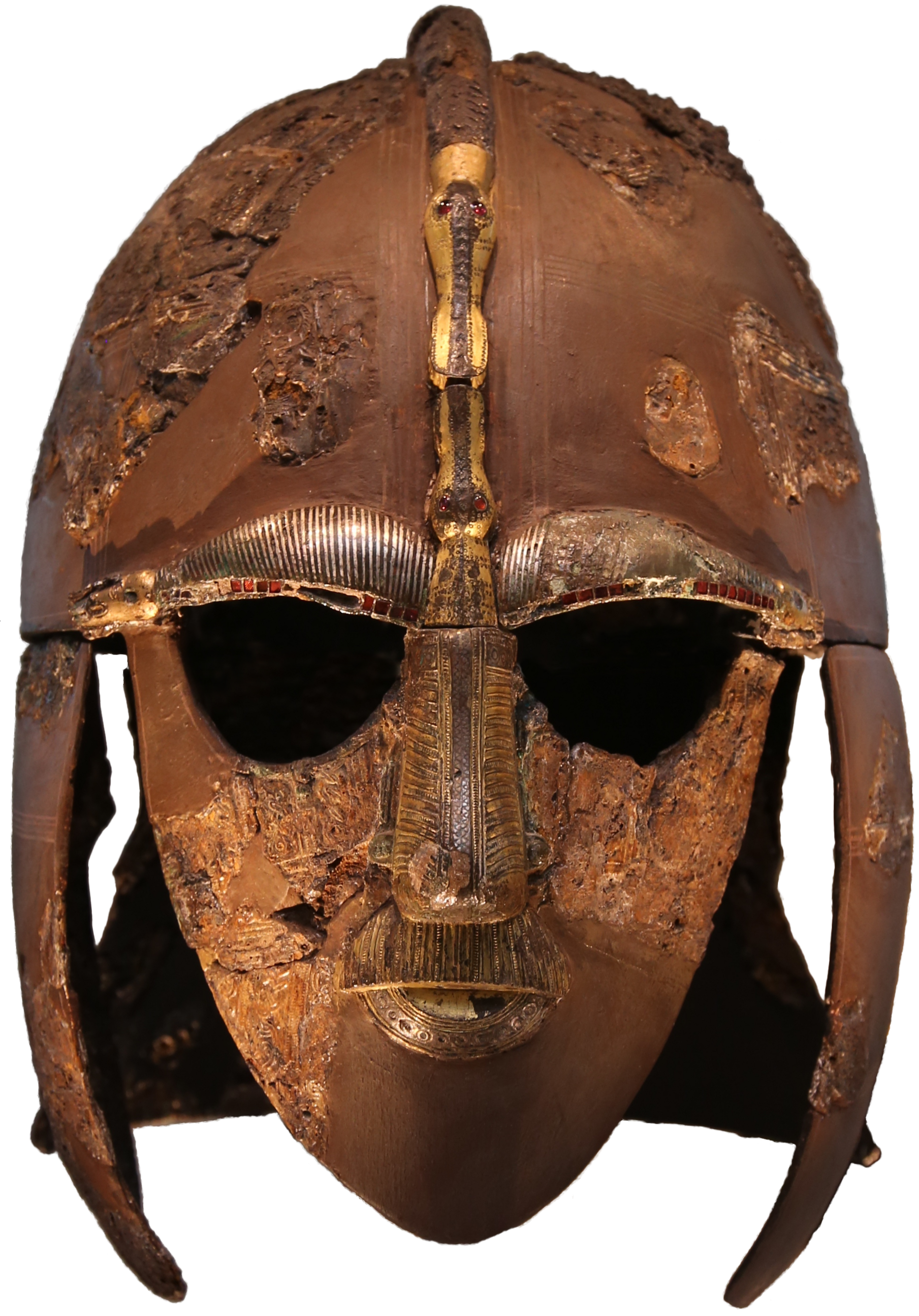
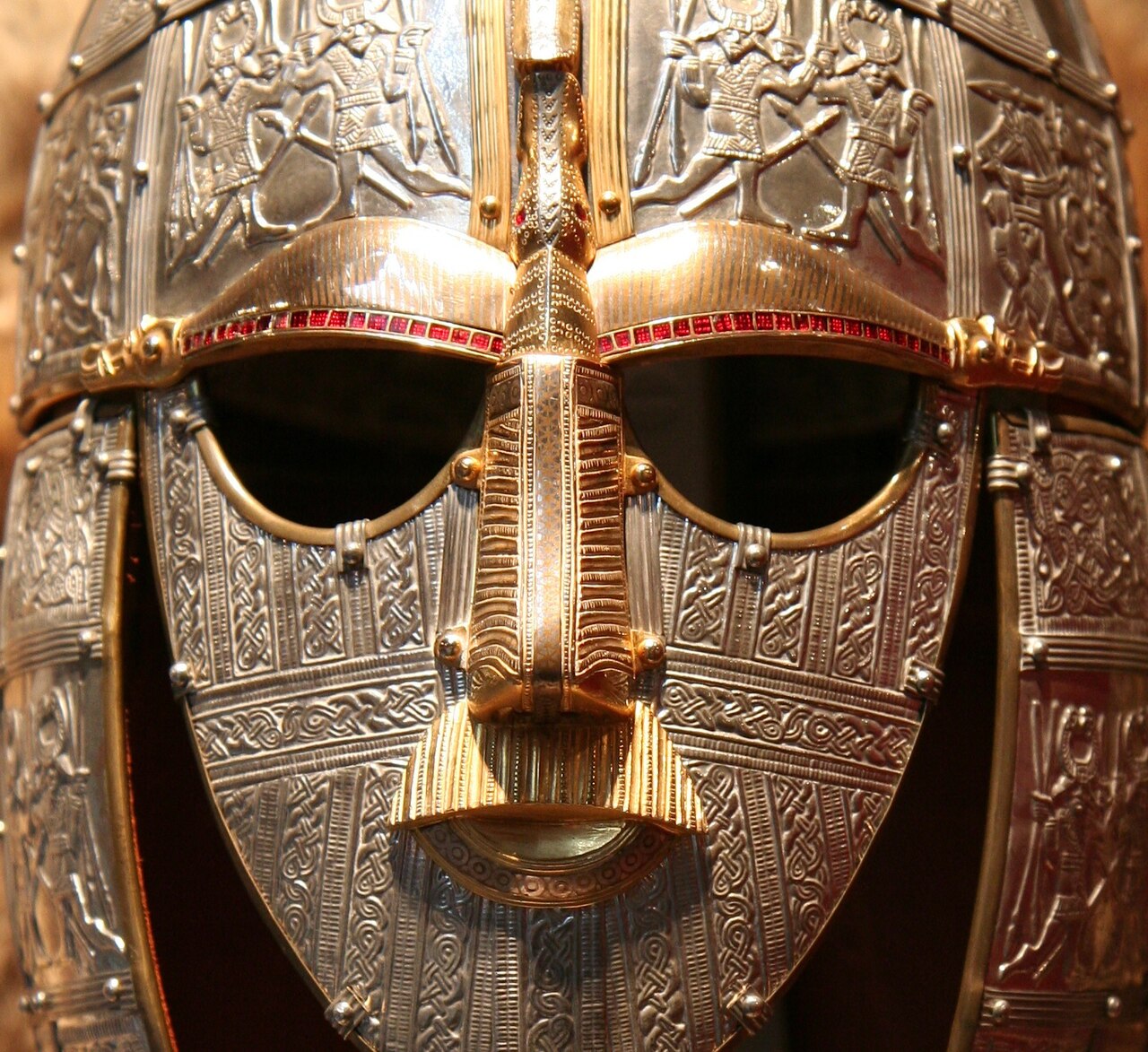
The excavated helmet in its current, 1971 reconstruction, photographed from the front at the British Museum. This is the object described in this record.
| Artist | Unknown workshop, probable East Scandinavian (Swedish or Danish) manufacture or influence |
|---|---|
| Date | early 7th century AD, most likely c. 600-625 |
| Medium | Iron cap and internal fittings; tinned copper-alloy (bronze) sheet decoration applied by the pressblech (die-stamping) process; cast copper-alloy gilt face and dragon fittings; gold; silver wire inlay; garnets in cloisonne cells with gold foil backing (except the left eye); originally lined with leather |
| Dimensions | 31.8 x 21.5 x 25.5 cm (12.5 x 8.5 x 10 in), reconstructed; approximately 2.5-2.7 kg in its reconstructed state |
| Where it is now | British Museum, London, Room 41 (Sutton Hoo and Europe)last confirmed |
| Inventory number | 1939,1010.93 |
| Attribution | DisputedThe helmet itself is undisputed as an object; what is disputed is where and by whom it was made, and who it was buried for. Full note |
| Object type | Arms and armour |
| Period | Anglo-Saxon England, early 7th century (Sutton Hoo Mound 1 ship burial) |
| Cases | Disputed attribution · Has a provenance gap |
| Inscriptions | None. No maker's mark, owner's name or runic inscription survives on any fragment. |
| Owners on record | 4 links4 documented |
| Sources | 16 cited |
About this record Last verified · 16 sources cited · Change log
On this page 9 sections
ContentsClose
Excavated in 1939 from the undisturbed burial chamber of a 27-metre ship buried in Mound 1 at Sutton Hoo, Suffolk, the helmet did not come out of the ground as a helmet. It came out as several hundred corroded fragments of iron and tinned bronze, and everything about its present appearance is the result of two separate acts of reconstruction, forty years apart, that do not agree with each other in every detail.
Herbert Maryon assembled it first, in 1945-46, working mostly by intuition with the pieces then available. Nigel Williams took it apart again in 1970-71 and rebuilt it using fragments recovered in a second dig, comparative material from Sweden that had not been available to Maryon, and a much more rigorous physical method. The object on display in Room 41 is Williams's helmet, not Maryon's, though Maryon's version circulated in print and photographs for a generation and still shapes the popular image.
The burial is generally associated with Raedwald, king of the East Angles, who died around 624, though this rests on circumstantial reasoning about wealth, date and the burial's proximity to the royal centre at Rendlesham, not on an inscription. In 2025 a Danish metal-detector find reopened the older question of where the helmet itself was actually made, since its closest known design parallel is no longer Swedish.
Provenance
Each link is graded. Documented: a cited source supports it. Disputed: the identification is argued but not established. Unknown: no owner for that span, and the gap is not smoothed into a narrative. The grades in the glossary.
- c. 600-625 AD -Unknown East Anglian royal or elite figure, probably (not certainly) Raedwald, king of the East Anglesdocumented
The helmet was made in the early 7th century and placed, already old or new, in the burial chamber of the ship interred in Mound 1 at Sutton Hoo. The identity of the person for whom it was made and with whom it was buried is not documented; Raedwald (died c. 624) is the most widely favoured candidate on circumstantial grounds only.456
- c. 625 AD - 1939No one; buried and undisturbed except for a probable early robbers' shaft into the upper part of the chamberdocumented
The mound and its ship burial lay undisturbed at core level for roughly thirteen centuries, though evidence suggests a post-burial robbers' shaft reached the upper part of the chamber at some earlier date without finding the helmet or main deposit.23
- May-August 1939 - 14 August 1939Discovered in situ; ownership contested between the Crown (treasure trove) and Edith Pretty as landownerdocumented
Basil Brown, working for landowner Edith Pretty via Ipswich Museum, located the ship and its burial chamber; Charles Phillips, brought in from Cambridge University with Office of Works backing from 10-11 July 1939, took over excavation of the chamber itself, sidelining Brown and Ipswich Museum curator Guy Maynard. A coroner's inquest at Sutton village hall on 14 August 1939, presided over by coroner L.H. Vulliamy, ruled the find not treasure trove but a grave deposit, awarding ownership to Pretty as landowner.23678
- 1939 - presentBritish Museum, Londondocumented
Edith Pretty gave the entire Sutton Hoo Mound 1 find, including the helmet fragments, to the British Museum in 1939 without payment, at a time the find's value was estimated above one million pounds. It has remained in the museum's collection since, registered 1939,1010.93.269
Technical evidence
| Attribution note | The helmet itself is undisputed as an object; what is disputed is where and by whom it was made, and who it was buried for. Its five stamped bronze designs are close enough to helmet plates from Vendel and Valsgarde in eastern Sweden that most twentieth-century scholarship treated it as either Swedish-made or made by a Scandinavian-trained smith working in England. In 2025 a bronze stamp (patrice) found by a metal detectorist on the Danish island of Tasinge was identified by Peter Pentz, curator at the National Museum of Denmark, as an even closer match to the helmet's rider motif than the Swedish material, raising the possibility of a Danish origin or shared craftsmen. Pentz has explicitly cautioned this is not proof and that a small portable stamp could have travelled. No maker's name or workshop mark survives. The identity of the person buried with the helmet is separately disputed: most historians favour Raedwald, king of the East Angles (died c. 624), but the case is circumstantial and no inscription names an occupant. |
|---|---|
| Materials | Iron cap and internal reinforcing bands; tinned copper-alloy (bronze) sheet, die-stamped (pressblech); cast gilt copper-alloy face, dragon heads and boar-head terminals; silver wire inlay; garnets in cloisonne cells, mostly gold-foil backed; originally leather-lined.14 |
| Dimensions (reconstructed) | 31.8 cm high x 21.5 cm wide x 25.5 cm deep.1 |
| Weight (reconstructed) | Approximately 2.5 to 2.7 kg.1 |
| Construction of the cap | Raised from a single sheet of iron, internally stiffened by a browband, a nose-to-nape band and four further strips dividing the dome into eight panels, hammered and riveted.1 |
| Decoration technique | Five distinct stamped designs applied to the tinned bronze sheet by the pressblech process, using preformed dies (patrices) pressed or hammered against a mould (matrice).111 |
| Gilding | The nose and mouth piece is fire-gilded; the presence of residual mercury, the bonding agent used in fire-gilding, has been detected analytically.1 |
| Registration number | British Museum 1939,1010.93.1 |
| First reconstruction | Herbert Maryon, British Museum, completed 1945-46, published 1947; plaster fills and wax-secured elements.23 |
| Second (current) reconstruction | Nigel Williams, British Museum, 1970-71; full disassembly (4 months), study (5 months) and reassembly (9 months) onto a textile-and-plaster support, incorporating fragments recovered 1965-1970 and comparative material from the Valsgarde 7 helmet, Sweden.23 |
Images
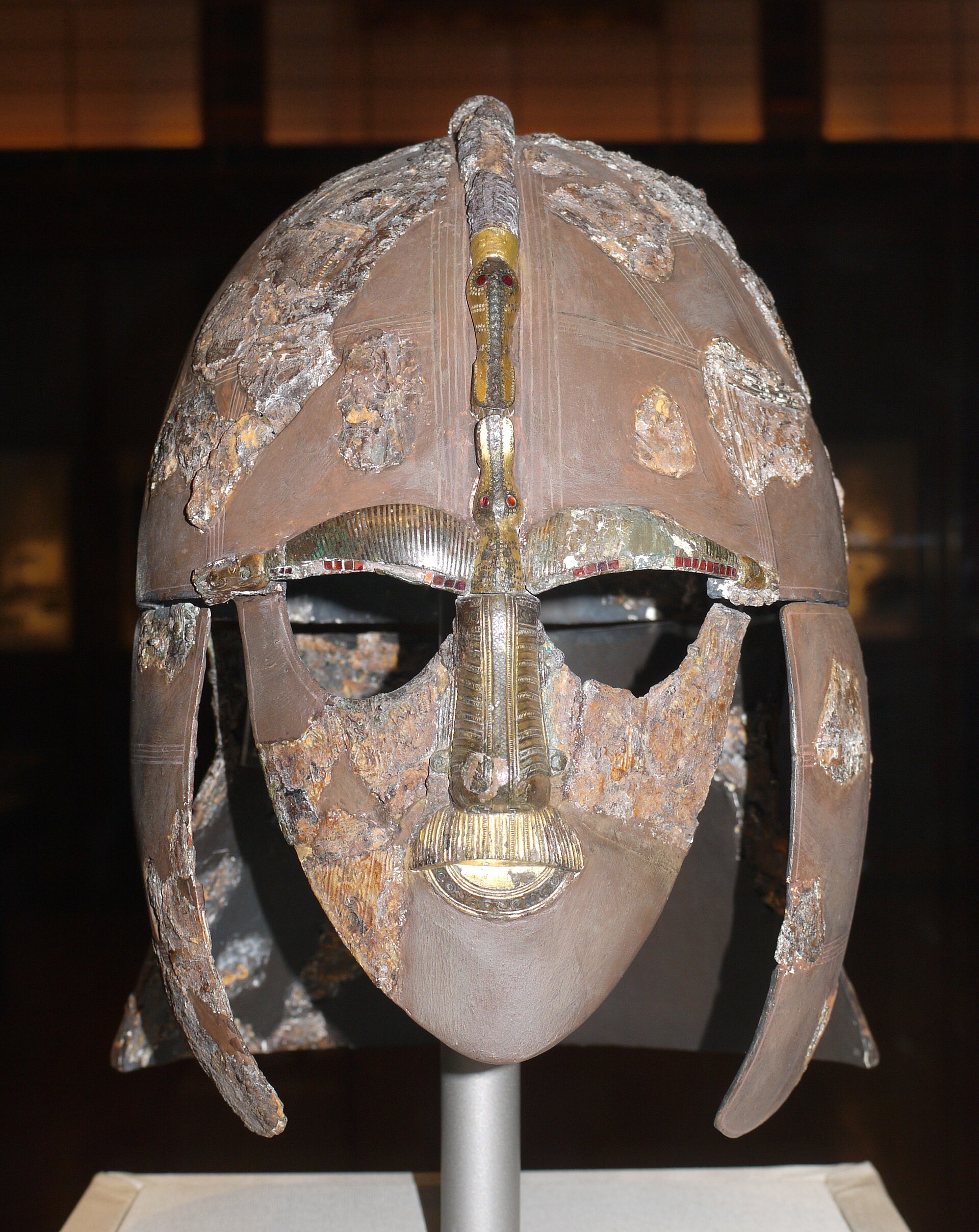
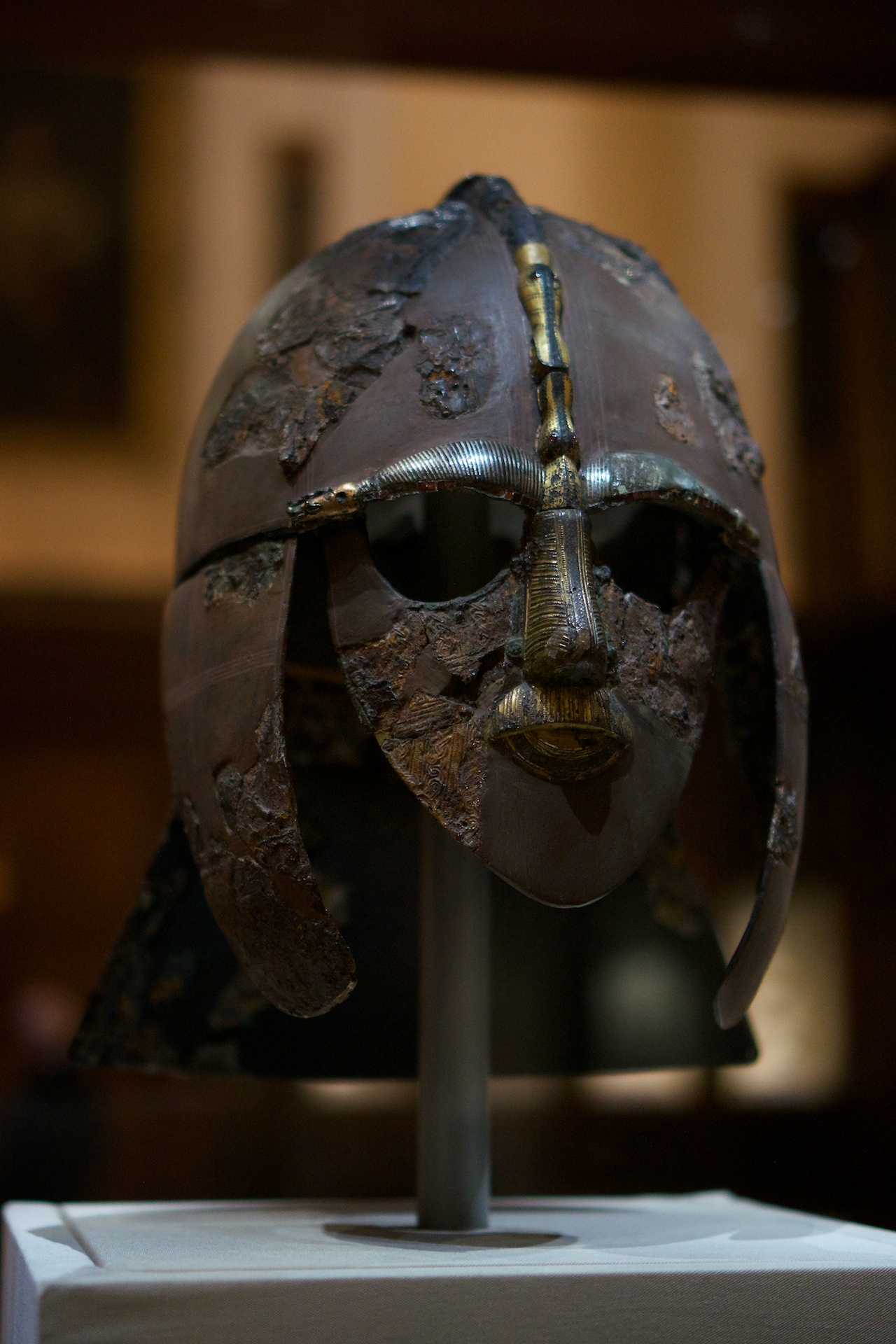
The record in full
Chapter 1What it is
A single iron cap, beaten from one piece of metal, fitted with a face-mask, a pair of hinged cheek-pieces, a full neck-guard and a crest running front to back, and covered almost entirely in...
A single iron cap, beaten from one piece of metal, fitted with a face-mask, a pair of hinged cheek-pieces, a full neck-guard and a crest running front to back, and covered almost entirely in decorated tinned copper-alloy sheet, cast gilt-bronze fittings, silver wire and garnet cloisonne work. Reconstructed, it stands 31.8 cm high, 21.5 cm wide and 25.5 cm deep and weighs approximately 2.5 to 2.7 kilograms. It is the most completely equipped of the small number of helmets to survive from early medieval England, and the only one found with a face-mask that reads, worn, as a single stylised human-animal face rather than a plain visor.
It is not intact. It is a reconstruction built from several hundred corroded fragments, and every published account of its decoration is a reading of what those fragments, and the gaps between them, appear to show.
Chapter 2How it was made
The cap was raised from a single sheet of iron.
The cap was raised from a single sheet of iron. Internally it was stiffened by a browband running ear to ear, a second band running nose to nape, and four further iron strips dividing the dome into eight panels, all hammered and riveted together, a construction method paralleled in the Vendel and Valsgarde helmet graves in eastern Sweden. The exterior tinned bronze plaques were not engraved directly but stamped: a die (a patrice) bearing a design in relief was used to press or hammer thin sheet metal into a matching mould (a matrice), a technique called pressblech, which let a single die produce multiple identical panels around the cap. The cast gilt-bronze face, the paired dragon heads flanking the crest, and the boar-head terminals of the eyebrows were made separately and fitted on. The nose and mouth piece was fire-gilded, a process detected in modern analysis by residual mercury, the element used to bond gold to a copper-alloy surface at high temperature. Staining on surviving fragments indicates the helmet was originally lined in leather, evidence recovered only when Nigel Williams dismantled the 1940s reconstruction in 1970 and examined the reverse faces of pieces that had not been looked at since Maryon set them.
Chapter 3The excavation
Edith Pretty, who owned the Sutton Hoo estate outside Woodbridge, Suffolk, had long been curious about the eighteen visible barrows on her land and in 1938 hired Basil Brown, a self-taught excavator...
Edith Pretty, who owned the Sutton Hoo estate outside Woodbridge, Suffolk, had long been curious about the eighteen visible barrows on her land and in 1938 hired Basil Brown, a self-taught excavator working for Ipswich Museum on a wage of about thirty shillings a week, to investigate them. Brown opened three smaller mounds in 1938, finding evidence that grave robbers had already emptied them centuries earlier. In May 1939 he began on Mound 1, the largest, assisted by Pretty's gardener John Jacobs and gamekeeper William Spooner. Within days Jacobs found an iron rivet; Brown recognised it as a ship's rivet, and over the following weeks he traced the full impression of a clinker-built vessel roughly 27 metres long, pressed into the sandy soil, its timbers long since rotted away but its iron rivets still in place in their original rows.
By mid-June, working along the ship, Brown located an undisturbed burial chamber amidships. Word of the find reached Cambridge archaeologist Charles Phillips, who visited on 6 June 1939 and judged the scale of the ship consistent with a royal burial. Following meetings between Pretty, the British Museum, the Office of Works, Ipswich Museum and the Suffolk Institute of Archaeology, it was agreed that Phillips would take charge of excavating the burial chamber itself, formally from 10-11 July 1939, bringing in his own team under Office of Works authority: W.F. Grimes, O.G.S. Crawford, and Stuart and Margaret (Peggy) Piggott among them. Basil Brown continued working on site under his existing contract with Pretty, but was excluded from the excavation of the chamber he had found. Ipswich Museum's curator, Guy Maynard, who had employed and directed Brown, was also frozen out of the new arrangement, and relations between him and Phillips were reported as tense. Brown was at one point instructed to stop work by the incoming team but continued regardless, a decision later credited with helping keep the site secure against looting during the handover.
The burial chamber, opened through July and August 1939 under wartime time pressure, produced an unparalleled array of grave goods: the helmet, an iron and wood shield with bronze fittings, a pattern-welded sword, a purse containing 37 gold Merovingian tremisses and other coin-like objects, gold and garnet shoulder clasps, a great gold belt buckle, silver plate of Byzantine origin, drinking horns, a lyre, and more, but no trace of a body. Chemical analysis of the sand beneath the chamber, carried out much later, found phosphate levels consistent with a body having been present and having fully dissolved in the acidic Suffolk soil.
Chapter 4The inquest and the gift
Under English treasure trove law as it then stood, objects of gold or silver deliberately hidden with intent to recover them belonged to the Crown; objects placed in the ground without such intent...
Under English treasure trove law as it then stood, objects of gold or silver deliberately hidden with intent to recover them belonged to the Crown; objects placed in the ground without such intent, including grave goods, belonged to the landowner. A coroner's inquest was convened at Sutton village hall on Monday 14 August 1939, presided over by coroner L.H. Vulliamy. Charles Phillips testified that the burial's scale, the ceremony implied by hauling a ship inland and building a chamber for it, and the presence of items that functioned as regalia rather than currency, told against any intent to recover the goods later; Stuart Piggott testified to the arrangement of objects consistent with a body laid at full length in the ship despite the total loss of skeletal remains. The jury found for Pretty: the find was ruled not treasure trove but a grave deposit, and ownership passed to her as landowner.
Edith Pretty then gave the entire find to the British Museum in 1939, without payment, at a time contemporary estimates placed its value above one million pounds. It remains the largest single act of private donation in the museum's modern history and the reason the Sutton Hoo material entered the national collection as a single, undivided group rather than being dispersed or sold.
Chapter 5Excavated in pieces, not as a helmet
What came out of the chamber where the helmet had lain was not a helmet.
What came out of the chamber where the helmet had lain was not a helmet. Corrosion, the weight of thirteen centuries of overlying soil, and probable damage from an Anglo-Saxon robbers' shaft that had already disturbed the upper part of the burial before 1939, had crushed it into several hundred fragments of rusted iron and tinned bronze, many no larger than a coin, some barely legible even under a microscope. Everything the public now recognises as the Sutton Hoo helmet is an act of reconstruction built from that wreckage, twice over.
Chapter 6The first reconstruction: Herbert Maryon, 1945-46
Herbert Maryon, a British Museum conservator then in his seventies with a background as a sculptor and metalworker, undertook the first assembly of the fragments, completing the work by 1946 and...
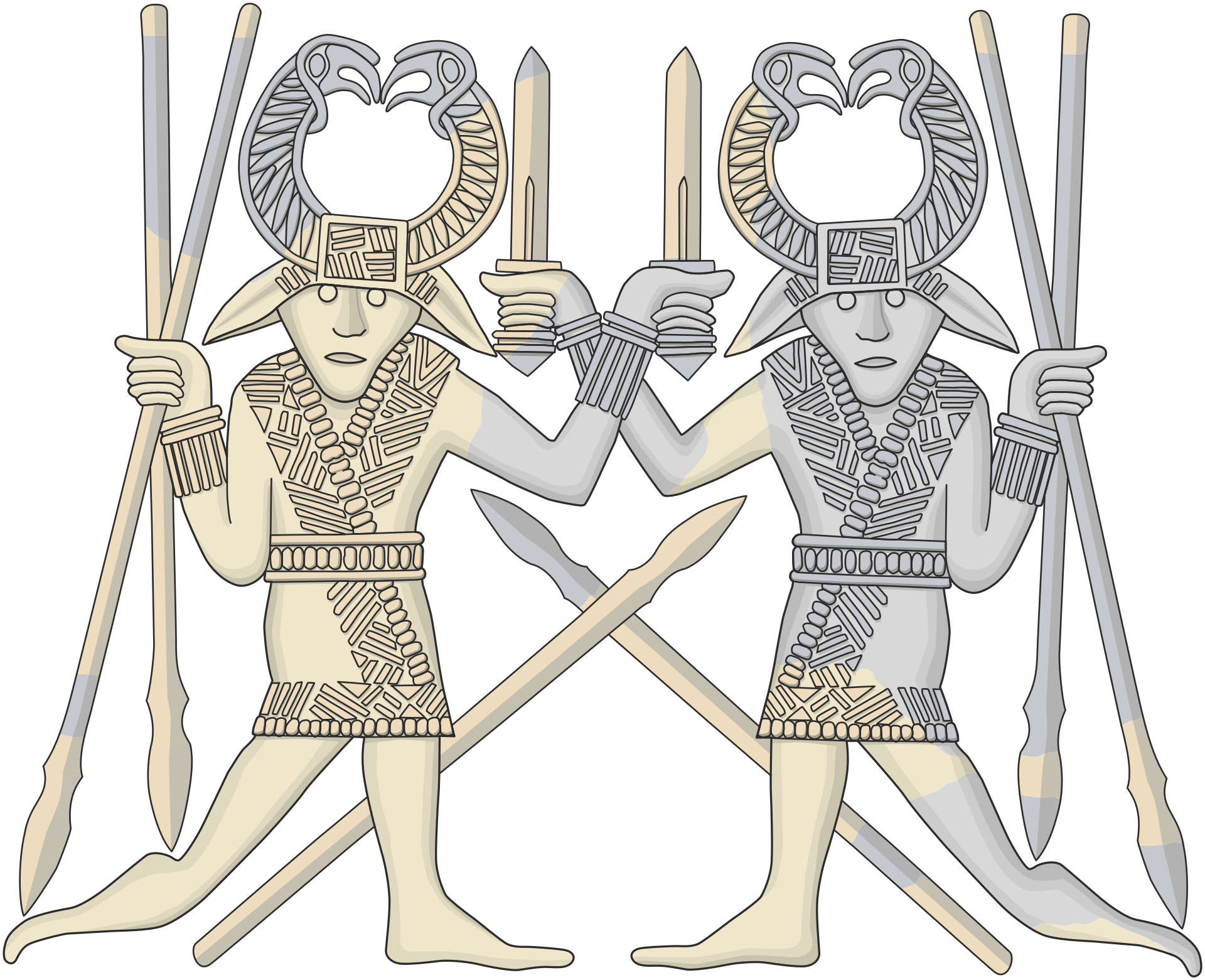
Herbert Maryon, a British Museum conservator then in his seventies with a background as a sculptor and metalworker, undertook the first assembly of the fragments, completing the work by 1946 and publishing his account of it in 1947. It took him roughly six months of continuous work, which he compared to solving a jigsaw puzzle with pieces missing and no picture on the box to guide him. He filled gaps with plaster and secured decorative elements, including garnets, with wax. The result, displayed publicly for the first time in this form, established the basic recognisable silhouette of the helmet, its five stamped bronze designs, and the reading of Design 1 as two dancing warriors, but it rested on limited comparative evidence and involved Maryon's own judgement calls about how loose or fragmentary pieces related to one another. It drew criticism, notably from Swedish scholars familiar with the related helmet graves at Vendel and Valsgarde, over specific points of design and proportion.
Chapter 7The second reconstruction: Nigel Williams, 1970-71
Further excavation at Sutton Hoo between 1965 and 1970, led by Rupert Bruce-Mitford and Paul Ashbee, recovered additional helmet fragments that had not been available to Maryon, including cheek-piece...
Further excavation at Sutton Hoo between 1965 and 1970, led by Rupert Bruce-Mitford and Paul Ashbee, recovered additional helmet fragments that had not been available to Maryon, including cheek-piece material found in 1967. This, combined with the twenty years of scholarship since 1947 and a fresh comparative study of the Valsgarde 7 helmet in Sweden undertaken by Bruce-Mitford, prompted a decision to take Maryon's reconstruction apart and start again.
Nigel Williams, then in his mid-twenties and a career British Museum conservator, carried out the work. He spent four months completely disassembling Maryon's helmet, a process a colleague likened to opening a box of horrors, since removing plaster and wax fills not designed for later removal risked the fragments themselves. He then spent five months studying the resulting several hundred fragments individually, by profile, colour and surface morphology, consulting other specialists at each stage, before spending a further nine months reassembling them onto a new support of heavy-duty textile stiffened with adhesive and covered in plaster, which holds the fragments in shape without claiming to reproduce lost material as if it were original. The published, current reconstruction dates to 1971.
The rebuild changed more than cosmetics. Williams's disassembly exposed the leather-lining stains and internal iron reinforcement bands not properly recorded in the 1940s, and the incorporation of newly excavated fragments allowed the figural Design 1 dancing-warrior scene and other panels to be positioned with more confidence, using the Valsgarde 7 helmet and related Torslunda die plates from Oland as comparanda that were not fully worked through when Maryon assembled the object. Williams went on to a long conservation career, including the later reconstruction of the Portland Vase, and is credited within the profession as having set a new standard for how fragmentary metalwork should be documented and rebuilt.
Chapter 8What is still uncertain in the object itself
Even the 1971 reconstruction is an argument built from evidence, not a certainty.
Even the 1971 reconstruction is an argument built from evidence, not a certainty. Design 3, known from only seven small, ambiguous fragments, has never been confidently identified and may represent a repair using an unrelated design rather than part of the original decorative scheme. The crest, the precise junction of the dragon-head fitting between the eyebrows, and the full extent of Design 1's dancing-warrior frieze (known from six fragments and reconstructed by comparison with Valsgarde 7 and the Torslunda dies) all depend on comparative reasoning as much as on surviving physical evidence. No third full physical reconstruction has been undertaken since 1971; recent work on the object has been analytical and digital rather than another rebuild, including laser and 3D surface scanning used to study tool marks (for example, a deliberate cut removing an eye from one of the Torslunda-type die figures) and continuing comparison with newly found continental material.
Chapter 9A Danish stamp reopens the question of where it was made
In 2025 Danish metal-detectorist Jan Hjort found a small copper-alloy stamp, or patrice, 4.5 centimetres across, in a field on the island of Tasinge in the South Funen archipelago, later passed via...
In 2025 Danish metal-detectorist Jan Hjort found a small copper-alloy stamp, or patrice, 4.5 centimetres across, in a field on the island of Tasinge in the South Funen archipelago, later passed via Svendborg Museum to the National Museum of Denmark. Peter Pentz, curator at the National Museum, identified its mounted-warrior design, matching wrist cuff, hairstyle, horse-harness fitting, reins, sword and the ring of circles around the trampled figure's feet, as considerably closer to the Sutton Hoo helmet's Design 2 (Rider and Fallen Warrior) than any surviving Swedish die or plate. Pentz's stated view is that a resemblance this close could mean the helmet and the Tasinge stamp were made in the same place, possibly by the same craftsmen, which would point to Denmark rather than Sweden as the helmet's country of manufacture or design origin, a significant shift given how long the Vendel and Valsgarde connection has anchored the standard account.
Pentz has been explicit that this does not amount to proof: a 4.5-centimetre object is portable and could have travelled a considerable distance from where it was made or used, and he has stated plainly that it cannot on its own demonstrate a Danish regional power to rival Sweden's in the early 7th century. As of this record's publication the comparison rests on visual and stylistic analysis; a direct 3D scan comparison between the Tasinge stamp and the helmet's own die-stamped panels has been proposed by researchers but had not been completed and published in the sources consulted.
Chapter 10Who the helmet was made for
No inscription names an owner. The case for Raedwald, king of the East Angles, who according to Bede died around 624, rests on circumstance: the burial's wealth and evident royal status, a date range...
No inscription names an owner. The case for Raedwald, king of the East Angles, who according to Bede died around 624, rests on circumstance: the burial's wealth and evident royal status, a date range for the coins and other datable material that fits the early 620s to 630s, and the site's proximity, about six kilometres, to Rendlesham, the East Anglian royal centre named by Bede as a place where an East Anglian king had his hall. Rupert Bruce-Mitford was the identification's leading proponent from the 1940s onward. The case has been described by the Oxford Dictionary of National Biography as argued more strongly than convincingly, and McClure and Collins, editors of Bede's history, describe the supporting evidence for naming any specific individual as almost non-existent.
Named alternative candidates include Raedwald's sons and immediate successors Eorpwald, Sigeberht and Ecgric; an unnamed member of the East Anglian royal Wuffingas dynasty other than Raedwald; a high-status foreign visitor rather than a native king; and, per historian Helen Gittos writing in 2025, an elite local figure who had served as a soldier in the army of the Byzantine Empire, proposed on the strength of the burial's Byzantine silver and its display of Mediterranean-derived prestige goods alongside the distinctly northern European helmet and weapons. No consensus candidate other than Raedwald commands majority support, and the identification of Raedwald itself remains, honestly stated, the best-supported guess rather than a settled fact.
Chapter 11What the helmet said about its wearer
Read as a whole rather than fragment by fragment, the helmet's face is not a plain visor.
Read as a whole rather than fragment by fragment, the helmet's face is not a plain visor. The gilt-bronze nose, mouth and moustache, flanked by the silver-wire-inlaid eyebrows terminating in gilded boar heads, and topped by a bronze dragon head at the point where the eyebrows meet, combine into a second image superimposed on the human face beneath: a bird- or dragon-like form with the nose as body, the moustache as tail and the eyebrows as wings, its head defined by garnet eyes. Worn, the helmet presented two faces at once, a man's and a creature's.
Boars carried an established, textually attested meaning in this material culture: the Old English poem Beowulf twice describes helmets bearing boar-images, eoforlic, as protective devices worn into battle, once as boar-shapes flashing above the wearers' cheek-guards. The Sutton Hoo helmet's boar-head eyebrow terminals are a physical instance of exactly the image the poem names, made concrete in metal roughly contemporary with (or not long before) the world the poem describes.
A further, more debated reading concerns the eyebrows themselves. Nearly every other garnet-set object from the Sutton Hoo burial backs its garnets with gold foil to make them catch and throw light; the helmet's right eyebrow is backed this way, but the twenty-five garnets of its left eyebrow are not, and so read visibly darker. Archaeologists Neil Price and Paul Mortimer, writing in the European Journal of Archaeology in 2014, argue this asymmetry was deliberate: in firelight or low sun the wearer's face would appear to have one bright eye and one dark one, evoking Woden (the Anglo-Saxon form of Norse Odin), the one-eyed god who traded an eye for wisdom, and central to the origin-myth of the East Anglian royal line itself. The Wuffingas dynasty that ruled early East Anglia, of which Raedwald was a member, is named in surviving genealogies as descending from Woden by way of a legendary ancestor named Wuffa, meaning roughly little wolf; Wuffingas itself has been read as kin of the wolf. A king wearing a helmet built to suggest, in the right light, the one-eyed god from whom his own dynasty claimed descent would have been making a specific and legible claim about the sacred basis of his authority, not a generic display of wealth. This reading is argued, not documented: it depends on an inference about intended visual effect and about how audiences would have read it, and other scholars have not universally accepted it, but it is a serious, citable, peer-reviewed proposal rather than a speculative aside, and it is consistent with the wider pattern of a burial that otherwise combines a formally adopted or tolerated Christianity (Bede records Raedwald keeping a Christian altar alongside a pagan one in the same temple) with grave goods that are emphatically pre-Christian in character and function.
Chapter 12Materials and where they came from
The Sutton Hoo burial as a whole contained more than four thousand garnets, most set in gold cloisonne work elsewhere in the grave goods (the purse-lid, the shoulder clasps, the great buckle) rather...
The Sutton Hoo burial as a whole contained more than four thousand garnets, most set in gold cloisonne work elsewhere in the grave goods (the purse-lid, the shoulder clasps, the great buckle) rather than in the helmet itself, whose garnets are comparatively few and set in copper-alloy rather than gold cells. Scientific and comparative sourcing work discussed by the British Museum in connection with its Silk Roads research places the likely origin of Anglo-Saxon garnets of this period, including material from Sutton Hoo, in Sri Lanka or India, reaching England via long trade networks rather than any local or even continental European source. The thirty-seven gold coins in the burial's purse are Merovingian tremisses, minted in Frankish Gaul, and silver vessels in the grave derive from the eastern Mediterranean and Byzantine world. None of this material is native to Suffolk; the burial as a whole, and by extension the environment the helmet's owner controlled or could draw on, was provisioned from trade routes running from Scandinavia to the Mediterranean and beyond.
Chapter 13Reproduction, replicas and the risk of confusing them with the original
Because the excavated object is dark, corroded and visibly reconstructed, its familiar bright, golden public image is very largely the product of replicas, not of the artifact itself.
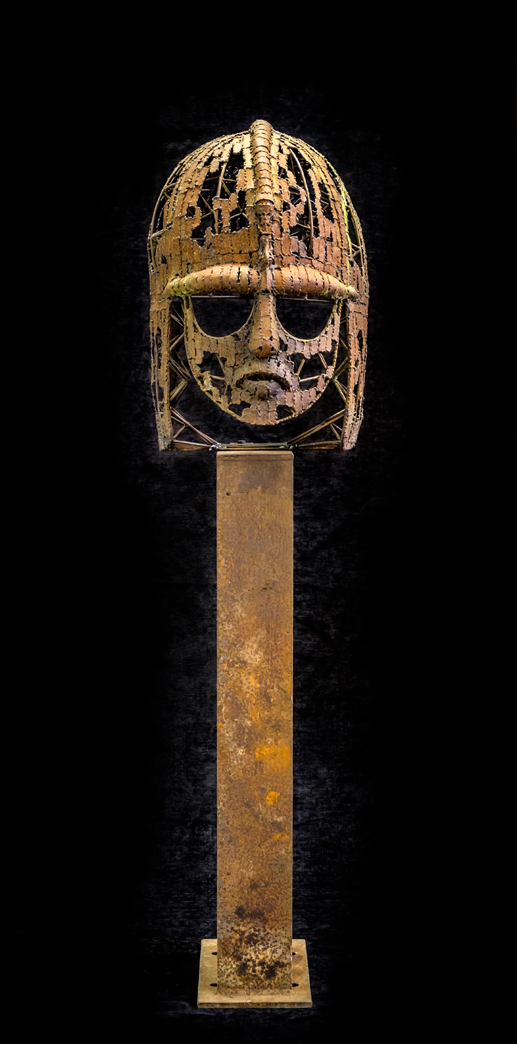
Because the excavated object is dark, corroded and visibly reconstructed, its familiar bright, golden public image is very largely the product of replicas, not of the artifact itself. The Royal Armouries produced a full-scale working replica in the early 1970s, its decorated panels gilded and polished to approximate the helmet's original, unweathered appearance; on 15 September 1973 Rupert Bruce-Mitford wore this replica in public and recited lines from Beowulf, an event that did much to fix the now-standard bright image of the helmet in popular imagination even though it shows the replica, not the excavated object. Both the excavated, reconstructed original and the Royal Armouries replica are held by the British Museum and have at times been displayed together. Separately, sculptor Rick Kirby was commissioned by the National Trust to make a monumental abstract steel sculpture evoking the helmet's fragmented, corroded appearance; unveiled on 13 March 2002 by Seamus Heaney and standing 1.8 metres high, it is a modern artwork, not a replica or a scale reproduction, and was relocated to the entrance of the Sutton Hoo visitor site on 30 May 2019. None of these objects should be captioned or treated as the excavated helmet itself.
Chapter 14Basil Brown's recognition, corrected late
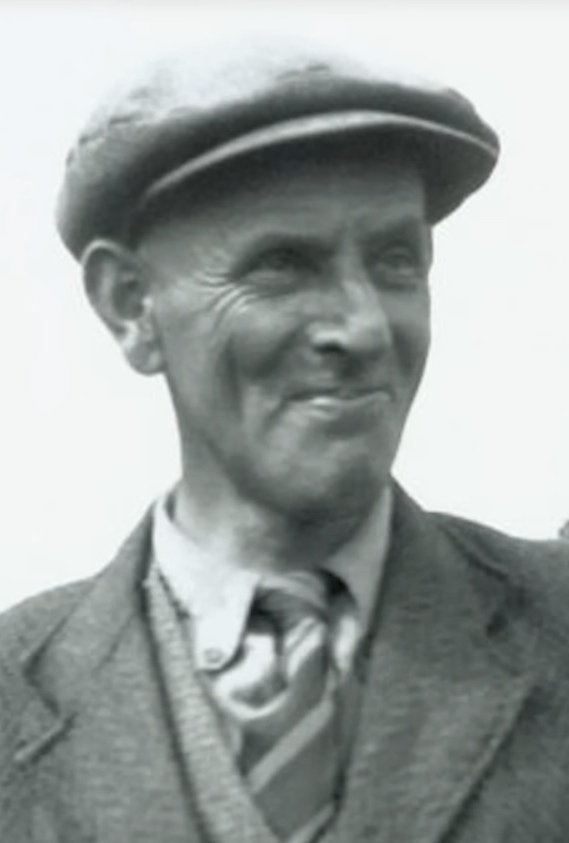
Brown was not excluded from the historical record entirely: Charles Phillips's first published account of the 1939 excavation, in the journal Antiquity in 1940, named him.
Brown was not excluded from the historical record entirely: Charles Phillips's first published account of the 1939 excavation, in the journal Antiquity in 1940, named him. But when the Sutton Hoo treasure was first shown to the wider public, at the Festival of Britain exhibition in 1951, Brown's name did not appear on the display, an omission that shaped decades of popular retelling in which the discovery was credited primarily to Phillips and the Office of Works team who took over the chamber excavation. Brown returned to work for Ipswich Museum after the war, continued fieldwork into the 1960s, and died in 1977 having received little wider public recognition in his lifetime beyond a Civil List pension of 250 pounds awarded in 1966.
Recognition has since been corrected, in stages, well after his death: a memorial plaque was placed at Rickinghall Inferior Church, near his home, in 2009; a small close was named Basil Brown Close in his home village; the Sutton Hoo Society established an annual Basil Brown Memorial Lecture; a blue plaque was unveiled at his former home in May 2023; and the British Museum's own current public-facing description credits him, in its own words, with making the discovery of a lifetime. The 2021 film The Dig, in which Brown was played by Ralph Fiennes, dramatised the historical marginalisation directly, ending on the fact that his name was omitted from the 1949 and 1951 public presentations of the find, and is widely credited with prompting the most recent round of formal acknowledgement.
The artist
Unknown royal workshop or itinerant smith, early 7th-century Anglo-Saxon England, working in a design tradition shared with eastern Sweden and, on 2025 evidence, possibly Denmark
No name survives for the maker of this helmet, and none is likely to. What can be reconstructed is not a biography but a working method: a smith or workshop equipped with cast bronze dies, competent in iron raising, sheet-metal die-stamping, fire-gilding and garnet cloisonne work, operating inside a shared North Sea design vocabulary that also produced the helmets buried at Vendel and Valsgarde in Sweden and, on the evidence of a single stamp found in 2025, something closely related in Denmark. Identifying this workshop is therefore a comparative exercise in metalwork technique and design transmission, not archival research, and its findings are provisional in a way a documented signature would not be.
Related works
| Work | Relation | Where it is |
|---|---|---|
| Valsgarde 7 helmet Unknown Scandinavian workshop | Closest well-published comparandum; used directly by Rupert Bruce-Mitford and Nigel Williams in planning the 1970-71 reconstruction of Design 1 One of several helmets from the Vendel-period boat-grave cemeteries at Vendel and Valsgarde, Sweden, sharing the general iron-band construction and pressblech decoration technique. | Gustavianum, Uppsala University, Sweden |
| Tasinge patrice (mounted-warrior stamp) Unknown Scandinavian workshop | Bronze die found in Denmark in 2025 identified by curator Peter Pentz as a closer stylistic match to the helmet's Design 2 than any Swedish comparandum Found by metal-detectorist Jan Hjort on the island of Tasinge; the comparison is the basis for a proposed, still unproven, Danish origin for the helmet's design. | National Museum of Denmark, Copenhagen |
| Royal Armouries replica of the Sutton Hoo helmet Royal Armouries, London | Full-scale gilded working replica made in the early 1970s; worn publicly by Rupert Bruce-Mitford on 15 September 1973 A modern reproduction, not the excavated object; source of most of the helmet's familiar bright, golden popular image. | British Museum, London |
| Sutton Hoo Helmet (sculpture) Rick Kirby | Monumental abstract steel artwork evoking the helmet's fragmentary, corroded appearance, commissioned by the National Trust Unveiled 13 March 2002 by Seamus Heaney. A modern artwork, not a replica or scale reproduction; must not be captioned as or confused with the excavated helmet. | Sutton Hoo visitor site, Suffolk (relocated to site entrance 30 May 2019) |
| Benty Grange helmet Unknown Anglo-Saxon workshop | Separate Anglo-Saxon helmet find, from a different site and burial, notable for its boar-crest finial, a physical parallel to the Sutton Hoo helmet's boar-head eyebrow terminals and the Beowulf boar-helmet motif Not from Sutton Hoo. Found in Derbyshire; a separate object entirely. | Weston Park Museum, Sheffield |
| Staffordshire Hoard helmet fragments Unknown Anglo-Saxon workshop | Separate Anglo-Saxon helmet, known only from a large group of gilded fragments in the Staffordshire Hoard Not from Sutton Hoo. A distinct find, distinct site, distinct object. | Birmingham Museum and Art Gallery / Potteries Museum, Stoke-on-Trent |
Open questions
- Was the helmet made in England, Sweden or Denmark? The 2025 Tasinge stamp find is the strongest evidence yet for a Danish connection, but Peter Pentz, the curator who identified the match, has explicitly said it does not prove Danish manufacture.
- Who was actually buried in Mound 1? Raedwald is the best-supported candidate but the case is circumstantial; McClure and Collins describe the supporting evidence for naming any individual as almost non-existent.
- Is the Price and Mortimer reading of the eyebrow asymmetry as an intentional Woden allusion correct, or is the missing gold foil on the left eyebrow simply an unfinished or lost repair? The 2014 argument is peer-reviewed but not universally accepted.
- What did Design 3, known from only seven small ambiguous fragments, actually depict? It has never been confidently identified and may be an unrelated repair patch rather than part of the original decorative programme.
- Has any part of the 1971 reconstruction itself since been questioned by conservators or archaeologists working with modern imaging, given that no full third physical reconstruction has been attempted? The sources consulted describe ongoing analytical and digital study but no published reassessment naming specific errors in the Williams reconstruction.
Questions about this object
What is The Sutton Hoo Helmet?
The Sutton Hoo Helmet is an arms and armour, dated early 7th century AD, most likely c. 600-625. Medium: Iron cap and internal fittings; tinned copper-alloy (bronze) sheet decoration applied by the pressblech (die-stamping) process; cast copper-alloy gilt face and dragon fittings; gold; silver wire inlay; garnets in cloisonne cells with gold foil backing (except the left eye); originally lined with leather.
Who made The Sutton Hoo Helmet, and is the attribution settled?
The attribution to Unknown workshop, probable East Scandinavian (Swedish or Danish) manufacture or influence is recorded here as disputed. The helmet itself is undisputed as an object; what is disputed is where and by whom it was made, and who it was buried for. Its five stamped bronze designs are close enough to helmet plates from Vendel and Valsgarde in eastern Sweden that most twentieth-century scholarship treated it as either Swedish-made or made by a Scandinavian-trained smith working in England. In 2025 a bronze stamp (patrice) found by a metal detectorist on the Danish island of Tasinge was identified by Peter Pentz, curator at the National Museum of Denmark, as an even closer match to the helmet's rider motif than the Swedish material, raising the possibility of a Danish origin or shared craftsmen. Pentz has explicitly cautioned this is not proof and that a small portable stamp could have travelled. No maker's name or workshop mark survives. The identity of the person buried with the helmet is separately disputed: most historians favour Raedwald, king of the East Angles (died c. 624), but the case is circumstantial and no inscription names an occupant.
Where is The Sutton Hoo Helmet now?
British Museum, London, Room 41 (Sutton Hoo and Europe). Inventory number 1939,1010.93. Last confirmed 13 August 2026. Gift of Edith Pretty to the British Museum, 1939, following the treasure trove inquest of 14 August 1939.
What is still unknown about The Sutton Hoo Helmet?
Was the helmet made in England, Sweden or Denmark? The 2025 Tasinge stamp find is the strongest evidence yet for a Danish connection, but Peter Pentz, the curator who identified the match, has explicitly said it does not prove Danish manufacture.
Sources
- 1Wikipedia, 'Sutton Hoo helmet', for construction technique, materials, dimensions, weight, decoration designs and iconography. en.wikipedia.org/wiki/...
- 2Icon (Institute of Conservation), 'Digging deeper: Nigel Williams and Sutton Hoo', on the 1970-71 reconstruction process, timeline and method. icon.org.uk/resource/...
- 3National Trust, 'Archaeology history: Sutton Hoo', for the 1938-39 excavation, the 1939 handover from Basil Brown to Charles Phillips, and the 1965-1970 re-excavation campaign. nationaltrust.org.uk/visit/...
- 4Wikipedia, 'Raedwald of East Anglia', for the historical Raedwald, Bede's account, the attribution debate and named alternative candidates. en.wikipedia.org/wiki/...
- 5Wikipedia, 'Wuffingas', for the East Anglian royal dynasty's genealogical descent from Woden and the meaning of the dynastic name. en.wikipedia.org/wiki/...
- 6Wikipedia, 'Basil Brown', for full biographical detail, the 1939 dispute with Charles Phillips and the Office of Works, and posthumous recognition (Civil List pension, memorial plaque, blue plaque, Basil Brown Memorial Lecture). en.wikipedia.org/wiki/...
- 7East Anglian Daily Times, 'Sutton Hoo at 80: Did Basil Brown not get the credit he deserved?', on Brown's exclusion from excavating the burial chamber and his self-taught background. eadt.co.uk/news/...
- 8The Sutton Hoo Ship's Company (saxonship.org), 'The Sutton Hoo Inquest - Part 1', for the exact date (14 August 1939), location (Sutton village hall) and presiding coroner (L.H. Vulliamy) of the treasure trove inquest, and testimony given by Charles Phillips and Stuart Piggott. saxonship.org/the-basil-brown-diaries/...
- 9MovieMaker, 'The Dig: Did Basil Brown Really Not Get Credit for the Sutton Hoo Treasure?', for the 1951 Festival of Britain exhibition omitting Brown's name and the British Museum's current public credit line describing his find as 'the discovery of a lifetime.' moviemaker.com/the-dig-basil-brown-netflix-ralph-fiennes-...
- 10The Linda Hall Library, 'Basil Brown', for biographical background and career details. lindahall.org/about/...
- 11Medievalists.net, 'Medieval Stamp Found in Denmark Could Reveal Where Sutton Hoo Helmet Was Made', 24 July 2026, for the 2025 Tasinge patrice find, curator Peter Pentz's comparative analysis, and his stated caveats. medievalists.net/2026/...
- 12Smithsonian Magazine, 'Britain's Famous Sutton Hoo Helmet May Have Come From Denmark, Not Sweden, New Discovery Suggests', for finder Jan Hjort, the Tasinge findspot and additional detail on the 2025 discovery. smithsonianmag.com/smart-news/...
- 13Neil Price and Paul Mortimer, 'An Eye for Odin? Divine Role-Playing in the Age of Sutton Hoo', European Journal of Archaeology 17(3), 2014, for the argued reading of the helmet's eyebrow asymmetry as an intentional allusion to the one-eyed god Woden/Odin. cambridge.org/core/...
- 14Wikipedia, 'Sutton Hoo Helmet (sculpture)', for Rick Kirby's 2002 steel sculpture at the Sutton Hoo visitor site: commission, unveiling date, sculptor, dimensions, and its explicit status as a modern artwork distinct from the excavated helmet. en.wikipedia.org/wiki/...
- 15British Museum, 'Sri Lanka to Suffolk: Sutton Hoo and the Silk Roads', for the Sri Lankan/Indian sourcing of garnets used across the Sutton Hoo burial assemblage. britishmuseum.org/exhibitions/...
- 16Wikipedia, 'Sutton Hoo', for the broader excavation history, treasure trove inquest outcome, Edith Pretty's donation, the 1965-1970 and 1983-1993 (Martin Carver) re-excavation campaigns, and the discovery of adjacent mounds and burials. en.wikipedia.org/wiki/...
Last verified · Published
Change log
13 August 2026 - Record created at the house standard: researched narrative, technical evidence, maker dossier, graded provenance chain, prices with hammer and premium separated, related works, open questions and sources.