Sophie Taeuber-Arp
1889-1943
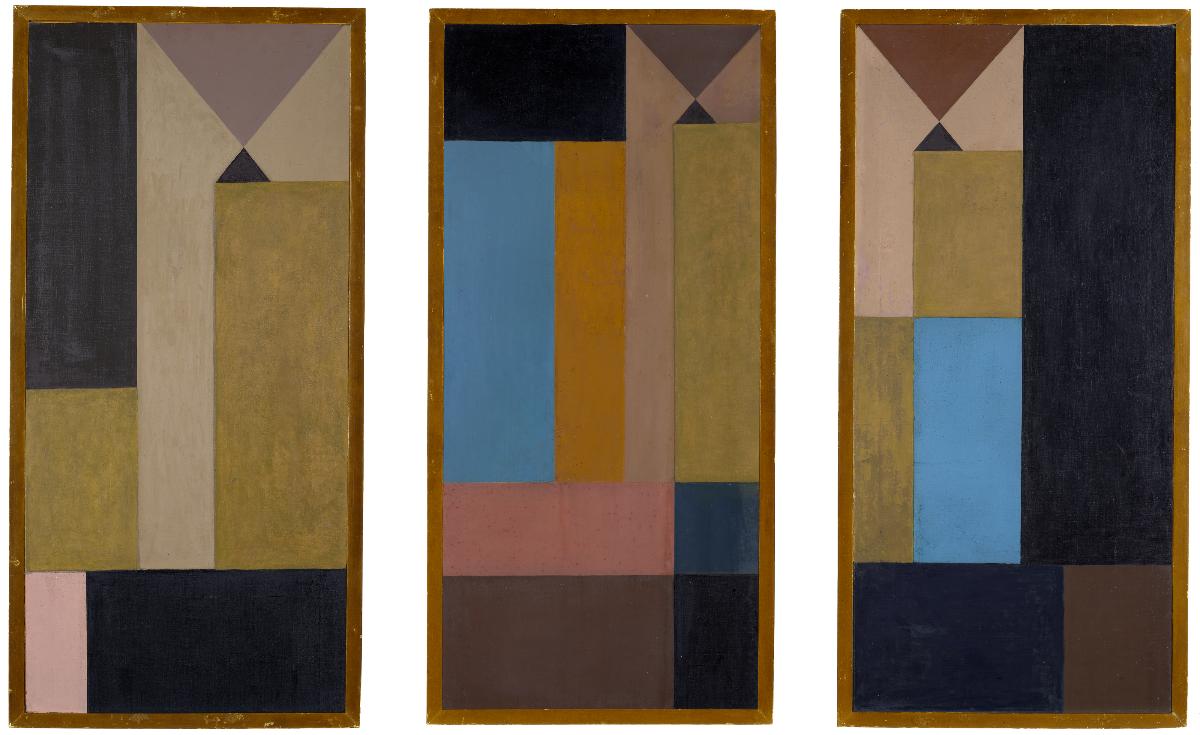
Triptych: Vertical-Horizontal Composition with Reciprocal Triangles, 1918 Three tall panels of coloured rectangles and triangles in muted blues, ochres and blacks, from 1918, once perhaps a folding screen (Basel). Kunsthaus Zurich inventory 1958-0023 a-c per Commons. Gabriele Mahn reads the palette as recalling religious painting. No verified portrait. No securely identified likeness of this maker is available under a free licence. We do not publish a face we cannot verify.
Kunsthaus Zurich (public domain, via Wikimedia Commons)| Full name | Sophie Henriette Gertrud Taeuber-Arp (born Taeuber) |
|---|---|
| Worked as | Painter, Textile designer, Puppet maker, Architect and interior designer |
| Born | 19 January 1889 · Davos, Switzerland |
| Died | 13 January 1943 (the night of 12 to 13 January per one... · Zurich, Switzerland |
| Nationality | Swiss (born with a German father, later also French by naturalisation) |
| Movement | Zurich Dada |
| Sources | 20 cited |
| Last verified |
About this page Last verified · 20 sources cited
On this page 13 sections
ContentsClose
Sophie Taeuber-Arp left a body of work that nobody has finished counting. The only printed catalogue raisonne, published in 1948 with a classification by Hugo Weber, covers around 500 works. The online database that grew out of it, run by the Sophie Taeuber-Arp research project, records 1,025 objects. A new catalogue raisonne at SIK-ISEA in Zurich, planned for 2025 to 2029, expects at least 1,200. Those are the three published figures, and they are the nearest thing to an accepted corpus that exists. No source read gives a count of works formally accepted or rejected.
The thing a reader probably doesn't know is how much of her output was never a painting at all. For her first decade as an artist she lived on beaded bags, cushions, rugs, embroideries and turned wooden boxes, and taught textile design at the Zurich trade school for twelve years. The 1948 catalogue under-represents that applied work, and the Kunstmuseum Basel says so in its own exhibition text. Her abstraction came out of the grid of embroidery canvas, and her best-known room, the Aubette in Strasbourg, was an interior commission that was covered over again from 1938.
For a buyer the sharpest fact is authorship. Her husband Hans Arp exhibited more than ten wood sculptures under his own name at Basel in 1932, and the research project calls the exact authorship of those sculptures unclear. After her death he executed reliefs from her designs, and Sotheby's offered one in London in 2023 described as conceived by her and made by him, signed Arp. Authentication sits with two foundations, not one, and the Fondation Arp keeps its examination fee even when a work is rejected.
Images
Chronology
- 1889
Born in Davos on 19 January, the youngest child of a Prussian pharmacist and a Swiss mother.12
- 1907-1910
Trains in textiles at the school of the Industrie- und Gewerbemuseum in St. Gallen.2
- 1910-1914
Studies at the Debschitz school in Munich with a stay in Hamburg (a semester per Basel, a year per the research project) and takes her diploma in summer 1914.12
- 1915
Meets Hans Arp at a Galerie Tanner show; makes her first dated Vertical-Horizontal Compositions in coloured pencil.12
- 1916
Begins teaching textile design and embroidery at the Zurich trade school, a post she holds until 1929, and joins the Swiss Werkbund.12
- 1917
Dances a solo at the opening of the Galerie Dada in Zurich.12
- 1918
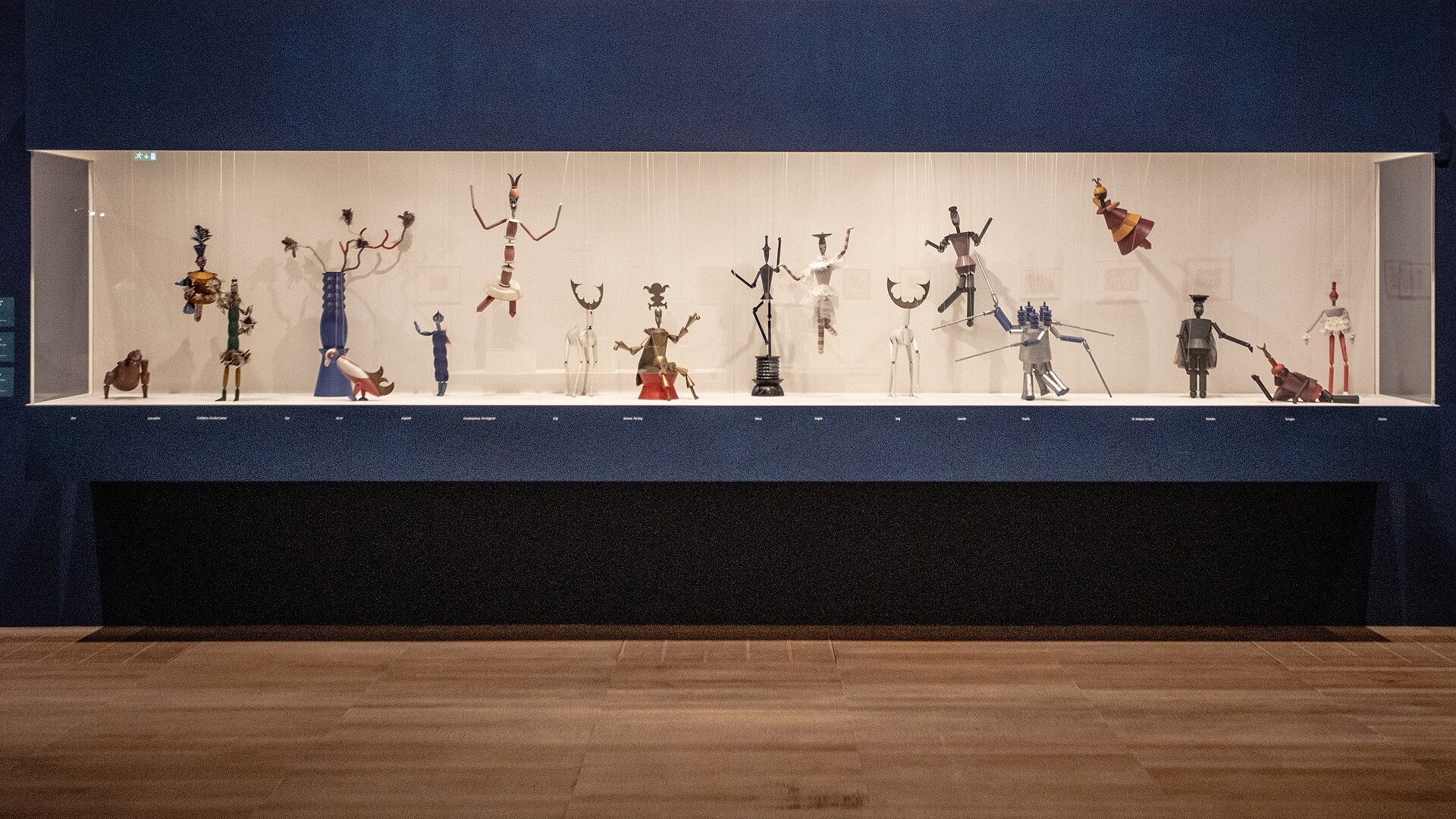
Designs the marionettes and sets for King Stag at the Swiss Marionette Theatre; performed no more than three times.19
- 1918-1920
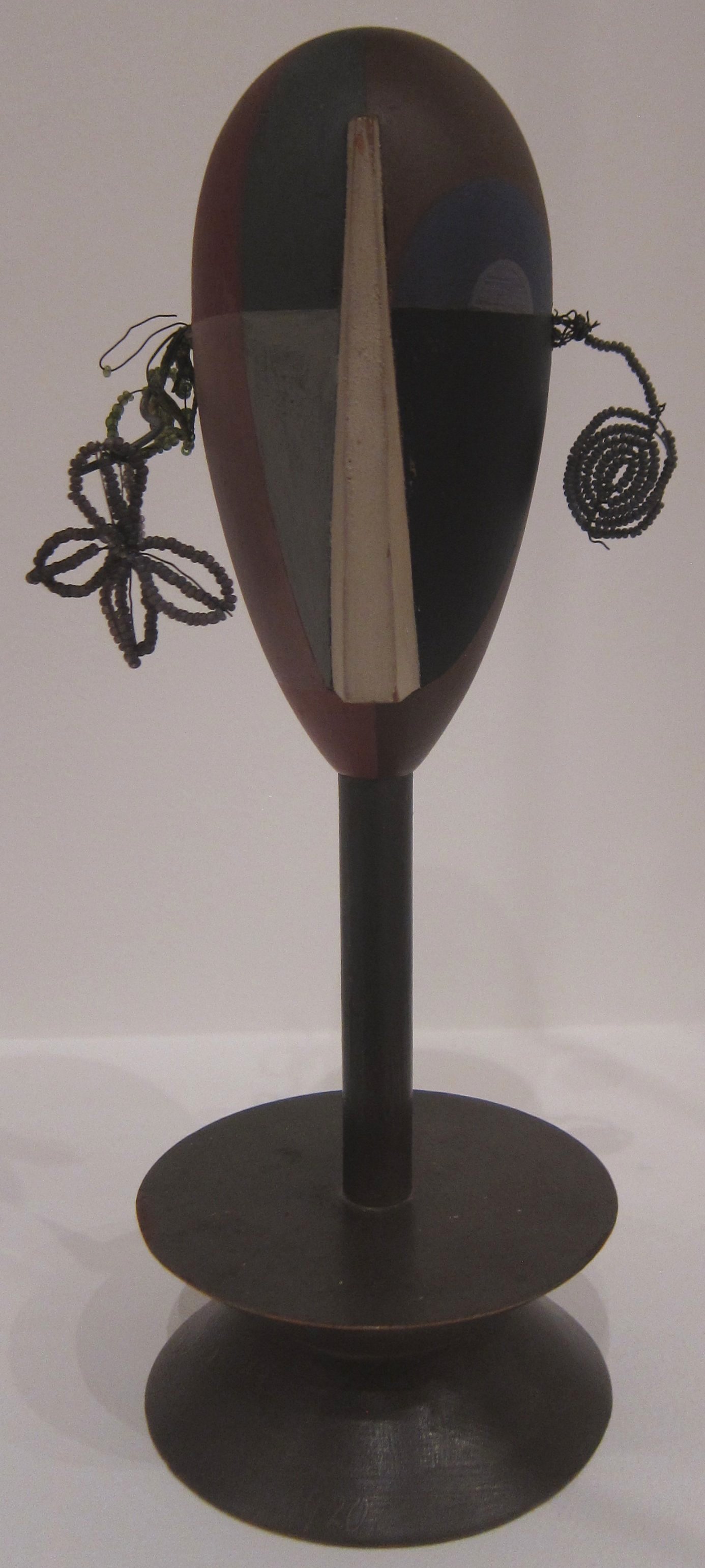
Makes the turned-wood Dada heads; the Basel museum says at least six were made and four survive, the research project says about eight.12
- 1922
- 1925
Serves on the jury for the Swiss section of the Paris decorative arts exposition and shows tapestries.12
- 1926-1928
Works in Strasbourg on Hotel Hannong and the Aubette; the Aubette is inaugurated on 16 February 1928.113
- 1929
Resigns her Zurich teaching post and moves to Clamart, where she plans a limestone studio house paid for with the Aubette proceeds.19
- 1931
Takes part in Abstraction-Creation from 1931; the Arps resign in 1934.12
- 1932
More than ten wood sculptures are exhibited under Arp's name at the Kunstmuseum Basel; the research project says the authorship is unclear.2
- 1937
Twenty-four of her works are shown at Konstruktivisten, Kunsthalle Basel, the largest showing in her lifetime; she begins editing Plastique.19
- 1938
The entire Aubette decoration is covered up from this year.13
- 1940
The Arps flee Paris and settle in Grasse by September.1
- 1943
Dies in Zurich in January of carbon monoxide poisoning at Max Bill's house; buried at Hoengg.12
- 1948
The only printed catalogue raisonne appears, covering around 500 works, with Hugo Weber's classification.3
- 1959-1968
Arp marries Marguerite Hagenbach in 1959; she gives much of her collection, including Animated Circle Picture, to the Kunstmuseum Basel in 1968.1
- 2003
The 1920 Dada head makes USD 1.41m at Calmels Cohen, Paris, then the record.14
- 2021
Living Abstraction opens at Kunstmuseum Basel with MoMA and Tate Modern.111
- 2025
Christie's Paris sets a new record on 8 April; SIK-ISEA starts its catalogue raisonne project for 2025 to 2029.414
The market
Her auction record is USD 3.34m (EUR 3.06m) for a painted wood relief at Christie's Paris on 8 April 2025, reported by HENI as including fees and as 125 per cent above the previous record, which was the 1920 Dada head at USD 1.41m in 2003. HENI's own text says 125 per cent while its table says 137 per cent; the figures of USD 1.93m on USD 1.41m support the larger number. No source read gives a hammer figure for any lot, so every row records the hammer as unpublished.
Two other price points are estimates only: Sotheby's London March 2023 lot 23, an Arp-executed relief after her design, estimated GBP 140,000 to GBP 180,000; Sotheby's Paris 2012 lot 19, a gouache, estimated EUR 20,000 to EUR 30,000. An aggregator reported results for some lots but its pages were not opened, so no result is entered from it. What moves the price is category: a relief she made, a Dada-period object, a painting, a gouache or a posthumous relief executed by Arp. These are different markets under one name.
| Date | Sale | Work | Result | Note |
|---|---|---|---|---|
| 8 April 2025 | Christie's Paris | Relief rond en quatre hauteurs, elements courbes, coupant(s), cassant(s), painted wood, 60 cm diameter; dated 1936 by HENI and the Art Newspaper, 1937 by Antiques and Art Ireland | Hammer not published in the sources read With premium USD 3.34m / EUR 3.06m is a fees-included figure per HENI; the Art Newspaper (French edition) gives about EUR 3m and does not say whether fees are included USD and EUR | Estimate EUR 1.9m to EUR 2.5m (Art Newspaper, Antiques and Art Ireland); HENI gives a low estimate of USD 2.06m. Backed by a guarantee per HENI. Provenance: Michel Seuphor, from the studio; Lise and Roland Funck-Brentano from 1987 per Antiques and Art Ireland. Sale of 41 works totalled USD 7.05m (HENI). |
| 12 June 2003 | Calmels Cohen, Paris | Dada head, 1920 | Hammer not published in the sources read With premium USD 1.41m as reported by HENI, whose stated method is that its results include buyer fees and premiums; Antiques and Art Ireland gives EUR 1.2m with no fee treatment stated USD (HENI) and EUR (trade article) | The record until April 2025. The sale itself was not opened. |
Hammer is the price at which the bidding stopped; with premium adds the fee the house charges the buyer on top. Hammer price and buyer's premium in the glossary.
Recorded without a public price
- 16 March 2023 · Composition verticale-horizontale, lot 23, oil on wood relief 65 x 75 cm, conceived 1927-28 by Taeuber-Arp and executed by Jean Arp between 1943 and 1956 · Sotheby's London, (Women) Artists · not published; the page shows a log-in wall for the result Estimate GBP 140,000 to GBP 180,000. Provenance: private collection, Caracas, acquired from Arp about 1956; then BFAS Blondeau, Geneva. Stamped S H Taeuber-Arp, label signed Arp. Result not seen.
- 2012 · Composition, gouache on paper, 35.1 x 25.9 cm, lot 19 · Sotheby's Paris · not published; the page shows a log-in wall for the result Estimate EUR 20,000 to EUR 30,000. Provenance Ruth Tillard-Arp, acquired by the owner's family 1990-91. Sale date was not on the page read; the link points to sale PF1206.
Where to see the work
| Institution | City | Holdings | Note |
|---|---|---|---|
| Kunstmuseum Basel | Basel | Marguerite Hagenbach-Arp's 1968 gift includes the large painting Animated Circle Picture; the museum organised the 2021 Living Abstraction retrospective. | Confirm current display with the museum. |
| Kunsthaus Zurich | Zurich | The Triptych of about 1918 (inventory 1958-0023 a-c) and the 1939 painting Zwoelf Raeume, both per Commons file descriptions. | The Triptych's panels may originally have formed a folding screen (Basel). |
| Aubette 1928 (Strasbourg museums) | Strasbourg | The Aubette interiors, covered up from 1938 and listed as a historic monument in 1985 and 1989; two construction sites there were completed in 1994 and 2006. | Open Wednesday to Saturday afternoons with free admission on the museum page read; confirm before travelling. |
| Musee d'art moderne et contemporain (MAMCS) | Strasbourg | Aubette designs and objects, per the Commons category for her works there. | Holdings are known from a Commons category listing only. |
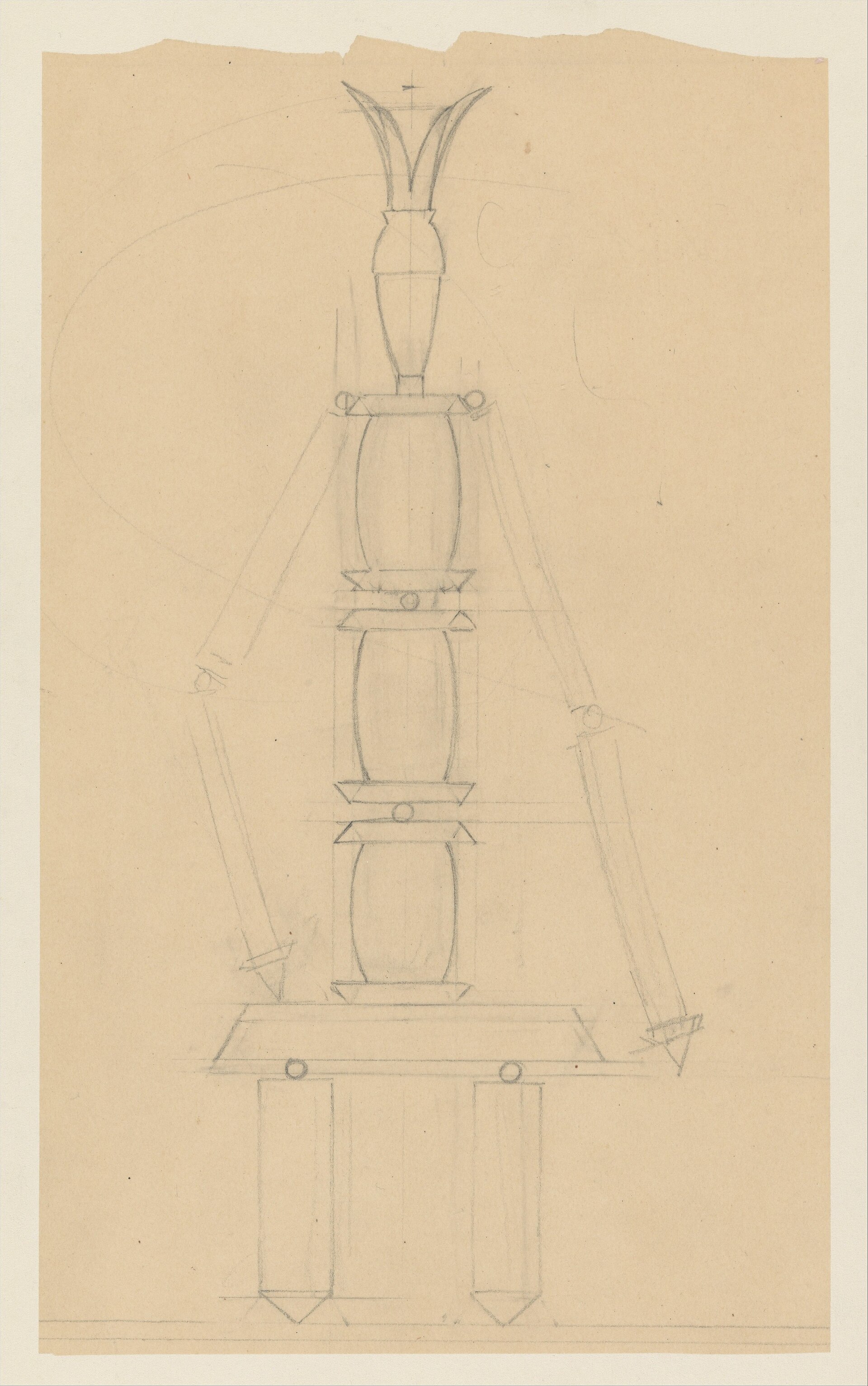
| Metropolitan Museum of Art | New York | Study for a Marionette (1918, 2007.49.91) and a 1920 Dada head, per Commons file descriptions. | Display status not checked. |
| Museum Arp (Bahnhof Rolandseck) | Remagen | A joint museum for Arp and Taeuber-Arp opened in 2007 per Wikipedia. | Tertiary source; holdings not checked. |
| Stiftung Arp e.V. | Berlin | Archive and library, plus drawings by her such as a c. 1936 design for a relief. | Research use is by arrangement. |
| Muzeum Sztuki | Lodz | Composition, 1931, oil and distemper on canvas, 55 x 46 cm, per a Commons description. | Commons description only. |
Forgeries and misattributions
- No documented forgery found; the live risks are shared authorship and posthumous execution
- The Basel show of 1932 put more than ten wood sculptures under Arp's name and the research project calls their exact authorship unclear. Arp claimed one Duo-Collage alone. After 1943 he executed reliefs from her designs; a Sotheby's lot sold as conceived by her and executed by him between 1943 and 1956 carries her stamp and his signed label and was exhibited in 1988-89 under a different title and date. By catalogue text, not by science: the 2023 Sotheby's entry says so openly, and the research project names the confusion in its biography. Authentication is by the Fondation Arp and the Stiftung Arp.21868
- A catalogue baseline that under-counts applied art
- The 1948 catalogue omitted some turned powder boxes and under-represents her applied art; an object absent from it is not thereby doubtful, and one present in it may be dated only by Weber's later estimate. Basel's exhibition text identifies the gap; the database page says datings are largely posthumous.13
- A posthumous bronze cast beside the original turned-wood sculpture
- After her death Arp gave the original 1937 turned-wood Sculpture en bois tourne to the Yale University Art Gallery and had a bronze cast made for himself, per the research project. A cast exists beside the original and carries a separate status for any buyer. Documented in the research biography; not a forgery.2
The essay
Chapter 1Three counts and no verdict on any of them
The 1948 catalogue is the only printed catalogue raisonne.
The 1948 catalogue is the only printed catalogue raisonne. The research project's own page calls it that, says it covers around 500 works, and says the online database is built on Hugo Weber's 'Catalogue de l'oeuvre de Sophie Taeuber', with his classification system developed after her death. The same page says she dated her works only occasionally, that most of the dates were supplied after her death by Weber, and that reliable dating of many works remains problematic.
The database page claims to contain all the works known to art-historical researchers and counts 1,025 objects. It adds that the data are checked with care and that errors can't be ruled out, and it gives all information without guarantee. That is a research tool, not a ruling. The SIK-ISEA project that will replace it is described by the institute as addressing every field of her output on an equal footing, textiles, furniture, home accessories, theatre puppets, architecture and interior design included, and estimates at least 1,200 works. The Kunstmuseum Basel adds a warning about the old baseline: when the 1948 book appeared many of her works could no longer be located, and her applied art, which the museum calls a sizable part of her output, is under-represented in it.
The practical result is that nobody can say how many of her works exist or how many have been accepted. The four known turned and painted wooden receptacles from about 1918, of which the powder box is one, are among the objects the Basel text says are not mentioned in the 1948 catalogue at all.
Chapter 2A weaver's grid before it was a painter's grid
She was born in Davos on 19 January 1889, the youngest child of a pharmacist from Prussia who died when she was small, and she grew up in Trogen where her mother ran a boarding house and taught the...
She was born in Davos on 19 January 1889, the youngest child of a pharmacist from Prussia who died when she was small, and she grew up in Trogen where her mother ran a boarding house and taught the children crafts. She trained in textiles at the St. Gallen school of the Industrie- und Gewerbemuseum from about 1907 to 1910 and then at the Debschitz school in Munich, with a semester at the applied arts school in Hamburg, graduating in 1914. The Basel museum describes Debschitz as a reform school where women and men studied together and where applied and fine arts were treated as allied.
What this gave her was a method. The Museum of Modern Art's exhibition text says she developed a formal vocabulary from the grid structure of the open-weave canvas used in embroidery and carried it to other supports. The Tate's guide says the same in its own words: she drew directly on the grid structures of textiles. The research project's biographer, Gabriele Mahn, writes that her whole output rests on the criss-cross of warp and weft. This is documented in her working practice: she wrote to her sister in 1922 that she had made a whole series of small watercolours she could easily rework into beaded bags, cushions, carpets and wall coverings, and the MoMA text describes the resulting collage-like migration of motifs from one object to another.
The standard account puts her next to Arp. The record shows her abstract grid drawings, the Vertical-Horizontal Compositions, dated 1915 to 1917 and made before or at the start of their acquaintance. Mahn reports that Arp was enthralled with them and made her aware of their importance, and quotes the critic Michel Seuphor comparing their art-historical weight to contemporary abstractions by Mondrian and Malevich. Mahn also records the art historian Willy Rotzler calling her a key figure and perhaps the actual initiator of Swiss Concrete Art. Those are named opinions, offered as such.
Chapter 3Zurich: Laban, the Dada evenings and a puppet play that ran three nights
She settled in Zurich in 1914 and met Hans Arp at a Galerie Tanner exhibition in 1915, in November according to the research project.
She settled in Zurich in 1914 and met Hans Arp at a Galerie Tanner exhibition in 1915, in November according to the research project. The Basel museum and the research project agree on the rest of her entry into Dada. She studied expressive dance with Rudolf von Laban and Mary Wigman in Zurich and Ascona, which the project says involved her in the first steps towards Laban choreographic notation, and in 1917 she danced a solo at the opening of the Galerie Dada that Hugo Ball wrote about. The Basel text adds that she translated a sound poem by Ball into dance and attended a summer course at Monte Verita near Ascona.
In 1918 the director of her school commissioned her to design the marionettes for the Swiss Marionette Theatre's production of King Stag, Rene Morax's adaptation of Gozzi's Il Re Cervo, which turned the old play into a parody of psychoanalysis with characters named Freudanalyticus and Dr. Oedipus Complex. The figures were turned on a lathe rather than carved, built of geometric elements, and left the bolts joining the limbs visible. By her own later recollection, quoted by Basel, they were widely panned as far too modern and too outre. The show ran no more than three performances, in part because of the Spanish flu, and the figures were celebrated at once by avant-garde circles. Arp and El Lissitzky chose a picture of the Guards from the production to represent Dada in The Isms of Art in 1925.
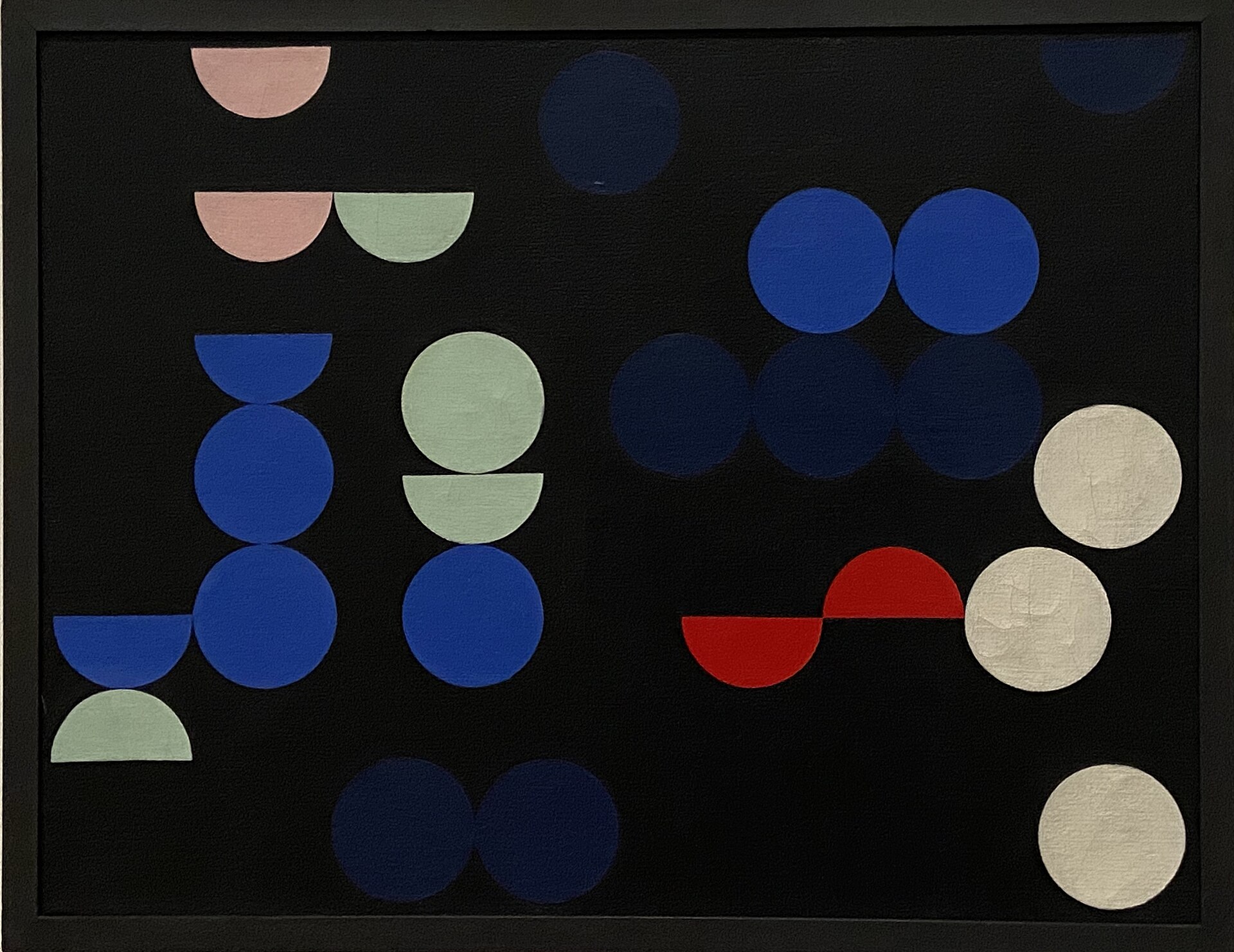
The programme in the work is documented in its content, not in a statement of belief. The play is a documented joke about Freud. The dance, Dada and Laban links are documented in her own movements and in Ball's notice. Mahn goes further and argues that the three-panel Triptych of 1918, with a palette that recalls religious painting and recurring triangles, acts as an affirmation of the spiritual side of Dada. That is Mahn's reading, in the research project's biography, and no source read shows what Taeuber-Arp herself said about it. The Basel museum offers a second argued reading of her later circles and curves: the sense of inward motion may recall the bodily experience of dance and choreography. It poses this as a question, and so does this page.
Chapter 4The heads, the boxes and who turned the wood
The Dada heads are the objects most likely to be quoted at a collector.
The Dada heads are the objects most likely to be quoted at a collector. The Basel text says the portrait of H[ans] A[rp] of 1918 is one of at least six such heads made between 1918 and 1920, four of which survive. The research project's biography says she made about eight. The two figures are close but not the same and no source read settles which is right. The MoMA text says she exhibited three works as 'studies for marionettes' soon after King Stag and thinks it likely these were the turned-wood heads, which would tie the heads to the puppets. The last head, the Tete dada of 1920, is described by Mahn as having a manifesto-like quality at the close of Zurich Dada.
Who physically made them is the question the market skips. Basel says of the turned wooden receptacles, the powder box among them, that she had no workshop of her own and probably had them made to her designs and then painted them by hand. Its room text also calls her a skilled woodworker who designed turned vessels and a series of abstract heads, and no source read says who turned the heads themselves. Mahn writes of the sculptures of the late 1920s in the same terms: she produced design drawings which were executed by craftsmen, and not all of her projects were realised. A buyer is therefore looking at an authorship that is design plus hand-painting for the receptacles, and the same question hangs over the heads without a source that answers it.
Chapter 5Arp's name on her work, and her design under his hand
The research project is direct about this.
The research project is direct about this. Of the five large Duo-Collages that she and Arp made together in the Zurich years, Mahn writes that Arp claimed authorship of one for himself alone, and that Arp liked to give the impression that he had discovered geometry as a fundamental element on his own account, though her grid work predates their meeting. Mahn names this as one source of the confusion over authorship. In 1932, according to the same biography, more than ten sculptures were exhibited under Arp's name at the Kunstmuseum Basel while the exact authorship of these wood sculptures is unclear. At the end of the 1920s the couple had made some wood sculptures collaboratively. The same page's footnote records that the 1931 Un grand et deux petits, always referred to as a duo work, had Taeuber-Arp's authorship withdrawn around 2010 without explanation, and the footnote places the 1932 show at the Kunsthalle Basel, where the text says Kunstmuseum Basel.
After her death the problem continued as a market category. The Sotheby's lot page for lot 23 in the March 2023 (Women) Artists sale in London, estimated at GBP 140,000 to 180,000, describes Composition verticale-horizontale as conceived in 1927 to 1928 by Sophie Taeuber-Arp and executed in relief by Jean Arp between 1943 and 1956. It is oil on a wood relief mounted on board, stamped S H Taeuber-Arp, with a label signed Arp, and the 1988-89 exhibition catalogue that Sotheby's cites titles it Composition and dates it 1963. The Sotheby's page was read through a fetch tool and the result is behind a log-in, so what the work made is not known to this page.
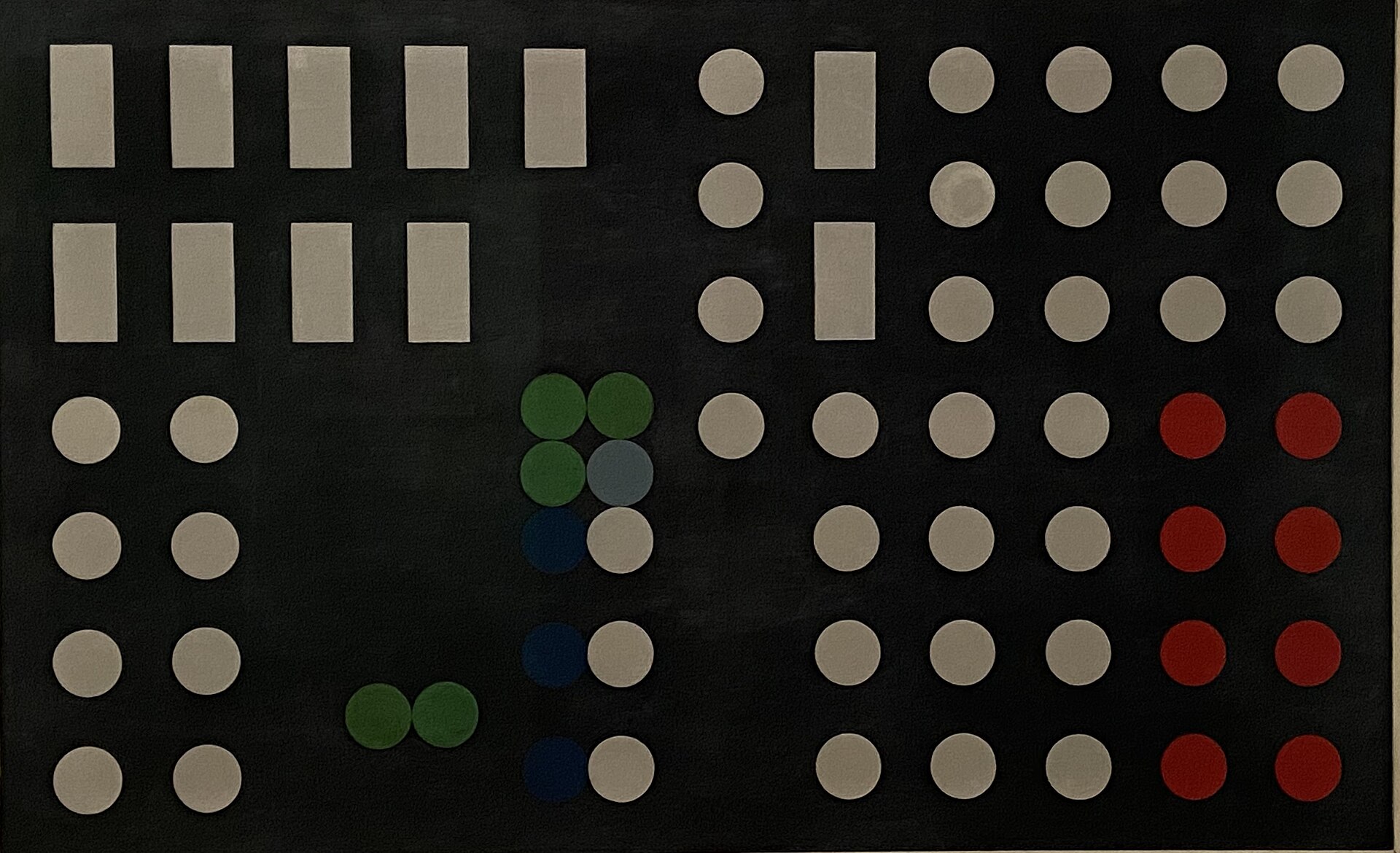
Arp's attitude to her work after 1943 is mixed in the evidence. Mahn writes that he treasured the 1937 turned-wood Sculpture en bois tourne so much that he gave the original to the Yale University Art Gallery and had a bronze cast made for himself. The Basel museum records that the Basel collector Marguerite Hagenbach, who bought the large painting Animated Circle Picture straight from the 1937 Konstruktivisten show, became his second companion after Taeuber-Arp's death, married him in 1959 and in 1968 gave a considerable part of her collection to the Kunstmuseum Basel. The project that is writing the next catalogue is carried out with the Fondazione Marguerite Arp in Locarno-Solduno, the Fondation Arp at Clamart and the Stiftung Arp in Berlin.
Chapter 6The Aubette: a commission, a quarrel and a covered room
The Aubette was a leisure complex in a building in the centre of Strasbourg, run by the brothers Paul and Andre Horn, who according to Wikipedia commissioned the three artists in 1926.
The Aubette was a leisure complex in a building in the centre of Strasbourg, run by the brothers Paul and Andre Horn, who according to Wikipedia commissioned the three artists in 1926. The Strasbourg museums' page says the interiors were designed by the three artists Taeuber-Arp, Hans Jean Arp and Theo van Doesburg, covering stage sets, furniture and typography, and inaugurated on 16 February 1928. Her part is documented in the Basel text: she took the tearoom, the Aubette bar and the lobby bar herself and brought in Arp and Van Doesburg for other components.
The division of rooms is reported differently. The Wikipedia article on the building gives her the entrance hall, tearoom and two bars and gives Arp the basement, passage and billiard room. Mahn gives her the Five o'clock tearoom, the small Aubette bar, a billiard room on the upper floor and a large foyer, with the staircase, the stained-glass window and the entrance done jointly. The two cannot both be right about the billiard room, and no primary document for the allocation was read. On the working relationship Mahn is blunt: the commission was more than the Arps could manage alone, so they brought in Van Doesburg, who attempted to secure control of the project, an aim he partially achieved. Mahn nevertheless calls her contribution considerable.
The rooms were not loved. The Basel text says users never warmed to the innovative materials and clean lines, that the public expected sumptuous decoration, and that major alterations in the 1930s destroyed the whole. The Strasbourg museums' page says the entire decoration was covered up again from 1938. The cinema hall and staircase were listed as a historic monument in 1985 and the ballroom and foyer bar in 1989, and the museum page says two construction sites followed, completed in 1994 and 2006, without saying which rooms each covered. Critics came to call it the Sistine Chapel of modernism (Basel) or of abstract art (MoMA, and Wikipedia), a phrase the museum texts quote and do not endorse.
The money mattered more than the room. The Basel and MoMA texts agree that the Aubette proceeds let the Arps buy land at Clamart outside Paris, where she drew up the plans for a limestone studio house, and that she resigned her Zurich post. Mahn adds that she laid a geometric tiled floor in the arcade outside which she describes as reminiscent of Laban dance notation. That is Mahn's comparison, an argued resemblance and not a documented intention.
Chapter 7Clamart, furniture and the 1937 show that nobody photographed
From 1929 her business card, printed with her new address in Clamart, listed her as an interior architect and furniture designer, according to the Basel text, and the MoMA text says she took several...
From 1929 her business card, printed with her new address in Clamart, listed her as an interior architect and furniture designer, according to the Basel text, and the MoMA text says she took several commissions in Paris, Basel and Berlin from 1929 to 1935 and that commissions were increasingly rare by the late 1930s. Mahn gives the Paris apartment of Theodor and Woty Werner as one of them. She joined Cercle et Carre in 1929 and, in 1931, its successor Abstraction-Creation, and she and Arp resigned from it in 1934 over its rejection of all representation, according to Basel. She edited and laid out the trilingual magazine Plastique from 1937 to 1939, five issues.
The largest showing of her work in her lifetime was twenty-four works at the Konstruktivisten exhibition at the Kunsthalle Basel in 1937, and only one installation photograph is known to show a fragment of one of them, Animated Circle Picture, between contributions by Gabo, Lissitzky and Moholy-Nagy, per the Basel text. She said of the show, in the MoMA text's phrasing, that it attracted everyone with a triangle at the end of their brush. Her painting that Marguerite Hagenbach bought from it was the first in Hagenbach's collection.
In 1937 and 1938 she made the series of round wood reliefs, tondos built of layered strata with cut curved openings. The Basel museum says wood as a material goes back to her Zurich vessels and marionettes. Antiques and Art Ireland, writing before a 2025 Paris sale, says ten wooden reliefs by her are known and only three remain in private hands. That figure is from a trade article and was not independently checked.
Chapter 8War, flight and the stove
The Arps fled Paris a week before German troops arrived in June 1940, stayed briefly with Peggy Guggenheim at Veyrier and settled at Grasse in September.
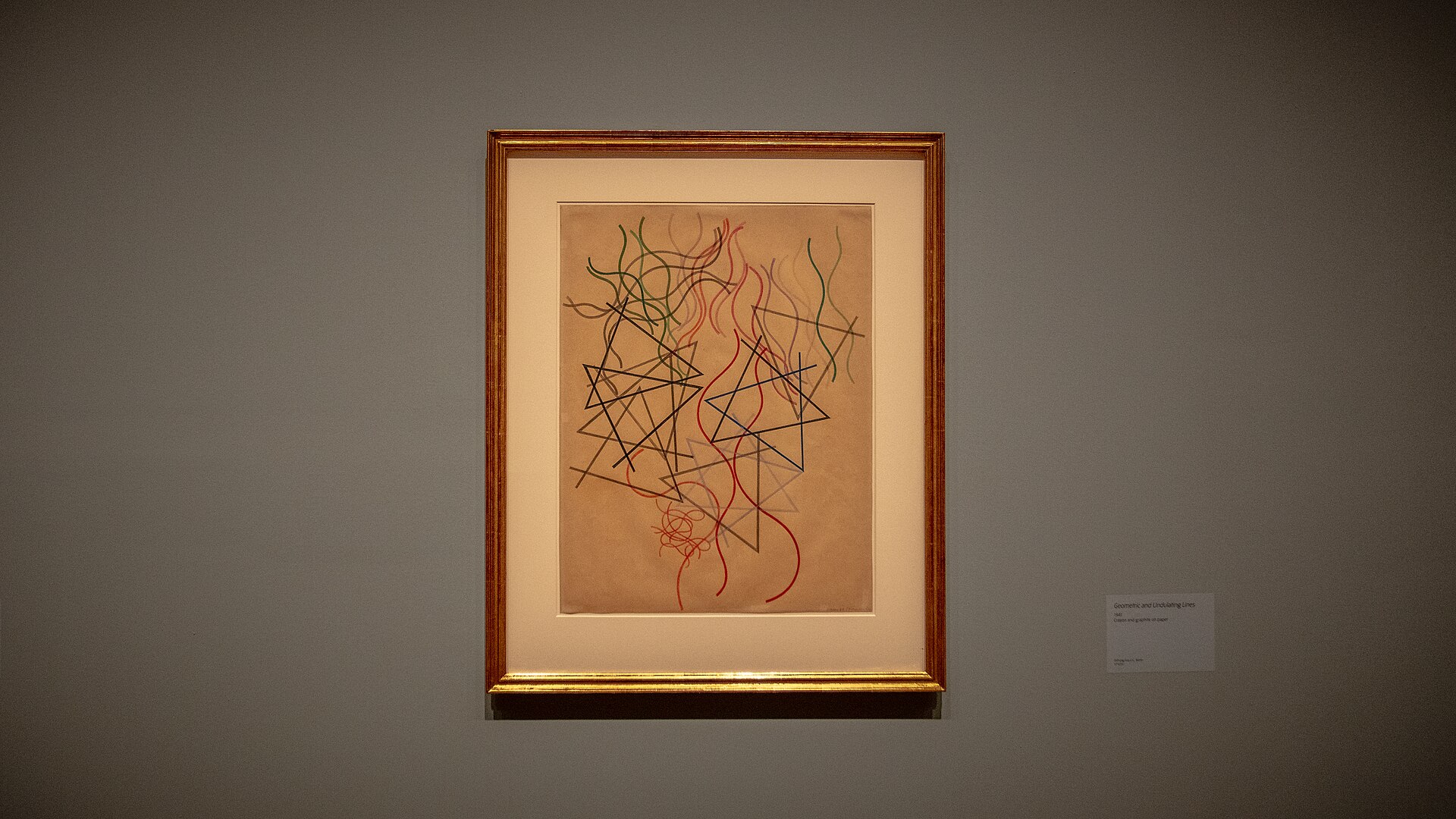
The Arps fled Paris a week before German troops arrived in June 1940, stayed briefly with Peggy Guggenheim at Veyrier and settled at Grasse in September. Supplies of paint were scarce and she turned to coloured pencil on paper, producing the tangled lines the Basel text calls the hallmark of her last drawings. In 1942 a US visa was granted and the couple decided not to leave Europe. A temporary Swiss visa took them to Zurich at the end of 1942, where she lived with her sister and Arp stayed with Max Bill.
The Basel museum's account is that on 13 January 1943 she decided to spend the night in Bill's guest bedroom, failed to notice that the flue of a wood-burning stove was blocked and died of carbon monoxide poisoning in her sleep, and was buried at Hoengg in Zurich on the eve of what would have been her fifty-fourth birthday. English Wikipedia places the death in a snow-covered summer house after a missed last tram and gives 14 January in its infobox. The research project's biography dates it to the night of 12 to 13 January and says the cause is generally imputed to carbon monoxide poisoning but the circumstances remain largely unexplained. Three sources read, three versions of the date (13 January, the night of 12 to 13 January, 14 January), a guest bedroom against a summer house where a room is named at all, one agreed cause. No inquest or police record was found.
Chapter 9How the reputation moved
The reputation followed Arp's for decades.
The reputation followed Arp's for decades. Wikipedia reports that she was largely overlooked after her death and cites her inclusion in documenta 1 in 1955, a 1981 MoMA retrospective that toured to Chicago, Houston and Montreal, the opening of a joint museum at Rolandseck station in Germany in 2007, her portrait on the Swiss 50-franc note from 1995 to 2016 and the 2021 Living Abstraction retrospective that went from Basel to Tate Modern and MoMA. The note and the 2021 show are confirmed by the Basel text; the 1955, 1981 and 2007 dates rest on Wikipedia alone and are labelled tertiary.
The scholarship that now carries her was an institutional effort across four bodies: a database of her work at the research project, a coming catalogue raisonne at SIK-ISEA with Walburga Krupp as external expert, the Fondation Arp's archives and the Stiftung Arp archive in Berlin. The Basel booklet names Krupp, with Anne Umland, among the MoMA partners in the 2021 exhibition.
Chapter 10Who rules on attribution today
There is no single authority. The Fondation Arp at Clamart examines works attributed to Jean Arp and to Sophie Taeuber, with its secretary general handling requests, a questionnaire with photographs...
There is no single authority. The Fondation Arp at Clamart examines works attributed to Jean Arp and to Sophie Taeuber, with its secretary general handling requests, a questionnaire with photographs, a research fee of EUR 800 per work and certificates of authenticity at EUR 1,500 to EUR 3,500 depending on material, issued only after the work is shown physically. The foundation's page states that the payment is retained even if the work is proven not to be by Arp or Taeuber. For the most complex cases it may consult the Comite Arp Taeuber, three independent art historians, Margit Rowell, Juan Manuel Bonet and Serge Fauchereau, for an added EUR 300 and only with the owner's agreement. The committee's opinion goes to the owner, who must disclose it when ownership transfers. The page does not say whether the committee's opinions are published.
The Stiftung Arp e.V., which has an archive and library in Berlin, separately says it welcomes questions about works by both artists and examines each registered work for authenticity, with a committee of experts consulted and 1 to 2 examination dates a year. It states it is under no obligation to document works. Neither page says how the two bodies resolve a disagreement, and the SIK-ISEA page, which names the foundations as partners, does not say who makes the final attribution decision.
Chapter 11What the market has paid
The market is small and its record was reset in April 2025.
The market is small and its record was reset in April 2025. At Christie's Paris on 8 April 2025 the round wood relief Relief rond en quatre hauteurs, elements courbes, coupant(s), cassant(s), dated 1936 by two sources and 1937 by a third, made USD 3.34m, which HENI gives as EUR 3.06m and says includes fees. The Art Newspaper's French edition gives about EUR 3m, with a pre-sale estimate of EUR 1.9m to EUR 2.5m, and says the work had never been offered at auction. It came from the collection of Lise and Roland Funck-Brentano, who received it in 1987 from Michel Seuphor, who had it directly from her studio according to a trade article. HENI says the work had changed hands five times, was backed by a guarantee and beat the previous record by USD 1.93m. The previous record was the 1920 Dada head, sold at Calmels Cohen in Paris on 12 June 2003 for USD 1.41m, which a trade article gives as EUR 1.2m.
No source read separates hammer from premium for any of her lots. The 2025 price is all-in per HENI. For the 2023 Sotheby's lot only the estimate was published on the page opened, and for a 2012 Sotheby's Paris gouache only the estimate of EUR 20,000 to EUR 30,000 was visible. Works on paper trade at the low end. A buyer should treat Arp-executed reliefs from her designs as a different category from reliefs she made, and should ask the Fondation Arp and the Stiftung Arp both.
What is documented
Technique
The surviving work
- What is accepted
- No count of formally accepted works is published. The 1948 catalogue covers around 500 works; the online database records 1,025 objects (research project, date of count not stated); the SIK-ISEA project expects at least 1,200.
- What is contested
- Authorship, not attribution, is what is contested: Arp exhibited more than ten wood sculptures under his name at Basel in 1932 whose exact authorship the research project calls unclear, and claimed one of five Duo-Collages for himself alone. Arp also executed reliefs from her designs after 1943. The research project's own notes record one withdrawal: the 1931 wood sculpture Un grand et deux petits, long treated as a duo work with Arp, had her authorship withdrawn around 2010 without explanation. No source read gives a list of other works removed.
- Who rules on attribution
- No single authority. The Fondation Arp (Clamart) examines works attributed to Arp and Taeuber and may consult the Comite Arp Taeuber; the Stiftung Arp e.V. (Berlin) separately examines registered works; SIK-ISEA's catalogue project is partnered by both foundations and the Fondazione Marguerite Arp. How disagreements between them are settled is not stated in the pages read.
Catalogue raisonne
- Catalogue de l'oeuvre de Sophie Taeuber (1948), classification by Hugo Weber; described by the research project as the only printed catalogue raisonne. Around 500 works; most datings are Weber's, supplied posthumously; applied art under-represented; many works could already not be located.13
- Sophie Taeuber-Arp online oeuvre database (STARP), based on Weber's catalogue. 1,025 objects; all information without guarantee; not an authentication.3
- SIK-ISEA, Catalogues Raisonnes of Swiss Artists, volume 34, Sophie Taeuber-Arp (project 2025-2029). At least 1,200 works, every field on an equal footing, with Fondation Arp, Fondazione Marguerite Arp and Stiftung Arp as partners.4
Questions about Sophie Taeuber-Arp
Who was Sophie Taeuber-Arp?
Painter; Textile designer; Puppet maker; Architect and interior designer; Dancer; Sculptor; Teacher; Magazine editor. 1889-1943.
When did Sophie Taeuber-Arp live?
Born 19 January 1889, Davos, Switzerland; died 13 January 1943 (the night of 12 to 13 January per one source; one reference work gives 14 January), Zurich, Switzerland.
How are fakes and misattributions of Sophie Taeuber-Arp detected?
No documented forgery found; the live risks are shared authorship and posthumous execution. The Basel show of 1932 put more than ten wood sculptures under Arp's name and the research project calls their exact authorship unclear. Arp claimed one Duo-Collage alone.
Where can you see work by Sophie Taeuber-Arp?
Kunstmuseum Basel (Basel); Kunsthaus Zurich (Zurich); Aubette 1928 (Strasbourg museums) (Strasbourg); Musee d'art moderne et contemporain (MAMCS) (Strasbourg); Metropolitan Museum of Art (New York); Museum Arp (Bahnhof Rolandseck) (Remagen).
What does the market for Sophie Taeuber-Arp look like?
Her auction record is USD 3.34m (EUR 3.06m) for a painted wood relief at Christie's Paris on 8 April 2025, reported by HENI as including fees and as 125 per cent above the previous record, which was the 1920 Dada head at USD 1.41m in 2003. HENI's own text says 125 per cent while its table says 137 per cent; the figures of USD 1.93m on USD 1.41m support the larger number.
What is still unresolved about Sophie Taeuber-Arp?
How many works are accepted? The 1948 catalogue has around 500, the database 1,025 and SIK-ISEA expects at least 1,200; no source read gives a count of rejected works or a rule for acceptance.
Open questions
- How many works are accepted? The 1948 catalogue has around 500, the database 1,025 and SIK-ISEA expects at least 1,200; no source read gives a count of rejected works or a rule for acceptance.
- Who made the more than ten wood sculptures shown under Arp's name in Basel in 1932? The research project says the exact authorship is unclear; no document read resolves it.
- How do the Fondation Arp, the Stiftung Arp and the SIK-ISEA project resolve a disagreement over a work? None of their pages says who has the final word.
- Which of her Aubette rooms did she design alone? Wikipedia and the research project differ on the billiard room, and no contract or plan was read.
- What exactly happened on 12 to 13 January 1943? The sources differ on the date (13 or 14 January, or the night between), on the building (a guest bedroom in Bill's house or a summer house) and the research project calls the circumstances largely unexplained.
- How many Dada heads were made? At least six (Basel) or about eight (research project); the lost head illustrated in Merz in 1923 is one that can't be examined.
- What did the 2023 Sotheby's Arp-executed relief make, and what did a Fondation Arp certificate say about it? The result and the certificate were not published on the page read.
- What was her stated relation to any system of belief? Mahn reads the 1918 Triptych as affirming the spiritual side of Dada, but no letter or statement in the sources read shows her own position.
Sources
- 1Kunstmuseum Basel, 'Sophie Taeuber-Arp: Living Abstraction', exhibition booklet (English), 2021, with biography and room texts. kunstmuseumbasel.ch/en/...
- 2Gabriele Mahn, 'Sophie Taeuber-Arp biography (1889-1943)', Sophie Taeuber-Arp research project (STARP), sophietaeuberarp.org. sophietaeuberarp.org/english/...
- 3Sophie Taeuber-Arp research project, 'What will you find in this database?' (about the oeuvre database and the 1948 catalogue). sophietaeuberarp.org/english/...
- 4SIK-ISEA, Zurich, research project 'Sophie Taeuber-Arp' (catalogue raisonne 2025-2029). sik-isea.ch/en-us/...
- 5Stiftung Arp e.V., 'Sophie Taeuber-Arp. Catalogue Raisonne', project page. stiftungarp.de
- 6Fondation Arp, Clamart, 'Authentication of works'. fondationarp.org/en_authentification.html
- 7Fondation Arp, Clamart, 'Comite Arp Taeuber'. fondationarp.org/en_comite.html
- 8Stiftung Arp e.V., 'Foundation' page (documentation and authentication). stiftungarp.de/foundation
- 9Museum of Modern Art, New York, 'Sophie Taeuber-Arp: Living Abstraction', exhibition section texts (PDF), November 2021. press.moma.org/wp-content/...
- 10Tate Modern, Sophie Taeuber-Arp exhibition guide. tate.org.uk/whats-on/...
- 11Wikipedia, 'Sophie Taeuber-Arp' ( source; replace with museum or archival sources for the 1955, 1981 and 2007 items). en.wikipedia.org/wiki/...
- 12Wikipedia, 'Aubette (building)' ( source; Strasbourg museums' documents). en.wikipedia.org/wiki/...
- 13Strasbourg museums, 'Aubette 1928'. en.musees.strasbourg.eu/aubette-1928
- 14HENI News, 'Sophie Taeuber-Arp's Auction Record Soars 125% With $3.34m Sale', April 2025. heni.com/news/...
- 15HENI News, Christie's Collection Lise et Roland Funck-Brentano sale report, April 2025. heni.com/news/...
- 16The Art Newspaper (French edition), 'Sophie Taeuber-Arp atteint un nouveau sommet chez Christie's', 10 April 2025. artnewspaper.fr/2025/...
- 17Antiques and Art Ireland, pre-sale article on the Christie's Paris 8 April 2025 relief (trade press). antiquesandartireland.com
- 18Sotheby's, lot 23, Composition verticale-horizontale (after Sophie Taeuber-Arp, executed by Jean Arp), (Women) Artists, London, March 2023. sothebys.com/en/...
- 19Sotheby's, lot 19, Sophie Taeuber-Arp, Composition (gouache), Paris, sale PF1206. sothebys.com/en/...
- 20Wikimedia Commons, Category: Paintings by Sophie Taeuber-Arp (file licence tags and descriptions checked per file). commons.wikimedia.org/wiki/...
Last verified