Plautilla Nelli
 Florentine (Italian) · 1524-1588
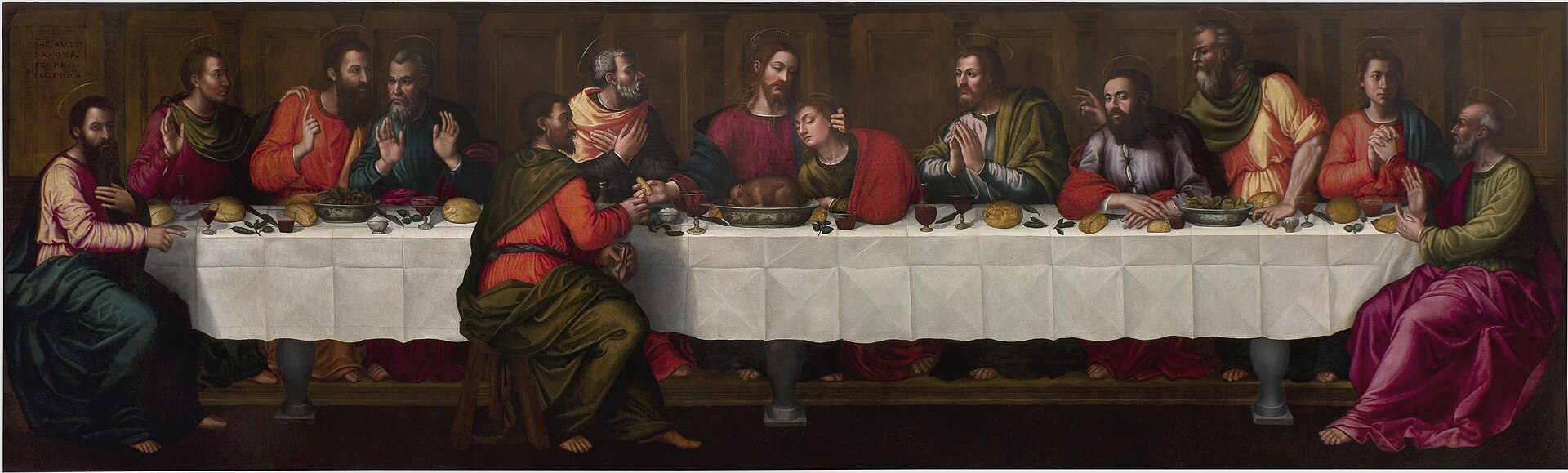
The Last Supper, restored 2019 Oil on canvas, about 200 x 700 cm per Commons, from the refectory of Santa Caterina in Cafaggio, now at Santa Maria Novella, Florence. The signature and the prayer for the painter are in the upper left corner; the date is disputed (1560s, c. 1568 or 1569). No verified portrait. No securely identified likeness of this maker is known under a free licence. We do not publish a face we cannot verify.
Santa Maria Novella museum collection; public domain via Wikimedia Commons (PD-Art)| Full name | Pulisena (Polissena) Margherita Nelli, in religion Suor Plautilla |
|---|---|
| Worked as | Painter, Draughtswoman, Miniaturist, Dominican nun |
| Born | Baptised 29 January 1524 per the Dizionario Biografico... · Florence, parish of San Felice in Piazza |
| Died | May 1588, per the chronicle of her convent as cited in the... · Florence, convent of Santa Caterina da Siena (Santa... |
| Nationality | Florentine (Italian) |
| Movement | Florentine Renaissance, the San Marco school (Fra Bartolommeo's tradition) |
| Sources | 16 cited |
| Last verified |
About this page Last verified · 16 sources cited
On this page 13 sections
ContentsClose
Plautilla Nelli is the earliest woman painter in Florence for whom a body of work survives, and the size of that body is still not settled. Three works form the secure core: the Lamentation now in the Museo di San Marco, the Pentecost in San Domenico at Perugia and the Last Supper now in the Museo di Santa Maria Novella (the Dizionario Biografico, a New York dealer's 2023 catalogue entry and the Italian Wikipedia all name these three; the Dizionario Biografico records a signature on the Pentecost and the Last Supper, and the dealer calls all three signed or documented). Advancing Women Artists, the foundation that restored her work, says three works were confirmed when it started in 2006 and that scholars have since taken the number to some seventeen; The Art Newspaper put it at around 20 in 2019. No board rules on her attribution, and nobody publishes an accepted list.
Three things the popular account gets wrong are checkable. She is often called the author of one signed work, but the Dizionario Biografico records the Pentecost as signed too. She is often called a pupil of Fra Paolino, but the same entry says his workshop had left Florence for Pistoia about 1526, two years after her birth, so he can't have taught her in any ordinary sense. And she is often described as nobly born; the entry gives her father as a haberdasher in the parish of San Felice and says the family does not seem to have been noble. The more useful correction is the workshop. Her convent produced and sold pictures on a scale a single hand can't explain, and the director of the foundation that paid for the Last Supper's 2019 restoration says different hands show inside its seven metres.
For a collector the market is thin and mostly invisible. The one public result found is a drawing at Christie's South Kensington on 9 July 2009, which realised GBP 5,625 against an estimate of GBP 5,000 to 7,000 (Christie's estimates exclude the buyer's premium and the lot page does not say whether the realised figure includes it, so the hammer may have been lower). Panels given to her or her workshop have since passed through a New York dealer (2023) and a Florentine auction house (March 2024), and no price for either was found. The Fra Bartolommeo drawings she kept were sold out of her convent in 1725 to 1727; 400 of those sheets are in Rotterdam.
Images
Chronology
- 1500
Santa Caterina da Siena in Cafaggio is founded on 30 September by Camilla Bartolini Rucellai, in religion Suor Lucia (student summary of the convent chronicles).13
- 1517
Fra Bartolommeo dies; Lorenzo di Credi inventories his workshop at 830 single drawings and twelve books of about 180 sheets.12
- 1524
Pulisena Margherita Nelli is baptised on 29 January, second child of the haberdasher Piero Nelli and Francesca Calandri (a dealer gives 24 January).18
- 1530
Her mother dies, probably of plague; her father remarries the same year.1
- 1538
She takes the veil, probably in December, as Plautilla, at Santa Caterina in Cafaggio.1
- 1547
Fra Paolino da Pistoia dies. Rotterdam records that he left Fra Bartolommeo's drawings to her; Muzzi says he had worked at Pistoia since about 1526 and could not have been her master.112
- about 1550
Date given by Garrard for the Lamentation; Muzzi judges it her earliest painting on style, with no document read.110
- 1555 or soon after
Pentecost for the Pontani altar at San Domenico, Perugia, signed S. Plautilla faciebat (a student's summary and the Commons file titles give 1554).113
- 1559
March payment that Turrill links to the Santa Lucia panel at Pistoia named by Vasari.1
- 1563 to 1565
First term as prioress; later terms 1571 to 1573 and 1583 to 1585 (the Dizionario Biografico). A student's summary gives 1571 to 1575 for the second.113
- 1566
Council of Trent decrees forbid the nuns to seek alms outside; the Uffizi text says sales of pictures became fundamental to the convent.7
- 1568
Vasari's second edition calls her 'now prioress' and praises her works within the Life of Properzia de' Rossi (the Dizionario Biografico's terms do not cover 1568).12
- 1575
The convent is enclosed (Garrard).10
- 1587
The nuns of San Domenico al Maglio commission a Madonna from the convent and pay more than for a similar Stiattoni (student summary; no figure found).13
- May 1588
Dies in the convent, per its chronicle.1
- 1596
Serafino Razzi's history of the Dominicans names her pupils and fellow painters.611
- 1725 to 1727
Niccolo Gabburri buys 400 sheets, 505 drawn sides, of Fra Bartolommeo's drawings from the convent; mounted in two albums in 1729.12
- 1817
The Last Supper is moved to Santa Maria Novella after the convent's suppression.34
- 1938
Giovanna Pierattini publishes a study of her in Memorie domenicane; the Uffizi drawing in her hand is identified.914
- 1939
The Last Supper is restored after decades in storage (Smithsonian, citing the 2019 monograph).5
- 1966
Flood of Florence damages the Last Supper by humidity (Guardian).3
- 1998
Jonathan Nelson convenes the first scholarly symposium on her (Apollo).6
- 2006
Advancing Women Artists restores its first Nelli, the Lamentation.315
- 2008
Nelson's The Painter-Prioress of Renaissance Florence includes Turrill Lupi's list of attributed paintings and Faietti's drawings catalogue.19
- 9 July 2009
Christie's South Kensington sells a signed drawing of a kneeling saint in nun's robes, lot 522, for GBP 5,625.9
- 8 March to 4 June 2017
The Uffizi holds the first show it has given a woman artist; the crowdfunding drive for the Last Supper raises USD 67,000.467
- 17 October 2019
The restored Last Supper is shown at Santa Maria Novella after a four-year campaign.34
- 2022
Three lunettes move from San Salvi to San Marco after restoration.6
- 14 December 2024
The Montaione altarpiece, identified by Navarro in 2016, is shown after conservation.6
The market
The market is small and the public record almost empty. One result was found: Christie's South Kensington, sale 5979 (Old Master, 19th Century and British Drawings and Watercolours), 9 July 2009, lot 522, a black chalk drawing of a kneeling saint in nun's robes, 22.8 by 19.7 cm, signed in pen 'Di Suor Plautilla allieva d[e]l Frate', estimate GBP 5,000 to 7,000, price realised GBP 5,625. Christie's states on the lot page that estimates do not include the buyer's premium; it does not say whether the price realised does, and it gives no hammer. The two figures are therefore not strictly comparable: if the price realised includes premium, as is usual at Christie's but not stated here, the hammer was below GBP 5,625 and possibly below the low estimate (5,625 is exactly 4,500 plus 25 per cent, an arithmetic coincidence, not a published hammer). The hammer stays unrecorded. The lot notice records that Paul Joannides pointed out the figure is after Beccafumi's Stigmata of Saint Catherine in Siena. Fra Bartolommeo died in 1517, seven years before her birth, so 'pupil of the Friar' cannot describe an actual apprenticeship.
Panels are rarer. The Robert Simon Fine Art catalogue entry for a Madonna and Child enthroned with Saints Catherine, Ursula, John the Baptist and John the Evangelist, oil on panel, 37 by 28 cm, provenance 'Private Collection, Europe', appeared in The Winter Show 2023 in New York; no price is on the page. The Dizionario Biografico says a Madonna with four angels close to her style appeared at Sotheby's Florence on 27 November 1989; no result was found. Apollo says a further Madonna appeared at Pandolfini in Florence in March 2024 with a direct attribution to her, 'reflecting her name's growing currency'; I could not find the lot. Turrill Lupi, quoted by Apollo, says since 2017 'doors have opened' with related works in private hands and at auction.
On the period value of money: no payment figure for a picture was found, only the report that a 1587 Madonna cost more than a Stiattoni and a letter of the late sixteenth century in which Francesco Pitti is said to have offered any price the nuns asked for angel heads (both via a student's summary). A comparison with wages isn't possible from the sources read.
Recorded without a public price
- 9 July 2009 · A kneeling saint in nun's robes, black chalk, signed 'Di Suor Plautilla allieva d[e]l Frate', 22.8 x 19.7 cm · Christie's, London (South Kensington), sale 5979, lot 522 · not published on the lot page Estimate GBP 5,000-7,000 (excluding premium); price realised GBP 5,625, labelling of premium not given. Lot essay: style is hers beyond doubt; figure after Beccafumi (Joannides).
Where to see the work
| Institution | City | Holdings | Note |
|---|---|---|---|
| Museo di Santa Maria Novella | Florence | Last Supper (about 7 x 2 m), restored 2019. | Shown opposite Alessandro Allori's Last Supper; confirm it is currently hung before travelling. |
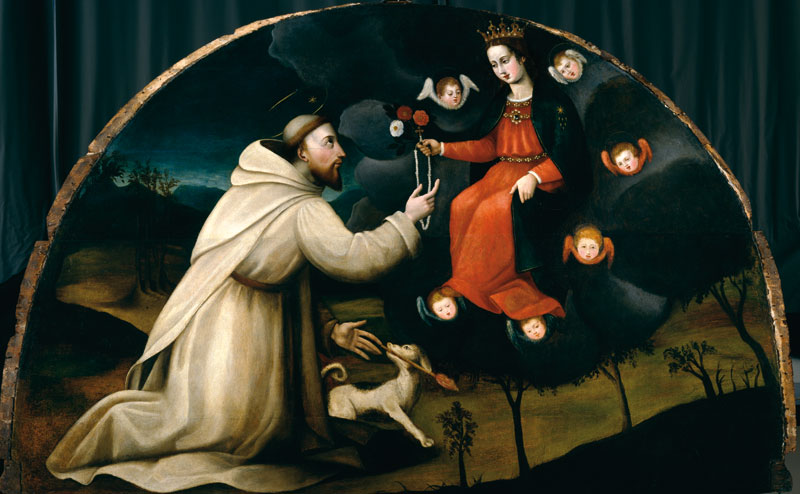
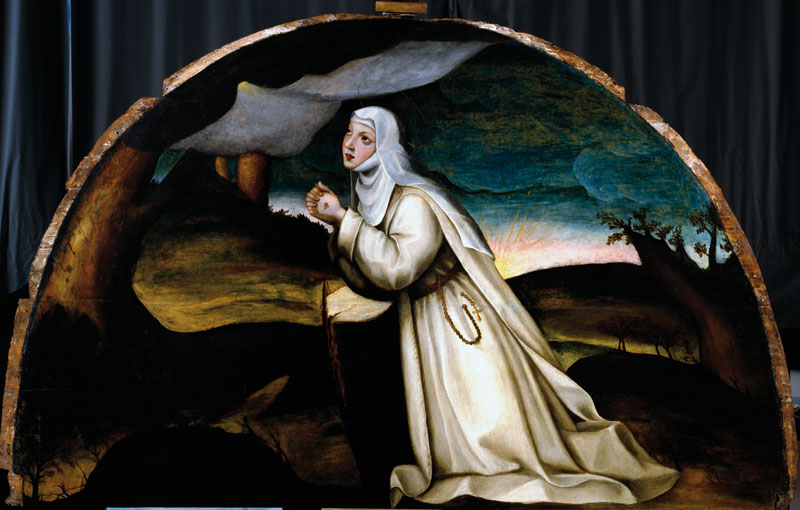
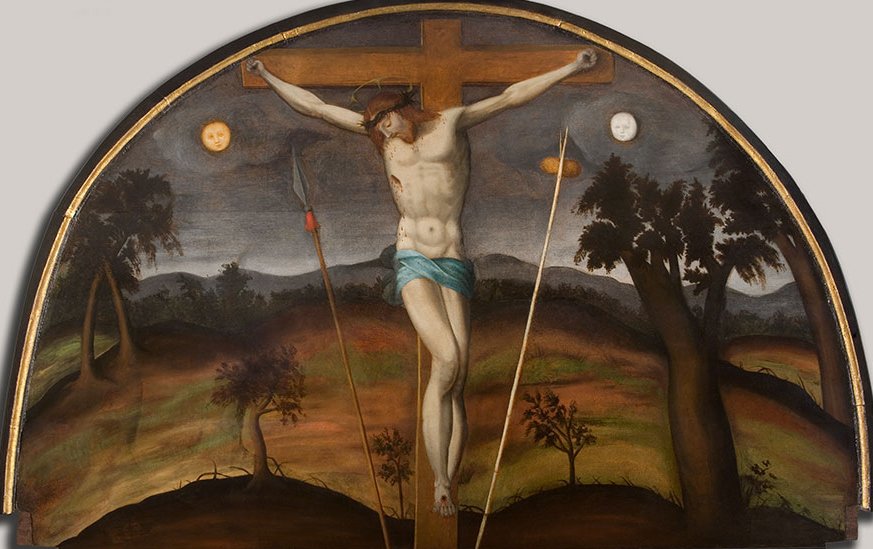
| Museo di San Marco | Florence | Lamentation; three lunettes (Crucifixion with symbols of the Passion, Saint Dominic receiving the rosary, vision of Saint Catherine) since 2022; a Caterina de' Ricci profile picture; manuscripts attributed to her. | New display of the refectory opened 1 October 2024. |
| Gallerie degli Uffizi, Gabinetto Disegni e Stampe and galleries | Florence | Drawings attributed to her; the Annunciation (acquired 1853 from Follonica); a small Saint Catherine on copper; a Seated Madonna Nursing drawing with a 17th-century inscription. | Display status of the drawings was not checked. |
| Palazzo Vecchio | Florence | Annunciation, a near replica of the Uffizi picture. | Attribution given by Apollo and the dealer's catalogue. |
| San Domenico | Perugia | Pentecost, signed S. Plautilla faciebat. | Also a Caterina profile picture in the Galleria Nazionale dell'Umbria in Perugia. |
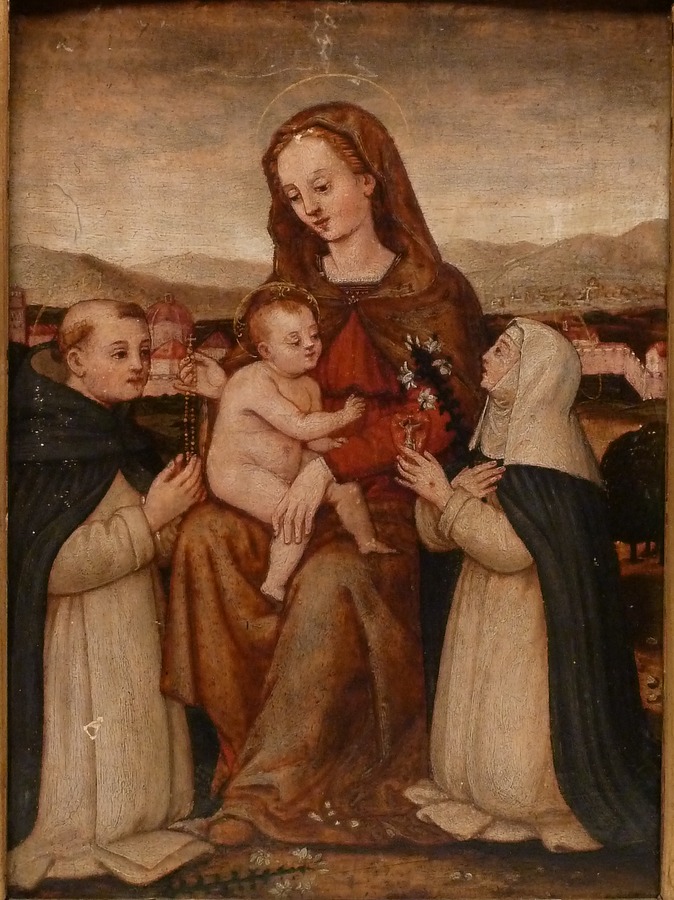
| Museum Catharijneconvent | Utrecht | Virgin and Child with Saints Dominic and Catherine of Siena, 27 x 20 cm. | Bought in Italy before 1842 by J. A. Ramboux as by Suor Plautilla Fiorentina. |
| Museum Boijmans Van Beuningen | Rotterdam | Gabburri Albums M and N: Fra Bartolommeo's drawings that passed through her convent. | Not her own work; the evidence for her training. |
| Santi Giuseppe e Lucia | Montaione | Madonna of the Rosary with Saints Dominic and Catherine of Siena, c. 1580, attributed by Navarro in 2016. | Presented again after conservation on 14 December 2024. |
Forgeries and misattributions
- No forgery of her work is documented
- None of the sources read records a fake. The risk runs the other way: works made by her or her workshop sat under other names or none. The Uffizi's 2017 text says her works are often unjustly attributed to male artists, without naming them. Commons carries a Mater dolorosa from the convent of Santa Mustiola titled as after Suor Plautilla Nelli or Alessandro Allori, so who copied whom is open. Reattribution by archive and style: a convent payment tied to a named panel; a hand matched to the inscription on a drawing identified by Pierattini; cartoon matches found by reflectography.791316
- A signed drawing that is a copy
- The Christie's 2009 drawing carried her signature and the phrase pupil of the Friar, yet Paul Joannides showed the figure derives from Beccafumi's altarpiece in Siena. A copy after another artist is consistent with Vasari's note that her best works were copies, and the lot essay says the style is hers beyond doubt. Comparison of the figure with the Siena altarpiece; handwriting of the inscription matched to the Uffizi Seated Madonna Nursing drawing.29
The essay
Chapter 1Three works carry her name and everything else is argument
The Dizionario Biografico entry by Andrea Muzzi (2013) says that, on present knowledge, she can be taken as the first woman painter in history from whom independent works survive, and in the same...
The Dizionario Biografico entry by Andrea Muzzi (2013) says that, on present knowledge, she can be taken as the first woman painter in history from whom independent works survive, and in the same breath calls her corpus fairly small, with a chronology built mostly on style. It treats three works as her securely known paintings: the Lamentation, the Pentecost and the Last Supper, and records a signature on the Pentecost and on the Last Supper; it records none on the Lamentation, which it dates only by style. A dealer's 2023 catalogue entry for a small panel calls these three altarpieces signed or documented, without saying which of the three is which. The Italian Wikipedia says only three can be attributed with certainty.
Beyond those three the counts drift upward as scholars attribute. The Advancing Women Artists page says only three confirmed works existed when the foundation restored its first Nelli in 2006 and gives some seventeen today (the page is undated). The Art Newspaper wrote in October 2019 that the number had risen from three to around 20 since the foundation began. The Guardian, the same week, said about 20 of her drawings and paintings had been found in storage or on church walls. Those are three press and foundation counts, not a catalogue, and none says who accepted what.
The published instruments are specific. Catherine Turrill Lupi's list of paintings attributed to her (pages 118 to 130) and Marzia Faietti's catalogue of the Uffizi drawings (pages 99 to 117) both sit in Jonathan Nelson's 2008 volume Plautilla Nelli (1524-1588): The Painter-Prioress of Renaissance Florence; Fausta Navarro added works in a 2009 book and in the catalogue of the 2017 Uffizi exhibition. A reader checking any single attribution should start with those pages. None of them was available to read for this page, so the page reports their existence and the counts around them, not their verdicts.
Chapter 2A haberdasher's daughter, not a noblewoman and not a painter's
The Dizionario Biografico gives her baptism as 29 January 1524, second child of Piero, a haberdasher (merciaio) of the parish of San Felice in Piazza, and Francesca Calandri.
The Dizionario Biografico gives her baptism as 29 January 1524, second child of Piero, a haberdasher (merciaio) of the parish of San Felice in Piazza, and Francesca Calandri. It says the family was related to the better known Nelli of the San Giovanni quarter but seems not to have been noble, as is often claimed. Her grandfather Piermaria Calandri was prior of the San Giovanni quarter. Her mother died, probably of plague, in 1530 and her father married Francesca di Tommaso Michelozzi the same year.
Other sources vary on each point. The Guardian calls her father a draper; a dealer's catalogue says merchant and has her taking the veil after the death of both parents, which the Dizionario Biografico's account of the father's remarriage doesn't support as read. A Christie's lot essay of 2009 says her father was also a painter, and nothing in the Dizionario Biografico or the other sources read supports that. The baptism date is itself disputed: the dealer gives 24 January 1524, Apollo says baptised 29 January, and the Italian Wikipedia prints 29 January 1525 with a note that Florentine-style dating is involved. The older books print 1523 in their titles (Nelson's 1998 symposium volume, and the Rotterdam museum's own record). The baptismal entry itself was not seen.
She took the veil, probably in December 1538, at Santa Caterina in Cafaggio, a Dominican convent across the Piazza San Marco from the friary of San Marco. Her sister Costanza, in religion Petronilla, had gone in before her. The convent was founded on 30 September 1500, according to a student's summary of the convent chronicles, by Camilla Bartolini Rucellai (Suor Lucia), a follower of Savonarola, and held 133 nuns by 1562. The convent is gone; the Advancing Women Artists page says it stood on what is now Via Cavour.
Chapter 3No master, a dead friar's drawings and a bequest nobody can date
Vasari gave no teacher, and the Dizionario Biografico notes that the usual biographical detail is absent from his account.
Vasari gave no teacher, and the Dizionario Biografico notes that the usual biographical detail is absent from his account. Older writing named Fra Paolino da Pistoia as her master because he was Dominican, a Savonarolan and from the same San Marco circle. Muzzi rejects it on chronology: from about 1526 Fra Paolino worked from the Dominican house at Pistoia until his death in 1547, so the two may have met but could not have had a close master and pupil relationship. Muzzi adds a technical point, that she differs from Paolino in using the more modern oil medium.
What she did have was paper. The Rotterdam museum's record for Album M says Fra Bartolommeo's estate, inventoried after his death in 1517 by Lorenzo di Credi, held 830 single drawings and twelve books of about 180 sheets; that he left them to Fra Paolino; that Paolino "in his turn" left them to Suor Plautilla Nelli; and that through her they came to Santa Caterina. Muzzi writes that she kept the drawings of the Fra Bartolommeo and Fra Paolino workshops and that some sheets ended up in Vasari's own drawing book. The Rotterdam record and Muzzi say that the convent still had them in the eighteenth century. In 1725 to 1727 Niccolo Gabburri bought 400 sheets with 505 drawn sides from the convent and had them mounted in two albums in 1729.
Scholars read her training differently. Mary Garrard thinks she was probably trained in drawing and painting by nuns, that she studied the art visible in Florence because the convent wasn't cloistered until 1575, and that a drawing after Michelangelo's Risen Christ shows she travelled as far as Rome; Silvia Colucci, director of the Santa Maria Novella museum, says she had no training and no male painter beside her. The record has no document of any lesson. The Santa Caterina profile pictures (c. 1560 to 1580) were made with cartoons, and a student's summary says reflectography shows the profiles match those in Fra Bartolommeo's Cambi altarpiece, so her relation to him ran through his drawings, not his person.
Chapter 4Vasari gave her one passage and it cuts both ways
In the 1568 edition Vasari placed her in the Life of Properzia de' Rossi among women who equalled Properzia at drawing.
In the 1568 edition Vasari placed her in the Life of Properzia de' Rossi among women who equalled Properzia at drawing. In the English translation reproduced by a modern site, he calls her "Sister Plautilla, a nun and now Prioress in the Convent of Santa Caterina da Siena, on the Piazza di San Marco in Florence", who by imitating pictures by excellent masters "has executed some works with such diligence, that she has caused the craftsmen to marvel". He lists two panels in her convent church (the Adoration of the Magi much praised), a large panel at the convent of Santa Lucia in Pistoia, another sent abroad by the director of the Hospital of Lelmo, a great Last Supper in the refectory, a panel in the workroom and a Nativity after Bronzino. Of lay patrons he names only the Annunciations owned by the wife of Signor Mondragone and by Madonna Marietta de' Fedini, and notes that in the houses of gentlemen across Florence there were too many of her pictures to mention.
He is just as clear on what he thought her limits were: her best works were copies, and she would have done marvels had she been able, as men do, to study living and natural objects. He says the women's faces in her work are much nearer the truth than the men's, and that she put Madonna Costanza de' Doni into some of them. Garrard points out that this last remark contradicts the claim that she could not draw from life, and that modern scholars have taken Vasari's line on copying to call her an unoriginal copyist. Muzzi reads the whole Vasari passage differently: Nelli belongs to the category of 'dilettanti', people who practised drawing for self-improvement without a professional career, and Vasari's own interest in drawings may have helped him notice her. Vasari also names her, without the name, in the Life of Fra Bartolommeo as "una monaca che dipigne" who held the friar's drawings.
The English text used here is a modern site's reproduction of the standard English translation, not the Italian of 1568; the Italian wording quoted comes through the Dizionario Biografico. The Indiana University entry says Vasari praised her drawings as equal to Properzia's; the passage as read praises the copying and the diligence and doesn't use that wording.
Chapter 5A convent that painted for a living
Everything points to a workshop. The Dizionario Biografico says the new thing in her biography is that she headed one, probably with chorus-like collaboration by other nun-artists, which the...
Everything points to a workshop. The Dizionario Biografico says the new thing in her biography is that she headed one, probably with chorus-like collaboration by other nun-artists, which the documents and the quality differences inside each painting suggest. Serafino Razzi's 1596 history of the Dominican order, as reported by Apollo and the Indiana entry, names disciples including Prudenza Cambi, Agata Trabalesi (Traballesi) and Maria Ruggieri, and nuns working in their own right, among them Razzi's sister Maria Angelica, Veronica and Dionisia Niccolini. Apollo adds that Agata Traballesi seems to have carried the workshop into the seventeenth century as madre pittora, and that Turrill Lupi has long warned against the Vasari-derived picture of Plautilla as a solitary figure. A document about an altarpiece for the convent dormitory says it was painted by the hand of 'our Mother Sister Plautilla and her companions' (this quotation comes through a student's summary, not the document).
Attribution erasure is the standing risk. Apollo notes that Plautilla seems to have signed only her very largest works, and that most nuns' works are unsigned, which is why tracing the other women is, in Apollo's word, formidable. The Uffizi's 2017 exhibition text goes further and says her works are often unjustly attributed to male artists, without naming cases.
The convent sold. The Uffizi text says sales became fundamental after the Council of Trent reforms of 1566 forbade seeking alms outside the walls, and that the demand came mainly from relatives and clients tied to the network of Dominican houses in Tuscany; the four serial pictures of a Dominican saint in profile show how seriality followed. Garrard says that by about 35 she was earning income from paintings sold outside. The convent became enclosed only in 1575 (Garrard). A student's summary of the convent records, a tertiary source, says that in 1587 the nuns of San Domenico al Maglio commissioned a Madonna from Santa Caterina and paid more than they had paid Antonio Stiattoni for a similar one; no figure for either payment was found.
Chapter 6The Lamentation: four women weeping
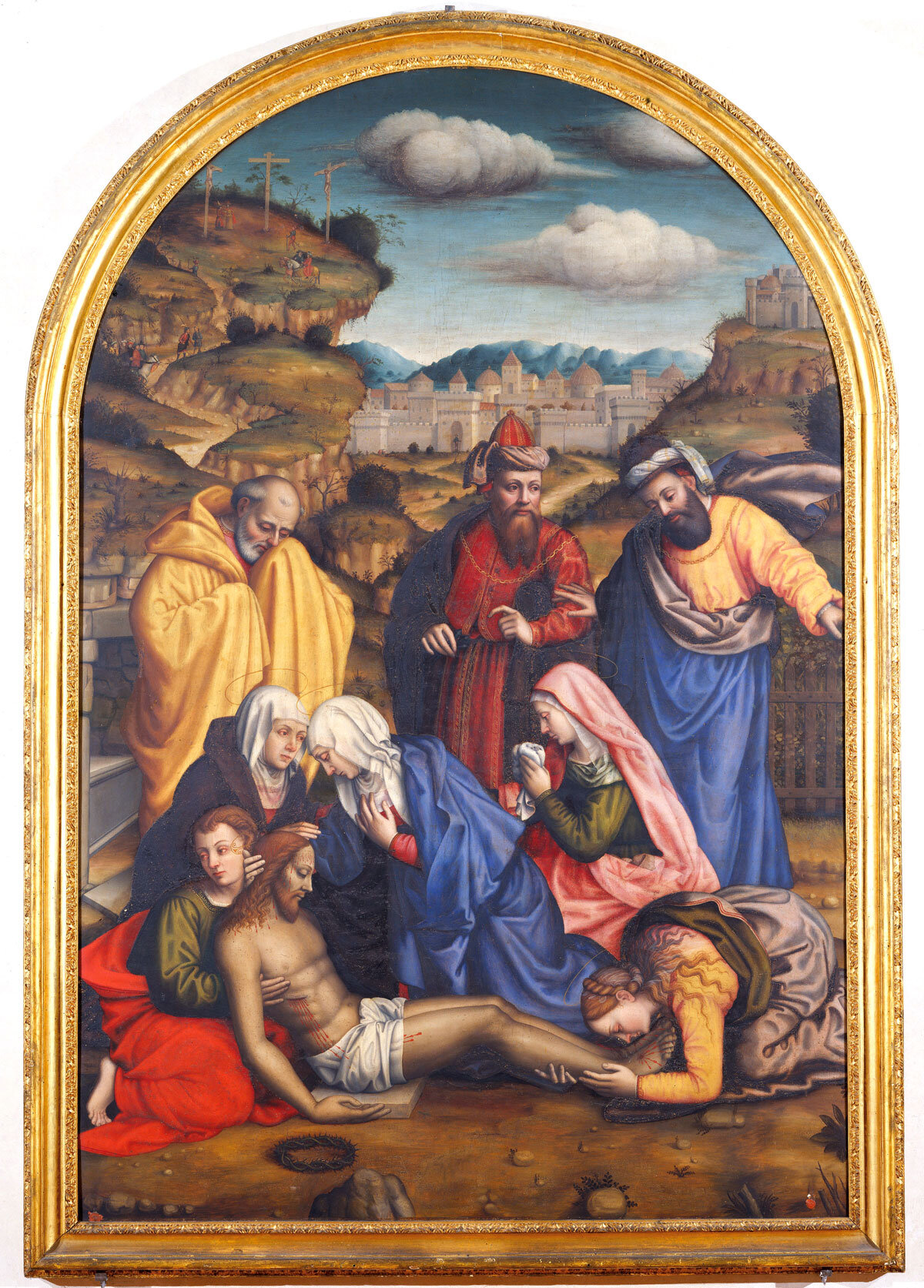
Muzzi judges the Lamentation, now in the Museo di San Marco but made for the church of Santa Caterina, the earliest of her three, by the evidence of its quotation of early-sixteenth-century models...
Muzzi judges the Lamentation, now in the Museo di San Marco but made for the church of Santa Caterina, the earliest of her three, by the evidence of its quotation of early-sixteenth-century models such as Fra Bartolommeo and Perugino. Garrard's caption dates it 1550, and a recent summary labels it before 1568; no document dating it was read. It stood, Garrard says, nearly ten feet high on a prominent altar in the convent's public church. Muzzi sees archaic structure in the foreground and background, and a grief shown through tears and reddened eyes that she ties to Flemish art, some of which was held in the San Marco workshop.
Garrard argues a function for it. Art made for a convent was judged on devotional effectiveness, she says, not on originality, so the right comparison isn't with Andrea del Sarto's dramatic Lamentation but with the work an altar did for the nuns who looked at it at eye level. In Nelli's version four women of equal size weep, linked by gaze and gesture, and Mary touches her breast in private grief instead of swooning at the centre. Garrard says the picture was probably not meant as a critique of male predecessors but functions as one. This is an argued reading, by one named scholar, of what the picture does; it isn't a claim about what Nelli intended. Where Garrard sees women's grief as the subject, the Uffizi exhibition text takes the opposite emphasis for the nuns' art in general, conservative taste valued for devotional effect and continuity with the Dominican tradition. The two aren't incompatible.
Chapter 7The Last Supper: seven metres and several hands
The canvas is almost seven metres wide and two high with life-size apostles.
The canvas is almost seven metres wide and two high with life-size apostles. Dates conflict: the Guardian and Apollo say the 1560s, the Smithsonian says around 1568, and a student's article prints 1569 with the signature detail. The inscription in the upper left reads, per the Dizionario Biografico, 'S. Plautilla. Orate pro pictora', the feminine form of a formula Fra Bartolommeo and Sogliani had used in Dominican commissions with several hands at work. Muzzi says the composition draws on Sogliani's 1531 Last Supper at Anghiari; The Art Newspaper says she may have emulated Leonardo. The two readings differ and neither is documented.
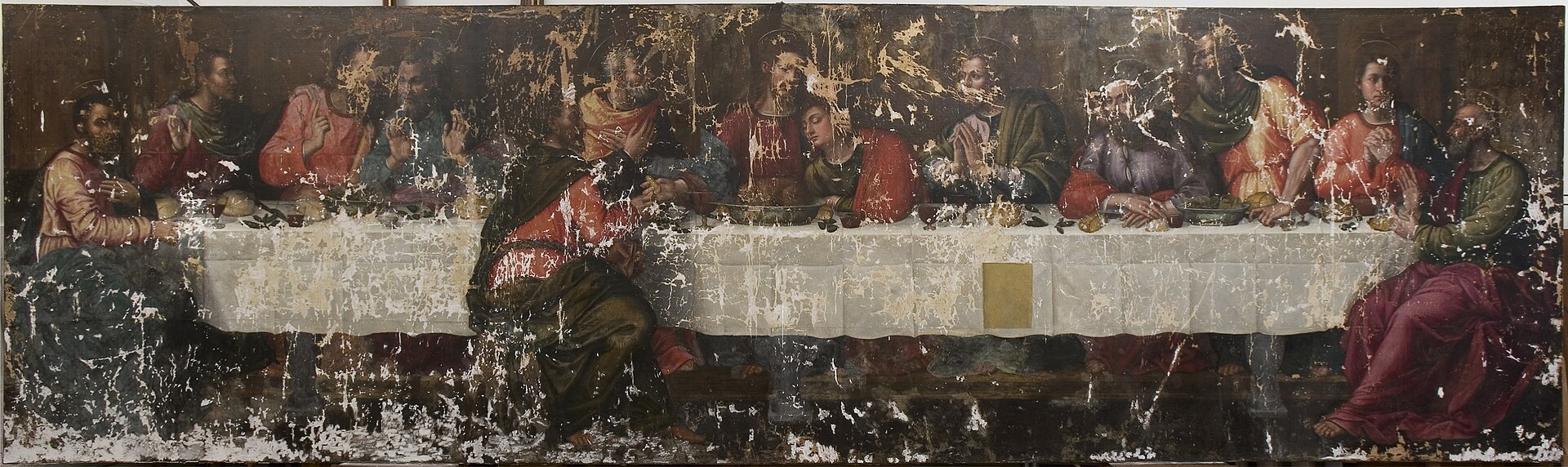
It hung on the refectory wall of her own convent. After the convent's suppression it went to Santa Maria Novella in 1817 (Guardian; The Art Newspaper says it hung in the friars' refectory). The Smithsonian, citing the 2019 monograph, says it was put into storage rolled up, then restored in 1939; its 1911 date for the storage, tied to the scholar Giovanna Pierattini, who published in 1938, is internally awkward and the page does not rely on it. The Guardian, quoting the museum's director, says it was rolled up and neglected for almost three decades, restored in the 1930s and then damaged by humidity after the 1966 flood.
The four-year restoration, led by Rossella Lari and funded by Advancing Women Artists, ended with the October 2019 display. The foundation raised $67,000 in a 2017 crowdfunding drive and offered the twelve apostles for adoption at $10,000 each, with Judas covered by ten donors at $1,000 each (The Art Newspaper). No total cost was found. Lari removed much heavy overpainting, studied other Florentine Last Supper tables to fill gaps, and found little underdrawing by reflectography, which she reads as a painter who knew what she wanted. The Art Newspaper quotes the foundation's director saying different hands show within the seven metres; it is her interpretation, not a technical report.
The Last Supper has an unusual table. Gealt, writing for Indiana University, reads the salad and beans as bearing on women's traditional role in preparing food, and the Chinese porcelain and Venetian glass as probably reflecting expensive gifts to the convent. The Art Newspaper's account has lamb and salad served in fine Chinese porcelain. Motti's summary adds that many of the nuns came from merchant or noble families, so porcelain wasn't hard to find. These are interpretations of detail, argued from the nuns' circumstances; none is a documented intention.
Chapter 8A convent in Savonarola's shadow
The evidence for the Savonarolan link is of three grades.
The evidence for the Savonarolan link is of three grades. Documented: the Dizionario Biografico says she kept all her life a biography of Savonarola copied by her sister Petronilla (Biblioteca Moreniana, Moreni 219, shortly after 1560), and that convents in the Congregation of San Marco, which Savonarola had wanted for reform of the Dominican order, developed artistic activity in many ways. A student's summary adds that she signed as 'dipintora' in the colophon of that book, a claim not checked against the manuscript. Argued: Muzzi in the Dizionario Biografico, the Uffizi exhibition catalogue by Fausta Navarro and Apollo's authors treat her art as shaped by that reform. Apollo says the nuns were strongly influenced by the reform programme and the cult of San Marco's preacher, burnt in 1498. The Uffizi exhibition text calls her a passionate interpreter of the figurative poetics of his teaching on the arts, and a Christie's lot essay says the nuns were devout adherents.
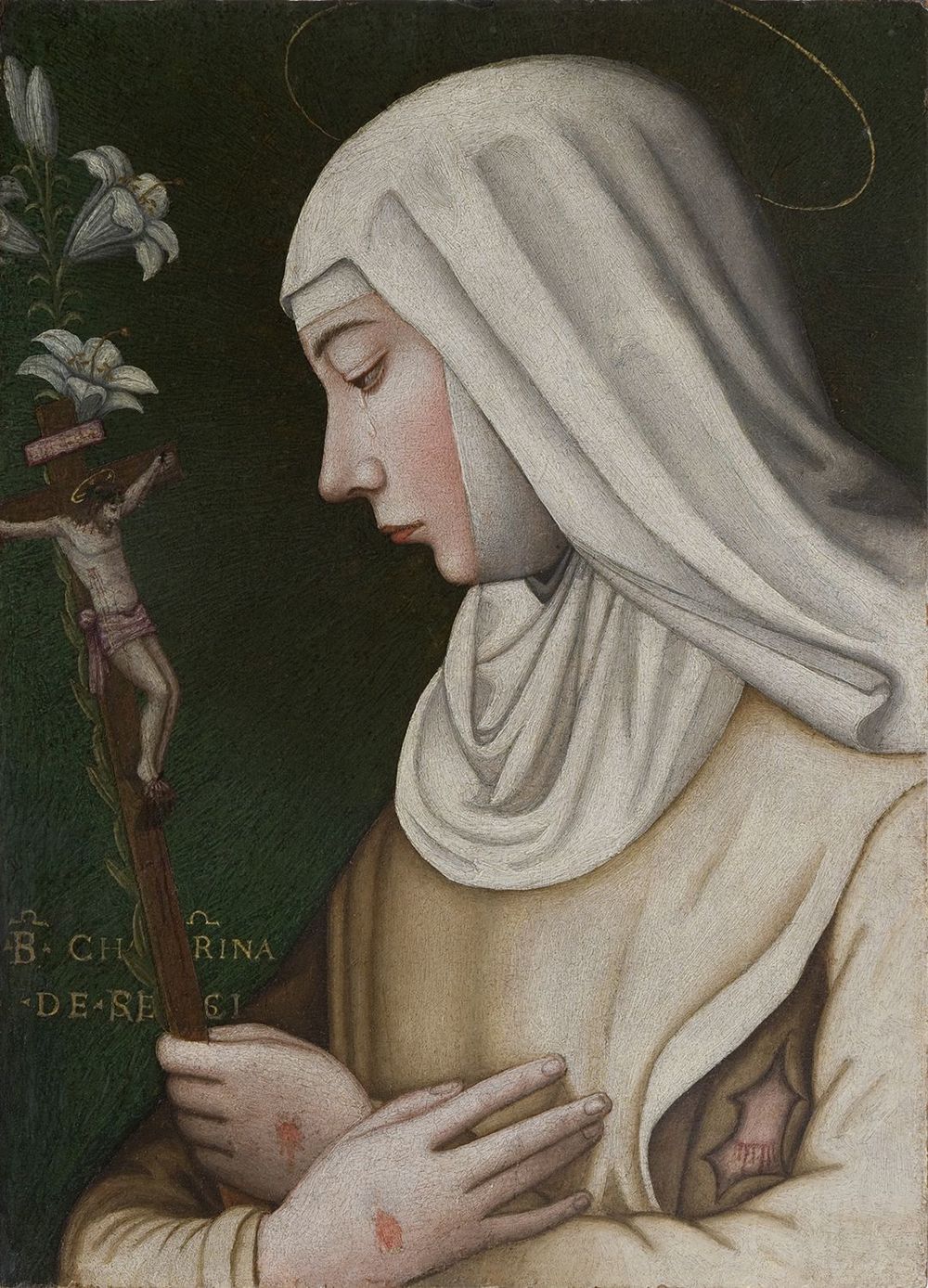
The sharpest argued case is the profile series of a Dominican saint. The Uffizi text says that changed inscriptions on four paintings turn Catherine of Siena into 'another Catherine', Caterina de' Ricci, the living Dominican of Prato and a fervent Savonarolan, 'suggesting the possibility' that Nelli wished to equate her with the saint of Siena. Apollo, reporting the 2017 attribution, says Plautilla left the subject's identity purposely ambiguous, and that copies in Prato, Siena and Perugia suggest systematic circulation from her workshop to Dominican communities. This is argued by Navarro and echoed by Apollo, with no document read that states the intention.
A caution. The review in Finestre sull'Arte, whose opening lines are all that was readable behind a paywall, begins by warning against both ante litteram feminism and overestimates that lose the historical context. Muzzi also notes that Vasari, close to Cosimo I, disliked the Savonarolan party's republican leanings, yet treats it more mildly in 1568, a change Muzzi links to the post-Savonarolan new course led by Caterina de' Ricci. Nothing in the sources read says Nelli painted with a hidden programme; what is documented is a devotional house with a tradition and customers.
Chapter 9Who bought, and what for
The Perugia Pentecost, signed 'S. Plautilla faciebat' (Dizionario Biografico), was made for an altar dedicated to the Perugian jurist Guglielmo Pontani, probably soon after his death in 1555.
The Perugia Pentecost, signed 'S. Plautilla faciebat' (Dizionario Biografico), was made for an altar dedicated to the Perugian jurist Guglielmo Pontani, probably soon after his death in 1555. Muzzi links the commission to the Dominican friar Niccolo degli Alessi, author of Pontani's funeral oration and a life of Caterina de' Ricci, who was in the same Florentine circle. A Perugia date in 1554, which appears in a student's article and on the Commons file titles, is therefore at odds with that reading; no document dating it was read.
Smaller devotional panels belong to another market. A panel of the Virgin and Child with Saints Dominic and Catherine of Siena in the Museum Catharijneconvent, Utrecht, came to the collector Johann Anton Ramboux, before 1842, as by 'Suor Plautilla Fiorentina'; Apollo says Turrill Lupi first linked it to Nelli in 2017, while the dealer's catalogue calls it long attributed. Turrill Lupi has argued that this genre may relate to Virgin and Child pictures recommended to newly professed nuns, and Apollo notes that the figures in the Utrecht panel and in a newly conserved one match closely, which suggests use of cartoons. Indiana's essay argues replicas served shared devotional practice and kept the wonder-working potential of an original; that is argued, not documented.
Two Annunciations, one in the Uffizi (which the dealer says arrived in 1853 from the chapel of the Palazzo Granducale at Follonica) and one in the Palazzo Vecchio, are treated by Apollo as the pair of lay-patron pictures Vasari singled out; each is almost a metre high. The attribution of lay panels to her rests on Vasari's words and on the match, not on a surviving contract.
Chapter 10What was lost and what was dispersed
Of Vasari's list, the Adoration of the Magi in the convent church was lost (The Art Newspaper); the Pistoia Santa Lucia panel hasn't been found, though Muzzi, following Turrill, links it to a payment...
Of Vasari's list, the Adoration of the Magi in the convent church was lost (The Art Newspaper); the Pistoia Santa Lucia panel hasn't been found, though Muzzi, following Turrill, links it to a payment of March 1559; the Lelmo panel, the predella of San Zanobi scenes, the Nativity after Bronzino and the portraits of Costanza de' Doni are all untraced in what was read. Muzzi also says the portraits Vasari praised have not been found.
Her convent's contents went out in three waves. The Fra Bartolommeo drawings were sold to Gabburri in 1725 to 1727. The convent was suppressed in the Napoleonic period and its works scattered, stored and forgotten (Indiana). The Last Supper then spent decades rolled up. The Rotterdam record traces the albums from Gabburri's heirs to the dealer William Kent in Rome, then through Benjamin West, Thomas Lawrence, Samuel Woodburn, the Dutch king Willem II and the Grand Duchy of Saxe-Weimar-Eisenach, to Franz Koenigs in 1923 and the Boijmans museum in 1940. Whether any sheets stayed in Florence is a gap: Apollo says a corpus of 883 sheets went to the nuns and about half later reached Rotterdam, a figure that doesn't match the Rotterdam record's 400 sheets bought by Gabburri.
Chapter 11How the name came back
She was well known in her lifetime and soon after: Razzi in 1596 and again in a 1602 text, the convent chronicler Rucellai and an obituary by Modesto Biliotti are all reported by the student's...
She was well known in her lifetime and soon after: Razzi in 1596 and again in a 1602 text, the convent chronicler Rucellai and an obituary by Modesto Biliotti are all reported by the student's summary, a tertiary source that should be replaced by the originals. Indiana's bibliography lists Francesco Bocchi's 1591 guide to Florence, Giuseppe Richa (1754-64) and Vincenzo Marchese (1845). Giovanna Pierattini published a study in Memorie domenicane in 1938 and identified the hand on the Uffizi drawing (Christie's; the Dizionario Biografico bibliography).
Apollo dates modern scholarship from Jonathan Nelson's 1998 conference, with attention snowballing after 2000; Muzzi's 1996 San Marco catalogue essay is an earlier item in the bibliographies. Advancing Women Artists was founded by Jane Fortune after she found a market-stall book about the Lamentation, and its first restoration was that picture in 2006 (AWA page; Guardian). The 2017 Uffizi show, 8 March to 4 June, was the first the gallery had given to a woman artist (Apollo). Fortune died in September 2018. The Last Supper was unveiled at Santa Maria Novella on 17 October 2019. After 2018 the work passed to the charity Artemisia Gold. In 2022 three lunettes (Crucifixion, Saint Dominic receiving the rosary and Saint Catherine's vision) moved from San Salvi to San Marco; a new display opened there on 1 October 2024; on 14 December 2024 the conserved Madonna of the Rosary at Montaione, attributed by Navarro in 2016, was presented (Apollo).
Chapter 12A story told about her, kept apart
The Italian Wikipedia quotes Vincenzo Marchese's Memorie of 1845 for a tradition that Suor Plautilla, wanting to study the nude for her Christ, used the body of a dead nun, and that the other sisters...
The Italian Wikipedia quotes Vincenzo Marchese's Memorie of 1845 for a tradition that Suor Plautilla, wanting to study the nude for her Christ, used the body of a dead nun, and that the other sisters joked she made Christas instead of Christs. That is nearly three centuries after her death, appears in none of the sixteenth-century sources read, and is a joke on her figures, not evidence. The soft features of her male figures are a recurring comment (the Guardian notes that John in the Last Supper has suspiciously feminine features); that is a later reading of the faces, not documentation.
What is documented
Technique
The surviving work
- What is accepted
- No count has been accepted by a body. Three works are the secure core (Lamentation, Pentecost, Last Supper; the Dizionario Biografico, 2013, records a signature on the last two). The Advancing Women Artists page says some seventeen attributions now stand against three confirmed in 2006; The Art Newspaper (2019) said around 20; Apollo (2024) says the oeuvre has been greatly expanded by careful attribution.
- What is contested
- Attributions added since 2006 include the Santa Caterina profile series (first reconstructed in the 2017 Uffizi show), the three San Salvi lunettes (recently attributed, per the Italian Wikipedia), the Utrecht Madonna (first linked by Turrill Lupi in 2017 according to Apollo, though a dealer calls it long attributed), the Montaione altarpiece (Navarro, 2016) and a Winter Show panel confirmed by Christopher Daly and Sheila Barker. Many are labelled attributed, or with workshop, on Commons. No rejection list was found.
- Who rules on attribution
- No active authority. Attribution is by publication: Jonathan Nelson, Catherine Turrill Lupi, Fausta Navarro of the Uffizi, Andrea Muzzi, Marzia Faietti and dealers' consultants such as Christopher Daly and Sheila Barker. Advancing Women Artists funded much of the conservation; after its founder's death in 2018 the charity Artemisia Gold took over sponsorship (Apollo).
Catalogue raisonne
- Catherine Turrill Lupi, List of paintings attributed to Plautilla Nelli, in J. K. Nelson (ed.), Plautilla Nelli (1524-1588): The Painter-Prioress of Renaissance Florence, Florence, 2008, pp. 118-130. The working list of attributed paintings; not read, cited from the Dizionario Biografico bibliography.1
- Marzia Faietti, 'In the shadow of the Friar': the Uffizi drawings attributed to Plautilla Nelli, ibid., pp. 99-117. The extensive catalogue of attributed drawings, per Christie's; not read.19
- Fausta Navarro (ed.), Plautilla Nelli. Arte e devozione sulle orme di Savonarola, Livorno, Sillabe, 2017 (Uffizi exhibition catalogue); and Navarro (ed.), Orate pro pictora, Prato, 2009. Where the profile series and several new works were first attributed.714
Questions about Plautilla Nelli
Who was Plautilla Nelli?
Painter; Draughtswoman; Miniaturist; Dominican nun; Prioress; Workshop head. 1524-1588.
When did Plautilla Nelli live?
Born Baptised 29 January 1524 per the Dizionario Biografico degli Italiani and Apollo (one dealer's catalogue gives 24 January; one reference work prints 1523), Florence, parish of San Felice in Piazza; died May 1588, per the chronicle of her convent as cited in the Dizionario Biografico, Florence, convent of Santa Caterina da Siena (Santa Caterina in Cafaggio), Piazza San Marco.
How are fakes and misattributions of Plautilla Nelli detected?
No forgery of her work is documented. None of the sources read records a fake. The risk runs the other way: works made by her or her workshop sat under other names or none.
Where can you see work by Plautilla Nelli?
Museo di Santa Maria Novella (Florence); Museo di San Marco (Florence); Gallerie degli Uffizi, Gabinetto Disegni e Stampe and galleries (Florence); Palazzo Vecchio (Florence); San Domenico (Perugia); Museum Catharijneconvent (Utrecht).
What does the market for Plautilla Nelli look like?
The market is small and the public record almost empty. One result was found: Christie's South Kensington, sale 5979 (Old Master, 19th Century and British Drawings and Watercolours), 9 July 2009, lot 522, a black chalk drawing of a kneeling saint in nun's robes, 22.8 by 19.7 cm, signed in pen 'Di Suor Plautilla allieva d[e]l Frate', estimate GBP 5,000 to 7,000, price realised GBP 5,625.
What is still unresolved about Plautilla Nelli?
Which attributions count? Nobody has published an accepted list; the figures of three, 17 and 20 come from a dictionary, a foundation page and two newspapers.
Open questions
- Which attributions count? Nobody has published an accepted list; the figures of three, 17 and 20 come from a dictionary, a foundation page and two newspapers.
- When was she born and who were her parents? The baptismal entry has not been checked against 29 January 1524, 24 January 1524 and the 1525 Florentine-style date; the father is a haberdasher, merchant, draper or painter depending on the source.
- Who taught her? Muzzi rules out Fra Paolino as a master on chronology yet Rotterdam says he left her the drawings; Garrard says nuns taught her and she went to Rome; others say no teacher at all.
- When was each of the three core works made? No document found dates the Lamentation, the Pentecost (1554 against after 1555) or the Last Supper (1560s, about 1568 or 1569).
- What did the Last Supper's pigment analysis find? The 2019 conservation team analysed the paint but the results were not found; the 2019 monograph Visible should hold them.
- What did a Nelli picture cost? No payment for any picture is reported with a figure, and no price is found for the 2023 Winter Show panel, the March 2024 Pandolfini lot or the 1989 Sotheby's Florence lot.
- Which nuns painted which parts of the Last Supper and the lunettes? The conservator sees different hands but no one has assigned them.
- Is the Caterina de' Ricci series a statement about a living holy woman? Navarro and Apollo argue so; no document of the intention has been read.
- Which prioress dates are right? The Dizionario Biografico gives 1563 to 1565, 1571 to 1573 and 1583 to 1585, yet Vasari's 1568 edition and Christie's both have her prioress around 1568, outside those terms.
Sources
- 1Andrea Muzzi, 'NELLI, Pulissena Margherita', Dizionario Biografico degli Italiani, vol. 78 (2013), Istituto della Enciclopedia Italiana (Treccani). Read in full. treccani.it/enciclopedia/...
- 2Giorgio Vasari, Life of Properzia de' Rossi (1568), English translation as reproduced on fineartphotographyvideoart.com; fineartphotographyvideoart.com/2021/...
- 3Joanna Moorhead, 'Restored to glory: How a 16th-century nun regained her place in art history', The Guardian / Observer, 19 October 2019, read via a Yahoo UK reprint. uk.news.yahoo.com/restored-glory-16th-century-nun-1305251...
- 4Hannah McGivern, 'Renaissance woman Plautilla Nelli's Last Supper unveiled after restoration in Florence', The Art Newspaper, 21 October 2019. theartnewspaper.com/2019/...
- 5Meilan Solly, 'Renaissance Nun's Last Supper Painting Makes Public Debut After 450 Years in Hiding', Smithsonian Magazine, 21 October 2019. smithsonianmag.com/smart-news/...
- 6Suri Li and Donal Cooper, 'After centuries of neglect, Plautilla Nelli's reputation is soaring again', Apollo, 31 December 2024. apollo-magazine.com/plautilla-nelli-500-nun-workshop-wome...
- 7Uffizi Galleries, exhibition page 'Plautilla Nelli. Art and devotion in the convent in Savonarola's footsteps', 8 March to 4 June 2017. uffizi.it/en/...
- 8Robert Simon Fine Art, catalogue entry, Suor Plautilla Nelli, Madonna and Child Enthroned with Saints Catherine, Ursula, John the Baptist and John the Evangelist, The Winter Show 2023, New York. A dealer's catalogue: selling text, not scholarship. thewintershow.org/media/...
- 9Christie's, London South Kensington, sale 5979, 9 July 2009, lot 522, Suor Plautilla Nelli, A kneeling saint in nun's robes (lot page with estimate and price realised). christies.com/en/...
- 10Mary D. Garrard, 'Repositioning Plautilla Nelli's Lamentation', Conversations, Yale MAVCOR, 2014. mavcor.yale.edu/node/...
- 11Heidi Gealt, 'Plautilla Nelli', A Space of Their Own, Eskenazi Museum of Art, Indiana University, with bibliography. space.artmuseum.indiana.edu/artists/...
- 12Museum Boijmans Van Beuningen, record for Album M (Tomo Primo) of Niccolo Gabburri, with provenance of the Fra Bartolommeo drawings. boijmans.nl/en/...
- 13Alessia Motti, 'Plautilla Nelli and the Workshop of Santa Caterina in Cafaggio', Art Herstory, 28 March 2025 (a student guest post; artherstory.net/plautilla-nelli-and-the-workshop-of-santa...
- 14Plautilla Nelli, Italian Wikipedia, with bibliography and the Marchese (1845) quotation (). it.wikipedia.org/wiki/...
- 15Advancing Women Artists, 'Plautilla Nelli' artist page. advancingwomenartists.org/artists/...
- 16Wikimedia Commons, Category:Plautilla Nelli and the file pages of the plates used (licence read per file from and wikitext). commons.wikimedia.org/wiki/...
Last verified