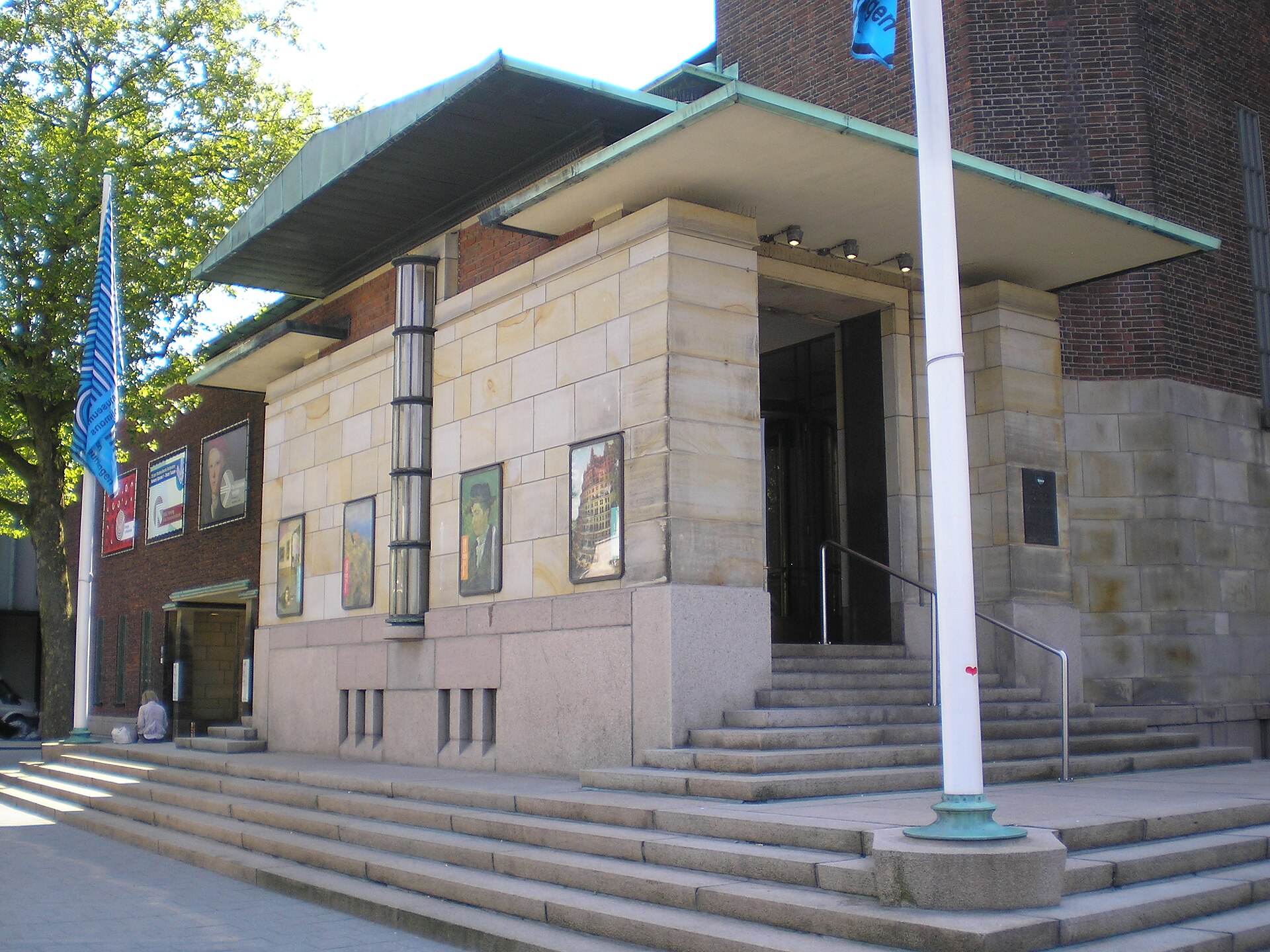
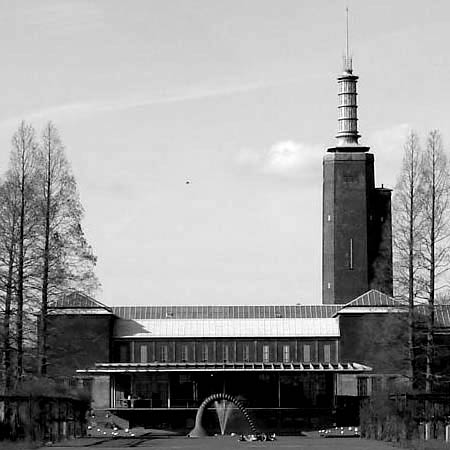
The main entrance of Museum Boijmans Van Beuningen at Museumpark 18-20, the historic 1935 Van der Steur building closed for renovation since 2019 and described throughout this record. Banners advertising exhibitions still hang across the sandstone facade either side of the doors.
Photograph by Antoine · CC BY-SA 3.0Closed to visitors - not permanently
Museum Boijmans Van Beuningen is currently closed. Not open and not permanently closed. The museum's own renovation page states plainly that the historic Museumpark 18-20 building is closed for renovation and that the buildings have been closed since 2019. This is the main museum building, the one this record and its address, coordinates and lead photograph describe. A separate structure a few dozen metres away, the Depot Boijmans Van Beuningen (opened 5 November 2021, a distinct Wikidata item, Q41061028), is open to the public on a timed ticket and is where the museum's own admission and hours pages currently send every visitor; this record uses the Depot's published admission and hours because it is the only way to see anything from this collection today, and says so throughout rather than presenting Depot figures as if they described the closed main building. Re-confirmed 10 September 2026 on the museum's own English renovation page: still closed since 2019, still no reopening date stated on that page itself, asbestos removal reported near complete.
Expected to reopen: 2030 · a target, not yet confirmed
Closure confirmed from the institution's own page. We re-check this page on a schedule and will update it, from the institution's own announcement, the moment it reopens.
On this page 16 sections
ContentsClose
More than one hundred and fifty thousand objects spanning the Middle Ages to the present, assembled from roughly fifty thousand gifts by some seventeen hundred donors since the museum's 1849 founding. The museum's own account names four areas of genuinely world-class depth: early Netherlandish painting (Geertgen tot Sint Jans, Bosch, Bruegel), Dutch Golden Age painting anchored by Rembrandt, one of the largest Surrealist collections in Europe (Dali, Magritte, Ernst), and a prints and drawings cabinet running to roughly eighteen thousand drawings and sixty-nine thousand prints, including the historically contested Koenigs collection of Old Master drawings. An eight-centuries design and applied-art holding and a growing modern and contemporary collection round out the range. Almost none of it is on public view while the historic building is closed; the Depot shows fragments of it through storage-rack glass and rotates a separate programme of temporary exhibitions alongside.
| Kind | Museum |
|---|---|
| Founded | Founded 3 July 1849 as Museum Boijmans, built on the bequest of the Rotterdam collector Frans Jacob Otto Boijmans (1767-1847); renamed Museum Boijmans Van Beuningen in 1958 after the businessman Daniel George van Beuningen (1877-1955) added his own collection |
| City and country |  Rotterdam, Netherlands Rotterdam, Netherlands |
| Address | Museumpark 18-20, 3015 CX Rotterdam, Netherlands |
| Website | boijmans.nl/en |
| Status | Closed temporarily, confirmed |
| Record last verified |
Visiting
- Hours (pre-closure)
- Tuesday-Sunday11:00 to 17:00Depot Boijmans Van Beuningen. A time slot is required; the museum's own page states without a time slot you cannot visit the Depot. This is not the main museum building, which remains closed for renovation with no public hours.
- MondayClosed, Depot included.
- Closed
- Monday, Depot; the main Museumpark 18-20 building is closed every day of the week for renovation and has no public hours at all. The Depot's own opening-times page additionally lists specific holiday closures, confirmed 10 September 2026: closed King's Day (26 April), Liberation Day (5 May) and Christmas Day (25 December) in 2025; open, per its 2026 list, on Good Friday, the Easter weekend, Ascension Day, the Whit weekend, Boxing Day and New Year's Eve.
- Admission (pre-closure)
- Adult (Depot entry, including rooftop)EUR 20This is the ticket for the Depot Boijmans Van Beuningen, the only part of the institution open to the public while the main Museumpark 18-20 building is closed for renovation. The museum's own price list adds a EUR 2.50 surcharge to most tiers for the duration of the Marisol exhibition, 9 October 2026 to 29 March 2027, exempting under-18s, Friends of Boijmans, Rotterdampas and several other discount categories.
- Under 18FreeFree, Depot entry.
- Students and CJP cardholdersEUR 10.50Depot entry.
- Museumkaart, Rotterdampas, ICOM, Vereniging Rembrandt, VriendenLoterij VIP cardFreeFree Depot entry for holders of any of these cards, per the museum's own price list.
Free entry: No free-admission day is published for the Depot in the sources read for this record; entry is by paid timed ticket every open day, with the free categories listed above- Do I need to book?
- Yes, for the Depot: the museum's own page states a time slot must be booked in advance and that without one a visitor cannot enter. Not applicable to the main building, which is closed to all visitors.
- Address
- Museumpark 18-20, 3015 CX Rotterdam, Netherlands MapMetro Metro lines A, B and C, stop Eendrachtsplein, on the museum's own directions page for reaching the site.
Tram Tram line 7, stop Museumpark, directly beside the building.
Parking A car park (Parking Museumpark) sits beneath the Depot with its entrance at Museumpark 32, though the museum's own page warns capacity is reduced by ongoing renovation works and recommends checking the municipal parking map for alternatives rather than parking on the street. - Website
- boijmans.nl/en
- Telephone
- +31 (0)10 441 9400
- [email protected]
Before you go how long, access, photography, bags, eating, shop
- How long to allow
- Not addressed as a single figure in the sources read for this record. The Depot's own guided introduction to a storage compartment runs about ten minutes; a full visit including the rooftop and an exhibition floor runs longer.
- Access
- The Depot is fully accessible: all floors are reached by a passenger lift with braille buttons and voice announcements, floors are level throughout, doorways are wide enough for a wheelchair, and accessible toilets are on the ground and sixth floors. Mobility scooters are not permitted but electric wheelchairs are, loan wheelchairs are available, and a visitor unable to move independently may bring a companion free of charge on a valid public transport companion card, with no ticket or time slot required for the companion. Assistance and guide dogs are welcome.
- Photography
- Personal, non-flash photography is permitted inside the Depot on the evidence of visitor-facing guidance read for this record; the museum's own accessibility and FAQ pages do not themselves state a photography policy in the text fetched.
- Bags
- Handbags are allowed; bags no larger than A4 may be carried if worn at the front. Larger bags and backpacks must go in the lockers provided, and coats are not permitted inside the Depot's storage floors or on the sixth-floor restaurant level.
- Eating
- Restaurant Renilde occupies the sixth floor of the Depot and can be visited without a Depot ticket by checking in at the information desk; it serves lunch Tuesday to Sunday and dinner Thursday to Saturday.
- Shop
- Not published in the sources read for this record.
The museum is closed (see above). These are the figures published before the closure, kept here for a visitor planning ahead rather than presented as bookable today, and you can check the current position at the source we used. We will re-confirm them once it reopens.
What is inside
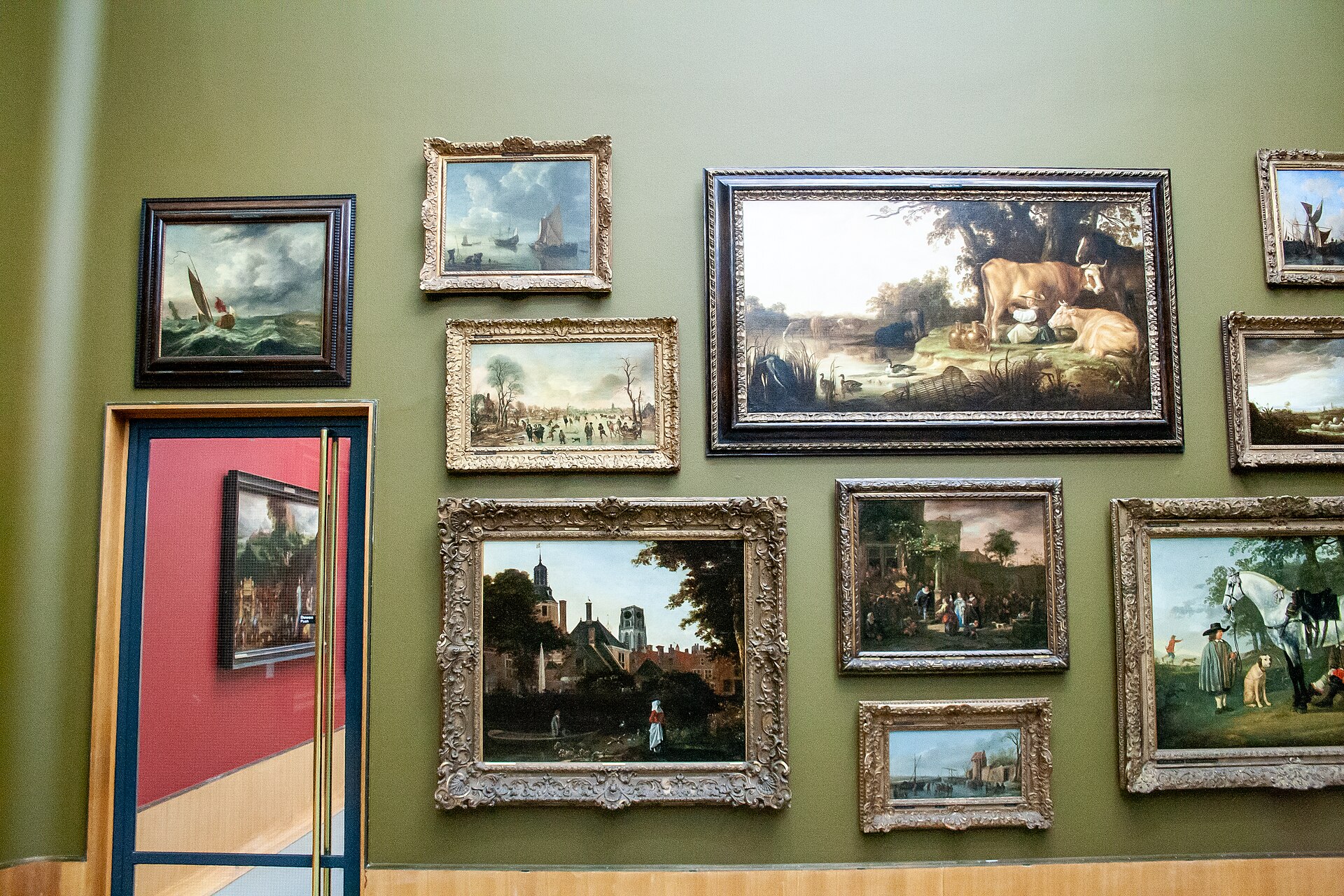
Photograph by Szilas · CC BY-SA 4.0 Old Masters: early Netherlandish and Dutch Golden Age painting
The museum's founding strength: fifteenth-century Netherlandish panels including Geertgen tot Sint Jans's Glorification of the Virgin, Hieronymus Bosch's The Pedlar, and Pieter Bruegel the Elder's small Tower of Babel, alongside a deep run of seventeenth-century Dutch painting built around Rembrandt, including his Titus at his Desk. None of this hangs in a public gallery while the Museumpark building is closed; pieces are visible only in fragments, through the Depot's storage-rack windows, on the museum's own account.
Surrealism
One of the largest Surrealist collections in Europe on the museum's own description, built around Salvador Dali's Impressions of Africa and Rene Magritte's On the Threshold of Liberty, alongside Max Ernst and other core figures of the movement. Like the Old Masters, this material is presently in Depot storage rather than on permanent public display.
Prints and Drawings Cabinet (Prentenkabinet)
A works-on-paper collection the museum's own material calls world-famous: roughly 18,000 drawings and around 69,000 prints, spanning the same centuries as the paintings collection and including the contested F.W. Koenigs holdings acquired in the 1930s and 1940s. It is a separate Wikidata-recorded entity within the institution (Q2002903) and, before the closure, operated its own study room for scholars by appointment.
Design and applied art
Eight centuries of design history on the museum's own framing: medieval ceramics and pewter through to twentieth-century furniture by Gerrit Rietveld and Ettore Sottsass, glass, tapestries (including a Peter Paul Rubens-designed Wrath of Achilles series) and silver, one of the largest applied-art holdings in a single Dutch museum.
Modern and contemporary art
Nineteenth- and twentieth-century painting from Monet and Van Gogh through Mondrian, plus postwar and contemporary work including Yayoi Kusama, Willem de Kooning, Cindy Sherman and site-specific installation by artists such as Matthew Barney and Olafur Eliasson; a portion of this newer material is what actually rotates through the Depot's temporary exhibition floors while the historic building is shut.
What to see first
The (Small) Tower of Babel
Pieter Bruegel the Elder, c. 1563One of only two surviving painted Babel towers by Bruegel and among the most reproduced images in the museum's entire collection, a compact panel version of the same subject as his larger Vienna painting.2
The Pedlar
Hieronymus Bosch, c. 1500-1510A moralising roundel of a traveling pedlar looking back at a den of vice, one of the small group of secure Bosch attributions anywhere in the world and a cornerstone of the museum's early Netherlandish holding.2
The Glorification of the Virgin
Geertgen tot Sint Jans, c. 1490-1495A rare surviving panel by an artist whose documented output is tiny, and one of the earliest works that anchors the museum's claim to cover Western art from the Middle Ages onward.2
Titus at his Desk
Rembrandt van Rijn, 1655A portrait of the artist's own son, painted in Rembrandt's late, loosely handled manner, and one of the most personally documented sitters in his entire output.12
Portrait of Armand Roulin
Vincent van Gogh, 1888One of a set of portraits Van Gogh made of the Roulin family in Arles in 1888, painted in the same burst of activity that produced his Sunflowers series, and a rare Van Gogh portrait held outside a dedicated Van Gogh institution.12
On the Threshold of Liberty
Rene Magritte, 1929A large, panel-divided composition central to Magritte's own account of Surrealist method, and a signature piece of a Surrealism collection the museum itself calls one of the largest in Europe.8
Impressions of Africa
Salvador Dali, 1938A major late-1930s Dali canvas, painted the same year as his Metamorphosis of Narcissus, and one of the works most consistently named by the museum itself as central to its Surrealist holding.8
Exhibitions on now
Past exhibitions here
A merchant's bequest becomes a city museum, 1849 to 1935
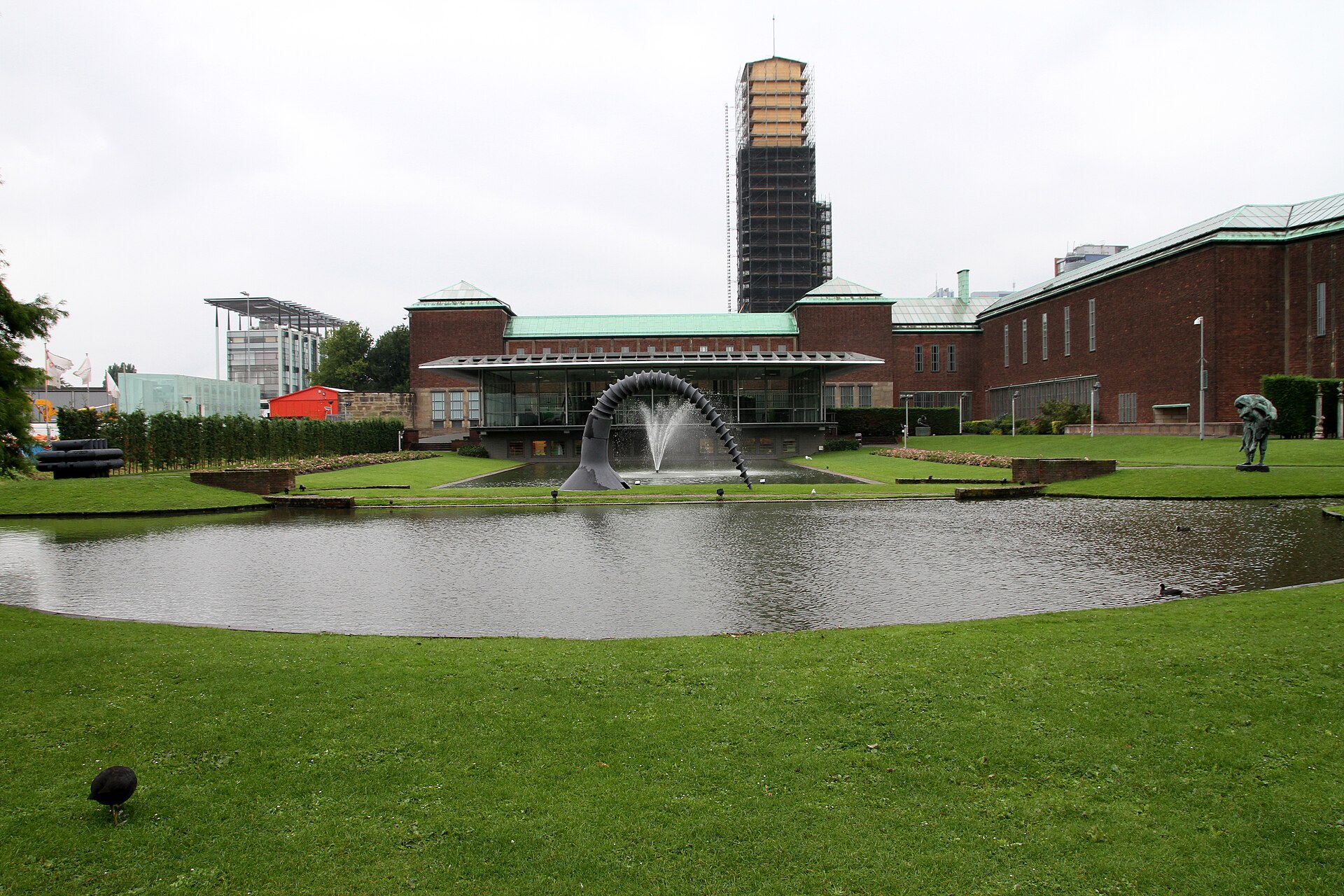
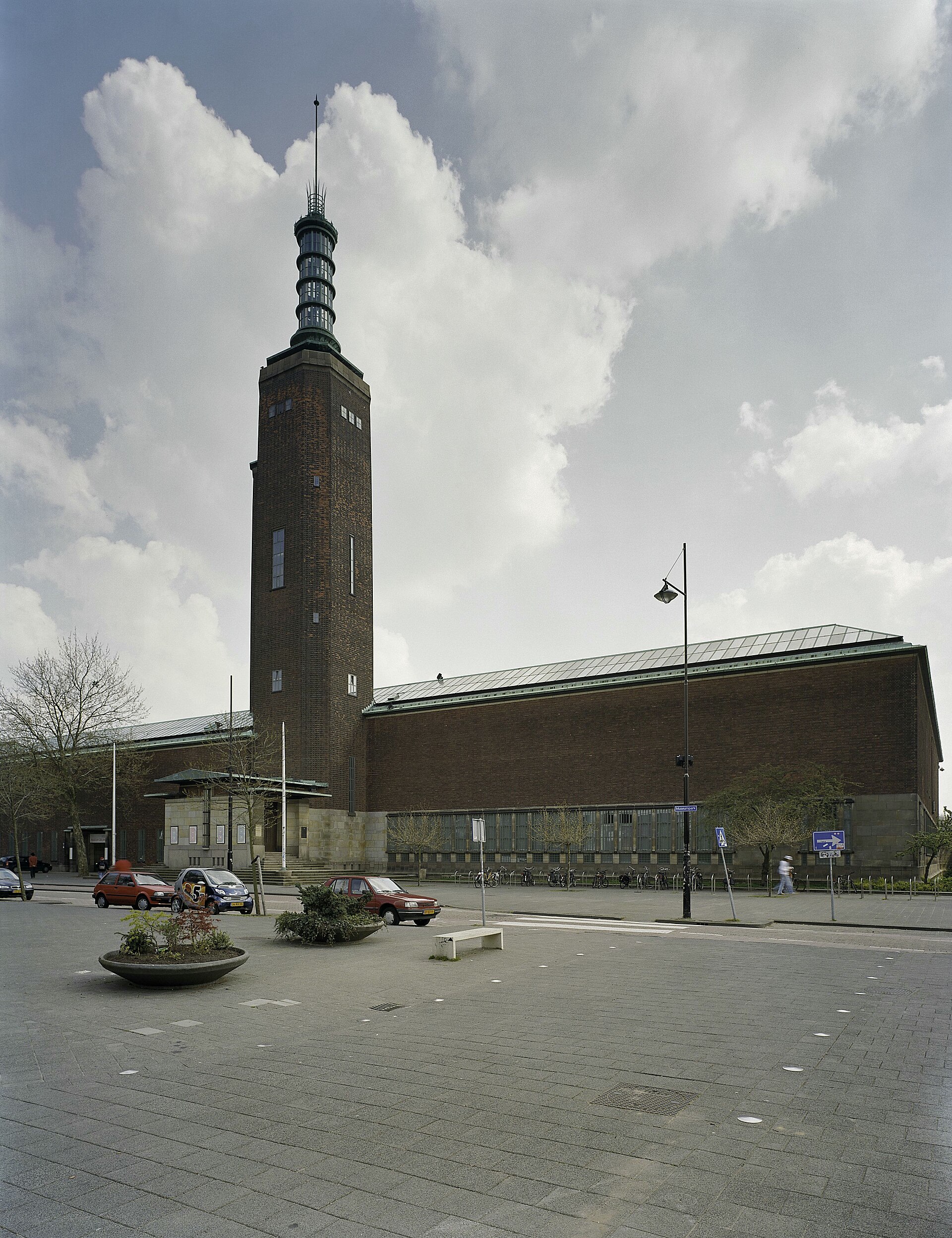
Museum Boijmans Van Beuningen traces its founding to 3 July 1849, when the city of Rotterdam accepted the collection of the local lawyer and collector Frans Jacob Otto Boijmans, who had died two years earlier and left his paintings, drawings and prints to the municipality on the condition that they be kept together and shown to the public. The young museum lost much of that founding collection in a fire in 1864, a loss the institution itself still cites as the first major event in its history. It operated for decades from an older building before the city commissioned a purpose-built museum from the architect Adriaan van der Steur, who designed the structure that still stands at Museumpark 18-20 and that opened in 1935, its distinctive tower a Rotterdam landmark ever since.
The building was extended more than once in the twentieth century: an exhibition wing by Alexander Bodon in 1971 gave the museum flexible temporary-show space, and in 2003 the Belgian architecture firm Robbrecht and Daem added a further set of galleries at a cost of roughly seventeen million euros, funded largely with public money. Both additions are now part of the argument over the building's future described later on this page.
Van Beuningen, the Koenigs drawings, and a name the museum still carries
The museum took its current double name in 1958, when the collection of the Rotterdam businessman Daniel George van Beuningen was added to the city's holdings; the spelling was standardised to Boijmans-Van Beuningen, later simplified further, in 1996. Van Beuningen's own collection had a complicated wartime history of its own: it included the F.W. Koenigs collection of Old Master drawings, one of the most important such collections ever assembled in the Netherlands, which the banker Franz Koenigs had been forced to pledge and ultimately lose control of under financial pressure connected to the German occupation, and which Van Beuningen acquired before donating it onward to the museum in 1940.
The museum's wartime director, Dirk Hannema, who led the institution from 1921 to 1945, is documented by the museum's own later research to have acquired works looted from Jewish collectors who were subsequently deported and murdered. Some of those works have since been returned to descendants of their original owners following formal provenance research the museum began in the late 1990s; six works out of roughly thirty flagged as suspicious were restituted between 1999 and 2009 alone, and further restitutions followed in 2019, 2020, 2022 and 2024. A 1996 request from a Jewish community representative, Ronny Naftaniel, that the museum drop the Van Beuningen name over his own wartime conduct did not succeed, and the museum's own restitutions page shows the process is still active: three further claims, including one filed with the Dutch Restitutions Committee as recently as March 2026, remained open as of the date this record was researched.
Eight centuries under one roof: what the collection actually is
On its own account, Museum Boijmans Van Beuningen is the only museum in the Netherlands offering a single continuous survey of Western art from the Middle Ages to the present, built from roughly fifty thousand objects given by around seventeen hundred private donors over the institution's history, and now totalling more than one hundred and fifty thousand objects in all. The museum itself singles out four areas where it considers its holdings genuinely world class: prints and drawings, early Netherlandish painting, Impressionism, and Surrealism, the last of these one of the largest such collections held by any European museum. A design and applied-art collection running from medieval ceramics to Gerrit Rietveld furniture rounds out the range, and the prints and drawings cabinet alone holds on the order of eighteen thousand drawings and sixty-nine thousand prints.
The scale of the holding is also the reason so little of it is ever visible at once: even before the 2019 closure, published accounts of the museum's own display practice put only a small fraction of the collection on the walls at any time, the rest in storage, which is precisely the problem the building now called the Depot was built to solve differently, by making the storage itself the thing on view.
Closed since 2019, and the mirrored bowl next door
The historic Museumpark building closed to the public in 2019 for a renovation the museum's own site describes as an operation of at least ten years, driven by the age of the building's electrical systems and the presence of asbestos as much as by any ambition to redesign the galleries. Rather than put the entire collection into ordinary warehouse storage for the duration, the museum and the Rotterdam architecture firm MVRDV built a new, separate structure a short walk away: the Depot Boijmans Van Beuningen, a thirteen-storey bowl-shaped building clad in more than sixteen hundred mirrored glass panels, which the museum and its architects describe as the world's first fully publicly accessible art depot. It opened on 5 November 2021, at a cost reported at ninety-four million euros, and holds the entire collection across fourteen climate-controlled storage compartments.
The building has drawn attention for its architecture as much as for its contents. Its origin story, told repeatedly by the architect Winy Maas, traces the shape to a stainless steel Ikea salad bowl grabbed off an office lunch table during early design discussions in 2013; Rotterdammers have since nicknamed it the flowerpot, the salad bowl and the grand mirror. The neighbouring Erasmus Medical Centre opposed the project during planning and, after opening, had to erect a screen to limit visual stimulation for children in a psychiatric ward facing the reflective facade. Architecture critics have been divided: the building has won design recognition, including a Dutch national best-building award, while others, including a widely read Guardian review discussed below, have questioned how well a circular building actually serves the practical business of storing rectangular art.
A renovation measured in cost overruns and a lawsuit over a vanishing wing
The renovation of the historic building has not moved in a straight line. Early plans, as reported around the time of the Depot's 2021 opening, described a roughly six-year closure with a reopening envisaged for the middle of the decade; by late 2021 that had already slipped to a stated 2028 target at a projected cost of about two hundred and sixty million euros. Rotterdam's city council approved a definitive design by the architecture firm Mecanoo, led by Francine Houben, on 4 December 2025, at a total project cost of up to three hundred fifty-nine million euros, of which the municipality contributes two hundred seventy million, the Droom en Daad foundation eighty million, and other donors nine million. On that plan, tendering runs through 2026, construction begins toward the end of that year or in early 2027, the building is due for delivery in 2029, and the museum expects to reopen to the public in 2030, a date the city's own published materials already flag as dependent on the construction schedule holding.
Mecanoo's design restores the visual presence of the original 1935 Van der Steur and 1971 Bodon structures by removing two later additions: Hubert-Jan Henket's 1991 pavilion and, more contentiously, the 2003 wing added by Robbrecht and Daem. The Belgian firm sued the museum and the city in 2021 to try to stop the demolition, arguing under Dutch copyright law's moral-rights provision that an architect retains standing to object to the destruction of a building even after ownership has passed to someone else, and pointing out that their wing had been built with seventeen million euros of public money at the museum's own request less than two decades earlier. Nothing in the sources read for this record establishes a final court ruling on that claim, and the demolition remains part of the definitive design the council approved in December 2025.
What a visitor can actually do today
None of the paintings, drawings or design objects described above hang in a public gallery in Rotterdam right now. What is open is the Depot, on Museumpark itself but a distinct address and a distinct building from the closed museum: entry is by timed ticket only, booked in advance, Tuesday to Sunday, with the museum's own site stating plainly that a visitor without a booked slot cannot get in. Inside, visitors move through glass-walled storage compartments holding parts of the collection arranged by material and size rather than by period or subject, can book a guided tour into one of the storage rooms with a conservator, and finish on a rooftop garden and restaurant with a view across the city. The Depot also runs its own changing programme of temporary exhibitions and installations independent of the closed building's own collection, including shows on show through 2026 built around individual artists and design themes rather than the museum's historical holdings.
The honest summary for a reader planning a visit is this: the address on this page, the building in its lead photograph, and almost everything described in the sections above as the collection are currently inaccessible, and will stay that way on the museum's own published timeline until 2030. The Depot is real, it is open, and it is worth a visit in its own right, but it is a different building answering a different question, and this record has tried to keep the two apart at every point rather than letting one stand in silently for the other.
What visitors say
What reaches visitors today is not the museum but its stand-in: the Depot, the mirrored storage building MVRDV completed in 2021 a short walk from the closed Museumpark site. Visitor accounts on aggregator platforms and the architecture press are consistently split along the same line. The building itself, its rooftop garden and its behind-the-scenes conservation views are praised more often and more strongly than the art inside it, which several sources note is genuinely hard to see well: racked works are visible mostly from a distance, through glass, without labels, and the museum's own stars, on published critical accounts, are kept back from the visible racks for conservation reasons. A minority of visitors report the building's height and glass floors uncomfortable.
What is praised, what is criticised
- Praised: the sheer range of the underlying collection once it is accessible at all - early Netherlandish panels, Dutch Golden Age painting, one of the largest Surrealist holdings in Europe, and a prints and drawings cabinet the museum itself calls world-famous
- Praised: the Depot building as a piece of architecture and as a novel idea, letting a visitor watch real conservation work and see the normally hidden back-of-house life of a museum collection
- Praised: the rooftop garden and restaurant, consistently singled out for its view over Rotterdam
- Criticised: the architecture critic Oliver Wainwright's assessment for the Guardian that, for a substantial ticket price, a visitor to the Depot actually gets to see comparatively little of the collection, since the stored racks are viewed from a distance through glass with no labels, the most celebrated paintings are kept out of visible storage, and much of the visitable space is occupied by the loaned corporate art collections of companies such as Rabobank and KPN rather than the museum's own holdings
- Criticised: the renovation project's repeatedly slipping schedule and growing cost: an original plan for roughly a six-year closure with an early-2020s reopening had, by the time of the Guardian's 2021 report, already become a 2028 target at a stated EUR 260 million, and by the Rotterdam city council's definitive-design approval of 4 December 2025 had become a 2030 target at EUR 359 million, criticised publicly by the museum's own former director, Sjarel Ex, and by a former city alderman for urban development as a prolonged failure of municipal decision-making and communication stretching back to the early 2000s
- Criticised: the current renovation design's demolition of the museum's own 2003 exhibition wing by the Belgian architects Robbrecht and Daem, contested by the original architects in a 2021 lawsuit invoking their legal right as authors to object to the destruction of their own building, a dispute this record found no confirmed final court outcome for in the sources read
- Criticised: unresolved wartime provenance: the museum's own restitution page lists three works still under active claim as of a March 2026 filing with the Dutch Restitutions Committee, on top of works already returned between 1999 and 2024, and a 1996 request by a Jewish community representative to remove Van Beuningen's name from the institution, itself tied to the wartime conduct of the wartime director Dirk Hannema, was not acted on
Ratings on other platforms
TripAdvisor: 4.2 from 1,459 ratings, read 12 August 2026
A platform average is a tertiary source: it moves, it is not audited, and we quote no visitor's words.
Questions about Museum Boijmans Van Beuningen
Where is Museum Boijmans Van Beuningen?
Museumpark 18-20, 3015 CX Rotterdam, Netherlands.
How much does it cost to visit?
Adult (Depot entry, including rooftop): EUR 20; Under 18: free; Students and CJP cardholders: EUR 10.5; Museumkaart, Rotterdampas, ICOM, Vereniging Rembrandt, VriendenLoterij VIP card: free. As confirmed 10 September 2026.
When is it open?
Tuesday-Sunday 11:00-17:00; Monday closed. Closed: Monday, Depot; the main Museumpark 18-20 building is closed every day of the week for renovation and has no public hours at all. The Depot's own opening-times page additionally lists specific holiday closures, confirmed 10 September 2026: closed King's Day (26 April), Liberation Day (5 May) and Christmas Day (25 December) in 2025; open, per its 2026 list, on Good Friday, the Easter weekend, Ascension Day, the Whit weekend, Boxing Day and New Year's Eve. As confirmed 10 September 2026.
How do you get there?
Metro: Metro lines A, B and C, stop Eendrachtsplein, on the museum's own directions page for reaching the site; Tram: Tram line 7, stop Museumpark, directly beside the building; Parking: A car park (Parking Museumpark) sits beneath the Depot with its entrance at Museumpark 32, though the museum's own page warns capacity is reduced by ongoing renovation works and recommends checking the municipal parking map for alternatives rather than parking on the street.
What should you see first?
The (Small) Tower of Babel (Pieter Bruegel the Elder, c. 1563); The Pedlar (Hieronymus Bosch, c. 1500-1510); The Glorification of the Virgin (Geertgen tot Sint Jans, c. 1490-1495); Titus at his Desk (Rembrandt van Rijn, 1655); Portrait of Armand Roulin (Vincent van Gogh, 1888); On the Threshold of Liberty (Rene Magritte, 1929).
What we could not confirm
- No final court ruling on Robbrecht and Daem's 2021 lawsuit over demolition of their 2003 wing was located in the sources read for this record; the definitive design approved in December 2025 still includes the demolition, so the dispute appears unresolved rather than settled in the museum's favour.
- Published reopening estimates for the renovated building have moved at least twice in the reporting read for this page (an early-2020s figure, then 2028, then 2030), and at least one specialist source raised 2032 as a downside scenario if the construction schedule slips again; this page treats 2030 as the museum's current stated target, not a settled fact.
- The museum's own budget figures (359 million euros total, 270 million from the municipality, 80 million from the Droom en Daad foundation, 9 million from other donors) come from the city of Rotterdam's own page and a specialist architecture-press report of the December 2025 definitive design; no line-item breakdown of what the money covers was read for this record.
- Whether the practical visitor details captured here (bag policy, accessibility provision, photography rules) will carry over unchanged to the reopened Museumpark building, as opposed to applying only to the Depot as it operates today, is not addressed in any source read for this record.
- The founding date is given consistently as 1849 across the museum's own material and Wikidata, but this record did not independently verify the exact wording of Boijmans's 1847 bequest beyond the summaries in the sources cited.
Images
Sources
- 1Wikidata, Museum Boijmans Van Beuningen (Q679527). Verified by label match and by claims: P31 art museum, P17 Netherlands, P131 Rotterdam, P625 coordinates 51 54 51.174 N, 4 28 24.028 E (51.914215, 4.473341), P571 inception 1849, P856 official website boijmans.nl, no P576 dissolved date, plus recorded P793 significant events for the 1864 fire and for restitution claims on the collection. wikidata.org/wiki/Q679527
- 2Museum Boijmans Van Beuningen, official 'About the museum' page. The museum's own self-description: founding in 1849, roughly fifty thousand objects from about seventeen hundred donors, its claim to be the only Dutch museum spanning the Middle Ages to the present, and its own naming of prints and drawings, early Netherlandish painting, Impressionism and Surrealism as its strongest areas, including calling its Surrealist collection one of the largest in Europe. Fetched 12 August 2026. boijmans.nl/en/about-the-museum
- 3Museum Boijmans Van Beuningen, official 'Renovation' page (English). The museum's own statement that the Museumpark buildings are closed for renovation and have been closed since 2019, and that the renovation is expected to take at least ten years; used here as the primary proof that the historic building is not open to the public. Fetched 12 August 2026. boijmans.nl/en/museum/renovation
- 4Museum Boijmans Van Beuningen, official 'Renovatie' page (Dutch), most recently updated after the December 2025 council vote. States the museum expects to reopen its doors in 2030, that tendering runs through 2026, and that construction begins at the end of 2026, on the museum's own account rather than a news report of it. Fetched 12 August 2026. boijmans.nl/museum/renovatie
- 5Gemeente Rotterdam (City of Rotterdam), official page on the Museum Boijmans Van Beuningen renovation. States the total cost at approximately 359 million euros, of which the municipality pays 270 million, the council approved the definitive design on 4 December 2025, construction begins at the end of 2026, and reopening is planned for 2030. Fetched 12 August 2026. rotterdam.nl/renovatie-museum-boijmans-van-beuningen
- 6Museum Boijmans Van Beuningen, news post 'We gaan bouwen aan de toekomst!' ('We are going to build the future!'), published 5 December 2025. Reports the Rotterdam city council's approval of the definitive design on the evening of 4 December 2025 by an overwhelming majority, and confirms the collection stays accessible through the Depot and touring exhibitions during construction. boijmans.nl/nieuws/we-gaan-bouwen-aan-de-toekomst
- 7Architectenweb.nl, report on the definitive design (definitief ontwerp) presented 30 October 2025. Confirms demolition of the 2003 Robbrecht and Daem wing under the approved design, gives the cost breakdown (359 million euros maximum, 270 million from Rotterdam, 80 million from the Droom en Daad foundation, 9 million from other donors), and gives 2029 as the delivery date with 2030 the expected public reopening, flagging 2032 as a possible outcome if the schedule slips. Fetched 12 August 2026. architectenweb.nl/nieuws/artikel.aspx?id=60051
- 8Museum Boijmans Van Beuningen, official Depot entry-prices page. Full current ticket list for the Depot: 20 euros adult, free under 18, free for Friends of Boijmans, 10.50 euros students and CJP cardholders, free for Museumkaart, Rotterdampas, ICOM, Vereniging Rembrandt and VriendenLoterij VIP cardholders, plus the 2.50-euro Marisol-exhibition surcharge running 9 October 2026 to 29 March 2027. Fetched 12 August 2026. boijmans.nl/en/Entry%20prices
- 9Museum Boijmans Van Beuningen, official opening-times and plan-your-visit pages. Depot hours Tuesday to Sunday 11:00-17:00, closed Monday; Restaurant Renilde's separate lunch and dinner hours; the statement that a booked time slot is required to enter the Depot; and directions by Metro (lines A, B, C, stop Eendrachtsplein), tram (line 7, stop Museumpark) and the Parking Museumpark car park beneath the Depot. Fetched 12 August 2026. boijmans.nl/en/Opening%20times
- 10Museum Boijmans Van Beuningen, official contact page. Phone +31 (0)10 441 9400, email [email protected], postal address. Fetched 12 August 2026. boijmans.nl/en/contact
- 11Museum Boijmans Van Beuningen, official accessibility page and Depot FAQ page. Wheelchair accessibility, companion-card policy, bag and coat rules, and Restaurant Renilde's location and access without a Depot ticket. Fetched 12 August 2026. boijmans.nl/en/accessibility
- 12English Wikipedia, Museum Boijmans Van Beuningen. Cross-checked founding and renaming history, the 1935 Van der Steur building and later Bodon and Robbrecht-and-Daem additions, named collection highlights including Titus at his Desk and Portrait of Armand Roulin, the Dirk Hannema wartime directorship and looted-art history, and visitor-number figures for 2013-2018. en.wikipedia.org/wiki/Museum_Boijmans_Van_Beuningen
- 13English Wikipedia, Depot Museum Boijmans Van Beuningen. The Depot's MVRDV design, its 2021 opening cost of 94 million euros, physical dimensions, the Ikea Blanda Blank origin story, storage arrangement across fourteen compartments, and both positive and negative critical reception including the Oliver Wainwright review. en.wikipedia.org/wiki/Depot_Museum_Boijmans_Van_Beuningen
- 14Oliver Wainwright, 'Slapstick architecture: how a Euro3.99 Ikea salad bowl became part of the Rotterdam skyline', The Guardian, 12 November 2021. Read in full as raw fetched text, not a summarised excerpt. The architect Winy Maas's own account of the design's origin, the building's 94 million euro cost, the neighbouring Erasmus hospital's opposition, the critical argument that visitors see comparatively little of the actual collection for the ticket price, that much of the visitable space houses corporate loan collections (Rabobank, KPN) rather than the museum's own art, and the then-current 2028 reopening target and 260 million euro renovation cost for the historic building, together with the Robbrecht-and-Daem demolition dispute. theguardian.com/artanddesign/2021/nov/12/slapstick-architecture-ikea-salad-bowl-rotterdam-depot-boijmans-van-beuningen
- 15NOS, report on Robbrecht en Daem's legal action against Museum Boijmans Van Beuningen over demolition of their 2003 wing, published 16 June 2021, the day before the Rotterdam city council's vote on the renovation plan. Confirms the lawsuit's initiation, the architects' moral-rights argument under Dutch copyright law, and the 17-million-euro public cost of the original 2003 wing. nos.nl/l/2385366
- 16Museum Boijmans Van Beuningen, official page on ongoing and settled restitution claims. Lists three works under active claim as of a March 2026 Restitutions Committee filing (an anonymous Three Marys at the Tomb, and two Honore Daumier works possibly from the Jakob Goldschmidt collection), and settled restitutions from 1999 through 2024 including a 2024 Max Liebermann drawing and a 2024 Hodegetria ivory relief. Fetched 12 August 2026. boijmans.nl/en/restitutions-ongoing-and-settled-restitution-claims
- 17TripAdvisor, Museum Boijmans Van Beuningen attraction page. Aggregate rating 4.2 out of 5 from 1,459 reviews, read 12 August 2026; used only for the cited numeric aggregate, never for reproduced review text. Recurring visitor themes read from the page (architecture and rooftop praised, some vertigo at height and information placement complaints) are described in this record's own words in reception.consensus rather than quoted. tripadvisor.com/Attraction_Review-g188632-d314945-Reviews-or210-Museum_Boijmans_Van_Beuningen-Rotterdam_South_Holland_Province.html
- 18Wikimedia Commons, Category:Museum Boijmans Van Beuningen, Category:Exterior of Museum Boijmans Van Beuningen and Category:Interior of Museum Boijmans Van Beuningen. commons.wikimedia.org/wiki/Category:Museum_Boijmans_Van_Beuningen
- 19Museum Boijmans Van Beuningen, official 'Renovation' page (English), re-fetched for the 10 September 2026 re-confirmation pass. Confirms the historic Museumpark building remains closed since 2019, the renovation is described as taking at least ten years, asbestos removal is reported nearly complete, and this English page itself states no target reopening date. boijmans.nl/en/museum/renovation
- 20Museum Boijmans Van Beuningen, official 'Renovatie' page (Dutch), re-fetched 10 September 2026. Confirms the 2030 reopening target is unchanged, construction is planned to begin end of 2026 / early 2027, and the definitive design was approved by Rotterdam city council 4 December 2025. boijmans.nl/museum/renovatie
- 21Museum Boijmans Van Beuningen, official Depot entry-prices page, re-fetched 10 September 2026. Confirms all admission tiers unchanged: Adult EUR 20, Students/CJP EUR 10.50, under-18 free, Friends of Boijmans/Museumkaart/Rotterdampas/ICOM/Vereniging Rembrandt/VriendenLoterij VIP free, and the EUR 2.50 Marisol-exhibition surcharge (9 October 2026-29 March 2027) unchanged; no free-admission day published. boijmans.nl/en/Entry%20prices
- 22Museum Boijmans Van Beuningen, official opening-times page, re-fetched 10 September 2026. Confirms Depot hours Tuesday-Sunday 11:00-17:00, closed Monday, and additionally lists specific holiday closures/openings (2025: closed King's Day, Liberation Day, Christmas Day; 2026: open Good Friday, Easter weekend, Ascension Day, Whit weekend, Boxing Day, New Year's Eve) not previously captured on this record. boijmans.nl/en/Opening%20times
- 23Museum Boijmans Van Beuningen, official contact page, re-fetched 10 September 2026. Phone +31(0)10-4419400 and email [email protected] unchanged from the 12 August 2026 reading. boijmans.nl/en/contact