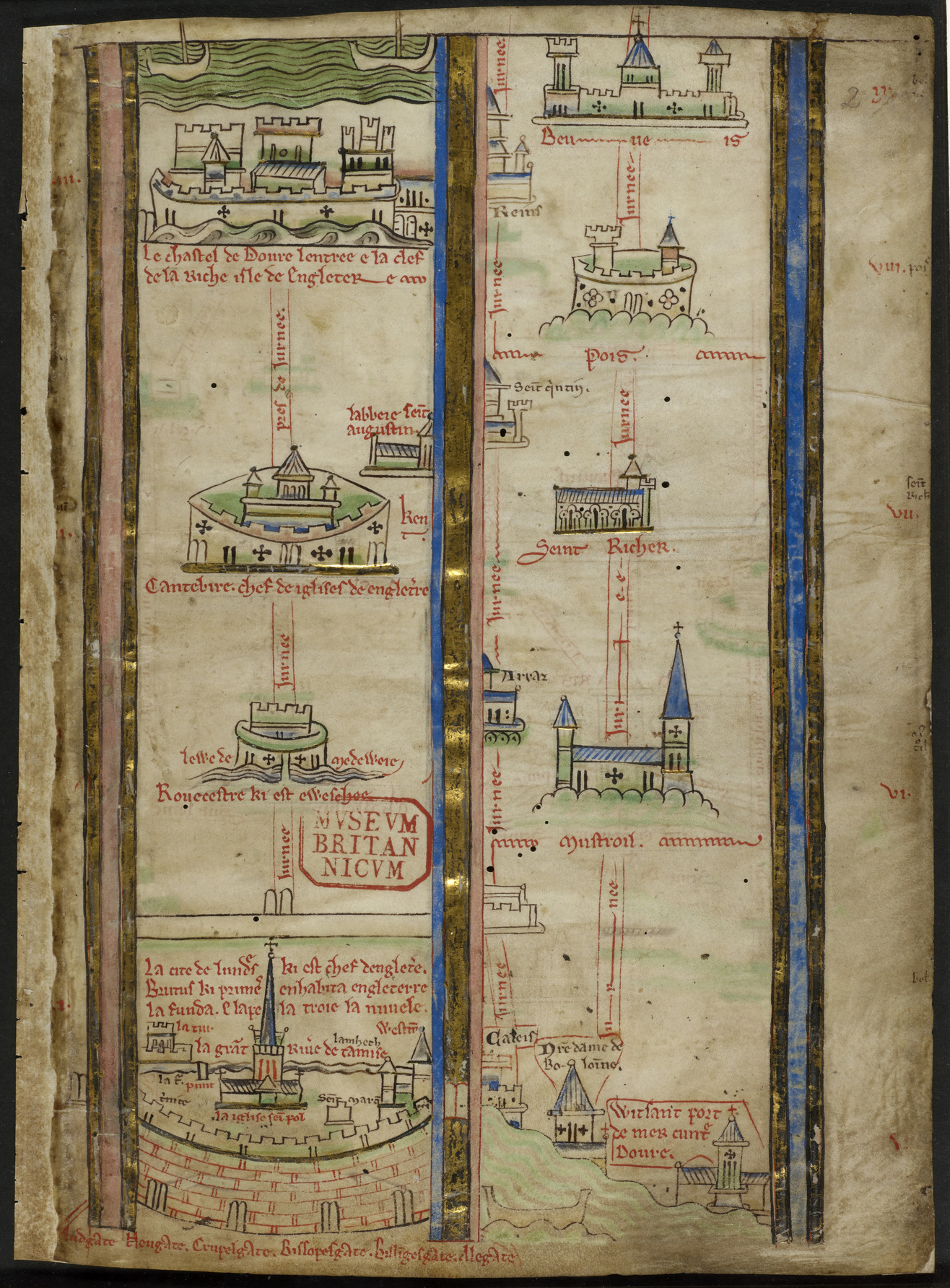
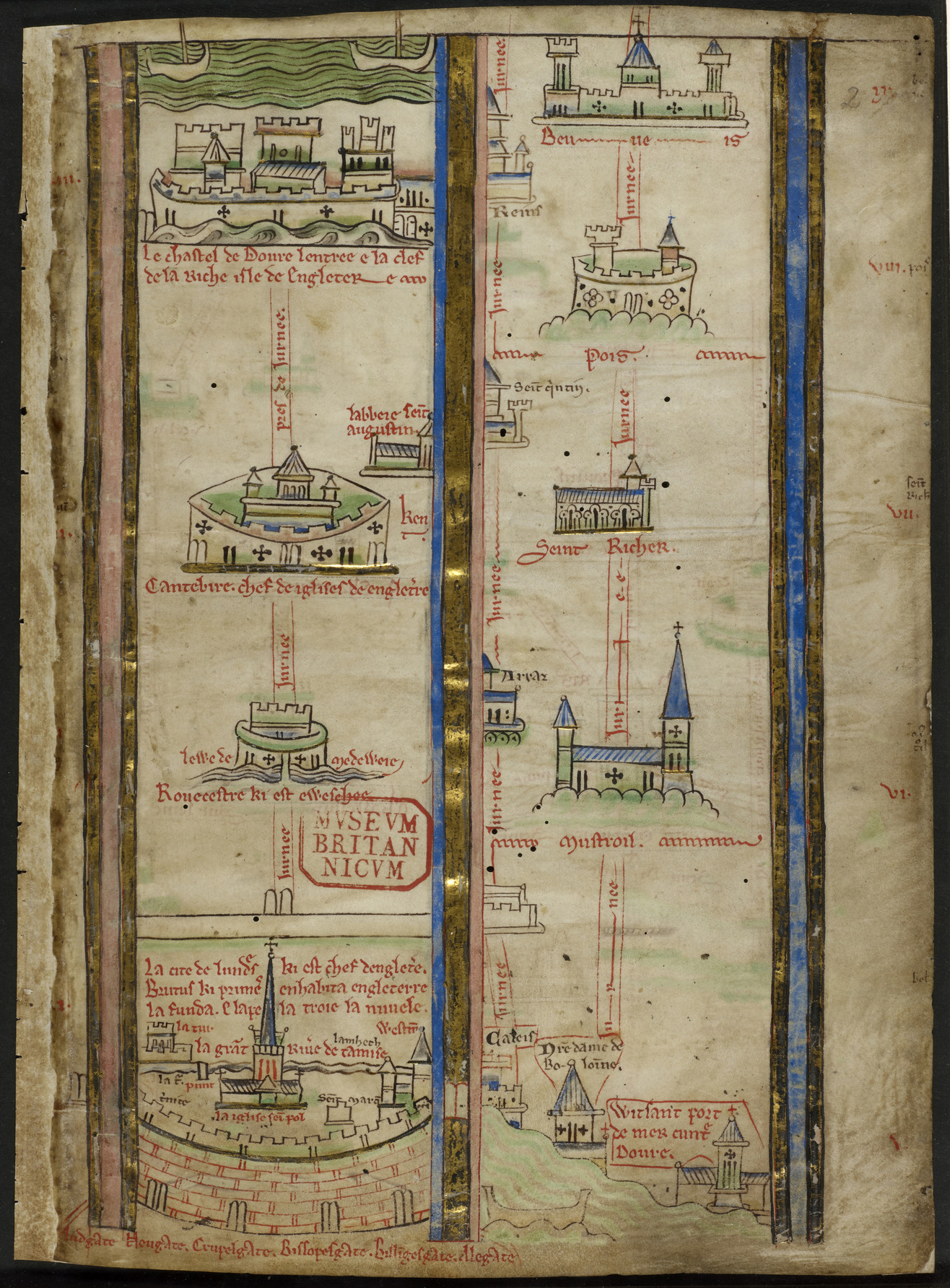
Itinerary from London to the Holy Land
c. 1250-1259 · Pen and ink line drawing with tinted colour...
British Library, London
 English · 1200-1259
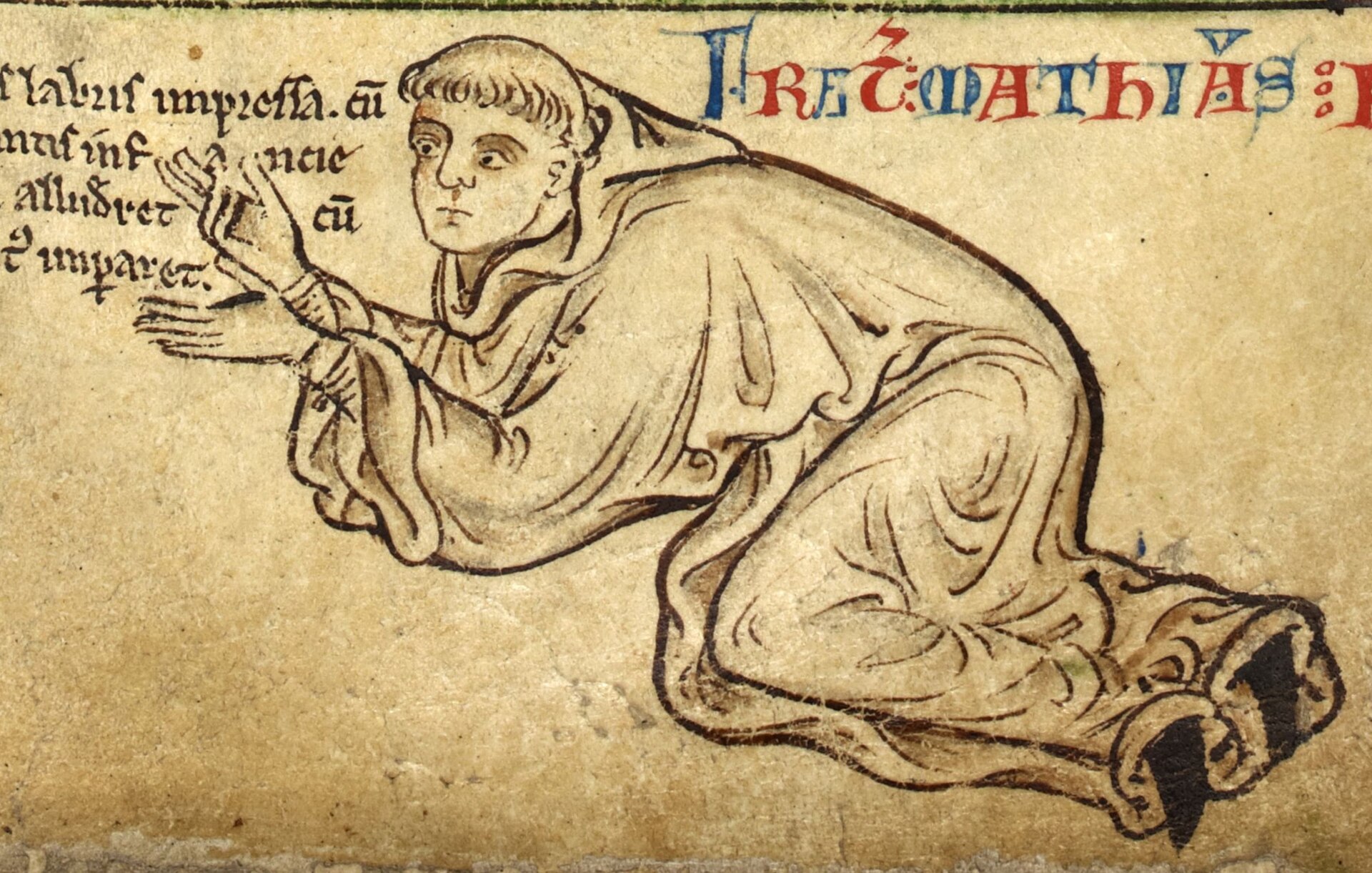
Matthew Paris's own self-portrait: a small kneeling figure, named by an inscription, at the feet of the Virgin and Child, on folio 6r of British Library Royal MS 14 C VII, drawn in the same prefatory booklet that opens with his itinerary maps. The British Library's own catalogue describes the drawing as showing the author, whose name is attached, in prayer at their feet, confirming the identification rests on an inscription rather than a later guess.
British Library, London| Full name | Matthew Paris (Latin: Mattheus Parisiensis) |
|---|---|
| Worked as | Benedictine monk, Chronicler, Illuminator, Cartographer |
| Born | c. 1200 · Not documented. Conventionally placed by working back from... |
| Died | 1259 · St Albans Abbey, Hertfordshire, England |
| Nationality | English |
| Movement | English Gothic manuscript illumination |
| In this archive | 1 artwork |
| Sources | 20 cited |
| Last verified |
About this page 1 artwork in the archive · Last verified · 20 sources cited
Matthew Paris was a Benedictine monk of St Albans Abbey who wrote and drew his own histories, an unusual combination in a thirteenth century scriptorium where the scribe and the illuminator were normally different people. He inherited the post of house chronicler from Roger of Wendover in 1236 and turned it into the Chronica Majora, a history of the known world carried down toward his own lifetime and illustrated throughout in a fast pen and wash technique that let one man keep pace with his own text.
He is one of very few medieval makers for whom a self-portrait by his own hand survives: a small kneeling figure, named by an inscription, at the feet of the Virgin and Child on a page he drew himself. Most claims about a medieval artist's face are guesswork attached centuries later to an anonymous image. Here the identification rests on the artist's own label, in his own manuscript, checked against the holding library's own catalogue.
What makes him more than a curiosity is the range of what survives under his hand or his scriptorium's: two volumes of chronicle at Cambridge, a history of England and a set of itinerary maps at the British Library, a verse life of a royal saint usually credited to him, and a personal acquaintance with the reigning king close enough that Henry III is recorded sitting beside him and, in Paris's own words, guiding his pen. Almost nothing by him has ever reached a saleroom, because almost nothing by him has ever left the institutions that have held it since the sixteenth century or earlier. This page sets out what is actually established about the man, the corpus, and the live argument over whose hand drew what.
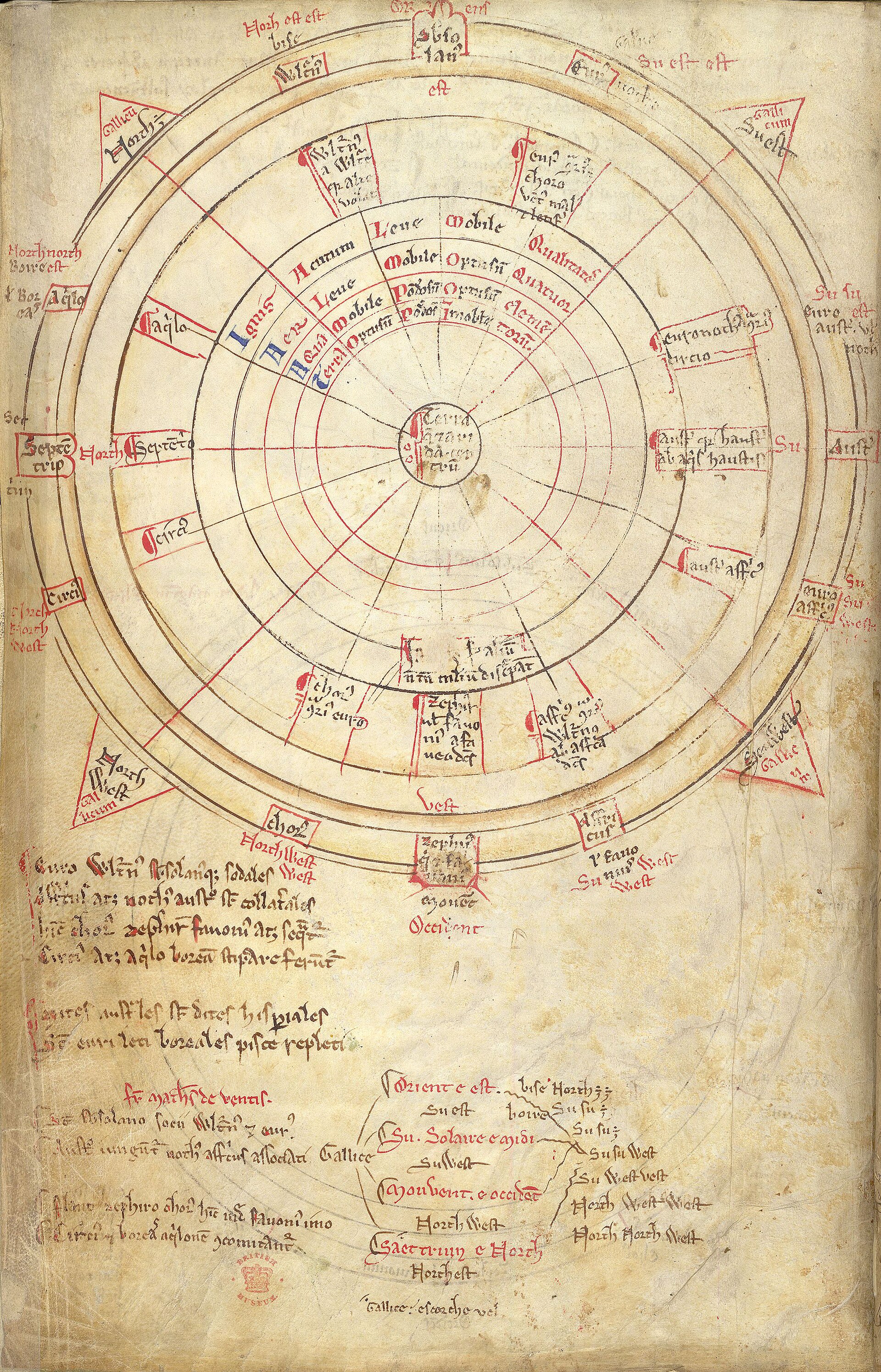
Conventionally placed birth, calculated backward from his 1217 entry to St Albans. No birthplace or family is documented.3
Enters St Albans Abbey as a Benedictine monk, probably in his teens.31
Succeeds Roger of Wendover as St Albans's official chronicler on Wendover's death, inheriting and continuing the Flores Historiarum as the basis of his own Chronica Majora.34
Present at Henry III's dinner following the translation of the shrine of Edward the Confessor at Westminster.5
Sent to Norway by Pope Innocent IV, carrying an invitation from Louis IX to King Haakon IV to join the crusade, to reform the Benedictine abbey of St Benet Holm on Nidarholm. His only recorded journey outside England.5
Rebukes Henry III to his face over injuries done to St Albans Abbey; the king, in the surviving account, answers him lightly.5
Main text of the Chronica Majora reaches its principal terminus; Paris continues a shorter version to the year of his death.34
Henry III spends a week at St Albans and keeps Paris close, telling him, in the chronicler's own words, that he guided his pen with much goodwill and diligence.3
Dies at St Albans. The continuation of the Chronica Majora bound at the end of the Corpus Christi volumes is carried on afterward by another, unidentified hand.31
Archbishop Matthew Parker gives his manuscript collection, including the two Chronica Majora volumes, to Corpus Christi College, Cambridge, with a clause forfeiting the whole gift to another college if it is not kept intact.11
George II gives the Old Royal Library, including the volume now catalogued as Royal MS 14 C VII, to the British Museum.12
The British Library is established as an independent institution and the Royal manuscripts, this volume among them, transfer to it.12
There is effectively no market for Matthew Paris. Every major manuscript associated with him has been in continuous institutional custody since at latest the sixteenth century: the two Chronica Majora volumes since Archbishop Matthew Parker's 1574 gift to Corpus Christi College, Cambridge, the Historia Anglorum since it entered the English royal library and passed to the British Museum in 1757 and the British Library in 1973. No complete manuscript by him has ever been offered at public auction, and no record of a genuine loose leaf in his own hand reaching the market was found in the sources consulted. What occasionally circulates in the book trade are later reproductions, chiefly the nineteenth century Rolls Series printed edition of the Chronica Majora and the Roxburghe Club's 1920 facsimile of the Estoire de Seint Aedward le Rei. Neither is the medieval object itself, and this record does not treat either as a substitute for one.
| Institution | City | Holdings | Note |
|---|---|---|---|
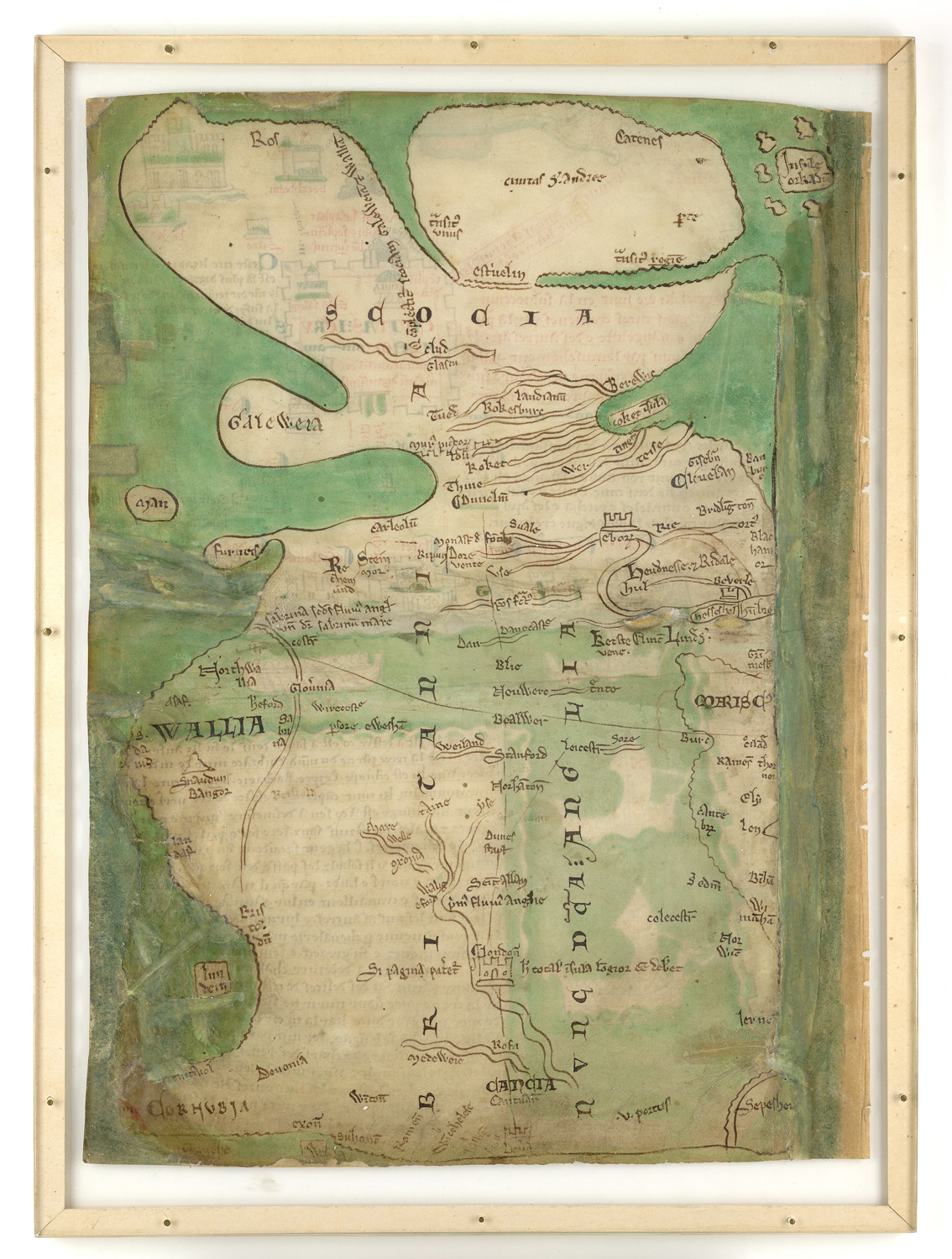
| British Library | London | Historia Anglorum with its prefatory itinerary maps and map of Britain (Royal MS 14 C VII); Liber Additamentorum (Cotton MS Nero D I); Abbreviatio Chronicorum (Cotton MS Claudius D VI); a further map of Britain (Cotton MS Julius D VII). | Reached the Museum via George II's 1757 gift of the Old Royal Library; the Royal manuscripts transferred to the newly independent British Library in 1973. |
| Corpus Christi College, Cambridge (Parker Library) | Cambridge | Chronica Majora, in two volumes: MS 26 (to 1188) and MS 16 (1189-1253), with their own itinerary and Britain maps and around a hundred marginal drawings. | Given to the college in 1574 by Archbishop Matthew Parker, who had gathered manuscripts scattered at the Dissolution of the Monasteries, under a condition that forfeits the whole gift if it is not kept intact. |
| Cambridge University Library | Cambridge | La Estoire de Seint Aedward le Rei, a verse life of Edward the Confessor usually credited to Paris (MS Ee.3.59). | Sole surviving copy. Facsimiled in full by the Roxburghe Club in 1920, together with related leaves of a Life of St Alban held at Trinity College, Dublin. |
Paris entered St Albans Abbey as a Benedictine monk in 1217, probably in his teens, which is how his birth is placed at around 1200.
Paris entered St Albans Abbey as a Benedictine monk in 1217, probably in his teens, which is how his birth is placed at around 1200. Nothing about his birthplace or family is documented; a connection sometimes proposed to a Paris family of Hildersham, Cambridgeshire, is not established, and the surname itself was not uncommon in thirteenth century England and does not by itself indicate any personal connection to the city of Paris. His only recorded journey outside England, discussed below, went to Norway rather than France.
At St Albans, a wealthy and well connected Benedictine house on the great north road, Paris trained as scribe, artist and, by some accounts, metalworker. What set him apart from most monastic chroniclers of his period is that he did not hand his text to a separate illuminator once it was written. He drew the pictures himself, in a rapid pen and ink line finished with translucent colour washes rather than fully modelled opaque miniature painting, a technique modern scholarship calls tinted drawing. It let him illustrate a chronicle at the pace a working historian needed, rather than at the pace a commissioned painter could supply.
Roger of Wendover, the abbey's chronicler, died in 1236, and Paris succeeded him.
Roger of Wendover, the abbey's chronicler, died in 1236, and Paris succeeded him. He revised and continued Wendover's Flores Historiarum and built it into his own life's project, the Chronica Majora, a history of the world from Creation carried to 1253 in its main text and continued in a shorter form to the year of his own death. The finished work survives in two large volumes at Corpus Christi College, Cambridge: Parker Library MS 26, running to 1188, and MS 16, running from 1189 to 1253, together carrying around a hundred marginal drawings alongside full page illustrations, fragmentary maps and an itinerary of their own.
He also produced an abridged history of England, the Historia Anglorum, covering 1070 to 1253, now British Library Royal MS 14 C VII, prefaced by the fullest surviving copy of his itinerary map from London toward the Holy Land. Iconotheca holds a full record on that object. The standard art historical treatment of the drawings across the whole corpus is Suzanne Lewis's 1987 study, 553 pages built around the two Cambridge volumes; there is no shorter reference that supersedes it.
Paris's own text carries an outspoken, consistent editorial position, not a modern reading imposed on it afterward.
Paris's own text carries an outspoken, consistent editorial position, not a modern reading imposed on it afterward. He wrote with open hostility toward what he saw as papal encroachment on the English church and toward the enrichment of Roman curial officials at English expense, and he was equally sharp about Henry III's foreign favourites, particularly the king's Poitevin ministers, whose influence and self enrichment he condemned repeatedly across the chronicle. This is a documented stance in his own writing, not an interpretation read into it by a later historian.
He did not spare the king to his face either. In 1250 he rebuked Henry III directly over injuries done to St Albans Abbey; Henry, in the account that survives, answered him lightly rather than with anger. The two facts sit together oddly only if you expect a court chronicler to be a flatterer. Paris was something closer to an institutional advocate who happened to have the king's ear, and used it.
That access was real and documented, not a chronicler's self-flattery.
That access was real and documented, not a chronicler's self-flattery. Paris was present at Henry III's dinner following the October 1247 translation of the shrine of Edward the Confessor at Westminster. Ten years later, in 1257, Henry spent a week at St Albans and kept Paris close throughout the visit. Paris's own account of it is the closest thing to a personal quotation this record has: the king, he says, guided my pen with much goodwill and diligence, wanting his reign recorded accurately.
A monk with that kind of standing was unusual, and it explains a good deal about the confidence with which Paris wrote about matters far outside a cloister: royal marriages, continental wars, the affairs of a foreign king, and his own diplomatic errand abroad.
In 1248, Pope Innocent IV appointed Paris visitor to the Benedictine houses of Norway, with the specific task of reforming the abbey of St Benet Holm on the island of Nidarholm near Trondheim, whose...
In 1248, Pope Innocent IV appointed Paris visitor to the Benedictine houses of Norway, with the specific task of reforming the abbey of St Benet Holm on the island of Nidarholm near Trondheim, whose finances and discipline had collapsed after its abbot absconded with the monastery's seals. On the same journey Paris carried a personal letter from Louis IX of France inviting King Haakon IV of Norway to join what became Louis's crusade to Egypt. The mission put a monk of St Albans briefly inside the diplomatic traffic of the Seventh Crusade, and it began a friendship with Haakon that Paris's own later references to the Norwegian king suggest lasted the rest of his life.
It was the only time Paris is recorded leaving England. Everything else attributed to him in the way of first hand observation of the wider world, the itinerary maps included, was compiled at St Albans from what visitors, correspondence and returning travellers told him, not from personal travel.
Paris drew a strip map of the pilgrim and crusader route from London to the Holy Land at least four times across different manuscripts, each version different in length and detail.
Paris drew a strip map of the pilgrim and crusader route from London to the Holy Land at least four times across different manuscripts, each version different in length and detail. The fullest, prefacing the Historia Anglorum in Royal MS 14 C VII, is the subject of a separate record in this archive. It is not a map of a country in the way his separate Britain maps are; it is a sequence of walled towns strung along a drawn road, read bottom to top, each linked to the next by a line marked with the number of days between them.
Daniel Connolly has argued, and Dana Vasiliu independently makes a related case, that these maps functioned as instruments of imagined pilgrimage: a way for monks bound by vows of stability to perform a journey to Jerusalem in the mind, one town at a time, that they could never make in the body. Neither claim rests on a statement of intention by Paris himself; both are arguments from the maps' physical design, made by named scholars in citable publications, and this record reports them as arguments rather than as the chronicler's own stated purpose.
Two folios after the itinerary in the same prefatory booklet of Royal MS 14 C VII, folio 6r carries a tinted drawing of the Virgin and Child with a small kneeling figure at their feet, in the...
Two folios after the itinerary in the same prefatory booklet of Royal MS 14 C VII, folio 6r carries a tinted drawing of the Virgin and Child with a small kneeling figure at their feet, in the conventional posture of a donor or votive portrait. The British Library's own catalogue describes it as the author, whose name is attached, in prayer at their feet: an inscription, not a modern attribution, identifies the kneeling figure as Paris himself.
That inscription is the whole basis for calling this a secure self-portrait rather than a disputed one. Portrait identifications in this period are contested constantly, most often because a later dealer or cataloguer supplied a name an image never carried at the time it was made. This one does not depend on later guesswork: the label is in the same hand, on the same page, in the same campaign of work as the itinerary maps beside it.
A single secure self-portrait does not settle who drew everything attributed to Paris, and this is the direct analogue, in a manuscript context, of the workshop-hand problem that runs through the...
A single secure self-portrait does not settle who drew everything attributed to Paris, and this is the direct analogue, in a manuscript context, of the workshop-hand problem that runs through the whole of this archive. Richard Vaughan's 1958 paleographic study is still the basic method for separating Paris's own script and drawing from his assistants' and continuators', and it is not a closed question everywhere it has been applied.
Two cases show the range of disagreement. Daniel Connolly argues from differences in script, spelling and the added gold decoration that the specific copy of the itinerary bound into Royal MS 14 C VII was made by a later, unidentified scribe for a royal patron, probably Edward I, rather than by Paris for a monastic reader at all, against the standing institutional attribution. Separately, four surviving leaves of a French verse life of Thomas Becket, known as the Becket Leaves and held as British Library Loan MS 88, are attributed to Paris by Janet Backhouse and not by Nigel Morgan. Neither dispute is adjudicated by this record; both are reported with the names attached to each position, because that is what the evidentiary standard here requires. What is not disputed is that the continuation of the Chronica Majora, bound at the end of the same volume that carries this itinerary, was written by another hand entirely after Paris's death in 1259.
The core of the corpus sits in three collections.
The core of the corpus sits in three collections. The British Library holds the Historia Anglorum with its itinerary maps and separate map of Britain (Royal MS 14 C VII), the Liber Additamentorum, a supporting volume of documents and drawings (Cotton MS Nero D I), the Abbreviatio Chronicorum (Cotton MS Claudius D VI) and a further map of Britain (Cotton MS Julius D VII). Corpus Christi College, Cambridge holds the two volumes of the Chronica Majora itself (Parker Library MS 26 and MS 16). Cambridge University Library holds the sole surviving copy of La Estoire de Seint Aedward le Rei, a verse life of Edward the Confessor usually credited to Paris (MS Ee.3.59), facsimiled in full by the Roxburghe Club in 1920 together with related leaves of a Life of St Alban held at Trinity College, Dublin.
No Matthew Paris autograph manuscript was identified at the Bodleian Library in the sources consulted for this record, and none is claimed here; where a maker's work sits is stated only where a specific holding could be verified.
St Albans Abbey was dissolved in 1539, scattering its library along with every other English monastery's.
St Albans Abbey was dissolved in 1539, scattering its library along with every other English monastery's. The two Chronica Majora volumes reached Corpus Christi College, Cambridge by a specific and documented route: Matthew Parker, Master of Corpus Christi and later Archbishop of Canterbury, spent decades gathering manuscripts that had come loose from the dissolved houses, partly to build a documentary case for an English church independent of Rome, and gave his whole collection, some 480 manuscripts including the Chronica Majora, to the college in 1574. His gift carried a deliberately harsh condition: if the college let the collection fall into serious disrepair or loss, it would pass first to Gonville and Caius College and then to Trinity Hall. That clause is generally credited with keeping the collection intact for over four centuries.
The Historia Anglorum took a different, later documented route: it carries a Royal shelfmark, meaning it belonged to the Old Royal Library assembled by English sovereigns, and George II gave that library, some 2,000 manuscripts, to the newly founded British Museum in 1757. It transferred to the British Library on that institution's independence in 1973. The chain back from that gift is itself documented in stages rather than continuous: an inscription dates it to John Russell, Bishop of Lincoln, by 1488; Polydore Vergil used it for his Anglica Historia of 1534; it was in the Upper Library at Westminster after about 1547; the antiquary John Bale recorded it in the custody of Bartholomew Traheron, lent to Henry Fitzalan, Earl of Arundel; Arundel lent it to Matthew Parker for his 1571 edition of the chronicle; it passed to John Lumley, then to Henry Frederick, Prince of Wales, and appears in the Royal Library catalogues of 1666 and 1698 before the 1757 gift. What is not documented in the sources consulted is where it was kept in the roughly two and a half centuries between its production at St Albans and the 1488 Russell inscription.
There is effectively no market for Matthew Paris, and this record says so plainly rather than inventing one.
There is effectively no market for Matthew Paris, and this record says so plainly rather than inventing one. Every major manuscript associated with him has been in continuous institutional custody since at latest the sixteenth century: the two Chronica Majora volumes since Parker's 1574 gift, the Historia Anglorum since it entered the English royal library and passed to the British Museum in 1757. No complete manuscript by him has ever been offered at public auction, and no auction record for a genuine loose leaf in his own hand was found in the sources consulted. A confirmed discovery of that kind would be a scholarly event rather than a market one.
What occasionally circulates in the book trade are later reproductions: the nineteenth century Rolls Series printed edition of the Chronica Majora, and the Roxburghe Club's 1920 facsimile of the Estoire de Seint Aedward le Rei. Neither is the medieval object itself, and neither is treated here as a substitute for one.
Several questions a careful reader would want answered are not answered in the sources consulted, and are recorded here rather than smoothed over.
Several questions a careful reader would want answered are not answered in the sources consulted, and are recorded here rather than smoothed over. Whether the itinerary copy in Royal MS 14 C VII is autograph Paris or a later royal scribe's work is a live scholarly dispute. Whether the Becket Leaves are his is disputed by name between Backhouse and Morgan. His birthplace and the reason for his surname are simply not documented. Full authorship of the Estoire de Seint Aedward le Rei, though usually credited to him, is treated in the specialist literature as not entirely closed. And how many of the roughly hundred marginal drawings across the two Chronica Majora volumes are his own hand rather than a continuator's, especially in the portion of the chronicle completed after his death in 1259, has not been mapped drawing by drawing in any source this record could verify.
Benedictine monk; Chronicler; Illuminator; Cartographer. c. 1200-1259.
Born c. 1200, Not documented. Conventionally placed by working back from his 1217 entry to St Albans; died 1259, St Albans Abbey, Hertfordshire, England.
British Library (London); Corpus Christi College, Cambridge (Parker Library) (Cambridge); Cambridge University Library (Cambridge).
There is effectively no market for Matthew Paris. Every major manuscript associated with him has been in continuous institutional custody since at latest the sixteenth century: the two Chronica Majora volumes since Archbishop Matthew Parker's 1574 gift to Corpus Christi College, Cambridge, the Historia Anglorum since it entered the English royal library and passed to the British Museum in 1757 and the British Library in 1973.
Whether the itinerary copy bound into British Library Royal MS 14 C VII is autograph Matthew Paris, as the library's catalogue and Vaughan's attribution hold, or the work of a later scribe for a royal patron, as Daniel Connolly has argued, is unresolved.
Last verified
One artwork and its story every Tuesday, with the picture: who owned it, what it made, and what closes soon in the exhibition calendar. No promotion, and nothing we cannot cite.
We send one email to confirm the address and keep nothing else. Every letter carries a one-click unsubscribe. How we handle your data.


