Maria Sibylla Merian
 1647-1717
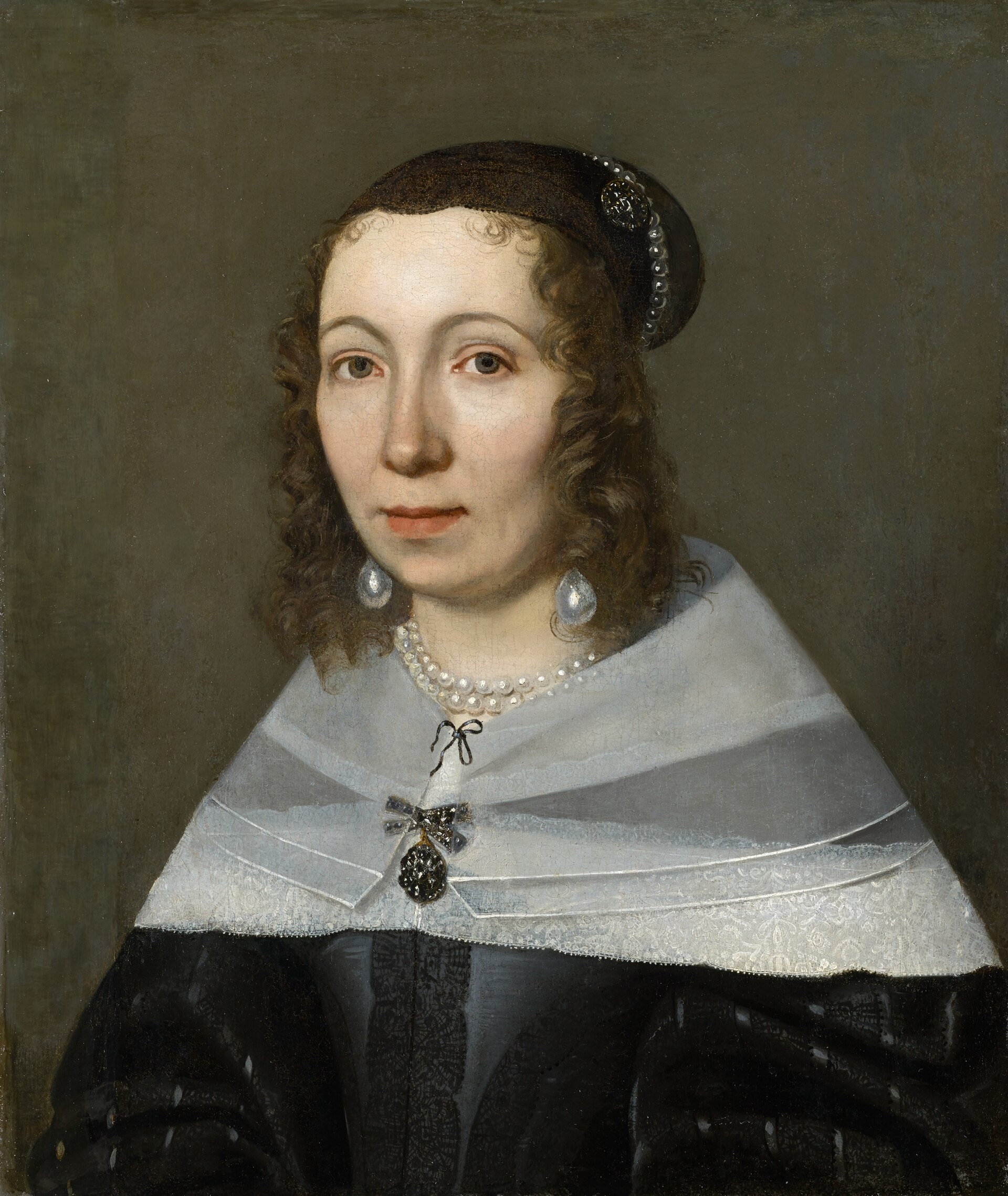
Oil on canvas, 1679, Kunstmuseum Basel Inv. 436, credited to Jacob Marrel, her stepfather, and titled as a portrait of Merian at 32. The Natural History Museum captions it 'possibly by Marrel' and the SHE Wrote database calls the sitter 'a woman called' Merian. The identification is long-standing but not independently verified, so it is not marked as certain.
Kunstmuseum Basel (public domain, Commons)| Full name | Maria Sibylla Merian (Maria Sibylla Graff by marriage) |
|---|---|
| Worked as | Painter, Engraver, Publisher, Naturalist |
| Born | 2 April 1647 (Stearn gives 4 April) · Frankfurt am Main |
| Died | 13 January 1717 · Amsterdam (Stearn says Leiden |
| Nationality | German-born, worked in the Dutch Republic |
| Movement | Seventeenth-century natural history illustration |
| Sources | 28 cited |
| Last verified |
About this page Last verified · 28 sources cited
On this page 13 sections
ContentsClose
Maria Sibylla Merian published three books on the life cycles of European caterpillars and one on the insects of Surinam, engraved the plates for some of them herself and sold the results from her own house. She put each insect on the plant it ate, stage by stage, at a time when animal and plant images normally lived in separate volumes. The Surinam book of 1705 has 60 plates. The standard account stops there.
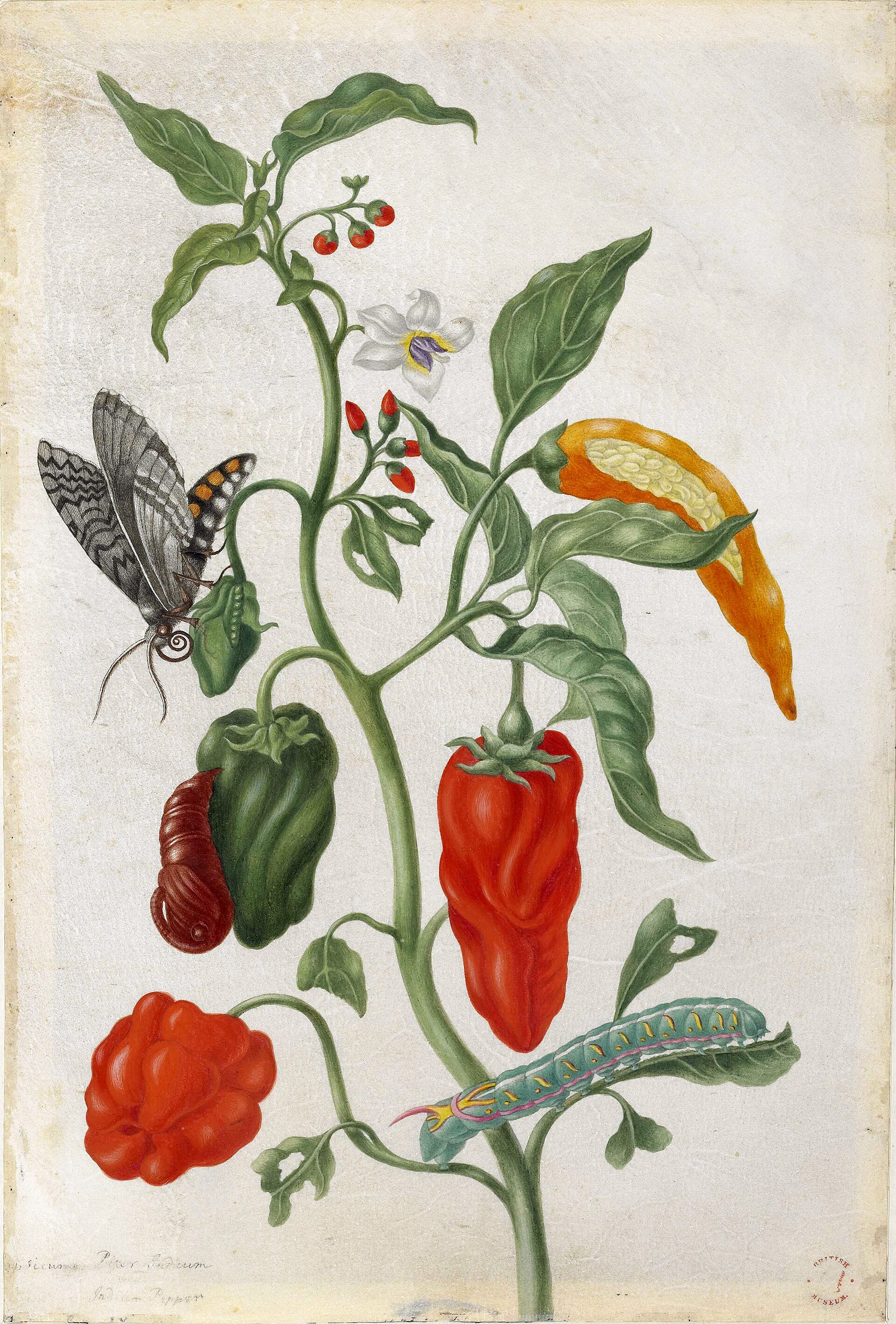
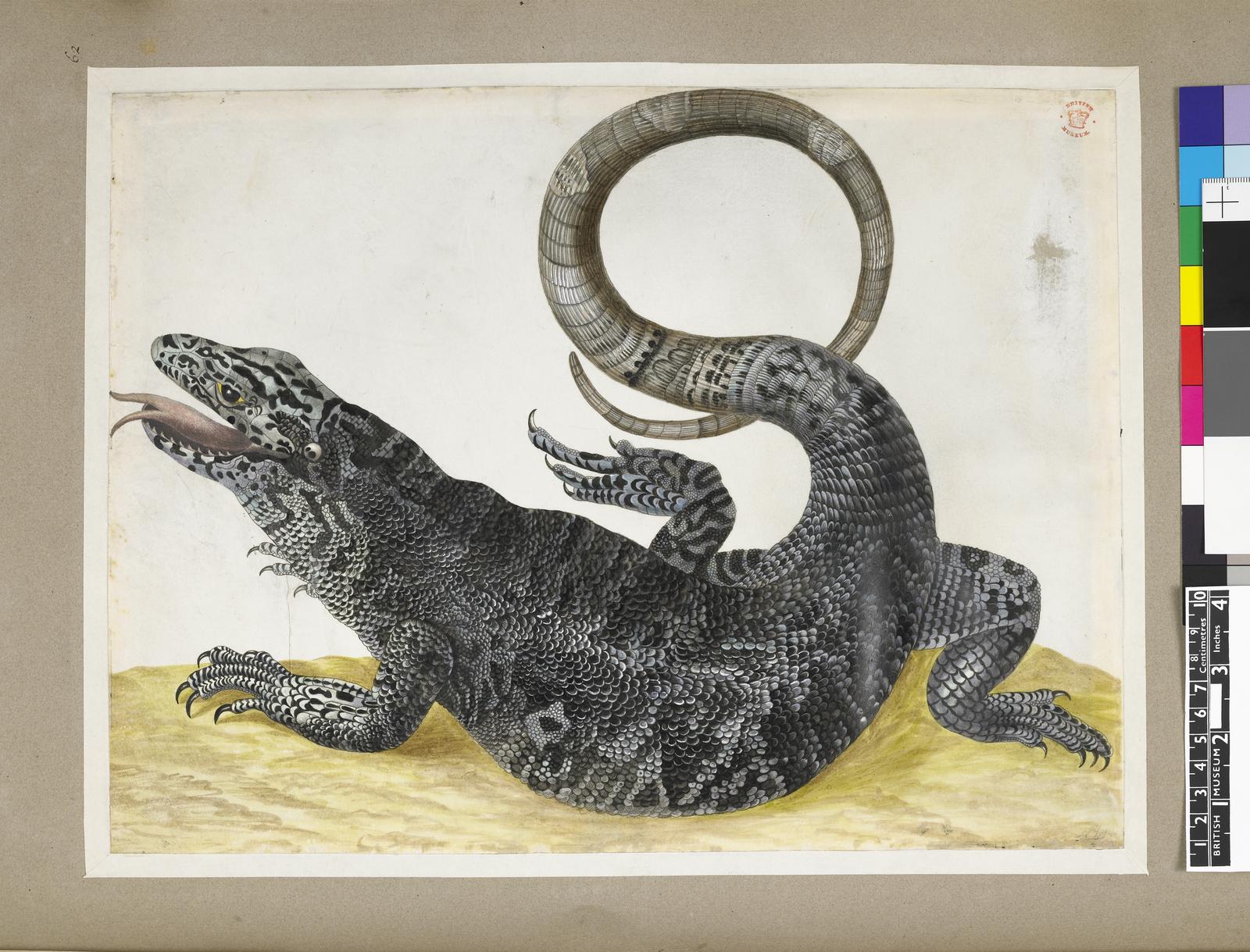
The part the standard account leaves out is what survives under her name. The Royal Collection holds ninety-five watercolours that George III acquired as hers, and its catalogue entry for one of them says that sheet is more likely by her daughters Johanna Helena or Dorothea Maria; how many of the other ninety-four are in doubt is not published in any source opened here. The British Museum's Surinam album gives at least one of its drawings, the Black Tegu, to Dorothea. No sheet-by-sheet census of whose hand is whose was found, and the workshop did not sign.
This page sets out what is documented about her life, her books, her prices and her estate, and says where scholars and collections disagree. It also records what the sources say about the enslaved and Indigenous people whose knowledge went into the Surinam book, in the words the sources use.
Images
Chronology
- 1647
Born in Frankfurt am Main on 2 April according to the Dutch lexicon and the Natural History Museum; Stearn gives 4 April.1152
- 1651
Her mother marries the flower painter Jacob Marrel, who taught her to draw and paint.1
- 1665
Marries Johann Andreas Graff, Marrel's former apprentice, on 16 May.12
- 1668
First daughter, Johanna Helena, born on 1 January.2
- 1670
Moves with Graff to Nuremberg.1
- 1675-1680
Blumenbuch published in three parts of twelve plates (1675, 1677, 1680), reissued as the Neues Blumenbuch in 1680.5
- 1678
Second daughter, Dorothea Maria, born.1
- 1679
First part of the Raupen book, fifty plates, published in Nuremberg.51
- 1683
Second part of the Raupen book, fifty plates, published in Frankfurt and Leipzig.5
- 1685
Leaves her husband and goes with her mother and daughters to the Labadist house at Wieuwerd (Groningen's library says 1686).1217
- 1688-1691
Works at Waltha State on the herb series; the Studienbuch dates from this period.1
- 1691
Leaves Wieuwerd for Amsterdam with her daughters and sets up a trade in insects and pigments.1
- 1692
Her marriage is dissolved (Dutch lexicon; the Public Domain Review says 1690).18
- 1699
Departs for Surinam with Dorothea, in June according to the Dutch lexicon and July according to Stearn.12
- 1701
Leaves Surinam on 18 June and reaches Holland on 23 September 1701.12
- 1701-1705
Draws for Rumphius's book on Amboinese rarities while preparing the Surinam book (Dutch lexicon; the Merian Society says evidence for this commission has not been found).15
- 1705
Metamorphosis insectorum Surinamensium published in Amsterdam, 60 plates, Latin and Dutch issues.526
- 1711
Zacharias Conrad von Uffenbach visits her in Amsterdam and buys works.1
- 1714
Richard Bradley visits her house and in July writes a price list to Petiver; the Dutch lexicon dates her stroke to this year.71
- 1717
Dies on 13 January. Dorothea publishes the third Raupen volume in March and sells the plates to Oosterwijk; Peter the Great reportedly buys watercolours through Areskin.113
- 1719
- 1733
Dorothea brings watercolours to Holland; the St Petersburg Academy buys 34.13
- 1755
Dr Richard Mead's sale (lot 66, 13-16 January) is the earliest recorded sale of the Windsor Water Hyacinth sheet, RCIN 921214.4
- 1771
Last of the four posthumous editions from the original plates (Desnos, Paris).5
- 1834
Lansdown Guilding attacks the Surinam book in the Magazine of Natural History.1
- 1976
Studienbuch published in facsimile (Leipzig).1
- 1982
Windsor watercolours published in facsimile with commentary by Rucker and Stearn.2
- 1992
500 Deutsche Mark note with her portrait issued on 27 October.19
The market
The market is for books, not drawings. A first-edition coloured Metamorphosis made GBP 91,750 at Christie's in 2001 against an estimate of GBP 50,000 to 70,000 [9]. A blog reports a first edition at USD 238,355 including premium at Christie's on 8 June 2011 [11]. Sotheby's offered a first edition, Dutch text, at GBP 80,000 to 120,000 in 2017 and did not show a result on the page [10]. A later edition made less: a 1730 edition at USD 51,840 in November 2011 per the same blog [11]. Sotheby's estimated a three-volume 1771 Desnos set, which adds European insects and plates after Daniel Rabel, at USD 90,000 to 120,000 in 2017, with no result shown [12]. Estimates are not prices.
None of the results gives hammer and premium separately, and the 2001 page does not say whether its figure includes the premium. Prices depend on which edition, whether the colour is contemporary and whether the copy is a counterproof.
| Date | Sale | Work | Result | Note |
|---|---|---|---|---|
| 28 November 2001 | Christie's | Metamorphosis insectorum Surinamensium, Amsterdam, [1705], first edition, 60 plates with contemporary hand-colouring, contemporary calf (lot 41) | Hammer Not published on the lot page With premium GBP 91,750 (price realised; the page does not say if premium is included) GBP | Estimate GBP 50,000-70,000. Catalogue note quotes Merian's letter to Volckamer of 16 April 1705. Sale location not shown on the page. |
| 8 June 2011 | Christie's | First edition of Metamorphosis insectorum Surinamensium (details not given) | Hammer Not given With premium USD 238,355 including buyer's premium, as reported by Booktryst USD (as reported) | Tertiary blog; the original sale currency and lot are not shown. Replace with Christie's own record. |
| 21 November 2011 | Ketterer Kunst, Hamburg | 1730 edition, Dutch text (fourth edition, third in Dutch) | Hammer Not given With premium USD 51,840 as reported; premium status not stated USD (as reported; sale probably in EUR) | Tertiary blog; the sale currency is not shown. |
Hammer is the price at which the bidding stopped; with premium adds the fee the house charges the buyer on top. Hammer price and buyer's premium in the glossary.
Where to see the work
| Institution | City | Holdings | Note |
|---|---|---|---|
| Royal Collection Trust (Windsor Castle) | Windsor | 95 watercolours acquired by George III as by Merian (a press account of the 2016 show describes luxury vellum versions of the Metamorphosis plates); a copy of the 1705 book from the collection of William Forsyth, acquired by William IV (the record says at the sale following his death in 1835). | One sheet is catalogued as more likely by Johanna or Dorothea; the 2016 Queen's Gallery show had 49 works. |
| British Museum | London | Sloane 5275: 91 drawings 'Merian's Drawings of Surinam Insects &c'. | At least the Black Tegu sheet is catalogued as by Dorothea Graff, formerly Merian. |
| Archive and Library of the Russian Academy of Sciences | St Petersburg | 184 watercolours in the archive, the Studienbuch in the library; 18 more at the Botanical Institute library. | Bought by Peter the Great in 1717, with later additions via Dorothea in 1733. |
| Kunstmuseum Basel | Basel | Portrait of a woman called Maria Sibylla Merian, 1679, Inv. 436. | Credited to Jacob Marrel; the sitter identification is not independently verified. |
| Library of Congress | Washington DC | A 1705 copy of the Surinam book, with published pigment analysis. | Result published in November 2025. |
| Koninklijke Bibliotheek; British Library | The Hague; London | Digitised 1705 copies (KB KW 1792 A 19, plates on Commons; BL 649.c.26). | Free to use for study. |
Forgeries and misattributions
- No forgery of a Merian work is documented in any source opened for this page.
- The real hazards are attribution and printing. The plates survived her, so the book was printed again in 1719, 1726, 1730 and 1771, and a coloured copy of a later printing can be offered as a 1705 first. Vellum watercolours are mostly workshop pieces by Merian and her daughters, with no signature to settle it. Check the plate count and text issue against the editions (60 plates in 1705, 72 later), the imprint, and the colour against the Library of Congress analysis of pigments and the Groningen note that colour differs copy to copy. A Royal Collection catalogue entry or the British Museum's attribution notes are the nearest thing to an expert opinion on hand. No source opened says a pigment test can separate an original from a later colouring.251417420
The essay
Chapter 1The signature problem: ninety-five sheets bought as Merian, at least one now catalogued as more likely by a daughter
Royal Collection Trust catalogues a Water Hyacinth watercolour (RCIN 921214) as workshop of Merian and says it is one of ninety-five works acquired by George III as by Maria Sibylla Merian but more...
Royal Collection Trust catalogues a Water Hyacinth watercolour (RCIN 921214) as workshop of Merian and says it is one of ninety-five works acquired by George III as by Maria Sibylla Merian but more likely by one of her daughters, Johanna or Dorothea [4]. The same catalogue family describes the Surinam workshop plainly: after 1701 Merian, Dorothea and the elder daughter Johanna Helena worked up the sketches into vellum compositions, and the images were unsigned, so it is hard to tell which parts are Merian's own [3].
The British Museum's album of 91 drawings (Sloane 5275) shows the same problem from the other side. Its Black Tegu sheet, SL,5275.62, is catalogued as attributed to Dorothea Graff and formerly attributed to Merian, and the museum's entry records that another version is at Windsor and that it was engraved as plate 70 of the 1719 edition [20]. The entry's quoted Folio Society commentary by J. Harvey describes the lizard but does not discuss who drew it.
Where this leaves a buyer or a student: a vellum watercolour with a Surinam subject and an old Merian attribution is a sheet whose hand is undetermined until a hand-by-hand study says otherwise. One such analysis exists for the herb series: Carin Grabowski (2017, pp. 314-315), as relayed on a Commons file page, assigns the wild mugwort on one sheet to Merian, the garden form to Johanna Herolt and the moth and parasitised caterpillar to Dorothea Graff [28]. This page has not seen Grabowski's book.
Chapter 2Frankfurt and Nuremberg: a stepfather's studio, a husband's publishing house
Her father Matthaeus Merian the Elder, engraver and publisher, died when she was three.
Her father Matthaeus Merian the Elder, engraver and publisher, died when she was three. Her mother married the flower painter Jacob Marrel in 1651, and Marrel's studio taught her drawing and painting; his pupil Abraham Mignon is also named as a teacher [1][2]. On 16 May 1665 she married Johann Andreas Graff, another Marrel apprentice. Their daughters were Johanna Helena (born 1 January 1668) and Dorothea Maria (born 1678) [1][2].
In Nuremberg from 1670 she taught embroidery, drawing and painting to a circle of women, painted silk and table linen with flowers, and dealt in pigments and painting supplies [1]. The Neues Blumenbuch came out in three parts of twelve plates in 1675, 1677 and 1680, published by Graff, and was sold unbound, which is why plate order differs between copies; the Society counts six complete copies known [5]. The twelve-plate flower sheets were pattern sources for embroiderers [1].
Chapter 3The caterpillar books: the plant moves to the centre
Der Raupen wunderbare Verwandelung und sonderbare Blumennahrung has fifty plates in its first part of 1679 and fifty in the second of 1683, each with German text; a third part with fifty plates and...
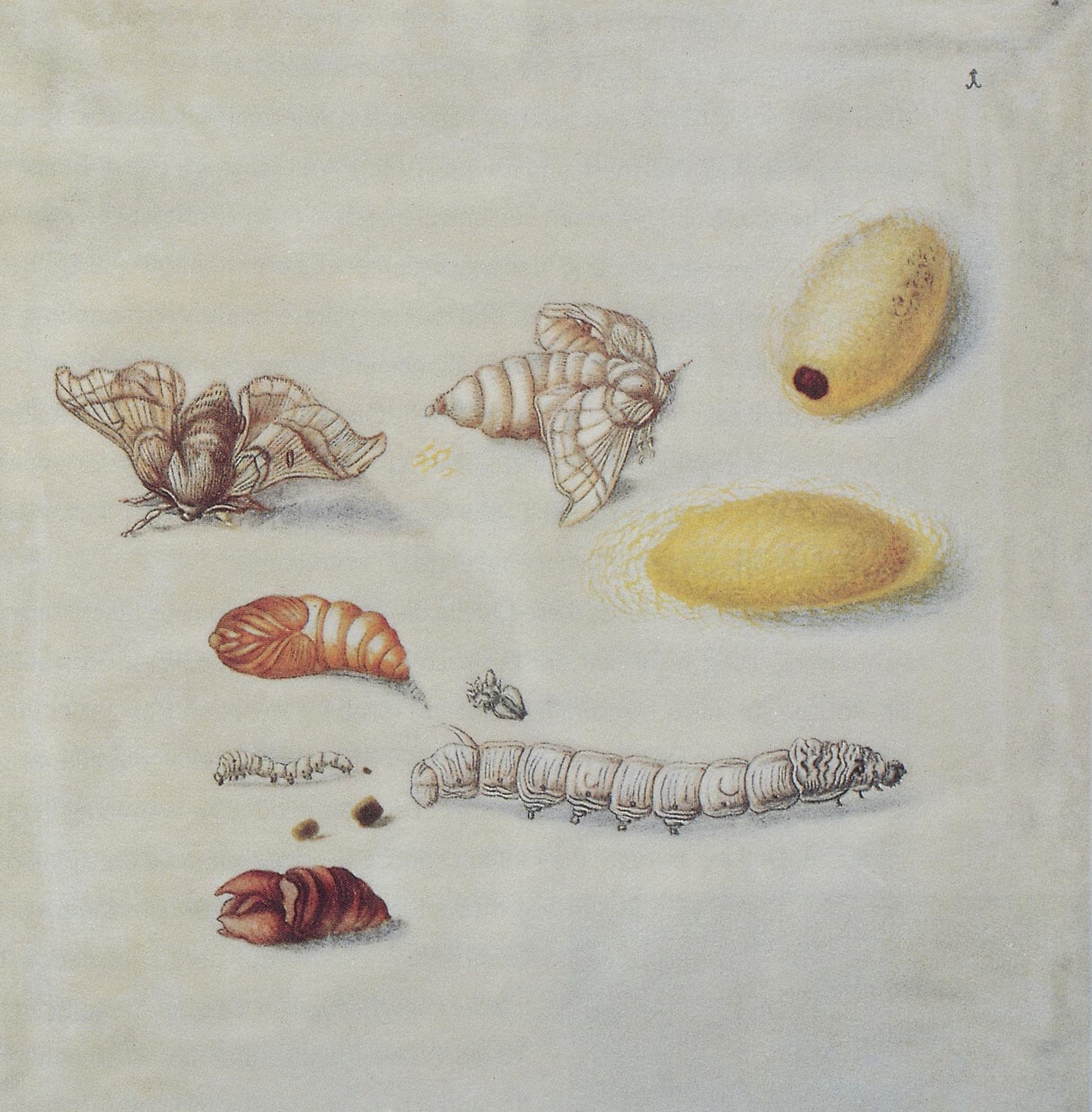
Der Raupen wunderbare Verwandelung und sonderbare Blumennahrung has fifty plates in its first part of 1679 and fifty in the second of 1683, each with German text; a third part with fifty plates and shorter Dutch text was arranged by Dorothea and appeared in 1717 [5][1]. Stearn dates her first insect investigations to about 1660 and records that she reared silkworms as a girl in Frankfurt [2].
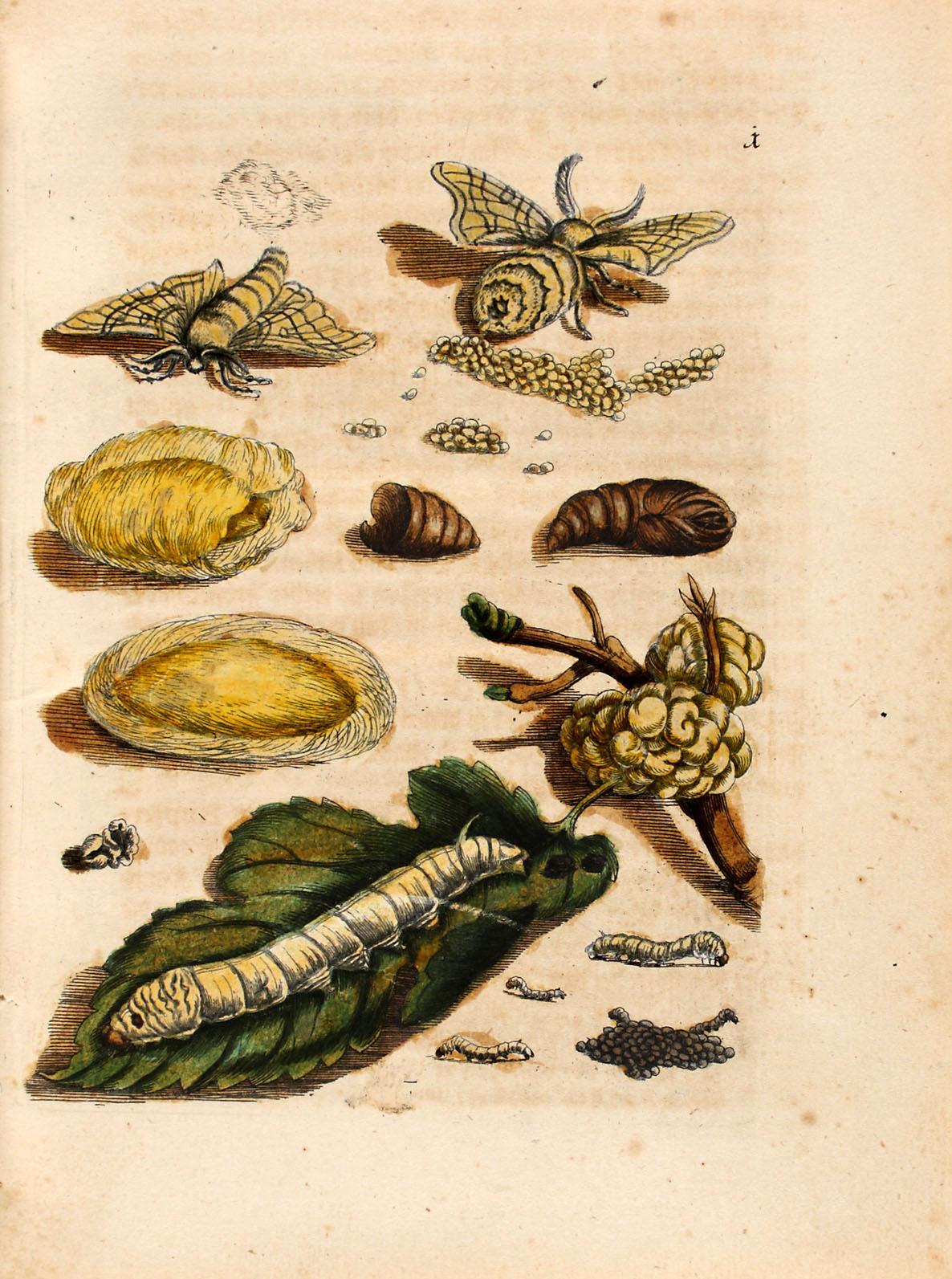
What was new, in Stearn's account, was the deliberate association of each insect with its host plant. Johannes Goedaert had earlier published life histories of Lepidoptera without the food plants, and Dutch flower painters had put insects in bouquets for decoration only [2]. Kay Etheridge adds that she recorded whether a caterpillar fed on one plant or several, described cannibalism under starvation, and was puzzled for years by parasites emerging from pupae, which she explained correctly in the third part; Etheridge puts her records at roughly 300 species [18]. The Dutch lexicon notes the books also differed from other flower and insect books by their coloured engravings [1].
Chapter 4Wieuwerd, 1685-1691: what is documented about the Labadist years
Documented. In 1685 (Groningen's librarians say 1686, the Merian Society 1685 or 1686) Merian left her husband and went with her mother and her daughters to Waltha State at Wieuwerd in Friesland, the...
Documented. In 1685 (Groningen's librarians say 1686, the Merian Society 1685 or 1686) Merian left her husband and went with her mother and her daughters to Waltha State at Wieuwerd in Friesland, the house of the Labadists, a dissenting community founded around the former Jesuit Jean de Labadie, where her half-brother Caspar Merian had lived since 1677 [1][2]. She worked there on what later became known as the herb series between 1688 and 1691, and the Studienbuch, her working journal, dates from the same stretch [1]. She left in the summer of 1691 with her daughters, her mother having died in 1690, as the community came apart under internal strain [1]. The Groningen library says Merian and her daughters had to leave in 1691 because the community was short of money [17]; Labadists stayed at the castle until 1732 [16].
Documented, about the community. De Baar reports indications that in the 1680s the community numbered three to four hundred people including children, that members were said to hold goods in common until 1692, and that visitors included William Penn in 1677 and John Locke in 1684 [16]. Stearn says the castle was made available to the Labadists by its owner, Cornelius van Sommelsdijck, governor of Surinam, and that under his protection they founded a settlement called Providentia in Surinam [2]. The Royal Collection essay says the group's patron had a collection of South American flora and fauna at Waltha that sparked her interest in the tropics [3].
Argued. Stearn speaks of 'some kind of religious and emotional change' about 1685 and treats the Surinam plan as growing out of it [2]. That is his reading of a gap in the record.
Argued, not documented. The Groningen library says she and her family joined the Labadist community, that the Labadists recognised only marriages within their own group, and that she wished to honour God as creator through her research; the Russian article says she joined the sect [17][13]. Neither cites a membership register, confession or letter, and none was found for this page. The residence is documented; her own statement of belief is not. Her printed books do carry praise of the Creator: the 1705 book opens with a Dutch poem saying every leaf and blossom shows God's working, and Groningen's librarians read it as her wish to honour God as creator [17]. That reading is theirs, and the poem's authorship is not established in the source. The same Groningen post says the Labadists allowed science that served faith and tied the butterfly to resurrection; that is the post's account of the community, not a quotation from Merian.
Chapter 5Amsterdam cabinets and the reason for the voyage
In Amsterdam from 1691 she set up a trade in prepared insects and pigments and made botanical watercolours on commission from Agnes Block [1].
In Amsterdam from 1691 she set up a trade in prepared insects and pigments and made botanical watercolours on commission from Agnes Block [1]. The Dutch lexicon names the collectors she gained access to: Nicolaas Witsen, burgomaster and VOC director, his nephew Jonas Witsen, Caspar Commelin of the Botanical Garden and Frederik Ruysch [1]. Her own preface, quoted by the Russian article, adds the cabinet of Livinus Vincent and says she found countless insects there [13].
Her stated reason for going to Surinam, as the lexicon reports from the preface, was that these cabinets held many insects but did not show how they developed from caterpillars [1]. That matters because the prevailing belief she was working against was that insects arose from mud and waste; the Natural History Museum calls her one of the first to record metamorphosis closely [15]. Stearn adds the commercial setting: Amsterdam burghers were forming small private museums of shells, birds, minerals and showy butterflies, and Surinam was the nearest tropical possession [2].
Chapter 6Surinam, 1699-1701: the voyage, the colony and whose knowledge it was
Merian paid for the trip by selling her own paintings and prepared insects; the Public Domain Review gives roughly 255 paintings, a figure it does not source [1][8].
Merian paid for the trip by selling her own paintings and prepared insects; the Public Domain Review gives roughly 255 paintings, a figure it does not source [1][8]. She sailed with Dorothea at the age of 52. The Dutch lexicon dates the departure to June 1699, Stearn to July and Wikipedia to 10 July; the lexicon dates the return voyage from 18 June 1701 with arrival on 23 September 1701, and Stearn agrees on the September arrival [1][2][25]. The sources also disagree on where she lived: the lexicon says first at the run-down Labadist plantation Providentia and then Paramaribo, while Stearn has her reaching Paramaribo first and travelling upriver to Providentia in April 1701 [1][2].
The Royal Collection states that she employed enslaved and Indigenous people to cut vegetation and carry luggage and sought their advice about unfamiliar species and wrote of the culinary and medicinal uses of plants [3]. The Dutch lexicon says that enslaved people were sent into the jungle to bring back insects, fruits and plants, which the two women then raised, described and drew [1]. None of these informants is named in any source opened for this page.
Merian wrote about the system she saw. Stearn reports that in her opinion the Dutch settlers thought of little but sugar and treated their African and Amerindian slaves and servants brutally [2]. In the text for the peacock flower, plate 45, she writes that the Indians, badly treated by their Dutch masters, used the seeds to abort their children so that they would not become slaves like themselves, and that the enslaved people from Guinea and Angola demanded good treatment, threatened to refuse to have children and sometimes took their own lives; in the Public Domain Review's rendering she adds that they told her this themselves [8]. The Royal Collection quotes the same passage in different English, with an editorial bracket naming enslaved women [3]. The Public Domain Review argues the knowledge was then ignored in Europe, where the plant was grown as an ornamental and kept out of the London, Paris and Amsterdam pharmacopoeias; that is that article's claim, not a finding from the plate text [8].
Illness cut the stay short. Utrecht notes that some butterflies on the plates do not match their caterpillars and suggests specimens may have been mixed up on the return voyage, Merian having come back ill [6].
Chapter 7The 1705 book: plates, engravers, formats, prices and how many copies exist
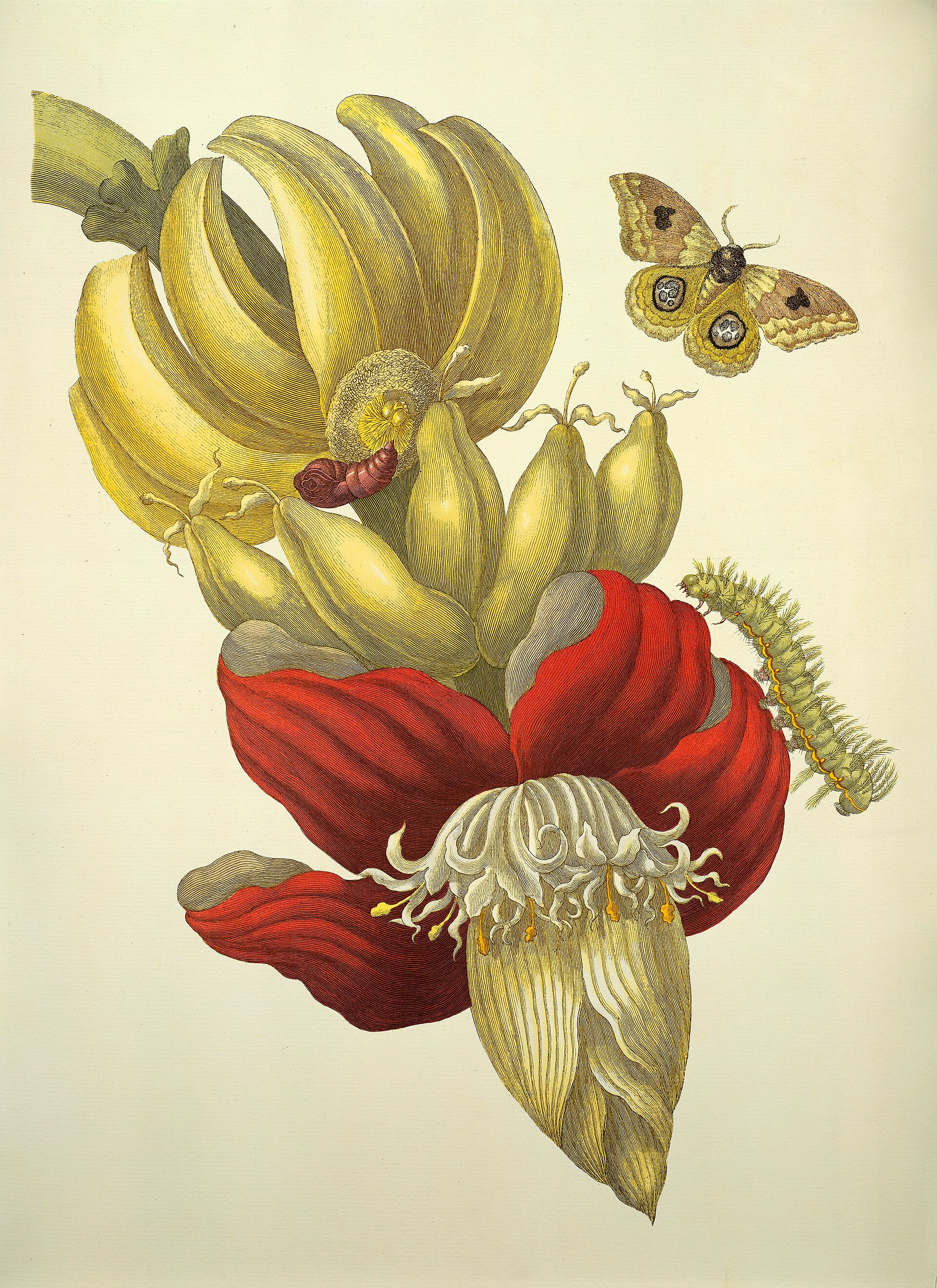
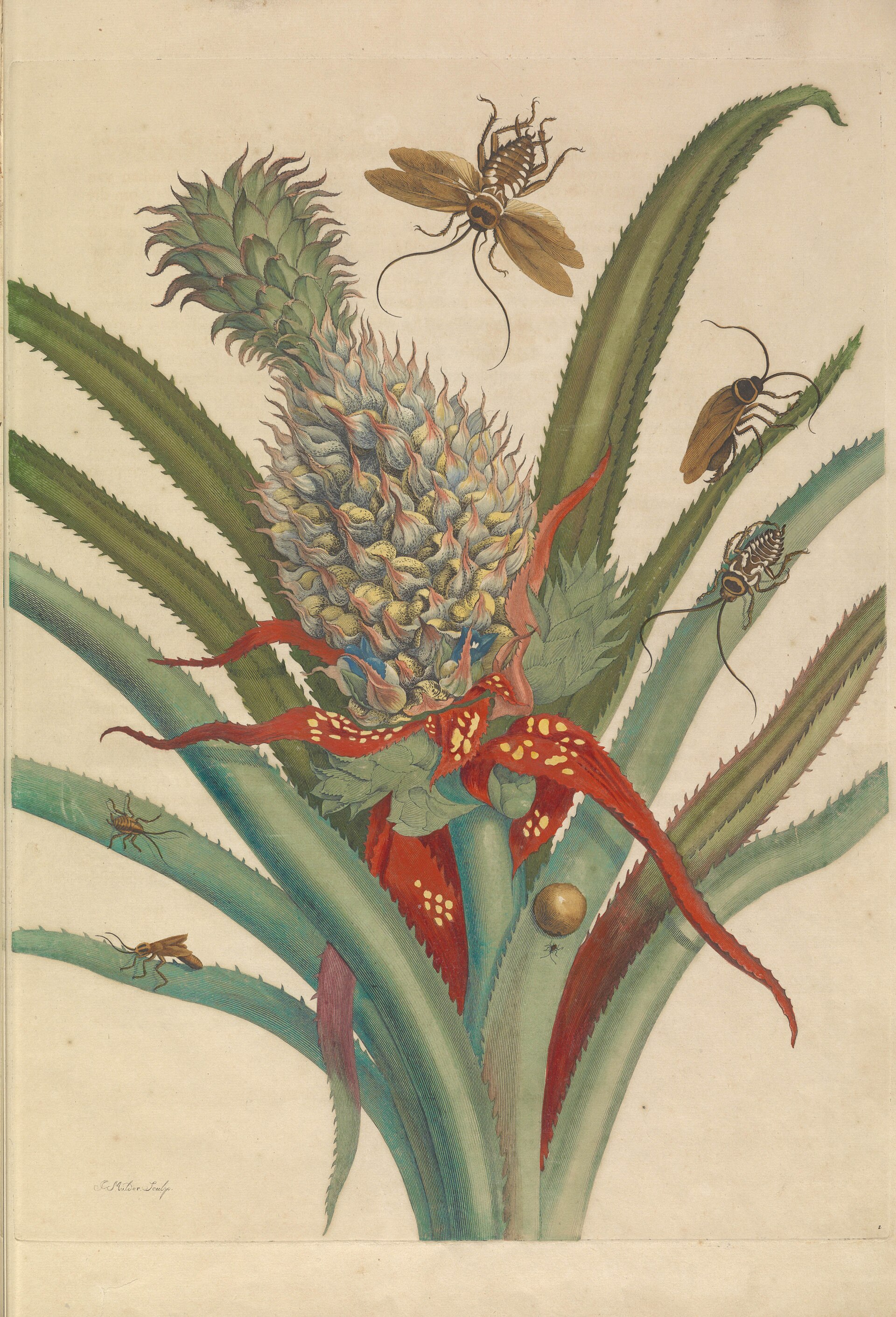
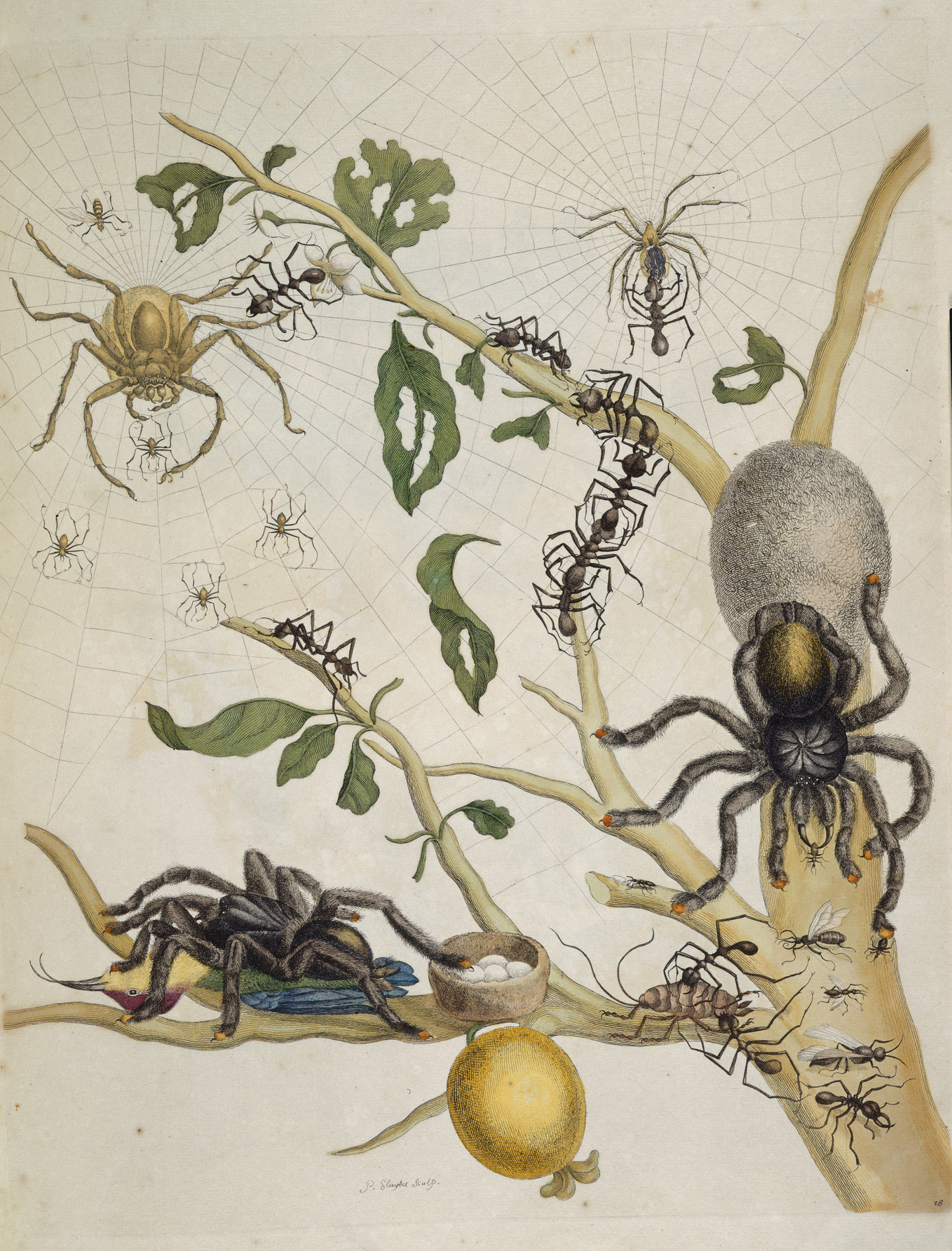
Metamorphosis insectorum Surinamensium appeared in Amsterdam in 1705 in Latin and Dutch issues, each with sixty plates [5][2].
Metamorphosis insectorum Surinamensium appeared in Amsterdam in 1705 in Latin and Dutch issues, each with sixty plates [5][2]. Valck's name is on the imprint, but Utrecht says he acted as her agent and that she bore the financial risk herself [6]. Merian engraved three plates herself and Joseph Mulder, Pieter Sluyter and Daniel Stoopendael made the rest, according to Utrecht; Christie's lists the same three engravers without mentioning her own three plates, and the Merian Society says she engraved all the plates of her books except those of the Surinam book [6][9][5]. The sources do not agree. Caspar Commelin supplied botanical names; the Latin text is presumed to be his [6][2]. A German edition was planned but lacked enough subscribers [5].
The Society records uncoloured copies at 15 florins, later 18, and hand-coloured copies at 45 florins; Christie's gives the ratio as three to one and quotes Merian's letter to Volckamer of 16 April 1705 about illuminating a copy [5][9]. Brigitte Wirth, reading the letters of the Amsterdam merchant Baltasar Scheid, concludes the 60 plates were finished in February 1705, and she cites the Opregte Leydsche Courant for the Dutch edition being ready on 2 March 1705 [7]. Counterproof copies, made by pressing a wet print onto a clean sheet, gave softer lines with no plate mark and were the most expensive in the Dutch lexicon's account [1][6]. In the Utrecht counterproof copy only plate 18 is a normal copper print [6].
Print run and survival do not agree. Utrecht gives about 60 copies printed; the Society says about 70 survive [6][5]. Both are secondary statements and neither shows its count.
Chapter 8Technique: vellum, counterproofs and the colours on the Library of Congress copy
Merian preferred fine white vellum for her paintings; Stearn says it let her paint the precision insects need [2].
Merian preferred fine white vellum for her paintings; Stearn says it let her paint the precision insects need [2]. The Russian archive article describes thin vellum, a white priming coat, watercolour and gouache, colours still fresh after three centuries [13]. The Royal Collection says the vellum compositions for the 1705 book were painted in bold watercolour and bodycolour [3].
The Library of Congress analysed its copy with X-ray fluorescence, reflectance spectroscopy and multiband microscopy and reports vermilion on cherries in matte and glossy layers, a caterpillar built from two pigments in at least eight shades, azurite for butterfly blues and brazilwood for pink and burgundy [14]. The blog does not say who applied the colour or whether it was contemporary; a reader's comment on the same page asks exactly that, and no source opened answers it for any copy [14]. The Groningen library holds two coloured copies in which the colour differs, a caterpillar yellow in one and orange in the other, which fits colouring done copy by copy [17].
Chapter 9What her work was worth in her lifetime
Richard Bradley visited her house in 1714 and in July wrote to James Petiver with prices.
Richard Bradley visited her house in 1714 and in July wrote to James Petiver with prices. For the Rariteitkamer paintings she asked 100 guineas, more than 1,000 florins; for the Raupen paintings 500 florins; for 32 bird paintings 400 florins; for a large folio of Amsterdam garden plants 600 florins; for Commelin's Horti Medici Amstelodamensis with coloured prints 200 florins [7]. Wirth works out from the Raupen figure about 170 florins per 50-plate book as paintings on parchment, against 20 florins for the same book painted as a coloured counterproof or replica on paper, 10 florins for a coloured copy and 2.5 florins for an uncoloured copy per Uffenbach [7].
The Dutch lexicon says that between 1701 and 1705 she also drew, from financial necessity, for Georg Everhard Rumphius's book on Amboinese rarities, whose original pictures had largely been lost; the Merian Society says that evidence for this commission has not been found [1][5]. Zacharias Conrad von Uffenbach visited her in Amsterdam in 1711 and bought several works [1].
No source opened gives a period wage or house price against which to read these figures, so no modern equivalent is offered here.
Chapter 101714 to 1717: the stroke and the estate
The Dutch lexicon places her partial paralysis from a stroke in 1714, after which, the lexicon says, her daughters probably worked on under her name; Wikipedia says 1715 [1][25].
The Dutch lexicon places her partial paralysis from a stroke in 1714, after which, the lexicon says, her daughters probably worked on under her name; Wikipedia says 1715 [1][25]. She died on 13 January 1717 and was buried at the Leiden cemetery [1]. Dorothea published the third Raupen volume in March 1717, which Merian did not live to see [1].
The estate went three ways in the sources. Dorothea sold all the engraved plates and texts of the flower books, the caterpillar books and the Surinam book to the Amsterdam publisher Joannes Oosterwijk; he issued the first Latin edition of the three caterpillar books in 1718 [1][5]. Peter the Great, reportedly through his physician Robert Areskin, bought a large collection of vellum watercolours and coloured prints; the Dutch lexicon values it at 3,000 guilders and says Areskin bought the Studienbuch for himself, while the Russian article quotes the historian Golikov for two thick vellum books of over 200 paintings and records the legend that the tsar came to her house on the day she died [1][13]. Later, in 1733, Dorothea brought watercolours to Holland and the St Petersburg Academy bought 34 [13].
Johanna Helena's share, the lexicon says, ended up in the British Museum and at Windsor [1]. For one Windsor sheet, the Water Hyacinth (RCIN 921214), the Royal Collection gives a chain: the sale of Dr Richard Mead (London, 13-16 January 1755, lot 66), where an unknown collector bought it, a sale on 15 June 1768 where Sir John Hill bought through Wilson, then George III by about 1810 [4]. The record does not give the chain for the other ninety-four sheets. The Natural History Museum says Hans Sloane bought a number of her watercolours; how the British Museum's Sloane album reached him is not documented in any source opened here [15].
Chapter 11How naturalists used her, and how they dismissed her
Linnaeus cited her plates for a few plants in Species Plantarum (1753) and for many insects in the tenth edition of Systema Naturae (1758); for example plate 45 under Poinciana pulcherrima and plate...
Linnaeus cited her plates for a few plants in Species Plantarum (1753) and for many insects in the tenth edition of Systema Naturae (1758); for example plate 45 under Poinciana pulcherrima and plate 26 under Theobroma cacao [2]. The Natural History Museum says he cited her for more than 100 new animal species, and that at least six plants, nine butterflies, two bugs, one spider and one lizard have been named for her [15]. The Dutch lexicon counts six plants, nine butterflies and two beetles [1]. The two counts differ in the non-insect animals and neither is a primary list.
The Dutch lexicon, following Londa Schiebinger, records the nineteenth-century backlash: Lansdown Guilding in 1834 called the book full of errors, and Hermann Burmeister in 1854 asked whether her popularity came from the content or the showy format; Schiebinger notes that Guilding kept reminding readers she was a woman [1]. Stearn's own list of errors includes the cashew, whose swollen stalk she took for the fruit and drew upside down on plate 16 [2].
The book also grew after her death. Posthumous editions of 1719, 1726, 1730 and 1771 used the original plates and added twelve new engravings, which the Society says show reptiles, amphibians and marsupials, with some not by Merian and the authorship of others disputed [5]. Stearn counts 72 plates in all of them [2]; Christie's attributes the extra twelve to Johanna [9].
Chapter 12Her face and her afterlife on banknotes and stamps
The portrait most often reproduced is a canvas of 1679 in the Kunstmuseum Basel (Inv.
The portrait most often reproduced is a canvas of 1679 in the Kunstmuseum Basel (Inv. 436), credited to Jacob Marrel, her stepfather [23]; Commons titles it a portrait of Merian without giving a basis. The Natural History Museum captions it as possibly by Marrel, and the SHE Wrote database titles it a portrait of a woman called Merian [15][24]. Treat it as a long-standing but not independently verified identification; the sitter would be about 32.
The Bundesbank issued a 500 Deutsche Mark note with her portrait on 27 October 1992, with a dandelion, caterpillar and Pale Tussock moth on the reverse [19]. The Dutch lexicon says the portrait on the note, and on a German stamp of 1987, was a rejuvenated portrait drawing by her son-in-law Gsell; the Bundesbank page does not say where the likeness came from, so that detail rests on the lexicon alone [1][19].
The twentieth-century revival ran through facsimiles: the Leningrad watercolours (1974), the Studienbuch (1976) and the Windsor watercolours with the 1982 Rucker and Stearn commentary [1]. The Queen's Gallery showed 49 of her works in 2016 [26].
What is documented
Technique
The surviving work
- What is accepted
- No source opened gives a count of accepted works by Merian herself. What the sources give are collection totals: 95 Windsor works acquired as hers, 91 drawings in the British Museum's Sloane 5275, 184 in the Russian Academy archive, and the Studienbuch of 285 works. Some sheets in the first two groups are attributed in part or whole to her daughters; the sources opened give no count.
- What is contested
- Windsor: the Royal Collection catalogues one of George III's 95 works, RCIN 921214, as more likely by Johanna or Dorothea; how many others are in doubt is not stated (Royal Collection Trust). British Museum: SL,5275.62 is catalogued as by Dorothea Graff, formerly Merian. Printed work: the twelve extra plates of the posthumous editions include some not by Merian and some of disputed authorship (Merian Society).
- Who rules on attribution
- No active authority. Attribution between Merian and her daughters rests on individual curators and on Grabowski's 2017 analysis of herb-series sheets (known here from one Commons description); no committee or board rules on it.
Catalogue raisonne
- Max Adolf Pfeiffer, Die Werke von Maria Sibylle Merian bibliographisch zusammengestellt, Meissen, 1931. Bibliography of the printed works and editions; Stearn notes it was limited to 99 copies. Not opened for this page.2
- Kurt Wettengl (ed.), Maria Sibylla Merian 1647-1717: Kuenstlerin und Naturforscherin, Ostfildern, 1997. Exhibition catalogue; prints Merian's 18 surviving letters (pp. 262-269). Cited by the Dutch lexicon and the Merian Society; not opened.17
- Elisabeth Ruecker and William T. Stearn, Maria Sibylla Merian in Surinam (commentary volume to the Pion facsimile of the Windsor watercolours), London, 1982. Reproduces plates from the Windsor originals; not opened.2
- Carin Grabowski, Maria Sibylla Merian zwischen Malerei und Naturforschung, Berlin: Reimer, 2017. Cited on a Commons file page for a hand-by-hand analysis of one herb-series sheet (pp. 314-315); known here only through that file description.28
Questions about Maria Sibylla Merian
Who was Maria Sibylla Merian?
Painter; Engraver; Publisher; Naturalist; Dealer in natural history specimens and pigments. 1647-1717.
When did Maria Sibylla Merian live?
Born 2 April 1647 (Stearn gives 4 April), Frankfurt am Main; died 13 January 1717, Amsterdam (Stearn says Leiden; the Dutch lexicon and Russian article say Amsterdam, buried at Leiden).
How are fakes and misattributions of Maria Sibylla Merian detected?
No forgery of a Merian work is documented in any source opened for this page. The real hazards are attribution and printing. The plates survived her, so the book was printed again in 1719, 1726, 1730 and 1771, and a coloured copy of a later printing can be offered as a 1705 first.
Where can you see work by Maria Sibylla Merian?
Royal Collection Trust (Windsor Castle) (Windsor); British Museum (London); Archive and Library of the Russian Academy of Sciences (St Petersburg); Kunstmuseum Basel (Basel); Library of Congress (Washington DC); Koninklijke Bibliotheek; British Library (The Hague; London).
What does the market for Maria Sibylla Merian look like?
The market is for books, not drawings. A first-edition coloured Metamorphosis made GBP 91,750 at Christie's in 2001 against an estimate of GBP 50,000 to 70,000 [9].
What is still unresolved about Maria Sibylla Merian?
Which of the 95 Windsor sheets and 91 drawings in the British Museum's Sloane 5275 are by Merian herself? The Royal Collection says one sheet is more likely by Johanna or Dorothea and the British Museum gives at least the Black Tegu to Dorothea; this page found no published census of hands for either group.
Open questions
- Which of the 95 Windsor sheets and 91 drawings in the British Museum's Sloane 5275 are by Merian herself? The Royal Collection says one sheet is more likely by Johanna or Dorothea and the British Museum gives at least the Black Tegu to Dorothea; this page found no published census of hands for either group.
- What did Merian believe? Her residence at Wieuwerd from 1685 or 1686 to 1691 is documented and Stearn reads a religious change about 1685; Groningen's library and the Russian article say she joined the Labadists but cite no register or statement of her own.
- How many copies of the 1705 book were printed? Utrecht says about 60; the Merian Society says about 70 survive, and neither shows how it counted.
- Who engraved what? Utrecht says Merian engraved three plates herself; Christie's names only Mulder, Sluyter and Stoopendael. Which three plates are not stated in the sources opened.
- Which of the twelve extra plates of the posthumous editions are by Merian, which by Johanna and which by neither? The Merian Society says some are not hers and the authorship of others is disputed.
- Did Dorothea's own drawings survive? The Russian article says it is not known whether they have, while the British Museum's Black Tegu entry credits one sheet to her.
- Whether Peter the Great actually called at her house on the day she died is a legend recorded in the Russian article; Golikov, a later historian, reports the 1717 purchase and the Dutch lexicon says it is said to have happened, so neither is shown by a contemporary document here.
- What did the money mean at the time? No source opened gives a period wage or house price against Bradley's 1714 figures.
Sources
- 1Astrid de Beer, 'Merian, Maria Sibylla', Digitaal Vrouwenlexicon van Nederland (Huygens ING / Utrecht University), entry dated 5 July 2015. Opened and read in full. Secondary scholarly reference work in Dutch; cites Wettengl (1997) and Schiebinger. resources.huygens.knaw.nl/vrouwenlexicon/...
- 2William T. Stearn, 'Maria Sibylla Merian (1647-1717) as a Botanical Artist', Taxon 31(3), August 1982, pp. 529-534 (JSTOR copy). Opened and read in full. Stearn co-wrote the commentary to the 1982 Windsor facsimile. tela-botanica.org/wp-content/...
- 3Royal Collection Trust, RCIN 1085787, Metamorphosis insectorum Surinamensium (1705), record and catalogue essay: provenance (William Forsyth; William IV, 1835), Merian's workshop, the Surinam journey. Opened and read (the col.rct.uk host answers; www.rct.uk blocks automated access). col.rct.uk/collection/...
- 4Royal Collection Trust, RCIN 921214, Water Hyacinth with three insects, workshop of Maria Sibylla Merian: provenance (Mead sale 1755, Hill 1768, George III by c.1810) and the note that this is one of ninety-five works acquired as by Merian but more likely by Johanna or Dorothea. Opened and read. col.rct.uk/collection/...
- 5The Maria Sibylla Merian Society (University of Amsterdam), 'Books by Maria Sibylla Merian (overview)': plate counts, prices, surviving copies, posthumous editions, Oosterwyk and the heirs. Opened and read. themariasibyllameriansociety.humanities.uva.nl
- 6Utrecht University Library Special Collections, 'Metamorphosis by Merian' (The Treasury, early and rare prints): the Utrecht copy, counterproof impressions, engravers, print run. Opened and read. uu.nl/en/...
- 7Brigitte Wirth, 'Maria Sibylla Merian, Baltasar Scheid and Richard Bradley - some remarks on their letters', essay for the 2014 Merian Society symposium: Richard Bradley's July 1714 price list, Scheid, Volckamer, Petiver. Opened and read. themariasibyllameriansociety.humanities.uva.nl
- 8Paloma Ruiz, 'Maria Sibylla Merian's Metamorphosis Insectorum Surinamensium (1705)', The Public Domain Review, 6 March 2024 (an English rendering of the plate 45 passage; roughly 255 paintings sold to fund the voyage). Opened and read. Popular secondary source; the English wording of Merian's text differs from the Royal Collection's rendering. publicdomainreview.org/collection/...
- 9Christie's, lot 41 (sale ending 28 November 2001): Metamorphosis insectorum Surinamensium, Amsterdam, [1705], 60 plates with contemporary hand-colouring; estimate GBP 50,000-70,000, price realised GBP 91,750 (fields read from the lot page data); catalogue note quoting Merian's letter to Volckamer of 16 April 1705. Opened and read. christies.com.cn/lot/...
- 10Sotheby's London, Travel, Atlases, Maps and Natural History (2017 sale), lot 5: first edition, Dutch text issue, estimate GBP 80,000-120,000, result not shown on the page; provenance Maurits Fortuin. Opened and read. sothebys.com/en/...
- 11Booktryst blog, 'The Beautifully Strange Insects of Maria Sibylla Merian', November 2011: reports Christie's 8 June 2011 first edition at USD 238,355 including premium and Ketterer Kunst (Hamburg) 21 November 2011, 1730 edition, USD 51,840. booktryst.com/2011/...
- 12Sotheby's New York, 2017 D. F. Allen sale, lot 37: Histoire generale des insectes de Surinam et de toute l'Europe (Desnos, Paris, 1771), three volumes including plates after Rabel, estimate USD 90,000-120,000, result not shown. Opened and read. (An earlier note of a 2011 lot 925 with twelve plates could not be verified and was removed.) sothebys.com/en/...
- 13'The Vivid Colors of Merian', World in the Eye of Science vol. 25 no. 1, 30 April 2010 (Russian Academy of Sciences archive and library holdings; Peter the Great, Areskin, Golikov quoted; Dorothea in St Petersburg; 1733 purchase). Opened and read. Secondary, quotes Golikov and Lukina. scfh.ru/en/...
- 14Library of Congress, 'The Secrets of Illustrating Bug Beauties in the 17th Century', Timeless blog, 20 November 2025, by Cindy Connelly Ryan and Jessica Fries-Gaither: XRF and reflectance analysis of the Library's 1705 copy. Opened and read. blogs.loc.gov/loc/...
- 15Natural History Museum, London, 'Maria Sibylla Merian: metamorphosis unmasked by art and science' by Kerry Lotzof: portrait caption ('possibly by Jacob Marrel'), Sloane, Peter the Great, Linnaeus, spontaneous generation. Opened and read. nhm.ac.uk/discover/...
- 16Mirjam de Baar, 'Godsdienstvrijheid voor de labadisten in Wieuwerd (1675-1732)', De Zeventiende Eeuw 20 (2004), on DBNL: size and life of the Wieuwerd community, visitors, community of goods. Opened; it does not mention Merian. dbnl.org/tekst/...
- 17University of Groningen Library, 'Maria and her insect world' (Gauronica blog): the poem near the start of the 1705 book, the Groningen copies (one counterproof, two coloured differently). Opened and read. rug.nl/library/...
- 18Kay Etheridge, 'The Ecology of the Raupen books', Merian Society symposium essays 2014: what was new in the composition, about 300 species, false transformations. Opened and read. themariasibyllameriansociety.humanities.uva.nl/research/...
- 19Deutsche Bundesbank, DM banknotes (BBK3 series), entry for the 500 DM note: Merian portrait, reverse with dandelion and Pale Tussock moth, issued 27 October 1992. Opened and read; the page names no portrait source. bundesbank.de/en/...
- 20Wikimedia Commons file page (wikitext read): File:Drawing, album (BM SL,5275.62).jpg - British Museum SL,5275.62, Black Tegu; catalogued 'Attributed to Dorothea Graff, formerly attributed to Maria Sibylla Merian'; J. Harvey's Folio Society commentary quoted; another version at Windsor, engraved as plate 70 of the 1719 edition. commons.wikimedia.org/wiki/...
- 21Wikimedia Commons file page (wikitext read): File:Maria Sibylla Merian - plant study with peppers.jpg - British Museum SL,5275.55, album of 91 drawings 'Merian's Drawings of Surinam Insects &c', watercolour and bodycolour on vellum, 36.8 x 24.9 cm, labelled Merian by the uploader. commons.wikimedia.org/wiki/...
- 22Wikimedia Commons file page (wikitext read): File:Maria Sibylla Merian - Metamorphose des Seidenspinners.jpg - from the Studienbuch, St Petersburg, Library of the Academy of Sciences, Inv. F 246; reproduced from Wettengl (ed.), Maria Sibylla Merian 1647-1717, Ostfildern 1997, pl. 21. commons.wikimedia.org/wiki/...
- 23Wikimedia Commons file page (wikitext read): File:Bildnis der Maria Sibylla Merian, 1679.jpg - Kunstmuseum Basel Inv. 436, oil on canvas, 59 x 50.5 cm, gift of Louise Bachofen-Burckhardt 1904, credited to Jacob Marrel. commons.wikimedia.org/wiki/...
- 24SHE Wrote (Radboud University) work record: 'Jacob Marrel, portrait of a woman called Maria Sibylla Merian, 1679', oil on canvas, Kunstmuseum Basel, RKDimages 250605. Opened and read; the RKD record itself blocks automated access. shewrote.rich.ru.nl/works/...
- 25Wikipedia, 'Maria Sibylla Merian' (English). Used only to record where it differs from the scholarly sources (sailing on 10 July 1699; stroke in 1715; divorce date); replace with primary documents. en.wikipedia.org/wiki/...
- 26ArtDaily, 'New exhibition explores remarkable life and work of 17th-century artist and naturalist Maria Sibylla Merian', 15 April 2016: Maria Merian's Butterflies at The Queen's Gallery, Buckingham Palace, 49 works. Opened and read. artdaily.com/news/...
- 27Wikimedia Commons file page: File:Metamorphosis insectorum Surinamensium - KW 1792 A 19 - plaat01.jpg - plate 1 (pineapple) from the Koninklijke Bibliotheek copy, KW 1792 A 19, digitised by the KB; and File:Spiders - Metamorphosis insectorum surinamensium (1705), 74 plate 18 - BL.jpg, British Library 649.c.26, CC0. Wikitext read. commons.wikimedia.org/wiki/...
- 28Wikimedia Commons file page (wikitext read): File:Eberraute von Maria Sibylla Merian gemeinsam mit Johanna Herolt und Dorothea Graff.jpg - herb-series sheet (Inv. IX-8-17); cites Carin Grabowski, 2017, pp. 314-315, for who painted which part. Secondary; Grabowski not seen. commons.wikimedia.org/wiki/...


Last verified